Archive for the ‘Weekday Homilies’ Category

The Desert Problem—Thursday, 16th Week in Ordinary Time—Year I

July 21, 2011

This morning I would like to talk with you about something I call “the Desert Problem.” We see it with the children of Israel during the Exodus. They had seen the ten plagues that were afflicted on their Egyptian oppressors. They had seen the Red Sea split before them. They heard God speak so powerfully and intensely with Moses at the mountain that they trembled. They accepted God’s covenant. They saw, they heard, but then they forgot. The Israelites seem to always be sinning in the desert and we can feel annoyance at them. However, we should not judge them harshly, for their story is our own. We also struggle with the desert problem.
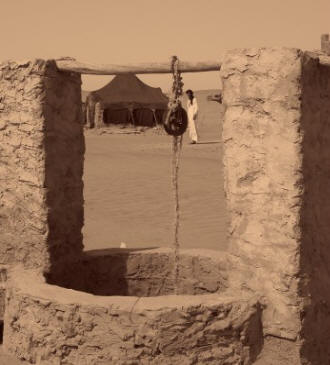
We come to dry and difficult places in our own lives, too. When we face difficulties we too often forget what we have seen and heard and give in to depression, despair, and sin. The solution to the desert problem is the refreshing water of memory. When you are in a desert you need water, but you don’t need to dig a new well every time you need refreshment; you can go back to an old and reliable well. Before you come to your next desert, think of times in the past when you knew God was close, perhaps an intense consolation experienced in prayer, or a providential miracle you’ve witnessed in life. And when you enter your next desert (or if you find yourself in one now) recall these memories to mind and be refreshed in faith. ‘Blessed are your eyes, because they have seen, and your ears, because they have heard,’ but to remain faithful to God in the desert you must remember the great things of God you have seen and heard.

Bread of Angels — Wednesday, 16th Week in Ordinary Time—Year I

July 21, 2011

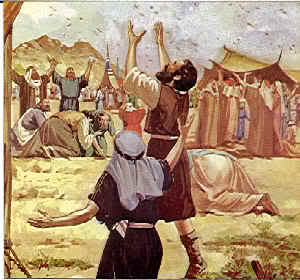
Here at St. John’s, on the wall behind me, there is painted an angel holding a banner which says, “Ecce Panis Angelorum.” This is a Latin phrase. “Ecce” means “behold,” “panis” means “the bread,” and “angelorum” translates to “of the angels.” And thus the phrase goes, “Ecce Panis Angelorum; Behold the bread of angels.” This idea comes from Psalm 78, the psalm we heard today, which says of the Manna and the Israelites in the desert, “Man ate the bread of angels, food he sent them in abundance.” 

Why was the Manna in the desert was called the bread of angels? Extra-Biblical Jewish tradition suggested that the Manna bread actually nourished the angels. The Manna also came down from Heaven for the benefit of men and came through the mediation of angels. Of course, the Manna prefigures the Eucharist, which nourishes us through the deserts of this life toward the Promised Land. The Eucharist is really Jesus Christ who came down from Heaven for mankind. The angels are indeed nourished by this bread, Jesus Christ, for their lives are sustained thorough Him. We also receive the New Testament Manna with the help of the angels. As we say in Eucharistic Prayer I: “Almighty God, we pray that your angel may take this sacrifice to your altar in heaven. Then, as we receive from this altar the sacred body and blood of your Son, let us be filled with every grace and blessing.” It has been said that if angels could envy us, it would be for our reception of Jesus in the Eucharist.

The angels do more for us than we realize. We should remember to thank them; for getting us out of bed to come to Mass this morning, for assisting us here in our prayers, and for assisting us in our daily lives. Lovingly invite them, give them the permission, to do more in your lives. (They’re probably just waiting for you to ask.) Let us ask their intercession and at this Mass, together with the angels who surround us, let us delight in the bread of angels.

Seek As To Find — Monday, 16th Week in Ordinary Time—Year I

July 18, 2011

When I was a kid, I was neither hot nor cold. I was a cradle-Catholic and wouldn’t renounce Christ, but I wasn’t much of a disciple of Christ either. I would have pseudo-philosophical religious conversations with friends, asking questions like, “How do we know that God is real? How do we know the Bible is really true? Couldn’t the Apostles have been hallucinating on Easter? Doesn’t science contradict religion?” And other objections of that type.

One day, when I was about 12-13 years old, I imagined myself  standing before the judgement seat of God after my death. He looked disappointed and annoyed like I had promised to meet Him somewhere and never showed up. He asked, “Why didn’t you live your life like I wanted you to live it?” (At the time I thought, “Whether this idea is coming by God or just from my own imagination, I have to honestly address this question. What would I say in this situation?”) “God,” I said, “I wasn’t even sure that you were really real. How could I commit my one life to you while I was still uncertain? Who would stand out on a cliff-ledge unless they knew that it could bear their weight?”  He promptly replied, “Well, did you ever really try to find out [if I was real?] I mean, did you even read my book?” When I heard this, I had two reactions. I laughed (because it was funny) and I said, “Oh crud,” (though I didn’t say “crud.”) God had called me out. If I had really been searching for the truth, I would’ve been searching differently. Instead of just asking questions I’d be looking for answers. After that, I began praying more, reading the Bible, and exploring my Catholicism more deeply. Because of this, I stand here today.

Jesus refused to give the Pharisees a sign because they weren’t really looking for the truth but excuses.  If you meet someone who doubts God and says they would believe in Him if He gave them a sign, perhaps ask them if they are really searching for the truth or just raising doubts about God in order to be free from the demands of the Gospel. Whoever truly seeks, finds. As a corrolary for our own lives, for we who believe in God, don’t expect the Lord to explicitly reveal His will for you, unless you are willing to accept His will.

Born Under the Law — Tuesday, 15th Week in Ordinary Time—Year I

July 12, 2011

The story of Moses prefigures the life and works of Jesus Christ. St. Paul tells the Galatian Christians, “[We,] when we were not of age, were enslaved to the elemental powers of the world. But when the fullness of time had come, God sent his Son, born of a woman, born under the law, to ransom those under the law, so that we might receive adoption.”

The elemental powers St. Paul speaks of are the devil and the demons who powerfully and harmfully influence the world. Pharaoh and his evil reign image Satan, the demons, and their works. The children of Israel strained under the law and it brought them death. But, when the fullness of time had come, God sent a child, born of a woman, born under that law. That child, who would image person and works of Jesus, was Moses.

As long as he remained a quiet, sleepy newborn, the mother of Moses could hide him, but after three months her son began to loudly and frequently cry. With a pain that pierced her to the heart, she laid her son in the waters of death, hoping against hope, that she would receive him back safe. And, like Mary the mother of Jesus, God miraculously brought her son came back to her alive and safe. For what purpose was Moses was born under the law?—to ransom those under the law, so that they might receive God’s adoption. The Hebrews were known as the children of Israel, but they were to become the people of God.

Moses was destined to lead them, but in his youth, he was still unready. (His actions towards the Egyptian taskmaster make this clear. The one who would lead the people into the Promised Land, the one who would prefigure the Christ, could not to have an undisciplined and violent character.) After decades in a hidden life of preparation, Moses confronted Pharaoh and brought out the Israelites, not by force of arms, but by God’s power.

Moses led them into a new covenant relationship with God, who declared to them, “I will be your God, and you will be my people.” Through Moses, the Israelites were made God’s people. Through Jesus Christ, we are made God’s children. Let us recognize, that as much as Jesus is greater Moses, so the gift of the New Covenant is greater than the Old. As amazing as mighty deeds and graces of God were in the age of Moses, remember that these are all greater in the age of Jesus Christ.

St. Benedict & The Pharoah — Monday, 15th Week in Ordinary Time—Year I

July 11, 2011

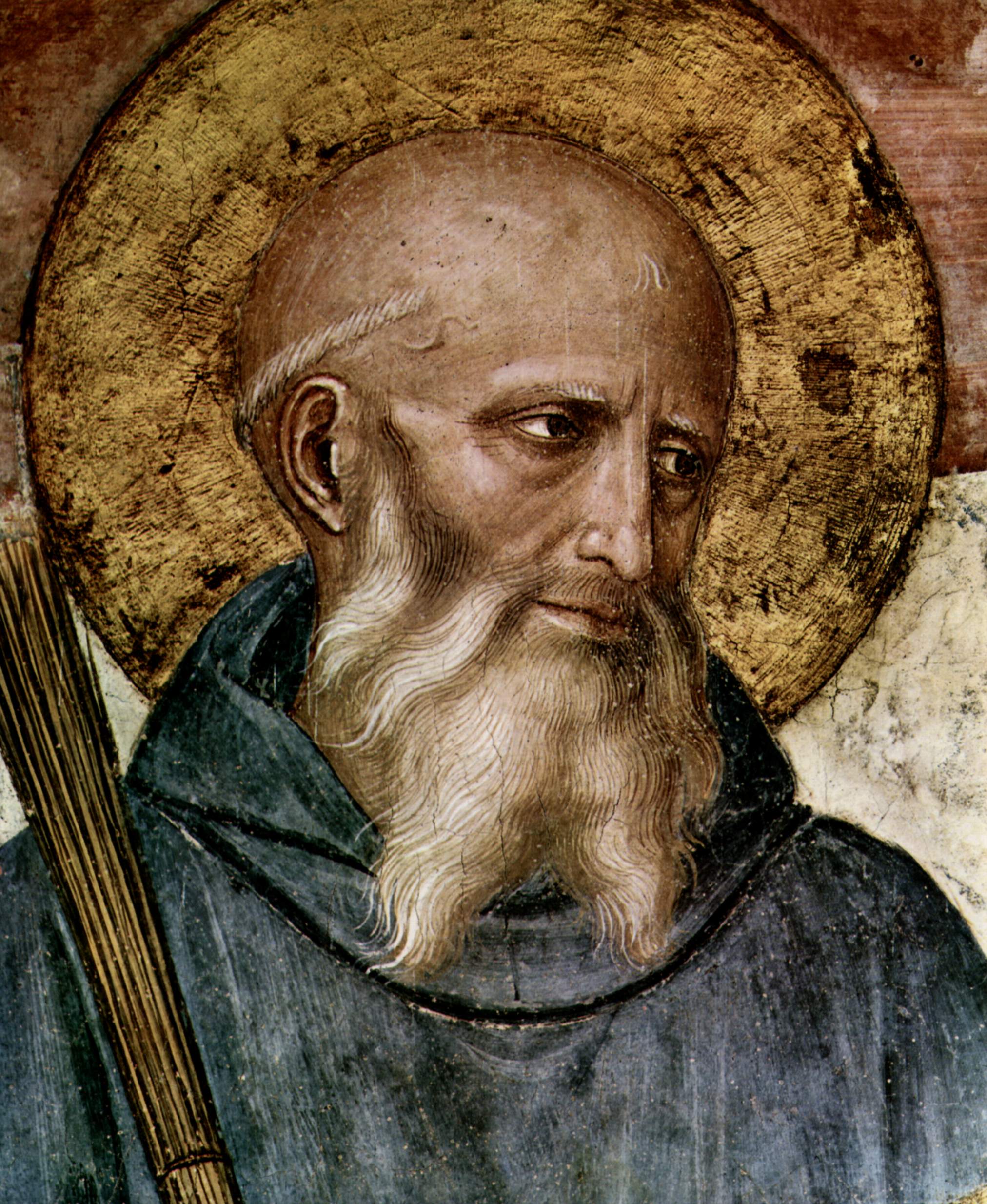
Today we recall two lawgiving rulers, one Egyptian and one Italian, one who was wicked and one who is good. This morning we hear of Pharaoh, who oppressed the Israelites, and we celebrate St. Benedict, who is called the founder of Western monasticism.

When Pharaoh saw the growing demographics of the children of Israel, he saw them as a threat and devised a new social strategy. Pharaoh had the Israelites enslaved and ordered that their male babies be sacrificed to Hapy, the fertility god of the River Nile. This would then force Israeli young women to take Egyptian husbands. In this way, if everything went according to plan, after a few generations of cultural assimilation, the children of Israel would be effectively no more.

St. Benedict, for his part, also established new laws over those he governed. His “Rule of St. Benedict” has directed the spirituality and administration of Benedictine monastic life for more than fifteen hundred years. Both Benedict and Pharaoh were shrewd men, clever and astute about practical matters like human behavior, but Pharaoh’s strategy was evil and failed while St. Benedict’s was good and still endures. Both men had intelligence, but only one had wisdom.

Pharaoh and St. Benedict demonstrate that intelligence is not the same thing as wisdom, that being clever is not the same thing as being good. Just because we know how to do something doesn’t mean we should. We see this in science, which teaches us how to do certain things, but which (of itself) cannot tell us whether we should. Governments can pass new laws, but that does not mean that all laws are just or serve the common good. Intelligence without wisdom is almost a curse. The devil is a brilliant creature, but he is without wisdom.

Where do we find wisdom? We find it in Jesus Christ, who presents Himself as the definitive prophet and righteous man, who presents His life as our pattern to follow. Whoever receives Him receives wisdom, and will receive wisdom’s reward.

Instructions For Missionaries — Thursday, 14th Week in Ordinary Time—Year I

July 7, 2011

Today, Jesus teaches His Apostles how they are to behave as they proclaim the Gospel and do His works. Why does Jesus give them the instructions He does, and what do they mean for us?

Jesus said, “Do not take gold or silver or copper for your belts, no sack for the journey.”  He wants us to depend on God, so that we can learn that God is dependable. But if we depend on God for nothing, then how can our trust grow? The things in your life that you worry about are the places in your life where He wants you to depend on Him more.

Jesus said, “take no second tunic, nor sandals, nor walking stick.” He did not want the Apostles making long trips. They wouldn’t need gear for long-distance hikes, such as a second tunic to sleep in outside overnight. They were to witness in one small village after the next, so that, working separately for the same goal together, everyone in every place would be reached with the Gospel. Like the Apostles, your mission territory is not far away.

Jesus said, “Whatever town or village you enter, look for a worthy person in it, and stay there until you leave.” Of course a person has to stay somewhere until they leave, but a person who has been welcomed into one house could receive a tempting invitation to stay in the same town with someone “better.” We too must beware the temptation to alienate Christ’s “little ones” in order to ingratiate ourselves to others.

Jesus said, “As you enter a house, wish it peace. If the house is worthy, let your peace come upon it; if not, let your peace return to you.” Like the Apostles, we are sure to encounter people who would snub, ignore, insult, or be cold to us, but that should not rob us of our peace.

What Jesus said to the Apostles, He is saying to us as well. Let us do as He instructs us as we proclaim the Gospel and do His works.

Why Twelve Apostles? — Wednesday, 14th Week in Ordinary Time—Year I

July 6, 2011

Yesterday, Jesus said to His followers, “ask the master of the harvest to send out laborers for his harvest.” Today, He summons twelve disciples from the crowd to have a special role and authority among His people. Each is named an “apostle,” a title which is a Greek word, meaning “one who is sent.” Jesus shall send the apostles into the world to be the foundation stones of the Church. Why did Jesus choose twelve Apostles, rather than ten, twenty, or one hundred? I think that reasons are found in the history of God’s people and in the symbolic meaning of numbers.

Yesterday, Jacob wrestled with God and his name was changed Israel. This man, Israel, had twelve sons and through these sons, descended the twelve tribes, the people of Israel. By choosing twelve, Jesus establishes the people of God anew; He constitutes a new Israel. The number twelve is also three times four. Three is the Trinitarian number of God and four is the number of the created world; as in north, south, east and west, or the four corners of the earth. Twelve, the number which is three times four, denotes how the Triune God shall reach out to all nations to form a new people of God, a new family, a New Israel, the Church.

Our Church, its bishops, priests and deacons, like the sons of Israel and the twelve Apostles, frequently prove that they are human, yet our Church is more than just an organization and the ordained are more than just functionaries. Our clergy derive their special role and authority from Jesus Christ and the Apostles, and our Church is intended for all. They are our fathers and the Church is God’s family.

Independence Day Homily

July 4, 2011


What is the most important and the most famous sentence ever coined in the English language? I believe it was a declarative sentence, of thirty-five words, published two hundred and thirty-five years ago today.

“We hold these truths to be self-evident, that all men are created equal, that they are endowed by their Creator with certain unalienable Rights, that among these are Life, Liberty and the pursuit of Happiness.”

Like a passage of Sacred Scripture, this sentence from the Declaration of Independence was more profound, and would effect more providential good, than its human authors ever imagined.

In their original context, these words from the Declaration of Independence were written to justify the American colonies’ separation from the English crown. At that time, many people believed in the divine right of kings, that a monarch had been invested by God with supreme authority to rule. There was precedent for this in the Old Testament, where God chose Saul, David, Solomon, and others to rule His people as anointed kings. In declaring that “all men are created equal,” the Founding Fathers were rejecting the idea that some men are born royal while others are born common. They further asserted that God Himself endows every man with certain rights, and that any government which deprives men of these rights may be justly replaced by its people. In this way, the signers justified the American Revolution.

How much did the Founding Father reflect on how their words about the equality of all men applied to men of color, such as those enduring intergenerational slavery? How much did they consider what these God-given rights required for the female segment of mankind? I would say that these words, like a passage of Sacred Scripture, carried truths more profound than their human authors knew.

These were providential words, for they have been, and continue to be, instrumental in the work of advancing and defending the rights and dignity of all people, from conception to natural death, in our country and around the world. Wherever our nation has failed to embody these words, we look back with shame; but wherever we have honored human dignity, these represent our proudest moments. Martin Luther King Jr. called these words our nation’s creed, and like him we have a dream that one day this nation will rise up and live out the true meaning of its creed: “We hold these truths to be self-evident, that all men are created equal, that they are endowed by their Creator with certain unalienable Rights….”

This Fourth of July, let us thank God for this great gift to our country. Let us praise God for endowing each one of us with dignity and rights which every person and every government must respect. And in the future, let us remember and remind our neighbors, that if our country allows government and men to become our gods, human dignity and human rights will be swiftly brushed aside. Like the Psalmist, may our country always say to the Lord, “My refuge and my fortress,my God, in whom I trust.”

The Significance of Standing — Tuesday, 3rd Week of Easter

May 10, 2011

There’s a curious detail about Stephen’s vision of Heaven in our first reading today:

“Stephen, filled with the Holy Spirit, looked up intently to heaven and saw the glory of God and Jesus standing at the right hand of God, and Stephen said, ‘Behold, I see the heavens opened and the Son of Man standing at the right hand of God.’”

Stephen looks up to Heaven and sees Jesus standing at the Father’s right hand, but both the Apostles’ Creed and Nicene Creed (which we say each Sunday) describe Jesus as “seated at the right hand of the Father.” What are we to make of this?

In the ancient world, to be seated at someone’s right hand gave you the place of higher honor. At a meal, this favored seat granted a special closeness to the host. In a kingdom, the one seated at the right hand of the throne would share in the king’s authority and rule. Of course, describing Jesus as “seated at the right hand of the Father” is only an image (God the Father is unlimited, pure spirit and doesn’t have a right hand.) But this phrase from our creeds does describe a reality: that Jesus is now in the intimate presence of God the Father, sharing supremely in His glory and rule. In his vision, Stephen beholds Jesus in the place of honor, at the Father’s “right hand,” but Stephen sees Jesus standing. So why is Jesus standing?

Did you know that whenever the President of the United States enters a room, everybody stands up? It doesn’t matter if it is a room full of Democrats or Republicans, members of the press, or ordinary citizens, everyone stands up for the President. The same goes for a judge in his courtroom: “All rise, the Honorable Judge So-and-so presiding.” And a gentleman knows that he ought to stand up whenever he greets a lady. Why do they stand? Because it is a sign of respect. If you think about it, whenever we’re offering prayers in the Mass, provided we’re not kneeling, we’re standing up to pray. We stand to pray as a sign of respect to God.

Sometimes, people stand as a sign of respect not so much for the individual but for the greatness of the office they possess. Even a U.S. President’s most hostile critics in Congress, political opponents who couldn’t say one good thing about him, will stand up when he arrives to give his State of the Union address out of respect for the office he holds. It wasn’t for this reason that Jesus stood. No one on earth could have demanded Jesus’ respect by holding an office higher than his.

Jesus stood up because he wanted to show Stephen a sign of His respect. Jesus stood up because he was proud of Stephen. I think that we forget that Jesus is a real human being, with human feelings and emotions about the human events he sees. At the same time, He is also God; and therefore, He sees us all.

When you’re alone, and overcome temptation to do what you know is good, Jesus sees you and He’s proud of you. When you give an anonymous contribution or do a secret kindness, Jesus sees it and He’s proud of you. When you are opposed like Stephen, by people who hate you, or that just don’t understand you, when all the while you’re trying act with love, you do not stand alone. Remember that when you do what’s hard for Jesus, He sees it, and He sees you and He’s proud of you for it.

The Real Jesus — Monday of Holy Week

April 20, 2011

Who is Jesus? What is He like? Jesus is not the things that many people dismiss as being. Jesus is not an ancient myth or a bedtime story. Jesus is not a heavenly Mr. Rogers. Jesus is not a mean guy on a cloud. Jesus is not a hippy and Jesus is not an unmanly wimp. Jesus is not a weirdo, or a freak, and yet Jesus is not ordinary either. Jesus is not a religious fanatic and yet Jesus is not tamed. Jesus is not far away and He is not inactive. Jesus is not out-of-date and He is not irrelevant. Jesus is not a joke but He is not a stick-in-the-mud either. Jesus is not just a “nice guy” or a “buddy.” Jesus is not just a Jewish carpenter who died a long time ago. Jesus is not just a social reformer or a moral teacher who transformed the entire world more than anybody else. Jesus Christ is God and the greatest human being alive.

Our secular culture and sometimes Christians themselves create false pictures of who Jesus is, what He’s like, and what He’s about. And these false depictions can make us hesitate to draw closer to Him. But with the real Jesus, there is nothing to be embarrassed about. In the real Jesus there is nothing to be afraid or ashamed of.

My prayer today is that each of you would all come to know the real Jesus Christ better. This is relationship is at the very core of what it is to be a Christian. Listen to what Pope Benedict wrote for the opening of his very first encyclical: “Being Christian is not the result of an ethical choice or a lofty idea, but the encounter with an event, a person, which gives life a new horizon and a decisive direction.” (This event, this person, is of course Jesus Christ.) “We have come to believe in God’s love.” In these words the Christian can express the fundamental decision of his or her life.

In today’s Gospel, Mary the sister of Lazarus approaches Jesus at a dinner with an alabaster jar of ointment. The jar was made of a type of marble and had a narrow neck to pour out the precious oil slowly. However, Mary breaks the jar and pours it entirely on Jesus’ feet, and its fragrance fills the house. When Judas saw this he criticized her, “Why was this oil not sold for three hundred days’ wages and given to the poor?” Some of the other disciples felt that way too. (Imagine spending $25,000 on a gift for someone.) But Mary knew the real Jesus in a way that Judas never would. She knew Him, and loved Him, and therefore desired to pour her entire self out for Him. If you know the real Jesus like Mary did, it makes sense.

I pray that you will seek to know the real Jesus through a commitment to daily prayer, without which spiritual growth is impossible. Ask Jesus in this Mass to reveal Himself to you. Then you too shall know Him, love Him, and pour yourself out like Mary the sister of Lazarus did, and then fragrance of the wonderful life will fill the house for all.

We Owe Him Big — Tuesday of Holy Week

April 20, 2011

When I was your age, there was a popular show on TV that I liked to watch that maybe you’ve heard of, the show was called The Simpsons. And though it was 20 years ago, I still remember my favorite episode: “Bart Gets an F.” This episode happens to be the most highly-rated Simpsons of all-time and Entertainment Weekly once picked it as the “31st Greatest Moment in Television [History].”

Bart Simpson was failing the fourth grade, and Mrs. Krabappel told him that if he failed his next exam he would forced to repeat the year. Bart tries to prepare by teaming up with Martin to study, but Martin abandons him. And so, the night before the exam, Bart has run out of time. Bart goes to his bedside, kneels down, and prays.

“I know I haven’t always been a good kid, but, if I have to go to school tomorrow, I’ll fail the test and be held back.  I just need one more day to study, Lord.  I need Your help! A teachers strike, a power failure, a blizzard… Anything that’ll cancel school tomorrow.  I know it’s asking a lot, but if anyone can do it, You can!  Thanking You in advance, Your pal, Bart Simpson.” Bart turns off the light, goes to bed, and outside, snowflakes begin to fall.

The next day, the whole world is white and deep. Kids are throwing snowballs, building forts, and riding sleds downhill. Even the adults are joining in the fun. Mayor Quimby solemnly proclaims, “I hereby declare this day to be Snow Day, the funnest day in the history of Springfield!” Bart grabs his sled and makes to rush out the front door, but when arrives at the door, Lisa’s ominous shadow blocks the way.

“I heard you last night, Bart.  You prayed for this.  Now your prayers have been answered.  I’m no theologian; I don’t know who or what God is exactly, all I know is He’s a force more powerful than Mom and Dad put together, and you owe Him big.”

Bart pauses and says, “You’re right.” He removes his goggles from his head and hands them to Lisa. “I asked for a miracle, and I got it.  I gotta study, man!” He goes up stairs and studies like he’s never studied before, or probably since. The next day Bart passes his exam, and the fourth grade, with a D—, and mother Marge puts his test proudly on the fridge.

This weekend, we are going to have a lot of days off from school. Let us remember whom we have to thank for that, what he did for us, and what this long weekend is for. I know you will all be in church on Easter. Everybody’s in church on Easter. But Holy Thursday evening, and Good Friday afternoon, Jesus would enjoy your company at church then, too. If you can’t come at least think of Him then, and of what He’s done for us. Let’s not be like Judas, who was without gratitude, and was the first one out the door. Let us be like Bart Simpson, at least in this much, in showing our thanks to the God who saved our butts, because we owe Him big.

The Giving Tree — Tuesday, 8th Week in Ordinary Time—Year I

March 1, 2011

Do you remember The Giving Tree, that very green childrens book by Shel Silverstein? It’s a story about a boy and the tree that loved him. When he is a boy, the tree gives him her leaves to play with and her apples to eat. However, when the boy becomes a young man he comes asking for money, so that he can buy things and have fun. Since money doesn’t grow on trees, she gives him her apples for him to sell. Time passes, and he comes back, this time asking for a house. The tree lets him cut off her branches so that he may build one. Later, much later, the boy returns again, but he is now a much older and sadder man.”I want a boat that will take me far away from here,” he says. “Can you give me a boat?” The tree offers her trunk and he takes it. He fashions a boat, and sails far away. After a long time, the boy returns, now a very tried and very old man. The tree is now just an old stump. He has taken everything, but she still gives. The story closes with these words: “‘Come, Boy, sit down. Sit down and rest.’ And the boy did. And the tree was happy.”

Now if The Giving Tree has always been one of your favorite books, that’s ok. If it has a special place in your heart, don’t let me or anybody take that from you. But, as for me, this book has always bothered the heck out of me. Even when I was a kid, the story filled me with indignation. Do you know what I’m taking about?

It’s the boy! The selfish, ungrateful boy, who never gives anything back. He receives everything the tree has to give and he never says, “Thank you.” He takes everything she has to give, uses all of it up on himself, and he never says, “I’m sorry.” This book would have been so much better if he just said “thank you” at the end. Does this kid’s behavior in the story of The Giving Tree bother you like it bothers me? If so, then you and I should make sure that we’re not doing the same in our own lives.

So who would be the “giving tree” we take for granted in our lives? Our moms and dads come first to mind. They’ve given us life, food, shelter, clothing, and love our entire lives. What have we given back to them? They probably don’t need your material support right now, but they would appreciate signs of your love. (It’s probably no coincidence that Shel Silverstein dedicated The Giving Tree to his own mom.) But there is another “Giving Tree” we can take for granted, who is even greater and more generous than our parents. I speak of God, and of Jesus Christ, “from whom all good things come.” What should we do for our parents and for God? We should honor them with our words. We should obey them in our actions. We should be grateful for everything and show it.

For God, we do this by way of sacrifices. (This Eucharist is a thanksgiving sacrifice. The name itself means thanksgiving in Greek.) Yet our sacrifice is not merely what happens here at church, but the offering of our whole lives. Those who make no sacrifices for God in their daily lives bring nothing to His altar. What do we have to offer Him today? What will we have to offer him tomorrow?

Jesus Christ is The Giving Tree. At this sacrifice, let us say to Him, “I’m sorry, for misusing your gifts.” Let us say, “Thank you, for your generosity to us.” And let us say, “I love you,” because that will make Him happy.

The Babel Project — Friday, 6th Week in Ordinary Time—Year I

February 18, 2011

Why did God break up the Babel project? What was wrong with lots of people working together toward this common goal? Perhaps the problem was that they were trying to “make a name for” themselves, that is, a new identity for themselves, different from their status as God’s human creatures. Building up to heaven, they were trying to become as gods without God. The tower of Babel was a temple for the worship of themselves. God broke up their endeavor because of the harm it would have caused to themselves and to the world.

That city, in itself, was no threat to God above.  The Lord had to “(come) down to see the city and the tower that they had built.” God was untouchable, invulnerable, and immortal. But this changed in history, with the Incarnation. The Son of God became touchable, vulnerable, and mortal. He did this not only to save us, but also so that our human nature could be transformed to something greater.

At Pentecost, the Holy Spirit came down from Heaven as tongues of fire. He rested upon them and they began to speak in languages that people of any nation could understand. They were temples of the Holy Spirit. They were a holy city, whose foundation is God.

As St. Augustine wrote, the City of Man and the City of God exist side by side in this world. The City of Man is imaged by Babel. The City of God is imaged by the Church. The City of Man is destined for destruction, but the City of God will endure forever.

Prayers Gradually Answered — Wednesday, 6th Week in Ordinary Time—Year I

February 16, 2011


Noah’s Ark was no cruise ship, and forty days and nights on stormy waters is no pleasure cruise. Imagine what it was like for Noah; shoveling food for the animals all morning, shoveling something else all afternoon; hearing the squawking of the animals all night, hearing the complaints of your family all day. Noah must have been praying hard for land. He sends out a raven and it doesn’t come back. He sends out a dove and it brings back with a twig. After sending out the dove again they finally make landfall. Noah’s prayer was fulfilled in a gradual way, just like Jesus healed the blind man of today’s gospel in stages.

Sometimes we get impatient and question when our prayers for ourselves and others are not answered immediately, but we should not lose hope.  But remember, slow, gradual progress doesn’t mean that God’s plan is not being fulfilled. And just because you’re not instantly healed doesn’t mean that your prayer for healing is not being answered.

Christ Or Foe? — Monday, 6th Week in Ordinary Time—Year I

February 15, 2011

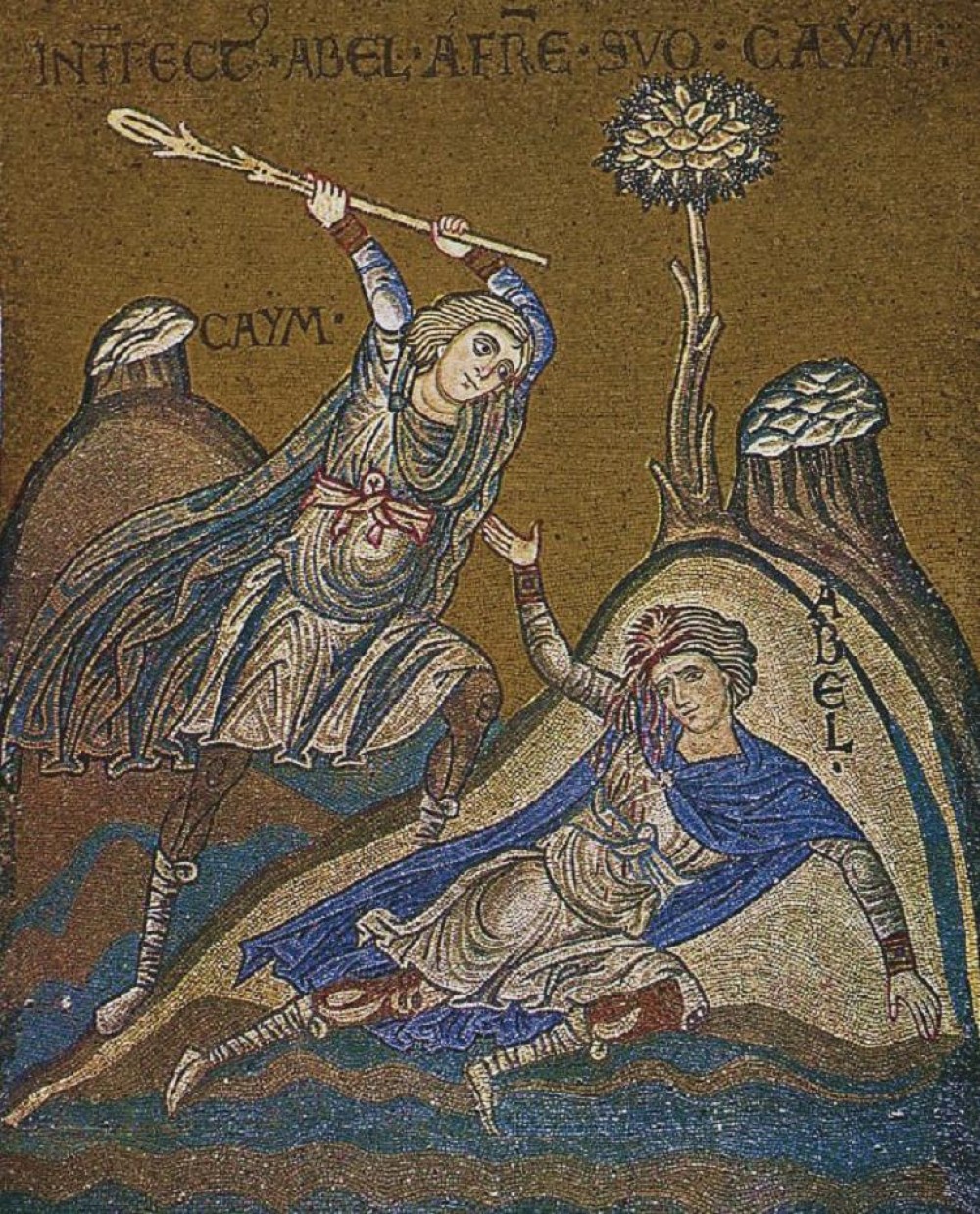
Today we recall two brothers who were icons of Christ. I speak of Cain and Abel. (At least, they both started off as images of Christ.)

When Eve conceived and bore Cain, she said, “I have produced a man with the help of the Lord.” We can imagine the New Eve, Mary, saying the same thing. Abel was a keeper of flocks, like Jesus the Good Shepherd. Cain was a tiller of the soil, like Jesus the Sower of the Seed and Reaper of the Harvest. Both Cain and Abel had priestly characters because both offered sacrifices to God.

Imagine how much better the world would have been if these two brothers had lived and worked together in harmony. They would have transformed the whole world, like the holy brothers Cyril and Methodius, the patron saints of Europe.  Instead, tragically, jealousy, resentment, temptation, and sin led Cain to murder his brother. By this spilling of innocent blood, Abel came to image the future Christ still further, while Cain became a likeness of the Christ’s future enemies; the chief priests, scribes, and Pharisees.

For you and I, in the end, it may all come down to this: are we Christ, or are we those who would destroy Him?