Archive for the ‘Weekday Homilies’ Category

Christ’s Boat — Tuesday, 6th Week in Ordinary Time—Year I

February 15, 2011

Perhaps you’ve noticed at Mass that most of our prayers are directed to God the Father. That is why you see me looking up so often. I’m looking up to our Father in Heaven as I speak to Him. From time to time, while I’m looking up, I can’t help but notice the ceiling. Take a look for yourself. It often reminds me of a boat’s wooden hull. That is really quite appropriate, because the Church is a boat and it is an important boat to be in.
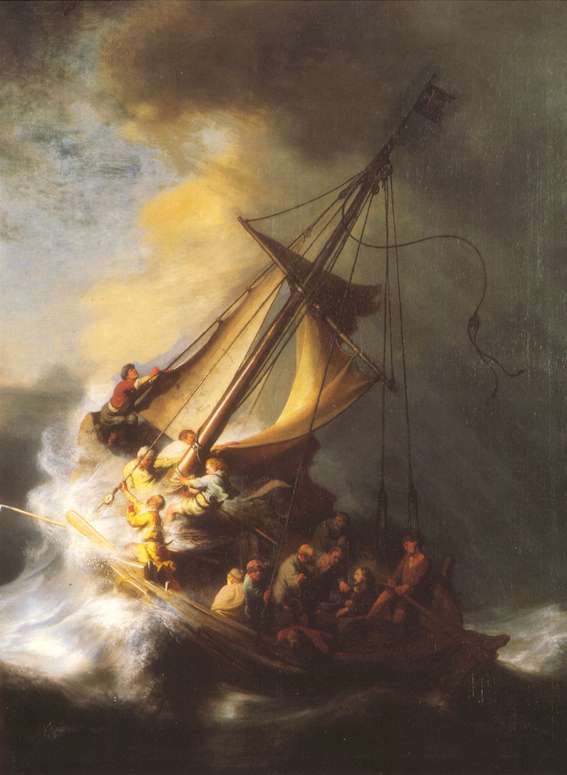
The old ark was a boat built by Noah in which a few persons, eight in all, were saved through the waters of the flood. The new ark is our Church, the boat built by Christ, in which many are saved through the waters of baptism. Jesus’ boat has the cross for its mast and its sails are filled by the winds of the Holy Spirit. The Catholic Church, the bark of Peter, is the only vessel that navigates safely through the dangerous waters of this world.

As the Church Fathers frequently said, “Outside the Church there is no salvation.” But how should we understand this teaching? Restated positively it means this: that all salvation comes from Christ the Head through the Church, which is his Body. Basing Herself on Scripture and Tradition, Bride of Christ teaches that she, the Church, is necessary for salvation. As the Second Vatican Council repeated in modern times, Jesus “himself explicitly asserted the necessity of faith and Baptism, and thereby affirmed at the same time the necessity of the Church which men enter through Baptism as through a door. Hence they could not be saved who, knowing that the Catholic Church was founded as necessary by God through Christ, would refuse either to enter it or to remain in it.”

It must be noted that this teaching is not aimed at those who do not know Christ and his Church through no fault of their own. “Those who, through no fault of their own, do not know the Gospel of Christ or his Church, but who nevertheless seek God with a sincere heart, and, moved by grace, try in their actions to do His will as they know it through the dictates of their conscience – those too may achieve eternal salvation.”

“Although in ways known to Himself God can lead those who, through no fault of their own, are ignorant of the Gospel, to that faith without which it is impossible to please Him, the Church still has the obligation and also the sacred right to evangelize all men.” If we love all men, we will naturally desire to share the truth and blessings of the Church’s Gospel with everyone. Think of it this way: while it is theoretically possible for anyone to swim the English Channel, it is a far easier crossing if we take the ferry. In the same way, it is not a matter of indifference if people come into the Church or not. The journey is much safer and easier if you’re in the boat.

Remember not underestimate the importance of the Church. In the end, all those who will be saved will be saved through their relationship, known or unknown, with the one, holy, catholic and apostolic Church Jesus founded.

And do not underestimate the importance of the Mass. All the graces that flow into souls pours forth from the Catholic Church through this sacrifice we celebrate. The Mass takes the sacrifice of Calvary from then and there, through space and time, to here and now, and applies its power and effects to our world today. (What we’re doing here is a very important thing.)

And finally, do not underestimate the importance of remaining in the Church. May we never forsake it. We have to stay in the boat with Jesus Christ, because without Him, none of us can walk on water.

Man and Wife — Thursday, 5th Week of Ordinary Time—Year I

February 10, 2011

God cast a deep sleep on the man and made for him the woman of his dreams. God fashioned her from his rib, perhaps because it was the bone closest to his heart. This reflects her dignity, for the man was made from mud while she was made from flesh. Woman is God’s final and ultimate creation.

The man beholds her with joy and names her, just as he had named every animal. This authorship is a sign of his authority, not to manipulate nor humiliate, but to lovingly lead and to care for what is entrusted to him. (The fact that “the man and his wife were both naked, yet they felt no shame,” reveals that they completely trusted and respected each other.) As Christ loves His Church, so husbands should love their wives.

Child of God Homily

February 9, 2011

 
Do you know who Bill Gates is? He started a computer software company called Microsoft and is one of the richest men in the world.  If Bill Gates were your dad do you think that he would be willing to buy you things you could never have otherwise? Imagine if President Obama were your uncle.  Do you think he would invite you to the White House sometime?  Do you think that you would have the opportunity to talk to him about your concerns and ideas for the world? Hold that in mind…

When I was younger, something about how we professed the Nicene Creed on Sundays struck me as strange: “For us men and for our salvation He came down from heaven. *Profound Bow* By the power of the Holy Spirit, He was born of the Virgin Mary, and became man. *Straighten* He was crucified under Pontius Pilate. He suffered, died, and was buried.” I wondered, “Why do we bow for Jesus being born? Heck, even I was even born. Why don’t we bow for His suffering instead?” 

We tend to think of God becoming man as a perfectly normal thing for God to do, we take it for granted, but it is actually the most surprising thing that has ever happened in history. The divine Son became one of us so that He could be our brother, and so that His Father could be ours. “See what love the Father has bestowed on us that we may be called the children of God. Yet so we are.”

Our heavenly Father is unimaginably rich, and He wants to provide for you and bless you. Our Father is all-powerful, and He is always open to hearing your prayers. Our Father in heaven has a house far greater than the White House, and He is preparing a place for you to stay. Remember this: you are a child of God the Father, and that’s a big deal.

Wine and Drunkenness — Tuesday, 5th Week of Ordinary Time—Year I

February 8, 2011

“God looked at everything he had made, and he found it very good. … Such is the story of the heavens and the earth at their creation.”

Everything that God has made is good, but anything can be misused or abused in ways that are wrong. A volleyball-sized amount of Uranium can provide electrical power to 200 U.S. homes for a year, but it can also be used in a single bomb to level a city like Hiroshima. The complimentarily of man and woman is very good.  They were made for each other, but they sometimes use each other in painful and unloving ways.

What about alcohol in its many forms? Is it good or bad? On the one hand, the Scriptures praise God for it as a gift: “You bring bread from the earth, and wine to gladden our hearts.” (Psalm 104:14-15) Yet throughout, the Scriptures also caution about the sin of drunkenness: “…Do not get drunk on wine, in which lies debauchery, [instead] be filled with the Spirit.” (Ephesians 5:18) You’ll recall that Jesus provided wine for the wedding feast of Cana, yet He would not be pleased if the guests used His gift for getting trashed.  If we are adults we may only drink alcohol in moderation, and if we are still minors we may only consume it under our parents’ direct supervision. Anything else is misuse, abuse, immoral and dangerous.

But what about illegal or recreational drugs? Can they be used in moderation? No, there is no moderation in this, for the entire goal of using them is to get high, to become intoxicated. If you have never abused drugs or alcohol, I hope you never start; and if you have, I hope you never will again.

Please do not dismiss this teaching as merely the tradition of your elders; for it is God’s command that we should never get drunk or high. God forbids it, just as every good parent forbids it of their children, because getting intoxicated is harmful and dangerous for us. The Scriptures say, “Honor your father and your mother,” and, “Whoever curses father or mother shall die.” Indeed, those who spurn their parents in this can taste sin and death in many forms.

When you’re intoxicated you make dumb decisions. (I don’t know about you, but I already make enough dumb mistakes in a day as it is.) Someone who is drunk or high will do impulsive, stupid things that they would never do otherwise. You lose control of yourself and become vulnerable to others. I don’t want any of you to wake up a morning after, regretting some serious thing done the night before. I don’t want any young woman here to find herself with child, and be tempted to do something terrible.

Imagine which experience would be worse as a consequence of getting intoxicated? To die alone from driving your car off a road into a tree, or to survive a head-on collision that kills a stranger or a friend? Go too far just once and alcohol poisoning or a drug overdose can have you pass out and never wake up again, put you in a coma or make you drown in your own vomit.

Or consider the risk and costs of addiction. Any recovering alcoholic can tell you a story about how much addiction costs, and any smoker can tell you how hard additions are to break. Of course, not everyone who gets drunk or high will become an addict, but some will, and after the first use of certain drugs, addiction is all but certain. With addiction, even if drug or alcohol abuse never sends you to prison, it can still cost you your freedom. And even if drug use never takes your life, it can cost lives of people far away.

Did you know that since 2007 there have been over 35,000 deaths in Mexico from the violence of their organized crime drug cartels? That’s almost ten times the number of American troops who have died in combat since 2001 in Iraq and Afghanistan. Why so much violence? It’s because the Mexican drug cartels make more than one hundred billion dollars a year from selling marijuana and other drugs to Americans, and they will murder or assassinate whoever stands up to them. When we buy their drugs, we’re supporting their terror.

Today I set before you life and death; choose life. If you have never abused drugs or alcohol, I hope you never start; and if you have, I hope you never do again. May no one ever say of Columbus Dons as Jesus said of the Pharisees: their hands are clean in public and ‘they honor me with their lips, but their hearts are far from me.’

Evil: Unholy Holes — Tuesday, 5th Week of Ordinary Time—Year I

February 8, 2011

“God looked at everything he had made, and he found it very good.” Everything that God has made, everything that has being, contains God’s goodness. What then is this thing called evil?

Think of a hole in the ground. What is the hole made of? Nothing really. If not for the good earth surrounding it you would not even know that a hole was there. Evil is like that hole, it’s an absence, a deprivation, a negation of something good. Evil can only be present within something good, as a corruption. Even though evil is essentially nothingness, that doesn’t mean that it can’t still hurt you, like falling into a deep, gaping hole.

Let no one think that evil is necessary for there to be good. No one should think of evil as the Ying to God’s Yang. God created a universe which was entirely good. It has been the free choices of the demons and of us to rebel in sin which have brought evils upon us.

Because of the goodness that remains in them, God shall love and preserve the Devil, the demons, and the damned forever. They shall not be destroyed, but they shall no longer do harm. They shall be as the wounds in Jesus’ hands, feet and side, which are as they are due to evil, but which cause no more pain, only glory.

Fear of Death — Friday, 3rd Week of Ordinary Time—Year I

January 28, 2011

God permits us to feel a natural aversion to death. This is healthy and for our good. (Imagine what the world would be like if everyone were completely indifferent as to whether they lived or died.) However, for faithful Christians, there is no reason to be terrorized by a fear of death.

If you remain close to the sacraments and rooted in daily prayer you have no reason to be afraid. Maybe you feel ill-prepared to die, but like the seed that grows without the farmer understanding how, God is preparing you for the unending life of Heaven in ways you don’t even perceive. Like the mustard seed, we may go into the ground as seemingly small and weak human beings, but we will rise with a greatness and power that even delights and blesses the angels of Heaven.

A natural aversion to death is healthy, but for Christians a fear of death is out of place. For, as the Letter to the Hebrews says, “We are not among those who draw back and perish, but among those who have faith and will possess life.”

Lamps, Baskets & Beds — Thursday, 3rd Week of Ordinary Time—Year I

January 27, 2011

“Is a lamp brought in to be placed under a bushel basket or under a bed, and not to be placed on a lampstand?”

How many bushels can a bushel basket hold when the bushel basket is covering a lamp? Zero. A basket used like this is totally unproductive for bringing in a harvest.

How would you feel about sleeping in a bed with an open flame beneath it? You probably wouldn’t get much peaceful rest.

You are the lamp and your light is from Christ. Having been brought into the house, the Church, your light should shine for the benefit of others. As the Letter to the Hebrews says, “We must consider how to rouse one another to love and good works. We should … encourage one another.”

How do you help others to produce good works? How do you help others to be at peace? What else could you do to help those around you to become more productive and more peaceful with Christ?

No Regrets — Tuesday, 2nd Week of Ordinary Time—Year I

January 21, 2011

When I was a kid, my Uncle Tom said to me, “I remember when I was young like you, when I felt invincible and thought that I’d live forever.” It struck me, because I have never felt that way. In fact, the idea that I would someday have to look back on my whole life was a consideration throughout my youth.

When I was about the age of most of you, I began to read the Gospels on my own and started to seriously consider Jesus’ teachings. What He said challenged me. Jesus said, “Give and gifts will be given to you; a good measure, packed together, shaken down, and overflowing, will be poured into your lap. For the measure with which you measure will in return be measured out to you.” I had always felt like whatever I gave away only made me that much more vulnerable to harm. But I thought to myself, “Do I want to have to look back from my deathbed and have to wonder how my life would have been blessed if I had been more generous?”

Jesus said, ‘Do not worry about your life, what you will eat or drink, or about your body, what you will wear.  If our heavenly Father feeds the birds and clothes the grass in flowers, will he not much more provide for you, O you of little faith? Are not you more important than they?’ Jesus was telling me not to worry when there seemed so much to worried about. But I thought to myself, “Do I want to have to look back at the end of an anxiety-filled life and wonder if I could have live in peace the whole time?”

When Jesus encountered the apostles and called them to follow Him, it seemed like He might be calling me, too, to serve Him as a priest. Though I had always respected our priests, priesthood had never been a personal dream of mine. But I knew that if I never went to seminary to seriously discern it, even if I went on to live an otherwise o.k. life, I would still wonder if I had missed out on God’s plan for me.

I wanted to live a regret-free life, so I tested whether God’s blesses a giver, I tried out what life was like when I trusted God to handle things, and I followed where I thought He was calling me. I’m glad I did.

There are two different views of religion reflected by the Pharisees and Jesus. For the Pharisees, religion is about keeping rules.  They say, “Look, why are [your disciples] doing what is unlawful on the sabbath?” Jesus answers, “The sabbath was made for man, not man for the sabbath.” For Jesus, religion is about freedom and fulfillment. So it is with Sundays, our Sabbath, the Lord’s Day.

When I was in college I wanted to try taking Jesus at His word by keeping the third commandment, so I resolved to make every Sunday a true day of rest. That meant no studying or homework, no matter what I had due on Monday. Now I had some pretty late Saturday nights, but I was faithful to my commitment. The funny thing I discovered was that when I gave my Sundays to God, He gave them back to me. Before, Sunday had been just another day; but after, I had a vacation day every week; to sleep, to have meals and fun with friends, to go to Mass and to pray.

Do you want to live a regret-free life, and not have to look back someday and wonder what your life would have been life if you had trusted Jesus more? Then take Jesus at His word, and put His words into practice.

Attacks Within — Tuesday, 1st Week of Ordinary Time—Year I

January 18, 2011

In the beginning, when God created the heavens and the earth, He also created purely spiritual beings called angels to serve Him and share His friendship. Unfortunately, some of these spirits decided that they would not serve, and rejected His friendship. We call these rebels demons, and with intense hate they wage spiritual war against us on the battlefields of our hearts and minds.

Demons are pleased when we hold either of these two extreme attitudes towards them: either in denying their very existence, so that we will be completely unaware of their activity in the world, or in fixating upon them, so that we are paralyzed with false fears of their power. Demons are powerful (by nature we human being are “lower than the angels”) but we should not be terrorized. First, Jesus is greater than them all. Made “for a little while lower than the angels” the Father has crowned Jesus “with glory and honor, subjecting all things under his feet.” Second, as a baptized Christian, you belong to Christ, you are claimed by Him, and that gives you special protection. Demons cannot possess you like the man in the Gospels unless you invite them in. (This is why Ouija Boards, Tarot cards, seances, magic and other things occult are so dangerous.) Demons cannot control us, overriding our freewill, but they can influence our thoughts and feelings.

When I interact with you, I can influence your thoughts and feelings by what I say and how I act. If I mention elephants, you’ll think of elephants. If I smile and compliment you, you’ll feel good, and if I insult you, you’ll feel bad. But however I interact with you, you can see and hear me doing it right in front of you. The work of spirits, on the other hand, is more subtle since they operate invisibly, speaking in our thoughts and influencing our hearts. God’s good angels direct us toward what is good, but demons would lead us toward sin and harm. To be forewarned and aware of the demons’ tactics is to be forearmed and prepared to resist them.

One typical demonic tactic is to first entice and then condemn. Suppose you gave up cookies for Lent and you notice the cookie jar sitting on the counter. A demon might entice you by speaking thoughts to you like this: “… a cookie would be great right now …this sucks …I’ve been good all Lent… I’ve earned it.” Then, once you give in and have the cookie, the enemy shifts to words of condemnation: “…couldn’t even give up one cookie for God.” Whenever you fall into sin, the demons don’t want you to get back up with Christ, they want to kick you when you’re down and keep you there. Sometimes our heavenly friends will correct and challenge us, but whenever they do, they always do it in a way that makes us stronger to do what’s right.

Another demonic tactic is Always/Never, or All or Nothing Thinking. If you find yourself thinking that you’re “always” this, or “never” that, you’re probably being fed a lie; either an untruth welling-up out of your own human brokenness, or a lie coming from an external attack. If you find yourself thinking that you ‘always mess things up,’ or that you ‘don’t have any friends,’ or that you ‘never really sin,’ you’re facing a falsehood. The truth is that only in rare cases are you “always” or “never” anything. The truth is probably somewhere in the middle.

Another tip: don’t dialogue with temptations. Whether the temptation springs from an external enemy or merely from our own desirous passions, both demons and we ourselves are cleaver enough to persuade us into sinning, if granted enough time for convincing.

So what can we do to defend against such attacks? We should pray every day and stay close to Jesus Christ through frequent reception of confession and the Eucharist. We should use holy water and holy images to sanctify the places where we dwell. We should call on our heavenly friends; Mary, St. Michael the Archangel, leader of God’s angelic armies, and all the saints. We should also remember that we are always accompanied by a Guardian Angel who God-given mission is to light, to guard, to rule, and to guide us.

Demons want us to either fixate on them or to deny that they even exist. Instead, let’s be forewarned in faith and confident in Christ about the invisible spiritual warfare fought on the battlefields of our hearts and minds.

He Came To Us — Wednesday, 1st Week in Ordinary Time—Year I

January 12, 2011

In today’s Gospel, “everyone” was looking for Jesus but only a few disciples could find Him. Jesus told them, “Let us go on to the nearby villages that I may preach there also. For this purpose have I come.”

Since the beginning, humanity has been searching for its completeness in God, but only a few could find Him. This is why He came to us as one of us. As the Letter to the Hebrews said, “Since the children share in blood and flesh, Jesus likewise shared in them.” He approached us as one of us, grasped our hands and helped us up, because everyone had been looking for Him, but only a few could find Him.

Multiplying Our Gifts — Tuesday After Epiphany

January 5, 2011

When the crowd gets hungry, Jesus takes the five loaves and two fish that his disciples offer to Him and uses these to feed everybody. Now if Jesus had wanted to, He could have used just one loaf and one fish. Or, He could have transformed a single piece of bread into more loaves, more fish, or whatever He chose. In fact, Jesus could have forgone the bread and fish business entirely and created a meal from absolutely nothing (ex nihilo) if He had wished. Yet, Jesus takes everything that the disciples offer to Him, blesses it, and uses it to a greater effect than any of them could imagine. Let us remember this when we consider offering our gifts to God.

Recognizing God’s Child — Monday Before Epiphany

January 3, 2011

If you saw Jesus clean-shaven, in slacks and a shirt, would you recognize Him? Probably not — John the Baptist only knew Him as God’s Son after he saw the Holy Spirit descend upon Him at His Baptism. The world did not recognize Jesus as God’s Son, nor does it recognize us as God’s children, yet so we are! Sometimes we treat others as if they were obstacles, distractions, or not even there. Instead, let us think of how Jesus would treat us if He anonymously encountered you or I, and then follow His example.

Seen and Unseen — December 28 — St. John the Evangelist

December 27, 2010

Today’s Gospel says that when John the Apostle went into the tomb on Easter morning “he saw and believed.” What did he see that led him to believe? Was it how the burial cloth which had wrapped Jesus’ body wasn’t taken away or tossed in a mess on the floor,  but left behind (perhaps deflated) in its place? Or was the cloth which had covered the Lord’s head rolled up in a familiar way, such that John recognized Jesus’ hand behind it. Or perhaps, if the Shroud of Turin is truly the burial shroud of Christ, John believed through beholding its testimony to the resurrection.

On the other hand, maybe it wasn’t something John saw that led him to believe, but something he didn’t see. Perhaps it was from the fact that Jesus wasn’t there that he infered the truth. “Dead bodies don’t just disappear for no reason at all. I didn’t do this. None of us did this. And what motive would our enemies have to take Him? This is the work of God.”

Just as John may have inferred the resurrection of Jesus from the empty tomb, so we can infer the truth of God from the presence of the universe: “Things don’t just appear for no reason at all. I didn’t make this. None of us made this. And how could an enemy have to create beauty, life, and love? This is the work of God.”

Tradition says that after Jesus entrusted the care of His mother into the care of John the Apostle, they went to live in what is modern-day Turkey.  What if we had gone to visit them in their home at Ephesus and asked them how someone can believe in the God of the universe, or the Lord Jesus Christ, when their reality can sometimes seem so distant.

I can imagine Mary or John replying, “Beloved, the One who was from the beginning, whom we have heard, whom we have seen with our eyes, whom we looked upon and touched with our hands, the Word of God, the Word of Life, the Lord Jesus Christ——we have seen Him, and testify to Him, and proclaim to you His eternal life.” The Christian faith is firmly founded, upon the unseen things we can infer and the things which we  have seen.

Of A Great Lineage — Friday, 3rd Week of Advent

December 17, 2010

Among the four Gospels, three of them contain genealogies of Jesus Christ. Matthew traces His origin from Abraham, for salvation is from the Jews. Luke traces His origin back to Adam, for Jesus is the savior of all. And John traces His origin from the Eternal Father, for Jesus is the Son of God.

In today’s gospel, we heard the names of all sorts of Old Testament people who became ancestors to Jesus Christ. They were all connected to each other, by faith and by blood, yet they little understood the amazing plan that God was accomplishing through them; namely, the Incarnation of Jesus Christ, the Son of God and Savior of the world. I believe that Jesus is accomplishing great things with all of us. We might not see it now, but in Heaven we will see what great things He is doing through us.

The New Eve — December 8 — Immaculate Conception

December 8, 2010

In the beginning, when our first parents fell, they lost a great deal, but they were not deprived of hope, for God spoke in their hearing a prophesy to the deceiving serpent, the devil. God said, “I will put enmity between you and the woman, and between your offspring and hers; he will strike at your head, while you strike at his heel.” Who is this offspring, who strikes back at the devil? He is Jesus the Christ, the New Adam, the Son of God. And who is this woman, who is Satan’s enemy? She is Mary of Nazareth, the New Eve, the Immaculate Conception.

After their Fall, when Adam and Eve heard God approaching in the garden, they became afraid, they fled and hid, so God called out, “Where are you?” When God drew near to Mary, she also was afraid, but she did not hide or flee. She declared, “Behold, I am the handmaid of the Lord. May it be done to me according to your word.” And, because she did, her Holy Offspring could go on to say in His garden of testing, “Father… not my will but yours be done.”

The first man, Adam, called the first woman Eve, because she became the mother of all the living. Now, Mary is the New and Second Eve, for she is the mother of all the living, and she loves each one of us personally as her very own children.

She is the icon of the Church, and as she is, we are called to be: holy and without blemish before God, as the second reading from Ephesians says. But how can we do this? Unlike Mary, at times we have been allies of Satan by our sins. To cleanse us, God gives us the sacrament of reconciliation, and to strengthen us He gives us the fruit from the new tree of life; that tree is the cross, and its fruit is the Eucharistic Christ.

If it has been a long time since you have been to confession, come that you may be purified as pure as Mary. And if you receive our Lord in the Eucharist tonight, consider that the Son of God Incarnate has come to dwell in you, just as truly as He dwelt in Mary.