Archive for the ‘Weekday Homilies’ Category

Signs of the Times — Thursday, 18th Week in Ordinary Time—Year II

August 5, 2010

The Chicago Archbishop, Cardinal Francis George, [reportedly] recently remarked, “I expect to die in my bed. I expect my successor to die in prison and his successor to die a martyr’s death.” An overly-dark prediction? Perhaps. But there are threatening signs for the Catholic Church’s future in America.

Yesterday a federal judge overturned Proposition 8, California’s Marriage Protection Act. He ruled same-sex marriage to be a constitutional right. About two years from now, the issue will reach the Supreme Court, where most anticipate a 5-4 decision to go one way or the other. A poor decision, enshrining a national right to gay marriage, could drive Catholic organizations out of many charitable efforts, such as adoption services.

This year in Wisconsin, the legislature came close to removing the statute of limitation for all child sexual abuse cases. This would have allowed civil suits, no matter how old, to be brought against alleged perpetrators and their employers. (Government institutions, like public schools, were exempted.)

What’s wrong with a law like this? Consider the difficulty of gathering facts, witnesses, and accurate testimony for events twenty, thirty, or even forty years ago. This is why statute of limitation laws exist. How does one question a dead priest or a dead bishop to assess their response to an allegation or their knowledge of an incident? Merely responding to a handful of these new-old cases in litigation would cost Wisconsin dioceses immensely. The legislation died this year in committee, but its supporters intend to reintroduce it next year.

The President’s recent health insurance overhaul will intertwine the federal government into medicine more than ever before. What will this mean down the line for the work of Catholic hospitals? That remains to be seen.

So what shall do? We will pray. As St. John Vianney told us yesterday, ‘God commands us to pray, but He forbids us to worry.’ We shall continue to love, for love is what changes hearts. We should vote, because we live in a democracy where the government is made in the image of those who vote.

And finally, we shall be faithful, no matter what. Even if, God forbid, churches are confiscated and sold off… even if Catholic charities and hospitals have to close their doors… even if priests and bishops go to jail for things they say or things they are unwilling to do… we will be faithful and unafraid. For Jesus promises us, “the gates of the netherworld shall not prevail against the Church.”

We shall not deny Jesus Christ, nor His teachings, before the world. We, the Church, will be faithful to Christ and His teachings. We shall be His people, and He shall be our God.

Across the Waters — Tuesday, 18th Week in Ordinary Time—Year II

August 3, 2010

Today’s gospel follows from yesterday’s. In yesterday’s gospel, Jesus hears that his relative and friend, John the Baptist, has been murdered—for that is what it is to intentionally kill the innocent, even when kings and governments do it. Jesus tries to go to a deserted place, but insistent crowds meet his boat. John’s death turns Jesus’ thoughts to the events ahead of Him. He has the people sit, takes the bread, says the blessing, breaks it, and gives it to His disciples, that they may share this miraculous bread with the people.

When evening comes, He sends off the Twelve ahead of Him in the boat and He dismisses the crowds on their way. Jesus climbs the mountain and communes with His Father in that solitude He longed for. Imagine if you were there with Jesus, giving Him silent company on that hill overlooking the Sea of Galilee, as He contemplated the things that were before Him.

Perhaps Jesus would turn to you, and ask, “Do you see that boat captained by Peter, the likeness of my Church? Shall I walk through the darkness across the waters of this world’s chaos and death? Should I face the headwinds of spiritual evil for you and them?” Of course, Jesus knows what He is going to do, but He wants to hear you answer. Let Him hear how precious His sacrifice is, for you and all His own.

Anointing Mass — Wednesday, 17th Week in Ordinary Time—Year II

July 28, 2010

Today we listen to the prophet Jeremiah complain to the Lord,

Under the weight of your hand I sat alone because you filled me with indignation. Why is my pain continuous, my wound incurable, refusing to be healed?

Sometimes our trials tempt us to indignantly complain like Jeremiah, but every trial permitted by God is permitted for our good. Trials, patiently borne, sanctify us and help to save others.

It is right for us to pray for cures, as we do in the anointing of the sick. But if our trials are to continue this sacrament offers the grace to bear the weight of our trials, not alone, but with Christ.

Praise is Fireproof — Tuesday, 17th Week in Ordinary Time—Year II

July 27, 2010

St. Therese of Lisieux, one of the greatest and most beloved saints in modern time, once remarked that she almost wished that she could go to Hell.  That way, she said, at least her small, solitary voice would lovingly praise Him from there. Of course, this is impossible. Those in Hell ‘wail’ in sadness, and ‘grind their teeth’ in anger, but they never praise God. No one praising Him would remain in Hell. Let us take comfort in the knowledge that if we persevere in our praise of God we shall not join their number.

The Kingdom is Like… — Monday, 17th Week in Ordinary Time—Year II

July 26, 2010

Jesus says the Kingdom of heaven is like a mustard seed sown in a field, or like some yeast worked into three measures of dough. These passages are usually taken to describe how the Church, or the Christian faith, despite small beginnings, has spread and transformed the entire world for the better. This is a valid interpretation, but the Kingdom of heaven is not only an external reality; it is internally and personally experienced. Since the Scriptures are written not only by human authors, but by the Holy Spirit as well, every passage contains more than one true interpretation. Jesus’ similies also describe faith in the life of individual Christians.

At the beginning of one’s discipleship, the seed of faith is small and vulnerable. Any challenge or trial, any passing bird, can potentially come along and consume it. This seed of faith must be guarded, watered, and given light. This means vigilence, education, and contact with Christ in prayer and the sacraments. In time, faith grows to the point that trials and challenges are no longer a grave threat, but calmly accepted.

The faith of the Christian is also like yeast which is not meant to be merely kept in a jar in on the shelf, segregated to Church or private life. It is meant to be mixed into the whole of life; at home, at work, and everywhere, so that the entire batch of life will be transformed and raised.

If your faith is young and fledging, or a confined and isolated part of your life, be encouraged by the hope these passages promise. The Kingdom of God is at hand for you.

Augustine on Humility — Thursday, 15th Week in Ordinary Time—Year II

July 18, 2010

A Thought on Humility from St. Augustine:

‘You are to “take my yoke upon you, and learn from me.” You are not learning from me how to refashion the fabric of the world, nor to create all things visible and invisible, nor to work miracles and raise the dead. Rather, you are simply learning of me: “that I am meek and lowly in heart.” If you wish to reach high, then begin at the lowest level. If you are trying to construct some mighty edifice in height, you will begin with the lowest foundation. This is humility. However great the mass of the building you may wish to design or erect, the taller the building is to be, the deeper you will dig the foundation. The building in the course of its erection rises up high, but he who digs its foundation must first go down very low. So then, you see even a building is low before it is high and the tower is raised only after humiliation.

Humbly Rising High — July 15 — St. Bonaventure

July 18, 2010

St. Bonaventure became the master-general of the Franciscans 31 years after St. Francis of Assisi himself. He was renowned for his learning and later named a Doctor (or great teacher) of the Church, yet he was also humble. When the pope sent his representatives to inform Bonaventure that he had been named a bishop and cardinal they found Bonaventure washing the dishes. The saint told them to hang the red hat on a tree and to wait in the garden until he had finished the task.

St. Bonaventure reassures us, that whatever our gifts, holiness is within our daily reach. “A constant fidelity in small things,” he once wrote, “is a great and heroic virtue.”

In today’s gospel, Jesus invites us to take his yoke. This burden is restful, easy and light, yet we must be humble; we cannot carry it without Christ by our side. Beatitude (true happiness) is within everyone’s reach, but we cannot possess it without God.

As St. Bonaventure says:

No one can be made happy unless he rise above himself, not by an assent of the body, but of the heart. But we cannot rise above ourselves unless a higher power lifts us up. And divine aid is available to those who seek it from their hearts, humbly and devoutly.

An Incomplete Lord’s Prayer — Thursday, 11th Week in Ordinary Time—Year II

June 18, 2010

Sometime in the past, I realized that I didn’t pray the Lord’s Prayer right.  It’s not that I was actually changing the words Jesus taught us to say, but I realized my focus was not fully what Jesus had in mind. My subjective, firsthand experience of praying the prayer went something like this: 

God, who art in heaven…
     [<Here I get distracted for several seconds>]
…give me this day my daily bread,
and forgive me my trespasses,
as I forgive those who trespass against me,
and lead me not into temptation,
but deliver me from evil.

Did you notice anything different?

First, Jesus taught us to pray to “Our Father” because we are not praying to anonymous force, but a person, a divine person who is imaged in a special way by natural and spiritual fathers on earth. Earthly fatherhood is a diminished image of Him. Biological fatherhood teaches us about our heavenly Father’s transcendence, while devoted fathers teach us about His love. (“The respective ‘perfections’ of [both] man and woman reflect something of the infinite perfection of God,” as the Catechism teaches, but “Our Father” is significant.)

Second, the prayer’s early petitions, “hallowed be thy name. Thy kingdom come. Thy will be done on earth as it is in heaven,” are every bit as important as the later petitions ‘about us.’ God is justly entitled to glory, His kingdom and reign.  Remember that all these are essential and conducive to our own greatest happiness.

Third, the Lord’s Prayer is not meant to be prayed just for yourself or myself, but for all of our Father’s family, for the whole Church, for even the whole world. The Our Father is not only a petitionary prayer, but an intercessory prayer.

So when we prayer the Our Father, the perfect prayer which Jesus taught us, let us pray it in its completeness, with a presence of mind and fullness of heart.

Not If, But When — Wednesday, 11th Week in Ordinary Time—Year II

June 16, 2010

Notice that in today’s gospel, Jesus does not teach saying, “If you give alms…” or “If you pray…” or “If you fast….”

Jesus says, “When you give alms… when you pray…. [and] when you fast….”

Prayer, fasting, and alms giving are assumed for the follower of Christ. If we do not have all three of these as a regular part of our lives, we need to put them there. And when we do, our Father, who sees all, will repay us.

Getting Slapped — Monday, 11th Week in Ordinary Time—Year II

June 16, 2010

Jesus taught:

“…Offer no resistance to one who is evil. When someone strikes you on your right cheek, turn the other one to him as well. If anyone wants to go to law with you over your tunic, hand him your cloak as well. Should anyone press you into service for one mile, go with him for two miles.”

Should we always offer no resistance to those who would do evil against us?

Notice that each of the examples Jesus gives are of injustices that do no real lasting harm. If you are slapped on the cheek, it stings awhile, but in a few minutes you’re fine. Even Jesus’ disciples owned spare clothes–we know because He told them to leave their second tunics behind when He sent them two by two. There is no lasting harm until your last tunic or cloak is taken. (cf. Exodus 22:25-26) In those days, Roman soldiers could force Jews to carry their gear for up to a mile down a road. Jesus teaches that one should go the extra mile for these enemies and occupiers.

In each example Jesus gives of offering no resistance to evil-doers, the affliction is felt in one’s pride more than anywhere else. Jesus is teaching us to be humble when people wrong us in small ways, so that they will be struck by our magnanimous patience and strength and be converted.

But what if the evil someone would do to us would do us grave and lasting harm? Should we offer no resistance then? Two incidents for Jesus’ life come to mind. When the money changers and animal sellers were doing business in the temple’s court of the Gentiles, profaning it and impeding the nations’ worship of the One True God, Jesus resisted. He made a whip out of cords and drove out the people who were doing what was evil. On the other hand, in the Passion, Jesus offered no resistence. He let His enemies slap Him, strip Him, and force Him to carry a cross.

It seems that there are times when we are called to resist evils for the sake of the common good, and times when we are called to accept evils, even grave injustices against us, in the pattern Jesus Christ. Let us trust the Holy Spirit to guide us to know when is the time for which.

Rejoice, Daughter Zion! — The Visitation

June 2, 2010

The Blessed Virgin Mary is the Icon of Israel and the Icon of the Church. Mary is the bridge between the Old and New Testaments and we can discover her in both. Whenever we encounter positive descriptions of “Jerusalem,” “Zion,” “Daughter Zion,” or “Israel” in the Old Testament, or praises of “Mother Church” today, these words often apply quite fittingly to Mary as well. Today’s first reading is a great example of this. But before returning there, let me share with you this interesting detail. Even though we traditionally pray, “Hail Mary, Full of Grace,” the Archangel Gabriel’s greeting to Mary at the Annunciation [“Chaire” in Greek] literally means , “Rejoice… Full of Grace!” Now hear again the words from the Book of Zephaniah:

Shout for joy, O daughter Zion!
Sing joyfully, O Israel!
Be glad and exult with all your heart,
O daughter Jerusalem!

In today’s Gospel, Mary fulfills these words, glad and exulting with all her heart:

My soul proclaims the greatness of the Lord
My spirit rejoices in God my savior

Zephaniah says:

The LORD has removed the judgment against you,
he has turned away your enemies;
The King of Israel, the LORD, is in your midst,
you have no further misfortune to fear.

And Mary agrees:

He has mercy on those who fear Him
In every generation.
He has shown the strength of his arm,
he has scattered the proud in their conceit.

Earlier, at the Annunciation, when the angel Gabriel came to Mary, He said to her:

“Hail, [Rejoice,] full of grace! The Lord is with you.” But she was greatly troubled at what was said and pondered what sort of greeting this might be.

As Zephaniah foretells,

On that day, it shall be said to Jerusalem:
Fear not, O Zion, be not discouraged!
The LORD, your God, is in your midst,
a mighty savior;

And the angel says to her, “Do not be afraid, Mary, for you have found favor with God. Behold, you will conceive in your womb and bear a son, and you shall name him Jesus,” a name which means, “God saves.”

Zephaniah foretold of the Lord’s pleasure in Mary,

He will rejoice over you with gladness,
and renew you in his love,
He will sing joyfully because of you,
as one sings at festivals.

The Lord rejoices over Mary, and Mary in her Lord. Let us always remember, that the Lord rejoices over us as well. Despite our sins and failings, we are the Church, the new Israel, and whatever one can say of Mary usually applies quite fittingly to us as well. Mary is the icon of the Church, the sign of who we are, and who we are called to be with Christ.

Preparing for Tests — Friday, 8th Week of Easter

May 31, 2010

Today were heard from the first encyclical of the first pope. Today’s first reading came from the First Letter of St. Peter. And what he said applies to you: “The end of all things is at hand.” Originally, St. Peter meant that Christians should always be ready for the end of their lives or the end of the world (whichever comes first.) But this morning I think we can hear the Holy Spirit speaking to us about the coming end of this school year.

At Columbus, the end of all things is at hand: that means finals week, with all of its due dates, studying, and exams. Don’t be surprised that this trial by fire is occurring among you, as if something strange were happening to you. Finals week happens every year. I know that finals time is a challenge and that it takes some hard work, but why should this trial overwhelm us or make us behave ugly towards each other? If we have Jesus Christ in our lives we should face difficulties differently than the world does. The beauty of a soul at peace in Christ, is seen through the person’s  graceful actions.

So how should we face our finals? First of all, have faith in God, and remain at peace, confident that no matter what, everything is going to be ok.  Second, be serious and sober-minded. You’ve worked for the whole semester. Now keep going just one more week to maintain or even improve those grades you’ve worked for all semester. And third, above all and through it all, let your love for one another be intense, be hospitable to one another without complaining, and as each of you has received gifts. Use them to help one another.

At this Mass, prepare yourself. Ask Jesus for constant peace, for steady focus, and for generous love throughout finals week so that you may perform at your best in every respect. It’s nice to get good grades in school, but that’s not the most important thing. The most important thing is to be prepared for the final exam which awaits us all.

Farewell, and Farewell — Friday, 7th Week of Easter

May 23, 2010

When you were younger, your parents dressed you, and you were often led where you did not want to go. But now that you are older, you dress yourselves and more than ever you go where you wish.

As this school year ends, you take another step into the maturity of your youth. Soon you will be leaving school. Some of you will be leaving for the freedom of summer. You seniors will be leaving to begin the rest of your lives.

Your new freedom calls on you to make important choices about Christ. Now the question comes to you: Do you love Him? Do you want to respond like Simon Peter in the high priest’s courtyard, with a non-committed shrug as you walk away? Or will you choose to respond like St. Peter the Rock, who said, “Yes Lord, you know that I love you,” and then lived a life which proved that love.

Jesus asks you, “Do you love me?”  How are you going to answer Him?  Jesus asks you to do at least these things: to pray every day, to attend Mass every week, and strive to do His will every day.

Freely give your freedom to Jesus. He has given you everything good that you are. He has given you everything good that you have. Give it all to Him and stand in His will. His love and His grace are more than you know. He wants to give you more than you can ask. Jesus asks you, “Do you love me?” Follow Him.

Grandparents’ Day Children’s Mass

May 23, 2010

How long have your grandparents been your grandparents? My grandpa’s and grandma’s have been mine for as long as I can remember.  In fact, your grandparents were around before you even existed (and even before your parents existed!)

When your grandma’s and grandpa’s heard the news of your birth, they rejoiced that you were in the world. They know you. They understand what your life is like now and they are wise about the things that lie ahead of you–they have gone through it all themselves already . Your grandparents love you. If there was ever something that you needed, or something you wanted and that it would be good for you to have, they would want to give it to you.

Your grandparents are a lot like Jesus.  He existed before any of us, and He rejoiced when we came to into the world.  He knows you, and he understands what lies ahead of you, because He’s gone through it all Himself. If there is ever something that you really need, or something that you want and that it would be good for you to have, ask Him and He will give it to you.

Our grandpa’s and grandma’s bear a likeness to Jesus Christ. And all of you adults out there–you possess an insight into how Jesus relates to us, through your relationships with these young ones.

God’s Favorite Instrument — Tuesday, 6th Week of Easter

May 11, 2010

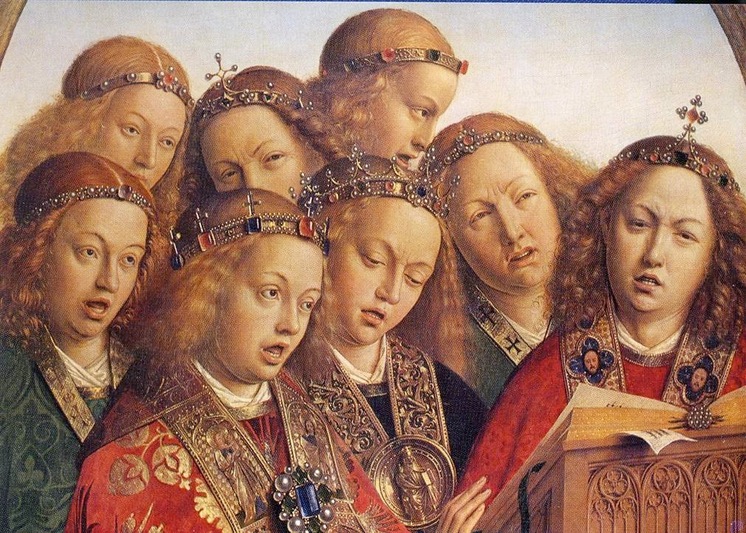
What is God’s favorite musical instrument? Harps? Organs? Bongos? I believe it is the instrument He created Himself, the one which He loved so much that He gave one to each of us for free–the human voice.

God is pleased when we sing for Him. St. Augustine said, “The person who sings prays twice.” Some people say this is because singing adds melody to our words of prayer. But it could be that a person sings twice because singing enlists the heart to join in the prayer of the mind. Singing lifts up our hearts to the Lord.

In today’s first reading, the missionaries St. Paul and Silas get beaten and stripped. They are locked in prison with their ankles placed in stocks. Things are at their darkest and most difficult time, but the night finds them not only praying, but singing hymns. This lifts their spirits, shakes loose their bonds, and pours out grace on that place. Singing makes a difference.

Maybe you feel like coming to our weekly school Masses is like being led somewhere in shackles. But if you must be here either way, why not make the most of it? Singing at Mass (and I mean really singing) is liberating, and a gift to God. 

If God has blessed you with a beautiful voice, sing strongly, as if to say to God, “You gave me this gift, and I offer it back to you.” If He has not blessed you with a good voice, you should still sing boldly, as though to say, “You gave me this voice, and I’m going to let you have it.” Your voice is God’s favorite instrument. So at this Mass and at every Mass, let Him hear it.