Archive for the ‘Weekday Homilies’ Category

3 What If’s — Tuesday, 5th Week of Easter

May 4, 2010

Before today’s Mass, I would like you to imagine three “what if” scenarios. How would you respond in the three situations I’m about to describe?

First:  Imagine, what if, at this morning’s school Mass, the great apostle St. Paul was going to preach to you? How interested are you in whatever he has to tell you?

A second scenario: What if there were a book out entitled, Actual Prayers of Jesus and Mary, and what if there was strong archeological evidence to support that these really were prayers which Jesus and Mary prayed frequently during their lives on earth? How interested are you in discovering these prayers? How powerful would it be for you to pray their prayers?

The third and final scenario: What if I were to tell you, calmly and with firm conviction, that I had received a message for you, a revelation, from Jesus Christ, which He wanted you to hear through me at this Mass? How interested and open are you to receiving such a message?

Of these three scenarios, which one would you most desire to be true?Now listen closely…. All three of these scenarios will be realized, will be true, at this Mass.

The first scenario will be realized: St. Paul will indeed preach to you–in this morning’s first reading. Perhaps St. Paul did not realize it when he first spoke these words, nor perhaps did the sacred author who wrote them down in the Book of Acts, but the Holy Spirit was inspiring, was guiding these words.

And the Holy Spirit did not only have the first-century Christians of Lystra, Iconium, and to Antioch in mind when He prompted these words. St. Paul’s inspired message is meant for us today just as much as they. So this morning, St. Paul will preach a message (though only one sentence long) which is truly intended for you.

As to the second scenario, where is this book containing Actual Prayers of Jesus and Mary? We read from it at almost every Mass, as we will today. This book is the Book of Psalms. In the day of Jesus and Mary, all devout Jews prayed these 150 psalms and they usually knew them by heart. Jesus and Mary prayed the Psalms too. These prayers were inspired by the Holy Spirit to be prayed by all God’s people, including us today, but one could say that the Psalms find their fullest voice through Jesus and Mary. In today’s responsorial psalm, we will join Jesus and Mary in one of their powerful prayers in praise of the Lord.

The third scenario will also be true at this Mass: I have indeed received a message from Jesus Christ which He wants you to hear through me this morning. You will hear His message addressed to you in the proclaimation of the Gospel. At the Last Supper, Jesus was not only speaking to the disciples seated around Him. With His divine sight, Jesus saw all of us here then, and He speaks intending His words for us this morning just as much as they. How much will you allow Jesus’ message to you to affect and change you?

We believe that, “When the Scriptures are read in the Church, God himself is speaking to his people and Christ, present in his own word, is proclaiming the Gospel.” At this and at every Mass, let us come to the Scriptures expecting much, so that we may find much, and receive in from them in abundance.

The Miraculous Pool — Tuesday, 4th Week of Easter

April 28, 2010

Once upon a time, in a certain forest clearing, there was a miraculous (and strange) pool of water. The pool’s waters’ were miraculous, having unique healing and life-giving properties, but something else made this pool strange. When travelers would come upon it, the pool would appear differently depending on how the person approached it.

For those who expected to find something remarkable, the pool was large and deep, and drinking its waters was powerful. But for those who came expecting little or nothing (and there were many such people,) the pool had the appearance of a small, cloudy puddle, and they would not drink from it.


Why did so many come expecting so little, and walk away unchanged? Maybe they had passed by that clearing a hundred times before; and, never expecting much, never had found very much. Maybe they dismissed the whole idea as superstition, as an old myth. Maybe they had never seen evidence that this pool was any better than any other because the people whose lives had been changed by its waters were too timid to give a strong witness to its power and reality.

Now we come to the point of this parable of mine. Encountering our Catholic Faith, the Mass, and the Scriptures is a lot like encountering this miraculous pool. When we expect much, we find much, and receive a great deal. And when we expect to get nothing from them, the usually meet our expectations.

I believe our Catholic Faith is a miraculous pool with the power to change everything. Walking in Christian faithfulness is hard for everyone at times, but I have seen too much, firsthand and from others’ experiences, ever to walk away from Christ and His Church. I have forsaken all other paths for my one life because I am convinced that our Faith, the Mass, and the Scriptures are true, and powerful, and good. Yet even I often need to remind myself not to settle, but to go more deeply and prayerfully into these dangerously familiar things. And when I do, I receive more. I think we all need to receive more. So, in the weeks ahead, I’m going to teach, through pre-Mass talks like this one, or through homilies during Mass, about ways to drink from the miraculous pool to our greater benefit.

For this morning’s Mass, I have four suggestions:

1.  Pray to the Holy Spirit for a more expectant and receptive heart.
2. Form a Mass intention to pray for during the Eucharistic prayer.
3. During the psalm, try to find the Virgin Mary or the Church in it.
4. Listen to Jesus speak to you in the Gospel for He will be speaking to you through His word.

 Let us approach this miraculous pool expectantly.

Hearing Him — Friday, 3rd Week of Easter

April 23, 2010

Jesus says, “Whoever eats my Flesh and drinks my Blood,” as we are about to do in at this Mass, “remains in me and I in him.” After we receive Him, He remains with us and we with Him.  And He stays with us, provided we do not cast Him out through committing serious sin, until we receive Him again.

Jesus remains close to us throughout our day. Wouldn’t it make sense, that time to time, He would occasionally have something to tell us? Maybe we don’t hear Him because He knows we would refuse to listen. Perhaps He knows we would dismiss hearing Him speak to us out of hand, or maybe He knows we don’t trust Him enough to go out on a limb. For example, if you got the feeling that the Lord wanted you to relay to a message, a message you didn’t really understand, to particular person what would you do?

In the first reading, the Lord speaks to Ananias and Ananias answers, “Here I am.” Then the Lord gives Him an entirely wholesome, but very counter-intuitive task: lay your hands on Saul and heal him. Ananias hesitates a little. Ananias might be wondering if this is really coming from the Lord, or maybe he’s not sure he wants to risk this much for the Lord. But in the end, Ananias listens, and because of it, Saul became St. Paul.

If we would like the Lord to do such things with us let us be faithful in little things, faithful to the commands of our consciences and to the gentle nudges of the Holy Spirit throughout our daily lives. If we are willing to trust Him, Jesus will ask us to be His chosen instrument in greater matters too. So let’s listen, let’s be docile, and see what He does with us.

Rabbi Gamaliel’s Wisdom — Friday, 2nd Week of Easter

April 16, 2010

The apostles were brought before the Sanhedrin, the Jewish High Council, to be questioned for why they continued to teach in “that name.” At hearing the apostles’ answers, the Jewish leaders “became infuriated and wanted to put them to death,” but a Pharisee in the Sanhedrin stood up and had the apostles put outside. This was Gamaliel, a great teacher of the law who was respected by all the people. (It was at this rabbi’s feet that St. Paul received his Pharisaical training.)

Gamaliel said, “Fellow children of Israel, be careful what you are about to do to these men.” Now his form of address here is interesting and revealing. He could have addressed his peers in the Sanhedrin in many different ways, but by calling them “fellow children of Israel” he recalls Jacob (whose name God changed to Israel) and his twelve sons.

Now of all those sons, Joseph was Jacob’s favorite. This made the others so jealous that they sold Joseph into slavery. But through suffering this dishonor Joseph would go on to become the instrument of their salvation. Even though they meant to destroy him, they failed. God intended this for good, to achieve the salvation of many.

Gamaliel concluded his speech to the Sanhedrin wisely observing, “If this endeavor or this activity is of human origin, it will destroy itself. But if it comes from God, you will not be able to destroy them…”

Evil endeavors or activities are destroyed in time. But what is of God endures, even if it is sometimes setback by evil and sins. In these beleaguering times, for our country, for our Church, and for our pope, this lesson from Rabbi Gamaliel gives us good reason for hope.

The Apostles’ Charge — Thursday, 2nd Week of Easter

April 16, 2010

 The high priest Caiaphas had once remarked to the Sanhedrin during the time of Jesus’ ministry:

“You know nothing, nor do you consider that it is better for you that one man should die instead of the people, so that the whole nation may not perish.” He did not say this on his own, but since he was high priest for that year, he prophesied that Jesus was going to die for the nation, and not only for the nation, but also to gather into one the dispersed children of God. (John 11:49-52)

The high priest, whom many Jews believed possessed the gift of prophesy, here spoke words truer than he realized. A similar episode happens in today’s first reading:

When the court officers had brought the Apostles in and made them stand before the Sanhedrin, the high priest questioned them, “We gave you strict orders did we not, to stop teaching in that name. Yet you have filled Jerusalem with your teaching and want to bring this man’s blood upon us.”

With their teaching, the apostles have indeed filled Jerusalem, the true and heavenly Jerusalem, with the souls of the saints. And the apostles did want to bring Jesus’ blood upon those who questioned them, for the blood of Christ cleanses us from sin. In his revelation, St. John “saw the holy city, a new Jerusalem, coming down out of heaven from God, prepared as a bride adorned for her husband.” (Rev 21:2) “They have washed their robes and made them white in the blood of the Lamb.” (Rev 7:14)

The Sanhedrin commanded the apostles to stop proclaiming Jesus, but the apostles replied, “We must obey God rather than men,” for as John’s Gospel says, “whoever disobeys the Son will not see life.” The Gospel teaches, “Whoever believes in the Son has eternal life, but whoever disobeys the Son will not see life, but the wrath of God remains upon him.” But who truly believes and shall be saved?  Who disobeys and shall be condemned? Thankfully, this final judgment is not ours to decide, but our mission from Jesus is clear. Like the apostles, with Jesus’ teachings we are to fill the heavenly Jerusalem  and bring Christ’s saving blood upon all people.

Easter Endures — Easter Friday—Year C

April 11, 2010

For the rest of the world, today is the second friday of April. For us, today is Easter. The rest of the world has gone back to life as before, but we in the Church continues to remember and celebrate Easter.

In the Gospel we see Peter and some of the disciples going back to their old ways, back fishing in Galilee. And in the first reading we see the Jewish leaders, elders, and scribes operating just the same as before. But they all get reminded that Easter has changed everything.

So let’s not forget the graces we received this Triduum. And let us remember that in these “last days” every day is Easter and that our lives and our world will never be the same as before.

The Savior’s Hands — Good Friday

April 7, 2010

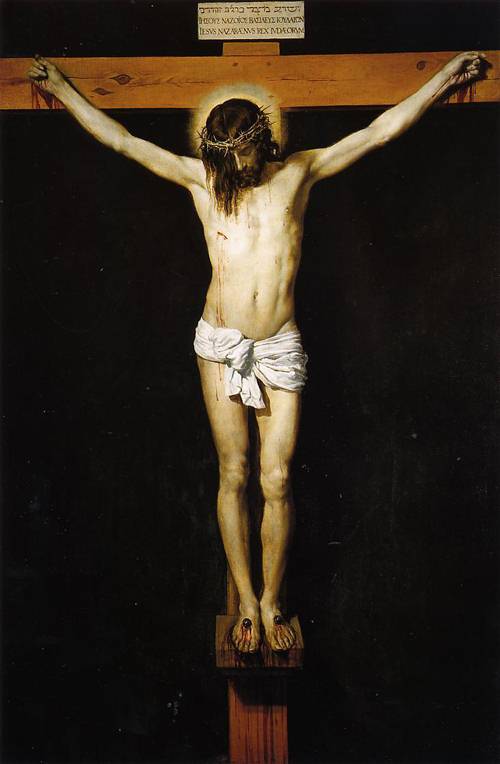
This Good Friday, let us meditate on our Savior’s hands.

These hands held the scrolls of the Jewish Scriptures, from which He learned the Word of God. These hands held the hand of Joseph, and reassured him for his happy death. These hands fashioned the products of a carpenter to support His mother and Himself in their needs.

When the time came for His public ministry, these hands touched the ears and toungue of a deaf and mute man, allowing him to hear and speak. They smeared mud in the eyes of a blind man, who then washed and was able to see. They touched a leperous man and cured him of his affliction.

These hands formed a whip out of cords and drove out the moneychangers and salesmen out of the court of the Gentiles so that the temple could be a place for all peoples to worship the True God. These hands blessed and broke a few loaves of bread and multiplied them to feed thousands.

Today, these hands are nailed to the cross. Jesus’ crucified hands can do nothing, apart from perhaps twitching a couple fingers with excruciating pain. Yet of all the wonderful things that Jesus did with His hands, this was the greatest.

I offer two obeservations for us today.

First, that when Jesus could do nothing, He could still speak and pray. We can do the same we when faced with the things beyond our power (which is really nearly all things.)  We can bind our hands in prayer, a symbol and  acknowledgement of our own limitations, and pray.

Second, it was when Jesus was powerless he performed his greatest good. We worship a crucified God; who suffered, died, and rose from it triumphant. We should expect and understand that this mystery will be replayed within our own Christian lives. As St. Paul observed when he considered his own life, “when I am weak, it is then that I am strong.” The same applies for us.

Sometimes we suffer because of loved ones we cannot seem to help, or serious illnesses that befall ourselves or others. Our crosses take different forms, and can feel powerless with them. But we do more good through our crosses than we know.  Remember, that of all the things that Jesus did with His hands, the greatest was when He suffered them to be nailed to the cross for us today.

The Disciples’ Feet — Holy Thursday

April 4, 2010

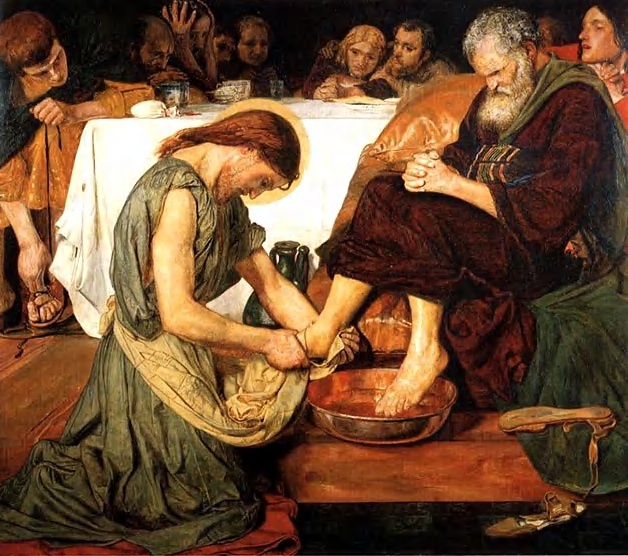
This Holy Thursday evening, I would like to talk about feet, the apostles’ feet and our own.

Feet are funny, awkward, and funky. They are lowly, odd, and unclean. This was true in the apostles’ day and it is still true today. Of all the parts of the body, the feet are the most lowly. They are humbly situated on the ground and they’re the only parts of our body which are regularly stepped-on.

Our feet are odd-looking things. They’re like clubs, with knobs and nubs all over. And feet are ackward too. Their range of motion is limited and they’re the only part of the body which we trip-over.

Feet are funky, that is, they’re unclean. Even though the apostles walked everywhere either sandled or barefoot, while we have shoes and socks and daily showers, we remain well-familiar with smelly feet.

We have feet, just like the apostles, so we still have some sense of what it means for Jesus to wash His disciples’ feet. I have been speaking up to now of physical feet, the feet of our legs, but one could say that we also have spiritual feet too, the feet of our souls. The imperfect apostles had these spiritual feet, and so do we.

Perhaps you feel worthless and low, unworthy of Christ’s love, friendship, or help. Perhaps you have been humbled and brought down to earth by others or by an awareness of your sins. Yet, no matter how low you may feel, know that just as He stooped down to the feet of His disiciples, so Jesus is willing to stoop down for you.

Perhaps you feel there are aspects of yourself which are too ackward or limited to be offered to God, parts which you think are of no use or value to Him. Yet, just are Jesus embraced the feet of His disiciples, so He wants to receive even our ackward and limited parts.

Perhaps you feel spiritually unclean because of sin. Know that just as Jesus washed His disciples feet, so He wants to wash you clean.

Jesus stooped down, embraced, and washed his apostles’ feet because He loved them, and He wants do the same for us. By giving Himself to His disciples in the Eucharist, Jesus shows us that He wants to share everything He is with us. By washing His disciples’ feet, Jesus shows us that He wants us to share everything we are with Him.

11 Absent Students — March 25 — Annunciation

March 28, 2010

You have probably wondered why our school chapel’s icon, statues, and crucifixes are veiled with purple cloth. Covering of religious images is a tradition for the last two weeks of Lent, a period we call Passiontide. So why do we have this tradition?

One explanation recalls that Jesus’, when His enemies sought to kill Him, hid Himself prior to His final days: “Jesus left and hid from them.” (John 12:36) Others see in this veiling a symbol for how Jesus’ divinity was veiled within His humble and vulnerable humanity. He was God incarnate, but none of the rulers of His age knew, “for if they had known it, they would not have crucified the Lord of glory.” (1 Corinthians 2:8) But behind all of this I think there is a very human reason for why we veil the holy images of Jesus and the saints at Passiontide. “Absence makes the heart grow fonder.”

During Lent we deprive ourselves of luxuries and pleasures for our personal conversion and growth in holiness, but we also do this so that we can celebrate the Christ’ Easter triumph with an even greater feeling of joy. This is why we normally don’t sing as much (or say the Gloria or the “A”-word before the Gospel) during Lent—so that we can enjoy pulling out all the stops at Easter.

Veiling our statues of Mary and Joseph, our wall icon of Elizabeth Ann Seton, and our crucifixes causes a little pain of separation within us. But what if this chapel had never been furnished? What if our chapel had always been bare of religious art? Then their absence would not affect us at all because we would not know that we were missing them.

There are not as many students here today as there should be. Now I’m not saying that this should have been a whole school Mass, and I’m not begrudging anyone who may have stayed in study hall this hour to work on homework.  This is a great turn out and every seat is filled. But still, there are not as many students here as should be here today.

In the early nineties, when most of you were born, for every three live births in our country there was one boy or girl who was intentionally killed. (CDC) I counted roughly 33 students here today. That means we are missing 11 of your classmates who were not allowed to be born.

Today we recall the Annunciation, which some people call “Pro-Life Christmas,” for even though Jesus will be born nine months from now, today is the day of the Incarnation, when God became a human being like us in the womb of the Virgin Mary. After the angel Gabriel departed, Mary went in haste to see her relative. Elizabeth exclaimed, “Who am I that the mother of my Lord should come to me,” and John the Baptist leapt for joy in his mother’s womb in the presence of our microscopic Savior, Jesus Christ. (Luke 1:43-44)

Imagine if 11 of your classmates were to die in a bus accident. You would you feel terrible from the loss, and our whole school would be in mourning. But we have never known the 11 who are missing here today, so we do not feel our loss.

At this Mass and henceforth, let us keep the following things in mind regarding the past, present, and future. As to the past, remember these absent classmates and pray for them. They never received a name, they never had a funeral, and few people have ever prayed for them. Pray for their parents, too. 

In the present, perhaps you honestly find yourself not feeling much emotion one way or the other towards the reality of one million innocents being murdered in our country every year. If so, then ask God to give us His heart and His sight to love what He loves and to hate what He hates. God loves us all, but He hates our sins. He hates our sins because they are bad for us, and the worse they are for us the more He hates them. His love for us and His hatred for our sins are two sides of the same coin. Blessed Mother Teresa of Calcutta said “the greatest destroyer of peace today is abortion.” The Lord’s heart is certainly not indifferent to this evil, and neither should ours be.

And finally, for the future, keep hope that this evil of abortion will come to an end in our time. We can have this hope, for as the angel Gabriel said to Mary, “nothing will be impossible for God.”

One Catholic Church — Tuesday, 3rd Week of Lent

March 9, 2010

In the first reading we hear the ardent prayer of an Old Testament Jew named Azariah who finds himself in a pretty hot spot. He fervently prays, “… O Lord, do not deliver us up forever, or make void your covenant. [Save us for] the sake of Abraham, your beloved… to whom you promised to multiply … offspring like the stars of heaven, or the sand on the shore of the sea.”

This was God’s covenant promise to Abraham, and God has indeed made Abraham’s spiritual offspring vast and numerous. Today, half of the people on earth claim Abraham as their father in faith—these are Christians, Muslims and Jews who all seek to worship the God of Abraham.

Yet Jesus prayed that all people would be one in Him, as one holy family of God—a diversity of persons sharing one perfect unity. To achieve this goal Jesus established one, holy, catholic, and apostolic Church, so that all may be one, as He and the Father are one. Our Church was established by Jesus, Himself, who said to Peter, our first pope, “You are rock, and upon this rock I will build My Church.”

Our Catholic family is made up of every race and reaches to every nation. To illustrate this, I would ask all high school students; freshmen, sophomores, juniors, and seniors, to stand up now. Imagine that these 146, or so, young men and women represent the world’s nearly 1.2 billion Catholics. Each one represents about eight million of our  Catholic brothers and sisters.

In the United States we have 68 million Catholics, but this is only 5.7% of all the Catholics in the world. I would now ask the male freshmen to remain standing and for everyone else to sit down. These guys represent the Catholics of the United States, plus the rest of North America and the Caribbean—just 9% of Catholics worldwide.

The freshmen can sit down and I would ask the male sophmores to stand up. This is Asia, Australia, and the Pacific Islands, totaling 11% of all Catholics.

You can sit and I’ll ask the senior males to stand. This is Africa’s Catholics, 12% of the Catholics in the world.

You can sit and we’ll have the male juniors and the female seniors rise. This is Europe, 27% of all Catholics.  (The pope is in there somewhere.)

You can sit and we’ll have our largest region of all, represented by the female juniors and the full sophomore class, please stand. This is Central and South America, where 39% of all Catholics live.

So, as you can see our Catholic family is far more diverse than you might have imagined. We are young and old, men and women, rich and poor, sinners and saints.

Our Catholic family not only spans the globe, it also spans the centuries. This is reflected in the ancient prayers we sing today, such as the Latin Sanctus and Agnus Dei, the Kyrie which is ancient Greek, and the Amen which is Hebrew.

Let me put this another way: Could I have one high school student please stand up. This one person represents about 13½ years, which is about how long you have had to explore and get to know about your faith. Now could all of the high schoolers please stand up. You represents all the years that the Church has been on earth, since 33 AD. Our Church has been around a lot longer than we have. You may be seated.

Roman Catholics make up the largest religious denomination in the United States.  However, it is said that the second largest denomination in our country would be former Catholics. Tragically, many Catholics leave the Church. Oftentimes, they experience one or two parishes and a couple of priests, in one region, of one country, over a handful of years, and they imagine that they have exhausted the riches of the 2,000 year-old worldwide Church and Faith of Jesus Christ. But in reality, you can explore the mysteries of Catholic beauty and truth for a lifetime and never exhaust them.

My message for you, with all passionate the urging of Jesus Christ, is this: always remain in the Church that Jesus Christ founded. Never walk away from the fullness of God’s family, but dwell in the household of God.

Sources:
Distribution of Catholic Population, by Region: 2000
USCCB: The Catholic Church in the United States At A Glance

Alive in Christ — Funeral for Lila O’Brien, 94

March 3, 2010

On behalf of Christ the King parish I wish to offer to you, Lila’s family and friends, the sympathies and prayers of this community. I also want to give special recognition, praise and thanks to Lila’s children, who provided her with around the clock companionship and care, allowing her the blessing of dying at her home with her loved ones.

In these last months, I had the privilege to visit Lila at home on two occasions. The first time I came, I anointed her with holy oil, to strengthen her for the share in Christ’s passion which laid before her. The second time some of her family and I gathered and pray with her the prayers of commendation for the dying.

When I ask people about Lila they tell me that she was friendly and feisty. That she was ever active and always on the go. That she was funny, a bit goofy, and unpredictable. They tell me that she was very independent, yet also very personable. Lila was a neat lady. Let us not forget that she remains a neat lady.

It is the habit in our culture to refer to people who have died using the past tense. For instance people say, “So and so was such a loving person,” and they say the person “would have really enjoyed being with us today.” Even if unintentionally, these words implies that the dead love no longer and that they are no longer aware of us.

Yet after death, a person who is loving in this life becomes still more loving. It seems quite likely that each of us will be aware of our own funerals, just as I believe that Lila is aware of our gathering today.

Though we fall into speaking of the departed in the past tense, we do not really believe that death is the end. Dying does not annihilate those we love. As Jesus said, ‘The God of Abraham, the God of Isaac, and the God of Jacob is not the God of the dead, but of the living, for to Him all are alive.’

Nor does dying make a person less fully themselves than what they were before. “Whether we live or die, we are the Lord’s.” And as Jesus said in the gospel, to the good thief crucified with Him, “Amen, I say to you, today you will be with me in Paradise.”

Lila has passed on, but if you would like to talk to her, just go ahead and pray. She will hear you and she will appreciate it. And be sure to pray for her too.

In her years on earth, Lila did not like to travel far from home and she didn’t take long trips, unless the promise of a casino jackpot awaited her. But now Lila is making the human soul’s furthest trip, the journey to full and heavenly presence of God. She has an incredible jackpot to motivate her, the promise of supreme and perfect happiness, however receiving this reward is not a matter of luck. It requires the purification of her soul and the help of our prayers, so offer this morning’s mass and your continued prayers to God for her.

Lila has died, but Lila is not dead. If the woman we remember has changed it is only to become more perfectly who she really is, in all her unrepeatable uniqueness. Lila was, and she remains, a friendly, funny and feisty lady.

The Scales Myth — Friday, 1st Week of Lent

February 26, 2010

In ancient myths and modern imagination, the judgement of our lives will be done with a pair of scales, with our good deeds one one side and our bad on the other.  If our good deeds outwiegh the bad ones (so the story goes) then we’re in good shape.  If not, we’re toast. However, our first reading from the prophet Ezekiel shows that this not how God judges things.

If the wicked man turns away from all the sins he committed, if he keeps all my statutes and does what is right and just, he shall surely live, he shall not die. None of the crimes he committed shall be remembered against him; he shall live because of the virtue he has practiced.

And if the virtuous man turns from the path of virtue to do evil, the same kind of abominable things that the wicked man does, can he do this and still live? None of his virtuous deeds shall be remembered, because he has broken faith and committed sin; because of this, he shall die.

God is more interested in where we’re headed than where we’ve been. This is encouraging good news for the long-time sinner who needs to repent and it is a warning to us who have done well in the past.  It’s not what we’ve done in the past that matters, because each of us can make a definitive turn toward or away from the Lord today.

What advantage then do we who are faithful to the Lord have over those who have deathbed conversions, over those steal heaven like the good thief on his cross next to Jesus? Very much indeed, for our lives’ holiness and good deeds will be weighed and our personal degree of heavenly glory and reward will be measured out accordingly. In heaven we shall all be filled and satisfied, but those who love most in this life shall enjoy the most love in the next.

So whether you are far from God or serving Him faithfully, heed these holy words: “If today you hear His voice, harden not your hearts.”

The Our Father — Tuesday, 1st Week of Lent

February 23, 2010

When the apostles asked Jesus how they should pray, Jesus taught them what is called the perfect prayer, the “Our Father.” It is a concise prayer, with just seven petitions (a perfect number for the Scriptures,) yet there is great depth beneath its simplicity.  This morning I show you three insights into this prayer which I hope will come to your mind from time to time as you pray this prayer for the rest of your lives.

First, Jesus teaches us that we are to pray to “Our Father.”  This is a far more wonderful thing than we realize.  To see its greatness, just imagine if the prayer were different. We do not pray, “Our tyrant, who art our ruler, before thee we grovel.” Nor, “Our master, we art thy slaves, for thee we must toil.” And we do not say, “Unknowable one, whom none can name, unapproachable be thy being.” We pray, “Our Father who art in heaven,” hallowed be His name.  We have the privilege to call God our Father on account of our faith in His Son, Jesus Christ. Jesus is God’s Son by His nature, (God from God, light from light,) but we are made God’s children by adoption through Christ. One way to see why this is such a big deal is to imagine if God were everyone’s heavenly Father, except for you. Whatever applies to a good father’s relationship with his natural children, also goes (with limited exceptions) for the perfect Father’s relationship towards us, His spiritual children. Keep in mind how privileged we are when you pray to “Our Father.”

The second insight this prayer yields is the proper attitude we should have towards prayer. Perhaps you’ve heard some people say, “Well, if you like to pray that’s fine—I mean, if that helps you to motivate yourself that’s great,” as if the only power of prayer was to change one’s personal attitude. This is something said by people who don’t pray, and if we thought as they did then we wouldn’t pray either, for who would bother to ask someone else to receive what is already in one’s own hands (i.e., the choice of one’s own attitude.) A second motivation among people who do not pray is more faithful, but also misguided. These say, “I can’t change God’s mind, so why should I bother to pray? Whatever He wills will be, whether I pray to Him or not.”

The first three petitions of the “Our Father” are worded carefully. They do not say, “Our Father, who art in heaven, make your name holy among us, make your kingdom come upon us, and make your will be done among us.” This would put everything on God. Nor do the opening lines read, “Our Father, who art in heaven, we will glorify your name, we will make your kingdom come, and we will make your will be done, on earth as it is in heaven.” This would put everything in our own hands.

The prayer which Jesus gives us does not put everything on God, or put everything on us. Jesus presents the middle and true way of faith. We are not called to an independent activism, nor to a vacant passivity, but to an active receptivity in relationship with God. Like the Virgin Mary, we are to stand before our Father, with a spirit of active receptivity, and pray, “Behold, I am yours, may your will be done, in and through me, and on earth as it is in heaven.”

There are some things which are simply beyond my human ability.  For instance, I can no more forgive my own sins than I can pull up on my belt loops and hold myself up in midair. However, that does not mean I can do nothing to help my situation. I can first forgive others as I wish to be forgiven. I can pray, go to confession, and tell God that I’m sorry. God calls us to do our part and to cooperate in His work.

Maybe this explains why Jesus could not work great miracles where people were lacking faith. It was not that such things were beyond God’s omnipotent power, it is that God insists upon doing His works in relationship with us, rather than entirely apart from us. (This is His purpose in establishing the Church—to do His saving work with and through us.) Like St. Augustine said, ‘The God who created us without us, will not save us without us.’

The third and final insight into the Lord’s Prayer regards the meaning of the petition for “our daily bread.” We say, “Give us this day our daily bread.” We can pray for this “bread” in three senses; literal, spiritual, and Eucharistic.

First, there is the literal sense, praying that God would provide for our material needs in life; such as housing, clothing, and food. We take these things for granted—your daily bread already waits for you in the cafeteria or in your kitchen at home—but there are many people around the world, who are much less well-off than we are, who pray these words from their hearts every day. Occasionally we should call these brothers and sisters of ours to mind and pray these words as intercession on their behalf before our Father.

Second, there is the spiritual sense, asking for the graces and helps that money can’t buy; such as peace and virtue, faith, hope, and love. Without these things, even a rich man remains impoverished, for man is not meant to live on material bread alone.

Third and finally, there is the Eucharistic sense, which asks for the bread from this altar which is God’s Son. Whenever we receive Jesus in the Eucharist He remains with us and in us until we receive Him again (unless we should disinvite and evict Him by committing grave sin.) In this way, Jesus persists as our “Daily Bread.”

So when you pray the “Our Father” realize your privilege in being His child through Jesus Christ. Consider that the coming of the Kingdom is a joint effort of God with man, in which our prayers play an important part. And pray for all your daily bread; literal, spiritual, and Eucharistic. May you remember these insights for all of your life and may the words of Christ’s perfect prayer make you a fruitful child of our Father.

Romantic Christianity — Friday after Ash Wednesday

February 21, 2010

In the gospel disciples of John ask Jesus, “Why do we and the Pharisees fast much, but your disciples do not fast?” Jesus answered them, “Can the wedding guests mourn as long as the bridegroom is with them?” Of all the images in the Bible to depict the relationship between God and His people, perhaps the most common is that of bridegroom and bride.

As we begin this Lent we should understand that the saints became holy and made their great sacrifices not by relying upon their own “iron-wills,” but by falling passionately in love.

If we strive after holiness as a personal achievement our exertions will make us discouraged and resentful, like the people in the first reading who complain, “Why do we fast, and you do not see it? Afflict ourselves, and you take no note of it?”

But what sort of person can make incredible sacrifices for another, without counting the cost, and feel intoxicating happiness as they do so? A person who can do this is a person who’s in love.

What if Christianity is not supposed to be so hard as you’re making it out to be? What if it is supposed to be as easy as falling in love? Perhaps you are being called to a new approach.

The Two Ways — Thursday, 6th Week in Ordinary Time—Year II

February 21, 2010

In the first reading Moses sets before the people ‘the two ways’: life and prosperity, or death and doom. In the gospel Jesus tells us to deny ourselves, take up our cross and to follow Him. From this we might think that one could choose to bypass the cross, to never take it up, and to avoid the burden of the cross, but the cross is unavoidable.

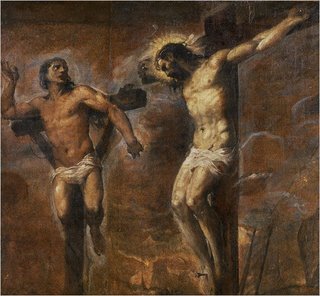
Jesus was crucified along with two others, one on His left and one on His right; one who rejected Him, and one who accepted Him. These two people represent us. We are all crucified with Christ, and He is crucified with us. The question is how we will respond to Him.

In life there is no avoiding the cross, but in which way will we respond to it?  Will we rage and despair, or embrace it and follow Christ? Today I have set before you life and prosperity, death and doom. Let us follow the Lord, ‘for whoever wishes to save their life will lose it, but whoever loses their life for Christ’s sake will save it.’