Archive for the ‘Jesus Christ’ Category

The Saints & Us — 22nd Sunday in Ordinary Time—Year C

November 5, 2010

 
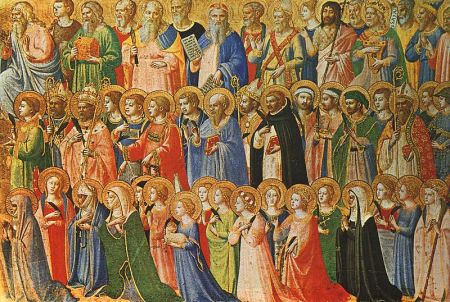
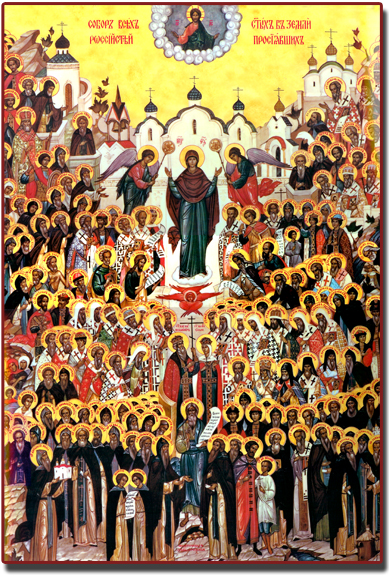
Brothers and sisters, as the Letter to the Hebrews tells us, we have approached Heaven even as we remain on earth. Though we are dust and sinners, we stand before Jesus, the eternal Father, and the Holy Spirit. We draw near to each other and they invite us to share more deeply in their friendship. And they are not alone. They are surrounded by countless angels and by a multitude of men and women whom they have made perfect in goodness and love. We have a name for these “holy ones” who live with God in Heaven. We call them “saints,” and Jesus invites us to share their friendship, too.

Have you ever had the pleasure to introduce your friends to each other; people who already know and enjoy you, but who have never met each other? I think you’ll agree that it’s a very special joy when your friends to befriend each other. When your friends befriend each other do they love you less because of it, as if their affection has been divided or diluted? No, the love between all of you is greater for being shared. So it is with Jesus, the saints, and us. Some Christians fear that befriending Jesus’ friends in Heaven will lessen our love for Him. They fear that talking to them and honoring them will distract us from Christ. But these are silly fears. Love increases by being shared.

When someone asks you, “Would you pray for me,” or asks you to pray for one of their heartfelt concerns, what do you say in reply? Do you refuse, saying, “Why should you ask me to pray for you when you can go directly to God?” Nobody says that. Instead, Christians say, “Of course I’ll pray for you.” Christians ask each other to intercede for them not because they have lost hope in Christ, but because they have it, and because Scriptures tell us, “pray for one another.” Asking our friends and family in Heaven to pray for us is no different than asking our friends and family on earth, except that the prayers of the saints are offered by souls perfected in love and divine intimacy.

What about the objection that honoring the saints distracts from Christ? Today’s Gospel shows that Jesus does not think that sharing honor with His saints detracts from His own preeminent glory. He has said to them, “My friend, move up to a higher position. Then you will enjoy the esteem of your companions at the table.” By giving seats of honor to His saints at His heavenly wedding banquet Jesus invites us to esteem them. In honoring them, we honor Him.

Remember that our circle of closest family and friends is not limited to earth. We have brothers and sisters in Heaven; saints and angels who know us, love us, and want to help us arrive at our true home. Let us remember to take the opportunity to make their acquaintance and grow in their friendship.

Have A Holy Halloween!—31st Sunday in Ordinary Time—Year C

October 31, 2010

Have you ever noticed how our Christian holidays get filled with stuff that distracts us from what we’re really celebrating? Take Christmas, for example. There’s nothing wrong with exchanging gifts and decorating with tress and lights, but there is good reason in that season that we need be reminded, to “Keep Christ in Christmas.” For many people, celebrating the birth of the Prince of Peace on earth is the most stressful time of the year. Or consider Easter: There’s nothing wrong with chocolate bunnies and hunting for Easter eggs, but the connection between egg-laying rabbits and Jesus’ resurrection is tenuous at best.

However, this disconnection between Christian holy days and the cultural observance of holidays is the greatest when it comes to Halloween. There’s nothing wrong with kids playing dress-up and going door-to-door to ask for candy, (I have many happy memories of this myself,) but Halloween’s connection to its Christian holy day seems to have been forgotten. The name “Halloween” comes from “All Hallows Eve,” or the evening before All Saint’s Day. Something is “Hallowed” when it is sanctified or respected, as in, “Our Father, who art in Heaven, Hallowed be thy name.” All Saints Day celebrates the “hallowed” ones, the holy ones, the saints who are now in Heaven. Some of these saints are canonized, but most of them are not.

For every friend and relative we knew on earth who is now in Heaven, November 1st is their feast day in the Church. And for our holy dead who are still being purified and made perfect so that they may enter the fully-unveiled presence of our infinite God, there is November 2nd, the Feast of All Souls. In this fall season, when the natural world appears dying, our Church celebrates the holy dead, for we have hope in the new life.

Halloween, or “All Hallows Eve,” is to All Saints Day what Christmas Eve is to Christmas. As Christmas Eve reminds us of Christ’s coming, so Halloween should remind us of the victory of the saints, and of our own life’s calling: to become the best possible versions of ourselves, to become saints.

I think it is in no way an overreaction to observe that the secular observance of Halloween has overtones in dark, demonic things; the things of horror. Isn’t it suspicious that from a feast celebrating the saints in light, we have a secularized holiday focused on things of darkness? Instead of Christian hope in the resurrection of the dead, Halloween gives us images of zombies. Instead of the consolation that we are surrounded by the perfected souls of the saints, who love us and are full of concern to help us, Halloween gives us tales of ghosts and demons who want to harm and scare us. How does this sort of thing happen? I don’t think it is crazy to think that the Evil One wants to distract people from the true reason for this season; that the Devil would have us thinking about him, rather than the saints, that he wants us to be terrified, rather than full of hope.

Did you know that this Sunday, Satanic worshipers will come to Masses and Catholic Churches around the country trying to steal our Lord in the Eucharist? (Interestingly, they don’t go after the communions of Protestant denominations, but only the Catholic Eucharistic Hosts.) Their plan is to desecrate Jesus in a ritual they call a Black Mass. In doing this they are trying to rebel, seeking a false freedom that cannot make them happy. They try to harm Jesus, but only hurt Him in as much as they sadden Him. These sad people, who strike out at Jesus, are really hurting themselves and the Jesus still loves them. We know that the Lord loves every person He has made, for as the first reading notes, if the Lord did not love His creations, they would not continue to exist. As we see in today’s gospel about Zacchaeus the sinful tax-collector, there is hope for them and all of us, for Jesus “has come to seek and to save what was lost,” and He calls every one of us to be happy and holy with Him.

This Halloween, let us pray for the misguided persons, who knowingly or unknowingly, will dabble in bad things tonight, that they may turn to Christ. Let also offer Jesus our consolation for how the feelings of His Sacred Heart will be wounded by their offenses against His love. And for ourselves, let us try celebrating Halloween in some different ways this year.

Maybe everyone in your household already has their trick-or-treat costumes ready (but I know it can sometimes be a last minute decision.) If you’re still looking for costume ideas, how about dressing up as an awesome saint? Saint costumes can be easy and very creative. Dressing like this delights the saints (and it will probably score you more candy.)

Does your family have a patron saint? If not, then pick one this Halloween and entrust your family to them for the year ahead. Print off their picture from the internet and put it on the wall, learn about them as a family, and pray to them, asking that they pray for you. (I, for myself, am choosing St. John Vianney this year; the patron saint of priests and a good guy to know.) Great saints are waiting, just waiting, to grow in friendship with you.

This year, make it a point to celebrate the vigils and feasts of All Saints and All Souls. Our family and friends who are now in Heaven or on their way there expect us to be joyful on these feast days in their honor, and there is not better place for us on earth to draw near to them than here, around the altar of Jesus Christ.

Christ is the Light who shines through the darkness. This Halloween, let us claim the night for Jesus Christ and His saints.

The Great Marriage — The Nick and Laurel White Wedding

October 9, 2010

In the Gospel we just heard Jesus say that “from the beginning of creation, God made them male and female,” and “for this reason a man shall leave his father and mother and be joined to his wife, and the two shall become one flesh.” Jesus is quoting here from Genesis, but something about these words has always struck me as a little strange. Why did Jesus and Genesis mention that ‘a man shall leave his father and mother to be joined to his wife?”

We tend to think of the bride as leaving her family to join her husband. Traditionally, as we saw today, her father walks her down the aisle to give her away, and the bride changes her name to match her husband’s. Perhaps it was put this way (“a man shall leave his father and mother”) because for the man must go out in pursuit of his bride. If a woman in a relationship found out that her man was leaving it to her to pursue him she would be very disappointed.

There is, I think, another important reason for the choice of these words: these words speak of Christ. Jesus left His eternal Father’s house in Heaven to become a man, and then He departed His perfect mother’s house to begin His ministry, all in pursuit of winning a bride, His bride the Church. Jesus is the man who left His father and His mother to be joined to his wife.

From the beginning of creation, God had made us male and female. So when the Lord sought to be perfectly united with us, Christ became a human being. Jesus became one flesh with our humanity, so that we could become one with His divinity. He came as a man because a man, like God, pursues his beloved. He comes to us as a man in love, not out of lust, not to dominate us or for His own selfish pleasure, but for a noble purpose. Jesus comes to propose to us and to enter into a marriage between Heaven and Earth, between God and man, between Himself and His bride, the Church.

Nick and Laurel, the sacrament you are about to enter, the sacrament of marriage, connects you to this union between Christ and the Church. Don’t try to rely on you own resources alone, but connect to the power of your sacrament. Nick, ask Jesus to let you share the love He has for His bride. Then, empowered by this love, you will lay down your life for your bride, and cherish her and bless her as long as you both shall live. Laurel, ask Mary and the saints, to let you share the love they have for the Bridegroom. Then, empowered by this love, you will rejoice in your husband, and honor him and follow him as long as you both shall live. Remember, this sacrament you are about to enter is not merely a symbol the of love between Christ and His bride. It makes that love truly present in you.

The Divine Perfectionist — Funeral for Joseph Stockheimer, 76

October 9, 2010

I never got to know Joseph while he lived on earth, but in preparation for this homily, I talked to Helen, his wife of 51 years, and his daughter, Vicky, and asked them what sort of person Joseph is. They described a man who lived faithfully, piously, and with high standards. These qualities expressed themselves in a certain perfectionism throughout his life.

He worked his farm for 35 years. Not only did he keep to the cows’ daily milking schedule, but I’m told his field rows were perfectly straight and cleared every stone. Even the barn (the barn) was clean! After retiring from farming, Joseph turned his efforts to working the flower garden and cleaning the house, two activities that pleased Helen greatly. Their house was always clean and his nails were always dirty. Sometimes Joseph would be work in the garden until 11:30 at night.  There wasn’t any light to see, but he still kept at it. Joseph also worked in the kitchen at the Knights of Columbus hall. They called him “Scrubby” because he never quit on cleaning the pans. He would talk to you while he worked, but he wouldn’t stop scrubbing.

Joseph’s attitude was, ‘If you start a job, get it done, and get it done right.’ In this, Joseph bears a likeness to an attribute of our Lord, Jesus Christ. The Lord works as a perfectionist too. Jesus says, “Everything that the Father gives me will come to me, and I will not reject anyone who comes to me… …This is the will of the one who sent me, that I should not lose anything of what he gave me, but that I should raise it on the last day.” Jesus is not content to save just some of what the Father gives Him. He is not willing to save only some of those who come to Him. ‘For this is the will of His Father, that everyone who sees the Son and believes in him may have eternal life, and He shall raise them on the last day.’ There is hope and consolation for us in this: we are the Lord’s field, we are His house, we are His garden, we are His pans, and  Jesus does not willingly give up on His work.

It is a good thing that Christ is a perfectionist, for nothing imperfect can bear to stand in God’s fully unveiled presence. The fact is that you and I will refuse to enter Heaven until we are perfect, so Christ must make us so. Even if we are good and faithful, the pan-bottoms of our souls may still need some hard scrubbing at the end of our lives. This is what we call purgatory, the joyful but challenging time after death when our souls are scrubbed clean of every imperfection.

Now I am confident that Joseph is bound for Heaven, since Jesus does not reject those who are His own. But I think we do well to assist Him with our prayers to help Him get his last job done and to get it done right—the job of perfecting His soul for Heaven. So talk to Joseph, for he can hear you, and pray for Joseph, especially at this Mass, so that he may have eternal rest and fully enjoy the reward of his labors.

The Author of Life — Tuesday, 27th Week in Ordinary Time—Year II

October 5, 2010

If you took our Catholic faith and boiled it down to its most central and fundamental truths what would you have? I think you would end up with these four foundations:

First, that God is three divine persons who are one in being, a union we call the Trinity. Second, that Jesus Christ is both God and Man, a reality we call the Incarnation. Third, that Jesus Christ, to save us from sin and death, suffered, died, resurrected and ascended, an event we call the Pascal Mystery, and from which Jesus empowers His Church’s sacraments. And fourth, that every, single, human being has inherent worth and surpassing value, a truth we call the dignity of the human person. It is this fourth fundamental truth of our Catholic Faith that I will focus upon today.

The psalmist says to God:

“Truly you have formed my inmost being;
you knit me in my mother’s womb.
I give you thanks that I am fearfully, wonderfully made”

From the womb, God fashioned your inmost being, giving you an intellect to know, a freewill to act, and a desire for loving communion with others. Made in God’s own image and likeness, made for a purpose and made for love, every human life is precious from conception to natural death.

Sadly, laws sometimes disregard this dignity, and even Christians can forget it too. Martha looked down on her sister because she thought Mary was not being useful enough or productive enough. Martha only saw Mary as causing a burden to herself, yet Mary was exactly where the Lord willed her to be.

As Mrs. Eichstadt said before, God has a providential plan for each one of you. Like St. Paul, the Lord has set you apart from your mother’s womb for a great story which He has in mind. But anyone who would presume to cut short an innocent life would deprive God of a masterpiece.

Assisted suicide or euthanasia rips out the crucial final chapters. Suicide, murder, or neglect of our neighbor unto death, would end a story halfway. And abortion prevents the story from ever being told. Jesus is the author of our lives and He is to be the one who decides when our lives end. Maybe you will always remember the homily when Father tore up a book, but remember this too: every human life is precious and worth more than many, many books.

The Scandalous Cross — September 14 — Exultation of the Holy Cross

September 14, 2010

Jesus died on a cross. But what if Jesus had died differently? Then, instead of crosses, Christians might wear little nooses. Under different circumstances, we might be celebrating the Feast of the Holy Electric Chair, or the Exultation of the Lethal-Injection Syringe. These images unsettle us, but we are comfortable with the idea of Jesus’ cross. However, whenever we find ourselves complaining, we are feeling the scandal of the cross.

We will naturally dislike it when life is hard on us, but “do not forget the works of the Lord.” Jesus’ crucifixion, despite its pain, injustice, and seeming futility, was the means for His glory and for our salvation. With Christ we become invincible, because even our suffering profits us. So when unavoidable crosses come, patiently bear them and use them as a powerful offering to God.

Enduring Injustices — Tuesday, 23rd Week in Ordinary Time—Year II

September 7, 2010

St. Paul rebukes the Corinthians today, saying, “[It is] a failure on your part that you have lawsuits against one another.” Then he says something that rubs us the wrong way: Paul asks, “Why not rather put up with injustice? Why not rather let yourselves be cheated?” We resist, saying, “It’s just common sense that we shouldn’t let ourselves be cheated.” But sometimes common sense falls short. That’s why we need the teachings Jesus Christ revealed. Jesus said:

“When someone strikes you on your right cheek, turn the other one to him as well. If anyone wants to go to law with you over your tunic, hand him your cloak as well. Should anyone press you into service for one mile, go with him for two miles. Give to the one who asks of you, and do not turn your back on one who wants to borrow.”

Now this does not mean that we should be indifferent to injustices done to others, nor that we should seek out opportunities to be wronged by others ourselves. But when we are personally wronged, Paul suggests that we try imitating Jesus. St. Peter would agree, for he wrote:

“If you are patient when you suffer for doing what is good, this is a grace before God. For to this you have been called, because Christ also suffered for you, leaving you an example that you should follow in his footsteps. ‘He committed no sin, and no deceit was found in his mouth.’ When he was insulted, he returned no insult; when he suffered, he did not threaten; instead, he handed himself over to the one who judges justly. He himself bore our sins in his body upon the cross, so that, free from sin, we might live for righteousness. By his wounds you have been healed.”

The next time you find yourself wronged, try imitating Christ. Jesus trusted that the Father would provide for Him, and He was provided for. Jesus accepted His unjust suffering, and it changed the world. Jesus invites you to accept a cross and to follow Him into this mystery.

Outstreched Hands — Monday, 23rd Week in Ordinary Time—Year II

September 6, 2010

The Lord said to Moses in Egypt, “Stretch out your hand toward the sky, that hail may fall upon the entire land…” Moses stretched out his hand, and the Lord rained down hail upon their enemies.

Then the Lord said to Moses, “Stretch out your hand over the land of Egypt, that locusts may swarm over it and eat up all the vegetation and whatever the hail has left.” Moses stretched out his hand, and the Lord sent locusts upon their enemies.

Finally, the Lord said to Moses, “Stretch out your hand, over the sea, that the water may flow back upon the Egyptians, upon their chariots and their charioteers.” Moses stretched out his hand, and the Lord hurled their enemies into the sea.

Centuries later, the Lord Jesus Christ said to a man in the synagogue, “Stretch out your hand.” The man stretched out his withered hand and it was healed, but the scribes and the Pharisees were enraged and plotted against Jesus. This time, it was not the Lord’s enemies who were to bear the terrible onslaught, but the Lord Jesus Himself. Jesus realized this, and freely accepted it, for the sake of you and me.

Strive to Enter — 21st Sunday in Ordinary Time—Year C

September 2, 2010

The Emmy-winning Servant of God, Bishop Fulton J. Sheen, once said that in Heaven we will have three surprises: 

  1) We’ll see people there that we didn’t expect to see…

  2) We won’t see people there that we did expect to see, and…

  3) We’ll be surprised to see ourselves there!
 
 
In today’s gospel, someone shouts out from the crowd, “Lord, will only a few people be saved?” Jesus answers Him, “Strive to enter through the narrow gate, for many, I tell you, will attempt to enter but will not be strong enough.” Instead of giving the man a figure, Jesus gives him more valuable counsel, “Strive to enter through the narrow gate, for whether or not you will be saved depends (in part) on you.” Yet we are still left wondering, “Will the number saved be many, or only a few?”

On the one hand we have John’s eyewitness testimony from the Book of Revelation. When he say the worship of the saints in heaven he saw  “a vision of a great multitude, which no one could count, from every nation, race, people, and tongue.” (Note that this ‘countless multitude’ is much larger than 144,000 which had just been counted.) It is as the Lord said through the prophet Isaiah in our first reading, “I come to gather nations of every language; they shall come and see my glory.” Based on this we can say that many will be saved.

On the other hand, in the Gospel of Matthew, in the parallel passage to today’s gospel, Jesus says, “Enter through the narrow gate; for the gate is wide and the road broad that leads to destruction, and those who enter through it are many. How narrow the gate and constricted the road that leads to life. And those who find it are few.” The ‘few’ who find the narrow gate certainly sounds like less than the ‘many’ who don’t. Based on this we can say that many will not be saved.

My purpose in raising this topic is not to frighten you, for Jesus said, over and again, “Do not be afraid.” But I believe it is with Jesus’ heart that I urge you not to be complacent. To be complacent is to be self-satisfied and unaware of possible dangers. Jesus urges us to, “Strive to enter through the narrow gate” for many will not be able.

There is no way to know, but something in me suspects that the man who called out to Jesus assumed his own salvation to be a certainty; he was merely curious if many others would be joining him.  Jesus warned him not to be presumptuous, and this gospel has come down to us today because it’s a message meant for us too.

All of us come to church, and that’s a very good thing, but coming to church every Sunday does not guarantee our salvation. In the parable that Jesus told, the master of the house arises like the judge of our world at the end of time. People knock on the locked door and say, “Lord, we ate and drank in your company and you taught in our streets.” We eat and drink in Jesus’ company too, and he teaches in our streets. We eat and drink with Him here, at the Eucharist, and whenever the Scriptures are proclaimed, Christ speaks. Being a disciple of Christ, a true friend of Christ, means more than just coming to church.

We must strive to enter the narrow gate. We must pursue and embrace holy discipline for our lives, as we heard from the Letter to the Hebrews: “…Do not disdain the discipline of the Lord or lose heart when reproved by him; for whom the Lord loves, he disciplines…. At the time, all discipline seems a cause not for joy but for pain, yet later it brings the peaceful fruit of righteousness to those who are trained by it.  So strengthen your drooping hands and your weak knees. Make straight paths for your feet, that what is lame may not be disjointed but healed.”

What in your life needs holy discipline? Do you pray every day, or is God only a bedtime afterthought? Do you pray with your spouse and your children, besides at mealtimes? Do you read and watch things that feed your soul? Do you fast and give alms? Do you treat every Friday as a day of penance and every Sunday as a day of joyful rest? What good habit do you need to begin? And what persistent sin do you need to fight, like a life-threatening cancer, for indeed it is. If you were to look back on your life someday from your deathbed, what would you most regret having left undone?

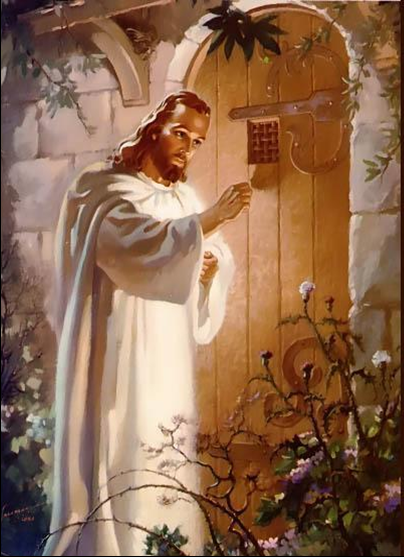
Jesus says to us in this present age, “Ask and it will be given to you; seek and you will find; knock and the door will be opened to you. For everyone who asks, receives; and the one who seeks, finds; and to the one who knocks, the door will be opened.” Are you asking, are you seeking, are you knocking? Strive for holiness while the door remains unlooked, and be encouraged, for Jesus is also striving after you. In Revelation He says, “Those whom I love, I reprove and chastise. Be earnest, therefore, and repent. Behold, I stand at the door and knock. If anyone hears my voice and opens the door, (then) I will enter his house and dine with him, and he with me.”

Jesus knocks on the door of our hearts, minds, and souls; in our feelings, thoughts, and deepest desires. If we open our doors and welcome Him now, and strive with Him for holiness, Jesus will open for us the door to Heaven and welcome us inside.

A Veiled Beauty — The Assumption

September 2, 2010

Consider this reflection by the servant of God, Bishop Fulton Sheen:

“Just suppose that you could have pre-existed your own mother, in much the same way that an artist pre-exists his painting. Furthermore, suppose that you had the infinite power to make your mother anything that you pleased, just as a great artist like Raphael has the power of realizing his artistic ideas. Suppose you had this double power, what kind of mother would you have made for yourself?

Would you have made her of such a type that would make you blush because of her unwomanly and un-mother-like actions? Would you have made her exteriorly and interiorly of such a character as to make you ashamed of her? Or would you have made her, so far as human beauty goes; the most beautiful woman in the world; and so far as beauty of the soul goes, one who would radiate every virtue, every manner of kindness and charity and loveliness; one who by the purity of her life and her mind and her heart would be an inspiration not only to you but even to your fellow men, so that all would look up to her as the very incarnation of what is best in motherhood?”

Now if you who are an imperfect being and who have not the most delicate conception of all that is fine in life would have wished for the loveliest of mothers, do you think that our Blessed Lord, who not only pre-existed His own mother but who had an infinite power to make her just what He chose, would in virtue of all the infinite delicacy of His spirit make her any less pure and loving and beautiful than you would have made your own mother? If you who hate selfishness would have made her selfless and you who hate ugliness would have made her beautiful, do you not think that the Son of God, who hates sin, would have made His own mother sinless and He who hates moral ugliness would have made her immaculately beautiful?”

Fulton Sheen thought that Mary was, in every respect, the most beautiful woman who had ever lived. However, if we had been travelers walking through the small town of Nazareth during the reign of Emperor Tiberius, I’m not sure that we would have recognized God’s greatest creature as we passed by her. I imagine that her face may have looked quite ordinary, apart from her beautifully, loving smile. Her Son, was the all-beautiful God become man, yet it seems that Jesus was not the most handsome man alive. As the prophet Isaiah says of Him, “There was in him no stately bearing to make us look at him, nor appearance that would attract us to him.” (Is 53) Perhaps Jesus and Mary had ordinary physical features on earth because having extraordinary appearances would have impeded their missions.

Yet now, invested with heavenly glory, Jesus and Mary possess a beauty greater than anyone in history. The perfection of love, goodness, purity and virtue within them shines through their exterior in a way that captivates those who behold them. Jesus told St. Faustina to commission a painting of how He appeared to her. When Faustina saw the artist’s quality work she dissappointedly lamented, “[Jesus,] Who will paint You as beautiful as You are?” The young visionaries at Fatima and Lourdes we struck by how very beautiful the mysterious lady was. And when St. Bernadette visited the grotto for the last time she remarked, “I have never seen her so beautiful before.” There is more to a beauty of this kind than natural appearance.

Why does the Church celebrate Mary’s Assumption? Because this solemnity not only celebrates her, but points to Church’s future. Virgin Mary is the icon, the image, of our Church. Jesus Christ’s Church is Marian. What she did, we are called to do; and where she has gone, we are called to follow. What Christ has done for Mary, He shall do for His Church on the last day. My previous reflections on the ordinary, appearances of Jesus and Mary probably had on earth only goes to show that external appearances can veil the true reality of things. 

Men judge by appearances, and they often misjudge. Many will drive past this building this hour without realizing the wondrous beauty of what is happening here inside. Many fail to see the beauty of Christ’s one, Catholic Church, for which this world was made and through which this world is saved. Many people see the beauty of exterior flesh, but not the beauty of the soul. Yet after the Last Judgment, everyone will see the most homely saint become radiant with beauty, and the most attractive sinner become repellant.

Mary is the first and greatest member of Jesus Christ’s Church. At the end of her unassuming life on earth Jesus lifted up her up body and soul into Heaven and gave her a beauty unmatched in history. He will do the same thing for His Church someday, and He desires to do the same for each of us. You and I are called to follow Mary in following Christ; to imitate their love, goodness, purity and virtue. Despite any appearances to the contrary, in this veiling and deceptive world, we are called to share in a beauty and glory like theirs.

Saintly Vigilance — Thursday, 21st Week in Ordinary Time—Year II

August 26, 2010

The usual reading of today’s Gospel sees Jesus warning His followers to be ever watchful and prepared for the coming of the Lord. When we hear his image of a mud-brick house being broken into (or literally, dug through) we think of the devil as that thief, robbing us of the treasure in our souls. This interpretation is good and true. We should be vigilant in the keeping of our own immortal souls. But let me suggest that He teaches us another lesson as well, for Jesus words are autobiographical.

Jesus is that “master of the house.” He is the husband in His household, the Church. And Jesus did know the pivotal hour of night to “stay awake” and “keep watch” in the garden of Gethsemane. When His enemies arrived, Jesus did not allow His household be broken into and robbed. He said, “…If you are looking for me, let these men go.” He did not lose any of His own which the Father had given to Him.

“Who then is the faithful and prudent servant, whom the master has put in charge of his household to distribute to them their food at the proper time?” Jesus is that faithful and prudent servant, who feeds us our needed food. And seeing His suffering servant’s love, God the Father, who the master of all, has placed Jesus over all His property.

Yes, we should be vigilant in the keeping of our own immortal souls, but Jesus’ example suggests something more, to be have concern for the care of others’ souls as well. Who has God entrusted to you? Perhaps family members come first to mind, but think of your friends, co-workers, and others as well. Ask yourself in what ways you can be of good to their souls as well. God rewards those who love like this with a greater glory than just salvation alone.

Across the Waters — Tuesday, 18th Week in Ordinary Time—Year II

August 3, 2010

Today’s gospel follows from yesterday’s. In yesterday’s gospel, Jesus hears that his relative and friend, John the Baptist, has been murdered—for that is what it is to intentionally kill the innocent, even when kings and governments do it. Jesus tries to go to a deserted place, but insistent crowds meet his boat. John’s death turns Jesus’ thoughts to the events ahead of Him. He has the people sit, takes the bread, says the blessing, breaks it, and gives it to His disciples, that they may share this miraculous bread with the people.

When evening comes, He sends off the Twelve ahead of Him in the boat and He dismisses the crowds on their way. Jesus climbs the mountain and communes with His Father in that solitude He longed for. Imagine if you were there with Jesus, giving Him silent company on that hill overlooking the Sea of Galilee, as He contemplated the things that were before Him.

Perhaps Jesus would turn to you, and ask, “Do you see that boat captained by Peter, the likeness of my Church? Shall I walk through the darkness across the waters of this world’s chaos and death? Should I face the headwinds of spiritual evil for you and them?” Of course, Jesus knows what He is going to do, but He wants to hear you answer. Let Him hear how precious His sacrifice is, for you and all His own.

We’re in a Hurry — 16th Sunday in Ordinary Time—Year C

July 18, 2010

The other day I was thinking about this homily when I heard the words of some modern poets on my radio. They said:

I’m in a hurry to get things done,
Oh, I rush and rush until life’s no fun.
All I really gotta do is live and die,
But, I’m in a hurry and don’t know why.

This goes to show that we still have a Martha problem today. The group Alabama said that they didn’t know why we get in a hurry, even though we’re not having fun, but I think I know the answer. The reason is that our loves and good desires are mixed with fears. If we would take that fear away, we would find peace.

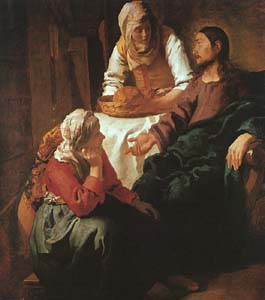
Martha loved the Lord and wanted to serve Him well, but she had fears mixed in. She was the one who invited Him to the house and He probably had His apostles and other disciples with Him. She was busy serving them all, perhaps making the biggest meal she had ever made, and she was full of worries. “What if I’m a poor host and Jesus is disappointed with me? What if there’s not enough food for everyone to eat?”

We are often the same way. We fear that our lives are on the edge of disaster if our own plans and efforts should fail. We worry about bad things happening to ourselves and the people we love. We are anxiety about how Jesus feels about us.

Martha had a great desire to do good, but Martha’s fear tempted her to do harm. Her sister, Mary, was sitting at Jesus’ feet, listening to His words. (The Greek word for disciple actually means “one who sits at the feet of.”) Martha tries to take Jesus’ disciple away from Him.

Similiar thing can happen in our live on account of fear mixed with love. A husband and father can obsess about his work, out of a love for his family and a desire to provide, but his family can be left feeling like they come second in his life. A wife and mother can be so concerned that her loved ones will be safe and happy that she tries to control everything, making her family less happy because of it. Martha’s problem and ours is not that we work–work is a part of life–but in how we go about it.

Jesus says to Martha, and to us, “Martha, Martha, you are anxious and worried about many things. There is need of only one thing.” What is this one thing we need? We need the peace of Christ. What is the peace of Christ? It is several things.

It is the awareness that God is near and guiding us. In the first reading, three heavenly visitors approach outside of Abraham’s tent. Now, the Holy Spirit dwells within our tents, Jesus is at our side, and we have a Father above. We are never left on our own.

With the peace of Christ we recognize that whatever may happen to us or those we love, it is for our good. As St. Paul observes in the second reading, even his sufferings are a cause for rejoicing for they advance the salvation of the whole Church with Christ.

With the peace of Christ we recognize that misery is not just around the corner, nor is happiness out of reach. Happiness is at head, in the knowledge that Jesus loves us, likes us, cares about us, and cares for us. Living in the peace of Christ means there is no reason for us to be unhappy.

Let us continue to do works of love for God, ourselves, and others, but let us do them always in the peace of Christ.

We’re Inn-Keepers — 15th Sunday in Ordinary Time—Year C

July 18, 2010

The “Good Samaritan” is a very familiar parable, but there remains much for us to learn from it. Today I will present the history, the context, behind it; the symbolic meaning contained within it; and the challenge to ourselves that comes out of it.

Jesus’ story begins, “A man fell victim to robbers as he went down from Jerusalem to Jericho.” From this we might think that Jericho is south of Jerusalem because we put the South at the bottom of our maps. Yet, Jericho is actually some twenty miles to northeast of Jerusalem. The reason why the man went down from Jerusalem is that Jerusalem is situated 2,550 feet above sea level, while Jericho is about 1,200 feet below sea level, near the Dead Sea, which is the lowest place on the surface of the earth.

Jerusalem was the city of the temple, the place of God’s dwelling. Jericho, you may remember, was the city which Joshua and the Hebrews marched around for seven days, before blowing their horns and shouting, causing the walls to fall down. They conquered the city because it was in rebellion with God.

“The [robbers] stripped and beat [the man] and went off leaving him half-dead. A priest happened to be going down that road,
but when he saw him, he passed by on the opposite side. Likewise a Levite came to the place, and when he saw him, he passed by on the opposite side.”

You know what a priest is. He is one who offers sacrifice. What is a Levite? They were like acolytes or altar servers; they helped the priest offer the sacrifices at the temple. Why did they both pass by ‘on the opposite side?’ Maybe that they thought the man was already dead and wanted to avoid ritual impurity. The Mosaic Law taught that contact with a dead body made one ritually impure and ritual purity was necessary to worship at the temple. Whether this was their reason, or whether they just did not care enough to be bothered, another comes along who is both willing and able to help.

“…A Samaritan traveler who came upon him and was moved with compassion at the sight.” Who are these Samaritans? We hear about them in the Gospels and we know they didn’t get along with the Jews. For instance, the woman at the well that Jesus meets in John was a Samaritan. Where do they come from?

Some five hundred years before the coming of Christ the Babylonians were the superpower of the ancient world. When the king in Jerusalem decided he was not going to pay tribute to Babylon anymore, the king of Babylon was not pleased. He sieged Jerusalem, conquered it, and carried the region’s inhabitants into what is called the Babylonian Exile. Not everyone was taken though; some of the poor, the farmers and the vine-dressers, were left behind. To ensure that the people did not rebel again, and to make sure that the land did not go to waste, the Babylonians settled five pagan nations in the land.

Seventy years later, after the Babylonians had been conquered by the Persians, the new king gave the Jews permission to return to their homeland. When they got there they found that the people who had remained behind had intermarried with the pagans, in both their families and religion. The Jews regarded these people, these Samaritans, as unfaithful to the Lord. It is no coincidence that the Samaritan woman at the well had had five husbands.

Jesus chooses a Samaritan as the protagonist, the hero, of his story. He does this to show us an example we are to follow. The Samaritan was not Jewish victim’s neighbor geography, for he was only a traveler to the region, nor was he related to him by blood, nor by prior friendship. In the same way, our neighbors are not to be only those who are close to us in distance, are in our family, or who have shown kindness to us. Everyone is to be our neighbor. Such is the meaning of the parable in its historical context, but contained within this story there is Christian symbolism, as well.

The man who fell to the robbers is you and I, this man represents all mankind. Traveling from Jerusalem to Jericho, we were descending from the height of communion with God to the depths of rebellion. We fell to robbers, to evil spirits and evil desire. These stripped us naked, depriving of our original honor and glory. They beat us and left us half-dead; biologically we still lived, but spiritually we were dead. No one could or would help us. But then the Good Samaritan came. This man is Jesus Christ.

He looked upon us and was moved with compassion. Jesus approached to us and poured His blood on us, like wine, to cleanse the wounds of our sin. He poured the Holy Spirit on us like oil to make us strong again. Jesus gave us his teachings and commandments as bandages for our wounds. These disciplines bind us, yet they free us through the health they provide. Jesus lifted us up on his own animal.  This beast of burden was his own flesh. He took us to the inn, which is the Church, and here He continues to care and provide for us in it until the time of His return.

Even though the man who fell to the robbers is meant to symbolize each one of us, I don’t think he is the character in this story with whom we can most identify ourselves. The character I have in mind is one everyone overlooks. I don’t mean the Good Samaritan, nor the priest or the Levite. The character I’m thinking of is the inn-keeper, who is only mentioned in passing.

Here’s all that Jesus tells us about the inn-keeper: “The next day [the Good Samaritan] took out two silver coins and gave them to the innkeeper with the instruction, ‘Take care of him. If you spend more than what I have given you, I shall repay you on my way back.’”

Most of us here entered into the Catholic Church when we were baptized as infants. So we don’t remember being brought into the Church, half-dead.  For us, it feels like this inn has always been our home. This is where we have lived and worked for as long as we can remember. So I think we may identify more with the inn-keeper, more then the victim who has been gratefully saved. With this comes a challenge for our lives.

We are like the inn-keeper.  We are comfortably at home, and business is good. The Samaritan brings in this guy like a sack of potatoes, buys a room and takes care of him. That’s fine with us, but this Samaritan guy comes along and instructs us to take care of this friend of His. Now he is shifting that job onto us. Sure he’s given us some coin for doing it, two silver denarii, the sum of two day’s wages, and he says that if we spend more than what he has given he will repay us on his way back, but do I really want this hassle?

Besides, is that Samaritan fellow really coming back?  If not, then the more I give caring for this invalid the less I’ll have left for myself. If I’m stuck with the bill for this guy and his friend, them I’ll feel like a fool. On the other hand, if I just toss the guy out of my inn, or just ignore him while he’s here, that’s two day’s profit for me guaranteed. If I just pretend that I never heard that Samaritan’s instructions, if I can just quiet my conscience, I’ll get along just fine.

I’m busy enough as it is already. Is playing nurse to this crime statistic really worth my time? Do I trust that Samaritan? Do I believe he is he truly good?  Do I believe he is really coming back? Jesus is the Good Samaritan, and he brings many people to our lives and asks us to take care of them in our inn. Are you living as though Jesus is really coming back to repay each of us according to our deeds, or are you just minding your own business?

Everything you have comes from Jesus, and everything you have belongs to Him.  He is entitled to your time, talents, and treasure and He wants you to share them with your neighbors. Do not fear, don’t be afraid. The truth is that you can never spend more than what He has given you. Act with confidence that He will repay you an amount far greater than you give, not only at the end of your life, but even by the end of the day.

Jesus Christ’s command which He “enjoin[s] on you today is not too mysterious and remote for you. …No, it is something very near to you, already in your mouths and in your hearts; you have only to carry it out.” You shall love your neighbor as yourself.
Gospel Movies

July 1, 2010

Below are five original shorts drawn from the Scriptures. Click the images to watch them.

Teddy Bear Annunciation


The Annunciation of the Archangel Gabriel to the Blessed Virgin Mary; the Gospel of Luke, chapter 1, with teddy bears.

Robot Jesus at the Watering Hole

 
Jesus meets the woman at the well; the Gosple of John, chapter 4, starring robots.

The Rich Young Rapper

 
A rich young rapper questions Jesus on the subway; a remix of Matthew, chapter 19 and Mark, chapter 10.  

Doubting Thomas

 The resurrected Christ appears to a skeptical disciple in the Gospel of John, chapter 20.

The Importance of the Resurrection


From St. Paul’s 1st Letter to the Corinthians, chapter 15.