Archive for the ‘Jesus Christ’ Category

A Weird Passage — Wednesday, 3rd Week in Ordinary Time—Year II

January 28, 2010

“Focus on the weird.”  That’s advice I heard that a homiletics professor once gave. “Focusing on the weird part of the readings in preparing one’s homily leads to the unlocking of mysteries. Besides, it’s what the people are most likely to be distracted thinking about during your homily anyways.” (This is a good rule of thumb for one’s personal Bible studies too.) So what’s the weird part about today’s readings? It comes in Jesus’ private answer to the disciples about His parables:

“The mystery of the Kingdom of God has been granted to you. But to those outside everything comes in parables, so that they may look and see but not perceive, and hear and listen but not understand, in order that they may not be converted and be forgiven.”

Does Jesus really teach in parables so that the crowd will not understand?  Why teach them if you don’t want them to learn? And why would Jesus want to be misunderstood by people “in order that they may not be converted and be forgiven”? Doesn’t He want all to be saved?

Jesus spoke in parables because it allowed those with open minds and hearts to understand Him, while serving as a defense against his hostile critics (who had appeared in Mark’s Gospel just before this scene.) Those who were open to the truth would patiently ponder His imagery and come to understand.  Those who chose to be closed off to Jesus would dismissively discard His stories without comprehending. Jesus did not want to be too clear too soon with His enemies, for if He had spoken to them plainly about Himself and His mission they might have moved to kill Him too early for God’s plan to unfold fully.

Did Jesus speak in parables with His enemies “in order that they may not be converted and be forgiven.” Surely not, for Jesus wills the salvation of all. The choice not to be converted and forgiven lays at their own feet. They themselves choose not to be open, not to understand, “in order that they may not be converted and be forgiven.”

Are we open to Jesus’ message and will for us? We sometimes say that we wish that Jesus would be more clear about His will for our lives. Could it be that the reason Jesus doesn’t lay out His will for us plainly is that He knows we would simply answer “No” to His wishes? If we want to understand and respond to Jesus’ will for us in big things, we need to practice responding to His will for us in small, everyday things.

We need to turn off the TV or internet when He tells us we’re wasting our time. We need to respond to His invitations to prayer. We need to show patience and kindness with all the people He has placed in our day-to-day lives. If we are faithful in small matters then He will trust us to be faithful in big ones; we will hear His words, receive them with joy, and bear fruit thirty and sixty and a hundredfold.

Speaking Up — January 26 — Sts. Timothy and Titus

January 26, 2010

Think back.  When was the last time that the name of Jesus passed your lips? For comparison, do you speak about Jesus Christ less often than, say, Brett Favre, or President Obama? But isn’t Jesus Christ far more important than professional athletes or politicians? Our culture teaches us to keep our faith in Jesus unspoken and hidden, but this is a habit we need to unlearn. Our Christian faith is supposed to be personal, but it’s not supposed to be secret.

Today’s first reading comes from a letter from St. Paul to a young Christian named Timothy. Timothy grew up in a Christian family, but as we see in the Gospel, family ties are not what make a person close to Christ. What makes one close to Christ is the choice to do God’s will. Paul understood that Timothy’s youth might cause him to be too timid about expressing his faith in Jesus Christ. So Paul told Timothy, as I say to you, “stir into flame the gift of God that you have…. For God did not give us a spirit of cowardice but rather of power and love and self-control. So do not be ashamed of your testimony to our Lord….”

Never deny or be ashamed of Jesus because of the people who happen to be around you. Often, people are more receptive about Christ than you might think, and witnessing to your faith can change lives. Besides, if the people you’re with would mock our savior then the opinion they have about you doesn’t matter much anyways. Still, they may well may mock you one day, and respect you for your convictions the next.

Don’t be too timid lead prayers out loud to Jesus. Nobody expects you to be a poet. Just speak simply from your heart and your words will have a powerful effect. Listening to another’s struggle can help, but sharing prayer to Christ with them can really heal.

Be unafraid to talk about Jesus. Everyone needs Him and what He has to teach us, even if we’ve been Christians all of our lives. John Paul the Great said that Jesus Christ reveals humanity to itself. Jesus provides the answer; to why we’re here, where we’re going, how we should live, and how we are loved. He is the most worthy of topics for conversation.

As our psalm says,

“Announce [Christ’s] salvation, day after day.
Tell his glory among the nations;
[and] among all peoples, his wondrous deeds.”

So be unashamed of Jesus no matter who happens to be around you. Lead prayers aloud to Jesus for the benefit of your neighbors. And be not afraid to let the name of Jesus past your lips.

Carrying Water — 2nd Sunday in Ordinary Time—Year C

January 20, 2010

Today’s Gospel, the miracle at the wedding fest of Cana, is a scene rich in symbolism and has many preachable parts. For example, the water of Old Covenant law is changed into New Covenant wine. It is the seventh day in John’s Gospel, according to the narration, pointing to a new Creation and rest. And the New Adam and the New Eve are at a wedding feast together, foreshadowing the marriage of Christ and His Church. But this morning, I would like to bring your attention to an extraordinary part of this Gospel which we disregard as being ordinary. I’m referring to the six stone water jars and the servers who carried them.

“Now there were six stone water jars there for Jewish ceremonial washings, each holding twenty to thirty gallons. Jesus told them, ‘Fill the jars with water.’ So they filled them to the brim.”

You’ve carried a gallon of milk before.   Imagine carrying 25 gallons of milk. I doubt you could do it all at once. Not only would they be too bulky, they would be awfully heavy too. Maybe you could put them on a pole and carry them with a partner. Maybe that’s what the servers in the Gospel had to do, or maybe they were doing laps between the well of Cana and the stone jars at the party. In either case, they we’re hauling an awful lot of water and weight.

Now a gallon of water weighs a little more than eight pounds. If each jar in the Gospel was at least 40 pounds of stone and held 20 to 30 gallons, then we are talking about six filled jars weighing 200 to 300 pounds apiece. And we know they were completely filled, for Mary had told them, “Do whatever he tells you,” and Jesus had told them, “Fill the jars with water.” “So they filled them to the brim.”

The saying “To carry water for (someone)” means to do a menial or difficult task for others.  That’s what these servers were doing and they definitely felt the burden.  Did they have any idea, as they carried those 1,500 pounds of stone and water, that they were a part of something remarkable? Did they know that they were playing an intimate role in one of Jesus’ most memorable miracles? No, they had no idea, not until later, and this reflects a encouraging truth for us to hold onto this week. We often don’t realize the extraordinary impact of our ordinary sacrifices.

You may feel burdened in your life, like your just scrapping or limping along; at work, at school, or at home; with your peers, your friends, or your family. But you do more good than you know. Sometimes we catch glimpses of this, like when someone takes your hand and says, “Thank you sooo much,” or when someone shares with you that they have always looked up to you, or when a child grows to realize and thank you for everything you did for them. After this life, one of our joys in heaven will be seeing how our ordinary sacrifices have touched and changed the lives of thousands, even millions, of people.

Like the servers with their six stone jars, we disregard our efforts as ordinary and do not realize their extraordinary impact. Maybe you don’t see it now, but your ordinary sacrifices do more good than you know. Let us be encouraged by recalling this truth in our daily lives, for if you’re carrying water for Jesus, you’re going to have a part in His miracles. So, “do whatever He tells you,” no matter how ordinary it may seem.

Holy Reminders — Friday, 1st Week in Ordinary Time—Year II

January 16, 2010

Jesus said to the paralytic, “I say to you, rise, pick up your mat, and go home.”But why did Jesus send the man home with his mat? Why say anything more than, “I say to you, be healed and rise”? Why send the man home and have him take his mat with him?

Was it that Jesus was annoyed with the intrusion of this man and his amateur skylight instillation crew? That’s not it, for throughout the Gospels Jesus is always pleased by seeing displays of faith, and it says here that Jesus “saw their faith.” Rather, it is those who obstinately hold on to their faithlessness against all positive evidence who elicit Jesus’ annoyance in the Gospels. Recall when He said elsewhere:

“Woe to you, Chorazin! Woe to you, Bethsaida! For if the mighty deeds done in your midst had been done in Tyre and Sidon, they would long ago have repented in sackcloth and ashes.”

So why did Jesus send the cured man away with his mat? In setting the scene, the Gospel says that when “it became known that [Jesus] was at home… many gathered together so that there was no longer room for them, not even around the door, and [Jesus] preached the word to them.” Jesus preaches the word to the crowd so that they may be prepared to receive the Gospel about Himself. It seems that Jesus sends the cured man home because in his short time with Jesus he has been brought fully up to speed. Jesus sends the man home because, for now, the man knows everything he needs to know. Jesus forgives the man’s sins and cures him. From this the man understands why Jesus has come: for the forgiveness of sins and the healing of persons.

And why does Jesus send him home with his mat? I bet that the man would have gladly left it behind, happy to be rid of it, without a second thought. I think there are two reasons he’s told to take the mat: First, so that he may preach to others about Jesus. The mat will be conversation starter (“Hey, what’s with the mat?”) and it will also serve as “exhibit A” when the man gives his testimony about Jesus. The second reason for having him keep the mat is so that the man will always remember what Jesus did for him and what it meant. What good would it be for Jesus to teach the man everything he needed to know, if he were to quickly forget everything he had learned?

Perhaps we have need for such concrete reminders for ourselves in our life of faith. Maybe we don’t have souvenirs laying around from times that Jesus helped you, but I bet we all have access to Post-It Notes. If you think you would benefit from being reminded of Jesus’ past goodness shown to you, then write down titles for a few of these great moments.  Post them up on your wall, your mirror, your computer monitor, or wherever you will see them. This will help keep you mindful of Christ, what He did for you and what it means. And maybe, someday, someone will ask you, “Hey, what’s with the Post-it Note?”

Encountering Jesus in Prayer — Baptism of the Lord—Year C

January 11, 2010

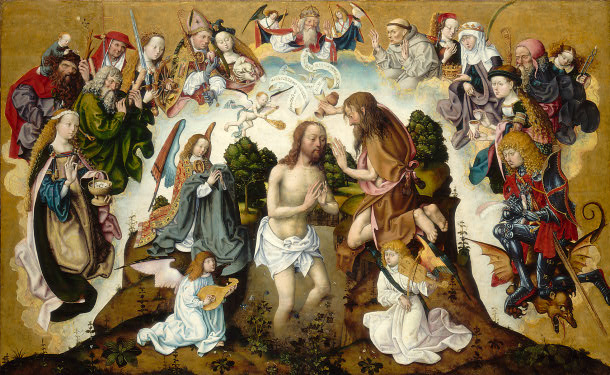
At Jesus’ baptism, the Father spoke to Him from heaven, “You are my beloved Son; with you I am well pleased.” Today, our Father wants you to hear Him say to you, “You are my beloved child and with you I am well pleased.”

This may be hard for us to hear. Maybe we think to ourselves, “I’m certainly not Jesus.   How could God be well pleased with me? Our past and present sins of come to mind and we feel pained by guilt. In times of prayer and in our daily life we are burdened by the thought that we are not the person God wants us to be. We think, “If only I were better, if only I could be perfect, then I could live and pray like the saints and God would love me.” If we think like this, our thinking has it backwards.

It’s not that God decides to love the saints, or us, only after we have achieved holiness by our own incredible feats of strength, endurance and personal sacrifice. Here’s the secret to the saints: the knowledge of God’s love and pleasure toward them came to them first, the saints’ great holiness only followed. Saints are not self-made men and women. It is by accepting God’s embracing love for us that we’re empowered to live incredible lives of love. We live like saints if we live in the truth that God loves us already.

To bear this point out, I would like you to try a thought experiment.  (You may close your eyes if you think it will help.) Imagine if you were a completely perfect person, totally free from sin, and free from guilt and fear before Him. Now pray to the Father in heaven imagining you’re this perfect version of yourself.

If you’re like me, imagining this makes it much easier to approach Him, to love Him, to praise Him, to thank Him and to feel His love for you.

And now, still imagining you’re this perfect person, consider the day or the week ahead of you.  What kind of attitude do you feel towards your life?

Again, if you’re like me, you find it much easier to see the future not so much as a burden, but with a certain eager calm. You view your life as an great opportunity to serve and to love from out of the abundance of love that you feel.

It’s not just your imagination that makes you feel this way.  It is the Holy Spirit confirming a truth in you. And the truth is that when the Father looks at you He doesn’t see the unlovable wretch of your fears, He sees something much closer to this perfect person.  By our baptism into Christ, we are loved as God’s daughters and sons, but maybe we not living like the saints we so admire because we’re tripped up by fear and self-doubts, thinking that for us intimacy with God remains a thousand miles away. The Father wants you to be confident, peaceful, and joyful in His love for you. In this way of His, He will lead you out of sins which history proves that your own efforts alone cannot conquer. Compared to the self-imposed yoke of our own anxious strivings to holy, the way of accepting God’s love for us is easy and light, and it actually works. We will live like saints when we accept the truth that God loves us already.

The saints became saints by overflowing with God’s love for them, by receiving His acceptance, approval and pleasure. These are gifts which He always wanted to give them, and He would do the same for us, if only we would let Him. So when you pray the Our Father today do it as the Father’s beloved son or daughter. And whenever you pray, or in whatever you do, do it in the liberating and empowering truth: “You are my beloved child; with you I am well pleased.”

Decoding the Ritual — Friday After Epiphany

January 9, 2010

Jesus stretched out his hand, touched the leper before Him, and said, “Be made clean.” The leprosy left him immediately and Jesus ordered Him, “Go, show yourself to the priest and offer for your cleansing what Moses prescribed…” What was Jesus asking this man to do? In the Book of Leviticus it says:

This is the law for the victim of leprosy at the time of his purification. He shall be brought to the priest, who is to go outside the camp to examine him. If the priest finds that the sore of leprosy has healed in the leper, he shall order the man who is to be purified, to get two live, clean birds, as well as some cedar wood, scarlet yarn, and hyssop. The priest shall then order him to slay one of the birds over an earthen vessel with spring water in it. Taking the living bird with the cedar wood, the scarlet yarn and the hyssop, the priest shall dip them all in the blood of the bird that was slain over the spring water, and then sprinkle seven times the man to be purified from his leprosy. When he has thus purified him, he shall let the living bird fly away over the countryside.  (Leviticus 14:2-7)

Hidden within this strange Old Covenant ritual, Jesus Christ is concealed. And through Jesus’ death for us on the cross the true symbolism of this ritual is revealed.

The scarlet, the wood and the hyssop all have their place in Christ’s Passion.  The scarlet yarn points to the robe they placed upon Him; the wood to the cross on which they nailed Him; and the hyssop to the branch they used to offer Him drink. One bird is slain and the other is spared, dipped in the water and the blood of its brother. This water points to the water of Christian baptism, which receives its grace through the blood of Jesus’ cross. In the ritual the priest would take all of these things and sprinkle the man to be purified seven (the perfect number of) times from his leprosy. In His Passion Jesus took all these things and used them to purify us from the leprosy of our sins.

In our wonder at these signs, let us make our faith in God firmer, and give Him our thanks.

The Old New Pattern — Thursday After Epiphany

January 8, 2010

In his first letter to his brothers and sisters in Christ, St. John says that the commandment he writes to them is not new, and yet new. (1 John 2) The commandment he is referring had been given to them years before, by Jesus Christ at His Last Supper. He told His disciples, “I give you a new commandment: love one another. As I have loved you, so you also should love one another.” (John 13:34)  Love sums up the moral law, and we know how to love from Christ.

Once when Jesus’ opponents were trying to trip Him up they asked Him what was the greatest commandment. He answered, “You shall love the Lord, your God, with all your heart, with all your soul, and with all your mind. This is the greatest and the first commandment.”  Then He added, “The second (commandment) is like it: You shall love your neighbor as yourself. The whole law and the prophets depend on these two commandments.” (Matt 22) Or, as St. Paul would later put it, “Love is the fulfillment of the law.” (Rom 13:10) Love sums up the moral law, and we know how to love through Christ.

It is intuitive for people to understand that we should do good and avoid evil, that we should love good and hate what is evil. Yet that does not mean that everyone agrees as to how we should live this out. Often we see the truths which Christians present in love angrily dismissed by the world as hate. (Frequently the throwing of this charge allows people to dismiss opposing viewpoints without ever giving them serious thought.) Even those in a post-Christian secular culture will agree that somehow “love is the answer,” but how exactly are we to love one another?

Jesus shows us how to love.  He says, “As I have loved you, so you also should love one another.” We can learn from His example especially here, as we witness His Passion, death, resurrection, and ascension in the Mass, but we can also learn from the entire life He lived.

Sometimes it can be hard understand example, or difficult to relate Jesus’ life to the particulars of our own. To help us He gives us the example of His saints, through whom He has continued to live His one, salvific way of life through thousands of different human expressions. The Spirit of the Lord was upon Jesus; He was anointed to bring glad tidings to the poor, to proclaim liberty to captives, to restore sight to the blind, to free the oppressed, and to proclaim a year acceptable to the Lord. Today this Scripture passage is still being fulfilled by Him through the lives of His saints.

“The love of God is this, that we keep his commandments.”  So let us learn what love is through the example of Jesus and His saints, for love sums up the law, and we know how to love through Christ.

‘Tis Better to Give — Tuesday After Epiphany

January 5, 2010

(The Micro Machines Aircraft Carrier – Not the Summum Bonum)

When I was a kid, in preparation for Christmas, I remember how my sisters and I would explore those big Sears and J.C. Pennies catalogues and circle the things we really wanted. I also remember the intensity of my excitement when I would open my presents to discover the toys that I had dreamed about. But over the years, I saw a pattern develop that maybe you’ve begun to start noticing for yourself.

Christmas after Christmas, I would play with all my toys, but I discovered that I would never get as much happiness from as I had imagined they would give me when they were still in their boxes. No Christmas toy ever delivered the supreme happiness I had hoped for from them. I was blessed through these experiences to learn a very valuable lesson. I learned that that getting stuff would not and could not complete me—it couldn’t make me truly happy.

Stuff won’t make you truly happy, but there are lots of people who don’t know this. Why do you think it is that TV and advertisers are always going after that “target demographic” of 18 to 34 year-olds, especially that younger segment of 18 to 24 year-olds? It’s because these consumers have significant amounts of disposable income, perhaps for the first time in their lives. And, since they do not have the wisdom of years, many of them can still be fooled into thinking that this or that product will really make them as happy as advertised.

Don’t let yourself be fooled into taking that bait. Keep in mind the words Jesus who said, “It is more blessed to give than to receive” (Acts 2:35). It’s really about giving that I want to speak to you today. There are many ways that we can give of ourselves, of our time, talent and treasure, but this morning I want to address the importance and blessedness of giving from our incredible wealth.

Now I doubt that you would describe yourself as a rich person. In terms of our society, you’re probably not. But realize, that when compared to the rest of the world, you are a very wealthy individual. Did you know that about half of the people in the world live on less than $2.50 a day?

From our great material blessedness comes the great responsibility to share. Yet, the fact that we are far richer than many other people is really beside the point. Even if we were poor compared to everyone else, Jesus would still ask us to share of what we have. For whenever we give out of love, and a desire to spread and advance God’s kingdom, we imitate Jesus Himself, who gave of Himself to us first.

Maybe you feel like you have nothing much to give. The disciples thought they had next to nothing to give too, and they were right. They had just five loaves of bread and two fishes, but Jesus said to them, ‘Give the crowd some food yourselves.’ The disciples wondered what good so little could do for so many, but in Jesus’ hands their small gifts multiplied.  Their deed first feed thousands, and then, through its retelling in the Gospel, it feed untold millions.

It would be hubris, or foolish pride, for us to think that if only we had a million dollars, a billion dollars, a trillion dollars, or any sum, that we by ourselves could save the world. Yet, when we place what little we have into Christ’s hands, giving where and when the Holy Spirit prompts us, Jesus blesses it and our deed does more good within His kingdom than we realize.

Though you never fully see all of the good your giving causes on earth, you can immediately feel some of its goodness inside yourself. Part of the blessedness of charitable giving is in the joy you feel in always knowing that you have done a good deed. When you consume something you may enjoy it for a moment, but when you give something away in love you can enjoy that act forever. If fact, when we get to heaven, we should find ourselves made the instant friends of many strangers when it is revealed to us how our lives were profoundly connected through the smallest gifts.

To help in put our faith into practice, to love our neighbors and advance the Kingdom, we are going to begin taking more regular collections at our weekly school Masses in support various causes. We will be starting by helping a number of area organizations suggested by the Student Senate. And, once our Liturgy & Campus Ministry Committee is up and running, about which Mr. Zimmerman will be speaking to you about at the end of Mass, the selection of worthy charitable causes will one of the important tasks that will fall to them.

Today our collection will be going, in its entirety, to support the Hope Lodge here in Marshfield. The Hope Lodge provides temporary accommodations for patients and their family members while they are receiving cancer treatments at the Marshfield Clinic. Please give as generously as the Holy Spirit may prompt you and know that you will certainly be blessed.

Luke’s Source — January 1 — Mary the Mother of God

January 1, 2010

Have you ever wondered how it is that Luke the Gospel writer knows the stuff he’s telling us? For instance, he wasn’t present at the Annunciation to take down notes.  Only Mary and the Archangel Gabriel were there. And in today’s Gospel, after the shepherds visit, it says, “Mary kept all these things, reflecting on them in her heart.” Now how does Luke know what Mary was thinking? Who could know something like that besides Mary herself?

Now I suppose the Holy Spirit could have directly infused the knowledge of these things into him, but that’s probably not what has happened here. Luke probably learned of these details in the most natural and human way; by being told about them, first or second-hand, by people who knew. Luke begins his Gospel by saying that his narrative of events is composed from what “those who were eyewitnesses from the beginning and ministers of the word have handed … down to us.”

But there is only one person who could have been the original source for many of Luke’s details, and that is Mary herself. In fact, some call the beginning chapters of the Gospel of Luke “the Memoirs of Mary.” Perhaps Luke heard of these details from Mary’s very own lips and took them all to heart.  Then later, knowing these things by heart, committed them to writing.

And so we do know something today of what was going on inside of Mary in those early days, “Mary kept all these things, reflecting on them in her heart.” And some years later, upon finding Jesus in the temple, Luke reports that Mary and Joseph did not understand what their boy when said to them, but “his mother kept all these things in her heart.” In this there is a lesson for us to discover through Mary, a lesson that is particularly applicable for us this New Year’s [Eve/Day].

In her life, Mary knew some important aspects of God the Father’s plan, but there was always a great deal about which she did not know. She knew that her Son was messiah, savior, and Lord, but his future, and hers, remained largely a mystery. Perhaps Mary wondered, as we often wonder when faced with evils and obstacles, “How can this be, Lord?  How will your promises be fulfilled despite this?”  Yet through it all, Mary firmly trusted that the Lord was with her, and we should do the same.

What does the new year ahead hold for each of us? Like Mary, we do not know, yet Mary shows us that we do not have to know.  We do not have to fully know our future to be able to do great things for God and to be richly blessed by Him. We do not need to know our future for the Almighty to do great things for us.

In the year ahead, may the Lord bless you and keep you, as He did the Virgin Mary.

May the Lord let his face shine upon you, and be gracious to you, as He did for Mary through Jesus’ infant face.

And may the Lord look upon you kindly and give you peace, a peace like that which Mary always kept with her Son, Jesus the Christ.

Strengthening Your Family — Holy Family

December 29, 2009

Today we are going to try something unique. Close your eyes and let the Holy Spirit guide your imagination to show you what family life was like in the home of Joseph, Mary, and the boy Jesus…

Theirs is a small dwelling and you can see all of them there…

How old is Jesus as you see Him? What is He doing?

What are His parents up to? What are Joseph and Mary like as you see them interact with each other?

It comes to time to eat. What do you see the Holy Family doing?

As they relate to one other, what do you see expressed in their faces? It is now later in the evening and time for prayer. What do you see the members of the Holy Family doing?

You can return in your imagination to visit this house any time you wish, but now, let’s open our eyes and review our mediation.

What did you see as Joseph and Mary interacted with each other? Were they not tender and reverent towards each other? I bet you could see their great mutual love reflected in their smiles.

What happened in their house when it was time to eat? Who would imagine them not coming together to share their meal in each others’ company?

And later, when it was time for prayer, did the Holy Family do? Did you see them go off to their own corners, or did they come together, to pray as one family?

Did you see the Holy Family’s intimacy, their happiness, and their love for each other? Do you want your family to share a bond like theirs? Then take the Holy Family as your model: share your love, share your meals, and share your prayers.

First, on sharing your love. Let your spouse and children know every day that you love them. You can say it, you can show it, or you can do both. For instance, kids never tire of being hugged and told their loved each day.

As for married couples, don’t make the mistake of thinking that intimacy and love are only expressed physically. For St. Joseph had all sorts of simple, little ways to let Mary know that she was loved, and vice-versa. Be like the Holy Family in sharing your love.

A second way to model the Holy Family is to share your meals. The research of social scientists indicates that having frequent family meals together contributes many goods for one’s family: For starters, everyone eats healthier meals, and so kids are less likely to become overweight or obese. And kids who eat family meals are less likely to start smoking, to drink alcohol, or to try or to be addicted to drugs. These kids’ grades are better at school, and there is less stress in their homes. These things probably stem from the fact that families which eat together are bound to talk more, provided the TV is off.

These parents are more likely to know about their children’s lives and struggles and, just as importantly, their kids are more likely to know that their parents are proud of them and love them.

Jesus Christ thinks that the shared family meal is so important for us that He has instituted one for His Church and expects His entire family to be there; for to share in the Eucharist is to share in the life and communion of His family.

A third way to make your family more like the Holy Family is to share your prayers. Apart from dinner prayers or going to Church, most Catholic families do not pray together. I think that maybe we see the priest praying the Church’s prayers and think that we are not equipped to lead prayers of our own at home.

But it’s not true.  As fathers and mothers you have a spiritual authority within your families, what John Paul the Great called “the domestic Church.” Your spouse and your children need you to pray, not only for them, but with them. Right after the family meal might be the perfect time for this ritual of family prayer.

Now you may be thinking to yourself, “But we’ve never done this as a family before.” Remember this: as parents, you create what’s normal for you children. If you want it to be normal for your children to eat meals with you, then make it normal for them.

If you want it to be normal for your children to pray to God with you, then do it normally. As parents, you create what is normal for your children and through your gift of these traditions to them you can bless them for a lifetime.

Finally, husbands and wives, if you do not pray one-on-one with each other, then you do not yet share a perfect intimacy together.  It is in prayer that our most intimate selves are laid bare and we ask another person to help us with our heartfelt needs and concerns.

Maybe you’ve never prayed with your spouse before. Then perhaps you can begin like this:  hold each others’ hands, close you eyes, and pray to God for each other, for a little while, even if for just ten seconds, say, before you go out the door. 

Once this becomes comfortable you can begin to telling each other what you want to be prayed for. And, after this is comfortable, you can begin to pray for each other aloud.  Begin the process of praying like this and it will transform your intimacy together.

Perhaps you gave many gifts to your family members yesterday for Christmas, but the greatest gift you can give to each other is yourselves. So follow the way of the Holy Family: share your love, share your meals, and share your prayers.

Treasure the Gift — Christmas Mass at Midnight

December 26, 2009

It’s Christmas, and today we hear one of the most familiar passages in the Gospel, the nativity scene in Bethlehem.  Is there anything that we can learn out of such a familiar text?  Yes, very much indeed. For example, have you ever wondered: what are swaddling clothes anyways?  ‘Mary wrapped her Son in swaddling clothes and laid him in a manger.’

When I was young I thought swaddling clothes were just dirty pajamas, but in fact swaddling refers to an ancient custom. They would use tightly bound cloths to wrap-in an infants’ arms and legs to their bodies (they thought this was important for promoting proper posture.) This practice was called “swaddling.” Was it cruel to confine the babies like this? No, the babies liked this. It reminded them of their many months, warm and snug, within their mothers’ wombs. Another thing I’ve learned since the time I was a kid was what a manger really was.  A manger is not a stable. It’s a feeding trough.  Mary wrapped Jesus up in swaddling clothes and laid him in a feeding trough.

Even if you knew all that stuff before, there remains the question of why St. Luke included these details in his Gospel. Why is it important?  Not only does it show the poverty and humility of the Christ, it also points to Jesus’ future. This is not the last time that His mother would wrap Him in tight cloths and lay His body down. And baby Jesus is laid in a feeding trough because when He is grown He will say to His disciples, as you will her Him say to you here, “Take this, all of you, and eat it. This is my body which will be given up for you.” The swaddling cloths point to Jesus burial cloth, and laying in the manger points to His Eucharist, where which He offers us His whole self, His body, blood, soul, and divinity as food.

So you see, whether we are a talking about the Sacred Scriptures, prayer, the sacraments, the teachings of Christ’s Bride (our Mother, the Church,)  our Catholic faith is not a half-cut orange whose richness you can drain out with one or two squeezes and then toss away. A lifetime of discovery will not exhaust what all that our Catholic Faith contains.

When I was a kid I might have looked at this manger scene and though that some people were missing.  “Where are the Magi, the wise men (or astrologers) from the East?”  They’re over there, hiding among the poinsettias. Maybe they are journeying through the forests, or maybe they haven’t even left home yet, but one thing we do know is that they were not there on Christmas night.  When they arrive in Jerusalem they ask King Herod, “Where is the newborn king of the Jews?” Days, weeks, or even months have passed since Christmas, and when they do arrive in Bethlehem they do not find Jesus, Mary and Joseph living in a stable or a cave, but in a house.

So who was there that first Christmas night? The shepherds were there. The angel said to them in the fields, ‘I declare to you news of great joy! A savior who is Christ and Lord is born for you in Bethlehem.  You will find Him wrapped in swaddling clothes and lying in a manger.” The shepherds look at each other and say, “Hey, we’ve gotta check this out.” Who wouldn’t turn out for that first Christmas after an angelic invitation like that?

The shepherds came to the stable and find the infant Christ just as the angel described. From there, Luke’s Gospel says, they returned rejoicing and spread the word about what had happened to all. The shepherds probably knew everybody from Bethlehem, since they were locals (“from that region”) and within walking distance from the stable.

Yet there is a question which I would like us to consider, a question which the Gospels do not answer, and it is this: After that first Christmas, did the shepherds ever come back to visit the Holy Family again? I doubt you could find two people more friendly and welcoming than Joseph and Mary, so I sure that any guest was welcome in their home, but did the shepherds ever take the opportunity to visit them again? The Magi had to travel hundreds of miles just to see Jesus once, but the shepherds were only a short distance away. 

Did the shepherds ever get to know Mary and Joseph better, these two holy saints of God? Did they ever take time come back to adore Jesus, to consider what the birth of this Child meant for their lives, and to praise and thank God for all the blessings they had received? If they had merely spent a single hour each week in the Christ child’s presence, imagine what difference it would have made for their relationships, their work, and their lives in general? We don’t know whether the shepherds ever came back again after that first Christmas, but if they didn’t, then they were foolish and they really missed out.

This Christmas Jesus Christ invites you come back and see Him again, to visit this house of Joseph and Mary, where He is always present to be adored. He wants to bless you through His saints, His teachings, His sacraments, and His Real Presence here, the whole year round. You may be receiving many gifts this Christmas, but make sure that you do not return this one.

Saying Amen — Golden Mass

December 26, 2009

Can you guess what word I’m thinking of? It’s a Hebrew word… it’s four letters long… and you’ll say it seven times in this (weekday) Mass. Have you got it?  I’ll give you one more hint… It starts with “A” and ends with “Men.” That’s right… “Amen.”

What do we mean when we say “amen”? Sometimes we say “amen” as a declaration of our faith. In this case our “amen” translates to us saying, “I believe it; this is true.” The sign of the cross, the Gloria, and the Creed all end with “amen’s” by which we declare, “This is true.”

At other times, we say “amen” to entrust our prayers (and ourselves) to God. Whenever we come to the end of our prayers, whether we’re alone or in a group, we always conclude by saying “amen.” With this “amen” we are saying, “Please, Lord, let this be done for us.”

What do we mean when we say “amen”? We’re saying “This is true,” as a confident profession of our faith, or we’re entrusting our prayers to God, saying, “Let this be done for us, Lord, according to your will.” That is what we’re saying when we say “Amen.”

Now here’s another riddle… Who was the first Christian, by which I mean, the first person to believe in Jesus Christ? You might be thinking it was John the Baptist, or one of Jesus’ apostles, but it wasn’t. Mary was the first Christian; she was the first person to believe in Jesus Christ. (Adam and Eve believed in the Redeemer, but they did not know His name.)

The angel announced to Mary, ‘Behold, you will conceive in your womb and bear a son, and you shall name him Jesus. …and He will be called the Son of the Most High.’ And Mary said, “Behold, I am the handmaid of the Lord. May it be done to me according to your word.”

In a word, Mary said “Amen,” in both senses, to the angel’s message: “I believe it, Lord; let this be done.” With this word, the Second Person of the Trinity took on flesh within her. Jesus the Christ was small within her, but truly present as God and man. Imagine the joy Mary must have experienced as she thought of His presence within her.

Just minutes from now, you will stand before a Eucharistic minister who will say to you, “The Body of Christ.” And you will answer “Amen,” like Mary answered the angel. “Amen, Lord, I believe you that are truly present in the Eucharist,” and, “Amen, Lord, let this be done to me, let me become your body; your presence in the world.”

With this word, you will receive the Christ; small within you, but truly present as God and man. When you return to your pew today consider Jesus’ presence within you and ask Mary that you be given a taste of her joy from the day the Lord first dwelt in her.

Wednesday, 34th Week in Ordinary Time—Year I

November 25, 2009

Today’s responsorial psalm is not actually one of the 150 Psalms.  It comes from Daniel 3, where 3 men (none of whom are Daniel) are thrown into a fiery furnace for refusing to worship a golden  statue of King Nebuchadnezzar. (Isn’t it always so that all of history’s oppressive states and rulers have insisted that everyone fall down and worship gilded images of themselves or else be thrown to the fire?) Anyway, these three men are heaved into the flames, but God sends to them an “angel of the Lord,” or literally, a messenger, to preserve them from all harm. The trio sings a hymn of praise, part of which we heard today as our responsorial psalm.

Sun and moon, bless the Lord…
Stars of heaven, bless the Lord…
Every shower and dew, bless the Lord…
All you winds, bless the Lord…
Fire and heat, bless the Lord…
Cold and chill, bless the Lord;
praise and exalt him above all forever.

King Nebuchadnezzar rose in haste and asked his nobles, “Did we not cast three men bound into the fire?” “Assuredly, O king,” they answered. “But,” he replied, “I see four men unfettered and unhurt, walking in the fire, and the fourth looks like a son of God.”

Could this “son of God” amidst the flames actually be the Second Person of the Trinity, God the Father’s greatest messenger, or is it merely one of God’s many angelic spirits? In either case, this heaven-sent deliverer for God’s faithful ones at least symbolically points to Jesus Christ. We should not be surprised to find signs of Christ in the Old Testament.  Nor should we be surprised to see symbols of Him built into God’s creation all around us.

Consider the sun in the sky, which gives light to the world. It comes to earth, dies, and is buried, but then it rises again for us.

Consider the moon in the night, which resembles the Eucharistic host. We admire it held on high. We see it broken before us. Though consumed, it is renewed again for us.

Consider the stars, which resemble Christ’s numerous and glorious saints shining in heaven.

Consider the showers and dews, which resemble Him who humbly comes down from heaven to earth to give life to the world.

Consider the winds, which resembles Christ’s Spirit, mysteriously moving and active across the whole world.

Fire and heat, bless the Lord. Cold and chill, bless the Lord. For even in the extremes and in-between’s of life, God is to be found. Let us praise and exalt him above all forever.

34th Sunday in Ordinary Time—Year B

November 23, 2009

Today we celebrate the Solemnity of Christ the King. Jesus Christ is our king, now and forever. Yet, the idea of monarchy doesn’t really resonate with us. And it’s not just because we don’t have an earthly king ruling our country. It’s that we’re not big fans of authority. We are wary of anyone having too much power. This is because power is often abused.

Those with any degree of power, be it over entire people or a single employee, can abuse that power. We can fall into thinking only of themselves and our own advantages and be blind and deaf to the legitimate concerns and genuine needs of others. Sometimes those with power hold on to it jealously and will stomp out any real or perceived threats to that power without regard to the truth. This is how the Roman Governor Pontius Pilate responds to Christ. When Pilate asks Jesus, “Are you the King of the Jews,” he is not searching for the Jewish messiah, or even the truth.  He is probing for a political threat to himself.

The true purpose of power and authority is for serving the good of others. This goes for the Church and for all government, for our workplaces and our homes. The reason that our all-powerful God shares some of His power and authority with us, His creatures, is not so that we may be self-serving. It is so that we may serve others, give them life and bless them, and in this way resemble God Himself. God has given of Himself, given us life, and blessed all creation.

As Jesus said to His apostles, “You know that the rulers of the Gentiles lord it over them, and the great ones make their authority over them felt. But it shall not be so among you. Rather, whoever wishes to be great among you shall be your servant; whoever wishes to be first among you shall be your slave.”

Jesus showed his perfect love for us by becoming a slave and dying for us on the cross. For this reason, we do not fear the idea of Him being the first among us, reigning as our king. The Church, His bride, welcomes its royal bridegroom. And as it is for the bride of Christ as a whole, so it is for every Christian soul in relationship with Christ.

Every bride yearns to be fought for, to be pursued and to be a priority to someone. Christ has made us His priority.  He came down from heaven in pursuit of us. He has fought for and died for us, and now in heaven He still fights for us.

Every bride also wants an adventure to share. She doesn’t want to be the adventure; she wants to be caught up in something greater than herself. When we are living for ourselves we are alone, without purpose, and empty. Each of us is meant to live a life about more than just ourselves.  A life in Christ. We each have a vocation, a calling from God, a unique part to play in an epic adventure, a significant part to play in His great story.

Every bride wants to have a beauty to unveil. And it’s not just an exterior beauty. It’s a deep desire to truly BE the beauty and to be delighted in by the bridegroom. Christ is the lover of our souls and all of us wish to have beautiful souls. Each person desires to be approved and uniquely enjoyed by Christ. For us males, this is a desire for his approval and regard.  To be one who He is unashamed to call us His brother, a member on his team; a man in His platoon

Why bring up how Christ our King is the perfect bridegroom for His bride, the Church? Gentlemen, take note. Imitate Christ for your brides with Christian chivalry, love your wives as Christ loves the Church, and you will be like our king for your queen. Fight battles on Christ’s side for your beautiful bride. Lay down your life for her each day. Be Christ the king’s shining knight for her—honor, serve, and defend your bride and lead her on an adventure. The power you have is for her and you family.

For any of us, with any power and authority comes responsibility. And the power each of us has gives us a great opportunity. For by serving Christ our King and by caring for those He has entrusted to our care, we win the only glory and happiness worth having, that of Christ our king—the glory and happiness with the power to last forever.

November 11 – Veterans Day

November 11, 2009

Pearl Merchant

In the Gospel today, Jesus describes the kingdom of heaven as being like a treasure buried in a dirt field, or like a ridiculously underpriced pearl in a market place. These are valuable things that take great personal sacrifice to obtain. Jesus’ lesson in this for us is that a wise person should be willing to trade away everything else they have, and do it joyfully, because of the desirability of what’s before them. So it is with the Kingdom of God.

But these parables are not only about us, and how we should go after God’s kingdom. They also tell about how God has sought after for us for His kingdom. The Lord saw us as the treasure buried in a field, the field being the world. He was like the pearl merchant, who saw us as a precious pearl whose great worth was unrealized by others. And out of love for us one could say that He joyfully sold everything that He had to possess us.

“For us men and for our salvation, He came down from heaven. By the power of the Holy Spirit He was born of the Virgin Mary and became man. For our sake He was crucified under Pontius Pilate.  He suffered, died, and was buried. On the third day he rose again,” ‘giving us a new birth to a living hope through His resurrection.’ Through Christ’s poverty, He made us rich, giving us “an inheritance that is imperishable, undefiled, and unfading, kept in heaven for [us].”

Whenever something is truly valuable, it is worth one’s great personal sacrifice to possess it and to protect it. Today we are honoring those men and women who have done just that; who have made great personal sacrifices to serve our country in the military. Today is Veterans’ Day. While we would be mistaken to identify our country as being the kingdom of God, it would also be a mistake to dismiss the good our country and its veterans have done around the world.

We can we be so proud of our country’s veterans because they are true soldiers. As G.K. Chesterton said, “The true soldier fights not because he hates what is in front of him, but because he loves what is behind him.” This is reflected in how we have treated those we have defeated. We forgive them, rebuild them, and let them have their freedom. We may need to fight some enemies, now and in the future, but we have no need to hate them. Our power is not in our hatred, but our love. In this we follow our model, Jesus Christ, who loved the world so much that sacrificed everything He had for it. And let us remember that He conquered the whole world for us without firing a single shot.