Archive for the ‘Jesus Christ’ Category

29th Sunday in Ordinary Time—Year A

August 23, 2009

[Given before the 2008 presidential election]

I think it is by God’s providence that this Gospel about money, politics, and religious faith, is being read today in Catholic Churches throughout our country, and especially here in Ohio. We are now experiencing what people are calling a financial crisis, and we are on the verge of a pivotal election. First I would like to speak to you about the Gospel, then our financial fears, and then about this election.

In today’s Gospel, we see the Pharisees engaging in the politics of personal destruction against Jesus. They don’t like Jesus so they have launched a negative campaign to trap him in a damaging sound bite. The Pharisees’ dirty tricks squad comes to Jesus to set him up.  They begin with some flattery and then they ask Jesus about the religious lawfulness of paying the census tax. Notice that they don’t ask about the rightness or wrongness of paying taxes to the occupying Romans in general. They focus on one particular tax, the census tax, because census-taking was condemned in the Law of Moses.

God told Moses that the future leaders of His people should not make a count of the whole people. Knowing these figures, a king would know how to maximize his tax revenues. He would also know the size of the pool of men available to him to draft for his conquests. But with the king clearly knowing these things, knowing the great wealth and power at his disposal, he would be tempted to hubris. The king would be likely to fall to ambition and pride, to be forgetful of God and indifferent to God’s will. This would lead him, and all the people, towards disaster. The Law of Moses forbid the census-taking of the people, because a census-taking king is inclined to think that the people and everything belong to him, to do with as he wishes. But in truth, God’s people and everything else really belongs to God.

But isn’t this a lot like us? When we become overconfident in our position and wealth and power, when we live beyond our needs and live beyond our means, when our passions and pride are leading us, we are forgetful of God and indifferent to God’s will, and this leads us towards disaster. From time to time we should ask ourselves: is it in coins we trust, or is it in God we trust?

Now Back to Jesus, the Pharisees, and the Herodians. The disciples of the Pharisees hope that Jesus will answer this way: “The census tax is unlawful and no faithful Jew should pay it.” Because when he does that, the Herodians will step in and have Jesus arrested. You see the Herodians are the supporters of King Herod, the Roman-backed puppet king of Galilee. If the Herodians hear Jesus say that it is wrong to pay the Roman tax, they’ll have Jesus arrested for sedition, for preaching rebellion. Now you understand something of the difficult and dangerous spot in which the Pharisees and the Herodians have placed Jesus.

But Jesus answers with a phrase you already know well, “Repay to Caesar what belongs to Caesar and to God what belongs to God.”  This answer amazes Jesus’ hearers. All they can do is walk away. But what does this statement mean? I believe he is saying this to us: “Coins are of little consequence. Whose image and inscription is on this coin? Caesar’s? Then they belong to Caesar, let him have them. But as for you, whose image and inscription do you bear? The image and the likeness and the name that you bear is God’s.  So you belong to God. Give yourself to Him.”

[The fears raised by this financial crisis]

Jesus said, time and again, perhaps more than anything else, “Don’t be afraid.” So do not be afraid. It’s going to be ok. Worry is worthless, concern is enough. If you are doing the little that is in your power, be at peace with that.  Pray, and leave the rest to God. Because it’s going to be ok. Why? Because as much as Caesar loves his money, God loves you a thousand times more.  How great of a compliment is it to God when we choose not to worry, because this is an act of faith and trust in His goodness and His love for us.

Now please don’t dismiss me when I say “it’s going to be ok” because you think I’m Pollyannish, or that I’m youthful and overly optimistic about life. I say it because this is the good news our faith. The worst scenario that you can imagine happening in the future is very unlikely to occur, but let’s imagine for a moment that this financial crisis results in the very worst for you.  What if you’re stripped naked, left in complete poverty and humiliation? What if you experience pain like the palms of your hands and the soles of your feet nailed to beams of wood? What if you become so powerless that you can’t even wipe away blood and tears from your eyes? Even if this happens to you, even then, it’s going to be ok. Even if everyone else abandons you, you will not be alone. God our loving Father, who might seem distant, will never abandon you. He will be helping you. Mary our Mother, who always loves us, will never be far. She will be interceding for you. In your suffering, you will be with Christ, and you will rise again and be glorified with Him. So don’t be afraid, because no matter what, even if this happens to you, it’s going to be ok.

[What to consider in this pivotal election]

What makes America great? Is it our wealth and our military strength? I don’t think so, at least not in themselves, for a miser is wealthy, but he is hardly a great man. And a violent criminal may be very strong, but he is hardly a great man. If you judge greatness according to wealth and military strength, then Caesar was a great man and Jesus wasn’t. I believe America is great because it is founded upon human dignity.

“We hold certain truths to be self-evident, that all people are created equal, that they are endowed by God, their Creator, with certain rights that cannot be taken away, and that among these are the right to pursue happiness, the right to liberty, and the right to life.” We recognize that people do not have value or rights merely because the government says so, but because we are valued by God and invested with just rights by Him.

The greatest and proudest moments in American history have been when we defended human dignity. The WWII generation, which is called the Greatest Generation, defended the world from Nazism and liberated the concentration camps. In our time, we have given hundreds of millions of dollars in tsunami relief for people in Southeast Asia. We have never meet these people and will likely never meet them in this life, but when we saw them on TV we knew they were human beings just like us and we had to do something. I also believe we have good reason in our day to be proud of our armed forces because they are protecting the innocent from the kind of people who execute women in soccer stadiums and who strap bombs to the young and send them into market places. In as much as our troops are defending human dignity abroad, I believe that’s something to be very, very proud of.

On the other hand, the saddest and most regrettable moments in our history have been where we failed to defend human dignity. Such as the oppression of the Native Americans, the institution of slavery, or our history of racial prejudice. Remember learning about history when you were a kid?  Perhaps you remember saying things like this: “If I had lived in the South in those days, I wouldn’t have owned slaves,” or, “If I had lived in Nazi Germany, I wouldn’t have been silent.” But the truth is that when you are living in a particular time it can be frighteningly easy to accept things as just the way things are. In one hundred years, when American school children look back at our times, about what will they say, “How could they have been so blinded, so indifferent, to what was going on in their midst? Why didn’t they do more to defend human dignity from conception to natural death?”

In short, everything I have said today, about the Gospel, our financial fears and this pivotal election can be summed up in this: We belong to God, we bear His image and He values us, so give yourself to Him.

Thursday, 20th Week in Ordinary Time—Year I

August 20, 2009

It can be important to remember that not every person and deed in the Bible is meant to be emulated as a model for us. Oftentimes the Scriptures are just recording the facts; the misdeeds and sinfulness of humans in need a savior. This is frequently true in the Old Testament where today we see Jephthah vowing to do an evil thing. There is a lot wrong with what Jephthah did.

First of all, human sacrifice was loved by the false gods surrounding and often infecting Israel, but it was absolutely forbidden under the Law of the Lord. Jephthah was disobeying that Law. He vowed to do something evil for the Lord, which is a self-contradiction. Finally, why did Jephthah promise to sacrifice the first person he saw—why did he not offer himself for the sacrifice?

Perhaps it was easy for Jephthah to vow a human sacrifice when he thought it would only cost him a stranger or one of his servants. But to offer his firstborn, or he himself, that was beyond his imagination. In this context, let us ponder and grapple with this strange mystery at the center of our faith:

Jesus Christ, God’s only and unique Son, allowed Himself to be sacrificed by sinners for His Father’s victory; for the salvation of God’s people.

What makes this divine sacrifice so different from Jephthah’s? Why is the one glorious and the other abominable?

Jephthah’s sacrifice was pointless and unnecessary, it was not needed to save God’s people. God fully planned to lead Israel to victory over the Ammonites even before, and without, Jephthah’s evil vow. On the other hand, the divine self-offering was necessary to save God’s people. (For His part, Jesus’ total self-offering, even to the point to death, was not a “necessary evil,” but a necessary good.) Theologians speculate and debate about whether our redemption could have come about under different circumstances, but Jesus spoke more than once during His life of the necessity that He go up to Jerusalem, to suffer and die, for our salvation.

Another importance difference is that Jephthah intentionally killed his innocent daughter (which is the definition of murder) by his own hand. The Father did not murder His Son, nor did the Son commit suicide. Jesus was killed by sinners.  The Father and Son permitted this, endured this, and made of this the perfect sacrifice for the salvation of the world.

We can imagine these words of the psalm as coming from Christ, but not as coming from Jephthah:

“Sacrifice or oblation you wished not,
but ears open to obedience you gave me.
Burnt offerings and sin-offerings you sought not;
then I said, ‘Behold, I come.’”

While Jephthah transgressed the Law by his sacrifice, Jesus uniquely and perfectly fulfilled it, at great personal cost to Himself. Christ is the model we should emmulate.

August 6 – The Transfiguration

August 17, 2009

Today, Peter, James and John see Jesus in a new light. The light they see does not shine on their teacher from another source. This light originates from within the person of Jesus Himself. At the Transfiguration, these apostles come closer to realizing Jesus’ full glory and dignity; that He is more than a teacher, more than a miracle worker, and more than the messiah. He is divine, the Son of the Ancient One.

We are human, not divine, but Christ wants to divinize us. He wants to make us more like God. Coming to appreciate who Jesus really was changed how the apostles related to Him. In the same way, knowing that everyone you meet will someday be transformed should influence how you relate to them.

My closing words come from C.S. Lewis and his book, The Weight of Glory:

“It is a serious thing to live in a society of possible gods and goddesses, to remember that the dullest and most uninteresting person you can talk to may one day be a creature which, if you saw it now, you would be strongly tempted to worship, or else a horror and a corruption such as you now meet, if at all, only in a nightmare.

All day long we are, in some degree, helping each other to one or other of these destinations. It is in the light of these overwhelming possibilities, it is with the awe and the circumspection proper to them, that we should conduct all our dealings with one another, all friendships, all loves, all play, all politics.

There are no ordinary people. You have never talked to a mere mortal. Nations, cultures, arts, civilization—these are mortal, and their life is to ours as the life of a gnat. But it is immortals whom we joke with, work with, marry, snub, and exploit—immortal horrors or everlasting splendors.”

16th Sunday in Ordinary Time—Year B

August 17, 2009

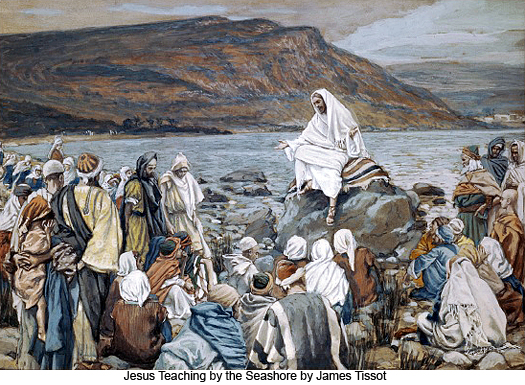
Their boat set out for a deserted place along the Sea of Galilee. But the word got out and lots of people “hastened” there, that is, they eagerly ran on foot, and arrived there faster than Jesus and the apostles could.

Why did those people run? They ran because they anticipated good things. They ran because they believed their desires would be fulfilled. In a word, they ran because Jesus and the Apostles had given them hope.

What can we hope for as Christians? Can we hope that if we stay close to Christ and to His Church that we’ll go to heaven someday?   Yes.  But is that all there is?  No. Our hope in Christ is not only for the time beginning once we’ve died.

Moments ago we heard Psalm 23, a psalm commonly heard at funerals. Though we tend to associate it with the holy dead, the blessings this psalm speaks of are for the living as well. For example, in the Gospel, Jesus leads the Apostles to a place beside restful waters to refresh their souls. He teaches the vast crowds that come many things, guiding them in right paths, and giving them courage. He has the people lay upon the green grass and, breaking bread, He spreads a meal before them.

We can confidently hope that Jesus will do these things for us.

Jesus wants to give you peace.  But what is peace? It means, in part, being liberated from worthless worry, having anxiety at all. As Christ inspired St. Paul to write the Philippians,

“Have no anxiety at all, but in everything, by prayer and petition, with thanksgiving, make your requests known to God.  Then the peace of God that surpasses all understanding will guard your hearts and minds in Christ Jesus.”

Jesus wants to teach you wisdom, and give you the courage you need to live it. Jesus Christ, teaching through our Church and its Scriptures, proclaims to you truths that the world doesn’t know and isn’t going to teach you. Jesus not only tells you how to live well but empowers you to do it too through the Holy Spirit alive within you.

Jesus wants to give you the bread you need. In a few moments, you will be receiving the body, blood, soul, and divinity of Jesus Christ in His Eucharist. And in addition to that, Jesus doesn’t only provide for you on this one day at Church. He provides for us all week long in the world out there. We pray for “daily bread”, and this is not just food, but whatever it is we need. Christ is rich, and wants to give you good things. If we a frugal and generous, He will provide us with whatever we need.

There is a lot of hopelessness about our times and the way things are headed, but we Christians should live with hope about our lives and about the world we live in. Now bad things are going to happen, but with Christ, a more glorious resurrection always follows the cross. With this truth in mind, we should be a people of hope.

At the same time, we should be wary of unchristian hopes, which are too worldly. Consider the crowds that eagerly flocked to Jesus. They held hope in this world because of Him. Unfortunately, their hope was often because they thought Jesus might become some militant, revolutionary messiah, who would ascend to the throne of David by slaying the Roman armies that occupied Israel. They were invested in hopes that he would establish a kingdom for Israel that would provide them with cheap food and easy money for the rest of their lives. John’s Gospel says that after the miracle of the loaves they wanted to carry Jesus off and make him king. The people wanted change, but Jesus wasn’t interested in their kind of change. Jesus knew that changing this world would be ultimately fruitless, unless we ourselves could first somehow be changed.

Our world is broken, but man is more broken more by sin. Give two sisters identical dolls, or give two brothers identical trucks, and a short time later you might come back to find them fighting over the exact same toy. Even if you handed everyone on earth everything they wanted, there would not be peace. The problem isn’t out there somewhere, the problems always in here. Money can do good things, but wealth in not our salvation. Good laws can help people, but politics are not our salvation. Christ is our salvation.

Christ is real and active with power in the world out there, but He tends to work from the inside-out.  That is to say, the kind of change that He is interested in usually begins within souls, like ours. Christ first changes Christians, and then through us, He transforms the world.

He wants to give us trusting peace inside, so we can live with freedom. He wants to give us contentment inside, as the antidote for our over-consumption. But first and foremost of all, He wants to give you prayer inside.

If you only hear one thing I say, this is the final and most important thing: A Christian has to pray, every single day. Daily prayer is the means to our conversion. Daily prayer is the first step to transforming our world. Daily prayer is the key to realizing our hopes, for this life and the next.

Christ has good things He wants to give you. So run to Him, with eager hope.