Archive for the ‘Jesus Christ’ Category

Something New Under the Sun — Funeral Homily for Marvin Weber, 94

December 30, 2022

By Fr. Victor Feltes

Ancient people thought about time differently than us. They did not picture time to be like a flying arrow, moving forward toward some end and purpose. They imagined time to be like a flat circle, going round and round. They saw history, in its broad strokes, repeating itself. The same four seasons, cycling over and over. Every empire eventually being replaced by another. This attitude is reflected in the Old Testament book of Ecclesiastes, whose author wrote:

“What has been, that will be; what has been done, that will be done. Nothing is new under the sun! Even the thing of which we say, ‘See, this is new!’ has already existed in the ages that preceded us.”

That author adds:

“There is no remembrance of past generations; nor will future generations be remembered by those who come after them.”

Indeed, very few people’s names are remembered by this world after just a handful of generations. To keep track of time in the ancient world, the custom was to refer to the years of the ruler’s reign (such as “the 15th year of the reign of Tiberius Caesar”). Yet those earthly rulers came and went, as history spun round and round with no apparent purpose.

But then, unexpectedly, something truly new happened under the sun. It is an event that we always celebrate during the present time of year. At the center of history, God entered history, becoming a human being like us. “Behold, God’s dwelling is with the human race.” We now number all the years of time as before or after the Christmas birth of Christ our King (“B.C.” or “A.D.”). Jesus says, “I am the Alpha and the Omega, the beginning and the end.” His life reveals that our lives, this world, and all human history are not merely random accidents but exist with purpose in God’s plan. As Pope Emeritus Benedict XVI said, “Each of us is the result of a thought of God. Each of us is willed, each of us is loved, each of us is necessary.”

We are gathered here for Marvin’s funeral at a meaningful time. He passed away two weeks ago, before the celebration of Christmas. Today, we offer his funeral Mass during the week between Christmas Day and a new year. His peaceful passing comes, in a sense, both before and after Christmas. Year after year, Marvin already knew and looked forward to the joy of Christ’s coming. He had already experienced great joy in Jesus but had not yet experienced its fullness in the time to come. The life of Jesus Christ causes us to see a Christian’s death through eyes which are different than the world’s. For a Christian, dying, “this momentary light affliction, is producing for us an eternal weight of glory beyond all comparison.” So Marvin’s passing is more than just a sad parting; it is a cause for joy in us as well.

Marvin married Betty inside this church 65 years ago. She told me many stories about her husband’s life, and there is no way I could retell them as thoroughly or as well as she. But I would like to highlight three anecdotes: First, Betty told me about Marvin’s dad who, when Marvin was about seven years old abandoned his family. Thirty years later, he appeared at his son’s doorstep and said, “I’m here.” He offered no apology, he gave no explanation, and Marvin was not happy about that, but Marvin valued forgiveness and forgave him. Marvin said he wanted his children to have a grandfather; he wanted them to know his father. Second, Betty tells me regarding Marvin, “If he found two pieces of wood he would make something.” Marvin has loved woodworking. He delights to repair or remake things into something greater. And third, at an age of 94, Marvin died relatively young. Because of the longevity of many of his ancestors who lived to be more than 100, Marvin died at a younger age than he had expected. For this reason, according to Betty he often put projects off for later saying, “I’ve got time.”

In our Gospel, Jesus tells us, “Where I am going you know the way. … I am the way and the truth and the life. No one comes to the Father except through me.” Christians’ lives throughout the centuries will reflect the One whom they have followed. For instance, despite our past unfaithfulness, our abandonment of God, Jesus forgave us, because he desired that we would come to know his Father. Christ took two pieces of wood for his Cross and used them to repair us and make us into something greater. And though our Lord died relatively young, with the resurrection he’s got time—everlasting life—to share with us forever.

The world will not remember us a few generations from now, but though the world may forget us, Jesus never will. Christ our King has come; entered time, our world, and our humanity to save us. So on this day of Marvin’s funeral, we are consoled by Jesus’ words: “Do not let your hearts be troubled. You have faith in God; have faith also in me. … Behold, I make all things new.”

Good News Needed by Each & All

December 24, 2022

Christmas Mass
By Fr. Victor Feltes

I proclaim to you good news of great joy!” Today is born our Savior, Christ the Lord. Why is his birth such good news? Well, why do people still need Jesus Christ today?

Would you say we presently live in a time of great wisdom? A time of advanced technology? Certainly. A time with more wealth than previous centuries? Sure. But is this a time of great wisdom? Relatively few know how to live rightly, anchored firmly in hope, and thrive. Would you say we live in a time of great heroes? Who would be our heroes now beyond paid athletes or fictional characters with superpowers? No U.S. politician in national office today has an approval above 50%. And even the best leaders among us are flawed. Would you say we live in a time of strong fatherhood? Rather, families are increasingly strained or broken. And many people have never had a good father. Would you say we live in a time of great peace? Bombs are not exploding around us like in Ukraine, but is there peace in our culture and peace in all our souls?

The good news of Christmas, as the Prophet Isaiah foretold in our first reading, is that ‘the people who walk in darkness see a great light; upon those who dwell in the land of gloom a light shines.’ “A child is born to us, a son is given us… They name him Wonder-Counselor, God-Hero, Father-Forever, Prince of Peace.” In our foolish world, Jesus is the wisest teacher whose counsel wondrously changes lives. In our unvirtuous world, Jesus is the only flawless hero; he is God among us. In our world lacking fatherhood, Jesus says he “only [does] what he sees his Father doing”— so Jesus acts and loves like his Good Father forever. And in our troubled world, Jesus is the Lord who would bring us peace, both around us and within us.

In the days of the birth of Jesus, St. Matthew’s Gospel notes a decree had gone out from the Roman Emperor that the whole world should be enrolled in a census. (This brought the Holy Family to Bethlehem.) Caesar Augustus wanted everybody grouped and tallied for his worldly purposes: to tax more efficiently, to draft more men for war, and to dominate more effectively. Beginning with the birth of Jesus at the center of history, God decrees for all the people of the world to be gathered into his Church for his holy purposes. It is not to tax us, but to give us his gifts. It is not for waging wars, but to bring about his peace. It is not to dominate us, but to share with us the freedom of his Kingdom. Like St. Paul says in our second reading, the grace of God has appeared in Christ to save and train us all to reject godless ways and worldly desires and to live temperately, justly, and devoutly in this age, as we await our blessed hopes: the return of Christ, the resurrection of the dead, and everlasting life with him.

On Christmas Day, Divine Providence brought the Holy Family (Jesus, Mary, and Joseph) and the shepherds all together. God’s Providence has likewise brought you and all of us together this morning with the Lord Jesus in this Church. Will you be here next Sunday? I pray the joyful news of Christmas will bring you back again. The Lord who loves you calls you. Our world needs Jesus Christ profoundly and so do you.

Immanuel: God Among Us

December 22, 2022

Advent Retreat Reflection
By Fr. Chinnappan Pelavendran

Emmanuel means God is with us. From the beginning even today God is with His people through His presence, He Strengthens us, comforts us, guides us, cares for us, and loves us. First, God is with us always. Secondly, he is coming every day, every hour to those who believe in him and those who do not believe in him. Third, he will come again in his glorified body, the same Jesus who was here two thousand years ago. He will be coming to judge the living and the dead.

In the beginning, God created Adam and Eve in His Image and likeness, which means God lives with everyone. God lives in you, God lives in me and God lives in each and every human being in the world. God was with Adam and Eve in the Garden of Eden. He wanted to care for them and be with them. He created us with love because he wanted to be with us.

When Abram was 75 years old, God told him to move out of his country and to go land that God would lead him to. He told Abram:

I will make of you a great nation,
And I will bless you;
I will make your name great
so that you will be a blessing.
I will bless those who bless you
And curse those who curse you.
All the communities of the earth
Shall find blessing in you.” (Genesis 12:2–3)

Abram had a strong faith in God. He knew that God would always be with him. He gathered his family together and they left his country just as the lord told him. Abram was 75 years old when he left the country, Abram trusted God to lead him. He didn’t know where they were going, so a map or GPS would not have helped. Everything was unknown. God was with Abram and led him to the land of Canaan. God was with him in a strange land among strangers.

God heard the cries of His people. They were slaves of the Pharaoh of Egypt. They were being treated with much cruelty. They called out to God to save them. God appeared to Moses from a burning bush and called him, “Moses! Moses!” He answered, “Here I am.” And God said to him, “I have witnessed the affliction of my people in Egypt and have heard their cry of complaint against their slave drivers, so I know well what they are suffering. I have come down to rescue them and lead them out of that land into a good and spacious land, a land flowing with milk and honey.” (Exodus 3:7–8)

The suffering they endured is unimaginable to us. The Israelites worked long hard days, were frequently beaten and all male children were killed at birth. Through all their suffering the lord was always with them.

Moses was a shepherd, a common man, and not eloquent in speech. He led his people out of Egypt. They were in the desert for forty years and Moses was able to take care of all their needs (food, and shelter, Clothing and water) because God was with him.

Judith was a widow and a member of the Israelites. God was with her. They knew that they were going to be attacked by the Assyrian army led by a chief general, Holofernes. He had 120,000 soldiers and also 12,000 archers on Horseback. He took provisions to provide for his entire army. Judith’s people found safety on top of a mountain. The army camped at the base of the mountain cutting of the water supply for the Israelites that was located there. Judith came down from the mountain to meet with the captain of the enemy. She had prayed to God to help her save her people. God enabled her to take the head of Holofernes back to her people. God was with Judith.

In the New Testament, God continued to be with his people. A good example is the Blessed Mother. She was conceived without original sin because she was chosen by God. She was a single young girl when the Angel came to her and said, “Behold, you will conceive in your womb and bear a son, and you shall name him Jesus. He will be great and will be called Son of the Highest, and the Lord God will give him the throne of David his father, and He will rule over the house of Jacob forever, and of his kingdom, there will be no end.” (Luke 1:31-33) And Mary said yes to God. Mary was well aware of the possible difficulties she could encounter, pregnant and single. If she were found out, she could be stoned to death. It would cause embarrassment to her and her entire community.

During the birth of Jesus, there was no one to deliver her baby. They did not have a place to stay. They finally found a barn and when Jesus was born he was placed in a manger.

St. Joseph was a just man and the earthly father of Jesus. When Jesus was born, King Herod issued a command to kill all the male children under the age of two. He was afraid that Jesus was an earthly king and would overthrow him. “Angel of the Lord appeared to Joseph in a dream and said Rise and take the child and his Mother, flee to Egypt, and stay there until I tell you. Herod is going to search for the child to destroy him.” (Matthew 2:13) In their life with Jesus, God was with them.

Jesus was very good friends with Martha, Mary and Lazarus and frequently stayed at their home. When Lazarus was sick, Mary and Martha sent word to Jesus. “When Jesus heard this He said, this illness is not to end in death, but is for the glory of God, that the Son of God may be glorified through it.” (John 11:4) Jesus came after the death of Lazarus. Martha was disappointed and told Jesus that Lazarus would not have died if Jesus had been there. Jesus went to the tomb of Lazarus and prayed, “Father, I thank you for hearing me. I know that you always hear me; but because of the crowd here I have said this, that they may believe that you sent me.” (John 11:41–42) Then He called Lazarus out of the tomb and told them to remove the burial bands. God was with his people through their pain and suffering.

Saul was a Jew, educated under Gamaliel a teacher of the law. Saul received permission to kill the Christians that were following Christ. On his way to Damascus, he met the Lord. “On his journey, as he was nearing Damascus, a light from the sky suddenly flashed around him. He fell to the ground and heard a voice saying to him, Saul, Saul, why are you persecuting me? He said, who are you, Sir? The reply came, I am Jesus whom you are persecuting.” (Acts 9:3-5) Saul then continued his journey to Damascus, then became a believer in Jesus. Saul became Paul. After his conversion, He traveled to many countries spreading the Good News of Jesus. He also wrote many of the letters in the New Testament.

During his ministry, he suffered a lot. St. Paul told the people of his suffering, “Five times at the hands of the Jews I received forty lashes minus one. Three times I was beaten with rods, once I was stoned, three times I was shipwrecked, I passed a night and a day on the deep; on a frequent journey in dangers from rivers, dangers from robbers, dangers from my own race, dangers from gentiles, dangers in the city, dangers in the wilderness, dangers at sea, dangers among false brothers; in toil and hardship, through many sleepless nights, through hunger and thirst, through frequent fasting, through cold and exposure.” (2nd Corinthians 11:24–27). Through all of his sufferings, God was with him.

The first time God spoke the promise of Emmanuel was to Judah’s king Ahaz. The Assyrian forces occupied the land and the king was afraid. God said if you do not stand firm in the faith, you will not stand at all. (Isaiah 7:9) Ahaz refused what God offered him. God then gave his own sign, one that would be fulfilled long after Ahaz. “The virgin will be with child and will give birth to a Son, and you will call Him Emmanuel. He will eat curds and honey when He knows enough to reject the wrong and choose the right.” (Isaiah 7:14)

In the Gospel of Matthew, we are told of the fulfilled prophecy. It is fulfilled through Mary with the birth of Jesus. The Angel appeared to Mary, a young woman from Nazareth, who was betrothed to a man named Joseph. The Angel appeared to him in a dream telling him that the child Mary was expecting was from God. Joseph then took Mary as his wife. “All this took place to fulfill what the Lord said through the prophet Isaiah; ‘The virgin will be with child and will give birth to a Son, and they will call Him Emmanuel – which means God with us.’” (Matthew 1:20–23)

The New Testament makes it clear, that Jesus God’s Son was the fulfillment of the Old Testament prophesy. He was the long-promised Emmanuel, sent by God to save His people. He came as the mediator between God and man, as our Redeemer, Savior, and Friend.

From the beginning of creation, even today and in the future, God is always with His people. Because of Jesus, Emmanuel, we never have to be alone. We never have to wonder how to please God or worry if our efforts are not enough. We know that Jesus is with us, in us, loves us, and will never leave us.

The Humility of Jesus

December 22, 2022

Advent Retreat Reflection
By Fr. Chinnappan Pelavendran

God loves the humble. St. Augustine once said, “The first virtue of Christianity, I will tell you that it is humility. If you ask me again, what is the second, I will say to you it is humility. Again, if you ask me a third time, I will say that it is humility, and as you ask me this question, I shall always give you the same answer.”

Humility enables us to accept others as God’s children, our brothers and sisters, redeemed by the blood of Christ. It encourages us to do loving and sacrificial services for them through acts of charity, mercy, and forgiveness. It enables us to accept ourselves as we are before God with all our defects.

You are all familiar with St. Mother Teresa of Calcutta and the good works she did. One time she was asking for donations for the poor in the city of Calcutta. She went to the rich man’s house and asked for help and he spit in her hand, she held that hand toward her and said this is enough for me. Do you have anything for the poor? He was humbled and now wanted to give her money to help the poor.

In the Second Book of Kings (5:1–19), we have the story of Naaman. He was no ordinary man, for he was an important figure during king Aram’s reign. He was wealthy and powerful. One day he developed the condition of leprosy. Being a leper was more than a person having a skin condition at that time. It signified that a person with leprosy was filthy and untouchable. So Naaman wanted to be cured as soon as possible because his condition was taking away everything he had. Power, wealth, and even people.

He needed and wanted help. A female slave told him to meet Elisha who was a well-known Hebrew prophet with a reputation for healing people. So he went to meet Elisha, but Elisha sent out his servant. This servant told Naaman to go into the River Jorden seven times and he will be cured. However, Naaman did not believe the servant and felt insulted. To him, he was suffering a severe disease, and to give such a simple and straightforward solution was insulting.

The servant was able to convince him to do as told. Finally, Naaman agreed, so he dipped his body into the Jordan River seven times. After doing so, he was completely healed and vowed to serve the Lord forever. It was not the Jordan River that healed him, it was the humility of receiving help from a servant. When Naaman humbled himself, he was able to witness the healing hand of God through the advice of the servant.

Solomon is good example of humility in the Bible. He was not an ordinary man. He was the king of one of the most powerful nations at the time, he was blessed with splendor, power, and vast riches. Wealth is usually accompanied by pride, boastfulness, and arrogance but, Solomon did not have any of that in his heart. One day, God appeared to Solomon in his dreams.

God asked Solomon what he wanted. Being the humble person that he was, he asked god for wisdom to rule and lead God’s people. God was very pleased to hear this and granted him wisdom, along with all the other things he already possessed. Solomon spent his life honoring the Lord. He built temples and prayed to God and he was humble until his death.

The humility of Solomon reveals the blessing received by those who are humble. He did not boast about his riches, he was powerful but knew it was only because of god’s blessing. Solomon is known to kneel in front of many people, which shows his humility. God blessed him with abundance and happiness. The world makes us think that we need many possessions to be important. However, Solomon knew that what he needed was wisdom and a relationship with God. These were the only things he really wanted. If we read about Solomon in the bible, he lived a great life. Solomon was humble.

In the Second Book of Chronicles, we read about Manasseh who became the king of Judah when he was only twelve years old. He offended God in many ways; he worshipped foreign gods and built altars to them in God’s holy temple. God spoke to Manasseh about his people’s sins but he did not listen. Because Manasseh did not listen, God brought the king of Assyria and his army to fight against Manasseh’s kingdom. It was a victory for the Assyrians who then captured the king and took him away.

During his imprisonment, Manasseh was able to see who god really is. He humbled himself before God and prayed wholeheartedly. God knew that Manasseh was genuinely sorry. He helped Manasseh by rescuing him, bringing him back to Jerusalem, and restoring his kingdom. Despite the many things Manasseh had done against God, the Lord blessed him the moment he decided to live under the influence of humility.

The Lord even gave Manasseh another chance to be king! Manasseh, honored God with all his heart. He changed his ways, and got rid of all the foreign gods and their altars. Then, he built the altar of God in which he gave praise and thanked the Lord. He used his voice to tell people, to serve God, and only God, just as the Lord wanted him to do. If you are feeling bad because you know you offended God, it is never too late to tell God you are sorry. You can humble yourself to God, like Manasseh.

In the New Testament, Jesus was often in the company of Pharisees, He noticed that many of them boasted of their good deeds and despised others. He told them this parable: “Two men went up into the Temple to pray. Once was a Pharisee, the other a publican. The Pharisee stood proudly and said this prayer to himself; O God, I thank you that I am not like the rest of men, greedy, dishonest, adulterous or even like this tax collector, and particularly that I am not like this publican. I fast twice a week, and pay tithes on all I receive.” This prayer was said with vanity and pride. The Pharisees did not come to ask god for his grace, but to praise himself, and to despise those who really were praying.

The publican, on the other hand, stood some distance away from the altar, not daring, even to raise his eyes to heaven. He struck his breast and said, “My God, have mercy on me, a sinner.” Jesus said, this man went home justified, the other did not. The publican had his sins forgiven; the Pharisee, with all his good deeds, went home, more in sin than when he left.

Although he was a sinner, the publican’s humility was more pleasing to God than all superficial good works of the proud Pharisee. Jesus Christ demonstrates with the example that everyone who exalts himself shall be humbled, and he who humbles himself shall be exalted.

When we hear about St. John the Baptist, we know that he was concerned about the work he was doing for our Lord. He was preparing the way for people to know about Jesus. The Gospel of Matthew tells us that John’s shirt was made of camel’s hair, and it must have been very itchy. His food was locusts and wild honey.

St. John the Baptist is like a road sign. A road sign gives direction but does not get attention for itself. The road sign is there to show us the way. Like a road sign, St. John pointed to Jesus, the way to the Father.

St. John the Baptist was with two of his disciple as he saw Jesus walk by, he said, “Behold the lamb of God the two disciples heard what he said and followed Jesus.” The next day Andrew introduced Simon to Jesus, who named him Peter (which means Rock). It then became a chain effect and many began to follow Jesus.

St. Luke tells us the people were filled with expectation, and all were asking whether John might be the Messiah. St. John the Baptist remains humble saying, “I am baptizing you with water, but one mightier than I is coming. I am not worthy to loosen the straps of his sandals.” (Luke 3:16)

St. John the Baptist humbled himself saying that he was only the prophet. He was there to prepare the way of the Lord. He pointed out to his disciple behold the Lamb of God and his disciple followed Jesus. He baptized with water and said, “He must increase, I must decrease.

We have been looking at the way God wants us to live. Jesus Christ by his example showed us how to live. He was humble. Jesus identified totally as a man. To be a man, He was not ashamed and He called us his brothers and sisters. Sometimes we feel superior to others. We feel more educated or better than other people. All of this pride is because Adam sinned. He came and became one of the lowest in the social level of His day. He came below everybody because he wanted to be a servant of everybody. St. Paul tells how Jesus humbles himself and became man:

Though he was in the form of God, did not regard equality with God something to be grasped. Rather, He emptied himself, taking the form of a slave, coming in human likeness; and human in appearance, he humbled himself, becoming obedient to death, even death on a cross. Because of this, God greatly exalted him and bestowed on him the name that is above every name, that at the name of Jesus every knee should bend, of those in heaven and on earth and under the earth, and every tongue confess that Jesus Christ is Lord, to the glory of God the Father. (Philippians 2: 6 – 11)

From the time he came to earth as a human being, he steadily went down in social status. He became a servant, then a slave, and finally like a criminal to die on the cross. Because it was His father’s will, He accepted and obeyed. He was humble during his entire time on earth. So God raised him up. That every knee shall bend at the name of Jesus, on the earth, above the earth, and below the earth. Every tongue shall confess that Jesus Christ is Lord.

You have heard about St. Mother Theresa, Naaman, Solomon, Manasseh, and the Publican. They were human like all of us, and during their lives had many difficulties and problems, but they were all faithful to God. They were humble. It does not matter if you are a king like Solomon and Manasseh, or poor like St. Mother Theresa and the Publican, if you are humble before God, He will raise you up.

David’s Kingdom Prefigures Christ’s Kingdom

November 20, 2022

Solemnity of Christ the King
By Fr. Victor Feltes

When the ancient Romans would crucify someone they displayed upon the cross the person’s name and the reason they were punished. For the Holy Cross on Good Friday, Governor Pilate had a sign inscribed in Hebrew, Latin, and Greek with Christ’s identity and the why he was condemned. It read: “Jesus the Nazorean, the King of the Jews.” (The famous first letters of this phrase in Latin were “I.N.R.I.”) The Jewish chief priests told Pilate, “Do not write ‘The King of the Jews,’ but that he said, ‘I am the King of the Jews.’” But Pilate replied, “What I have written, I have written.” Pilate did not have faith in Jesus — he wrote what he did to troll the Jewish leaders — but what he had written was true. Jesus was condemned, suffered, and rose again as the King of the Jews and King of the Universe. This Sunday, we celebrate Christ the King, but where is Christ’s Kingdom today?

During his public ministry, Jesus preached, “Behold, the Kingdom of God is among you!” And at the Last Supper, Jesus prophesied, “Amen, I say to you, I shall not drink again the fruit of the vine until the day when I drink it new in the Kingdom of God.” The next time Jesus drinks “the fruit of the vine,” (that is to say, wine) is on his Cross, when he drinks it from a sponge held up to his lips. From these passages, we can gather that the Kingdom of God has arrived. Yet we can also see that his Kingdom has not yet reached every place and every heart in every way. This is why the world was able to hand Jesus over to death and why Christians still pray to our Father above: “thy Kingdom come, thy will be done, on earth as it is in Heaven.” So where are we to find Christ’s Kingdom on earth? There are clues for us present in Sacred Scripture and history.

In our first reading, all the tribes of Israel become joined to David as their king. The Jews believed that the coming Messiah, their Christ, would be the King of Israel. And Jesus in the Gospels is repeatedly called the Son of David (that is, King David’s descendant, the heir to David’s throne). As St. Augustine taught, the Old Testament is the New Testament concealed, and the New Testament is the Old Testament revealed. The old foreshadows and points to the new. And though imperfect, the Old Testament Kingdom of David and his successors prefigures Jesus’ New Testament Kingdom. Several aspects of the old Davidic Kingdom help us to identify Jesus’ Kingdom in our midst; in particular, the Queen Mother, the Chief Steward, and the royal eunuchs.

One flawed feature of the old Davidic dynasty was that the kings each had multiple wives. From the beginning, God intended marriage to be a union of one man and one woman, but the kings of Israel — believing blood is thicker than water — used multiple marriages to seal their peace treaties and alliances with other lands. However, this creates a problem: when the king has many wives, who is the queen? You can imagine the rivalry and discord this question could cause. The Davidic dynasty’s solution to this problem was for the mother of the king to hold that prominent place as Queen Mother. The Queen Mother had a throne of honor at the king’s right hand and she served as an intercessor for the kingdom. If people had a request, they might bring it to her to present to the king. And if her request were pleasing to her son and served the kingdom’s good, the king would happily grant it to please his beloved mother.

Like in other kingdoms of past and present, the Davidic Kingdom had many royal ministers serving the king. But there was one prime minister among them: the king’s chief steward, the master of the royal household. The Davidic king’s chief steward bore on his shoulders a large wooden key as a sign of his office and authority. Today we honor citizens by giving them a symbolic key to the city; but this chief steward carried a symbolic key to the kingdom. His power was that of the king, on whose authority and with whose authority he acted, to open or to close, to permit or to forbid. However, any chief steward acting contrary to the king’s will would soon find himself replaced by another.

In the courts of ancient kingdoms like Israel’s, one would find royal eunuchs. A eunuch is a male who is either born or made physically incapable of marrying and having children. Kings preferred eunuchs for practical reasons: first, these men were safe to be around the king’s harem; and second, since they had no wife or children of their own, these eunuchs were fully-focused on the work of the kingdom.

The trusted eunuch’s mission, personal success, and legacy were wedded to that of the king and his kingdom. Perhaps you may already realize how the old Davidic kingdom foreshadows the Kingdom of God among us now. Jesus calls disciples who are willing and able to be “eunuchs for the sake of the Kingdom of Heaven.” Today, in his Church, celibate clergy and consecrated religious are dedicated to serving Christ’s Kingdom. Jesus told St. Peter, “I give you the Keys to the Kingdom of Heaven. Whatever you bind on earth shall be bound in Heaven, and whatever you loose on earth shall be loosed in Heaven.” Jesus made Peter his prime minister, the first Pope, his chief steward and master of his household on earth Pope Francis is St. Peter’s successor in that office today.

Jesus has sealed his peace treaty and alliance with peoples of all lands through a single marriage: his marriage to his bride, the Church, bone of his bone and flesh of his flesh. But among the Church’s many members, is anyone the queen? As before, our queen is the mother of our King. Christ the King has raised up his Blessed Mother Mary to a throne at his right hand where she intercedes for his Church. We can ask her to present any request to her Son, and if it is pleasing to him and serves his Kingdom’s good, Christ our King will happily grant it, because he loves his mother and us so much.

The beginning of the Kingdom of God on earth is the one Church of Jesus Christ. Let us remain loyal to Christ our King, and remain loyal to his Kingdom, a Kingdom that is among us now, his Holy Catholic Church.

Our Lord Jesus Christ, King of the Universe

November 20, 2022

By Fr. Chinnappan Pelavendran

Many years ago, Mohandas Gandhi the great Hindu religious leader in India wanted to overthrow the British Empire through love not violence. Christianity has not failed. It’s never been tried. As we celebrate this Feast of Christ the King, we need to follow Jesus peacefully.

What’s wrong with calling Jesus the King? A king is identified three ways: power, wealth, and force. With Jesus none of this is true. The power of kings is to control people and be the boss over them. His apostles James and John wanted the honor to be seated at the right and left hand of Jesus. Jesus was upset and rebuked them saying that the power of Jesus is to love and be a servant to all people.

The kings of this world are identified with wealth, they have more than they could possibly ever need. They draw money from everyone even the poor and build up their own prosperity. There is an incident in the Gospel where a young man asks Jesus “what must I do to gain everlasting life?” Jesus says, “Keep my commandments.” He replies, “I have done that from my youth.” And Jesus says if you want to truly be perfect to follow me now, go sell everything you have. Give it to the poor then come and follow me. The wealth of Jesus is His people especially the poor. He loves all of us and wants best of everything for us.

The kings of this world want to have superior dominance and control in this world. They will even go to war to get their ways. Jesus rejected all violence. While Jesus was praying in the garden of Gethsemane, the soldiers came to arrest Him. One of the disciples drew his sword and cut off the ear of the high priest’s servant. Jesus said put away your sword. Jesus healed the servants’ ear. Jesus rejected violence. Those who want to live by the sword die by the sword.

Human kings follow the ways of the world, not the ways of Jesus. So it’s really a contradiction to think of Jesus as a king of this world. We think of the aspects of earthly kings: power, wealth and force and try to make that the way of Jesus. If we are going to follow the way of Jesus, live Christianity, don’t talk about it. Gandhi says “it has never been tried, it has not failed, it just has not been tried.” Each of us is called now to try to live the way of Jesus, really change according to his ways and his thoughts.

Is not this one of the reasons why we and the church and everyone throughout the world are fascinated with Pope Francis, the Bishop of Rome. When he was elected the first thing he did was bow and seek the blessing of the people. He wants to be our servant. In a short time after he was elected, he went to visit the prison, knelt down and washed the feet of the prisoners. He’s showing time after time how he reaches out to the poor, the vulnerable, the way Jesus did. We rejoice in it because it’s clearly the way of Jesus and that’s what we are called to do.

The kings and rules of this world want to dictate and control everyone. The kingship of Jesus is different from the kings of this world. He loves, forgives, accepts, and He rules over us with mercy and compassion. We are all equally important to him.

Three Strengths of Saint Zacchaeus

October 30, 2022

31st Sunday of Ordinary Time
By Fr. Victor Feltes

The Jews in Jericho looked down on Zacchaeus (and not just because he was short). He was a tax collector regarded as a sinner. When Zacchaeus chose his occupation he knew his neighbors would despise him. Even if he had never extorted or cheated anybody, he still would be resented for serving the unpopular political powers ruling over Israel. It’s easy to imagine him being insulted and shunned by the Jews in his territory. He needed a thick skin to do his job, caring little about what others thought of him. He was not only a tax collector but a chief tax collector, and this made him a very wealthy man. Yet his riches did not fulfill him. He was searching for something more than money and this led him to Jesus.

[Zacchaeus] was seeking to see who Jesus was; but he could not see him because of the crowd, for he was short in stature. So he ran ahead and climbed a sycamore tree in order to see Jesus, who was about to pass that way.” Now apart from tree trimmers and deer hunters, when was the last time you saw a grown man sitting in a tree? It’s something children do, and Zacchaeus likely looked ridiculous in the eyes of the unfriendly crowd below. But “when [Jesus] reached the place, [he] looked up and said, ‘Zacchaeus, come down quickly, for today I must stay at your house.’ And he came down quickly and received him with joy.

When the crowd saw this they began to grumble, “He has gone to stay at the house of a sinner!” But Zacchaeus stood there and said to Jesus, “Behold, half of my possessions, Lord, I give to the poor, and if I have extorted anything from anyone I shall repay it four times over.” As a wealthy man, Zacchaeus came to know how great wealth disappoints. He had developed significant detachment from his wealth, which allowed him to give up half (and perhaps much more than half) of everything he owned. And Jesus declared to him, “Today salvation has come to this house because this man too is a descendant of Abraham. For the Son of Man has come to seek and to save what was lost.”

Zacchaeus had these three strengths helping him to find and follow Jesus: firstly, his honest acknowledgement of his dissatisfaction in this world; secondly, his indifference towards what others thought of him; and thirdly, his healthy detachment towards his riches. Why was he “seeking to see who Jesus was?” Why was he so joyfully eager to host Jesus at his house? Because Zacchaeus could admit that he was dissatisfied, with himself and what this sinful world offers, and he believed that Jesus could help him find salvation. Zacchaeus had developed a thick skin as a tax collector. He did not care about others’ mockery, gossip, and dim opinions about him. This allowed him to climb that tree to see Jesus even if others might laugh at him as a fool. And Zacchaeus’ healthy detachment concerning riches allowed him to be generous and fulfill justice with his wealth, as our Lord wished him to do.

Let us take stock of ourselves from the example of St. Zacchaeus. Can you admit where you are not yet fully the Christian you are called to be and then present yourself to Jesus? Are you dissatisfied enough with this unjust world to hope and act for more than the status quo, to sacrifice for this world’s betterment while longing for a world to come? Are you willing to be unapologetically Catholic before others; a person, for example, willing to pray before a meal at a restaurant even if someone might see you; a Christian who does not allow others’ opinions prevent you from being openly faithful to Jesus Christ and his Catholic Church? And are you detached enough from your wealth to generously share it and serve justice with it boldly, as our Lord would have you do? In what ways is Jesus calling you to go out on a limb for him?

A Trimmer of Trees — Funeral Homily for Gordon “Gordy” Weyers, 90

October 27, 2022

By Fr. Victor Feltes

For several decades, Gordy has loved trimming trees. Of course, there is much more to the man as a Catholic, a husband, a father, and a friend, but this is one of his curious quirks. Whenever Gordy saw outside his house a tree branch which was not right, he was highly-motivated to intervene. He would pull out his ladder and tree-cutting tool to go take care of that errant branch. Dot (that is, Dorothy) his wife of sixty-seven years would tell him, “Don’t climb the ladder,” but he would do it anyway.

Gordy began saying he wanted a new ladder but his kids kept trying to talk him out of this desire, hoping he would stop climbing at his age entirely. Yet by all accounts, his old ladder was very rickety, so eventually Dot said, “Get him a new ladder, because he’ll fall off the old one.” Dot would periodically look out the window to check on Gordy tree trimming on his ladder. Years later, she told him, “Good thing you never fell off!” He replied, “Oh, I fell off a few times, I just didn’t tell you.”

But here’s the thing: after Gordy’s trimming—however daring or reckless it may have been—his trees looked really good. Dot reports that “he never did anything that made them look bad.” Those trees became more perfect, more healthy and strong, more handsome and beautiful, by having been cared for and pruned by Gordy.

We often recall “the Lord is my shepherd,” but we less often reflect on how our God is a gardener. In the beginning, God created a perfect garden. And when St. Mary Magdalene first encountered Christ resurrected on Easter Sunday she thought he was the gardener. Jesus teaches, “I am the vine, you are the branches… and my Father is the vine grower. He takes away every branch in me that does not bear fruit, and every one that does he prunes so that it bears more fruit.” And the Letter to the Galatians tells us that the fruits which the Holy Spirit grows in us include love, joy, peace, patience, kindness, generosity, faithfulness, gentleness, and self-control. We are like trees which God prunes to make us more perfect.

Now I imagine if gold were alive and aware it may not feel eager be purified in a furnace’s fire, and the pruning process might not be a lot fun for a tree. But the Book of Wisdom tells us, ‘as gold in the furnace, God proves us… before taking us to himself.’ And though parts of our trees (of ourselves) must die and some of our unsightly branches must be trimmed away, the Lord makes our souls more perfect, more healthy and strong, more handsome and beautiful, through his care and pruning.

Like Gordy with his trees, Jesus saw us outside of his Father’s house. He saw our branches were not right. And he was highly-motivated to intervene. Call it daring or reckless, but our Lord put his life on the line. Christ went up the tree of the Cross to trim our flaws and perfect us. And after death felled him, Jesus rose again.

He declares, “I am the way and the truth and the life. No one comes to the Father except through me.” To enter into heaven, we must be perfected in Christ’s love. So if any imperfections still remain in Gordy’s soul, we ask Jesus today to prune them away. And we welcome our Lord to continue trimming any errant branches within our souls as well.

Hands Lifted up to Heaven

October 16, 2022

29th Sunday in Ordinary Time
By Fr. Victor Feltes

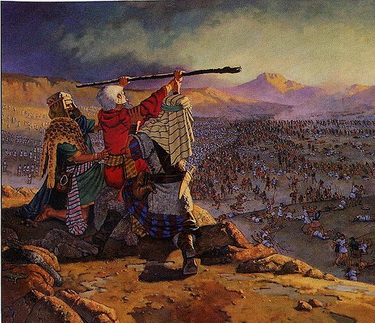
After God’s people, the descendants of Israel, crossed the Red Sea in the Exodus, an army of Amalekites came to battle them in the Sinai desert. So Moses instructed his servant Joshua: “Pick out certain men, and tomorrow go out and engage Amalek in battle. I will be standing on top of the hill with the staff of God in my hand.” The next day, while Joshua led Israel’s soldiers in fighting the foe on the battlefield, Moses stood upon an adjacent hill along with Aaron and Hur.

As long as Moses kept his hands raised up, Israel had the better of the fight, but when he let his hands rest, Amalek had the better of the fight.” Moses wielding this staff at God’s command triggered the plagues in Egypt, parted the Red Sea, and now brought Israel’s victory on the battlefield. But this raises a reasonable question: why would God condition his people’s success in combat upon an old man holding a piece of wood above his head? Moses lifting up this staff of God was a sign for God’s people which preserved them from a spiritual disaster.

God knew that if Israel had won apart from this sign they would have ascribed the victory to themselves. “We won this battle because we’re so smart, and strong, and brave! Maybe we don’t need God’s help after all.” Such pride in their success could be their downfall, in this life and the next. So instead, through the sign of an up-lifted staff, the Lord showed Israel, “I am the vine, you are the branches. Whoever remains [with] me and I [with] him will bear much fruit, because apart from me you can do nothing.”

Similarly today, our Lord desires us to pray without ceasing for the good things we want or need. Otherwise, if and when his blessings come, we shall attribute these things to mere luck, coincidence, or to our own personal abilities, with no growth in our relationship with God. He is the source from whom all good things come. By asking and then receiving, we come to see and know the Lord is near and cares for us. And in the end, that is the most valuable gift of all.

God not only wants us to know and to love him, he desires us to glorify us as well. God is all-powerful, omnipotent, he could do everything without us. But by God accomplishing his will through us, as he did with Moses, the Lord makes us more like himself and causes us to share in his glory.

Holding the staff of God in his hands throughout the day made Moses’ hands and arms grow tired. (If you cannot understand why, try holding an object above your head for just ten minutes sometime.) When Moses’ body grew tired, his friends came to his aide. “They put a rock in place for him to sit on. … Aaron and Hur supported his hands, one on one side and one on the other, [one on his right and the other on his left,] so that his hands remained steady till sunset.” With this help from his friends, Moses kept his arms raised-up and God’s people prevailed against their foe. All of this was a foreshadowing of greater things to come.

On Good Friday, when Jesus was condemned to death, he took the cross into his hands and carried it to the top of a hill. There his hands were nailed to the wood above his head. And Jesus was not there alone. All four Gospels note he was crucified between two others, “one on his right and the other on his left.”

Our Lord was mocked as he hung for hours upon the Cross: “Are you not the Messiah? … If you are the King of the Jews, save yourself!” But in the Garden of Gethsemane, Jesus had said, “Do you think that I cannot call upon my Father and he will not provide me at this moment with more than twelve legions of angels? But then how would the Scriptures be fulfilled…?” Christ had the power to come down from the Cross, but if he had done that—if Jesus had released his hands from the wood—if he had refused to die for us, how would we have been saved from our enemies, sin and death?

Love kept Jesus on his Cross: love for his friends gathered nearby. love for the criminals on his right and left, and love for you and me. Consider what a precious consolation it was for Jesus in his suffering to have his Mother Mary, John the Beloved, and Mary Magdalene there supporting him. “But,” Jesus asks, “when the Son of Man comes [again], will he find faith on earth?” Will Jesus return to a world where everyone imagines they can get along just fine without him?

Let us continue being God’s humble people, recognizing our dependence on him. Let us ask of him our wants and needs so that we can know and experience his blessings. Then we shall share his deeper friendship and share in his great works, increasing in his likeness and increasing in his glory. By relying on God and the holy friends and loved ones his providence places near to help us, we shall share in our Lord’s great victory.

Are you Friends with Jesus?

August 21, 2022

21st Sunday in Ordinary Time
By Fr. Victor Feltes

How many friends do you have on earth? When was the last time you counted them? It’s not the same as the number of Facebook friends you have. Each of us have many acquaintances, but fewer friendly acquaintances, and still fewer true friends. What is it that makes you and your friends friends? Are you friends with Jesus and how can you tell?

Luke’s Gospel relates a parable which foreshadows that not all will die as friends of Christ. The Lord Jesus is the master of the house and he plainly warns us that after he has arisen and locked the door, many will stand outside knocking and saying, “Lord, open the door for us… We ate and drank in your company and you taught in our streets.” But he will answer, “I do not know where you are from. Depart from me, all you evildoers!” In the parallel passage to this which appears in Matthew’s Gospel, Jesus cautions us, “Not everyone who says to me, ‘Lord, Lord,’ will enter the kingdom of heaven… I will declare to them solemnly, ‘I never knew you.’” Seeing many figures from the Old Covenant and from around the world saved, reclining at table, and feasting in the kingdom of God, those kept outside will be angry and grieved, wailing and grinding their teeth, at having squandered their chance to enter.

But doesn’t Jesus say elsewhere: “Knock and the door will be opened to you. For everyone who asks, receives; and the one who seeks, finds; and to the one who knocks, the door will be opened”? That is true for us during this lifetime, but at the moment of death one’s eternal fate is sealed. As the Catechism of the Catholic Church teaches: “Death puts an end to human life as the time open to either accepting or rejecting the divine grace manifested in Christ.” (CCC #1021) We must come to Jesus. Jesus says, “I am the gate…. No one comes to the Father except through me… Whoever believes and is baptized will be saved; whoever does not believe will be condemned.” Now is the time to approach him and befriend him for our salvation. We know that he loves us, but are we friends with Jesus?

When I was growing up, I thought about how many friends I had. I wondered, “Who counts as a friend?” I came up with a test: my close friends were those who could invite me to their house for supper with their family, or whom I could have over to eat with mine, without it being strange. With most of my grade school peers such invites would have felt weird, but with my handful of friends it felt fine. Eating with other people has been a sign of fellowship since ancient times. This is partly why Jesus calls us to Mass, to this meal together with him and the family of God. What greater dinner invitation could we receive than this?

Yet, simply eating with our Lord does not guarantee our closeness. During his public ministry, Pharisees invited Jesus to dine with them while regarding him with suspicion, and recall what those locked outside in the parable say to our Lord: “We ate and drank in your company and you taught in our streets.” Merely being present for these activities does not automatically yield a close friendship with Christ. At every Mass, Jesus’ Word is taught and his Body and Blood are consumed, but friendship with Christ is about more than just coming to church. So how can we be closer to him?

I recognized my boyhood friends in those whom I would visit for meals and whom I would likewise welcome to dine with me. Jesus invites us to visit him in the Eucharist but desires that we in turn would invite him to our homes. In the Book of Revelation, Jesus says, “Behold, I stand at the door and knock. If anyone hears my voice and opens the door, I will enter his house and dine with him, and he with me.” How can we invite Jesus inside? How do we receive him into the places where we live?

Jesus knocks upon the door of our souls and hearts and minds each day, and through daily prayer we let him in. Open the door to him by prioritizing your relationship with habits of devotion. Be a gracious host to your great guest and make him feel at completely home, listening to his voice and fulfilling all his requests. Seek to serve the Kingdom of Christ and embody his righteousness as a saint like him. Reject your sins and love like him, for Jesus says, “You are my friends if you do what I command you.” Jesus knows we’ll mess up sometimes, but Christ’s true friends will strive to be his close friends.

In the Boss’s Shoes

August 7, 2022

19th Sunday in Ordinary Time
By Fr. Victor Feltes

Once upon a time, you had an idea, an idea to bless the entire world by starting a new business from scratch. You fully invested yourself into the project – your time and talent and treasure – to make this enterprise successful, and it was very successful. After leading your business for many years without a single vacation, you announced you would be taking some time away. You reassured your employees the company would continue and that you would be back, perhaps in a few weeks or maybe several months.

You gave careful instructions to all of your managers for what they were to do in your absence, and then you left on a journey which was out of this world. You celebrated a beautiful, destination wedding which you had long-looked forward to and enjoyed many other things. Then one Friday afternoon around 3:00 PM, you returned to your workplace, your creation.

Driving into the parking lot, you’re surprised by how few cars there are. Your confusion turns into shock when you discover the building’s front doors are locked, despite it being business hours. Fishing out your keys from your pocket you unlock the door and walk into an empty lobby. First, you go to your office and find your dear secretary, Mary, at her desk.

Thank God you’re here,” she says and she begins to tear up. “After you left, everything became horrible. Despite what you told them, people started doing their own thing. When I tried to correct them, they wouldn’t listen and were cruel.” “Where are they now?” you ask. “Most of the salaried employees have simply stopped showing up, and the rest are skipping work today to make it another ‘long weekend.’” “Mary, I thank you for your faithfulness. I’m sorry this happened to you, and I will make it up to you.

As you walk throughout the building you notice many empty beer bottles and pizza boxes laying around. The cubicles and warehouse are nearly deserted, except for Jennifer helping customers over the phone at her computer and Michael moving shipping crates on his forklift. Then you find several of the junior employees goofing-off in the break room. They become very quiet when you enter.

Why aren’t you working?” “Because… no one has told us what to do.” “Fine! Start by clearing these tables and picking up the floor. Clean these workspaces and take out the trash. Then report back to me.

Returning to your office, you immediately dictate two memos: the first, firing all of your current managers for cause, and a second memo giving large raises and promotions to Mary, Jennifer, and Michael, appointing them as the new leaders of their departments. I trust this tale sounds familiar; it is similar to Jesus’ parables but dressed in modern clothes.

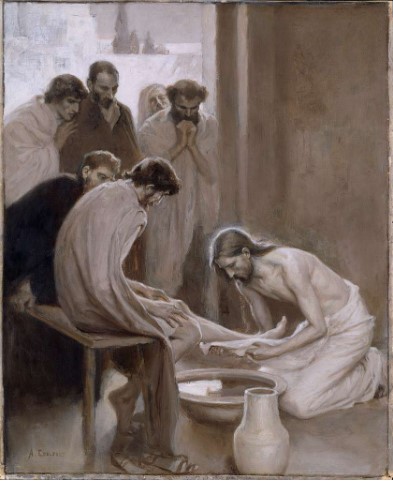
In today’s Gospel, Jesus urges us to be prepared “like servants who await their master’s return from a wedding, ready to open immediately when he comes and knocks.” Blessed will such servants be upon his arrival, especially if he finds them vigilant in nighttime’s “second or third watch,” that is, during this world’s darkest hours. Their joyfully returning lord and master will be so grateful for their proven faithfulness. “Amen, I say to you, he will gird himself, have them recline at table, and proceed to wait on them,” just like Jesus washes his disciples’ feet, dries their feet with a towel wrapped around his waist, and gives them his Eucharist at the Last Supper. Our Lord and Master, who shall come knocking on an unknown future day – either on the day we die or on the Last Day – is Jesus Christ himself.

As for those who say “the master is delayed in coming” or imagine he is never coming back, who mistreat other people (the menservants and the maidservants) and serve their own selfish desires (eating and drinking and getting drunk), our Lord will come at an unknown hour and punish them severely, condemning them to where the unfaithful go.

In the beginning, God had an idea, an idea to bless our entire world, creating this universe from scratch. Jesus Christ, through whom all things were made, has fully invested himself into his enterprise’s success. Yet Jesus has given us all freewill. Though never far, Christ leaves us free to choose to be his good co-workers or to do our own wicked thing. Today I hope that, having imagined yourself in the Boss’s shoes, you may better personally feel and appreciate how much our Lord treasures your faithfulness and how eager he is to reward it.

The Third-Day Surprise — Funeral Homily for Greg Seidling, 60

July 23, 2022

By Fr. Victor Feltes

Greg often said, “If you don’t get up in the morning, you won’t get anything done in the morning.” And I imagine he would say you’d have to wake up pretty early before “the shank of the day” if you were going to successfully pull his leg. Earlier this year, one scheme which took three days to prepare gave him a great surprise.

His son Mike began calling him daily pretending he had begun renovating his house. As a self-employed contractor and Jack-of-all-trades, Greg was interested in his son’s project. But on the third day, Mike called his dad and said, “I cut a supporting wall! The roof is falling down! Come and help me!” “What were you doing!?” Greg exclaimed. (The great outdoorsman had swallowed the bait.)

Greg could fix anything, from picnic tables to chicken coops, and he sprang into action. He and Valeria started driving to Mike’s home and Greg got on the horn to call for others’ help – to bring their tools and add their muscle. It was Saturday, March 26th, 2022, Greg’s 60th birthday, and the people Greg was calling were already at his surprise party.

Greg had his suspicions. On the way, he asked his high school sweetheart, his wife of nearly forty years, if there was some kind party planned. Valeria did not lie to her husband, she denied having anything to do with planning a surprise party, and it was true – she hadn’t done any of the organizing. But her spouse finally knew what was up when they reached Mike’s house and saw the driveway full of cars.

Greg found Mike and said, “It doesn’t look like you need anymore help, you’ve got plenty of help here! … I don’t know if I should be upset that I fell for this or happy that my son was not as dumb as I thought.” Greg, always ready to find a reason to party, greeted his gathered family and friends and started enjoying his party with them.

The Gospel we heard today featured the Beatitudes of Jesus from his Sermon on the Mount. It is a list of character traits suited for the Kingdom of God. These traits belong to Jesus Christ, and he calls us to believe in him and become like him.

It took three days to prepare Greg’s great surprise, and it took three days for Jesus to accomplish his great plan. Christ suffered, died, and was buried, rested and rose again, and when he appeared to his disciples they were very surprised and overjoyed.

Like Greg, Jesus is also a skilled repairman and builder, through whom “we have a building from God, a dwelling not made with hands, eternal in heaven.” So even in the face of death “we are courageous” and have peace in the thought of going “home to the Lord.” Death can seem like a disaster, like our walls are failing, our roof is falling, and all might be lost. “Come and help me, Lord!” And Jesus comes to us, because he loves us.

Like Valeria on Greg’s birthday, Christ the bridegroom, the Holy Spouse of his Holy Church, did not lie to us. In life, we won’t always know exactly what Jesus Christ is up to, but if you follow him as your Good Shepherd you will be joyfully welcomed at his house. There is a party prepared for us where Jesus would gather all of us together, with Greg and one another.

Abraham, Martha, and Our Lord

July 16, 2022

16th Sunday in Ordinary Time
By Fr. Victor Feltes

In this Sunday’s readings, Abraham and Martha play host and hostess to our Lord. The Book of Genesis tells how “the Lord appeared to Abraham… as he sat in the entrance of his tent,” and that Abraham ran to offer his three visitors hospitality. Today’s gospel from Luke recounts how “Jesus entered a village where… Martha welcomed him.” Both Abraham and Martha served the Lord but Martha, unlike Abraham, receives a gentle correction from him. So in what ways did Martha and Abraham’s actions differ?

The pair share similarities. Both of them wanted to put other people to work. Abraham tasked his wife Sarah to make bread rolls and his servant to prepare a tender, choice steer, while Martha sought for her sister Mary to help her. Both Abraham and Martha were a flurry of activity. After running to set Sarah and his servant to work, Abraham fetched curds and milk and the meat that had been prepared and served these to his guests in the tree shade. And Martha was famously “burdened with much serving.” So what are the key differences between them? I would like to highlight three.

First, Martha gives the Lord an command, while Abraham politely invites. She says, “Tell [my sister] to help me.” Abraham also asks things of the Lord but in a different spirit: “Sir, if I may ask you this favor, please do not go on past your servant.” Abraham is respectful and open to whatever the Lord thinks best. When the Blessed Mother brings Jesus the news that the wedding feast of Cana has run out of wine, she does not order him what to do; instead she instructs the servants to “do whatever he tells you.” We are free and invited to ask the Lord Jesus for anything, large or small, but ask him with reverence and trusting that whatever he decides will be best.

A second difference between Martha and Abraham is that Martha gets noticeably stressed out while Abraham, though vigorously active, appears to maintain his peace. “Martha, burdened with much serving,” complains and criticizes. “Lord, do you not care that my sister has left me by myself to do the serving?” But Jesus says to her in reply, “Martha, Martha, you are anxious and worried about many things. There is need of only one thing.” Martha has placed expectations on herself for how she needs to show hospitality, she’s failing to meet these self-imposed standards and it is depriving her of peace. Martha has fallen into an anxiety trap. Anytime we feel like, “I have to do this, but I can’t. I have to, but I can’t,” it’s not true. Jesus does not demand the impossible from us. So either you do not really have to do that thing, or (if God is calling you to do it) with the help of God you can accomplish it. When the yoke you carry on your shoulders feels heavy and grinding, consider whether it may be a yoke of your own making. Jesus says, “Take my yoke upon you… and you will find rest for yourselves. For my yoke is easy, and my burden light.” Some reevaluation may be necessary to exchange your yoke for his.

A third and final difference between Martha and Abraham, is that Martha allows her work to get in the way of her relationship with the Lord. Abraham labors too, but he enjoys the company of his heavenly guests even as he serves and waits on them under the tree. He and his guests converse together, leading to Abraham’s great blessing. One of his guests declares to him, “I will surely return to you about this time next year, and Sarah will then have a son.” Jesus said Martha’s sister Mary, sharing the Lord’s company listening at his feet, had “chosen the better part and it [would] not be taken from her.” Abraham did not exclude this better portion from his labors. We too should spiritually commune with the Lord throughout our day’s tasks, for he is always near.

Whatever good works we do for Jesus are not nearly as important as who we are for each other. Jesus says that at the Judgment, “Many will say to me on that day, ‘Lord, Lord, did we not prophesy in your name? Did we not drive out demons in your name? Did we not do mighty deeds in your name?’ Then I will declare to them solemnly, ‘I never knew you. Depart from me, you evildoers.’” Do not merely serve and obey Jesus, on the level of a slave. Love him as your dearest friend, for he is already the greatest friend towards you. The one thing needed is Jesus Christ.

A Heaven-Sent Hug

July 10, 2022

15th Sunday in Ordinary Time
By Fr. Victor Feltes

Last month, a parishioner told me she looked forward to the great stories I would bring back from vacation. Today, I would like to tell you the best story from my time away. It’s actually a story of Tori, the wife of a former college roommate I visited. It is a God story which all involved are happy to share with others, and this story is entirely true.

Tori worked ten years at a Christian school in Oregon with a much-beloved Bible teacher named Dave. He was like a father figure for her. Tori did not really know his wife, Marcy, but he often spoke of her in glowing terms. When Tori had left her teaching job and moved away, Dave was diagnosed with an aggressive form of cancer shortly after his retirement. Dave and Marcy helped keep their friends and family in the loop through their joint Facebook account until he passed in 2017.

Amanda Robin Sandberg

Fast-forward to May of 2022. Tori and her family have lived in Northern Idaho for a little more than a year. And it so happens that Marcy, the now remarried widow, has also moved to Idaho and lives less than two miles away from Tori, though they still remain merely acquaintances. One Monday, Tori is scrolling Facebook and sees one of Marcy’s posts: it’s the picture (right) of a smiling 42-year-old woman paired with the caption “My beautiful daughter.” This seems like a rather benign item, but Tori’s thoughts keep returning back to it, over and over. So Tori revisits the post the next day and reads its many replies. From this she learns that Marcy’s daughter Amanda has died, recently and suddenly, in an unmentioned way.

Being a mother herself, Tori’s heart breaks; she weeps, moved with compassion. Seeing far away Facebook friends writing to Marcy saying “I wish we could be there for you,” Tori prays, “I’m right here, I’m close. God, what can I do?” And the idea she receives is, “Go! Go to her house!” Tori thinks, “I don’t know her very well. I should bring her cookies or flowers.” But this was answered with, “No, don’t bring anything. … Bring her a hug. That’s what you’re allowed to bring her and nothing else.”

Now Tori is very kind, but naturally an introvert. This plan to just drop-in on a mourning acquaintance was not her preference. She asked, “Is this really what you want me to do?” And the compelling idea continued urging her like a mantra: “Show up, bring her a hug. Show up, bring her a hug.” Like she had experienced in previous inspired episodes, this thought’s persistence despite Tori’s personal fears and doubts were a sign to her that it was coming from the Lord. Tori reports, “I felt stronger and stronger: ‘This hug is from her daughter. This is what she wants to give her.’

Late Tuesday afternoon, her stomach sick with anxiety, Tori went to Marcy’s home and rang the bell. Marcy soon opened the door with a surprised but friendly expression. Tori said, “I believe I saw something on Facebook.” Marcy’s face fell and she nodded. Extending her arms, Tori said, “I’m here to give you…” and Marcy interrupted, “A Hug!” Tori is ordinarily a light hugger but she gave Marcy strong embraces. Marcy joyfully said to her husband, “She hugs just like Amanda!” The two women smiled, cried, and hugged again and again.

Amanda had died just four days before in a car accident. She was the same age as Tori. Marcy had Christian faith her daughter was in heaven but was asking God for a sign that Amanda was alright. Just hours before Tori’s visit, Marcy had told her husband one of the things she was going to miss most were Amanda’s hugs. Marcy told Tori that Amanda had once hugged her mom so tightly that she broke some of her mother’s ribs. “I never told her,” Marcy said, “but I guess she knows now!” What beautiful things would the Lord do through us if we were more open to his promptings?

This morning, Jesus shares with us one of his greatest Gospel stories. In this famous parable, after evil befalls a traveler on the road at least three people happen by. When the priest, Levite, and Samaritan began their days’ journeys none of their plans had foreseen a detour to help a stranger in need. The priest and the Levite both saw the robbers’ victim but they were too busy or too afraid to help, or they simply assumed God didn’t want them to get involved. The Samaritan, however, was open to the will of the Lord that day in a way the other two were not. The Samaritan was moved with compassion and approached the man; cared for him, lifted him up, provided help for him, and left him better than he found him. Of the three, Jesus presents the Good Samaritan as an example for us to follow, telling us to “go and do likewise.”

You can do likewise by being open and asking, by asking the Lord and being open to his promptings. First, choose to increase your openness to loving “the Lord, your God, with all your heart, with all your being, with all your strength, and with all your mind, and your neighbor as yourself.” Then ask the Lord in prayer to use you as his voice, hands, and feet; as his conduit, his vessel, his powerful instrument in your daily life. (“God, please show me your will.”) Finally, as you go throughout your day, be open to his invitations.

What are the Lord’s promptings like? When some innocuous thing seems highlighted in Tori’s attention or when someone comes to her mind during prayer, in a dream, or in the course of her day, she pauses to ask Jesus about it. Maybe she is supposed to reach out to someone with inspired words or some good deed. Tori notices the Lord’s ideas hit her differently than her own, they stick with her rather than fade away, returning to her in quiet moments. And if she were ever to hear an evil suggestion, she would then know it’s not from him. Provided Tori does not give in to busyness or distraction, when she is welcoming heaven’s invitations, “Every time I’m open to God doing something,” she says, “he does stuff.”

This spiritual openness, asking and listening and doing, is a skill to practice. Like when cultivating a new garden or starting to lift weights, it is better to begin small and to grow over time than to never start at all. Be prepared to take some risks for Jesus. It is better to make small mistakes than to miss amazing opportunities. Christ died for us. We must be concerned about more than merely our own comfort and plans. Like the Good Samaritan, be interested in helping to save and bless others. Be open and ask God to use you, ask our loving Lord and be open to his great ideas.

Why Did Jesus Go?

May 29, 2022

The Ascension
By Fr. Victor Feltes

This week, our Catholic school celebrated our eighth graders’ graduation with a Mass and an awards ceremony. Afterwards, while the graduates were having their pictures taken, a teacher and I stood off to the side, looking on. He remarked, “It’s sad to see them go.” I replied, “Yeah, but it would be even sadder if they stayed.

Just whimsically imagine remaining an eighth grader well into your twenties. You don’t have a full-time job because you’re a full-time student without a high school degree. Of course you’re unmarried and have no kids—you’re still in middle school! And sure, after a decade of eighth grade, having had the same lessons over and over, you could ace all of your homework and tests (if you still had any motivation left to do so) but you would not be learning very much. It is bittersweet to see our graduates go forth from us, but it is better that they go. Though in one sense they are leaving us, they are not really gone. Yet this departure is necessary for them to reach their full human maturity and to fulfill God’s plans for their glory.

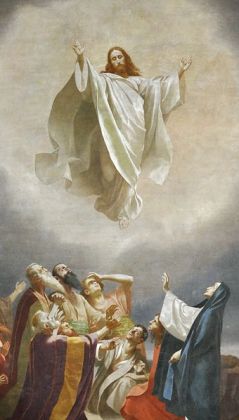
Today we celebrate Jesus’ bodily ascension into Heaven. The traditional day for celebrating the Ascension is forty days after Easter, which was last Thursday, or “Ascension Thursday.” Our diocese, like most dioceses in our country, transfers this celebration to this Sunday. I guess we like keeping Jesus around longer. But seriously, the ascension of Jesus into heaven raises this question: “Why did he go? Why didn’t Jesus stay?

Now Jesus does tell us, “Wherever two or three are gathered in my name I am there in their midst.” He says, “Behold, I am with you always until the end of the age.” And he is truly present for us in the Holy Eucharist. But Jesus’ presence now remains invisible or veiled to our eyes. By bodily ascending and disappearing into the clouds Jesus is visibly departing from us until he comes again with a glory manifested to all. “But I tell you the truth,” he says, “it is better for you that I go.” Why is this better? What would it be like if Jesus dwelt among us throughout the centuries like he did with his disciples those forty days, walking with them and talking with them, following his Resurrection?

There is no physical reason why Jesus could not have done this. His risen body is a glorified body no longer subject to injury or death, so that’s not the reason he did not remain. Did he go because on earth he’s reduced to being in one particular place, or limited in how much he can see, know, or do? Remember, Jesus is not merely human but divine, all-knowing and all-powerful, and his bi-locating saints (such as Venerable Mary of Ágreda or St. Padre Pio) who have manifested the miracle of being more than one place at once surely do not possess any supernatural ability which Jesus lacks.

So God the Father could have chosen “by his own authority” for his Son to remain visibly active here with us, in one, or thousands, or millions of locations at once, throughout the centuries up to our day. Jesus could be the pastor in every parish, the teacher in every classroom, the doctor in every hospital, and the leader in every country. He is the perfect priest, the best teacher, the greatest healer, and the rightful ruler of all. Who is better-qualified than Jesus to do any of these things? Nobody. People would demand this of him and resent him for not doing it. But if Jesus were visibly present and doing everything, then we would be left doing very little.

Would it be a better world if Jesus personally did everything? In some ways, yes. Earth would be closer to paradise in many respects. But would this lead to more souls being saved? I’m not so sure. Adam and Eve lived in an earthly paradise, too, before they fell. And the glory of Christ being manifested to the world in an undeniable way might gain peoples’ submission, but not necessarily their conversion or love. The demons who fell had no doubts about God’s existence and yet they chose to disobey him as far as they were able.

If Jesus did everything of importance on earth without us, one result which seems evident to me is that we would remain in an unending adolescence, like someone attending the eighth grade well into their adulthood. This is why it was better for us that Jesus ascended. We are children of God called to what St. Paul calls “the stature of the fullness of Christ.” If everything which matters were just Jesus’ job to handle, how would we grow from our immaturity into the full maturity of Christ?

Jesus says, “I tell you the truth, it is better for you that I go. For if I do not go, the (Holy Spirit) will not come to you. But if I go, I will send him to you.” By the Holy Spirit, the Church (which is Christ’s Body) is animated in this world. As members of his body we are moved by the Holy Spirit to love and to work united with Christ, growing more into his likeness and glory along the way. Would Jesus not ascending into heaven, remaining constantly here on earth and doing everything without us, have been easier than this present Christian life of ours? Perhaps, but Jesus desires that we would graduate with him to higher things and ascend to a greater glory with himself.