Archive for the ‘Heaven’ Category

A Vision of the Saints in Heaven

November 1, 2025

Solemnity of All Saints
By Fr. Victor Feltes

On this All Saints’ Day, let us consider what we can look forward to living as saints in heaven one day. But first, how does one get to heaven?

At the moment of death, our immortal souls will separate from our mortal bodies and go immediately to our particular judgment. There we will be judged according to our faith and deeds in Christ, based upon our connection to Christ and our love of God and neighbor. Then our personal punishment or reward will begin: either immediate and everlasting damnation, or entrance into the everlasting blessedness of heaven —either immediately or after the purifying process of purgatory. One day, the dead will arise and the saints will experience a new heavens and new earth in their glorified resurrected bodies. But for now, the saints only experience heaven through their souls (with the Blessed Virgin Mary being a notable exception). When someday, by the grace of God, we are saints in heaven, here are some things we will enjoy.

One thing to look forward to is probably having a perfect memory. A colleague of the genius mathematician and physicist John von Neumann writes “one of his remarkable abilities was his power of absolute recall. …Von Neumann was able on once reading a book or article to quote it back verbatim; moreover, he could do it years later without hesitation. …. On one occasion I tested his ability by asking him to tell me how A Tale of Two Cities started. Whereupon, without any pause, he immediately began to recite the first chapter and continued until asked to stop after about ten or fifteen minutes.” If this is possible with a frail human brain, how much more knowledge could our unhindered souls retain?

Another perk of being a saint in heaven is great ease in doing whatever is best. When in the unveiled presence of God, “we shall see him as he is,” and discerning God’s will should be easy. And our perfected virtues will make it easy to do what is good and right, for we shall be “pure, as he is pure.”

Another extraordinary blessing in heaven is having innumerable friends. In St. John’s vision of heaven he beholds “a great multitude which no one could count from every nation, race, people, and tongue.” Every saint in heaven has become an incredible person perfected in Christ’s beatitudes and love. There will be no lack of time to get to know people and with your perfect memory you’ll never forget anyone’s name or stories.

Yet the greatest joy in heaven is the beatific vision of God. Sometimes people worry the restful reward of seeing God and worshipping him forever will be dull. Don’t worry, heaven will never be boring. Every good and beautiful thing in Creation which you have ever delighted in has its origin in God who is supremely good, beautiful, and delightful. You have yet to fully exhaust the joys to be experienced in just one culture in one country in one century of human history, so do not imagine you will exhaust the joys to be found in our infinite God.

These are things to look forward to someday in heaven, but on this All Saints’ Day I wish to remind you that the saints in heaven know us and love us now. Yesterday, an online friend shared with me a beautiful story about the intercession of the saints and he has given me permission to share his story with you.

In January of 2018, his father suffered a massive heart attack at home. In the Emergency Room, they were able to restart his heart, but there was almost 100% arterial blockage and likely serious brain damage from the lack of oxygen. Some of the best doctors in the world could do nothing more to help. So the next day, all the family gathered to share final moments as they withdrew the mechanical life support. My friend writes:

I remember sitting in the room, in the cardiology unit there, praying my brains out for a miracle, as he lay dying. Just focused on nothing else but praying, praying, praying. Eyes closed, focused on nothing else. Praying, praying, praying for some miracle. And then I suddenly wasn’t in the hospital room anymore.

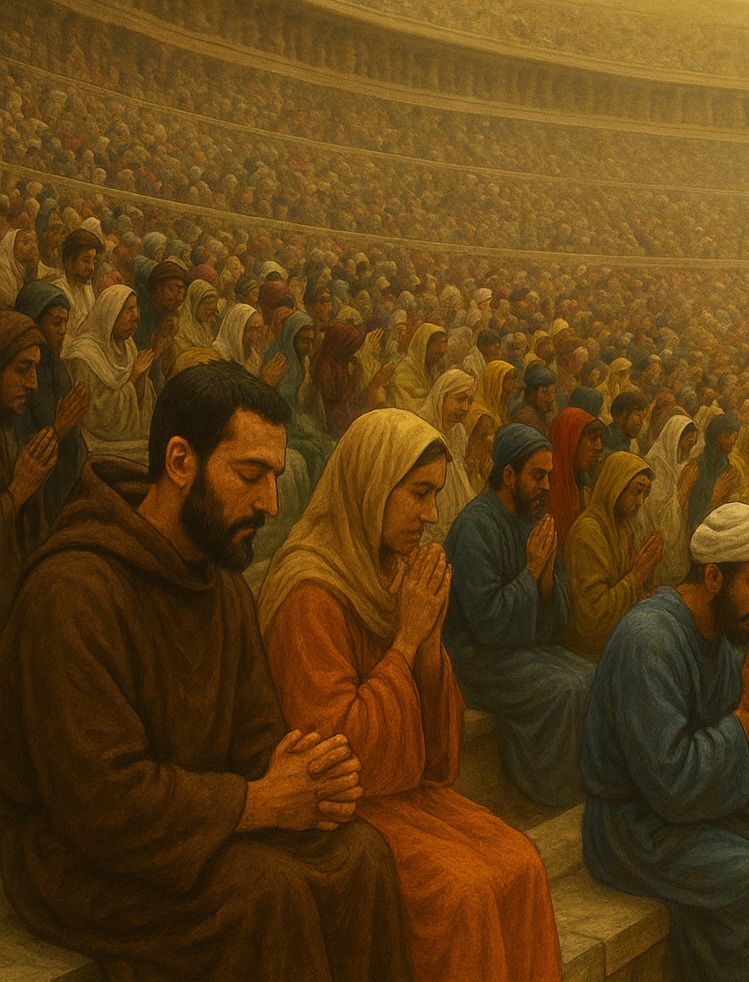
I was sitting on a bench in what to me appeared to be a huge football stadium, or more like a Roman circus (those long chariot tracks), stretching further in each direction than I could see (even the opposite side was so far away I couldn’t see it). And every seat was filled with people, all dressed differently (though most of them were in robes, in the section I was in), and all praying in different languages.

Their prayers collectively seemed like a buzzing, or the sound of a waterfall, because they were individually indistinct—countless voices all praying at once. But it was clear that each one of them were praying, non-stop, for me, my dad, and for everybody in the world.

And it was in that instant that it was told to me that I could stop praying—(“Look, all these Saints have the whole ‘praying for your dad’ thing covered for the moment…”)—and use the few moments my dad had left with us to just be with him, hold his hand, tell him that I love him and say goodbye to him. So that’s what I did. And I’m very grateful to this day that I did.

Why was my friend’s vision of the saints set in a long racetrack stadium? I recognize in this a reference to the Letter to Hebrews, which says, “since we are surrounded by so great a cloud of witnesses, let us rid ourselves of every burden and sin that clings to us and persevere in running the race that lies before us while keeping our eyes fixed on Jesus, the leader and perfecter of faith.” So be sure to befriend the saints and call upon them, because they know you, and they love you, and they eagerly want you to join their number.
Life Eternal — Funeral Homily for Ronald “Ron” Woolever, 75

August 6, 2025

By Fr. Victor Feltes

We are courageous, and we would rather leave the body and go home to the Lord.” That is what St. Paul writes about himself and the Christians at Corinth in our second reading. But is this true for us today? Would we rather leave the body and go home to the Lord?

Imagine if you could have endless more years of this life on earth. Would you wish for that? Pondering such a wish you would be wise to reflect upon the burdens of bad health. The coming of such crosses in the later years of life makes many people more open to the next life. Ron endured poor health but he is freed from that burden now.

But suppose you could live an endless life on earth free from all illness and pain; the next thing you might consider is the prospect of outliving everybody you know now, as well as everyone you would ever know. Even with our well-founded hope for Heaven, where all friends of God will be reunited, the temporary separation between us and our dearly departed causes sadness in us who remain behind. It is okay to mourn at Ron’s passing, though we do ‘not grieve like those who have no hope,’ for we have hope in him who said “Do not let your hearts be troubled. You have faith in God; have faith also in me.”

But imagine if each person on earth were granted pain-free immortality; the next thing to consider is what life in that world would be like. After Adam and Eve sinned at the tree they were deprived of the fruit of another—the Tree of Life—lest they eat of it and live forever in their unhappy fallen state. Even if scientists were to develop a treatment to eradicate all pain and all death, moral sickness would remain untreated in many human souls. Endless life without Christian conversion would create a hell of moral evils on earth. Ron’s love for Jesus and our Catholic faith led to his deep devotion to the Holy Eucharist and St. Paul’s Parish. He hungered and thirsted for holiness, and our holy religion helped him to go deeper, change, and grow with God in his grace.

Now suppose if everyone on earth were forever freed from pain and death and sin, to live peacefully together on earth forever—what would life in that world be like? Ron delighted in many things in our world. Beyond family and friends, there were monster trucks and parade floats, old cars, new movies, and countless good things more. But after living in our world a few decades, which is far less time than millennia, we can think to ourselves, “These things are nice but is this really all there is?” Every heart contains a God-shaped hole which can only be fully satisfied by the infinite beauty, goodness, and love of the Holy Trinity. Understanding this changes how we see our lives in this world (which we must not cling to) and our future deaths (which we must not grasp at) until the Lord finally calls us home to be with him. Jesus tells his disciples, “I am going to prepare a place for you… [and] take you to myself, so that where I am you also may be.”

Therefore,” St. Paul writes, “we aspire to please him, whether we are at home or away. For we must all appear before the judgment seat of Christ, so that each may receive recompense, according to what he did in the body, whether good or evil.” Pray for Ron’s soul, that he may now enjoy the endless bliss of Heaven. And let Jesus Christ be the good and loving Lord of your life so that you may enter eternal life, for ‘no one comes to the Father except through him.’

Heavenly Feasts — Funeral Homily for Angeline “Angie” Rihn, 98

July 1, 2025

By Fr. Victor Feltes

One theme in Angie’s earthly life, from the stories her family shares about her, is meals: the meals she prepared and the meals she shared. The meals on the farm with Herman and their children always began with a prayer, thanking the Lord and asking for his blessings. And her spouse would always praise her cooking with compliments, like calling it “A meal fit for a king!” On the farm, with the animals they raised and the produce they grew and often canned, there was never a need to buy any food. For holidays such as Christmas and Thanksgiving, Angie would cook for days. Three rooms of their farmhouse a couple miles out of town would be filled with tables and chairs for guests. Angie would always have guests over for a meal. For example, her beloved grandkids could show up anytime to enjoy sharing a meal with her. As a leader in the parish Altar-Rosary Society, she headed the organizing of funeral luncheons. And with unfaltering faith, she never skipped our Lord’s feast of the Holy Mass.

Scripture often speaks of our God preparing feasts. The Prophet Isaiah foretells that the Lord God on his holy mountain will “provide a feast for all peoples of rich food and choice wines, of juicy, rich food and pure, choice wines.” King David pens the 23rd Psalm saying of the Lord, “You spread the table before me in the sight of my foes. You anoint my head with oil; my cup overflows.” Jesus declares to his apostles, “I confer a Kingdom on you, just as my Father has conferred one on me, that you may eat and drink at my table in my Kingdom….” And Jesus announces “many will come from the east and the west, and will recline with Abraham, Isaac, and Jacob at the banquet in the Kingdom of Heaven….” During the heavenly visions of the Book of Revelation, an angel tells St. John “Write this: Blessed are those who have been called to the wedding feast of the Lamb,” adding, “These words are true; they come from God.”

Are these prophesies about eating and drinking in the Kingdom of Heaven literally true? Jesus says in his Sermon on the Mount: “Blessed are they who hunger and thirst for righteousness, for they shall be satisfied,” but that is metaphorical language. And how could we eat foods or drink drinks after death separates our souls from our bodies? But we must remember that our well-founded Christian hope is not only for an eternal afterlife for our souls but also a physical resurrection of our bodies one day. Recall how St. Luke reports that the Resurrected Jesus in the Upper Room on Easter Sunday asked, “‘Have you anything here to eat?’ They gave him a piece of baked fish; he took it and ate it in front of them.” Why does Jesus eat with his resurrected body? It was not because of hunger, for his glorified body has no need of such nourishment. He ate as a demonstration for the apostles and us that he is not a ghost or mirage but truly risen again. But then why does Jesus eat again later, as recorded by St. John, when he had breakfast with seven disciples along the Sea of Galilee? Since the fact of his resurrection was already firmly established, it appears it simply pleased him to share a meal with them. So ‘feasting in God’s Kingdom’ appears to be more than merely a metaphor.

After the Resurrection of the dead, once our souls reunite with our bodies, many will come from east and west and recline with Abraham, Isaac, and Jacob for the Lord’s promised feast. A supper not of necessity but of joy, with delights not merely from fine food and drink but from sharing the fond table fellowship of God and his friends. Angie’s delight in preparing meals reflected our Lord’s delight in preparing meals for us: at every Mass and in the world to come. Angie rejoiced to have family and friends flock to her feast like our Lord longs for us to join him for his feast, too. So pray for Angie’s soul, that she may be perfectly purified, and let us live our lives faithfully so as to be well-prepared to one day take our places at the banquet in the Kingdom of God.

The Widow’s Gift Was Love

November 9, 2024

32nd Sunday in Ordinary Time
By Fr. Victor Feltes

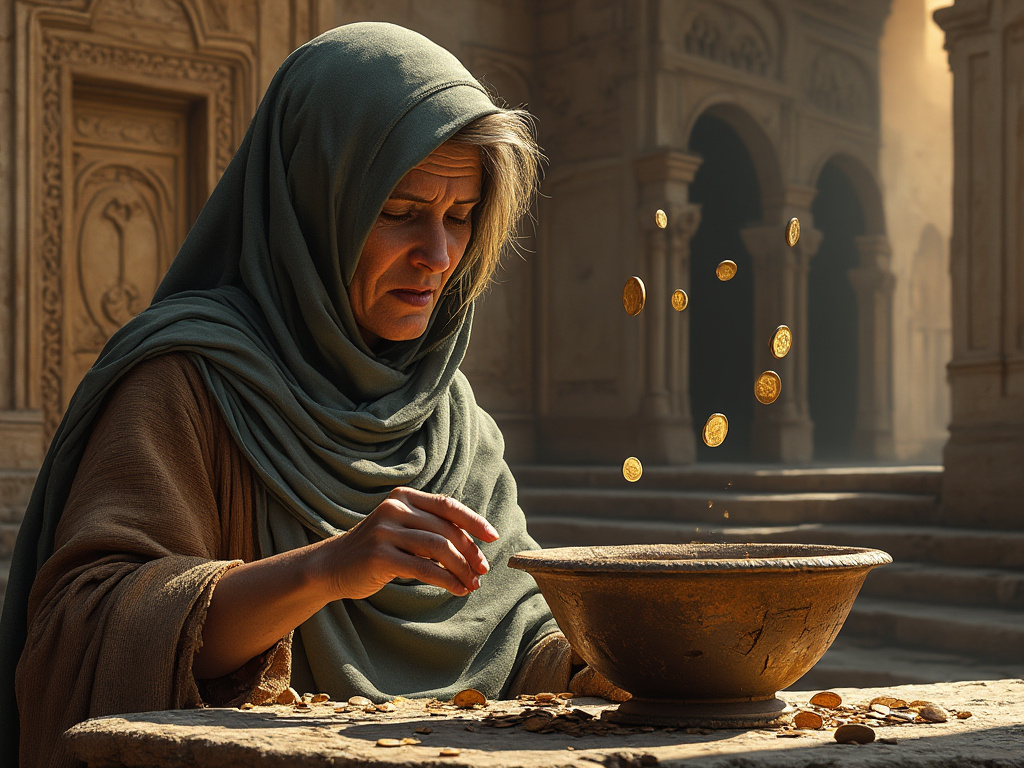
Jesus sat down opposite the temple treasury and watched how people gave money at God’s house. There were thirteen donation trumpets attached to sturdy chests into which people were dropping their contributions. Many rich people were donating large sums, causing loud commotions. But one poor widow’s two small coins went in quietly; a little click-click. Why did Jesus highlight her gift above everyone else’s that day?

Our Father in heaven is rich. He created the universe out of nothing. All things belong to him. Being the Almighty, he does not strictly need anything from us. In the 50th Psalm, God tells his people that he does not rebuke them for their animal sacrifices—he had commanded them to make them—but he notes “every animal of the forest is mine, beasts by the thousands on my mountains. I know every bird in the heights; whatever moves in the wild is mine. Were I hungry, I would not tell you, for mine is the world and all that fills it.” And yet, God insists upon our sacrifices for him.

God places us in a material world in which what we do matters. Whether and how we work and pray, learn and teach, plant and harvest, build and repair, save and donate, visit and invite, feed and clothe and care and love, these things really matter—for good or evil—for ourselves and others. It is true Almighty God could do everything all by himself, entrusting us with no mission and zero responsibility. But then, how would we ever mature and grow as glorious saints? Instead, God chooses to work through us, and with us, and in us. Our holy gifts and sacrifices, inspired and empowered by grace, advance God’s Kingdom while transforming us in Christ. Though, strictly speaking, God has no need of our gifts or praises, he insists upon them for our own good.

When Jesus saw that poor widow give God’s house just two coins worth only a few cents, he called his disciples to himself and said, “Amen, I say to you, this poor widow put in more than all the other contributors to the treasury; for they have all contributed from their surplus wealth, but she, from her poverty, has contributed all she had, her whole livelihood.”

Jesus condemns those who “devour the houses of widows,” but he celebrates this woman’s evident trusting, love for God. Jesus says to beware the scribes who love the robes, the titles, the honored seats at synagogues and feasts, who recite lengthy prayers in order to be seen by men. “They will receive a very severe condemnation,” Jesus says, because their focus is not on love of God and neighbor. That poor, loving widow, however, receives the praise of God. “The last shall be first, and the first shall be last.

As I preached in a homily three weeks ago, hierarchies are normal and natural, though some are better than others. The secular world has hierarchies according to power, wealth, or status. Christ establishes a hierarchy for his Church on earth according to sacramental holy orders. But amongst the Church in heaven, a hierarchy exists according to love. In heaven, God reigns supreme and God is love pouring out for all. There is no money to be had there, the sacraments are no longer needed, and there is perfect, perpetual peace. Greatness above is according to one’s capacity to give and receive love. So whoever wishes to be great in God’s Kingdom must imitate the faithful, self-gifting love Jesus highlights in that widow and which we see modeled for us by Jesus Christ himself.

How you love and what you do matters. In the words of St. Paul, “Let us not become weary in doing good, for at the proper time we will reap a harvest if we do not give up.” “Whatever you do, do it with all your heart as for the Lord … knowing that you will receive an inheritance from the Lord as a reward.” For when Christ comes “he will bring to light what is hidden in darkness and will manifest the motives of our hearts, and then everyone will receive praise from God.”

The Last Shall Be First

October 19, 2024

29th Sunday in Ordinary Time
By Fr. Victor Feltes

In today’s Gospel, James and John shoot their shot to move higher up in Christ’s Kingdom. They say, “Teacher, we want you to do for us whatever we ask of you. … Grant that in your glory we may sit, one at your right and the other at your left.” Jesus replies, “You do not know what you are asking.” The two brothers jump at the chance to drink from Jesus’ cup and be baptized in his baptism because they don’t realize these things mean sharing in Christ’s suffering. Jesus assures them, ‘You will drink of my cup and experience my baptism, but to sit at my right and my left is for those for whom it has been prepared.’ Where were the places at Christ’s sides at his glorious royal enthronement? St. Mark’s Gospel tells us: “With him they crucified two revolutionaries, one on his right and one on his left. … [And] the inscription of the charge against him read, ‘The King of the Jews.’”

James and John did not realize what they were asking. They sought places closer to Jesus in order to live earthly lives in a palace on Easy Street. They imagined reigning over a kingdom with Christ where they would be served like the rulers of the nations who made their dominance over other people felt. But Jesus gathered his disciples and said, “It shall not be so among you. Rather, whoever wishes to be great among you will be your servant; whoever wishes to be first among you will be the slave of all. For the Son of Man did not come to be served but to serve and to give his life as a ransom for many.”

Hierarchies are normal and natural, though some are better than others. The secular world has hierarchies according to power, wealth, or status. Christ establishes a hierarchy for his Church on earth according to sacramental holy orders. But amongst the Church in heaven, a hierarchy exists according to love. In heaven, God reigns supreme and God is love—pouring out for all. There is no money to be had, the sacraments are no longer needed, and there is perfect, perpetual peace. Greatness above is according to one’s capacity to give and receive love. So whoever wishes to be great in God’s Kingdom must practice the self-gifting, servant love modeled for us by Jesus Christ.

We can expect to see many surprises after this life. Reality will look very differently in the light of eternity. Some things which we once thought were valuable—even necessary—will be seen as nothing. And things once rejected as useless will be recognized for their true value—especially in people. Many unknown people will become recognized as great, while many rich, powerful, and popular people will be humbled. “Thus,” Jesus says, “the last shall be first, and the first shall be last.” So let us begin living life with more of that eternal vision now: by seeing with the eyes of Christ, by thinking with the mind of Christ, and by loving with the heart of Christ.

Just Two Doors Down — Funeral Homily for Robert “Bob” Nosal, 76

October 8, 2024

By Fr. Victor Feltes

You may know him as fun “Cousin Bob.” Or maybe you worked with “Big City Bob.” Or perhaps you heard him play guitar as one of “The Noblemen.” But if you know Bob, then you should know how important his family is to him. For instance, Christmas was Bob’s favorite holiday because everyone got to celebrate it together. And his family can testify to Bob’s faithful religious devotion. Bob grew up Catholic and raised his children Catholic, emphasizing the importance of our Faith in practice. He was adamant about attending Jesus Christ’s Holy Mass. Even when his family would go out camping, finding a local parish and Sunday Mass time was a priority. He and Mary Kay would frequently pray St. Mary’s Rosary together whenever they drove somewhere. Bob believed our family and friends are not limited solely to this world. We also have close and holy ones in heaven who know us and love us profoundly.

Last March, on the Wednesday of Holy Week, on the day before the beginning of our annual remembrance of our Lord’s Passion, Bob suffered his first stroke. In the following months, Bob was in and out of the hospital, and when he was hospitalized Mary Kay would faithfully visit and stay with him throughout the day. The visiting hours at Bloomer Hospital were from eight in the morning to six in the evening, so eventually it would come time for her to leave. Bob didn’t like being stuck there alone in the hospital overnight. Who would? He wished that he could go home, or else that Mary Kay could stay there with him. ‘It’s easier for you,’ he said. “You get to sleep in your own bed.” The Nosal house is situated very close to the hospital, so to encourage him, Mary Kay would reply that she would not be far. She would be “just two doors down.” And she would see him again in the morning.

You and I do not like being separated from our loved ones by death. Who would? We wish that we could go home with them, or else that they could stay here with us. But those who die as friends of Christ are not far from us. They still know and love us, and we can always talk to them. Yet it’s easier for them, for they happily go to their rest. Perhaps they dwell in purgatory where their souls are being purified to inevitably enter God’s all-holy presence. Or else, having been completely personally prepared by Christ, they already dwell in our Father’s house. Bob is now either behind the door of purgatory, where our prayers and offerings to God can aid his holy growth, or else he has passed through the door of heaven, where he now enjoys perfect peace and joy. But either way, be comforted remembering that Bob is no more than “just two doors down,” and we will see him again soon.

Prayers for Us in Heaven — Funeral Homily for Donna Mae Peterson, 88

June 26, 2024

By Fr. Victor Feltes

Jesus teaches that “there are many dwelling places” in his Father’s house. He says “I am going to prepare a place for you… [And] I will come back again and take you to myself, so that where I am you also may be.” The eternal dwelling place of our Father is heaven, and Jesus prepares a place for us and desires to take us there. But when can we arrive?

The Seventh-Day Adventists and Jehovah’s Witnesses believe in versions of “soul sleep” and think deceased Christian souls are not yet conscious in heaven; they both hold that experiencing heaven begins after the resurrection of the body. I have heard other Christians question whether we will still recognize or remember our loved ones in heaven. Some have wondered if we will be so overwhelmed experiencing God’s glory that we won’t think or care about anyone else. So are there saints in heaven now who are thinking about and caring about and praying about us?

In the Book of Revelation, St. John beholds visions of heaven where human souls are aware and active there even before Christ’s Second Coming, the General Resurrection, and the Last Judgment. In his sixth chapter, John recalls, “I saw underneath the altar the souls of those who had been slaughtered because of the witness they bore to the word of God. They cried out in a loud voice, ‘How long will it be, holy and true master, before you sit in judgment and avenge our blood on the inhabitants of the earth?’ Each of them was given a white robe and they were told to be patient a little while longer until the number was filled of their fellow servants and brothers who were going to be killed as they had been.” In the previous chapter, John saw people offering prayers in heaven: “Each of the elders held a harp and gold bowls filled with incense, which are the prayers of the holy ones.” So saints are now conscious and praying in heaven, but do they still remember and love those of us on earth?

How could a closer union with the All-Knowing One in heaven make us more ignorant? How could a closer relationship with the God who is Love make our love for all people colder? In one of Jesus’ parables, even a condemned rich man suffering in the netherworld remembered his five living brothers and prayed (or asked) for a messenger to be sent to warn them. The fact that miracles have followed from praying to saints in heaven asking for their intercession before God shows us that the holy dead continue to be aware of us, care about us, and pray for us.

Donna’s two sons, Tim and Ron, have shared a number of beautiful stories about her. They both mention her prayerful devotion and loving concern. Tim says the two core things in his parents’ lives were their devotion to Jesus and their dedication to family. Ron notes she was “always praying… always interested.” When Ron was experiencing hard times at chiropractic college far away in Iowa, his mom called every night to help him through it. Donna also spent hours on the phone with other relatives and friends, eventually becoming a texter and learning how to FaceTime on an iPod in order to stay in touch. She could always patiently listen and provide good counsel to help others with struggles but she would discern her advice with prayer and support those people with her prayers.

Pray for Donna’s soul, for “as gold in the furnace” God tries and purifies us in this world or in purgatory as needed, so “that we might no longer be in slavery to sin” and he may take us to himself in heaven as perfect offerings. But also remember that Donna does not forget you, she will continue to love you and continue to pray for you. Follow and cooperate with Jesus Christ, so her prayers for you shall not be in vain.

Invest Yourself in Heaven’s Reward

November 19, 2023

33rd Sunday in Ordinary Time
By Fr. Victor Feltes

As Jesus traveled from place to place he preached parables to different people. He told stories, for instance, featuring fields, fish, and flocks to teach farmers, fishermen, and shepherds about the Kingdom of God. It makes sense that Jesus would tell the same stories more than once, for different crowds to hear them for the first time and for his apostles to hear them repeatedly. But the gospels suggest Jesus sometimes changed his parables’ details to highlight different truths. What Jesus says in his Sermon on the Plain is similar but not identical to his Sermon on the Mount. As the Church journeys through our three-year cycle of Sunday readings we hear some parables retold by more than one gospel. And each fall, as we near the end of the Church year, our readings reflect upon the Four Last Things. Today, we have another such parable, about death and judgment, Heaven and Hell, Jesus Christ and us.

Christ is our Lord, our journeying master who shall return. We are his servants to whom he has entrusted our fortunes. And each of us one day will stand before him to give an account of our faithful or unfaithful service, with generous rewards or just punishments to follow. In Jesus’ telling through St. Matthew’s Gospel, the master entrusts weighty slabs of precious metal (called talents) in varying numbers to his servants, each according to their abilities. Upon his return, his faithful servants have doubled what they were given and receive the same words of praise: “Well done, my good and faithful servant! Since you were faithful in small matters, I will give you great responsibilities. Come, share your master’s joy!” One servant, however, who buried his talent and returned it ungrown, receives his master’s condemnation and is tossed into the darkness outside.

When Jesus retells his parable in St. Luke’s Gospel, the master is a nobleman who goes off to claim his kingdom, entrusting to ten servants one gold coin each. Upon his return, his faithful servants reveal their various positive returns on his investment. One has earned ten more gold coins and his king declares, “Well done, good servant! You have been faithful in this very small matter; take charge of ten cities.” Another servant has earned five more coins and the king decrees, “You, take charge of five cities.” One servant, however, hid his coin in a napkin and returned it unmultiplied. The king condemns that servant and orders all of his enemies who did not want him as their king to be slain.

The differences between these two parables highlight different truths about Heaven. In the first parable, the master speaks the same blessing to each faithful one: “Well done, good servant! … Come, share your master’s joy!” But in the other parable, the king gives his servant with ten additional coins ten cities and gives his servant with five additional coins five cities. So is Heaven’s reward the same for all the saints or can one’s reward be greater than another’s? One parable suggests their reward is the same, while the other suggests their rewards vary. On one hand, the reward of every saint is the same: they experience God’s unveiled glory forever in happy, loving communion with him and all who are in Christ. On the other hand, a great saint’s capacity for love and joy and glory may be greater than another’s.

Doctor of the Church St. Therese of Lisieux recounts in her great autobiography (“Story of a Soul”) how this idea once troubled her as a child: “One day, I expressed surprise that God does not give an equal amount of glory to all the elect in Heaven—I was afraid that they would not all be quite happy. [My older sister Pauline] sent me to fetch Papa’s big tumbler and put it beside my tiny thimble, then, filling both with water, she asked me which seemed the fuller. I replied that one was as full as the other—it was impossible to pour more water into either of them, for they could not hold it. In this way [she] made it clear to me that in Heaven the least of the Blessed does not envy the happiness of the greatest…

Notice how in both forms of Jesus’ parable all the faithful servants are entrusted with greater responsibilities. The saints in Heaven are likewise given higher roles as our intercessors now and in the family and household of God forever. Consider how many churches, religious communities, and cities around the world are dedicated to St. Paul. They are blessed to have him as a loving patron praying for them. And consider how the Blessed Virgin Mary shall always hold a privileged place in Heaven as the spiritual mother of every Christian.

St. Paul says, “Consider this: whoever sows sparingly will also reap sparingly, and whoever sows bountifully will also reap bountifully.” The generosity of our loving gifts to Christ, the additional sacrifices we make and good deeds we do, will surely not go unrewarded. Jesus tells us, “Give, and it will be given to you. Good measure, pressed down, shaken together, running over, will be put into your lap. For the measure with which you measure will be measured out to you.” Our individual hustle, cooperating with Christ’s grace, can win us greater glory, therefore “run so as to win!

We should not fear that we lack sufficient talents or gifts to produce good fruits for glory. In the first parable, every faithful servant was able to double his money and won his master’s praise. The issue with that unfruitful, condemned servant is that he never tried. His master calls him “wicked” and “lazy” because that servant did not make even the most minimal effort to grow his gift. “Should you not then have put my money in the bank so that I could have got it back with interest on my return?” That servant did not love his lord but rather resented his lordship over him. Which is easier: to digging a hole or visiting the bank? He did not want to be his master’s servant, he did not want him as his king, and so he finds himself condemned and cast out forever. But if we love our Lord we will produce fruit, just as “every good tree bears good fruit.” As Jesus declares, “Whoever remains in me and I in him will bear much fruit.”

What is something more that you will do with the talents and gifts our Lord has lent you? It could be something large or small, in private or with others. You could be a more-focused prayer warrior, or offer secret penances for the salvation of souls. You could start a Catholic book or movie club at your home, or organize a regular Bible study that discusses the upcoming Sunday readings. You could visit shut-ins as an extraordinary Eucharistic minister, or invite somebody new each week to come with you to Mass. There are many good things you could do and I urge you to consider and answer this call, for Jesus Christ will honor your faithful, loving efforts with glorious rewards.

Our Friends Who Have Gone Before Us

November 2, 2023

All Souls’ Day
By Fr. Victor Feltes

Yesterday, we celebrated all of the saints in Heaven. The saints in Heaven now enjoy supreme, definitive, enduring happiness. They are in the glorious presence of God, the Father, Son, and Holy Spirit, with all the holy angels. There, the saints’ deepest human longings are fulfilled without end. The Church’s recognized saints, beatified saints, and canonized saints, are Christianity’s hall of famers. We celebrate these saints on their feast days throughout the year. However, there are also many, many unknown saints in Heaven. How do I know that? Because of what St. John describes in the Book of Revelation.

In the Book of Revelation, when John describes his vision of Heaven, he says: “I had a vision of a great multitude, which no one could count, from every nation, race, people, and tongue.” Thirteen years ago, I printed out this list of recognized saints. It is eighty-one pages long and lists more than 13,000 names. But the number of those in Heaven is “a great multitude which no one could count.” I could count beyond 13,000 in less than a day, so there must be many more saints in Heaven than these.

Something I think many Christians do not realize is that if your relative, or friend, or neighbor who passed away is now in Heaven, yesterday was their feast day. We celebrated them on All Saints’ Day. Today, is All Souls’ Day. So what is the difference? Today, we remember and pray for those who have died as friends of God but are still on their way to Heaven.

Why are there any Christians who have died but are not yet in the full glory of Heaven? Well, what if we die as friends of God but we are not yet fully perfect? The Book of Revelation says “nothing unclean will enter [God’s holy, heavenly city].” What if we die still loving some of our sins? What if we die still a slave to certain vices? What if we die carrying hatred or unforgiveness towards others in our hearts? Psalm 24 asks, “Who can ascend the mountain of the Lord? Or who may stand in his holy place?” Then it tells us, “One whose hands are sinless, whose heart is clean, who desires not what is vain.” And Jesus tells us in the Beatitudes, “Blessed are the clean of heart, for they will see God.”

Jesus tells us in our gospel, “Everything that the Father gives me will come to me, and I will not reject anyone who comes to me.” But what if we die as his friends but with unclean hearts, not yet ready to stand before and behold God’s all-holy, fully-unveiled presence? Happily, God provides a way to perfect, to heal, to sanctify his friends (if, and as needed) after death. This purifying process is called Purgatory, and everyone who enters it will surely reach Heaven. Yet we know from lived experience that personal change is difficult, so we should help the souls of people in Purgatory with our prayers.

One spiritual problem in our culture these days is the idea that every Christian who dies is immediately in Heaven. We can hope for our loved one’s quick entry into Heaven, but an ordinary funeral Mass is not a canonization Mass. If I die and need the cleansing work of Purgatory, I hope that people will be praying for my soul instead of assuming that I’m already all the way home to Heaven. We can and should pray for the dead. We who are united in the Body of Christ, even if temporarily separated by death, remain joined in love. We on earth do not know with certainty whether our loved ones have reached Heaven yet, until the Church beatifies or canonizes them, or unless we receive some private revelation from God. But whether they are with the saints in Heaven or with the souls in Purgatory, they can still pray for us!

St. James writes in his New Testament letter that, “The prayers of a righteous person are very powerful.” We ask people on earth to pray for us, especially if someone is holy, and we are eager for the help of their prayers to God. How mighty are the prayers of those holy ones who began journeying closer to God before us? “The prayers of a righteous person are very powerful.

Here’s some homework for today: first, I invite you to think of the most loving, devout, holy people you know who have passed away and pray for them in case they need it. (No loving prayers are ever wasted.) Next, thank God for the great gift those people were and are. Finally, ask these holy souls to pray for you. They will be happy to help you.

“I believe no happiness can be found worthy to be compared with that of a soul in Purgatory except that of the saints in Paradise; and day by day this happiness grows as God flows into these souls, more and more, as the hindrance to His entrance is consumed.”

~St. Catherine of Genoa, Treatise on Purgatory

God’s Invitation

October 14, 2023

28th Sunday in Ordinary Time
By Chinnappan Pelavendran

Jesus used various parables to explain the concept of the kingdom of God. The parables show us that it is God’s will that all people be saved and He offers to humanity the gifts of salvation. The readings today, including the Gospel parable, invite us to accept God’s invitation with joyful hearts. The word of God challenges us to examine our own response to His call. God extends to us the greatest invitation we will ever receive: come to the feast, come to the banquet of eternal life. Sooner or later, each one of us has to give Him an answer. “Yes, I am coming,” or, “No, I will not come.” The choice is ours.

In the first reading, the prophet Isaiah invites us to have a glimpse of heaven. Our loving God has a plan for each one of us; the Lord of Hosts will prepare for all people a banquet of rich food. He will remove the mourning veil; He will wipe all tears from our eyes. No sadness or pain, only celebration in the heavenly banquet. Today’s Responsorial Psalm presents God as the Good Shepherd who nourishes, leads, and protects His flock. In the second reading, St. Paul advises the Philippians to have trust in the power of and goodness of a providing God, who, in Jesus, has invited us to participate in the Heavenly Banquet.

In the Gospel, we hear that the King, who is God the Father, gave a feast for his son’s wedding. Jesus is the groom wedded to the Church. The Church is the Bride of the Lamb. For this wedding, the king sent His servants, that is the prophets in the Old Testament, to invite people to the wedding but they would not come. The chosen people were not living according to the covenant. As a result, the king sent his troops, to destroy those murderers and burn their city. This could be a reference to the destruction of Jerusalem. Then the king gave an order to invite everyone whom they found on the road because those who were invited were not worthy. The chosen people rejected the invitation, but a huge number of non–Jews, the Gentiles, came to Jesus and had faith in Him.

Those absentees are not necessarily sinners; they are generally engaged in legitimate work, not sinful activity. One goes to the farm, another to his business. These are necessary and useful occupations. Sometimes what keeps us away from the joy of the kingdom is not sin but our preoccupations with the necessities of life. To be serious with our job is a good thing, but when our job keeps us away from attending the Lord’s Supper, it has become an obstacle to our faith.

To be a participant in the kingdom of God is a privilege as well as a responsibility. The responsibility is to accept the invitation and to undergo change in our lives. It is a change from self-centeredness to God-centeredness, from hatred to forgiveness, and from greediness to sharing.

The celebration of the Holy Mass is called ‘heaven on earth,’ a foretaste of the heavenly banquet. Before Communion, we hear the words; this is the Lamb of God who takes away the sins of the world. Blessed are those called to the Supper of the Lamb. This is not only an invitation to receive the body and blood of Jesus in Holy Communion. It is also an invitation to the eternal wedding feast in heaven.

God wants everybody to be saved. He invites everyone to His feast. Therefore, let us always say “Yes” to His invitation, and clothe ourselves with the garment of love, so that we may worthily enter the eternal joy and glory of Heaven.

Glimpses of our Future Glory

August 17, 2023

Solemnity of the Assumption
By Fr. Victor Feltes

The Church of Jesus Christ celebrates our Blessed Mother Mary. For instance, we mark her conception, her birth, and today the beginning of her life in glory. It is fitting the Church does this since her Lord commands us: “Honor your Father and mother.” And when the people we love have birthdays or anniversaries, we love to celebrate with them. Today we celebrate how the Virgin Mother of God was assumed body and soul into heaven.

She is the icon of the Church, the beginning and image of the Church’s coming to perfection. We are happy for Mary, but what we see in her is good news for us too. She is a sign of sure hope and comfort for our future, for what awaits for us in our resurrection to glory. To unpack what I mean, consider what the Blessed Virgin Mary has been up to in the centuries since her Assumption.

Enthroned beside her Son in a place of close intimacy and high honor, she is an intercessor for us, her spiritual children. How many children does Mary have? The Book of Revelation says “her offspring [are] those who keep God’s commandments and bear witness to Jesus.” Therefore, she has many, many millions of children. And how many “Hail Marys” and other prayers are sent her way every minute? Yet we believe that she hears us without becoming overwhelmed and that she knows each of us personally, as a mother knows her children. We also have reason to think that Mary has not merely remained in heaven for nearly 2,000 years, but has been active here below.

Though we are not obliged to hold belief any particular Marian apparition (since none of these later events belong to the ancient Deposit of the Faith) the Church has judged many proclaimed appearances of Mary to be credible, or “worthy of belief.” These apparitions offer us clues about Mary’s life now and what life will be like for us in resurrected glory.

In her Church-approved apparitions, the Blessed Virgin Mary comes in varying appearances. For example, in her appearances to St. Juan Diego in 1531, Our Lady of Guadalupe in Mexico had darker skin and black hair and wore traditional clothing indicating she was with child. In her appearances to the Belgian immigrant Adele Brise in 1859 near Green Bay, Wisconsin, Our Lady of Good Help had white skin and blonde hair in different apparel.

In Mary’s Church-approved apparitions she also speaks in varied languages. For instance, to St. Bernadette Soubirous at Lourdes, or the three shepherd children at Fatima, she did not speak ancient Aramaic, Hebrew, Greek, or Latin. She spoke to them in their local dialects. Mary resembles her seers and speaks their mother tongues because she is the mother of each of them.

Mary’s apparitions suggest a saint in his or her glorified body will have the power to change its age or appearance. Mary remains a woman, but race presents no barrier and different languages are no hindrance to communication. And if our glorified consciousness will become like hers, it will be no strain to know and be close friends with more than a billion people at once. Won’t that be wonderful?

Another detail that seers of Mary’s apparitions agree on is that she is now exceedingly beautiful. During the years of her life on earth, Mary may have looked quite ordinary. We do not imagine that Jesus Christ had to be the tallest, most muscular, or handsomest man who ever lived, so Mary need not have been the most beautiful woman alive either. In this fallen world, the holy can look ugly while the wicked can look very attractive. But now there appears to be no mismatch between Mary’s inner and outer beauty. This interior beauty is called holiness.

After our resurrection, the abundance (or lack) of holiness we have cultivated with God within us will be seen in our endless beauty (or ugliness) forever. The glory we are called to in Christ is like Mary’s and that gives us reason to rejoice with her today all the more.

Ascension: a Bittersweet Christian Mystery

May 21, 2023

Feast of the Ascension
By Fr. Victor Feltes

The bodily Ascension of Jesus into heaven feels like a bittersweet Christian mystery. Before ascending, Jesus said, “I am going to the one who sent me… But because I told you this, grief has filled your hearts. But I tell you the truth, it is better for you that I go. For if I do not go, the Advocate will not come to you. But if I go, I will send him to you.” Though Christ is no longer openly, visibly walking the earth today, he assures us, “Behold, I am with you always, until the end of the age.” At this time of year, during the Easter season, when celebrating Jesus going up and the Holy Spirit coming down, with so many young people graduating from one life into another, and I am reminded of the most difficult homily I ever preached.

I have heard it said that when a young person goes off to college or off into the world their experience is very different than their family’s. For the one who goes, the change begins an adventure. They learn and experience new, amazing things. They meet great people and make new friends, while still loving and caring about their family. They are happy and excited to be starting a new life, while their loved ones left behind understandably take this transition much harder.

For a daughter who goes off, her life becomes more full, but her family at home feels a new emptiness. She’s not in her room. She’s not in her seat at the table. Her voice and laughter are not heard like before. Of course, her family can still speak to her long-distance, and she’s still well-aware of what’s going on at home, but her departure creates a separation, and that’s difficult. Loving families could even wish their loves ones would never ever leave. But imagine how much those loved ones would miss out on if they never journeyed forth?

Bridget Achenbach, 1995-2015

I first shared these reflections in 2015, at the funeral of a nineteen-year-old, first-year college student I knew named Bridget. Eight years ago, following the Sunday Mass of Pentecost, Bridget was driving to a friend’s graduation party. Her car hydroplaned on an old, country highway and she died in a violent crash.

Some people today, when faced with this world’s temptations, despite their Christian upbringing choose to leave our Lord and go their own way. Bridget, with her beauty, smarts, and popularity was free to choose that too, but instead she grew from good to better. During her freshman year at the University of Wisconsin in La Crosse, through the campus’s Catholic Newman Center, she participated in Bible studies, attended a five-day Catholic youth conference in Tennessee, and pilgrimaged to the March for Life.

On the bus ride of that last trip she shared with friends how Jesus was transforming her life and said she felt closer to him than ever before. At times during that final year when she was home from college, I would not only see Bridget receive Our Lord in the Eucharist at Sunday Mass but sometimes at weekday morning Masses as well before she would leave for her job as a pool lifeguard. The Lord was calling her to be closer to him, just as Jesus calls us all.

At her funeral eight years ago, I noted that Jesus never does evil. He is goodness and love incarnate, “in him there is no darkness at all.” But we also know the Lord refrained from intervening even with some subtle miracle to prevent Bridget’s car accident and death. Why would God allow such a charismatic young woman to die on Pentecost?

Consider how the Blessed Virgin Mary was an invaluable presence among the first Christians. Yet, once she had completed the course of her earthly life and was taken up into Heaven, Mary could assist more powerfully than before. Now, in glory, Mary can hear and intercede on behalf of many, many millions of people while loving each of us uniquely. Like Mary, the spiritual mother of all Christians, I believe Bridget was ready to graduate from this life to the next.

A final exam awaits you. You do not know its exact day or its hour, but it awaits us all. Are you ready for it? None of us know if we will still be here next year. Jesus hopes that with his help you will graduate to where he has gone before us. In Christian maturity, St. Paul writes that “we would rather leave the body and go home to the Lord.” This present world is not our true home. May the bitterness and scandal of death and parting not cause you to overlook the sweetness of heaven. And may you always choose to follow Jesus closely in this life so that you may one day follow him above.

The Kingdom in his Garage — Funeral Homily for John Schwartz, 81

December 2, 2022

By Fr. Victor Feltes

Many stories could be shared about John; as a friend or neighbor, as a father to six children, or as a husband to Vernetta, whom he married sixty-one years ago today. He did interesting work for both multinational businesses and local organizations throughout the years. And even after his final job concluded, his kids tell me “he never retired.” I wish to tell you today about one of the ways John kept himself busy.

Whenever he drove a load to the Bloomer Recycling Center he might return home with more stuff than he had left with. In what others had rejected as trash, John saw value. He often said, “Everything is fixable.” John took his found-treasures back to a four-car garage in the backyard of his home. His kids tell me, “When he wasn’t working, he was there…” working.

The interior of John’s garage featured cupboard cabinets; each one painted to match and labeled to indicate the tools, parts, or materials stocked inside. John’s garage was a warm place—in both senses of the word. Throughout the colder months, John used his wood stove to keep the inside temperatures around 75 or 80 degrees. And once hotter weather came, John would open up his garage doors, sit in the doorway with a toothpick between his teeth, drinking coffee and waiting for people to stop-by to visit.

He was happy to share his time and talents with them, generous in sharing his tools or efforts whenever asked. His children tell me John loved that garage, saying, “His garage is his kingdom.” All good things in this world reflect the goodness of our Creator and our Redeemer. The beautiful realities we see are icons of invisible realities. And so, John’s garage is a partial glimpse of the Kingdom of God.

Because of humanity’s sins and corruption, we were rightly condemned. But we were not to be rejected, left to be abandoned, forever. God continued to value us. He saw treasure in our trash. And Jesus came down to redeem us, intending to take us home. Christ is always working, and everything is fixable, because “all things are possible for God.”

Jesus prepares a special place for each of us. Enthroned in heaven, he opens the doors to receive us. His Father’s house is a very warm place—in both senses of the word. We must be prepared to stand in the intense fire of God’s all-holy presence and infinite love for us. Thankfully, Christ is generous in sharing with us his tools and helping graces, so that we may become perfect (truly “good enough”) through faith in him. Through Jesus Christ, our Lord, about whom countless stories could be told, John and you and I can all be together in the Kingdom of Heaven.

A New, Joyful Day — Funeral Homily for Robert “Bob” Sobotta, 77

September 26, 2022

By Fr. Victor Feltes

It was the day after Bob’s nineteenth birthday and the day before he would marry Joann. Bob and Joann had met at a Pines Ballroom dance and now they were at The Pines Ballroom again, together with family preparing food for the next day’s festivities. They listened to the radio as they labored, and that’s how they learned what had happened at 12:30 PM that day in Texas. A short time later that same afternoon, the first report of grim news was followed by another: President John F. Kennedy was dead. It was Friday, November 22nd, 1963.

Presidential assassinations had happened before, first and most famously with President Lincoln. But it had been sixty-two years since the last murder of a president, when President McKinley was shot and died in Buffalo, NY in 1901, and few were still alive who remembered living through it. So Joann recalls how shocked everyone was that a president, America’s first Catholic president, was killed. They were all discussing it, stunned. They just couldn’t believe it, it seemed so unbelievable — and yet it was real, as real as death.

I asked Joann whether that mournful news, whether this national tragedy, soured their “Big Day”? No, she said, it was “just as joyful.” Bob and Joann awoke the next day and were married in the morning (as was the custom then) in a 9:30 AM Saturday wedding Mass at St. Peter’s in Tilden in the company of many loved ones, their family and friends. This was followed by a dinner at the Sundial Club and then a reception back at The Pines, a feast and a dance for them all. Bob loved to dance, polkas and waltzes in particular, and he enjoyed dancing with his new bride. Bob and Joann would happily share their next fifty-eight years together loving God, each other, and their family, friends, and neighbors, until Bob’s recent passing.

Death is sad and unsettling. Though common to history, it still remains shocking for us. But suffering and death are not the end of our stories. Though we mourn now, we will be comforted. We expect a new dawn, a new day, when the blessed friends of Christ – our King who dies no more – will awaken to celebrate his wedding feast with him. Jesus our Good Shepherd will spread the table before us, and the just shall dance with delight, and every tongue shall give praise to God. Though today we walk in the dark valley, the day we prepare for, the day we look forward to, the day that awaits us, will be full of joy.

Are you Friends with Jesus?

August 21, 2022

21st Sunday in Ordinary Time
By Fr. Victor Feltes

How many friends do you have on earth? When was the last time you counted them? It’s not the same as the number of Facebook friends you have. Each of us have many acquaintances, but fewer friendly acquaintances, and still fewer true friends. What is it that makes you and your friends friends? Are you friends with Jesus and how can you tell?

Luke’s Gospel relates a parable which foreshadows that not all will die as friends of Christ. The Lord Jesus is the master of the house and he plainly warns us that after he has arisen and locked the door, many will stand outside knocking and saying, “Lord, open the door for us… We ate and drank in your company and you taught in our streets.” But he will answer, “I do not know where you are from. Depart from me, all you evildoers!” In the parallel passage to this which appears in Matthew’s Gospel, Jesus cautions us, “Not everyone who says to me, ‘Lord, Lord,’ will enter the kingdom of heaven… I will declare to them solemnly, ‘I never knew you.’” Seeing many figures from the Old Covenant and from around the world saved, reclining at table, and feasting in the kingdom of God, those kept outside will be angry and grieved, wailing and grinding their teeth, at having squandered their chance to enter.

But doesn’t Jesus say elsewhere: “Knock and the door will be opened to you. For everyone who asks, receives; and the one who seeks, finds; and to the one who knocks, the door will be opened”? That is true for us during this lifetime, but at the moment of death one’s eternal fate is sealed. As the Catechism of the Catholic Church teaches: “Death puts an end to human life as the time open to either accepting or rejecting the divine grace manifested in Christ.” (CCC #1021) We must come to Jesus. Jesus says, “I am the gate…. No one comes to the Father except through me… Whoever believes and is baptized will be saved; whoever does not believe will be condemned.” Now is the time to approach him and befriend him for our salvation. We know that he loves us, but are we friends with Jesus?

When I was growing up, I thought about how many friends I had. I wondered, “Who counts as a friend?” I came up with a test: my close friends were those who could invite me to their house for supper with their family, or whom I could have over to eat with mine, without it being strange. With most of my grade school peers such invites would have felt weird, but with my handful of friends it felt fine. Eating with other people has been a sign of fellowship since ancient times. This is partly why Jesus calls us to Mass, to this meal together with him and the family of God. What greater dinner invitation could we receive than this?

Yet, simply eating with our Lord does not guarantee our closeness. During his public ministry, Pharisees invited Jesus to dine with them while regarding him with suspicion, and recall what those locked outside in the parable say to our Lord: “We ate and drank in your company and you taught in our streets.” Merely being present for these activities does not automatically yield a close friendship with Christ. At every Mass, Jesus’ Word is taught and his Body and Blood are consumed, but friendship with Christ is about more than just coming to church. So how can we be closer to him?

I recognized my boyhood friends in those whom I would visit for meals and whom I would likewise welcome to dine with me. Jesus invites us to visit him in the Eucharist but desires that we in turn would invite him to our homes. In the Book of Revelation, Jesus says, “Behold, I stand at the door and knock. If anyone hears my voice and opens the door, I will enter his house and dine with him, and he with me.” How can we invite Jesus inside? How do we receive him into the places where we live?

Jesus knocks upon the door of our souls and hearts and minds each day, and through daily prayer we let him in. Open the door to him by prioritizing your relationship with habits of devotion. Be a gracious host to your great guest and make him feel at completely home, listening to his voice and fulfilling all his requests. Seek to serve the Kingdom of Christ and embody his righteousness as a saint like him. Reject your sins and love like him, for Jesus says, “You are my friends if you do what I command you.” Jesus knows we’ll mess up sometimes, but Christ’s true friends will strive to be his close friends.