Archive for the ‘Heaven’ Category

Dorothy at Home — Funeral Homily for Dorothy Turner, 85

February 22, 2022

I am informed that Dorothy dreaded snowstorms. In years past, she would urge her family not to travel on a day with weather like today’s. But for love of Dorothy you have gathered here to spiritually aid her on her journey and for your mourning hearts to be blanketed by heavenly grace. Today, I would like to share and reflect on a handful of Dorothy stories.

When her kids were growing up, her beloved husband Bob would come home in time for supper when his work schedule permitted. Bob loved everything and everyone to be in their right and proper place. So, near five o’clock, Dorothy would glance out the window to glimpse her husband’s approach. “He’s coming around the corner,” she would yell, and the whole household would spring into action. One child would run into the living room, to tidy up the toys and homework materials. Meanwhile in the kitchen, one kid set the table, another prepared the dessert, while another helped mom put the food into bowls. When dad walked in, Dorothy had everyone seated and ready, awaiting him at the table.

Four years ago, after sixty years of marriage together, Bob passed away. In addition to her many relatives and friends, one of Dorothy’s great consolations in these last years has been her favorite dog, Bud. After suffering a stroke and heart attack eight years ago, Dorothy moved with much more difficulty. Yet Bud would not impede her path or bump into Dorothy’s legs. He would walk with her, behind her all the way. When Dorothy sat or slept, he was there nearby.

A few days before her recent passing at home, Dorothy was saying, “I need to go upstairs. I need to go upstairs.” Josh, her devoted caregiver, asked her, “Why do you need to go upstairs?” She answered, “Because Pa and Ma and all my brothers and sisters are waiting for me.” Dorothy lived in a ranch duplex, it has no second story upstairs. But like others who have approached the end of their earthly lives with perceptions of the hereafter, Dorothy referred “not to what is seen but to what is unseen.” As St. Paul writes, though our bodies (“our earthly dwellings”) may be destroyed, we have a building from God, eternal in heaven.

And who through the many years of Dorothy’s life has most faithfully accompanied her? When she would rest or rise, he was there. He was never an obstacle but her constant companion. Who was her Good Shepherd who has never misled or abandoned her and would seek her out if she ever strayed? He is our Lord Jesus Christ, of whom the blessed say, “You spread the table before me.”

We rightly pray for Dorothy’s soul today but it is also right for us to hope that our holy family upstairs is now in a flurry of activity, making last-minute arrangements, preparing her place at the heavenly banquet. In the difficult moments ahead as you mourn Dorothy’s passing imagine an archangel announcing in our Father’s house, “She’s coming around the corner! Dorothy is coming home!

A Martyr Preaches: “Banish the Fear of Death”

November 27, 2021

1st Sunday of Advent

This Sunday’s celebration comes in a moment of two overlapping times. This is a Sunday in November, the month in which we particularly remember, celebrate, and pray for the dead. This Sunday is also the beginning of Advent, a season in which we prepare for the coming of Christ. Through Advent we prepare not only for Christmas, the first coming of Christ, but also for Jesus’ Second Coming one day. Here and now at this Sunday Mass, our past and our future, the living and the dead, this world and the next, meet together.

When we hear Jesus’ words in today’s gospel about the Last Days we may feel apprehensive. Jesus tells us “people will die of fright in anticipation of what is coming upon the world.” And even if you or I do not belong to that final generation, we may fear to contemplate the coming sure reality of our own earthly deaths. But across time and space, an ancient saint and martyr urges us: “Let us shut out the fear of death and meditate upon immortality.

This is what St. Cyprian preached in the mid-third century A.D. as the bishop of Carthage, a North African city on the Mediterranean coast. God wills us to be good stewards of his gift of life, not recklessly pursuing self-harm or death, and yet not dreading the approach of death with mortal terror either. Listen to these words of St. Cyprian of Carthage as if he stood here before you preaching to you today:

“Our obligation is to do God’s will, and not our own. We must remember this if the prayer that our Lord commanded us to say daily (that is, the “Our Father”) is to have any meaning on our lips. How unreasonable it is to pray that God’s will be done, and then not promptly obey it when he calls us from this world! Instead we struggle and resist like self-willed (servants) and are brought into the Lord’s presence with sorrow and lamentation, not freely consenting to our departure, but constrained by necessity. And yet we expect to be rewarded with heavenly honors by him to whom we come against our will! Why then do we pray for the Kingdom of Heaven to come if this earthly bondage pleases us? What is the point of praying so often for its early arrival if we would rather serve the devil here than reign with Christ?

The world hates Christians, so why give your love to it instead of following Christ, who loves you and has redeemed you? John is most urgent in his (first New Testament letter) when he tells us not to love the world by yielding to sensual desires. Never give your love to the world, he warns, or to anything in it. A man cannot love the Father and love the world at the same time. All that the world offers is the lust of the flesh, the lust of the eyes and earthly ambition. The world and its allurements will pass away, but the man who has done the will of God shall live forever. Our part, my dear brethren, is to be single-minded, firm in faith, and steadfast in courage, ready for God’s will, whatever it may be. Banish the fear of death and think of the eternal life that follows it. That will show people that we really live our faith.

We ought never to forget, beloved, that we have renounced the world. We are living here now as aliens and only for a time. When the day of our homecoming puts an end to our exile, frees us from the bonds of the world, and restores us to paradise and to a kingdom, we should welcome it. What man, stationed in a foreign land, would not want to return to his own country as soon as possible? Well, we look upon paradise as our country, and a great crowd of our loved ones awaits us there, a countless throng of parents, (brothers and sisters), and children longs for us to join them. Assured though they are of their own salvation, they are still concerned about ours. What joy both for them and for us to see one another and embrace! O the delight of that heavenly kingdom where there is no fear of death! O the supreme and endless bliss of everlasting life!

There is the glorious band of apostles, there the exultant assembly of prophets, there the innumerable host of martyrs, crowned for their glorious victory in combat and in death. There in triumph are the virgins who subdued their passions by the strength of (chastity). There the merciful are rewarded, those who fulfilled the demands of justice by providing for the poor. In obedience to the Lord’s command, they turned their earthly inheritance into heavenly treasure.”

And so brothers and sisters, these are St. Cyprian’s lessons for us today. Love and obey Christ over and against this sinful world. Do not fear Jesus’ Second Coming. The Bible concludes with the prayer, “Come, Lord Jesus,” because his return is Good News for his friends. And do not dread your last days, but look forward to going to paradise. Jesus Christ and his holy saints, who love us, cheer us, and intercede for us, await the day we’ll join them in the fullness of joy.

Longing to go Home — Funeral Homily for Donetta Bowe, 90

September 27, 2021

You may or may not have known it, but Donetta wrote poetry. She wrote these words during her retirement:

“I want to go home
  Not to the house in town
  But back to the farm.”

In the following lines she went on to fondly recall the farm’s many sights and sounds, the cardinals and chickadees, the wild turkeys and pheasants, “the humming birds by the flowers,” the deer crossing through the fields, and the barn cats she left behind.

“But it’s not the same anymore,” she wrote,
“I need to find another way
  To satisfy those feelings now.”

In her later years, Donetta felt the fading of her flesh, and lamented at not being able to do all that she could do before.

“Only in my spirit,” she wrote,
“Only in my spirit
  can I run up a green grassy hill.
Only in my spirit
  can I skip along a shady park path.
Only in my spirit
  can I still run up the stairs.”

Over time, our lives accumulate losses. We painfully lose people and places and bodily powers. If this were only natural, why doesn’t it sit more naturally with us? Why do we desire the infinite? Where is the fulfillment of our insatiable longings to be found?

As Martha mourned the death of her brother Lazarus, Jesus assured her this was not her loved one’s end. She replied to him, “I know he will rise, in the resurrection on the last day.” Jesus told her, “Whoever believes in me, even if he dies, will live… Do you believe this?” She answered him, “Yes, Lord,” and Martha saw his words proven true sooner that she had expected.

Therefore,” as St. Paul told the Christians of Corinth, Greece, “we are not discouraged… Although our outer self is wasting away, our inner self is being renewed day by day… This momentary light affliction is producing for us an eternal weight of glory… We look not to what is seen but to what is unseen; for what is seen is passing, but what is unseen is eternal.

Despite looking back, Donetta looked ahead, to the ultimate fulfillment of her longings through our Lord, Jesus Christ. Here are the words of a final Donetta poem, as it appears on her funeral card:

“My time has come for me to go
  and say goodbye to the ones I know.
My body is tired my mind is weak
  it’s difficult for me to speak.
And now I’m waiting by the gate
  so as I go don’t be sad
  for I am grateful for all I had.
Embrace the day and smile for me
  for I am going where I want to go.”

The Fire of God

December 6, 2020


2nd Sunday of Advent

Eighteen years ago, when I applied to become a seminarian for our diocese, one part of the process was taking the MMPI, the Minnesota Multiphasic Personality Inventory Test — 567 True-False questions that help to detect psychological disorders. Of all of those written questions this one is for me the most memorable: “True or False: I am fascinated by fire.” How would you answer that question on a psych exam? I recall thinking at the time, “Yes, yes I am fascinated by fire, but I don’t want them to think I’m a pyromaniac. And I’m not a pyromaniac so maybe I should answer ‘False.’” But then I considered that wouldn’t be honest, so I reluctantly filled in the bubble for “True.” In the end, the diocesan psychologist did not diagnose me as crazy, so they sent me to seminary, eventually ordained me, and here I am today. But upon later reflection, I think this question is something of a trick.

Why do people pay more to have a fireplace in their home when a central heating system is sufficient to keep everyone comfortable? When people sit around a campfire, what does everybody look at for hours into the night? I strongly suspect this question (are you fascinated by fire) isn’t looking for pyromania so much as it is checking to see whether people will lie, because everyone is fascinated by fire. Fire is beautiful, it’s mesmerizing, dynamic and powerful; it’s well-known to us and yet surprising, an incredible blessing yet dangerous to the unwary.

The Sacred Scriptures often speak about fire. In today’s in gospel, we hear the preaching of St. John the Baptist. In the parallel passages of Matthew and Luke, St. John similarly cries out:

I am baptizing you with water… but the one who is coming after me is mightier than I… He will baptize you with the Holy Spirit and fire. His winnowing fan is in his hand. He will clear his threshing floor and gather his wheat into his barn, but the chaff he will burn with unquenchable fire.

Fire is also mentioned in today’s second reading. The Second Letter of St. Peter tells us:

The day of the Lord will come like a thief,
and then the heavens will pass away with a mighty roar
and the elements will be dissolved by fire…
the heavens will be dissolved in flames
and the elements melted by fire.”

The coming and presence of the Lord is associated with fire in the Old Testament as well. God first spoke to Moses through a burning bush. And during the Exodus the Lord went before his people, leading them in a pillar of cloud and fire. The appearance of God’s glory was like a devouring fire atop Mt. Sinai. The mountain was wrapped in smoke because the Lord had descended upon it in fire. Smoke rose up from it into the sky and the whole mountain greatly trembled. The Lord commanded Moses to warn the people not to approach, not to climb up the mountain, lest they be struck down in their unholiness. Listen to this vision of God the Prophet Daniel had in a dream one night:

As I looked, thrones were placed, and the Ancient of Days took his seat; his clothing was white as snow, and the hair of his head like pure wool; his throne was fiery flames; its wheels were burning fire. A stream of fire issued and came out from before him; a thousand thousands served him, and ten thousand times ten thousand stood before him; the court sat in judgment, and the books were opened.

Is the fire of God of which John the Baptist, Peter, Moses, and Daniel speak something for us to fear? Scripture says the punishment of God’s judgment is fire, but it also speaks of fire as God’s means of purifying his own. In regards to judgment, the Prophet Isaiah writes, “the Lord will come in fire, and his chariots like the whirlwind, to render his anger in fury, and his rebuke with flames of fire.” At the Last Judgment, Jesus Christ the King will turn to the goats on his left and say “Depart from me, you accursed, into the eternal fire prepared for the devil and his angels.” And the Book of Revelation says anyone whose name is not found written in the book of life will be thrown into a lake of fire: “[A]s for the cowardly, the faithless, the detestable, as for murderers, the sexually immoral, sorcerers, idolaters, & all liars, their portion will be in the lake that burns with fire and sulfur, which is the second death.” This is a fire to dread and to earnestly avoid.

Yet God’s prophets also speak of God’s purifying fire which perfects his people. Psalm 66 says “you, O God, have tested us; you have tried us as silver is tried;” and a verse from the Book of Proverbs says, “The crucible is for silver, and the furnace is for gold, and the Lord tests hearts.” Ancient gold and silversmiths would melt their precious metals with fire to separate out and burn away any impurities which they contained. Likewise, through the Prophet Zechariah, God says, “[I will put my people] into the fire, and refine them as one refines silver, and test them as gold is tested. They will call upon my name, and I will answer them. I will say, ‘They are my people’; and they will say, ‘The Lord is my God.’” This is why Jesus exclaims, “I have come to set the earth on fire, and how I wish it were already blazing!

Jesus would separate and burn away in us everything impure, false, and worthless. This purification can happen for God’s faithful friends in this life on earth or afterwards in Purgatory. St. Peter writes to the Church in his First Letter, “Now for a little while you may have to suffer through various trials, so that the genuineness of your faith, more precious than gold that is perishable even though tested by fire, may prove to be for praise, glory, and honor at the revelation of Jesus Christ.” And St. Paul tells the Corinthians, “If anyone builds on the foundation with gold, silver, precious stones, wood, hay, straw — each one’s work will become manifest, for the Day [of the Lord] will disclose it, because it will be revealed by fire, and the fire will test what sort of work each one has done.” Is this a fire we should fear and dread? No, as illustrated by this story from the Book of Daniel:

In the days of the Babylonian Empire, King Nebuchadnezzar had three servants named Shadrach, Meshach, and Abednego. When the king set up a tall, golden statue and commanded that all bow down and worship it, these three faithful Jewish men refused. Enraged, the king commanded that they be bound with rope and cast into a white-hot furnace. Once this had been done, the king looked inside the furnace. He became startled and rose in haste, asking his counselors, “Did we not cast three men bound into the fire?” “Certainly, O king,” they answered. “But, I see four men unbound and unhurt, walking in the fire, and the fourth looks like a son of God.” Then Nebuchadnezzar came to the opening of the furnace and called: “Shadrach, Meshach, and Abednego, servants of the Most High God, come out,” and the trio came out of the fire.

The fire had had no power over their bodies; not a hair of their heads had been singed, nor were their garments altered; there was not even a smell of fire about them. Yet notice, all of the ropes which had bound them were burned away and gone. Recall that the burning bush at Mt. Sinai was not destroyed by God’s fire. And when the Holy Spirit came down as tongues of fire at Pentecost, the disciples touched by the Holy Flame were not tormented by pain but rather filled with rejoicing. The process of conversion may entail some pains because change is often hard, whether on earth or in Purgatory, but I urge you not to fear it. God’s purifying fire would take away what binds you, it will not destroy what is good in you, and its fruit will be joy.

The Book of Wisdom tells us:

Chastised a little, [the souls of the just] shall be greatly blessed, because God tried them and found them worthy of himself.
As gold in the furnace, he proved them, and as sacrificial offerings he took them to himself.
In the time of their visitation they shall shine, and shall dart about as sparks through stubble;”
They shall judge nations and rule over peoples, and the Lord shall be their King forever.

So just souls become as sparks of fire and rule over the nations. They will rule like God their King and they will share in God’s fire. The New and Old Testaments agree, as the Books of Hebrews and Deuteronomy say, that “our God is a consuming fire.” The Lord your God is a consuming fire – beautiful, dynamic and powerful; well-known to us and yet surprising, an incredible blessing yet dangerous to the unwary. There is no approaching God without encountering his fire. Perhaps the delights of the saints and pains of damned have the same source – the unveiled presence of God. In this life, many people dismiss God while others long to see Him. But beyond the veil of this life the Holy One can no longer be ignored. Either we will eagerly run toward him or desperately desire to flee. The same Holy Fire is loved or despised according to our openness to love and honor and serve like him.

The call of Prophets Isaiah and John the Baptist to prepare the way of the Lord is addressed to us this Advent. In the wasteland of your imperfect soul prepare a straight and smooth highway for our God. Repent and confess your sins for forgiveness. When St. John the Baptist appeared in the desert, people from the whole Judean countryside and the city of Jerusalem were going out to him and being baptized by him in the Jordan River as they acknowledged their sins aloud. They would devote an entire day to walk or ride an animal out to where John was baptizing; wait in a single, very long line; and then confess their sinfulness in front of everybody in the mere hope of being forgiven by God. Jesus Christ makes it so much easier for us in the Sacrament of Confession. His minsters are not just one, but many, and his churches are not far away. We get to confess our sins privately in the quiet of the confessional, and with every good confession our forgiveness is assured.

St. Peter tells us “the day of the Lord will come like a thief,” that is, by surprise; we know not when. “(Then) the elements will be dissolved by fire, and the earth and everything done on it will be found out.” Since this is the case, St. Peter asks, “what sort of persons ought you to be?” Conduct yourselves in holiness and devotion. Do not delay your repentance and conversion. Jesus says, “If your hand or your foot causes you to sin, cut it off and throw it away. It is better for you to enter life crippled or lame than with two hands or two feet to be thrown into the eternal fire.” If this would be the case with precious limbs, how much more surely should we now cast off our worthless sins?

To give you that opportunity, for the forgiveness of your sins and a new infusion of God’s graces, I will be hearing confessions all day this Wednesday, December 9th at St. Paul’s. This Wednesday, from 10 AM to 8 PM, at the top of every hour, I will come to St. Paul’s main sacristy to hear the confessions of all penitents, either face-to-face or anonymously, masked and socially-distanced until all are heard. I sincerely hope you will come, and bring your family too, for the purifying fire of God is far sweeter than his fire which will punish unrepentance.

The Oil for our Lamps

November 7, 2020

32nd Sunday in Ordinary Time

“The kingdom of heaven will be like ten virgins who took their lamps and went out to meet the bridegroom. Five of them were foolish and five were wise.”

What are we to make of Jesus’ parable today? Who is this bridegroom and who are these virgins? What are these lamps and the oil that fuels them? How can we be like those wise virgins who enter the wedding feast, and unlike the foolish who are unhappily locked outside? We will better understand the meaning of this parable through a familiarity with Jewish marriage customs.

In the culture of Jesus’ day, when a young man betrothed a woman they would remain apart, typically for twelve months, manifesting the propriety of their union. Once this time of separation was over, the groom would return to his bride with his groomsmen, usually with a nighttime torchlight procession. The bride and her bridesmaids would be expecting him but without knowing the exact hour of his arrival. This is why the bridegroom’s second coming would be preceded by his friend and forerunner’s announcing cry: “Behold, the bridegroom! Come out to meet him!” Then the bride and her virgin attendants would go up with the groom to his father’s house for a great wedding feast. There the marriage would be consummated and days of feasting and merriment would commence. So whose marriage is being symbolized in Jesus’ parable? Who is the bridegroom and who is his bride? The Scriptures point to Jesus Christ as the bridegroom and his Church as his bride.

The Old Testament prophet Isaiah spoke of God’s promise: “As a young man marries a virgin, your Builder shall marry you; and as a bridegroom rejoices in his bride so shall your God rejoice in you.” In the Gospels, St. John the Baptist testifies, “I am not the Christ but I have been sent ahead of Him. He who has the bride is the bridegroom…” Then later, when Jesus is questioned as to why his disciples do not fast, he replies, “Can the wedding guests fast while the bridegroom is with them? As long as they have the bridegroom with them they cannot fast.” Later in the New Testament, St. Paul tells the Church at Corinth, “I betrothed you to one husband, so that to Christ I might present you as a pure virgin.” And finally, the Book of Revelation peers into Heaven declaring, “The marriage of the Lamb has come and His bride has made herself ready. … Blessed are those who are invited to the marriage supper of the Lamb.” Heaven is the fullness of the marriage supper of the Lamb to which his Bride, the Church, is called.

While the Church is one, its members are many. The one Bride of Christ exists as a collection of persons. This is why there are multiple bridesmaids in this parable. Each of us is called individually and together to join the Bridegroom in Heaven. Each virgin in the parable awaits the coming of the Bridegroom and each holds a lamp which could provide light to lead her to the joyful wedding feast. Yet not all have oil for their lamps and, due to their foolishness, some go on to find themselves locked outside.

What is this lamp that leads to Heaven and what is the oil that fuels it? We can look to other Bible passages for answers. The Second Book of Samuel quotes David rejoicing in God: “You are my lamp, O Lord; and the Lord illumines my darkness.” While Psalm 119 calls God’s word a lamp: “Your word is a lamp for my feet, a light for my path.” But how could both God and God’s word be the lamp? “In the beginning was the Word, and the Word was with God, and the Word was God.” Jesus Christ is the Word of God. Later John’s Gospel, Jesus says: “I am the light of the world. (Which can also be translated as, “I am the lamp of the world.”) Whoever follows me will not walk in darkness, but will have the light of life.” So we are individually the bridesmaids, and Jesus is our lamp that would lead us to Heaven. But we must not neglect the oil which fuels this lamp.

What or who is this oil? Oil (which was used to anoint biblical priests, prophets, and kings) is a symbol for the Holy Spirit and grace. After the Holy Spirit descended upon Jesus at his baptism, revealing him to be the promised Messiah and Christ (two words which both mean “Anointed One”) Jesus likens the Holy Spirit to anointing oil. “In the power of the Spirit” Jesus declares at Nazareth; “The Spirit of the Lord is upon me, because he has anointed me…” And the Book of Acts recalls how, “God anointed Jesus of Nazareth with the Holy Spirit and power…” The Holy Spirit is a gift of God, and Jesus teaches that “the Father in Heaven [will] give the Holy Spirit to those who ask him.” This Spirit connects us to Jesus, to know him and be like him. As the Holy Spirit inspired and strengthened Jesus throughout his ministry, like the oil of a lamp fueling its light, so the Holy Spirit enables the Christian to shine. “You are the light [the lamp] of the world,” Jesus tells us, “Your light must shine before others…

In Jesus’ parable, all of the virgins believed in the bridegroom and expected his arrival. All of them had lamps but not all had oil. Similarly, all Christians have heard of Jesus and of his Second Coming, yet not all of them are prepared for him, to burn with his holy light. As the Book of Proverbs says, “The light of the just gives joy, but the lamp of the wicked goes out.” When the foolish virgins’ need for oil becomes clear, why don’t the wise virgins give to those without? This seems very strange to us because sharing would seem to be the kind and generous Christian thing to do. But the oil the wise virgins possess is not something they can hand over. “No… Go instead to the merchants,” they say, “and buy some for yourselves.” This oil is the gift of the Holy Spirit and grace that God the Father provides; but then what is meant by this detail of dealing with the merchants?

In our world, whenever we make a purchase or trade, we exchange a thing we possess for something else we desire more. For instance, when I fill up my tank at Kwik Trip, I’m exchanging $25 I have for gasoline instead. I can have either the money or the gas but I can’t have both. I must to decide which I value more — though without the gas I won’t get very far. The wise virgins brought flasks of oil with their lamps but the foolish ones did not. They carried extra coins of the world instead. The Holy Spirit is not of this world. St. Paul wrote the Corinthians, “We have not received the spirit of the world but the Spirit that is from God.” But to possess the Holy Spirit we must sacrifice — hand back to the world — what is taking up the space for the Spirit and his graces.

For example, for some Christians, TV prime time crowds out quiet prayer time. For too many, Sunday various entertainments and excursions take the place of Sunday Mass. A smartphone can distract us from noticing God is calling. And if we are possessed by our possessions, our fearful clinging excludes a generous spirit. Are you restrained in your devotion to Jesus because of what worldly people might think of you? Chose either God or the world, take the oil or the coins, you can’t have both. Sacrifice in your life what makes the Holy Spirit and his grace unwelcome.

Just as Lady Wisdom (poetically described in our first reading) is met by those who seek, desire, and watch for her, so the Holy Spirit more readily comes not to those who are indifferent or resistant, but to those who are intentional, receptive, and docile for him. Know that the Holy Spirit is given not merely so that your labors can be more fruitful — though you will be more fruitful. Something else is more important than all good works. Elsewhere in Matthew’s Gospel, Jesus teaches, “Not everyone who says to me, ‘Lord, Lord,’ will enter the kingdom of Heaven… Many will say to me on that day, ‘Lord, Lord, did we not prophesy in your name? Did we not drive out demons in your name? Did we not do mighty deeds in your name?’ Then I will declare to them solemnly, ‘I never knew you. Depart from me, you evildoers.’” Note that this is just like what the Bridegroom says to the foolish virgins after the door to the feast has been locked. They say, “Lord, Lord, open the door for us!” But he says in reply, “Amen, I say to you, I do not know you.”

The most important mission of the Holy Spirit is not to make us fruitful laborers, but to grow our relationship with the Holy Trinity, so that we will approach God’s door as friends and not as strangers. The Holy Spirit leads us to the Father. St. Paul writes to the Romans, “you received a Spirit of adoption, through which we cry, ‘Abba, Father!’ The Spirit himself bears witness with our spirit that we are children of God.” And the Holy Spirit reveals to us the person of Jesus Christ. St. Paul tells the Corinthians, “the natural [worldly] person does not accept what pertains to the Spirit of God, for to him it is foolishness, and he cannot understand it, because it is judged spiritually. The spiritual person, however, can judge everything… [Because] we have the mind of Christ.

However, we know neither the day nor the hour of Christ the Bridegroom’s Second Coming. He does not reveal this knowledge to us for our own good, but Jesus urges us to always be ready for him. Like all ten virgins in the parable,  it is quite possible that all of us here will fall asleep, will experience the sleep of death, before Jesus returns. But when the cry goes up at his coming and the dead are raised, will we be prepared to follow him into his joyful wedding feast? That will all depend upon what we do now in this present life. Will we have already traded away the coins of this world to have the precious oil, the Holy Spirit, fueling the lamp of our relationship with Jesus Christ? This is what the wise will do, and what the foolish will neglect until it is too late to their great regret. So let us be wise and welcome the Holy Spirit and his graces.

Prepared for His House — Funeral Homily for Cynthia “Cindy” Nazer, 64

November 3, 2020

Today, St. Paul’s Parish offers you our sympathies, our prayers, and the consolation of Jesus Christ. The parting that comes from death is naturally mournful. But it is our faith in Jesus Christ that allows us to mourn with hope. No funeral homily can capture the full mystery of a Christian life; all that Cindy has done, or all that Christ has done in her. But speaking with Steve, her husband, I learned a particularly interesting aspect of their life together I’d like to share with you.

Cindy always liked things made of wood, and one of her desires was to have a log-cabin home. So, in the 1980’s, Steve and Cindy began building one together midway between Bloomer and Chippewa Falls. They began with the garage. Steve says this was for practice. Better to make one’s mistakes on the garage than with the house. After that, they stored lots of lumber onsite there. The project also involved an barn in which their cut logs were dried for two years, purging them of unwanted water, to prevent them from later warping out of shape. Placing these heavy logs was an exacting process. Steve tells me that each log must be laid in place three times over to make sure they fit properly, along with shaving, trimming, and cutting of the logs all throughout the process. But once perfected in this way, these logs became the home where Cindy and Steve and their family lived together. It was her home through their marriage together until her final day on earth.

This building of a house to share in marriage has a connection to our Gospel today. In Jesus’ time and culture, when a Jewish groom married his bride, he would go off to build or prepare the space of their home. It would typically be an extension upon his own father’s house. And once this long and demanding project was complete, the husband would return to his bride and take her into their new home to share their lives together. This is why Jesus says to his disciples, and tells us, his bride the Church:

In my Father’s house there are many dwelling places. If there were not, would I have told you that I am going to prepare a place for you? And if I go and prepare a place for you, I will come back again and take you to myself, so that where I am you also may be.

Jesus is the bridegroom and we, the Church, are his bride. He says, “Do not let your hearts be troubled. You have faith in God; have faith also in me… Where I am going you know the way.” But this last remark causes St. Thomas alarm, “Master, we do not know where you are going; how can we know the way?” And Jesus answers, “I am the way and the truth and the life. No one comes to the Father except through me.” What does the way of Jesus look like? What does the life of Christ look like? This is the truth in Jesus Christ: for the faithful one, after much suffering, comes death, but this dying is not the end, it is not utter destruction, for this life is followed by new life and resurrection.

Therefore,” as St. Paul writes “we are not discouraged; rather, although our outer self is wasting away, our inner self is being renewed day by day. For this momentary light affliction is producing for us an eternal weight of glory beyond all comparison… For we know that if our earthly dwelling, a tent, should be destroyed, we have a building from God, a dwelling not made with hands, eternal in heaven.

Like those logs chosen, refined, and fitted for the log cabin, God uses the events of our lives, the good moments and the bad, to make us ready for his home. “Chastised a little,” the Book of Wisdom says, “they shall be greatly blessed, because God tried them and found them worthy of himself. As gold in the furnace, he proved them, and as sacrificial offerings he took them to himself.

The parting of a loved one may ache our hearts, but our sufferings are not without hope, or meaning, or purpose. Through Jesus, with Jesus, and in Jesus, the Savior of the world, the prayer of the psalmist can be beautifully fulfilled for Cindy, for others, and ourselves – which is the fulfillment of all our longings:

There is one thing I ask of the Lord;
only this do I seek:
To dwell in the house of the Lord
all the days of my life.
That I may gaze on the loveliness of the Lord
and contemplate his temple.

Our Glorious Friends

October 31, 2020

Solemnity of All Saints

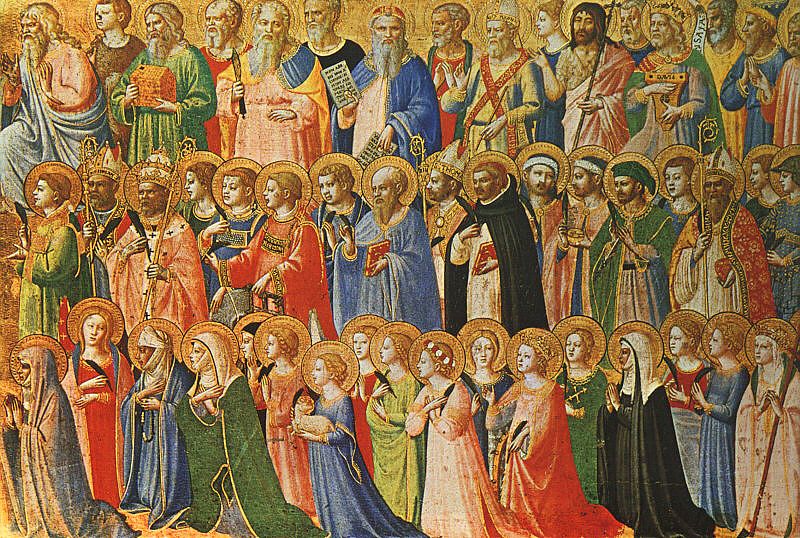
The saints who have died are not dead – they are more alive than we are now. The human saints in Heaven lived in times past, but they were made of the same stuff and faced similar struggles then as you and I today. Though the Catholic Church has canonized thousands of saints, when you consider the billions of Christians throughout history canonizations are relatively rare, yet there are more saints in Heaven than we can count. We know this because of St. John’s Revelation of Heaven: “I had a vision of a great multitude, which no one could count, from every nation, race, people, and tongue.” The Lord Jesus Christ wants you to be in that number. Unfortunately, common misconceptions about saints can keep us further from them. So, in this homily, I would like to help you to grow closer to them in friendship and in likeness.

First realize that the saints are not dead and gone but still living. This is why whenever I preach about the deceased I try to speak of them using the present tense whenever some fact about them remains true. For instance, if a kind and generous Christian father of three dies he is still a kind and generous father of three. Rather than saying “his name was David,” faithfully witness that “his name is David” even after he has died. Though deprived of their bodies for the moment, those who are in Heaven are more alive than we are here. There they experience God opening himself to them an inexhaustible way. This is called the beatific vision, an ever-flowing well-spring of happiness, peace, and mutual communion. The saints in Heaven see God face to face, and they have become like him for they see him as he is.

What is a glorified human being or exulted human nature like? Let’s consider the Blessed Virgin Mary. How much does she know us? How much does she love us? Does she hear each one of our prayers addressed to her? It is our sense of the Faith that our spiritual mother does indeed know us and loves us individually as her children. But consider this: if every Catholic in the world offers one Hail Mary a day, this means an average of more than fifteen thousand new prayers come her way each second. Therefore, if Mary hears all our prayers, her experience of time and/or the capacity of her glorified consciousness must far surpass our own.

The other glorified saints in Heaven, our brothers and sisters in Christ, know and care about you too. They understand you because they’ve walked in our shoes. Governments and borders and technologies change over time, but human nature is constant. The saints began with the same humanity as you and I, experienced challenges like our own, and prevailed. Lots of canonized saints have been priests, nuns, bishops, popes, or martyrs, but Heaven is certainly not limited to these backgrounds. Saints come from varied walks of life. Some canonized saints did extraordinary miracles or had visions here on earth, but even for these most of their days were ordinary, spent faithfully doing very ordinary things like us.

The saints in Heaven are our friends who lend us constant aid even if we do not know their names yet. In response, I encourage you to befriend them back. Which ones? Try doing this holy experiment: ask Jesus to introduce you to a saint and then keep your eyes open. Watch for a saint to providentially present him or herself to you, perhaps through an icon, a painting, or a photograph, a book or a film, or mentioned in a conversation thereafter. I look forward to hearing whom you’ll meet. Take these saints as teachers you learn from, role models you imitate, heroes to inspire you, and holy intercessors whose prayers before God for you are very powerful. I urge you to follow the saints, because those who follow them will embody the beatitudes, become more like Jesus, and become saints themselves.

Though it is unlikely any of us here will be officially canonized by the Church, we are all called to be saints. You are called to be a saint. St. Catherine of Siena said, “If you are what you should be, you will set the world on fire.” Do not say, “I have too sinful of a past to become a saint.” Recall that St. Paul had once persecuted Christians. There is no saint without a past and no sinner without a future. And do not say, “I’m too imperfect to become a saint.” Realize that even while St. Peter was serving as the first pope he sometimes made personal mistakes in his ministry. And do not say, “I’m too late in my life to become a saint.” Remember how the Good Thief on his cross next to Jesus made the most of the time he had left. As St. John Paul the Great preached, “Become a saint, and do so quickly.” Jesus is calling you to be a saint, so befriend the saints and they will help you on the way to Heaven.

What Happens When You Die — 32nd Sunday of Ordinary Time—Year C

November 9, 2019

Our days are growing shorter and shorter. In the fall, it’s impossible not to notice the dark night encroaching. The trees are being drained of the color of life, their foliage is falling dead to the ground, turning the trees into bare skeletons. The farmer’s field has yielded its harvest; the once-living crops have been cut down. This changing of nature chills us in our flesh. During this season of dying, we are reminded in the world and in the Church, of our own mortality. This is a topic personally relevant to us all. Unless Jesus comes back first, each of us is going to die. What happens next is what I’ll preach about today.

Human nature is a unity of body and soul. At death, our body and soul will separate. Our mortal remains, our dead bodies, will decay according to natural processes. Sometimes God works a miracle, causing a saint’s corpse to remain incorruptible in part or in whole, but ordinarily our dead bodies return to the dust from which we were made. Our immortal souls, however, will not go into the grave with our bodies; at death; the who that is you behind your senses, your soul, will appear for the judgment of your Creator. As the Letter to the Hebrews says, “it is appointed that human beings die once, and after this the judgment.”

In the words of the Catechism of the Catholic Church: “Death puts an end to human life as the time open to either accepting or rejecting the divine grace manifested in Christ… each will be rewarded immediately after death in accordance with his works and faith. … Each man receives his eternal retribution in his immortal soul at the very moment of his death, in a particular judgment that refers his life to Christ: either entrance into the blessedness of Heaven—through a purification or immediately,—or immediate and everlasting damnation.”

Those who die in God’s grace and friendship and are perfectly purified live for ever with Christ. This perfect life with the Most Holy Trinity – this communion of life and love with the Trinity, with the Virgin Mary, the angels and all the blessed – is called ‘Heaven.’ Heaven is the ultimate end and fulfillment of the deepest human longings, the state of supreme, definitive happiness. … [Jesus] makes partners in his heavenly glorification those who have believed in him and remained faithful to his will.

But what if we die spurning his friendship? We cannot be united with God unless we freely choose to love him. But we cannot love God if we sin gravely against him, against our neighbor or against ourselves. To die in mortal sin without repenting and accepting God’s merciful love means remaining separated from him for ever by our own free choice. This state of definitive self-exclusion from communion with God and the blessed is called “Hell.” Jesus speaks repeatedly of Hell in the Gospels, so we cannot dismiss its reality. The numerous rebel angels, the demons, experience Hell, and it seems that many human beings will experience it forever as well. It’s a terrible thing, but recall C.S. Lewis’ words: “The gates of Hell are locked from the inside. … There are only two kinds of people in the end: those who say to God, ‘Thy will be done,’ and those to whom God says, in the end, ‘Thy will be done.’ All that are in Hell, choose it. Without that self-choice there could be no Hell.

What if I die as a friend of God but I’m still not yet perfect? What if I sincerely love God and my neighbor but I still retain a fondness for my sins. The Book of Revelation says of God’s Heavenly city “nothing unclean will enter it,” so how can I be cleansed to enter in? The Catechism teaches: “All who die in God’s grace and friendship, but still imperfectly purified, are indeed assured of their eternal salvation; but after death they undergo purification, so as to achieve the holiness necessary to enter the joy of Heaven. The Church gives the name ‘Purgatory’ to this final purification of the elect, which is entirely different from the punishment of the damned.

On earth we know that personal conversion and change of lifestyle can be difficult. Private revelation suggests that the purifying process of Purgatory is both painful and joyful at the same time. It’s like a soldier returning victorious from a war overseas, traveling to his wife and family. His long trip home may be exhausting, but his great love for those who await him sweetens his journey and focuses his efforts to join them.

We should pray for one another on earth and we should pray for the dead as well. From her beginning, the Church has honored the memory of the dead and offered prayers for them, above all at Christ’s great sacrifice, the Mass, so that, thus purified, they may attain the beatific vision of God. The Church also commends us, especially in the month of November, to almsgiving, indulgences, and works of penance on behalf of the dead to help them on their way to the fully-unveiled presence of God. The saints in Heaven now behold the divine essence with an intuitive vision, without the mediation of any creature. The Blessed Virgin Mary, and possibly Elijah, Moses, and Enoch, already have their bodies there, but the reunited bodies and souls of all the dead, of both the just and the unjust, will rise again one day.

The resurrection of the dead, which in today’s Gospel the Sadducees denied and Jesus affirms, will precede the Last Judgment. This will be “the hour when all who are in the tombs will hear [the Son of man’s] voice and come forth, those who have done good, to the resurrection of life, and those who have done evil, to the resurrection of judgment.” Then Christ will come “in his glory, and all the angels with him… Before him will be gathered all the nations, and he will separate them one from another as a shepherd separates the sheep from the goats, and he will place the sheep at his right hand, but the goats at the left… And they will go away into eternal punishment, but the righteous into eternal life.” This Last Judgment will reveal even to its furthest consequences the good each of us has done or failed to do during our earthly life.

After this last and universal judgment, the universe itself will be renewed into what Scripture calls “a new Heavens and a new Earth.” Recall how Jesus’ resurrected body is the body that was pierced (for he still bears some wounds as trophies,) and it is the body that was buried (for the Easter tomb is empty,) but Jesus’ resurrected body is now gloriously transformed. The same body, but renewed Likewise, our resurrected bodies and this material universe will be renewed and transformed as well. Then the righteous will reign with Christ, glorified in body and soul, in a new heavens and new earth, forever.

From these reflections on the last things, I offer you these three takeaways. First: care for your soul. Be committed to prayer and the sacraments (particularly confession for the forgiveness of your sins.) Second: pray for the dead. They will appreciate it forever and pray for you too. Third and finally: remember that our time on earth is short. And forever is a very long time. You have just one life, so live and love heroically in Christ.

Chihuahuas & Heavenly Glory — 22nd Sunday of Ordinary Time—Year C

September 1, 2019


Saturday Night Live used to have a running bit called “Deep Thoughts, by Jack Handy,” and this was my all-time favorite Deep Thought:

I hope if dogs ever take over the world, and they choose a king, I hope they don’t just go by size, because I bet there are some Chihuahuas with some good ideas.

Imagine if our human social standing in the world were based upon size. What if we were looked up to, or looked down upon, because of our height? I imagine that more men would wear big boots and more women would wear high heels. Guys would don tall hats and gals would keep their hair up. Basketball would be the sport of kings. And some unfriendly folk would say, “I don’t want no short people round here.”

Or, what if our worldly status were based upon the alphabetical order of our last names? A, B, and C families would have every honor and advantage, and the middle letter households would be considered middle class. I suspect there would be more romantic stories and fairy tales about Andersons marrying Zwiefelhofers. And I can picture lots of people legally changing their last names, until perhaps this practice got outlawed by a new law signed by President Aaaaaaaaaaaaaaaaah.

These are silly and unjust ways to structure a society. But what is the basis for social standing and status in our real world? Money comes to mind. Now people usually work for their pay or profits, so personal wealth is a personal trait that – to some degree – is earned. But how much have we really merited all the wealth that we possess? Compared to international averages, all of us here are very rich. I try to do my best in ministry, but do I really work five times harder than a priest in Bolivia? Am I actually twelve times more productive than a priest in The Philippines? Am I truly twenty-five times more fruitful than a parish priest in Nigeria? I doubt it. So how proud can I be of my being rich? How much should I be enamored by, or how much should I look up to, people wealthier than me? And how much should I look down on people with less than me? Other sources of status and standing in our society include political power or physical attractiveness. But history teaches us that people in positions of power are often not admirable. And sometimes the wicked in this world can be very attractive, while the good can look quite plain or even ugly.

Our second reading today speaks of a society quite different and far better than this broken world we live in. The Letter to the Hebrews tells us we approach ‘the heavenly Jerusalem, the city of the living God.’ Who lives there? God the judge of all, and countless angels in festal gathering, and the spirits of the just made perfect, and Jesus, the mediator of a new covenant. All are happy who live in Heaven, happy to their fullest, but their individual weights of glory are not the same. It is like how thimbles and small cups can be as completely full as buckets and tubs while holding different amounts of water. We know that glory differs in Heaven because, for starters, who among us could possess as much glory as our Lord? Within the hierarchy of the angels some have more glory than others. And glory varies amongst the human saints in Heaven as well.

The salvation of every saint is only possible through Jesus’ precious blood—the blood of his sacrifice we could not and did not deserve; sprinkled blood which speaks more eloquently than that of Abel, because Abel’s blood cried out from the earth for punishment on his murderer, while Jesus’ blood cries out to God for mercy on us all. Yet, once redeemed by Christ’s blood, we can merit, because God promises to reward our good deeds done in Christ. Jesus promises that he, “the Son of Man will come with his angels in his Father’s glory, and then he will repay everyone according to his conduct.” He tells us today, “When you hold a banquet, invite the poor, the crippled, the lame, the blind… for you will be repaid at the resurrection of the righteous.” St. Paul speaks to this in various places in the New Testament. He says, “…A person will reap only what he sows… Let us not grow tired of doing good, for in due time we shall reap our harvest, if we do not give up.” And St. Paul says elsewhere, “Consider this: whoever sows sparingly will also reap sparingly, and whoever sows bountifully will also reap bountifully.

Our gracious good deeds transform us more and more into God’s likeness, allowing us to receive more and reflect more of his glory, both now in this life and forever in Heaven. So what is the best way to sow bountifully in this life for the greatest possible reward in the next? We can look to and imitate the lives of the saints. We can learn from them and we are wise to befriend them. Yet the saints were first and foremost imitators and friends of Christ; who, though he was in the form of God, emptied himself to became human like us. Jesus deserved to be our king on earth, but he took the form of a servant. He humbled himself, even to the point of death on a cross. And because of this, God greatly exalted him and bestowed upon him the name and honor and glory that is above and before all.

Like in today’s parable, Jesus took the lowest place, and the Father called him up to a higher place, to be seated at his right hand in Heaven. Jesus calls us to be like him, in what we respect and in who we honor, in what we value and in who we treasure, in how we live and in how we treat others. You may or may be considered a big dog in this world, but you must follow our good Master, loyally heed his commands, and show kindness to all the Chihuahuas.

Consoling the New Jerusalem — 14th Sunday of Ordinary Time—Year C

July 8, 2019

This word of the Lord regarding Jerusalem was spoken through the Prophet Isaiah in our first reading:

“Thus says the LORD: Rejoice with Jerusalem and be glad because of her, all you who love her; exult, exult with her, all you who were mourning over her! For thus says the LORD: Behold, I will spread prosperity over Jerusalem like a river. As a mother comforts her child, so will I comfort you; in Jerusalem you shall find your comfort. When you see this, your heart shall rejoice and your bodies flourish like the grass; the LORD’s power shall be known to his servants.”

When reading Old Testament prophesies, the tone can really widely vary. Depending upon the particular century, the Lord’s message directed towards Jerusalem or the Israelites can be consoling, encouraging, promising good things to come; or denouncing, woeful, declaring punishments to follow. I find it really difficult to place our country and our present time amongst these Old Testament messages. I can imagine the people of our land being pleasing the Lord in many respects and I can see us meriting his correcting chastisement for other reasons. So do the consoling words of Isaiah apply to us? Let me explain how I think that they can.

In Old Testament times, Jerusalem, the holy city, was the place of God’s temple, his dwelling place on earth. But in 70 A.D., the Romans sieged Jerusalem and destroyed the temple leaving not one stone upon another, as Jesus had proselytized and foretold. In New Testament times, Jesus is the Temple. In John’s Gospel, Jesus tells a crowd, “Destroy this temple and in three days I will raise it up,” and John notes Jesus “speaking about the temple of his body.” The Body of Christ is the New Temple. The Christian understanding of Jerusalem changes, too. In the Book of Revelation, St. John beholds “the holy city, a new Jerusalem, coming down out of heaven from God, prepared as a bride adorned for her husband.” John hears a loud voice from the throne say, “Behold, God’s dwelling is with the human race. He will dwell with them and they will be his people and God himself will always be with them as their God.” So the New Temple is the Body of Christ. And the New Jerusalem is the Bride of Christ. Where is the Body of Christ now and where is his Bride? As New Testament Scriptures tell us, they are present on earth and in Heaven, as his Holy Church.

There are wounds and sufferings in the Body of Christ. This was personally true for Jesus on earth, and it is true for his members. In our second reading, St. Paul writes: “From now on, let no one make troubles for me; for I bear the marks of Jesus on my body.” Paul composed his letter in Greek, and here the Greek word for “marks” is literally “stigmata.” In the ancient world, slaves and devotees of pagan deities were often branded by marks called “stigmata” to indicate to whom they belonged, who they served or who was their god. In a Christian context, “stigmata” has come to mean the miraculous sign or gift of receiving the wounds of Christ, in one’s hands, feet, or side. St. Francis of Assisi experienced the stigmata near the end of his life, and St. Padre Pio bore Christ’s wounds in his hands for fifty years. But what St. Paul is describing in this passage is not necessarily that. In 2nd Corinthians, he enumerates the sufferings he had endured: “Five times at the hands of the Jews I received forty lashes minus one. Three times I was beaten with rods, once I was stoned…” St. Paul greatly suffered in Christ, but many wounds are not physical.

I hate that wolves in sheep’s clothing have hurt and scarred members of the Body of Christ, the Church. I hate that the Bride of Christ I love is denounced as something evil. Perhaps it has never been easy to be a Catholic, but it is hard to be a Catholic today. How are we going to respond? In today’s gospel, Jesus says, “Beg the master of the harvest [that is, God his Father] to send laborers into his harvest.” In other words, we should ask God to raise up saints. In the worst and hardest times in Church history, God has supplied holy saints. And he still lifts up saints in our modern times as well.

In the year 2010, a baby boy was born in Illinois with neither breath nor pulse. The parents prayed for the intercession of another native son of Illinois. That man had grown up in El Paso, Illinois, become a priest and eventually an archbishop, was an excellent preacher and author, and even won an Emmy for his highly-rated, prime-time, national TV show called “Life is Worth Living.” Archbishop Fulton J. Sheen died in 1979, but after praying for his help in saving their son’s life, after sixty-one minutes of no signs of life, their boy began to breathe and show a pulse. Today, James Fulton Engstrom is a fully healthy eight-year-old, and yesterday the Vatican officially announced that his inexplicable healing was a miracle, which clears the way for Archbishop’s Sheen’s beatification in the near future.

Fulton Sheen was a twentieth century saint, but God desires to raise up twenty-first century saints as well. And not just among others elsewhere, but among we ourselves. You and I likely never be beatified or canonized, but we are all called to be saints because we are all called to Heaven, and to begin living the life of Heaven here and now.

Notice how in today’s gospel, Jesus does not send out his missionaries one-by-one but in pairs. He told them to stick together, “stay in the same house.” Why? He wanted them to be a help, encouragements to each other, to be faithful and fruitful. Likewise, we have the fellowship of one another to help us become saints. And we have holy friends who know and love us to help us, the saints in Heaven. And we have our greatest friend who provides the means for our sanctification in himself, Jesus Christ. Let us become saints together. Then the words of Isaiah will be fulfilled among us. All who were mourning over Jerusalem will exult and all who love her will rejoice. In holiness the Lord’s power shall be known to his servants. And we will be comforted and flourish, in the New Jerusalem here on earth and in Heaven without end.

A Wonderful Vacation

September 7, 2017

How was my vacation? It was a wonderful adventure! Missouri’s solar eclipse was beautiful; a black circle with white wisps extending over a surprisingly blue background. In the first seconds when the Sun began reemerging from the Moon there was a bright speck and then an expanding light so intense that it could not be looked at. It was like seeing the large stone rolled away from the mouth of the tomb on Easter morning at the moment of the Resurrection.

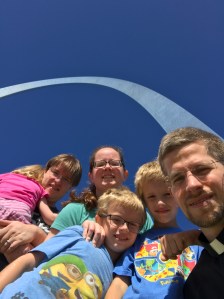
We touched the St. Louis Arch, a structure whose geometric simplicity belies the amazing landmark that it is. Ask yourself, how would you build such a thing sixty-three stories in the air?

In Arizona, I was pleased to providentially cross paths with Clare Shakal from Cooks Valley. I was surprised to learn she happens to work at the parish where a friend from seminary I was visiting is now pastor.

In  Southern California I saw the last line of light from a red Sun be swallowed by the ocean. Pedestrians paused on the pier to watch the Earth eclipse of the Sun (what we call a sunset) but there was nothing like the numbers who gathered for the much rarer eclipse the week before.

One morning, I body-surfed in the Pacific Ocean, and went to bed in Wisconsin that night. While flying home (over a distance it would have taken me months to travel on foot) I gazed down upon the Grand Canyon for the first time. Our pilot never mentioned it.

My trip had many highlights but the part I enjoyed the most and what seasoned all the rest was the good friends I was blessed to share my adventure with.

What makes something wondrous? Things we encounter often feel less precious and usually go unnoticed. If solar eclipses happened daily at noon they would be no less beautiful but they never make the news. Our world is filled with wonders but even when we live in appreciative gratitude we still long for more. This is a sign to us that we were made to live forever; in a loving communion of persons with an infinitely interesting and beautiful God.

Questions & Answers About My Cat, Leo XIV

July 17, 2017


Why did you name your cat “Leo the Fourteenth?”

So he wouldn’t be confused with Pope Leo XIII—who had the fourth longest papal reign (from 1878 to 1903) and died at the age of 93 as history’s oldest pope. The name “Leo” is Latin for “Lion.”

Why did you want a black cat?

Cats are great, and have you ever noticed cat hair on my clothing? … Exactly.

How does Leo like living in the rectory?

Leo enjoys greeting visitors to the parish offices (he is very friendly) and exploring our house. The dust and cobwebs I sometimes find on him indicate he likes the basement. I predict that Leo will leave a “gift” for me on my bed or office floor someday.

Do you think Leo XIV will go to Heaven?

Even though Leo is a very good cat, I am not certain. St. Thomas Aquinas argued that animals, lacking a rational soul such as humans have, cannot experience the Beatific Vision of God. On the other hand, the Book of Revelation foretells of a New Heavens and a New Earth while the Prophet Isaiah speaks of wolves, lambs, leopards, goats, calves, lions, cows, bears, cobras, and children peacefully living together one day on God’s holy mountain. (Isaiah 11) As I consoled myself when my previous, dear cat, Dexter died; if there is anything eternal about Leo, I trust that Jesus will take care of him. If we reach Heaven and find our deceased pets are not there, upon understanding their loving purpose in the divine plan, we shall thank God for the gift they were and be at peace.

Ghost Stories From Sts. Augustine & Gregory

October 31, 2014

In 398 AD, St. Augustine shared the following story about a probable visitor from beyond the veil in a letter to his friend, Evodius:

“Our brother, Gennadius … told us that he doubted once … whether there was any life after death. As God would not abandon a man of his disposition and works of mercy, there appeared to him in sleep a handsome youth of dignified appearance, who said to him: ‘Follow me.’ He followed and came to a certain city, where he began to hear, on his right, singing of such exquisite sweetness that it surpassed all known and ordinary sweetness. Then, as he listened, he asked what it was and his guide said it was the hymns of the blessed and the saints. I do not clearly remember what he said he saw on his left. When he awoke, the dream vanished and he thought of it only as one does of a dream.

But, on another night, behold, the same youth appeared to him again and asked whether he recognized him; he answered that he did so fully and perfectly. Then the youth asked where he had known him. He remembered what to reply to that, too, and described the whole vision and the hymns of the saints which the other had led him there to hear, recalling them with ease as a recent experience. Thereupon, the youth asked whether he had been asleep or awake when he saw what he had described. He answered: ‘It was in a dream.’ The other said: ‘You remember well, it is true, that you saw all that in a dream, but you must know that even now you see, although you are asleep.’ When he heard that, he believed it was so and expressed it by his answer.

Then the one who was teaching him continued and said: ‘Where is your body now?’ He answered: ‘In my bedroom.’ ‘And do you know,’ said the other, ‘that in that same helpless body, your eyes are fast shut and useless, and that you see nothing with those eyes?’ Gennadius answered: ‘I know it.’ His guide went on: ‘Then, with what kind of eyes do you see me?’ He fell silent at this, finding no reply, and, as he remained in doubt, the youth made known what he was trying to teach by these questions.

He went on: ‘As those eyes of flesh are now inactive and perform no function while your body lies asleep in bed, yet you have eyes with which you behold me and a sight of which you make use, so, when you die and the eyes of your flesh see nothing, there will be in you another life by which you will live and sense by which you will perceive. See to it that henceforth you do not doubt of the life which remains after death.’ Thus this faithful man says that his doubt on this matter was removed, and what was his teacher but the providence and mercy of God?”

In 593 AD, Pope St. Gregory the Great related this story in his Dialogues:

“Bishop Felix…said that he had been told of such a case by a saintly priest who was still living two years ago in the [Italian] diocese of Centum Cellae as pastor of the Church of St. John in Tauriana [on the toe of Italy.] This priest used to bathe in the hot springs of Tauriana whenever his health required. One day, as he entered the baths, he found a stranger there who showed himself most helpful in every way possible, by unlatching his shoes, taking care of his clothes, and furnishing him towels after the hot bath.

After several experiences of this kind, the priest said the himself: ‘It would not do for me to appear ungrateful to this man who is so devoted in his kind services to me. I must reward him in some way.’ So one day he took along two crown-shaped loaves of bread to give him.

When he arrived at the place, the man was already waiting for him and rendered the same services he had before. After the bath, when the priest was again fully dressed and ready to leave, he offered the man the present of bread, asking him kindly to accept it as a blessing, for it was offered a token of charity.

But the man sighed mournfully and said, ‘Why do you give it to me, Father? That bread is holy and I cannot eat it. I who stand before you was once the owner of this place. It is because of my sins that I was sent back here as a servant. If you wish to do something for me, then offer this bread to almighty God, and so make intercession for me, a sinner. When you come back and do not find me here, you will know that your prayers have been heard.

With these words he disappeared, thus showing that he was a spirit disguised as a man. The priest spent the entire week in prayer and tearful supplications, offering Mass for him daily. When he returned to the bath, the man was no longer to be found. This incident points out the great benefits souls derive from the Sacrifice of the Mass. Because of these benefits the dead ask us, the living, to have Masses offered for them, and even show us by signs that it was through the Mass that they were pardoned.”

A Glorious Lady in Heaven

August 15, 2014

Like Dante’s Divine Comedy, C.S. Lewis’ The Great Divorce takes a first-person tour of Hell, Purgatory, and Heaven. Dante had a next-worldly guide in the Roman poet Virgil, while Lewis had the Scottish author George MacDonald. While on the Plains of Heaven, Lewis beholds the following (abridged) scene:

Some kind of procession was approaching us, and the light came from the persons who composed it.  First came bright Spirits, not the Spirits of men, who danced and scattered flowers. Then, on the left and right, at each side of the forest avenue, came youthful shapes, boys upon one hand, and girls upon the other. If I could remember their singing and write down the notes, no man who read that score would ever again grow sick or old. Between them went musicians; and after these a lady in whose honor all this was being done. And only partly do I remember the unbearable beauty of her face.

“Is it?…  Is it?” I whispered to my guide.

“Not at all,” said he. “It’s someone ye’ll never have heard of.  Her name on earth was Sarah Smith and she lived at Golders Green.”

“She seems to be… well, a person of particular importance?”

“Aye. She is one of the great ones.  Ye have heard that fame in this country and fame on Earth are two quite different things.”

“And who are all these young men and women on each side?”

“They are her sons and daughters.”

“She must have had a very large family, Sir.”

“Every young man or boy that met her became her son – even if it was only the boy that brought the meat to her back door. Every girl that met her was her daughter.”

“Isn’t that a bit hard on their own parents?”

“No.  There are those that steal other people’s children. But her motherhood was of a different kind. Those on whom it fell went back to their natural parents loving them more. Few men looked on her without becoming, in a certain fashion, her lovers. But it was the kind of love that made them not less true, but truer, to their own wives. It is like when you throw a stone into a pool, and the concentric waves spread out further and further. Who knows where it will end? Redeemed humanity is still young, it has hardly come to its full strength. But already there is joy enough in the little finger of a great saint such as yonder lady to waken all the dead things of the universe into life.”

The Next Life — Monday, 4th Week of Lent

March 31, 2014

Readings:  Isaiah 65:17-21, John 4:43-54

Thus says the LORD: Lo, I am about to create new heavens and a new earth; The things of the past shall not be remembered or come to mind. Instead, there shall always be rejoicing and happiness in what I create; For I create Jerusalem to be a joy and its people to be a delight; I will rejoice in Jerusalem and exult in my people. No longer shall the sound of weeping be heard there, or the sound of crying; No longer shall there be in it an infant who lives but a few days, or an old man who does not round out his full lifetime; He dies a mere youth who reaches but a hundred years, and he who fails of a hundred shall be thought accursed. They shall live in the houses they build, and eat the fruit of the vineyards they plant.

What are we to make of this first reading of Isaiah? Has it been fulfilled in the two-dozen centuries since it was written? Clearly not, though just a few generations from now, because of medical and technological advances, people may be living up to 125 or 150 years on a regular basis. Yet what advantage does someone who dies at 150 without God have over someone who dies at 75? And even in a future with longevity and prosperity, there will still be weeping and crying.

I think the Lord gave this vision of a new heavens and a new earth in ancient times to help his people hope in something tangible and relatable: “What is eternal life? Would I really want that? But living a very long life without sadness would be something I’d desire.” In the new heavens and earth after Jesus’ return in glory there will be complete happiness and no death at all (Revelation 21:4.) We should imagine what that will be like; an intimate community of friends, conversation and feasting, sports and play, singing and dancing, and joyful worship; while at the same time realizing that our experience of the next life will surpass all of these earthly things as we know them.