Archive for the ‘Last Things’ Category

A Redecorated Soul — Funeral Homily for Linda Gorka, 70

July 29, 2020

There’s a natural sadness from the passing of a loved one and added stress from life’s current strains. But there is profound consolation from our faith in Jesus Christ and we are blessed in our freedom to be able to gather here today. St. Paul’s Parish is honored to be offering our greatest prayer, the Holy Mass, for Linda’s soul and for all of you who know and love her. No mere homily could capture the full mystery of a human life; no brief homily can tell the fullness of the story of how Christ has shepherded Linda’s life. But a funeral homily can reveal something of what Jesus Christ has done, and does, in the lives of Christians.

Rodney tells me that Linda loved interior decorating. Though never formally trained, she had a talent for it — a creative flair. For holidays, especially the Christian celebrations of Christmas and Easter, Linda’s house was transformed; nick-nacks here and there, wall and window coverings, all set the season; providing a pleasant backdrop when she would entertain welcomed guests at parties. She loved being a grand-hostess for her friends.

Another thing Rodney recollected to me is how the companionship between them helped them through each other’s serious health trials. She remained by his side, minded his meds, and drove him for treatments during his throat cancer nine years ago. And last year, Linda helped him through his recover from a bad car accident. Then, in this her final year, Linda received support and care during her purifying crucible experience of suffering with cancer. (Rodney wants to thank all those who helped before and after Linda death: her daughter Michelle and Arianne, son David, grandson Joe, friends Randy and Dawn, and others whom Rodney may have forgotten.) We believe, like St. Paul says, ‘this momentary light affliction is produced for her an eternal weight of glory beyond all comparison,’ because Linda died as a Christian with Christ.

Three weeks ago, I went to visit Linda in the hospital and did something I have never done before. Rodney had informed me that, though Linda believed in God and Jesus Christ, neither she nor her family members had any knowledge or evidence of her ever having been baptized. She was not speaking very much at that point, but when I asked her whether she wished to be baptized she answered that she did. I baptized Linda with water on her forehead right there in her bed, “in the name of the Father, and of the Son, and of the Holy Spirit” — a conditional baptism, ensuring that whether or not she had ever been baptized before, she was assuredly a baptized Christian after.

What is the meaning and purpose of all these trials of life? If this life were all there is, if Christ were not raised and all people and things were destined for unending death, our lives would have no enduring significance. But Jesus is risen, so this life is vitally important, yet it’s only the beginning of eternity, so the God allow trials to transform us more and more into the likeness of Christ, who often suffered with love and virtue. The famous Christian author C.S. Lewis once observed that, like Linda, God is something of a master interior redecorator as well:

Imagine yourself as a living house,” Lewis wrote, “God comes in to rebuild that house. At first, perhaps, you can understand what He is doing. He is getting the drains right and stopping the leaks in the roof and so on; you knew that those jobs needed doing and so you are not surprised. But presently He starts knocking the house about in a way that hurts abominably and does not seem to make any sense. What on earth is He up to? The explanation is that He is building quite a different house from the one you thought of – throwing out a new wing here, putting on an extra floor there, running up towers, making courtyards. You thought you were being made into a decent little cottage: but He is building a palace. He intends to come and live in it Himself.

St. Paul writes that, “We know that if our earthly dwelling, a tent, should be destroyed, we have a building from God, a dwelling not made with hands, eternal in Heaven.” And Jesus tells us, “Do not let your hearts be troubled. You have faith in God; have faith also in me. In my Father’s house there are many dwelling places. …I am going to prepare a place for you… I will come back again and take you to myself, so that where I am you also may be.” And so, today, while we mourn Linda’s departing from us, we rejoice in her going to God. The journey of life through death to a next life awaits us all. Let us, each and all, respond to Jesus Christ the Good Shepherd as one of his sheep, so that our story may be happily joined to his own great story forever.

A Man for our Seasons

June 22, 2020

12th Sunday in Ordinary Time

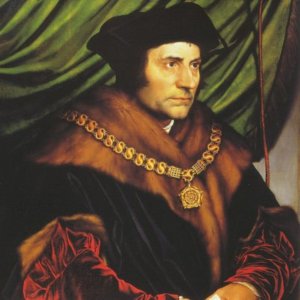
June 22nd is the feast day of St. Thomas More, one of my favorite saints. Back in 1929, the great Catholic writer G.K. Chesterton wrote: “Thomas More is more important at this moment than at any moment since his death, even perhaps the great moment of his dying; but he is not quite so important as he will be in about a hundred years’ time.” This prediction’s one hundred year anniversary arrives this decade. So who is St. Thomas More, what made him a martyr, and what lessons does he have for us today?

In 1509, the new eighteen-year-old Catholic King of England, Henry VIII, married a smart and extremely beautiful Spanish princess, Catherine of Aragon. Seventeen years later, King Henry, without a male heir, with his affections now shifted toward a mistress, began citing a passage from the Old Testament book of Leviticus to argue that his marriage to Catherine was invalid and he asked the pope to annul his marriage. What happened thereafter is a story retold in my favorite movie, 1966’s Best Picture Winning film, A Man for All Seasons. That remarkable man for all seasons – adept in all circumstances – was St. Sir Thomas More.

A successful attorney, judge, diplomat, and statesman, Thomas More served in many official roles, including as Speaker of the British House of Commons. His brilliance is reflected by his witty quotes and writings. Four hundred ten English words have their invention (or at least their first-known appearances) from him, including the word “Utopia,” the title of his most famous book. A deeply devout Catholic, Thomas More had seriously considered becoming a monk, but instead discerned a call to marriage, family, and a career in public life. All these traits combined made him a great asset to the King. For instance, More once helped Henry VIII write a treatise in “Defense of the the Seven Sacraments” against Martin Luther’s errors for which the pope bestowed upon the king the title “Defender of the Faith.” The king trusted and admired Thomas More for years and appointed him to be the Lord Chancellor of England, a very high office. Then a season of great evil came to that land.

When King Henry asked Pope Clement VII to annul his marriage the pope refused. What Henry sought would have been a divorce, and Jesus said, “Whoever divorces his wife and marries another commits adultery.” Henry continued petitioning, but the Holy Father’s refusal was steadfast against this king spurning his queen. In response, Henry divorced and remarried anyway and went on to assert his supremacy over and against the pope, declaring himself to be the leader of the Catholic Church throughout his realm. Henry then used the power of the state to make all his subjects fall into line. It became a crime to agree with the pope against the king and all public figures were required to swear oaths affirming the king’s supreme headship over the Church in England. Those who denied the king’s claims would be executed.

Thomas had resigned his office and withdrawn from public life because of and prior to the king’s illegitimate remarriage and Thomas did not attend the wedding ceremony. Thomas was not going to endorse, by his words or actions what he did not believe. The king’s remarriage was wrong, but Thomas hoped that by maintaining public silence he and his family would be left alone. However, the compelled oath affirming the king’s supremacy would no longer tolerate Thomas’ neutrality. The oath was evil. Jesus, from his own lips while on this earth, had entrusted the role of supreme governance of the Church to St. Peter and his successors, the popes. Thomas was absolutely resolved not to swear a false oath, for Jesus warns us, “Whoever denies me before others, I will deny before my heavenly Father.”

When Thomas would not take the oath, he was imprisoned in the Tower of London and was charged with high treason. Thomas, the brilliant expert of law and debate, put up a sound defense that under the law they had no grounds to punish him, but following evidently false testimony from an ambitious acquaintance who betrayed him, Thomas More, under this pretext, was found guilty. The condemned man then spoke out against the unchristian oath and the injustice being done, yet in closing he said this to his judges: “More have I not to say, my lords, but that like as the blessed apostle Saint Paul, as we read in the Acts of the Apostles, was present and consented to the death of St. Stephen, and kept their clothes that stoned him to death, and yet be they now [both] holy saints in heaven and shall continue there friends forever: so I verily trust and shall therefore right heartily pray, that though your lordships have now in earth been judges to my condemnation, we may yet hereafter in Heaven merrily all meet together to our everlasting salvation.” At his beheading for being condemned as a traitor, at his martyrdom for being faithful to Christ and his Church, St. Thomas More spoke these words: “I die the king’s good servant and God’s first.”

Today, like willful King Henry VIII, much of our prevailing culture also wants things contrary to God’s will and Christ’s teachings. They declare that all who do not fully agree with them are evil and should be expelled, cancelled from society. And the powers of government, our courts and leaders, seem to be taking their side. Jesus said:

“Have you not read that from the beginning the Creator ‘made them male and female’ and said, ‘For this reason a man shall leave his father and mother and be joined to his wife, and the two shall become one flesh’? So they are no longer two, but one flesh. Therefore, what God has joined together, no human being must separate.”

God made us male and female, he created marriage, all peoples and races share a common origin and dignity from him, and Christ was sent to save us all. Thus, marriage is a lifelong union between one man and one woman, an adult female is a woman and an adult male is a man, no one should be judged for the color of their skin, and Jesus Christ is the only way to the Father. These beliefs are not always popular, but ignoring these truths leads to pain and loss. The story of St. Thomas More shows us that public silence and private disagreement may not be tolerated by this world. Sooner or later, it may be demanded that you too either submit or suffer. At that time, and all times, remember: do not lie, never ever lie, and do not be a party to a lie.

Jesus says, “Blessed are they who are persecuted for the sake of righteousness… thus they persecuted the prophets who were before you.” In years past, this passage made me think of suffering Christians in the distant mission lands of Asia or Africa, where they are the vulnerable minority, or of how the Roman pagans persecuted the early Church. But who was Jesus referring to when he said “they persecuted the prophets who were before you”? Who persecuted the Jewish prophets in the Old Testament? It wasn’t so much the unbelieving pagans as the prophets’ own leaders and neighbors they were sent to, the people of God. Likewise, a Christian can easily become a betrayer or a passive party to evil if he or she does not resolve like St. Thomas More to live in the truth and stand with Christ no matter what.

Though Thomas More was clearly innocent, it took his twelve jurors only fifteen minutes to find him guilty. They were afraid. There were fifteen judges at his trial, many of whom had been his friends, but none of them were willing to defend him. They were all afraid too. The saint might have been saved if only one had stood firm instead of just standing by. The Church in England might not have collapsed if there had been more upright men like St. Thomas More. What we do in the time that is given us matters. Stand with him and the Lord will strengthen you like he did the Prophet Jeremiah. You may feel alone, but you won’t be, and Jesus Christ will be proud of you.

This stand may cost you dearly. Will it be worth it? Jesus tells us, “Blessed are you when they insult you and persecute you and utter every kind of evil against you falsely because of me. Rejoice and be glad, for your reward will be great in Heaven.” So do not be afraid. Jesus says, “Fear no one.” Remember there is only One whose opinion ultimately matters. “Do not be afraid of those who kill the body but cannot kill the soul; rather, be afraid of the one who can destroy both soul and body in Gehenna. Everyone who acknowledges me before others I will acknowledge before my heavenly Father.” St. Thomas More said, “I do not care very much what men say of me, provided that God approves of me.”

Last Friday evening, a statue of St. Junipero Serra, the Franciscan missionary to California, was pulled down and desecrated by about one hundred people in San Francisco. The police did nothing to stop them. Those people who did this probably believed false and horrible things about the saint, and that would be some encouragement except that many people believe false and terrible things about our Church today. Along this path it’s not hard to imagine Catholic churches being firebombed sooner or later. But remember, even if this happens, whatever may come, whatever persecution we may face, Jesus says, “love your enemies and pray for those who persecute you.” Love God and everyone because it’s Christian love that saves. This is what Jesus Christ, St. Thomas More, and all the martyrs showed in their courageous words and actions. Let’s learn from them and imitate them in whatever seasons await us, and so come to share in the eternal reward of the Just in Christ’s Kingdom.


Be Well-Prepared for Disaster

February 20, 2020

On October 9th, 1859, the first Marian apparition in the United States (since approved by the Catholic Church as “worthy of belief – although not obligatory”) occurred near Green Bay, Wisconsin. Adele Brise, a 28-year-old Belgian immigrant, was walking eleven miles home from Sunday Mass when she saw a beautiful lady with long, wavy, golden hair wearing a crown of stars and clothed in a dazzling white dress with a yellow sash around her waist.

Adele fell to her knees and asked, “In God’s name, who are you and what do you want of me?” The Blessed Virgin Mary replied, “I am the Queen of Heaven, who prays for the conversion of sinners, and I wish you to do the same. You received Holy Communion this morning, and that is well. But you must do more. Make a general confession, and offer Communion for the conversion of sinners. If they do not convert and do penance, my Son will be obliged to punish them. … Gather the children in this wild country and teach them what they should know for salvation…

Adele was faithful to her mission, teaching the Catholic Faith to the young and praying for sinners’ souls. However, almost exactly twelve years to the day after Mary’s message, Eastern Wisconsin experienced the one of the largest and the most deadly forest fire in our nation’s history. Flames of the vast Pestigo Fire surrounded the shrine built upon the apparition site, but all who fled to this ground dedicated to Mary survived. Consider: is our present time and culture somehow less deserving of divine punishment than theirs?

Another disaster afflicted our land a century ago. From 1918 to 1920, a deadly flu plagued Europe and the U.S. but wartime censors suppressed news reports from many nations besides the World War One neutral country of Spain. The Spanish Flu, as it came to be called, would go on to kill an estimated 675,000 Americans and at least 50 million people worldwide. This largely-forgotten history has been on my mind as the Coronavirus pneumonia outbreak has spread forth from Wuhan, China. There are strong indications that the dictatorial Chinese government is under-reporting how many of their people are infected or have died from this highly-infectious disease, and new cases are being reported day-by-day around the world. Earlier this month, in a effort to contain the spread of the disease, the Hong Kong government asked its citizens to stay at home and the cardinal of their Catholic diocese has suspended public Masses. Could we experience a deadly pandemic here? The U.S. Centers for Disease Control saysthe potential public health threat posed by [Coronavirus] is high.” Therefore, it is wise to be prepared.

I urge prudent preparation on two fronts. First, materially speaking, if an emergency were declared and schools and businesses sent everyone home, could your family be able to shelter at your house away from others for two or three weeks until the crisis passed? What food and water would you have if your electric power went out? Building non-perishable food reserves is easy now while store shelves remain fully stocked. And if no disaster ever comes (as may well be the case) you can simply cycle through these pantry supplies over time; so nothing is lost. The second, more important front in your disaster preparedness is: are you spiritually ready?

If you knew this Lent might possibly be your last, how would that change your spiritual focus? What vices would you cut and which virtues would you grow? How would you commit to prayer and prepare your soul? For many, times of great crisis or the end of their lives arrive unexpectedly and people face them unprepared. As Jesus once observed, “In [the days of Noah] before the flood, people were eating and drinking, marrying and giving in marriage, up to the day that Noah entered the ark. They did not know until the flood came and carried them all away.” Mark’s Gospel recalls one occasion when the Pharisees came forward and began to argue with Jesus, seeking from him a sign from Heaven to test him. Jesus sighed from the depth of his spirit and said, “Why does this generation seek a sign?” The Pharisees had heard Jesus’ teachings and known his mighty works but they still obstinately refused to change. Why do we put off the Lord, refusing to listen and respond, postponing our conversion until it might be too late?

Once, after a tower collapse in Jerusalem ended eighteen lives, Jesus asked, “Do you think they were more guilty than everyone else who lived in Jerusalem? By no means! But I tell you, if you do not repent, you will all perish as they did!” Will the Coronavirus become a devastating American disaster like the Pestigo Fire or the Spanish Flu? Hopefully not. I pray to God it will not be so and ask that you do the same. Yet even if this crisis never comes to your community, why not prepare? Stocking-up your pantry, regularly washing your hands, instilling our Faith into your children, and deepening your own relationship with Jesus Christ are wise decisions you won’t regret.

What Happens When You Die — 32nd Sunday of Ordinary Time—Year C

November 9, 2019

Our days are growing shorter and shorter. In the fall, it’s impossible not to notice the dark night encroaching. The trees are being drained of the color of life, their foliage is falling dead to the ground, turning the trees into bare skeletons. The farmer’s field has yielded its harvest; the once-living crops have been cut down. This changing of nature chills us in our flesh. During this season of dying, we are reminded in the world and in the Church, of our own mortality. This is a topic personally relevant to us all. Unless Jesus comes back first, each of us is going to die. What happens next is what I’ll preach about today.

Human nature is a unity of body and soul. At death, our body and soul will separate. Our mortal remains, our dead bodies, will decay according to natural processes. Sometimes God works a miracle, causing a saint’s corpse to remain incorruptible in part or in whole, but ordinarily our dead bodies return to the dust from which we were made. Our immortal souls, however, will not go into the grave with our bodies; at death; the who that is you behind your senses, your soul, will appear for the judgment of your Creator. As the Letter to the Hebrews says, “it is appointed that human beings die once, and after this the judgment.”

In the words of the Catechism of the Catholic Church: “Death puts an end to human life as the time open to either accepting or rejecting the divine grace manifested in Christ… each will be rewarded immediately after death in accordance with his works and faith. … Each man receives his eternal retribution in his immortal soul at the very moment of his death, in a particular judgment that refers his life to Christ: either entrance into the blessedness of Heaven—through a purification or immediately,—or immediate and everlasting damnation.”

Those who die in God’s grace and friendship and are perfectly purified live for ever with Christ. This perfect life with the Most Holy Trinity – this communion of life and love with the Trinity, with the Virgin Mary, the angels and all the blessed – is called ‘Heaven.’ Heaven is the ultimate end and fulfillment of the deepest human longings, the state of supreme, definitive happiness. … [Jesus] makes partners in his heavenly glorification those who have believed in him and remained faithful to his will.

But what if we die spurning his friendship? We cannot be united with God unless we freely choose to love him. But we cannot love God if we sin gravely against him, against our neighbor or against ourselves. To die in mortal sin without repenting and accepting God’s merciful love means remaining separated from him for ever by our own free choice. This state of definitive self-exclusion from communion with God and the blessed is called “Hell.” Jesus speaks repeatedly of Hell in the Gospels, so we cannot dismiss its reality. The numerous rebel angels, the demons, experience Hell, and it seems that many human beings will experience it forever as well. It’s a terrible thing, but recall C.S. Lewis’ words: “The gates of Hell are locked from the inside. … There are only two kinds of people in the end: those who say to God, ‘Thy will be done,’ and those to whom God says, in the end, ‘Thy will be done.’ All that are in Hell, choose it. Without that self-choice there could be no Hell.

What if I die as a friend of God but I’m still not yet perfect? What if I sincerely love God and my neighbor but I still retain a fondness for my sins. The Book of Revelation says of God’s Heavenly city “nothing unclean will enter it,” so how can I be cleansed to enter in? The Catechism teaches: “All who die in God’s grace and friendship, but still imperfectly purified, are indeed assured of their eternal salvation; but after death they undergo purification, so as to achieve the holiness necessary to enter the joy of Heaven. The Church gives the name ‘Purgatory’ to this final purification of the elect, which is entirely different from the punishment of the damned.

On earth we know that personal conversion and change of lifestyle can be difficult. Private revelation suggests that the purifying process of Purgatory is both painful and joyful at the same time. It’s like a soldier returning victorious from a war overseas, traveling to his wife and family. His long trip home may be exhausting, but his great love for those who await him sweetens his journey and focuses his efforts to join them.

We should pray for one another on earth and we should pray for the dead as well. From her beginning, the Church has honored the memory of the dead and offered prayers for them, above all at Christ’s great sacrifice, the Mass, so that, thus purified, they may attain the beatific vision of God. The Church also commends us, especially in the month of November, to almsgiving, indulgences, and works of penance on behalf of the dead to help them on their way to the fully-unveiled presence of God. The saints in Heaven now behold the divine essence with an intuitive vision, without the mediation of any creature. The Blessed Virgin Mary, and possibly Elijah, Moses, and Enoch, already have their bodies there, but the reunited bodies and souls of all the dead, of both the just and the unjust, will rise again one day.

The resurrection of the dead, which in today’s Gospel the Sadducees denied and Jesus affirms, will precede the Last Judgment. This will be “the hour when all who are in the tombs will hear [the Son of man’s] voice and come forth, those who have done good, to the resurrection of life, and those who have done evil, to the resurrection of judgment.” Then Christ will come “in his glory, and all the angels with him… Before him will be gathered all the nations, and he will separate them one from another as a shepherd separates the sheep from the goats, and he will place the sheep at his right hand, but the goats at the left… And they will go away into eternal punishment, but the righteous into eternal life.” This Last Judgment will reveal even to its furthest consequences the good each of us has done or failed to do during our earthly life.

After this last and universal judgment, the universe itself will be renewed into what Scripture calls “a new Heavens and a new Earth.” Recall how Jesus’ resurrected body is the body that was pierced (for he still bears some wounds as trophies,) and it is the body that was buried (for the Easter tomb is empty,) but Jesus’ resurrected body is now gloriously transformed. The same body, but renewed Likewise, our resurrected bodies and this material universe will be renewed and transformed as well. Then the righteous will reign with Christ, glorified in body and soul, in a new heavens and new earth, forever.

From these reflections on the last things, I offer you these three takeaways. First: care for your soul. Be committed to prayer and the sacraments (particularly confession for the forgiveness of your sins.) Second: pray for the dead. They will appreciate it forever and pray for you too. Third and finally: remember that our time on earth is short. And forever is a very long time. You have just one life, so live and love heroically in Christ.

Catholic Twitter

October 16, 2019

Twitter.com is a social media website where both famous figures and less famous folks share their free thoughts of 280 characters or less. Pope Francis posts there daily (@Pontifex) alongside many other Catholics as well. There is a good deal of Catholic community, evangelization, and defenses of the Faith to be found on Twitter, depending on whom you follow. I recently came across a wonderful reflection by Fr. Dylan Schrader, a Catholic pastor in Missouri with a Ph.D. in systematic theology. @FrDylanSchrader wrote:

If the Catholic Church fulfills the figure of Noah’s Ark, then of course the Church is ridiculed and seems stupid, crazy, or like a waste of time to the world until all of a sudden we realize that it’s our only hope.” Like Jesus says in the Gospels, in the days before the Great Flood people were eating and drinking, marrying and given in marriage, up until the day that Noah entered the ark. They had disbelieved until the flood waters came, and it carried them all away. So it will be with the Second Coming of Christ.

Twitter allows threads of conversation and Fr. Schrader’s tweet was apparently replied to by a Protestant Christian who wrote: “CHRIST JESUS, alone, is the hope of a [C]hristian… if your hope is in a church, then your hope is misplaced.” Does the Church displace or minimize the Lord? To this, Fr. Schrader answered, “That’s like saying that it’s Noah who saves from the flood, not the Ark.” Indeed, Noah built his Ark and Jesus builds his Church. The Ark was God’s means to save a portion of humanity through Noah. Likewise, the Catholic Church is God’s means for saving the human race through Christ.

Chihuahuas & Heavenly Glory — 22nd Sunday of Ordinary Time—Year C

September 1, 2019


Saturday Night Live used to have a running bit called “Deep Thoughts, by Jack Handy,” and this was my all-time favorite Deep Thought:

I hope if dogs ever take over the world, and they choose a king, I hope they don’t just go by size, because I bet there are some Chihuahuas with some good ideas.

Imagine if our human social standing in the world were based upon size. What if we were looked up to, or looked down upon, because of our height? I imagine that more men would wear big boots and more women would wear high heels. Guys would don tall hats and gals would keep their hair up. Basketball would be the sport of kings. And some unfriendly folk would say, “I don’t want no short people round here.”

Or, what if our worldly status were based upon the alphabetical order of our last names? A, B, and C families would have every honor and advantage, and the middle letter households would be considered middle class. I suspect there would be more romantic stories and fairy tales about Andersons marrying Zwiefelhofers. And I can picture lots of people legally changing their last names, until perhaps this practice got outlawed by a new law signed by President Aaaaaaaaaaaaaaaaah.

These are silly and unjust ways to structure a society. But what is the basis for social standing and status in our real world? Money comes to mind. Now people usually work for their pay or profits, so personal wealth is a personal trait that – to some degree – is earned. But how much have we really merited all the wealth that we possess? Compared to international averages, all of us here are very rich. I try to do my best in ministry, but do I really work five times harder than a priest in Bolivia? Am I actually twelve times more productive than a priest in The Philippines? Am I truly twenty-five times more fruitful than a parish priest in Nigeria? I doubt it. So how proud can I be of my being rich? How much should I be enamored by, or how much should I look up to, people wealthier than me? And how much should I look down on people with less than me? Other sources of status and standing in our society include political power or physical attractiveness. But history teaches us that people in positions of power are often not admirable. And sometimes the wicked in this world can be very attractive, while the good can look quite plain or even ugly.

Our second reading today speaks of a society quite different and far better than this broken world we live in. The Letter to the Hebrews tells us we approach ‘the heavenly Jerusalem, the city of the living God.’ Who lives there? God the judge of all, and countless angels in festal gathering, and the spirits of the just made perfect, and Jesus, the mediator of a new covenant. All are happy who live in Heaven, happy to their fullest, but their individual weights of glory are not the same. It is like how thimbles and small cups can be as completely full as buckets and tubs while holding different amounts of water. We know that glory differs in Heaven because, for starters, who among us could possess as much glory as our Lord? Within the hierarchy of the angels some have more glory than others. And glory varies amongst the human saints in Heaven as well.

The salvation of every saint is only possible through Jesus’ precious blood—the blood of his sacrifice we could not and did not deserve; sprinkled blood which speaks more eloquently than that of Abel, because Abel’s blood cried out from the earth for punishment on his murderer, while Jesus’ blood cries out to God for mercy on us all. Yet, once redeemed by Christ’s blood, we can merit, because God promises to reward our good deeds done in Christ. Jesus promises that he, “the Son of Man will come with his angels in his Father’s glory, and then he will repay everyone according to his conduct.” He tells us today, “When you hold a banquet, invite the poor, the crippled, the lame, the blind… for you will be repaid at the resurrection of the righteous.” St. Paul speaks to this in various places in the New Testament. He says, “…A person will reap only what he sows… Let us not grow tired of doing good, for in due time we shall reap our harvest, if we do not give up.” And St. Paul says elsewhere, “Consider this: whoever sows sparingly will also reap sparingly, and whoever sows bountifully will also reap bountifully.

Our gracious good deeds transform us more and more into God’s likeness, allowing us to receive more and reflect more of his glory, both now in this life and forever in Heaven. So what is the best way to sow bountifully in this life for the greatest possible reward in the next? We can look to and imitate the lives of the saints. We can learn from them and we are wise to befriend them. Yet the saints were first and foremost imitators and friends of Christ; who, though he was in the form of God, emptied himself to became human like us. Jesus deserved to be our king on earth, but he took the form of a servant. He humbled himself, even to the point of death on a cross. And because of this, God greatly exalted him and bestowed upon him the name and honor and glory that is above and before all.

Like in today’s parable, Jesus took the lowest place, and the Father called him up to a higher place, to be seated at his right hand in Heaven. Jesus calls us to be like him, in what we respect and in who we honor, in what we value and in who we treasure, in how we live and in how we treat others. You may or may be considered a big dog in this world, but you must follow our good Master, loyally heed his commands, and show kindness to all the Chihuahuas.

How Many Will Be Saved? — 21st Sunday of Ordinary Time—Year C

August 25, 2019

Someone asks Jesus from the crowd, “Lord, will only a few people be saved?” And Jesus replies, “Strive to enter through the narrow gate, for many, I tell you, will attempt to enter but will not be strong enough.” Instead of quoting some particular figure, like ten thousand or ten billion souls, Jesus says, “Strive to enter through the narrow gate…” Jesus dodges the question. So we are left wondering: in the end, will the number of people saved be small or large?

In the Book of Revelation, St. John witnesses a vast number of saints worshiping God in heaven. He beholds “a vision of a great multitude, which no one could count, from every nation, race, people, and tongue.” Note that this ‘countless multitude’ is different and much larger than the “144,000 marked from every tribe of the Israelites” that John observes several verses before. Jesus came to save people not only from the twelve tribes of Israel, but from the whole world. As the Lord declares through the Prophet Isaiah in our first reading, “I come to gather nations of every language; they shall come and see my glory.” Based on this, we can confidently say that a very large number will be saved.

On the other hand, in our gospel’s parallel passage from St. Matthew’s Gospel, Jesus says, “Enter through the narrow gate; for the gate is wide and the road broad that leads to destruction, and those who enter through it are many. How narrow the gate and constricted the road that leads to life. And those who find it are few.” The ‘few’ who enter the narrow gate to life sounds like less than the ‘many’ who do not. From this, it would seem that the number saved will be comparatively small.

However, the words “few” and “many” are relative terms which depend upon the context. For example, nearly 19,000 medals have been awarded in the modern Summer and Winter Olympic Games, and that is indeed many. But how many Olympic gold, silver, or bronze medalists have you personally met? If any at all, probably only a few. In a more tragic example, around 130,000 Americans die each year in accidents, and that’s awfully many. But at the same time, roughly 99.96% of Americans do not die in accidents each year, making the 0.04% who do relatively few. The word “many” sometimes refers to a majority of people, but not always.

Jesus suffered, died, and rose to redeem all of mankind. Even if there had been only one sinner on earth in all of human history, it seems that Jesus would have become man in order to offer himself to save him or her, me or you. Suppose that the number of human souls condemned to Hell on Judgment Day turns out to be only a dozen. Knowing how much our Lord loves each and every person, will not those lost twelve feel like many in the heart of Jesus and those saved billions feel like few? In any case, Jesus never tells us whether the majority of the human race will be saved or lost. Either outcome is possible.

Why isn’t Jesus more clear about exactly how many people will be saved? Because Jesus knows how such knowledge would be harmful for us. If we were told that most people will be saved in the end, we would fall into dangerous presumption. We’d say to ourselves, “I haven’t robbed any banks or murdered anybody; I sure I’m good enough.” And if we were told that most people will be lost in the end, we would fall into poisonous despair. We’d say to ourselves, “With my sins, what’s the use in me even trying?” St. John’s Gospel tells us that Jesus “did not need anyone to testify to him about human nature. He himself understood it well.” So, instead of giving us some precise statistic, some number or percentage about how many will be saved, Jesus gives us this much more beneficial advice: ‘Strive to enter through the narrow gate (for whether you are saved or not depends, in part, on you.)’

Almighty God “wills everyone to be saved and to come to knowledge of the truth,” in the words of St. Paul, but upon coming to know that truth, the Lord requires our personal response. He respects our freedom, and we are free to ignore him, to our own harm. As Jesus tells us, after the master of the house has arisen and locked the door, you may stand outside knocking and saying, “Lord, open the door for us.” He will say to you in reply, “I do not know where you are from.” (In other words, “You’re a stranger to me.”) And you will say, “We ate and drank in your company and you taught in our streets” (as happens at every Holy Mass.) Then he will say to you, “I do not know where you are from. Depart from me, all you evildoers!” In Matthew’s Gospel, Jesus declares, “Not everyone who says to me, ‘Lord, Lord,’ will enter the Kingdom of Heaven, but only the one who does the will of my Father in Heaven.

For adults like you and me, entering through Jesus’ narrow door requires more than merely wishing or have vague aspirations about going to Heaven someday. Striving to enter through the narrow gate entails sacrifices and discipline. As our second reading tells us, to those who are trained by it, discipline brings the peaceful fruit of righteousness. “So strengthen your drooping hands and your weak knees. Make straight paths for your feet.” Consider:

What sacrifice does Jesus ask of you?
What is Jesus asking you to remove from your life?
What is Jesus asking you to add to your life?
What sin does he want you to cease?
What gift does he want you to give?
Think about it. Pray about it.
Jesus has answers for you.

Let us intentionally cooperate with God and his grace. Let us accept the Lordship of Jesus Christ in our lives, so that we may be numbered among ‘the few‘ who are saved in the end.

The Great Carpenter — Funeral for James “Jim” Rogge, 55

July 10, 2019

St. Matthew’s Gospel tells us that St. Joseph, the foster-father of Jesus, was a carpenter or craftsman by occupation. He supported his family, both wife and child, as a carpenter, a woodworker, or perhaps a mason, and a builder. And, as his son grew older, Joseph taught him his trade. We read in St. Mark’s Gospel that when Jesus returned to preach in his hometown, the people of Nazareth asked, “Is he not the carpenter, the son of Mary?” Odds are that Jesus the Nazarene was personally well-familiar with the work of preparing timber for his uses.

Every log comes to be from a once-living tree, from a natural canopy or tent of foliage over the earth. But every round log to become fit for the craftsman’s purpose, such as to become a portion of his dwelling place, must be transformed from its original, natural, unfinished state. Before the advent of modern sawmills, this difficult task was done up-close, by hand. First, the rough, brittle, dead bark must be stripped away. In life, this bark served as a protective layer against our imperfect, trial-some world, but in this stripping process this layer is removed and discarded into the craftsman’s fire. From there, the log of wood is hewn (perhaps flattened, notched, or whittled down) to fit its intended purpose. When the carpenter desires to erect a building, each piece, each log or plank, is made to fit with its neighbors, so that the builder’s structure may stand solidly and harmoniously as one. And the greater the carpenter the greater the perfection they desire in their work.

Our Lord Jesus Christ is a carpenter. He is the greatest carpenter. And his work material is the wood of humanity; that is, you, and me, and Jim. The Lord would shape us as he has done with others since ancient times: laboring personally, up-close. As King David said in the psalm: “He guides me in right paths for his name sake. I fear no evil; for you are at my side.” But we build up layers of bark against him and the world, because we’re afraid to trust or we love our faults, yet Jesus doesn’t give up. Our rough, brittle, dead bark must be stripped away, in this life or hereafter.

We must allow Jesus to befriend us – it is supremely important that we befriend him – for as Daniel writes in our first reading and St. Paul in our second, a resurrection and a judgment awaits us all. But if we do befriend the Lord, “we know that [when] our earthly dwelling, a tent, should be destroyed, we have a building from God, a dwelling not made with hands, eternal in Heaven.” As St. Paul told the Ephesians, “Through him the whole structure is held together and grows into a temple sacred in the Lord; in him you also are being built together into a dwelling place of God in the Spirit.

You probably know of Jim’s faith in Jesus, of his strengths and his weaknesses. Pray for him, that he may be hewn and perfectly fitted with our brothers and sisters in Heaven. And today at this altar, renew your commitment to Christ, so that we and he may remain in the house of the Lord, the master craftsman, forever.

Consoling the New Jerusalem — 14th Sunday of Ordinary Time—Year C

July 8, 2019

This word of the Lord regarding Jerusalem was spoken through the Prophet Isaiah in our first reading:

“Thus says the LORD: Rejoice with Jerusalem and be glad because of her, all you who love her; exult, exult with her, all you who were mourning over her! For thus says the LORD: Behold, I will spread prosperity over Jerusalem like a river. As a mother comforts her child, so will I comfort you; in Jerusalem you shall find your comfort. When you see this, your heart shall rejoice and your bodies flourish like the grass; the LORD’s power shall be known to his servants.”

When reading Old Testament prophesies, the tone can really widely vary. Depending upon the particular century, the Lord’s message directed towards Jerusalem or the Israelites can be consoling, encouraging, promising good things to come; or denouncing, woeful, declaring punishments to follow. I find it really difficult to place our country and our present time amongst these Old Testament messages. I can imagine the people of our land being pleasing the Lord in many respects and I can see us meriting his correcting chastisement for other reasons. So do the consoling words of Isaiah apply to us? Let me explain how I think that they can.

In Old Testament times, Jerusalem, the holy city, was the place of God’s temple, his dwelling place on earth. But in 70 A.D., the Romans sieged Jerusalem and destroyed the temple leaving not one stone upon another, as Jesus had proselytized and foretold. In New Testament times, Jesus is the Temple. In John’s Gospel, Jesus tells a crowd, “Destroy this temple and in three days I will raise it up,” and John notes Jesus “speaking about the temple of his body.” The Body of Christ is the New Temple. The Christian understanding of Jerusalem changes, too. In the Book of Revelation, St. John beholds “the holy city, a new Jerusalem, coming down out of heaven from God, prepared as a bride adorned for her husband.” John hears a loud voice from the throne say, “Behold, God’s dwelling is with the human race. He will dwell with them and they will be his people and God himself will always be with them as their God.” So the New Temple is the Body of Christ. And the New Jerusalem is the Bride of Christ. Where is the Body of Christ now and where is his Bride? As New Testament Scriptures tell us, they are present on earth and in Heaven, as his Holy Church.

There are wounds and sufferings in the Body of Christ. This was personally true for Jesus on earth, and it is true for his members. In our second reading, St. Paul writes: “From now on, let no one make troubles for me; for I bear the marks of Jesus on my body.” Paul composed his letter in Greek, and here the Greek word for “marks” is literally “stigmata.” In the ancient world, slaves and devotees of pagan deities were often branded by marks called “stigmata” to indicate to whom they belonged, who they served or who was their god. In a Christian context, “stigmata” has come to mean the miraculous sign or gift of receiving the wounds of Christ, in one’s hands, feet, or side. St. Francis of Assisi experienced the stigmata near the end of his life, and St. Padre Pio bore Christ’s wounds in his hands for fifty years. But what St. Paul is describing in this passage is not necessarily that. In 2nd Corinthians, he enumerates the sufferings he had endured: “Five times at the hands of the Jews I received forty lashes minus one. Three times I was beaten with rods, once I was stoned…” St. Paul greatly suffered in Christ, but many wounds are not physical.

I hate that wolves in sheep’s clothing have hurt and scarred members of the Body of Christ, the Church. I hate that the Bride of Christ I love is denounced as something evil. Perhaps it has never been easy to be a Catholic, but it is hard to be a Catholic today. How are we going to respond? In today’s gospel, Jesus says, “Beg the master of the harvest [that is, God his Father] to send laborers into his harvest.” In other words, we should ask God to raise up saints. In the worst and hardest times in Church history, God has supplied holy saints. And he still lifts up saints in our modern times as well.

In the year 2010, a baby boy was born in Illinois with neither breath nor pulse. The parents prayed for the intercession of another native son of Illinois. That man had grown up in El Paso, Illinois, become a priest and eventually an archbishop, was an excellent preacher and author, and even won an Emmy for his highly-rated, prime-time, national TV show called “Life is Worth Living.” Archbishop Fulton J. Sheen died in 1979, but after praying for his help in saving their son’s life, after sixty-one minutes of no signs of life, their boy began to breathe and show a pulse. Today, James Fulton Engstrom is a fully healthy eight-year-old, and yesterday the Vatican officially announced that his inexplicable healing was a miracle, which clears the way for Archbishop’s Sheen’s beatification in the near future.

Fulton Sheen was a twentieth century saint, but God desires to raise up twenty-first century saints as well. And not just among others elsewhere, but among we ourselves. You and I likely never be beatified or canonized, but we are all called to be saints because we are all called to Heaven, and to begin living the life of Heaven here and now.

Notice how in today’s gospel, Jesus does not send out his missionaries one-by-one but in pairs. He told them to stick together, “stay in the same house.” Why? He wanted them to be a help, encouragements to each other, to be faithful and fruitful. Likewise, we have the fellowship of one another to help us become saints. And we have holy friends who know and love us to help us, the saints in Heaven. And we have our greatest friend who provides the means for our sanctification in himself, Jesus Christ. Let us become saints together. Then the words of Isaiah will be fulfilled among us. All who were mourning over Jerusalem will exult and all who love her will rejoice. In holiness the Lord’s power shall be known to his servants. And we will be comforted and flourish, in the New Jerusalem here on earth and in Heaven without end.

A Testing By Fire

April 17, 2019

Jesus teaches, “There will be more joy in Heaven over one sinner who repents than over ninety-nine righteous people who have no need of repentance. … I tell you, there will be rejoicing among the angels of God over one sinner who repents.” I suspect the world’s heartbroken reaction to seeing Paris’ Notre Dame Cathedral ablaze resembles how the angels in Heaven mourn the loss of one soul.

On the day of the fire, many feared that this 12th century church honoring “Our Lady,” which took 182 years to build, was no more. But thankfully, the destruction appears limited to its massive oak beam roof. Its tall limestone walls and celebrated stained-glass windows reportedly survived with minor damage. The great cathedral will be resurrected, yet this event should be a wake-up call, a reminder that the most precious of things can be neglected and lost forever.

It is right and good that buildings for the worship of God should be strikingly beautiful. John’s Gospel recalls how less than a week before Jesus’ Passion, Judas Iscariot criticized Mary of Bethany for wasting wealth; using an expensive, fragrant ointment to adore Jesus rather than help the poor. But Christians are called to both – with our worship inspiring and guiding our charity – and no time in history has been wealthier to do both than ours. Notre Dame Cathedral, even now amid ashes and debris, draws souls to closer God. In this is its true value.

In itself, though great in age or size, a church is a less precious thing than its visitors. As C.S. Lewis wrote, “Nations, cultures, arts, civilization — these are mortal, and their life is to ours as the life of a gnat. But it is immortals whom we joke with, work with, marry, snub, and exploit — immortal horrors or everlasting splendors.” The famous author of The Lion, the Witch and the Wardrobe adds, “All day long we are, in some degree, helping each other to one or other of these destinations.” Our own choices help lead ourselves in one direction or the other, too.

Many will come to church for Easter this Sunday and that is well, but we must do more. Our faith in Jesus Christ must be our life’s foundation and, as St. Paul says, “each one must be careful how he builds upon it… If anyone builds on this foundation with gold, silver, precious stones, wood, hay, or straw, the work of each will come to light, for the Day [of Judgment] will disclose it. It will be revealed with fire, and the fire will test the quality of each one’s work.” As the Letter to the Hebrews tells us, “our God is a consuming fire.” A trial by fire came to France’s great cathedral and, by the grace of God worthy of our praise, it survived. “In just the same way,” Jesus says of souls, “it is not the will of your heavenly Father that one of these little ones be lost.” So let us carefully consider what is truly precious and what we value, what we have been choosing and what we will choose now beyond this Easter morning.

A Prayer Litany for the Souls in Purgatory

November 2, 2018

O Jesus, Thou suffered and died that all mankind might be saved and brought to eternal happiness. Hear our pleas for further mercy on the souls of:

My dear parents & grandparents,

     [Response: “My Jesus, Have Mercy”]

My brothers & sisters & other near relatives,

My godparents & sponsors of Confirmation,

My spiritual & temporal benefactors,

My friends & neighbors,

All for whom love or duty bids me pray,

Those who have suffered disadvantage or harm through me,

Those who have offended me,

Those whose release is near at hand,

Those who desire most to be united to Thee,

Those who endure the greatest sufferings,

Those whose release is most remote,

Those who are least remembered.

Those who are most deserving on account of their services to the Church,

The rich, who are now the most destitute,

The mighty, who are now powerless,

The once spiritually blind, who now see their folly,

The frivolous, who spent their time in idleness,

The poor who did not seek the treasures of heaven, The tepid who devoted little time to prayer,

The indolent who neglected to perform good works, Those of little faith, who neglected the frequent reception of the Sacraments,

The habitual sinners, who owe their salvation to a miracle of grace,

Parents who failed to watch over their children, Superiors who were not solicitous for the salvation of those entrusted to them,

Those who strove for worldly riches & pleasures, The worldly minded, who failed to use their wealth & talent for the service of God,

Those who witnessed the death of others, but would not think of their own,

Those who did not provide for the life hereafter,

Those whose sentence is severe because of the great things entrusted to them,

The popes, kings, & rulers,

The bishops & their counselors,

My teachers & spiritual advisors,

The priests & religious of the Catholic Church,

The defenders of the Holy Faith,

Those who died on the battlefield,

Those who fought for their country,

Those who were buried in the sea,

Those who died of strokes,

Those who died of heart attacks,

Those who suffered & died of cancer,

Those who died suddenly in accidents,

Those who died without the last rites of the Church,

Those who shall die within the next 24 hours,

My own poor soul when I shall have to appear before Thy judgment seat,

Eternal rest grant unto them, O Lord, and let perpetual light shine upon them: For evermore with Thy Saints, because Thou art gracious. May the prayer of Thy suppliant people, we beseech Thee, O Lord, benefit the souls of Thy departed servants and handmaids: that Thou mayest both deliver them from all their sins, and make them to be partakers of Thy redemption. Amen. Eternal rest grant unto them, O Lord. And let perpetual light shine on them. Amen. May their souls & the souls of all the faithful departed through the mercy of God, rest in peace. Amen.

A Wonderful Vacation

September 7, 2017

How was my vacation? It was a wonderful adventure! Missouri’s solar eclipse was beautiful; a black circle with white wisps extending over a surprisingly blue background. In the first seconds when the Sun began reemerging from the Moon there was a bright speck and then an expanding light so intense that it could not be looked at. It was like seeing the large stone rolled away from the mouth of the tomb on Easter morning at the moment of the Resurrection.

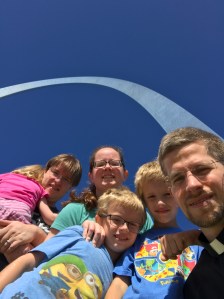
We touched the St. Louis Arch, a structure whose geometric simplicity belies the amazing landmark that it is. Ask yourself, how would you build such a thing sixty-three stories in the air?

In Arizona, I was pleased to providentially cross paths with Clare Shakal from Cooks Valley. I was surprised to learn she happens to work at the parish where a friend from seminary I was visiting is now pastor.

In  Southern California I saw the last line of light from a red Sun be swallowed by the ocean. Pedestrians paused on the pier to watch the Earth eclipse of the Sun (what we call a sunset) but there was nothing like the numbers who gathered for the much rarer eclipse the week before.

One morning, I body-surfed in the Pacific Ocean, and went to bed in Wisconsin that night. While flying home (over a distance it would have taken me months to travel on foot) I gazed down upon the Grand Canyon for the first time. Our pilot never mentioned it.

My trip had many highlights but the part I enjoyed the most and what seasoned all the rest was the good friends I was blessed to share my adventure with.

What makes something wondrous? Things we encounter often feel less precious and usually go unnoticed. If solar eclipses happened daily at noon they would be no less beautiful but they never make the news. Our world is filled with wonders but even when we live in appreciative gratitude we still long for more. This is a sign to us that we were made to live forever; in a loving communion of persons with an infinitely interesting and beautiful God.

Transfiguring Our Perception of Others

August 6, 2017

Today, Jesus hikes with his three closest apostles, Peter, James, and John, to the top of Mount Tabor in Israel. And there, Jesus is transfigured before them. His face shines and his clothes become intensely white. Then they hear God the Father speaking from a bright cloud that envelops them, declaring: “This is my beloved Son.”

In the Incarnation, some two thousand and seventeen years ago, the Eternal Word became Flesh, the Second Person of the Holy Trinity became Man, and the divinity of the Son of God became veiled within a human nature. It has long been my sense that Jesus is not changed or transformed at the Transfiguration so much as his apostles are allowed to glimpse him more deeply as he really, truly is: God from God, Light from Light. This light shines from his face as radiantly as the sun and from his body such that the fabric of his clothing is brightly illuminated like a thin lampshade.

When the disciples become frightened after hearing the Father’s voice and fall prostrate on the ground, burying their faces, Jesus comes over and touches them: “Rise, and do not be afraid.” And when the disciples raise their eyes, they see Jesus once more the same way as they had always seen him, and yet they see him differently now.

If we saw Jesus tomorrow while buying bread and milk at the store, or if Jesus visited our place of work, or came to our front door, do you think we would recognize him? I tend to doubt it. Many of the Jews in Jesus’ day noticed nothing extra special about him. “Is he not the carpenter’s son?” The Prophet Isaiah foretold of the Messiah that ‘there would be in him no stately bearing to make us look at him, nor appearance that would attract us to him.’ Even Jesus’ close friends sometimes had a hard time recognizing him after his Resurrection. The most famous example of this was on the Road to Emmaus. But by the gift of God’s grace, with the Breaking of the Bread, the eyes of Jesus’ disciples were opened and they recognized him in their midst. The reason I doubt that many would recognize Jesus amid their everyday lives tomorrow is because so few of us recognize him among us today.

In the very early Church, a man named Saul had a murderous hatred for the first Christians. One day, was traveling to Damascus, Syria to arrest any Christians he might find there and bring them back to Jerusalem in chains. As he was nearing Damascus, a light from the sky suddenly flashed around him. He fell to the ground and heard a voice saying to him, “Saul, Saul, why are you persecuting me?” Saul asked, “Who are you, sir?” And the voice replied, “I am Jesus, whom you are persecuting.” This man went on to be converted to a Christian. We know him today as St. Paul.

Note how Jesus does not say, “Saul, Saul, why are you persecuting my Church,” nor “Why are you persecuting my people.” He says, “Why are you persecuting me?” Jesus identifies himself with his people and his Church because he is personally present within them. At the Last Supper, Jesus tells his disciples, “In a little while the world will no longer see me, but you will see me… You will realize that I am in my Father and you are in me and I in you.” Jesus speaks of his mystical presence within us our and neighbors at other times in the Gospels as well.

At the Last Judgment, Jesus tells us he will say to his saved sheep: ‘Whatever you did for one of the hungry, or thirsty, or naked, or sick, or imprisoned little brothers or sisters of mine, you did it for me.’ And then Jesus will turn and declare to the condemned goats: “Amen, I say to you, what you did not do for one of these least ones, you did not do for me.” These goats, Jesus tells us, will go off to eternal punishment, but the righteous sheep to eternal life.

And so you see, recognizing, loving, and serving Jesus in other people must be a top and serious priority for us. Yet how many people do we interact with each day with so much thoughtless indifference? We speed past other people like so many unnoticed trees and cars as we drive along our way of life. Sometimes we even take the people living in our own home for granted, treating our family members worse than our mere acquaintances. Many failed to recognize Jesus’ importance in his day; while we overlook the importance of people in our midst today. As C.S. Lewis wrote:

“It is a serious thing to live in a society of possible gods and goddesses, to remember that the dullest and most uninteresting person you can talk to may one day be a creature which, if you saw it now, you would be strongly tempted to worship, or else a horror and a corruption such as you now meet, if at all, only in a nightmare.

All day long we are, in some degree, helping each other to one or other of these destinations. It is in the light of these overwhelming possibilities, it is with the awe and the circumspection proper to them, that we should conduct all our dealings with one another, all friendships, all loves, all play, all politics.

There are no ordinary people. You have never talked to a mere mortal. Nations, cultures, arts, civilization — these are mortal, and their life is to ours as the life of a gnat. But it is immortals whom we joke with, work with, marry, snub, and exploit — immortal horrors or everlasting splendors.”

So how can we begin to behold and relate to other people in the manner we ought, as Christ would have us do? Jesus himself was open and loving towards everyone. I would suggest two steps: First, ask for the gift of God’s grace at this Breaking of the Bread on the Feast of the Transfiguration, that your eyes may be opened to truly see others. And second, begin a habit of praying for, say, five or ten people every day whom you’ve never thought to pray for before. For example, the cashier who gave you change yesterday, that politician whom you dislike, the suffering people of North Korea, your child’s best friend, your quiet co-worker, and the person whom you heard just died. And then, the next day, chose another new collection of people to pray for. This practice will reveal to you your inter-personal, spiritual blinders, and help you to begin tearing them down. Let us ask Jesus to transfigure our perception of others so that we may see them more in the way that he beholds them, with love.

Questions & Answers About My Cat, Leo XIV

July 17, 2017


Why did you name your cat “Leo the Fourteenth?”

So he wouldn’t be confused with Pope Leo XIII—who had the fourth longest papal reign (from 1878 to 1903) and died at the age of 93 as history’s oldest pope. The name “Leo” is Latin for “Lion.”

Why did you want a black cat?

Cats are great, and have you ever noticed cat hair on my clothing? … Exactly.

How does Leo like living in the rectory?

Leo enjoys greeting visitors to the parish offices (he is very friendly) and exploring our house. The dust and cobwebs I sometimes find on him indicate he likes the basement. I predict that Leo will leave a “gift” for me on my bed or office floor someday.

Do you think Leo XIV will go to Heaven?

Even though Leo is a very good cat, I am not certain. St. Thomas Aquinas argued that animals, lacking a rational soul such as humans have, cannot experience the Beatific Vision of God. On the other hand, the Book of Revelation foretells of a New Heavens and a New Earth while the Prophet Isaiah speaks of wolves, lambs, leopards, goats, calves, lions, cows, bears, cobras, and children peacefully living together one day on God’s holy mountain. (Isaiah 11) As I consoled myself when my previous, dear cat, Dexter died; if there is anything eternal about Leo, I trust that Jesus will take care of him. If we reach Heaven and find our deceased pets are not there, upon understanding their loving purpose in the divine plan, we shall thank God for the gift they were and be at peace.

Catholic Teachings About The End Times

November 10, 2016

Catechism of the Catholic Church #668-679

I.  HE WILL COME AGAIN IN GLORY
Christ already reigns through the Church…

The Resurrection by Piero della Francesca, 1450-1463.        “Christ died and lived again, that he might be Lord both of the dead and of the living.”
Christ’s Ascension into heaven signifies his participation, in his humanity, in God’s power and authority. Jesus Christ is Lord: he possesses all power in heaven and on earth. He is “far above all rule and authority and power and dominion,” for the Father “has put all things under his feet.” Christ is Lord of the cosmos and of history. In him human history and indeed all creation are “set forth” and transcendently fulfilled.

        As Lord, Christ is also head of the Church, which is his Body. Taken up to heaven and glorified after he had thus fully accomplished his mission, Christ dwells on earth in his Church. The redemption is the source of the authority that Christ, by virtue of the Holy Spirit, exercises over the Church. “The kingdom of Christ [is] already present in mystery,” “on earth, the seed and the beginning of the kingdom.”

        Since the Ascension God’s plan has entered into its fulfillment. We are already at “the last hour.” “Already the final age of the world is with us, and the renewal of the world is irrevocably under way; it is even now anticipated in a certain real way, for the Church on earth is endowed already with a sanctity that is real but imperfect.” Christ’s kingdom already manifests its presence through the miraculous signs that attend its proclamation by the Church.

…until all things are subjected to him.

      Though already present in his Church, Christ’s reign is nevertheless yet to be fulfilled “with power and great glory” by the king’s return to earth. This reign is still under attack by the evil powers, even though they have been defeated definitively by Christ’s Passover. Until everything is subject to him, “until there be realized new heavens and a new earth in which justice dwells, the pilgrim Church, in her sacraments and institutions, which belong to this present age, carries the mark of this world which will pass, and she herself takes her place among the creatures which groan and travail yet and await the revelation of the sons of God.” That is why Christians pray, above all in the Eucharist, to hasten Christ’s return by saying to him: Marana tha! “Our Lord, come!”

        Before his Ascension Christ affirmed that the hour had not yet come for the glorious establishment of the messianic kingdom awaited by Israel which, according to the prophets, was to bring all men the definitive order of justice, love, & peace. According to the Lord, the present time is the time of the Spirit and of witness, but also a time still marked by “distress” and the trial of evil which does not spare the Church and ushers in the struggles of the last days. It is a time of waiting and watching.

The glorious advent of Christ, Israel’s hope

        Since the Ascension Christ’s coming in glory has been imminent, even though “it is not for you to know times or seasons which the Father has fixed by his own authority.” This eschatological coming could be accomplished at any moment, even if both it and the final trial that will precede it are “delayed.”

        The glorious Messiah’s coming is suspended at every moment of history until his recognition by “all Israel,” for “a hardening has come upon part of Israel” in their “unbelief” toward Jesus. St. Peter says to the Jews of Jerusalem after Pentecost: “Repent therefore, and turn again, that your sins may be blotted out, that times of refreshing may come from the presence of the Lord, and that he may send the Christ appointed for you, Jesus, whom heaven must receive until the time for establishing all that God spoke by the mouth of his holy prophets from of old.” St. Paul echoes him: “For if their rejection means the reconciliation of the world, what will their acceptance mean but life from the dead?” The “full inclusion” of the Jews in the Messiah’s salvation, in the wake of “the full number of the Gentiles,” will enable the People of God to achieve “the measure of the stature of the fullness of Christ,” in which “God may be all in all.” 

The Church’s ultimate trial

The Devil Tempting a Young Woman by André Jacques Victor Orsel, 1832.

        Before Christ’s second coming the Church must pass through a final trial that will shake the faith of many believers. The persecution that accompanies her pilgrimage on earth will unveil the “mystery of iniquity” in the form of a religious deception offering men an apparent solution to their problems at the price of apostasy from the truth. The supreme religious deception is that of the Antichrist, a pseudo-messianism by which man glorifies himself in place of God and of his Messiah come in the flesh.

      The Antichrist’s deception already begins to take shape in the world every time the claim is made to realize within history that messianic hope which can only be realized beyond history through the eschatological judgment. The Church has rejected even modified forms of this falsification of the kingdom to come under the name of millenarianism, especially the “intrinsically perverse” political form of a secular messianism.

        The Church will enter the glory of the kingdom only through this final Passover, when she will follow her Lord in his death and Resurrection. The kingdom will be fulfilled, then, not by a historic triumph of the Church through a progressive ascendancy, but only by God’s victory over the final unleashing of evil, which will cause his Bride to come down from heaven. God’s triumph over the revolt of evil will take the form of the Last Judgment after the final cosmic upheaval of this passing world.

II. TO JUDGE THE LIVING AND THE DEAD

The Resurrection by El Greco, Madrid, 1596-1600.      Following in the steps of the prophets and John the Baptist, Jesus announced the judgment of the Last Day in his preaching. Then will the conduct of each one and the secrets of hearts be brought to light. Then will the culpable unbelief that counted the offer of God’s grace as nothing be condemned. Our attitude about our neighbor will disclose acceptance or refusal of grace and divine love. On the last day Jesus will say: “Truly I say to you, as you did it to one of the least of these my brethren, you did it to me.”

        Christ is Lord of eternal life. Full right to pass definitive judgment on the works and hearts of men belongs to him as redeemer of the world. He “acquired” this right by his cross. The Father has given “all judgment to the Son.” Yet the Son did not come to judge, but to save and to give the life he has in himself. By rejecting grace in this life, one already judges oneself, receives according to one’s works, and can even condemn oneself for all eternity by rejecting the Spirit of love.