Archive for the ‘Last Things’ Category

Parables About Jesus — Monday, 17th Sunday in Ordinary Time—Year A

July 26, 2011

Jesus speaks of Kingdom of God (or the Kingdom of Heaven) more times in the Gospel than perhaps anything else. But what is this kingdom? The Kingdom dwells among us when God’s will is done on earth as it is in Heaven. The Kingdom reigns wherever the will of God is known and followed. His Kingdom is not equally present at all times and everywhere, which is why we pray for the kingdom to fully come, yet it can be present within a good community, in a loving family, or within a Christian’s soul.

Jesus leads us into the Kingdom of God. He teaches us how to live as kingdom people. There’s an interesting twist contained in Jesus’ teachings: whenever He speaks about the kingdom of God, He is usually teaching us something true about Himself. This is so, because Jesus is the kingdom incarnate. Wherever Jesus is, you find the Kingdom, and wherever the Kingdom is, Jesus is there.

Because of this close identification between Jesus and the Kingdom, we can substitute between these terms and reread Scripture with new eyes. For example, “In those days John the Baptist appeared, preaching in the desert of Judea saying, ‘Repent, for (Jesus Christ) is at hand!’” The beatitude becomes: “Blessed are the poor in spirit, for theirs is (Jesus Christ).” One time, when Jesus sees how his disciples are shooing the little children away, He becomes indignant and says to them, “Let the children come to me; do not prevent them, for (I) belong to such as these.” And we hear it said, “Seek ye first (Jesus Christ) and his righteousness, and all these things will be given you besides.” When applied to today’s Gospel, Jesus three parables become revelatory of Jesus Himself.

Jesus is like a treasure buried in a field. This means that Jesus must be found. In the movie Forrest Gump, a down-in-the-dumps Lt. Dan Taylor asks Forrest derisively, “Have you found Jesus, Gump?” Forrest replies, “I didn’t know I was supposed to be looking for Him, Sir.” If I ask you if you’ve found Jesus you might feel like a bit Forrest; you’re baptized, you’re here at church, how could you still need to find him?

Well, think of it this way: do you have a joy and excitement in your relationship with Christ anything like a man who finds a hidden treasure? Does you life feel rich and full of opportunity because you know Him? If not, then you have not yet found Him like He wants you too. We need to seek after Him in prayer and learning. Encounter Him in the Gospels, especially if you never have before. (Do you want to reach the end of your days without ever having read the Gospels?) Jesus is a rich treasure whom we must seek out and discover.

The second parable: Jesus is like a merchant searching for fine pearls. (Notice that Jesus was first the treasure, now He’s the searcher.) This means that Jesus searches after us. We should not despair. He pursues more passionately than a man searching a profit. Jesus seeks us as a man in love. A pearl may get dirty and think it is no longer desirable, but Jesus has the solution for cleansing pearls. He emptied Himself of glory to become man for us, and then he gave everything He had to die as a man for us. Do not forget that if we were the only sinner on earth He would have still come for you. Never despair. Jesus will always pursue you like a man in love.

In the third and final parable, Jesus is like a net thrown into the sea, which collects fish of every kind. This means that Jesus confronts us all. As Simenon foretold of The baby Jesus when Mary and Joseph brought Hi to the temple, “Behold, this child is destined for the fall and rise of many in Israel, and to be a sign that will be contradicted so that the thoughts of many hearts may be revealed.” The truth of Jesus Christ confronts all people, even if they’ve never heard the name of Jesus. But we have heard His name, and we must not put off responding to Him forever.

Jesus is the treasure we must seek. We must not despair, for Jesus relentlessly seeks after us. Jesus is the net who confronts us all, so we must not put Him off forever.

The Age of the Donkey — 14th Sunday in Ordinary Time—Year A

July 4, 2011


Jesus tells us in today’s gospel, “All things have been handed over to me by my Father.” But if that is so, why do so many things in the world seem so out of hand? We see that many things are sinful, broken, and not as they should be. Zechariah foretold that the true king would proclaim establish peace among the nations. Yet, this Fourth of July weekend sees our country fighting in at least two wars abroad. If we take our faith seriously, and think seriously about our faith, we’re led to ask, “Where is the reign of Jesus and where is His promised peace?”

In our first reading, we heard Zechariah prophesy that the true king, the Messiah, the Christ, would come to Jerusalem riding on a donkey. You will recall, of course, how Jesus fulfilled this passage when he rode into Jerusalem on Palm Sunday to the people’s shouts of joy. So what is the significance of His riding in on a donkey? The significance of the donkey is that it points to the meekness of Jesus’ reign.

In the ancient world, when a general sieged and took a fortified city, he would most often ride through its city gates by means of horse power. That conqueror would either be saddled upon one of these magnificently fast and powerful animals, or else he would ride in a chariot pulled by them. Then, upon entering, one would expect him to ruthlessly establish the new order of things. Oftentimes, to secure the conqueror’s rule, new laws would be proclaimed and severely enforced, prominent enemies would be put to death, and all local resistance would be crushed.

Jesus, however, comes into Jerusalem in a different way; not on a warhorse or in a chariot, but on a slow and humble donkey. This signifies that His reign shall be different. Apart from the relatively tame activism of scattering livestock and tipping tables at the temple, Jesus introduces his reign without any sign of force. In fact, the only person who would be murdered in the course of Jesus’ rise to power… would be Jesus Himself.

When Jesus stood accused before the high priest and the Sanhedrin, when He was in chains before Pilate and his troops, do you not think that He could have called upon His Father to provide Him in an instant with more than twelve legions of angels? Jesus could have backed Himself up with the power of more than 60,000 angelic warriors, but then He would not have died, and His kingdom would have been very different.

Let me speak for a minutes about the angels. God’s angels, in the first instant of their created existence, had a clear knowledge into God’s goodness and preeminence. In that moment, some of them decided that they would rather live as their own gods. As the Book of Revelation tells us, a war broke out in heaven; St. Michael the Archangel and his angels battled against Satan. Satan and its angels fought back, but they did not prevail and there was no longer any place for them in heaven. Satan was thrown down to earth, and his angels were thrown down with him, where they have tempted us to share in their rebellion ever since. Sometimes people ask if Satan and the demons could be someday be saved. However, angels and demons are creatures that do not change their minds. Unlike human beings, they do not change over time. We human beings are a different sort of creatures. We learn through experience and (hopefully) grow in maturity. If one of us chooses to rebel through grave sin, hope remains for us, as long as we live, that we will repent and turn again to God, to love Him and others as we ought. Even after Caiaphas and Pilate condemned Jesus and handed Him over to for execution, hope remained for their conversion and salvation.

What if Jesus had called in His angelic reinforcements, unveiling before them the Heavenly armies in their terrifying fierceness? What if Christ had tolerated no resistance to the advent of His reign, to the coming of His Kingdom, in 33 AD?        In that case, all of humanity would be confronted with a sudden and inescapable choice, a choice either for Christ or against Him; a moment of choosing like that experienced by the angels and demons.

Some human beings, when confronted with Christ in this way, would sinfully refuse to follow Him, and that refusal would be a rebellion. And here we come to the heart of the problem: How can Christ allow these rebels to remain on the earth, in hopes that they may repent, unless He is willing to show some tolerance and patience toward their sinful resistance for a time? Jesus could wipe away all sin from the face of the earth in an instant, but He would have to wipe out all of the earth’s unrepentant sinners in the process. A sudden judgment would bring a quick and clean end to sin, but less of mankind would be saved. The approach Jesus has taken with us is more merciful, but is also messier. God hopes that all shall turn to Him freely, and not by force, because love cannot be forced. Jesus Christ hopes and works for the conversion and salvation of all. As St. Peter writes, “The Lord’s patience is directed towards salvation.” And though it can be difficult for us to see God’s providential purposes and plans in our lives, “we know that,” as St. Paul says, “all things work for good for those who love God.”

Where is the peace that was promised to the world? Its total reign, the fullness of the kingdom of God, is yet to come. For now, the spirit of the world and the Spirit of life do battle. But we can experience peace in our souls, peace in our families, and peace in our communities, if we live by the Spirit of Christ.

In this age, Jesus comes to us on a donkey, but in the age to come He shall ride a warhorse. As the Book of Revelation says:

“I saw the heavens opened, and there was a white horse; its rider was called ‘Faithful and True.’ He judges and wages war in righteousness.… He wore a cloak that had been dipped in blood, and his name was called the Word of God. The armies of heaven followed him, mounted on white horses and wearing clean white linen. Out of his mouth came a sharp sword to strike the nations. He will rule them with an iron rod, and he himself will tread out in the wine press the wine of the fury and wrath of God the almighty. He has a name written on his cloak and on his thigh, ‘King of kings and Lord of lords.’”

In this age, Jesus rides the donkey, for this is the time of patient mercy. But on the Last Day, Jesus shall ride the white warhorse, for that is the time of decisive and definitive judgment. Let sinners take note; we shall not be permitted to keep sinning forever. And let those who mourn the brokenness, the sin, the suffering and death in the world take courage, for these things shall pass away. ‘See, your king shall come to you; a just savior is he. He shall proclaim peace to the nations. And His rule shall be to the ends of the earth.’

The Death of Bin Laden — May 3 — Sts. Philip and James

May 3, 2011

Osama Bin Laden has caused the deaths of countless people worldwide, he has spread hatred and division among peoples, and he has exploited religion for these purposes. He has done evil things, and now he is dead. How should we take this news? On Sunday night, some people celebrated in the streets of New York City and Washington, DC. Many people said with unrestrained delight that not a man, but a vermin, or a thing of pure evil, had been exterminated. But what is God’s opinion? What are His feelings on these events? God speaks to us in his words from Ezekiel 33:11: “Answer them: As I live, says the Lord God, I swear I take no pleasure in the death of the wicked man, but rather in the wicked man’s conversion, that he may live.” If God does not rejoice in the death of the wicked, then neither should we.

Our U.S. Special Forces’ successful mission in Abbottabad, Pakistan rightly pleases us in many ways, like in how this achievement may prevent future terrorist attacks or the fact that al-Qaeda is now deprived of their most charismatic leader, but a Christian should not rejoice in the death of a sinner. It should be noted here, that Jesus the Prince of Peace loves peace, but He is not a pacifist. (A pacifist is someone who condemns the use of force in all situations.) Recall that Jesus did not drive out the money-changers and animal-sellers from the temple solely by endlessly asking them nicely. “He made a whip out of cords and drove them all out of the temple area…” Force, even deadly force, is sometimes just and necessary, as I believe it was in Abbattabad this Sunday. And yet, even in wartime, we must not hate those who hate us, nor rejoice in the death of wrongdoers, not even when it’s Osama Bin Laden. The death of a sinner is a tragedy to the heart of Jesus, whose Divine Mercy and Love we celebrated on that same Sunday.

Perhaps someone might hear this and ask, “What difference does it make whether or not I hate Bin Laden or other people I’ve never met? Or what difference does it make whether or not I hate some of the people I actually know?” This is why it matters. You heard Jesus say to Thomas, “I am the way and the truth and the life. No one comes to the Father except through me.” No one comes to the Father, except through Him. Jesus is the way. He is our way to Heaven not just by our saying that He’s our Lord and Savior. Jesus is the way because He is the way we must become. No one comes to the Father in Heaven except they who conform themselves to the person of Jesus Christ. Therefore, if you die hating anyone in your heart, when you come to the gates of Heaven, whether the persons you hate are inside or not, you will not enter in; either you will be prevented from entering until your heart is cleaned to be like Christ’s, or you will never enter in, because you will have decided that you do not want Heaven’s ways, Heaven’s truths, or Heaven’s life.

You’re unlikely to hear the message of this homily said anywhere on TV. Imagine how the world would react if someone went on FOX News or CNN and suggested we shouldn’t hate Bin Laden. If you’ve heard anything like this homily since Sunday’s events, it was probably here at Columbus, through one of your teachers. What makes them different from the world is that they have been formed by the Gospel and a Catholic Christian worldview. Our Catholic Faith is the only thing that frees from the slavery of merely being a child of one’s time. It allows us to see the world more through Jesus’ eyes and to conform our hearts to His. This is important, because if you and I want to enter into Heaven someday, we must be converted into Him.

The Greatest Vacation — Funeral for Angela Ernst, 88

April 2, 2011

In the summer of 1923, when Angie was just eight months old, the Ernst family embarked for a new life in America. Little Angie traveled simply, but probably quite comfortably, in a basket, a memento that she kept among her possessions for the rest of her life. I think we can easily romanticize what it was like to immigrate to this country back then. We do not think about how intimidating, how daunting, how unnerving it was for people to leave behind what was well-known to come and live in a whole new world. I’m told that Mr. and Mrs. Ernst were not initially thrilled about life on these shores, but eventually they warmed-up to it, embraced this land and its people, and it became home for them.

I’m told that Angie was full of life and fun and love towards her family and friends for all these past eighty-eight years that she lived here in Marshfield. Yet, a wanderlust, a desire for travel, to see new places and meet new people, was always a part of her, whether it was with her brother Joseph, or later with her sister Rose. Angie traveled east to Europe multiple times and visited family in the old country. She traveled out west and backpacked in the mountains. She traveled further west still and enjoyed the beaches of Hawaii. She traveled north to Canada and south to Mexico, and wherever she went she sought out the Lord in His houses, His beautiful churches. Angie lived her life close to Jesus Christ and His Church with a great love for others that is reflected in your love for her. Therefore, I am confident that Angie is now enjoying the greatest adventure of all her travels. Every interesting, beautiful, and friendly place we can travel to on earth reflects something of Heaven, yet none of them compare. The journey to Heaven is the greatest of all vacations.

We all have a natural aversion to death, and that’s a healthy thing. But sometimes this aversion can be too great of an anxiety.  Even with our Christian faith, the idea of dying and leaving behind what is well-known to go and live in a whole new world can feel intimidating, daunting, and unnerving. Yet there is no cause for us to fear or grieve like people who see no hope. Instead let us remember this, if you and I live in Christ, dying shall be the greatest adventure of our lives. Do no be afraid to be comforted by the truth. It’s a wonderful thing to visit the shrine of Our Lady of Guadalupe in Mexico, as Angie did several times. But how much better must it be to travel to an encounter with Our Lady of Guadalupe herself. It’s fun to visit Jesus in His many earthly houses as Angie liked to do. But how much better must it be to visit Jesus in the Father’s house. I trust that Angie is now fine, “just fine,” as she would say, but just in case her journeying to Heaven continues let us help her with our prayers, especially at this Mass for her.

3 Myths / 3 Mitos — 9th Sunday in Ordinary Time—Year A

March 6, 2011

Many today assume three modern myths: One, that we get into Heaven based on whether our good works out-weigh our sins. Two, that as long as we claim Jesus Christ as our personal Lord and Savior we are assured Heaven. And three, that one Christian church is just as good as another. Let us consider these common myths one by one, and come to understand the truth about Christianity.

If you ask people whether they think they’ll go to Heaven, many say something like this, “I’m a pretty good person. I mean I’ve never robbed any banks or killed anybody. I’ve done good things, so yeah, I think I’ll go to Heaven.” In their minds, such people seem to envision the Last Judgment as a giant scale, with their good deeds on one side and their sins on the other.

The truth is, we cannot earn our own salvation. God is all good and deserving of all our love. When we do good we are just giving Him what He deserves. But when we sin, we disfigure ourselves and our relationship with God in ways that only He can repair. “…All have sinned and are deprived of the glory of God.” But thanks be to God, we “are justified freely by his grace through the redemption in Christ Jesus…. What occasion is there then for boasting?” asks St. Paul. “It is ruled out.” We do not save ourselves. We are saved only through Jesus Christ.

Many Christians like to ask, “Have you accepted Jesus Christ as your personal lord and savior?” Do not hesitate to answer “Yes,” for every time you receive Him worthily in the Eucharist you are accepting Him as your Savior and Lord. Evangelical Christians also like to ask, “Are you saved?” They say this because they think whoever professes faith in Christ is assured of their salvation. However, according to Jesus, “Not everyone who says to me, ‘Lord, Lord,’ will enter the kingdom of heaven, but only the one who does the will of my Father in heaven.”

Think of it this way: the demons recognize that Christ is Christ, but that does not save them. They are not saved because they do not love Him, and love is about more than just words. As Jesus told His Apostles, “If you love me, you will keep my commandments. … This is my commandment: love one another as I love you.” (Jn 14:15, 15:12)

Consider the New Testament words of St. James, “What good is it, my brothers, if someone says he has faith but does not have works? Can that faith save him? If a brother or sister has nothing to wear and has no food for the day, and one of you says to them, ‘Go in peace, keep warm, and eat well,’ but you do not give them the necessities of the body, what good is it? So also faith of itself, if it does not have works, is dead.” (James 2:14) As St. Paul observes, “If I have all faith so as to move mountains but do not have love, I am nothing.” Our salvation in Christ requires faith and love in action.

We know that more than a few Catholics have wandered away from the Church. Some have been drawn away, after being told the Catholic Church does not know the Bible. Others have simply left, thinking that one Christian church is just as good as another. Do not be misled by myths.

In truth, Jesus Christ has built only one house, one Church. And, being a wise man, he built the house on a rock, St. Peter, our first Pope. However, men have built other houses. These Christian denominations have many good characteristics from the one Church of Christ: like Scripture, prayer, the Apostles’ Creed, baptism, marriage, and Christian morals. However, in time, the rains fall, the floods come, and the winds blow and buffet their houses and they collapse ruined. Those houses separate from the truth and separate from within into new houses. Therefore, never abandon the beliefs and the sacraments of the Catholic Church. There is one true house of Jesus Christ. Do not be misled by myths.

Muchos hoy aceptan tres mitos modernos: Uno, que entramos en el cielo si nuestras buenas obras son más que de nuestros pecados. Dos, si nos declararía Jesucristo como nuestro Señor personal y Salvador estamos seguros de entrar en el cielo. Y tres, que una iglesia Cristiana es tan buena como la otra. Consideremos estos mitos populares uno por uno y comprender la verdad acerca del cristianismo.

Si se pregunta a las personas si piensan que van a ir al cielo, muchos dicen algo como esto, “Soy una persona buena bastante. Yo nunca he robado al banco ni matado a nadie. He hecho cosas buenas, entonces sí, creo que voy a ir al cielo.” Estas personas imaginan el juicio final para ser una escala gigante, con sus buenas acciones en un lado y sus pecados en el otro.

La verdad es que no podemos ganar nuestra propia salvación personal. Dios es el sumo bien y digno de ser amado sobre todas las cosas. Cuando hacemos bueno sólo damos lo que se merece Dios. Pero cuando pecamos, nos hacemos daño a nosotros mismos sino a nuestra relación con Dios in maneras que solo Dios puede reparar. “Como todos pecaron, todos están privados de la presencia salvadora de Dios; pero todos son justificados gratuitamente por su gracia, en virtud de la redención llevada a cabo por medio de Cristo Jesús… por medio de la fe.” “¿Dónde, pues, quede el orgullo del hombre ante Dios,” pregunta de San Paulo. “Queda eliminado!” Nosotros no ganamos nuestra salvación por nosotros mismos. Somos salvados sólo a través de Jesucristo.

A veces otros cristianos nos preguntan, “Has aceptado a Jesucristo como tu Señor personal y Salvador?” No duden en responder “Sí”, porque cada vez que le reciban dignamente en la Eucaristía  lo aceptan como su Salvador y Señor.  Nuestros amigos cristianos evangélicos también quieren preguntar, “¿Eres salvado?” Dicen porque piensan que la person que profesa la fe en Cristo se asegura su salvación. Sin embargo, según Jesús, “No todo el que me diga ‘Señor, Señor!’, entrará en el Reino de los cielos, sino el que cumpla la voluntad de mi Padre, que está en los cielos.”

Consideren esto: los demonios reconocen que Cristo es Cristo, pero no los salva. No se salva porque ellos no lo aman, y amor es más que decir palabras. Como Jesús les dijo a sus apóstoles, “Si ustedes me aman, obedecerán mis mandamientos. … Mi mandamiento es este: Que se amen unos a otros como yo los he amado a ustedes.”

Consideren las palabras del Nuevo Testamento de San Santiago, “Hermanos míos, ¿de qué le sirve a uno decir que tiene fe, si sus hechos no lo demuestran? ¿Podrá acaso salvarlo esa fe? Supongamos que a un hermano o a una hermana les falta la ropa y la comida necesarias para el día; si uno de ustedes les dice: ‘Que les vaya bien; abríguense y coman todo lo que quieran’, pero no les da lo que su cuerpo necesita, ¿de qué les sirve? Así pasa con la fe: por sí sola, es decir, si no se demuestra con hechos, es una cosa muerta.” Como San Pablo observa, “Si tengo la fe necesaria para mover montañas, pero no tengo amor, no soy nada.” Nuestra salvación en Cristo requiere fe y amor en acción.

Sabemos que más que unos católicos pocos han vagado de la Iglesia Católica. Algunos son atraídos, oyen falsamente que la Iglesia Católica no conoce la Biblia. Otros simplemente dejaron, piensan falsamente que una iglesia cristiana es tan buena como la otra. No se engañen por mitos.

En verdad, Jesucristo ha construido sólo una casa, una iglesia. Y, siendo un hombre sabio, construyó la casa sobre una roca, San Pedro, nuestro primer Papa. Pero, hombres han construido otras casas. Estas denominaciones cristianas tienen muchas características buenas de la única casa de Cristo: como escritura, oración, el credo de los apóstoles, bautismo, matrimonio, las morales cristianas. Pero, en tiempo, viene la lluvia, bajan las crecientes, se desatan los vientos, contra esas casas y las arras an.  Esas casas sparan de las verdad y sparan desde los interiors en las casas nuevas. Por lo tanto, nunca abandonen las creencias y los sacramentos de la Iglesia Católica. Es la única casa de Jesucristo. No se engañen por mitos.

Set To Heaven — 6th Sunday in Ordinary Time—Year A

February 13, 2011

This morning, consider this important question: Are you a thermometer or a thermostat? In this life, we can live like either thermometers or thermostats. A thermometer (as you know) accepts whatever temperature, hot or cold, that happens to surround it. A thermometer acts passively to the world’s influence. A thermostat, on the other hand, does not submit to the world around it. A thermostat is set to an ideal temperature and strives to attaint its goal.  As Christians, we should be as thermostats, and we should all be set on Heaven.

Do you think about Heaven much? Do you ever meditate on what it will be like? I think many of us get so drawn in by the here and now that we fail to give Heaven much thought. Yet, I think we would all be strengthened by meditating on it more; on what it promises and what it requires.

The next life is a mystery about which we can know a great deal. As Saint Paul says, “What God has prepared for those who love him, this God has revealed to us through the Spirit.” For example, we know that there will be no suffering or death in Heaven. The Book of Revelation says God ‘will wipe every tear from our eyes, and there shall be no more death or mourning, wailing or pain, for the old order (the way of this world) will have passed away.’

There shall also be no hatred in Heaven. No one with hatred in his or her heart will be able to enter. The Book of Wisdom teaches that God hates none of the persons he has made. He does not always like all the things that they do, but it is His love for each one that continues to hold them in being, and will hold them in existence forever. In order to see God in Heaven, we must become like Him. This is why Jesus forbids not only murder, but hatred in the heart as well. Consider how wonderful it will be to live in Heaven at peace with everyone.

After the resurrection, when our dead bodies are reconstructed from the dust, those who are just will be remade, stronger, handsomer, more incredibly beautiful, than they have ever looked before. Will their perfect bodies have any flaws? If glorified bodies do have “flaws,” they shall be as the wounds that remain in Jesus’ hands and side, beautiful and glorious forever. In this life, the beauty of one’s soul has little relationship to the beauty of one’s flesh; but in Heaven, the holiness of the saints shines out for all to see. 

In Heaven, in this midst of this overwhelming beauty, no one shall lust and none shall exploit another. Lust and exploitation go hand in hand. There is a good reason for the expression “to lust for power,” for lust is about manipulating another for one’s pleasure. Instead of lust, everyone in Heaven shall desire the true good of one another from their hearts.

In this life, temptations will come whether we want them or not, but remember that temptations in themselves are not sins—it is only when we say “yes” to temptation, when we choose to sin as temptations suggest, that we can be guilty of a sin such as lust. Until we can refuse temptation’s invitations, until all lust is driven from our hearts, we are not yet ready for Heaven. This is why Jesus teaches not only against adultery, but against lust in the heart as well. How wonderful it will be to full of love for all, purely, from our hearts, and to receive that same overflowing love in return.

Our lives on earth we are full of questions. But in Heaven, every question which has answer will be answered for us. As St. Paul told the Corinthians, “At present we see indistinctly, as in a [cloudy] mirror, but then face to face. At present I know partially; then I shall know fully, as I am fully known.” Heaven is a place of transparent truth. There, the barriers to communication disappear. In Heaven, we shall know others fully, and be fully known ourselves. No lies nor concealments are possible there, “for there is nothing hidden that will not become visible, and nothing secret that will not be known and come to light.” Until we are free of lies, until we are people whose ‘Yes’ means ‘Yes,’ and whose ‘No’ mean ‘No,’ we are not yet ready to live in Heaven.

If we die in God’s grace and friendship, we may still have some attachments to sin, and be unprepared for Heaven. But, thanks be to God, there is Purgatory, to clean us up and make us perfect, so that we may enter the Father’s house and join the feast of Heaven. Though there is Purgatory, we must always aim for Heaven. If you shoot a bow and arrow and aim carefully for the bull’s-eye, you will probably miss but still hit the target. If you shoot only aiming at the target in general, you will probably miss and hit the ground. So aim for Heaven, lest any of us miss entirely.

Jesus said to his disciples, “I tell you, unless your righteousness surpasses that of the scribes and Pharisees, you will not enter the kingdom of heaven. So let us not default to world’s standards. Do not be a thermometer. Set your thermostat to the perfection of Heaven. Meditate on it and strive for it, and you will experience the joys and blessings of Heaven beginning in this life.

Evil: Unholy Holes — Tuesday, 5th Week of Ordinary Time—Year I

February 8, 2011

“God looked at everything he had made, and he found it very good.” Everything that God has made, everything that has being, contains God’s goodness. What then is this thing called evil?

Think of a hole in the ground. What is the hole made of? Nothing really. If not for the good earth surrounding it you would not even know that a hole was there. Evil is like that hole, it’s an absence, a deprivation, a negation of something good. Evil can only be present within something good, as a corruption. Even though evil is essentially nothingness, that doesn’t mean that it can’t still hurt you, like falling into a deep, gaping hole.

Let no one think that evil is necessary for there to be good. No one should think of evil as the Ying to God’s Yang. God created a universe which was entirely good. It has been the free choices of the demons and of us to rebel in sin which have brought evils upon us.

Because of the goodness that remains in them, God shall love and preserve the Devil, the demons, and the damned forever. They shall not be destroyed, but they shall no longer do harm. They shall be as the wounds in Jesus’ hands, feet and side, which are as they are due to evil, but which cause no more pain, only glory.

Fear of Death — Friday, 3rd Week of Ordinary Time—Year I

January 28, 2011

God permits us to feel a natural aversion to death. This is healthy and for our good. (Imagine what the world would be like if everyone were completely indifferent as to whether they lived or died.) However, for faithful Christians, there is no reason to be terrorized by a fear of death.

If you remain close to the sacraments and rooted in daily prayer you have no reason to be afraid. Maybe you feel ill-prepared to die, but like the seed that grows without the farmer understanding how, God is preparing you for the unending life of Heaven in ways you don’t even perceive. Like the mustard seed, we may go into the ground as seemingly small and weak human beings, but we will rise with a greatness and power that even delights and blesses the angels of Heaven.

A natural aversion to death is healthy, but for Christians a fear of death is out of place. For, as the Letter to the Hebrews says, “We are not among those who draw back and perish, but among those who have faith and will possess life.”

The Sound of Heaven — Monday, 34th Week in Ordinary Time—Year II

November 22, 2010

What do you think Heaven sounds like? In the first reading, St. John describes it for us. “I heard a sound from Heaven like the sound of rushing water or a loud peal of thunder. The sound I heard was like that of harpists playing their harps.”

The sound of Heaven that John describes is powerful and beautiful. It is like the onslaught of a tidal wave or a thunder burst, yet it has the harmony, clarity, proportion and perfection of supreme beauty. What John is hearing is the sound of worship in Heaven.

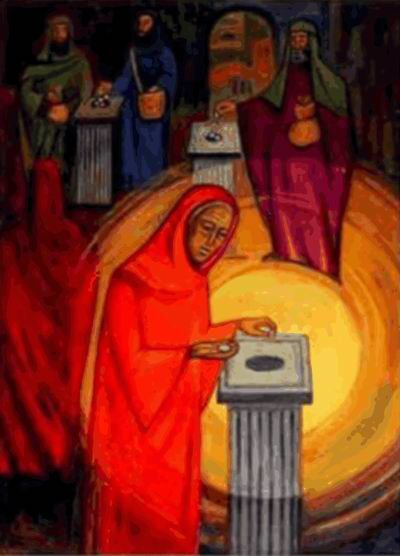
In the Gospel, we hear another sound, neither great nor gorgeous in itself: the quiet chinking of two small coins. Yet, this simple sound has echoed for two-thousand years and millions have been drawn to it. When Jesus Himself heard the sound of the faithful, poor widow’s generous gift, He was moved to speak words in praise. Despite its subtlety, it reminded Jesus of a sound He knew well; it reminded Him of the sound of Heaven.

In our own simple ways, with unending joy, let us echo on earth the song of the angels in Heaven as they praise God’s glory for ever.

Demonic Delay — 33rd Sunday in Ordinary Time—Year C

November 14, 2010

Once upon a time, an uncertain number of years ago, there was an important meeting of demons in Hell. In the midst of their fires and shadows, with a foul and terrible stink in the air, the top of Hell’s hierarchy was planning a long-term strategy for how to mislead humanity.

Why do they scheme against us? Because on the day when Jesus comes again to judge and rule the world with justice, the demons do not want us to experience His healing rays; they want us to burn with fire, like themselves. Since they cannot hurt God directly, they lash out by trying to make us share in their misery.

As they met, brainstorming for ideas, one demon suggested, “How about we try telling them that there is no such thing as evil?” The chairman said, “You stupid worm, you pathetic disgrace, the humans will never believe that! Do you think that we can pit a person against a person, a nation against a nation, or a soul against our Enemy above, without the humans noticing the sadnesses, sufferings, impurities, jealousies, envies, rivalries, resentments, hatreds, injustices, cruelties, or murders that follow? They see evidence of evil on the front page of every newspaper and in every gossip’s tale! Humans are reminded that something’s wrong with their world whenever their alarm clocks ring, whenever their toes get stubbed, or whenever someone they know dies! You’ll have to do better than that!”

A little while later, another demon suggested, “What if we told them that there is no such thing as goodness?” The chairman said, “You worthless slime, you ugly idiot, the humans will never believe that! Our Enemy above has littered their world with beauties and gifts to many to count, and everything that the humans do is in the pursuit of what they think is good! They have this irresistible desire to be happy that our Enemy has built into them! Tell me, how would we tempt them to sin without promising them something which attracts them, something which is at least seemingly good? Is there anyone here who is not a useless fool?”

But then, one of the chairman’s most cunning underlings suggested another approach, an approach which was immediately welcomed by the others with cruel smiles and restrained applause (for a demon resists praising anyone but himself.) This insightful demon said, “Let us convince the humans… that there’s no need to hurry.”

In every generation, there have been Christians who belived that their generation would be the last. But personally, I don’t expect the second coming of Jesus Christ to happen in the very near future for the simple fact that it remains legal to be a Christian throughout North and South America. There are great evils in our world, even within our own country, but the final attack of evil against Christ’s Church in the last days should be far worse than this. [For more from the Catechism of the Catholic Church on “The Church’s Ultimate Trial,” see CCC 675-677 ]

I do not expect Christ to come in the immediate future to us, but we must always be preparing ourselves to be ready to go to Him, for we never know when we will die. Never be anxious and never be afraid, but prepare yourself for what is certainly coming. Instead of being busybodies, distracted by many unimportant things, let’s get busy making the most important things the most important things.

If you knew for a fact that you were going to die six months from today how would you begin to live your life differently? Would you pray more each day? Would you go to confession and to Mass more often? Would you work harder at doing good works? Would you crush your lingering vices? Would you forgive your enemies? Would you show more love to the people in your daily life?

Seriously thinking about what you would you do different if you knew you were going to die will give you a good place to start in living more intentionally for Christ, with your eternal goal in mind. Do not believe the demon’s whispered lie that ‘there is no need to hurry,’ for your last day is closer than it was yesterday, and it may be much closer than you think.

The Saints & Us — 22nd Sunday in Ordinary Time—Year C

November 5, 2010

 
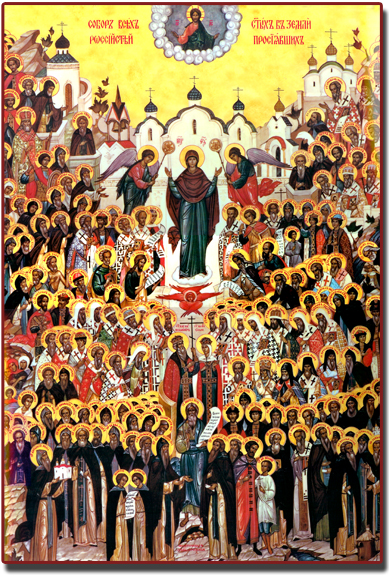
Brothers and sisters, as the Letter to the Hebrews tells us, we have approached Heaven even as we remain on earth. Though we are dust and sinners, we stand before Jesus, the eternal Father, and the Holy Spirit. We draw near to each other and they invite us to share more deeply in their friendship. And they are not alone. They are surrounded by countless angels and by a multitude of men and women whom they have made perfect in goodness and love. We have a name for these “holy ones” who live with God in Heaven. We call them “saints,” and Jesus invites us to share their friendship, too.

Have you ever had the pleasure to introduce your friends to each other; people who already know and enjoy you, but who have never met each other? I think you’ll agree that it’s a very special joy when your friends to befriend each other. When your friends befriend each other do they love you less because of it, as if their affection has been divided or diluted? No, the love between all of you is greater for being shared. So it is with Jesus, the saints, and us. Some Christians fear that befriending Jesus’ friends in Heaven will lessen our love for Him. They fear that talking to them and honoring them will distract us from Christ. But these are silly fears. Love increases by being shared.

When someone asks you, “Would you pray for me,” or asks you to pray for one of their heartfelt concerns, what do you say in reply? Do you refuse, saying, “Why should you ask me to pray for you when you can go directly to God?” Nobody says that. Instead, Christians say, “Of course I’ll pray for you.” Christians ask each other to intercede for them not because they have lost hope in Christ, but because they have it, and because Scriptures tell us, “pray for one another.” Asking our friends and family in Heaven to pray for us is no different than asking our friends and family on earth, except that the prayers of the saints are offered by souls perfected in love and divine intimacy.

What about the objection that honoring the saints distracts from Christ? Today’s Gospel shows that Jesus does not think that sharing honor with His saints detracts from His own preeminent glory. He has said to them, “My friend, move up to a higher position. Then you will enjoy the esteem of your companions at the table.” By giving seats of honor to His saints at His heavenly wedding banquet Jesus invites us to esteem them. In honoring them, we honor Him.

Remember that our circle of closest family and friends is not limited to earth. We have brothers and sisters in Heaven; saints and angels who know us, love us, and want to help us arrive at our true home. Let us remember to take the opportunity to make their acquaintance and grow in their friendship.

The Glorious Mysteries, Meditations with the Saints

October 27, 2010

The 1st Glorious Mystery:
The Resurrection of Jesus from the Dead

St. John Bosco, an Italian priest, founded a famous school for boys in the mid-1800’s and is the patron saint of students. He is known to have worked many miracles, but one from 1849 stands out. Returning from a journey, he learned that Charles, a 15 year old student, had died. He went immediately to the teenager’s home where the family informed him that Charles had been dead for over 10 hours. The body was laid out in the living room, already dressed for burial.

Fr. Bosco asked everyone to leave except the mother and the aunt. After some time in silent prayer, he cried out: “Charles, rise!” Charles emitted a long sigh, stirred, opened his eyes, stared at his mother and asked, “Why did you dress me like this?” Then, realizing Fr. Bosco was present, he told him how he had cried out for him and how he had been waiting for him. He exclaimed, “Father, I should be in hell!” He told of how a few weeks before he had fallen into serious sin. Then he said he had a “dream” of being on the edge of a huge fiery furnace, and as he was about to be thrown into the flames, a beautiful lady appeared and prevented it. She said, “There is still hope for you, Charles. You have not yet been judged.” Then he heard the voice of Fr. Bosco calling him back.

Charles asked Fr. Bosco to hear his confession. After his confession, the mourners filled the room again, and Fr. Bosco said, “Charles, now that the gates of heaven lie wide open for you, would you rather go there or stay here with us?” A profound silence filled the room. Charles, with tears in his eyes said, “I’d rather go to heaven.” Then he leaned back on the pillows, closed his eyes and breathed his last.

Unless Jesus’ Second Coming happens first, each of us here will die, and rise. As we meditate on Jesus’ resurrection, let us consider how ready we are to meet Him.

The 2nd Glorious Mystery:
The Ascension of Jesus into Heaven.

St. Padre Pio is another Italian priest from not so long ago who also worked remarkable miracles. During WWII, Allied planes flew bombing raids over Italy. Almost all of the centers of the region were subjected to repeated bombardment, but no bombs ravaged the town of San Giovanni Rotondo. Every time the aviators approached that place, they saw a monk flying in the air who prevented them from dropping their bombs. Understandably, reports of this flying friar did not amuse the superior offices.

Bernardo Rosini, a general of the Italian Air Force, recounts this story: “One day, an American commander wanted to lead a squadron of bombers himself to destroy the German arms depository of war material that was located at San Giovanni Rotondo. The commander related that as he approached the target, he and his pilots saw rising in the sky the figure of a friar with his hands held outward. The bombs released of their own accord, falling in the woods, and the planes completely reversed course without any intervention by the pilots.”  

Someone told the commanding general that in a convent at this town, there lived a saintly man. At war’s end, the general wanted to go meet this person. “He was accompanied by several pilots… He went to the convent of the Capuchins. As soon as he crossed the threshold of the sacristy, he found himself in front of several friars, among whom he immediately recognized the one who had ‘stopped’ his planes. Padre Pio went forward to meet him, and putting his hand on his shoulder, he said, `So, you’re the one who wanted to get rid of us all!’”

As we meditate on the Ascension of Jesus, to the right hand of the Father in Heaven, let us pray that He would establish justice and peace, in this country and the whole world, in our time.

The 3rd Glorious Mystery:
The Descent of the Holy Spirit at Pentecost

We usually don’t associate India with Christianity, but that nation has over 24 million Christians.  That’s about as many people as live in Texas, our second largest state. If you were to ask them how the faith reached their land they would point to St. Thomas the Apostle.

What led St. Thomas, who at first refused to even believe in the Good News, to travel over 2,500 miles to bring them the Gospel? It was not merely seeing the risen Christ. Jesus knew His disciples would need more to strengthen them then merely their memories of Him. St. Thomas journeyed because the Lord had sent the Holy Spirit at Pentecost, to fill them with gifts, like wisdom, courage, and zeal.

If we are in the state of grace, God the Holy Spirit dwells in us too, and He wants to empower us with His gifts. As we meditate on the descent of the Holy Spirit at Pentecost, let us pray for whatever spiritual gift that we need the most.

The 4th Glorious Mystery:
The Assumption of the Virgin Mary.

No Church, in the East or the West, claims to contain the body of St. Mary. This is because “the Immaculate Mother of God, the ever Virgin Mary, having completed the course of her earthly life, was assumed body and soul into heavenly glory.” This is because Jesus would not suffer Mary, His sinless, faithful beloved, to undergo corruption.

Death is a consequence of human sin, and without human intervention, as in embalming or mummification, our dead bodies will ordinarily experience its corruption. But, sometimes, the Lord preserves the dead bodies of his saints, to give a sign of their holiness, and to show that death is not all that awaits us.

Among the numerous saints whose incorrupt bodies you can still see today are:  St. John Bosco, St. John Vianney, St. Catherine Laboure (the visionary of the Miraculous Medal), St. Bernadette Soubirous (the visionary of Lourdes), and St. Maria Goretti.

As we meditate on the Assumption of the Virgin Mary, let us pray for purity in our lives.

The 5th Glorious Mystery:
The Coronation of Mary as the Queen of Heaven and Earth

Once, when St. Maximillian Kolbe was a boy, his behavior began trying his mother’s patience. She said in exasperation, “Maximillian, what will become of you?” As St. Maximillian writes, “Later, that night, I asked the Mother of God what was to become of me. Then she came to me holding two crowns, one white, the other red. She asked me if I was willing to accept either of these crowns. The white one meant that I should persevere in purity, and the red that I should become a martyr. I said that I would accept them both.” St. Maximillian would receive both crowns, as a holy Franciscan brother, and as a victim of the Nazis at Auschwitz, were he took the place of another innocent man who was condemned to die.

Jesus crowns his holy ones. He wills that those who share in His sacrifice should also share in His glory. As we meditate on the Coronation of Mary, let us pray to accept whatever crowns of burden and glory the Lord wants to give to us.

Prepare Yourself—Wednesday, 30th Week in Ordinary Time—Year II

October 20, 2010

If you knew for a fact that you were going to die, or that Jesus was coming again,  one month from today, how would you begin living your life differently?

  • Would you pray more? 
  • Would you work harder to do good deeds?
  • Would you resolve to crush lingering vices?
  • Would you forgive enemies?
  • Would you show greater love toward people in your life?

Jesus said to his disciples:

“Be sure of this: if the master of the house had known the hour when the thief was coming, he would not have let his house be broken into. You also must be prepared, for at an hour you do not expect, the Son of Man will come.”

This is much is certain: someday we will die, or we shall live to see Jesus return ‘at an unexpected hour.’ So, let us commit ourselves by the grace of God  to living in such a way now that if someone were to ask us what we would do differently if the end of the world or the end of our lives were near, we could honestly answer, “Nothing. Nothing at all.”

The Rot Inside — Tuesday, 28th Week in Ordinary Time—Year II

October 13, 2010

St. Paul says in the first reading that “the works of the flesh are obvious.”  If so, then why does Jesus have to point out the sins of the scribes and Pharisees, whose sinfulness “are like unseen graves over which people unknowingly walk”? It’s not that Jesus is pronouncing “woe” upon people unaware that they have sins, the problem is these people think that their hidden sins are no big deal because of their outward practices and appearances.

As long as we are at ease with “immorality, impurity, licentiousness, idolatry, sorcery, hatreds, rivalry, jealousy, outbursts of fury, acts of selfishness, dissensions, factions, occasions of envy, drinking bouts, orgies, and the like,” in our lives we will not enter the Kingdom of God. Even if we do not end up in Hell because of them, we will certainly have to wait on the doorstep to Heaven in Purgatory until these sins are rooted out. Let us crush these sins in our lives like the cancers that they are.

The Divine Perfectionist — Funeral for Joseph Stockheimer, 76

October 9, 2010

I never got to know Joseph while he lived on earth, but in preparation for this homily, I talked to Helen, his wife of 51 years, and his daughter, Vicky, and asked them what sort of person Joseph is. They described a man who lived faithfully, piously, and with high standards. These qualities expressed themselves in a certain perfectionism throughout his life.

He worked his farm for 35 years. Not only did he keep to the cows’ daily milking schedule, but I’m told his field rows were perfectly straight and cleared every stone. Even the barn (the barn) was clean! After retiring from farming, Joseph turned his efforts to working the flower garden and cleaning the house, two activities that pleased Helen greatly. Their house was always clean and his nails were always dirty. Sometimes Joseph would be work in the garden until 11:30 at night.  There wasn’t any light to see, but he still kept at it. Joseph also worked in the kitchen at the Knights of Columbus hall. They called him “Scrubby” because he never quit on cleaning the pans. He would talk to you while he worked, but he wouldn’t stop scrubbing.

Joseph’s attitude was, ‘If you start a job, get it done, and get it done right.’ In this, Joseph bears a likeness to an attribute of our Lord, Jesus Christ. The Lord works as a perfectionist too. Jesus says, “Everything that the Father gives me will come to me, and I will not reject anyone who comes to me… …This is the will of the one who sent me, that I should not lose anything of what he gave me, but that I should raise it on the last day.” Jesus is not content to save just some of what the Father gives Him. He is not willing to save only some of those who come to Him. ‘For this is the will of His Father, that everyone who sees the Son and believes in him may have eternal life, and He shall raise them on the last day.’ There is hope and consolation for us in this: we are the Lord’s field, we are His house, we are His garden, we are His pans, and  Jesus does not willingly give up on His work.

It is a good thing that Christ is a perfectionist, for nothing imperfect can bear to stand in God’s fully unveiled presence. The fact is that you and I will refuse to enter Heaven until we are perfect, so Christ must make us so. Even if we are good and faithful, the pan-bottoms of our souls may still need some hard scrubbing at the end of our lives. This is what we call purgatory, the joyful but challenging time after death when our souls are scrubbed clean of every imperfection.

Now I am confident that Joseph is bound for Heaven, since Jesus does not reject those who are His own. But I think we do well to assist Him with our prayers to help Him get his last job done and to get it done right—the job of perfecting His soul for Heaven. So talk to Joseph, for he can hear you, and pray for Joseph, especially at this Mass, so that he may have eternal rest and fully enjoy the reward of his labors.