Archive for the ‘Last Things’ Category

Rich Man’s Loss — 26th Sunday in Ordinary Time—Year C

September 26, 2010

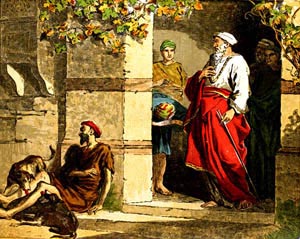
[The rich man] cried out, “Father Abraham, have pity on me. Send Lazarus to dip the tip of his finger in water and cool my tongue, for I am suffering torment in these flames.”

Why does the rich man suffer in flames? It’s not that Abraham is unaware of him, for when the rich man speaks Abraham answers him. And it’s not that Abraham no longer acknowledges him, for Abraham calls him “my child.” It’s not that Abraham lacks in mercy, for Abraham once intervened to spare a city of sinners. The rich man is not in the flames because of Abraham, or Moses, or the prophets of God, for if he had listened to them he would not be in torment.

So why does the rich man suffer in flames? He suffers because he feasted each day, while Lazarus starved. Because he dressed in fine linen, while Lazarus went naked. Because he was clothed in purple, while Lazarus was covered in purple sores. Yet the rich man is not in the flames because he is rich, for King David was far richer than he and is heralded as a man after God’s own heart. The rich man suffers because the dogs who licked Lazarus’ wounds showed the poor man more kindness than he ever did.

The rich man was not unaware of Lazarus lying at his door, for he had passed him enough times to recognize him when he saw him. The rich man even knew Lazarus by name, for he calls out, “Father Abraham… Send Lazarus…”  The rich man suffers in flames because he did not care about Lazarus. The rich man suffers because he did not love. If we wish to avoid the flames, we should ponder and act on this question: Who is Lazarus in your life?

Strive to Enter — 21st Sunday in Ordinary Time—Year C

September 2, 2010

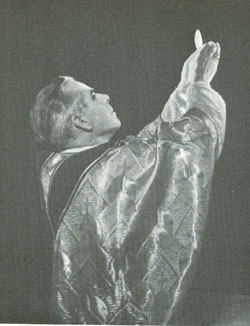
The Emmy-winning Servant of God, Bishop Fulton J. Sheen, once said that in Heaven we will have three surprises: 

  1) We’ll see people there that we didn’t expect to see…

  2) We won’t see people there that we did expect to see, and…

  3) We’ll be surprised to see ourselves there!
 
 
In today’s gospel, someone shouts out from the crowd, “Lord, will only a few people be saved?” Jesus answers Him, “Strive to enter through the narrow gate, for many, I tell you, will attempt to enter but will not be strong enough.” Instead of giving the man a figure, Jesus gives him more valuable counsel, “Strive to enter through the narrow gate, for whether or not you will be saved depends (in part) on you.” Yet we are still left wondering, “Will the number saved be many, or only a few?”

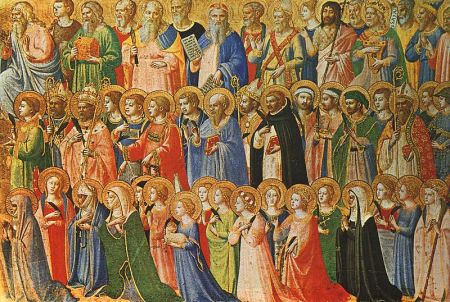
On the one hand we have John’s eyewitness testimony from the Book of Revelation. When he say the worship of the saints in heaven he saw  “a vision of a great multitude, which no one could count, from every nation, race, people, and tongue.” (Note that this ‘countless multitude’ is much larger than 144,000 which had just been counted.) It is as the Lord said through the prophet Isaiah in our first reading, “I come to gather nations of every language; they shall come and see my glory.” Based on this we can say that many will be saved.

On the other hand, in the Gospel of Matthew, in the parallel passage to today’s gospel, Jesus says, “Enter through the narrow gate; for the gate is wide and the road broad that leads to destruction, and those who enter through it are many. How narrow the gate and constricted the road that leads to life. And those who find it are few.” The ‘few’ who find the narrow gate certainly sounds like less than the ‘many’ who don’t. Based on this we can say that many will not be saved.

My purpose in raising this topic is not to frighten you, for Jesus said, over and again, “Do not be afraid.” But I believe it is with Jesus’ heart that I urge you not to be complacent. To be complacent is to be self-satisfied and unaware of possible dangers. Jesus urges us to, “Strive to enter through the narrow gate” for many will not be able.

There is no way to know, but something in me suspects that the man who called out to Jesus assumed his own salvation to be a certainty; he was merely curious if many others would be joining him.  Jesus warned him not to be presumptuous, and this gospel has come down to us today because it’s a message meant for us too.

All of us come to church, and that’s a very good thing, but coming to church every Sunday does not guarantee our salvation. In the parable that Jesus told, the master of the house arises like the judge of our world at the end of time. People knock on the locked door and say, “Lord, we ate and drank in your company and you taught in our streets.” We eat and drink in Jesus’ company too, and he teaches in our streets. We eat and drink with Him here, at the Eucharist, and whenever the Scriptures are proclaimed, Christ speaks. Being a disciple of Christ, a true friend of Christ, means more than just coming to church.

We must strive to enter the narrow gate. We must pursue and embrace holy discipline for our lives, as we heard from the Letter to the Hebrews: “…Do not disdain the discipline of the Lord or lose heart when reproved by him; for whom the Lord loves, he disciplines…. At the time, all discipline seems a cause not for joy but for pain, yet later it brings the peaceful fruit of righteousness to those who are trained by it.  So strengthen your drooping hands and your weak knees. Make straight paths for your feet, that what is lame may not be disjointed but healed.”

What in your life needs holy discipline? Do you pray every day, or is God only a bedtime afterthought? Do you pray with your spouse and your children, besides at mealtimes? Do you read and watch things that feed your soul? Do you fast and give alms? Do you treat every Friday as a day of penance and every Sunday as a day of joyful rest? What good habit do you need to begin? And what persistent sin do you need to fight, like a life-threatening cancer, for indeed it is. If you were to look back on your life someday from your deathbed, what would you most regret having left undone?

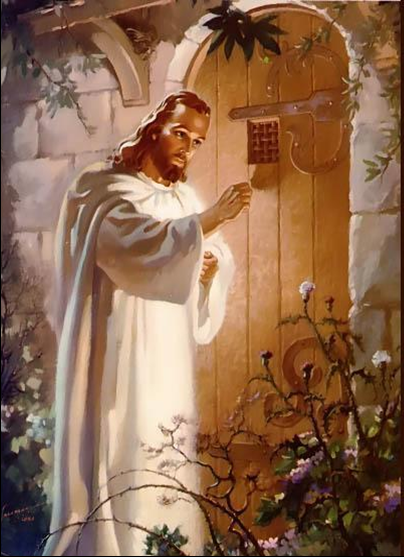
Jesus says to us in this present age, “Ask and it will be given to you; seek and you will find; knock and the door will be opened to you. For everyone who asks, receives; and the one who seeks, finds; and to the one who knocks, the door will be opened.” Are you asking, are you seeking, are you knocking? Strive for holiness while the door remains unlooked, and be encouraged, for Jesus is also striving after you. In Revelation He says, “Those whom I love, I reprove and chastise. Be earnest, therefore, and repent. Behold, I stand at the door and knock. If anyone hears my voice and opens the door, (then) I will enter his house and dine with him, and he with me.”

Jesus knocks on the door of our hearts, minds, and souls; in our feelings, thoughts, and deepest desires. If we open our doors and welcome Him now, and strive with Him for holiness, Jesus will open for us the door to Heaven and welcome us inside.

A Veiled Beauty — The Assumption

September 2, 2010

Consider this reflection by the servant of God, Bishop Fulton Sheen:

“Just suppose that you could have pre-existed your own mother, in much the same way that an artist pre-exists his painting. Furthermore, suppose that you had the infinite power to make your mother anything that you pleased, just as a great artist like Raphael has the power of realizing his artistic ideas. Suppose you had this double power, what kind of mother would you have made for yourself?

Would you have made her of such a type that would make you blush because of her unwomanly and un-mother-like actions? Would you have made her exteriorly and interiorly of such a character as to make you ashamed of her? Or would you have made her, so far as human beauty goes; the most beautiful woman in the world; and so far as beauty of the soul goes, one who would radiate every virtue, every manner of kindness and charity and loveliness; one who by the purity of her life and her mind and her heart would be an inspiration not only to you but even to your fellow men, so that all would look up to her as the very incarnation of what is best in motherhood?”

Now if you who are an imperfect being and who have not the most delicate conception of all that is fine in life would have wished for the loveliest of mothers, do you think that our Blessed Lord, who not only pre-existed His own mother but who had an infinite power to make her just what He chose, would in virtue of all the infinite delicacy of His spirit make her any less pure and loving and beautiful than you would have made your own mother? If you who hate selfishness would have made her selfless and you who hate ugliness would have made her beautiful, do you not think that the Son of God, who hates sin, would have made His own mother sinless and He who hates moral ugliness would have made her immaculately beautiful?”

Fulton Sheen thought that Mary was, in every respect, the most beautiful woman who had ever lived. However, if we had been travelers walking through the small town of Nazareth during the reign of Emperor Tiberius, I’m not sure that we would have recognized God’s greatest creature as we passed by her. I imagine that her face may have looked quite ordinary, apart from her beautifully, loving smile. Her Son, was the all-beautiful God become man, yet it seems that Jesus was not the most handsome man alive. As the prophet Isaiah says of Him, “There was in him no stately bearing to make us look at him, nor appearance that would attract us to him.” (Is 53) Perhaps Jesus and Mary had ordinary physical features on earth because having extraordinary appearances would have impeded their missions.

Yet now, invested with heavenly glory, Jesus and Mary possess a beauty greater than anyone in history. The perfection of love, goodness, purity and virtue within them shines through their exterior in a way that captivates those who behold them. Jesus told St. Faustina to commission a painting of how He appeared to her. When Faustina saw the artist’s quality work she dissappointedly lamented, “[Jesus,] Who will paint You as beautiful as You are?” The young visionaries at Fatima and Lourdes we struck by how very beautiful the mysterious lady was. And when St. Bernadette visited the grotto for the last time she remarked, “I have never seen her so beautiful before.” There is more to a beauty of this kind than natural appearance.

Why does the Church celebrate Mary’s Assumption? Because this solemnity not only celebrates her, but points to Church’s future. Virgin Mary is the icon, the image, of our Church. Jesus Christ’s Church is Marian. What she did, we are called to do; and where she has gone, we are called to follow. What Christ has done for Mary, He shall do for His Church on the last day. My previous reflections on the ordinary, appearances of Jesus and Mary probably had on earth only goes to show that external appearances can veil the true reality of things. 

Men judge by appearances, and they often misjudge. Many will drive past this building this hour without realizing the wondrous beauty of what is happening here inside. Many fail to see the beauty of Christ’s one, Catholic Church, for which this world was made and through which this world is saved. Many people see the beauty of exterior flesh, but not the beauty of the soul. Yet after the Last Judgment, everyone will see the most homely saint become radiant with beauty, and the most attractive sinner become repellant.

Mary is the first and greatest member of Jesus Christ’s Church. At the end of her unassuming life on earth Jesus lifted up her up body and soul into Heaven and gave her a beauty unmatched in history. He will do the same thing for His Church someday, and He desires to do the same for each of us. You and I are called to follow Mary in following Christ; to imitate their love, goodness, purity and virtue. Despite any appearances to the contrary, in this veiling and deceptive world, we are called to share in a beauty and glory like theirs.

C.S. Lewis on Our Immortality & Potential Glory

August 14, 2010

From The Weight of Glory:

It is a serious thing to live in a society of possible gods and goddesses, to remember that the dullest and most uninteresting person you talk to may one day be a creature which, if you saw it now, you would be strongly tempted to worship, or else a horror and a corruption such as you now meet, if at all, only in a nightmare. All day long we are, in some degree, helping each other to one or other of these destinations.

It is in the light of these overwhelming possibilities, it is with the awe and the circumspection proper to them, that we should conduct all our dealings with one another, all friendships, all loves, all play, all politics. There are no ordinary people. You have never talked to a mere mortal. Nations, cultures, arts, civilization—these are mortal, and their life is to ours as the life of a gnat. But it is immortals whom we joke with, work with, marry, snub, and exploit—immortal horrors or everlasting splendours.

This does not mean that we are to be perpetually solemn. We must play. But our merriment must be of that kind (and it is, in fact, the merriest kind) which exists between people who have, from the outset, taken each other seriously—no flippancy, no superiority, no presumption. And our charity must be a real and costly love, with deep feeling for the sins in spite of which we love the sinner—no mere tolerance or indulgence which parodies love as flippancy parodies merriment.

Next to the Blessed Sacrament itself, your neighbour is the holiest object presented to your senses. If he is your Christian neighbour he is holy in almost the same way, for in him also Christ vere Latitat [Latin, “truly hides”]—the glorifier and the glorified, Glory Himself, is truly hidden.

Praise is Fireproof — Tuesday, 17th Week in Ordinary Time—Year II

July 27, 2010

St. Therese of Lisieux, one of the greatest and most beloved saints in modern time, once remarked that she almost wished that she could go to Hell.  That way, she said, at least her small, solitary voice would lovingly praise Him from there. Of course, this is impossible. Those in Hell ‘wail’ in sadness, and ‘grind their teeth’ in anger, but they never praise God. No one praising Him would remain in Hell. Let us take comfort in the knowledge that if we persevere in our praise of God we shall not join their number.

A Mystery Revealed — Trinity Sunday

June 2, 2010

You may recall my mention of one of my favorite professors at seminary, Dr.  Perry Cahall. And I remember him telling us one day in class, “If, someday when you’re a priest, I hear that you got into the pulpit on Trinity Sunday and tell the people, ‘You know, the Trinity is a mystery, and so there’s really nothing we can know or say about it…’ I will hunt you down like the dogs you are.” This is my first homily on Trinity Sunday, and I’m going to make sure I give Dr. Cahall no reason to come after me.

The Trinity is a mystery, but that doesn’t men we know nothing or can say nothing about this central mystery of our Faith. In Catholic theology, a “mystery” is not something which is unknowable to us, it is just something which our human reason could not have discovered on its own.

Imagine if you came upon a sophisticated and well-written mystery novel. It’s so good that you can’t put it down. But as you get towards the end, you discover that the last couple chapters of the book are missing. You noticed some clues as the story unfolded, but without those last pages you can’t figure out the identity of the one “who did it.” You might try to find the ending in another copy of the book, but what if no other copies existed and no one had ever read the ending before? Your only hope would be to speak with the author. The author could tell you the rest of the story. The author could unveil the mystery for you and reveal the identity of the one “who did it.” Like that in sophisticated mystery novel, our God has placed clues throughout creation and His Old Testament interactions with His People. Yet, it was not until the coming of Jesus that the “who done it” was plainly revealed: God, the Author of the universe, is Father, Son and Holy Spirit.

Today I would like to talk about some common questions people have about the Trinity. For instance, how is God both one and three, and then what difference does the Trinity make?

Some people have trouble with the concept of the Trinity because they think it is the claim that “one equals three” in God. However, this is not what we believe about the Trinity. The number one does not equal the number three, not in God or anywhere else, and not even the omnipotent power of God can make a logical contradiction true.

We believe one God, comprised of three divine persons: the Father, the Son, and the Holy Spirit. God is one What, as three Who’s. There is one divine nature, but three divine knowers, three divine willers, and three divine actors. We do not believe in three anonymous forces, but three loving persons. There is no God apart from or beyond these three persons.

Now the Father is not Jesus Christ. Jesus is not the Holy Spirit. And the Spirit is not our Father. They are distinct persons. Yet, at the same time, each possesses the fullness of the divinity: perfect goodness, infinite beauty, perfect knowledge, infinite power, perfect mercy, and infinite love. We do not worship three gods, but three eternal persons who comprise one God.

The belief in the oneness of God was firmly instilled into the Jewish people. This conviction helped to keep Israel from falling into the worship of false gods and experiencing all of the evils that brings. For instance, Israel’s Canaanite neighbors were idolaters, who worshiped mere objects as gods that could make them happy. They practiced child sacrifice, killing their own children in hopes of receiving greater blessings in this life from the gods. And they had temple prostitution, in which promiscuous sexuality was as hailed as sacred.

Notice how our society has become more and more like those pagans as it has drifted from belief in the one true God. Our worship of objects which we think can make us happy is called materialism, or consumerism. Our human sacrifice, done in hopes of greater blessings in this life, is called abortion. And some have raised up sexual promiscuity as the way of greatest freedom and happiness.

The Jews were spared all of these evils so long as they clung to their conviction that “All gods are not the same, and we are to worship only one.” The God of Abraham, Isaac, and Jacob. Even to this day, observant Jews pray a prayer twice daily called the “Shema Yisrael,” from a passage in Deuteronomy:

“Hear, O Israel! The LORD is our God, the LORD is one!  Therefore, you shall love the LORD, your God, with all your heart, and with all your soul, and with all your strength.”

Jews remain Jews today because they do not believe that Jesus is the promised messiah, or the Christ, the one for whom they have been waiting. Sometimes they criticize Christians saying we are not really monotheists, but polytheists, who believe in three gods: “The LORD is our God, the LORD is one!”

Yet, revealingly, the word that God inspired in this Old Testament passage (“The Lord is one”) is not one of the words in Hebrew which always means numerical and solitary oneness (such as “yachid” or “bad”.)  Instead, the Holy Spirit selected a word which usually means a unified oneness: “echad.” This word (“echad”) is the same word used in Genesis, where God says of man and woman, “the two shall become one flesh.” In their union, the persons are as one being. And recall, God had said, “Let us make man in our image , after our likeness. …[And] God created man in his image; in the divine image he created him; male and female he created them.” When husband and wife become a unified one, as one couple, in time, they are in the image and likeness of the Father, Son, and Spirit, who have are a unified one, as one God, eternally.

So what difference does the reality of the Trinity make for our lives? The Trinity shows us that God is not a solitary individual, isolated and alone. God is a loving communion of persons. This is the reality we come from, and this is the reality we are called to, in this life and the next.

In our post-modern age, some people talk about “the meaning of life” as if it were some kind of joke, or an unsolvable mystery beyond our capacity to discover or know. But we Christians believe we know the meaning of life, for it has been revealed to us. The meaning of life is the loving communion of persons. The loving communion of persons is what gives our lives meaning and it will be our primary delight forever in Heaven. Love is the reality we come from, and the reality we are called to.

‘Hear, O Church of God! The LORD is our God, the LORD is a unified one!  Therefore, you shall love the LORD, your God, with all your heart, and with all your soul, and with all your strength.’ Love the Lord your God, who is Father, Son, and Spirit, and become like the God you love.

Gift of Self — 5th Sunday in Easter—Year C

May 2, 2010

I would like to begin today by telling the beautiful story of a gorgeous young woman named Leah Darrow. Leah grew up in a strong Catholic family in Oklahoma, but when she was in high school she says that her Catholicism started to get “fuzzy.”  By the time she was in college Leah says she had become a “Catholic But.” She would say, “I’m Catholic, but I don’t agree with the Church’s teaching on cohabitation,” or, “I’m Catholic but I don’t see the problem with a couple who love each sleeping together before their marriage… I think the Church is behind the times.”

One evening at college she saw a reality TV show called “Americas’s Next Top Model,” with Tyra Banks and thought to herself, “I’m pretty cute, maybe I could be on that show.” She tried out and got on, but lost the competition, yet she was resolved not to let her TV elimination mean the end of her modeling career. And she was rather successful.  She still recalls her excitement at receiving her first paycheck with a comma (a comma!) in it.

Leah eventually found herself at a photo-shoot high above 5th Avenue in New York that would change her life forever. She came to pose for an international magazine which wanted to help her develop a more risque image. They brought out a number of itsy-bitzy outfits for her to wear.  She picked one out and shooting began. Now Leah says that every model knows not to look at the flash when the photos are being taken (and she insists that she didn’t look at the flash) yet while she was posing, a vision flashed in her mind, three images in the span of perhaps a second or two. This is what she saw:

She saw herself standing in a large white space in the immodest outfit she was wearing. In this scene she wasn’t in pain, but she had the sense that she had died. In the second image Leah was looking up, holding out her open hands at her waist, with the knowledge that she was in the presence of God. In the third and final image, another white flash hit her eyes and Leah saw herself holding her hands all the way up, offering to God all that she had, but in that moment she realized that she was offering Him nothing. For her entire life up to that point, with all of the blessings, talents, and gifts that God had given her, she had wasted them all on herself. If she had died at that moment, Leah knew that she would have nothing to offer Christ.

She came back to reality when the photographer said, “Leah, Leah, are you OK?” She shook her head and said, “No, I can’t.” He said, “Ok, we can go over here.” And she said, “No, I can’t .”  She ran back to the makeup counter, changed back into her own clothes, and ran down 5th Avenue, balling her eyes out, afraid that she might be losing her mind.

She called her dad and said, “Dad, if you don’t come get me I am going to lose my soul.” Dad drove across the country to New York, and when he arrived she wanted to leave town, but he said he couldn’t wait to see the sights; Central Park, the Empire State Building, the Carnegie Deli, “But first we go to confession.” She made a good, tearful confession spanning the ten commandments like she was ordering off the dollar menu: ‘Two number ones, four number twos…’ She came out like a new woman, healed.  Today she goes around telling her story and supporting an organization that promotes modesty in young lades’ dress.

Leah says she was living a very selfish life before her conversion. Perhaps she was confused, as many in our culture, about the nature of true love. In English we use the word love in a broad and ambiguous way.  We say, “I love that TV show. I love the Packers. I love my children. I love my wife. I love God. I love my dog.” But all of these loves are different in kind and degree. When we say, “I love pizza,” or, “I love wine,” it is not really pizza and wine that we love so much as  ourselves.  I love myself, and that’s why I consume pizza or wine. Yet, not all love is easy, warm, and fuzzy. True love is a sacrifice, and often feels that way.

As St. Paul tells us in the first reading, “It is necessary for us to undergo many hardships to enter the kingdom of God.” And Jesus says in the gospel, “I give you a new commandment: love one another.” Love how? “As I have loved you, so you also should love one another.” How did Jesus love us? Through a total gift of self.

Now we know from the Gospels that Jesus’ self-giving wasn’t always a ordeal. It was often joyful. Jesus enjoyed going to weddings, dinner parties, and spending time with His friends. But Jesus’ acts of love were the most powerful and manifest when they were hard, as when He was on the cross.

Self-gifting love powerfully good. Someone can live a life of great fame and wealth, but without self-gift their life will account for nothing.  This is the world of difference we see between George Bailey and Mr. Potter in It’s a Wonderful Life.

Difficult self-gifting love is also the most powerful witness. Some theologians have speculated that Jesus could have redeemed in other ways besides the cross. (Perhaps a single cry from the infant God-Man would have been enough if that had been the divine plan.) But Jesus dying for us on the cross communicates a powerful message about His love for us. Jesus said, “This is how all will know that you are my disciples, if you have love for one another.” The way we love should be a witness, it should make us stand out.

Earth is a training ground. Our life here on Earth is training for Heaven. In Heaven, self-gifting is the rule and the norm. If that’s not the sort of thing we are interested in, there will be no place for us to be at home in heaven–and there is only one other place for us to go forever. In today’s second reading, Heaven is seen “coming down out of heaven from God, prepared as a bride adorned for her husband.” It is a revealing description, for spousal relationship prepares us for the life of Heaven.

We are all called to marriage and parenthood, either natural or spiritual. Some are called to live single lives, to enter religious life, or be ordained, in a fruitful spousal relationship with Christ and/or His Church. Others are called to natural marriage and to fruitfulness seen in their spousal love and its natural or spirital children.

Self-gift is the life of marriage. What if there is a priest who does not pray, who does not serve, but who seeks only his own comfort? Such a priest will eventually leave his priesthood. So it is with a natural marriage. If one spouse seeks just their own pleasure, their marriage will seem empty. But if both spouses seek to make a self-gift to the other, they will both be satisfied. Jesus said, “Seek first the kingdom of God, and His righteousness, and all thing will be added on to you.” If we go for self-gratification, even that escapes us, but if we focus on self-gift, satisfaction comes as well. This is the reason for the Catholic tradition of a crucifix hanging over a husband and wife’s bed.

Jesus has given us a new commandment: love one another. As He has loved us we should love one another. Such love is powerful. It should make us stand out as disciples of Christ. And it prepares us for the life of Heaven, where self-gift is rule.

Leah Darrow Interview on the Drew Mariani Catholic radio show (4/30/10)

Leah Darrow Talk to a Boston Catholic Women’s Conference (2/27/10)

Clearing Heaven’s Haziness — 4th Sunday in Easter—Year C

April 25, 2010

Today, St. John has a vision of a great multitude, which no one could count, from every nation, race, people, and language. They wear white robes and hold palm branches in their hands. They stand before the throne and before the Lamb (who is Jesus Christ,) and in His temple they worship Him day and night. St. John is glimpsing the worship in Heaven.

Heaven should be one of our great consolations in difficult times and we should really be excited about going there someday. But I think that we often have faulty ideas about Heaven that can get in the way of us being excited or consoled. For instance, maybe you heard the first reading today and thought, “The idea of standing night and day and holding a palm branch doesn’t seem that awesome to me; and going to Mass for an hour is well and good, but I don’t know how I could enjoy going to church forever in Heaven.” Concerns like these would understandably make us weary of Heaven.

We need to recognize that the Book of Revelation is symbolic.  Not everything we see in John’s vision is not literally what we’ll get in Heaven. For instance, St. John sees Jesus as a lamb who was slain and having seven horns and seven eyes. That’s one odd looking lamb, but this is symbolism. The image of the lamb recalls Jesus’ sacrifice, His horns imply perfect power and His eyes imply perfect wisdom. Likewise, the multitude’s white robes point to their dignity, their palms signify their victory, and they are standing because that is the traditional posture for worshiping God. The God who created the universe, and all of the good things we enjoy in it, surely has more to offer us than just palm branches, white robes, and boredom in Heaven.

You have heard it said that we will enjoy the “beatific vision” in Heaven, but you maybe wonder, “How could I enjoy staring at God forever?” But the phrase “beatific vision,” is also metaphor and the experience means more than mere gazing. The “beatific vision” is the immediate knowledge of God enjoyed by the angels and saints in Heaven. We call it “vision” because it is an experience of God which is direct, not mediated, and in the fullest depth and detail which our souls can receive. We call this vision “beatific” because intimately experiencing God, what the prophets call beholding Him “face to face,” gives perfect happiness.

The saints in heaven experience this beatific vision now, even though, (except for the Virgin Mary, and perhaps Enoch, Moses, and Elijah,) none of the saints have their bodies yet. Their flesh is still on earth awaiting the resurrection. But this raises the question of how can we experience anything without having our bodies?

Think of it this way: When I am asleep I see nothing with my eyes (for they are closed.) And in the silence, I’m not hearing anything with my ears. There’s nothing to taste nor smell, and even if I’m feeling the bed sheets they do not have my attention. Yet sometimes when I sleep, even as I’m dead to my senses, my soul can be alive and alert while I dream. If dreams of mere fantasies can be made vividly realistic to our souls, then I’m confident that God can engage our souls with the higher realities of truth and love, even as our bodies sleep in death.

Sometimes people ask, “Will my experience of Heaven only be between God and me? I mean will I be so overwhelmed by God that I won’t notice or care about the multitude around me?  Will I even remember the people that I knew on earth?” I would answer in this way: how could coming closer to the God who is Love make our love toward others colder, or how could being in the presence of Truth Himself make us stupider? In Heaven, we will never forget that our parents were our parents, or that our friends were our friends, or that our spouses were our spouses and we will remember the love we shared. And the fact that miracles have occurred through praying to the saints for their intercession before God shows that the holy dead are still aware of us and care about us still on earth.

So what exactly is heaven like now, and what will it be like after the resurrection when this entire universe is remade into a new heaven and new earth? We don’t exactly know. Like in the book of Revelation, Scripture speaks of it in images: life, light, peace, a wedding feast, wine of the kingdom, the Father’s house, the heavenly Jerusalem, and paradise. Though we don’t exactly know what Heaven will be like, we shouldn’t fear that it will disappoint us. When, by God’s grace, we all get arrive there we will look at everything that He has prepared for us and find it very good.  

Until we get there, let us realize and remember that every Mass gives us a foretaste of Heaven. Here we bring with us everything that has happened in our lives. We come here before the throne of the Lamb who was slain, and we praise Him. And here He gives us Himself along with every heavenly blessing which we are ready to receive. Though a veil remains, every Mass bring Heaven to earth.

The Apostles’ Charge — Thursday, 2nd Week of Easter

April 16, 2010

 The high priest Caiaphas had once remarked to the Sanhedrin during the time of Jesus’ ministry:

“You know nothing, nor do you consider that it is better for you that one man should die instead of the people, so that the whole nation may not perish.” He did not say this on his own, but since he was high priest for that year, he prophesied that Jesus was going to die for the nation, and not only for the nation, but also to gather into one the dispersed children of God. (John 11:49-52)

The high priest, whom many Jews believed possessed the gift of prophesy, here spoke words truer than he realized. A similar episode happens in today’s first reading:

When the court officers had brought the Apostles in and made them stand before the Sanhedrin, the high priest questioned them, “We gave you strict orders did we not, to stop teaching in that name. Yet you have filled Jerusalem with your teaching and want to bring this man’s blood upon us.”

With their teaching, the apostles have indeed filled Jerusalem, the true and heavenly Jerusalem, with the souls of the saints. And the apostles did want to bring Jesus’ blood upon those who questioned them, for the blood of Christ cleanses us from sin. In his revelation, St. John “saw the holy city, a new Jerusalem, coming down out of heaven from God, prepared as a bride adorned for her husband.” (Rev 21:2) “They have washed their robes and made them white in the blood of the Lamb.” (Rev 7:14)

The Sanhedrin commanded the apostles to stop proclaiming Jesus, but the apostles replied, “We must obey God rather than men,” for as John’s Gospel says, “whoever disobeys the Son will not see life.” The Gospel teaches, “Whoever believes in the Son has eternal life, but whoever disobeys the Son will not see life, but the wrath of God remains upon him.” But who truly believes and shall be saved?  Who disobeys and shall be condemned? Thankfully, this final judgment is not ours to decide, but our mission from Jesus is clear. Like the apostles, with Jesus’ teachings we are to fill the heavenly Jerusalem  and bring Christ’s saving blood upon all people.

Jesus’ Resurrected Body — Easter

April 7, 2010


On Holy Thursday, we meditated on the disciples’ feet. On Good Friday, our Saviour’s hands.  Today, let us consider Jesus’ resurrected body.

Jesus’ resurrected body is the very same that died and was buried, but it is a very different body, too. The tomb was empty on Easter morning, not because Jesus’ body was vaporized, but because it was raised.

Jesus’ resurrected body has wounds, in his hands and feet and side, showing that this is the same body that suffered on the cross. It seems that the cuts and bruises on Jesus’ face and the lashes on His back are healed, but these five wounds remain. Why? These wounds are trophies and jewels.  They no longer cause Him pain, but they testify to Jesus’ greatness and love and He will have them forever.

So Jesus’ resurrected body is the very same body that died on the cross and was buried in the tomb, but it is a very different body. For instance, Jesus in His glorified body can cause others to see but not recognize Him, as He did on Easter evening with two disciples on the road to Emmaus. Only later, in the breaking of the bread, did they recognize Him. Then Jesus displayed another new power, disappearing from their sight. In His glorified body Jesus can move at the speed of thought and the walls and locked doors of the upper room do not prevent Him from appearing in the midst of the apostles.

In this there is a sign for the future of humanity. People often speak of “the end of the world” and imagine Heaven in strictly spiritual terms, but just as Jesus’ body was not annihilated but transformed, so our bodies and this universe will be remade. A glimpse into the future of the righteous is reflected in the resurrection of Christ.

Jesus’ body is not discarded, but gloriously transformed. In this there is a lesson for us. In (just about) every  life, there is a line that we have drawn in our relationship with God. It is a self-imposed limit on our trust, commitment, and self-gift towards Christ. “Lord, I will walk with you that far, (but no farther.)”

Perhaps we are unwilling to cross that line with us because we are too attached to the sins and mediocrity we have settled for, maybe we are afraid that we will lose who we are and become something that we are not, or maybe we are afraid that a total self-gift to God won’t truly make us happy. The devil likes this arbitrary line. He would like you to reach the end of your life and have to wonder with regret, “What would my life been if I had gone all-in for God?” The devil would have you fearful and repulsed of “the cross, the cross!” but the cross is not the end of our story.  Remember, as in Christ, God does not want to destroy you, but to transform you into who you truly are.

Do you believe Jesus suffered and died for you? Then He surely loves you. If He loves you, then how could He not desire your greatest happiness? Do you believe Jesus is divine and all-knowing? The surely He knows what will lead to your greatest good. Do you believe Jesus is all-powerful? Then surely He has the power the lead you to that good. Then what is standing in His way? There is only one thing standing in the way of His omnipotent power, preventing Him from transforming us into who (deep down) we truly want to be. That obstacle is our own freewill, the arbitrary line we draw in our relationship with Christ.

This Easter, let us be resolved to follow Christ without compromise. Let us entrust our whole selves to Him who has given us everything. Jesus does not want to destroy you, but to gloriously transform you into who you truly are.

When Towers Fall — 3rd Sunday in Lent—Year C

March 7, 2010

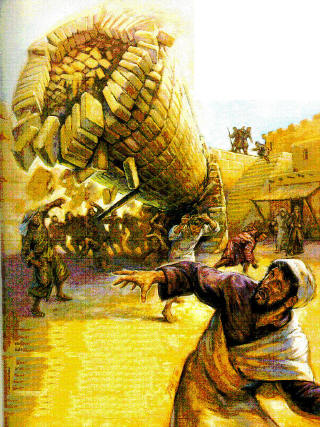
When disasters happen, like the recent earthquakes in Haiti and Chile, some Christian observers respond according to two opposite extremes. One reaction says that a truly just God would never let the innocent die along side the guilty; therefore, all of the victims must have been punished for their sins and got what they had coming to them. The opposite reaction says that a truly loving God would never punish our sins; therefore, all of the victims must have been innocent.

The truth is more complicated than either of these simple and pat explanations. Our God is both perfectly loving and perfectly just. In this world the wheat grows side by side with the weeds. At harvest time, the two are uprooted together, but their eternal fates are not the same. We see that the truth is more complex than some assume by looking at the gospels.

One day Jesus and His disciples observed a man blind from birth. The disciples asked Jesus, “Rabbi, who sinned, this man or his parents, that he was born blind?” Jesus answered, “Neither he nor his parents sinned; it is so that the works of God might be made visible through him.” Jesus smeared clay in man’s eyes and told him to wash in the Pool of Siloam. The innocent man washed and returned able to see.

Yet, on another occasion (in the same Gospel of John) Jesus saw a man lying on the ground who had been ill for thirty-eight years. Jesus miraculously cured this man too, but finding him later Jesus said to the man, “Look, you are well; do not sin any more, so that nothing worse may happen to you.” In this case, it appears that the man’s sin was connected to the cause of his sufferings.

We need to remember that people who suffer and die are not always guilty. On the other hand, people are not always innocent either. Discerning the truth behind why this or that evil befell this or that person or place usually lies well beyond our own limited vision.

For instance, the friends of Job insisted with all confidence that Job’s sufferings must be due to some great sin he had committed.  However, Job stood firm on his innocence, and he truly was as righteousness he claimed. Great sufferings and even violent death are no certain indication of a person’s sinfulness, that “they had it coming.” Just look at our holy and beloved saints:

  • St. John the Baptist was murdered in his 30’s, and St. Paul in his 60’s—they were both beheaded.
  • St. Peter was murdered too, crucified upside down, and of all the apostles, only St. John died of old age.
  • St. Joan of Arc, age 19, was murdered with fire.
  • St. Therese of Lisieux and St. Faustina Kowalska both died of tuberculosis, at ages 24 and 33.
  • St. Maximilian Kolbe and St. Edith Stein were murdered by the Nazi’s in the Auschwitz concentration camp.
  • More recently, before our eyes, John Paul the Great suffered greatly and died of Parkinson’s disease.
  • Even the Blessed Virgin Mary, as perfectly innocent as she was, shared as a mystic and a mother in suffering the passion and death of her Son.

The innocent who suffer live and die in the likeness of Jesus Christ are promised a heavenly reward like His.

So from where do earthquakes and other natural disasters come? In the beginning of time, some of the angels and all of humanity rebelled against God and we rejected our proper places within His creation. This Fall introduced disharmony into our (now) mortal bodies and into the entire natural world. Since that time, Christ has come and in perfect obedience to our Father, died, rose, and has enabled us to be reconciled with God. However, the disharmony of nature remains and we remain free to choose to rebel against our God.

If rebel in sin, we should not be surprised if bad things happen as a result. Usually in this world, we are punished through our sins, more so than for them. For example, someone who neglects prayer and Sunday worship should expect that they will feel disconnected from God. Someone who abuses drugs or alcohol, will see the harmful consequences it brings to their relationships and at school or at work. Someone who covets their neighbors’ spouse and possessions will become sickly green with lust and envy. Add up the sum total of an entire peoples’ sins and you can easily see how an empire or a great nation can decline and decay over time.

God hates our sins, but not merely because they “break His rules.” God hates our sins in proportion to how harmful they are to us. If sins were not bad for us, then God would not command us not to do these things. God hates our sins because He loves us; these are two sides of the same coin.

So what should we do when we witness disaster strike half a world away or in our own community? We should pray for the dead and give our aid to those who live on. Christ calls us to give our compassion, love, spiritual support, and material aid to those who need it. And as for ourselves, such disasters should lead us to convert and reform our lives. Death can come suddenly to any of us. A car crash or a heart attack could take any of us tomorrow placing us unexpected before the judgment seat of God. Let us take such opportunities to prepare ourselves for that day which will come to us all.

What if is not instant death, but a more prolonged evil that comes to me? For instance, what if I go to the doctor and receive a terrible diagnosis?  When such a day comes for me, I hope that I may remember the tree from today’s Gospel, which the gardener worked and fertilized in hopes that it would bear much fruit. If I, like that tree, will humbly accept the manure that comes to me, then it will be a source of great fruitfulness to me.

Could an evil such as this be a correction or a chastisement from God on account of my sins? Possibly, but if I’m not aware of any serious unconfessed sins on my conscience, then probably not. More likely, Jesus is giving me the opportunity to following in His footsteps, to have a share in His cross like the holy saints who came before me. If we accept our crosses with humility, then they can become the means of our sanctification in the likeness of Christ and a source for spiritual fruitfulness for ourselves and the entire world.

Alive in Christ — Funeral for Lila O’Brien, 94

March 3, 2010

On behalf of Christ the King parish I wish to offer to you, Lila’s family and friends, the sympathies and prayers of this community. I also want to give special recognition, praise and thanks to Lila’s children, who provided her with around the clock companionship and care, allowing her the blessing of dying at her home with her loved ones.

In these last months, I had the privilege to visit Lila at home on two occasions. The first time I came, I anointed her with holy oil, to strengthen her for the share in Christ’s passion which laid before her. The second time some of her family and I gathered and pray with her the prayers of commendation for the dying.

When I ask people about Lila they tell me that she was friendly and feisty. That she was ever active and always on the go. That she was funny, a bit goofy, and unpredictable. They tell me that she was very independent, yet also very personable. Lila was a neat lady. Let us not forget that she remains a neat lady.

It is the habit in our culture to refer to people who have died using the past tense. For instance people say, “So and so was such a loving person,” and they say the person “would have really enjoyed being with us today.” Even if unintentionally, these words implies that the dead love no longer and that they are no longer aware of us.

Yet after death, a person who is loving in this life becomes still more loving. It seems quite likely that each of us will be aware of our own funerals, just as I believe that Lila is aware of our gathering today.

Though we fall into speaking of the departed in the past tense, we do not really believe that death is the end. Dying does not annihilate those we love. As Jesus said, ‘The God of Abraham, the God of Isaac, and the God of Jacob is not the God of the dead, but of the living, for to Him all are alive.’

Nor does dying make a person less fully themselves than what they were before. “Whether we live or die, we are the Lord’s.” And as Jesus said in the gospel, to the good thief crucified with Him, “Amen, I say to you, today you will be with me in Paradise.”

Lila has passed on, but if you would like to talk to her, just go ahead and pray. She will hear you and she will appreciate it. And be sure to pray for her too.

In her years on earth, Lila did not like to travel far from home and she didn’t take long trips, unless the promise of a casino jackpot awaited her. But now Lila is making the human soul’s furthest trip, the journey to full and heavenly presence of God. She has an incredible jackpot to motivate her, the promise of supreme and perfect happiness, however receiving this reward is not a matter of luck. It requires the purification of her soul and the help of our prayers, so offer this morning’s mass and your continued prayers to God for her.

Lila has died, but Lila is not dead. If the woman we remember has changed it is only to become more perfectly who she really is, in all her unrepeatable uniqueness. Lila was, and she remains, a friendly, funny and feisty lady.

The Scales Myth — Friday, 1st Week of Lent

February 26, 2010

In ancient myths and modern imagination, the judgement of our lives will be done with a pair of scales, with our good deeds one one side and our bad on the other.  If our good deeds outwiegh the bad ones (so the story goes) then we’re in good shape.  If not, we’re toast. However, our first reading from the prophet Ezekiel shows that this not how God judges things.

If the wicked man turns away from all the sins he committed, if he keeps all my statutes and does what is right and just, he shall surely live, he shall not die. None of the crimes he committed shall be remembered against him; he shall live because of the virtue he has practiced.

And if the virtuous man turns from the path of virtue to do evil, the same kind of abominable things that the wicked man does, can he do this and still live? None of his virtuous deeds shall be remembered, because he has broken faith and committed sin; because of this, he shall die.

God is more interested in where we’re headed than where we’ve been. This is encouraging good news for the long-time sinner who needs to repent and it is a warning to us who have done well in the past.  It’s not what we’ve done in the past that matters, because each of us can make a definitive turn toward or away from the Lord today.

What advantage then do we who are faithful to the Lord have over those who have deathbed conversions, over those steal heaven like the good thief on his cross next to Jesus? Very much indeed, for our lives’ holiness and good deeds will be weighed and our personal degree of heavenly glory and reward will be measured out accordingly. In heaven we shall all be filled and satisfied, but those who love most in this life shall enjoy the most love in the next.

So whether you are far from God or serving Him faithfully, heed these holy words: “If today you hear His voice, harden not your hearts.”

Christian and Unashamed — Ash Wednesday at the Parish

February 17, 2010

In today’s Gospel, Jesus warns us against giving so that others see us giving, against praying so that others see us praying, and against fasting so that others see us fasting. Yet, I don’t think that showy religiosity is where the danger lies for us.

In Jesus’ day, the popular culture proudly believed in God and respected religious piety. Hence, those people were tempted to publically flaunt their acts of prayer, fasting, and almsgiving and thereby gain the respect and praise of others. But today, in our secularized culture, the temptation is to do the opposite, and to do something far worse. We are tempted to deny our faith in Jesus and teachings before others because we’re afraid of what they might think of us.

The hypocrites Jesus spoke of, who pray to be seen by others, merely limit their prayers’ reward, but if we deny Christ before others we lose our rewards entirely. For Jesus tells us:

“Whoever is ashamed of me and of my words, the Son of Man will be ashamed of when he comes in his glory and in the glory of the Father and of the holy angels.” “Everyone who acknowledges me before others I will acknowledge before my heavenly Father. But whoever denies me before others, I will deny before my heavenly Father.”

This is why the early Christians went to the lions rather than to deny Christ, and it was their courageous witness to Him that conquered the pagan culture which surrounded them.

This Lent, let us begin to practice putting the Lord before men. For instance, are you someone who will be so embarrassed by having an smudge of ash on your forehead that you’ll want to wash it off the first chance you get? If so, then you should leave it there until it wipes away on its own.

Are you are someone who sees good deeds that just call out to be done but pass them by because of your peers would see you doing them? Then you need to bite the bullet and start doing those hard-good-deeds anyways.

Are you someone who is self-conscious about other people seeing you pray, here at Church, at work, or when your family goes out to a restaurant? Then you need to make it a point to pray, and when you do, do not ask that God would make you invisible; ask Him that other people would become invisible to you and then pray to Him as from your heart.

Now, these are not examples of performing righteous deeds so that others may see you. This is about doing the right thing even if others might happen to see you do it. This Lent, let us begin to love and serve our eternal Lord amidst a world which is destined to become dust.

You are called to be the light of the world. People do not light a candle and then put a bucket over it; it is set it high up, where it can give light for everyone. Just so, your light must shine before others, that they may see your good deeds and glorify your heavenly Father. This Lent, let’s begin to shine.

Unashamably Christian — Ash Wednesday at the School

February 17, 2010

In today’s Gospel, Jesus warns us against giving so that others see us giving, against praying so that others see us praying, and against fasting so that others see us fasting. Yet, I don’t think that showy religiosity is where the danger lies for us.

In Jesus’ day, the popular culture proudly believed in God and respected religious piety. Hence, those people were tempted to publically flaunt their acts of prayer, fasting, and almsgiving and thereby gain the respect and praise of others. But today, in our secularized culture, the temptation is to do the opposite, and to do something far worse. We are tempted to deny our faith in Jesus Christ and His teachings before others because we’re afraid of what they might think of us.

The hypocrites who pray to be seen by others limit their rewards, but if we deny Christ lose our rewards entirely. I’ve touched on this topic twice before from this ambo, as recently as three weeks ago, but I feel that it is important for me to emphasize it, and that it’s important for you to hear it. For Jesus tells us:

“Whoever is ashamed of me and of my words, the Son of Man will be ashamed of when he comes in his glory and in the glory of the Father and of the holy angels.” “Everyone who acknowledges me before others I will acknowledge before my heavenly Father. But whoever denies me before others, I will deny before my heavenly Father.”

This Lent, let us begin to put God first; in our prayers, in our penances, and in our personal relationships.

Are you someone who will be so embarrassed by having an smudge of ash on your forehead that you’ll want to wash it off the first chance you get? Well then, you’re someone who needs to leave it there until it wipes away on its own.

Are you are someone who sees good deeds that call out to be done but pass them by because of the people who would see you doing it?  Then you need to bite the bullet and start doing those hard-good-deeds anyways.

Are you someone who will have more to say in gratitude to God after Mass this morning than is allowed by the eight seconds before your pew starts clearing-out? Well, then you need to stay in your pew to say what your heart wants to say as long as you need to say it (without, of course, being late to class.)

Now, these are not examples of performing righteous deeds so that others may see you.  This is doing the right thing even if others might happen to see you doing it.

If you’re self-conscious about other people seeing your devotion to the Lord (for instance at Mass) do not pray that you would be invisible to them; ask that they would invisible to you and continue as you would.

You are called to be the light of the world. People do not light a candle and then put a bucket over it; it is set on a lampstand, where it gives light for everyone. Just so, your light must shine before others, that they may see your good deeds and glorify your heavenly Father.

This Lent let us begin to love and serve the Lord in the world. This Lent, let’s begin to shine.