Archive for the ‘Marriage and Family’ Category

Heralding the Best Path

December 7, 2025

2nd Sunday of Advent
By Fr. Victor Feltes

St. John the Baptist taught his hearers that the time had come for them to take action and change course. St. Matthew writes it was of John the Baptist the Prophet Isaiah spoke when he foretold of “a voice of one crying out in the desert,” saying, “Prepare the way of the Lord! Make straight in the wasteland a highway for our God! Every valley shall be filled in, every mountain and hill shall be made low; the rugged land shall be made a plain, the rough country, a broad valley. Then the glory of the Lord shall be revealed…” So what is this imagery about?

In ancient times, preceding a king’s journey somewhere, a messenger would be sent ahead to announce how people should get ready for the royal arrival. One practical task was to improve his road: removing rocks, filling potholes, and smoothing ruts. For the coming of the King of kings, Isaiah even envisions lowering mountains and raising valleys to form a straight and level highway. John the Baptist calls everyone to reevaluate our priorities to better prepare the way for encountering Christ.

An angel of the Lord had announced to the Baptist’s father, Zechariah, that John’s mission had an intergenerational component. John was to “turn the hearts of fathers toward children and the disobedient to the understanding of the righteous, to prepare a people fit for the Lord.” St. John, inspiring adults to seek the very best for children and to form them in godly ways, would “turn many of the children of Israel to the Lord their God.” Today, I wish to inspire you to do the same for children now through our St. Paul’s Catholic Grade School.

We have an excellent Catholic school. For our most recent reaccreditation, administrators from four other Catholic schools thoroughly evaluated us and told us: “You have a beautiful school.” “[It’s] welcoming, faith-filled, and charming!” “[It’s] filled with excellent educational instruction.” “[There are] high expectations.” “The students are so well-mannered.” “[And there are] great relationships between teachers and students.” And all of them agreed, “We wish we could work at your school.”

Our highly-qualified teachers can provide one-on-one attention in a wholesome environment more like a family than a factory. And we have great young people who positively influence each other. Our reinvigorating new principal, Mr. Brad Cody, has been struck by our students’ respectfulness and politeness, noting how in all his time here he has yet to hear any student swear. Our behavioral expectations, our academic expectations, and our moral expectations are not found in many other schools today. St. Paul’s devoted teachers and substitutes who have taught in both worlds can attest to the differences in our Catholic school.

God and Christ’s teachings are not excluded here. We have daily prayer, weekly Mass, Confession, and seasonal devotions. Our students get to know Catholic clergy beyond just at Sunday Mass, like when we eat our excellent school lunches with them at their tables. Our littlest ones enjoy the Catechesis of the Good Shepherd, which introduces Christianity to them in an engaging way on their level. And while people of all faiths are welcome at our school, the Catholic Faith is taught and lived.

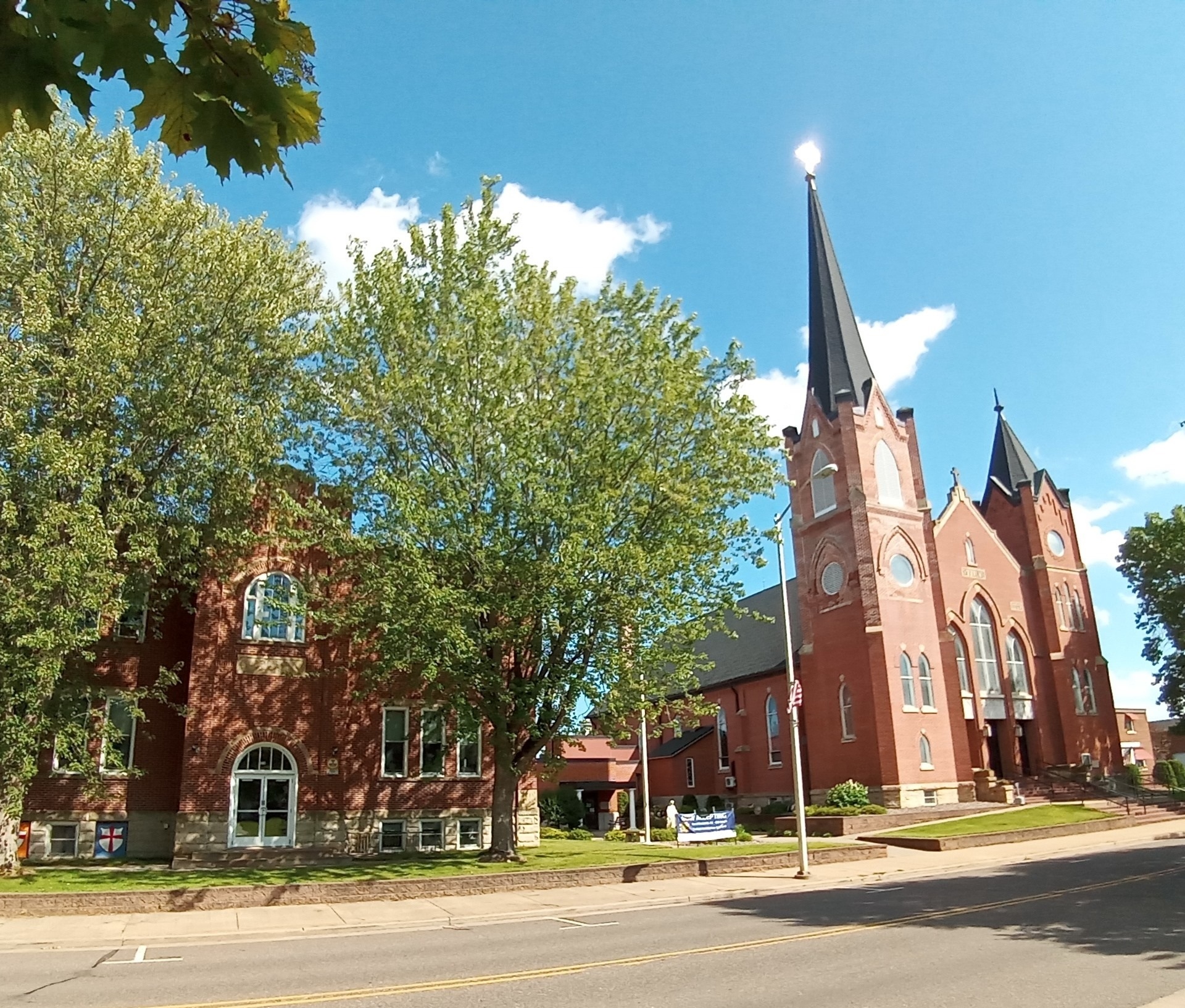
Our 4K through 8th grade Catholic school prepares the way for the Lord without the rocks, ruts, and pitfalls found in other paths; a smooth and straight road for children to get to know Jesus Christ and walk forward with him together. So if you or your acquaintances have school-aged children, please work to get them enrolled here in 2026. Make a call, take a tour. School Choice makes tuition free at higher incomes than you would think. But even families who don’t qualify can receive grants and scholarships we offer, so do not imagine cost to be an obstacle. In addition to recruiting for our great school, I invite you to join our work in person. We could always use more playground supervisors, substitute teachers, or helpers in the library, office, or classrooms.

It’s not so much that our Catholic school has a mission, as our Catholic mission here in Bloomer has a school. Please help prepare the way for our Lord, make straight our children’s paths, by supporting our St. Paul’s Catholic School.

True Christianity Cleaves

August 16, 2025

20th Sunday in Ordinary Time
By Fr. Victor Feltes

Jesus asked his disciples, “Do you think that I have come to establish peace on the earth? No, I tell you, but rather division.” Why does he say this? Is he not the one whom Isaiah called the “Prince of Peace”? The Prophet Zechariah foretold: “Behold: your king is coming to you… humble and riding on a donkey… He shall banish the chariot from Ephraim, and the warhorse from Jerusalem; the warrior’s bow will be banished, and he will proclaim peace to the nations.” But this Kingdom of unending worldwide peace has not yet fully come and will not arrive until Christ’s Second Coming.

Jesus told his apostles, “Peace I leave with you; my peace I give to you,” but he added, “because you do not belong to the world… the world hates you. … In the world you will have tribulation. But take heart; I have overcome the world.” Jesus wished to dispel his followers’ presumptions about immediate peace on earth and warned them of future conflicts. He said, “You will hear of wars and reports of wars; see that you are not alarmed, for these things must happen, but it will not yet be the end.” Jesus also warned his disciples of future religious persecutions because not everyone, even amongst his own people, would accept him as the Christ. “From now on,” Jesus said, “a household of five will be divided, three against two and two against three.” “Brother will hand over brother to death, and the father his child; children will rise up against parents and have them put to death.” “You will be hated by all because of my name,” Jesus said, “but whoever endures to the end will be saved.

You have probably heard both ancient and modern stories about people who suffered and sacrificed a great deal in order to be a Christian or to join his Catholic Church. We are surrounded by great a cloud of such witnesses: like St. Paul the Apostle, St. Edmund Campion St. Kateri Tekakwitha, St. Elizabeth Ann Seton, St. John Henry Newman, and many other saints. When we hear of a household divided—three against two or two against three—on account of Christ, we might imagine a family at odds due to some accepting Jesus and his Church while others remain atheists, pagans, Muslims, Jews, or non-Catholic Christians. This sometimes happens, yet Jesus absolutely insists that we love him most of all and follow him no matter what. He says, “Whoever loves father or mother more than me is not worthy of me, and whoever loves son or daughter more than me is not worthy of me; and whoever does not take up his cross and follow after me is not worthy of me.” If you have been considering becoming a Catholic Christian, I urge you to take the next step and learn more this fall by enrolling in parish OCIA classes (formerly known as RCIA).

Though we typically imagine persecution coming from people outside our faith, resistance can come from our co-religionists as well. The Prophet Jeremiah and those who were persecuting him in today’s first reading were all Old Testament Jews professing to follow the same God and same faith. Yet those who mistreated Jeremiah were opposing God’s will. This can happen inside of a Catholic household as well. What if some family members understand the necessity of worshipping and thanking God every Sunday at Mass while others in the family are unwilling to prioritize him? What if one spouse wants to live in accord with God’s will about the marital embrace, virtue, love, and human life, but the other spouse wants to contracept? What if children want to explore possible priestly or religious vocations but their parents resist what may be God’s will saying, “We want grandchildren”? What if some family members treat our religion like merely “fire insurance,” hoping the Lord won’t mind us doing whatever we prefer, while other members are on fire for the Lord?

Jesus said, “I have come to set the earth on fire, and how I wish it were already blazing!” He wants us to be on fire for him, aflame with the Holy Spirit, shining light with a warm inner peace which this troubled world cannot take away. If that uniquely describes you in your household, pray for your family members, love them, and keep modeling and advocating for what is right and good. If that does not describe you, then pray for a more fervent heart and obey the voice of Christ challenging your conscience. Realize you cannot clear a six foot charism using only three foot hops.

Love & Eight — The Jacob Pake & Kayla Bowen Wedding

June 22, 2025

By Fr. Victor Feltes

We read in the Genesis Creation account that it was not good for mankind to live in solitude, so God made a suitable partner for the man. “That is why a man leaves his father and mother and clings to his wife, and the two become one body, one flesh.” Man and woman were made for each other. Psalm 128 notes how marriage, that first blessing from the original Garden, remains visible in the world even after the Fall: “Your wife like a fruitful vine in the heart of your house; your children like shoots of the olive around your table.” However, after the Fall, we are wounded by sin and drawn by temptation. Humanity commonly does not do as we should.

That is why St. Paul’s exhortation to the Corinthians reminds their divided and squabbling community what love is and what it is not. He lists eight things that love “is” or does alongside eight things love “is not.” Love is not jealous, not pompous, not inflated, not rude, not self-seeking, not quick-tempered, not brooding over injury, not rejoicing over wrongdoing. But love is patient, love is kind, it rejoices in the truth, bears all things, believes all things, hopes all things, endures all things, and love never fails. These groupings of eight are interesting because Jesus in his Sermon on the Mount lists eight beatitudes. (Some may count nine beatitudes, but the Greek indicates that the final “blessed” is an expansion on the eighth one.) These beatitudes describe Christian saints, but first and foremost they describe Christ himself.

So eight, eight, and eight — What does this have to do with how we are to love today? In Genesis, God begins creating on the first day of the week, which is Sunday. He works six days and then rests on the seventh day. That is why the Jewish Sabbath, their holy day of rest, was Saturday. Jesus Christ, who on Good Friday worked his perfect Sacrifice, whose lifeless body on Holy Saturday kept a day of perfect rest, rose again on Easter Sunday. Christians beginning in the 1st or 2nd century called that Sunday “the eighth day,” the eighth day of Creation on which Jesus Christ transforms humanity and our lives in this world. Now we have hope beyond this life, hope for blessed endless life with God. And the Passion, Death, and Resurrection of Jesus have opened access to grace, the help of God, enabling us to live and love like him.

How can we achieve and preserve true unity and harmony among us in our homes and community? This is not possible merely on our own. We must let God give us his grace which allows us to live and love like him. This is why daily prayer, weekly worship, and consistent devotion to the Lord must be top priorities for any Christian. Jacob and Kayla, draw near to him and remain with him, so that you both may live and love like him and be blessed together. Like the psalmist said, ‘Blessed are all who fear, who reverence, the Lord and walk in his ways. You will be blessed and prosper. May you see your children’s children. May the Lord bless you all the days of your life.’

A City on a Mountain — The Garrett Mikula & Annabelle Wittrock Wedding

June 7, 2025

By Fr. Victor Feltes

“You are the salt of the earth…
  You are the light of the world.
  A city set on a mountain cannot be hidden.”

This is a classic Gospel reading. It encourages all Christians to be salt on this earth and light in this world in ways which cannot go entirely unnoticed. Yet in all my years, despite this reading being a valid option for weddings, I cannot recall it ever being selected. This got my mind wondering: “How is Christian marriage like a city set on a mountain?” How does Sacred Scripture connect mountains, cities, and marriage? Let’s look at three episodes.

In the 6th century B.C., the Prophet Daniel interpreted King Nebuchadnezzar’s secret dream which featured a huge statue representing ancient empires. A stone hewn from a mountain by God struck the statue, shattering it to pieces. Daniel foretells that the stone which struck the statue would become a great mountain, fill the whole earth, and stand forever.

Earlier, in the 8th century B.C., the Lord had declared through the Prophet Isaiah that he was “creating new heavens and a new earth.” “Indeed, I am creating Jerusalem to be a joy and its people to be a delight; I will rejoice in Jerusalem and exult in my people. … None shall harm or destroy on all my holy mountain….”

Finally, in the Book of Revelation, St. John describes his vision: “I saw a new heaven and a new earth… I also saw the holy city, a New Jerusalem, coming down out of heaven from God, prepared as a bride adorned for her husband.” John hears a loud voice from God’s throne say, “Behold, God’s dwelling is with the human race. He will dwell with them and they will be his people and God himself will always be with them as their God.” Then John hears an angel say: “Come here. I will show you the bride, the wife of the Lamb.” Then the angel takes him in spirit to a great, high mountain and shows him the holy city Jerusalem coming down out of heaven from God.

So we see Sacred Scripture associating and connecting a holy mountain, a holy city (Jerusalem), and holy marriage. Now the Bible repeatedly calls God a Rock (“my Rock,” “our Rock,” an “eternal Rock”) and the city is identified as the Bride. God’s holy city appears to marry the earth upon the holy mountain.

In Ephesians 5, St. Paul gives instructions for husbands and wives: ‘Wives, follow your husbands. Husbands, sacrificially love your wives. The two shall become one flesh.’ And then St. Paul concludes, “This is a great mystery, but I speak in reference to Christ and the Church.” Bringing all of this together, I would suggest that the mountain and the city, Christ and the Church, you Garrett and Annabelle, are all (soon to be) joined in the same mystery. She, the city, relies on the mountain’s firm foundation, immovable core, quiet strength, loyal defense, strong support, provident resources, and enduring presence. And he, the mountain, delights in the city’s closeness, beauty, community, festivity, fruitfulness, joy, and laughter.

Garrett and Annabelle, your marriage is meant to share in this mystery. Behold, God’s dwelling is meant to be with the human race. So you must always allow Jesus Christ to be your Rock, the living Lord of your dwellings and daily lives. Only then will your marriage be salt for this earth and light to this world, a city set on a mountain which cannot be hidden.

The Vision of Christian Marriage

January 18, 2025

2nd Sunday in Ordinary Time
By Fr. Victor Feltes

God created mankind in his image; in the image of God he created them; male and female he created them.” When God’s Old Covenant people only knew of God’s oneness, they may have assumed we only share in God’s image by our freewill, our intellect, and our rule over creation. But Jesus reveals to his New Covenant people that God’s oneness is not mere solitude but a unity of persons sharing one divine nature – the Holy Trinity. The Father eternally begets the Son, while the Son eternally gifts himself back to the Father, and from their love the Holy Spirit eternally proceeds. And in the beginning in the Garden of Eden, from Adam’s side close to his heart, Eve is fashioned — the woman of his dreams, his equal in dignity, sharing one human nature. And from their self-gift to each other, another person (children) can proceed. A family or loving community reflects a fuller image of God than an individual alone.

The human body speaks a language. In the one-flesh union, a man and woman’s bodies express a total gift of self to each other, open to enduring love and open to new life. This embrace says, “I give myself to you freely and completely for the rest of our lives. In the sight of God and neighbor I pledge my love for you and promise to will the very best for you.” When an occasion of this act does not match what the language of the body is saying, it is a lie, a sin, and often feels impure. But when what is being said matches the reality, then it is true, pure, and holy. Indeed, for Christian couples it seals or renews their covenant in the Sacrament of Marriage.

God made marriage before the Fall and created it good, but after the Fall the relationships between men and women have been impacted by sin. Since then, their unity has been threatened by discord, spirits of domination, selfishness, infidelity, jealousy, and conflict which can even escalate to hatred and separation. To prevail over sin, man and woman need the help of God’s grace which in his infinite mercy he never refuses them. The Sacrament of Marriage connects couples to Christ’s grace to create new holy families. Indeed, Christ the Bridegroom’s earthly mission was a courtship leading to a marriage with children.

Jesus’ first recorded miracle was performed at the wedding feast of Cana. “There were six stone water jars there for Jewish ceremonial washings,” and his public ministry began by transforming those Old Covenant waters into wine. In Sacred Scripture, six is a number of imperfection and incompletion while seven is a number of completion and perfection. And there is a seventh jar in the Gospel of John: “[On the Cross,] aware that everything was now finished, in order that the Scripture might be fulfilled, Jesus said, ‘I thirst.’ There was a jar filled with sour wine. So they put a sponge soaked in wine on a sprig of hyssop and put it up to his mouth. When Jesus had taken the wine, he said, ‘It is finished (or fulfilled, complete, consummated)’ And bowing his head, he handed over the Spirit.

Jesus is the New or Second Adam who, naked at a tree with the New Eve, proves faithful to God. Jesus enters the deep sleep of death, and from his side, from his heart, water and blood pour forth, the water for baptism and Blood for the Eucharist from which the Bride of Christ is fashioned. This bride, the Church, is fruitful in bearing, nurturing, and forming her children. The Old Testament foreshadowed this, like in our first reading from Isaiah: “As a young man marries a virgin, your builder shall marry you; and as a bridegroom rejoices in his bride, so shall your God rejoice in you.” And at the end of Scripture in the Book of Revelation it is declared in heaven: “Blessed are those who have been called to the wedding feast of the Lamb.”

The Sacrament of Marriage taps into the mystery and power of this loving union of Christ and his Church. In Ephesians 5, St. Paul writes how husbands and wives should love each other, with wives respecting their husbands’ leadership and husbands serving their brides like Jesus loves us. And Paul says in conclusion, “This is a great mystery, but I speak in reference to Christ and the Church.” Twenty years ago this year, when I was still a seminarian I attended my cousin’s wedding. Around the time when the bride and groom exchanged their vows, they were gazing in each other’s eyes, holding hands, and smiling. Then, without anything visibly changing, my perception shifted, and for several seconds I saw in them Jesus Christ marrying the Church. Now I hesitate to share this story because it might be like when someone talks about an “awesome” dream they had which fails to impress or translate for others. Yet I mention it all the same in hopes that, in addition to seeing the importance of being sacramentally married in the Church and being open to God’s will in bearing and raising children, you may have the vision to see your marriage in a new, real, more spiritual and mystical way.

Life Lessons From A Holy Family

December 29, 2024

Feast of the Holy Family
By Fr. Victor Feltes

The Holy Family went up to Jerusalem each year for the feast of Passover. Once, when Jesus was twelve years old, as they were leaving the city at the end of the festival, the Boy Jesus stayed behind without his parents knowing it. Whole communities would pilgrimage to and from these feasts together, so Joseph and Mary had assumed Jesus was walking with others in the caravan during that first day journeying on the road back to Nazareth. But then, perhaps when it was time to share a meal or set up camp for the evening, his parents could not find him. They would have asked all of their relatives and neighbors about the last place they had seen the boy and realized that he had not been with them for hours. Joseph and Mary would soon return to Jerusalem and find Jesus alive and well on the third day. In this difficult episode for the Holy Family, there are lessons for us today.

Jesus had the best parents in all of human history. His adoptive father was a great saint and his mother was filled with grace. And yet, one time, they lost track of their only child for three days. This shows us that sometimes we can try our hardest and things will still go wrong (at least in our own eyes). We can always choose to put forth our best effort, but we cannot control every outcome. Remember: Just because something goes wrong, even painfully wrong, does not necessarily mean that we have sinned. The Blessed Mother was sinless and yet she lost her Son.

When we are little, our parents might seem perfect. As we grow up, we are disappointed to see their imperfections. But as we advance in wisdom and age becoming adults ourselves, we better understand human weakness and limitations. This does not erase people’s flaws and sometimes grave faults, but it can help us have more mercy for people, including forgiving our parents and ourselves.

After three days, Joseph and Mary found Jesus in the temple, “sitting in the midst of the teachers, listening to them and asking them questions.” Jesus shows us that we can learn things even from imperfect people. Jesus’ parents were astonished when they found him, and his mother said to him, “Son, why have you done this to us? Your father and I have been looking for you with great anxiety.” Like holy figures in the Old Testament before her, Mary questions the Lord about the things she does not understand.

Being twelve years old, Jesus was years beyond the age of reason. He must have known his parents would be concerned after he concealed his plans from them. But the Sinless One does not offer an apology. Instead, he asks them, “Why were you looking for me? Did you not know that I must be in my Father’s house?” It is a mystery why it was God’s will for Jesus to remain in Jerusalem. Even after his reply, his parents did not understand what he said to them. But he returned home with them to Nazareth and was obedient to them as he advanced in wisdom and age and favor before God and man. Blessed Mother Mary kept this episode in her memory, remembering its stressful beginning and joyful end, and pondering its meaning in her heart.

The things which happen in our lives, like the circumstances of our upbringing or the crises that come our way, will not always make sense to us. But we can learn and grow from all these things, and become more holy families because of them, for “God works all things for the good of those who love him.”

Let The Children Come

October 5, 2024

27th Sunday in Ordinary Time
By Fr. Victor Feltes

People were bringing their little children to Jesus that he might touch them, pray for them, and bless them through laying his hands on them. His disciples, however, rebuked those parents. “No, stop doing that. Leave the teacher alone.” Why did his disciples behave this way? Jesus was very busy with his work. His time was very valuable and they believed he had much more important things to do. They saw those children as an unwelcome inconvenience.

Pascal-Emmanuel Gobry details how the ancient world had small regard for little ones in his excellent article “How Christianity Invented Children.” “Society,” he writes, “was organized in concentric circles, with the circle at the center containing the highest value people, and the people in the outside circles having little-to-no value. At the center was the freeborn, adult male, and other persons were valued depending on how similar they were to the freeborn, adult male. Such was the lot of foreigners, slaves, women…and children.” In pagan Rome, a father could kill his kids for any reason until they came of age; unwanted infants were abandoned to die by exposure, youths were subjected to all forms of abuse, and all of this was legal. The early Christians, however, protected children and loved them. This marked difference is because of Jesus Christ.

Though children are small and weak, Jesus says, “See that you do not despise one of these little ones, for I say to you that their angels in heaven always look upon the face of my heavenly Father.” They have no wealth, no worldly power, but Jesus declares, “Unless you turn and become like children, you will not enter the Kingdom of Heaven.”

Calling over a child and putting his arms around it, Jesus teaches, “Whoever humbles himself like this child is the greatest in the Kingdom of Heaven.” Just as a good shepherd hates to lose even one lamb from his flock, Jesus insists “it is not the will of your heavenly Father that one of these little ones be lost.” Jesus says children are to be treasured and loved like himself, for “whoever receives one child such as this in my name receives me.” And in this Sunday’s gospel, in response to those who were turning the children away, Jesus says, “Let the children come to me, and do not prevent them; for the Kingdom of Heaven belongs to such as these.” Then Jesus welcomed, embraced, and blessed the children.

Jesus taught that all children should be loved. How well have we listened? If we have personally sinned against little ones in the past, then we must repent—if we have not done so already. Go to God for Divine Mercy, for if you are baptized into Christ then you are God the Father’s precious child also. And going forward, we must do our Christian duty to protect and care for them, the most vulnerable in our country.

The Bride of Christ, his Church, teaches that “abortion, the deliberate killing of a human being before birth, is never morally acceptable and must always be opposed.” In light of the upcoming elections, our U.S. bishops as successors to the apostles insistthe threat of abortion remains our preeminent priority, because it directly attacks life itself, because it takes place within the sanctuary of the family, and because of the number of lives destroyed.” Last year, that number of innocent children killed before birth in our country was more than one million. Pope Francis himself has observed that abortion is not primarily a Catholic or even a religious issue, it is first and foremost a human rights issue. Our Holy Father has said that if we fail to protect life, no other rights matter.

Have we, as Roman Catholics, fully rejected the spirits of pagan Rome? How we choose to live, to love—and yes, how we choose to vote—will be revealed as our answer at the Last Judgment.

For Love & Life

September 21, 2024

25th Sunday in Ordinary Time
By Fr Victor Feltes

What is the act of eating for? It is good for eating and drinking to be enjoyable, but they are intended for supporting life. What if people tasted but refused to consume? What if it became common and culturally accepted for people to eat and expel their meals without digestion? A normalization of bulimia would obviously be very unhealthy. It would be psychologically unhealthy — warping attitudes about food and our bodies — and also physically unhealthy, leading to malnourishment and the death of many. However, new technologies, products, and politics would rise to promote this way of life despite its harms. The divine purpose for eating and drinking is our nourishment. It is not merely for our delight but for the good of supporting life. As Jesus once taught in a conversation about marriage, “What God has joined together, no human being must separate.”

Did you know, less than one hundred years ago, all Christian denominations opposed contraception? Contraception is an intentional act, before, during, or after a marital embrace to render it unfruitful. It is like the priest at Mass consecrating the wine while refusing to consecrate the bread; a distortion which is not how the Lord wills us to renew our covenant. Natural and artificial forms of contraception are nothing new. Scrolls from 1850 B.C. describe various Egyptian methods, and pagans practiced contraception in the Roman Empire. Church Fathers like St. Clement of Alexandria, St. Augustine, and St. John Chrysostom condemned contraception and sterilization. Protestants like Martin Luther (the founder of Lutheranism), John Calvin (the founder of Calvinism), and John Wesley (the co-founder of Methodism) all wrote against contraception as well. Naturally, not every occasion of marital union creates new life. But until about a century ago, all groups of Christians agreed that whenever a husband and wife renewed their one-flesh union they must be open both to love and the possibility of life.

In 1917, the Anglicans called contraception “demoralizing to character and hostile to national welfare.” But then, in 1930, they became the first Protestants to officially approve the use of contraception in limited cases. By the 1960s, most Protestants had changed their previous teachings. The Catholic Church, however, stood firm in the unchanging truth. At the end of 1930 and again in 1968, popes reaffirmed the constant teaching of Christ’s Church on the nature, purpose, and goodness of marriage and the marital act. In 1968, St. Pope Paul VI warned that great harms would come from the acceptance use of contraception: broadly lowered morality, increased marital infidelity, lessened respect toward women, coercive impositions by governments, and the self-destructive belief that we have unlimited dominion over our bodies and human life in general. Advocates for contraception insisted back then that it would increase women’s happiness, strengthen marriages, prevent unplanned pregnancies, and reduce abortions. But today in our country, after decades of widespread contraceptive use, women report lower levels of happiness, nearly half of pregnancies are unplanned, nearly half of marriages end in divorce, and every year an estimated one million unborn children are murdered.

Powerfully driven by modern media, one false cultural idea has led to another. Contraception promises couples child-free relations, so when a child is conceived that child is viewed as a mistake for which his or her parents do not feel personally responsible, making abortion seem like an acceptable solution to the problem of an unwanted human being. When contraception strips away the idea of the creation of children as a primary purpose for marital relations, marriage need not require a man and a woman. From there, it is hard to explain why marriage need be limited to only two people who love each other. Once sexuality becomes detached from human biology, gender identity becomes easily confused. Where sexuality is viewed as exclusively for pleasure, unchastity grows and interest in marriage itself collapses. On the other hand, spouses who respect the God-given meaning of sexuality and are aware of their fertility levels throughout the month can faithfully practice Natural Family Planning (or NFP) as a safe and reliable way to space or postpone the conception of children. These couples are statistically less likely to divorce and grow together in communication, self-control, and intimacy.

The world, hostage to its passions, does not welcome the Catholic Church’s message but instead attacks the messenger. The crowds foretold of in the Book of Wisdom say, “Let us beset the just one, because he is obnoxious to us; he sets himself against our doings…” Jesus suffered in this way before us. Even Jesus’ apostles began with worldly views on many things. For instance, they argued over who among them was the greatest. Following Jesus requires our repentance, turning to him for mercy and healing, which he lovingly extends to us in confession, whatever our past sins may be. Christ’s love redeems us. From there, we are called to imitate him, carrying our crosses for God and each other, growing in virtue, growing in the gift of self, and growing together in love.

To follow Jesus requires humility, to confess and turn away from our sins, and to be open, teachable, and trusting in Christ. Jesus, taking a child, put his arms around it and said, “Whoever receives one child such as this in my name, receives me; and whoever receives me… receives the One who sent me.” So let us love purely and be open to life, welcoming, protecting, and cherishing all little ones, for the person who loves these least ones is loving Jesus Christ.

The Holy Family Get Together

August 25, 2024

21st Sunday of Ordinary Time
By Deacon Dick Kostner

Today’s scripture readings from St Paul and St John give to us the meat and potatoes of how we gain salvation and the gift of heaven using the sacrament of Marriage for us to understand what we are called to begin and develop and that is a relationship with Jesus the “husband” and His Church, the “wife” the earthly body of Christ.

I requested from Fr. Victor, the opportunity to preach this message of direction because I chose St. Paul’s Letter to the Ephesians as a scripture reading when Barb and I were married 54 years ago. I must confess that I picked it not because of its intrinsic message about Jesus and His bride the Church but rather that I was just having fun with my Bride showing her that God has willed it that wives must be subordinate to their husbands “in everything” , for husbands are “the head of their wives”. Oh I didn’t disagree with the second part, that husbands are to “love their wives,” but it took me years before I realized the importance of how God gives wives a “get out of jail card” from being subordinate to their husbands in everything, the answer is, because of their husbands love for their wives.

Paul uses marriage to show us that God is not a dictator over us. Oh, God has power over us, but always qualifies that power over us because of His great love for his bride, the Church. The Church being “us.” We are Jesus’ bride. The bride he was willing to suffer for and even die for so that we could be with him for all eternity. That is why he desires not to rule over us but rather asks that we love him as much as he loves us, always putting the well being of his spouse over the wishes he has to have a relationship and desire to be with them for all eternity.

All married couples have disagreements. All married couples suffer disappointments with some things their spouses fail at. But the glue that allows us to accept imperfection is love.

Now lets move to our Gospel and the foods that will allow us to live. It doesn’t take a masters degree to know that if we don’t eat foods that we will perish. The body has to be fed in order for us to exist and grow in strength and health. But Jesus is trying to tell us that we are more than a body. Remember the scripture readings that tells us that God knew us before we were born? We are more than body we are each gifted with a spirit which does not have a body but is even more important to have life. Life that does not know death or governed by time. That is what Jesus is talking about. The Spirit like the body, needs food to live and mature. Jesus is telling his followers that he is the food and water that will allow the spirit within us to grow in love for him and his Church. We need him as food to grow in spirit with not only him but with his Church family.

Two people I have always looked up to for wisdom were Barb’s mom and dad Barb’s mom always looked forward to having family “get togethers”. It was there that we got to know Uncles, Aunts, nieces and nephews of our in-law’s, and yes some out-laws. As she got older we would hear her say more and more often: “We need to have a get together!

When Jesus is talking about him as food he is telling us of the importance of coming together as family to get updated on each other and to form a bond with our spiritual brothers and sister and with our God who offers to make the food for us to enjoy at the Holy Family “get together”. This is the food that will allow us to be happy in this life with family support for the challenges of life, and to grow in knowledge and wisdom by celebrating the Eucharist with our spiritual brothers and sisters and people we grow in love with.

Our gospel tells us that without the spiritual food of Jesus our spirit will not grow in love for him and the family of God and when are bodies witness death we will not want to spend all of eternity with people we never got to know or found need of when times got challenging. Bottom line folks: The greatest fear for us to overcome in this life is in not the fear of a earthly death but rather to face Jesus after this life when all meet Jesus face to face and have him come up to us and say, “Hi, my name is Jesus and this is my family, and what is your name?

Let me end with a thought for you to ask from Jesus above: “Jesus, if you knew me before I was born tell me what your plan is for me to help bring your Kingdom to the world I was born in?” Jesus tells us that our earthly life is short! How about we have a Holy Family “get together” with Barb’s mom and your family here every Sunday at Church? No need to bring anything but yourself and maybe a friend.

P.S. Jesus said he will bring the food and the entertainment.

Three Pillars

May 26, 2024

Solemnity of the Most Holy Trinity
By Fr. Victor Feltes

Sacred Scripture proclaims, “God created mankind in his image; in the image of God he created (us); male and female he created (us).” And our Catholic Faith teaches the divine image is present in every human person. The image of God also shines forth in the communion of human persons, communion in the likeness of the union of the Trinity’s Divine Persons among themselves. We are finite and sinful while God is infinite and perfect, yet we reflect his image and likeness in many ways: as individuals, as families, and as the Church of Jesus Christ.

Each one of us, made in God’s image, “possesses the dignity of a person, who is not just something, but someone.” Like God, we can know things, choose freely, and love. Like God, we can fashion things beyond ourselves, we can enter into relationship with others and reign over Creation. One psalmist in the Book of Psalms asks God: “What is man that you are mindful of him, and a son of man that you care for him? Yet you have made him little less than a god, crowned him with glory and honor. You have given him rule over the works of your hands, [and] put all things at his feet.” These words proclaim the glory of human persons, but also foretell the coming of Christ, who called himself “the Son of man.” Jesus Christ reveals to us that which was veiled yet always true before: God is not the solitary oneness of a single person but a unified oneness in three eternal Persons. This revelation of the Trinity opens our eyes to how the image of God is reflected among us not only individually but communally, such as in a family and as in the Church.

In the beginning, when God created the first human person, he saw that it was not good for the man to be in utter solitude. So, perhaps because it was the bone closest to his heart and core, God brought forth the woman from the man’s rib, ‘bone of his bone, flesh of his flesh.’ This is a reflection of God where, “God from God, Light from Light,” the Son is eternally begotten of the Father. God the Father lovingly gives all that he is to the Son and God the Son gives himself back as a total gift to the Father. And from this mutual self-gifting love, the Holy Spirit eternally proceeds. This is likewise reflected in marriage, where a husband and wife gift their whole selves to each other and a third distinct person can proceed.

Jesus Christ the Bridegroom founds the Church as his Bride, unites us in her and makes us fruitful, yet even though he makes us one he does not make us all the same. There are more than a billion Catholics spread across the earth. We have different strengths, cultures, and treasures, “different gifts according to the grace given to each of us.” No one of us mere creatures completely manifests the infinite goodness of God. But united together as his holy Church, our diversity of goods more fully reflects God’s glory.

God has created mankind in his image; in the image of God he has created us. So reverence each and every human person he has made, honor the holiness and fruitfulness of marriage, and celebrate the plethora of goodness present in the Church. For all of these are God’s creations, pillars of Christian civilization, and each one reflects the glory of our Triune God.

The Graduation Party of the Holy Family

May 12, 2024

The Feast of the Ascension
By Deacon Dick Kostner

You have heard me say many times that “Family” is God’s plan for our salvation and the key to heaven. It is through family that we receive mentorship and instruction from Jesus on how to live a life bringing us happiness in this life and the key to heaven for all eternity. As I reflected upon the Ascension of Jesus into heaven I realized that this act of Jesus was his way of telling his disciples and us that we are ready to begin our “ascension” into God’s Kingdom. It’s time for us to celebrate our readiness to begin to share the good news with others of the Gospel message that Jesus tells us will bring us to fulfillment and life with him in heaven.

It is through family that we learn that we are called to care for others more than caring for ourselves. It is through family that we humans are gifted with the ability to co-create with God in bringing about new life. It is through family that we learn to share our gifts of faith and time to help others overcome life struggles. Today we also celebrate Mother’s Day. A time when we thank our mothers for not only giving us life, but also for their gift to us of giving up their desire for time for themselves for the welfare and happiness of their children. Jesus himself refers to them when he calls his Church and Mary our mother and his followers as his brothers and sisters.

Our readings today have Jesus telling his disciples and us that we are ready to begin our ascension into heaven. He has given us his teachings and sacraments. He has instilled in us his gift of wisdom. He has adopted us as his brothers and sisters though our baptism into His Holy Family and today he tells his followers that its time for us to begin our solo takeoff to our ascension into heaven. He gives us the power to bring others into the Holy Family. The power to drive out demons and speak many languages. The power to heal the hurts of others, and to lay hands on the sick to overcome their illnesses. He promises to send his very spirit to aid us when we are uncertain or afraid. Bottom line is that today is our Graduation our license to go out into this crazy world and to love others as Jesus has loved us. We are called into service. Our compensation for this will be out of this world.

Let me share with you my “out of this world experience” I recently was gifted with, as a Deacon and as an attorney. In February Barb and I decided to take a few days off and go with some friends to Arizona. We were to fly out of Eau Claire on a early Sunday morning flight. We arrived before daylight and were directed to get our boarding passes from one of three airport attendants. We got in line with 190 other people when all at once one of the airport attendants eyeballed me and pointed out to the other attendants, “Look, that guy is my Deacon!” Everyone turned around to look at me and then she said with a smile, “ That guy is the Deacon at my Church.” One of the other attendants said to me “she needs a Deacon, I could tell you some pretty nasty stories about her.” I told him that it sounds like she needs to go to confession but that Deacons are not allowed to forgive sins but I would be willing to hear her sins but I would require a fee for only the priests do that for free. Everyone laughed and we moved on. I felt like a rock star. Jesus had given me a thumbs up for my ministry as a Deacon. But my story continues.

All 190 of us boarded the plane and I was given the isle seat on the left side of the plane and Barb had the isle seat on the right side of the plane. We were seated at the rear of the plane where the bathrooms were located. About an hour into the flight I noticed a woman walking towards me from the front of the plane. As she got closer I recognized that she was one my clients from the Sand Creek area who had just lost her husband about a year earlier and whose funeral I had attended. I had done their legal work for over 30 years. As she got closer to me she looked twice at me and then recognized who I was. She yelled out, “Dick”, and threw her arms around me and gave me a big hug. Everyone around us looked at me including Barb. After she left Barb asked me ,“Who was that?” my response was, “oh, just a client.” God gave me another thumbs up for my vocation of being a deacon whose service area extends far beyond the walls of a church altar.

I was flying high and truly humbled and the last time I felt that happy was when I had found out that I had passed the Bar exam. God gives to the Holy Family out of this world “thank yous” when he is proud of his Family Ministers. It is time folks to start our ascension into heaven knowing that it might be scary, and thinking that we are not ready, but the time clock keeps ticking, but I promise you that you will feel great when others thank you for giving of your time and ministry so that they too can experience the joy of their “out of this world” ascension experience of ascending up the stairs to heaven. And to all the Mothers of our Parish both living and deceased and on behalf of all of us here at St. Paul’s, I wish to thank you and may God bless you for your sacrifices and your mentorship of love! Happy Mother’s Day!

A Thanksgiving Meal With Family

March 28, 2024

Holy Thursday
By Deacon Dick Kostner

Tonight we celebrate the Last Supper a time when Jesus called his disciples together whom he called brothers to share a meal and gift them with the Bread of Life and to commission them as priests and anoint them into the sacred family of the kingdom of God.

As I pondered the significance of this Holy Thursday I came to realize three great spiritual events of that evening. First was the importance of “family” in God’s plan for our salvation and how family is God’s University offering everyone the opportunity to earn a Masters Degree in the Gospel directive of God’s Two Greatest Commandments, “Love of God and Love of Neighbor.” Family teaches us that we need to be humble and wash the feet of not only our children but all we encounter.

Second: Jesus gifted humans with the Bread of Life by offering himself as spiritual food for us to become one in spirit with him through the Sacrament of Eucharist, and commissioned his Disciples to consecrate bread and wine into his own body and blood for distribution to members of his Church, the bride of Christ.

Third: He had such great love for humans that he willingly offered his life up so that the doors to heaven would once more be open so that we could gain everlasting life and live forever with Jesus, in the Kingdom of God. Family takes care of family.

Our culture has downplayed the importance of family, God’s creations of male and female and the importance of children and the parents responsibility to teach them about our creator and the need to mentor them with God’s plan for our salvation. The need to love our neighbor and to help each other through the Good Friday’s we all encounter. We see what happens when humans try to come up with a better plan than God’s plan for our happiness here on earth and everlasting life in the Kingdom of God. Yes, we live in world of suffering but we also live through those sufferings as people of faith in a God who loves us even though we are weak and sinful, and yes not too bright. Why? Because we carry within us the light of Christ, a soul that makes us children of God, made in his image and likeness.

You will notice that I named this reflection “A Thanksgiving Meal with Family.” Holy Thursday Services and the Triduum remind us that we are family and we do give thanks to a God for all the gifts he has bestowed upon us during our lives knowing that through his gift of Jesus, and his Passion and Death, we too can handle rough times knowing that Easter Sunday is coming!

I want to share with you the death story of a lady most of us knew and loved. She was a great mom and wife to Norman and was my first pick to be part of my RCIA program that Father Norm asked me to start back some 20 + years ago. She had been diagnosed with a terminal illness and knew she had little time to live. On one Christmas Day at about Supper time I received a call from her family indicating that she had just passed away, and asking if I could come and say some prayers with the family. I jumped in my car, prayer book in hand and headed for their home. When I got there I was greeted by her family and was surprised to see a smile on their faces. They had just finished their Christmas meal and we all went into the bedroom where she was laying. We said a series of prayers together and then went back into the living room.

It was there that the family shared with me her last few days alive. They told me that she had been dying for a few days but that she was determined to make it to Christmas before she would die. They thought that she was just “hanging on” for their welfare so they kept telling her that it was “OK” to go. Finally she got kind of mad at them and on Christmas Day she told them to quit telling her that “it was OK to go.” Then she said, “I just want to savor this last time here before I go.” The family went back to have their Christmas meal together and when they had finished they went back to her room and found that she had died. Knowing Kathleen, I told her family that I am sure she was thanking God for the life he had given her and praying for God to be with her husband and children.

We are told that after we die God will judge us by how we lived our lives. I looked up the obit on Kathleen to see how she lived. Besides taking care of her children and husband this is what I found: “Parish Council of Catholic Women Secretary; Treasurer of Bloomer Catholic Cemetery Assoc; Deanery Council of Catholic Women; Triniteam, Maturity Matters and 4-H leader for years; High School CCD Teacher; Eucharistic Minister; RCIA Leader; and active member of St. Paul’s School and Church throughout her life.”

I told her family that I thought we had just witnessed the death of a Saint. I believe the people of Bloomer have been blessed to live with many saints many from the parish family of St. Paul’s Catholic Church. Today and everyday let us thank God for allowing us to live out our lives here with this Holy Family and the people of Bloomer. Let us never forget the ashes we received on Ash Wednesday and our directive to: “Repent and believe in the Gospel,” and might I add, “Honor the Saints we have been blessed to pray and live with.”

Obey Christ For Abundant Life

January 28, 2024

4th Sunday of Ordinary Time
By Fr. Victor Feltes

The people of Capernaum witnessed the authority and power of Jesus, “He commands even the unclean spirits and they obey him.” The demons are mere creatures, but Jesus Christ is Lord. Will we heed and obey him? According to Catholic exorcists, a good confession is more powerfully effective than an exorcism. This makes sense. It is difficult to root out demonic influence in a person’s life when the person is siding with the demons in rebellions against God through grave sin. But once that person comes to Confession — repentant, seeking to sin no more — they are rejecting those sins and the demons lose some in-roads.

I once received a request from an unmarried, non-Catholic couple to help them with spiritual disturbances occurring in their home. They were hearing strange noises and voices, seeing and finding inanimate objects moving about, and their dogs were behaving strangely. Unless they were lying to me (and I can see no purpose in them lying) the couple sometimes witnessed phenomena together, which rules out the possibility of these being mere hallucinations. I visited and spoke with them, blessed their house, prayed for them, and blessed them.

When I reached out to them some months later, they said they had been thinking about contacting me again. They said that following the house blessing things had gotten better — quieter, for a time — but then the disturbances resumed and maybe worse than before. So I came back and blessed their house and both of them anew, but I admonished them again, just as I had before, that it was gravely important that they cease fornicating. I told them God’s will for them was either to marry, to live separately, or to live chastely like a brother and sister. Behaving otherwise is to lie with one’s body; simulating a permanent gift of self without vowing that same commitment before God and the world.

That man and woman and I did not know whether spiritual disturbances had occurred in that house before they moved in. However, I can see why the Lord might permit these unsettling signs for the couple’s own good: to deepen their faith in spiritual things, to help them recognize their sin, and to motivate them to change. I believe my first blessings had some effect to reveal to these non-Catholics that such blessings hold power and to validate me as a messenger. Yet these blessings did not make the disturbances go away forever since that would do them little good; making the symptoms disappear without curing the underlying disease. The couple was grateful for my visits, but I do not know what they went on to choose.

Jesus manifests his full authority over demons. “He commands…the unclean spirits and they obey him.” So one might ask, “Why doesn’t Jesus simply constrain all of the demons now, making them completely incapable of doing anything?” I suppose some imagine that without any demons there would be no further evil in the world, but temptations and sins would still remain. As St. James writes in his New Testament letter, “each person is tempted when he is lured and enticed by his own desire. Then desire conceives and brings forth sin, and when sin reaches maturity it gives birth to death.” Would our temptations be less if the demons were no more? Quite possibly. So why does Jesus allow them to prowl about the world at all? It must be for our greater good and glory, for “God works all things for the good of those who love him.” Why was Satan allowed to tempt Jesus in the desert if not for Christ’s glory and our greater good? And notice how once Jesus said, “Get away, Satan,” then the devil left him. Jesus Christ offers each of us the grace to do his will, but will we heed and obey him?

Someday, I would like to write a book imagining modern-day America if it suddenly became impossible to commit the vast majority of sins. How would people react to God the Father decreeing that much more of his active will must be done on earth as it is in heaven? My story would describe the initial disruptions for a society in which the markets for immoral things evaporate overnight, and many other goods and jobs (like door locks and security guards) are no longer needed. Then I would tell how much society would benefit from the abolishment of sin. Imagine all of the wealth wasted on sins or on repairing sins’ effects instead being spent more usefully; not to mention the greater peace people would enjoy from never being willfully mistreated anymore. Yet my narrative would also note how much people would complain; for instance, they would insist upon their “rights” to speed or curse or lie, or to misuse their bodies or their money however they desire. They would denounce God for his tyranny, and wail and grind their teeth. For these people, it would be like a hell on earth.

In Deuteronomy, Moses proclaims to the Hebrews, “A prophet like me will the Lord, your God, raise up for you from among your own kin; to him you shall listen.” God declares about that prophet, “[I] will put my words into his mouth… Whoever will not listen to my words which he speaks in my name, I myself will make him answer for it.” Jesus is that promised prophet raised up from his own people, the Incarnate Word of God. “People were astonished at his teaching, for he taught them as one having authority and not as the scribes.

Jesus does not instruct us in order to control us. He does not command us so that he may dominate us. Jesus declares, “A thief comes only to steal and slaughter and destroy; I came so that [you] might have life and have it more abundantly.” In this age, we are free to disobey God like the demons did. But in the age to come, such sins will no longer be permitted. If we die as friends of God, before we can enter heaven our love for sins will need to first be fully purged. God shall not force his enemies into heaven against their will.

Brothers and sisters, Christ is Lord. He is here to help us, not to destroy us. So choose love over sin, end your rebellions, and encounter him in the confessional. Heed his authority, obey his teachings, and embrace the more abundant life Jesus is offering you.

A Protest Against Paradise

Family is the Gift of God

December 30, 2023

Feast of the Holy Family
By Fr. Chinnappan Pelavendran

Today we celebrate the Feast of the Holy Family. By celebrating the Sunday following Christmas as the feast of the Holy family, the church encourages us to look to the Family of Jesus, Mary, and Joseph for inspiration, example, and encouragement. We know very little about the life of the Holy Family through the Scriptures. They speak of the early years of the Holy Family, including the birth of Jesus in Bethlehem, the flight into Egypt, the finding of Jesus in the temple, and their life at Nazareth. However, we certainly know that they were a model family in which both parents worked hard, helped each other, understood and accepted each other, and took good care of their Child so that He might grow up not only in human knowledge but also as a Child of God.

Every human family is in God’s Plan. We know that in the book of Genesis, from the time of creation, God did not want man to be alone but created the human race as a family. The readings of today also speak of the family as a gift of God. The book of Sirach tells us about the obligation of parents towards their children. It reminds us of the first parents who were created in the image and likeness of God. It explains the close bond that exists between God and man. It teaches that children must learn from their parents about the love of the Lord and the precepts received from God. Parents must set a good example to their children. In turn, children must carry out their duties to God, to their parents, and to their fellow human beings.

The Second reading of today reminds us of the centrality of love. We are the children of God. In addition to our own family, we also belong to God’s family. We are all brothers and sisters to each other of our common Father and we share his life. There is then an obligation for all of us to care for each other.

The Gospel today tells us how Mary and Joseph offered the Child Jesus in the temple and returned to Nazareth to live a life of poverty. The earnings of Joseph as a village carpenter may not have been high. They willingly accepted the simple ordinary life in a remote village, living in harmony, observing the laws prescribed, visiting the temple and synagogue, and living an exemplary life. They accepted God’s will and were ready to accept the suffering and pain that came along the way. They are for us a true example of what family life should be like here on Earth.

The feast of the Holy Family is not just about the Holy Family, but about our families too. The main purpose of the feast is to present the Holy Family as the model for all Christian families. It is a good time to remember the family unit and pray for our human and spiritual families. We also take this feast to reflect on the value and sanctity of the family unit and to evaluate our own family life. We must ask ourselves what we are doing to promote the family within our own cultures, neighborhoods, and communities.

God’s Holy Family of Saints

December 30, 2023

Feast of the Holy Family
By Deacon Dick Kostner

Today we celebrate the Holy Family the mentor of “Patience.” I like many Americans suffer from the illness I call “Patienitus” an illness that attacks those who demand results in conquering life struggles and challenges not tomorrow but rather right now- before any suffering can occur. Oh I know the rules of nature that God is not governed by “time” as we know it and you will hear me say “…remember God does not wear a watch like we wear” because God has no beginning nor end. But I also know that God has no limitations so God can speed things up or slow things down, if he so desires.

Today’s Gospel tells us the story about the Presentation of Jesus at the Temple as was required by the Law of Moses and two old people of faith Simeon and Anna who believed in the coming of Jesus and were awaiting his arrival to meet him before they died. They knew God is not governed by time but they also knew that their age was getting up there and I am sure they worried that they would die before they could meet Jesus and the Holy Family. They were beginning to show symptoms of coming down with “Patienitus.” But their faith held strong and they were finally blessed with meeting the Holy Family. Simeon and Anna knew the vaccination for not getting “Patienitus” was faith in God. God did not speed up their prayers to meet Jesus rather God just extended their life span so that they could witness their prayers being answered.

We live in troubled times. As a Parish family we continue to meet and offer our prayers to God together as a family asking for help for ourselves and help and direction for the welfare of our children and friends. But we sometimes wonder if God is really listening to our prayer petitions. The world needs divine help now not sometime in the future. We need Jesus to come to us now before we loose are freedoms, and before we just give up and that’s when we are most likely to become a disciple of the evil one who is working very hard to destroy our faith that God will always be there for us.

You have heard the saying, “Only death and taxes are certain.” Well I learned a new certainty at my Deacon Education session a few weeks ago. The priest speaker said it is a certainty that as followers of Christ we must experience suffering before we are able to be admitted into heaven. He also said that we all expect that maybe we can get a pass but that cannot happen. Even Jesus prayed that the cup of suffering might pass, but then he ended his prayer with saying “but not my will but the will of the Father be done.” We need to remember to include that phrase in all our prayers for relief from suffering. No one, not even Jesus or Mary escaped the certainty and need for suffering as a requirement to enter into the Kingdom of God.

This is when we need to ask for help from the saints like Simeon and Anna who were growing old waiting to see in person, the Redeemer of the world, who would bring light to the darkness we experience during our journey to join Jesus and the Saints in the land of light. Mary and Joseph did not know what their experience would be like raising the Son of Light before their trip to the Temple with Jesus. But, God gifted them with the presence of two special people who shared with them a look into the future by sharing communications they had received from God on what life would be like raising the Son of God in a very troubled world.

The gift that God gave the Holy Family is also given to us as a member of the Holy Family, and that is the gift of faith. Faith that God has us covered even though things may seem hopeless, and time is running out for us to see in person our friend and redeemer, Jesus. Remember that Jesus has many faces and many bodies in people we call Saints who are members of the Holy Family who are living with and praying with us, and for us, every day.

No Jesus does not have a watch to keep track of time, but he does give us members of His Church to guide and support us here and now who will reveal to us our future life as Simeon and Anna did for Jesus and Mary. Let us remember today to give thanks to God for allowing us to become a member of the Holy Family and join them in prayer and thanksgiving celebrating our faith that Jesus is present with us for support and waiting for a hug from his brothers and sisters of faith.