Archive for the ‘Marriage and Family’ Category

Lost Children — Feast of the Holy Family—Year C

March 3, 2013

Joseph and Mary loved their faith. Every year they journeyed with family and friends to celebrate the Passover in Jerusalem. But one year, when the festivities had ended and they were heading for home, Jesus stayed behind.

It takes a day for them to realize He’s even missing, and then his parents hastily retrace their steps, with impassioned prayers on their lips for the safety of their Son. (Perhaps Mary wondered if these days would bring the sword that was to pierce her soul.) But then, on the third day, they find Jesus safe and sound, dialoguing ably with the religious teachers in the temple.

He seems surprised that his parents would be searching for Him, “Why were you looking for me?” Jesus still has some “advancing” to do in both wisdom and in the experience that comes with age. Not telling His parents where He was going to be was perhaps the boy Jesus’ honest mistake, and when Mom and Dad tell Him it’s time to come home He leaves with them and is obedient to them.

Today, on the Feast of the Holy Family, we recall Saints Mary and Joseph, the ideal parents, who lost track of their only Son in the big city; and we recall Jesus, the holy Child, the sinless Lamb, who wandered off from them. This episode goes to show that even perfect people sometimes make mistakes. Remember: not every personal failure is a personal sin.

Sometimes parents come to me with great sadness because their children have wandered from the Catholic Faith. They often blame themselves. Now it is possible to be negligent in not handing on the Faith, but the kind of parents who grieve over their children leaving the Church are probably ones who raised their children in the best way they knew how. These parents should not be so hard on themselves. Even Mary and Joseph had a child who wandered off on His own.

In this Year of Faith, who are the ones who have wandered from the Church that we should be seeking out? Pray for them and invite them back. Tell them, “It’s time to come home.”

Teachings Hardly Heard — 15th Sunday in Ordinary Time—Year A

July 10, 2011

Like the rains that come down from heaven to water the earth, so we are called to live lives of self-gift, fruitfulness, and peace. Jesus comes down from heaven to give us life, to free us from futility and slavery to corruption. But sometimes when Jesus preaches, people hear without understanding and the evil one steals away the seed of truth He sows. For others, worldly fear and the attraction of riches prevent Jesus’ word from bearing fruit. But when His word lands on a person of openness and discernment, it bears a great fruitfulness for that person and others.

What are teachings that we as Catholics have tended to hear but not understand, to glace at but never really examine. What are the teachings of Jesus Christ’s Church which we hardly hear with our ears and toward which we are most tempted to close our eyes? These are the issues about which clergy are most hesitant to preach. Nevertheless, Jesus wills that we hear these things with our ears, understand them with our hearts, and be converted, that He may heal us. Please pray now, for the grace of the Holy Spirit, that your heart may receptive to His word.

One area about which we hardly hear with our ears is the harm in sensual or romantic fantasizes.

For men, this temptation tends to be toward indecent images. For women, it tends towards things like romance novels. With these things, a person looks at another, or imagines being with another, without ever touching them, but that does not make sensual or romantic fantasies o.k. or harmless. Recall how Jesus said, “Everyone who looks at a woman with lust has already committed adultery with her in his heart.”

What is the harm in these things? Real love is only found and shared in the real world. Sensual or romantic escapism leaves behind those we are called to love. Compared to these fantasies, no real man or woman, no wife or husband, can possibly measure up. These fantasies can be addictive and they change the way we look at and relate to others in daily life.

If books, magazines, or movies tempt you in this way, throw them out. If the internet is the gateway to fantasy, place near the monitor a picture of someone you love. Commit yourself to loving the real people in your life, for that is the only place where real love is found.

Another topic about which we hardly hear is the harm of contraception.

In the beginning, upon creating the first man and woman, “God blessed them, saying: ‘Be fertile and multiply.’”  To unite husband and wife in love, and to bless the world with new human life, God designed the one-flesh marital embrace. God created and wills this embrace for life as well as love. Contraception, however, separates life from love, to the harm of both.  This must not be done for as Jesus said, in the context of marriage, “What God has joined together, no human being must separate.”

Forms of contraception are not new, they’re actually quite ancient. And from the start, the Catholic Church has recognized the wrongness of intentionally contracepted acts. In fact, as late as 1930, all Protestant groups agreed with Catholics on this principle (before they began to splinter off.) If the constant teaching of the Church of Jesus Christ is not persuasive enough, consider the fallout of contraception.

A contracepting couple closes off their marriage, their embrace, to life. Therefore, if they unexpectedly conceive a child, the little one is not felt to be a gift from God but a mistake. Whenever the surprise blessing of a child is considered to be a curse, love for that child is wounded, and even the unspeakable becomes tempting.

Contraception also threatens the love of couples. Pope Paul VI foresaw this danger, as he wrote in Humanae Vitae, “It is also to be feared that the man who grows accustomed to contraceptive methods may forget the reverence due to a woman, and, disregarding her physical and psychological equilibrium, reduce her to being a mere instrument for the satisfaction of his own desires, and no longer as his partner whom he should surround with care and affection.” Contraception separates life and love to the harm of both.

What then does the Church ask couples to do; to have as many children as they physically possibly can? No—For serious physical, psychological, economic, or social reasons, a couple may limit their marital embraces to her cycle’s naturally infertile periods. This is called Natural Family Planning (or NFP) and its methods, when used as directed, are as effective as the pill. But unlike the pill, Natural Family Planning has no unhealthy side-effects, is not an abortifacient, and conforms with God’s will. Practicing NFP is fruitful within marriage, whether God blesses a couple with more children or not.

A third subject about which we do not hear is the harm of fornication, or partaking of the marital embrace without the covenant of marriage.

Body language speaks, and the message of the body in the marital embrace is one of total self-gift. It says, “I joyfully give myself to you, all of me, completely and forever.” Fornication, however, makes this language of the body a lie. Unless a relationship has been sealed, before God and the world, in the bond of marriage, either one of the couple can back out at any time, and the couple knows this. It’s always in the back of their minds. For this reason, these couples tend to repress anger and complaints, avoid facing problems in their relationship, and put off the hard questions about their future together.

The embrace of man and woman naturally forges strong emotional bonds between the couple. In marriage, that’s a good thing, but before a marriage this clouds judgment and can plaster over serious flaws, serious cracks, in a bad relationship, at least for awhile. And what if their embrace conceives a child they don’t think they’re ready for? The woman, to preserve the relationship, may be tempted or coerced toward an unspeakable choice she’ll always regret.

Cohabitating couples can slouch into marriage; sometimes the man doesn’t really choose marriage so much as finally give in to others’ expectations. Then, after their wedding, nothing really seems different from before, and psychologically, the assumptions of their dating relationship carry into the marriage. Once their wedding day (which wasn’t as special for them as it should have been) drifts further away into the past, and marital difficulties inevitably arise, the old idea, the old escape hatch of breaking up and moving out, naturally returns, increasing the risk of divorce.

Fornication and cohabitation expose a person to emotional and spiritual pains, decrease one’s chances of marrying the right person, and increase one’s chances of divorcing in the future. No matter where you are in your dating relationships, Jesus Christ calls you to pre-marital chastity, for true love is found in purity.

A final topic about which we hardly hear is the harmfulness in acting out according to one’s same-sex attractions.

As the Catechism of the Catholic Church notes, “The number of men and women who have deep-seated [tendencies of this kind] is not negligible. This inclination, which is objectively disordered, constitutes for most of them a trial. They must be accepted with respect, compassion, and sensitivity. Every sign of unjust discrimination in their regard should be avoided. These persons are called to fulfill God’s will in their lives and, if they are Christians, to unite to the sacrifice of the Lord’s Cross the difficulties they may encounter from their condition.”

It is important for all of us to remember that a temptation, whatever it is, by itself, is not sin. Unless we go out looking for temptation, we are not responsible for the temptations which our genetics, upbringing, or environment send our way. What important is how we respond to our temptations, whether we give in to them and fall, or if stand strong with God like His saints before us.

As a Christian, and a fellow sinner, it would be wrong for me to look down on anyone. God loves everyone like He loves me. But at the same time, it would not be loving for me as a follower of Jesus Christ to say that acting out on one’s same-sex attractions is o.k. or harmless. The Old and New Testaments and the constant teachings of Christ’s Church are clear.

People of the same sex may be friends, even the dearest of friends with each other, but they’re not meant to be lovers. Man and wife were made each other. Their masculine and feminine differences compliment and complete each other and husbands and wives, as mothers and fathers. This is seen physically, in their marital embrace and in the conception of new life; but also psychologically and spiritually as well, in faithful marriages that last a lifetime. Persons of the same sex do not have this complimentarity and to ignore truth this leads to suffering, for such relationships are unhealthy for one’s body or soul. The tragically higher rates of promiscuity, transmittable diseases and cancers, domestic violence, drug and alcohol abuse, depression, and attempted suicide, point to the brokenness of these lifestyles. (And one notes that these comparatively higher rates are found not only in our country, but also aboard, like in the Netherlands where such relationships are more common and much more socially accepted.) Jesus calls these brothers and sisters of His and ours to a different, better, happier way of life.

Regardless of our temptations, there is hope. Freedom from sin and joyful peace are possible for all of us, by the grace of Jesus Christ the support of one another. For example, Courage international is a Catholic organization which ministers to help those with same-sex attractions live chaste and happy lives. For more information about Courage groups in our area, or about how to enroll in Natural Family Planning classes see me after Mass or give me a call. If you are cohabitating and wish to return to chastity but you don’t know how you as a couple can practically achieve it, talk to me. God has solutions for those who seek His will. May the seeds of Jesus’ teachings find rich soil in your hearts and bear an abundant harvest for you and for others.

United Hearts — The Kristopher and KayLee Schnitzler Wedding

July 4, 2011

Kristopher and KayLee, when you chose this day, July 2nd, to be your wedding day you were probably not aware that you were choosing an extra special date. We unite your hearts today in holy matrimony amidst Sacred Heart of Jesus and the Immaculate Heart of Mary. Yesterday was the Solemnity of His Sacred Heart and today is the Memorial of her Immaculate Heart. We celebrate these two feasts so closely on the calendar, one after the other, because no two human hearts are so intimately united in a perfect love. I present them to you as role models for your love

Mary and Jesus were mother and Son. They were never married in the way we think of marriage, so how can they be role models for your marriage? In Jesus and Mary, we see the perfect man with the perfect woman, we see the New Adam together with the New Eve, we see the King and Queen of Heaven and Earth. Jesus is the Bridegroom and Mary is the flawless image of the Church, which is His Bride. By seeing how Jesus loves her and how Mary loves Him we can learn much about how men and women are to serve and love each other.

How does Jesus love Mary? For one thing, he listens to her. He is receptive to her wants and needs. It was true at the wedding feast of Cana, He worked a miracle to provide wine at her request, and it is still true now in heaven, where she continues to ask for good things for us. A good husband must be receptive to his wife’s wants and needs. On the other hand, in what manner do you think Mary asks things of Jesus? Mary does not nag Jesus, asking Him in plaintive tones. She doesn’t sit next to Jesus in Heaven and sigh, “I see you still haven’t taken care of the garbage down there.” Instead, I imagine she says to Him, “It would make me very happy if you would do this for me.” A good wife must allow pleasing her to be her husband’s joy, not his burden.

A good husband must die to himself in many ways for his family, and a good wife must support him through his sacrifices. Look how Jesus goes to the cross and offers Himself for the good of Mary and her children. He suffers for her and lays down his life for her. And how does Mary support Him? She is right there, at the foot of the cross, faithful and consoling. God gave Eve to Adam as a partner, to support him in the garden. Mary continues to be a helpmate to Jesus in His work of harvesting the vineyard of this world. A good husband lays down his life for his wife and a good wife must support him through his sacrifices.

From the cross, Jesus make Mary the mother of all Christians. He desired Mary to be the mother of many children, and now, Mary’s motherhood is perhaps her greatest joy. A good husband and wife must be open to children. This is the will of God for you and He will bless you with joy for saying “Yes” to Him.

The worship of God and following His will was at the center of the relationship between Jesus and Mary. Every Sabbath they came to join the worship at the synagogue (the Church of their day) and every day they said prayers and remained close to God. So too, God must be at the center of every good marriage. You must come to Mass every Sunday and pray every day. Good husbands and wives share the same mission in life, to assist each other and their children in getting to Heaven.

From earth to Heaven, Jesus led Mary through life with love, and Mary faithfully followed Him. A good husband must have the integrity not to phone it in, but to lead, and a good wife must have the courage to follow that lead. Kristopher and KayLee, May the hearts of Jesus and Mary reign in your homes. May you model their virtues on earth. And may you draw each other, and your children, to share their heavenly joy forever.

The Emmaus Travelers — 3rd Sunday in Easter—Year A

May 7, 2011

Let’s start off with a riddle… Once, a father and his son were driving along in the country together when they got into a terrible car crash. They were both seriously injured and ambulances rushed them to two different hospitals. But when the boy was brought into the Emergency Room, the surgeon on duty saw him and declared, “I can’t operate on him. He’s my son.” How can this be…? The trick of the riddle is that we tend to assume that surgeons will be male. The answer is that the surgeon is the boy’s mother.

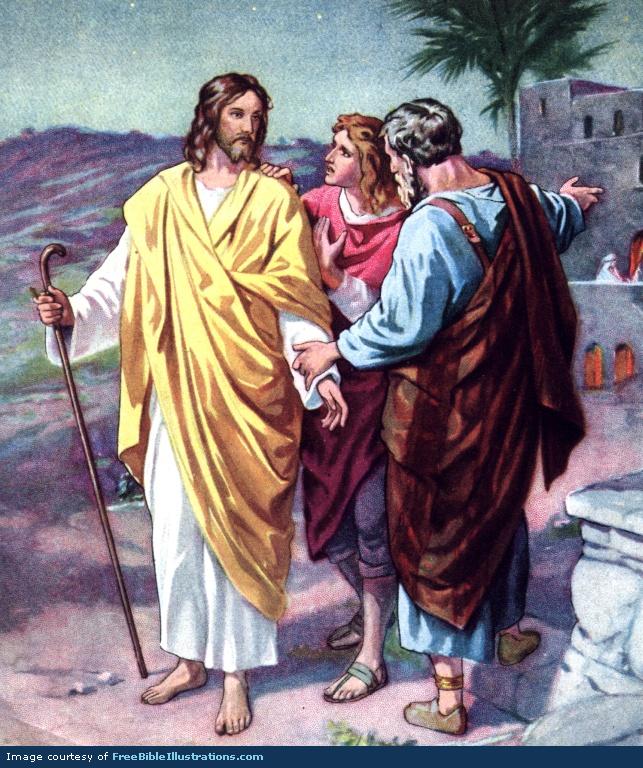
There is a similar trick of the mind at work when we hear the story of the two travelers on the road to Emmaus; we always assume that they were two men. It’s not wonder, since virtually every painting of the encounter on the road to Emmaus will show Jesus with two men. For example, look at the relief on the front of our altar. Many people assume that this is a depiction of the Last Supper (but that there are only two apostles shown because we had to crop it down to size.) Actually, this scene is from after His Passion—you can see crosses on the hill in the distance and there are wound marks in Jesus’ hands. What we have here is to two men at the house in Emmaus, shocked to recognize Jesus in the breaking of the bread.

The artistic depictions always show two men [the picture on the right being the only possible exception I could find], however the original Greek does not call them “two men,” or even “two disciples.” It only says there were “two of them” and that one of them was a man named Cleopas. As to the name and gender of the other traveler, the gospel text is silent. Perhaps the second person’s identity is left as a mystery so as to invite any of us to imagine ourselves in their place in this story. This may be the extent of what we can know for certain, but there is an interesting clue from another Gospel that suggests more detail.

In Gospel of John, it says that “standing by the cross of Jesus were his mother and his mother’s sister, Mary the wife of Clopas….” (John 19:25) So we have a Clopas and Cleopas both associated with Jesus. Perhaps these similar names are merely a coincidence, but perhaps Clopas and Cleopas are variations of the same person’s name. If Clopas and Cleopas are one in the same person, then the other traveler on the road was probably his wife, Mary. This Mary was most likely either Jesus’ aunt and the sister of St. Joseph, or one of the cousins of the Blessed Virgin Mary. What we do know for certain is that this Mary stood with Jesus’ mother at the foot of the cross.

Admittedly, it is speculation to say the other traveler was Cleopas’ wife, but if it was, then this Resurrection episode has a much greater poetry. In the Garden of Eden, a husband and wife ate from a tree. “Then the eyes of both of them were opened, and they realized that they were naked.” They felt ashamed and afraid. But in the house at Emmaus, a husband and wife ate the Eucharist, the fruit of the tree of the cross. “With that their eyes were opened and they recognized Him.” They felt joyful and unafraid. In Eden, God moved about the garden with the man and the woman. After the resurrection, Jesus walks with us, both men and women, along our road.

But whether that second traveler on the road was a woman or not, it would be a remain mistake to think that only men were important in the early Church. That would be at least as mistaken as thinking that every surgeon is a male. Jesus Christ chose some men to be the Church’s leaders, and much is said about them in the Scriptures, but He chose to spread the good news about Himself through the witness of women as well.

Though we sing of the “Faith of Our Fathers,” the faith of our mothers has been just as important, if not more, through time. Today,  it is oftentimes mom who takes the forefront in fostering faith in the family, in leading her children to Christ and His Church; through bedtime prayers and Bible stories, by bringing them to Mass and to CCD, in seeing to it that they receive the graces of the sacraments. If you feel like you’re alone in witnessing to the faith in your family, I commend you, and Jesus is proud of you.

There is another trick of the mind when it comes to celebrating Mother’s Day. On Mother’s Day we remember our mothers, who gave us birth and nurtured us, who raised us and put up with us, but we tend to forget about the greatest gift, the gift of our faith. At the Easter vigil the Exultet asks: “What good would life have been to us, had Christ not come as our redeemer?” Indeed, what good would life be to us if after our births we had not also been brought to Christ through the witness of holy women. Who were these holy women in your life? At this Mother’s Day Mass, let us remember and pray not only for our mothers in the natural order, but for each of our spiritual mothers as well.

They Ran For Him — Easter Morning

April 24, 2011

When Mary Magdalene came to the tomb early Easter morning, she found the stone removed and the body of Jesus gone. She ran to Peter and John, because her love demanded that something must be done. “They have taken the Lord from the tomb,” she said, “and we don’t know where they put him!” So Peter and John went out and ran to the tomb. They both ran, but John ran faster and arrived at the tomb first; not because he loved Jesus more, but because he was younger than Peter.

Some adults run for exercise, but they are the odd exception. Generally, grown-ups just don’t run; except under special circumstances. For instance, my mother doesn’t jog, but she’ll sprint to answer a ringing phone. She loves her friends and doesn’t want to leave them hanging on the line. So, love can make a grown person run.

One time, when I was a boy, I saw my mother run outside in her nightgown and dive into our swimming pool. My mother saved the life of my younger sister, who was floating there facedown.

In all my life, I can only remember ever seeing my father run once. A few years later, during a family walk around a camping resort in my hometown, where we had never walked before, we came upon a tragic emergency. While Mom did CPR, Dad and I ran for the phone at the front office to call for an ambulance. I ran as hard as I could, but Dad was much faster than my ten-year-old legs. I remember seeing his back, his arms rapidly pumping, and thinking to myself, ‘I had no idea he could move that fast.’ And so, from my youth, I’ve known that for the love of another, or in matters of life and death, adults will run. If something is important to them, they’ll run for it.

Mary Magdalene, Peter and John ran to and from an empty tomb out of concern for a dead man’s corpse. So great was their love for Jesus, so great was their admiration for Him, that they ran for Him, even though they thought He had nothing more to offer them. But we are here this morning because Jesus wasn’t dead. He is risen and still active in peoples’ lives today. (To the latter, I am an eyewitness.) He has much to offer to us, our families, our children. But do we run to Him? Do we run to His Church, His sacraments, worship and teachings; or do we run from them? Whether we run is a question of love, and in a world subverted by sin and temptation in so many ways, it’s a matter of life and death. Jesus is risen. So let’s run to Him.

The Giving Tree — Tuesday, 8th Week in Ordinary Time—Year I

March 1, 2011

Do you remember The Giving Tree, that very green childrens book by Shel Silverstein? It’s a story about a boy and the tree that loved him. When he is a boy, the tree gives him her leaves to play with and her apples to eat. However, when the boy becomes a young man he comes asking for money, so that he can buy things and have fun. Since money doesn’t grow on trees, she gives him her apples for him to sell. Time passes, and he comes back, this time asking for a house. The tree lets him cut off her branches so that he may build one. Later, much later, the boy returns again, but he is now a much older and sadder man.”I want a boat that will take me far away from here,” he says. “Can you give me a boat?” The tree offers her trunk and he takes it. He fashions a boat, and sails far away. After a long time, the boy returns, now a very tried and very old man. The tree is now just an old stump. He has taken everything, but she still gives. The story closes with these words: “‘Come, Boy, sit down. Sit down and rest.’ And the boy did. And the tree was happy.”

Now if The Giving Tree has always been one of your favorite books, that’s ok. If it has a special place in your heart, don’t let me or anybody take that from you. But, as for me, this book has always bothered the heck out of me. Even when I was a kid, the story filled me with indignation. Do you know what I’m taking about?

It’s the boy! The selfish, ungrateful boy, who never gives anything back. He receives everything the tree has to give and he never says, “Thank you.” He takes everything she has to give, uses all of it up on himself, and he never says, “I’m sorry.” This book would have been so much better if he just said “thank you” at the end. Does this kid’s behavior in the story of The Giving Tree bother you like it bothers me? If so, then you and I should make sure that we’re not doing the same in our own lives.

So who would be the “giving tree” we take for granted in our lives? Our moms and dads come first to mind. They’ve given us life, food, shelter, clothing, and love our entire lives. What have we given back to them? They probably don’t need your material support right now, but they would appreciate signs of your love. (It’s probably no coincidence that Shel Silverstein dedicated The Giving Tree to his own mom.) But there is another “Giving Tree” we can take for granted, who is even greater and more generous than our parents. I speak of God, and of Jesus Christ, “from whom all good things come.” What should we do for our parents and for God? We should honor them with our words. We should obey them in our actions. We should be grateful for everything and show it.

For God, we do this by way of sacrifices. (This Eucharist is a thanksgiving sacrifice. The name itself means thanksgiving in Greek.) Yet our sacrifice is not merely what happens here at church, but the offering of our whole lives. Those who make no sacrifices for God in their daily lives bring nothing to His altar. What do we have to offer Him today? What will we have to offer him tomorrow?

Jesus Christ is The Giving Tree. At this sacrifice, let us say to Him, “I’m sorry, for misusing your gifts.” Let us say, “Thank you, for your generosity to us.” And let us say, “I love you,” because that will make Him happy.

Man and Wife — Thursday, 5th Week of Ordinary Time—Year I

February 10, 2011

God cast a deep sleep on the man and made for him the woman of his dreams. God fashioned her from his rib, perhaps because it was the bone closest to his heart. This reflects her dignity, for the man was made from mud while she was made from flesh. Woman is God’s final and ultimate creation.

The man beholds her with joy and names her, just as he had named every animal. This authorship is a sign of his authority, not to manipulate nor humiliate, but to lovingly lead and to care for what is entrusted to him. (The fact that “the man and his wife were both naked, yet they felt no shame,” reveals that they completely trusted and respected each other.) As Christ loves His Church, so husbands should love their wives.

Child of God Homily

February 9, 2011

 
Do you know who Bill Gates is? He started a computer software company called Microsoft and is one of the richest men in the world.  If Bill Gates were your dad do you think that he would be willing to buy you things you could never have otherwise? Imagine if President Obama were your uncle.  Do you think he would invite you to the White House sometime?  Do you think that you would have the opportunity to talk to him about your concerns and ideas for the world? Hold that in mind…

When I was younger, something about how we professed the Nicene Creed on Sundays struck me as strange: “For us men and for our salvation He came down from heaven. *Profound Bow* By the power of the Holy Spirit, He was born of the Virgin Mary, and became man. *Straighten* He was crucified under Pontius Pilate. He suffered, died, and was buried.” I wondered, “Why do we bow for Jesus being born? Heck, even I was even born. Why don’t we bow for His suffering instead?” 

We tend to think of God becoming man as a perfectly normal thing for God to do, we take it for granted, but it is actually the most surprising thing that has ever happened in history. The divine Son became one of us so that He could be our brother, and so that His Father could be ours. “See what love the Father has bestowed on us that we may be called the children of God. Yet so we are.”

Our heavenly Father is unimaginably rich, and He wants to provide for you and bless you. Our Father is all-powerful, and He is always open to hearing your prayers. Our Father in heaven has a house far greater than the White House, and He is preparing a place for you to stay. Remember this: you are a child of God the Father, and that’s a big deal.

Wine and Drunkenness — Tuesday, 5th Week of Ordinary Time—Year I

February 8, 2011

“God looked at everything he had made, and he found it very good. … Such is the story of the heavens and the earth at their creation.”

Everything that God has made is good, but anything can be misused or abused in ways that are wrong. A volleyball-sized amount of Uranium can provide electrical power to 200 U.S. homes for a year, but it can also be used in a single bomb to level a city like Hiroshima. The complimentarily of man and woman is very good.  They were made for each other, but they sometimes use each other in painful and unloving ways.

What about alcohol in its many forms? Is it good or bad? On the one hand, the Scriptures praise God for it as a gift: “You bring bread from the earth, and wine to gladden our hearts.” (Psalm 104:14-15) Yet throughout, the Scriptures also caution about the sin of drunkenness: “…Do not get drunk on wine, in which lies debauchery, [instead] be filled with the Spirit.” (Ephesians 5:18) You’ll recall that Jesus provided wine for the wedding feast of Cana, yet He would not be pleased if the guests used His gift for getting trashed.  If we are adults we may only drink alcohol in moderation, and if we are still minors we may only consume it under our parents’ direct supervision. Anything else is misuse, abuse, immoral and dangerous.

But what about illegal or recreational drugs? Can they be used in moderation? No, there is no moderation in this, for the entire goal of using them is to get high, to become intoxicated. If you have never abused drugs or alcohol, I hope you never start; and if you have, I hope you never will again.

Please do not dismiss this teaching as merely the tradition of your elders; for it is God’s command that we should never get drunk or high. God forbids it, just as every good parent forbids it of their children, because getting intoxicated is harmful and dangerous for us. The Scriptures say, “Honor your father and your mother,” and, “Whoever curses father or mother shall die.” Indeed, those who spurn their parents in this can taste sin and death in many forms.

When you’re intoxicated you make dumb decisions. (I don’t know about you, but I already make enough dumb mistakes in a day as it is.) Someone who is drunk or high will do impulsive, stupid things that they would never do otherwise. You lose control of yourself and become vulnerable to others. I don’t want any of you to wake up a morning after, regretting some serious thing done the night before. I don’t want any young woman here to find herself with child, and be tempted to do something terrible.

Imagine which experience would be worse as a consequence of getting intoxicated? To die alone from driving your car off a road into a tree, or to survive a head-on collision that kills a stranger or a friend? Go too far just once and alcohol poisoning or a drug overdose can have you pass out and never wake up again, put you in a coma or make you drown in your own vomit.

Or consider the risk and costs of addiction. Any recovering alcoholic can tell you a story about how much addiction costs, and any smoker can tell you how hard additions are to break. Of course, not everyone who gets drunk or high will become an addict, but some will, and after the first use of certain drugs, addiction is all but certain. With addiction, even if drug or alcohol abuse never sends you to prison, it can still cost you your freedom. And even if drug use never takes your life, it can cost lives of people far away.

Did you know that since 2007 there have been over 35,000 deaths in Mexico from the violence of their organized crime drug cartels? That’s almost ten times the number of American troops who have died in combat since 2001 in Iraq and Afghanistan. Why so much violence? It’s because the Mexican drug cartels make more than one hundred billion dollars a year from selling marijuana and other drugs to Americans, and they will murder or assassinate whoever stands up to them. When we buy their drugs, we’re supporting their terror.

Today I set before you life and death; choose life. If you have never abused drugs or alcohol, I hope you never start; and if you have, I hope you never do again. May no one ever say of Columbus Dons as Jesus said of the Pharisees: their hands are clean in public and ‘they honor me with their lips, but their hearts are far from me.’

Two Becoming One — The Ann and Larry Feltes Wedding

January 12, 2011


Has the institution of marriage now passed its time? More and more people are not getting married at all. Has the time for marriage passed? Is marriage good for nothing but to be thrown out and trampled under foot? No. Marriage is not old-fashioned, it is from the beginning. Marriage is not customary, it is foundational. Marriage, the sacrament of marriage, is needed today more than ever. The world looks around and wonders… “Can promises really be kept for life? Is self-less love really sustainable?” Yes. By the power of this sacrament, which Larry and Ann will henceforth be able to call upon whenever they have need.

What is the source of this sacrament’s power? Jesus, on the night before He gave His life for us, took bread and wine and said, ‘This is my body and blood, this is my very self. I give myself to you, lay myself down for you, and offer you a covenant. I love you, I want to bless you, and I want us to be one.’ Finally, He said, “Do this in memory of me.” This is what husbands and wives do in the sacrament of marriage.

Sacraments make present the realities they signify. The sacrament of marriage is not merely like the love shared between Christ and His Church, the sacrament really makes this mystery present. In your marriage, you can draw upon the love of Christ for His bride and upon the love of the saints for the Bridegroom. Stay close to the Eucharist, continue to pray together every day (as you do now,) and you will embody this mystery clearly for all to see.

On this day, it is natural for us to think of Jim and Mary; and it is right that we do so, for no one puts bushel baskets over shinning lamps. Mary and Jim are irreplaceable, and we would not try to replace them. Today, Ann and Larry enter this sacrament so that they may continue to enjoy and be blessed by the great goods contained in marriage. There may be challenges in melding two families together, but God’s grace will level any bumps on the path, and help the two become one. Every year, Ann writes a Christmas letter to her grandchildren. This Christmas she told them that this year would be special because they would be getting “a bonus grandpa.” Today I feel that I am receiving a “bonus aunt.”

When I asked Ann what she liked about Larry she said, “He’s a good man.” Later, when I asked Larry what he liked about Ann he said (and I paraphrase,) “In summary, in preponderance of all the evidence, and in conclusion… she’s a good woman.” Larry and Ann, because your marriage will be built on this powerful sacrament, with a shared mission (focused on God, family and the work of love,) I trust that people will see your good marriage, and glorify our heavenly Father, for many happy years to come.

God’s Icon, The Family — Feast of the Holy Family

January 5, 2011

Our Catholic Faith is full of mysteries, but what is a “mystery?” In the world, or in a novel, a mystery can be completely solved once important clues are found. “It was Cornel Mustard, in the Library, with the Candle Stick”–case closed. But in the Church, a mystery is something rather different. Is not something that one more clue could solve, nor something so dark and impenitrable that we can know nothing for certain about it. We can know many things with certainty about Christian mysteries, but they are parts of our Faith which are so rich that we will never completely exhaust them. The Trinity is perhaps the greatest of these mysteries, but by God’s revelation (through words and deeds and created things) truths about the Trinity have been revealed to us. Invisible realities can be known through the things that God has made. One great window into the mystery of the Trinity is the human family.

In the beginning, the Lord God said: “It is not good for the man to be alone. I will make a suitable partner for him.” So the Lord God cast a deep sleep on the man, took out one of his ribs, and built it into a woman.  When he brought her to the man, the man said: “This one, at last, is bone of my bones and flesh of my flesh” The two came together, and brought forth new life.

In the Trinity, the Son is of the Father; “God from God, light from light, true God from true God.” The Son is “begotten, not made,” He is a person from a person; not a lesser, created thing. From the everlasting, mutual self-gift of love shared between the Father and the Son, God the Holy Spirit proceeds.

The human family is an icon of the Trinity, like the icon of Mary and Jesus on our Marian altar. An icon can teach us about, and actually connect us to, the events and holy people they depict; however, it is also possible to misunderstand their metaphor. Gazing and meditating upon the Holy Mother and Child can help us to know them and relate to them better, but it would be foolish to think that they are made of wood and paint like the icon. Not everything found in a human family applies equally to the Trinity, but the family is perhaps the greatest icon of the Trinity, sharing many of its realities.

The Trinity is one; three persons sharing the same divine nature. Jesus said, “The Father and I are one,” and, “Whoever has seen me has seen the Father.” Likewise, in the family, husband and wife are one flesh and their children are their very flesh and blood. No matter what, your biological parents and siblings will be related forever, for there is a special oneness to your nature.

There is equality in the Trinity. Jesus accepted peoples’ worship, something only God can justly receive, and the Holy Spirit does the same: “With the Father and the Son, He is worshiped and glorified.” Likewise, there is equality (or at least there should be) between husband and wife in marriage. Though there are natural differences between them, the two are equal in dignity.

Though there is equality among the persons of the Trinity, there is also an order among them. Jesus said, “I do nothing on my own, but I say only what the Father taught me…. The Father who sent me commanded me what to say and speak.” Though equal in dignity, the Son follows the Father’s lead.

Notice in the Gospel how three angelic messages come to Joseph in three separate dreams: first, to flee to Egypt; second, to return to Israel; and third, to settle in Nazareth. Now God could have chosen to send His angel to Mary. He had done it before, Mary would have certainly obeyed God’s command, and Joseph (following her miraculous pregnancy) would have believed her, but that’s not what God did. God wanted Joseph to lead his family, and when Joseph woke his wife up in the middle of the night and said, “Mary, I had a dream–we need to leave, right now.” Mary said, “Ok,” because she knew that he loved her and trusted him. As Mary was to be the heart of their home, Joseph was to be the head of their family.

Mothers and fathers, in sometimes different but complementary ways,  reflect the divine attributes of God. Our moms and dads were distant likenesses of God, but through them we first came to conceptualize about God. Through them we first experience beauty and strength, the firmness of justice and the tenderness of mercy, the immanent love that braces what we are and the transcendent love that calls us to be more.  Parents are icons of God. That is why bad parents can be such a scandal to a life of faith. If our own parents were poor, let us recognize that it is the ideal they failed to live up to, not their behavior, which is the actual likeness of God.

We are all called to marriage, either natural or spiritual. We are all called to raise up biological or spiritual children for God. We are all called to be icons of God. Let us pray for the grace for our own married and parental love to be a worthy icon of the Trinity. That may seem intimidating, but don’t be afraid. You were made for this.

Their First Christmas — Christmas Mass at Midnight

December 27, 2010

Christmas can be a hard time of year for a lot of people. Despite the pious, peaceful, and nostalgic scenes we see on the Christmas cards (like the one on the right,) many peoples’ Christmases are less than picture perfect. Today I would like to tell you the true story of two friends of mine, newlyweds whose first Christmas together was far from idyllic. (I’ll call them Chuck and Sue, though that’s not their real names.)  

In fact, Chuck and Sue’s first year together had been a rocky road. Chuck has always been a good and faithful man, but at one point in the beginning, he seriously thought about getting a divorce. He says that it was only by the grace of God that the serious tensions and misunderstandings between them were resolved and their marriage was saved.

After they tied the knot, the two picked-up and moved away from their closest family and friends to a small town down south where they had some distant relatives. Chuck worked hard as a blue-collar laborer, but after this transition, he found himself unemployed. And unfortunately, all of those distant relatives proved too distant to care about helping-out a struggling young couple in need. Their first Christmas together, Chuck and Sue were out of work, pregnant, and homeless.

How do you think Sue must have felt? Do you think she felt concerned about their circumstances and their family’s future? And how do you think Chuck must have felt when through no fault of his own he wasn’t able to provide better for his wife and child on the way? Had it not been for their deep faith in God and the consolation of their prayers, they would have been overcome by darkness, resentment, fear, and despair. But instead, their first Christmas together was the brightest and most joyful in history. You know Chuck and Sue’s story well, for theirs is the Christmas story. Chuck’s real name is Joseph and Sue’s real name is Mary.

Remember, the Christmas story is not a fairy tale from far, far away. It’s a real story in the real world, and for the real world. Our lives still have difficulties, but Jesus Christ has come, and that makes all the difference in the world. No matter what we’re going through, because of Christmas, we all have good reason to be merry.

And in closing, let me say one final word: I’m always pleased by how full the church is at Christmas. Please come back. Jesus Christ calls you back. He knows our world well and He knows how much you and those you love need His grace to get through it. The shepherds were called to find Jesus in a feed trough. Jesus invites you to find Him here.

Let Advent Be Advent — 2nd Sunday of Advent—Year A

December 5, 2010

John the Baptist was living quite differently compared to people in his day. What he wore was different, what he ate was different, and what came from his lips was also different. Yet, John shared something in common with us today. Like Christians in this season of Advent, John knew that the Christ, or Messiah, had already been born, years before in the past. Like us, what John was preparing for was the coming of Christ anew.

That’s the reason why in Advent, in this season of awaiting the Messiah’s arrival, John the Baptist is so prominently featured in our Sunday Gospel readings, like today’s. By looking at John we can learn how to prepare ourselves for Christ’s arrival. As I mentioned before, John was rather different from his neighbors in his day. Today I suggest that we in the Church need to be a bit more different from everybody else if we want to prepare better for Christ’s coming this year.

What did John do with all that time alone in the desert, when he wasn’t out preaching or baptizing? Surely, John was praying, asking for grace and contemplating the one who was coming. The desert is a quiet place, free of distractions, and conducive to prayer. The world can make this month before Christmas a very stressful time. This Advent, you must find a desert, a quiet place, free from distractions, where you can pray each day. Create a daily desert space for your own family as well and prayer together as one. You cannot prepare well for Christ’s coming without daily prayer and the peace it gives.

What did John eat in the desert? He ate locusts, or grasshoppers, and wild honey. The wild honey may sound pretty sweet, until you realize that it was guarded by wild bees. John ate simply. Our meals in Advent should be simple too. You know how it is at Easter, when you enjoy what you gave up for Lent again for the first time? You find yourself enjoying what you denied yourself more than ever before. Then just think of how much greater your Christmas feasting will be if you eat more simply in Advent. (Besides, if you fast or diet now, there will less pounds to lose next year.)

John dressed differently than other people in his day. He wore a garment made of camel’s hair and tied a leather belt around his waist. He dressed like the Old Testament prophet Elijah because he wanted people to know that these were special days. You can also dress in ways that witness to the world that these are special days. One way to do this is to dress liturgically. As you can see, the main color of Advent is purple. If you have purple outfits or ties, now is their season.

By the way, this Wednesday, December 8th, is a holy day of obligation and Christ is asking you to attend the worldwide feast in honor of His immaculately conceived mother. On such a day, intentionally wearing blue or white would honor her. Try dressing liturgically and you’ll find that it reminds you and others of what makes these days special.

What came from the lips of John was different, and despite the large crowds, whatever he spoke was not for himself but for Christ. This year, wish people “merry Christmas” instead of “seasons greetings,” and instead of “happy holidays,” say “happy holy days,” for by this you give witness to the true reason for the season.

John knew that he must decrease and that Christ must increase, for John himself was not the light but had come to give testimony to the light. In the world, the Christmas songs have already begun on the radio and the Christmas trees are all up and lit in the malls, but the day after Christmas their songs will stop and their decorations will be taken down. But as the world is packing Christ away for another year, the Church is just beginning its celebration. You know the “twelve days of Christmas?” On Christmas day, the twelve day begin, not end. Like Easter, the Church celebrates not just one day, but for weeks after.

This year, let Advent be Advent, and save Christmas for Christmas. Sing Advent songs for Advent, and (as much as possible) save Christmas carols for their time. I suggest leaving your Christmas lights, on your tree and on your house, unlit during Advent. Then, when you plug-in at last on Christmas Eve, you shall enjoy a joyful sign that the light of the world has come.

St. John the Baptist calls to you through the Scriptures. I encourage you here, before you. And I hope the Holy Spirit is now prompting you, in your hearts and minds, to keep Advent as Advent this year, and to prayerfully prepare for the coming of Christ at Christmas more profoundly than you ever have before.

The Saints & Us — 22nd Sunday in Ordinary Time—Year C

November 5, 2010

 
Brothers and sisters, as the Letter to the Hebrews tells us, we have approached Heaven even as we remain on earth. Though we are dust and sinners, we stand before Jesus, the eternal Father, and the Holy Spirit. We draw near to each other and they invite us to share more deeply in their friendship. And they are not alone. They are surrounded by countless angels and by a multitude of men and women whom they have made perfect in goodness and love. We have a name for these “holy ones” who live with God in Heaven. We call them “saints,” and Jesus invites us to share their friendship, too.

Have you ever had the pleasure to introduce your friends to each other; people who already know and enjoy you, but who have never met each other? I think you’ll agree that it’s a very special joy when your friends to befriend each other. When your friends befriend each other do they love you less because of it, as if their affection has been divided or diluted? No, the love between all of you is greater for being shared. So it is with Jesus, the saints, and us. Some Christians fear that befriending Jesus’ friends in Heaven will lessen our love for Him. They fear that talking to them and honoring them will distract us from Christ. But these are silly fears. Love increases by being shared.

When someone asks you, “Would you pray for me,” or asks you to pray for one of their heartfelt concerns, what do you say in reply? Do you refuse, saying, “Why should you ask me to pray for you when you can go directly to God?” Nobody says that. Instead, Christians say, “Of course I’ll pray for you.” Christians ask each other to intercede for them not because they have lost hope in Christ, but because they have it, and because Scriptures tell us, “pray for one another.” Asking our friends and family in Heaven to pray for us is no different than asking our friends and family on earth, except that the prayers of the saints are offered by souls perfected in love and divine intimacy.

What about the objection that honoring the saints distracts from Christ? Today’s Gospel shows that Jesus does not think that sharing honor with His saints detracts from His own preeminent glory. He has said to them, “My friend, move up to a higher position. Then you will enjoy the esteem of your companions at the table.” By giving seats of honor to His saints at His heavenly wedding banquet Jesus invites us to esteem them. In honoring them, we honor Him.

Remember that our circle of closest family and friends is not limited to earth. We have brothers and sisters in Heaven; saints and angels who know us, love us, and want to help us arrive at our true home. Let us remember to take the opportunity to make their acquaintance and grow in their friendship.

Have A Holy Halloween!—31st Sunday in Ordinary Time—Year C

October 31, 2010

Have you ever noticed how our Christian holidays get filled with stuff that distracts us from what we’re really celebrating? Take Christmas, for example. There’s nothing wrong with exchanging gifts and decorating with tress and lights, but there is good reason in that season that we need be reminded, to “Keep Christ in Christmas.” For many people, celebrating the birth of the Prince of Peace on earth is the most stressful time of the year. Or consider Easter: There’s nothing wrong with chocolate bunnies and hunting for Easter eggs, but the connection between egg-laying rabbits and Jesus’ resurrection is tenuous at best.

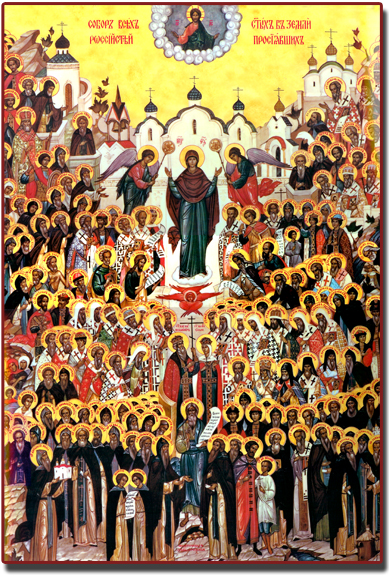
However, this disconnection between Christian holy days and the cultural observance of holidays is the greatest when it comes to Halloween. There’s nothing wrong with kids playing dress-up and going door-to-door to ask for candy, (I have many happy memories of this myself,) but Halloween’s connection to its Christian holy day seems to have been forgotten. The name “Halloween” comes from “All Hallows Eve,” or the evening before All Saint’s Day. Something is “Hallowed” when it is sanctified or respected, as in, “Our Father, who art in Heaven, Hallowed be thy name.” All Saints Day celebrates the “hallowed” ones, the holy ones, the saints who are now in Heaven. Some of these saints are canonized, but most of them are not.

For every friend and relative we knew on earth who is now in Heaven, November 1st is their feast day in the Church. And for our holy dead who are still being purified and made perfect so that they may enter the fully-unveiled presence of our infinite God, there is November 2nd, the Feast of All Souls. In this fall season, when the natural world appears dying, our Church celebrates the holy dead, for we have hope in the new life.

Halloween, or “All Hallows Eve,” is to All Saints Day what Christmas Eve is to Christmas. As Christmas Eve reminds us of Christ’s coming, so Halloween should remind us of the victory of the saints, and of our own life’s calling: to become the best possible versions of ourselves, to become saints.

I think it is in no way an overreaction to observe that the secular observance of Halloween has overtones in dark, demonic things; the things of horror. Isn’t it suspicious that from a feast celebrating the saints in light, we have a secularized holiday focused on things of darkness? Instead of Christian hope in the resurrection of the dead, Halloween gives us images of zombies. Instead of the consolation that we are surrounded by the perfected souls of the saints, who love us and are full of concern to help us, Halloween gives us tales of ghosts and demons who want to harm and scare us. How does this sort of thing happen? I don’t think it is crazy to think that the Evil One wants to distract people from the true reason for this season; that the Devil would have us thinking about him, rather than the saints, that he wants us to be terrified, rather than full of hope.

Did you know that this Sunday, Satanic worshipers will come to Masses and Catholic Churches around the country trying to steal our Lord in the Eucharist? (Interestingly, they don’t go after the communions of Protestant denominations, but only the Catholic Eucharistic Hosts.) Their plan is to desecrate Jesus in a ritual they call a Black Mass. In doing this they are trying to rebel, seeking a false freedom that cannot make them happy. They try to harm Jesus, but only hurt Him in as much as they sadden Him. These sad people, who strike out at Jesus, are really hurting themselves and the Jesus still loves them. We know that the Lord loves every person He has made, for as the first reading notes, if the Lord did not love His creations, they would not continue to exist. As we see in today’s gospel about Zacchaeus the sinful tax-collector, there is hope for them and all of us, for Jesus “has come to seek and to save what was lost,” and He calls every one of us to be happy and holy with Him.

This Halloween, let us pray for the misguided persons, who knowingly or unknowingly, will dabble in bad things tonight, that they may turn to Christ. Let also offer Jesus our consolation for how the feelings of His Sacred Heart will be wounded by their offenses against His love. And for ourselves, let us try celebrating Halloween in some different ways this year.

Maybe everyone in your household already has their trick-or-treat costumes ready (but I know it can sometimes be a last minute decision.) If you’re still looking for costume ideas, how about dressing up as an awesome saint? Saint costumes can be easy and very creative. Dressing like this delights the saints (and it will probably score you more candy.)

Does your family have a patron saint? If not, then pick one this Halloween and entrust your family to them for the year ahead. Print off their picture from the internet and put it on the wall, learn about them as a family, and pray to them, asking that they pray for you. (I, for myself, am choosing St. John Vianney this year; the patron saint of priests and a good guy to know.) Great saints are waiting, just waiting, to grow in friendship with you.

This year, make it a point to celebrate the vigils and feasts of All Saints and All Souls. Our family and friends who are now in Heaven or on their way there expect us to be joyful on these feast days in their honor, and there is not better place for us on earth to draw near to them than here, around the altar of Jesus Christ.

Christ is the Light who shines through the darkness. This Halloween, let us claim the night for Jesus Christ and His saints.