Archive for the ‘Marriage and Family’ Category

Prayer is Necessary — 29th Sunday in Ordinary Time—Year C

October 17, 2010

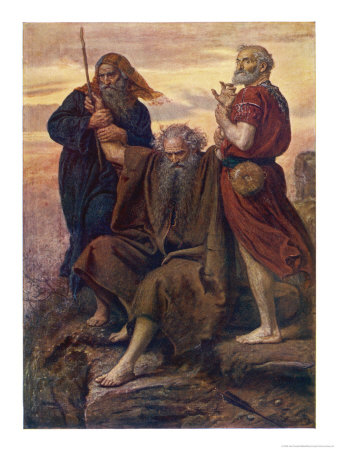
As the Hebrews fought the Amalekites, Moses held up in his hands, above his head, the wooden staff of God. In doing this, He resembles Jesus, who outstretched his arms on the cross, and the priests of Christ’s Church, who raise their hands up to Heaven.  Each one, Moses, Jesus, and His priests, offer prayers to the Father.

As long as Moses kept his hands raised up,
Israel had the better of the fight,
but when he let his hands rest,
Amalek [the enemy] had the better of the fight.

What would have happened if Moses had kept his arms just down at his sides? God’s people would have lost their deadly battle. What would happen if Jesus were to stop pleading for us at right hand of the Father in Heaven? We would be left all on our own. What would happen if priests were to no longer to offer the Mass? The Church would be deprived of graces. If Moses, or Jesus, or the priests of the Church were not persistent in prayer, souls would be lost. The same is true for you and I as individuals.

If you or I wish to be saved, it is necessity for us to pray always without becoming weary. As St. Alphonsus Liguori, a doctor of the Church, said: “He who prays is certainly saved; he who does not pray is certainly damned. All the saints in heaven, except infants, were saved because they prayed; and all the damned in hell were damned because they did not pray, and this is their greatest torment to see how easily they could have been saved, had they prayed, and that now the time for prayer is over.”

Prayer is how we grow in our relationship with God. And Heaven consists first and foremost in an intimate relationship with Him. But, if we do not pray, we will not have much of a relationship with God, and Heaven will not be a place where we really want to live. It is essential that you commit yourself to praying every day, ‘whether it is convenient or inconvenient.’

To remain committed to this, ask the help of other to strengthen you and keep you faithful to prayer. Moses had the help of Aaron and Hur, at his right and his left. Jesus had the help Mary and John, at the foot of His cross. The priest celebrating Mass has the help of God’s people, those in the church on earth and those in the Church in Heaven. So have your spouse, your children, and your friends to pray with you and keep you faithful to prayer.

Families should pray together, parents with their children. This will instill the Faith in them more than anything else.  And Fathers need to take the lead, for if only Mom prays with the children they will wonder, “Why doesn’t Dad pray, too?”

Couples should also pray together.  A couple that prays together every day a divorce rate less than one percent. And it makes sense, because if I know that someone is praying for me, that they’re willing my true good, then even if there are rough spots between us, I know that we’re on the same side. So before you leave the house, or before you go to bed, pray together as a couple; even if it’s as simple as a moment of silent prayer. Remember that the family that prayers together, stays together.

It is necessity for us to pray always without becoming weary, as families and individuals, for “He who prays is certainly saved; he who does not pray is certainly damned.” So pray every day, because our souls depend on it.

The Great Marriage — The Nick and Laurel White Wedding

October 9, 2010

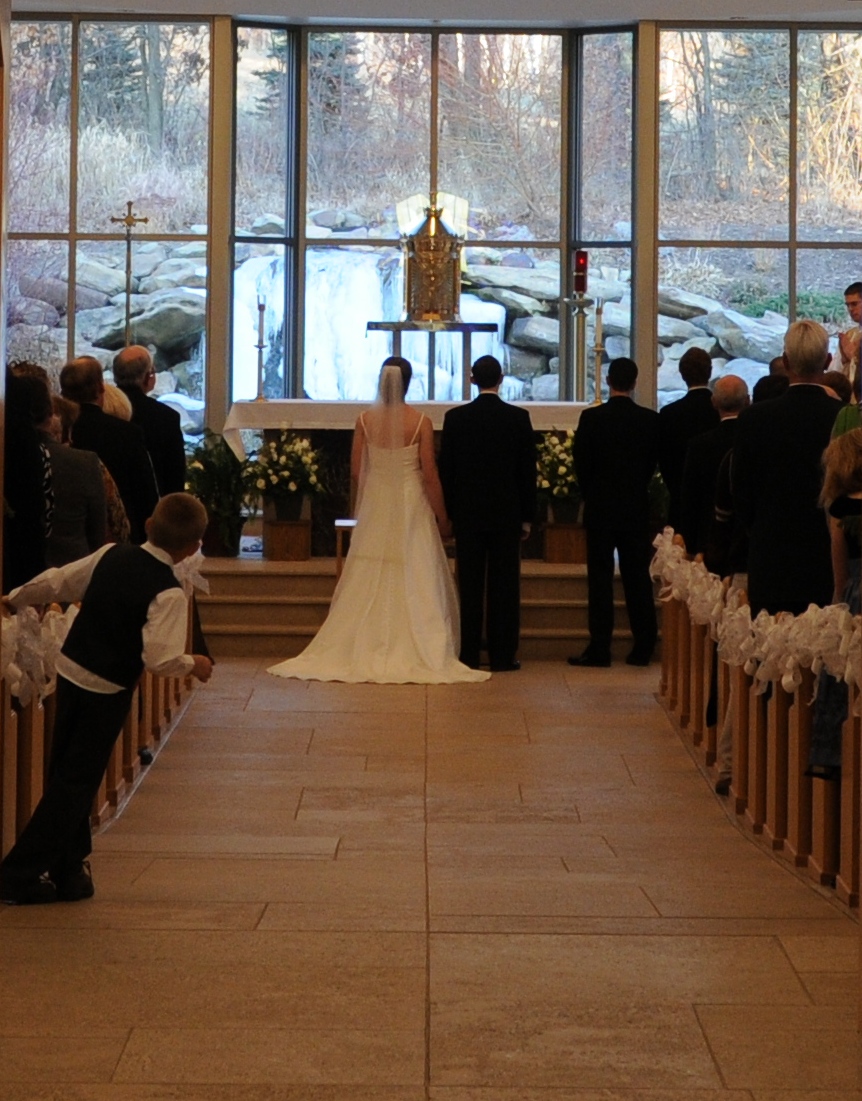
In the Gospel we just heard Jesus say that “from the beginning of creation, God made them male and female,” and “for this reason a man shall leave his father and mother and be joined to his wife, and the two shall become one flesh.” Jesus is quoting here from Genesis, but something about these words has always struck me as a little strange. Why did Jesus and Genesis mention that ‘a man shall leave his father and mother to be joined to his wife?”

We tend to think of the bride as leaving her family to join her husband. Traditionally, as we saw today, her father walks her down the aisle to give her away, and the bride changes her name to match her husband’s. Perhaps it was put this way (“a man shall leave his father and mother”) because for the man must go out in pursuit of his bride. If a woman in a relationship found out that her man was leaving it to her to pursue him she would be very disappointed.

There is, I think, another important reason for the choice of these words: these words speak of Christ. Jesus left His eternal Father’s house in Heaven to become a man, and then He departed His perfect mother’s house to begin His ministry, all in pursuit of winning a bride, His bride the Church. Jesus is the man who left His father and His mother to be joined to his wife.

From the beginning of creation, God had made us male and female. So when the Lord sought to be perfectly united with us, Christ became a human being. Jesus became one flesh with our humanity, so that we could become one with His divinity. He came as a man because a man, like God, pursues his beloved. He comes to us as a man in love, not out of lust, not to dominate us or for His own selfish pleasure, but for a noble purpose. Jesus comes to propose to us and to enter into a marriage between Heaven and Earth, between God and man, between Himself and His bride, the Church.

Nick and Laurel, the sacrament you are about to enter, the sacrament of marriage, connects you to this union between Christ and the Church. Don’t try to rely on you own resources alone, but connect to the power of your sacrament. Nick, ask Jesus to let you share the love He has for His bride. Then, empowered by this love, you will lay down your life for your bride, and cherish her and bless her as long as you both shall live. Laurel, ask Mary and the saints, to let you share the love they have for the Bridegroom. Then, empowered by this love, you will rejoice in your husband, and honor him and follow him as long as you both shall live. Remember, this sacrament you are about to enter is not merely a symbol the of love between Christ and His bride. It makes that love truly present in you.

The Eager Provider — Thursday, 27th Week in Ordinary Time—Year II

October 7, 2010

Today we celebrate Our Lady of the Rosary and we hear a parable about a man who would rather not be bothered.  Let us compare this man to Mary.

He considers his visitor his friend, but she claims us as her children.

He feels too tired to help, but she never sleeps.

He hesitates to provide, but she is eager to give.

If mothers who are imperfect know how to give good gifts to their children, how much more will our perfect mother in Heaven intercede to give us good things whenever we ask her in the Rosary. It is a prayer which she receives from us as a sweet bouquet of roses.

The Child Mary — September 8 – Nativity of Mary

September 8, 2010

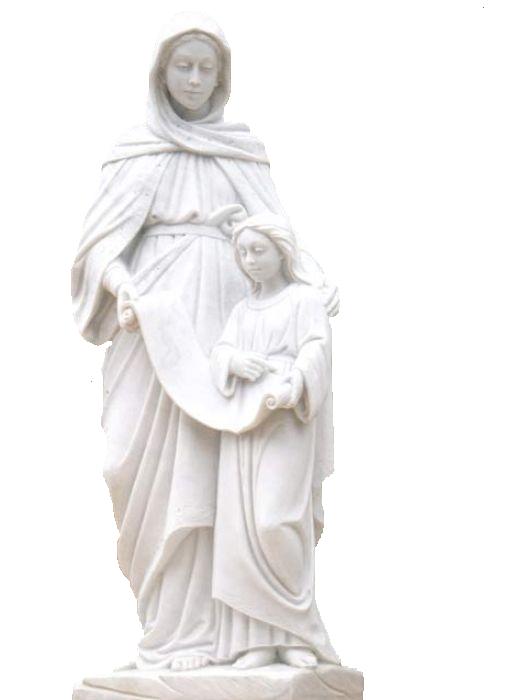
Nine months ago we celebrated Mary’s Immaculate Conception. Today we celebrate her birthday. By my estimation, Mary is now about two thousand, twenty-five years old, but if you saw her I’m sure she wouldn’t show her age. How old does Mary seem when you picture her in your mind? I’d bet that you think of her as fully-grown up; like your mom or your teachers. But today’s feast reminds us that she was once your age too.

Mary was little once too, and just because Mary lived a life without sin doesn’t mean that her childhood was a bed of roses. I think adults sometimes forget how hard and stressful things can be when you’re little, but Mary remembers everything perfectly well.

She remembers what it was like to be little like many of you. How she got scared when Nazareth’s big, neighborhood dogs would bark at her. How loud cracks of thunder frightened her at night and made her hide under the covers. She remembers how other girls made fun of her, for being different or weird, and she remembers how she cried. But even when she got sad or scared, Mary knew that she was loved and not alone. Not only did her parents love her, but she was convinced of God’s love, too, and understood that He was never far from her. This consoled Mary and reassured her that everything would be alright.

After our resurrection, when we get glorified bodies like Mary has now, we will have some new abilities. We will be able to go anywhere we want in an instant. And our glorified bodies should allow us to be more than one place at once. (It only makes sense that if saints on earth can bi-locate, then the  saints in Heaven should be able to as well.) And I also suspect that we will be able to change ourselves back and forth to whatever age we choose.

All this is to say that if at any moment you want Mary to be with you for consolation and support, you only need to ask her. Knowing her abundant love, I can’t imagine she would refuse. And when you think of her with you feel free to picture her at your age, even if you’re little. She understands you, loves you, and can relate to your situations more than you know. Like her Son, Mary is always with us, especially when we ask her be.

We’re in a Hurry — 16th Sunday in Ordinary Time—Year C

July 18, 2010

The other day I was thinking about this homily when I heard the words of some modern poets on my radio. They said:

I’m in a hurry to get things done,
Oh, I rush and rush until life’s no fun.
All I really gotta do is live and die,
But, I’m in a hurry and don’t know why.

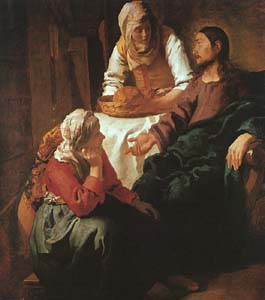
This goes to show that we still have a Martha problem today. The group Alabama said that they didn’t know why we get in a hurry, even though we’re not having fun, but I think I know the answer. The reason is that our loves and good desires are mixed with fears. If we would take that fear away, we would find peace.

Martha loved the Lord and wanted to serve Him well, but she had fears mixed in. She was the one who invited Him to the house and He probably had His apostles and other disciples with Him. She was busy serving them all, perhaps making the biggest meal she had ever made, and she was full of worries. “What if I’m a poor host and Jesus is disappointed with me? What if there’s not enough food for everyone to eat?”

We are often the same way. We fear that our lives are on the edge of disaster if our own plans and efforts should fail. We worry about bad things happening to ourselves and the people we love. We are anxiety about how Jesus feels about us.

Martha had a great desire to do good, but Martha’s fear tempted her to do harm. Her sister, Mary, was sitting at Jesus’ feet, listening to His words. (The Greek word for disciple actually means “one who sits at the feet of.”) Martha tries to take Jesus’ disciple away from Him.

Similiar thing can happen in our live on account of fear mixed with love. A husband and father can obsess about his work, out of a love for his family and a desire to provide, but his family can be left feeling like they come second in his life. A wife and mother can be so concerned that her loved ones will be safe and happy that she tries to control everything, making her family less happy because of it. Martha’s problem and ours is not that we work–work is a part of life–but in how we go about it.

Jesus says to Martha, and to us, “Martha, Martha, you are anxious and worried about many things. There is need of only one thing.” What is this one thing we need? We need the peace of Christ. What is the peace of Christ? It is several things.

It is the awareness that God is near and guiding us. In the first reading, three heavenly visitors approach outside of Abraham’s tent. Now, the Holy Spirit dwells within our tents, Jesus is at our side, and we have a Father above. We are never left on our own.

With the peace of Christ we recognize that whatever may happen to us or those we love, it is for our good. As St. Paul observes in the second reading, even his sufferings are a cause for rejoicing for they advance the salvation of the whole Church with Christ.

With the peace of Christ we recognize that misery is not just around the corner, nor is happiness out of reach. Happiness is at head, in the knowledge that Jesus loves us, likes us, cares about us, and cares for us. Living in the peace of Christ means there is no reason for us to be unhappy.

Let us continue to do works of love for God, ourselves, and others, but let us do them always in the peace of Christ.

Father’s Day Homily

June 19, 2010

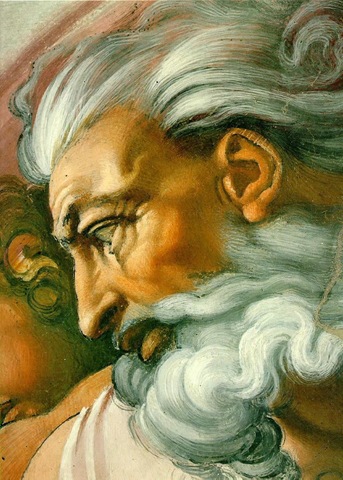
“See what love the Father has bestowed on us that we may be called the children of God. Yet so we are.” (1 John 3:1) As St. Paul says in the second reading, “Through faith [and baptism] you are all children of God in Christ Jesus.” (Galatians 3:26-27) God is our Father who lives and reigns in Heaven. What is the fatherhood of God the Father like? What can we say about His fatherhood. I offer these insights:

The Father’s love begets life.
We see this in His Son, who is eternally begotten from the Father. And begetting is not a merely an action which the Father had done and then walked away from. The Son is eternally begotten from the Father in love.  And, as the Prologue of John’s Gospel says, “All things came to be through [this Son], and …. what came to be through him was life…” The Father’s love begets life.

The Father labors in love.
God the Father labors to fashion and sustain creation; heaven and earth and every creature, seen and unseen. He makes them in love and preserves them in love. As the prophet in the book of Wisdom observes, “[Lord,] you love all things that are and loathe nothing that you have made; for what you hated, you would not have fashioned. And how could a thing remain, unless you willed it; or be preserved, had it not been called forth by you? But you spare all things, because they are yours, O LORD and lover of souls, for your imperishable spirit is in all things!” (Wisdom 11:24-12:1)  The Father labors in love.

The Father guides His family.
The world became dark though sin, so the Father enlightened it. The people became lost without Him, so the Father guided them. The Father enlightens and guides His children by speaking His word to them. Jesus Christ is the Father’s word. The Father guides His family.

The Father is easily pleased by those who are His own, yet He calls them ever higher.
At Jesus’ baptism, the Father spoke from the heavens, “You are my beloved Son; with you I am well pleased.” Yet, as today’s gospel recalls, the Father also called His beloved Son to take up the cross. Four days before His Passion, Jesus said, “I am troubled now. Yet what should I say? ‘Father, save me from this hour’? But it was for this purpose that I came to this hour. Father, glorify your name.” Then a voice came from heaven, “I have glorified it and will glorify it again.” (John 12:27-28) On the cross, Jesus was not just lifted up, but exalted. The Father is easily pleased by those who are His own, yet He calls them ever higher.

The Father is just like the Son.
Some people find it difficult to relate to the Father, but the Father is just like His Son. At the Last Supper, Philip said to Jesus, “Master, show us the Father, and that will be enough for us.” Jesus said to him, “Have I been with you for so long a time and you still do not know me, Philip? Whoever has seen me has seen the Father. How can you say, ‘Show us the Father’?  Do you not believe that I am in the Father and the Father is in me? The words that I speak to you I do not speak on my own. The Father who dwells in me is doing his works.” (John 14:8-10)  The Father is just like the Son.

The Father transcends human fatherhood, but He is the origin and standard of all fatherhood.
God transcends the human distinction between the sexes. The Father is neither man nor woman: He is God. Although the Father is the origin of all fatherhood, He transcends human fatherhood. No one is father as God is Father. Yet, we who are earthly fathers, who have natural or spiritual families and children of our own, must take our Father in Heaven as our standard and model. Each of the insights I have given for God the Father have application for our fatherhood.

Your fatherhood should beget life.
Now the begetting of life is not merely biological, if it were then priests would not be fathers. There are some biological fathers who beget life and leave. These men fall very far short being true fathers. True fathers give life and nurture that life forever, like God the Father who begets His Son eternally. If you are a mother or father, even if even if your children should die, even if you should die, you are a mother or father forever.

Your natural fatherhood should be fruitful. More than just biologically, but biologically, too. What would you think of a priest who was both capable and called to work to beget more spiritual children by sharing the gospel, but who refused to do so for self-centered reasons. What if he were to say, “I’m happy with the number of parishioners I have already.” Your fatherhood should beget life.

Your fatherhood should be a labor in love.
Always remember whom you are working for and work for love of them. Beware of an ambitious careerism, which is all about you. What would you think of a priest whose primary ambition was to become a cardinal, instead of those entrusted to him. 

At home or at the workplace, labor in love for your family. And take time to rest and enjoy them. Even God the Father rested after His labors to enjoy how “very good” it was.

Your fatherhood should guide your family.
You are called to be a leader, guide, and teacher for your family. Your wife will not begrudge your lead if you love her and lead her as Jesus loves and leads the Church. Remember, Jesus died for His family and bride.

As parents, you are the primary educators of your children. Sometimes we think of education as only what happens at school. But the most important lessons in life are not taught in the schools, but in the home. The home is the domestic Church and the school of love.

In your fatherhood, let your children know your pleasure in them and always call them ever higher, to all they can be.
Always show them your pleasure, that with them you are well-pleased. But like God, love them too much to let us remain as we are.  Grow them to their full potential.

In your fatherhood, take the Father in heaven as your standard and model.
If you’re ever unsure of how to image the Father, look at His son, for Jesus is the perfect image of the Father. The Father is just like the Son.

May God bless all our Fathers, living or dead, and may help we who are fathers to be better ones.

An Incomplete Lord’s Prayer — Thursday, 11th Week in Ordinary Time—Year II

June 18, 2010

Sometime in the past, I realized that I didn’t pray the Lord’s Prayer right.  It’s not that I was actually changing the words Jesus taught us to say, but I realized my focus was not fully what Jesus had in mind. My subjective, firsthand experience of praying the prayer went something like this: 

God, who art in heaven…
     [<Here I get distracted for several seconds>]
…give me this day my daily bread,
and forgive me my trespasses,
as I forgive those who trespass against me,
and lead me not into temptation,
but deliver me from evil.

Did you notice anything different?

First, Jesus taught us to pray to “Our Father” because we are not praying to anonymous force, but a person, a divine person who is imaged in a special way by natural and spiritual fathers on earth. Earthly fatherhood is a diminished image of Him. Biological fatherhood teaches us about our heavenly Father’s transcendence, while devoted fathers teach us about His love. (“The respective ‘perfections’ of [both] man and woman reflect something of the infinite perfection of God,” as the Catechism teaches, but “Our Father” is significant.)

Second, the prayer’s early petitions, “hallowed be thy name. Thy kingdom come. Thy will be done on earth as it is in heaven,” are every bit as important as the later petitions ‘about us.’ God is justly entitled to glory, His kingdom and reign.  Remember that all these are essential and conducive to our own greatest happiness.

Third, the Lord’s Prayer is not meant to be prayed just for yourself or myself, but for all of our Father’s family, for the whole Church, for even the whole world. The Our Father is not only a petitionary prayer, but an intercessory prayer.

So when we prayer the Our Father, the perfect prayer which Jesus taught us, let us pray it in its completeness, with a presence of mind and fullness of heart.

A Mystery Revealed — Trinity Sunday

June 2, 2010

You may recall my mention of one of my favorite professors at seminary, Dr.  Perry Cahall. And I remember him telling us one day in class, “If, someday when you’re a priest, I hear that you got into the pulpit on Trinity Sunday and tell the people, ‘You know, the Trinity is a mystery, and so there’s really nothing we can know or say about it…’ I will hunt you down like the dogs you are.” This is my first homily on Trinity Sunday, and I’m going to make sure I give Dr. Cahall no reason to come after me.

The Trinity is a mystery, but that doesn’t men we know nothing or can say nothing about this central mystery of our Faith. In Catholic theology, a “mystery” is not something which is unknowable to us, it is just something which our human reason could not have discovered on its own.
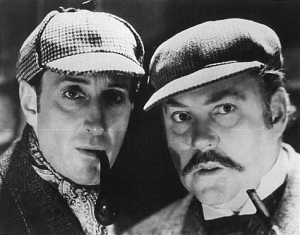
Imagine if you came upon a sophisticated and well-written mystery novel. It’s so good that you can’t put it down. But as you get towards the end, you discover that the last couple chapters of the book are missing. You noticed some clues as the story unfolded, but without those last pages you can’t figure out the identity of the one “who did it.” You might try to find the ending in another copy of the book, but what if no other copies existed and no one had ever read the ending before? Your only hope would be to speak with the author. The author could tell you the rest of the story. The author could unveil the mystery for you and reveal the identity of the one “who did it.” Like that in sophisticated mystery novel, our God has placed clues throughout creation and His Old Testament interactions with His People. Yet, it was not until the coming of Jesus that the “who done it” was plainly revealed: God, the Author of the universe, is Father, Son and Holy Spirit.

Today I would like to talk about some common questions people have about the Trinity. For instance, how is God both one and three, and then what difference does the Trinity make?

Some people have trouble with the concept of the Trinity because they think it is the claim that “one equals three” in God. However, this is not what we believe about the Trinity. The number one does not equal the number three, not in God or anywhere else, and not even the omnipotent power of God can make a logical contradiction true.

We believe one God, comprised of three divine persons: the Father, the Son, and the Holy Spirit. God is one What, as three Who’s. There is one divine nature, but three divine knowers, three divine willers, and three divine actors. We do not believe in three anonymous forces, but three loving persons. There is no God apart from or beyond these three persons.

Now the Father is not Jesus Christ. Jesus is not the Holy Spirit. And the Spirit is not our Father. They are distinct persons. Yet, at the same time, each possesses the fullness of the divinity: perfect goodness, infinite beauty, perfect knowledge, infinite power, perfect mercy, and infinite love. We do not worship three gods, but three eternal persons who comprise one God.

The belief in the oneness of God was firmly instilled into the Jewish people. This conviction helped to keep Israel from falling into the worship of false gods and experiencing all of the evils that brings. For instance, Israel’s Canaanite neighbors were idolaters, who worshiped mere objects as gods that could make them happy. They practiced child sacrifice, killing their own children in hopes of receiving greater blessings in this life from the gods. And they had temple prostitution, in which promiscuous sexuality was as hailed as sacred.

Notice how our society has become more and more like those pagans as it has drifted from belief in the one true God. Our worship of objects which we think can make us happy is called materialism, or consumerism. Our human sacrifice, done in hopes of greater blessings in this life, is called abortion. And some have raised up sexual promiscuity as the way of greatest freedom and happiness.

The Jews were spared all of these evils so long as they clung to their conviction that “All gods are not the same, and we are to worship only one.” The God of Abraham, Isaac, and Jacob. Even to this day, observant Jews pray a prayer twice daily called the “Shema Yisrael,” from a passage in Deuteronomy:

“Hear, O Israel! The LORD is our God, the LORD is one!  Therefore, you shall love the LORD, your God, with all your heart, and with all your soul, and with all your strength.”

Jews remain Jews today because they do not believe that Jesus is the promised messiah, or the Christ, the one for whom they have been waiting. Sometimes they criticize Christians saying we are not really monotheists, but polytheists, who believe in three gods: “The LORD is our God, the LORD is one!”

Yet, revealingly, the word that God inspired in this Old Testament passage (“The Lord is one”) is not one of the words in Hebrew which always means numerical and solitary oneness (such as “yachid” or “bad”.)  Instead, the Holy Spirit selected a word which usually means a unified oneness: “echad.” This word (“echad”) is the same word used in Genesis, where God says of man and woman, “the two shall become one flesh.” In their union, the persons are as one being. And recall, God had said, “Let us make man in our image , after our likeness. …[And] God created man in his image; in the divine image he created him; male and female he created them.” When husband and wife become a unified one, as one couple, in time, they are in the image and likeness of the Father, Son, and Spirit, who have are a unified one, as one God, eternally.

So what difference does the reality of the Trinity make for our lives? The Trinity shows us that God is not a solitary individual, isolated and alone. God is a loving communion of persons. This is the reality we come from, and this is the reality we are called to, in this life and the next.

In our post-modern age, some people talk about “the meaning of life” as if it were some kind of joke, or an unsolvable mystery beyond our capacity to discover or know. But we Christians believe we know the meaning of life, for it has been revealed to us. The meaning of life is the loving communion of persons. The loving communion of persons is what gives our lives meaning and it will be our primary delight forever in Heaven. Love is the reality we come from, and the reality we are called to.

‘Hear, O Church of God! The LORD is our God, the LORD is a unified one!  Therefore, you shall love the LORD, your God, with all your heart, and with all your soul, and with all your strength.’ Love the Lord your God, who is Father, Son, and Spirit, and become like the God you love.

Grandparents’ Day Children’s Mass

May 23, 2010

How long have your grandparents been your grandparents? My grandpa’s and grandma’s have been mine for as long as I can remember.  In fact, your grandparents were around before you even existed (and even before your parents existed!)

When your grandma’s and grandpa’s heard the news of your birth, they rejoiced that you were in the world. They know you. They understand what your life is like now and they are wise about the things that lie ahead of you–they have gone through it all themselves already . Your grandparents love you. If there was ever something that you needed, or something you wanted and that it would be good for you to have, they would want to give it to you.

Your grandparents are a lot like Jesus.  He existed before any of us, and He rejoiced when we came to into the world.  He knows you, and he understands what lies ahead of you, because He’s gone through it all Himself. If there is ever something that you really need, or something that you want and that it would be good for you to have, ask Him and He will give it to you.

Our grandpa’s and grandma’s bear a likeness to Jesus Christ. And all of you adults out there–you possess an insight into how Jesus relates to us, through your relationships with these young ones.

Mother’s Day Homily

May 9, 2010

This Sunday our country celebrates our mothers—and rightly so. For the care and love which our mothers have given us is beyond price or measure. Of course, our earthly parents are not perfect. Sometimes they’re quite far from perfect. But any love we’ve known from them is a likeness of the love God has for us.  A religious icon is made of mere wood and paint, but it can be a window to heavenly realities.  In the same way, we can see through our parents’ love a glimpse to God Himself.

Most of us have more memories about our mothers than we could possibly count, but today I would like to take you back to a time and place about which you have no clear memories—to the time in your mother’s womb.

In the Bible, the number forty denotes times of waiting and preparation: For instance, Noah spent 40 days and nights in the ark. The Hebrews wandered with Moses for 40 years in the desert. Before His ministry, Jesus fasted 40 days in the wilderness, and after His death, He rested 40 hours in the tomb. Similarly, you remained 40 weeks, more or less, within your mother’s womb, being prepared for a new life.

Attached to your mother’s vine you grew into the mature fruit of her womb. You were nourished and matured within her. You were never far from her heart or mind. You existed in within her, connected to her at the center of your being. She fed you with her very self. She provided for all your needs. Apart from her, you could do nothing. You remained in her and found rest within her.

In the womb, at the earliest stages of our lives, our minds did not comprehend very much, but what if you could have understood everything that your mother was doing for you at the time? Surely you would have directed your thoughts to her often.  And certainly, from time to time, you would have turned to her with the eyes of your heart to bask in her love for you.

What if you could have talked with your mom from the womb? Would you not have taken the opportunity to speak with her every day? Would you not have thanked her daily out of a deep gratitude? Would you not have let her know each day how much you love her? Whoever would refuse or neglect to express such love and thanks would continue to live, at least functionally or biologically, but they would not be fully alive without this relationship with their mother.

As you and your mother would continue to talk, as the days and months of pregnancy passed by, she would eventually present you with a most-frightening prospect: She might put it this way, “My child, soon, in a little while, you are going to begin a new stage of your life. You will be departing from the life you know, and then you’ll experience a whole world of people and things you have never known before.”

You might say, “I’m scared! I don’t want to go—not now, not ever!” But she would answer, “I realize this concept is scary for you, but trust me when I say that it is better that you go. In fact, someday soon you’ll look back and think it a silly thought to be again as you are now. This transition is going to hurt a little bit… trust me, I know… but when the appointed time comes, I’ll be right here with you. Don’t be afraid. It’s going to be O.K.”

This morning we reflect on this time in the womb because our life in our mothers is like our life in Christ. As it was with our mothers, so it is, in our life with Christ. You are attached to Him as to a vine you mature as a child of God. You are nourished and grow within Him. You are never far from His heart or mind. You exist within Him, connected to Him at the center of your being. He feeds you with His very self. He provides for all your needs. Apart from Him, you can do nothing. You remain in Him and find rest in Him.

Knowing and believing this, shouldn’t we direct our thoughts to Him often? Shouldn’t we, from time to time, turn to Him with the eyes of our hearts to bask in His love for us. We have the ability to talk with Jesus Christ, in prayer, whenever we wish. Who would not take the opportunity to speak with Him every day? Who would not thank Him daily out of deepest gratitude? And who would not let Him know each day how much we love Him? Whoever would refuse or neglect to speak with Him, would continue to live, at least functionally or biologically, but they will not be fully alive without this relationship with Christ. We need to pray every day if we want to remain in Him and bear much fruit.

We don’t want to die and that’s perfectly natural. But Jesus says to us, “Soon, in a little while, you are going to begin a new stage of life. You will be departing from the life you know, and then you’ll experience a whole world of people and things you have never known before. I realize this concept is scary for you, but trust me when I say that it is better that you go. In fact, someday soon you’ll look back and think it a silly thought to be as you are now again. This transition is going to hurt a little bit… trust me, I know… but when the appointed time comes, I’ll be right there with you. Don’t be afraid. It’s going to be O.K.”

Today, let us thank God for the life, love, and tender care we have received from our mothers and through Jesus Christ. God bless our mothers and praised be Jesus Christ.

Gift of Self — 5th Sunday in Easter—Year C

May 2, 2010

I would like to begin today by telling the beautiful story of a gorgeous young woman named Leah Darrow. Leah grew up in a strong Catholic family in Oklahoma, but when she was in high school she says that her Catholicism started to get “fuzzy.”  By the time she was in college Leah says she had become a “Catholic But.” She would say, “I’m Catholic, but I don’t agree with the Church’s teaching on cohabitation,” or, “I’m Catholic but I don’t see the problem with a couple who love each sleeping together before their marriage… I think the Church is behind the times.”

One evening at college she saw a reality TV show called “Americas’s Next Top Model,” with Tyra Banks and thought to herself, “I’m pretty cute, maybe I could be on that show.” She tried out and got on, but lost the competition, yet she was resolved not to let her TV elimination mean the end of her modeling career. And she was rather successful.  She still recalls her excitement at receiving her first paycheck with a comma (a comma!) in it.

Leah eventually found herself at a photo-shoot high above 5th Avenue in New York that would change her life forever. She came to pose for an international magazine which wanted to help her develop a more risque image. They brought out a number of itsy-bitzy outfits for her to wear.  She picked one out and shooting began. Now Leah says that every model knows not to look at the flash when the photos are being taken (and she insists that she didn’t look at the flash) yet while she was posing, a vision flashed in her mind, three images in the span of perhaps a second or two. This is what she saw:

She saw herself standing in a large white space in the immodest outfit she was wearing. In this scene she wasn’t in pain, but she had the sense that she had died. In the second image Leah was looking up, holding out her open hands at her waist, with the knowledge that she was in the presence of God. In the third and final image, another white flash hit her eyes and Leah saw herself holding her hands all the way up, offering to God all that she had, but in that moment she realized that she was offering Him nothing. For her entire life up to that point, with all of the blessings, talents, and gifts that God had given her, she had wasted them all on herself. If she had died at that moment, Leah knew that she would have nothing to offer Christ.

She came back to reality when the photographer said, “Leah, Leah, are you OK?” She shook her head and said, “No, I can’t.” He said, “Ok, we can go over here.” And she said, “No, I can’t .”  She ran back to the makeup counter, changed back into her own clothes, and ran down 5th Avenue, balling her eyes out, afraid that she might be losing her mind.

She called her dad and said, “Dad, if you don’t come get me I am going to lose my soul.” Dad drove across the country to New York, and when he arrived she wanted to leave town, but he said he couldn’t wait to see the sights; Central Park, the Empire State Building, the Carnegie Deli, “But first we go to confession.” She made a good, tearful confession spanning the ten commandments like she was ordering off the dollar menu: ‘Two number ones, four number twos…’ She came out like a new woman, healed.  Today she goes around telling her story and supporting an organization that promotes modesty in young lades’ dress.

Leah says she was living a very selfish life before her conversion. Perhaps she was confused, as many in our culture, about the nature of true love. In English we use the word love in a broad and ambiguous way.  We say, “I love that TV show. I love the Packers. I love my children. I love my wife. I love God. I love my dog.” But all of these loves are different in kind and degree. When we say, “I love pizza,” or, “I love wine,” it is not really pizza and wine that we love so much as  ourselves.  I love myself, and that’s why I consume pizza or wine. Yet, not all love is easy, warm, and fuzzy. True love is a sacrifice, and often feels that way.

As St. Paul tells us in the first reading, “It is necessary for us to undergo many hardships to enter the kingdom of God.” And Jesus says in the gospel, “I give you a new commandment: love one another.” Love how? “As I have loved you, so you also should love one another.” How did Jesus love us? Through a total gift of self.

Now we know from the Gospels that Jesus’ self-giving wasn’t always a ordeal. It was often joyful. Jesus enjoyed going to weddings, dinner parties, and spending time with His friends. But Jesus’ acts of love were the most powerful and manifest when they were hard, as when He was on the cross.

Self-gifting love powerfully good. Someone can live a life of great fame and wealth, but without self-gift their life will account for nothing.  This is the world of difference we see between George Bailey and Mr. Potter in It’s a Wonderful Life.

Difficult self-gifting love is also the most powerful witness. Some theologians have speculated that Jesus could have redeemed in other ways besides the cross. (Perhaps a single cry from the infant God-Man would have been enough if that had been the divine plan.) But Jesus dying for us on the cross communicates a powerful message about His love for us. Jesus said, “This is how all will know that you are my disciples, if you have love for one another.” The way we love should be a witness, it should make us stand out.

Earth is a training ground. Our life here on Earth is training for Heaven. In Heaven, self-gifting is the rule and the norm. If that’s not the sort of thing we are interested in, there will be no place for us to be at home in heaven–and there is only one other place for us to go forever. In today’s second reading, Heaven is seen “coming down out of heaven from God, prepared as a bride adorned for her husband.” It is a revealing description, for spousal relationship prepares us for the life of Heaven.

We are all called to marriage and parenthood, either natural or spiritual. Some are called to live single lives, to enter religious life, or be ordained, in a fruitful spousal relationship with Christ and/or His Church. Others are called to natural marriage and to fruitfulness seen in their spousal love and its natural or spirital children.

Self-gift is the life of marriage. What if there is a priest who does not pray, who does not serve, but who seeks only his own comfort? Such a priest will eventually leave his priesthood. So it is with a natural marriage. If one spouse seeks just their own pleasure, their marriage will seem empty. But if both spouses seek to make a self-gift to the other, they will both be satisfied. Jesus said, “Seek first the kingdom of God, and His righteousness, and all thing will be added on to you.” If we go for self-gratification, even that escapes us, but if we focus on self-gift, satisfaction comes as well. This is the reason for the Catholic tradition of a crucifix hanging over a husband and wife’s bed.

Jesus has given us a new commandment: love one another. As He has loved us we should love one another. Such love is powerful. It should make us stand out as disciples of Christ. And it prepares us for the life of Heaven, where self-gift is rule.

Leah Darrow Interview on the Drew Mariani Catholic radio show (4/30/10)

Leah Darrow Talk to a Boston Catholic Women’s Conference (2/27/10)

For an Extraordinary Marriage — Wedding of Andrew and Laura Foreki

March 3, 2010

I would like to begin this homily today by sharing with you the extraordinary story of how this boy, Andrew, met this girl, Laura. Picture Andrew, walking one morning across the University of Wisconsin campus in the deep cold of winter. He is on his way to Chadborn Hall where a prayer group is meeting for their twice-weekly 7:30 rosary. 

He walks into the room where the group is meeting and casts his eyes, for the very first time, upon a drowsy-eyed coed named Laura. And can you guess what Andrew said to himself when his eyes saw Laura for the very first time? That’s right. He said to himself, “Oh, I don’t know who that is.” This reaction, of course, is to be expected, since Andrew and Laura didn’t know each other prior to being introduced a few moments later.

Now Andrew’s first impression is not what makes this an extraordinary story. Did you notice what was the extra-ordinary part? Here it is: Here we have two college students, getting up, out of warm beds, on a cold day, to pray a rosary, at 7:30 in the morning! Now, you have to understand, in College Student Time, this is like getting up at 4:30 AM. Your typical college student doesn’t get up any earlier than he has to, but these two got up… to pray. For this and a thousand other reasons, I think you will all agree with me, that we have here two extra-ordinary people, from whom we good reason to expect an extraordinary marriage.
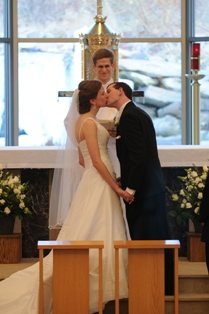
Do you two want to ensure you share an extraordinary marriage together? Then there are three things that I, as an ordained servant of Jesus Christ, believe that you should do.

First, like Tobit and his wife Sarah in our first reading, you should pray together. Of course you must pray individually. And of course you must pray with your children once they come. But you also need to pray together. It doesn’t need to be anything complicated.  Just hold each others’ hands a few moments before you part for work, or stand, or kneel, at your bedside, like Tobit and Sarah did, and speak aloud from your hearts to God. Ask blessings for each other, and give thanks for all the blessing you have received, and close you prayer by saying, “Amen, amen.”

Some couples find this kind of prayer too intimidating, or too personal, to be attempted; for our prayers express our most intimate selves, our fears, our hopes, our pains, our joys, our deepest longings. If you pray honestly in this way, nothing will be hidden between you. Today you will vow to give yourselves completely to each other. Do you want to be truly and totally one? Then pray together. Through marriage you will share of one flesh, if but pray together and you will also share of one spirit. Pray together and you will share an extraordinary marriage as one flesh with one soul. So please, pray together.

The second thing you should do for an extraordinary marriage is to come to Mass. Come to Mass every Sunday and every holy day of obligation. Come, and be moved by the beauty of architecture and songs. Come, and be strengthened by the experience of Christian fellowship. Come, and be inspired by the eloquence of Gospel preaching.

No doubt some people hear this and think to themselves, “That sounds great… But our church is ugly and the songs are dumb and hard to sing. And our community is little more than a gathering of strangers. And our priest always gives the same boring homilies.” Which all boils down to saying, I just don’t get anything out of going to Mass. Then hear this, even if everything else is lacking at Mass, Jesus Christ is always here for us, Body, Blood, Soul, and Divinity in the Eucharist. At Mass, the one sacrifice of Calvary and the Last Supper are made truly present to us for us to receive their power.

At Mass Jesus Christ shows us the perfect spousal love that He calls each of us to imitate. Jesus never called himself “the bachelor.” No, He joyfully called himself “the bridegroom” and eagerly seeks to unite himself to His bride. On the cross, naked without shame, He consummates this union with her, giving himself freely, fully, fruitfully, and forever… freely, fully, fruitfully, and forever. Do you want your union with each other to be free, fully, fruitful, and forever? Then come to Mass to learn the pattern of how Christ loves us and draw from the power He offers us through communion with Him. His is the pattern and the power for an extraordinary marriage. So please, come to Mass.

The third and final thing you should do for an extraordinary marriage is to be salt and light in the world. What does this mean? Being salt and light means that your Christianity should show. As Jesus says, “Your light must shine before others, that they may see your good deeds and glorify your heavenly Father.”

Your good deeds should stand out in the world. As St. Paul says in the second reading, “Do not conform yourselves to this age, but be transformed by the renewal of your mind” If the world never judges you to be radical in any aspect of your Christian life, then you’re not doing it right. Then you’re not yet living as salt and light–you’re not yet living like the saints. For example, everyone loves their friends, but who loves their enemies and prayers for them? Most people pray, but who spends a long time to be with God every day. Many people can give when times are prosperous, but who gives generously when times are tight? Such things as this are what it means to be the light and the salt of the world. Light is different than the darkness, and salt makes the ordinary flavorful.

Clearly, you two are salt and light already, for who goes on weekend retreats to know God better? Or who drives to Washington D.C. to march for life? Or who goes down to Louisiana to volunteer for Hurricane relief? Or who get up at 7:30 in the morning to pray the Rosary? So, please keep on being salt and light, and your marriage will be extraordinary.
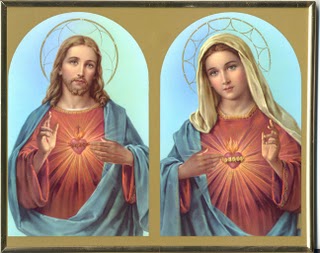
Years from now, I don’t expect that you will remember much from this homily, but I hope you remember these three things: Pray together, come to Mass, and be salt and light and you will have an extraordinary marriage.

[Preached as a deacon for my sister’s wedding,  November 22, 2008]

Romantic Christianity — Friday after Ash Wednesday

February 21, 2010

In the gospel disciples of John ask Jesus, “Why do we and the Pharisees fast much, but your disciples do not fast?” Jesus answered them, “Can the wedding guests mourn as long as the bridegroom is with them?” Of all the images in the Bible to depict the relationship between God and His people, perhaps the most common is that of bridegroom and bride.

As we begin this Lent we should understand that the saints became holy and made their great sacrifices not by relying upon their own “iron-wills,” but by falling passionately in love.

If we strive after holiness as a personal achievement our exertions will make us discouraged and resentful, like the people in the first reading who complain, “Why do we fast, and you do not see it? Afflict ourselves, and you take no note of it?”

But what sort of person can make incredible sacrifices for another, without counting the cost, and feel intoxicating happiness as they do so? A person who can do this is a person who’s in love.

What if Christianity is not supposed to be so hard as you’re making it out to be? What if it is supposed to be as easy as falling in love? Perhaps you are being called to a new approach.

The Fool’s Blindness — Tuesday, 5th Week in Ordinary Time—Year II

February 9, 2010

Some priests like to begin their homilies with jokes. Today I’m going begin by telling you a few jokes—some very, very old jokes. In fact, they come from the oldest joke book in the world, a collection of 265 jokes from the 4th century A.D. entitled The Philogelos, or (in English) The Laugh-Addict.

One day an intellectual bumped into a friend and said to him, “I heard you were dead.” “Well,” said the friend, “As you can see, I am very much alive.” “Yes,” [replied the other,] “but the person who told me you were dead is much more reliable than you.”

[On another occasion,] A doctor stole the lamp of a man whom he was treating for inflammation of the eyes. A few days later, the doctor asked the patient how his eyes were. “It’s a funny thing, [Doctor,] ever since you treated them I haven’t been able to see my lamp.”

[And finally,] An intellectual was [once] on a sea voyage when a big storm blew up, causing his slaves to weep in terror. ‘Don’t cry,’ he consoled them, ‘I have freed you all in my will.’”

Now these three jokes have something in common, besides being very old. They all share the have comedic device: a foolish person who focuses on the wrong thing, like the patient who mistrusts his eyes more than his doctor. This is called majoring in the minors, or as Jesus would say, “straining the gnat and swallowing the camel.” In the Gospel today, Jesus really takes it to the scribes and Pharisees for doing this sort of thing: “You disregard God’s commandment but cling to human tradition. … This people honors me with their lips, but their hearts are far from me…”

So do we focus on small details of our faith and neglect what’s really important? For instance, next Wednesday is Ash Wednesday, the beginning of Lent, and during Lent we usually give up something we enjoy as a form of penance until the joyful celebration of Easter. Now keeping a Lenten penance is a good tradition, because penance helps us to shed old sins and to grow in our ability to do good and to be happy. But… if we give up pop, cookies, candy, or ice cream, while we neglect to go to Sunday Mass, we are keeping a human tradition while we neglect God’s command: keep holy the Lord’s day. Instead of doing neither this Lent, please do both.  Take a penance and go to Mass every weekend for the love of God.

Maybe your family doesn’t go to Mass on weekends, but that doesn’t mean that you can’t. If you love God enough to ask your parents’ permission to go by yourself or with a friend this Sunday, I doubt you will need to go alone a second time. For you will provide your parents with a needed reminder about God’s important in our lives, and I bet you that at least one of them, if not the whole family, will come with you every week after.

So let us keep first things first, and not be stupid, like the man who was swimming when it started to rain; and dove to the bottom, to keep from getting wet. This Lent, let us keep the Lord’s Day, every Lord’s Day, holy. The reason the Lord calls you out is to call you to Himself.

Then and Now — Funeral for Fabian “John” Wingert, 80

February 5, 2010

John did not know when the day would come, but he knew it was coming, and so he was proactive in making preparations. It was 1952, and our country was at war on the Korean peninsula. John knew that his army draft number was low and that he going to be called up for service any day. John was proactive, and he heeded the advice of his father, who said, “Join the navy. It’s better to have a bed than to sleep on the ground.” John enlisted in the navy two days before his army draft number came up.

Later, when it came time for him to ship out, John took the initiative again. John had met Beverly two years before. He would later say they met at a dance in Rozellville. She insists that it happened earlier at an ice rink. But in the week before he was to ship out they were in perfect agreement about what they wanted to do. They were wedded in Los Angeles at St. Michael’s Catholic Church, beginning 57 years of marriage. They enjoyed the sweetness of their too short honeymoon together, and then he left, as he had been called to do by higher-ups.

Beverly tells me that this time without him was lonely, and that she would worry about him, too. They wrote to each other every day, though the mysterious mechanisms of the mail service made the letters arrive in clumps. Finally, John came home, and he and Beverly began raising children and living happily, together.

Today we gather to mourn and pray for John, who suffered his last days’ passion in Christ’s likeness, and whom we trust will be raised up in Christ’s likeness. John has been called up for service by the Higher-Ups of heaven.

There’s a sadness in this separation, but there is no need for fear. It is you who sit here who remain in the war, while John is heading home. We need not fear for him, for unlike the mail, he cannot be lost now, but we pray for him while experiences the mysterious mechanisms that perfect souls until they reach their final address.

And if you have anything you wish you could tell him, you can, for like our connection to the love of Christ, nothing can separate our spiritual connection with John in Christ.  If you would like to talk to him, just pray. You might even sense him speaking back.

This life has the happiness and incompleteness of a too short honeymoon. But if we proactively respond to God’s grace, in not too long, we will all be joyfully reunited. And we will live happily, together, forever.