Archive for the ‘Marriage and Family’ Category

Jesus is Love — 4th Sunday in Ordinary Time—Year C

January 30, 2010

Today’s second reading from St. Paul is perhaps his most known and most loved. You’ve probably heard it at weddings—perhaps you remember hearing it at your own, but most people don’t realize that St. Paul wrote these words to a community in disunity.

The Christian church in Corinth, Greece was divided. Various factions insisted that they were right, that they had “wisdom,” even as they bitterly quarreled with each other. St. Paul acknowledged what the Corinthians possessed in gifts and knowledge, and they had both, but he shined light upon how incomplete they were. “Strive eagerly for the greatest spiritual gifts,” he says, “But I shall show you a still more excellent way.” And then he teaches them about love.

Love is easy when it’s warm and fuzzy, and no one needs a lesson on doing what comes naturally. But how are we to behave when personalities conflict and there are serious disagreements and old resentments within our families, at work, or in our parish? During these times of tension, let us think of Christ and embrace Him as our model for action.

Jesus is patient.  Jesus is kind. In a way, Jesus is jealous, He’s jealous for our souls, but Jesus never manipulates others. He is not pompous. He is not inflated. He is not rude. Jesus is humble. He does not seek His own interests. He is not quick-tempered. He does not brood over injuries, no matter how unjust. He does not rejoice over wrongdoing but rejoices with the truth. Jesus bears all things and endures all things. Look at how He responded in Nazareth when His own acquaintances, whom He had known almost all of His life, turned against Him:

“They were all filled with fury. They rose up, drove him out of the town, and led him to the brow of the hill on which their town had been built, to hurl him down headlong.  But Jesus passed through the midst of them and went away.”

Jesus knew exactly what they were up to as they led Him towards the plummeting edge of town, and He could have turned and walked out on them whenever He chose, so why did He give even them the time of day? Jesus was patient, he was humble, and He endured this trial in hopes that He might lead them from their wrong way and restore personal communion with them. When they were just about to throw Him down, Jesus walked away, for the time had not yet come for Him to lay down His life for love of them.

God assures us through St. Paul that “love never fails.” The love of Jesus Christ never fails, even if we can’t see how, even if His victory, as for the souls for the community of Nazareth, takes more than a single day to accomplish. “Love never fails,” so follow Christ in this most excellent way; at home, at work, and in our church, and the promise of this Scripture passage, that “love never fails,” will be fulfilled in us.

Carrying Water — 2nd Sunday in Ordinary Time—Year C

January 20, 2010

Today’s Gospel, the miracle at the wedding fest of Cana, is a scene rich in symbolism and has many preachable parts. For example, the water of Old Covenant law is changed into New Covenant wine. It is the seventh day in John’s Gospel, according to the narration, pointing to a new Creation and rest. And the New Adam and the New Eve are at a wedding feast together, foreshadowing the marriage of Christ and His Church. But this morning, I would like to bring your attention to an extraordinary part of this Gospel which we disregard as being ordinary. I’m referring to the six stone water jars and the servers who carried them.

“Now there were six stone water jars there for Jewish ceremonial washings, each holding twenty to thirty gallons. Jesus told them, ‘Fill the jars with water.’ So they filled them to the brim.”

You’ve carried a gallon of milk before.   Imagine carrying 25 gallons of milk. I doubt you could do it all at once. Not only would they be too bulky, they would be awfully heavy too. Maybe you could put them on a pole and carry them with a partner. Maybe that’s what the servers in the Gospel had to do, or maybe they were doing laps between the well of Cana and the stone jars at the party. In either case, they we’re hauling an awful lot of water and weight.

Now a gallon of water weighs a little more than eight pounds. If each jar in the Gospel was at least 40 pounds of stone and held 20 to 30 gallons, then we are talking about six filled jars weighing 200 to 300 pounds apiece. And we know they were completely filled, for Mary had told them, “Do whatever he tells you,” and Jesus had told them, “Fill the jars with water.” “So they filled them to the brim.”

The saying “To carry water for (someone)” means to do a menial or difficult task for others.  That’s what these servers were doing and they definitely felt the burden.  Did they have any idea, as they carried those 1,500 pounds of stone and water, that they were a part of something remarkable? Did they know that they were playing an intimate role in one of Jesus’ most memorable miracles? No, they had no idea, not until later, and this reflects a encouraging truth for us to hold onto this week. We often don’t realize the extraordinary impact of our ordinary sacrifices.

You may feel burdened in your life, like your just scrapping or limping along; at work, at school, or at home; with your peers, your friends, or your family. But you do more good than you know. Sometimes we catch glimpses of this, like when someone takes your hand and says, “Thank you sooo much,” or when someone shares with you that they have always looked up to you, or when a child grows to realize and thank you for everything you did for them. After this life, one of our joys in heaven will be seeing how our ordinary sacrifices have touched and changed the lives of thousands, even millions, of people.

Like the servers with their six stone jars, we disregard our efforts as ordinary and do not realize their extraordinary impact. Maybe you don’t see it now, but your ordinary sacrifices do more good than you know. Let us be encouraged by recalling this truth in our daily lives, for if you’re carrying water for Jesus, you’re going to have a part in His miracles. So, “do whatever He tells you,” no matter how ordinary it may seem.

Traveling to God — Epiphany of the Lord

January 3, 2010

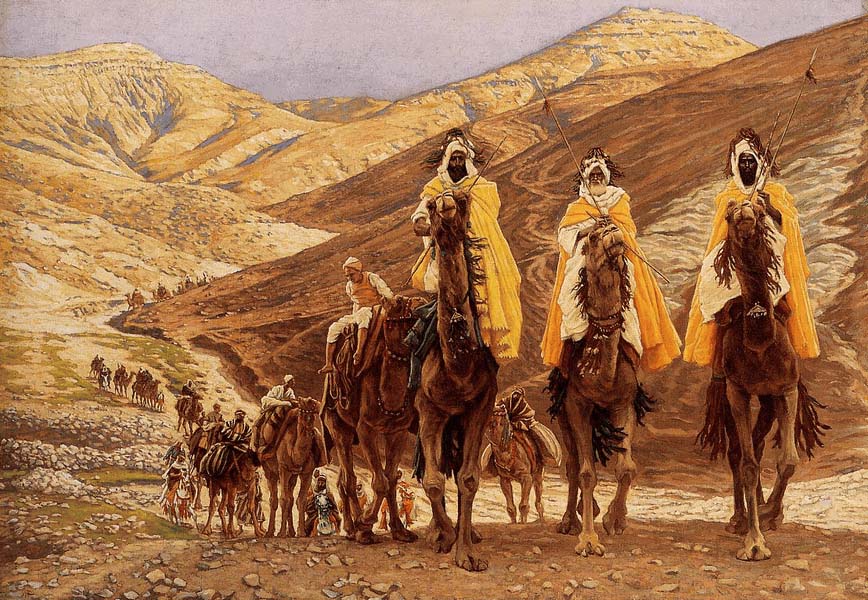
Today the nations come to Christ, to bring Him their gifts and to worship Him. We see it in the gospel, where great, wise ones called Magi travel afar to Bethlehem of Judea. And we see it in our world today, wherever those honored to be called Christians gather in Christ’s Church throughout the world. Every Sunday is a little Epiphany where, like the Magi, all the nations come to worship the One whom all the world ought not to be able to contain.

Our responsorial psalm prayed, “Lord, every nation on earth will adore you.” In another psalm, Psalm 87, the Lord foretells that every nation on earth would adore Him. The Lord says,

“Babylon and Egypt I will count among those who know me; Philistia, Tyre, Ethiopia, these will be her children and Zion shall be called ‘Mother’ for all shall be her children.”

Today there are Christians in all of these places: in Egypt and Iraq, in the Holy Land and Africa.  In fact Christians span entire continents about which the ancients never knew. There are Christians all nations who have entered the Lord’s house and found Jesus with Mary, who is the symbol of Mother Church. She is rightly called mother, for all nations are her children.

In many lands Christians suffer harsh persecution, as in China, where a red dragon like that of Revelation still seeks to destroy the Christ Child and the God-bearing mother. How fortunate we are to be able to safely gather here, to be free to practice our faith without fear, to come to Christ’s house easily and often, not in hiding or in secret, and without having to travel for months across desert expanses like the Magi.

Yet, in our ease, we can take our religion for granted. In our routine, we can be blind to how we are blessed. And in our closeness to Christ, we can overlook Him. So, from time to time, it is important for our faith to be renewed. One way we can do this is to imitate what the Magi did. At least once every year we should make a pilgrimage to Christ and stay to retreat some days with Him.

After spending precious time with Jesus in the heart of their pilgrimage the gospel says the Magi “departed for their country by another way.” Their physical journey changed (for they had been warned in a dream not to return to Herod,) but their spiritual way changed as well. The Magi were believers even before they came, but after adoring Jesus and giving their gifts, they went away spiritually richer. We too would be spiritually richer if we were to give Christ some gift of our time and treasure to pilgrimage and retreat with Him.

As busy as priests are, the Church requires all of them to go on several days of retreat each year, for she knows how important this is for spiritual renewal and intimacy with Christ. Imagine what difference a pilgrimage to a shrine and a quiet, prayerful weekend on retreat center would have for you.

You must love and care for your children, so show them by your own example the importance of seeking after Christ. Give your spouse the opportunity to spend two days alone with the Lord, or take the whole family along for a trip to a holy shrine. For instance, there is a new, magnificent shire to Our Lady of Guadalupe which everyone should make it a priority to see. If you are looking for destinations or ideas, I’m more than happy to help.

In this year of our Lord, 2010, 51 weekends remain. Let us act now to prepare even just one of those many weekends for a gift-bearing journey. Pilgrimages and retreats are a gift to Christ and a gift to ourselves. Let us follow the Magi and come, let us adore Him this year, with days of pilgrimage and retreat.

Luke’s Source — January 1 — Mary the Mother of God

January 1, 2010

Have you ever wondered how it is that Luke the Gospel writer knows the stuff he’s telling us? For instance, he wasn’t present at the Annunciation to take down notes.  Only Mary and the Archangel Gabriel were there. And in today’s Gospel, after the shepherds visit, it says, “Mary kept all these things, reflecting on them in her heart.” Now how does Luke know what Mary was thinking? Who could know something like that besides Mary herself?

Now I suppose the Holy Spirit could have directly infused the knowledge of these things into him, but that’s probably not what has happened here. Luke probably learned of these details in the most natural and human way; by being told about them, first or second-hand, by people who knew. Luke begins his Gospel by saying that his narrative of events is composed from what “those who were eyewitnesses from the beginning and ministers of the word have handed … down to us.”

But there is only one person who could have been the original source for many of Luke’s details, and that is Mary herself. In fact, some call the beginning chapters of the Gospel of Luke “the Memoirs of Mary.” Perhaps Luke heard of these details from Mary’s very own lips and took them all to heart.  Then later, knowing these things by heart, committed them to writing.

And so we do know something today of what was going on inside of Mary in those early days, “Mary kept all these things, reflecting on them in her heart.” And some years later, upon finding Jesus in the temple, Luke reports that Mary and Joseph did not understand what their boy when said to them, but “his mother kept all these things in her heart.” In this there is a lesson for us to discover through Mary, a lesson that is particularly applicable for us this New Year’s [Eve/Day].

In her life, Mary knew some important aspects of God the Father’s plan, but there was always a great deal about which she did not know. She knew that her Son was messiah, savior, and Lord, but his future, and hers, remained largely a mystery. Perhaps Mary wondered, as we often wonder when faced with evils and obstacles, “How can this be, Lord?  How will your promises be fulfilled despite this?”  Yet through it all, Mary firmly trusted that the Lord was with her, and we should do the same.

What does the new year ahead hold for each of us? Like Mary, we do not know, yet Mary shows us that we do not have to know.  We do not have to fully know our future to be able to do great things for God and to be richly blessed by Him. We do not need to know our future for the Almighty to do great things for us.

In the year ahead, may the Lord bless you and keep you, as He did the Virgin Mary.

May the Lord let his face shine upon you, and be gracious to you, as He did for Mary through Jesus’ infant face.

And may the Lord look upon you kindly and give you peace, a peace like that which Mary always kept with her Son, Jesus the Christ.

Strengthening Your Family — Holy Family

December 29, 2009

Today we are going to try something unique. Close your eyes and let the Holy Spirit guide your imagination to show you what family life was like in the home of Joseph, Mary, and the boy Jesus…

Theirs is a small dwelling and you can see all of them there…

How old is Jesus as you see Him? What is He doing?

What are His parents up to? What are Joseph and Mary like as you see them interact with each other?

It comes to time to eat. What do you see the Holy Family doing?

As they relate to one other, what do you see expressed in their faces? It is now later in the evening and time for prayer. What do you see the members of the Holy Family doing?

You can return in your imagination to visit this house any time you wish, but now, let’s open our eyes and review our mediation.

What did you see as Joseph and Mary interacted with each other? Were they not tender and reverent towards each other? I bet you could see their great mutual love reflected in their smiles.

What happened in their house when it was time to eat? Who would imagine them not coming together to share their meal in each others’ company?

And later, when it was time for prayer, did the Holy Family do? Did you see them go off to their own corners, or did they come together, to pray as one family?

Did you see the Holy Family’s intimacy, their happiness, and their love for each other? Do you want your family to share a bond like theirs? Then take the Holy Family as your model: share your love, share your meals, and share your prayers.

First, on sharing your love. Let your spouse and children know every day that you love them. You can say it, you can show it, or you can do both. For instance, kids never tire of being hugged and told their loved each day.

As for married couples, don’t make the mistake of thinking that intimacy and love are only expressed physically. For St. Joseph had all sorts of simple, little ways to let Mary know that she was loved, and vice-versa. Be like the Holy Family in sharing your love.

A second way to model the Holy Family is to share your meals. The research of social scientists indicates that having frequent family meals together contributes many goods for one’s family: For starters, everyone eats healthier meals, and so kids are less likely to become overweight or obese. And kids who eat family meals are less likely to start smoking, to drink alcohol, or to try or to be addicted to drugs. These kids’ grades are better at school, and there is less stress in their homes. These things probably stem from the fact that families which eat together are bound to talk more, provided the TV is off.

These parents are more likely to know about their children’s lives and struggles and, just as importantly, their kids are more likely to know that their parents are proud of them and love them.

Jesus Christ thinks that the shared family meal is so important for us that He has instituted one for His Church and expects His entire family to be there; for to share in the Eucharist is to share in the life and communion of His family.

A third way to make your family more like the Holy Family is to share your prayers. Apart from dinner prayers or going to Church, most Catholic families do not pray together. I think that maybe we see the priest praying the Church’s prayers and think that we are not equipped to lead prayers of our own at home.

But it’s not true.  As fathers and mothers you have a spiritual authority within your families, what John Paul the Great called “the domestic Church.” Your spouse and your children need you to pray, not only for them, but with them. Right after the family meal might be the perfect time for this ritual of family prayer.

Now you may be thinking to yourself, “But we’ve never done this as a family before.” Remember this: as parents, you create what’s normal for you children. If you want it to be normal for your children to eat meals with you, then make it normal for them.

If you want it to be normal for your children to pray to God with you, then do it normally. As parents, you create what is normal for your children and through your gift of these traditions to them you can bless them for a lifetime.

Finally, husbands and wives, if you do not pray one-on-one with each other, then you do not yet share a perfect intimacy together.  It is in prayer that our most intimate selves are laid bare and we ask another person to help us with our heartfelt needs and concerns.

Maybe you’ve never prayed with your spouse before. Then perhaps you can begin like this:  hold each others’ hands, close you eyes, and pray to God for each other, for a little while, even if for just ten seconds, say, before you go out the door. 

Once this becomes comfortable you can begin to telling each other what you want to be prayed for. And, after this is comfortable, you can begin to pray for each other aloud.  Begin the process of praying like this and it will transform your intimacy together.

Perhaps you gave many gifts to your family members yesterday for Christmas, but the greatest gift you can give to each other is yourselves. So follow the way of the Holy Family: share your love, share your meals, and share your prayers.

3rd Sunday of Advent—Year C

December 14, 2009

Advent is a season for penance and conversion, for the confession of sins and the changing of lives, but this Sunday of Advent reminds us that it is also time for joy. Today we celebrate Gaudete Sunday, a name which comes from the Latin command “rejoice!” This command is heard from St. Paul in today’s second reading:

“Rejoice in the Lord always.
I shall say it again:  rejoice!”

But is it that why do we need to be reminded, even commanded, to rejoice? Why are we not a people of constant joy and peace, even though we have great reason to be? I think it is because our hearts and minds give in to fear.

God is near, but when we give in to fear we do not trust that He really cares about us and really provides for us. In fear we become anxious about our future. In our fear we feel too stressed-out to be thankful. And in fear we forget or refuse to pray. St. Paul seems to have realized all this, that may be why he followed his command to rejoice with these words, words that it would do a lifetime of good to know by heart:

“The Lord is near.
Have no anxiety at all,
but in everything,
by prayer and petition,
with thanksgiving,
make your requests known to God.
Then the peace of God
that surpasses all understanding
will guard your hearts and minds in Christ Jesus.”

Today I would like to share with you a true story about two friends of mine who had every seeming reason to afraid, but who kept God’s peace. Let’s call them Andrew and Christi. I have changed their names to conceal their identities, but I know they wouldn’t mind me sharing with you their story because it can teach us all a lot.

To say my friends had a difficult first year of marriage would be to understate it. Andrew, a hard-working man with rough hands and a good heart, became afraid that marrying Christi had been a mistake and he seriously considered getting a divorce. Christi, a beautiful woman inside and out, prayed fervently to God, for both Andrew and herself. She honestly did not know how God would provide for her, but God gave her a peace that surpassed her limited understanding of His plans. Then, as Andrew tells it, God intervened, giving him a sign that this marriage was indeed His will and that Andrew should not be afraid. This divine reassurance strengthened Andrew and he resolved to remain faithfully at Christi’s side no matter what.

A few months later, forces beyond their control forced Andrew and Christi to leave their hometown, away from all their family and friends, and to move down south to a town where Andrew had some distant relatives. But, once they got down there, all of these relatives proved to be too distant or too busy to care enough to lend this vulnerable couple a hand. Their first Advent season together, Andrew and Christi were jobless, homeless, and with child.

It would have been so easy for them to give in to despair that first Christmas Eve, for Andrew to feel like he had failed his wife as a husband, or for Christi to feel anxious and afraid about their future as a family. Yet, Andrew and Christi trusted that the Lord was near. They would pray together as a couple, and gain courage and strength, peace and even joy through their prayers.

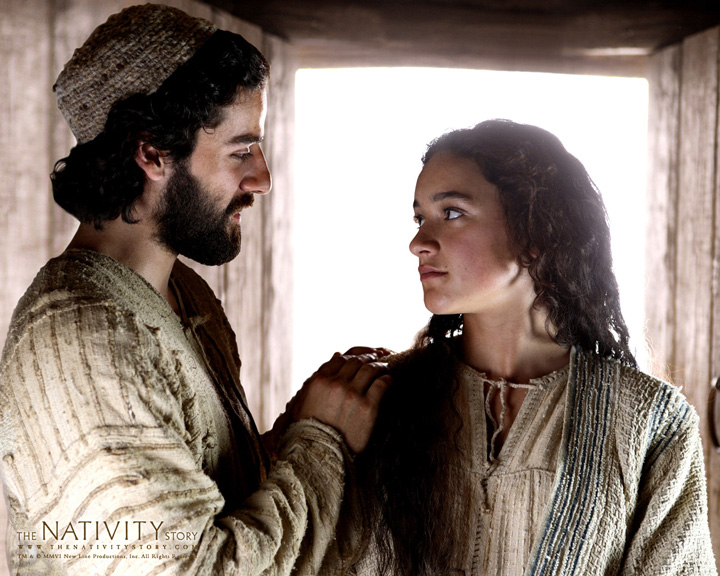
Indeed the Lord was near them, through it all, and their first Christmas together turned out to be was the brightest and the most joyful that they, or the world, had ever seen. As I said, this is the true story of two friends of mine, but they’re also friends of yours and you knew their story even before I told it to you today. For Andrew’s real name is St. Joseph and Christi’s real name is St. Mary.

Today we rightly call them saints, not because they lived in a world free from difficulties, an imaginary world different from our own. Joseph and Mary are saints because they knew and practiced how to live in this world well; with joy, kindness, prayer, thanksgiving, and peace. And so brothers and sisters:

Rejoice in the Lord always.
I shall say it again:  rejoice!
Your kindness should be known to all.
The Lord is near.
Have no anxiety at all,
but in everything,
by prayer and petition,
with thanksgiving,
make your requests known to God.
Then the peace of God
that surpasses all understanding
will guard your hearts and minds in Christ Jesus.

34th Sunday in Ordinary Time—Year B

November 23, 2009

Today we celebrate the Solemnity of Christ the King. Jesus Christ is our king, now and forever. Yet, the idea of monarchy doesn’t really resonate with us. And it’s not just because we don’t have an earthly king ruling our country. It’s that we’re not big fans of authority. We are wary of anyone having too much power. This is because power is often abused.

Those with any degree of power, be it over entire people or a single employee, can abuse that power. We can fall into thinking only of themselves and our own advantages and be blind and deaf to the legitimate concerns and genuine needs of others. Sometimes those with power hold on to it jealously and will stomp out any real or perceived threats to that power without regard to the truth. This is how the Roman Governor Pontius Pilate responds to Christ. When Pilate asks Jesus, “Are you the King of the Jews,” he is not searching for the Jewish messiah, or even the truth.  He is probing for a political threat to himself.

The true purpose of power and authority is for serving the good of others. This goes for the Church and for all government, for our workplaces and our homes. The reason that our all-powerful God shares some of His power and authority with us, His creatures, is not so that we may be self-serving. It is so that we may serve others, give them life and bless them, and in this way resemble God Himself. God has given of Himself, given us life, and blessed all creation.

As Jesus said to His apostles, “You know that the rulers of the Gentiles lord it over them, and the great ones make their authority over them felt. But it shall not be so among you. Rather, whoever wishes to be great among you shall be your servant; whoever wishes to be first among you shall be your slave.”

Jesus showed his perfect love for us by becoming a slave and dying for us on the cross. For this reason, we do not fear the idea of Him being the first among us, reigning as our king. The Church, His bride, welcomes its royal bridegroom. And as it is for the bride of Christ as a whole, so it is for every Christian soul in relationship with Christ.

Every bride yearns to be fought for, to be pursued and to be a priority to someone. Christ has made us His priority.  He came down from heaven in pursuit of us. He has fought for and died for us, and now in heaven He still fights for us.

Every bride also wants an adventure to share. She doesn’t want to be the adventure; she wants to be caught up in something greater than herself. When we are living for ourselves we are alone, without purpose, and empty. Each of us is meant to live a life about more than just ourselves.  A life in Christ. We each have a vocation, a calling from God, a unique part to play in an epic adventure, a significant part to play in His great story.

Every bride wants to have a beauty to unveil. And it’s not just an exterior beauty. It’s a deep desire to truly BE the beauty and to be delighted in by the bridegroom. Christ is the lover of our souls and all of us wish to have beautiful souls. Each person desires to be approved and uniquely enjoyed by Christ. For us males, this is a desire for his approval and regard.  To be one who He is unashamed to call us His brother, a member on his team; a man in His platoon

Why bring up how Christ our King is the perfect bridegroom for His bride, the Church? Gentlemen, take note. Imitate Christ for your brides with Christian chivalry, love your wives as Christ loves the Church, and you will be like our king for your queen. Fight battles on Christ’s side for your beautiful bride. Lay down your life for her each day. Be Christ the king’s shining knight for her—honor, serve, and defend your bride and lead her on an adventure. The power you have is for her and you family.

For any of us, with any power and authority comes responsibility. And the power each of us has gives us a great opportunity. For by serving Christ our King and by caring for those He has entrusted to our care, we win the only glory and happiness worth having, that of Christ our king—the glory and happiness with the power to last forever.

30th Sunday in Ordinary Time—Year B

October 25, 2009

Return of Vampire. 1944.

Next Saturday, as the children here may know, is Halloween, the evening celebration involving crazy costumes, yummy candy, and scary stuff. But this evening was formerly popularly known as All Hollows’ Eve, for it is the vigil of All Saints Day, November 1, the Solemnity of God’s hallowed ones. oday, I would like to talk to you about vampires, that’s right, vampires. Now vampires are not real, but we can learn a lot from their mythology and bad example, for vampires are embodiments of the anti-Gospel.

For example, Christians are children of the light and of life, but vampires are creatures of the night, of darkness and of death. Vampires fear the daytime and they sleep in coffins. Vampires tempt, seduce, and exploit others. They manipulate persons as things to be used. Vampires steal others’ blood and take their lives. This is the opposite of Christ, who tempts, seduces, and exploits no one. Rather, Jesus calls, invites, persuades, and challenges with the truth, with goodness, and with love. He treats everyone as a person to be loved. Rather than taking, Jesus gives us His blood and His life, His entire living person in the Eucharist, so that we can share His life.

How do you defeat an otherwise immortal vampire? Traditionally, there are two ways: either drag him into the sunlight, or put a wooden steak through the heart. Why do these tactics work against them?      These things work because vampires are personified evil, and evil cannot overcome either the light of Christ or the wood of His cross.

There’s one more element of vampire mythology with something to teach us. Vampires can only enter a house, if they are invited inside by the people who live there. In vampire stories, the peasants don’t realize that the attractive, charming, intriguing person at their door is really a vampire, so they invite him in without realizing the threat he poses, or their own vulnerability.

Now comes the scary part of the homily, where we apply the lesson to ourselves. What have we unguardedly welcomed into the heart of our homes? What in our lives most resembles the vampire? It is, I suggest, the television and the internet.

Now granted, television and the internet are not digitized evil, like the vampires are personified evil. There is real good to be gained through these forms of technology, but we are kidding ourselves if we think that they can’t seduce us. More often than not, it seems that television and the internet suck our lives out of us. They are up to our necks, but we are too infatuated with, or hypnotized by, them to realize that something is wrong.

Ask yourself, when was the last time that you watched TV and came away thinking, “Wow, that was great.  You know, I really think watching television made me a better person”? Now consider this question: when was the last time you watched TV and came away from it feeling unmoved and unsatisfied? That dissatisfaction should tell us something. Television sucks our life from us, and the internet can be just as bad, or even worse. Not only do these forms of media tend to disappoint us, numb us, and give near occasions to sin, they can harm our families too.

TV Children

Imagine if there was going to be a public execution in Marshfield tonight and your son wanted to go and watch, would you let him go? Yet how much death, simulated and real, is there to be seen on TV? Would you allow a complete stranger into your daughter’s bedroom unsupervised? Yet how many of our children have a TV or the internet right in their rooms? If TV or the internet were a person, would you welcome that person into your home?

Again, I am not saying that everything on television or the internet is evil, or that every good Catholic should discontinue their cable and internet subscriptions. But I am convinced that we need to be more careful and discerning about their roles in our lives, and that our habits with them probably need to change.

It could be that the single greatest thing you could do today to strengthen your family life and to improve your life of prayer would be to simply unplug. Imagine how much more opportunity and motivation you would have every day for family bonding and quiet times with God, if you put all your TVs in the basement and hid the internet cables along with them. Why not try it for a week? Or, if you’re really serious, why not make this your Advent penance and see how much your life is changed?

Like the psalmist said,

‘Although you may go forth weeping,
you’ll be carrying the seed to be sown,
And you shall come back at the end rejoicing,
carrying the sheaves you’ve harvested.’

After your unplugged period is over, you can bring the TV and the internet back if you want, but you will be freed from any addictions to them and they will be less likely to seduce you in the future, into the life of the living dead.

In the Gospel, the blind man, Bartimaeus, threw aside his cloak, sprang up, and ran to Jesus. Jesus said to him, “What do you want me to do for you?” The blind man replied, “Master, I want to see.”

Like vampires, change in our lives can be scary, but we should have the courage to see how much our lives could be better by following Christ in this way.

27th Sunday in Ordinary Time—Year B

October 4, 2009

At my old seminary in Ohio, where I was formed for the priesthood, there’s a great professor named Dr. Perry Cahall. Dr. Cahall taught us not only through his lectures but also by his personal example, as a husband, a father, and a good Catholic man. One of the courses taught us was early Church history, a class that covered the controversies and councils of that era about Jesus Christ and the Trinity. Now a person might easily overlook the importance of those councils, but Dr. Cahall presented us with a revealing thought experiment. He would have us imagine how things would be different if the heretics had won the day. For example, he would say, “Imagine a world in which Arius was right.” (Arius claimed in the 4th century that Jesus was neither God nor man, but rather the highest creature God had made.) What if the bishops at the council of Nicaea would have spurned the Holy Spirit, and the apostolic tradition, to make Arius’ theology the creed we say each Sunday? When you sit down to consider the consequences Arius’ belief would have for our morality, our worship, and our world, you realize that everything was at stake at Council of Nicaea. 

Important ideas have consequences. If some Christian belief does not influence your life, then you have either not accepted it, or you have not really grasped what it means. Dr. Cahall liked to say, “If you get into pulpit as a priest on Trinity Sunday and preach to your people that, ‘The Trinity is a mystery, so there’s really nothing we can say about it,’ I will hunt you down like the dogs you are. (We think he was kidding.) He said this because the Trinity and Incarnation are the two most central beliefs of our faith and they are full of implications for our lives. Important ideas have important consequences and our beliefs should shape our lives.

Dr. Cahall also taught our seminary course on marriage and family, and he had a meditation about marriage, family, and the Last Judgment that I hope to never forget and always remember. He would say, “At the Last Judgment, every person who has reached adulthood will stand before the Lord’s throne and Christ will ask them two things: First, ‘Were you faithful to your spouse?’ And second, ‘Show me your children.’” Now he said this to a room full of seminarians on their way to becoming celibate priests, but what he said is valid for everyone. We are all called to marriage, be it spiritual or natural. And we are all called to be mothers or fathers, either spiritually or naturally.

The Lord God said, “It is not good for the man to be alone. That is why a man… clings to his wife, and the two of them become one flesh.”

The fulfillment of our humanity is achieved, in Christ, through marriage and having children. Priests and religious who live chaste, celibate lives are no exception. That’s because celibacy is really about fruitful, spousal relationship, to one spouse, bearing many children. It is not without meaning that tradition calls nuns and consecrated virgins the “brides of Christ,” for they really are. All people are called to marriage; to fidelity in marriage, to permanence in marriage, and to fruitfulness in marriage. This is our Christian belief, but many people today have either not accepted it, or not really grasped what it means.

Consider the meaning of fruitfulness for marriage. The psalmist today considered having a large family to be a blessing (‘may your children be like olive plants around your table’) and Jesus said, “Let the children come to me and do not prevent them.” But many people today act as if having more than two children were a curse, and prevent more children from coming. Now there can be serious and legitimate reasons for naturally regulating and limiting births, but I fear that many people, when it comes down to it, are resisting Christ. Jesus said, “Whoever receives a child such as this in my name receives me.” So what does it mean if someone refuses to receive a child in His name?

Couples are afraid; they’re afraid that having four children will be twice as hard as having two.  But if you ask most Catholic couples with large families (with numbers of kids that were commonplace fifty years ago) they’ll say that the burden is less with each additional child, while the love and blessings within the family are multiplied. We should not be afraid to give ourselves fully to fruitfulness in marriage.

We are also called to permanence in marriage. Marriage in Christ is “until death do us part.” But in America today, one in every two marriages end in divorce. God says in the Old Testament, “I hate divorce,” and I suspect that the children of divorced parents share in His sentiment. Cases of abuse, serious addition, or unrepentant infidelity may require a couple’s separation, perhaps indefinitely, or may even require a divorce in the eyes of the state, but a consummated sacramental marriage can never be divorced in God’s eyes. As Jesus said:

“What God has joined together, no human being must separate. Whoever divorces his wife and marries another commits adultery against her; and if she divorces her husband and marries another, she commits adultery.”

That is why a divorced person cannot be remarried in the Church without a determination by the Church that something essential was lacking in the first marriage, from its very beginning, which prevented that marriage from being sacramental. So no one should say that annulments are “Catholic divorces.”  Annulments are judgments by the Church that a marriage was never sacramental. But in a valid, sacramental marriage, the mission of the husband and wife is to lead each other to heaven, no matter what, and to raise up children, natural or spiritual, for God.

If you want you children to feel safe and secure, tell them what my parents told me and my sisters when we were kids. Tell them, “Even, though Mom and Dad may argue sometimes, we want you to know that we will never, ever, get divorced.” Tell them this, and mean it.  They’ll really appreciate it. And I’m sure your spouse would like hearing you say it, too.

Most people would still agree that a married couple should be faithful to each other, exclusively.  But I would not be surprised if we began to see the open dismantling of this third pillar of marriage as well. The institution of marriage has been under assault for many years. It’s not that people have been out to destroy marriage per se; but steps to redefine what marriage means weaken marriage all the same.

Now a person might easily overlook the importance that traditional beliefs about marriage have for our society; but, like Arius’ heresy, when you sit down to consider the consequences of negating fruitfulness, permanence, and fidelity in marriage, then you realize that everything is at stake when it comes to marriage. You can’t remove or seriously weaken all the pillars from a house and expect the roof to remain hovering in the air. When we redefine marriage to mean what it is not, the house we live in comes crashing down upon us. That goes for one marriage or an entire society’s marriages.

So what are we to do? First, we must pray. Pray for your marriage. Pray together as a couple, because you need this. Pray together with your children, because they need this. And pray for our country, because it needs this. And then, empowered through your sacrament of marriage, which makes the love between Christ and His Church really present between the two of you, live out what Christian marriage really is as an example for all to see. Be fruitful, be faithful, be loving and joyful, as long as you both shall live.

September 15 – Our Lady of Sorrows

September 16, 2009

Imagine if you had to start a whole new life. I don’t mean just changing schools, or moving away from home, or even entering the federal witness protection program. Imagine if you had to start a whole new life from the very beginning, as a tiny little embryo. And imagine that this reincarnation of yours required you to choose a new mother for yourself, from among all the women in all the world. What qualities would you look for in choosing a new mom?

You would want her to be beautiful, not only on the outside, but on the inside too, for what we desire most of all from our mothers, is a great and beautiful love.

You would want her to be wise and full of goodness, someone who could introduce you to the world and show you how to live in it well.

You would want her to be the perfection of femininity, so you girls could see how to grow into excellent women, and to show you boys what to look for in an excellent wife someday.

You would want a mother with patience, and tenderness, and compassion, who would be at your side if you were sick or in pain, and who would comfort you just by her presence.

As fantastic as this sounds, Jesus faced a scenario a lot like this one. He had to choose from among all the women in all the history of all the world, the one woman who would become His mother. For his incarnation, Jesus chose Mary to be His own mother.

She was beautiful, inside and out. She introduced Him to life in our world. She loved Jesus with a great and beautiful love. And when Jesus looked at Mary, he saw the likeness of His future bride, because Mary is the icon of the Church perfected. She stood at His cross with compassionate strength and her presence helped Him amidst his suffering.

Mary was so great a mother, that Jesus wanted to share her with us. He wanted her to be our mother, too. Jesus looked down from the cross, on her and the beloved disciple, and said, “Woman, behold, your son,” and to the beloved disciple, “Behold, your mother.” You and I are the beloved disciple. Jesus gives us Mary to be a mother for us. He created her perfectly, to be His own mother and our mother, too.

From that hour, at the cross, the beloved disciple took Mary into the heart of his life. From this hour, at this Eucharist, take Mary deeper into the heart of your life; because she loves you more than you know.

August 27 – St. Monica

August 27, 2009

Today I would like to tell you a true story, the story of a Catholic woman in a very difficult marriage to a non-Christian husband. Her husband was a man with a hot temper and hostility towards Christianity. He was unfaithful in their marriage, but she remained faithful to him—not out of weakness, but out of an inner-strength.

She bore his faults with patience and persistently sought after his conversion. The daily example of her gentleness and kindness finally had its victory. Her husband became a Christian one year before his death. However, the year after that, she had to face a new burden alone.

The oldest of her three children joined an anti-Catholic religious cult. It started him down a path of sinful pride and many sensual sins. It broke her heart. Then one night, she had a dream.

She was standing on top of a wooden ruler, and she saw a young man coming towards her, surrounded by a glorious halo. Although she felt sad and full of grief, the young man smiled at her joyfully. He asked her for the reason for her sadness and daily tears. (This wasn’t because he didn’t know, but because he had something to tell her—this is the way things happen in visions.) When she answered that her tears were for the lost soul of her son he told her to take heart for, if she looked carefully, she would see that where she was, there also was he. And when she looked, she saw her son standing beside her on the same ruler. Reassured by this dream she continued, for years to come, praying tearful prayers for his conversion.

She even asked the bishop to intervene in winning over her son. He counseled her to be patient, saying, “God’s time will come.” When she persisted in asking, the bishop (perhaps busy with many other things) famously reassured her: “Go now, I beg you; it is impossible that the son of so many tears should perish.”

That son, as you may have guessed by now, was the great St. Augustine. And his mother is St. Monica. May her story encourage us to pray and strive for the conversion of our loved ones to the Catholic faith. Remember and take hope: God loves us with a human heart and He cares about your loved ones even more than you do.

5th Sunday of Easter—Year B

August 23, 2009

This Sunday our country celebrates our mothers—and rightly so.  For the care and love which our mothers have given us cannot be measured or given a price.  Of course, our earthly parents are not perfect. Sometimes they’re quite far from perfect.  But any love we’ve known from them is a likeness of the love God has for us. A religious icon is made of mere wood and paint, but it can be a window to heavenly realities. In the same way, we can see through our parents’ love a glimpse to God himself.

Most of us have more memories about our mothers than we could possibly count, but today I would like to go with you back to a time and place about which you have no clear memories—to the time in your mother’s womb. Just as the Hebrews were 40 years in the desert; just as Jesus prepared 40 days in the wilderness; and just as Christ rested 40 hours until his resurrection from the tomb; so you remained 40 weeks, more or less, within your mother’s womb, being prepared for a new life.

Through your mother’s vine you grew into the mature fruit of her womb. You were nourished and grew within her. You were never far from her heart or mind. You existed in within her, connected to her at the center of your being.      She fed you with her very self. She provided for all your needs. Apart from her, you could do nothing. You remained in her and found rest in her.

At the early stages of our life in the womb, our minds did not comprehend very much, but what if you could have understood everything that your mom was doing for you at the time? Certainly you would have directed your thoughts to her often.  And certainly, from time to time, you would have turned to her with the eyes of your heart to bask in her love for you.

And imagine further what if you could have talked with your mom from the womb? Would you not have taken the opportunity to speak with her every day? Would you not have thanked her daily out of a deep gratitude? Would you not have let her know each day how much you love her? Whoever would refuse or neglect to do so would continue to live, at least functionally or biologically, but the person would not be fully alive without this relationship .

As you and your mother would continue to talk as the days and months of pregnancy passed, she would eventually present you with a most-frightening prospect: She might say, “My child, soon, in a little while, you are going to begin an new stage of life. You will be departing from the life you know, and then you’ll experience a world of people and things you have never known before.” But you would say, “I’m scared, I don’t want to go, not now, not ever!” But she would say, “I realize this concept is scary for you, but trust me when I say that it is better that you go. In fact, someday soon you’ll look back and think it a silly thought to be again as you are now. This transition is going to hurt a little bit… trust me, I know… but when the appointed time comes, I’ll be right here with you. Do not be afraid.”

This morning we reflect on this time in the womb because our life in our mothers is like our life in Christ. As it was with our mothers, so it is, in this life, with Christ. You are nourished and grow within Him. You are never far from His heart or mind. You exist in within Him, connected to Him at the center of your being. He feeds you with His very self. He provides for all your needs. Apart from Him, you can do nothing. You remain in Him and find rest in Him.

Knowing and believing this, shouldn’t we direct our thoughts to Him often? Shouldn’t we, from time to time, turn to Him with the eyes of our hearts to bask in His love for us.

We have the ability to talk with Jesus Christ. Who would not take the opportunity to speak with Him every day? Who would not thank Him daily out of deepest gratitude? And who would not let Him know each day how much we love Him? Whoever would refuse or neglect to talk with Him, that is to pray, would continue to live, at least functionally or biologically, but the person would not be fully alive without this relationship with Jesus Christ. We need to pray every day if we want to remain in Him and to bear much fruit.

None of us want to die and that’s perfectly natural. But Jesus says to us, “Soon, in a little while, you are going to begin a new stage of life. You will be departing from the life you know, and then you’ll experience a world of people and things you have never known before. I realize this concept is scary for you, but trust me when I say that it is better that you go. In fact, someday soon you’ll look back and think it a silly thought to be as you are now again. This transition is going to hurt a little bit… trust me, I know… but when the appointed time comes, I’ll be right there with you. Be not afraid.”

Today, let us thank God for the gift of our mothers and the gift of Jesus Christ.  God bless our mothers, and praised be Jesus Christ.

18th Sunday in Ordinary Time—Year B

August 17, 2009

We humans are forgetful creatures. Look at the Hebrews, running short on food and patience in the first reading. It’s only one month since they’ve walked freely out of Egypt; after ten miraculous plagues, after the parting of a sea before them, after the total destruction of their enemies behind them. It’s just one month later and they’ve already forgotten God’s desire and creative ability to care for them. They’ve forgotten, and their hope is gone.

In the Gospel there’s more forgetfulness.  The people come to Jesus and they ask Him, “What sign can you do, that we may see and believe in you?  What can you do?” Have they already forgotten about His recent miraculous sign, how just the other day he multiplied loaves and fish for them?  Recalling that miracle to mind would have strengthened their faith and hope.

We’re forgetful too. I, for example, often have a problem remembering how the responsorial psalm goes.  I hear it, I repeat it, and then it’s gone. We’re forgetful people. For instance, can you remember what I preached about the last Sunday I was here? I wouldn’t expect you to.

I spoke about how we should be hopeful because of Jesus Christ. I also strongly emphasized the importance of each of us to pray every day. This morning I want to teach you how we can be strengthened in faith and hope by recalling in prayer our most grace-filled memories.

Maybe you pray as the first thing when you wake up. Maybe you pray before you go to bed each night. Maybe you pray while you’re driving, perhaps imagining Jesus or Mary in the seat beside you. Maybe you make a daily visit to Jesus here really present in our tabernacle. When and where you pray each day is not as important as the prayers you offer and the connection and consolation that Christ wants to give you.

Anyone who prays frequently will have times when they sometimes seem to wander about in a desert of unfocused thoughts. By an act of will, we can try digging a hole here or there, looking for new, fresh, spiritual water. But there is an easier way to go about things when our prayer time feels hard and dry.

If we search our memories we can find places and times when God was obviously close and active. Perhaps a time when He silently but clearly spoke to you, or a time when He provided for you in answer to your prayers. Perhaps the births of your children or day you got married are moments that perceivably touched the eternal.

These memories can be wellsprings of grace and consolation for you. Just because we have left a well behind in your past doesn’t mean that well is run dry. What was true then, is still true now and you can go back their in your memories and draw graces from it again. Our grace-filled memories can serve as an anchor of hope, our ever-accessible source for faith and hope in prayer.

There is one more thing I on which I want to speak.  Our psalm said today:

“What we have heard and know, and what our fathers have declared to us, We will declare to the generation to come the glorious deeds of the LORD and his strength and the wonders that he wrought.”

This psalm is not only written for the Old Testament Jews, its meant for us as well. And when it mentions “fathers” here, priests like me are not the fathers it has foremost in mind. Fathers, if your children only hear about God from me, your silence will speak a message to them. It is important that you be a spiritual leader for your family and tell the stories of our faith and of your faith.

Parents, have you ever told your children of “the glorious deeds” that the Lord has done for you? If not, why not? Do you feel reluctant to tell? Or do you think that there is nothing to tell? Either way, a change needs to happen.

So remember, whether you are dry at prayer, or raising children for the Lord, remember to remember.