Archive for the ‘Parenting’ Category

We’re in a Hurry — 16th Sunday in Ordinary Time—Year C

July 18, 2010

The other day I was thinking about this homily when I heard the words of some modern poets on my radio. They said:

I’m in a hurry to get things done,
Oh, I rush and rush until life’s no fun.
All I really gotta do is live and die,
But, I’m in a hurry and don’t know why.

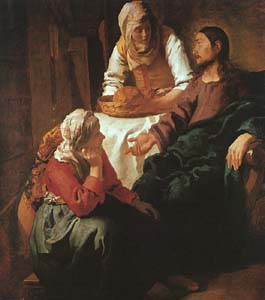
This goes to show that we still have a Martha problem today. The group Alabama said that they didn’t know why we get in a hurry, even though we’re not having fun, but I think I know the answer. The reason is that our loves and good desires are mixed with fears. If we would take that fear away, we would find peace.

Martha loved the Lord and wanted to serve Him well, but she had fears mixed in. She was the one who invited Him to the house and He probably had His apostles and other disciples with Him. She was busy serving them all, perhaps making the biggest meal she had ever made, and she was full of worries. “What if I’m a poor host and Jesus is disappointed with me? What if there’s not enough food for everyone to eat?”

We are often the same way. We fear that our lives are on the edge of disaster if our own plans and efforts should fail. We worry about bad things happening to ourselves and the people we love. We are anxiety about how Jesus feels about us.

Martha had a great desire to do good, but Martha’s fear tempted her to do harm. Her sister, Mary, was sitting at Jesus’ feet, listening to His words. (The Greek word for disciple actually means “one who sits at the feet of.”) Martha tries to take Jesus’ disciple away from Him.

Similiar thing can happen in our live on account of fear mixed with love. A husband and father can obsess about his work, out of a love for his family and a desire to provide, but his family can be left feeling like they come second in his life. A wife and mother can be so concerned that her loved ones will be safe and happy that she tries to control everything, making her family less happy because of it. Martha’s problem and ours is not that we work–work is a part of life–but in how we go about it.

Jesus says to Martha, and to us, “Martha, Martha, you are anxious and worried about many things. There is need of only one thing.” What is this one thing we need? We need the peace of Christ. What is the peace of Christ? It is several things.

It is the awareness that God is near and guiding us. In the first reading, three heavenly visitors approach outside of Abraham’s tent. Now, the Holy Spirit dwells within our tents, Jesus is at our side, and we have a Father above. We are never left on our own.

With the peace of Christ we recognize that whatever may happen to us or those we love, it is for our good. As St. Paul observes in the second reading, even his sufferings are a cause for rejoicing for they advance the salvation of the whole Church with Christ.

With the peace of Christ we recognize that misery is not just around the corner, nor is happiness out of reach. Happiness is at head, in the knowledge that Jesus loves us, likes us, cares about us, and cares for us. Living in the peace of Christ means there is no reason for us to be unhappy.

Let us continue to do works of love for God, ourselves, and others, but let us do them always in the peace of Christ.

Father’s Day Homily

June 19, 2010

“See what love the Father has bestowed on us that we may be called the children of God. Yet so we are.” (1 John 3:1) As St. Paul says in the second reading, “Through faith [and baptism] you are all children of God in Christ Jesus.” (Galatians 3:26-27) God is our Father who lives and reigns in Heaven. What is the fatherhood of God the Father like? What can we say about His fatherhood. I offer these insights:

The Father’s love begets life.
We see this in His Son, who is eternally begotten from the Father. And begetting is not a merely an action which the Father had done and then walked away from. The Son is eternally begotten from the Father in love.  And, as the Prologue of John’s Gospel says, “All things came to be through [this Son], and …. what came to be through him was life…” The Father’s love begets life.

The Father labors in love.
God the Father labors to fashion and sustain creation; heaven and earth and every creature, seen and unseen. He makes them in love and preserves them in love. As the prophet in the book of Wisdom observes, “[Lord,] you love all things that are and loathe nothing that you have made; for what you hated, you would not have fashioned. And how could a thing remain, unless you willed it; or be preserved, had it not been called forth by you? But you spare all things, because they are yours, O LORD and lover of souls, for your imperishable spirit is in all things!” (Wisdom 11:24-12:1)  The Father labors in love.

The Father guides His family.
The world became dark though sin, so the Father enlightened it. The people became lost without Him, so the Father guided them. The Father enlightens and guides His children by speaking His word to them. Jesus Christ is the Father’s word. The Father guides His family.

The Father is easily pleased by those who are His own, yet He calls them ever higher.
At Jesus’ baptism, the Father spoke from the heavens, “You are my beloved Son; with you I am well pleased.” Yet, as today’s gospel recalls, the Father also called His beloved Son to take up the cross. Four days before His Passion, Jesus said, “I am troubled now. Yet what should I say? ‘Father, save me from this hour’? But it was for this purpose that I came to this hour. Father, glorify your name.” Then a voice came from heaven, “I have glorified it and will glorify it again.” (John 12:27-28) On the cross, Jesus was not just lifted up, but exalted. The Father is easily pleased by those who are His own, yet He calls them ever higher.

The Father is just like the Son.
Some people find it difficult to relate to the Father, but the Father is just like His Son. At the Last Supper, Philip said to Jesus, “Master, show us the Father, and that will be enough for us.” Jesus said to him, “Have I been with you for so long a time and you still do not know me, Philip? Whoever has seen me has seen the Father. How can you say, ‘Show us the Father’?  Do you not believe that I am in the Father and the Father is in me? The words that I speak to you I do not speak on my own. The Father who dwells in me is doing his works.” (John 14:8-10)  The Father is just like the Son.

The Father transcends human fatherhood, but He is the origin and standard of all fatherhood.
God transcends the human distinction between the sexes. The Father is neither man nor woman: He is God. Although the Father is the origin of all fatherhood, He transcends human fatherhood. No one is father as God is Father. Yet, we who are earthly fathers, who have natural or spiritual families and children of our own, must take our Father in Heaven as our standard and model. Each of the insights I have given for God the Father have application for our fatherhood.

Your fatherhood should beget life.
Now the begetting of life is not merely biological, if it were then priests would not be fathers. There are some biological fathers who beget life and leave. These men fall very far short being true fathers. True fathers give life and nurture that life forever, like God the Father who begets His Son eternally. If you are a mother or father, even if even if your children should die, even if you should die, you are a mother or father forever.

Your natural fatherhood should be fruitful. More than just biologically, but biologically, too. What would you think of a priest who was both capable and called to work to beget more spiritual children by sharing the gospel, but who refused to do so for self-centered reasons. What if he were to say, “I’m happy with the number of parishioners I have already.” Your fatherhood should beget life.

Your fatherhood should be a labor in love.
Always remember whom you are working for and work for love of them. Beware of an ambitious careerism, which is all about you. What would you think of a priest whose primary ambition was to become a cardinal, instead of those entrusted to him. 

At home or at the workplace, labor in love for your family. And take time to rest and enjoy them. Even God the Father rested after His labors to enjoy how “very good” it was.

Your fatherhood should guide your family.
You are called to be a leader, guide, and teacher for your family. Your wife will not begrudge your lead if you love her and lead her as Jesus loves and leads the Church. Remember, Jesus died for His family and bride.

As parents, you are the primary educators of your children. Sometimes we think of education as only what happens at school. But the most important lessons in life are not taught in the schools, but in the home. The home is the domestic Church and the school of love.

In your fatherhood, let your children know your pleasure in them and always call them ever higher, to all they can be.
Always show them your pleasure, that with them you are well-pleased. But like God, love them too much to let us remain as we are.  Grow them to their full potential.

In your fatherhood, take the Father in heaven as your standard and model.
If you’re ever unsure of how to image the Father, look at His son, for Jesus is the perfect image of the Father. The Father is just like the Son.

May God bless all our Fathers, living or dead, and may help we who are fathers to be better ones.

Strengthening Your Family — Holy Family

December 29, 2009

Today we are going to try something unique. Close your eyes and let the Holy Spirit guide your imagination to show you what family life was like in the home of Joseph, Mary, and the boy Jesus…

Theirs is a small dwelling and you can see all of them there…

How old is Jesus as you see Him? What is He doing?

What are His parents up to? What are Joseph and Mary like as you see them interact with each other?

It comes to time to eat. What do you see the Holy Family doing?

As they relate to one other, what do you see expressed in their faces? It is now later in the evening and time for prayer. What do you see the members of the Holy Family doing?

You can return in your imagination to visit this house any time you wish, but now, let’s open our eyes and review our mediation.

What did you see as Joseph and Mary interacted with each other? Were they not tender and reverent towards each other? I bet you could see their great mutual love reflected in their smiles.

What happened in their house when it was time to eat? Who would imagine them not coming together to share their meal in each others’ company?

And later, when it was time for prayer, did the Holy Family do? Did you see them go off to their own corners, or did they come together, to pray as one family?

Did you see the Holy Family’s intimacy, their happiness, and their love for each other? Do you want your family to share a bond like theirs? Then take the Holy Family as your model: share your love, share your meals, and share your prayers.

First, on sharing your love. Let your spouse and children know every day that you love them. You can say it, you can show it, or you can do both. For instance, kids never tire of being hugged and told their loved each day.

As for married couples, don’t make the mistake of thinking that intimacy and love are only expressed physically. For St. Joseph had all sorts of simple, little ways to let Mary know that she was loved, and vice-versa. Be like the Holy Family in sharing your love.

A second way to model the Holy Family is to share your meals. The research of social scientists indicates that having frequent family meals together contributes many goods for one’s family: For starters, everyone eats healthier meals, and so kids are less likely to become overweight or obese. And kids who eat family meals are less likely to start smoking, to drink alcohol, or to try or to be addicted to drugs. These kids’ grades are better at school, and there is less stress in their homes. These things probably stem from the fact that families which eat together are bound to talk more, provided the TV is off.

These parents are more likely to know about their children’s lives and struggles and, just as importantly, their kids are more likely to know that their parents are proud of them and love them.

Jesus Christ thinks that the shared family meal is so important for us that He has instituted one for His Church and expects His entire family to be there; for to share in the Eucharist is to share in the life and communion of His family.

A third way to make your family more like the Holy Family is to share your prayers. Apart from dinner prayers or going to Church, most Catholic families do not pray together. I think that maybe we see the priest praying the Church’s prayers and think that we are not equipped to lead prayers of our own at home.

But it’s not true.  As fathers and mothers you have a spiritual authority within your families, what John Paul the Great called “the domestic Church.” Your spouse and your children need you to pray, not only for them, but with them. Right after the family meal might be the perfect time for this ritual of family prayer.

Now you may be thinking to yourself, “But we’ve never done this as a family before.” Remember this: as parents, you create what’s normal for you children. If you want it to be normal for your children to eat meals with you, then make it normal for them.

If you want it to be normal for your children to pray to God with you, then do it normally. As parents, you create what is normal for your children and through your gift of these traditions to them you can bless them for a lifetime.

Finally, husbands and wives, if you do not pray one-on-one with each other, then you do not yet share a perfect intimacy together.  It is in prayer that our most intimate selves are laid bare and we ask another person to help us with our heartfelt needs and concerns.

Maybe you’ve never prayed with your spouse before. Then perhaps you can begin like this:  hold each others’ hands, close you eyes, and pray to God for each other, for a little while, even if for just ten seconds, say, before you go out the door. 

Once this becomes comfortable you can begin to telling each other what you want to be prayed for. And, after this is comfortable, you can begin to pray for each other aloud.  Begin the process of praying like this and it will transform your intimacy together.

Perhaps you gave many gifts to your family members yesterday for Christmas, but the greatest gift you can give to each other is yourselves. So follow the way of the Holy Family: share your love, share your meals, and share your prayers.

30th Sunday in Ordinary Time—Year B

October 25, 2009

Return of Vampire. 1944.

Next Saturday, as the children here may know, is Halloween, the evening celebration involving crazy costumes, yummy candy, and scary stuff. But this evening was formerly popularly known as All Hollows’ Eve, for it is the vigil of All Saints Day, November 1, the Solemnity of God’s hallowed ones. oday, I would like to talk to you about vampires, that’s right, vampires. Now vampires are not real, but we can learn a lot from their mythology and bad example, for vampires are embodiments of the anti-Gospel.

For example, Christians are children of the light and of life, but vampires are creatures of the night, of darkness and of death. Vampires fear the daytime and they sleep in coffins. Vampires tempt, seduce, and exploit others. They manipulate persons as things to be used. Vampires steal others’ blood and take their lives. This is the opposite of Christ, who tempts, seduces, and exploits no one. Rather, Jesus calls, invites, persuades, and challenges with the truth, with goodness, and with love. He treats everyone as a person to be loved. Rather than taking, Jesus gives us His blood and His life, His entire living person in the Eucharist, so that we can share His life.

How do you defeat an otherwise immortal vampire? Traditionally, there are two ways: either drag him into the sunlight, or put a wooden steak through the heart. Why do these tactics work against them?      These things work because vampires are personified evil, and evil cannot overcome either the light of Christ or the wood of His cross.

There’s one more element of vampire mythology with something to teach us. Vampires can only enter a house, if they are invited inside by the people who live there. In vampire stories, the peasants don’t realize that the attractive, charming, intriguing person at their door is really a vampire, so they invite him in without realizing the threat he poses, or their own vulnerability.

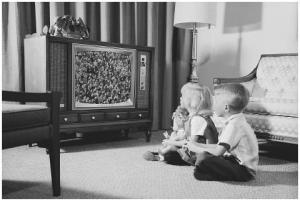
Now comes the scary part of the homily, where we apply the lesson to ourselves. What have we unguardedly welcomed into the heart of our homes? What in our lives most resembles the vampire? It is, I suggest, the television and the internet.

Now granted, television and the internet are not digitized evil, like the vampires are personified evil. There is real good to be gained through these forms of technology, but we are kidding ourselves if we think that they can’t seduce us. More often than not, it seems that television and the internet suck our lives out of us. They are up to our necks, but we are too infatuated with, or hypnotized by, them to realize that something is wrong.

Ask yourself, when was the last time that you watched TV and came away thinking, “Wow, that was great.  You know, I really think watching television made me a better person”? Now consider this question: when was the last time you watched TV and came away from it feeling unmoved and unsatisfied? That dissatisfaction should tell us something. Television sucks our life from us, and the internet can be just as bad, or even worse. Not only do these forms of media tend to disappoint us, numb us, and give near occasions to sin, they can harm our families too.

TV Children

Imagine if there was going to be a public execution in Marshfield tonight and your son wanted to go and watch, would you let him go? Yet how much death, simulated and real, is there to be seen on TV? Would you allow a complete stranger into your daughter’s bedroom unsupervised? Yet how many of our children have a TV or the internet right in their rooms? If TV or the internet were a person, would you welcome that person into your home?

Again, I am not saying that everything on television or the internet is evil, or that every good Catholic should discontinue their cable and internet subscriptions. But I am convinced that we need to be more careful and discerning about their roles in our lives, and that our habits with them probably need to change.

It could be that the single greatest thing you could do today to strengthen your family life and to improve your life of prayer would be to simply unplug. Imagine how much more opportunity and motivation you would have every day for family bonding and quiet times with God, if you put all your TVs in the basement and hid the internet cables along with them. Why not try it for a week? Or, if you’re really serious, why not make this your Advent penance and see how much your life is changed?

Like the psalmist said,

‘Although you may go forth weeping,
you’ll be carrying the seed to be sown,
And you shall come back at the end rejoicing,
carrying the sheaves you’ve harvested.’

After your unplugged period is over, you can bring the TV and the internet back if you want, but you will be freed from any addictions to them and they will be less likely to seduce you in the future, into the life of the living dead.

In the Gospel, the blind man, Bartimaeus, threw aside his cloak, sprang up, and ran to Jesus. Jesus said to him, “What do you want me to do for you?” The blind man replied, “Master, I want to see.”

Like vampires, change in our lives can be scary, but we should have the courage to see how much our lives could be better by following Christ in this way.

27th Sunday in Ordinary Time—Year B

October 4, 2009

At my old seminary in Ohio, where I was formed for the priesthood, there’s a great professor named Dr. Perry Cahall. Dr. Cahall taught us not only through his lectures but also by his personal example, as a husband, a father, and a good Catholic man. One of the courses taught us was early Church history, a class that covered the controversies and councils of that era about Jesus Christ and the Trinity. Now a person might easily overlook the importance of those councils, but Dr. Cahall presented us with a revealing thought experiment. He would have us imagine how things would be different if the heretics had won the day. For example, he would say, “Imagine a world in which Arius was right.” (Arius claimed in the 4th century that Jesus was neither God nor man, but rather the highest creature God had made.) What if the bishops at the council of Nicaea would have spurned the Holy Spirit, and the apostolic tradition, to make Arius’ theology the creed we say each Sunday? When you sit down to consider the consequences Arius’ belief would have for our morality, our worship, and our world, you realize that everything was at stake at Council of Nicaea. 

Important ideas have consequences. If some Christian belief does not influence your life, then you have either not accepted it, or you have not really grasped what it means. Dr. Cahall liked to say, “If you get into pulpit as a priest on Trinity Sunday and preach to your people that, ‘The Trinity is a mystery, so there’s really nothing we can say about it,’ I will hunt you down like the dogs you are. (We think he was kidding.) He said this because the Trinity and Incarnation are the two most central beliefs of our faith and they are full of implications for our lives. Important ideas have important consequences and our beliefs should shape our lives.

Dr. Cahall also taught our seminary course on marriage and family, and he had a meditation about marriage, family, and the Last Judgment that I hope to never forget and always remember. He would say, “At the Last Judgment, every person who has reached adulthood will stand before the Lord’s throne and Christ will ask them two things: First, ‘Were you faithful to your spouse?’ And second, ‘Show me your children.’” Now he said this to a room full of seminarians on their way to becoming celibate priests, but what he said is valid for everyone. We are all called to marriage, be it spiritual or natural. And we are all called to be mothers or fathers, either spiritually or naturally.

The Lord God said, “It is not good for the man to be alone. That is why a man… clings to his wife, and the two of them become one flesh.”

The fulfillment of our humanity is achieved, in Christ, through marriage and having children. Priests and religious who live chaste, celibate lives are no exception. That’s because celibacy is really about fruitful, spousal relationship, to one spouse, bearing many children. It is not without meaning that tradition calls nuns and consecrated virgins the “brides of Christ,” for they really are. All people are called to marriage; to fidelity in marriage, to permanence in marriage, and to fruitfulness in marriage. This is our Christian belief, but many people today have either not accepted it, or not really grasped what it means.

Consider the meaning of fruitfulness for marriage. The psalmist today considered having a large family to be a blessing (‘may your children be like olive plants around your table’) and Jesus said, “Let the children come to me and do not prevent them.” But many people today act as if having more than two children were a curse, and prevent more children from coming. Now there can be serious and legitimate reasons for naturally regulating and limiting births, but I fear that many people, when it comes down to it, are resisting Christ. Jesus said, “Whoever receives a child such as this in my name receives me.” So what does it mean if someone refuses to receive a child in His name?

Couples are afraid; they’re afraid that having four children will be twice as hard as having two.  But if you ask most Catholic couples with large families (with numbers of kids that were commonplace fifty years ago) they’ll say that the burden is less with each additional child, while the love and blessings within the family are multiplied. We should not be afraid to give ourselves fully to fruitfulness in marriage.

We are also called to permanence in marriage. Marriage in Christ is “until death do us part.” But in America today, one in every two marriages end in divorce. God says in the Old Testament, “I hate divorce,” and I suspect that the children of divorced parents share in His sentiment. Cases of abuse, serious addition, or unrepentant infidelity may require a couple’s separation, perhaps indefinitely, or may even require a divorce in the eyes of the state, but a consummated sacramental marriage can never be divorced in God’s eyes. As Jesus said:

“What God has joined together, no human being must separate. Whoever divorces his wife and marries another commits adultery against her; and if she divorces her husband and marries another, she commits adultery.”

That is why a divorced person cannot be remarried in the Church without a determination by the Church that something essential was lacking in the first marriage, from its very beginning, which prevented that marriage from being sacramental. So no one should say that annulments are “Catholic divorces.”  Annulments are judgments by the Church that a marriage was never sacramental. But in a valid, sacramental marriage, the mission of the husband and wife is to lead each other to heaven, no matter what, and to raise up children, natural or spiritual, for God.

If you want you children to feel safe and secure, tell them what my parents told me and my sisters when we were kids. Tell them, “Even, though Mom and Dad may argue sometimes, we want you to know that we will never, ever, get divorced.” Tell them this, and mean it.  They’ll really appreciate it. And I’m sure your spouse would like hearing you say it, too.

Most people would still agree that a married couple should be faithful to each other, exclusively.  But I would not be surprised if we began to see the open dismantling of this third pillar of marriage as well. The institution of marriage has been under assault for many years. It’s not that people have been out to destroy marriage per se; but steps to redefine what marriage means weaken marriage all the same.

Now a person might easily overlook the importance that traditional beliefs about marriage have for our society; but, like Arius’ heresy, when you sit down to consider the consequences of negating fruitfulness, permanence, and fidelity in marriage, then you realize that everything is at stake when it comes to marriage. You can’t remove or seriously weaken all the pillars from a house and expect the roof to remain hovering in the air. When we redefine marriage to mean what it is not, the house we live in comes crashing down upon us. That goes for one marriage or an entire society’s marriages.

So what are we to do? First, we must pray. Pray for your marriage. Pray together as a couple, because you need this. Pray together with your children, because they need this. And pray for our country, because it needs this. And then, empowered through your sacrament of marriage, which makes the love between Christ and His Church really present between the two of you, live out what Christian marriage really is as an example for all to see. Be fruitful, be faithful, be loving and joyful, as long as you both shall live.
18th Sunday in Ordinary Time—Year B

August 17, 2009

We humans are forgetful creatures. Look at the Hebrews, running short on food and patience in the first reading. It’s only one month since they’ve walked freely out of Egypt; after ten miraculous plagues, after the parting of a sea before them, after the total destruction of their enemies behind them. It’s just one month later and they’ve already forgotten God’s desire and creative ability to care for them. They’ve forgotten, and their hope is gone.

In the Gospel there’s more forgetfulness.  The people come to Jesus and they ask Him, “What sign can you do, that we may see and believe in you?  What can you do?” Have they already forgotten about His recent miraculous sign, how just the other day he multiplied loaves and fish for them?  Recalling that miracle to mind would have strengthened their faith and hope.

We’re forgetful too. I, for example, often have a problem remembering how the responsorial psalm goes.  I hear it, I repeat it, and then it’s gone. We’re forgetful people. For instance, can you remember what I preached about the last Sunday I was here? I wouldn’t expect you to.

I spoke about how we should be hopeful because of Jesus Christ. I also strongly emphasized the importance of each of us to pray every day. This morning I want to teach you how we can be strengthened in faith and hope by recalling in prayer our most grace-filled memories.

Maybe you pray as the first thing when you wake up. Maybe you pray before you go to bed each night. Maybe you pray while you’re driving, perhaps imagining Jesus or Mary in the seat beside you. Maybe you make a daily visit to Jesus here really present in our tabernacle. When and where you pray each day is not as important as the prayers you offer and the connection and consolation that Christ wants to give you.

Anyone who prays frequently will have times when they sometimes seem to wander about in a desert of unfocused thoughts. By an act of will, we can try digging a hole here or there, looking for new, fresh, spiritual water. But there is an easier way to go about things when our prayer time feels hard and dry.

If we search our memories we can find places and times when God was obviously close and active. Perhaps a time when He silently but clearly spoke to you, or a time when He provided for you in answer to your prayers. Perhaps the births of your children or day you got married are moments that perceivably touched the eternal.

These memories can be wellsprings of grace and consolation for you. Just because we have left a well behind in your past doesn’t mean that well is run dry. What was true then, is still true now and you can go back their in your memories and draw graces from it again. Our grace-filled memories can serve as an anchor of hope, our ever-accessible source for faith and hope in prayer.

There is one more thing I on which I want to speak.  Our psalm said today:

“What we have heard and know, and what our fathers have declared to us, We will declare to the generation to come the glorious deeds of the LORD and his strength and the wonders that he wrought.”

This psalm is not only written for the Old Testament Jews, its meant for us as well. And when it mentions “fathers” here, priests like me are not the fathers it has foremost in mind. Fathers, if your children only hear about God from me, your silence will speak a message to them. It is important that you be a spiritual leader for your family and tell the stories of our faith and of your faith.

Parents, have you ever told your children of “the glorious deeds” that the Lord has done for you? If not, why not? Do you feel reluctant to tell? Or do you think that there is nothing to tell? Either way, a change needs to happen.

So remember, whether you are dry at prayer, or raising children for the Lord, remember to remember.