Archive for the ‘Mass’ Category

St. Paul’s Mass Registration

May 21, 2020

Our bishop’s current guidelines for public Masses require a measure of social distancing and limit our church’s capacity.

To attend, register your seat(s) any and all upcoming St. Paul’s Masses. A scheduled minster (usher, lector, server, organist, or sacristan) is not to reserve a seat for him or herself.


(Online registration is no longer required for Masses)


Joyful Gifts — The Reception of Lane Severson into Full Communion

May 17, 2020

6th Sunday of Easter—Year A

Today we have special cause for joy. This Sunday, Lane Severson formally joins the Catholic Church and will receive the Sacraments of Confirmation and First Holy Communion. His story bears a likeness to today’s first reading from the Book of Acts, in which the people of Samaria heard the preaching of the Gospel:

“Philip went down to the city of Samaria and proclaimed the Christ to them. … Once they began to believe Philip as he preached the good news about the kingdom of God and the name of Jesus Christ, men and women alike were baptized.”

Lane became a Christian thirteen years ago when, professing faith in our Lord and Savior Jesus Christ, he was baptized in a Washington State pond. This was God’s greatest gift to him since the day of his birth. Today, he comes to Jesus Christ’s Church because, as it was for the people of Samaria, God has additional great gifts he delights to give him and calls him to receive.

“[W]hen the apostles in Jerusalem heard that Samaria had accepted the word of God, they sent them Peter and John, who went down and prayed for them, that they might receive the Holy Spirit, for it had not yet fallen upon any of them; they had only been baptized in the name of the Lord Jesus. Then they laid hands on them and they received the Holy Spirit.”

Those Samaritans had each been baptized, but there was still more for them to receive, still more for each to experience. God does not merely seek to cleanse us of former sins and fill us with new grace — as wonderful as that is — the Most Holy Trinity desires personal and profound relationship with each of us, desires that we would become intimately united to each Divine Person. God calls us to be more deeply united to the Spirit through Confirmation, to be more deeply united to the Son through the Eucharist, and to be led to the Father and the eternal life of Heaven beginning in his Church here on earth.

The Sacrament of Confirmation is a special outpouring of the Holy Spirit as once granted to the apostles on the day of Pentecost. It increases the gifts and fruits of the Holy Spirit within us. It roots us more deeply as prayerful children of God, moving us to cry out, “Abba! Father!” And it provides the Spirit’s strength to spread and defend the faith by word and deed as true witnesses of Christ; to confess the name of Christ boldly, unashamed of the Cross; to “always be ready,” as St. Peter says in our second reading, “to give an explanation to anyone who asks you for a reason for your hope.

The Holy Eucharist is also an incredible gift of God. This sacrament is a partaking in the same holy meal and offering Jesus gave his apostles at the Last Supper. It increases and deepens our union with Christ. As Jesus says, “Whoever eats my flesh and drinks my blood remains in me and I in him. Just as the living Father sent me and I have life because of the Father, so also the one who feeds on me will have life because of me.” The Holy Eucharist separates us from sin, wiping away venial sins when we receive the Lord worthily and strengthening us against future temptation. And it unites us as one with each other in the Mystical Body of Christ, his Church. As St. Paul writes, “The cup of blessing which we bless, is it not a participation in the blood of Christ? The bread which we break, is it not a participation in the body of Christ? Because there is one bread, we who are many are one body, for we all partake of the one bread.

We are all excited for Lane joining the Catholic Church and receiving her great God-given gifts this day. And we Catholics who have already received these precious sacraments will profit to remember their powerful effects which, in the state of grace, endure within each of us. In Samaria, at the preaching of the Gospel and the mighty signs of God, “There was great joy in that city.” We, like they, have cause for joy today. So in the words of today’s psalm:

“Shout joyfully to God, all the earth,
sing praise to the glory of his name;
proclaim his glorious praise.
Say to God, ‘How tremendous are your deeds!’”


New Catholic Lane Severson & Carol Kaszubowski, his Confirmation Sponsor, on May 17, 2020.

On Returning to Sunday Masses

May 14, 2020

On May 14th, following the repeal of Wisconsin’s statewide Safer at Home order, our Bishop William Callahan promulgated this letter and these guidelines on the possible resumption of public Sunday Masses in Diocese of La Crosse parishes as early as May 31st.

St. Paul’s and St. John the Baptist’s Churches will be actively pursing a safe return to weekly Sunday Masses. However, it appears likely that the issuing of new Wisconsin state and/or Chippewa County rules in the near future may restrict aspects of what our diocese seeks to allow. Stay tuned for updates in these weeks ahead.

Fasting from the Eucharist

April 10, 2020

Good Friday

St. Pope John Paul II and Joseph Cardinal Ratzinger, Lent of 1995

The Latin Rite of the Catholic Church, to which we and 98.6% of the world’s Catholics belong, has just one day each year when no Masses are to be celebrated. That day is today, Good Friday. After a reading of Christ’s Passion from the Gospel of John and reverencing his holy Cross, the Good Friday liturgy contains a Communion service in which presanctified (previously consecrated) Hosts are distributed and consumed. However, in the early Church, there was no reception of Holy Communion by the faithful on Good Fridays at all. This fact was once noted by Joseph Cardinal Ratzinger. Cardinal Ratzinger, this highly-esteemed theologian, would go on to be elected pope and take the more familiar name Benedict XVI. In his 1986 book “Behold the Pierced One,” he reflected upon the spiritual benefits that could be found by Catholics in full communion with the Church abstaining for a time from receiving our Lord in the Holy Eucharist. Obviously, these interesting passages are relevant to us now during this Long Lent of 2020.

Cardinal Ratzinger wrote:

“When [St.] Augustine felt his death approaching, he ‘excommunicated’ himself and took upon himself ecclesiastical penitence. In his last days, he set himself alongside, in solidarity, with the public sinners who seek forgiveness and grace through the pain of not receiving the Communion. He wanted to meet his Lord in humility of those who hunger and thirst for righteousness, for Him, the righteous and gracious One. Against the background of his sermons and writings, which describe the mystery of the Church as a communion with the Body of Christ and as the Body of Christ, on the basis of the Eucharist, in a really marvelous way, this gesture is quite shocking. It seems to me more profound and fitting, the more often I ponder it. Do we not often take things too lightly today when we receive the most Holy Sacrament? Could such a spiritual fasting not sometimes be useful, or even necessary, to renew and establish more deeply our relation to the Body of Christ?

In the early Church there was a most expressive exercise of this kind: probably since the time of the apostles, Eucharistic fasting on Good Friday was part of the Church’s spirituality of Communion. Not receiving Communion on one of the most holy days of the Church’s year, which was celebrated with no Mass and without any Communion of the faithful, was a particularly profound way of sharing in the Passion of the Lord: the sorrowing of the bride from whom the bridegroom has been taken away (see Mark 2:20). I think that a Eucharistic fast of this kind, if it were deliberate and experienced as a deprivation, could even today be properly significant, on certain occasions that would have to be carefully considered—such as days of penitence (and why not, for instance, on Good Friday once more?) […]

Such fasting — which could not be allowed to become arbitrary, of course, but would have to be consonant with the spiritual guidance of the Church — could help people toward a deepening of their personal relation to the Lord in the Sacrament; it could be an act of solidarity with all those who have a yearning for the Sacrament but cannot receive it. […] I would not of course wish to suggest by this a return to some kind of Jansenism: in biological life, as in spiritual life, fasting presumes that eating is the normal thing to do. Yet from time to time we need a cure for falling into mere habit and its dullness. Sometimes we need to be hungry—need bodily and spiritual hunger—so as once more to comprehend the Lord’s gifts and to understand the suffering of our brethren who are hungry. Spiritual hunger, like bodily hunger, can be a vehicle of love.”

During this dangerous Coronavirus pandemic, faithful shepherds charged by Christ to care for the fullness of persons entrusted to them have prescribed sad but necessary measures which have restricted access to Holy Communion. In doing this, our Church leaders follow in the prudential footsteps of past prelates who likewise suspended public Masses during times of deadly contagion, from the medieval plagues to the modern Spanish Flu. Although public liturgies with Communion have ceased it is important to remember that the Holy Mass continues to be offered by priests in our Catholic churches. The graces of Jesus’ sacrifice pour forth from these altars into Christians souls around the world. Do not doubt that our Lord will provide sufficient grace for all that you are called to do in this season of our lives. As the Lord once told St. Paul when the saint prayerfully begged for a certain trial to be taken away, “My grace is sufficient for you, for power is made perfect in weakness.”

When we cannot physically receive Jesus in the Eucharist we can still unite ourselves to him through a prayer for Spiritual Communion. Pope St. John Paul the Great wrote that the practice of Spiritual Communion “has happily been established in the Church for centuries and recommended by saints who were masters of the spiritual life. St. Teresa of Jesus wrote: ‘When you do not receive Communion and you do not attend Mass, you can make a Spiritual Communion, which is a most beneficial practice; by it the love of God will be greatly impressed on you.’” Once, in a 14th century vision, Jesus showed St. Catherine of Siena two chalices, one gold and one silver. He said her Sacramental Communions were preserved in the gold chalice and her Spiritual Communions in the silver one. When our sacramental reception of our Lord proves impossible, Jesus desires our Spiritual Communion. Until the day we are all safely reunited around his altar, I urge you to make acts of Spiritual Communion, such as this famous prayer of St. Alphonsus Liguori:

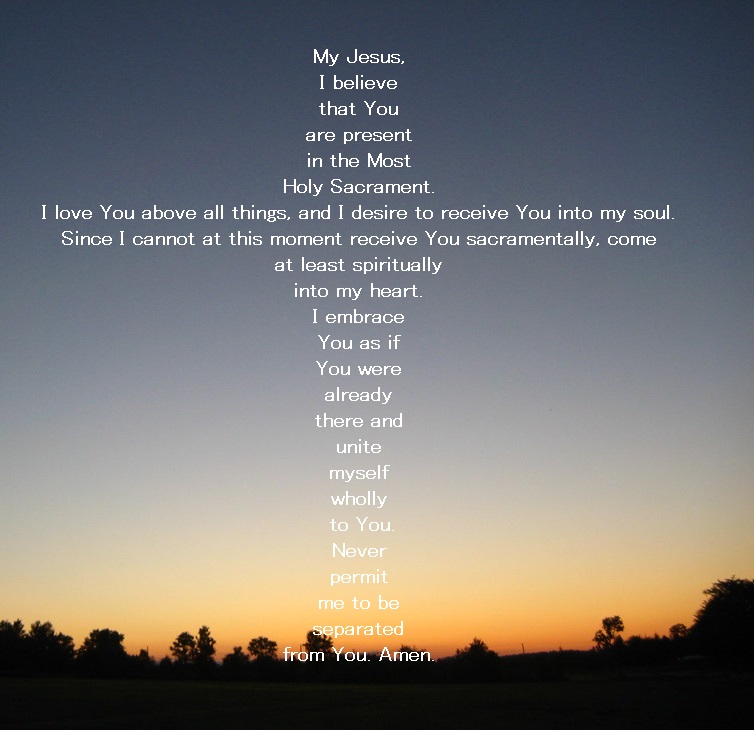
My Jesus,
I believe that You are present in the Most Holy Sacrament.
I love You above all things, and I desire to receive You into my soul.
Since I cannot at this moment receive You sacramentally,
come at least spiritually into my heart.
I embrace You as if You were already there
and unite myself wholly to You.
Never permit me to be separated from You.
Amen.

Just one month ago, when pews were full for the 2nd Sunday of Lent, we heard the Gospel story of the Transfiguration. On Mount Tabor, Jesus’ face shone like the sun and his clothes became white as light. Ecstatic, Simon Peter said in reply, “Lord, it is good that we are here! If you wish, I will make three tents here, one for you, one for Moses, and one for Elijah.” Peter wanted to never leave that euphoric time and place, but it was necessary that Jesus lead him down from that mountain top into the dark valley; from the Mount of Transfiguration to the Hill of Crucifixion.

It is a true sacrifice to fast from the Eucharist this Good Friday amidst this Long Lent. But our Christian sacrifice is not without purpose nor without hope. Like Jesus’ Passion, it is a sacrifice offered for the love of others. This is his Body given up to save many; we do this in memory of him. And like Jesus within his Passion, we can be confident that this arduous trial shall pass away and our suffering and obedience will soon yield great rewards, particularly a deepened love for our Eucharistic Lord. Being followers of the transfigured Christ takes us to Calvary, but the Passion is what leads us to his Resurrection. And the more we share in the likeness of Christ, the more we will share in his glory.

Christ Ordained

April 9, 2020

Holy Thursday


What the Old Testament foreshadowed, the New Testament reveals. What the Old Covenant prefigured, God’s New Covenant fulfills. What our Lord prepared in ancient times, he now bestows to his Church. The Holy Scriptures point to the gifts of God we particularly celebrate on this evening: the Holy Priesthood and the Holy Eucharist.

In the Book of Exodus, the Lord declares to Moses: “This is the rite you shall perform in consecrating [Aaron and his sons] as my priests. … Aaron and his sons you shall…bring to the entrance of the tent of meeting and there wash them with water.” On Holy Thursday, “[Jesus] rose from supper and took off his outer garments. He took a towel and tied it around his waist. Then he poured water into a basin and began to wash the disciples’ feet and dry them with the towel around his waist.

Peter said to the Lord, “You will never wash my feet.” But Jesus answered him, “Unless I wash you, you will have no inheritance with me.” The Book of Deuteronomy taught, “The levitical priests, the whole tribe of Levi, shall have no [landed] portion or [territorial] inheritance with Israel…. [T]he Lord set apart the tribe of Levi,” Deuteronomy says, “to carry the Ark of the Covenant of the Lord, to stand before the Lord to minister to him, and to bless in his name…. For this reason, Levi has no portion or inheritance with his relatives; the Lord himself is his inheritance….

When Jesus told Peter, “Unless I wash you, you will have no inheritance with me,” Simon Peter replied, “Master, then [wash] not only my feet, but my hands and head as well.” As part of the priestly ordination ritual in the Book of Exodus, the Lord commanded Moses: “[Sacrifice an unblemished male sheep and] some of its blood you shall take and put on the tip of Aaron’s right ear and on the tips of his sons’ right ears and on the thumbs of their right hands and the great toes of their right feet. Splash the rest of the blood on all the sides of the altar.” Jesus says Peter does not need to be washed all over, head and hand and foot, because whoever has bathed is clean. (This is likely a reference to his baptism.) But at the Last Supper, the Body of God’s perfect, unblemished Lamb is broken and his Blood is poured for the apostles.

As St. Paul wrote to the Corinthians: “[T]he Lord Jesus, on the night he was handed over, took bread, and, after he had given thanks, broke it and said, ‘This is my body that is for you. Do this in remembrance of me.’ In the same way also the cup, after supper, saying, ‘This cup is the new covenant in my blood.’” On Holy Thursday, the apostles receive the Blood of the Lamb and then, on Good Friday, this Blood marks the sides of the Lamb’s Altar, the vertical and horizontal beams of the Cross.

In Egypt before the Exodus, when the Lord instituted the Passover sacrifice, he commanded his people: “[E]very one of your families must procure for itself a lamb… The lamb must be a year-old male and without blemish…. It shall be slaughtered during the evening twilight. They shall take some of its blood and apply it to the two doorposts and the lintel of every house in which they partake of the lamb. That same night they shall eat its roasted flesh…. This day shall be a memorial feast for you, which all your generations shall celebrate… as a perpetual institution.” At the first Eucharist, Jesus commands his apostles, “Do this in remembrance of me,” thereby ordaining them as his priests of his New Covenant.

The apostles had been washed with water, sanctified by blood, bestowed an inheritance in the Lord, and entrusted with the mission of offering the unblemished Lamb. As the Catholic Church has always believed and taught, this memorial sacrifice, this Eucharist, re-presents, truly makes present, the sacrifice of the Cross, and applies its saving fruits among us. On Holy Thursday, Jesus gave his New Covenant Church the intertwined gifts of the Holy Eucharist and the Holy Priesthood.

The trial of this Long Lent of 2020 has made Catholics more appreciative of God’s precious gifts. This evening, we are blessed by the presence of the three seminarians from our local parishes assisting at Mass. We thank God for their vocations and urge them to press on. Eventually, this Long Lent of the Church will joyfully end and these young men will be (God willing) ordained to serve her, offering Christ’s sacrifice as loving servants for the good of us all. Pray for our seminarians, Eric, Matthew, and Isaac, that they may take up the cup of salvation; that they may offer the sacrifice of thanksgiving and call upon the name of the Lord; that they may fulfill ordination promises to the Lord in the presence of all his people. And with patient eagerness let us pray for the coming day when all of us, God’s priests and his people, can celebrate the Mass together again.

This is His Body Given up to Save Many

March 21, 2020

Laetare Sunday — 4th Sunday of Lent—Year A

This past Wednesday evening, I saw this image online with the caption: “Darkness has fallen: every single U.S. diocese has suspended public celebrations of the Mass.”

Our Laetare Sunday rejoicing is more subdued this Lent. The sad but necessary suspension of public Masses by our nation’s bishops is a painful loss. And for many of the faithful, the greater their love for the Lord the greater the pain they feel. They are like the woman at Simon the Pharisee’s house who could bathe Jesus’ feet with dripping tears ‘because she loved much.’ (Luke 7:47) However, darkness has not overcome us.

Brothers and sisters,” today’s second reading tells us, “you were once darkness, but now you are light in the Lord.” God is still God, Christ is still Lord, and we are still His. Though public liturgies have ended the Holy Mass continues to be privately offered in most every Catholic church. The graces of Jesus’ sacrifice pour forth from these altars into Christian souls throughout the world, for our good and the good of all his holy Church. Priests are celebrating these Masses in obedience to the command of Christ recalled at every Consecration, “Do this in memory of me.” Yet each of us, ordained and lay people alike, is called to keep this commandment of Christ in a deeper way; by personally imitating Jesus in his loving self-sacrifice for others.

Today, and in the critical weeks and months ahead, all of us are called to sacrifice in ways that will seriously limit our activities and impact our finances. Why are we doing this? To stop the spread of a deadly disease not merely to ourselves but to our many neighbors around us. From my research into this grave topic, it appears that hundreds of thousands—potentially millions—of American lives depend upon the extent of our collective and individual actions now. So please respond with a firm resolve from a Christian love for others.

When you ache today because you can neither gather for Mass nor physically receive our Lord, take heart in the reason for your sacrifice. This is his Body given up to save many; we do this in memory of Him. And soon, when you are asked to help people in the community meet their material needs, sacrifice for them knowing whom you are also serving. For whatever you do for the least of your brethren, you do it for Him. Invite Jesus now to enter into your heart and be with you, to console and strengthen you, today and in the trials ahead of us.

A Future Pope on Fasting from the Eucharist

March 18, 2020

In the Latin Rite of the Catholic Church (of which 98.6% of the world’s Catholics are members) there is only one day each year when no Masses are to be celebrated – that is, Good Friday. That day’s liturgy contains a Communion service in which presanctified (previously consecrated) Hosts are received and eaten by the faithful. However, in the early Church, there was no consumption of Holy Communion on Good Fridays by the faithful at all. This tradition was noted by the esteemed theologian Joseph Cardinal Ratzinger (the future Pope Benedict XVI) in his 1986 book “Behold the Pierced One” and again (reprinted) in the 2002 book “Pilgrim Fellowship of Faith: The Church as Communion.”

In passages relevant to our present-day, Lenten reality, Cardinal Ratzinger reflects upon the spiritual value that could be found in the practice of Catholics in full communion with the Church abstaining for a time from consuming Jesus Christ in the Holy Eucharist:

“When Augustine felt his death approaching, he ‘excommunicated’ himself and took upon himself ecclesiastical penitence. In his last days, he set himself alongside, in solidarity, with the public sinners who seek forgiveness and grace through the pain of not receiving the Communion. He wanted to meet his Lord in humility of those who hunger and thirst for righteousness, for Him, the righteous and gracious One. Against the background of his sermons and writings, which describe the mystery of the Church as a communion with the Body of Christ and as the Body of Christ, on the basis of the Eucharist, in a really marvelous way, this gesture is quite shocking. It seems to me more profound and fitting, the more often I ponder it. Do we not often take things too lightly today when we receive the most Holy Sacrament? Could such a spiritual fasting not sometimes be useful, or even necessary, to renew and establish more deeply our relation to the Body of Christ?

In the early Church there was a most expressive exercise of this kind: probably since the time of the apostles, Eucharistic fasting on Good Friday was part of the Church’s spirituality of Communion. Not receiving Communion on one of the most holy days of the Church’s year, which was celebrated with no Mass and without any Communion of the faithful, was a particularly profound way of sharing in the Passion of the Lord: the sorrowing of the bride from whom the bridegroom has been taken away (see Mark 2:20). I think that a Eucharistic fast of this kind, if it were deliberate and experienced as a deprivation, could even today be properly significant, on certain occasions that would have to be carefully considered—such as days of penitence (and why not, for instance, on Good Friday once more?), or also perhaps especially at great public Masses when there are so many people that a dignified distribution of the Sacrament is often not possible, so that by not receiving the Sacrament people could truly show more reverence and love than by doing so in a way that contradicts the sublime nature of this event.

Such fasting—which could not be allowed to become arbitrary, of course, but would have to be consonant with the spiritual guidance of the Church—could help people toward a deepening of their personal relation to the Lord in the Sacrament; it could be an act of solidarity with all those who have a yearning for the Sacrament but cannot receive it. It seems to me that the problem of people who have been divorced and remarried, yet equally the problem of intercommunion (in mixed marriages, for example), would be less of a burden if voluntary spiritual fasting was at the same time undertaken in visible recognition and expression of the fact that we are all dependent upon that ‘healing of love’ which the Lord effected in the ultimate solitude of the Cross. I would not of course wish to suggest by this a return to some kind of Jansenism: in biological life, as in spiritual life, fasting presumes that eating is the normal thing to do. Yet from time to time we need a cure for falling into mere habit and its dullness. Sometimes we need to be hungry—need bodily and spiritual hunger—so as once more to comprehend the Lord’s gifts and to understand the suffering of our brethren who are hungry. Spiritual hunger, like bodily hunger, can be a vehicle of love.”

News of a Sad but Necessary Measure

March 17, 2020

By Fr. Victor Feltes

Monday evening, our Bishop William Callahan announced the suspension of public Masses in the Diocese of La Crosse starting this Friday. “In light of the continued concern surrounding the coronavirus, and the advice of medical experts, across the country, and especially in our State, all Masses in the Diocese of La Crosse will be canceled beginning 20 March 2020 until further notice.” This means that there will be no Sunday or weekday parish Masses open to the general public. Earlier on Monday, Wisconsin Governor Tony Evers had announced his decision to ban public gatherings greater than fifty people in hopes of mitigating the deadly spread of COVID-19.

[Post-Script: Tuesday evening, Bishop Callahan directed his priests to abide by Wisconsin’s statewide ban on all gatherings of 10 or more people announced earlier in the day and cancelled all public Masses.

What does this mean for Holy Week and Easter?
Bishop Callahan predicts that this suspension of public Masses will need to continue until the beginning of May. If so, the rites of this year’s Easter Triduum at St. Paul’s will be celebrated without public participation.

Will Confession still be available?
Yes. Bishop Callahan has asked his brother priests to offer even more and varied times for hearing confessions.

What about Funerals and Weddings?
Funerals and weddings will continue to be celebrated for the faithful but with strictly-limited attendance.

Will our Churches be open?
Bishop Callahan asks that the churches in our diocese remain accessible for private prayer. St. Paul’s and St. John the Baptist’s churches are not kept unlocked 24-7, but they will continue to be as open as they were before this epidemic arose.

Will Anointing of the Sick and Viaticum be available?
Priests will make every effort to reach the sick or dying to share these precious sacraments. Please contact us if you are aware of someone in need. Fr. Feltes can be reached at 715-568-3255.

Will any Masses be offered?
Many priests of our diocese will be privately offering Mass each day for you, the Church, and the whole world. Fr. Feltes’ daily Masses will be celebrated unannounced, at irregular times, so as to limit dangerous contact amongst God’s people.

What can we do?
Amidst these events, unprecedented in our lifetimes, Bishop Callahan calls us to charity, faithful prayer, and patience. He asks us to pray for all of our brothers and sisters whose personal lives and the lives of their families have been affected by this disease. He also invites healthy volunteers to clean our churches at various times during the day for those who may wish to make a private visit or come for Confession. If interested in joining such a cleaning effort, please call or email the parish office. Our bishop also urges us to “Please stay well and take every precaution to do so.” Stay tuned, as Fr. Feltes will provide helpful updates and edifying reflections in these days and weeks ahead. “And behold,” Jesus tells us, “I am with you always, until the end of the age.” (Matthew 28:20)

Finding Jesus in our Isolation — 3rd Sunday of Lent—Year A

March 16, 2020

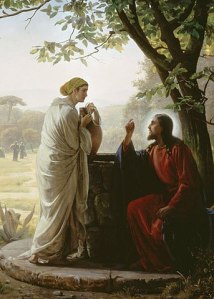
Today’s Gospel story contains a valuable lesson for us in our present situation.

Jesus, tired from his journey, sat down there
at [Jacob’s] well. It was about noon.
A woman of Samaria came to draw water.
Jesus said to her, “Give me a drink.”

There is a weird detail contained in these passages: the woman is going to the well to draw water at noon. It’s hot at noon in the Middle East, so Jesus and the woman are the only ones there. Why didn’t she come in the morning or the evening when the heavy job of hauling water would not have the added burden of the midday sun and heat? It’s because she didn’t want to be there when the other women would be around. Jesus reveals that the woman has no true husband and that she has had five different mates through the years. Jesus knows this supernaturally but her neighbors know something of these facts naturally, through local gossip. This woman has a reputation and if she were to go to that well at the same time as the other women they would make her feel unwelcome, through their words or their silence, with their eyes and their body language. They have quarantined themselves from her and she has socially distanced her heart from them.

In the middle of her day,
in the uncertainties of her life,
amid the stress of her tasks,
in her personal isolation,
she is surprised to encounter Jesus there.

He says to her:

“If you knew the gift of God and who is saying to you, ‘Give me a drink,’ you would have asked him and he would have given you living water. … Whoever drinks the water I shall give will never thirst; the water I shall give will become in him a spring of water welling up to eternal life.”

Jesus wins over the woman’s soul, she leaves her water jar behind and joyfully proclaims her great discovery. Meanwhile, the returned disciples urge Jesus, ‘Rabbi, Teacher, eat something!’ But he says to them, “I have food to eat of which you do not know. … My food is to do the will of the one who sent me and to finish his work.” Of course Jesus is hungry—physical realities are real—but he has nourishment in his soul, from his relationship with God his Father and his deepening relationship with those he has come to save, like this woman at the well.

Now in likening the woman at the well to one quarantined from others, I am not advising you to take unnecessary or imprudent risks amidst this current Coronavirus pandemic. In these months ahead, some of us will be called to acts of particular courage; nurses and doctors come first to mind. But we should not blithely, unnecessarily place ourselves in foreseeable natural dangers expecting God to perform miracles to protect us. Recall how Satan tempted, “If you are the Son of God, throw yourself down from here. For it is written: ‘He will command his angels concerning you’ and ‘with their hands they will support you, lest you dash your foot against a stone.” Jesus answers, “You shall not put the Lord, your God, to the test.” We must not act presumptuously.

The reason I mention the woman finding Jesus in her isolation is because, whatever our health may be, we need to encounter him there as well. Public Masses continue in our diocese, but it is very probable that these will be suspended in the future, just as Catholic Churches suspended public Masses a century ago during the Spanish Flu pandemic. I will personally be very surprised if we are having Mass here together two weeks from today. [Post-Script: On the evening of March 17th, Bishop William Callahan directed his priests to abide by Wisconsin’s statewide ban on all gatherings of more than 10 people announced earlier in the day. As a result, we are cancelling all remaining public Masses at my parishes.] Yet even in times when public Masses are readily available, most hours of our week and not spent inside of a church.

In the middle of your day,
in the uncertainties of your life,
amid the stress of your tasks,
in your personal isolation,
you can encounter Jesus there.

He is with you and within you, so you are never really alone.
Jesus says:

“Let anyone who thirsts come to me and drink.
Whoever believes in me, as scripture says:
‘Rivers of living water will flow from within him.’”

Wherever you are, find him there, and draw on his graces.

I seem to recall a story about St. Faustina Kowaska, the Polish nun and visionary most closely associated with the Divine Mercy devotion. When she was confined to her convent infirmary, suffering from the tuberculosis which would eventually take her life, she lamented that for one or more days in a row she had been unable to receive Holy Communion. In a vision, Jesus reassured her, saying, ‘Whenever you receive me in the Eucharist, I remain within you until you receive me again, unless you cast me out through mortal sin.’ Similarly, in the sixth chapter of John, Jesus famously declares:

“I am the bread of life; whoever comes to me will never hunger, and whoever believes in me will never thirst. … Whoever eats my flesh and drinks my blood remains in me and I in him.”

Christ’s Church encourages frequent, even daily, reception of Holy Communion as a helpful devotion toward holiness, but whether your next communion is one week or three months from now, know that Jesus is with you to provide his sufficient graces for your life. If public Masses are suspended in our diocese, realize that I and other Catholic priests, even if standing alone in our churches, will still be offering the Holy Mass daily for you and the whole world. And we will be bringing Confession, Holy Anointing, and Viaticum to the sick, as is our calling and duty, for as long as we are able. This Wuhan Coronavirus pandemic is rightfully concerning. (I urge you to read my bulletin article this weekend.) But whatever comes we need not fear, for “we know that all things work for good for those who love God,” and “whether we live or die, we are the Lord’s.” As Jesus would very often say, “Be not afraid.

Concerning Coronavirus

March 12, 2020

Coronavirus is a Serious Concern

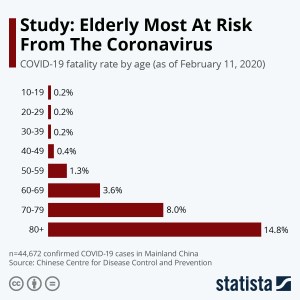
The Wuhan Coronavirus is very contagious and estimated by Dr. Anthony S. Fauci, head of the National Institute of Allergy and Infectious Diseases, to be ten times deadlier than the seasonal flu. This new pandemic poses some small danger to the young but puts the elderly and those with underlying health issues at much graver risk. In Italy, where 6% of those confirmed to be infected with Coronavirus have died thus far, the Italian Catholic bishops have suspended all public Masses in their churches until at least April 3rd. And in Washington State, where 31 people have died, the Catholic Archdiocese of Seattle has suspended all public Masses indefinitely.

Due to current limitations in the United States’ ability to test for the Coronavius, it is unclear how pervasively the illness is spreading in this country. For some idea of how bad things could become, according to the Centers for Disease Control and Prevention’s (CDC) figures the less contagious and less lethal Influenza virus has infected between 3% to 14% of Americans per year since 2010, resulting in 12,000 to 61,000 deaths annually. If, hypothetically, 14% of Americans go on to catch this new Coronavirus and its mortality rate proves to be 1% (as Dr. Fauci predicted this Wednesday in his testimony before Congress) it will result in 458,000 U.S. deaths. The Wuhan Coronavirus is clearly a matter for our serious attention.

Signs of Illness & Means of Prevention

What are the symptoms of the Wuhan Caronavirus? The World Health Organization (WHO) reports that among confirmed cases about 90% of patients manifest a high fever and about 70% have a dry cough. Shortness of breath is another noted symptom. If someone believes they are infected, the CDC recommends calling ahead to their personal doctor or hospital for instructions rather than just walking into their local E.R. and possibly infecting others. The sick are urged to stay home and to wear a mask to prevent spreading the disease. There is currently no vaccine to protect against this Coronavirus and a safe vaccine is not expected for at least another year.

The CDC says the virus is thought to spread mainly person-to-person, between people in close contact with one another (6 feet or less,) especially from the coughs or sneezes of an infected person. They recommend frequently washing your entire hands with soap and water for at least 20 seconds or (if soap and water are not available) to use hand sanitizer with at least 60% alcohol content. They also urge no touching of your eyes, nose, or mouth with unwashed hands, disinfecting commonly touched surfaces, avoiding contact with those who are sick, and distancing yourself from other people in general.

Missing Mass & Spiritual Communion

Common, good, and prudent reasons for missing Sunday Mass include being ill, dangerous conditions, or needing to care for another person. Therefore, when someone is sick, or believes that venturing out would be dangerous, or believes that the risk of bringing a sickness back home to someone in their care is too great, they are excused from attending Sunday Mass. However, if someone is avoiding Sunday Mass as a too-risky activity then it seems that person also should not be attending parties, going to the movies, out shopping for non-essential items, and the like, but rather social distancing in a way consistent with one’s concern. And if you will be missing Mass for an extended time, to help ensure the continued health of your parish consider registering for automatic withdrawal (ACH) giving from your checking account. Additionally, even if one has a legitimate reason to skip Mass, our duty to worship God and rest on the Lord’s Day remains.

Jesus Christ’s Catholic Church encourages frequent (even daily) Holy Communion, but if we cannot attend Mass we can still unite ourselves to Our Lord by making a Spiritual Communion. St. Teresa of Ávila wrote, “When you do not receive Communion and you do not attend Mass, you can make a Spiritual Communion, which is a most beneficial practice; by it the love of God will be greatly impressed on you.” Once, in a vision, Jesus showed St. Catherine of Siena two chalices, one gold and one silver. He said her Sacramental Communions were preserved in the gold chalice and her Spiritual Communions in the silver one. A Spiritual Communion with Jesus is the next best thing to physically receiving Him in the Eucharist.

If public Masses are suspended in your diocese, remember that the Holy Mass can be seen on TV or online as a next best alternative. Know that the daily Mass readings can be found at the U.S. Conference of Catholic Bishops (USCCB) website. And realize that Catholic priests, even if standing alone in their churches, will still be offering the Holy Mass daily for the whole world and bringing Confession, Holy Anointing, and Viaticum to the sick for as long as they are able. The Wuhan Coronavirus pandemic is rightfully concerning, but whatever comes we need not fear, for “we know that all things work for good for those who love God,” and “whether we live or die, we are the Lord’s.” (Romans 8:28,14:8) As Jesus often said, “Be not afraid.

The Visiting Shepherds — Christmas Mass

December 25, 2019

Early on the first Christmas Eve, in a field outside of Bethlehem, I imagine one of the shepherds complaining to his companions: “Wouldn’t you know it, we have to work on Christmas!” That’s just a joke, of course. The shepherds near Bethlehem, living in the fields and keeping watch over their flock, had no reason to expect that night would be anything special. Indeed, if not for Jesus’ birth into our world, today would be just another workday and there would be no reason to celebrate. But Jesus did come into our world to save us, and those shepherds were his first invited guests. “Do not be afraid; for behold, I proclaim to you good news of great joy that will be for all the people. For today in the city of David a savior has been born for you who is Christ and Lord.”

These shepherds would seem to be unlikely guests. Not rich, not powerful, not admired; but poor, dirty, and smelly. They lived apart from the community like outcasts. Shepherds were so little trusted that they could not give testimony in court. And yet, God’s Good News was offered to them. The Emperor Caesar Augustus, whose census brought the Holy Family to Bethlehem, was not given an angelic invitation. Perhaps the Roman Emperor was too proud to receive one; unwilling to admit that he was not a god over anything and that one God deserved his full worship, love, and obedience. But the shepherds were humble, humble enough to listen to the Heaven-sent message and act on it. “Let us go, then, to Bethlehem to see this thing that has taken place, which the Lord has made known to us.

The city of Bethlehem is to the south and west of Jerusalem. Bethlehem was only about 5½ miles away from the Jewish Temple, roughly the same direction and distance that St. John the Baptist Church in Cooks Valley is from here. Just as Bethlehem and Jerusalem are situated closely to each other, so Christmas points to Easter. The two are closely linked. It was specifically from Bethlehem’s flocks that sheep were provided to be sacrificed in Jerusalem for the peoples’ sins. In this region, the Lamb of God was born and to this region Jesus would return to die and rise to take away the sins of the world. Mary wrapped her little newborn snugly in swaddling clothes. Mary would later wrap his body in a linen burial shroud. Tradition says Joseph prepared a cave for the place of Jesus’ birth when other accommodations were unavailable. Later, another Joseph would make last-minute arrangements for Jesus to be buried in a rock-hewn tomb. Baby Jesus was born in Bethlehem, a city whose name means “House of Bread.” He was laid in a manger, a feed-box for grain. Later, on the day before he was to suffer, Jesus would take bread in hand and say, “Take this, all of you, and eat of it: for this is my body which will be given up for you.

The shepherds went in haste into Bethlehem and found Mary, Joseph, and the baby Jesus there. “When they saw this, they made known the message that had been told them about this child. … Then the shepherds returned, glorifying and praising God for all they had heard and seen, just as it had been told to them.” After Christmas, after that beautiful day, did the shepherds ever come back to visit the Holy Family? I doubt you could find two people more friendly and welcoming than holy Joseph and Mary, but did the shepherds ever take the opportunity to visit them and the Christ Child again? The Magi were soon to travel hundreds of miles to see Jesus just once, but these shepherds lived only a short, walking distance away. Did the shepherds ever take time come back and adore Jesus, to rest and to contemplate what he meant for their lives, to praise and thank the God for his presence in their midst? Did the shepherds ever get to know Mary and Joseph better, these holy saints and friends of God?

If the shepherds had spent a single hour each week in the presence of Christ and his holy family, imagine how it would have improved their daily lives; their work, their relationships, their whole outlook on life? Great graces flow from being close to Jesus. What do you think they should have done? What would you have done? We don’t know whether the shepherds ever came back again after Christmas, but if they didn’t, they really missed out. Living a life with Jesus Christ is better than a life neglecting him.

Christmas is a truly special day, a happy day and rightly so, but a day that points beyond merely itself to Easter and the fullness of Christ’s Gospel, Good News of great joy. For a Savior has been born for you who is Christ and Lord. Do not be too proud, do not be too busy, do not be afraid, make the short journeys to visit Jesus here again. Do not feel too unworthy to come, for even shepherds were his first guests. Feel welcome in this his dwelling place and find friends here among his family. Will you come back again after Christmas? I hope you will, but if you don’t, you’re really missing out; because living your life with Jesus Christ is better than life without him.

Really Present — 19th Sunday of Ordinary Time—Year C

August 12, 2019

The Pew Research Center, which conducts surveys on religious belief in America, published a poll this week which asked self-identifying, Catholic adults this question:

Regardless of the official teaching of the Catholic Church, what do you personally believe about the bread and wine used for Communion? During Catholic Mass, the bread and wine…
  1. Actually become the body and blood of Jesus Christ, or
  2. Are symbols of the body and blood of Jesus Christ.

65% of respondents said that the bread and wine are symbols of the body and blood of Jesus while only 30% said the bread and wine actually become the body and blood of Jesus. This is discouraging, but I’m inclined to think that many people are misunderstanding the question.

As you know, when the priest says the words of Consecration at Mass (“This is my body… This is the chalice of my blood”) what we see with our eyes appears unchanged. What the priest holds still looks like bread. What the chalice holds still looks like wine. On well-documented occasions throughout the centuries, Eucharistic miracles have occurred in which Hosts have turned into visible human flesh and the chalice contents have become visible blood. I encourage you to read about and investigate these ancient and modern miracles for yourself. But outside these extraordinary cases, if you looked at the Eucharist under a microscope, or ran a chemical analyses before and after Consecration, the Eucharist would appear unchanged. Catholics who have made their First Communion know the Host doesn’t taste like meat and drinking from the chalice doesn’t taste like blood. So, strictly in this outward sense, when people say “The bread and wine do not actually become the body and blood of Jesus” they are correct. But after the priest’s words of consecration at Mass, are the gifts on the altar just symbols of Jesus’ body and blood? No! Something very real and wonderful occurs.

Now Jesus does give his Eucharistic meal intrinsic symbolic meanings. For example, breaking the bread which is his body and pouring out his blood for us are symbols of his Passion. Separating his body and blood is a symbol of his death. And sharing his meal with us symbolizes our intimate communion with him. Yet, the Eucharist is no a mere symbol, any more than baptism can be called just a washing with water. After the water and words of baptism, a newly baptized person appears unchanged (they have the same height, same weight, same hair and eye color as before) but they have been radically transformed within; the baptized person’s soul is cleansed, they have become a child of the Father, a temple of the Holy Spirit, a new person in Jesus Christ. Likewise, at the Consecration, though appearances remain unchanged, the gifts on the altar undergo a radical transformation; in fact, apart from outward appearances they can no longer truly be called bread and wine at all; for they become the body and blood, soul and divinity, of the living person Jesus Christ. In the Eucharist, Jesus’ real presence is really present, and it is no blasphemy to gaze upon the Host and say, “My Lord and my God!

Our belief in the Real Presence of Jesus in the Eucharist is not something the Church just invented. This teaching goes back to Jesus himself. St. John writes about the Real Presence in his Gospel, St. Paul writes about it to the Corinthians, and the Church Fathers write about it throughout the first centuries AD. God has confirmed this mystery with Eucharistic miracles, as I mentioned before (miracles which occur in no Protestant denomination.) The Real Presence of Jesus Christ in the Eucharist her been our Catholic Church’s teaching from her beginnings to this day.

I am somewhat encouraged that when other polls ask Catholics adults about their belief in the Real Presence in a different way, using different words than in the recent Pew poll, their responses are different as well. When given a choice between saying: “Jesus Christ is really present in the bread and wine of the Eucharist,” or “The bread and wine are symbols of Jesus, but Jesus is not really present,” about 60% of Catholics give the first and correct answer. However, we should be only somewhat encouraged by this. Four out of ten Catholics not believing in the Real Presence of Jesus is a tragic and terrible thing.

This week, I visited an old college roommate friend and his wife and children in Oregon. He is a very faithful Evangelical Christian; following Jesus is the most important thing in his life. But he and his family haven’t attended a church on Sundays for some time. It’s partly because he has two very young children, but he also confided over dinner that it’s because he has difficulty seeing the point of going just for a message and some songs. My friend studied in a Protestant seminary and could probably give a better sermon than most preachers. He plays guitar and has a great voice; why can’t he just sing and worship with his family at home? Discussing the recent Pew poll and my plans for this homily with him, he asked me — not to challenge me, but to better understand — “What difference does it make whether Catholics believe in the Real Presence or not? What is the harm in them receiving Communion without holding this belief?” I answered that, without the Real Presence, the Holy Mass becomes optional. And when we skip the Mass we miss out on the source and summit of the Christian life, the most intimate sacramental encounter we can have with Jesus on earth, the Holy Eucharist. And if we do go to Mass and receive Communion without believing it’s really Jesus, we do not receive the fullness of graces he wants to give us, and perhaps — by receiving him unworthily — we are offending him and doing ourselves actual harm.

In a chapter of Luke’s Gospel different from the one we heard today, Jesus asks, “Who among you would say to your servant who has just come in from plowing or tending sheep in the field, ‘Come here immediately and take your place at table’? Would he not rather say to him, ‘Prepare something for me to eat. Put on your apron and wait on me while I eat and drink. You may eat and drink when I am finished’?” This is the attitude of a very earthly master. Yet notice what the master does in one of today’s parables. Jesus tells us, “Gird your loins and light your lamps and be like servants who await their master’s return from a wedding, ready to open immediately when he comes and knocks. Blessed are those servants whom the master finds vigilant on his arrival. Amen, I say to you, [the master] will gird himself, have them recline at table, and proceed to wait on them.” This is a parable about the coming of our Lord. We are to be diligent, vigilant, and ready for his Second Coming, or for the unknown day and unknown hour of our death. But Jesus, our Lord and Master, wishes to come to us more than just once at the end of our lives. He would come to us at every Mass. Blessed are those servants whom our master finds vigilant on his arrival on Sundays and Holy Days of Obligation. They open the doors of their lips and hearts to him receive him. He has returned from the wedding of Heaven and earth and desires to feast with us. Amen, I say to you, he girds himself, gathers us at his table, and proceed to wait on us. And he does not serve us mere things, dead foods, but the greatest gift and nourishment conceivable, his very living self.

Jesus says, “That servant who knew his master’s will but did not make preparations nor act in accord with his will shall be beaten severely; and the servant who was ignorant of his master’s will but acted in a way deserving of a severe beating shall be beaten only lightly. Much will be required of the person entrusted with much, and still more will be demanded of the person entrusted with more.” What greater thing could be entrusted to us than Jesus in the Holy Eucharist? Let us not spurn but cherish this precious gift of Jesus Christ; let us nor hesitate but dare to share with others this good news of Jesus’ Real Presence here. “Blessed is that servant whom his master on arrival finds doing so.”

Asking for a Gift to Give — 17th Sunday of Ordinary Time—Year C

July 28, 2019

Remember last Sunday, when Abraham hosted three mysterious visitors from Heaven. Once they had agreed to Abraham’s offer to serve them a meal can you recall the first thing Abraham did? “Abraham hastened into the tent and told Sarah, ‘Quick, three measures of fine flour! Knead it and make rolls.'” How much were “three measures of flour” back then? Through a scripture commentary, I learned that this was about half a bushel, or like twenty pounds of flour. That’s enough to make about twelve of the loaves of bread we buy at the grocery store these days. So, Abraham served about a dozen loaves of bread to three guests. Now I’m as much a fan of unlimited breadstick deals as anybody, but when was the last time you ate four loaves-worth of bread in one sitting? Abraham knew these were extraordinary guests, so he set an extraordinary meal before them. And perhaps he intended to give them all the leftover loaves as a further gift to God.

I wondered about those “three measures of flour” because of Jesus’ parable today: Suppose you have a friend to whom you go at midnight and say, “Friend, lend me three loaves of bread, for a friend of mine has arrived at my house…” So we have a meal with three measures and a parable with three loaves. Three measures of flour for the Lord, and three loaves of bread for a friend. I perceive that these things are connected, but more on that later.

Immediately preceding this parable, Jesus teaches his disciples how to pray. You surely noticed that the Our Father prayer in Luke differs from Matthew’s more familiar version. This is providential. If the two texts were exactly the same, some Christians might mistake Jesus’ example as being our only permissible prayer. But Jesus does not give the Our Father as a magic formula or incantation, but as a model for our approach and attitude to prayer. In Matthew’s version, the prayer begins with “Our Father.” He is not mine, but ours, because he calls us to salvation together. Luke’s version simply begins with “Father”; not “Master,” as though we were merely his slaves; not “Ruler,” as though we were merely his subjects; but “Father,” because we are his children. The prayer’s petitions are direct requests, simple requests, profound requests. For example, consider: “Give us each day our daily bread.” It’s straight-forward, basic, yet deep when you contemplate “our daily bread” as a symbol for all of our constant bodily and spiritual needs. And notice something else that these petitions have in common: “hallowed be your name,” “your kingdom come,” “forgive us our sins.” Each is asking God for something that God already desires for us. They are each a part of his plan already.

Who are we supposed to be like in Jesus’ parable? Surely it’s the persistently asking and seeking door-knocker. Because Jesus says, immediately after this parable, “And I tell you, ask and you will receive; seek and you will find; knock and the door will be opened to you.”

And who is God represented by in this parable? Naturally, the man in the house whose gifts can be gained through asking. Indeed, God is on the other side of Heaven’s door. And even at midnight, in the darkest hour, we can call on him for help. His children inside, the saints and angels who rest peacefully in his house, join their voices to ours when we persistently ask for good things on earth. But God is surely not like this annoyed neighbor in saying, “Do not bother me… I cannot get up to give you anything.” Jesus’ mode of teaching here is from the lesser to the greater. If this annoyed neighbor can be persuaded to give, how much more can God who already desires to give. Likewise, Jesus says, “If you, who are wicked, know how to give good gifts to your children, how much more will the Father in heaven give the Holy Spirit to those who ask him?

The request for three loaves and Abraham’s request for three measures suggests another character like the Lord in this parable: “Lend me three loaves of bread, for a friend of mine has arrived at my house from a journey and I have nothing to offer him.” Mystically speaking, this visiting friend is the Lord. For Jesus says, “Amen, I say to you, whatever you did for one of these least brothers of mine, you did for me.” Jesus says, “Whoever receives one child such as this in my name receives me.” And Jesus says to the early Church’s persecutor, “Saul, Saul, why are you persecuting me?” Jesus is mystically present in every Christian and within in his Church. Thinking of God as represented in this parable by both the homeowner and the visiting friend reveals a dynamic that could change how you relate to prayer.

When you pray for some good thing, when you ask some worthy blessing for yourself, someone else, or even billions of people at once, are you not praying for the greater glory of God among us? What prayer would he, could he, possibly grant you that would not also glory him? Furthermore, what can we offer him that is entirely of ourselves? The man in the parable asks his neighbor for loaves for his friend because “I have nothing to offer him.” As St. Paul asked the Corinthians, “What do you possess that you have not received?” It’s been said that to truly make an apple pie from scratch, you have to recreate the universe. Like Abraham asking Sarah for loaves for his holy guests, like the man in the parable asking for a loan of bread, every good prayer—whatever it may be—is asking for a gift to be gifted to the Lord. It’s like asking your dad for money to buy him a gift for Father’s Day. It’s for his own glory, so you don’t have to persuade or coerce him, he loves you and already wants to give. Which raises a question: if God already wants to give, then why doesn’t God always give immediately in answer to our prayers?

Sometimes God waits for the right time to grant our requests. If you bought your mom the perfect Christmas gift, you might desperately want to give it to her right now, but you would realize that the very best time for her to open it comes later. Would you rather have you prayer answered right now or at the best and perfect moment?

Sometimes God is storing up the accumulated reservoir of your prayers so that once the floodgates are opened a torrent will be unleashed. St. Monica prayed for her sinful, wayward son for years, and when he finally converted he was not merely saved but went on to become the priest, bishop, and great doctor and father of the Church we know as St. Augustine of Hippo. Would you rather have your prayer answered in a small way now or in an overwhelmingly incredible way later?

Sometimes it we must pray persistently, rather than just asking once and setting the request aside, for the powerful influence of that continued offering. On one occasion in the gospels, there was a demon afflicting a boy that the disciples could not exorcise. After Jesus cast out the demon his disciples asked why they were unable. Jesus is written to have answered them, “This kind can only come out through prayer and fasting.” Last week we heard St. Paul tell the Colossians, “I rejoice in my sufferings for your sake, and in my flesh I am filling up what is lacking in the afflictions of Christ on behalf of his body, which is the Church”. It’s not that Jesus’ Passion is insufficient, but that God allows our offered sufferings and sacrifices to have a vital role in Christ’s work of saving souls. Patient, persistent prayer is a sacrifice we offer with him.

In conclusion, the Father, our Father, already wants to give, for the praise and glory of his name, for our good and the good of all his holy Church. So let us not hesitate, but let us persist, in asking good things from Him who loves us.
Mass Apparitions of Our Lord

June 26, 2019

So there’s Our Lady of Guadalupe, Our Lady of Lourdes, Our Lady of Knock, Our Lady of Fatima, and Our Lady of lots of places. Our Lady of the Rosary, Our Lady of the Miraculous Medal, Our Lady of Good Counsel, Our Lady of Good Help, Our Lady of Sorrows, Our Lady of Victory, Our Lady of Grace, Our Lady of Peace, and Our Lady of lots of other good things, too. When I was a kid, I didn’t realize that all these ladies were the same lady. But eventually I figured out that these were all titles of the Blessed Virgin Mary. With that confusion cleared up, I went on to wonder why there seems to be so many apparitions of Mother Mary throughout Church history and so few of her Son, Jesus Christ.

Sure, there are famous exceptions. In the 18th century, Jesus appeared to St. Margaret Mary Alacoque to invite devotion to his Sacred Heart. The month of June is now dedicated to the Sacred Heart of Jesus. And in the 20th century, St. Faustina Kowalska had visions of Jesus encouraging devotion to his Divine Mercy. As a result, the first Sunday after Easter is celebrated as Divine Mercy Sunday. But it’s usually Mary who we hear about appearing here or there around the world, encouraging people to repent, to listen to her Son’s words, and be saved.

So I wondered, “Why aren’t there more apparitions of Jesus in the world?” Eventually I figured out the reason: there’s an apparition of Jesus Christ at every Holy Mass. At every Mass, Jesus’ words are proclaimed. At every Mass, he works a miracle for us. At every Mass, his Real Presence come to us by the Eucharist. Compared to how frequently Jesus appears before us at Mass, Marian apparitions are the rarity.

In today’s Gospel, Jesus multiplies five loaves and two fish to feed more than five thousand people (and that’s just counting the men.) He has them sit in groups of about fifty, blesses and breaks the food, and hands it to his disciples to serve the people. They all eat and are satisfied, and the leftovers are more than Jesus had started with. The day after this amazing event (a miracle recounted by all four Gospels) St. John tells us that Jesus was in Capernaum, teaching in the synagogue about the Bread of Life:

I am the bread of life,” he said, “whoever eats this bread will live forever; and the bread that I will give is my flesh for the life of the world.” At this the Jews quarreled among themselves, saying, “How can this man give us his flesh to eat?” And Jesus replied, “Amen, amen, I say to you, unless you eat the flesh of the Son of Man and drink his blood, you do not have life within you. Whoever eats my flesh and drinks my blood has eternal life, and I will raise him on the last day. …My flesh is true food, and my blood is true drink. Whoever eats my flesh and drinks my blood remains in me and I in him. …The one who feeds on me will have life because of me. …Whoever eats this bread will live forever.

The crowds were perplexed by this teaching and St. John notes that after this many of Jesus disciples left and no longer followed him. But Jesus doesn’t chase them down saying, “Come back, you misunderstood, I was only using a figure of speech.” Instead, he turns to his apostles and asks, “Do you also want to leave?” St. Peter, not understanding but trusting, replies, “Master, to whom shall we go? You have the words of eternal life.” After the Last Supper, recounted by St. Paul in today’s second reading, the Early Church understood Jesus’ teaching. Multiplying five loaves into enough bread to feed thousands is a miracle, but Jesus’ far greater miracle is feeding the world with bread transformed into himself.

If someone asked you, “Are you an object? Are you a thing?” how would you answer? If someone asked me if I was an object, I’d say that I do have many qualities and traits of an object; I have size, and shape, and color, and weight. But an object or a thing can be bought or sold, used and discarded, held cheaply and treated cheaply. You and I are not merely objects or things, but persons; persons meant to be loved and to recognized as worthy of love. So much about our devotion is set right when we recognize that the Holy Eucharist is not merely an object but a person.

When we dress up for Sunday Mass, we dress up for him. When we sing as Mass, we’re singing for him. Unlike Judas, who took the morsel and left the Last Supper before it was over, we remain until the end of Mass because he is here. Sunday Mass in not merely an obligation, but an opportunity for encounter with him. And when we visit him (on Sundays, or at a weekday Mass, or just stopping by the church) he is please that we are here. In love, Jesus offers us a communion with himself through the Eucharist more intimate and profound than that shared by spouses. Our Eucharistic Lord wants us to behold him, recognize him, and rejoice to receive him. So, if a Christian ever asks you, “Have you personally received Jesus?” you can answer, “Yes, in my hand, on my tongue, into my body and blood, in my soul and in my heart, through the Most Holy Eucharist, which is his very self.

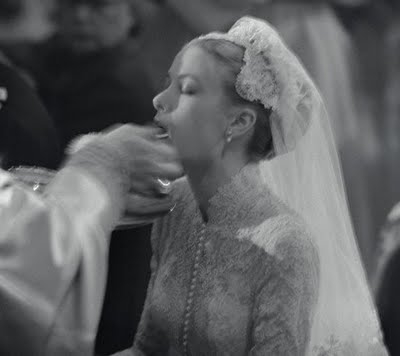
Princess Grace (née Kelly) of Monaco receives
the Holy Eucharist at her 1956 nuptial Mass


Christ, the Peace Light, is Born

December 27, 2018

In the city of Israel that is called Bethlehem, the ancient Church of the Nativity marks the site of the first Christmas. There one can actually stoop and bend down beneath the central altar & touch the celebrated spot where Jesus Christ was born. It is fitting that the pilgrims bend low to do this, because the miracle of God becoming a human being — to live and die and rise for us — surely deserves humble reverence with everything that we are.

Earlier this year, as has happened for a number of years now, an Austrian child and their family was selected to travel to Bethlehem. Candles and lamps are always burning within the Church of the Nativity, and there this chosen child transferred their fire into two blast-proof lanterns. Then they all flew back to Austria, where this flame (called “The Peace Light”) has spread from lamp to lamp, light to light, candle to candle, into more than thirty European countries and to places around the world. On December 1st of this year, the Peace Light arrived at J.F.K. Airport in New York City and it has traveled from there across our country. This week, it providentially came to our parish.

Last Friday, a Hudson couple traveling with the Peace Light approached me after morning Mass at St. Paul’s. I had never heard of the Peace Light before, but I happily received it and kept it for this Christmas celebration. All the flames you see burning our sanctuary this Christmas were originally lit from Bethlehem’s flame. Now I carefully carried, protected, and preserved this light; especially when I only had one vigil candle. I realized that one error, one jostling of the liquid wax, could extinguish the fire; and then what would become of this, my Christmas homily? I’d be lost. But, thanks be to God, these candles are lit here today.

So why do we have candles at Mass? Since the early days of Christianity, when Catholic Mass was celebrated in hiding, underground in the catacombs, lamps have provided useful illumination. But these lights are not merely practical. In the late 300’s A.D., a heretic named Vigilantius criticized Christians in the East about many of their practices, including their lighting of great piles of candles while the sun was still shining in the sky. St. Jerome declared in answer to him that candles are lighted where the Gospel is proclaimed not merely to put darkness to flight, but as a sign of joy. As an added symbol, these candles on the altar (and the Easter Candle) are, by tradition, mostly made of beeswax. Because beeswax, which is the product of the virginal female bee, is like the flesh of Our Lord supplied by the Blessed Virgin Mary.

Of course, the celebrated Peace Light is not merely a symbol of some abstract notion or idea of peace; it’s a symbol of the very real person of Jesus Christ. The “Light of the World” entered our world from his mother’s womb in Bethlehem. And his light has spread across the world and throughout time to this place and our day. Today, our candles burn and shine for him.

Within you there is also candle, but it is a very vulnerable light. Through error or neglect its light can go out. And without this light we are in darkness without true joy. So Jesus commands us to regularly gather all our candles together here, to be re-lit from the Source, the Light of Christ. In conclusion, in case my symbolism has been too subtle: Have a very joyful Christmas, and know that Jesus Christ (who loves you) wishes you to return here again for his Holy Mass next Sunday.