Archive for the ‘Mass’ Category

Jesus Christ’s Holy Mass

April 25, 2013

“The celebration of Holy Mass is as valuable as the death of Jesus on the cross.” —St. Thomas Aquinas

“Man should tremble, the world should vibrate, all Heaven should be deeply moved when the Son of God appears on the altar in the hands of the priest.” —St. Francis of Assisi

“It would be easier for the world to survive without the sun than to do without Holy Mass.” —St. Padre Pio of Pietrelcina

“One single Mass gives more honor to God than all the penances of the Saints, the labors of the Apostles, the sufferings of the martyrs, and even the burning love of the Blessed Mother of God.” —St. Alphonsus Liguori

“All the good works in the world are not equal to the Holy Sacrifice of the Mass because they are the works of men; but the Mass is the work of God. Martyrdom is nothing in comparison for it is but the sacrifice of man to God; but the Mass is the sacrifice of God for man.” —St. John Vianney

 “If the Angels could envy, they would envy us for Holy Communion.” —St. Pope Pius X

 “Do you realize that Jesus is there in the tabernacle expressly for you–for you alone? He burns with the desire to come into your heart.” —St. Thérèse of Lisieux

Lingering Before The Lord — Tuesday, 17th Week in Ordinary Time—Year I

July 26, 2011


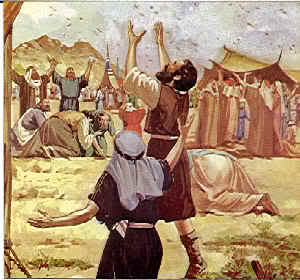
During the Exodus, the Lord’s presence would descend in a cloud upon the desert tabernacle called the tent of meeting. All the children of Israel would worship at the mouth of their own tents while Moses and his young assistant Joshua went in before the Lord. After speaking with the Lord, Moses had to leave to tend to the responsibilities involved in leading God’s people. Joshua, however, remained behind to pray, give thanks, and intercede for others.

God was pleased with Moses for the time he could spend with Him, blessing Him with a radiant light. He was also pleased with Joshua for lingering after. He would later select Joshua to lead the people after Moses’ passing because he was a man like David, “a man after God’s own heart.” Sometimes we can’t come to Mass early or linger after because of the demands of home and work and that’s ok. But if you can and do spend extra time with the Lord, know that this pleases Him greatly and helps you yield a greater harvest for Him.

Bread of Angels — Wednesday, 16th Week in Ordinary Time—Year I

July 21, 2011

Here at St. John’s, on the wall behind me, there is painted an angel holding a banner which says, “Ecce Panis Angelorum.” This is a Latin phrase. “Ecce” means “behold,” “panis” means “the bread,” and “angelorum” translates to “of the angels.” And thus the phrase goes, “Ecce Panis Angelorum; Behold the bread of angels.” This idea comes from Psalm 78, the psalm we heard today, which says of the Manna and the Israelites in the desert, “Man ate the bread of angels, food he sent them in abundance.” 

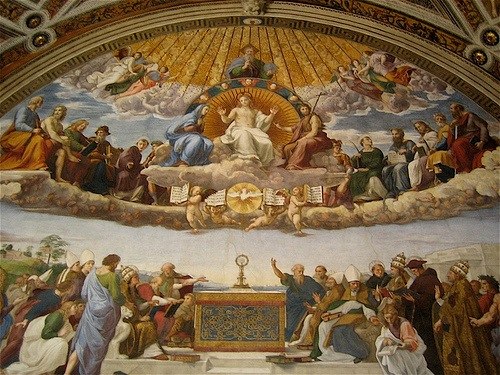
Why was the Manna in the desert was called the bread of angels? Extra-Biblical Jewish tradition suggested that the Manna bread actually nourished the angels. The Manna also came down from Heaven for the benefit of men and came through the mediation of angels. Of course, the Manna prefigures the Eucharist, which nourishes us through the deserts of this life toward the Promised Land. The Eucharist is really Jesus Christ who came down from Heaven for mankind. The angels are indeed nourished by this bread, Jesus Christ, for their lives are sustained thorough Him. We also receive the New Testament Manna with the help of the angels. As we say in Eucharistic Prayer I: “Almighty God, we pray that your angel may take this sacrifice to your altar in heaven. Then, as we receive from this altar the sacred body and blood of your Son, let us be filled with every grace and blessing.” It has been said that if angels could envy us, it would be for our reception of Jesus in the Eucharist.

The angels do more for us than we realize. We should remember to thank them; for getting us out of bed to come to Mass this morning, for assisting us here in our prayers, and for assisting us in our daily lives. Lovingly invite them, give them the permission, to do more in your lives. (They’re probably just waiting for you to ask.) Let us ask their intercession and at this Mass, together with the angels who surround us, let us delight in the bread of angels.

Testimony To The Real Presence — Corpus Christi—Year A

July 18, 2011

Jesus Christ is truly present Body and Blood, Soul and Divinity, in the Most Blessed Sacrament. This is called the Real Presence of Jesus Christ in the Eucharist. It is true that Jesus is present whenever the scriptures are read, or wherever two or three are gathered in his name, but the Holy Eucharist is His presence in the fullest sense, for this is Jesus Christ Himself. Some people accuse the Catholic Church of making up this idea during the Middle Ages or something, but Catholics have always believed in the Real Presence of Jesus Christ in Eucharist, unceasingly, in every age of the Church. For example, around 110 A.D., St. Ignatius of Antioch, a bishop and a prisoner in chains, wrote this on the way to his martyrdom in Rome:

“I have no taste for corruptible food nor for the pleasures of this life. I desire the bread of God, which is the flesh of Jesus Christ…; and for drink I desire his blood, which is love incorruptible”

Based upon rumors, the Romans despised and persecuted the early Christians and accused them of many things without understanding. The Christians were accused of atheism, because they refused to worship the pagan gods. The Christians were accused of incest, perhaps because others misunderstood the Christians’ love for each other as “brothers and sisters.” And, most interestingly, the Christians were falsely accused of cannibalistic feasts, of eating the flesh and blood of their offspring. Around 150 A.D., to help dispel rumors and to quell Roman hated, St. Justin Martyr wrote an open letter to the emperor explaining the actual beliefs of Christians. One of the things Justin touches upon is the Real Presence of Jesus Christ in the Eucharist. He writes:

“Not as common bread nor common drink do we receive [this Eucharist]; but since Jesus Christ our Savior was made incarnate by the word of God and had both flesh and blood for our salvation, so too, as we have been taught, the food which has been made into the Eucharist by the Eucharistic prayer set down by him, …is both the flesh and the blood of that incarnated Jesus”

Where did the early Christians get this idea? The Real Presence was taught them by the apostles and through the Holy Scriptures. For example, in today’s second reading, the Apostle St. Paul mentions the Real Presence to the Corinthian Christians as a given, as a settled matter. Paul says:  “The cup of blessing that we bless, is it not a participation in the blood of Christ? The bread that we break, is it not a participation in the body of Christ?” Is Paul only speaking symbolically? Well, a little later, He warns them, “…Whoever eats the bread or drinks the cup of the Lord unworthily will have to answer for the body and blood of the Lord.” Both the apostles and Scripture agree that Jesus Christ was the source of this belief. St. Paul writes the Corinthians:

“I received from the Lord what I also handed on to you, that the Lord Jesus, on the night he was handed over, took bread, and, after he had given thanks, broke it and said, ‘This is my body that is for you. Do this in remembrance of me.’”

The first three Gospels relate these words from the Last Supper as well, but the Gospel of John presents the subject differently. Jesus’ words of institution do not appear in John’s Gospel. (Perhaps St. John, writing His Gospel last, thought it wasn’t necessary to repeat them.) Yet John gives the words of Jesus where He emphatically teaches the truth of the Real Presence. In today’s gospel reading from the sixth chapter of John, Jesus tells followers that they will need to eat the bread which is His flesh six times. And the word used several times in this passage is not the normal Greek word for eating, but a more literal Greek verb, which means “to munch” or “to gnaw.” He says, “…My flesh is true food, and my blood is true drink.” John’s gospel tells us that “many of his disciples who were listening said, ‘This saying is hard; who can accept it?’” and, “as a result of this, many of his disciples … no longer accompanied him.” And Jesus let them go because they had heard Him right. As hard as it was to believe, they were called to eat His flesh and drink His blood. Curiously, there are Christian groups who take a very literal approach to everything in the Book of Genesis, yet who switch to a symbolic interpretation to what Jesus says six times in today’s Gospel.

Did you know that there have been Eucharistic miracles affirming the Real Presence of Jesus Christ in the Eucharist throughout the centuries? For instance, consecrated hosts forming drops of blood, hosts transforming into human heart muscle, or hosts which remain perfectly preserved after hundreds of years. In fact, this feast of Corpus Christ was established by Pope Urban IV after one such Eucharistic miracle in 1263. Some Christian groups have beliefs about communion which bear some resemblances to the Catholic belief in the Real Presence; but Eucharistic miracles are not heard of within Anglican, Episcopalian, and Lutheran communions.

Did you know that Satanic worshipers affirm the truth of the Real Presence? When they seek out hosts to abuse and misuse in profoundly depraved ways, it is the Holy Communion of the Catholic Church that they seek to steal for use in “Black Masses.” Andrew, a friend of mine from seminary, used to spend his summers at a parish in Paris, France. There he met a former satanic worshiper who had returned to the Lord and the Catholic Church. Andrew asked him whether it was true that Satanists could sense the difference between a consecrated and unconsecrated Host. His Parisian friend informed Andrew this was true, that he and others used to identify consecrated hosts out of a line up as something of a test. How did he know which one was consecrated? Andrew’s friend answered, “You could tell which one was the Lord because that was the one you felt hatred towards.” If Satanists can believe in the Real Presence of Jesus in the Eucharist, then why can’t every Catholic?

When I was a boy I had good teachers in the faith. When they taught us about the Real Presence I asked, “Do we really, really believe that?” I mean I could understand a symbolic understanding. Thinking of the Eucharist as a symbol like the American flag, which reminds us of our blessings and of sacrifices made for our freedom, that came easily to me. However, my catechists challenged me when they assured me, “We really do believe that the bread and wine really, really becomes Him.” I researched whether the whole Church taught this, and found that it did. I studied whether the Church had always taught this, and discovered they had through the ages. I explored whether Scripture supported the belief in the Real Presence, and indeed, it did. Yet there was still an important piece missing.

When I was a boy, I would look around at the faces of other people at Mass and, though looks can be deceiving, they didn’t look as if they were kneeling before God Almighty. But then our parish got a new pastor, Fr. Paul Gitter. When he celebrated the Mass you could tell that he believed that he was holding Jesus in his hands. Because I knew that he believed, I could too. For the sake of our families and our neighbors, it is important that we give witness to our belief in the Real Presence, too.

[From here, I encouraged everyone to attend Marshfield’s Corpus Christi procession, June 26, 2011 with our bishop. More than 200 people processed on that beautiful Sunday, from Sacred Heart to Our Lady of Peace, witnessing to their belief in Jesus Christ as truly present in the Holy Eucharist.]

The Way, Truth, & Life — 5th Sunday in Easter—Year A

May 22, 2011

Jesus said, “I am the way and the truth and the life. No one comes to the Father except through me.”

The Mass is an encounter with Jesus Christ, leading us to God the Father. Like Jesus Himself, the Mass contains the Way, the Truth, and the Life of Jesus. First, we journey on the Way to Jesus, then we come to the Truth of Jesus, finally we join in the Life of Jesus.

The Mass begins with the sign of the cross, for God is the beginning and end of everything. Next, we confess our unworthiness to approach the Lord, asking mercy for our sins, so that we may dare to take this journey to God. The, from the Holy Scriptures, we hear of God’s words and deeds among the Old Testament peoples and within the New Testament Church. In this, we learn of the providential way that God has prepared throughout time for us to encounter Jesus Christ today. Just as the journey on this Way through history leads to Jesus Christ, so the liturgy of the Word leads to the Gospel. Certainly, Jesus Christ the Word of God is present throughout the entire Word of God which is Sacred Scripture, but for the reading of the Gospel, we all stand up for Him and sing “Alleluia,” “Praise the Lord,” because we have come to Jesus Christ and He is more fully present among us in the proclamation of the Gospel.

The Gospel reading proclaims Jesus, who is the Truth. The homily that follows proclaims that the Truth matters for us here and now and demands our personal response. To this call, we answer with the Creed, proclaiming our faith in who God is and what He has done for us. In the Creed, we proclaim our acceptance of Jesus, the Truth. In the prayers of the faithful, we petition the Lord for our needs and concerns, saying in so many words, “Lord, let your kingdom come, on earth as it is in Heaven! Let us share you life! Give us your life!” At Mass, the Way leads to the Truth, and from the Truth we long for God’s Life. At Mass, the Liturgy of the Word leads to the Liturgy of the Eucharist.

The presentation of the gifts is not merely about moving around cash and bread and water and wine. The presentation of the gifts is about the presentation of everything that we have, and everything that we are, to God. We lift up our hearts to be one with our sacrifice. Amidst praises to the Father, the one life-giving sacrifice of the Last Supper, of the cross, and of Heaven becomes present here to us. We join in offering this sacrifice through Jesus, with Jesus, and in Jesus, in union with the Holy Spirit, to God the Father in Heaven.

Through this offered sacrifice, we join in God’s Life. We pray “Our Father,” because uniting with the paschal mystery, the great Easter deeds of Jesus, gives us life as the Father’s sons and daughters. Then we share with one another the sign of peace, the loving peace that is possessed by God’s holy ones. Finally, at the climax, we partake of Jesus Christ, Life Himself, most truly present in the Holy Eucharist.

Sometimes people say, “I just don’t get anything out of going to Mass. Father, I know that you say all this important and wonderful stuff is going on, but I don’t see it and I don’t feel it. The Mass is boring for me.” I understand. When I was a boy, I made a point of going to the bathroom (sometimes twice) during every Mass, just to break up the monotony. When I would see the priest cleaning the dishes at the altar—that was a good sign, because it meant that the Mass was almost done. I didn’t really know what was happening at Mass, so I really didn’t believe in what was happening at Mass. But as I grew older I began to learn what was happening, and as I grew in faith I began to believe in what was happening, and my experience of the Mass was transformed.

People who say that the Mass is boring resemble St. Phillip in something he said to Jesus at the first Eucharist, the Last Supper: “Master, (we don’t see or feel the presence of God the Father,) show us the Father, and that will be enough for us.” And Jesus said to him, “Have I been with you for so long a time and you still do not know me, Philip? Whoever has seen me has seen the Father. (Whoever has been to Mass has encountered my mysteries.) How can you say, ‘Show us the Father’? (How can you say, ‘The Mass is boring?’)” The awesome mystical realities of the Mass are true, and real, and present and active at every Mass we attend, whether we see them, or feel them, or believe in them, or not.

Jesus Christ and the Holy Mass contain the Way, the Truth, and the Life, and we shall receive from them according to our faith. Let us pray, that at this Mass and every Mass, we may be as fully present to Jesus Christ and His mysteries as they are to us at every Mass.

The Significance of Standing — Tuesday, 3rd Week of Easter

May 10, 2011

There’s a curious detail about Stephen’s vision of Heaven in our first reading today:

“Stephen, filled with the Holy Spirit, looked up intently to heaven and saw the glory of God and Jesus standing at the right hand of God, and Stephen said, ‘Behold, I see the heavens opened and the Son of Man standing at the right hand of God.’”

Stephen looks up to Heaven and sees Jesus standing at the Father’s right hand, but both the Apostles’ Creed and Nicene Creed (which we say each Sunday) describe Jesus as “seated at the right hand of the Father.” What are we to make of this?

In the ancient world, to be seated at someone’s right hand gave you the place of higher honor. At a meal, this favored seat granted a special closeness to the host. In a kingdom, the one seated at the right hand of the throne would share in the king’s authority and rule. Of course, describing Jesus as “seated at the right hand of the Father” is only an image (God the Father is unlimited, pure spirit and doesn’t have a right hand.) But this phrase from our creeds does describe a reality: that Jesus is now in the intimate presence of God the Father, sharing supremely in His glory and rule. In his vision, Stephen beholds Jesus in the place of honor, at the Father’s “right hand,” but Stephen sees Jesus standing. So why is Jesus standing?

Did you know that whenever the President of the United States enters a room, everybody stands up? It doesn’t matter if it is a room full of Democrats or Republicans, members of the press, or ordinary citizens, everyone stands up for the President. The same goes for a judge in his courtroom: “All rise, the Honorable Judge So-and-so presiding.” And a gentleman knows that he ought to stand up whenever he greets a lady. Why do they stand? Because it is a sign of respect. If you think about it, whenever we’re offering prayers in the Mass, provided we’re not kneeling, we’re standing up to pray. We stand to pray as a sign of respect to God.

Sometimes, people stand as a sign of respect not so much for the individual but for the greatness of the office they possess. Even a U.S. President’s most hostile critics in Congress, political opponents who couldn’t say one good thing about him, will stand up when he arrives to give his State of the Union address out of respect for the office he holds. It wasn’t for this reason that Jesus stood. No one on earth could have demanded Jesus’ respect by holding an office higher than his.

Jesus stood up because he wanted to show Stephen a sign of His respect. Jesus stood up because he was proud of Stephen. I think that we forget that Jesus is a real human being, with human feelings and emotions about the human events he sees. At the same time, He is also God; and therefore, He sees us all.

When you’re alone, and overcome temptation to do what you know is good, Jesus sees you and He’s proud of you. When you give an anonymous contribution or do a secret kindness, Jesus sees it and He’s proud of you. When you are opposed like Stephen, by people who hate you, or that just don’t understand you, when all the while you’re trying act with love, you do not stand alone. Remember that when you do what’s hard for Jesus, He sees it, and He sees you and He’s proud of you for it.

“Do This…” — Holy Thursday

April 21, 2011

At the Last Supper, the night before he suffered for us, Jesus took some bread. He thanks to God for it and He broke it. And He declared it to be His body which would be given up for others. Then He offered it to those He loved. When the supper was ended, Jesus took a cup of wine. Again He gave thanks and praise to the Father. And He declared it to contain His blood, blood to be shed for all. Then He offered the cup to His disciples and said, “Do this in remembrance of me.”

At the Last Supper, Jesus ordained His apostles the first priests of the New Covenant. They and their successors would do this in remembrance of Him, throughout the centuries, up to this very night, and until He comes again. When you and I celebrate the Mass we remember Him and what He did, and more than just recalling it, we re-encounter it as that same sacrifice is offered in front of us. But Jesus’ words, ‘to do this in memory of Him’ means more than just coming to Mass.

Jesus is calling and commanding us to do the thing that He is doing. We must give God thanks and praise for what He has given us. We must take our bodies and give them up. We must take our life’s blood and pour it out. And we can do this, for God and for each other, in as many ways as there is to love. The sacrifices of your daily life, at home, at work, and at prayer; the work of washing feet; may not seem significant to you now, but these sacrifices shall your glory in Heaven forever.

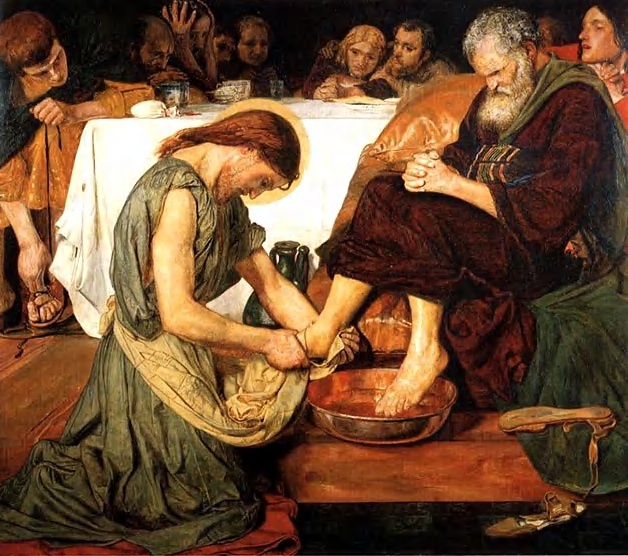
As Jesus washed His apostles’ feet He said, “What I am doing, you do not understand now, but you will understand later.” And when He had finished He said, “If I, … the master and teacher, have washed your feet, you ought to wash one another’s feet.  I have given you a model to follow, so that as I have done for you, you should also do.” At the Last Supper, Jesus said to His disciples, “Do this in remembrance of me.” Tonight, He says the same to us as well.

Christ’s Boat — Tuesday, 6th Week in Ordinary Time—Year I

February 15, 2011

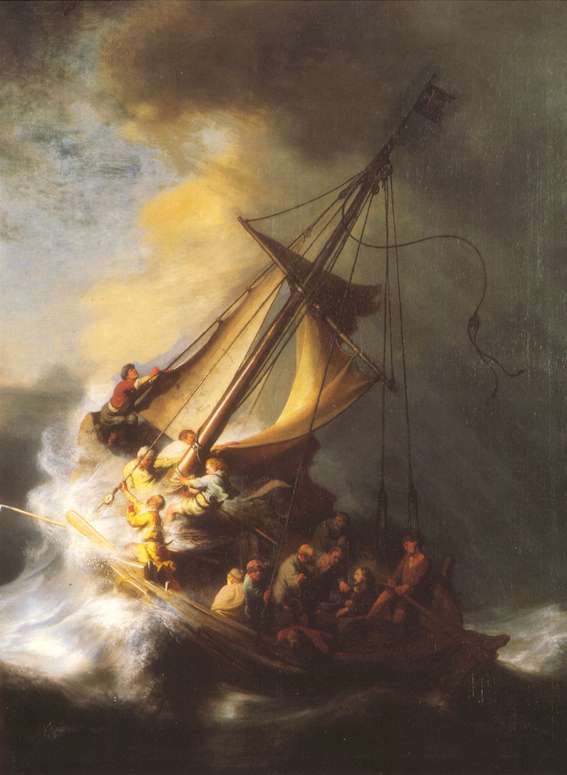
Perhaps you’ve noticed at Mass that most of our prayers are directed to God the Father. That is why you see me looking up so often. I’m looking up to our Father in Heaven as I speak to Him. From time to time, while I’m looking up, I can’t help but notice the ceiling. Take a look for yourself. It often reminds me of a boat’s wooden hull. That is really quite appropriate, because the Church is a boat and it is an important boat to be in.

The old ark was a boat built by Noah in which a few persons, eight in all, were saved through the waters of the flood. The new ark is our Church, the boat built by Christ, in which many are saved through the waters of baptism. Jesus’ boat has the cross for its mast and its sails are filled by the winds of the Holy Spirit. The Catholic Church, the bark of Peter, is the only vessel that navigates safely through the dangerous waters of this world.

As the Church Fathers frequently said, “Outside the Church there is no salvation.” But how should we understand this teaching? Restated positively it means this: that all salvation comes from Christ the Head through the Church, which is his Body. Basing Herself on Scripture and Tradition, Bride of Christ teaches that she, the Church, is necessary for salvation. As the Second Vatican Council repeated in modern times, Jesus “himself explicitly asserted the necessity of faith and Baptism, and thereby affirmed at the same time the necessity of the Church which men enter through Baptism as through a door. Hence they could not be saved who, knowing that the Catholic Church was founded as necessary by God through Christ, would refuse either to enter it or to remain in it.”

It must be noted that this teaching is not aimed at those who do not know Christ and his Church through no fault of their own. “Those who, through no fault of their own, do not know the Gospel of Christ or his Church, but who nevertheless seek God with a sincere heart, and, moved by grace, try in their actions to do His will as they know it through the dictates of their conscience – those too may achieve eternal salvation.”

“Although in ways known to Himself God can lead those who, through no fault of their own, are ignorant of the Gospel, to that faith without which it is impossible to please Him, the Church still has the obligation and also the sacred right to evangelize all men.” If we love all men, we will naturally desire to share the truth and blessings of the Church’s Gospel with everyone. Think of it this way: while it is theoretically possible for anyone to swim the English Channel, it is a far easier crossing if we take the ferry. In the same way, it is not a matter of indifference if people come into the Church or not. The journey is much safer and easier if you’re in the boat.

Remember not underestimate the importance of the Church. In the end, all those who will be saved will be saved through their relationship, known or unknown, with the one, holy, catholic and apostolic Church Jesus founded.

And do not underestimate the importance of the Mass. All the graces that flow into souls pours forth from the Catholic Church through this sacrifice we celebrate. The Mass takes the sacrifice of Calvary from then and there, through space and time, to here and now, and applies its power and effects to our world today. (What we’re doing here is a very important thing.)

And finally, do not underestimate the importance of remaining in the Church. May we never forsake it. We have to stay in the boat with Jesus Christ, because without Him, none of us can walk on water.

Child of God Homily

February 9, 2011

 
Do you know who Bill Gates is? He started a computer software company called Microsoft and is one of the richest men in the world.  If Bill Gates were your dad do you think that he would be willing to buy you things you could never have otherwise? Imagine if President Obama were your uncle.  Do you think he would invite you to the White House sometime?  Do you think that you would have the opportunity to talk to him about your concerns and ideas for the world? Hold that in mind…

When I was younger, something about how we professed the Nicene Creed on Sundays struck me as strange: “For us men and for our salvation He came down from heaven. *Profound Bow* By the power of the Holy Spirit, He was born of the Virgin Mary, and became man. *Straighten* He was crucified under Pontius Pilate. He suffered, died, and was buried.” I wondered, “Why do we bow for Jesus being born? Heck, even I was even born. Why don’t we bow for His suffering instead?” 

We tend to think of God becoming man as a perfectly normal thing for God to do, we take it for granted, but it is actually the most surprising thing that has ever happened in history. The divine Son became one of us so that He could be our brother, and so that His Father could be ours. “See what love the Father has bestowed on us that we may be called the children of God. Yet so we are.”

Our heavenly Father is unimaginably rich, and He wants to provide for you and bless you. Our Father is all-powerful, and He is always open to hearing your prayers. Our Father in heaven has a house far greater than the White House, and He is preparing a place for you to stay. Remember this: you are a child of God the Father, and that’s a big deal.

Close At Hand — 3rd Sunday of Advent—Year A

December 14, 2010

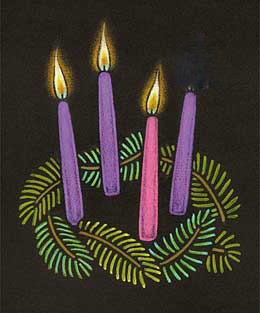
Today, the third Sunday of Advent, we light the pink or rose-colored candle because today is Gaudete Sunday. “Gaudete” means “rejoice” in Latin and we hear this call in the opening antiphon: “Rejoice in the Lord always; again I say, rejoice! The Lord is near.” Now that we are about halfway through this purple, penitential season, the Church is reminding us that Advent is also a time for joy. Though we await Him, “the Lord is near.”

This Guadete Sunday, we have extra cause for joy. As you may have heard, this week, a shrine in Champion, Wisconsin, 10 miles northeast of Green Bay, is now our country’s first Church-approved Marian apparition site. On the Feast of the Immaculate Conception, this happy news was announced by Bishop David Ricken of Green Bay:

“I declare with moral certainty and in accord with the norms of the Church that the events, apparitions and locutions given to Adele Brise in October of 1859 do exhibit the substance of supernatural character, and I do hereby approve these apparitions as worthy of belief (although not obligatory) by the Christian faithful.”

151 years ago, a lady clothed in dazzling white, with a yellow sash around her waist and a crown of stars around her head appeared to a 28-year-old lay woman named Adele. Adele asked the lady who she was and what she wanted, and the lady answered, “I am the Queen of Heaven who prays for the conversion of sinners, and I wish you to do the same. You received Holy Communion this morning and that is well. But you must do more. Make a general confession and offer Communion for the conversion of sinners… Gather the children in this wild country and teach them what they should know for salvation….”

That was the core of Mary’s message: the need for sinners to be converted and for children to be taught the faith. But Adele hesitated, and asked Mary how she was to teach the young when she knew so little herself. Mary replied, “Teach them their catechism, how to sign themselves with the sign of the Cross, and how to approach the sacraments; that is what I wish you to do. Go and fear nothing, I will help you.” After that encounter, Adele’s father built a small chapel on the site and Adele went about fulfilling her mission from Mary for the rest of her life.

The Bride of Christ, the Church, teaches that parents are the primary educators of their children. This means that even if your children go to Catholic or public school, you are their first and foremost teacher in the important lessons of life. But how often do our parents talk to their children about Jesus or Mary, or teach their children about what they should know for salvation? I suspect that many parents are intimidated because, like Adele Brise, they feel like they know too little. But Mary reassures us that we can all teach our children simple but important lessons in the faith that will remain with them and bless them forever.

Like Mary said, teach them the sign of the cross and how to approach the sacraments. At Mass, whisper in their ears, “Look, Father is holding up Jesus,” and on the way home in the car, ask them what they learned from the homily. Have interesting conversations with your children about the faith. Ask them, for example, if they think that Jesus likes sports, ask them what they think Mary’s favorite prayer is, or ask them what they think Heaven is like, and then share your answers with each other. And, perhaps most importantly, teach your children how to pray, by praying with them daily.

Though you know enough already to teach your children a great deal, you must always keep learning yourself. As your children mature in age, you must also mature in your understanding of the faith. Explore why we as Catholics do what we do, and learn why the Bride of Christ, our Mother, teaches as she does. For example, why do we make the sign of the cross? We do it at the open and close of our prayers and you’ve done it since you were little, but now consider more deeply what it means.

Its words and gestures encapsulate our faith’s most central mysteries. It confesses the Trinity and trances our redemption through the cross of Jesus Christ. We pray not “in the names,” but the “in the name of the Father, and of the Son, and of the Holy Spirit,” for God is three persons who are one in nature. [†] From the Father descends the Son, and the Holy Spirit proceeds from the love between them. Tracing the cross on ourselves, [†] we recall how the Father sent the Son to save us, and how the Holy Spirit now acts through our lives with power.

To pray this prayer, for it is a prayer, calls upon God to be powerfully with us. It is to say: “Father, Son and Holy Spirit, I ask you to be near me, here and now.” In the face of temptation or evil, this sign declares, “I belong to neither to the Devil nor the world, I belong to Jesus Christ.” So much is contained in this simple prayer and gesture. It can be taught to a child, yet meditated upon for a lifetime. And this is just one element of our faith. There is always more to explore.

Let us rejoice today, for the apparition of Our Lady of Champion reminds us, that even in Wisconsin, the Lord is near,  and [†] we can call upon Him at any time. Let us teach the faith to our children, so that they will remain near to Him and call upon His name.

C.S. Lewis on Our Immortality & Potential Glory

August 14, 2010

From The Weight of Glory:

It is a serious thing to live in a society of possible gods and goddesses, to remember that the dullest and most uninteresting person you talk to may one day be a creature which, if you saw it now, you would be strongly tempted to worship, or else a horror and a corruption such as you now meet, if at all, only in a nightmare. All day long we are, in some degree, helping each other to one or other of these destinations.

It is in the light of these overwhelming possibilities, it is with the awe and the circumspection proper to them, that we should conduct all our dealings with one another, all friendships, all loves, all play, all politics. There are no ordinary people. You have never talked to a mere mortal. Nations, cultures, arts, civilization—these are mortal, and their life is to ours as the life of a gnat. But it is immortals whom we joke with, work with, marry, snub, and exploit—immortal horrors or everlasting splendours.

This does not mean that we are to be perpetually solemn. We must play. But our merriment must be of that kind (and it is, in fact, the merriest kind) which exists between people who have, from the outset, taken each other seriously—no flippancy, no superiority, no presumption. And our charity must be a real and costly love, with deep feeling for the sins in spite of which we love the sinner—no mere tolerance or indulgence which parodies love as flippancy parodies merriment.

Next to the Blessed Sacrament itself, your neighbour is the holiest object presented to your senses. If he is your Christian neighbour he is holy in almost the same way, for in him also Christ vere Latitat [Latin, “truly hides”]—the glorifier and the glorified, Glory Himself, is truly hidden.

Catechetical Mass Reflections — Nativity of St. John the Baptist

June 30, 2010

Before Mass

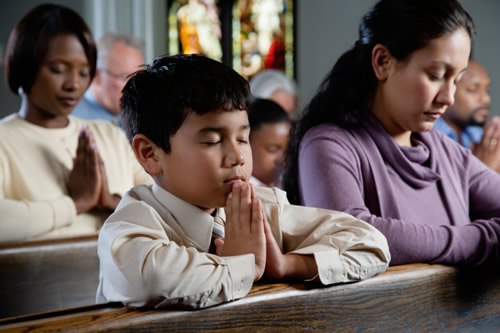
If you just sit around before Mass waiting, you are wasting your time. Prepare for Mass with prayer.

Ask Jesus to help you to be a fully present as He is present at this Mass.

Ask Him to help you be open to receiving everything He wants to give you at this Mass.

Form a Mass intention; that is, choose a person, group, or need you would like the graces of your participation in this sacrifice to be applied to.

After the Openning Prayer / Before the Readings

Shouldn’t we expect to find the incarnate the Word of God in the Word of God we proclaim at Mass? Look for Jesus shinng brilliantly in today’s first reading from Isaiah.

Millions of people purchased and “studied” the DaVinci Code even though it gave no real insights into Christ. Imagine if there were a book out which reputable archeologists claimed contained the actual prayers of Jesus and Mary? Would you read this book? Would you incorporate its prayers into your own devotions? This book really does exist… it is the Book of Psalms, which pious Jews in the time of Jesus and Mary knew by heart. Today we will be praying one of these psalms of Jesus and Mary and I invite you to unite your prayer to theirs.

In the second reading we will hear the preaching of St. Paul and in today’s gospel, the words written by St. Luke. Let us not think that they words are merely adressed to ancient Christians.  When the quill was put to papyrus to pen these words, the Holy Spirit saw you here. If you listen and are open to the Spirit, He will speak to you through these words.

After the Gospel / Before the Creed

Have you ever written or received a love letter? I believe it was St. Catherine of Siena (one of the three female doctors of the Church) who taught that we should say the creed like a love letter, as either one we are sending or one we have received. A love letter reflects the feeling of the lover and contains truths about the beloved. Let us call this to mind when we say the Gloria, too.

After the Presentation of the Gifts / Before the Eucharistic Prayer

During the Eucharistic prayer, don’t spectate, actively participate. You have not come to watch the priest pray for you, but to unite your prayer to His. When he prays for the Church, pray for the Church within yourself. When he prayes for the dead, pray for the dead, too.  The priest is the head and you are the body. Every member of the body should make the prayers of the mouth their own.

During Mass, look at the person you are praying to. Most of the prayers at Mass are addressed to the Father, while a few are addressed to the Son. When we are praying to the Father, raise your eyes up to Him in Heaven or close your eyes to address the He who cannot be seen. When Jesus is on the altar, look at Him with attentive love.

Put yourself and those you care for in the chalice, to be transformed like the wine and offered with Christ.

After Communion / Before the Closing Prayer

Take this moment to tell Jesus “thank you” for giving you so awesome a gift. It’s the least we can do.

An Incomplete Lord’s Prayer — Thursday, 11th Week in Ordinary Time—Year II

June 18, 2010

Sometime in the past, I realized that I didn’t pray the Lord’s Prayer right.  It’s not that I was actually changing the words Jesus taught us to say, but I realized my focus was not fully what Jesus had in mind. My subjective, firsthand experience of praying the prayer went something like this: 

God, who art in heaven…
     [<Here I get distracted for several seconds>]
…give me this day my daily bread,
and forgive me my trespasses,
as I forgive those who trespass against me,
and lead me not into temptation,
but deliver me from evil.

Did you notice anything different?

First, Jesus taught us to pray to “Our Father” because we are not praying to anonymous force, but a person, a divine person who is imaged in a special way by natural and spiritual fathers on earth. Earthly fatherhood is a diminished image of Him. Biological fatherhood teaches us about our heavenly Father’s transcendence, while devoted fathers teach us about His love. (“The respective ‘perfections’ of [both] man and woman reflect something of the infinite perfection of God,” as the Catechism teaches, but “Our Father” is significant.)

Second, the prayer’s early petitions, “hallowed be thy name. Thy kingdom come. Thy will be done on earth as it is in heaven,” are every bit as important as the later petitions ‘about us.’ God is justly entitled to glory, His kingdom and reign.  Remember that all these are essential and conducive to our own greatest happiness.

Third, the Lord’s Prayer is not meant to be prayed just for yourself or myself, but for all of our Father’s family, for the whole Church, for even the whole world. The Our Father is not only a petitionary prayer, but an intercessory prayer.

So when we prayer the Our Father, the perfect prayer which Jesus taught us, let us pray it in its completeness, with a presence of mind and fullness of heart.

Christ in the Sacraments — 11th Sunday in Ordinary Time—Year C

June 15, 2010

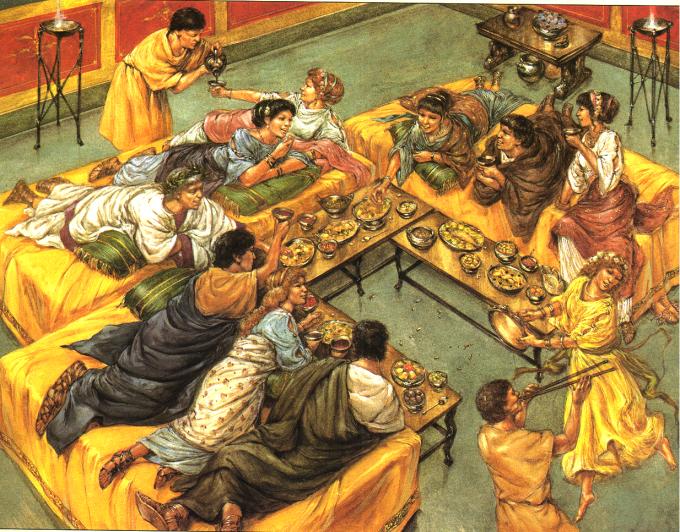
To understand today’s gospel, it helps to know a little about the Jewish culture of Jesus’ day.  For example, when the Jews would sit down to eat dinner they would not sit at all–they “reclined at table,” on beds that came up the edge of the table. You would have a cushion under your chest or under your side, as you ate with your free hand, with your legs laid out behind you. This clarifies how the beautiful, penitent woman was able to access to Jesus’ feet. This also explains how John was able to lay his head upon Jesus’ chest at the Last Supper to ask Him who would betray Him. The Beloved Disciple was not a contortionist–he was laying beside Jesus at table.

A second important thing to know about the Jewish culture of Jesus’ day to appreciate this gospel is to understand how they felt about feet. The Jews considered feet to be among the dirtiest, humblest, and lowliest parts of the human body. This is why our parish’s patron, St. John the Baptist, said, “[There is] one who is coming after me, whose sandal strap I am not worthy to untie.” In that Jewish culture, servants could not be commanded to wash the feet of others; it was considered even beneigth the dignity of a slave. Now we can understand the significance of the woman washing Jesus’ feet, and how much it means that Jesus later washed His disciples’ feet at the Last Supper.

But what was this woman thinking? Had she forgotten to bring a towel and a bowl of water at home? Was she so dumbstruck that her lips were unable to form the simple words, “I’m sorry and I want to return to God?” No, she knew what she was doing when she used her tears to cleanse, her hair to wipe, and her lips to kiss Jesus’ feet. When she heard that Jesus was going to be eating at the house of Simon the Pharisee I doubt she was holding that alabaster jar of ointment in her hands. No, she had to go and get it, and as she did she thought about exactly how she was going to approach Jesus.

What was Simon the Pharisee thinking? Had he forgotten about the customary curtesies in welcoming guests to one’s house in that culture: water for washing their own feet, oil for anointing one’s head against the harshness of the desert, a kiss in greeting at the door? Maybe he thought these were just optional, dispensible rituals. Regardless, Jesus put his finger on one major contributing factor: Simon the Pharisee loved Jesus little, while the beautiful penient woman loved Him greatly.

Simon gave Jesus an external gift, a meal in his home, but in addition to her ointment, the woman gave a gift of her very self; her tears, her hair, her kisses. As she had sinned with her body, she now sought to honor God though her body.

How does all of this apply to us? When we consider this beautiful, penitant woman and Simon the Pharisee relate to Jesus, we see two approaches the sacraments. For some, in the manner of Simon the Pharisee, the sacraments are just rituals, traditional customs, liturgical hoops the Church has us jump through. But for others, those with the heart of the woman who loved much, every sacrament is a personal encounter with Jesus Christ. If you onlt remember one thing from this homily, remember this: every sacrament is a personal encounter with Jesus Christ.

Consider the sacrament of marriage. Today, some people say, “As long as we love each other, what difference does a ceremony in a church and a piece of paper make?” But these people do not realize that the sacrament of marriage actually makes present the love between Christ and his Church. The love between husband and wife not only resembles the love between Christ and his Church–like all the sacraments, marriage actually makes present. If your marriage is sacramental, and you and your spouse do not put up obstacles in the way, you can experience firsthand to love with which Jesus loves His bride, the Church, and how the bride receives her Lord. You experience the intimacy between the two and you can tap and draw on their love and the power in your marriage. marriage is a personal encounter with Jesus Christ.

Today, some people say, “I don’t really have any sins, but if I did, why should I have to go tell my sins to a priest to have my sins forgiven? God can hears my prayers. Won’t he’ll forgive me anyway.” Imagine if the penitent woman had stayed away from Simon’s dinner party that night in the gospel and prayed to God at home. Would she have been forgiven? Perhaps, but she would not have had her life-transforming encounter with Jesus Christ. When you go to confession, you are personally encountering Jesus through the priest. If the priest does not put up obstacles in the way you will hear the words of Christ to you. And even if the priest does get in the way, you will hear that words that Jesus wants you to hear, just as He had said to the beautiful penitent woman: “Your sins are forgiven, go in peace.” The sacrament of reconciliation is a personal encounter with Jesus Christ.

These days some people say, “There’s a lot of Sundays in the summertime and a lot of things to enjoy on the weekend. Is it really that important that we come to Mass every Sunday?” To ask this about the most Blessed Sacrament is to be like Simon the Pharisee. Had Jesus not come as his guest that night, Simon would not have missed Him much; Simon would not have been that disappointed. And even after receiving Jesus under his roof, I can imagine Simon being left unchanged. But the beautiful penitent woman, who took Jesus’ flesh to her lips, was forgiven her sins and was filled with grace by the encounter.

In the celebration of this sacrament, and at every sacrament, let us appraoch Jesus with her humility, reverence, and love.

Real Presence — Corpus Christi

June 7, 2010

I once came across a story on the internet that went something like this: A Catholic man is giving his Muslim friend a tour of his Catholic Church. He shows him the holy water at the door and how we bless ourselves with it. He points out the stained glass windows and the stations of the cross, explaining how these present the majore events of Jesus’ life, death, and resurrection. He shows him the statues and the crucifix and finally the tabernacle.

“That’s the tabernacle. Inside that box is the Eucharist. It looks like flat, white bread, but it is truly the Body, Blood, Soul and Divinity of Jesus Christ, our Savior and God.”

The Muslim man looks at the tabernacle, pauses in thought, looks at his friend, and says, “If I believed that God was really present in that box, I wouldn’t let my face come off of the floor.”

Whose approach towards God is the right one: the Catholic’s or the Muslim’s? When we come up to receive communion we do not crawl up on our faces, but should we?

Christians relate to God as we do because of the way Jesus Christ related to us. With the incarnation, God came to us on our level, as one of us. Jesus did not want his disciples to regard him with terror. He invited them to be His friends, and to relate to Him as their Brother. He taught us to call His Father “our Father,” and he made us temples the Holy Spirit. Jesus gives us unprecedented intimacy with God and we are “free to worship Him without fear.”

Yet, there is some truth in the saying that familiarity breeds contempt. When we come to Mass and receive the Eucharist, how well do we prepare ourselves to receive Him? How much do we do to appreciate this priceless gift? This morning I would like to give some ways we can do this better.

Before we even leave home there is a way for us to prepare ourselves. Think of it this way: if you were going to be on TV and seen by a millions, what would you wear? If the president of the United States (whoever he happened to be) were coming to your town, and you were chosen to officially welcome him, how would you dress? At Mass we are not seen by millions, but by billions of angels and saints, and we more than just the president of the greatest country in the world, we meet the King of the universe. When we come to Mass we should wear our Sunday best.

When you arrive at church before Mass begins resist the temptation to just wait out the time until the priest comes out. Take the opportunity to prepare yourself with prayer. At the beginning of the liturgy there are some things we do to tune us into the liturgy, such as the penitential rite and the opening prayer, but if you have not prepared yourself before the Mass begins these will probably just flash by you.

When you get to your pew, say to Jesus, “Lord, I’m sorry for my sins. Please have mercy on me. Please help me to be as fully present as you are present. Help me to receive everything you want me give me in this Mass. I raise up my intention for this Mass you along with all I love and everything I am. Thank you for calling me to know you, and for everything.”

During the Mass, especially when Jesus is on the altar, his throne, we should give Him our full attention. Religious devotion is about more than mere appearances, but shouldn’t we expect a fervent devotion inside to be reflected on the outside?

When I was growing up and beginning to look at my faith more critically, I wondered if we really believed in the Real Presence. I mean, the symbolic understanding, that’s easy—like how the flag reminds us of America, but do we really, really think that’s Him? My CCD teachers insisted that’s what we believed and I found scriptural and historical evidence that Christians had always believed it.  Yet, when I looked around at other people at Mass it didn’t seem like they believed they were in the presence of God. Then an important thing happened. A new pastor came to our parish and when he celebrated the Mass you could tell that he believed he held something (Someone) precious in his hands. That priest was Father Paul Gitter, whom you know well.

During the Mass, give God your whole self. Express your devotion. Whenever you sing, don’t just do it because that’s what everyone else is doing—make it an offering, a gift, a prayer. When you are praying to the Father, raise you eyes to Him. When you are speaking to Jesus, turn you eyes to Him. Smile at Him in the cup and on the paten. Celebrate every Mass as if it were your first, your last, and your only.

After you receive Jesus in the Eucharist, open yourself to receive everything that He wants to offer you. In His private revelations to St. Faustina Kowaska (through whom we received the Divine Mercy devotion celebrated throughout the Church) Jesus said many people receive Him and then forget about Him. “My great delight is to unite Myself with souls,” He said. “When I come to a human heart in Holy Communion, My hands are full of all kinds of graces which I want to give to the soul. But souls do not even pay any attention to Me; they leave Me to Myself and busy themselves with other things. Oh, how sad I am that souls do not recognize Love! They treat Me as a dead object” (Diary of St. Faustina, #1385) After you receive Him, and kneel down in the pew, ask that you would receive from Him every grace He wants to give you with Himself. And remember to tell Him, “Thank you,” and, “I love you.” It’s the least that we can do.

When we leave church after Mass, let us not think that we have left Gift we have received behind us. Jesus also told St. Faustina that when we receive the Eucharist He remains in our souls until we receive Him again, provided that we do not cast Him out through serious, grave sin. He remains with us and provides what we need to serve Him.  We only have to remain open and mindful towards Him.

Jesus feeds us His Body and Blood because He wants us to be extensions of Himself. We the Body of Christ. We are His arms, His hands, and His eyes, ears, and mouth in the world. First, He transforms the bread and wine. Next, He transforms us. And then, He transforms the world. When ‘the Mass is ended,’ that’s just the beginning.

In a few moments we are going to receive the Body, Blood, Soul and Divinity of Jesus Christ in the Eucharist. Let us prepare ourselves and open ourselves to receive this most incredible Gift.