Archive for the ‘Mass’ Category

Relating to God Personally — Pentecost Sunday

May 23, 2010

In the Old Testament, the truth that God is a unity of three persons, that God is triune, that God is a Trinity, was only obscurely presented. The knowledge that God consists Father, Son, and Holy Spirit, only became clear to us through Jesus Christ. Our one true God has always been three persons: the Father, the Son, and the Holy Spirit.

Now the Father is not Jesus Christ. Jesus is not the Holy Spirit. And the Spirit is not our Father. They are distinct persons. Yet, at the same time, each possesses the fullness of divinity: perfect goodness, perfect beauty, perfect knowledge, and perfect power, perfect mercy, and perfect love. We do not worship three gods, but three eternal persons who comprise one God. There is no God apart from these divine persons.

Sometimes we say we are “praying to God,” and that is well and good. But when we are “praying to God” we should not imagine that we are speaking to some fourth person, to some divine abstraction above or beyond the three. If you don’t know which divine person you have been praying to at such times, you have been praying to the Father, through the Son, in the Holy Spirit. (Notice how the prayers in the Mass are always addressed to particular divine persons; usually the Father, but sometimes the Son.)

If you have been a Christian who has always directed your prayers some abstract Christian divinity, who is neither Father, Son, nor Spirit, I trust that your prayers have still been heard within the Trinity. And if you have never related to the Holy Spirit as a real person who knows and wills and loves, but only as some abstract force, I am confident that He has blessed you with His gifts and produced His fruits in you even without your asking. But Christianity is all about loving communion with  persons. Not forces, not abstractions, but persons: persons human, angelic, and divine.

Do you have a personal relationship with each of the persons of the Trinity; with Jesus Christ, with our heavenly Father, and with the Holy Spirit? If not, then it’s important that you begin to cultivate these relationships in prayer, for we are called to love God, and only persons can be truly loved.

On this Pentecost Sunday, we recall the gift of the person of the Holy Spirit to the Church. The Holy Spirit does not begrudge it when we ask Him for good things, for ourselves and for others; no, He is pleased when we ask and pleased to give. Gift is who the Holy Spirit is. But today and henceforth let us always speak to Him and the other divine persons in a personal way with a great personal love.

God’s Favorite Instrument — Tuesday, 6th Week of Easter

May 11, 2010

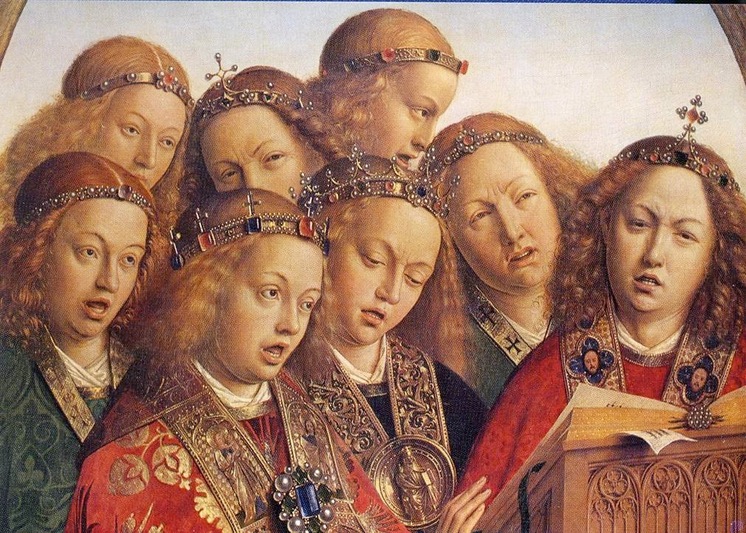
What is God’s favorite musical instrument? Harps? Organs? Bongos? I believe it is the instrument He created Himself, the one which He loved so much that He gave one to each of us for free–the human voice.

God is pleased when we sing for Him. St. Augustine said, “The person who sings prays twice.” Some people say this is because singing adds melody to our words of prayer. But it could be that a person sings twice because singing enlists the heart to join in the prayer of the mind. Singing lifts up our hearts to the Lord.

In today’s first reading, the missionaries St. Paul and Silas get beaten and stripped. They are locked in prison with their ankles placed in stocks. Things are at their darkest and most difficult time, but the night finds them not only praying, but singing hymns. This lifts their spirits, shakes loose their bonds, and pours out grace on that place. Singing makes a difference.

Maybe you feel like coming to our weekly school Masses is like being led somewhere in shackles. But if you must be here either way, why not make the most of it? Singing at Mass (and I mean really singing) is liberating, and a gift to God. 

If God has blessed you with a beautiful voice, sing strongly, as if to say to God, “You gave me this gift, and I offer it back to you.” If He has not blessed you with a good voice, you should still sing boldly, as though to say, “You gave me this voice, and I’m going to let you have it.” Your voice is God’s favorite instrument. So at this Mass and at every Mass, let Him hear it.

3 What If’s — Tuesday, 5th Week of Easter

May 4, 2010

Before today’s Mass, I would like you to imagine three “what if” scenarios. How would you respond in the three situations I’m about to describe?

First:  Imagine, what if, at this morning’s school Mass, the great apostle St. Paul was going to preach to you? How interested are you in whatever he has to tell you?

A second scenario: What if there were a book out entitled, Actual Prayers of Jesus and Mary, and what if there was strong archeological evidence to support that these really were prayers which Jesus and Mary prayed frequently during their lives on earth? How interested are you in discovering these prayers? How powerful would it be for you to pray their prayers?

The third and final scenario: What if I were to tell you, calmly and with firm conviction, that I had received a message for you, a revelation, from Jesus Christ, which He wanted you to hear through me at this Mass? How interested and open are you to receiving such a message?

Of these three scenarios, which one would you most desire to be true?Now listen closely…. All three of these scenarios will be realized, will be true, at this Mass.

The first scenario will be realized: St. Paul will indeed preach to you–in this morning’s first reading. Perhaps St. Paul did not realize it when he first spoke these words, nor perhaps did the sacred author who wrote them down in the Book of Acts, but the Holy Spirit was inspiring, was guiding these words.

And the Holy Spirit did not only have the first-century Christians of Lystra, Iconium, and to Antioch in mind when He prompted these words. St. Paul’s inspired message is meant for us today just as much as they. So this morning, St. Paul will preach a message (though only one sentence long) which is truly intended for you.

As to the second scenario, where is this book containing Actual Prayers of Jesus and Mary? We read from it at almost every Mass, as we will today. This book is the Book of Psalms. In the day of Jesus and Mary, all devout Jews prayed these 150 psalms and they usually knew them by heart. Jesus and Mary prayed the Psalms too. These prayers were inspired by the Holy Spirit to be prayed by all God’s people, including us today, but one could say that the Psalms find their fullest voice through Jesus and Mary. In today’s responsorial psalm, we will join Jesus and Mary in one of their powerful prayers in praise of the Lord.

The third scenario will also be true at this Mass: I have indeed received a message from Jesus Christ which He wants you to hear through me this morning. You will hear His message addressed to you in the proclaimation of the Gospel. At the Last Supper, Jesus was not only speaking to the disciples seated around Him. With His divine sight, Jesus saw all of us here then, and He speaks intending His words for us this morning just as much as they. How much will you allow Jesus’ message to you to affect and change you?

We believe that, “When the Scriptures are read in the Church, God himself is speaking to his people and Christ, present in his own word, is proclaiming the Gospel.” At this and at every Mass, let us come to the Scriptures expecting much, so that we may find much, and receive in from them in abundance.

The Miraculous Pool — Tuesday, 4th Week of Easter

April 28, 2010

Once upon a time, in a certain forest clearing, there was a miraculous (and strange) pool of water. The pool’s waters’ were miraculous, having unique healing and life-giving properties, but something else made this pool strange. When travelers would come upon it, the pool would appear differently depending on how the person approached it.

For those who expected to find something remarkable, the pool was large and deep, and drinking its waters was powerful. But for those who came expecting little or nothing (and there were many such people,) the pool had the appearance of a small, cloudy puddle, and they would not drink from it.


Why did so many come expecting so little, and walk away unchanged? Maybe they had passed by that clearing a hundred times before; and, never expecting much, never had found very much. Maybe they dismissed the whole idea as superstition, as an old myth. Maybe they had never seen evidence that this pool was any better than any other because the people whose lives had been changed by its waters were too timid to give a strong witness to its power and reality.

Now we come to the point of this parable of mine. Encountering our Catholic Faith, the Mass, and the Scriptures is a lot like encountering this miraculous pool. When we expect much, we find much, and receive a great deal. And when we expect to get nothing from them, the usually meet our expectations.

I believe our Catholic Faith is a miraculous pool with the power to change everything. Walking in Christian faithfulness is hard for everyone at times, but I have seen too much, firsthand and from others’ experiences, ever to walk away from Christ and His Church. I have forsaken all other paths for my one life because I am convinced that our Faith, the Mass, and the Scriptures are true, and powerful, and good. Yet even I often need to remind myself not to settle, but to go more deeply and prayerfully into these dangerously familiar things. And when I do, I receive more. I think we all need to receive more. So, in the weeks ahead, I’m going to teach, through pre-Mass talks like this one, or through homilies during Mass, about ways to drink from the miraculous pool to our greater benefit.

For this morning’s Mass, I have four suggestions:

1.  Pray to the Holy Spirit for a more expectant and receptive heart.
2. Form a Mass intention to pray for during the Eucharistic prayer.
3. During the psalm, try to find the Virgin Mary or the Church in it.
4. Listen to Jesus speak to you in the Gospel for He will be speaking to you through His word.

 Let us approach this miraculous pool expectantly.

Clearing Heaven’s Haziness — 4th Sunday in Easter—Year C

April 25, 2010

Today, St. John has a vision of a great multitude, which no one could count, from every nation, race, people, and language. They wear white robes and hold palm branches in their hands. They stand before the throne and before the Lamb (who is Jesus Christ,) and in His temple they worship Him day and night. St. John is glimpsing the worship in Heaven.

Heaven should be one of our great consolations in difficult times and we should really be excited about going there someday. But I think that we often have faulty ideas about Heaven that can get in the way of us being excited or consoled. For instance, maybe you heard the first reading today and thought, “The idea of standing night and day and holding a palm branch doesn’t seem that awesome to me; and going to Mass for an hour is well and good, but I don’t know how I could enjoy going to church forever in Heaven.” Concerns like these would understandably make us weary of Heaven.

We need to recognize that the Book of Revelation is symbolic.  Not everything we see in John’s vision is not literally what we’ll get in Heaven. For instance, St. John sees Jesus as a lamb who was slain and having seven horns and seven eyes. That’s one odd looking lamb, but this is symbolism. The image of the lamb recalls Jesus’ sacrifice, His horns imply perfect power and His eyes imply perfect wisdom. Likewise, the multitude’s white robes point to their dignity, their palms signify their victory, and they are standing because that is the traditional posture for worshiping God. The God who created the universe, and all of the good things we enjoy in it, surely has more to offer us than just palm branches, white robes, and boredom in Heaven.

You have heard it said that we will enjoy the “beatific vision” in Heaven, but you maybe wonder, “How could I enjoy staring at God forever?” But the phrase “beatific vision,” is also metaphor and the experience means more than mere gazing. The “beatific vision” is the immediate knowledge of God enjoyed by the angels and saints in Heaven. We call it “vision” because it is an experience of God which is direct, not mediated, and in the fullest depth and detail which our souls can receive. We call this vision “beatific” because intimately experiencing God, what the prophets call beholding Him “face to face,” gives perfect happiness.

The saints in heaven experience this beatific vision now, even though, (except for the Virgin Mary, and perhaps Enoch, Moses, and Elijah,) none of the saints have their bodies yet. Their flesh is still on earth awaiting the resurrection. But this raises the question of how can we experience anything without having our bodies?

Think of it this way: When I am asleep I see nothing with my eyes (for they are closed.) And in the silence, I’m not hearing anything with my ears. There’s nothing to taste nor smell, and even if I’m feeling the bed sheets they do not have my attention. Yet sometimes when I sleep, even as I’m dead to my senses, my soul can be alive and alert while I dream. If dreams of mere fantasies can be made vividly realistic to our souls, then I’m confident that God can engage our souls with the higher realities of truth and love, even as our bodies sleep in death.

Sometimes people ask, “Will my experience of Heaven only be between God and me? I mean will I be so overwhelmed by God that I won’t notice or care about the multitude around me?  Will I even remember the people that I knew on earth?” I would answer in this way: how could coming closer to the God who is Love make our love toward others colder, or how could being in the presence of Truth Himself make us stupider? In Heaven, we will never forget that our parents were our parents, or that our friends were our friends, or that our spouses were our spouses and we will remember the love we shared. And the fact that miracles have occurred through praying to the saints for their intercession before God shows that the holy dead are still aware of us and care about us still on earth.

So what exactly is heaven like now, and what will it be like after the resurrection when this entire universe is remade into a new heaven and new earth? We don’t exactly know. Like in the book of Revelation, Scripture speaks of it in images: life, light, peace, a wedding feast, wine of the kingdom, the Father’s house, the heavenly Jerusalem, and paradise. Though we don’t exactly know what Heaven will be like, we shouldn’t fear that it will disappoint us. When, by God’s grace, we all get arrive there we will look at everything that He has prepared for us and find it very good.  

Until we get there, let us realize and remember that every Mass gives us a foretaste of Heaven. Here we bring with us everything that has happened in our lives. We come here before the throne of the Lamb who was slain, and we praise Him. And here He gives us Himself along with every heavenly blessing which we are ready to receive. Though a veil remains, every Mass bring Heaven to earth.

A Premature Passion? — Palm Sunday—Year C

March 28, 2010

So why did we just proclaim the Passion?  Isn’t the Passion a bit premature? It’s Palm Sunday, not Holy Thursday or Good Friday. Aren’t we jumping the gun? No, like the two disciples Jesus instructed in our opening Gospel, we’re being told what we are going to see. The Church has us recount the Passion on Palm Sunday to prepare us; to prepare us for encountering Christ’s Passover through the special ceremonies and symbols of this Holy Week.

Now the celebration of the Eucharist actually makes the events of the Pascal mystery present for us every time we come to Mass. Jesus’ Last Supper, His Passion and Death, His Resurrection and Ascension into glory, are all truly presented to us at each and every Mass; but during Holy Week, we unpack and encounter these events in unique and special ways.

Today you have waved palms, an ancient symbol of victory, to Christ, welcoming Him into our city. On Holy Thursday, you can go where the Blessed Sacrament is reserved and give company to Christ in his lonely solitude, with Him in His agony before His arrest and with Him as He spends the night awaiting His trial. On Good Friday, you can reverence the crucifix; you can kiss the wood of Jesus’ cross and kiss His body hanging upon it, as He dies for us. And at the Easter Vigil, you can see the sign of the light of Jesus Christ resurrecting out of darkness and death.

And so I invite you to encounter Jesus’ Pascal mystery, at this Mass, at every Mass, and through the special signs and ceremonies of this Holy Week.

One Catholic Church — Tuesday, 3rd Week of Lent

March 9, 2010

In the first reading we hear the ardent prayer of an Old Testament Jew named Azariah who finds himself in a pretty hot spot. He fervently prays, “… O Lord, do not deliver us up forever, or make void your covenant. [Save us for] the sake of Abraham, your beloved… to whom you promised to multiply … offspring like the stars of heaven, or the sand on the shore of the sea.”

This was God’s covenant promise to Abraham, and God has indeed made Abraham’s spiritual offspring vast and numerous. Today, half of the people on earth claim Abraham as their father in faith—these are Christians, Muslims and Jews who all seek to worship the God of Abraham.

Yet Jesus prayed that all people would be one in Him, as one holy family of God—a diversity of persons sharing one perfect unity. To achieve this goal Jesus established one, holy, catholic, and apostolic Church, so that all may be one, as He and the Father are one. Our Church was established by Jesus, Himself, who said to Peter, our first pope, “You are rock, and upon this rock I will build My Church.”

Our Catholic family is made up of every race and reaches to every nation. To illustrate this, I would ask all high school students; freshmen, sophomores, juniors, and seniors, to stand up now. Imagine that these 146, or so, young men and women represent the world’s nearly 1.2 billion Catholics. Each one represents about eight million of our  Catholic brothers and sisters.

In the United States we have 68 million Catholics, but this is only 5.7% of all the Catholics in the world. I would now ask the male freshmen to remain standing and for everyone else to sit down. These guys represent the Catholics of the United States, plus the rest of North America and the Caribbean—just 9% of Catholics worldwide.

The freshmen can sit down and I would ask the male sophmores to stand up. This is Asia, Australia, and the Pacific Islands, totaling 11% of all Catholics.

You can sit and I’ll ask the senior males to stand. This is Africa’s Catholics, 12% of the Catholics in the world.

You can sit and we’ll have the male juniors and the female seniors rise. This is Europe, 27% of all Catholics.  (The pope is in there somewhere.)

You can sit and we’ll have our largest region of all, represented by the female juniors and the full sophomore class, please stand. This is Central and South America, where 39% of all Catholics live.

So, as you can see our Catholic family is far more diverse than you might have imagined. We are young and old, men and women, rich and poor, sinners and saints.

Our Catholic family not only spans the globe, it also spans the centuries. This is reflected in the ancient prayers we sing today, such as the Latin Sanctus and Agnus Dei, the Kyrie which is ancient Greek, and the Amen which is Hebrew.

Let me put this another way: Could I have one high school student please stand up. This one person represents about 13½ years, which is about how long you have had to explore and get to know about your faith. Now could all of the high schoolers please stand up. You represents all the years that the Church has been on earth, since 33 AD. Our Church has been around a lot longer than we have. You may be seated.

Roman Catholics make up the largest religious denomination in the United States.  However, it is said that the second largest denomination in our country would be former Catholics. Tragically, many Catholics leave the Church. Oftentimes, they experience one or two parishes and a couple of priests, in one region, of one country, over a handful of years, and they imagine that they have exhausted the riches of the 2,000 year-old worldwide Church and Faith of Jesus Christ. But in reality, you can explore the mysteries of Catholic beauty and truth for a lifetime and never exhaust them.

My message for you, with all passionate the urging of Jesus Christ, is this: always remain in the Church that Jesus Christ founded. Never walk away from the fullness of God’s family, but dwell in the household of God.

Sources:
Distribution of Catholic Population, by Region: 2000
USCCB: The Catholic Church in the United States At A Glance

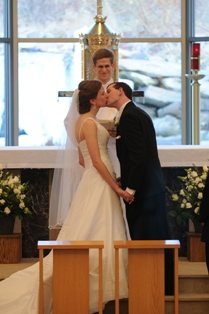
For an Extraordinary Marriage — Wedding of Andrew and Laura Foreki

March 3, 2010

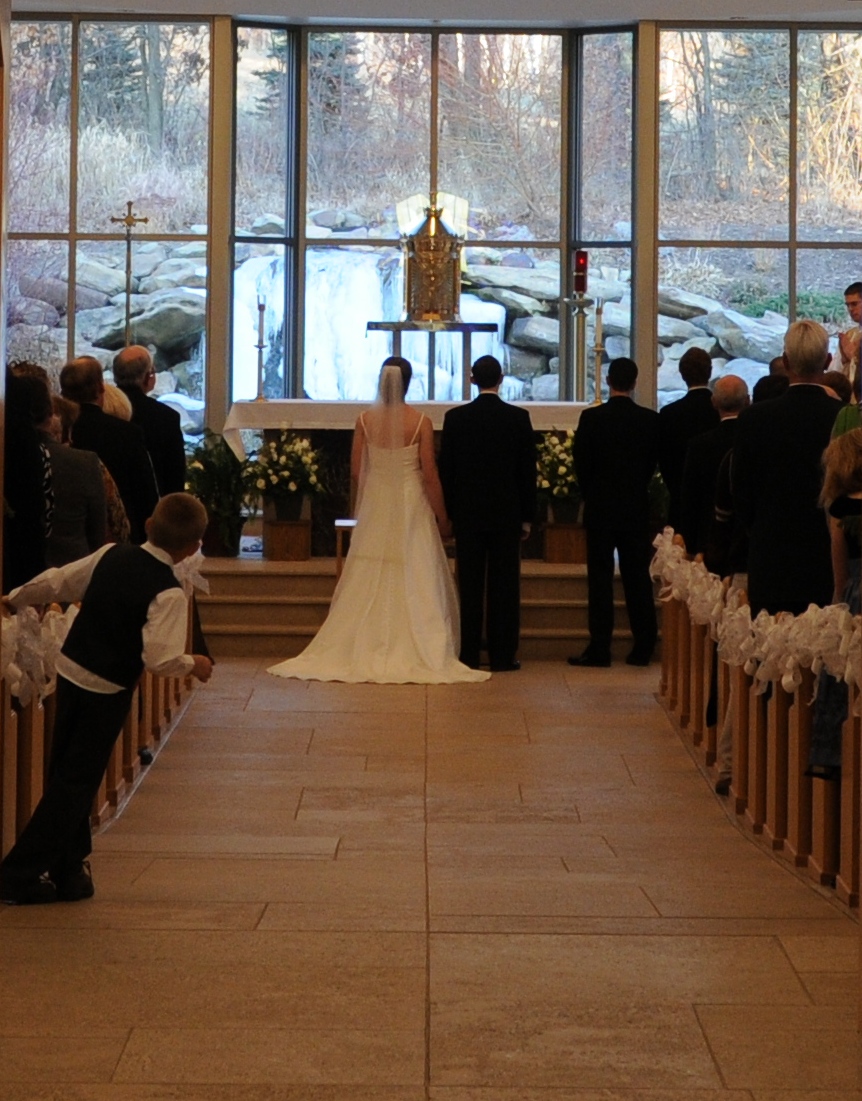
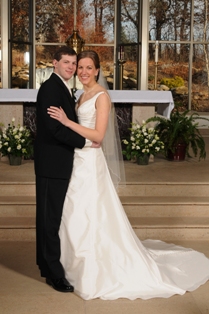
I would like to begin this homily today by sharing with you the extraordinary story of how this boy, Andrew, met this girl, Laura. Picture Andrew, walking one morning across the University of Wisconsin campus in the deep cold of winter. He is on his way to Chadborn Hall where a prayer group is meeting for their twice-weekly 7:30 rosary. 

He walks into the room where the group is meeting and casts his eyes, for the very first time, upon a drowsy-eyed coed named Laura. And can you guess what Andrew said to himself when his eyes saw Laura for the very first time? That’s right. He said to himself, “Oh, I don’t know who that is.” This reaction, of course, is to be expected, since Andrew and Laura didn’t know each other prior to being introduced a few moments later.

Now Andrew’s first impression is not what makes this an extraordinary story. Did you notice what was the extra-ordinary part? Here it is: Here we have two college students, getting up, out of warm beds, on a cold day, to pray a rosary, at 7:30 in the morning! Now, you have to understand, in College Student Time, this is like getting up at 4:30 AM. Your typical college student doesn’t get up any earlier than he has to, but these two got up… to pray. For this and a thousand other reasons, I think you will all agree with me, that we have here two extra-ordinary people, from whom we good reason to expect an extraordinary marriage.

Do you two want to ensure you share an extraordinary marriage together? Then there are three things that I, as an ordained servant of Jesus Christ, believe that you should do.

First, like Tobit and his wife Sarah in our first reading, you should pray together. Of course you must pray individually. And of course you must pray with your children once they come. But you also need to pray together. It doesn’t need to be anything complicated.  Just hold each others’ hands a few moments before you part for work, or stand, or kneel, at your bedside, like Tobit and Sarah did, and speak aloud from your hearts to God. Ask blessings for each other, and give thanks for all the blessing you have received, and close you prayer by saying, “Amen, amen.”

Some couples find this kind of prayer too intimidating, or too personal, to be attempted; for our prayers express our most intimate selves, our fears, our hopes, our pains, our joys, our deepest longings. If you pray honestly in this way, nothing will be hidden between you. Today you will vow to give yourselves completely to each other. Do you want to be truly and totally one? Then pray together. Through marriage you will share of one flesh, if but pray together and you will also share of one spirit. Pray together and you will share an extraordinary marriage as one flesh with one soul. So please, pray together.

The second thing you should do for an extraordinary marriage is to come to Mass. Come to Mass every Sunday and every holy day of obligation. Come, and be moved by the beauty of architecture and songs. Come, and be strengthened by the experience of Christian fellowship. Come, and be inspired by the eloquence of Gospel preaching.

No doubt some people hear this and think to themselves, “That sounds great… But our church is ugly and the songs are dumb and hard to sing. And our community is little more than a gathering of strangers. And our priest always gives the same boring homilies.” Which all boils down to saying, I just don’t get anything out of going to Mass. Then hear this, even if everything else is lacking at Mass, Jesus Christ is always here for us, Body, Blood, Soul, and Divinity in the Eucharist. At Mass, the one sacrifice of Calvary and the Last Supper are made truly present to us for us to receive their power.

At Mass Jesus Christ shows us the perfect spousal love that He calls each of us to imitate. Jesus never called himself “the bachelor.” No, He joyfully called himself “the bridegroom” and eagerly seeks to unite himself to His bride. On the cross, naked without shame, He consummates this union with her, giving himself freely, fully, fruitfully, and forever… freely, fully, fruitfully, and forever. Do you want your union with each other to be free, fully, fruitful, and forever? Then come to Mass to learn the pattern of how Christ loves us and draw from the power He offers us through communion with Him. His is the pattern and the power for an extraordinary marriage. So please, come to Mass.

The third and final thing you should do for an extraordinary marriage is to be salt and light in the world. What does this mean? Being salt and light means that your Christianity should show. As Jesus says, “Your light must shine before others, that they may see your good deeds and glorify your heavenly Father.”

Your good deeds should stand out in the world. As St. Paul says in the second reading, “Do not conform yourselves to this age, but be transformed by the renewal of your mind” If the world never judges you to be radical in any aspect of your Christian life, then you’re not doing it right. Then you’re not yet living as salt and light–you’re not yet living like the saints. For example, everyone loves their friends, but who loves their enemies and prayers for them? Most people pray, but who spends a long time to be with God every day. Many people can give when times are prosperous, but who gives generously when times are tight? Such things as this are what it means to be the light and the salt of the world. Light is different than the darkness, and salt makes the ordinary flavorful.

Clearly, you two are salt and light already, for who goes on weekend retreats to know God better? Or who drives to Washington D.C. to march for life? Or who goes down to Louisiana to volunteer for Hurricane relief? Or who get up at 7:30 in the morning to pray the Rosary? So, please keep on being salt and light, and your marriage will be extraordinary.

Years from now, I don’t expect that you will remember much from this homily, but I hope you remember these three things: Pray together, come to Mass, and be salt and light and you will have an extraordinary marriage.

[Preached as a deacon for my sister’s wedding,  November 22, 2008]

The Our Father — Tuesday, 1st Week of Lent

February 23, 2010

When the apostles asked Jesus how they should pray, Jesus taught them what is called the perfect prayer, the “Our Father.” It is a concise prayer, with just seven petitions (a perfect number for the Scriptures,) yet there is great depth beneath its simplicity.  This morning I show you three insights into this prayer which I hope will come to your mind from time to time as you pray this prayer for the rest of your lives.

First, Jesus teaches us that we are to pray to “Our Father.”  This is a far more wonderful thing than we realize.  To see its greatness, just imagine if the prayer were different. We do not pray, “Our tyrant, who art our ruler, before thee we grovel.” Nor, “Our master, we art thy slaves, for thee we must toil.” And we do not say, “Unknowable one, whom none can name, unapproachable be thy being.” We pray, “Our Father who art in heaven,” hallowed be His name.  We have the privilege to call God our Father on account of our faith in His Son, Jesus Christ. Jesus is God’s Son by His nature, (God from God, light from light,) but we are made God’s children by adoption through Christ. One way to see why this is such a big deal is to imagine if God were everyone’s heavenly Father, except for you. Whatever applies to a good father’s relationship with his natural children, also goes (with limited exceptions) for the perfect Father’s relationship towards us, His spiritual children. Keep in mind how privileged we are when you pray to “Our Father.”

The second insight this prayer yields is the proper attitude we should have towards prayer. Perhaps you’ve heard some people say, “Well, if you like to pray that’s fine—I mean, if that helps you to motivate yourself that’s great,” as if the only power of prayer was to change one’s personal attitude. This is something said by people who don’t pray, and if we thought as they did then we wouldn’t pray either, for who would bother to ask someone else to receive what is already in one’s own hands (i.e., the choice of one’s own attitude.) A second motivation among people who do not pray is more faithful, but also misguided. These say, “I can’t change God’s mind, so why should I bother to pray? Whatever He wills will be, whether I pray to Him or not.”

The first three petitions of the “Our Father” are worded carefully. They do not say, “Our Father, who art in heaven, make your name holy among us, make your kingdom come upon us, and make your will be done among us.” This would put everything on God. Nor do the opening lines read, “Our Father, who art in heaven, we will glorify your name, we will make your kingdom come, and we will make your will be done, on earth as it is in heaven.” This would put everything in our own hands.

The prayer which Jesus gives us does not put everything on God, or put everything on us. Jesus presents the middle and true way of faith. We are not called to an independent activism, nor to a vacant passivity, but to an active receptivity in relationship with God. Like the Virgin Mary, we are to stand before our Father, with a spirit of active receptivity, and pray, “Behold, I am yours, may your will be done, in and through me, and on earth as it is in heaven.”

There are some things which are simply beyond my human ability.  For instance, I can no more forgive my own sins than I can pull up on my belt loops and hold myself up in midair. However, that does not mean I can do nothing to help my situation. I can first forgive others as I wish to be forgiven. I can pray, go to confession, and tell God that I’m sorry. God calls us to do our part and to cooperate in His work.

Maybe this explains why Jesus could not work great miracles where people were lacking faith. It was not that such things were beyond God’s omnipotent power, it is that God insists upon doing His works in relationship with us, rather than entirely apart from us. (This is His purpose in establishing the Church—to do His saving work with and through us.) Like St. Augustine said, ‘The God who created us without us, will not save us without us.’

The third and final insight into the Lord’s Prayer regards the meaning of the petition for “our daily bread.” We say, “Give us this day our daily bread.” We can pray for this “bread” in three senses; literal, spiritual, and Eucharistic.

First, there is the literal sense, praying that God would provide for our material needs in life; such as housing, clothing, and food. We take these things for granted—your daily bread already waits for you in the cafeteria or in your kitchen at home—but there are many people around the world, who are much less well-off than we are, who pray these words from their hearts every day. Occasionally we should call these brothers and sisters of ours to mind and pray these words as intercession on their behalf before our Father.

Second, there is the spiritual sense, asking for the graces and helps that money can’t buy; such as peace and virtue, faith, hope, and love. Without these things, even a rich man remains impoverished, for man is not meant to live on material bread alone.

Third and finally, there is the Eucharistic sense, which asks for the bread from this altar which is God’s Son. Whenever we receive Jesus in the Eucharist He remains with us and in us until we receive Him again (unless we should disinvite and evict Him by committing grave sin.) In this way, Jesus persists as our “Daily Bread.”

So when you pray the “Our Father” realize your privilege in being His child through Jesus Christ. Consider that the coming of the Kingdom is a joint effort of God with man, in which our prayers play an important part. And pray for all your daily bread; literal, spiritual, and Eucharistic. May you remember these insights for all of your life and may the words of Christ’s perfect prayer make you a fruitful child of our Father.

Mary and Pilate — 6th Sunday in Ordinary Time—Year C

February 14, 2010

In a few moments, after this homily, we will recite our creed, the summary of our faith. Every Sunday, we profess, in union with the Christians who came before us, our belief in these truths and our resolve to live our lives according to them. This morning we will look at just one rich aspect of our creed and consider its implications for our lives.

Have you ever noticed that in the entire creed, only two non-divine persons are mentioned by name? These are the Virgin Mary and Pontius Pilate.

“By the power of the Holy Spirit, He was born of the Virgin Mary and became man. For our sake He was crucified under Pontius Pilate; He suffered, died and was buried.”

Now many other figures from the Old and New Testaments could have justifiably been included in our creed; such as Adam and Eve, Abraham, Moses, David, Mary Magdalene, Peter, Paul, and many others. Yet, only Mary and Pilate get mentioned. So why is this? There seems to be two very good reasons. The first of these reasons I will give now—and the second I will save for the end.

The first reason why Mary and Pilate receive special mention is that they ground Jesus’ life, death, and resurrection in our real history. Jesus was ‘born of the Virgin Mary, suffered and died under Pontius Pilate, and on the third day, He rose again.’ Now other pre-Christian religions sometimes had stories about dying gods who came to life again, but those stories were always said to have happened ‘once upon a time,’ in some remote and mythic past. But with Jesus Christ, this ancient intuition and longing of humanity is actually realized. The inclusion of Mary and Pilate in the creed witness to this: that God became man, died, and rose for us, in this world and in real history.

Some people try to be too sophisticated by saying it doesn’t really matter if Jesus rose from the dead, or even if He lived at all, because His teachings are what’s important. But St. Paul blows this idea out of the water. “If Christ has not been raised, your faith is vain; you are still in your sins. Then those who have fallen asleep in Christ have perished” and “we are the most pitiable people of all.” Without Jesus Christ and His resurrection there is no Gospel, there is no Good News.

Just like Jesus Christ, Mary His Mother and Pontius Pilate His executioner are not fictional characters made up for some story. They are real people, from a time not that much different from our own. Our styles and technologies may have changed, but human beings themselves remain much the same. When we look at Mary and Pilate we can see ourselves in these two people whom Christ encountered twenty centuries ago.

Pilate is the secular Man of the World.
Mary is the devoted Disciple of Christ.

Pilate seeks the glory of men.
Mary seeks the glory of God.

Pilate knows worldly wisdom, he is clever and cunning.
But Mary knows God’s wisdom, and she is truly wise.

Pilate thinks he knows how the world works and the pragmatic way to get things done. For Pilate, our world is totally shaped by of power, money, and influence, with some blind luck thrown into the mix. When Jesus stands silent before him, Pilate says, “Do you not speak to me? Do you not know that I have the power to release you and I have the power to crucify you?” Jesus replies, “You would have no power over me if it had not been given you from above.”

Pilate is a very post-modern man.  He’s a moral relativist. When he asks Jesus, “What is truth,” he doesn’t bother to wait for an answer from Truth Himself. That’s because Pilate thinks that the ‘truth’ cannot be known except for the ‘truths’ which we choose for ourselves or impose upon others.

The Gospels show that Pilate knows Jesus is innocent, or at least that he poses no real threat to society, yet Pilate is willing to have this innocent man whipped and even crucified when that becomes the most expedient thing to do. The crowd threatens Pilate, “If you release him, you are not a friend of Caesar,” and he quickly caves and hands Jesus over.
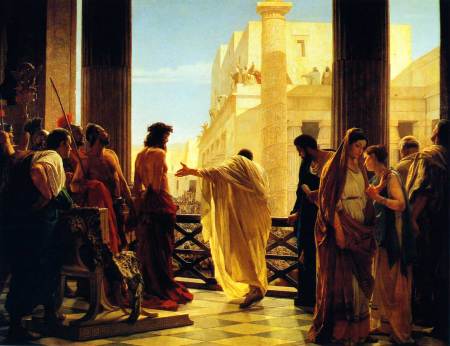
Pilate washes his hands of responsibility, and extends Christ’s arms on the cross. Mary had extended her arms declaring, “Let it be done to me according to your word,” and lovingly held the infant savior in her hands.

Pilate, despite all his power, is ruled by fear.
Mary, despite her weaknesses, is freed from it.

Governor Pilate is rich in wealth and power and yet he has no peace.
Mary, the poor widow, has peace and everything she needs from God.

Pilate has no faith in the God of Israel. He says, “I am not Jew, am I?” But for Mary, God is her rock and this makes all the difference in the world. Mary is defined by her faith, hope and love.

Mary never attends an academy, but she is profoundly wise because she reflects in her heart on the words and deeds of God and because she lives by her own advice: “Do whatever he tells you.” She knows that we do not manufacture the truth for ourselves, we receive it, ultimately from God. We love it, we defend it, and we share it with others. “Blessed [is she],” as Elizabeth said, “who believed that what was spoken to [her] by the Lord would be fulfilled.” Mary trusted and believed, for she saw the evidence through history that God “has mercy on those who fear Him in every generation,” that “He scatters the proud in their pride, and casts down the mighty from their throwns, but He lifts up the lowly.”

Mary’s life was full, but was not free from trials. When Mary consents to be found with child through the Holy Spirit she is uncertain of what will happen to her, but she trusts in God. She does not know how she and her husband will get by as poor immigrants in foreign country, but she continues to trust. Mary’s response to every trial in life, even to the death of her son, is to trust in God. Despite men’s sins, she trusts in God as the Lord of history, that He casts down the proud and mighty from their throwns and raises up the lowly.

Pilate is indifferent to Christ, and he consents to sending Him to the cross, but Mary is wholly devoted to Christ, and she consents to share in His Passion. Pilate’s heart is hardened despite Christ’s Passion, while Mary’s heart is pierced by it.

Governor Pilate was once the most powerful man in Judea, but where is he now? Mary, the poor widow, is now our glorious queen, the most beautiful and powerful woman in heaven or earth, and through her reign she draws millions to Christ our king.

She is the one who wept and now laughs.
He is the one who laughed and now weeps.

He was rich in the world and now he is poor.
She was poor in the world and now the kingdom is hers.

He took root in the desert, he was barren and uprooted.
But she was planted beside the flowing waters, she endured and bore much fruit.

So what do all of these reflections about Mary and Pilate have to do with us? I promised you at the beginning a second good reason why Mary and Pilate are mentioned in the creed; and here it is: Mary and Pilate represent us. They stand as archetypes, models or patterns, for every person.

The faithful one and the faithless one.

The one who serves God and the one who serves himself.

The one who gives Christ life and the one who puts him to death.

We live our daily lives as either Mary or Pilate, with shades of the other thrown in. As we come to the season of Lent, let us examine and discern who we are. “How am I Pilate, and how am I Mary?” And at this Eucharist, let us ask Jesus to exchange in us the ways of Pilate for the ways of Mary, for hers is the way of Christ.

Approaching God — 5th Sunday in Ordinary Time—Year C

February 11, 2010

In today’s first reading the prophet Isaiah hears the angels praising God at the temple with words like those we proclaim at every Mass: “Holy, holy, holy is the LORD of hosts! All the earth is filled with his glory!”

What do these words mean?  First, the Jews did not have adverbs for “very,” “most,” or “infinitely” in Hebrew, so if they wanted to say something was very heavy they would call it “heavy, heavy.”  If they wanted to say something was most heavy or (if it were possible) infinitely heavy they would call it “heavy, heavy, heavy.”  So when Isaiah hears the angels call God “holy, holy, holy,” they are praising His perfection, transcendence, and goodness to the highest degree.

Why is God called “the LORD of hosts?” A host is an army, or a large group of persons. In this case, God’s army of angelic  persons is referred to. Our God is holy and wields unsurpassed power. The earth is filled with his glory.

Isaiah behold this sight and becomes very afraid. “Woe is me, I am doomed! For I am a man of unclean lips, living among a people of unclean lips; yet my eyes have seen the King, the Lord of hosts!” In the Old Testament people thought that no human being could look upon God and live.

Then an angel, one of the seraphim, fly down, takes an ember with tongs from the altar (for the Jews sacrificed animals as burnt-offerings at the temple) and touches Isaiah’s mouth. “See,” the angel says, “now that this has touched your lips, your wickedness is removed, your sin purged.” God asks whom He can send to be His prophet, and now Isaiah has the courage to say “Here I am, send me!”

Imagine if, at communion time, people would line up and come before the priest to have a red hot coal touched to their lips or tongue? Priest: “The holiness of God.” Communicant: “Amen… Ou!” I imagine the communion line would be much shorter.

This is the bread that we will be offering at this Mass to become the real body, blood, soul, and divinity of Jesus Christ. It’s flat because it unleavened, just like the bread at the Jewish Passover meal and as at Jesus’ Last Supper.  Leaven, or yeast, is bacteria which grows and makes our bread fluffy. The Jews were to keep leaven, which symbolized sin, out of their Passover bread.

Like all of the other sacraments, the Lord’s choice to use bread has symbolic meaning.  Take baptism, for example: water cleanses us and gives us life.  Similarly, bread gives us life and becomes one with us. No wonder Jesus chose it to be his symbol for the Eucharist. The very use of bread invites us to receive him.  The symbol of bread speaks, “Come, do not be afraid. I am here to be received by you and to become one with you.” We tend to forget what an unprecedented privilege this is.

In the Old Covenant, Jews could always pray to God, for ‘all the earth was filled with his glory,’ but they you wanted to go where the Lord was most present on earth they had to go to one place, the temple in Jerusalem.  And even when they got there they did not enter in where the Lord was most present, the Holy of Holies, where only the high priest would go, and only once a year at that. The faithful would worship in the courts outside the temple.  It would be like us coming to church today to stand and pray from the parking lot. Instead, we have the privilege to stand and worship the Lord here in His sanctuary, and not only do we see the Most Holy Lord with our own eyes, but we actually receive Him in the Most Holy Sacrament.

The wonder and the privilege and the awe of this new intimacy with God at the Eucharist could not have been lost upon the early Christians, who were converts from Judaism. Do we approach the Lord with a healthy fear of the Lord, which is called the beginning to wisdom? This fear is not terror, which would cause us to hide ourselves from the Lord. It is a reverence which honors the Giver who is the Gift.

We all sin from week to week, but if our sins are minor, or venial, then Jesus wants us to approach Him in the Eucharist. Receiving this sacrament with contrition forgives our venial sins. On the other hand, if we are aware of serious, or grave sins on our souls, then Jesus wants us to approach Him in another sacrament first, the sacrament of confession, or reconciliation.

In the second reading we heard St. Paul’s words to the church at Corinth, reminding them of what he ‘handed on to them as of first importance as he had also received it.’ Later in the letter he reminds them of something else in a similar way:

For I received from the Lord what I also handed on to you, that the Lord Jesus, on the night he was handed over, took bread, and, after he had given thanks, broke it and said, “This is my body that is for you. Do this in remembrance of me.” In the same way also the cup, after supper, saying, “This cup is the new covenant in my blood. Do this, as often as you drink it, in remembrance of me.” For as often as you eat this bread and drink the cup, you proclaim the death of the Lord until he comes. Therefore whoever eats the bread or drinks the cup of the Lord unworthily will have to answer for the body and blood of the Lord. A person should examine himself, and so eat the bread and drink the cup. For anyone who eats and drinks without discerning the body, eats and drinks judgment on himself. That is why many among you are ill and infirm, and a considerable number are dying. If we discerned ourselves, we would not be under judgment…”

Before we approach the Eucharist let us examine ourselves first, and if we have serious unconfessed sins, from even years ago, let us present ourselves for Jesus’ needed forgiveness in confession first. Ask yourself, do I care more about others’ opinions of me, or about the opinion of the Lord (who sees all things)?

Whenever we come to Christ in the Eucharist let us approach Him as the earliest Christians did, with wonder, awe, and holy fear. Let us have that reverence which honors the Giver who gives Himself as a Gift to us.

The Fool’s Blindness — Tuesday, 5th Week in Ordinary Time—Year II

February 9, 2010

Some priests like to begin their homilies with jokes. Today I’m going begin by telling you a few jokes—some very, very old jokes. In fact, they come from the oldest joke book in the world, a collection of 265 jokes from the 4th century A.D. entitled The Philogelos, or (in English) The Laugh-Addict.

One day an intellectual bumped into a friend and said to him, “I heard you were dead.” “Well,” said the friend, “As you can see, I am very much alive.” “Yes,” [replied the other,] “but the person who told me you were dead is much more reliable than you.”

[On another occasion,] A doctor stole the lamp of a man whom he was treating for inflammation of the eyes. A few days later, the doctor asked the patient how his eyes were. “It’s a funny thing, [Doctor,] ever since you treated them I haven’t been able to see my lamp.”

[And finally,] An intellectual was [once] on a sea voyage when a big storm blew up, causing his slaves to weep in terror. ‘Don’t cry,’ he consoled them, ‘I have freed you all in my will.’”

Now these three jokes have something in common, besides being very old. They all share the have comedic device: a foolish person who focuses on the wrong thing, like the patient who mistrusts his eyes more than his doctor. This is called majoring in the minors, or as Jesus would say, “straining the gnat and swallowing the camel.” In the Gospel today, Jesus really takes it to the scribes and Pharisees for doing this sort of thing: “You disregard God’s commandment but cling to human tradition. … This people honors me with their lips, but their hearts are far from me…”

So do we focus on small details of our faith and neglect what’s really important? For instance, next Wednesday is Ash Wednesday, the beginning of Lent, and during Lent we usually give up something we enjoy as a form of penance until the joyful celebration of Easter. Now keeping a Lenten penance is a good tradition, because penance helps us to shed old sins and to grow in our ability to do good and to be happy. But… if we give up pop, cookies, candy, or ice cream, while we neglect to go to Sunday Mass, we are keeping a human tradition while we neglect God’s command: keep holy the Lord’s day. Instead of doing neither this Lent, please do both.  Take a penance and go to Mass every weekend for the love of God.

Maybe your family doesn’t go to Mass on weekends, but that doesn’t mean that you can’t. If you love God enough to ask your parents’ permission to go by yourself or with a friend this Sunday, I doubt you will need to go alone a second time. For you will provide your parents with a needed reminder about God’s important in our lives, and I bet you that at least one of them, if not the whole family, will come with you every week after.

So let us keep first things first, and not be stupid, like the man who was swimming when it started to rain; and dove to the bottom, to keep from getting wet. This Lent, let us keep the Lord’s Day, every Lord’s Day, holy. The reason the Lord calls you out is to call you to Himself.

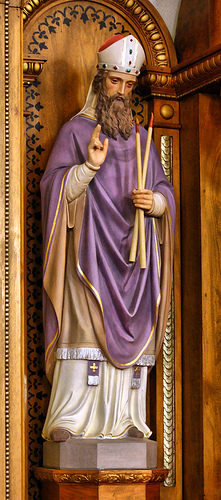
By the Throat — February 3 — St. Blaise

February 3, 2010

I began going to daily Mass in the fall semester of 2001. In college I had always gone to Sunday Mass, but after September 11th I felt that if the world was going to change for the better, it would require that people present themselves to God and offer Him more opportunity to work His grace in them. And so, two years later and seven years ago today, I was at daily Mass on the feast day of St. Blaise for the first time in my life.

At the end of Mass, Father Mark offered an opportunity for a special blessing of throats by means of two crossed candles and the intercession of St. Blaise. A line formed of the faithful, but I stayed in my pew. I felt a tug of conscience to go up there too, but I was really embarrassed by the oddness of it. “Who gets ailments of the throat anyways,” I justified to myself, and headed out the door.

With noon Mass behind me, I walked to the dining hall for lunch. I remember that I was passing an empty salad bar on my left when I got stopped in my tracks. It was like my throat suddenly got completely dry. I recognized I wasn’t choking, so I wasn’t frightened, but it took me a good minute or two get right again.

Now my best natural explanation for what happened to me is that I inhaled dust kicked up by some unseen kitchen sweeper which got blown in by a fan through the open door on my right. But it didn’t take me long to remember St. Blaise and to recognize in this providential incident God’s gentle correction.  The message: “Don’t refuse a holy blessing.”

We Catholics should not feel ashamed of our traditional blessings and sacramentals. Things like holy water, miraculous medals, and house blessings make a difference; for with these things we make an act of presenting ourselves to God and offer Him more opportunity to work His grace in us.

The Old New Pattern — Thursday After Epiphany

January 8, 2010

In his first letter to his brothers and sisters in Christ, St. John says that the commandment he writes to them is not new, and yet new. (1 John 2) The commandment he is referring had been given to them years before, by Jesus Christ at His Last Supper. He told His disciples, “I give you a new commandment: love one another. As I have loved you, so you also should love one another.” (John 13:34)  Love sums up the moral law, and we know how to love from Christ.

Once when Jesus’ opponents were trying to trip Him up they asked Him what was the greatest commandment. He answered, “You shall love the Lord, your God, with all your heart, with all your soul, and with all your mind. This is the greatest and the first commandment.”  Then He added, “The second (commandment) is like it: You shall love your neighbor as yourself. The whole law and the prophets depend on these two commandments.” (Matt 22) Or, as St. Paul would later put it, “Love is the fulfillment of the law.” (Rom 13:10) Love sums up the moral law, and we know how to love through Christ.

It is intuitive for people to understand that we should do good and avoid evil, that we should love good and hate what is evil. Yet that does not mean that everyone agrees as to how we should live this out. Often we see the truths which Christians present in love angrily dismissed by the world as hate. (Frequently the throwing of this charge allows people to dismiss opposing viewpoints without ever giving them serious thought.) Even those in a post-Christian secular culture will agree that somehow “love is the answer,” but how exactly are we to love one another?

Jesus shows us how to love.  He says, “As I have loved you, so you also should love one another.” We can learn from His example especially here, as we witness His Passion, death, resurrection, and ascension in the Mass, but we can also learn from the entire life He lived.

Sometimes it can be hard understand example, or difficult to relate Jesus’ life to the particulars of our own. To help us He gives us the example of His saints, through whom He has continued to live His one, salvific way of life through thousands of different human expressions. The Spirit of the Lord was upon Jesus; He was anointed to bring glad tidings to the poor, to proclaim liberty to captives, to restore sight to the blind, to free the oppressed, and to proclaim a year acceptable to the Lord. Today this Scripture passage is still being fulfilled by Him through the lives of His saints.

“The love of God is this, that we keep his commandments.”  So let us learn what love is through the example of Jesus and His saints, for love sums up the law, and we know how to love through Christ.

Strengthening Your Family — Holy Family

December 29, 2009

Today we are going to try something unique. Close your eyes and let the Holy Spirit guide your imagination to show you what family life was like in the home of Joseph, Mary, and the boy Jesus…

Theirs is a small dwelling and you can see all of them there…

How old is Jesus as you see Him? What is He doing?

What are His parents up to? What are Joseph and Mary like as you see them interact with each other?

It comes to time to eat. What do you see the Holy Family doing?

As they relate to one other, what do you see expressed in their faces? It is now later in the evening and time for prayer. What do you see the members of the Holy Family doing?

You can return in your imagination to visit this house any time you wish, but now, let’s open our eyes and review our mediation.

What did you see as Joseph and Mary interacted with each other? Were they not tender and reverent towards each other? I bet you could see their great mutual love reflected in their smiles.

What happened in their house when it was time to eat? Who would imagine them not coming together to share their meal in each others’ company?

And later, when it was time for prayer, did the Holy Family do? Did you see them go off to their own corners, or did they come together, to pray as one family?

Did you see the Holy Family’s intimacy, their happiness, and their love for each other? Do you want your family to share a bond like theirs? Then take the Holy Family as your model: share your love, share your meals, and share your prayers.

First, on sharing your love. Let your spouse and children know every day that you love them. You can say it, you can show it, or you can do both. For instance, kids never tire of being hugged and told their loved each day.

As for married couples, don’t make the mistake of thinking that intimacy and love are only expressed physically. For St. Joseph had all sorts of simple, little ways to let Mary know that she was loved, and vice-versa. Be like the Holy Family in sharing your love.

A second way to model the Holy Family is to share your meals. The research of social scientists indicates that having frequent family meals together contributes many goods for one’s family: For starters, everyone eats healthier meals, and so kids are less likely to become overweight or obese. And kids who eat family meals are less likely to start smoking, to drink alcohol, or to try or to be addicted to drugs. These kids’ grades are better at school, and there is less stress in their homes. These things probably stem from the fact that families which eat together are bound to talk more, provided the TV is off.

These parents are more likely to know about their children’s lives and struggles and, just as importantly, their kids are more likely to know that their parents are proud of them and love them.

Jesus Christ thinks that the shared family meal is so important for us that He has instituted one for His Church and expects His entire family to be there; for to share in the Eucharist is to share in the life and communion of His family.

A third way to make your family more like the Holy Family is to share your prayers. Apart from dinner prayers or going to Church, most Catholic families do not pray together. I think that maybe we see the priest praying the Church’s prayers and think that we are not equipped to lead prayers of our own at home.

But it’s not true.  As fathers and mothers you have a spiritual authority within your families, what John Paul the Great called “the domestic Church.” Your spouse and your children need you to pray, not only for them, but with them. Right after the family meal might be the perfect time for this ritual of family prayer.

Now you may be thinking to yourself, “But we’ve never done this as a family before.” Remember this: as parents, you create what’s normal for you children. If you want it to be normal for your children to eat meals with you, then make it normal for them.

If you want it to be normal for your children to pray to God with you, then do it normally. As parents, you create what is normal for your children and through your gift of these traditions to them you can bless them for a lifetime.

Finally, husbands and wives, if you do not pray one-on-one with each other, then you do not yet share a perfect intimacy together.  It is in prayer that our most intimate selves are laid bare and we ask another person to help us with our heartfelt needs and concerns.

Maybe you’ve never prayed with your spouse before. Then perhaps you can begin like this:  hold each others’ hands, close you eyes, and pray to God for each other, for a little while, even if for just ten seconds, say, before you go out the door. 

Once this becomes comfortable you can begin to telling each other what you want to be prayed for. And, after this is comfortable, you can begin to pray for each other aloud.  Begin the process of praying like this and it will transform your intimacy together.

Perhaps you gave many gifts to your family members yesterday for Christmas, but the greatest gift you can give to each other is yourselves. So follow the way of the Holy Family: share your love, share your meals, and share your prayers.