Archive for the ‘O.T. Figures’ Category

Our God of Second Chances

March 19, 2022

3rd Sunday of Lent
By Fr. Chinnappan Pelavendran 

On this third Sunday of Lent, the Church provides us with another moment of grace to straighten us on our journey. Today, we celebrate the Lord who frees us from our slavery to sin, if only we listen to His warning to repent. Repentance is, feeling sorry for the sin we committed and a firm resolve not to deliberately commit it again. Sincere repentance provokes God’s compassion, mercy, and love.

The first reading taken from the Book of Exodus, tells us about the deep concern of God towards his people suffering in Egypt. He sees the hardships experienced by his chosen people and observes their misery. God had heard their cries of misery and takes initiative to liberate them from the Egyptian masters. God shows His mercy to His chosen people by giving them Moses as their leader and liberator. The God of Abraham, Isaac, and Jacob reveals Himself to Moses from the burning bush and assures Moses of His Divine presence with His people and of His awareness of their sufferings in Egypt. He declares His intention to choose Moses as the leader who will rescue His enslaved people. Then God reveals to Moses His name as Yahweh (“I AM Who AM”) and renews the promise He made to the patriarchs to give them a “land flowing with milk and honey.

In the second reading, St. Paul warns us that our merciful God is also a disciplining God. Paul reminds the Christians of Corinth that they must learn from the sad experience of the Israelites who were punished for their sins by a merciful but just God. The merciful and gracious God is also just and demanding.

In today’s Gospel, Jesus informs us that those who do not repent will perish. On the other hand, Jesus tells us a parable about the patience of God. As the fig tree is given one last chance to produce fruit before it is cut down, so Jesus is giving His people one final opportunity to bear good fruits as evidence of its repentance. Through this parable, we are reminded of the patience of a God who is willing to give sinners a chance to reform their lives and to seek reconciliation. Just as the farmer tended the barren fig tree with special care, so God affords sinners whatever graces they need to leave their sinful ways behind and return to God’s love and embrace.

Divine grace is expressed as justice with compassion and judgment with mercy. However, we cannot draw strength and sustenance from God without producing fruit. Our fruit should consist of repentance, confession, and firm commitment to change our lives. Let us produce good fruit when we can, Let us repent while we have the chance. Let us turn to Christ, acknowledge our faults and failings, and receive from his mercy, forgiveness, and the promise of eternal life. There is no better way to take these words of Jesus to heart than to go to sacramental confession. There is no better time to go to confession than during Lent. Repentance helps us in life and in death. It helps us to live as forgiven people and helps us to face death without fear.

Our merciful Father always gives us a second chance. The prodigal sons returning to the father was welcomed as a son, not treated as a slave. The repentant Peter was made the head of the Church. The persecutor Saul was made Paul, the apostle to the Gentiles. During Lent, we, too, are given another chance to repent and return to our Heavenly Father’s love.

His Glorious Light Overcomes the Darkness

March 13, 2022

2nd Sunday of Lent
Fr. Victor Feltes

Once upon a time, little Billy’s grade school teacher was teaching her class about outer space. She said, “In 1969, the American astronaut Neil Armstrong became the first person to walk on the Moon.” Little Billy raised his hand and asked, “Teacher, has anyone ever walked on the Sun?” “Oh, no,” she said, “the Sun is far too hot for that.” But Billy replied with confidence, “I know how I can be the first.” Curious and bemused, she asked him how. “Easy. I’ll go at night!

The Sun, of course, does not turn off at night like a lamp on a switch. The Sun still blazes and shines with incredible heat and light even when the Earth obscures it from our sight. And even on the darkest, stormiest day the Sun remains in the heavens above us even though clouds prevent us from perceiving it clearly.

In this Sunday’s first reading from Genesis, Abram (before God changed his name to Abraham) seems discouraged. He’s lamenting to the Lord: “Look, you have given me no offspring.” Though God has promised him descendants, he and his wife have become very old without having any children together. The Lord God guides him outside and says, “Look up at the sky and count the stars, if you can. Just so, shall your descendants be.” We can easily picture this as a nighttime scene: Abram exits his dwelling and sees a billion stars in the Milky Way. Indeed, more than that number of people today recognize him as our spiritual ancestor, “our Father in Faith.” But this episode strikes as even more profound if, instead of during nighttime, it happened during the day.

‘Look up at the blue sky and count the stars, if you can. Just so, shall your descendants be. You know the stars are up there, Abram. You know they don’t stop being real each morning, it’s just that you can’t see them. Your many descendants will exist, though you cannot see them now, though you do not yet know how. I assure, you my promises to you will be kept.’ And “Abram put his faith in the Lord, who credited it to him as an act of righteousness.

Then God reaffirms his promises to Abram in a strange and mysterious way. The Lord directs him to sacrifice five animals. Abram slays them and lays them out, and then.. nothing happens. Birds of prey, scavengers, swoop down upon the carcasses to pick them over. Yet Abram does not give up; he patiently remains there. As the sun is about to set, a deep, terrifying darkness envelops Abram. And when the sun has set and it is dark, Abram sees a flaming torch and a smoking fire pot appear and pass between the sacrifices. This is a sign from God against any discouragement, doubt, and fear; it is the Lord’s light overcoming the darkness.

Christ’s Church pairs this reading from Genesis today with Jesus’ Transfiguration. After telling the disciples of his coming death, Jesus manifests to them his glory; a divine glory which is always present but which they cannot always see. This event seems to take place in the dark of night since Peter, John, and James were overcome by sleep while Jesus prayed. But upon becoming fully awake, their eyes are opened: they see Jesus’ face shining like the sun and his clothing now dazzling white, as he speaks with Moses and Elijah. These two, great prophets after their trials share in Christ’s radiant glory and speak of the exodus he will accomplish in Jerusalem (that is, they speak of his approaching paschal sacrifice which will set God’s people free).

In his Transfiguration, Jesus reveals his glory to the disciples to strengthen them for the scandal of the Cross. He wants to prepare them to accept, even by the testimony of the law and the prophets, that the Passion leads to the glory of the Resurrection. Christ’s glory shines forth from a body like our own, to show that we, his Church, the body of Christ, can likewise share his glory.

The stories of little Billy, Father Abraham, and Christ’s Transfiguration teach important truths believers will be blessed to remember and hold on to. Even more so than the Sun or stars, our good God endures unchanging. Though this world obscures the light of heaven, heaven’s light remains undimmed. Birds of prey may swoop down and impiously scavenge as enemies of Christ, but we are not forgotten. The innocent one may suffer like Christ, but he is not abandoned. Our times may be dark and frightening, but we need not be afraid: God’s promises will be kept. This is our faith: that despite doubt, discouragement, and distress, the glory of our Lord will overcome the darkness.

Timeless Temptation Tactics & Traps

March 6, 2022

1st Sunday of Lent
By Fr. Victor Feltes

The Book of Revelation identifies “the ancient serpent” who “deceived the whole world” as the one called the Devil and Satan. In the Garden and the desert, his tactics against human beings were similar.

For instance, Satan points out a desirable, material good and encourages grasping for it against God’s will. In the Garden, the serpent told Eve to eat fruit from the Tree of the Knowledge of Good and Evil, and she saw the tree was “good for food, pleasing to the eyes, and desirable for gaining wisdom.” But God had commanded, “You shall not eat it or even touch it, lest you die.” Jesus in the desert had eaten nothing for forty days and he was hungry, so the Devil encouraged him to break his fast by conjuring a stone into bread. This was apparently against God the Father’s will, for Jesus responded, “One does not live by bread alone, (but by every word that comes forth from the mouth of God.)

Another thing Satan does is promise power and happiness separate from God. The serpent told Eve in the Garden, “God knows well that when you eat of it your eyes will be opened and you will be like gods, who know good and evil.” And the Devil told Jesus in the desert, “I shall give to you all this power and glory; for it has been handed over to me, and I may give it to whomever I wish. All this will be yours, if you worship me.”

And a third tactic Satan tries is to say that sinful decisions will have no painful consequences. The serpent said to Eve before her Fall: “You surely will not die!” And the Devil told Jesus atop the temple, “throw yourself down from here, for it is written: ‘He will command his angels concerning you, to guard you,’ and: ‘With their hands they will support you, lest you dash your foot against a stone.’

Our Father knows how to give good gifts to his children. He wills to glorify us through and with and in himself. And he commands us not to sin because he knows it’s bad for us. The Devil, however, urges us to grasp after forbidden things, promises power and happiness apart from God, and lies to us that our sins will cause no harm or pain. Satan tries the same tricks on us today as he did in ancient times.

What if the Devil and all his demons were to suddenly cease existing? Would all our sinning end and disappear tomorrow? Sadly, no. Ever since the Fall, we human beings experience concupiscence; we feel unwieldy passions and misdirected desires. So, even absent demonic temptations, some sinning would still occur on earth. When we sin, how much is due to our wounded human brokenness and how much is instigated by demonic activity? Whatever the mix or mixture of the two, regardless of whether a particular temptation is coming from inside us or outside us — from inner wounds or external enemies, Jesus’ temptations in the desert reflect the ways we are tempted.

For example, in today’s gospel when does Jesus’ first temptation come? When Jesus is very hungry from extreme fasting. Temptation often attacks us in our weakness. Alcoholics Anonymous has an acronym called “HALT.” They observe that someone is more likely to fall off the wagon of sobriety when they are “Hungry, Angry, Lonely, or Tired.” I’ve noted this in the confessional as well. For instance, when parents confess to having lost patience with their children I commonly ask them if they’re tired. The answer is almost always “yes.” Now this doesn’t mean we should never make loving sacrifices which might leave us hungry or fatigued, but it does mean that we need to be aware of our vulnerability at such times and be extra careful in our actions.

Do you find that the sins you bring to the Sacrament of Confession are often much the same? This is common and can discourage some people, but thank goodness it’s not something totally different each time (gossip one day and arson the next)! As creatures of habit, the times and places and ways in which we will be tempted should not be total mysteries to us. Be conscious that you are most likely to be tempted again when and where and how you were before. Realizing this, make any necessary changes in your life, and live with your eyes wide open on the lookout for your known stumbling blocks.

In his second temptation today, Jesus is shown “all the kingdoms of the world in a single instant,” to tempt him toward idolatry. This seems to describe a vision, perhaps within Jesus’ imaginative faculty – a very real experience perceived within his mind. Our temptations often play upon our imaginations. Jesus responds to this temptation abruptly: “It is written: ‘You shall worship the Lord, your God, and him alone shall you serve.” Like a snowball beginning to roll at the top of a mountain, Jesus shows us that it is best to resist temptation early and firmly, before the snowball becomes an avalanche which brings disaster. Though we should not give our imaginations free rein to present us sinful shortcuts falsely-promising happiness, examining our daydreams can be revelatory. Consider: “I could fantasize about absolutely anything, so why am I fantasizing about this?” What is the good desire behind it which God wishes to ultimately fulfill for you somehow? Allow me to share a story about what I mean.

I once met a seminarian who felt strongly called to be a Roman Catholic priest but also felt drawn to marriage. Obviously, these two vocations were incompatible and this tension greatly vexed him. When he shared this internal conflict with his spiritual director, that priest asked him, “Could it be that what you are longing for isn’t actually marriage, or sex, but intimacy?” The young man then realized that he had simply always associated and identified deep intimacy – knowing and being known, loving and being loved – with marriage. He came to realize God was calling him to greater intimacy with himself. Through seriously examining his desire he discerned the deeper, holy desire behind it. Notice, too, how this seminarian gained a helpful perspective by sharing what he was experiencing with a wise and spiritual person. If he hadn’t, he might have made a grave mistake and missed out on his life’s calling.

In the gospel’s third and final temptation, we witness the Devil challenge Jesus’ identity and attempt to confuse him: “If you are the Son of God, [observe this is the third time the tempter says this phrase] throw yourself down from here.” The Devil then quotes two passages from Scripture to argue that Jesus should do something which would be wrong. When someone is going from good to better, our demonic foes often seek to confuse and confound us. Where the demons cannot make us wicked, they will seek to discourage and impede us.

For example, for a couple weeks in college, I continued going to Mass but refrained from receiving the Holy Eucharist. I worried that I lacked sufficient faith to receive our Lord worthily. But then I was enlightened in prayer with an (in retrospect) obvious insight: people who don’t believe in God don’t worry about whether they believe enough in God – that’s something believers do. My anxiety was relieved and my regular Communion was restored when the misleading illusion was dissolved.

When I started learning more about our Catholic Faith as a teenager, I would come across some seeming contradiction in the Bible or a Church teaching I didn’t understand and become greatly troubled, for if the Bible or the Church were wrong about this then how could they be trusted? But then I would learn how the bible passages were not actually in conflict, or that there were actually good reasons for the Catholic teaching. I experienced this cycle enough times that I learned to handle it with confident, trusting patience. I reflected, “There are good answers to my questions, but I don’t have to find them immediately, right this second. It’s going to be fine.” Don’t fall for the temptations to doubt and self-doubt which would rob you of your peace.

Challenges to our identity are another common temptation trap. The Devil says, “If you are the Son of God, throw yourself down from here,” implying, “If you don’t jump, then you don’t believe your Father’s word can be trusted, or you don’t really believe that you are his Son.” The Devil is attacking Christ’s identity and Jesus’ relationship with his Father. Temptation tells us, “You’re a fake, you’re a phony, you’re a hypocrite, you’re a failure, you’re an embarrassment, you’re worthless, you’re shameful, you’re rejected, you’re unlovable, you’re unloved.” Don’t fall for that garbage. Instead, ask our Father, Jesus, and the Holy Spirit to show you who you are to them and live in that beautiful truth.

To be forewarned is to be forearmed. Through knowing these timeless temptation tactics and traps, may you prevail in the spiritual battles ahead of you this Lent.

How Far is East From West?

February 20, 2022

7th Sunday in Ordinary Time

Today we praise the Lord with Psalm 103, a psalm written by King David: “Merciful and gracious is the Lord, slow to anger and abounding in kindness. Not according to our sins does he deal with us, nor does he (repay) us according to our crimes. As far as the east is from the west, so far has he put our transgressions from us.” David rejoices that the Lord is merciful and slow to anger, not punishing our sins in the measure we deserve. God forgives our sins and removes them from us, “as far as the east is from the west.

Let’s look more closely at that last line: “As far as the east is from the west, so far has he put our transgressions (our sins) from us.” How far away is the east, the place of sunrise, from the west, the place of sunset? Depending upon where you’re standing, your horizons may not be far away. But when ancient peoples walked beyond the next range of hills which blocked their view they did not imagine they had reached the ultimate place of the sun’s rising or setting. They knew that both east and west went on and on, farther still. What they likely did not know when King David wrote his psalms 3,000 years ago is that our Earth is spherical.

We know a number of facts that they didn’t back then, but ancient peoples were not less intelligent thinkers than us today. Could you, without using modern technology, prove that the world is round? Well, in the 3rd century B.C., Greek astronomers did and calculated the Earth’s circumference without using telescopes, photographs, airplanes, or satellites. So, given what we know now, how far is the east from the west?

Because the world is a globe, east and west eventually come together. If you were to travel from here due east while I journeyed due west, if we both kept going on making equal progress, we would meet once more near a border of China and Mongolia. If east and west actually meet together how are sins taken far from us “as far as the east is from the west” like this God-inspired psalm says?

Now some may say I’m taking biblical poetry too literally. A figure of speech doesn’t need to be painfully accurate to be true. We may know that each new morning comes from our perspective upon this spinning planet, but in ordinary conversation it’s not wrong to say the Sun rises. Or, in romantic poetry, a woman’s skin need not be made of real porcelain nor a man’s chin actually be chiseled for such metaphors to convey truths about their beauty. Saying the Lord removes our sins far away from us like the east is distant from the west is a straight-forward enough image on first impression. But humanity’s later discovery that these two opposites unite suggests an additional interpretation for this scripture passage about how our Lord takes our sins away.

Here is the puzzle God faced in regards to our redemption: how could the all-holy Trinity ever forgive humanity’s sins? If the Lord were to forgive us by merely ignoring our crimes, then what of cosmic justice and divine righteousness? There was a price to be paid which we sinners could not pay, but God found a way. As was foretold in the 85th Psalm: ‘Kindness and truth met; justice and peace kissed. Truth sprung out of the earth and justice looked down from heaven.’ Just as east and west were distant contraries which surprisingly converged, so sinless divinity and estranged humanity were amazingly joined through the Incarnation and Sacrifice of Jesus Christ. Jesus separates us from sin by uniting himself to us.

What our Lord Jesus has done to save us is reflected in all of this Sunday’s readings. In our first reading, Jesus’ great ancestor David took King Saul’s spear and water jug and then returned them, thereby proving his goodness to his persecutors. Later on the Cross, Jesus takes the soldiers’ spear into his side and water pours out with Christ’s blood, proving his love for us. In our second reading, St. Paul notes the first man, sinful Adam, is saved by the new God-man, Christ. “The first man was from the earth, earthly; the second man, from heaven.” And in our Gospel, Jesus observes that if you love those who love you and do good to those who do good to you, what is so remarkable about that? Jesus says, “Love your enemies and do good to them.” St. Paul wrote to the Romans that “God proves his love for us in this: that while we were still sinners Christ died for us.” We struck him on one check and he offered the other one as well. We took his cloak and he let us strip him of his tunic. We could not purchase our own redemption but Jesus paid the cost knowing we could not pay him back. “Indeed,” as St. Paul writes, “while we were enemies, we were reconciled to God through the death of his Son…”

Jesus Christ, the first of the Most High’s children, is kind to the ungrateful and the wicked, and merciful, just as his Father is merciful. He has loved his enemies, done good to those who hate him, blessed those who curse him, and prayed for those who mistreat him. He calls us to follow his own Christian example that we may share in his resurrected glory and heavenly rewards, “a good measure, packed together, shaken down, and overflowing,” poured into our laps. Praised be Jesus Christ! Let us always praise and thank him – for who he is and what he’s done. “From the rising of the Sun to its setting, may the name of the Lord be praised.”

Called to Seek & Save

January 22, 2022

3rd Sunday of Ordinary Time
By Fr. Chinnappan Pelavendran

“The Spirit of the Lord is upon me,
  because he has anointed me
  to bring glad tidings to the poor
  He has sent me to proclaim liberty to captives
  and recovery of sight to the blind,
  to let the oppressed go free
  and to proclaim a year acceptable to the Lord.”

—Luke 4:18-19

In the beginning, God created everything by His words. When God created the first human being, He created him out of the dust in His own image and likeness. God’s creation was perfect, yet Adam and Eve chose to disobey God. Instead of following his instructions, Adam and Eve ate from the Tree of the Knowledge of Good and Evil, bringing darkness and death into the world. But God did not abandon them. He gave them hope by sending them a savior who would be born from the seed of a woman and would crush the head of the serpent who tricked them. This Savior would save His people from sin and death. From that moment on, God’s mission started.

In our time we have a wonderful saint, Mother Teresa, who continued God’s mission to the poor, the orphan, the refugees and all those who are considered least in the society. Mother Teresa was born in 1910 in Yugoslavia in ordinary family. At the age of twelve she had a call from Jesus to serve the poor. When she was eighteen years old, she left her home to join a community of Irish nuns. One of Mother Teresa’s first assignments was to teach in the school, Later she discovered that God was calling her to do more. She received a second calling, “a call within a call.” She left the convent life and started to work with the poor in the streets. She started this mission with 5 rupees, which is Indian money worth less than a penny. People witness her nuns ministering to the suffering Jesus whom they encountered in the poor, especially those who were dying in the streets. She quickly attracted both financial support and volunteers. This is the way God continues His mission even today.

Today’s first reading is a beautiful scene of Nehemiah, who was a layman, not a priest, not a king. During the Babylonian exile, Nehemiah served under the Persian king as a cup bearer, a position of great importance and influence with the king’s court. Nehemiah was a man who was dependent on God, always praying, always seeking to be sensitive to God’s will in his life. One day he had a chance to speak to the king about helping the people of Israel to rebuild the wall of Jerusalem. Under Nehemiah’s leadership, the Jews came together to accomplish the goal of reconstructing the walls of Jerusalem, Judea’s capital city. Nehemiah and Ezra led the spiritual renewal of the people and directed the political and religious restoration of the Jews in their homeland after the Babylonian captivity. God shows us how He can take an ordinary layman like Nehemiah to continue His extraordinary mission to His people.

The mission begins in the heart of God. God sent his only Son to this world to save His people. Jesus’ mission was to save that which was lost. Jesus was convinced that he was able to fulfill his mission because God had anointed him with the Holy Spirit. When Jesus entered Zacchaeus’ house He said, “The Son of Man came to seek and to save the lost.” Jesus had just been criticized for going to the house of a sinner. Jesus responded by affirming His mission to save the lost; sinners whose reputation for sinfulness was not a reason avoid then, rather, it was a reason to seek them out. In Matthew chapter nine, when Jesus went to Matthew’s home for dinner, while he was at table, once again Jesus was criticized for “eating with the tax collector and sinners,” and once again Jesus responded by stating of His mission “I have not come to call the righteous but sinners.” Jesus’ mission was to save His people. Jesus did not passively wait for the lost to come to Him, but He went after them. He explained His mission in the Parable of the Lost Sheep (in Luke chapter fifteen). In this parable, Jesus talks about a shepherd who loses his sheep and leaves the rest of his herd to find that lost sheep. Jesus concludes this parable saying “there will be more joy in heaven over one sinner who repents than over ninety-nine righteous’ persons who need no repentance.”

The Church by its nature is missionary because her founder, Jesus Christ, was the first missionary. God the Father sent God the Son Incarnate in Jesus into the world with a message of God’s love and salvation. Thus, the evangelizing mission of the Church is essentially the announcement of God’s love, mercy, forgiveness, and salvation, as these are revealed to mankind through the life, death, and Resurrection of Jesus Christ our Lord. How should we evangelize? By exemplary and transparent Christian life. The most powerful means of preaching Christ is by living a truly Christian life — a life filled with love, mercy, kindness, compassion, and a spirit of forgiveness and service.

Widows’ Gifts

November 6, 2021

32nd Sunday in Ordinary Time

In today’s gospel, Jesus says, “Beware of the scribes… They devour the houses of widows and, as a pretext, recite lengthy prayers. They will receive a very severe condemnation.” Jesus denounced those scribes for their greedy hypocrisy. In recent decades, some televangelists and megachurches’ prosperity preachers have told believers ‘give your money to our ministry and God will bless you back with even more,‘ and then used the meager wealth of many widows to purchase mansions or private jets. This of course, gives scandal, leading many to think faith is just a grift and alienating people from Christ. Is it wrong for preachers to be paid? St. Paul defends the right of ministers to receive compensation, “for scripture says, ‘The laborer deserves his wages,’” but our holy work is not meant to be about getting rich.

The presence of unworthy motives among some Christian ministers is nothing new. St. Paul writes to the church at Corinth, “We are not like so many others who trade on the word of God for profit.” Such men were a problem in Paul’s day, too. So it might seem that poor widows should never be asked to give and that poor widows should never donate. That answer would be simple, yet God’s truth is not that simple.

In today’s first reading, the Prophet Elijah meets the widow of Zarephath during a time of great drought. He asks her for a cup of water and a bit of bread. She replies, “There is only a handful of flour in my jar and a little oil in my jug. Just now I was collecting a couple of sticks, to go in and prepare something for myself and my son; when we have eaten it, we shall die.” (She is preparing their last meal.) But Elijah says, “Do not be afraid. Go and do as you propose. But first make me a little cake and bring it to me. Then you can prepare something for yourself and your son. For the Lord, the God of Israel, says, ‘The jar of flour shall not go empty, nor the jug of oil run dry, until the day when the Lord sends rain upon the earth.’” She left and did as Elijah had said. And the poor widow, her fatherless child, and God’s prophet were all able to eat for a year. The jar of flour did not go empty, and the jug of oil did not run dry, as the Lord had foretold through Elijah. As today’s psalm tells, “The Lord keeps faith forever… The fatherless and the widow he sustains.

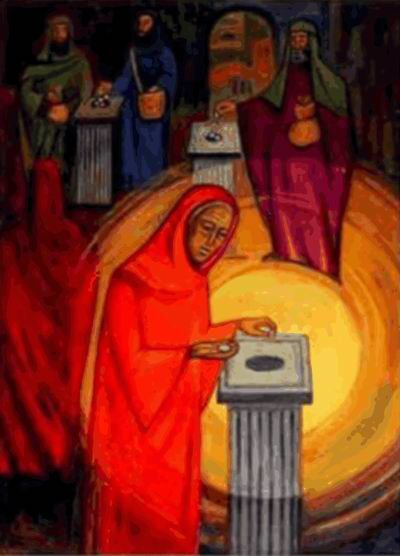
And in our gospel today, when Jesus sees a poor widow putting into the Temple treasury two small coins, which is all she has and her whole livelihood, what does he do? He does not try to stop her. He does not criticize her for being foolish. He calls his disciples to himself, he points her out to them, and he glorifies her trust in God in having given more than all the others. Her deed is still remembered to this day. Would it have been better if she had not given her gift?

I do not have a one-size-fits-all answer for how much poor widows should give. The Catechism teaches that the Church’s precept, “’You shall help to provide for the needs of the Church,’ means that the faithful are obliged to assist with the material needs of the Church, each according to his own ability,” so there’s recognition that some people have greater or lesser ability than others to materially assist the Church’s mission in this world. But if even poor widows are sometimes called to give, to trust in the Lord and give him the chance to prove himself their faithful provider, how much more so are the rest of us called to be generous?

We live in the wealthiest country in all of human history, and yet most of us only give a tiny fraction of our income to church and charity to support the good works they do. What accounts for this? Some of it is from the love of money and some of it is from fear. The Book of Ecclesiastes says, “He who loves money is never satisfied by money, and he who loves wealth is never satisfied by income.” Some are slaves to their greed, and some are shackled to their anxiety.

As an early teen, I felt reluctance at giving any money away for anything. I thought, “Who knows what my future holds? What if I need that money later? Every dollar I give away now is another dollar I’m exposed to future, unseen danger.” My mindset wasn’t informed by the Gospel, but when I finally read the Gospels myself I encountered Jesus’ teaching there. He says: “Do not worry and say, ‘What are we to eat?’ or ‘What are we to drink?’ or ‘What are we to wear?’ All these things the pagans seek. Your heavenly Father knows that you need them all. But seek first the Kingdom of God and his righteousness, and all these things will be given you besides. … Give and gifts will be given to you; a good measure, packed together, shaken down, and overflowing, will be poured into your lap.” The Lord was calling me beyond my comfort zone and into a deeper relationship with him.

I remember standing in St. Paul, Minnesota’s awe-inspiring cathedral. It was my first time there and I saw near the south exit a donation box labeled “For The Poor.” The largest bill in my wallet was a ten or a twenty, and I both wanted and very much did not want to give it, yet I knew what I should do. Once I had done it, I walked out smiling. It was a small donation, but even then I knew it was a big moment, and it changed the rest of my life.

I recall the story of one married couple. They used to pay their bills and then give to God if there was something left —and sometime there was nothing left. But God put it on their hearts to tithe consistently, so they began setting aside their gift to him first before paying their bills. And when they approached their giving in this way they discovered there was providentially always enough for both God and the bills.

God commands, “You shall not put the Lord, your God, to the test,” yet in his Old Testament Book of Malachi he says to test him in this: “Bring the whole tithe into the storehouse, that there may be food in my house. Put me to the test, says the Lord of hosts, and see if I do not open the floodgates of heaven for you, and pour down upon you blessing without measure!

And so, without embarrassment, I ask you to be generous in giving, not only so that our church may put your gifts to good use, but for the sake of deepening your personal relationship with our good and faithful God.

Marriage is for Life

October 3, 2021

27th Sunday in Ordinary Time


In “the beginning of creation, God made them male and female. For this reason a man shall leave his father and mother and be joined to his wife, and the two shall become one flesh.” They are no longer two but one flesh. “Therefore,” Jesus says, “what God has joined together, no human being must separate.” Jesus teaches, “Whoever divorces his wife and marries another commits adultery against her; and if she divorces her husband and marries another, she commits adultery.

Now Christ’s Church does believe and teach that there can be situations where it is prudent and right for a person to physically or legally separate from their spouse. Perhaps there’s physical or emotional abuse in the marriage; destructive, unchecked addictions; or obstinate infidelity. And after the marriage falls apart the Church can investigate whether something essential to that marriage being a binding, sacramental bond before God was missing from the start.

It is possible for Catholic brides and grooms to fail to marry sacramentally in many ways. For instance, the couple might get invalidly married outside the Church; inside a courtroom, on a beach, or in a barn. The bride might feel forced to marry such that her consent is not free. The groom might lack the psychological or physical capacity for marriage. Or one of them might say the vows without not really meaning them. There are many ways a marriage can be sacramentally invalid and non-binding. And where the Church finds sufficient proof for this she will grant an annulment, permitting the man or woman to remarry. So as I said before, being divorced is not necessarily a sin; it does not automatically bar you from receiving Communion. However, to abandon one’s spouse without cause, or to remarry when you are not free to remarry, are sins that require repentance.

What God has joined together, no human being must separate.” Jesus said this in response to a question about divorce, but what other things of human sexuality has God joined from the beginning which no human being should separate? God joined sexual relations to the covenant of marriage. He joined love-making to the possibility of life-making. And he joined one’s biological sex to one’s identity. God created them male and female, one man and one woman, not identical sexes—but physically and spiritually complimentary mates, and made God them man and wife in a covenant for life.

God’s first commandment in the Garden was “be fruitful and multiply,” and today we hear Jesus tell us “Let the children come to me.” His wish is to bring “many children to glory,” as our second reading says. God’s Word in the Bible celebrates having many children as a blessing, not a curse. Today’s psalm proclaims this blessing

Your wife shall be like a fruitful vine
  in the recesses of your home;
  your children like olive plants around your table…
  May you see your children’s children.

Indeed, being surrounded by the love of many offspring is among the greatest blessings for the aged. But human beings separating sexuality from an openness to life distorts God’s plan and the society around us.

Contraception is not something new. It existed in ancient times. Genesis relates how a man named Onan repeatedly “wasted his seed on the ground” during intercourse to avoid conceiving children. “What he did greatly offended the Lord, and the Lord took his life…” Egyptian scrolls dating to 1850 B.C. describe other methods and the pagans practiced contraceptive techniques in the Roman Empire in the days of Christ and the Early Church. The Church Fathers, such as St. Clement of Alexandria, St. Augustine, and St. John Chrysostom condemned acts of contraception or sterilization. Even the first Protestants denounced contraception, too. Martin Luther the founder of Lutheranism, John Calvin the founder of Calvinism, and John Wesley the co-founder of Methodism all wrote against it.

All Christian groups were agreed on this less than a century ago. That is until the Anglicans in 1930 became the first Protestants to officially approve artificial contraception use for hard cases. (Thirteen years before, in 1917, the same group had declared contraception “demoralizing to character and hostile to national welfare.”) As is the way of such errors, the exception became the norm and the Protestant denominations changed their teachings. By 1961, the National Council of Churches could pronounce that “most of the Protestant churches hold contraception… to be morally right when the motives are right.” The Catholic Church, however, stood firm and stood alone against the spirit of the age.

At the end of 1930 and again in 1968, the popes wrote encyclical letters reaffirming the constant teaching of Christ’s Church about the nature, purpose, and goodness of marriage and the marital act; and repeating the consistent and ancient rejection of all directly-willed acts of contraception, sterilization, and abortion. In 1968, St. Pope Paul VI predicted in his encyclical Humanae Vitae that the widespread use of contraception would broadly lower morality, increase marital infidelity, lessen respect towards women, be coercively imposed by governments, and promote the self-harming belief that we have unlimited dominion over our bodies and human life in general.

According to its advocates, contraception was supposed to strengthen marriages, prevent unplanned pregnancies, improve women’s happiness, and reduce abortions. After decades of cheap and widespread contraceptive use, half of all pregnancies are unplanned, half of all marriages end in divorce, women report lower and lower levels of happiness throughout the decades since the 1970’s, and about one-in-five U.S. pregnancies end in abortion, with more than 60 million killed since Roe vs. Wade in 1973. When persons and societies decouple and oppose human sexuality to its life-creating purpose, many harmful errors follow. You can trace the path of one error leading to the next. We are now to the point that many people cannot even define what a woman or a man is.

I would be remiss here if I did not mention that the Church teaches that there can be holy reasons and virtuous means to avoid conceiving more children. Natural Family Planning (also known as NFP) uses signs from a woman’s body to identify the days in her cycle when she can conceive. Equipped with this knowledge, for serious reasons a couple may virtuously abstain from the marital embrace to avoid a pregnancy, while respecting God’s design and the dual meaning of the marital act.

Couples who practice NFP report growing in communication, self-control, and intimacy. They are more open to discerning and embracing God’s plan for their families and are statistically less likely to divorce. Not only is NFP completely natural, the information it tracks about a woman’s body commonly leads to the diagnosis, treatment, and cure of health disorders, from infertility to life-threatening illnesses. Unlike common chemical contraceptives, NFP does not cause increased risks for breast, liver, or cervical cancer; nausea, vomiting, stomach problems, or diarrhea; depression, mood swings, or lowered libido; and it does not cause spontaneous abortions (by preventing implantation of newly conceived children into the uterine wall).

Realize that NFP is not the Rhythm Method. The old Rhythm Method simply counted how many days had passed since the woman’s last cycle and was a moral but rather ineffective approach. Faithfully-followed NFP techniques have a 99% effectiveness rate, comparable to illicit methods of artificial contraception. If you would like to learn more about NFP, visit the Diocese of La Crosse’s website and search for “NFP”. There you can investigate NFP techniques, their science and their benefits, and register for on-line courses.

Whether or not you are married, whether or not you are past the age for children, I hope that you will recognize that in the chaotic, constantly-changing, errant stream of human history, is our stable rock for truth is Christ’s Church. The Bride of Christ, our mother the Church, calls us to follow her teachings from Christ as faithful, trusting, loyal sons and daughters. Jesus says, “Amen, I say to you, whoever does not accept the kingdom of God like a child will not enter it.” Do not miss out on blessedness, in this life or the next.

The Day of Calamity

July 17, 2021

16th Sunday in Ordinary Time

Today I will be speaking to you about why the Jewish calendar is different from our own, about why this Sunday is of special significance in Jewish history, and about the enduring faithfulness of our Lord towards his people.

Like many ancient cultures, the Jews kept a lunar calendar, while we, and most of the world today, follow a particular solar calendar. Our modern calendar is called the Gregorian Calendar, instituted by Pope Gregory XII in 1582. For the Gregorian Calendar, one orbit around the Sun makes one year, counted as 365 days (or 366 days in a leap year). The Jewish calendar, instead, is focused on the Moon: one cycle of the Moon through its phases makes one month, counted as 29 or 30 days. Because the cycles of the Sun and Moon do not perfectly match-up, particular dates on solar and lunar calendars do not line-up either. This means the dates of Jewish holidays and observances float around on the Gregorian calendar. Today, for instance, is the ninth day of the Jewish month of Av. The ninth of Av falls on July 18th this year, but next year it will land on August 6th.

Detail of Destruction of the Temple of Jerusalem by Francesco Hayez, 1867The “ninth of Av,” also known as Tisha B’Av, is no ordinary day for observant Jews, but a day of fasting and abstaining, because ninth of Av has seen multiple calamities in Jewish history. First, during the Exodus, when the twelve spies sent by Moses returned from scouting the Land of Canaan, most of them voiced negative reports, saying there was no way The Promised Land could be conquered. The Hebrews despaired and cried and refused to proceed. As a consequence, God made his people spend 40 more years in the desert until almost all the adults of that generation had died without entering The Promised Land. The next calamity came in the days of the Prophet Jeremiah, after the founding of the Kingdom of Israel. In the sixth century B.C., the Jewish Temple built by King Solomon in Jerusalem was destroyed by the conquering Babylonians. With that disaster, the Jews were forced to leave their homeland and resettle in the East, and this Babylonian Exile lasted about seventy years until a significant number of Jews were able to return. A third catastrophe occurred in 70 A.D., when the Second Temple in Jerusalem was destroyed by the Romans in response to a Jewish revolt. Not one stone was left upon another, as Jesus had foretold about 40 years before it came to pass. All of these devastating catastrophes, all three of these traumatic, mournful events (the denial of The Promised Land and the destruction of the first and second Temples) are remembered as occurring over the ninth day of Av.
Each of these disasters flowed from the faithlessness or unfaithfulness of God’s people. All of the Hebrews in the Exodus had witnessed the Lord’s mighty power wielded against Egypt, yet they disbelieved that God would be with them and would enable them to enter the land he had promised to Abraham’s descendants. The Prophet Jeremiah in our first reading decries the shepherds of his day (that is, the leaders of the people) whose wickedness would lead to the fall of the nation and the scattering of the sheep. And before his Passion, Jesus once lamented: “Jerusalem, Jerusalem, you who kill the prophets and stone those sent to you, how many times I yearned to gather your children together, as a hen gathers her young under her wings, but you were unwilling! Behold, your house will be abandoned, desolate.” Jesus foresaw how that generation’s rejection of their Messiah would be followed by disaster.

Yet, in the face of this faithlessness and unfaithfulness among God’s people, God remained faithful to them. The first generation of Hebrews who had left Egypt were too afraid to enter the Promised Land, but God did not void his covenant with them. While denouncing the bad shepherds who led to the Babylonian Exile, God promises to gather his scattered flock again. And even as Jesus Christ was foretelling doom for Jerusalem from rejecting the Messiah, he spoke of his own people’s conversion to faith in him one day: “I tell you, you will not see me again until you say, ‘Blessed is he who comes in the name of the Lord.’

So what does all of this mean for you and me and the Church, the people of God’s New Covenant? Can calamities come to us? Yes – through our own unfaithful foolishness, or through the sins of others impacting our world; grave wrongs, tragic losses, painful sufferings, death. But when these calamities come, will the Lord still be with us? Yes. Through the Prophet Jeremiah he promised: “I myself will gather the remnant of my flock from all the lands.” In today’s Gospel, “When [Jesus] disembarked and saw the vast crowd, his heart was moved with pity for them, for they were like sheep without a shepherd; and he began to teach them many things.” Jesus declares, “I am the good shepherd, and I know mine and mine know me.” The Lord is our shepherd. He refreshes our souls. He guides us in right paths. Even when we walk through the dark valleys we need not fear evils, for he is at our side.

Last Sunday, a young woman named Sarah who graduated college five years ago, posted a beautiful tweet on Twitter that has been liked nearly 2,000 times. She wrote: “I looked at the crucifix at Mass today and saw love rather than death for the first time in my whole [dang] life.” Behold the Lamb of God, who takes away the sins of the world through the Cross. The Good Shepherd knows firsthand what it’s like to be a sheep like us. Jesus reassures us that he is with us and we need not be afraid. For whatever day of calamity may come, it is not the end of our story; the friends of God will rise again in glory.

Valuable Lessons for Life — The Craig & Debbie Zwiefelhofer Wedding

June 22, 2021

Ring Heart Shadow on Bible

Craig and Debbie, today you are here in this beautiful church to freely give yourselves to each other in marriage. Christ’s Church has discerned and affirms that you are both free to marry, and we gather together to celebrate this day with you. The excellent Scripture readings that you selected, and which we all just heard, contain valuable lessons for life. May their inspired insights bless your marriage and every household which takes them to heart.

In our first reading, on their wedding night, Tobiah arises from bed and says to his wife, “Sister, get up. Let’s pray…” Sarah gets up and they start to pray, praising and thanking God, and asking for his help and blessings. And they conclude, saying together, “Amen, amen.” There are couples who have shared a bed for decades who have never shared their prayers like this. They may go to church on Sunday or pray before meals—and that’s great—but sharing prayer as a couple like this is a greater intimacy. You do not need to be eloquent. You can even pray together silently. On a regular basis, offer two or three personal things for your spouse to pray about for you, and ask your spouse to share two or three things you can pray about to God for them. You can pray silently for each other for even just a minute or two and simply wrap up with an Our Father and Hail Mary.

A couple that prays together, and for each other, will be more perfectly one. A life of prayer is also a cure for our anxieties and fears. St. Paul reminds us in our second reading, “The Lord is near.” Therefore, he writes:

“Have no anxiety at all, but in everything,
  by prayer and petition, with thanksgiving,
  make your requests known to God.
  Then the peace of God
  that surpasses all understanding
  will guard your hearts and minds in Christ Jesus.”

The world and my problems may be bigger than me, but God is bigger than them both. Pray often and God’s peace, even without your fully understanding what he is doing, will secure and calm your hearts and minds. St. Paul then goes on to teach the Philippians and us another lesson:

“[B]rothers and sisters,
  whatever is true, whatever is honorable,
  whatever is just, whatever is pure,
  whatever is lovely, whatever is gracious,
  if there is any excellence
  and if there is anything worthy of praise,
  think about these things.”

If you ask someone, “How you doing?” and they say, “I can’t complain,” they don’t mean it literally. Everybody can complain. Things to complain about are all around us. Even good things can be complained about for not being better. Anybody can complain because complaining is easy. But to focus on what is lovely, excellent, and praiseworthy is a choice. Highlighting the good in your everyday life will nurture peace within you, peace between you, and peace around you. Finally, we come to Jesus’ words in our Gospel. Jesus tells his disciples:

“This is my commandment:
  love one another as I love you.
  No one has greater love than this,
  to lay down one’s life for one’s friends.”

Ahead of you are good times and trials, both joys and sufferings, Mount Tabors and Mount Calvarys. Choose to love through them all and your Good Fridays will lead to Easter Sundays. In conclusion, pray together, focus on what is good, and choose to love like Jesus loves you and you will be blessed.

The New Adam

April 2, 2021

Good Friday

Last evening, on Holy Thursday, I spoke of how Jesus calls and welcomes us to share his Eucharistic feast. Like at the first Passover in Egypt, the sacrifice of Jesus Christ the Lamb of God frees his people from slavery and death. And his Church continues to renew and rejoice in our great deliverance at this holy meal he gives us. Today, on Good Friday, Jesus resembles and surpasses Adam from the Garden of Eden.

Eve was God’s gift to Adam, and he was a gift to her. The Lord God had cast a deep sleep on the man and while he slept fashioned a woman, a bride, from his side. They began a marriage covenant, became one flesh, and were naked without shame on account of their innocence. Though Adam and Eve could have lived forever by eating from the Tree of Life, they still had some concept of what death was. Otherwise, God’s warning ‘you shall die if you eat of the Tree of the Knowledge of Good and Evil‘ would be meaningless to them. And also realize that the wicked tempter did not approach them crawling on his belly in the dirt — that humiliation followed as part of his punishment from God. The devil would have appeared to them as a more imposing predator.

God had placed the man in the Garden “to tend and keep it.” Adam was not only to cultivate paradise, but also to watch over, guard, and protect it, including Eve. However, when the tempter comes seeking to separate her from God forever, Adam does not intervene. At the Tree of the Knowledge of Good and Evil, the first Adam does not lay down his life, he does not fight to the death against “the dragon, the ancient serpent, which is the Devil or Satan,” endangering his bride. So instead, she “took some of its fruit and ate it; and she also gave some to her husband, who was with her, and he ate it.” They failed, and sinned and fell together, with painful consequences for us all.

Jesus Christ is our New Adam “who has similarly been tested in every way, yet without sin.” Though tried in the Garden of Gethsemane, he chose to fulfill God’s will, and “Christ became obedient to the point of death, even death on a cross.” Despite his sinless innocence, they stripped him naked and crucified him. The Cross is the New Tree of the Knowledge of Good and Evil, where we see both his goodness and our evil on full display.

Once he had died, they pierced Jesus’ side, and blood and water flowed out. The Bride of Christ is his Church, fashioned from his side as he slept the sleep of death, born from baptismal water and eucharistic Body and Blood. And note Jesus’ last words quoted by St. John: they may be translated as “It is finished,” or “It is consummated.” Christ the Bridegroom, the New Adam, dies for his Bride, the Church; laying down his life in his victorious battle against the Evil One in another garden, and rising again to eternal life from a garden tomb, exulting her along with himself.

It can be a challenge for guys to identify with being the Bride of Christ, just as ladies are challenged to connect with their baptismal call to be priest, prophet, and king in Christ. There is a spousal mystery here, and we must not mistake every feature of earthly marriage for the fullness of the mystical reality with Christ. But realize that Jesus feels an impassioned love for you, a desire to be with you and be one with you, in a close covenantal bond. This relationship involves work and sacrifice – our daily decision to love him – but Jesus’ love for you is constant, always faithful, in good times and in bad. He rejoices in you as bone of his bone and flesh of his flesh, and offers you his whole self, on the Cross, from this altar, and for ever.

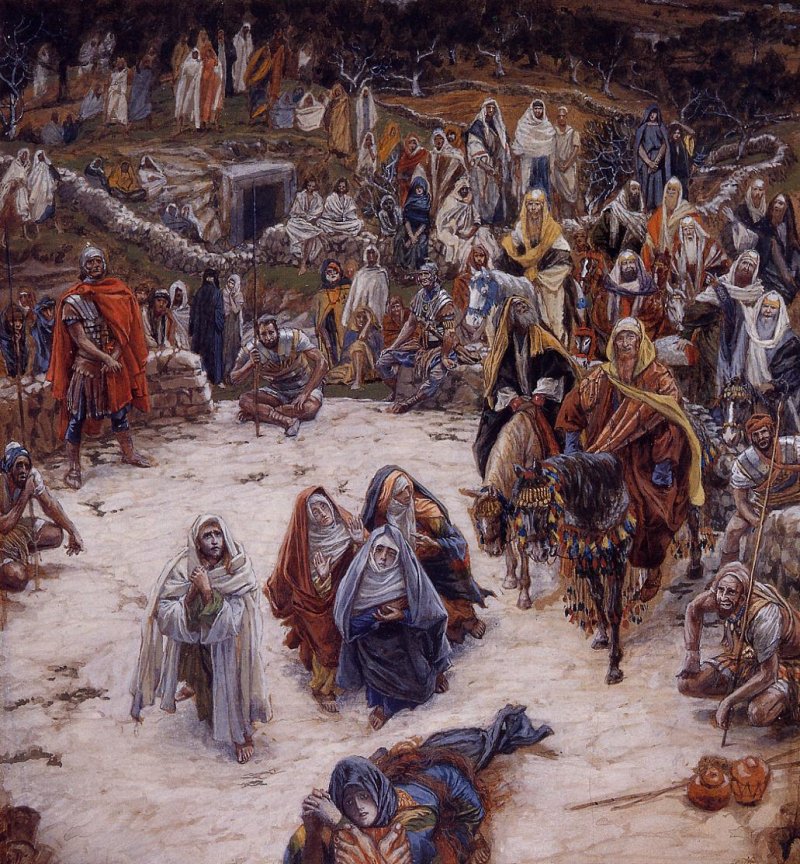
View From the Cross by Tissot

St. Patrick, the Moses of Ireland

March 17, 2021

Wednesday of the 4th Week of Lent

St. Patrick, the Apostle to Ireland, and Moses from the Exodus have a lot in common. Moses was targeted by the wicked as a baby; Pharaoh ordered that all newborn Hebrew boys be tossed into the Nile River to die. Patrick was also targeted by the wicked. Raiders kidnapped him from Roman Britain at the age of sixteen. Moses was separated from his family, growing up in Pharaoh’s palace. Patrick was separated from his family as a slave in Ireland for six years. Moses escaped Pharaoh and Patrick escaped his captors, and neither of them planned to ever go back again. But then, Moses had a vision at the Burning Bush calling him to return to Egypt. And Patrick had a vision in his sleep in which he heard the people of Ireland call out to him, “We appeal to you, holy servant boy, to come and walk among us!” Both men had worked as shepherds during their exiles, and this experience helped spiritually prepare them to become shepherds of men.

Moses was sent by God to free the Hebrews from slavery. Patrick was sent by God to free the Irish from their errors and sins. “Saying to the prisoners: Come out!” But the Egyptian and Irish leaders resisted. Pharaoh’s Egyptian gods and the druids’ Celtic gods were quite different from the Lord. Pharaoh thought killing babies in the river would please the god of the Nile while solving his problems, and the druids offered their gods many human sacrifices hoping that good things would come from them. By proclaiming mighty messages and performing mighty miracles, Moses and Patrick defeated these foes and freed the people. Both men are rightly celebrated for leading many people to God.

The Hebrews who left in Egypt and the Irish who lived in Ireland were introduced to a different and better way of life with the Lord our God. Yet amazingly, once they had been set free, the Hebrews often complained against Moses and said they wanted to return to Egypt and slavery. Today, after some 1,500 years of the True Faith in Ireland, more and more people there live as if Catholic in name only; not believing, not praying, not practicing. For example, in 2018 the people of Ireland voted 2-to-1 in a referendum to legalize more abortion. And in 2019, the first year under the new laws, Ireland’s Department of Health recorded exactly 6,666 abortions. “Can a mother forget her infant, be without tenderness for the child of her womb?” Isaiah suggests this as unthinkable thing – but that is how far we have wandered. Yet even if she should forget, God never forgets us. Even if we give up on God, he will not give up on us. “The Lord is gracious and merciful.” But you are free and you can choose to leave him.

Moses cared about the Hebrews, Patrick cared about the Irish, and I care about you, and we do not want any of you to be lost. But life in the desert is hard, and this world is seductive, and it is easy to be lost. Will you choose to follow the Lord, the God of Moses and St. Patrick, or not?

“Amen, amen, I say to you, whoever hears my word
and believes in the one who sent me
has eternal life and will not come to condemnation,
but has passed from death to life.”

As Moses said, “This day I call the heavens and the earth as witnesses… that I have set before you life and death, blessings and curses. So choose life, that you and your children may live.

At the Father’s Right Hand

March 13, 2021

4th Sunday of Lent

Jesus tells Nicodemus, “Just as Moses lifted up the serpent in the desert, so must the Son of Man be lifted up, so that everyone who believes in him may have eternal life.” First, Jesus is raised up on the Cross. Next, he is raised up from the tomb. And finally, he is raised up to heaven. As this week’s section of The Apostles’ Creed proclaims:

He ascended into heaven,
and is seated at the right hand of God the Father Almighty
from there He will come to judge the living and the dead.

Jesus’ body was glorified at the moment of his Resurrection on Easter. Then he visited his disciples in his body over more than a month, appearing and vanishing, conversing and teaching, eating and drinking, and showing painless wounds in his hands, side, and feet. (Jesus keeps these wounds from his Passion as trophies of his victory.) And then, on the fortieth day, Jesus led his Apostles and disciples a short ways east out of Jerusalem, past the Garden of Gethsemane where he had agonized, and up the Mount of Olives which looks down over the Holy City. He raised his hands and blessed them, and as he blessed them he parted from them and was taken up to heaven. He was lifted up as they looked on and a cloud took him from their sight. They did him homage and returned to Jerusalem rejoicing. Of course, one cannot fly an airplane or ride a rocket to enter God’s presence (unless the flight ends very badly). Heaven is not a place here or there, but another dimension of reality, distinct from us but not far distant. Jesus ascends in his disciples’ sight to manifest the invisible, his entry into heaven in fulfillment of what King David had foretold about the Christ, one thousand years before, in the 110th Psalm:

The Lord [God] says to my Lord [the Christ]:
“Sit at my right hand until I put your enemies under your feet. Yours is princely power from the day of your birth. In holy splendor, before the daystar, like the dew, I have begotten you.” The Lord [God] has sworn an oath he will not change: “You are a priest forever…” At your right hand is [Christ] the Lord, who will crush kings on the day of his great wrath, who judges nations…

From ancient times the right hand has been considered the favored spot, the seat of honor for your right-hand man. Being at the right hand means closeness, allowing for intimacy and confidence. You and I have a great friend in high places who “always lives to make intercession” for “those who draw near to God through him.” Jesus, the high priest of the new and eternal Covenant, has “entered, not into a sanctuary made by human hands… but into heaven itself, now to appear in the presence of God on our behalf.” Jesus Christ is not only humanity’s priest and advocate in Heaven, before ‘his Father and our Father, his God and our God,‘ he also sits enthroned as our king. As the Prophet Daniel once foresaw concerning Christ in a vision:

“To him was given dominion and glory and kingdom, that all peoples, nations, and languages should serve him; his dominion is an everlasting dominion which shall not pass away, and his kingdom one that shall not be destroyed.”

Jesus Christ is King, the Lord of the cosmos and of history, who dwells in his Church where his Kingdom is now present in mystery. The Catholic Church is the seed and beginning of the Kingdom come on earth as it is in heaven. We now await Christ’s Second Coming in fully-unveiled glory, such that he can no longer be dismissed or ignored by anyone. Jesus will return as ruler of all and come to judge the living and the dead. “‘As I live, says the Lord, every knee shall bend before me, and every tongue shall give praise to God.’ … Then each of us shall give an account of himself to God.” The conduct of each person and the secrets of every heart will be brought to light before his throne. Then the wicked “will go away into eternal punishment, but the righteous into eternal life.”

It is very important that we take God and personal conversion seriously. Our first reading chronicles how God’s people had “added infidelity to infidelity, practicing all the abominations of the nations.” The Lord had sent them his messengers, early and often, for he had compassion on his people, “but they mocked the messengers of God, despised his warnings, and scoffed at his prophets.” God’s anger became so inflamed that he permitted them to be conquered by the Babylonian Empire six hundred years before Christ. Those who escaped the sword were carried off into Babylon captivity to be unhappily subjugated there. As today’s psalm recalls, “by the streams of Babylon we sat and wept.” Many never knew true freedom and peace for the rest of their days. But eventually, the Babylonians were conquered by the Persians, and the Lord inspired King Cyrus of Persia to issue a proclamation throughout his empire encouraging the Jews to return to Jerusalem, rebuild the Temple, and worship God there. Notice how the king made this possible but didn’t force anyone to go. They were free to choose; to either return home or stay far away. Wickedness has grave consequences, in this life and hereafter, yet we do not earn our salvation by doing good deeds. As St. Paul tells us, “by grace you have been saved — [God] raised us up with [Jesus] and seated us with him in the heavens… By grace you have been saved through faith, and this is not from you; it is the gift of God; it is not from works, so no one may boast.” Salvation comes from accepting God’s invitation to come home to him.

On the Last Day, Jesus will come again as our Judge, yet “God did not send his Son into the world to condemn the world, but that the world might be saved through him.” “For God so loved the world that he gave his only Son, so that everyone who believes in him might not perish but might have eternal life.” In Christ “the light came into the world, but people preferred darkness to light, because their works were evil. For everyone who does wicked things hates the light and does not come toward the light, so that his works might not be exposed. But whoever lives the truth comes to the light, so that his works may be clearly seen as done in God.” A very powerful way to shed the darkness of sin and come into the light is through Jesus’ Sacrament of Reconciliation.

Here is another divine invitation to freedom and peace: I will be hearing Confessions in St. Paul’s Main Sacristy this Thursday, from 8 AM to 6 PM, at the start of every hour until all are heard. If those times won’t work let me know and we’ll set up something else. Maybe it’s been a long time since your last Confession? Maybe you’re nervous? You don’t need to be. I’ll help you through it. Know that when you come out you will feel absolutely wonderful. And Jesus Christ, seated at the right hand of our Father above, will look upon you and smile.

Christ Was Lifted Up

March 7, 2021

3rd Sunday of Lent

People would pilgrimage to the Temple in Jerusalem from across the known world to worship, often bringing money to purchase oxen, sheep, or doves for sacrifices to God. So vendors had set up shop in the Temple’s outermost court exchanging foreign currencies into Hebrew coins for a percentage fee and selling animals for a healthy profit. God, however, had designated that large, marble-paved court as the Court of the Gentiles where non-Jews (that is, the Gentiles) could come to worship him at his Temple. The Father willed his Temple to be “a house of prayer for all the nations,” but the moneychangers and animal sellers were making it a noisy, smelly “marketplace.” And by charging unlawful interest and demanding excessive prices even of the poor, they were also “making it a den of thieves.

A place intended to be free for holy worship and communion with God had become unclean, profaned by sin. So Jesus personally comes to Jerusalem at the time of Passover and does something dramatic. He zealously cleanses the Temple, conquering evil, achieving justice, restoring relationship between God and man, drawing people to himself, and indeed sacrificing himself; for when the chief priests and scribes heard of this incident they began seeking a way to put him to death. Their plotting would lead to the Pascal Mystery at the heart of The Apostles’ Creed:

He suffered under Pontius Pilate,
was crucified, died and was buried,
he descended into hell,
on the third day he rose again from the dead,
he ascended into heaven,
and is seated at the right hand of God the Father Almighty.

Why does Jesus Christ do these things? Because sin had caused the human race to fall far from God and paradise. Suffering, dying, and being barred from Heaven were our human lot. We had become slaves to sin and the Evil One, held hostage against our will. Our offenses against the All-Holy One required an incalculable repayment. And our separation from God had made us doubtful of his goodness and love for us. It was a slavery we could not escape, a debt of justice we could not repay, and a broken relationship we could not heal. But God had a plan to save us. He would aid humanity with his divinity by fashioning a remedy for us out of our weakness and suffering and mortality, that from fallout of our downfall would come the means to our salvation. By his Incarnation, the Son of God enters our sinful world as one of us and by his Pascal Mystery sets us free, cleansing us, for holy worship and communion with God. First, Jesus assumes our nature, and then he offers a perfect sacrifice.

As the Letter to the Hebrews says, since we “share in blood and Flesh, Jesus likewise shared in them, that through death he might destroy the one who has the power of death, that is, the Devil, and free those who through fear of death had been subject to slavery all their life.” Jesus said that he came “to give his life as a ransom for many.” And lest it be unclear, St. Paul proclaims that the Lord “gave himself as a ransom for all.” Christ’s death frees the slaves and ransoms the captives, and now saints and angels sing to Jesus, the Lamb of God, in Heaven: “Worthy are you… for you were slain and with your blood you purchased for God those from every tribe and tongue, people and nation.

To some, the idea of Almighty God dying on a cross seems impossible, unbecoming foolishness. Yet Christ crucified is the power and wisdom of God. “The foolishness of God is wiser than human wisdom, and the weakness of God is stronger than human strength.” This mysterious, hidden, wisdom, planned by God before the ages for our glory, was not understood by the devil and his demons; “for if they had known it, they would not have crucified the Lord of glory.” In sinning God, Adam had handed himself and his descendants into the devil’s clutches, but in crucifying Christ (the sinless New Adam) the serpent overplays his hand and loses big. St. Augustine uses the image of a mousetrap in which Jesus is the bait. The devil takes this bait in putting Jesus on the Cross, but by shedding Christ’s innocent blood the devil is forced to release his claims on those who are joined to Christ. The trap snapped down and crushed the serpent.

Jesus’ sacrifice was also able to pay the incredible debt of human sins before God. All sin is wrong, but consider which sin is worse: to lie to a stranger or to betray a friend; to slap your enemy or to slap your mother? The greater the generous goodness and love that a person has shown us, the greater is the offense of our trespasses against them. So how great a crime then are our sins against God, whose love created us and from whom all good things come? How very great a debt of justice must then be satisfied? Our sins caused a debt no sinner could repay. God had commanded his Old Covenant people to offer animal sacrifices for their sins, the idea being that the creature was dying in the place of the sinner whose sins had merited death. However, as the Letter to the Hebrews says, “it is impossible that the blood of bulls and goats take away sins. For this reason, when [Jesus] came into the world, he said: ‘Sacrifice and offering you did not desire, but a body you prepared for me; holocausts and sin offerings you took no delight in. Then I said, as is written of me in the scroll, “Behold, I come to do your will, O God.”’

Jesus Christ, God become man, perfectly fulfills the Law, keeping the commandments and doing his Father’s will. He lives for God without sin, honoring his Father and mother, proclaiming the Kingdom of God without idolatry or blasphemy, without murder or adultery, without thievery or lying or coveting, but with abundant love. And in his death, Christ obediently offers the perfect, acceptable sacrifice we were incapable of on our own; a divinely-perfected offering of humanity to God. By his Incarnation, Jesus has in a certain way united himself with every human person, inviting them to become one with him. Through his sacraments, we are more perfectly joined to Jesus to share in his life and enjoy the benefits of what he has accomplished. Christ is the Victor over sin and death, over the tomb and the underworld, over the world and the devil, and he invites us to partake in his victory.

In the beginning, though the Holy Trinity did not desire humanity to sin and fall, our freely-chosen rebellion did not come as a surprise. Before Creation, the eternal, all-knowing Trinity foreknew what it would cost to save us. And God still said Yes, “Let there be light.” Jesus Christ was freely delivered up crucifixion by lawless men according to the set plan and foreknowledge of God, as foreshadowed by the Old Testament Scriptures. But could God, if he had wished, before Creation or in the course of time, have ordained a manner for the Son’s saving sacrifice other than dying upon a Roman Cross? If so, if there were other unchosen options, then the Cross of Christ was chosen as a most effective and compelling sign for us. A less painful, less ignoble, less public, less striking death — if such a death could have saved us — would not speak to us so clearly as a powerful sign of God’s love for us as this. Jesus makes himself so vulnerable and so lowly so as to awaken a response of love in our hearts. He extends his arms on the Cross in hopes that the whole world will be drawn to his embrace. As Jesus said, “When I am lifted up from the earth, I will draw all people to myself.”

After Jesus died, the Apostles’ Creed says, “he descended into hell.” What are we to make of this? Death is the separation of one’s soul from one’s body. On Holy Saturday, while Jesus’ dead body laid in his sealed tomb keeping a perfect Sabbath rest, Jesus’ soul visited the souls of those in the realm of the dead. Our creed translates this abode of the dead (called “Sheol” in Hebrew or “Hades” in Greek) as “hell” because all souls there, whether righteous or unrighteous, were deprived of the vision of God. But this does not mean that the situations of the Just and Unjust there were identical. Jesus’ Parable of the Rich Man and Lazarus describes the afterlife before the gates of Heaven had opened, showing Lazarus comforted in the bosom of Father Abraham while the uncaring, anonymous rich man (whose name is not written in the Book of Life) suffers torment in the flames.

Jesus descends to hell as Savior, proclaiming the Good News to the souls imprisoned there. He does not descend into hell to deliver the damned, nor to destroy the hell of damnation, but to free the souls of the Just. Jesus had said, “Amen, amen, I say to you, the hour is coming and is now here when the dead will hear the voice of the Son of God, and those who hear will live.” By proclaiming the Gospel in the underworld and inviting souls to Heaven, Jesus extends his saving victory to all the faithful people who had preceded him in death.

On the third day he rose again from the dead,
he ascended into heaven,
and is seated at the right hand of God the Father Almighty.

I do not have the time to speak much about these lines this Sunday, but in closing, note what St. Paul beautifully observes about Christ in his Letter to the Philippians:

Though he was in the form of God, Jesus did not deem equality with God something to be grasped at. Rather, he emptied himself and took the form of a slave, Being born in the likeness of men, …it was thus that he humbled himself, obediently accepting even death, death on a cross!

Because of this, God highly exalted him and bestowed on him the name that is above every other name, so that at Jesus’ name every knee must bend in the heavens, on the earth, and under the earth, and every tongue proclaim to the glory of God the Father: Jesus Christ is Lord!

Jesus empties himself in his Incarnation, humbles himself in his holy obedience, submits himself to his Passion and death, descends to the depths of the underworld, lower and lower and then Jesus is raised up from there, higher and higher, to life and rewards, glory and honor and power, enthroned at the favored righthand of God the Father. St. Paul says to “have among yourselves the same attitude” as this in your Christian life, for as Jesus teaches, “Whoever exalts himself will be humbled; but whoever humbles himself will be exalted.

“I Believe in Jesus Christ”

February 27, 2021

2nd Sunday of Lent

In the words of The Apostles’ Creed:

I believe in Jesus Christ, his only Son, our Lord,
He was conceived by the power of the Holy Spirit
and born of the virgin Mary.
He suffered under Pontius Pilate,
was crucified, died, and was buried.

At the heart of our Christian Faith is a Person, the Person of Jesus of Nazareth. He is the Word become flesh, “the Father’s only Son, full of grace and truth.” Jesus comes to us as “the way, and the truth, and the life,” and Christian living consists in following him. As Pope Emeritus Benedict XVI has said, “Being Christian is not the result of an ethical choice or a lofty idea, but the encounter with an event, a person, which gives life a new horizon and a decisive direction.

I believe in Jesus Christ, his only Son, our Lord

Jesus’ name in Hebrew means: “God saves.” And this name, first announced by the archangel Gabriel, expresses his identity and mission. Through the incarnation, God made man “will save his people from their sins.” Jesus is the “name which is above every name” and “there is no other name under heaven given among men by which we must be saved.” He is called the Christ or the Messiah. These are Greek and Hebrew titles which mean “anointed one.” In Israel, those consecrated for a God-given mission were anointed in his name; kings, priests, and sometimes prophets had precious, shining olive oil poured upon them. Jesus Christ fulfills the messianic hope of Israel by coming anointed in the Holy Spirit as priest, prophet, and king, to inaugurate the Kingdom of God.

Jesus Christ the Son is eternally begotten of the Father. They are one God but two persons. This is why Jesus can say, “The Father and I are one,” and, “Whoever has seen me has seen the Father,” while he prays to, honors, and loves his Father as another Person. The Jews in holy reverence for God’s divine name Yahweh would substitute the word Adonai in Hebrew or Kyrios in Greek, both of which mean “Lord.” So when the early Christians professed “Jesus Christ is Lord” they were not merely announcing him as a king above Caesar but proclaiming him as God from God.

He was conceived by the power of the Holy Spirit
and born of the virgin Mary.

God becomes man not as a full-grown adult descending from the clouds; nor as an infant, delivered in a blanket by the Holy Spirit stork. Jesus Christ is conceived as a tiny embryo because that is how human life begins. Jesus Christ is not part God and part man, or some mixture of the two. He’s not half-and-half, or like 99.44% divine. The Son became truly man while remaining truly God; two natures united in one person, true God and true man. He is born among us, as one of us, to die for us as our saving sacrifice.

Roughly 3,800 years ago, God put Abraham to the test. “Take your son Isaac, your only one, whom you love, and go to the land of Moriah. There you shall offer him up as a holocaust [a sacrifice] on a height that I will point out to you.” Early the next morning Abraham saddled his donkey, took with him two of his servants and his son Isaac, and after cutting the wood for the burnt offering, set out for the place of which God had told him. On the third day, Abraham caught sight of the place from a distance. He said to his servants: “Stay here with the donkey, while the boy and I go on over there. We will worship and then come back to you.

We‘ will come back to you? Why lie to the servants? Why not just say, “Wait here”? You see, Abraham was in fact neither lying nor trying to deceive. As the Letter to the Hebrews teaches, God had promised him “through Isaac descendants shall bear your name,” so Abraham reasoned that God was able to raise even from the dead, and he received Isaac back as a symbol, a foreshadowing sign of things to come. God provides the sheep for the sacrifice upon Mount Moriah. There the city of Jerusalem would be established. There the Jewish Temple would be built, destroyed, and raised up again. And there Jesus Christ, the Lamb of God, would be sacrificed on the Cross. God the Father offers his own beloved Son in our place.

Born of the virgin Mary,
he suffered under Pontius Pilate,
was crucified, died, and was buried.

Holy Mary of Nazareth and Governor Pontius Pilate of Judea stand for the two types of people in this world in regards to Jesus: those who receive him, love him, and serve him like Mary, and those like Pilate who would prefer to ignore him but who will reject and destroy the Christ if he stands in the way of their desires. But Mary who bore him and Pilate who killed him are not merely types, symbols, or metaphors – they are real people who ground Jesus’ life in real history. Jesus’ public ministry, his Passion, death, and Resurrection were not “once upon a time,” but in the early 30’s AD. As the 2nd Letter of St. Peter testifies:

“We did not follow cleverly devised myths when we made known to you the power and coming of our Lord Jesus Christ, but we had been eyewitnesses of his majesty. For he received honor and glory from God the Father when that unique declaration came to him from the majestic glory, ‘This is my Son, my beloved, with whom I am well pleased.’ We ourselves heard this voice come from heaven while we were with him on the holy mountain.”

He speaks here of the Transfiguration, recounted in today’s gospel. Jesus, “after he had told the disciples of his coming death, on the holy mountain he manifested to them his glory, to show, even by the testimony of the law and the prophets, that the Passion leads to the glory of the Resurrection.” His disciples Peter, James, and John “were so terrified” at this experience, but then “Jesus came and touched them saying, ‘Rise, and do not be afraid.’

Brothers and sisters, we must take God seriously, but we need not be afraid. “Perfect love drives out fear.” The Word became flesh so that we might know God’s love. As Scripture says: “In this the love of God was made manifest among us, that God sent his only Son into the world, so that we might live through him.” – “God proves his love for us in that while we were still sinners Christ died for us.” – “God so loved the world that he gave his only Son, that whoever believes in him should not perish but have eternal life.”  – And “if God is for us, who can be against us?” If the Father has given us his Son, “how will he not also give us everything else along with him?” Jesus Christ, who died and was raised, sits at God’s right hand and intercedes for us.

So during this Lent, cultivate your personal relationship with Jesus, which is so very important. Yes, he is your Lord God and King, but you can personally relate to him in other true ways as well. He is your brother, for you share the same heavenly Father and blessed mother. He is your friend, for “no one has greater love than to lay down one’s life for one’s friends” and he has laid down his life for you. He is your teacher who said, “You call me ‘teacher’… and rightly so, for indeed I am.” He is your hero, champion, and star who by his excellence wins glory throughout the world. And he is your bridegroom, in whom his beloved bride and his best man rejoice. At the heart of our Christian Faith is a Person, Jesus Christ, the Word become flesh who died for you, and Christian life consists in knowing, and loving, and following him.

“I Believe in God”

February 20, 2021

1st Sunday of Lent

“I believe in God,
  the Father almighty,
  creator of heaven and earth.
  I believe in Jesus Christ,
  his only Son, our Lord.”

Thus begins the Apostles’ Creed, the earliest known Christian creed. Like the later Nicene Creed, it opens with a statement: “I believe” which in Latin is “Credo,” and from this the Church’s authoritative summaries of our Christian Faith are called creeds. The Apostles’ Creed is so named because it is rightly considered a faithful profession of the Faith the apostles believed and preached. Since our return to public Masses, we have been proclaiming the Apostles’ Creed together on Sundays and solemnities. For this season of Lent, I am going to do something I have never tried before. Beginning this Sunday and continuing through the 5th Sunday of Lent, I will be preaching a homily series on the Apostles’ Creed. Week by week, we will unpack this, “the oldest Roman catechism,” and explore its meaning and implications for us. The Apostles Creed begins, as all things began, with God.

I believe in God. The whole creed speaks of God, and when it also speaks of man and of this world it does so in relation to God. Each passage in the creed tells us more about him, much like how God has progressively revealed himself to us, who he is and what he is like, more and more throughout salvation history. Who is God? God is the fullness of Being and of every perfection. God is without beginning and without end. God is Truth who cannot lie. The beginning of sin and of man’s fall was due to a lie of the tempter who sowed doubt concerning God’s word, faithfulness, and love. God is love. God’s very being is love. By sending his only Son and the Spirit of love in the fullness of time, God has revealed his innermost secret: God is an eternal exchange of love between Father, Son, and Holy Spirit. They call us to share in their personal communion of love now and forever, but the choice whether to respond is ours.

I believe in God, the Father almighty, creator of heaven and earth. God the Father is the Father of all. He is the origin of everything, of the Holy Trinity in eternity and of all Creation in history. The Father fashions the material universe and the spiritual realms distinct from and outside of himself, and by his gift he creates new life inside of them, including the angels and us. God the Father is transcendent authority, perfectly just, while providing good things and loving care for all his children.

The story of Noah’s Ark and the Great Flood from the Book of Genesis communicates important truths. God is our Creator with sovereignty over all he has made. He is holy and hates sin in his creatures. God’s Great Flood aims to wash away sin from the face of the earth and then begin anew through a new covenant with Noah. Yet the consequences of the Fall were neither cured nor cleansed; Noah and his household carried sin with them onto the ark and humanity’s waywardness continued after they disembarked.

This represents a cautionary tale for us against a common human error or misconception about how evil might be cancelled or conquered in this world. In 1945, the Russian writer Aleksandr Solzhenitsyn was sentenced to a Soviet forced labor camp for his criticism of communist tyranny. After his release he went on to write his most famous work, “The Gulag Archipelago.” In it, the Christian Solzhenitsyn shares this true insight:

“If only it were all so simple! If only there were evil people somewhere insidiously committing evil deeds, and it were necessary only to separate them from the rest of us and destroy them. But the line dividing good and evil cuts through the heart of every human being. And who is willing to destroy a piece of his own heart?”

We can and should work for change in this world, but advocacy for changing evils “out there” will prove ultimately futile without accompanying spiritual change within us. But how are we to accomplish this most difficult transformation inside our own hearts? Human history and our personal experience show we cannot achieve this on our own, so how shall we be saved?

I believe in Jesus Christ, his only Son, our Lord. On the cusp of his fruitful public ministry,

“The Spirit drove Jesus out into the desert,
  and he remained in the desert for forty days,
  tempted by Satan. He was among wild beasts…”

After the Fall of man, the garden paradise is replaced by a desert. The animals, formerly tame in the Garden of Eden, have become wild in our fractured world. Humanity now had a great debt with God it could not pay, a vast chasm between him and us we could not cross. The first Adam died unatoned, but a new Adam has come. The Eternal Son of God entered time and space and became human to reconcile God and man and establish a new covenant between us. Jesus comes to undo the Fall, dwelling in the desert among the wild beasts, to be tempted by the ancient serpent, the devil. Jesus comes to reclaim the crown that Adam had lost. Jesus Christ, God’s only Son, would be the Lord of all. He comes and proclaims:

“This is the time of fulfillment.
  The Kingdom of God is at hand.
  Repent, and believe in the gospel.”

During these forty desert days of Lent, Jesus invites you to approach him, asking his forgiveness in the Sacrament of Confession. He invites you dwell with him, spend time with him, encountering him through daily prayer and the Holy Eucharist. Jesus would accompany and strengthen you in your earnest battles against temptation, growing you in his virtues. And he would perfect your love, forming you in his likeness, preparing you for more fruitful works on earth and for the supreme, communal joy of Heaven. Now is the time for Confession, for prayer, for the Mass, growth in virtue, and growth in love.

The Holy Spirit would lead you out to Jesus during this desert retreat of Lent. And everything Jesus does for you, everything he does within you, is to lead you back to God our Father. I believe and proclaim that this is the Father’s will for you. Yet, despite all of almighty God’s infinite, omnipotent power, only you can freely choose whether to answer him with your “Yes.”