Archive for the ‘O.T. Figures’ Category

Three Unexpectedly Expectant Mothers

December 22, 2010

Today’s readings feature three women who all wonderously conceived: Hannah, Mary, and Elizabeth.  There are many parallels between them. Together they teach us these lessons, among others:

  • With God, you can be more fruitful than you’d imagine.
  • You have great reason to rejoice today.
  • You keep forever what you give to God.

The New Eve — December 8 — Immaculate Conception

December 8, 2010

In the beginning, when our first parents fell, they lost a great deal, but they were not deprived of hope, for God spoke in their hearing a prophesy to the deceiving serpent, the devil. God said, “I will put enmity between you and the woman, and between your offspring and hers; he will strike at your head, while you strike at his heel.” Who is this offspring, who strikes back at the devil? He is Jesus the Christ, the New Adam, the Son of God. And who is this woman, who is Satan’s enemy? She is Mary of Nazareth, the New Eve, the Immaculate Conception.

After their Fall, when Adam and Eve heard God approaching in the garden, they became afraid, they fled and hid, so God called out, “Where are you?” When God drew near to Mary, she also was afraid, but she did not hide or flee. She declared, “Behold, I am the handmaid of the Lord. May it be done to me according to your word.” And, because she did, her Holy Offspring could go on to say in His garden of testing, “Father… not my will but yours be done.”

The first man, Adam, called the first woman Eve, because she became the mother of all the living. Now, Mary is the New and Second Eve, for she is the mother of all the living, and she loves each one of us personally as her very own children.

She is the icon of the Church, and as she is, we are called to be: holy and without blemish before God, as the second reading from Ephesians says. But how can we do this? Unlike Mary, at times we have been allies of Satan by our sins. To cleanse us, God gives us the sacrament of reconciliation, and to strengthen us He gives us the fruit from the new tree of life; that tree is the cross, and its fruit is the Eucharistic Christ.

If it has been a long time since you have been to confession, come that you may be purified as pure as Mary. And if you receive our Lord in the Eucharist tonight, consider that the Son of God Incarnate has come to dwell in you, just as truly as He dwelt in Mary.

Let Advent Be Advent — 2nd Sunday of Advent—Year A

December 5, 2010

John the Baptist was living quite differently compared to people in his day. What he wore was different, what he ate was different, and what came from his lips was also different. Yet, John shared something in common with us today. Like Christians in this season of Advent, John knew that the Christ, or Messiah, had already been born, years before in the past. Like us, what John was preparing for was the coming of Christ anew.

That’s the reason why in Advent, in this season of awaiting the Messiah’s arrival, John the Baptist is so prominently featured in our Sunday Gospel readings, like today’s. By looking at John we can learn how to prepare ourselves for Christ’s arrival. As I mentioned before, John was rather different from his neighbors in his day. Today I suggest that we in the Church need to be a bit more different from everybody else if we want to prepare better for Christ’s coming this year.

What did John do with all that time alone in the desert, when he wasn’t out preaching or baptizing? Surely, John was praying, asking for grace and contemplating the one who was coming. The desert is a quiet place, free of distractions, and conducive to prayer. The world can make this month before Christmas a very stressful time. This Advent, you must find a desert, a quiet place, free from distractions, where you can pray each day. Create a daily desert space for your own family as well and prayer together as one. You cannot prepare well for Christ’s coming without daily prayer and the peace it gives.

What did John eat in the desert? He ate locusts, or grasshoppers, and wild honey. The wild honey may sound pretty sweet, until you realize that it was guarded by wild bees. John ate simply. Our meals in Advent should be simple too. You know how it is at Easter, when you enjoy what you gave up for Lent again for the first time? You find yourself enjoying what you denied yourself more than ever before. Then just think of how much greater your Christmas feasting will be if you eat more simply in Advent. (Besides, if you fast or diet now, there will less pounds to lose next year.)

John dressed differently than other people in his day. He wore a garment made of camel’s hair and tied a leather belt around his waist. He dressed like the Old Testament prophet Elijah because he wanted people to know that these were special days. You can also dress in ways that witness to the world that these are special days. One way to do this is to dress liturgically. As you can see, the main color of Advent is purple. If you have purple outfits or ties, now is their season.

By the way, this Wednesday, December 8th, is a holy day of obligation and Christ is asking you to attend the worldwide feast in honor of His immaculately conceived mother. On such a day, intentionally wearing blue or white would honor her. Try dressing liturgically and you’ll find that it reminds you and others of what makes these days special.

What came from the lips of John was different, and despite the large crowds, whatever he spoke was not for himself but for Christ. This year, wish people “merry Christmas” instead of “seasons greetings,” and instead of “happy holidays,” say “happy holy days,” for by this you give witness to the true reason for the season.

John knew that he must decrease and that Christ must increase, for John himself was not the light but had come to give testimony to the light. In the world, the Christmas songs have already begun on the radio and the Christmas trees are all up and lit in the malls, but the day after Christmas their songs will stop and their decorations will be taken down. But as the world is packing Christ away for another year, the Church is just beginning its celebration. You know the “twelve days of Christmas?” On Christmas day, the twelve day begin, not end. Like Easter, the Church celebrates not just one day, but for weeks after.

This year, let Advent be Advent, and save Christmas for Christmas. Sing Advent songs for Advent, and (as much as possible) save Christmas carols for their time. I suggest leaving your Christmas lights, on your tree and on your house, unlit during Advent. Then, when you plug-in at last on Christmas Eve, you shall enjoy a joyful sign that the light of the world has come.

St. John the Baptist calls to you through the Scriptures. I encourage you here, before you. And I hope the Holy Spirit is now prompting you, in your hearts and minds, to keep Advent as Advent this year, and to prayerfully prepare for the coming of Christ at Christmas more profoundly than you ever have before.

Demonic Delay — 33rd Sunday in Ordinary Time—Year C

November 14, 2010

Once upon a time, an uncertain number of years ago, there was an important meeting of demons in Hell. In the midst of their fires and shadows, with a foul and terrible stink in the air, the top of Hell’s hierarchy was planning a long-term strategy for how to mislead humanity.

Why do they scheme against us? Because on the day when Jesus comes again to judge and rule the world with justice, the demons do not want us to experience His healing rays; they want us to burn with fire, like themselves. Since they cannot hurt God directly, they lash out by trying to make us share in their misery.

As they met, brainstorming for ideas, one demon suggested, “How about we try telling them that there is no such thing as evil?” The chairman said, “You stupid worm, you pathetic disgrace, the humans will never believe that! Do you think that we can pit a person against a person, a nation against a nation, or a soul against our Enemy above, without the humans noticing the sadnesses, sufferings, impurities, jealousies, envies, rivalries, resentments, hatreds, injustices, cruelties, or murders that follow? They see evidence of evil on the front page of every newspaper and in every gossip’s tale! Humans are reminded that something’s wrong with their world whenever their alarm clocks ring, whenever their toes get stubbed, or whenever someone they know dies! You’ll have to do better than that!”

A little while later, another demon suggested, “What if we told them that there is no such thing as goodness?” The chairman said, “You worthless slime, you ugly idiot, the humans will never believe that! Our Enemy above has littered their world with beauties and gifts to many to count, and everything that the humans do is in the pursuit of what they think is good! They have this irresistible desire to be happy that our Enemy has built into them! Tell me, how would we tempt them to sin without promising them something which attracts them, something which is at least seemingly good? Is there anyone here who is not a useless fool?”

But then, one of the chairman’s most cunning underlings suggested another approach, an approach which was immediately welcomed by the others with cruel smiles and restrained applause (for a demon resists praising anyone but himself.) This insightful demon said, “Let us convince the humans… that there’s no need to hurry.”

In every generation, there have been Christians who belived that their generation would be the last. But personally, I don’t expect the second coming of Jesus Christ to happen in the very near future for the simple fact that it remains legal to be a Christian throughout North and South America. There are great evils in our world, even within our own country, but the final attack of evil against Christ’s Church in the last days should be far worse than this. [For more from the Catechism of the Catholic Church on “The Church’s Ultimate Trial,” see CCC 675-677 ]

I do not expect Christ to come in the immediate future to us, but we must always be preparing ourselves to be ready to go to Him, for we never know when we will die. Never be anxious and never be afraid, but prepare yourself for what is certainly coming. Instead of being busybodies, distracted by many unimportant things, let’s get busy making the most important things the most important things.

If you knew for a fact that you were going to die six months from today how would you begin to live your life differently? Would you pray more each day? Would you go to confession and to Mass more often? Would you work harder at doing good works? Would you crush your lingering vices? Would you forgive your enemies? Would you show more love to the people in your daily life?

Seriously thinking about what you would you do different if you knew you were going to die will give you a good place to start in living more intentionally for Christ, with your eternal goal in mind. Do not believe the demon’s whispered lie that ‘there is no need to hurry,’ for your last day is closer than it was yesterday, and it may be much closer than you think.

Have A Holy Halloween!—31st Sunday in Ordinary Time—Year C

October 31, 2010

Have you ever noticed how our Christian holidays get filled with stuff that distracts us from what we’re really celebrating? Take Christmas, for example. There’s nothing wrong with exchanging gifts and decorating with tress and lights, but there is good reason in that season that we need be reminded, to “Keep Christ in Christmas.” For many people, celebrating the birth of the Prince of Peace on earth is the most stressful time of the year. Or consider Easter: There’s nothing wrong with chocolate bunnies and hunting for Easter eggs, but the connection between egg-laying rabbits and Jesus’ resurrection is tenuous at best.

However, this disconnection between Christian holy days and the cultural observance of holidays is the greatest when it comes to Halloween. There’s nothing wrong with kids playing dress-up and going door-to-door to ask for candy, (I have many happy memories of this myself,) but Halloween’s connection to its Christian holy day seems to have been forgotten. The name “Halloween” comes from “All Hallows Eve,” or the evening before All Saint’s Day. Something is “Hallowed” when it is sanctified or respected, as in, “Our Father, who art in Heaven, Hallowed be thy name.” All Saints Day celebrates the “hallowed” ones, the holy ones, the saints who are now in Heaven. Some of these saints are canonized, but most of them are not.

For every friend and relative we knew on earth who is now in Heaven, November 1st is their feast day in the Church. And for our holy dead who are still being purified and made perfect so that they may enter the fully-unveiled presence of our infinite God, there is November 2nd, the Feast of All Souls. In this fall season, when the natural world appears dying, our Church celebrates the holy dead, for we have hope in the new life.

Halloween, or “All Hallows Eve,” is to All Saints Day what Christmas Eve is to Christmas. As Christmas Eve reminds us of Christ’s coming, so Halloween should remind us of the victory of the saints, and of our own life’s calling: to become the best possible versions of ourselves, to become saints.

I think it is in no way an overreaction to observe that the secular observance of Halloween has overtones in dark, demonic things; the things of horror. Isn’t it suspicious that from a feast celebrating the saints in light, we have a secularized holiday focused on things of darkness? Instead of Christian hope in the resurrection of the dead, Halloween gives us images of zombies. Instead of the consolation that we are surrounded by the perfected souls of the saints, who love us and are full of concern to help us, Halloween gives us tales of ghosts and demons who want to harm and scare us. How does this sort of thing happen? I don’t think it is crazy to think that the Evil One wants to distract people from the true reason for this season; that the Devil would have us thinking about him, rather than the saints, that he wants us to be terrified, rather than full of hope.

Did you know that this Sunday, Satanic worshipers will come to Masses and Catholic Churches around the country trying to steal our Lord in the Eucharist? (Interestingly, they don’t go after the communions of Protestant denominations, but only the Catholic Eucharistic Hosts.) Their plan is to desecrate Jesus in a ritual they call a Black Mass. In doing this they are trying to rebel, seeking a false freedom that cannot make them happy. They try to harm Jesus, but only hurt Him in as much as they sadden Him. These sad people, who strike out at Jesus, are really hurting themselves and the Jesus still loves them. We know that the Lord loves every person He has made, for as the first reading notes, if the Lord did not love His creations, they would not continue to exist. As we see in today’s gospel about Zacchaeus the sinful tax-collector, there is hope for them and all of us, for Jesus “has come to seek and to save what was lost,” and He calls every one of us to be happy and holy with Him.

This Halloween, let us pray for the misguided persons, who knowingly or unknowingly, will dabble in bad things tonight, that they may turn to Christ. Let also offer Jesus our consolation for how the feelings of His Sacred Heart will be wounded by their offenses against His love. And for ourselves, let us try celebrating Halloween in some different ways this year.

Maybe everyone in your household already has their trick-or-treat costumes ready (but I know it can sometimes be a last minute decision.) If you’re still looking for costume ideas, how about dressing up as an awesome saint? Saint costumes can be easy and very creative. Dressing like this delights the saints (and it will probably score you more candy.)

Does your family have a patron saint? If not, then pick one this Halloween and entrust your family to them for the year ahead. Print off their picture from the internet and put it on the wall, learn about them as a family, and pray to them, asking that they pray for you. (I, for myself, am choosing St. John Vianney this year; the patron saint of priests and a good guy to know.) Great saints are waiting, just waiting, to grow in friendship with you.

This year, make it a point to celebrate the vigils and feasts of All Saints and All Souls. Our family and friends who are now in Heaven or on their way there expect us to be joyful on these feast days in their honor, and there is not better place for us on earth to draw near to them than here, around the altar of Jesus Christ.

Christ is the Light who shines through the darkness. This Halloween, let us claim the night for Jesus Christ and His saints.

Prayer is Necessary — 29th Sunday in Ordinary Time—Year C

October 17, 2010

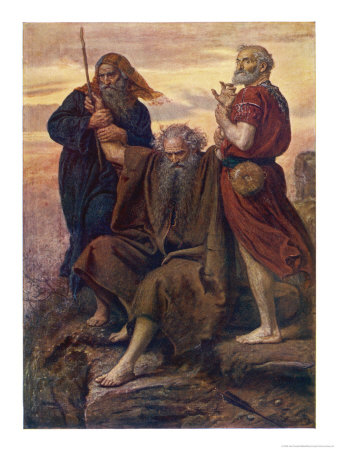
As the Hebrews fought the Amalekites, Moses held up in his hands, above his head, the wooden staff of God. In doing this, He resembles Jesus, who outstretched his arms on the cross, and the priests of Christ’s Church, who raise their hands up to Heaven.  Each one, Moses, Jesus, and His priests, offer prayers to the Father.

As long as Moses kept his hands raised up,
Israel had the better of the fight,
but when he let his hands rest,
Amalek [the enemy] had the better of the fight.

What would have happened if Moses had kept his arms just down at his sides? God’s people would have lost their deadly battle. What would happen if Jesus were to stop pleading for us at right hand of the Father in Heaven? We would be left all on our own. What would happen if priests were to no longer to offer the Mass? The Church would be deprived of graces. If Moses, or Jesus, or the priests of the Church were not persistent in prayer, souls would be lost. The same is true for you and I as individuals.

If you or I wish to be saved, it is necessity for us to pray always without becoming weary. As St. Alphonsus Liguori, a doctor of the Church, said: “He who prays is certainly saved; he who does not pray is certainly damned. All the saints in heaven, except infants, were saved because they prayed; and all the damned in hell were damned because they did not pray, and this is their greatest torment to see how easily they could have been saved, had they prayed, and that now the time for prayer is over.”

Prayer is how we grow in our relationship with God. And Heaven consists first and foremost in an intimate relationship with Him. But, if we do not pray, we will not have much of a relationship with God, and Heaven will not be a place where we really want to live. It is essential that you commit yourself to praying every day, ‘whether it is convenient or inconvenient.’

To remain committed to this, ask the help of other to strengthen you and keep you faithful to prayer. Moses had the help of Aaron and Hur, at his right and his left. Jesus had the help Mary and John, at the foot of His cross. The priest celebrating Mass has the help of God’s people, those in the church on earth and those in the Church in Heaven. So have your spouse, your children, and your friends to pray with you and keep you faithful to prayer.

Families should pray together, parents with their children. This will instill the Faith in them more than anything else.  And Fathers need to take the lead, for if only Mom prays with the children they will wonder, “Why doesn’t Dad pray, too?”

Couples should also pray together.  A couple that prays together every day a divorce rate less than one percent. And it makes sense, because if I know that someone is praying for me, that they’re willing my true good, then even if there are rough spots between us, I know that we’re on the same side. So before you leave the house, or before you go to bed, pray together as a couple; even if it’s as simple as a moment of silent prayer. Remember that the family that prayers together, stays together.

It is necessity for us to pray always without becoming weary, as families and individuals, for “He who prays is certainly saved; he who does not pray is certainly damned.” So pray every day, because our souls depend on it.

Job’s Desolation — Tuesday, 26th Week in Ordinary Time—Year II

September 28, 2010


The sadness of Job is like a heavy stone hanging from his neck.

In his pain, he seems to forget that he is surrounded by people who care about him very much. When Job’s friends learn of his misfortune they come to him. For days and nights they sit with Job, listening, not saying a word, yet saying a great deal by just being there. He is not alone.

In his despair, Job imagines that his life will never get better. Yet he cannot see the future. The Lord is going to bless Job and happiness will return to him.

In his darkness, Job wishes he were dead. He asks, “Why did I not perish at birth?” Yet death is not the way. When the Samaritans rejected Jesus, James and John asked to rain down fire, but Jesus rebuked them for it. As long as there is life, there is hope, for the Samaritans, and for us.

How wrong it is if we mistake death for the way of peace, for that is not Christ’s answer. How wrong it is if we imagine that we will never be happy again, for sun’s light shines beyond our horizon or behind the clouds, even if we cannot see it. And how wrong it is if we forget that people care about us, for each of us here is loved more than we know.

Rich Man’s Loss — 26th Sunday in Ordinary Time—Year C

September 26, 2010

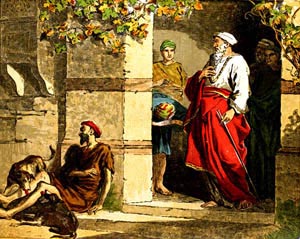
[The rich man] cried out, “Father Abraham, have pity on me. Send Lazarus to dip the tip of his finger in water and cool my tongue, for I am suffering torment in these flames.”

Why does the rich man suffer in flames? It’s not that Abraham is unaware of him, for when the rich man speaks Abraham answers him. And it’s not that Abraham no longer acknowledges him, for Abraham calls him “my child.” It’s not that Abraham lacks in mercy, for Abraham once intervened to spare a city of sinners. The rich man is not in the flames because of Abraham, or Moses, or the prophets of God, for if he had listened to them he would not be in torment.

So why does the rich man suffer in flames? He suffers because he feasted each day, while Lazarus starved. Because he dressed in fine linen, while Lazarus went naked. Because he was clothed in purple, while Lazarus was covered in purple sores. Yet the rich man is not in the flames because he is rich, for King David was far richer than he and is heralded as a man after God’s own heart. The rich man suffers because the dogs who licked Lazarus’ wounds showed the poor man more kindness than he ever did.

The rich man was not unaware of Lazarus lying at his door, for he had passed him enough times to recognize him when he saw him. The rich man even knew Lazarus by name, for he calls out, “Father Abraham… Send Lazarus…”  The rich man suffers in flames because he did not care about Lazarus. The rich man suffers because he did not love. If we wish to avoid the flames, we should ponder and act on this question: Who is Lazarus in your life?

Outstreched Hands — Monday, 23rd Week in Ordinary Time—Year II

September 6, 2010

The Lord said to Moses in Egypt, “Stretch out your hand toward the sky, that hail may fall upon the entire land…” Moses stretched out his hand, and the Lord rained down hail upon their enemies.

Then the Lord said to Moses, “Stretch out your hand over the land of Egypt, that locusts may swarm over it and eat up all the vegetation and whatever the hail has left.” Moses stretched out his hand, and the Lord sent locusts upon their enemies.

Finally, the Lord said to Moses, “Stretch out your hand, over the sea, that the water may flow back upon the Egyptians, upon their chariots and their charioteers.” Moses stretched out his hand, and the Lord hurled their enemies into the sea.

Centuries later, the Lord Jesus Christ said to a man in the synagogue, “Stretch out your hand.” The man stretched out his withered hand and it was healed, but the scribes and the Pharisees were enraged and plotted against Jesus. This time, it was not the Lord’s enemies who were to bear the terrible onslaught, but the Lord Jesus Himself. Jesus realized this, and freely accepted it, for the sake of you and me.

Anointing Mass — Wednesday, 17th Week in Ordinary Time—Year II

July 28, 2010

Today we listen to the prophet Jeremiah complain to the Lord,

Under the weight of your hand I sat alone because you filled me with indignation. Why is my pain continuous, my wound incurable, refusing to be healed?

Sometimes our trials tempt us to indignantly complain like Jeremiah, but every trial permitted by God is permitted for our good. Trials, patiently borne, sanctify us and help to save others.

It is right for us to pray for cures, as we do in the anointing of the sick. But if our trials are to continue this sacrament offers the grace to bear the weight of our trials, not alone, but with Christ.

One Catholic Church — Tuesday, 3rd Week of Lent

March 9, 2010

In the first reading we hear the ardent prayer of an Old Testament Jew named Azariah who finds himself in a pretty hot spot. He fervently prays, “… O Lord, do not deliver us up forever, or make void your covenant. [Save us for] the sake of Abraham, your beloved… to whom you promised to multiply … offspring like the stars of heaven, or the sand on the shore of the sea.”

This was God’s covenant promise to Abraham, and God has indeed made Abraham’s spiritual offspring vast and numerous. Today, half of the people on earth claim Abraham as their father in faith—these are Christians, Muslims and Jews who all seek to worship the God of Abraham.

Yet Jesus prayed that all people would be one in Him, as one holy family of God—a diversity of persons sharing one perfect unity. To achieve this goal Jesus established one, holy, catholic, and apostolic Church, so that all may be one, as He and the Father are one. Our Church was established by Jesus, Himself, who said to Peter, our first pope, “You are rock, and upon this rock I will build My Church.”

Our Catholic family is made up of every race and reaches to every nation. To illustrate this, I would ask all high school students; freshmen, sophomores, juniors, and seniors, to stand up now. Imagine that these 146, or so, young men and women represent the world’s nearly 1.2 billion Catholics. Each one represents about eight million of our  Catholic brothers and sisters.

In the United States we have 68 million Catholics, but this is only 5.7% of all the Catholics in the world. I would now ask the male freshmen to remain standing and for everyone else to sit down. These guys represent the Catholics of the United States, plus the rest of North America and the Caribbean—just 9% of Catholics worldwide.

The freshmen can sit down and I would ask the male sophmores to stand up. This is Asia, Australia, and the Pacific Islands, totaling 11% of all Catholics.

You can sit and I’ll ask the senior males to stand. This is Africa’s Catholics, 12% of the Catholics in the world.

You can sit and we’ll have the male juniors and the female seniors rise. This is Europe, 27% of all Catholics.  (The pope is in there somewhere.)

You can sit and we’ll have our largest region of all, represented by the female juniors and the full sophomore class, please stand. This is Central and South America, where 39% of all Catholics live.

So, as you can see our Catholic family is far more diverse than you might have imagined. We are young and old, men and women, rich and poor, sinners and saints.

Our Catholic family not only spans the globe, it also spans the centuries. This is reflected in the ancient prayers we sing today, such as the Latin Sanctus and Agnus Dei, the Kyrie which is ancient Greek, and the Amen which is Hebrew.

Let me put this another way: Could I have one high school student please stand up. This one person represents about 13½ years, which is about how long you have had to explore and get to know about your faith. Now could all of the high schoolers please stand up. You represents all the years that the Church has been on earth, since 33 AD. Our Church has been around a lot longer than we have. You may be seated.

Roman Catholics make up the largest religious denomination in the United States.  However, it is said that the second largest denomination in our country would be former Catholics. Tragically, many Catholics leave the Church. Oftentimes, they experience one or two parishes and a couple of priests, in one region, of one country, over a handful of years, and they imagine that they have exhausted the riches of the 2,000 year-old worldwide Church and Faith of Jesus Christ. But in reality, you can explore the mysteries of Catholic beauty and truth for a lifetime and never exhaust them.

My message for you, with all passionate the urging of Jesus Christ, is this: always remain in the Church that Jesus Christ founded. Never walk away from the fullness of God’s family, but dwell in the household of God.

Sources:
Distribution of Catholic Population, by Region: 2000
USCCB: The Catholic Church in the United States At A Glance

For an Extraordinary Marriage — Wedding of Andrew and Laura Foreki

March 3, 2010

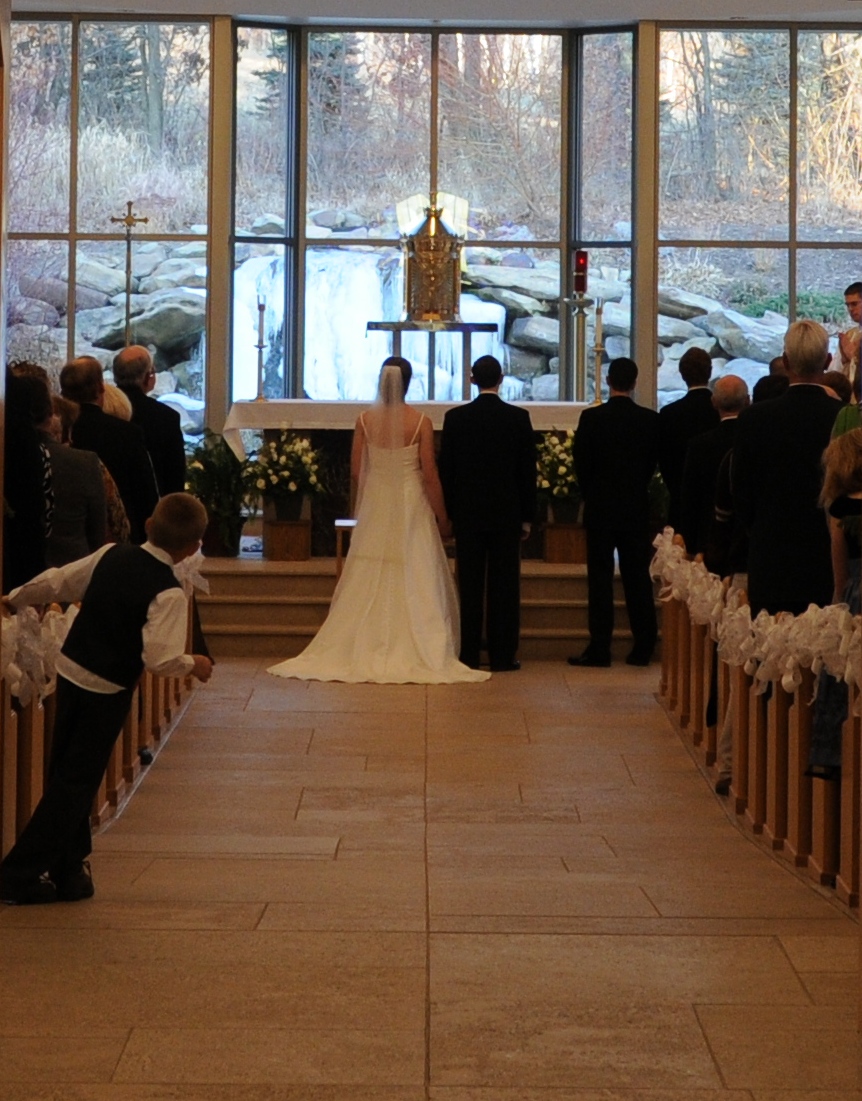
I would like to begin this homily today by sharing with you the extraordinary story of how this boy, Andrew, met this girl, Laura. Picture Andrew, walking one morning across the University of Wisconsin campus in the deep cold of winter. He is on his way to Chadborn Hall where a prayer group is meeting for their twice-weekly 7:30 rosary. 

He walks into the room where the group is meeting and casts his eyes, for the very first time, upon a drowsy-eyed coed named Laura. And can you guess what Andrew said to himself when his eyes saw Laura for the very first time? That’s right. He said to himself, “Oh, I don’t know who that is.” This reaction, of course, is to be expected, since Andrew and Laura didn’t know each other prior to being introduced a few moments later.

Now Andrew’s first impression is not what makes this an extraordinary story. Did you notice what was the extra-ordinary part? Here it is: Here we have two college students, getting up, out of warm beds, on a cold day, to pray a rosary, at 7:30 in the morning! Now, you have to understand, in College Student Time, this is like getting up at 4:30 AM. Your typical college student doesn’t get up any earlier than he has to, but these two got up… to pray. For this and a thousand other reasons, I think you will all agree with me, that we have here two extra-ordinary people, from whom we good reason to expect an extraordinary marriage.

Do you two want to ensure you share an extraordinary marriage together? Then there are three things that I, as an ordained servant of Jesus Christ, believe that you should do.

First, like Tobit and his wife Sarah in our first reading, you should pray together. Of course you must pray individually. And of course you must pray with your children once they come. But you also need to pray together. It doesn’t need to be anything complicated.  Just hold each others’ hands a few moments before you part for work, or stand, or kneel, at your bedside, like Tobit and Sarah did, and speak aloud from your hearts to God. Ask blessings for each other, and give thanks for all the blessing you have received, and close you prayer by saying, “Amen, amen.”

Some couples find this kind of prayer too intimidating, or too personal, to be attempted; for our prayers express our most intimate selves, our fears, our hopes, our pains, our joys, our deepest longings. If you pray honestly in this way, nothing will be hidden between you. Today you will vow to give yourselves completely to each other. Do you want to be truly and totally one? Then pray together. Through marriage you will share of one flesh, if but pray together and you will also share of one spirit. Pray together and you will share an extraordinary marriage as one flesh with one soul. So please, pray together.

The second thing you should do for an extraordinary marriage is to come to Mass. Come to Mass every Sunday and every holy day of obligation. Come, and be moved by the beauty of architecture and songs. Come, and be strengthened by the experience of Christian fellowship. Come, and be inspired by the eloquence of Gospel preaching.

No doubt some people hear this and think to themselves, “That sounds great… But our church is ugly and the songs are dumb and hard to sing. And our community is little more than a gathering of strangers. And our priest always gives the same boring homilies.” Which all boils down to saying, I just don’t get anything out of going to Mass. Then hear this, even if everything else is lacking at Mass, Jesus Christ is always here for us, Body, Blood, Soul, and Divinity in the Eucharist. At Mass, the one sacrifice of Calvary and the Last Supper are made truly present to us for us to receive their power.

At Mass Jesus Christ shows us the perfect spousal love that He calls each of us to imitate. Jesus never called himself “the bachelor.” No, He joyfully called himself “the bridegroom” and eagerly seeks to unite himself to His bride. On the cross, naked without shame, He consummates this union with her, giving himself freely, fully, fruitfully, and forever… freely, fully, fruitfully, and forever. Do you want your union with each other to be free, fully, fruitful, and forever? Then come to Mass to learn the pattern of how Christ loves us and draw from the power He offers us through communion with Him. His is the pattern and the power for an extraordinary marriage. So please, come to Mass.

The third and final thing you should do for an extraordinary marriage is to be salt and light in the world. What does this mean? Being salt and light means that your Christianity should show. As Jesus says, “Your light must shine before others, that they may see your good deeds and glorify your heavenly Father.”

Your good deeds should stand out in the world. As St. Paul says in the second reading, “Do not conform yourselves to this age, but be transformed by the renewal of your mind” If the world never judges you to be radical in any aspect of your Christian life, then you’re not doing it right. Then you’re not yet living as salt and light–you’re not yet living like the saints. For example, everyone loves their friends, but who loves their enemies and prayers for them? Most people pray, but who spends a long time to be with God every day. Many people can give when times are prosperous, but who gives generously when times are tight? Such things as this are what it means to be the light and the salt of the world. Light is different than the darkness, and salt makes the ordinary flavorful.

Clearly, you two are salt and light already, for who goes on weekend retreats to know God better? Or who drives to Washington D.C. to march for life? Or who goes down to Louisiana to volunteer for Hurricane relief? Or who get up at 7:30 in the morning to pray the Rosary? So, please keep on being salt and light, and your marriage will be extraordinary.

Years from now, I don’t expect that you will remember much from this homily, but I hope you remember these three things: Pray together, come to Mass, and be salt and light and you will have an extraordinary marriage.

[Preached as a deacon for my sister’s wedding,  November 22, 2008]
Three Temptations — 1st Sunday in Lent—Year C

February 23, 2010

In today’s gospel Jesus is led into the desert by the Holy Spirit for forty days of prayer, penance, and preparation and there He is tempted by the devil.  We have been led to this season of Lent and we also find ourselves being tempted. This morning I would like to talk about how the devil’s three temptations present themselves to us and to let you know about an allowance in Lent that you will be happy to hear.

Most of us here have chosen to take on a penance during Lent.  You have probably resolved to abstain from something good, like cookies, candies, ice cream, TV or the internet, to grow in disciple and virtue, and to offer some sacrifice to God. The devil first said to Jesus, “command this stone to become bread,” and we will probably be tempted in a similar way; “Put down the rock of your penance for awhile and let it nourish you.” It is the way of demons to first entice and then condemn. The rationalization, “Go ahead, it’s just a little cookie,” will afterwards become the accusation, “You couldn’t even sacrifice one cookie for God.” Let us preserve in our Lenten penances, for the joy of having carried a cross for the Lord is far preferable to the discouragement of a moment’s compromise.

As a second temptation, the devil, in a vision, showed Jesus all the kingdoms of the world in a single instant and said, “I shall give to you all this power and glory; for it has been handed over to me, and I may give it to whomever I wish. All this will be yours, if you worship me.” Scripture calls Satan the Father of Lies, so we ought to be skeptical about whether he really had this authority over the nations, and even if he did we should disbelieve that he would give Jesus the world if He were to worship him. Instead, I suspect that the devil would have simply laughed and left Jesus with nothing for having fallen into sin.

We human beings are creatures of habit. The same sins which you have struggled with in the past are probably the same ones that challenge you today. When we are tempted by sins they promise us the world, great peace and satisfaction. Yet we can look back at our own experiences and see that these are lies. Our past sins show us that they only lead to disappointment and dissatisfaction. We should stop swallowing the bait. We should stop accepting the lie. This Lent is a perfect time for us to commit to crushing the habitual sins in our lives, for our sins will not make us happy, even if they promise us the world.

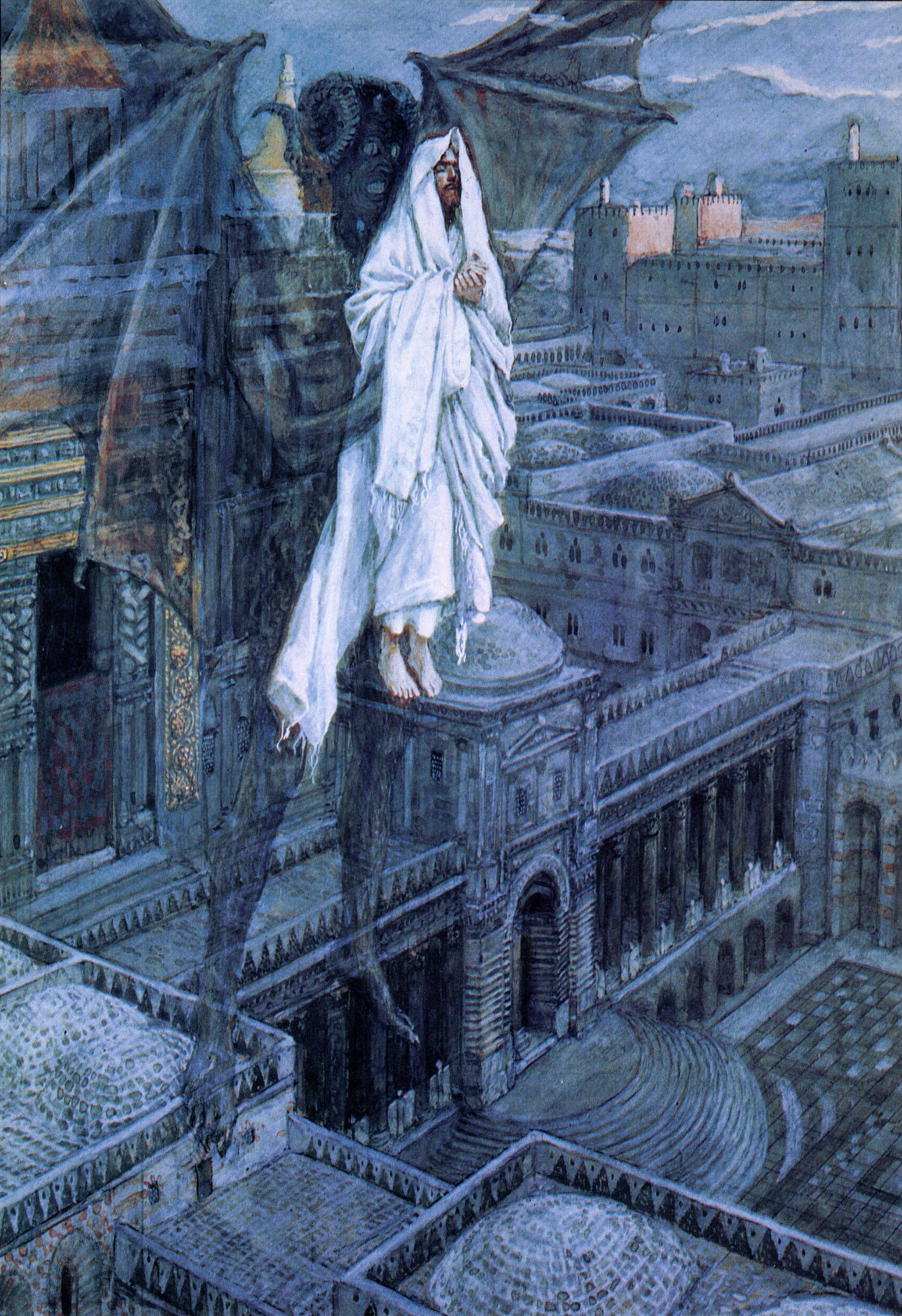
As a third temptation, the devil took Jesus up (in a vision or in the body we do not know) to the top of the temple in Jerusalem. He said to Him, “If you are the Son of God, throw yourself down from here, for it is written: He will command his angels concerning you, to guard you, and: With their hands they will support you, lest you dash your foot against a stone.” The temptation addressed to us sounds differently. “You are not the Son of God, you’re not even close to being saint! You should throw yourself down in shame for your sins and not dare to pray or present yourself to God!” On the contrary, as we heard in the second reading, “No one who believes in him will be put to shame.” Lent calls us to sorrow and conversion for our sins, not to shame and aversion from God.

We see the one-two combo of enticement and shame modeled in the case of Adam and Eve.  When they heard the sound of the Lord God moving about the garden they hid themselves among the trees, for they realized that they were naked before Him, and they were ashamed and afraid. Much later, in the case of Judas Iscariot, the devil led him to betray Jesus, one of the worst sins ever, and then after regretting it he was led to kill himself. If Judas had gone from the temple to Calvary, instead of to his tragic tree, Jesus would have forgiven him, because Jesus wanted to forgive him.

Jesus loves us. He doesn’t just love us because He’s God and He “has to” love everybody. Jesus loves us and He actually likes us for all the good things that we are and for all the good things He sees we can become. This is why He created us and died for us, because He loves us. So we should not be ashamed to come to Christ in the sacraments; in confession with our big sins, or at communion with our small ones. As Jesus told St. Faustina, the greater our sins the more entitled we are to his mercy. When it comes to God’s forgiveness, only we ourselves can get in His way.

Finally, I mentioned that there is an allowance during Lent which is a cause for consolation amidst our Lenten struggles. But first, did you know that there are more than forty days in Lent?  The season is longer than forty days because we don’t count the Sundays.  There are 40 days of penance, but every Sundays (from Saturday evening to Sunday night) we are released from our penances. At Sunday Mass the priest still wears the Lenten season’s purple, we might do less singing, and we don’t say the Gloria or say the “A”-word before the gospel, but we are freed from penances that day, for every Sunday is a “little Easter. ”

In the first reading, we heard how Moses commanded the Hebrews that once they came into the Promised Land they should come before God to present their first fruits and recount the story of how God had delivered them from slavery, brought them into the Promised Land, and filled them with blessings. Each Sunday we come before God and recall how His Son, Jesus Christ, delivered us from our slavery, brought us into His kingdom, and has filled us with His blessings, especially the gift of Himself in the Eucharist. Each Sunday gives us consolation, and this release from our penances encourages us to offer still more penance to God in the week ahead, for it is an easier thing abstain for just six days than to do it for forty in a row.

So in conclusion, be faithful to your penances, your faithfulness will have its reward. Commit to crushing your habitual sins, for sins cannot make us happy, even if they promise the world. Shame and fear are the devil’s traps, so whenever you sin, come to the Lord with trust and sorrow. And know that you are released from penances on Sundays in Lent.  May this gift be a cause for thanksgiving and joy and inspire us to make a still greater gift of ourselves to Christ in this Lenten season.

Approaching God — 5th Sunday in Ordinary Time—Year C

February 11, 2010

In today’s first reading the prophet Isaiah hears the angels praising God at the temple with words like those we proclaim at every Mass: “Holy, holy, holy is the LORD of hosts! All the earth is filled with his glory!”

What do these words mean?  First, the Jews did not have adverbs for “very,” “most,” or “infinitely” in Hebrew, so if they wanted to say something was very heavy they would call it “heavy, heavy.”  If they wanted to say something was most heavy or (if it were possible) infinitely heavy they would call it “heavy, heavy, heavy.”  So when Isaiah hears the angels call God “holy, holy, holy,” they are praising His perfection, transcendence, and goodness to the highest degree.

Why is God called “the LORD of hosts?” A host is an army, or a large group of persons. In this case, God’s army of angelic  persons is referred to. Our God is holy and wields unsurpassed power. The earth is filled with his glory.

Isaiah behold this sight and becomes very afraid. “Woe is me, I am doomed! For I am a man of unclean lips, living among a people of unclean lips; yet my eyes have seen the King, the Lord of hosts!” In the Old Testament people thought that no human being could look upon God and live.

Then an angel, one of the seraphim, fly down, takes an ember with tongs from the altar (for the Jews sacrificed animals as burnt-offerings at the temple) and touches Isaiah’s mouth. “See,” the angel says, “now that this has touched your lips, your wickedness is removed, your sin purged.” God asks whom He can send to be His prophet, and now Isaiah has the courage to say “Here I am, send me!”

Imagine if, at communion time, people would line up and come before the priest to have a red hot coal touched to their lips or tongue? Priest: “The holiness of God.” Communicant: “Amen… Ou!” I imagine the communion line would be much shorter.

This is the bread that we will be offering at this Mass to become the real body, blood, soul, and divinity of Jesus Christ. It’s flat because it unleavened, just like the bread at the Jewish Passover meal and as at Jesus’ Last Supper.  Leaven, or yeast, is bacteria which grows and makes our bread fluffy. The Jews were to keep leaven, which symbolized sin, out of their Passover bread.

Like all of the other sacraments, the Lord’s choice to use bread has symbolic meaning.  Take baptism, for example: water cleanses us and gives us life.  Similarly, bread gives us life and becomes one with us. No wonder Jesus chose it to be his symbol for the Eucharist. The very use of bread invites us to receive him.  The symbol of bread speaks, “Come, do not be afraid. I am here to be received by you and to become one with you.” We tend to forget what an unprecedented privilege this is.

In the Old Covenant, Jews could always pray to God, for ‘all the earth was filled with his glory,’ but they you wanted to go where the Lord was most present on earth they had to go to one place, the temple in Jerusalem.  And even when they got there they did not enter in where the Lord was most present, the Holy of Holies, where only the high priest would go, and only once a year at that. The faithful would worship in the courts outside the temple.  It would be like us coming to church today to stand and pray from the parking lot. Instead, we have the privilege to stand and worship the Lord here in His sanctuary, and not only do we see the Most Holy Lord with our own eyes, but we actually receive Him in the Most Holy Sacrament.

The wonder and the privilege and the awe of this new intimacy with God at the Eucharist could not have been lost upon the early Christians, who were converts from Judaism. Do we approach the Lord with a healthy fear of the Lord, which is called the beginning to wisdom? This fear is not terror, which would cause us to hide ourselves from the Lord. It is a reverence which honors the Giver who is the Gift.

We all sin from week to week, but if our sins are minor, or venial, then Jesus wants us to approach Him in the Eucharist. Receiving this sacrament with contrition forgives our venial sins. On the other hand, if we are aware of serious, or grave sins on our souls, then Jesus wants us to approach Him in another sacrament first, the sacrament of confession, or reconciliation.

In the second reading we heard St. Paul’s words to the church at Corinth, reminding them of what he ‘handed on to them as of first importance as he had also received it.’ Later in the letter he reminds them of something else in a similar way:

For I received from the Lord what I also handed on to you, that the Lord Jesus, on the night he was handed over, took bread, and, after he had given thanks, broke it and said, “This is my body that is for you. Do this in remembrance of me.” In the same way also the cup, after supper, saying, “This cup is the new covenant in my blood. Do this, as often as you drink it, in remembrance of me.” For as often as you eat this bread and drink the cup, you proclaim the death of the Lord until he comes. Therefore whoever eats the bread or drinks the cup of the Lord unworthily will have to answer for the body and blood of the Lord. A person should examine himself, and so eat the bread and drink the cup. For anyone who eats and drinks without discerning the body, eats and drinks judgment on himself. That is why many among you are ill and infirm, and a considerable number are dying. If we discerned ourselves, we would not be under judgment…”

Before we approach the Eucharist let us examine ourselves first, and if we have serious unconfessed sins, from even years ago, let us present ourselves for Jesus’ needed forgiveness in confession first. Ask yourself, do I care more about others’ opinions of me, or about the opinion of the Lord (who sees all things)?

Whenever we come to Christ in the Eucharist let us approach Him as the earliest Christians did, with wonder, awe, and holy fear. Let us have that reverence which honors the Giver who gives Himself as a Gift to us.

Holy Reading — Wednesday, 5th Week in Ordinary Time—Year II

February 11, 2010

If a saint, like St. Scholastica or St. Benedict, were coming to speak at our parish tonight, would you come out to listen to what they had to say? The queen of Sheba (thought to be present day Ethiopia) traveled hundreds of miles just to hear the wisdom of King Solomon. What would you be willing to offer in time and treasure to listen to the wisdom of a saint today? In truth, we can encounter their wisdom today and at fraction of the queen’s effort.

The saints of both modern times and centuries long past wrote their wisdom in books, which are easily assessable for us today. Jesus observes that food which comes from outside and passes through us cannot defile. The saints’ holy books, however, can sanctify us, if we hold on to their words with a receptive heart.

As it is written: “One does not live by bread alone, but by every word that comes forth from the mouth of God.” Spiritual reading is important for the growth of the Christian disciple, so commit yourself to beginning some holy reading that interests you.