Archive for the ‘Parables’ Category

How The Pharisee Fell Short

October 26, 2025

30th Sunday in Ordinary Time
By Fr. Victor Feltes
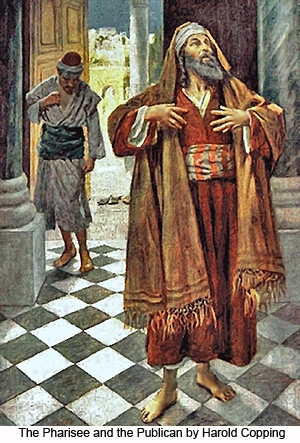
When the Pharisee in Jesus’ parable went up to the temple, he stood and spoke this prayer to himself: “O God, I thank you that I am not like the rest of humanity — greedy, dishonest, adulterous — or even like this tax collector.” And yet, Jesus tells us that this Pharisee did not go home justified, or righteous in God’s sight. Why is that?

When the Pharisee said ‘I am not like the rest of humanity — I am not greedy, dishonest, or adulterous…’ was it true that he had conquered sin? Very likely not. Psalm 130 rhetorically asks, “If you, O Lord, should mark our iniquities, who could stand?” And the Gospels record Jesus criticizing the Pharisees repeatedly, saying things like “Oh you Pharisees! Although you cleanse the outside of the cup and the dish, inside you are filled with plunder and evil.” But assuming this Pharisee quietly spoke his prayer to himself in a way which no one else could hear, why would he lie? Maybe he believed everything he said.

When we compare ourselves to others, like this Pharisee compared himself to the tax collector, we can imagine the great faults of others make our own faults unimportant. But just because somebody else is ten billion dollars in debt doesn’t mean that I am solvent. My own debts still remain. Some people accuse and make much of others’ sins because they are projecting at others what they dislike in themselves. It is much easier to condemn the faults in others than to change the faults in me.

Another phenomenon common to people and cultures is to condemn a person or group for the problems of the day. Sometimes, these are merely scapegoats for shifting blame. At other times, particular persons really are at fault and should be corrected or stopped. But we should not imagine that we can banish, purge, and kill our way to earthly paradise. Even after the Great Flood in Genesis, sinners disembarked from Noah’s ark. As the Christian Russian dissident and winner of the 1970 Nobel Peace Prize winner, Aleksandr Solzhenitsyn, famously wrote: “If only it were all so simple! If only there were evil people somewhere insidiously committing evil deeds, and it were necessary only to separate them from the rest of us and destroy them. But the line dividing good and evil cuts through the heart of every human being. And who is willing to destroy a piece of his own heart?

The Pharisee’s heart was probably not so pure of sin as he thought. He needed Jesus Christ to cleanse and heal and change it. But imagine if it really were true that the Pharisee was unlike the rest of humanity; not greedy, not dishonest, and not adulterous. Why then did this Pharisee not go home justified before God? What more did he lack?

Our Gospel tells us Jesus addressed today’s parable “to those who were convinced of their own righteousness and despised everyone else.” The Pharisee looked down on that tax collector and despised him with contempt. Greed, dishonesty, and adultery are hateful things, but Jesus forbids us from hating anyone. Jesus says you will be hated, you will have enemies, but he commands you to “love your enemies, and pray for those who persecute you, that you may be children of your heavenly Father.” If there is ever people you may be hating, be sure to pray for them (since you cannot pray for someone — willing their good — and hate them at the same time). Otherwise, when you die and you see someone whom you hate on the other side of the pearly gates, you might refuse to enter into Heaven.

Without ever denying right and wrong, without ceasing to share the truth, we must remain humble as sinners living among sinners. ‘For whoever exalts himself amongst others will be humbled, and the one who humbles himself will be exalted.’ That’s some food for prayerful thought today as we stand to pray in this temple and go back to our homes in the world.

Pray Without Ceasing

October 18, 2025

29th Sunday in Ordinary Time
By Fr. Victor Feltes

Once upon a time, the pope summoned his Vatican chauffeur. When his driver had brought the car around, the Holy Father confided, “Ever since I got elected pope, I have sorely missed not driving anymore. Please, sit in the backseat and let me take the wheel.” The chauffeur reluctantly agreed and the pope was beaming with joy. But soon the Holy Father accidentally went the wrong way down an empty one-way street and got pulled over by City of Rome police. An officer approached their vehicle intending to write them a ticket, but after a brief chat he soon returned to his partner waiting in the squad car. His partner asked, “What, no ticket? Who’s riding in that limo?” “I don’t know, but whoever it is he must be really important—the pope is his chauffeur!

Jesus (although in a much sounder, wiser way than this) also speaks from the lesser to the greater. This classic mode of rhetoric argues that something true in a smaller case is surely true for the larger case as well. For example, Jesus says a “person who is trustworthy in very small matters is also trustworthy in great ones; and the person who is dishonest in very small matters is also dishonest in great ones.” Elsewhere, he points out: “Are not two sparrows sold for a small coin? Yet not one of them falls to the ground without your Father’s knowledge. … So do not be afraid, [for] you are worth more than many sparrows!” And on another occasion, Jesus tells us: “If you, who are wicked, know how to give good gifts to your children, how much more will your heavenly Father give good things to those who ask him!

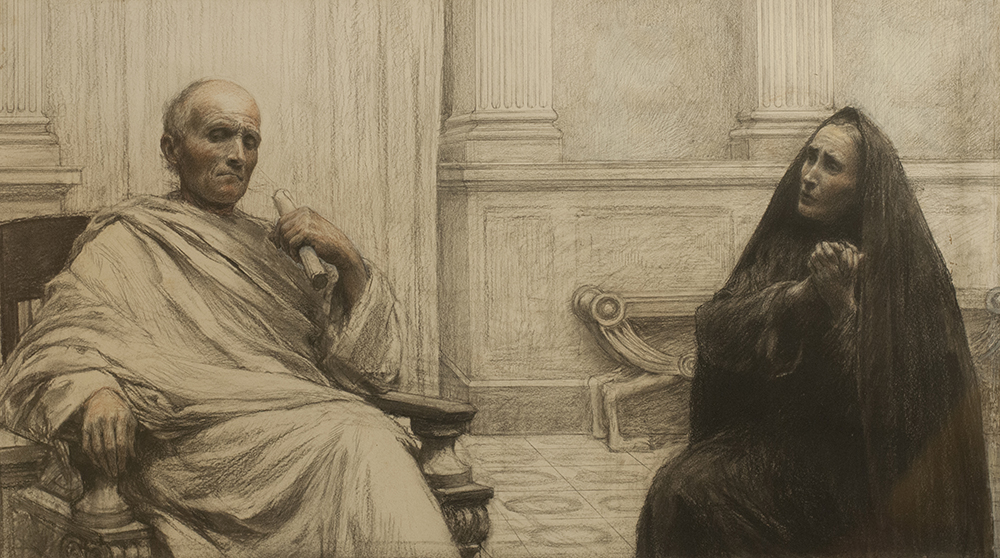
Jesus argues from the lesser to the greater in today’s Parable of the Unjust Judge. This bad judge does not care about justice. He neither fears God nor respects any human being. However, we see a widow wear him down to give her what she rightfully asks for through her dogged persistence. Jesus says, “Pay attention to what the dishonest judge says.” If a wicked judge with a heart of stone will eventually give in to a poor, weak widow, then, as Jesus argues, “will not God secure the rights of his chosen ones who call out to him day and night? Will he be slow to answer them? I tell you, he will see to it that justice is done for them speedily.” Unlike that unjust and indifferent judge, God is just and cares about us deeply, so we ought to ask God for good things and keep asking without becoming weary.

Our Sunday lectionary reinforces this lesson in today’s first reading. During the Exodus, when the Israelites entered a battle against the Amalekites, Moses climbed a hill overlooking the battlefield carrying the staff of God that had split the Red Sea. As long as Moses held that wooden staff raised above his head, Israel had the better of the fight. But whenever Moses let his tired arms rest, their enemy had the better of the fight. This scene prefigures Jesus’ crucifixion upon the hill of Calvary, where Christ’s arms upraised on the wooden Cross bring victory over our enemies. Just as Jesus had support from John the Apostle and the Virgin Mary and others at the Cross, so Moses had Aaron and Hur supporting his arms until the day was done and the battle was won. So who can support you in the battle of prayer? I can recommend spiritual allies divine, angelic, and human.

How often do we lack motivation to pray or, once beginning to praying, lack enthusiasm, inspiration, or insight? “We do not know how to pray as we ought,” but if we ask the Holy Spirit himself to help us to pray he will come to the aid of our weakness. Each of us is also accompanied by at least one sinless, loving, brilliant, and powerful guardian angel tasked by God to help us be saints. Ask your guardian angel to help you pray more faithfully and fervently. And finally, we have fellow Christians to help us. There are saints in heaven to intercede for us and people around us to pray with us, encourage us, and help keep us accountable. Ask the Holy Spirit, your guardian angels, other Christians to help you pray better.

Jesus expresses the necessity for us to pray always without becoming weary. St. Alphonsus Liguori, a doctor (or great teacher) of the Church, believed enduring in prayer is key to our salvation. St. Alphonsus said: “He who prays is certainly saved; he who does not pray is certainly damned. All the saints in heaven, except infants, were saved because they prayed; and all the damned in hell were damned because they did not pray, and this is their greatest torment to see how easily they could have been saved, had they prayed, and that now the time for prayer is over.” Jesus asked whether when he comes again he find faith on earth? If we keep on praying, he at least will find us faithful.

The Seed of Faith & Bearing Fruit

October 4, 2025

27th Sunday in Ordinary Time
By Fr. Victor Feltes

Once upon a time, a pastor prayed to God, “Lord, please let me win the lottery.” This pastor was not a greedy person—he planned on giving almost all of the winnings away—he just really, really wanted to win the lottery. He prayed for weeks and weeks and when nothing happened he became frustrated with God, “Lord, why haven’t you let me win?” And he heard the voice of God reply, “You have to buy a ticket.” Having Christian faith is like having that ticket, it makes possible the blessings which follow.

Without faith, the complex beauty and order of this universe are dismissed as merely incredible coincidences. Without faith, supernatural miracles can be rationalized away. Without faith, a person will not seek after God for they do not believe he is real and good. As the Letter to the Hebrews says “without faith it is impossible to please God, because anyone who comes to him must believe that he exists and that he rewards those who earnestly seek him.

In today’s Gospel, the apostles ask of the Lord: “Increase our faith.” Jesus replies, “If you have faith the size of a mustard seed, you would say to this [deeply-rooted] tree, ‘Be uprooted and planted in the sea,’ and it would obey you.” When I was a boy and I read this verse I felt discouraged because “My faith is not even the size of a tiny seed!” But Jesus intends this teaching as an encouragement; he’s saying that even a little faith can achieve a lot!

Sometimes people in Confession confess to lacking trust in God. I point out that if a person trusted God perfectly they would be a perfect person, so it’s a common human problem. Trusting God has been our primordial human problem since the Garden of Eden. Yes, faithfulness can be challenging, but you do believe in God.

There was a time in college when I attended Mass without approaching for Communion because I feared that I did not have enough faith to receive the Lord in the Eucharist worthily. After weeks of this worry, it came to me in prayer that “people who don’t believe in God don’t spend time worrying about whether or not they believe in God—that’s something only believers do.” In retrospect, my worry was rather silly, since so much of how I was living my life would not make sense without faith in God. I bet the same is true for you who freely came to Mass today. Why else would you be here?

Realize that having faith is different than having feelings. You can have great faith both when your heart is joyful and when it’s torn with sorrow. Whatever one may be feeling, faith choses to respond faithfully in trusting love. Notice when the apostles ask the Lord to increase their faith how Jesus does not rebuke them for it. They are asking for a good thing. Like greater humility and greater love, increased faith is a gift God is always eager to give.

Although your faith could be strengthened, do not imagine that your faith is too feeble to do anything now. Scripture says faith can uproot trees and move mountains. Faith has worked miracles, changed unjust laws, and converted nations. Jesus wants you to know that even the tiny faith you have can work great good for you and those around you. So pray for more faith and resolve to act in faith more often. There are great jackpots to be won, but you have to buy a ticket.

The Last Things

September 27, 2025

26th Sunday in Ordinary Time
By Fr. Victor Feltes

Last week, the season of fall officially began. Soon we will see the leaves fade and fall and many living things will enter a long, deep sleep. Imagine how much we would despair seeing the skeletons of trees in the wintertime if we did not remember the new life to come in spring. Like our falling asleep at night and reawakening in the morning, the changing of the seasons foreshadow our dying and rising again in Christ.

Last week, there was also an online rumor that all Christians would be taken up into heaven last Tuesday. Though, once again, no one really knew the day nor the hour. We Catholics do not believe in “The Rapture”— that true Christians will one day vanish from the earth while unbelievers are “left behind” for years. This idea was only imagined for the first time in 1830, which is discrediting in itself. We faithfully await Christ’s return to call forth the living and the dead, but his coming will be visible to all. “For,” Jesus says, “just as lightning flashes and lights up the sky from one side to the other, so will the Son of Man be in his day.”

In this Sunday’s Gospel, we hear Jesus’ story about a rich man and a poor man. The poor man is named Lazarus but the rich man goes unnamed. “When the poor man died, he was carried away by angels to the bosom of Abraham. The rich man also died and was buried, and from the netherworld, where he was in torment, he raised his eyes and saw Abraham far off and Lazarus at his side.” St. Augustine suggests that God “kept quiet about the rich man’s name because he did not find it written in heaven.” St. Jerome reproaches the rich man saying: “You have five brothers: sight, smell, taste, hearing, and touch…. Since they were the brothers you loved, you could not love your brother Lazarus…. These brothers of yours loved wealth and they had no eye for poverty.”

Unless Jesus Christ returns during our lifetimes, each of us will experience death before facing an eternal judgment. But some people completely avoid thinking about their own deaths. They are like to my late aunt who wouldn’t go in for annual health checkups because she feared what the doctor might tell her. Yet by contemplating “The Last Things” (Death, Judgment, Heaven, and Hell) we can become more confident and well prepared for what is to come.

Though God fashioned us for everlasting life, we experience death as a result of human sin. However, because of Jesus’ Passion and sacrificial death, we can unite our sufferings to his to advance his mission of salvation in this world and increase our glory in Christ. Our bodies will undergo natural decay, eventually returning to the dust from which they were made, but our souls are everlasting. At the moment of death, our immortal souls separate from our mortal bodies. Our earthly remains remain on earth to await our Resurrection, but our souls go immediately to our particular judgment.

Then we will be judged according to our faith and deeds in Christ. Remember that what will matter in the end is our connection to Christ and our love of God and love of neighbor. Then our personal reward or punishment will begin: an entrance into the unending blessedness of heaven—either immediately or through the purifying process of purgatory, or else immediate and everlasting damnation. These are the weightiest matters in the world, but I do not want you to ever feel burdened or discouraged.

Do you recall how in The Lord of the Rings the dark lord Sauron created a ring into which he poured his cruelty, malice, and will to dominate all life? This ring would slowly corrupt its bearer and resize itself to fit its wearer’s finger. Whenever Frodo wore it, Sauron would see and hear him immediately and send his ghostly servants after him. Gandalf warned Frodo to remember “the Ring is trying to get back to its master. It wants to be found.”

Now consider our Good Lord of Light. He poured his mercy, kindness, and grace into you at baptism to give you abundant life and bring you into the glorious freedom of the children of God. God’s gifts adapt to their recipients; from the simplest small children to fully-grown-up geniuses, and they sanctify us over time. With the Christian identify you bear you can call on our Lord at any time, and he will see and hear you and send his angels for you. Jesus Christ is striving to bring you to our Father. So if you ever wander off, remember that they want you to be found.

Be faithful to daily prayer and the sacraments, especially Confession and Holy Mass. Live your one and only life with and for our Lord Jesus Christ. And always be well prepared to journey from this world, eager for your reward and the many joys which await us in the next season to come.

Unconditional Alliance

September 7, 2025

23rd Sunday of Ordinary Time
By Fr. Victor Feltes

At the Last Supper, when Jesus told his disciples “one of you will betray me,” all of them replied “Surely, it is not I, Lord,” except for Judas. Judas answered, “Surely it is not I, rabbi (or teacher).” Jesus Christ must be more than merely our teacher. He insists on being our supremely-loved Lord. He told the crowds following him: “If anyone comes to me without hating his father and mother, wife and children, brothers and sisters, and even his own life, he cannot be my disciple.” Does Jesus really want us to be hating our loved ones? It would be strange for him to command that we love our enemies yet hate our families. Parallel Gospel passages prove Jesus is actually forbidding us from preferring anyone or anything to him, even our loved ones or our own lives. He must be our number one.

The Lord is like the conquering king in today’s parable; the King of kings and Lord of lords who has a rightful claim on everything. He made everything, sustains everything, and without him nothing finds true fulfillment, for he is Goodness itself. He marches toward our petty kingdoms with vastly greater forces. Can anyone successfully oppose him? No, only to our own destruction. So while his hosts of angels for the Day of Judgment are still far away, we should seek his peace terms, welcoming his offered covenant. The Lord seeks our unconditional surrender. He says “anyone of you who does not renounce all his possessions cannot be my disciple.” We must place everything we have and everything we are at his disposal. But his goal is not to destroy us like enemies or to dominate us like slaves but to have us as his siblings and friends. He says, “I came so that they might have life and have it more abundantly.” Ask yourself and seriously consider, “What am I holding back from him, keeping me from greater faithful love and fruitfulness?

Entering into Christ’s covenant is only the beginning. A tower (like the one in Jesus’ parable) is not finished by merely laying the foundation. Towers in Old Testament times symbolized security. They allowed you to see your enemies approaching and then to hole up behind high, thick walls safe and secure in an easily defended position. However, a half-finished tower was of little use, except as an object of mockery as onlookers remarked: “This one began to build but did not have the resources to finish!” Some Christian disciples begin following Jesus, laying a foundation, but then abandon the project, like the people mentioned in John 6:66. They say, “This saying is hard; who can accept it” and no longer accompany him, going off to do their own thing. After many of Jesus’ disciples left him after the Bread of Life Discourse at Capernaum, he asked his apostles, “Do you also want to leave?” And Peter answered, “Master, to whom shall we go? You have the words of eternal life.”

We must build brick-by-brick, floor-by-floor, day-by-day, even amidst construction setbacks, until our tower of faithfulness is finished at the end of our lives. But we must not labor all by ourselves, like the builders of the Tower of Babel did, failing to reach heaven. Of ourselves, we do not have enough resources to reach completion. We must receive the Lord’s support. As Psalm 127 says, “Unless the Lord builds the house, in vain do the workmen labor.” Our prayer should be that from Psalm 90 today: “May the gracious care of the Lord our God be ours. Prosper the work of our hands for us! Prosper the work of our hands!” This is your part: let the Lord Jesus Christ be your true Lord, and do not be too proud to call upon our Savior’s constant help.

God Was With Them

August 30, 2025

22nd Sunday in Ordinary Time
By Fr. Victor Feltes

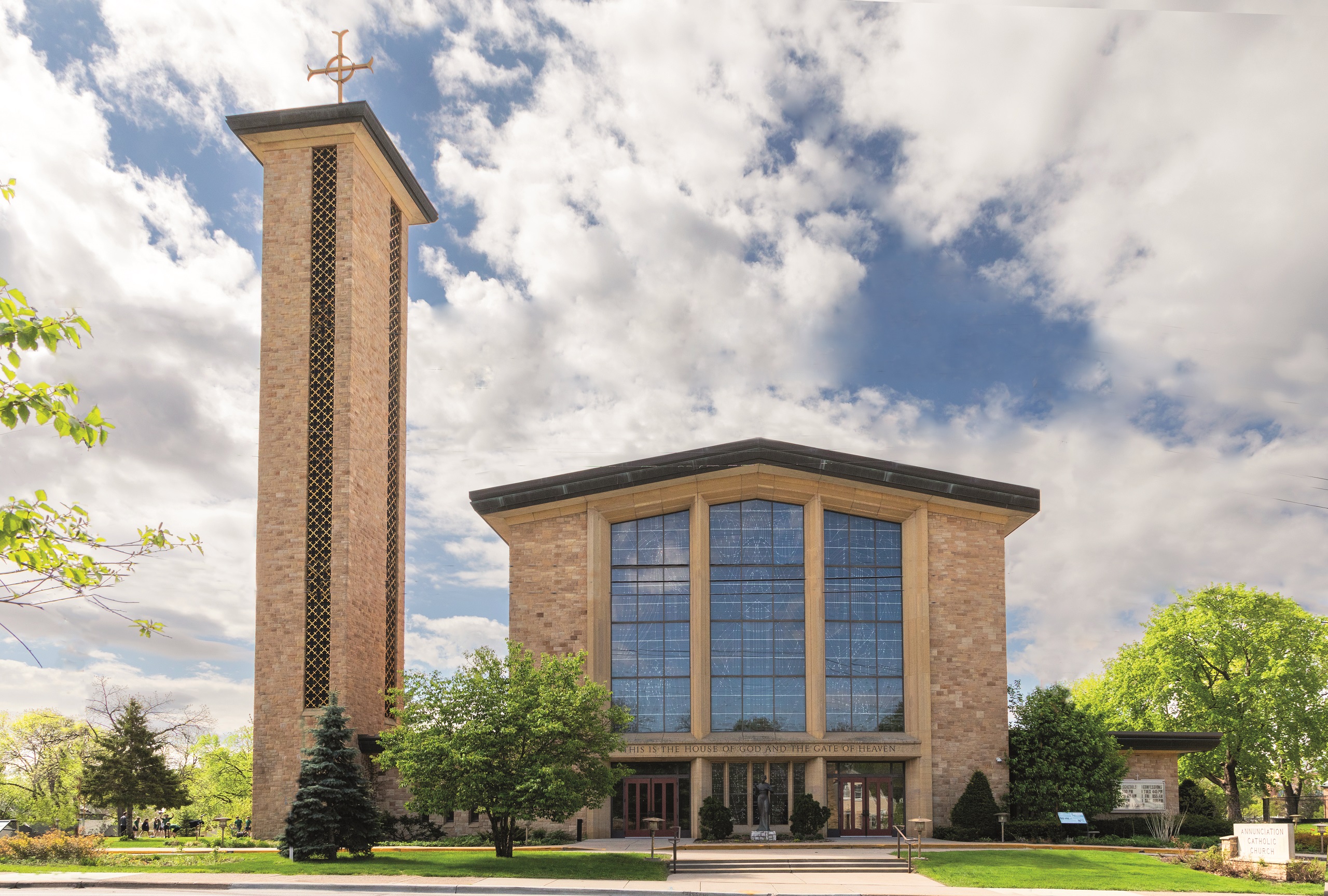
Wednesday’s awful attack at Annunciation Catholic School in Minneapolis is terrible and heart-aching. Such an evil occurring in our region of the country, to a place of Catholic faith and learning like our own, hits extra close to home. And whatever prudent proposals should follow, we are moved to pray fervently for these victims and everyone impacted. This week we witnessed some combination of mental illness, demonic influence, and chosen evil at work. If demons had no role in this atrocity, then their bad fruits are indiscernible in this world. St. Paul wrote to the Ephesians that our true adversaries are not flesh and blood—fixation on the hatred of other humans is a snare for the soul. Our struggle is with “the evil spirits in the heavens” who prowl about the world seeking the ruin of souls.

The tactics of demons are various but perhaps their foremost temptation is a repetition of history’s first temptation. The lie behind Satan’s suggestion to Adam and Eve that they eat from the forbidden tree to become like gods was: “You can’t trust God because he doesn’t really love you.” This is the point I wish to speak to, for this week I saw reactions to the attack on these innocents like this one online: “They were literally praying when they got shot. Praying doesn’t work.” The shooting at the Annunciation School Mass reportedly began during the Responsorial Psalm, which (if they were reading the same psalm we were at our parish that morning) included these lines: “Where can I go from your spirit? From your presence where can I flee? If I go up to the heavens, you are there; if I sink to the nether world, you are present there.” Does their suffering such evil mean that the Lord was not with them and for them at that church?

On Wednesday, my thoughts went to chapter two of the Book of Wisdom. You might not be familiar with its passages, since this Old Testament book is found in Catholic and Orthodox canons of Scripture but not included in most Protestant bibles. I encourage you to read the entire second chapter yourself, but I will excerpt from the text here. It begins by observing how the Wicked, “not thinking rightly, said among themselves: ‘Brief and troubled is our lifetime; there is no remedy for our dying, nor is anyone known to have come back from the underworld. For by mere chance were we born, and hereafter we shall be as though we had not been…”

The Book of Wisdom says the Wicked who think life is pointlessness and hopeless resolve to enjoy pleasures to the fullest and to exploit whomever they wish. They say, “Come, therefore, let us enjoy the good things that are here, and make use of creation with youthful zest. Let us oppress the righteous poor; let us neither spare the widow nor revere the aged for hair grown white with time. But let our strength be our norm of righteousness; for weakness proves itself useless.” Then from here the text goes on, at much more length than I am sharing, describing the Wicked’s hatred towards a holy person:

“‘Let us lie in wait for the righteous one, because he is annoying to us; he opposes our actions, reproaches us for transgressions of the law… He professes to have knowledge of God and styles himself a child of God. Let us see whether his words be true… For if the righteous one is the son of God, God will help him and deliver him from the hand of his foes. With violence and torture let us put him to the test… Let us condemn him to a shameful death; for according to his own words, God will take care of him.’ These were their thoughts, but they erred; for their wickedness blinded them, and they did not know the hidden counsels of God;  neither did they count on a recompense for holiness nor discern the innocent souls’ reward.”

This Old Testament prophecy clearly applies to Jesus, but not merely to him but his martyrs as well. I cannot tell you what specific goods will come from Almighty God permitting particular evils to occur but we know, in the words of St. Paul to the Romans, “God works all things together for the good of those who love him.” On Good Friday, the murder of the Messiah was incomprehensible to his disciples and friends, but just forty hours later, with the resurrection of Jesus, they began to better understand that mystery at the center of our Christian Faith. Like in today’s Gospel parable, Jesus went to the lowest place, but the Lord of Hosts saw and said to him “My friend, move up to a higher position,” and now he enjoys a most-honored seat in heaven and the esteem of all his companions around the Eucharistic table.

Our waiting to behold God’s full reversal of this world’s evils will likely last much longer than just three days, but we will endure in faith, hope, and love, praying and working and worshipping and journeying with Jesus Christ. We approach God’s Kingdom and we will press on to join the countless angels in festal gathering; and God the judge of all; and the spirits of the Just, the saints made perfect; and Jesus, the mediator of our new covenant; and the sprinkled blood that speaks more eloquently than that of history’s first martyr, Abel. God was with them and he will be with us too.

Greet Him At His House

August 9, 2025

19th Sunday in Ordinary Time
By Fr. Victor Feltes

Today’s Gospel is first and foremost about the Second Coming of Christ and our judgment on the Last Day. Jesus Christ, who called himself the Son of Man, said that in the End Times “the sign of the Son of Man will appear in heaven, and all the tribes of the earth will mourn, and they will see the Son of Man coming upon the clouds of heaven with power and great glory.” The Book of Revelation agrees: “Behold, [Jesus Christ] is coming amid the clouds, and every eye will see him, even those who pierced him… ‘Behold, I am coming soon. I bring with me the recompense I will give to each according to his deeds.’” “But of [the timing of] that day and hour,” Jesus says, “no one knows, neither the angels of heaven, nor the Son, but the Father alone.” (The Son of God is divine and therefore knows everything, but in his humanity Jesus apparently did not know the date or was not supposed to reveal it.) Could Jesus Christ return during our lifetime? Of course. But even if Christ returns a thousand years from now we should still heed his warning to be prepared today, for we do not know the day and hour of our deaths when he will judge our souls and deeds.

Jesus’ parable about the returning master and his servants suggests another secondary interpretation. Consider the story’s details. The master has come from a wedding. He comes to his own house. He wants his servants to be there, ready to greet him. And in response he will “have the servants recline at table and proceed to wait on them.” And “should he come in the second or third watch” (when it is darkest and most inconvenient) and find them present, attentive, and well-prepared, those servants will be greatly blessed. So where is the Lord Jesus’ house to which he returns? Where does he want his servants to be present and pleased to see him? Where would he have his faithful servants rest, partake in a meal served by him, and receive his blessed rewards? This church is his house. We are his servants. And Jesus wants us to meet him here for a meal. Our Lord arrives here joyfully from a wedding. He wedded the Church to himself two thousand years ago. And the Holy Mass extends that mystery throughout time and space to here and now. Indeed, ‘blessed are those called to the wedding supper of the Lamb’ and who are here and ready to greet him.

Yet, for too many people, the precious time of Sunday Mass is an hour when they do not expect the Son of Man to come. Despite our many scheduled weekend Masses, they still do not attend. Others show up out of obligation or custom or habit, but fail to be attentive. Perhaps they do not yet believe—despite Scripture, ancient teaching, and centuries of miracles—that Jesus Christ is truly present in the Holy Eucharist. Or perhaps they do not yet realize that they are not mere spectators at Holy Mass but offering a sacrifice with the priest and the whole community, the eternal offering of the Son to the Father, through which everything united to Christ is raised up to heaven and grace and blessings are poured down to earth in return.

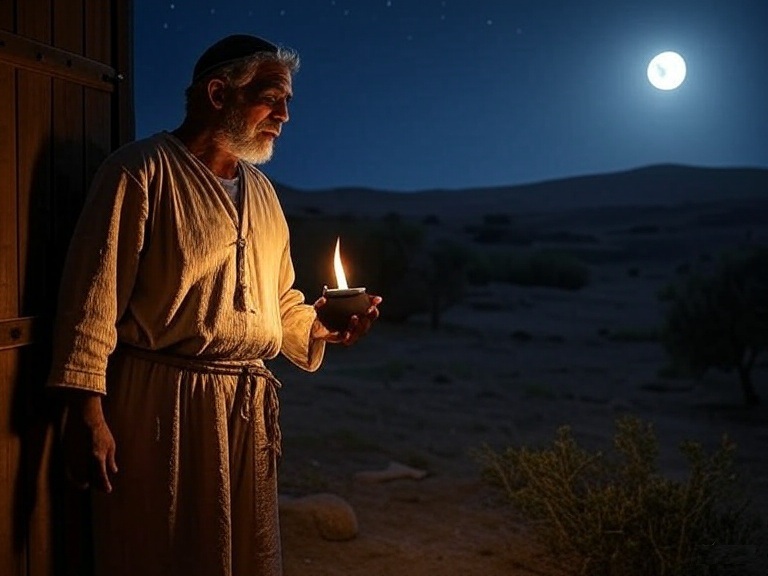
Be present and be vigilant. Distractions will come to anyone who is committed to regular Massgoing and daily prayer, but do not be discouraged by the times your thoughts accidentally wander. Every decision to turn your attention back to the Lord is another act of love and devotion. Sometimes those so-called distractions are actually things the Lord wants you to pray about or offer up to him. Ask the Holy Spirit and he will help you to pray as you ought, to gird your loins with reverence and light your lamps with faith and be like servants who are glad and blessed upon their master’s return from a wedding.

Holy Guides Are Needed

March 1, 2025

8th Sunday in Ordinary Time
By Fr. Victor Feltes

Lovingly correcting someone who is in moral or religious error is a good thing to do. As St. James writes in his New Testament Letter, “If anyone among you should stray from the truth and someone bring him back, he should know that whoever brings back a sinner from the error of his way will save his soul from death and will cover a multitude of sins.” Your fraternal correction could save a soul. Like a father who disciplines every son he acknowledges and delights in, addressing another’s faults in an appropriate way is an expression of our love for them.

Last Sunday, we heard Jesus say: “Stop judging and you will not be judged. Stop condemning and you will not be condemned. Forgive and you will be forgiven.” But understand that Jesus is not teaching indifference towards error and sin; he is commanding us to love sinners despite their wrongs. And loving others, always willing their good, will sometimes mean discussing their faults with them. As St. Paul teaches the Galatians, “[I]f a person is caught in some transgression, you who are spiritual should correct that one in a gentle spirit, looking to yourself, so that you also may not be tempted.” Is there someone the Lord desires you to call and bring back from the error of their way?

This Sunday, Jesus teaches that if we are going to see and correct the errors of others we must also see and correct what is wrong in ourselves. Jesus asks, “How can you say to your brother, ‘Brother, let me remove that splinter in your eye,’ when you do not even notice the wooden beam in your own eye? You hypocrite! Remove the wooden beam from your eye first; then you will see clearly to remove the splinter in your brother’s eye.” It is a good thing to help remove splinters from others’ eyes if we can, but if our vision is poor, or we are in a worse condition ourselves, then our intervention may cause more harm than good.

Why do we notice splinters in our neighbors’ eyes but fail to perceive wooden beams in our own? Because it’s easier to complain about others than to examine and reform ourselves. By criticizing rude people and know-it-alls, the holier-than-thou and the impious, bosses, co-workers, customers, political leaders and religious leaders, relatives, neighbors, and strangers, we can feel better about ourselves without improving ourselves or the world in any way. Being prone to criticizing others is spiritually dangerous, because the person for whom I have the greatest responsibility and whom I have the greatest influence to change — that is to say, myself — ends up feeling righteous while ignoring my own flaws. However, a holy season is at hand for us to examine ourselves and grow.

Lent, which always seems to sneak up on us, starts this week. This Wednesday is Ash Wednesday. Who will guide you through this important time of personal conversion? Jesus asks his disciples, “Can a blind person guide a blind person? Will not both fall into a pit?” St. Luke notes that this is a parable, indicating that Jesus’ observation has a deeper meaning. Jesus’ illustration contains a spiritual teaching. Each of us, where we are blind, need a guide who has clear sight. Where can we find guides to lead us? Jesus Christ and those conformed to him are trustworthy guides for us.

Jesus says, “No disciple is superior to the teacher; but when fully trained, every disciple will be like his teacher.” Disciples of Jesus Christ are called to become saints like Christ. This means we can learn from Jesus and his saints this Lent.

I suggest conversing with Jesus every day in prayer this Lent. You can just talk to him in your own words and listen for his replies within you. Sometimes the words you receive will be so true and good, insightful, and beautiful that you know they come from him. This Lent, you can also read or listen to the Gospels, especially if you’ve never read them before. You can encounter the words and person of Jesus there.

St. Paul wrote, “Be imitators of me as I imitate Christ.” This Lent you can also grow in holiness with a saint. Choose a saint as your patron for Lent, or ask that a saint would present themselves to you for this role. Learn about your saint online, or from a book, or a film. Read a saint’s writings, learn from their example, pray prayers that they prayed, and ask daily for the help of his or her prayers.

Prepare a spiritual plan for this Lent, so that the good tree you are may bear better fruit and the store of goodness in your heart may increase to fullness. This will make you a better witness and guide to sinners as you grow as a saint in the likeness of Christ.

Two Parables, a Poll, & a Purpose

September 15, 2024

24th Sunday in Ordinary Time
By Fr. Victor Feltes

Once upon a time, many years ago, a man who knew nothing about food production resettled to the countryside. He saw a farmer tilling a field and thought, “What a waste of effort! He’s just turning over dirt!” Then he saw the farmer planting seeds and wondered, “What’s he burying? Pebbles?” When the plants began to sprout and grow, he thought, “Ah, I see now! He’s growing a garden.” But the man was shocked at harvest time, “He’s cutting down everything he grew!” And when the farmer and his wife began hand-threshing, the man was baffled, “Why are they beating the plants?” The farmer’s wife ground flour and made loaves, placing them inside an oven, and the man was dumbfounded, “Now they’re burning it in a fire!” The farmer, of course, was growing grain and his wife was baking bread, but the onlooker did not understand all this until he was invited over to their house for supper.

Once upon a time in another tale, a little girl sat on the carpet of her living room while her mother sat in a nearby chair weaving embroidery stitches. The girl looked up and saw the chaotic, mishmashed underside of the embroidery and asked her good, and wise, and loving mother why she would create something so ugly. Her mother turned over the cloth, revealing what she was weaving and the little girl saw a beautiful, half-completed work of art.

Our God is all-good, and wise, and loving, and he is currently fashioning a beautiful, meaningful, lasting masterpiece for us on a scale the size of the universe. But until its completion we will see and experience ugly, painful things we will not understand, like the sufferings of Christ on Good Friday. His thoughts are not our thoughts, nor are his ways our ways, for we “are thinking not as God does but as human beings do.” Following Jesus will mean picking up the difficult crosses which come to us, denying ourselves, and acknowledging Christ before others.

Did Jesus care about what other people thought of him? Yes and no. Jesus asks, “Who do people say that I am?” and “Who do you say that I am?” That question is important, for Jesus declares, “I am the way and the truth and the life,” and “No one comes to the Father except through me.” Jesus gives his Church our Great Commission because all people are called to receive his baptism and to embrace all that he has taught for human thriving and salvation. But in another sense, he did not care what people thought of him.

Jesus did not allow what other people thought prevent him from doing what he should. Not even his friend Peter could change Jesus’ mind to do something against God’s will. Jesus knew that he would “suffer greatly and be rejected by the elders, the chief priests, and the scribes and be killed” but he went up to Jerusalem anyway and testified that he is the Christ. Christians today are called to courage too.

This week, I created an online survey to which 135 self-identified Christians responded. The poll’s question was: “Do you suffer for Christ?” 67% answered, “Yes, a little.” 12% replied, “Yes, significantly.” And 21% said, “No.” Do you suffer because you are a Christian? I asked a pastor-friend of mine how a Christian might discern if we’re suffering for Christ “significantly” or just “a little.” He thought that if we’re not sure, then it’s probably just “a little” — suffering greatly for Christ would be unmistakable.

So most Christians seem to suffer only a little for Christ, if at all, and yet we’re so afraid. You pray before meals, and that is good. Do you also pray before your meals in public? Do your coworkers or neighbors know you are a Catholic Christian? Have you invited anyone to our worship, to share this precious treasure? (Our classes for becoming Catholic begin two weeks from today.) As St. James says, ‘A faith without works is dead.’ We are called to be courageous, like the Prophet Isaiah, ‘to set our faces like flint, knowing that we shall not be put to shame, for the Lord God is our help.

I doubt the sufferings which flow from your Christian witness will be as severe as you might fear, but if sufferings do come your way know that you are not abandoned. When you suffer for Jesus and his Gospel, know that you are living out your faith with him. If you are faithfully carrying your Christian crosses, then you are following Christ.

Fruits at St. Paul’s Parish

June 16, 2024

11th Sunday in Ordinary Time
By Fr. Victor Feltes

Jesus says, “this is how it is with the Kingdom of God.” Seeds of the Kingdom are scattered on the earth. Day by day, we sleep and rise like farmers while God’s seeds sprout and grow. Though we each have a role in tending these plants in our local fields, exactly how they grow remains something of a mystery to us. Yet we can pause, look around, and see what heaven and earth have worked together to cultivate. Today, I would like to review some of the good fruits and fruits in progress which God has produced around us at St. Paul’s Catholic Parish.

In addition to our daily worship, our baptisms, confessions, weddings, and anointings, there are good things happening at St. Paul’s. Our entryway has been renovated, featuring a first-floor bathroom, with new exterior doors to be installed by the end of this summer. Our beautiful vestibule provides a new space for our community. It has already hosted one funeral visitation and will host Fr. Chinnappan’s farewell parties next weekend. It is sad to see Father go. He’s been a blessing and will be missed. But we are promised a new associate priest from India arriving hopefully this summer.

Our (4K through 8th grade) Catholic School has concluded another good year, and we are predicting higher enrollment this fall. An enhanced St. Paul’s school and parish website and other marketing efforts are making our great school better known. This summer, we’re renovating school bathrooms while refreshing other spaces and implementing a new English language curriculum which utilizes phonics. We have a full set of certified teachers lined up, including for our special courses like computers, phy-ed, health, and art. Our only unfilled spot remaining is for a one-fifth-time music teacher, so if you know someone excellent, please send them our way.

You have seen the gradual growth of our Sunday morning Children’s Liturgies. It’s a joy to see our little ones scamper off for their children’s gospel, homily, and prayers and come back proudly carrying their completed crafts. We are currently seeking lay volunteers to accompany them, so talk to me if you’re willing to support this important ministry. This summer, our young people are invited to Saints Basketball Camp every Monday and Wednesday evening (beginning this week), Saturday morning youth group at 9:30 AM every Saturday, and Vacation Bible School later this August.

With two priestly ordinations from our parish in recent years and a likely diaconate ordination to come, I would not be surprised to see more vocations emerging here. Pray for more vocations to priesthood, religious life, and holy marriage and encourage the young people in your life to pursue their true calling.

The volunteers at our St. Paul’s Thrift Sale, through the donations and purchases of so many, are on pace to achieve another record-breaking year. So drop off used treasures and pick up some new treasures on Thursdays or Fridays this summer. They also always welcome new volunteers.

Our 2023-24 Diocesan Annual Appeal campaign ends at the end of this month, and we are happily going to surpass our goal. Not only will any gift exceeding our goal fully return to the parish, but we also expect to receive school tuition grants this year like the $23,000 we received last year from our diocese (which is funded by the Annual Appeal).

Looking ahead, the second part of our St. Paul’s Church renovation is slated for the summer of 2026. As we continue fulfilling our Inspired by the Spirit campaign pledges, we will have all the necessary funds by then for wall repainting, floor reflooring, pew refinishing, and kneeler repadding; for security and streaming video cameras, new lighting, a new speaker system, and more. Your generosity towards this worthy effort is appreciated and will bring these plans to reality. Your donations to this project are likely a factor in another topic which I should mention.

Parish contributions come to St. Paul’s in various ways. Some people drop envelopes or cash into our collection baskets, others mail in checks to our parish office, some people have signed up to make no-fee, ACH automatic contributions from their bank accounts, and still others make donations directly from their IRAs. But as we now approach the end of this fiscal year, our parish Finance Council has noted that our year-to-date parish contributions are 10% under their year-to-date budget target. While fulfilling our renovation’s campaign’s pledges, it’s important that we maintain our regular parish giving as well.

So if you are regularly giving $10 on Sundays, please perhaps raise this up to 11 or more. If it’s $20, to 22; if $50, to 55; or $100, to 110, and so on. And if you do not tithe, I encourage you to start. It is a tangible way to exercise your trust in God, giving him an opportunity to prove himself faithful to you. And our Lord will not be outdone in generosity.

Jesus says the Kingdom of God “is like a mustard seed.” Even beginning as the “smallest of all the seeds on the earth,” the mustard seed is potent in flavor and powerful in potential. It springs up and becomes the largest of plants, putting forth large branches, and the birds of the sky dwell in its shade. Let us help grow the Kingdom of God among us so that our St. Paul’s Catholic Parish may be a still greater fruitful blessing and holy home for many more. And let us pray:

St. Paul our Patron,
please intercede with the Lord
for our parish and plans’ success,
for the glory of God
and salvation of souls. Amen.

The Kingdom of God Will Grow From Small to Large

June 15, 2024

11th Sunday in Ordinary Time
By Fr. Victor Feltes

Jesus compares the Kingdom of God to a seed, which is small, and simple but once it is planted in the ground, it will grow and become huge. We may not know how, but for sure, it will happen. More than two thousand years ago, Jesus started a small community of believers in Israel. When He was arrested, crucified, and died, His disciples were scattered and confused. However, when he rose again on the third day and appeared before them, they regrouped. On Pentecost Day, they were empowered by the Holy Spirit. From then on, that tiny community became a force that is present in all countries today.

Likewise, our spiritual growth as individuals mirrors that of the growth of a community of believers. Once the seed of the teachings of Jesus is planted in our hearts, the growth process is initiated and transformation starts. It happens little by little, in stages, and as long as we nourish it through prayers and service, we will put forth “branches” and bear fruit. There are no shortcuts to spiritual growth. Much like the growth of a plant, it will be an organic process. Along the way, there will be storms and other problems but the growth process will continue. Sometimes we ask why it seems that we are not growing at all. The key is patience and perseverance.

The parable also highlights the importance of small, humble beginnings. The seed is small and insignificant, yet it has the potential to grow into something big and beautiful. This reminds us that our small acts of faith, hope, and love can have a profound impact and bear fruit in ways we may not even imagine. Furthermore, the parable suggests that growth and transformation are gradual processes. The seed does not become a plant overnight, and the kingdom of God does not suddenly appear in our lives. Rather, it grows and develops over time, as we nurture it with our faith, hope, and love.

Just as a seed planted in the ground grows and flourishes without our full understanding of how, so too does the kingdom of God grow in our hearts and lives. We may not see it, but we can trust that it is working in us, transforming us, and bearing fruit.

Let us therefore focus on the here and now. So what can we do right at the moment? We can decide to be a tree for others to come and find shade and even make a nest. We can be a bird that sings a song of praise and thanksgiving. We can be the prophet to announce the good news of love and hope. May we be inspired by Jesus’ teaching to trust in the mysterious and wonderful ways of God’s kingdom, and may we bear fruit for the glory of God. May our small acts of faith, hope, and love be like seeds that grow into a harvest of righteousness and peace. May we be patient and hopeful; trusting in God has hidden working and timing.

The Dying Seed Bears Fruit — Funeral Homily for Marianna Greenlee, 88

May 21, 2024

By Fr. Victor Feltes

Jesus told his disciples: “Unless a grain of wheat falls to the ground and dies, it remains just a grain of wheat; but if it dies, it produces much fruit.” In what sense does a scattered or planted seed die? The seed is burst open by the plant’s first sprout and roots. The nutrient-rich meat of the seed is consumed by the plant’s growth and its shell of the seed dries out and decays. The seed sprouts and grows; first the blade, then the ear, then the full grain in the ear, bearing much fruit. The seed becomes the plant, but that original seed dies, in a sense, by offering up all that it is and all that it has.

In one of his parables, Jesus remarks how a man who scatters seed on the earth “would sleep and rise night and day and the seed would sprout and grow, he knows not how.” Gradually, quietly, and mysteriously, the seed and plant interact with the soil and sun, the moisture and air to produce a fruitful yield. These parables are reflected in the life of Marianna.

88-year-old Marianna is one of the most impressive ladies I have ever celebrated a funeral Mass for. After graduating as a Regis High School valedictorian, she went to UW-Eau Claire to earn her bachelors in education. There she would meet Tom Greenlee, her husband of 57 years, with whom she raised their six children. She taught many kindergarten, elementary, and high school students through the years, but that’s not all. She and Tom worked together in extended-stay volunteer programs around the country, with the Christian Appalachian Project in Kentucky, with the Gullah Geechee Nation in South Carolina, and for Focus on the Family in Colorado. They served in the Diocese of La Crosse’s Prison Ministry program, volunteered at the Chippewa Valley Historical Museum, and hosted Catholic Cursillo retreat gatherings.

What is the dynamic which produces amazing fruits like these? This little story contains a big clue: In 1998, when Tom and Marianna were celebrating their fortieth wedding anniversary, they pranked their family at the party by announcing they would be seeking an annulment of their marriage so Marianna could join a nunnery and Tom could join a monastery. And their children were not sure at first whether they were joking! This goes to show seriously this couple kept our Catholic faith.

A plant’s fruitful yield grows gradually, quietly, and mysteriously, through interactions with heaven and earth. Just as the plant depends upon air and water, soil and light, to live and grow, so we need Jesus Christ and his grace, his sacraments and daily prayer, his love for us and a love for him, to grow and produce good fruits on earth. But everything starts with the dying of the seed.

Unless a grain of wheat falls to the ground and dies, it remains just a grain of wheat; but if it dies, it produces much fruit.” We die, in a sense, by offering up all that we are and all that we have to God, saying, “Not my will, but yours be done.” Jesus teaches, “Whoever loves his life (always doing what they prefer) will lose (their life), and whoever hates his life in this world (choosing God and goodness over ease) will preserve (their life) for eternal life.” Pray for Marianna and learn from her, so that your life may be truly fruitful too. Remember what Jesus teaches and promises: “Whoever serves me must follow me, and where I am, there also will my servant be. The Father will honor whoever serves me.”

The Fruitful Trials of St. Paul

April 28, 2024

Fifth Sunday of Easter
By Fr. Victor Feltes

Imagine if Osama bin Laden, after masterminding terrorist attacks, had repented and begun proclaiming Jesus Christ and the Gospel? Christians might understandably still be afraid of him and wary of his claimed Christian conversion. In the first century, prior to his famous conversion, St. Paul had intensely persecuted God’s Church and tried to destroy it. At the stoning of St. Stephen the Martyr he had guarded the cloaks of the murderers. Before encountering Christ on the way to Damascus, he was “breathing out murderous threats against the Lord’s disciples.” He had sought and obtained letters from the high priest empowering him to arrest any Christians he found in that city and take them back to Jerusalem as prisoners. So after his conversion, when “he arrived in Jerusalem, he tried to join the disciples, [but] they were all afraid of him, not believing that he was a disciple.”

Yet it was all real and true. The amazing conversion of St. Paul, that fierce enemy of the early Church, is an authentic miracle in real history which has borne true fruit in Christ. St. Paul founded and fostered early Christian communities, wrote more books of the Bible than any other man, and had a hand in saving many souls. He also discovered good fruits for himself, including Christian peace and joy. St. Paul told the Philippians he had exchanged everything from before as if it were mere rubbish for “the supreme good of knowing Christ Jesus my Lord.” Such are fruits of a life in Christ.

Jesus tells his disciples in today’s gospel, “I am the vine, you are the branches.” He says, “I am the true vine, and my Father is the vine grower. He takes away every branch in me that does not bear fruit, and every one that does he prunes so that it bears more fruit…” Notice how Jesus says God prunes those who are in him. Pruning clips off of a vine branch certain shoots or leaves in order to help the branch to be healthy and grow and produce more and better fruit. If vine branches were conscious, self-aware like us, how would this pruning feel? Painful, I imagine. Even if a branch loved producing fruit and wished to produce much more, how would a vine branch feel about such pruning if it did not understand this pruning’s purpose? There is a danger for a Christian who expects only comforts in this life and is surprised by the coming of any trials.

Consider the life of St. Paul. He suffered and endured many trials. Five times he received thirty-nine lashes from Jewish foes, three times he was beaten with rods, one time he was stoned, three times he survived shipwrecks, and ultimately he was beheaded by the Romans. St. Paul was not always liked, even by fellow Christians. It appears some Christians at Corinth said things like, “His letters are severe and forceful, but his bodily presence is weak and his speech is contemptible.” St. Paul’s letters reflect that the first Christian communities were far from perfect and they gave him many stressful problems to deal with. He writes of having beautiful mystical experiences but also of a “thorn” in his flesh and physical illness. St. Paul’s life was not always comfortable. However, he wrote to the Philippians, “I have learned to be content whatever the circumstances. I know what it is to be in need, and I know what it is to have plenty. I have learned the secret of being content in any and every situation, whether well fed or hungry, whether living in plenty or in want. I can do all this through him who gives me strength.

When St. Paul, now amongst the saints and angels in heaven, looks back on all his troubles and beholds all their good fruits, does he believe that it was worth it? Of course he does. And he cheers us on alongside that “great cloud of witnesses,” prayerfully interceding for us to “persevere in running the race that lies before us while keeping our eyes fixed on Jesus.” In both good times and in bad, Jesus counsels us to remain in him. “Whoever remains in me and I in him will bear much fruit… By this is my Father glorified…” And in this will be our glory too.

Abide in Me & I in You

April 28, 2024

5th Sunday of Easter
By Fr. Chinnappan Pelavendran

Today we are invited to remain in Christ as branches on a vine. We do this by recognizing that God is at work in everyone and by striving to keep His commands and to do what is pleasing to God. The Christian life sounds easy and yet is a challenge for us all.

In the First Reading of today, we heard how Paul and the disciples of Jesus were trying to bear much fruit. When Paul arrived in Jerusalem and tried to join the disciples, the disciples avoided him with great fear. They knew that he had a reputation for persecuting the Christians. They were unable to believe that Paul was now one of them. Barnabas came forward and took Paul to the apostles. On behalf of Paul, he explained to the apostles how Jesus had spoken to Paul on the way to Damascus. Now Barnabas testified his spiritual joy by sharing with the others the Divine intervention of Jesus in the life of Paul. We all know what a difference Paul made to the Church. Jesus pruned St. Paul, and he bore many fruits.

In today’s gospel, Jesus uses the familiar image of the vine and the branches to teach us lessons about our Christian life. First, the image reminds us that God is the real owner of everything that we have. He is the vine grower. He does to us what is good and right. We belong fully to God. We should not allow our selfishness and pride to make us think that we have absolute control over our lives. Rather, we always have to be open to God’s action, confident that he knows fully what is good for us.

He is the vine and we are the branches. A branch cut off from the vine will wither and die. So it is with our life as disciples. We live fully and become fruitful only by remaining in Christ. In the gospel of John, the word “abide” appears several times: “Abiding in God,” “abiding in Christ,” and “abiding in his Word.” We need to abide in Christ because apart from him, we can do nothing.

The image tells us that to stay healthy and fruitful we need pruning. Vine growers know that the act of pruning is good for the branch. If the branch is not pruned for a long time, it becomes wild and produces no good grapes. Sometimes in our lives, God intervenes with the cross to challenge us and make us grow. To take away our pride, sometimes God allows us to fail to make us grow stronger in faith.

We are called to remain in Jesus, to be in communion with him. We are also to be pruned; what is useless in our lives is to be cut off. Our pruning is our self-denial and purification. We have to be open to pruning so that we can be healthy and fruitful for the Lord.

Like Paul, we believe in the name of Jesus Christ, God lives in us, and we live in him. We become branches of the true vine, Jesus Christ. Then with the psalmist, we can confidently sing: “You, Lord, I praise in the great assembly.” Alleluia!

Invest Yourself in Heaven’s Reward

November 19, 2023

33rd Sunday in Ordinary Time
By Fr. Victor Feltes

As Jesus traveled from place to place he preached parables to different people. He told stories, for instance, featuring fields, fish, and flocks to teach farmers, fishermen, and shepherds about the Kingdom of God. It makes sense that Jesus would tell the same stories more than once, for different crowds to hear them for the first time and for his apostles to hear them repeatedly. But the gospels suggest Jesus sometimes changed his parables’ details to highlight different truths. What Jesus says in his Sermon on the Plain is similar but not identical to his Sermon on the Mount. As the Church journeys through our three-year cycle of Sunday readings we hear some parables retold by more than one gospel. And each fall, as we near the end of the Church year, our readings reflect upon the Four Last Things. Today, we have another such parable, about death and judgment, Heaven and Hell, Jesus Christ and us.

Christ is our Lord, our journeying master who shall return. We are his servants to whom he has entrusted our fortunes. And each of us one day will stand before him to give an account of our faithful or unfaithful service, with generous rewards or just punishments to follow. In Jesus’ telling through St. Matthew’s Gospel, the master entrusts weighty slabs of precious metal (called talents) in varying numbers to his servants, each according to their abilities. Upon his return, his faithful servants have doubled what they were given and receive the same words of praise: “Well done, my good and faithful servant! Since you were faithful in small matters, I will give you great responsibilities. Come, share your master’s joy!” One servant, however, who buried his talent and returned it ungrown, receives his master’s condemnation and is tossed into the darkness outside.

When Jesus retells his parable in St. Luke’s Gospel, the master is a nobleman who goes off to claim his kingdom, entrusting to ten servants one gold coin each. Upon his return, his faithful servants reveal their various positive returns on his investment. One has earned ten more gold coins and his king declares, “Well done, good servant! You have been faithful in this very small matter; take charge of ten cities.” Another servant has earned five more coins and the king decrees, “You, take charge of five cities.” One servant, however, hid his coin in a napkin and returned it unmultiplied. The king condemns that servant and orders all of his enemies who did not want him as their king to be slain.

The differences between these two parables highlight different truths about Heaven. In the first parable, the master speaks the same blessing to each faithful one: “Well done, good servant! … Come, share your master’s joy!” But in the other parable, the king gives his servant with ten additional coins ten cities and gives his servant with five additional coins five cities. So is Heaven’s reward the same for all the saints or can one’s reward be greater than another’s? One parable suggests their reward is the same, while the other suggests their rewards vary. On one hand, the reward of every saint is the same: they experience God’s unveiled glory forever in happy, loving communion with him and all who are in Christ. On the other hand, a great saint’s capacity for love and joy and glory may be greater than another’s.

Doctor of the Church St. Therese of Lisieux recounts in her great autobiography (“Story of a Soul”) how this idea once troubled her as a child: “One day, I expressed surprise that God does not give an equal amount of glory to all the elect in Heaven—I was afraid that they would not all be quite happy. [My older sister Pauline] sent me to fetch Papa’s big tumbler and put it beside my tiny thimble, then, filling both with water, she asked me which seemed the fuller. I replied that one was as full as the other—it was impossible to pour more water into either of them, for they could not hold it. In this way [she] made it clear to me that in Heaven the least of the Blessed does not envy the happiness of the greatest…

Notice how in both forms of Jesus’ parable all the faithful servants are entrusted with greater responsibilities. The saints in Heaven are likewise given higher roles as our intercessors now and in the family and household of God forever. Consider how many churches, religious communities, and cities around the world are dedicated to St. Paul. They are blessed to have him as a loving patron praying for them. And consider how the Blessed Virgin Mary shall always hold a privileged place in Heaven as the spiritual mother of every Christian.

St. Paul says, “Consider this: whoever sows sparingly will also reap sparingly, and whoever sows bountifully will also reap bountifully.” The generosity of our loving gifts to Christ, the additional sacrifices we make and good deeds we do, will surely not go unrewarded. Jesus tells us, “Give, and it will be given to you. Good measure, pressed down, shaken together, running over, will be put into your lap. For the measure with which you measure will be measured out to you.” Our individual hustle, cooperating with Christ’s grace, can win us greater glory, therefore “run so as to win!

We should not fear that we lack sufficient talents or gifts to produce good fruits for glory. In the first parable, every faithful servant was able to double his money and won his master’s praise. The issue with that unfruitful, condemned servant is that he never tried. His master calls him “wicked” and “lazy” because that servant did not make even the most minimal effort to grow his gift. “Should you not then have put my money in the bank so that I could have got it back with interest on my return?” That servant did not love his lord but rather resented his lordship over him. Which is easier: to digging a hole or visiting the bank? He did not want to be his master’s servant, he did not want him as his king, and so he finds himself condemned and cast out forever. But if we love our Lord we will produce fruit, just as “every good tree bears good fruit.” As Jesus declares, “Whoever remains in me and I in him will bear much fruit.”

What is something more that you will do with the talents and gifts our Lord has lent you? It could be something large or small, in private or with others. You could be a more-focused prayer warrior, or offer secret penances for the salvation of souls. You could start a Catholic book or movie club at your home, or organize a regular Bible study that discusses the upcoming Sunday readings. You could visit shut-ins as an extraordinary Eucharistic minister, or invite somebody new each week to come with you to Mass. There are many good things you could do and I urge you to consider and answer this call, for Jesus Christ will honor your faithful, loving efforts with glorious rewards.