Archive for the ‘Parables’ Category

A Game of Monopoly & the Rich Man

March 10, 2015

Lazarus at the Rich Man's DoorGospel: Luke 16:19-31
Thursday, 2nd Week of Lent

    A UC-Berkley psychology professor sets two people down for an experiment: the pair will play a game of Monopoly with modified rules. One player will get the Rolls Royce while the other will be the old shoe. The player with the car will start with $2,000 and play by standard Monopoly rules, while the old shoe’s player gets $1,000, rolls just one die (making doubles impossible,) and collects only $100 for passing “Go.” Who gets which is decided by a fateful coin-flip. At the end of the game, the professor asks the winner (invariably the Rolls Royce player) whether they feel like they deserved to win the game. And the winner always says ‘yes.’

    I can understand the winner’s perspective. At the beginning of the game both players had a fair chance of winning (for either could have ended up with the car,) but the winner won that coin flip, played by the rules, and did what was necessary to arrive at victory. If the winner had cheated the loser, stealing cash or refusing rents, then that victory would feel undeserved.

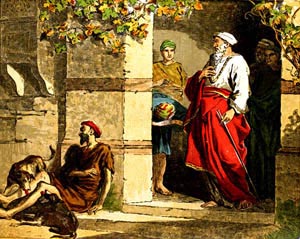
Abraham, Lazarus, and the Rich Man    The Rich Man who showed no concern for poor Lazarus may have felt like one of those Rolls Royce players. He “dressed in purple garments and fine linen and dined sumptuously each day,” but nothing in the text indicates that he had defrauded or exploited anyone to obtain his wealth. Maybe he looked at poor people like Lazarus and shrugged, “Some receive what is good in their lifetimes while others receive what is bad,” words that Father Abraham would throw back in his face. Perhaps the Rich Man had not so much perpetrated evils, but rather (ignoring the Scriptures) felt no responsibility to help the less fortunate outside his door.

    May the one who reads this—a winner in the coin-toss of life—not be condemned for failing to give alms.

Our Lady’s Wisconsin Message: The Meaning of the Two Trees

September 25, 2014

In the Garden of Eden, there were many fruit-bearing trees, but Genesis mentions only two by name: the Tree of Life, and the Tree of the Knowledge of Good and Evil. By partaking of the Tree of Life the human race could keep living forever, but the Lord warned that to eat from the other tree would mean our certain death. On October 9th, 1859, the Blessed Virgin Mary appeared near Green Bay to a 28 year-old Belgian immigrant named Adele Brise while she was walking eleven miles home from Sunday Mass. Interestingly, Our Lady chose to appear to Adele not in a church, or a thousand other places, but between two trees: a Maple and a Hemlock.

Maple LeavesYou’re familiar with the beauty and goodness of the Maple. In the fall, its leaves turn the most striking colors, and in the spring its sap yields sweet syrup. But do you know about the Hemlock tree? The poison that the Greek philosopher Socrates was condemned to drink came from this plant. Ingesting just six or eight fresh Hemlock leaves can kill a healthy adult. [Post-Script: The Hemlock Tree found in Wisconsin is not poisonous, but merely shares the name.]  The Maple is a tree of life while the Hemlock is a tree of death. Mary, the New Eve, stood between the two.

Three Conium Maculatum (or Poison Hemlock), Cedar Bog, Champaign CoMary told Adele, “I am the Queen of Heaven, who prays for the conversion of sinners, and I wish you to do the same. You received Holy Communion this morning, and that is well. But you must do more. Make a general confession, and offer Communion for the conversion of sinners. If they do not convert and do penance, my Son will be obliged to punish them.” Our Lady’s message between the two trees is akin the words of Moses, who told the Israelites: “I have set before you life and death, the blessing and the curse. Choose life, then, that you and your descendants may live, by loving the Lord, your God, heeding his voice, and holding fast to him. For that will mean life for you, a long life for you to live on the land….

Peshtigo Fire MapApparently, Our Lady’s warnings were not sufficiently heeded. In October of 1871, exactly twelve years later, disaster came. Both in terms of size and number of lives lost, the Peshtigo Fire remains the worst recorded forest fire in U.S. history. Between 1,200 and 2,400 lives ended in that firestorm which saw, according to an eyewitness, “large wooden houses torn from their foundations and caught up like straws by two opposing currents of air which raised them till they came in contact with the stream of fire.” This seems to be the punishment due to sin that Mary spoke of, yet this does not mean that everyone who perished in that fire was condemned. We should remember that at harvest time, the wheat and the weeds are pulled up together in a moment, but their future fates are not the same. Once uprooted, the good are gathered and kept in the barn, while the bad are thrown away forever.

The firestorm came and surrounded the shrine of Our Lady, where hundreds had come for refuge with their families and herds, beseeching her intercession before God. As many as fled to her there were saved. The shrine’s consecrated earth was an emerald-green island in an ocean of smoldering ashes as far as eyes could see.

Mary, the Queen of Heaven, prays for the conversion of sinners and she wishes you to do the same. You receive Holy Communion, and that is well. But you must do more. Begin by receiving the sacrament of reconciliation regularly, because it is powerful for growing in holiness. The sinner whose conversion you are most responsible for is your own.

Generosity & Envy — 25th Sunday in Ordinary Time—Year A

September 21, 2014

Readings: Isaiah 22:6-9; Philippians 1:20c-24, 27a; Matthew 20:1-16a

DenariusHe woke up while it was still dark and kissed his wife while she slept.

He dressed and left home quietly, so as not to wake up the children across the room.

He walked into town and came to the large market square, where the venders were already setting up shop, and day laborers like himself were congregating.

At dawn, landowners came to hire men to harvest their vineyards and fields.

He was left behind, yet he did not leave.

Hopefully, someone would hire him at noon for at least a half-day’s work.

Three o’clock came, and he was still standing there unemployed, refusing to go home. How could he go home… empty-handed?

Around five o’clock, a landowner found him and asked, “Why do you stand here idle all day?”

Speaking for those standing with him he answered, “Because no one has hired us.”

The landowner said to them, “You too go into my vineyard.”

When it was evening, the vineyard owner had his foreman summon the harvesters and pay them—in this he was abiding by the command in the book of Leviticus, “You shall not withhold overnight the wages of your laborer.”

When he received his pay, the man thought there had been some mistake.

Though he worked only an hour, he had been given a silver denarius coin, the standard pay for a full day’s work.

He badly wanted to leave with it, but he was a righteous man, and quietly approached the foreman.

But the foreman reassured him—there had been no mistake!

Oh, the joy he felt! For tonight and tomorrow, his family would not be hungry.

*  *  *  *  *

Was the landowner unfair in the treatment of his workers? At the beginning of the day, the Greek text says the landowner achieved ‘harmonious agreement’ with the labors regarding the usual daily wage. This was not fraud nor exploitation, but a just wage for an honest day’s work. Were the later workers been idle due to laziness? No, they honestly say, but “because no one has hired us.”

Let us revisit the landowner’s arguments in his own defense: he said to one of the grumblers in reply, “My friend, I am not cheating you. Did you not agree with me for the usual daily wage? Take what is yours and go. What if I wish to give this last one the same as you? Or am I not free to do as I wish with my own money? Are you envious because I am generous?” The landowner was not being unfair, he was being generous. He kept the precept of Leviticus, which ensured that poor laborers would not be deprived of their daily bread overnight, but he also kept the command which comes in Leviticus five verses later: “You shall love your neighbor as yourself.”

Would the grumblers have been happier if the coins were taken back from the hands of all of the one hour workers? Yes, and no. For the envious person is not happy until everyone is unhappy like himself. And even then, he is still unhappy. What if the grumblers had had perfect hearts? Then they would have been concerned about those unchosen workers, as impoverished as themselves, that were left behind in the marketplace, and upon seeing those latecomers receive a full daily wage they would be happy and relieved for them. But these grumblers’ thoughts were not God’s thoughts, and their ways were not his ways.

Saint Augustine in his Study by Botticelli, 1480Beware of envy. Envy is sadness at the sight of another’s blessings and the immoderate desire to acquire them for oneself. The Catechism of the Catholic Church teaches, when envy wishes grave harm to a neighbor, it is a mortal sin. St. Augustine rightly called envy “the diabolical sin,” for the book of Wisdom tells us that “by the envy of the devil, death entered the world.” St. Augustine observed, “From envy are born hatred, detraction, slander, joy caused by the misfortune of a neighbor, and displeasure caused by his prosperity.”

What is envy’s antidote or preventative vaccine? A good will towards all people, and rejoicing in their blessings and happiness as much as your own. Do you feel envious out of fear or resentment that there may not enough good things for you? Remember that the landowner in today’s parable, who ensures that his laborers receive their daily bread, represents God, who provides for the needs of those who serve him. As the psalmist says, “The Lord is near to all who call upon him.”

In Jesus’ parable, the landowner represents God, the laborers are those who faithfully serve him, and the equal pay they receive is salvation, eternal life, the reward of Heaven. Does this mean that all who serve God receive an equal reward? Once again, the answer is yes, and no. Each is given Heaven, but not all souls enjoy the same glory there. In our second reading, St. Paul says, “If I go on living in the flesh, that means fruitful labor for me.” He is not sure if he would rather live or die (“I do not know which I shall choose”) because death means peaceful rest with Christ, while more labor in life means a greater reward.

St. ThereseWhen St. Therese of Lisieux was a little girl, she was rather put out to learn that not all souls enjoy the same glory in heaven. For the young, fairness means simple sameness. Her older sister, Pauline, told her to fetch a thimble and her father’s water tumbler and to fill both of them to the top with water. Pauline then asked her which one was fuller. St. Therese saw that every soul in heaven is filled to its brim and can hold no more; each being full of God and completely happy. In Heaven, there is enough love, glory, and happiness for everyone, even if we grow and develop different capacities for these while on earth.

So who will have the largest capacity in Heaven? Who will hold the most glory? I believe, as Jesus says, “the last will be first, and the first will be last.” The greatest glory will not go to those who are focused on who is first and greatest, but to those interested in promoting in the greater glory of all.

God’s angels have different degrees of glory and power, yet they find delight in one another. They have labored for the Lord since the beginning of time, yet they rejoice that God has been generous with us latecomers and included us in his work. Let us be like our angels, who happily pray for us and aid us, so that we might attain a glory greater than their own. Let us pray that others might become holier than us, provided we become as holy as we ought.
Ezekiel’s Consolation — Tuesday, 19th Week of Ordinary Time—Year II

August 12, 2014

Readings: Ezekiel 2:8-3:4; Matthew 18:1-5, 10, 12-14

The Lord GOD said to me: “As for you, son of man, obey me when I speak to you: be not rebellious like this house of rebellion, but open your mouth and eat what I shall give you.” It was then I saw a hand stretched out to me, in which was a written scroll which he unrolled before me. It was covered with writing front and back, and written on it was: “Lamentation and wailing and woe!”

He said to me: “Son of man, eat what is before you; eat this scroll, then go, speak to the house of Israel.” So I opened my mouth and he gave me the scroll to eat. “Son of man,” he then said to me, “feed your belly and fill your stomach with this scroll I am giving you.” I ate it, and it was as sweet as honey in my mouth. He said: “Son of man, go now to the house of Israel, and speak my words to them.”

How can a message of “lamentation and wailing and woe” taste sweet in the prophet’s mouth? Ezekiel found the message sweet because it meant God was neither blind nor indifferent to the evils in his midst and that these evils, one way or another, would not continue forever. Either sincere conversion or painful events would soon check his people’s wickedness. This was the prophet’s consolation. Jesus says:

If a man has a hundred sheep and one of them goes astray, will he not leave the ninety-nine in the hills and go in search of the stray?

Guardian Angels by JHS MannIn the parable of the Lost Sheep, we focus on the lost sheep’s consolation while forgetting the ninety-nine’s desolation. The flock may fare just fine, but they will find the experience quite unsettling. Jesus tells us:

Whoever receives one child such as this in my name receives me.

It is not the will of your heavenly Father that one of these little ones be lost.

For forty years, the people of our land have intentionally and legally ended the lives of roughly one million unborn children annually. What would the opposite of receiving Jesus look like, if not this? Jesus warns us:

See that you do not despise one of these little ones, for I say to you that their angels in heaven always look upon the face of my heavenly Father.

This represents a warning, because God’s angels are fearsome and righteous creatures. Let us earnestly pray for our country’s conversion to a culture of life. Yet we too share Ezekiel’s consolation, for one way or another, this evil in our midst will not go on forever.

Travelers & Merchants — 17th Sunday in Ordinary Time—Year A

July 30, 2014

Readings: 1st Kings 3:5, 7-12; Romans 8:28-30; Matthew 13:44-46

The kingdom of heaven is like a treasure buried in a field, which a person finds and hides again, and out of joy goes and sells all that he has and buys that field. Again, the kingdom of heaven is like a merchant searching for fine pearls. When he finds a pearl of great price, he goes and sells all that he has and buys it.

What do these two analogies or parables of Jesus about the Kingdom of Heaven (or Kingdom of God) have in common? Both tell about men who find something precious and sell everything they have to possess it. These short stories are quite similar, but how do they differ? (There must be some significance to these differences otherwise Jesus would not have given us both images.)

Jesus does not give us many details, but in my imagining the first story goes like this: A traveler is walking a dusty road that he has walked many times before, but this time, as he is looking to one side at nothing in particular, a golden glint catches his eye from the adjacent field. Out of curiosity, he investigates and discovers a wooden crate full of gold coins which has been uncovered by recent plowing. Putting the coins back inside and fixing the lid, he reburies the treasure and joyfully goes to sell all that he has in order to buy that field. “Why doesn’t he simply carry the crate away?” Because that would be stealing and true happiness cannot be obtained through wickedness. One does not come to possess the treasure of the Kingdom of God through evil means.

Pearl MerchantIn the second story, a pearl merchant comes upon a high-priced specimen in a marketplace. Its price is, let’s say, one hundred thousand dollars. Many people have admired it before, but the merchant has an expert and discerning eye. He sees that this pearl is worth ten times more and he shrewdly sells everything he owns to possess it. To onlookers, he looks crazy (“Selling everything for just one pearl?”) but he knows what he is about. Those who forsake all else to possess the Kingdom of Heaven may likewise be thought foolish by some, but the wise one recognizes the pearl’s true value.

Both the traveler and the merchant find precious treasure, but one difference between them is that the merchant knew what he was looking for and actively sought it, while the country traveler did not. Some people seek out the true, the good, the beautiful, the eternal things. They seek God himself, and those who seek, find. Others do not seek the higher things of God, yet our humble Lord has been known to blindside them with the truth of his reality and love. So what do these parables mean for us here, who have already come to know Jesus Christ and his Church?

An important aspect to finding and possessing your treasure in the Kingdom of God is knowing and embracing your vocation. The word “vocation” comes from the Latin word “vocare,” which means “to call.” Your vocation is your life’s calling from God. Your vocation is the means by which God intends for you to become holy and a blessing to all.

Some people find their vocation like the traveler on the road—stumbling upon it without having sought it. I think this is true for many marriages. A man and woman can be drawn to each other, fall in love and delight in each other, and decide to spend their lives together without discerning God’s purpose for their lives. Yet, since “we know that all things work for good for those who love God,” (as St. Paul says in our second reading) the Lord still guides them according to his purposes. If you are in the sacrament of marriage your vocation is clear: your mission in life is to become the best spouse and parent you can be and to help lead them to heaven. You need not travel to a mountaintop monastery in a distant land to find your vocation and become a saint. Your vocation, your means to holiness, is as ordinary and close as a field or marketplace, yet your treasure is found there. Your vocation is sitting beside you.

Other vocations are usually discovered only with discernment, by searching like the merchant. One does not become a priest, a religious, or a dedicated single person without a firm decision to offer one’s life entirely to God. These people also find sanctity and bless others in the greatest way through their God-given callings. If you have not yet discovered your vocation, remain close to God in prayer and faithfulness, and he will reveal his will to you.

In our first reading, the Lord appears to Solomon in a dream and says, “Ask something of me and I will give it to you.” Solomon, the new, young king, feels overwhelmed by his office. “I am a mere youth, not knowing at all how to act. I serve you in the midst of the people whom you have chosen, a people so vast that it cannot be numbered or counted. Give your servant, therefore, an understanding heart to judge your people and to distinguish right from wrong.” Solomon’s request for wisdom to benefit the kingdom pleased the Lord, so God granted him great wisdom and all the gifts he had not asked for as well. As Jesus says, “Seek first the Kingdom of God and his righteousness, and all these things will be given you besides.” Pray to God for the wisdom to know your vocation and to embrace it (like the traveler and the merchant) with the investment of everything you are. In this way, you will come to possess the Kingdom’s precious treasure.

How God The Father Loves His Son

June 16, 2014

How does the Eternal Father love Jesus Christ his Son?
The Scriptures provide us insights into their relationship.


The Father gives his Son instruction and example

God the Father BlessingAs Jesus once said, “Amen, amen, I say to you, a son cannot do anything on his own, but only what he sees his father doing; for what he does, his son will also do,” adding, “I cannot do anything on my own.” The Father loves his Son and shows him everything that he does. Sometimes believers find it harder to relate to God the Father than Christ the Son. But what is the Father really like? He is just like his Son. Jesus “is the image of the invisible God.” As Jesus said, “Whoever has seen me has seen the Father.”  The Father offers his Son the perfect example, and his Son perfectly follows him.

The Father listens to his Son

Outside the tomb of Lazarus, Jesus said, “Father, I thank you for hearing me. I know that you always hear me…” Jesus shares his own attitude toward prayer when he tells us, “In praying, do not babble like the pagans, who think that they will be heard because of their many words. Do not be like them. Your Father knows what you need before you ask him. This is how you are to pray: Our Father…” Jesus knows that wordy, poetic prayers are not necessary because his Father is always listening.

The Father encourages his Son

At Jesus’ baptism in the Jordan River, the Father declared from heaven, “You are my beloved Son, in whom I am well pleased.” And on the summit of Mt. Tabor, at Jesus’ Transfiguration, the Father spoke from the cloud, “This is my beloved Son, listen to him.” The Father encourages his Son with reminders of his love.

The Father provides for his Son

Jesus said, “Everything that the Father has is mine.” Jesus’ Father is like the father in the parable of the Prodigal Son who told his first-born, “My son, you are here with me always; everything I have is yours.” Confident in his Father’s providence, Jesus tells us to be likewise unafraid concerning our basic needs, what we are to eat and drink, or what we are to wear: “Seek first the kingdom of God and his righteousness, and all these things will be given you besides.” The Father also provides his Son with gifts greater than material things. At the Last Supper, Jesus said of disciples, “Father, they are your gift to me.”

The Father welcomes closeness with his Son

It was a big deal when Jesus prayed, “Abba, Father.” As St. John Paul the Great observed, “An Israelite would not have used [“Abba” to address God] even in prayer. Only one who regarded himself as Son of God in the proper sense of the word could have spoken thus of him and to him as Father–Abba, or my Father, Daddy, Papa!” Because the Father welcomes intimate closeness with his Son, Jesus can say, “I and the Father are one.”

The Father loves his Son’s mother

At the Visitation, filled with the Holy Spirit, Elizabeth declared to Mary, “Most blessed are you among women,” and Mary rejoiced, “From this day all generations will call me blessed. The Almighty has done great things for me, and holy is his name.” By pouring his love and blessings into Mary, God the Father gave his Son a loving mother full of grace.

The Father fosters growth in his Son and sends him on mission

The Letter to the Hebrews says, “Son though he was, [Jesus] learned obedience from what he suffered; and when he was made perfect, he became the source of eternal salvation for all who obey him, declared by God high priest according to the order of Melchizedek.” But this raises a question: how can the divine Son grow in any way? Though perfect in heaven, the Son of God had no firsthand experience of weakness, suffering, or the trials of obedience, until his Incarnation. Through these things he was made complete so that he could be the savior of humanity. The Father prepares his Son and sends him on a mission to transform the world. “God did not send his Son into the world to condemn the world, but that the world might be saved through him.”

The Father as our model for Fatherhood

Whether we are biological or spiritual fathers, Jesus’ heavenly Father gives men a model for our fatherhood. We are to give our children instruction and good example. We should listen to them and encourage them, letting them know that they are well-beloved. We should provide for our children, according to our abilities, supplying their basic needs without neglecting the greater gifts. We are to welcome closeness with our children. We are to love our children by loving their mother, whether she be our spouse or the Church. We are to foster maturity and virtue in them so that they may go forth in mission to transform the world.  Which aspect of your fatherhood are you resolved to grow in with God the Father?

God the Father in the Creation of Man by Michelangelo, Sistine Chapel Ceiling, Vatican.Our Perfect Father

Some of us have had very good fathers, while some of our fathers were very far from perfect. But regardless of the quality of our earthly fathers, we all have a heavenly Father who loves us perfectly. As Jesus tells us, “the Father himself loves you, because you have loved me…” Our Father instructs us and shows us his example through his Word. He always listens, and we should not be surprised when he encourages us, speaking to us, in prayer. Our Father provides for our material needs and gives us the greater gifts. “For everyone who asks, receives…” Our Father welcomes intimacy with us, giving his children the spirit of his Son so that we too may cry, “Abba, Father!”  And he gives us Mary, the same perfectly loving mother he provided for his Son. Our Father would grow and mature us into greatness, into saints, into the likeness of his Son, and send us on mission for the transformation of the world.

Cut It Out — Thursday, 7th Week of Ordinary Time—Year II

February 28, 2014

Gospel: Mark 9:41-50

Jesus said to his disciples: “Anyone who gives you a cup of water to drink because you belong to Christ, amen, I say to you, will surely not lose his reward.”

“Whoever causes one of these little ones who believe in me to sin, it would be better for him if a great millstone were put around his neck and he were thrown into the sea.”

In establishing his first covenant with Abraham, the Lord said, “I will bless those who bless you and curse those who curse you.” (Genesis 12:3) Likewise, Jesus declares that whoever does the least kindness to those in his covenant will be rewarded, while whoever leads one his own into sin faces dire consequences. Sin is a serious thing.

“If your hand causes you to sin, cut it off.”

“And if your foot causes you to sin, cut if off.”

“And if your eye causes you to sin, pluck it out.”

Of course, Jesus does not want us to mutilate ourselves because our bodily organs are not the real cause of our sins. But let us consider: what actions or material possessions do I take in hand, to what places do I go by foot, what sights do I perceive with my eyes, that are near occasions of sin for me? Let us firmly resolve with the help of God’s grace to cut these things out of our lives, so that we may be a blessing to all and a scandal to none, the salt of the earth and never cast out.

Praying For Rain — February 10 — St. Scholastica

February 10, 2014

While some people only pray when they need or want something, others pray frequently but hesitate to ask anything for themselves. Like the Prodigal Son’s older brother, these think it more proper to never ask God for special gifts (not “even a young goat to feast on with” their friends.) However, the Office of Readings selection for St. Scholastica written by St. Pope Gregory the Great shows us that God is pleased to give His children the good gifts they request:

Scholastica, the sister of Saint Benedict, had been consecrated to God from her earliest years. She was accustomed to visiting her brother once a year. He would come down to meet her at a place on the monastery property, not far outside the gate. One day she came as usual and her saintly brother went with some of his disciples; they spent the whole day praising God and talking of sacred things. As night fell they had supper together.

Their spiritual conversation went on and the hour grew late. The holy nun said to her brother: “Please do not leave me tonight; let us go on until morning talking about the delights of the spiritual life.” “Sister,” he replied, “what are you saying? I simply cannot stay outside my cell.” When she heard her brother refuse her request, the holy woman joined her hands on the table, laid her head on them and began to pray. As she raised her head from the table, there were such brilliant flashes of lightning, such great peals of thunder and such a heavy downpour of rain that neither Benedict nor his brethren could stir across the threshold of the place where they had been seated. Sadly he began to complain: “May God forgive you, sister. What have you done?” “Well,” she answered, “I asked you and you would not listen; so I asked my God and he did listen. So now go off, if you can, leave me and return to your monastery.” Reluctant as he was to stay of his own will, he remained against his will. So it came about that they stayed awake the whole night, engrossed in their conversation about the spiritual life.

It is not surprising that she was more effective than he, since as John says, God is love, it was absolutely right that she could do more, as she loved more. Three days later, Benedict was in his cell. Looking up to the sky, he saw his sister’s soul leave her body in the form of a dove, and fly up to the secret places of heaven. Rejoicing in her great glory, he thanked almighty God with hymns and words of praise. He then sent his brethren to bring her body to the monastery and lay it in the tomb he had prepared for himself. Their minds had always been united in God; their bodies were to share a common grave.

Of Earth & The Universe — 5th Sunday in Ordinary Time—Year A

February 9, 2014

Literally, from the Greek:

You are the salt of the [ground] … You are the light of the [cosmos.]”

A Christian’s ordinary life on earth reveals the divine light responsible for the universe.

Baskets & Beds — Thursday, 3rd Week of Ordinary Time—Year II

January 30, 2014

Gospel Reading: Mark 4:21-25

Is a lamp “placed under a bushel basket or under a bed?” Of course not, for the open flame of an ancient lamp would risk the fiery destruction of these tools of work and rest. We must allow God’s Word to enlighten our toil and leisure, rather than try to suppress the Light in pursuits of profit and pleasure. Otherwise, “from the one who has not, even what he has will be taken away.”

Insights Into The Rich Man & Lazarus

September 29, 2013

● The name Lazarus means “one who has been helped.”

● Though presumably well known while he lived, the rich man’s name is never mentioned. St. Augustine says this is because God did not find the rich man’s name written in heaven.

● The rich man has traditionally been given the name “Dives” (the Latin word for “rich.”)

● Purple was the ancient world’s most expensive clothing color; it took 240,000 sea snails and a complex process to produce one ounce of “Royal Purple” dye.

● Being rich, in and of itself, is not a sin; Abraham, David, and Joseph of Arimathea were all rich and friends of God.

● Dives’ sin was his loveless indifference to a person in need he could have easily helped.

● Dives did not use his mammon to win friends like last week’s Gospel teaches.

● Dogs’ saliva has healing properties. In licking Lazarus’ (salty) wounds the dogs did him more good than Dives ever did.

● Dives couldn’t have missed Lazarus lying at his gate. In fact, Dives apparently even knew his name: “Send Lazarus…”

● Even after his condemnation for failing to serve Lazarus, Dives asks that Lazarus serve him; he asks Abraham to send Lazarus to “cool my tongue” and “to my father’s house.”

● St. Peter Chrysologus sees envy behind Dives’ requests: “He does not ask to be led to Lazarus but wants Lazarus to be led to him.”

● St. Augustine speculates that Dives and his brothers used to make fun of the prophets and doubted there was any existence after death.

● Those who do not see that Moses and the prophets speak about Jesus Christ are also unconvinced by Jesus’ rising from the dead.

● St. Jerome suggests that Dives’ five brothers are the five senses he served and loved so much.

● Even after he is condemned, Father Abraham still calls Dives “Son.” St. Ephraim notes that Abraham, who showed strangers kindness & asked mercy for Sodom, was unable to have mercy on one who showed no mercy.

● Abraham represents God, who forgives only the merciful, but who loves even those who are separated from him forever.

St. Augustine on the Parable of the Dishonest Steward

September 21, 2013

Why did the Lord Jesus Christ present this parable to us? He surely did not approve of that cheat of a servant who cheated his master, stole from him and did not make it up from his own pocket. On top of that, he also did some extra pilfering. He caused his master further loss, in order to prepare a little nest of quiet and security for himself after he lost his job.

Why did the Lord set this before us? It is not because that servant cheated but because he exercised foresight for the future. When even a cheat is praised for his ingenuity, Christians who make no such provision blush. I mean, this is what he added, “Behold, the children of this age are more prudent than the children of light.” They perpetrate frauds in order to secure their future.

In what life, after all, did that steward insure himself like that? What one was he going to quit when he bowed to his master’s decision? He was insuring himself for a life that was going to end. Would you not insure yourself for eternal life?

A Multiple Choice Meditation

August 6, 2013

In the Gospel’s Parable of the Rich Fool, a rich man’s land produces bountifully. Upon seeing this, which of the following does the rich man say:

A) “I shall fill my barns and give the rest to the poor.”
B) “I shall tear down my barns and build larger ones to store everything away.”
C) “I shall keep only what I need and give the rest away.”
D) “Lord, what do you want me to do with all of this wealth?”

Which response do you think would have pleased the Lord most?

The Work & Riches God Esteems

August 6, 2013

Two weeks ago, Martha approached Jesus to complain about her sister, “Tell her to help me.” Today, a man goes to Jesus to complain about his brother, “Tell my brother to share the inheritance with me.” While both complaints are seemingly appeals for justice, Jesus refuses them. They are actually centered on selfishness rather than love. Jesus says, “it will not be taken from her,” and “take care to guard against all greed.”

The rich man in the parable says to himself, “You have so many good things stored up for many years, rest, eat, drink, be merry,” but the God says, “You fool, this night your life will be demanded of you.” The rich man is about to come to face his judgment as a truly poor man—possessing no wealth “in what matters to God.”

Martha is corrected for being obsessed with her anxious, self-centered work. The Rich Man is condemned for aspiring to an easy life of leisure. We are called to avoid both errors as we work diligently with generous love to accrue the kind of riches that God esteems.

Who’s Who — 15th Sunday in Ordinary Time—Year C

July 14, 2013

Who are the “thrones, dominions, principalities and powers” mentioned in today’s second reading?

Saint Paul is listing four varieties of angels who have differing roles in serving God. Angels are purely spiritual creatures who were made through and for Christ. They have minds for knowing and freewill for choosing—this makes them persons and capable of love. The angels always glorify God and  serve in his saving plans for other creatures. Sometimes they are His messengers, like Gabriel at the Annunciation. Some serve as guardians; over whole nations or even the least children (see Daniel 10 & Matthew 18:10.) Archangels and our guardian angels are thought to belong to the lowest levels in the hierarchy of angels—well below the power of the ranks that Saint Paul mentioned—yet we do well to remember to pray for their help. Even the least of our angelic protectors is more powerful than any flesh and blood foe. Even the highest demons who act against God’s will can be overcome by humble angels, as the archangel Saint Michael’s victory over the devil proves (see Revelation 12:7-9.)

In our Gospel, Jesus is questioned by a “scholar of the Law.”  What does that title tell us about that man?

He was an expert on the Old Covenant Law of Moses and its 613 commandments. The scribes in Jesus’ day were regarded as scholars of the Law but tended to be hostile toward Christ.

A “Levite” passed on the opposite side. Who were the Levites?

These were men of the tribe of Levi (though not descended from Aaron like the Jewish priests) who were appointed to assist in the worship and rituals at the Temple in Jerusalem. A commandment in the Law of Moses required Levites (and priests) to avoid contact with dead bodies in order to remain ritually pure, which is probably why they passed by on the opposite side of the road.

The Samaritan showed mercy. Who were the “Samaritans?”

The Samaritans were a mixed-race people descended from intermarriage between Israelites and Assyrian colonists. They dwelt in Samaria, the region between Galilee and Judea. Samaritans worshiped the same God as the Jews and kept many of the same religious practices, but they rejected the priesthood at Mt. Zion and worshiped instead on their own Mt. Gerizim. The enmity between the Jews and Samaritans was so great that Jews traveling between Galilee and Judea often crossed the Jordan to bypass the land of Samaira entirely.