 The 2004 film begins quoting Isaiah 53, “He was wounded for our transgressions, crushed for our iniquities; by his wounds we are healed.” Isaiah foretold Christ’s sufferings seven centuries before they came to pass.
- We see a full moon, for Passover was always celebrated upon a full moon (similar to how Easter is always the Sunday after the first full moon following spring equinox on March 20th.)
- We find Jesus in the garden, praying the psalms to his Father: “Rise up, defend me” (Ps 94) “Save me from the traps they set for me” (Ps 141) “Shelter me, O Lord, I trust in you. In you I take my refuge.” (Ps 16)
- Satan appears in the garden; androgynous, attractive, and deathly pale. He speaks doubts to Jesus: “Do you really believe that one man can bear the full burden of sin? No one can carry this burden… No one. Ever. No. Never. … Who is your Father? Who are you?” Jesus never speaks to the devil throughout the film, but here he stands, locks eyes with Satan, and crushes the snake’s head underfoot. This recalls God’s words to the ancient serpent in Genesis 3:15, “I will put enmity between you and the woman, and between your seed and hers; He will strike at your head, while you strike at his heel.”
- Awoken from her sleep, the Virgin Mother senses something is awry. She asks Mary Magdalene, “Why is this night different from every other night?” She answers, “Because once we were slaves and we are slaves no longer.” This quotes the traditional dialogue of the Jewish Passover meal ritual.
- Given the choice, the crowd calls for the unsavory prisoner Barabbas, a violent revolutionary, to be freed instead of Jesus. “Barabbas” means “Son of the Father.”
- At the pillar, Jesus quotes Psalm 108: “My heart is ready, Father. My heart is ready.” In Hebrew, to say “very,” you repeat a word twice. To say something is so in the greatest measure, it is said thrice (e.g. “Holy, Holy, Holy.”) The Romans directing the flogging of Jesus say “Satis / Enough” three times.
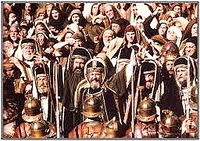 Pilate presents the lacerated Jesus saying, “Ecce Homo / Behold (the) man!” The shot is from behind, emphasizing the angry, riotous mob in the background, for these words are a critique of fallen man/mankind.
- Pilate asks, “Shall I crucify your king?” The high priest replies, “We have no king but Caesar,” denying the kingship of God.
- The 14 Stations of the Cross make appearances throughout the film, including the three times Jesus falls.
- Embracing his cross, Jesus alludes to Psalm 116: “I am your servant Father. Your servant and the son of your handmaid.
- Mary, recalling when Jesus once fell as a child, rushes to his side. Jesus tells her, “See, Mother, I make all things new,” foreshadowing Revelation 21:5, “Behold, I make all things new.”
- Veronica, who gives Jesus her veil to wipe his face, has a name which means “true image.”
- Jesus’ experiences at Golgotha are paralleled with flashbacks to the Last Supper. Jesus is stripped, the bread is uncovered. The Host is lifted, his cross is raised.
- The Virgin Mary at the foot of the cross calls Jesus, “Flesh of my flesh, heart of my heart…” echoing the words of Adam toward Eve.
- On the cross, Jesus quotes Psalm 22: “My God, my God, why have you forsaken me?”
Archive for the ‘Reflection’ Category
Reflections on The Passion of the Christ
February 26, 2015
21 Ideas for Lent
February 18, 2015Prayer
- Practice intentional, daily prayer.
- Pray with passages from the Gospels of Matthew, Mark, Luke, or John.
- Pray the Stations of the Cross communally or on your own.
- Read spiritual books and talk about them with Jesus.
- Learn more about a saint and grow closer to him or her.
- Pray the Rosary, imagining yourself present at each of the mysteries.
- Attend daily Mass.
Fasting
- Buy nothing that you do not need.
- Drink water in place of other beverages.
- Refrain from complaining.
- Say only good things about others unless your duty requires otherwise.
- Keep from the TV, internet, smart phone, iPad, and/or radio.
- Sleep without a pillow.
- Choose a distant parking space.
Almsgiving
- Save the money you would normally spend on something else to donate to a cause.
- Fill a give-away box with things you don’t really need.
- Clear your closet of clothes the clothes you don’t wear and give them away.
- When you go shopping, pick up non-perishable food items for the food bank.
- Contribute to our diocesan annual appeal to support Christ’s work.
- Give those living in nursing homes or the homebound the gift of a visit.
- Say three loving things to your spouse and kids each day.
Encountering Jesus at His Ministry’s Beginning & End
January 9, 2015Comparing John 1:35-43 & 20:11-18
- John the Baptist is with two of his disciples when he points out Jesus “the Lamb of God” passing by. Jesus turns, sees the two disciples following him, and asks, “What are you looking for?”
- Mary of Magdala is with two angels at the empty tomb when Jesus comes by. She turns around and sees Jesus, but does not know it’s him. He asks her, “Whom are you looking for?”
- John the Baptist’s two disciples answer Jesus, “Rabbi, (that is, Teacher) where are you staying?”
- Mary, recognizing the risen Lord, says to him, “Rabbouni!” (which also means Teacher.)
- Jesus tells the curious duo, (one of whom we are told is St. Andrew the Apostle) “Come, and you will see.”
- Jesus tells the overjoyed Mary, “Go to my brothers and tell them, ‘I am going to my Father and your Father, to my God and your God.”
Points for Reflection:
 □ We first come to Jesus looking for something. (“What are you looking for?”) But we are in fact looking for a Someone. (“Whom are you looking for?”)
□ Our search begins with curiosity, but grows finally into love.
□ Jesus is a Teacher to them all, but he more than a teacher to Mary of Magdela. (Similarly, in Matthew’s telling of the Last Supper, all the apostles call Jesus “Lord,” while Judas calls him merely, “Rabbi.”)
□ Jesus makes the first two apostles, but he makes Mary (as the Church Fathers call her) “the Apostle to the Apostles.”
□ Jesus draws us near (“Come and see,”) and then he sends us forth on mission (“Go to my brothers and tell them…”)
□ Jesus’ baptism leads to his tomb and resurrection.
□ Jesus, who dwelt on earth, now dwells with His Father in Our Father’s house. Jesus wills that we come to dwell with him, in Heaven, as it is on earth.
Who is John? — 3rd Sunday of Advent—Year B
December 15, 2014 Gospel: John 1:6-8, 19-28
Who are you?
“I am not the Christ.”
Are you Elijah?
“I am not.”
Are you the Prophet?
“No.”
While St. Peter denied Christ three times to his shame, St. John the Baptist denied himself three times to his glory.
Acknowledging Christ As Our King
November 22, 2014 Imagine if the United States of America had no protections for religious freedom. Imagine if on your way to Mass today you were pulled over by secret police and put under arrest. When you ask, “What have I done,” they reply, “You’re accused of being a believing Catholic Christian.” The police have had you under intense surveillance for several weeks; wire-tapping your phone, monitoring your computer, searching your personal belongings, and recording your movements and activities. Imagine yourself in this situation and consider this question: when all of the evidence is presented against you at trial, will there be enough evidence to find you guilty of being a believing Catholic Christian?
Could their informants testify that you observe Fridays as a day of penance and Sundays as a day of rest, that you faithfully go to Mass and frequent the sacrament of reconciliation? Could anyone testify that they heard you say positive things about Jesus Christ or speak up for the Catholic faith when it was mocked or criticized in your presence? Could they put into evidence some rosary, Bible, or other Catholic book marked with your fresh fingertips? Would they have hidden-camera footage of you praying before meals at a restaurant? Would they have grainy night-vision footage of you praying before going to bed, or first thing in the morning, making the tell-tale sign of the cross.
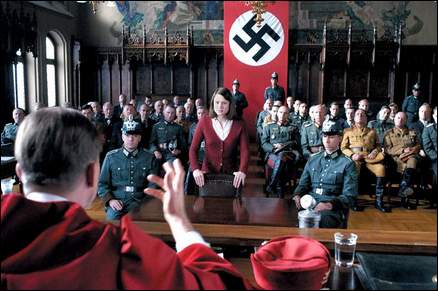 The judge, looking down from his bench, says, “It is alleged that you were picked up on your way to Mass. We realize that people get mixed-up with these hateful superstitions for different reasons. Maybe you went there unthinkingly, out of custom or habit. Perhaps you felt pressured by your relatives or neighbors. The punishment for being found guilty of being a believing Catholic is grave, but if you would simply acknowledge your mistake and renounce Jesus Christ we will let you go.”
How would you answer? Our Lord Jesus Christ tells us:
Everyone who acknowledges me before others I will acknowledge before my heavenly Father. But whoever denies me before others, I will deny before my heavenly Father.” (Matthew 10:32-33)
We may never face red martyrdom, but we decide whether or not to acknowledge Jesus Christ as our King in many little ways. As Jesus says:
“The person who is faithful in very small matters is also faithful in great ones; and the person who is dishonest in very small matters is also dishonest in great ones.” (Luke 16:10)
The Dying Words of Jesus & His Saints
November 14, 2014Each November, when the dark nights lengthen and trees become bare skeletons, we especially pray for the souls of those who have gone before us in death. This is also a fitting time of year to remember and consider the certainty of our own mortality. How did Jesus and his holy ones face the end of their lives? Their dying words can both instruct and inspire us:
“Father, into your hands I commend my spirit.”
—Our Lord Jesus Christ, c. 33 AD
“Lord Jesus, receive my spirit. Lord, do not hold this sin against them.”
—St. Stephen, martyr, c. 34 AD
“Glory to God for all things!”
—St. John Chrysostom, 407 AD
“Your will be done. Come, Lord Jesus!”
—St. Augustine, 430 AD
“May God forgive you, brother.”
—St. Wenceslaus, martyr, 935 AD
“I have loved justice and hated iniquity. Therefore I die in exile.”
—Pope St. Gregory VII, 1085 AD
“If all the swords in England were pointed against my head, your threats would not move me. I am ready to die for my Lord, that in my blood the Church may obtain liberty and peace.”
—St. Thomas Becket, martyr, 1170 AD
“When you see that I am brought to my last moments, place me naked upon the ground just as you saw me the day before yesterday; and let me lie there after I am dead for the length of time it takes one to walk a mile unhurriedly.”
—St. Francis of Assisi, 1226 AD
“Be assured that he who shall always walk faithfully in God’s presence, always ready to give him an account of all his actions, shall never be separated from him by consenting to sin.”
—St. Thomas Aquinas, 1274 AD
“Leave the doors open, so that everyone may enter and see how a pope dies.”
—Bl. Pope Urban V, 1370 AD
“Into your hands, O Lord, I commend my spirit.”
—St. Bridget of Sweden, 1373 AD
“Blood! Blood! Father, into your hands I commend my spirit.”
—St. Catherine of Siena, 1380 AD
“Jesus, Jesus, Jesus!”
—St. Joan of Arc, martyr, 1431 AD
“I die the king’s good servant, but God’s first.”
—St. Thomas More, martyr, 1535 AD
“O, my God!”
—St. Ignatius of Loyola, 1556 AD
“After all I die as a child of the Church. My Lord, it is time to move on. Well then, may your will be done. O my Lord and my spouse, the hour that I have longed for has come. It is time for us to meet one another.”
—St. Teresa of Avila, 1582 AD
“Jesus, I love you.”
—St. Kateri Tekakwitha, 1680 AD
“In all things I adore the will of God in my regard.”
—St. Jean Baptiste de la Salle, 1719 AD
“Be children of the Church.”
—St. Elizabeth Ann Seton, 1821 AD
“My immortal life is on the point of beginning. Become Christians if you wish to be happy after death, because God has eternal chastisements in store for those who have refused to know Him.”
—St. Andrew Kim Taegon, martyr, 1846 AD
“Holy Mary, pray for me, a poor sinner.”
—St. Bernadette Soubirous, 1879 AD
“I have reached the point of not being able to suffer any more, because all suffering is sweet to me. My God, I love you.”
—St. Therese of Lisieux, 1897 AD
“To restore all things in Christ.”
—Pope St. Pius X, 1914 AD
“Long live Christ the King!”
—Bl. Miguel Pro, S.J., martyr, 1927 AD
“Jesus. Maria.”
—St. Pio of Pietrelcina, 1968 AD
“Jesus, I love you. Jesus, I love you.”
—Bl. Mother Teresa of Calcutta, 1997 AD
“Let me go to the house of the Father.”
—St. John Paul the Great, 2005 AD
What do you want to be your dying words?
Praying with a “Marked Deck”
October 19, 2014 Meditating on the Gospels helps us to grow closer to Jesus, but which passage should we bring to our time of prayer?
With the 1st Sunday of Advent (coming liturgically the evening of November 29th, 2014) we’ll begin exploring the Gospel of Mark in our Cycle B Sunday readings. One option for prayer is to meditate on next Sunday’s Gospel in order to enter more deeply into the Mass.
Or, to contemplate Mark’s entire Gospel, you can pray with it bit by bit, day by day, from start to finish.
On the other hand, you can let yourself be completely surprised by whatever divine providence deals you. In my Holy Hours, I’m planning to randomly draw my Marcan passage for lectio divina from this list, and you can do the same:
2♠ Mark 1: 1-15
3♠ 1: 16-31
4♠ 1: 32-45
5♠ 2: 1-12
6♠ 2: 13-22
7♠ 2: 23 – 3: 6
8♠ 3: 7-19
9♠ 3: 20-35
10♠ 4: 1-9, 14-20
J♠ 4: 10-13, 21-25
Q♠ 4: 26-34
K♠ 4: 35-41
A♠ 5: 1-20
2♥ 5: 21-24, 35-43
3♥ 5: 25-34
4♥ 6: 1-16
5♥ 6:17-29
6♥ 6:30-44
7♥ 6:45-56
8♥ 7: 1-13
9♥ 7: 14-30
10♥ 7: 31-37 & 8: 22-26
J♥ 8: 1-10
Q♥ 8: 11-21
K♥ 8: 27 – 9: 1
A♥ 9: 2-13
2♦ 9: 14-29
3♦ 9: 30-37
4♦ 9: 38-50
5♦ 10: 1-16
6♦ 10: 17-31
7♦ 10: 32-45
8♦ 10: 46 – 11: 11
9♦ 11: 12-25
10♦ 11: 27 – 12: 12
J♦ 12: 13-27
Q♦ 12: 28-37
K♦ 12: 38-13:2
A♦ 13: 3-23
2♣ 13: 24-37
3♣ 14: 1-11
4♣ 14: 12-26
5♣ 14: 27-42
6♣ 14: 43-52
7♣ 14: 53-65
8♣ 14: 66-72
9♣ 15: 1-15
10♣ 15: 16-24
J♣ 15: 25-38
Q♣ 15: 39-47
K♣ 16: 1-13
A♣ 16: 14-20
Our Lady’s Wisconsin Message: The Meaning of the Two Trees
September 25, 2014In the Garden of Eden, there were many fruit-bearing trees, but Genesis mentions only two by name: the Tree of Life, and the Tree of the Knowledge of Good and Evil. By partaking of the Tree of Life the human race could keep living forever, but the Lord warned that to eat from the other tree would mean our certain death. On October 9th, 1859, the Blessed Virgin Mary appeared near Green Bay to a 28 year-old Belgian immigrant named Adele Brise while she was walking eleven miles home from Sunday Mass. Interestingly, Our Lady chose to appear to Adele not in a church, or a thousand other places, but between two trees: a Maple and a Hemlock.
 You’re familiar with the beauty and goodness of the Maple. In the fall, its leaves turn the most striking colors, and in the spring its sap yields sweet syrup. But do you know about the Hemlock tree? The poison that the Greek philosopher Socrates was condemned to drink came from this plant. Ingesting just six or eight fresh Hemlock leaves can kill a healthy adult. [Post-Script: The Hemlock Tree found in Wisconsin is not poisonous, but merely shares the name.] The Maple is a tree of life while the Hemlock is a tree of death. Mary, the New Eve, stood between the two.
 Mary told Adele, “I am the Queen of Heaven, who prays for the conversion of sinners, and I wish you to do the same. You received Holy Communion this morning, and that is well. But you must do more. Make a general confession, and offer Communion for the conversion of sinners. If they do not convert and do penance, my Son will be obliged to punish them.” Our Lady’s message between the two trees is akin the words of Moses, who told the Israelites: “I have set before you life and death, the blessing and the curse. Choose life, then, that you and your descendants may live, by loving the Lord, your God, heeding his voice, and holding fast to him. For that will mean life for you, a long life for you to live on the land….”
 Apparently, Our Lady’s warnings were not sufficiently heeded. In October of 1871, exactly twelve years later, disaster came. Both in terms of size and number of lives lost, the Peshtigo Fire remains the worst recorded forest fire in U.S. history. Between 1,200 and 2,400 lives ended in that firestorm which saw, according to an eyewitness, “large wooden houses torn from their foundations and caught up like straws by two opposing currents of air which raised them till they came in contact with the stream of fire.” This seems to be the punishment due to sin that Mary spoke of, yet this does not mean that everyone who perished in that fire was condemned. We should remember that at harvest time, the wheat and the weeds are pulled up together in a moment, but their future fates are not the same. Once uprooted, the good are gathered and kept in the barn, while the bad are thrown away forever.
The firestorm came and surrounded the shrine of Our Lady, where hundreds had come for refuge with their families and herds, beseeching her intercession before God. As many as fled to her there were saved. The shrine’s consecrated earth was an emerald-green island in an ocean of smoldering ashes as far as eyes could see.
Mary, the Queen of Heaven, prays for the conversion of sinners and she wishes you to do the same. You receive Holy Communion, and that is well. But you must do more. Begin by receiving the sacrament of reconciliation regularly, because it is powerful for growing in holiness. The sinner whose conversion you are most responsible for is your own.
Our Lady’s Message in Wisconsin: Conversion & Catechesis
September 18, 2014On the Feast of the Immaculate Conception in 2010, at the Shrine of Our Lady of Good Help located about sixteen miles northeast of Green Bay, Bishop David Ricken endorsed our country’s first Church-approved Marian apparition:
“I declare with moral certainty and in accord with the norms of the Church that the events, apparitions and locutions given to Adele Brise in October of 1859 do exhibit the substance of supernatural character, and I do hereby approve these apparitions as worthy of belief (although not obligatory) by the Christian faithful.”
 155 years ago, a lovely blond-haired lady clothed in dazzling white, with a yellow sash around her waist and a crown of stars around her head, appeared to a 28-year-old lay woman named Adele Brise. Adele asked the lady who she was and what she wanted. She answered, “I am the Queen of Heaven who prays for the conversion of sinners, and I wish you to do the same. You received Holy Communion this morning and that is well. But you must do more. Make a general confession and offer Communion for the conversion of sinners… Gather the children in this wild country and teach them what they should know for salvation…”
This was the core of Mary’s message: for sinners to be converted and for children to be catechised. Yet Adele hesitated and asked how she was to teach the young when she knew so little herself. Mary replied, “Teach them their catechism, how to sign themselves with the sign of the Cross, and how to approach the sacraments; that is what I wish you to do. Go and fear nothing, I will help you.” After Adele’s encounter, her father built a small chapel on the site and Adele went about fulfilling her entrusted mission for the rest of her life. Exactly twelve years after Mary’s message came the terrible Peshtigo Fire which still ranks as the worst fire disaster in U.S. history. By a miracle, all who fled to Mary’s shrine for refuge were saved.
Our Mother, the Church, teaches that parents are the primary educators of their children in the Faith. This means that whether our kids go to CCD or Catholic school, family is the first and foremost teacher of life’s most important lessons. But how often do we talk to our children about Jesus and Mary, or teach them about what they should know for salvation? I suspect that many feel intimidated like Adele Brise was because they think they know too little. Yet Mary reassures us that anyone can begin teaching children the simple, precious lessons that will stay with them and bless them forever. As our children grow, we also must grow in the Faith, exploring the what’s and why’s of the Church’s teachings and living them out in our lives. Catechesis without conversion is in vain.
The Virgin Mary’s message to Adele Brise remains timely for us today: “Pray for the conversion of sinners… Offer Communion for the conversion of sinners… Gather the children in this wild country and teach them what they should know for salvation… Go and fear nothing, I will help you.”
Everyone Has Time to Read the Gospels
September 9, 2014Have you ever read the four Gospels:
Matthew, Mark, Luke, & John?
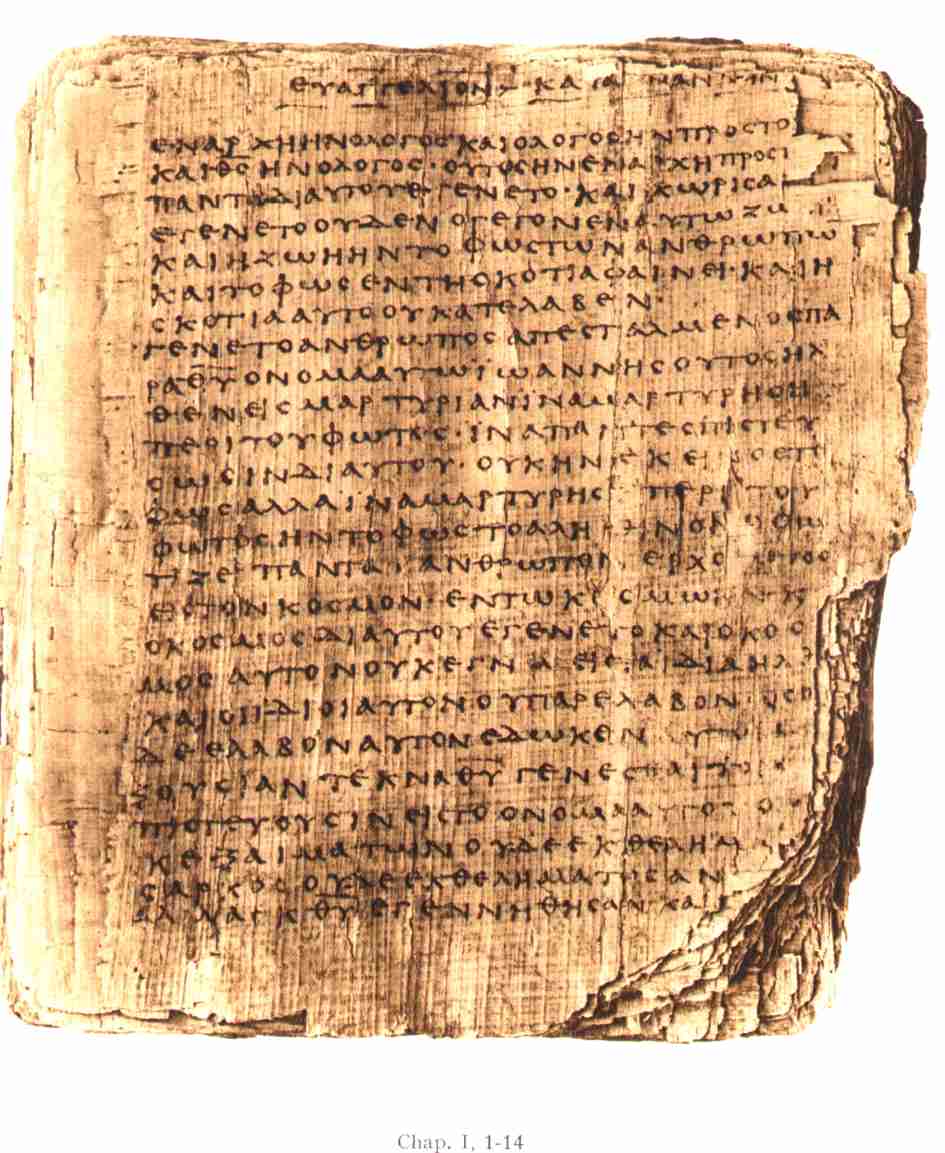
A Papyrus Manuscript (P66) of the Beginning of John
People say that they don’t have time to read the four most important books in human history, but the truth is that everyone does. It is simply a question of our priorities.
Given the average person’s reading speed and the number of words in each book, about how long does it take to read the Gospels? [NB: These times will vary based upon the Bible translation and a person’s reading speed.]
Matthew: 1 hour, 14 minutes
Mark: 46 minutes
Luke: 1 hour, 18 minutes
John: 1 hour, 3 minutesThe Four Gospels: 4 hours, 21 minutes
For comparison, you can read:
- Mark in the typical span of one quarter of NFL football.
- John in the time lost watching commercials in four hours of cable TV.
- Matthew in the average span of four Major League Baseball innings.
- Luke in the typical length of one half of an NBA playoff game.
- Matthew & Mark in the time it took to see Star Wars: Episode IV – A New Hope.
- Mark & Luke in the span of three plays of Michael Jackson’s Thriller album.
- Matthew & John in the average time of one regular season NBA game.
- Luke & John in the time it took to see Marvel’s The Avengers.
- Mark, Luke, & John in the time you took to watch Peter Jackson’s King Kong.
- Matthew, Mark, & John in the time of an average NFL football game.
- Matthew, Mark, & Luke in the theater runtime of The Lord of the Rings: The Return of the King.
- Matthew, Luke, & John in the time it took you to see M. Night Shyamalan’s The Sixth Sense twice.
- Matthew, Mark, Luke, & John in time it takes to watch the first season of Sherlock, or five episodes of House of Cards or Game of Thrones.
If we have had the time for any of the things above, what excuse will we have for someday appearing before the Lord Jesus without having read his Gospels? Put first things first, and take time today to begin reading his four Gospels.
The Ungospel of Matthew 18:15-17*
September 6, 2014(*From The Unbiblical Translation Bible)
15 “If your brother sins against you, go and tell anyone about his fault, except for him alone. He won’t listen, and the silent treatment guarantees this.
16 Instead, with one or two others (over coffee, on the phone, or during a lunch break,) testify to your grievances.
17 If they listen, then your gossip will spread through the church and (whether deserved or not) he will be treated as a telemarketer or a tax collector.”
“Late Have I Loved You…”
August 28, 2014 In “The Confessions,” the first autobiography in Western history, St. Augustine of Hippo tells of his sinful youth away from the Lord prior to his conversion. In perhaps its greatest passage, Augustine pens these words to God:
“Late have I loved you, O Beauty ever ancient, ever new, late have I loved you! You were within me, but I was outside, and it was there that I searched for you. In my unloveliness I plunged into the lovely things which you created. You were with me, but I was not with you. Created things kept me from you; yet if they had not been in you they would not have been at all. You called, you shouted, and you broke through my deafness. You flashed, you shone, and you dispelled my blindness. You breathed your fragrance on me; I drew in breath and now I pant for you. I have tasted you, now I hunger and thirst for more. You touched me, and I burned for your peace.”
Neat Things About “A Man For All Seasons”
August 21, 2014“A Man For All Seasons” was 1966’s Academy Award winner for Best Picture, and it is my all-time favorite movie. This YouTube video I made presents a number of interesting things you never knew about this wonderful film. I invite you to watch, “like,” and “share” it.
A Glorious Lady in Heaven
August 15, 2014Like Dante’s Divine Comedy, C.S. Lewis’ The Great Divorce takes a first-person tour of Hell, Purgatory, and Heaven. Dante had a next-worldly guide in the Roman poet Virgil, while Lewis had the Scottish author George MacDonald. While on the Plains of Heaven, Lewis beholds the following (abridged) scene:
Some kind of procession was approaching us, and the light came from the persons who composed it. First came bright Spirits, not the Spirits of men, who danced and scattered flowers. Then, on the left and right, at each side of the forest avenue, came youthful shapes, boys upon one hand, and girls upon the other. If I could remember their singing and write down the notes, no man who read that score would ever again grow sick or old. Between them went musicians; and after these a lady in whose honor all this was being done. And only partly do I remember the unbearable beauty of her face.
“Is it?… Is it?” I whispered to my guide.
“Not at all,” said he. “It’s someone ye’ll never have heard of. Her name on earth was Sarah Smith and she lived at Golders Green.”
“She seems to be… well, a person of particular importance?”
“Aye. She is one of the great ones. Ye have heard that fame in this country and fame on Earth are two quite different things.”
“And who are all these young men and women on each side?”
“They are her sons and daughters.”
“She must have had a very large family, Sir.”
“Every young man or boy that met her became her son – even if it was only the boy that brought the meat to her back door. Every girl that met her was her daughter.”
“Isn’t that a bit hard on their own parents?”
“No. There are those that steal other people’s children. But her motherhood was of a different kind. Those on whom it fell went back to their natural parents loving them more. Few men looked on her without becoming, in a certain fashion, her lovers. But it was the kind of love that made them not less true, but truer, to their own wives. It is like when you throw a stone into a pool, and the concentric waves spread out further and further. Who knows where it will end? Redeemed humanity is still young, it has hardly come to its full strength. But already there is joy enough in the little finger of a great saint such as yonder lady to waken all the dead things of the universe into life.”
The First Principle and Foundation
July 31, 2014Man is created to praise, reverence, and serve God our Lord, and by this means to save his soul.
And the other things on the face of the earth are created for man and that they may help him in prosecuting the end for which he is created.
From this it follows that man is to use them as much as they help him on to his end, and ought to rid himself of them so far as they hinder him as to it.
For this it is necessary to make ourselves indifferent to all created things in all that is allowed to the choice of our free will and is not prohibited to it; so that, on our part, we want not health rather than sickness, riches rather than poverty, honor rather than dishonor, long rather than short life, and so in all the rest; desiring and choosing only what is most conducive for us to the end for which we are created.
-St. Ignatius of Loyola, Spiritual Exercises #23
 Parishable Items