Archive for the ‘Reflection’ Category

One Bible, Many Interpretations

April 29, 2014

Mormons teach that the Father, Son, and Holy Spirit are three Gods, and that we too can become Gods in our own right someday.

You may reply to them, for instance, with James 2:19, “You believe that God is one. You do well. Even the demons believe that and tremble,” but Mormons will have some explanation for that New Testament passage which fits their theology.

Oneness Pentecostals teach that the Father, Son, and Holy Spirit are not three persons but three manifestations of one divine person, God.

You may ask them who Jesus is praying to in Matthew 26:39 when he says in the Garden of Gethsemane, “My Father, if it is possible, let this cup pass from me; yet, not as I will, but as you will,” yet Oneness Pentecostals will offer some answer for why Jesus is not praying to another person.

Jehovah’s Witnesses teach that Jesus is not God, not divine, but God’s first and greatest creature and that the Holy Spirit is not a person but the active force of God the Father in the world.

You may answer with the beginning and end of the Gospel of John: with John’s prologue where we see “the Word was with God, and the Word was God. … And the Word became flesh,” and the gospel’s climax, John 20:28, “Thomas answered and said to [Jesus,] ‘My Lord and my God!'” However, Jehovah’s Witnesses will surely have some reply for these verses.

A diagram of the ancient, orthodox, Christian conception of the Holy Trinity

A diagram of the ancient, orthodox, Christian conception of the Most Holy Trinity: One God, Three Divine Persons

In my personal experience, advocates of Mormon polytheism, Oneness Pentecostal modalism, or Jehovah’s Witnesses Arianism-esque theology have all been sincere, friendly, rational, and not unintelligent people. They were all well-versed in the Bible, regarded it as God’s infallible Word, and used it to support their beliefs. They all proudly claimed the name of “Christian.” However, the undeniable fact that their theologies contradict each other proves that these admirable personal traits are not enough to guarantee a true understanding of the Christian Faith. The problem is that there seems to be more than one possible internally-coherent interpretation of the Bible. Just as texts out of context can suggest several defensible, though incorrect, meanings; interpreting biblical texts outside the context of Christ’s one, holy, catholic, and apostolic Church leads to many errors.

Last week, two very nice Jehovah’s Witnesses visited me at my rectory and we spoke for a couple of hours. I believe we were debating whether one of Jesus’ “I Am” statements in John’s Gospel was a profession of his divinity when one of my guests remarked, “We can’t really be certain what he meant.” I replied to the effect, “You’re right!–If your opinion and my opinion are all we have to go on, if there’s no visible authority on earth with power from Jesus Christ to infallibly answer biblical questions, then we can never be certain our interpretations are true–since many sincere, reasonable, and even scholarly Christians firmly disagree. Without a clear, external teaching authority within the Church, we would be left as sheep without a shepherd and inevitably scatter.” Most Christians revere the Holy Scriptures as God’s infallible Word, and this is right and good, but for some reason many of them reject the Catholic Church through which the Scriptures come.

Recall that Jesus wrote nothing in the Gospels (except perhaps something in the dust near the woman caught in adultery) but Jesus did establish a Church. Through this Church the New Testament was written, collected, canonized, and revered. However, this process was certainly not completed in the first century AD. In the early Church there was much debate over which New Testament writings were inspired and should be included in the canon. The Shepherd of Hermas? The Book of Revelation? The Didache? The Letter to the Hebrews? The Epistle of Clement? Some early Church Fathers included works such as these in their lists of Bible books, while others left them out. It was the Catholic Church that ultimately canonized the New Testament books which all Christians acknowledge today.

One teaching shared by Mormons and Jehovah’s Witnesses is the belief that a Great Apostasy occurred in the early Church. The New Testament contains verses which warn about false teachers arising who will mislead many. A great deception, those religions say, happened soon after the death of the apostles and explains why the majority of self-professed Christians in history have held core doctrines widely different from their own. I would agree that false teachers and heresies arise in every age, but was there a Great Apostasy soon after the apostles that devastated Christ’s Church and caused his central teachings (like the true nature of God) to be discarded and forgotten?

Christ Handing the Keys to St. Peter by Pietro Perugino (detail)

Jesus entrusting the keys of his Kingdom to St. Peter (Matthew 16:19)

All Christians will agree that Jesus was a wise man. Jesus was a wise man indeed, who built his house on rock. Jesus declared to Simon, “‘I say to you, you are Peter [that is, you are “Rock” in Greek] and upon this rock I will build my church, and the gates of the netherworld shall not prevail against it.'” (Matthew 16:18) If Jesus was a wise man who built his house on rock we can be assured that even though “the rain fell, the floods came, and the winds blew and buffeted the house–it did not collapse; [his Church] had been set solidly on rock.” (Matthew 7:24-25)

After building his Church on Peter for some forty years, did Jesus let it go into shambles and fail to repair it for about eighteen centuries, until Joseph Smith or The Watchtower came along? If so, Jesus really dropped the ball. If the Mormons or Jehovah’s Witnesses are right, then God managed to get all of the New Testament books infallibly written, correctly canonized, and faithfully preserved throughout millennia, but could not maintain the truth about himself in his Church on earth in the hearts and minds of believers much beyond the death of the apostles. More likely, our Lord Jesus Christ succeeded in preserving his teachings and the visible hierarchical authority he gave to his Church, from St. Peter (the first pope) and the apostles to Pope Francis and the bishops in communion with him today. A clear and necessary line of teaching authority runs though the centuries, through the laying of hands and apostolic succession.

You may encounter people who will present you with internally-consistent but very different interpretations of Scripture. Do not let your hearts be troubled. There are good reasons for everything we believe as Catholics. They may “know” the Bible, but we are blessed to know God’s Church from which the Bible comes. If you love Jesus Christ, love his Catholic Church. As even St. Joan of Arc, who personally experienced the complexities of the Church as a divine and human institution, said, “About Jesus Christ and the Church, I simply know they are just one thing and we shouldn’t complicate the matter.” If you love Jesus’ Church you will love him well. Jesus Christ is risen and his Catholic Church, though ancient, has never died. Christ’s Church, the Bride he protects and for whom he laid down his life, is very much alive.

First Things First — Divine Mercy Sunday—2nd Sunday of Easter

April 28, 2014

Gospel: John 20:19-31

[Though the doors were locked, where the disciples were,] Jesus came and stood in their midst and said to them, “Peace be with you.” When he had said this, he showed them his hands and his side.

What was Jesus’ first order of business on the first Easter Sunday? Demonstrating to his disciples the fact of his resurrection.

What was the next most important thing on Jesus’ list? Commissioning his Church to impart his Divine Mercy to world.

Jesus said to them again, “Peace be with you. As the Father has sent me, so I send you.” And when he had said this, he breathed on them and said to them, “Receive the Holy Spirit. Whose sins you forgive are forgiven them, and whose sins you retain are retained.”

Tips for Praying With the Psalms

March 28, 2014

The Book of Psalms contains 150 psalms (or sung prayers) which have been used in communal worship and private devotion by God’s people for thousands of years; first among the Jews and now by Christians as well.   The psalms are prayers inspired by the Holy Spirit  corresponding to the wide spectrum of human experience:  joy and sorrow; triumph and defeat; contrition, thanksgiving, and praise.

Is it OK to question God and complain to him in prayer? Is it acceptable to tell the Lord how unhappy or angry you feel? The psalms show that God welcomes such prayers. He knows our only alternative to coming to him for help and healing is to stuff or deny these feelings, letting them to embitter or depress us.

Sometimes a particular psalm may not resonate with my spirit at the moment. For example, how can I benefit from a psalm lamenting a betrayal when all is well in my own life? I can pray such psalms as an intercessor for those experiencing such trials and unite my heart to theirs. Another way to pray each psalm with a new richness comes from the realization that these prayers were well-known and often offered by Jesus and Mary. This Lent, try praying the psalms through their eyes.

Reflections on St. Joseph — March 19 — St. Joseph

March 19, 2014
  • Joseph was probably the first person Jesus Christ called “Abba.”
  • As a carpenter, Joseph created things by his mind and hand, imaging God the Father, Creator of the universe.
  • Joseph never gave a stone, a snake, or a scorpion to Jesus when asked for a loaf of bread, a fish, or an egg.
  • Like God the Father, Joseph can seem quiet, but he never ceases in his love and action.
  • As God loved ancient Israel purely, so Joseph loved Mary—the icon of perfected Israel.
  • Joseph was the protector and provider in the household of the Son of God. Now he is the patron of the universal Church.

God’s Words — Tuesday, 1st Week of Lent

March 11, 2014

Readings: Isaiah 55:10-11, Matthew 6:7-13

[My word] shall not return to me void, but shall do my will, achieving the end for which I sent it.

Jesus said to his disciples: “This is how you are to pray: Our Father who art in heaven, hallowed be thy name…”

God’s word is an effective word. What God says, is. In the beginning, God said, “Let there be light,” and there was light. Jesus told the leper, “Be made clean,” and the paralytic, “Your sins are forgiven,” and so they were. At the Last Supper, Jesus said, “This is my body,” and it became so.

When we pray the Our Father we are asking for what the Father already desires for us using the very words of Jesus. Therefore, let us pray the Our Father with confidence, knowing we are praying the Father’s loving will and the Son’s effective word.

Tempting the Messiah — 1st Sunday in Lent—Year A

March 7, 2014

Gospel: Matthew 4:1-11

Jesus Tempted in the Wilderness by James Tissot 1886-1894.The devil suggests Jesus should change stones into bread. He wants Jesus to be a materialistic Messiah who will focus on nourishing bodies to the neglect saving souls. Jesus replies that “one does not live on bread alone, but on every word that comes forth from the mouth of God.” Christ shall change bread into himself at the Last Supper “for the life of the world.” (John 6:51)

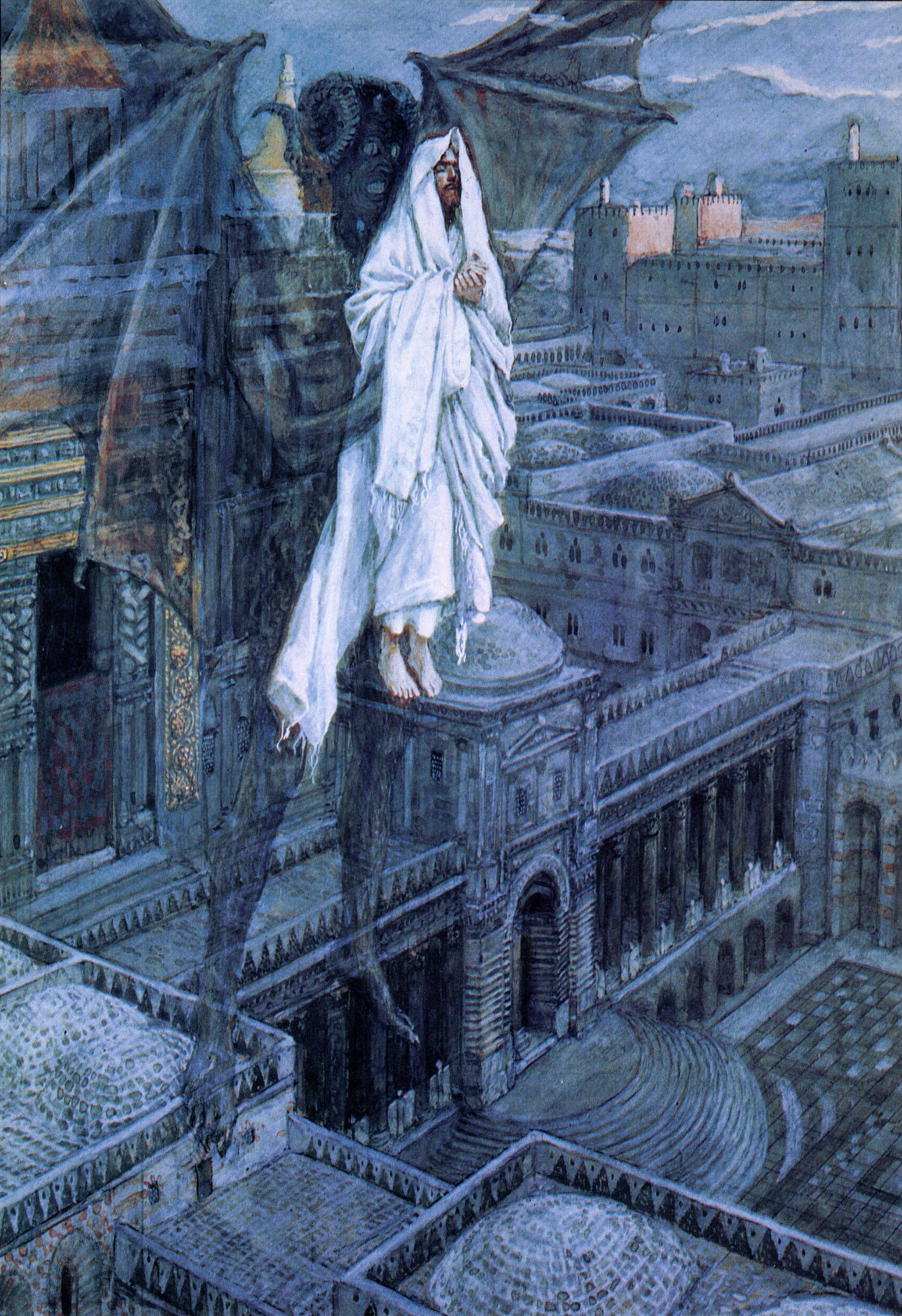
A depiction of Jesus being tempted at the temple by James Tissot, 1895The devil takes Jesus to a precipice atop the temple in Jerusalem and challenges him to throw himself down. He wants Jesus to be a Messiah who will hope to never suffer. Jesus responds that “you shall not put the Lord, your God, to the test” by trying to force him into doing our will. Christ shall be tested and condemned by the Sanhedrin in Jerusalem and be made a suffering Savior according to God’s plan. (Isaiah 53)

The devil takes Jesus up to a very high mountain, shows him all the kingdoms of the world, and promises to bestow them all if Jesus would simply prostrate himself and worship him. He wants Jesus to be a compromised Messiah who will pursue good by doing (or serving) evil. Jesus replies that “Lord, your God, shall you worship and him alone shall you serve.” By unwavering obedience to his heavenly Father, Christ shall become the king of all nations, enthroned high upon a cross on Mount Calvary. (Matthew 20:21)

The Seven Deadly Sins & Seven Lively Virtues

March 6, 2014

Pride is lowered by Humility

Envy is opposed by Admiration

Wrath is tamed by Forgiveness

Sloth is stopped by Zeal

Greed is relinquished by Generosity

Gluttony is moderated by Asceticism

Lust is controlled by Chastity

Which lively virtue will you focus on growing?


The Meaning of Ashes — Ash Wednesday

March 6, 2014

Both the atheist and the Christian will agree on this: we came from dust and to dust we shall return. Apart from God we have no hope, for we are dust and ashes.

The ashes on our forehead are not a beauty mark. They point to the ugliness of the sins within us. Yet they are also an appeal to God that he would wash us clean.

Fire, like sin, consumes all it touches. Our ashes are a sign of all we have lost or harmed by sin. However, Old Testament sacrifices were also offered up to God by fire. Our ashes are also a sign of our desire to sacrifice ourselves entirely to him.

We receive ashes on our forehead in the shape of a cross; ashes because we are sinners, and a cross because we are Christ’s.

One Is Enough — Tuesday, 8th Week of Ordinary Time—Year II

March 4, 2014

Gospel: Mark 10:28-31

Jesus said, “Amen, I say to you, there is no one who has given up house or brothers or sisters or mother or father or children or lands for my sake and for the sake of the Gospel who will not receive a hundred times more now in this present age: houses and brothers and sisters and mothers and children and lands, with persecutions, and eternal life in the age to come.

Jesus lists seven things people give up for him and his Gospel but only six things that we will receive a one hundred-fold more in this present age. A person might give up an earthly father for the Kingdom of God, but he or she receives in return the singular, infinite fullness of God the Father.

Prophetic Perseverance — Friday, 7th Week of Ordinary Time—Year II

February 28, 2014

Readings: James 5:9-12, Mark 10:1-12

Do not complain, brothers and sisters, about one another, that you may not be judged. Behold, the Judge is standing before the gates. Take as an example of hardship and patience, brothers and sisters, the prophets who spoke in the name of the Lord. Indeed we call blessed those who have persevered.

St. James recalls that the prophets endured the complaints, criticisms, and condemnation of their brothers and sisters. The Hebrews repeatedly complained against the prophet Moses in the desert, displeasing God and earning his serious chastisements. Perhaps Moses realized the ‘hardness of their hearts’ would incite them to reject any mandate of God’s original intention for marriage as an unbreakable lifelong union, thereby incurring severe condemnation. Yet, “blessed [are] those who have persevered” in keeping their marriage vows—blessed by God’s granting of needed graces and blessed by accepting these graces—those whose spousal “Yes” means “Yes.” What a prophetic witness their faithful love is to the world!

Magnanimous, Not Petty — 7th Sunday in Ordinary Time—Year A

February 23, 2014

“Petty” comes from the French word for “small” (“petit.“) “Magnanimous” comes from the Latin words for “great” and “soul” (“magna” and “anima.“) We are not called to be small, but of great soul in our interactions with others.

Four Cheeks Turned — 7th Sunday in Ordinary Time—Year A

February 22, 2014

Gospel: Matthew 5:38-48

When attacked, our natural response is “fight or flight,” but Jesus suggests a  supernatural response: “When someone strikes you on your right cheek, turn the other one as well.” Since the Jews regarded the left hand as unclean, they would reflexively strike with the right hand. If the right cheek were hit, then one had been backhanded with contempt. Responding by turning the other cheek neither attacks not retreats, but insists on being regarded as an equal, whom one must strike (if at all) with an open hand. Jesus wants us to stand our ground in the face of injustice, assertively but lovingly, in hopes that the offender will reconsider his ways. Jesus modeled this response when he was struck during his trial before Annas:

The high priest questioned Jesus about his disciples and about his doctrine. Jesus answered him, “I have spoken publicly to the world. I have always taught in a synagogue or in the temple area where all the Jews gather, and in secret I have said nothing. Why ask me? Ask those who heard me what I said to them. They know what I said.” When he had said this, one of the temple guards standing there struck Jesus and said, “Is this the way you answer the high priest?” Jesus answered him, “If I have spoken wrongly, testify to the wrong; but if I have spoken rightly, why do you strike me?” (John 18:19-24)

Another saintly example was shown by Blessed Mother Teresa of Calcutta. Though reports vary, Mother Teresa was once begging bread from a baker for her orphanage. When the baker responded by spitting into her hand, she replied to effect, ‘I will keep this for me, but please give something for my children.’

In Victor Hugo’s Les Miserables, a bishop welcomes an impoverished convict to join his table and sleep at his home. However, that night, Jean Valjean steals his host’s silverware and goes away. The police catch him and take him to the bishop. Looking at Jean Valjean, the good bishop exclaims, “Ah! here you are! I am glad to see you. Well, but how is this? I gave you the candlesticks too, which are of silver like the rest, and for which you can certainly get two hundred francs. Why did you not carry them away with your forks and spoons?” Jean Valjean opens his eyes wide and stares at the venerable Bishop “with an expression which no human tongue can render any account of.” The bishop’s turn of the cheek spares the thief’s freedom and saves his soul.

And finally, a true story from a modern marriage: A woman’s husband had a terrible temper and every time it flared she would say, “That’s just like you to lose your temper!” But then, following a stroke of insight, she began responding differently. The next time he began to fly of the handle she told him, “That’s not like you to lose your temper,” and he nearly fell out of his chair. Even the kids looked at her funny, but she stuck with her new resolution. Months later, while at a restaurant together, he became irritated by the slow service. He started to fume about it, but then he suddenly stopped, turned to her, and said, “That’s not like me to lose my temper, is it?” This time, it is said, she nearly fell on the floor.

Was it true the first time the woman declared that it was not like her husband to lose his temper? The claim did not match his previous behavior, but perhaps he changed because she revealed to him that his uncontrolled anger was quite unlike the father, husband, and Christian man he truly and deeply wanted to be. This is the sort of realization and conversion we are to hope for in turning the other cheek.

Plus, a fifth story: “If a teen mugs you for your wallet…

Of Earth & The Universe — 5th Sunday in Ordinary Time—Year A

February 9, 2014

Literally, from the Greek:

You are the salt of the [ground] … You are the light of the [cosmos.]”

A Christian’s ordinary life on earth reveals the divine light responsible for the universe.

Baskets & Beds — Thursday, 3rd Week of Ordinary Time—Year II

January 30, 2014

Gospel Reading: Mark 4:21-25

Is a lamp “placed under a bushel basket or under a bed?” Of course not, for the open flame of an ancient lamp would risk the fiery destruction of these tools of work and rest. We must allow God’s Word to enlighten our toil and leisure, rather than try to suppress the Light in pursuits of profit and pleasure. Otherwise, “from the one who has not, even what he has will be taken away.”

The Blind & Lame — Monday, 3rd Week of Ordinary Time—Year II

January 27, 2014

Readings:  2nd Samuel 5:1-7, 10; Mark 3:22-30

The Jebusites of Jerusalem told King David, “You cannot enter here: the blind and the lame will drive you away!” Jesus, the Son of David, was warmly received by the blind and lame because he cured them. Instead, it was the intellectually blinded and emotionally lamed, such as the scribes who had come from Jerusalem, who rejected Jesus and crucified him outside the city.