Archive for the ‘Reflection’ Category

Be Well-Prepared for Disaster

February 20, 2020

On October 9th, 1859, the first Marian apparition in the United States (since approved by the Catholic Church as “worthy of belief – although not obligatory”) occurred near Green Bay, Wisconsin. Adele Brise, a 28-year-old Belgian immigrant, was walking eleven miles home from Sunday Mass when she saw a beautiful lady with long, wavy, golden hair wearing a crown of stars and clothed in a dazzling white dress with a yellow sash around her waist.

Adele fell to her knees and asked, “In God’s name, who are you and what do you want of me?” The Blessed Virgin Mary replied, “I am the Queen of Heaven, who prays for the conversion of sinners, and I wish you to do the same. You received Holy Communion this morning, and that is well. But you must do more. Make a general confession, and offer Communion for the conversion of sinners. If they do not convert and do penance, my Son will be obliged to punish them. … Gather the children in this wild country and teach them what they should know for salvation…

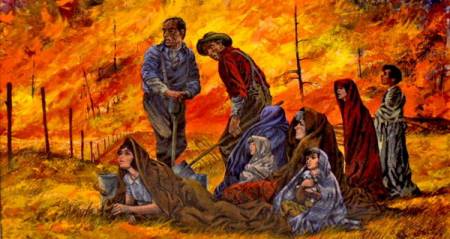
Adele was faithful to her mission, teaching the Catholic Faith to the young and praying for sinners’ souls. However, almost exactly twelve years to the day after Mary’s message, Eastern Wisconsin experienced the one of the largest and the most deadly forest fire in our nation’s history. Flames of the vast Pestigo Fire surrounded the shrine built upon the apparition site, but all who fled to this ground dedicated to Mary survived. Consider: is our present time and culture somehow less deserving of divine punishment than theirs?

Another disaster afflicted our land a century ago. From 1918 to 1920, a deadly flu plagued Europe and the U.S. but wartime censors suppressed news reports from many nations besides the World War One neutral country of Spain. The Spanish Flu, as it came to be called, would go on to kill an estimated 675,000 Americans and at least 50 million people worldwide. This largely-forgotten history has been on my mind as the Coronavirus pneumonia outbreak has spread forth from Wuhan, China. There are strong indications that the dictatorial Chinese government is under-reporting how many of their people are infected or have died from this highly-infectious disease, and new cases are being reported day-by-day around the world. Earlier this month, in a effort to contain the spread of the disease, the Hong Kong government asked its citizens to stay at home and the cardinal of their Catholic diocese has suspended public Masses. Could we experience a deadly pandemic here? The U.S. Centers for Disease Control saysthe potential public health threat posed by [Coronavirus] is high.” Therefore, it is wise to be prepared.

I urge prudent preparation on two fronts. First, materially speaking, if an emergency were declared and schools and businesses sent everyone home, could your family be able to shelter at your house away from others for two or three weeks until the crisis passed? What food and water would you have if your electric power went out? Building non-perishable food reserves is easy now while store shelves remain fully stocked. And if no disaster ever comes (as may well be the case) you can simply cycle through these pantry supplies over time; so nothing is lost. The second, more important front in your disaster preparedness is: are you spiritually ready?

If you knew this Lent might possibly be your last, how would that change your spiritual focus? What vices would you cut and which virtues would you grow? How would you commit to prayer and prepare your soul? For many, times of great crisis or the end of their lives arrive unexpectedly and people face them unprepared. As Jesus once observed, “In [the days of Noah] before the flood, people were eating and drinking, marrying and giving in marriage, up to the day that Noah entered the ark. They did not know until the flood came and carried them all away.” Mark’s Gospel recalls one occasion when the Pharisees came forward and began to argue with Jesus, seeking from him a sign from Heaven to test him. Jesus sighed from the depth of his spirit and said, “Why does this generation seek a sign?” The Pharisees had heard Jesus’ teachings and known his mighty works but they still obstinately refused to change. Why do we put off the Lord, refusing to listen and respond, postponing our conversion until it might be too late?

Once, after a tower collapse in Jerusalem ended eighteen lives, Jesus asked, “Do you think they were more guilty than everyone else who lived in Jerusalem? By no means! But I tell you, if you do not repent, you will all perish as they did!” Will the Coronavirus become a devastating American disaster like the Pestigo Fire or the Spanish Flu? Hopefully not. I pray to God it will not be so and ask that you do the same. Yet even if this crisis never comes to your community, why not prepare? Stocking-up your pantry, regularly washing your hands, instilling our Faith into your children, and deepening your own relationship with Jesus Christ are wise decisions you won’t regret.
Acknowledging our Unjustly Missing Children

January 24, 2020

It is said that those who do not learn from history are doomed to repeat it. The past offers us perspective on the present that can help preserve us from falling for the fashionable fallacies of our day.

Before the American Civil War (about 160 years or just two lifespans ago) slavery was legal in many U.S. states. You could buy a Black person as a slave and do whatever you wanted with him or her. You could beat or even kill your slave and there were no laws against it. If your slave had a child, you could sell that child away, at any time for whatever price, never to be seen again. Before the Civil War, the Supreme Court of the United States ruled in their Dred Scott decision that Black slaves were ‘not persons‘ under the U.S. Constitution. These human beings had zero rights. The Southerners said they were fighting the Civil War over “States’ Rights,” but the right to do what? First and foremost, the right to practice slavery. They might argue, “If you northerners don’t like slavery, fine, then don’t have slaves, but don’t come down here and tell us what to do in our states, with our laws, with our slaves, our own property. Unless you’re a southerner, you have no right to an opinion.” If you had lived in the South in those days, would you have pro or anti-slavery? If you think you would have opposed it, what makes you so certain?

Before the Second World War (about 80 years or just one lifetime ago) the Nazis in Germany began eradicating people they considered inferior. They began with the mentally and physically disabled, publicly arguing that their lives were not worth living and that they were burdens to society. Doctors and nurses would administer lethal injections to kill them. From there, the Nazis went on to kill millions more, not only on battlefields but in concentration camps; Jewish people, Polish people, people from any group the Nazis considered less than fully human. If you had lived in Nazi Germany you might not have fully realized what was going on (their news media wasn’t eager to report what was happening to the people being carried off in cattle cars) but if you had been there and known, what do you hope you would have done?

On January 22nd, 1973, the United States Supreme Court ruled in their Roe vs. Wade decision that unborn human beings are ‘not persons‘ under the U.S. Constitution and overturned laws prohibiting abortion across the nation. Since then, more than fifty million legal abortions have occurred in our country. In an abortion, a mother goes to a doctor to end the life of the baby girl or boy growing in her womb. Today some say that abortion is a woman’s personal right, that her unborn baby is not fully human, that the death of such little ones is best for society and that their lives would not be worth living anyways. As we’ve seen, such arguments have been made before.

In the United States ten years ago, for every 1,000 live births, 228 unborn babies were aborted. That means in a present day classroom of ten-year-old students, for every four children we see there is one child missing. In a class of sixteen, four are absent. In a classroom of twenty, five were never born. If three local youths were to die in a car accident this weekend, our community would be devastated by the tragic loss of three young lives cut short. But those who are not allowed to be born largely go unmourned; they are unnamed and unknown, yet they are known to God.

Will justice flourish in our time? Will we see the fullness of peace in our days? That depends in large part upon our choices and our prayers. We must repent of our sins against innocent life or we will experience the consequences of our sins. God is merciful but also just and He does not allow grave evils to continue unchecked forever. We did not live in Nazi Germany or the antebellum American South, but we likewise live in a time of important moral decision. Be resolved to hunger and thirst for the victory of a culture of life in our country and around the world. Pray and act for an end to abortion.

Sports Isn’t Everything

January 17, 2020

Human beings love sports. We also love to win. When we watch a team or athlete we identify with compete and prevail, we vicariously share in their victory. And this human trait is nothing new. The ancient Greeks celebrated their Olympians. The Romans had their famous gladiators and charioteers. In our day, almost one hundred million people watched the Super Bowl last year and more than one billion people around the world tune in to see the World Cup Final. Ironically, most Americans care very little about soccer—the most popular sport on earth, while most of the world has no interest in American football games. Sports, teams, and players, extremely important to some, can be completely disregarded by others.

Vince Lombardi was not the first coach to say it, but he did proclaim this maxim often: “Winning isn’t everything… it’s the only thing.” In his nine seasons coaching the Green Bay Packers, his teams won almost three out of every four games they played, including five NFL championships and two Super Bowls. And yet winning was not really the most important thing to Coach Lombardi. As sportswriter Jerry Izenberg recalls, “He told me one day, ‘I wish to h*** I’d never said that. (I.e., ‘Winning isn’t everything… it’s the only thing.’)” The sportswriter asked, “Well, don’t you believe it?” And Lombardi replied, “What I believe is, if you go out on a football field on Sunday, or any other endeavor in life, and you leave every fiber of what you have on that field when the game finally ends, then you’ve won. And to me that tells a lot more than the final score. And I never made that clear.’” However, I think his players had understood him, despite his imperfect and repeated maxim.

Former Packers reporter Ken Hartnett said of Vince Lombardi, “He was the first coach that I ever heard refer to love in the locker room. He really believed that there was a Christian love that he could incorporate into the team, the love that binds his players together, the love that comes out of sacrifice.” This flowed from Coach Lombardi’s faith. He was Catholic, attended the Sacrifice of the Mass every day, and was an adult altar server, too. “As far as myself is concerned,” he said, “I know my future happiness is, has to be, some other place. I want to try to do the things as well as I can here in order to attain someday maybe a greater happiness.” When Lombardi was dying from aggressive colon cancer fifty years ago this year, his past and present players came to his bedside out of grateful love for him. At his funeral Mass in St. Patrick’s Cathedral in New York City, Cardinal Terence Cooke preached, “Vince Lombardi fought the good fight. We believe in that last struggle with death this man won the final victory.

Unless it happens to be our own team, we rarely remember who won or lost state or national championships and titles, even just a few years afterward. Yet how many fans and parents forsake great amounts of time and money, their pleasant mood, or the Sunday worship our God is due on account of such games? There is a proper delight to found in sports, and virtues to be cultivated in their play, yet sports are not everything, nor the most important thing. In the words of St. Paul to the Colossians, “Whatever you do, in word or in deed, do everything in the name of the Lord Jesus, giving thanks to God the Father through him.

Jesus and His Wounded Church

October 27, 2019

On October 15th, her feast day, I heard a story told of St. Teresa of Avila I had never heard before. It may be a pious legend (as I have not found any primary sources for the tale) but it contains a truth all the same. The story goes that Satan once appeared to the 16th century Spanish nun in the glorious guise of Jesus. Satan intended to lead Teresa astray, but she quickly saw he was not Christ. Before departing from her the Devil asked how she was so certain. She replied, “Because you have no wounds.”

In the Book of Acts we read that on the road to Damascus Saul heard a voice say, “Saul, Saul, why are you persecuting me?” “Who are you, sir,” asked the afflictor of the Early Church. “I am Jesus, whom you are persecuting.” Jesus had already, some months or years before, bodily ascended into Heaven, but Our Lord felt all the afflictions of the Church on earth as his own. Saul repented, converted, and became St. Paul.

Jesus hates the grave mistreatment and harming of his members but his Body suffers and bears wounds still; wounds inflicted both from outside and within his Church. Jesus told his disciples, “Things that cause sin [literally “skandala,” scandals or stumbling-blocks] will inevitably occur, but woe to the person through whom they occur.” Yet even as Jesus heals and avenges his innocent, injured sheep he desires the salvation of wrongdoers too – that, justly-chastised, the sinner would ultimately appear before God as a saint.

Pray for our whole Church without despairing, for the victory of our Faithful Bridegroom is assured. St. Teresa of Avila said, “I do not fear Satan half so much as I fear those who fear him,” and she urged her sisters to unshakable confidence in Jesus Christ:

“Let nothing disturb thee; Let nothing dismay thee:
All thing pass; God never changes.
Patience attains all that it strives for.
He who has God finds he lacks nothing:
God alone suffices.”

Examination of Conscience (for Grades 6, 7, & 8)

October 18, 2019


Jesus preached, “What man among you having 100 sheep and losing one of them would not leave the 99 in the desert and go after the lost one until he finds it? And when he does find it, he sets it on his shoulders with great joy and, upon his arrival home, he calls together his friends and neighbors and says to them, ‘Rejoice with me because I have found my lost sheep.’ I tell you, in just the same way there will be more joy in Heaven over one sinner who repents than over 99 righteous people who have no need of repentance.And Jesus also said, “I am the good shepherd… Do not be afraid any longer, little flock…
(See Luke 15:4-5, John 10:11, & Luke 12:32)

Downloadable Booklet Version

Sins against our God
Jesus said, “You shall love the Lord, your God, with all your heart, with all your soul, and with all your mind. This is the greatest and the first commandment.” (Matthew 22:37-38)

  • Since my last, good confession, did I neglect daily prayer?
  • Did I reject God, the Lord Jesus Christ, or my Catholic Faith?
  • Did I receive the Holy Eucharist in a state of mortal sin?
  • Did I break the one-hour Eucharist fast and still receive Him?
  • Did I intentionally hold back from confessing my serious sins?
  • Did I put faith in magic, astrology, horoscopes, or superstitions?
  • Did I use the Lord’s name like a curse word?
  • Did I “swear to God” about something unimportant or untrue?
  • Did I ignore Friday as a special day for penance?
  • Did I ignore Sunday as a special day for worship and rest?
  • Did I act irreverently toward the Eucharist, holy persons or things?
  • Did I come late, leave early, or skip Sunday Mass by my own fault?
  • Did I attend Holy Mass irreverently or inattentively?
  • Did I make false gods (or idols) of delightful persons or things?
  • Did I stubbornly doubt God’s existence, goodness, or love for me?

Sins against our Parents & Teachers
Honor your father and your mother, as the Lord, your God, has commanded you, that you may have a long life and that you may prosper…” (Deuteronomy 5:16)

  • Did I neglect to show my parents love and gratitude?
  • Did I disobey my parents or neglect my household chores?
  • Did I lie to my parents or hide things from them?
  • Did I manipulate my parents to get what I wanted?
  • Did I disrespect a parent, through sarcasm or back-talking?
  • Did I disobey or disrespect a teacher?
  • Did I cheat on tests, plagiarize for papers, or copy homework?
  • Did I choose not give my best effort at school, work, or home?
  • Did I purposely break any rules or laws?

Sins against Others
Jesus said, “I give you a new commandment: love one another. As I have loved you, so you also should love one another.” (John 13:34)

  • Did I hate someone? (Is there anyone I am unwilling to pray for?)
  • Did I fight or quarrel with anyone?
  • Did I intentionally physically harm or kill someone?
  • Did I wish harm or revenge on someone?
  • Did I slander someone by spreading falsehoods about them?
  • Did I tell negative facts about someone for no good reason?
  • Did I judge others uncharitably or rashly?
  • Did I act as an unfaithful friend?
  • Did I tell any lies?
  • Did I steal or damage someone’s property on purpose?
  • Did I lead another person to sin by something I said or did?
  • Did I just stand by while another person did wrong?
  • Did I tell impure, mean, or offensive jokes?
  • Did I hurt someone by my teasing or prank?
  • Did I dress, speak, or behave immodestly?
  • Did I do sexual acts with another person?
  • Did I act selfish or phony in my relationships?
  • Did I manipulate someone to get want I wanted?
  • Did I act impatient, rude, envious, jealous, or indifferent toward others?

Sins misusing God’s Creation
God looked at everything He had made, and found it very good.” (Genesis 1:31)

  • Did I get intoxicated with alcohol or use illegal drugs?
  • Did I smoke or vape?
  • Did I use steroids or misuse medications?
  • Did I overeat, starve myself, or “binge and purge”?
  • Did I intentionally do harm to my own body?
  • Did I plan or attempt suicide?
  • Did I mistreat animals or the environment?
  • Did I watch, read, or listen to something I shouldn’t?
  • Did I lust using media?
  • Did I use technology to send or receive bad images?
  • Did I disrespect someone by viewing them as an object?
  • Did I do sexually-immoral acts by myself or in fantasy?
  • Did I use any form of technology addictively?
  • Did I use entertainments or media in isolating ways?
  • Did I act greedy or ungenerous?
  • Did I act as if God would not take care of me?

Examination of Conscience (for 2nd-5th Grade)

October 18, 2019

Christ with the Twelve Apostles by Tissot

On Easter evening, Jesus appeared to the Apostles in the upper room and said, “Peace be with you. As the Father has sent me, so I send you.” Then He breathed on them and said, “Receive the Holy Spirit. Whose sins you forgive are forgiven them, and whose sins you retain are retained.”  (See John 20:19-23)

Downloadable Booklet Version

Sins against our God
Jesus said, “You shall love the Lord, your God, with all your heart, with all your soul, and with all your mind. This is the greatest and the first commandment.” (Matthew 22:37-38)

  • Since my last, good confession, did I not pray daily?
  • Did I reject God, the Lord Jesus Christ, or my Catholic Faith?
  • Did I receive the Holy Eucharist in a state of mortal sin?
  • Did I break the one-hour Eucharist fast and still receive Him?
  • Did I hold back from confessing my serious sins on purpose?
  • Did I put faith in magic or superstitions?
  • Did I use the Lord’s name like a curse word?
  • Did I “swear to God” about something unimportant or untrue?
  • Did I ignore Friday as a special day for penance?
  • Did I ignore Sunday as a special day for worship and rest?
  • Did I act disrespectfully toward the Eucharist, holy persons or things?
  • Did I come late, leave early, or skip Sunday Mass by my own fault?
  • Did I behave disrespectfully or inattentively at Holy Mass?
  • Did I make false gods (or idols) of delightful persons or things?
  • Did I stubbornly doubt God’s existence, goodness, or love for me?

Sins against our Parents & Teachers
Honor your father and your mother, as the Lord, your God, has commanded you, that you may have a long life and that you may prosper…” (Deuteronomy 5:16)

  • Did I fail to show my parents love and thankfulness?
  • Did I disobey my parents or skip my household chores?
  • Did I lie to my parents or hide things from them?
  • Did I push or nag my parents to do what I wanted?
  • Did I disrespect a parent by being sassy or back-talking?
  • Did I disobey or disrespect a teacher?
  • Did I cheat on tests or copy homework?
  • Did I choose not to give my best effort at school or at home?
  • Did I purposely break any rules or laws?

Sins against Others
Jesus said, “I give you a new commandment: love one another. As I have loved you, so you also should love one another.” (John 13:34)

  • Did I hate someone? (Is there anyone I am unwilling to pray for?)
  • Did I wish harm or revenge on anyone?
  • Did I fight with anyone?
  • Did I physically harm someone on purpose?
  • Did I touch anyone in a bad or inappropriate way?
  • Did I use technology to hurt someone?
  • Did I spread untruths about someone on purpose?
  • Did I tell negative stories about someone for no good reason?
  • Did I judge others unfairly?
  • Did I act as an unfaithful friend?
  • Did I tell any lies?
  • Did I steal or damage someone’s property on purpose?
  • Did I try to get someone to do something wrong?
  • Did I lead another person to sin by something I said or did?
  • Did I just stand by while another person did wrong?
  • Did I tell mean or inappropriate jokes?
  • Did I hurt someone by my teasing or pranks?
  • Did I dress, speak, or behave inappropriately?
  • Did I act selfish or phony in my relationships?
  • Did I push or nag someone to get want I wanted?
  • Did I act unkind, impatient, rude, or jealous toward others?
  • Did I exclude other people?

Sins misusing God’s Creation
God looked at everything He had made, and found it very good.” (Genesis 1:31)

  • Did I abuse alcohol or use illegal drugs?
  • Did I smoke or vape?
  • Did I overeat, starve myself, or “binge and purge”?
  • Did I intentionally do harm to my own body?
  • Did I mistreat animals or the environment?
  • Did I watch, read, or listen to something I shouldn’t?
  • Did I use any form of technology addictively?
  • Did I use entertainments of media in isolating ways?
  • Did I act greedy or ungenerous?
  • Did I act as if God would not take care of me?

Catholic Twitter

October 16, 2019

Twitter.com is a social media website where both famous figures and less famous folks share their free thoughts of 280 characters or less. Pope Francis posts there daily (@Pontifex) alongside many other Catholics as well. There is a good deal of Catholic community, evangelization, and defenses of the Faith to be found on Twitter, depending on whom you follow. I recently came across a wonderful reflection by Fr. Dylan Schrader, a Catholic pastor in Missouri with a Ph.D. in systematic theology. @FrDylanSchrader wrote:

If the Catholic Church fulfills the figure of Noah’s Ark, then of course the Church is ridiculed and seems stupid, crazy, or like a waste of time to the world until all of a sudden we realize that it’s our only hope.” Like Jesus says in the Gospels, in the days before the Great Flood people were eating and drinking, marrying and given in marriage, up until the day that Noah entered the ark. They had disbelieved until the flood waters came, and it carried them all away. So it will be with the Second Coming of Christ.

Twitter allows threads of conversation and Fr. Schrader’s tweet was apparently replied to by a Protestant Christian who wrote: “CHRIST JESUS, alone, is the hope of a [C]hristian… if your hope is in a church, then your hope is misplaced.” Does the Church displace or minimize the Lord? To this, Fr. Schrader answered, “That’s like saying that it’s Noah who saves from the flood, not the Ark.” Indeed, Noah built his Ark and Jesus builds his Church. The Ark was God’s means to save a portion of humanity through Noah. Likewise, the Catholic Church is God’s means for saving the human race through Christ.

Close Companions of a Third Kind

October 9, 2019

Our Creator God has created living creatures in a vast variety. Some are as big as redwoods or blue whales and some are as small as amoebas or plankton. Many living things ordinarily cannot be seen with our naked eyes. Some creatures have intelligence (like monkeys, dogs, or octopuses) while some show little or none (like goldfish, slugs, and houseplants.) God has given earthly creatures material bodies and to the human race he gives rational, immortal souls as well, but third kind of his living beings are pure spirits without physical bodies. They are called the angels.

“Annunciatory Angel” by Fra Angelico, circa 1450.

As for intellect, every angel is likely infused by God with more knowledge than any human being on earth. The angels who did not rebel and become demons are entirely sinless. Angels are not all-powerful (for they are merely God’s creations) but they are mighty, as when St. Michael the Archangel led the battle expelling Satan and the demons from Heaven. Being without a body, angels can give their immediate attention to various places at the same time; beholding God in Heaven while attending to matters on earth. And angels are loving, even desiring that our holiness and glory would surpass their own.

You have an accompanying angel whose mission is to help you to both greater holiness and Heaven. We know this because Jesus tells us. “See that you do not despise one of these little ones, for I say to you that their angels in Heaven always look upon the face of my heavenly Father.” (Matthew 18:10) From the first moment of his or her existence, a child is entrusted to an angel’s care. This Guardian Angel is tasked by God “to light and guard, to rule and guide,” as the famous prayer says. “For he commands his angels with regard to you, to guard you wherever you go.” (Psalm 91:11)

As the old saying says, “Out of sight, out of mind.” We tend to forget about these close companions that humans only rarely see on earth. But we should remember to frequently thank our personal angels for their faithful support and to call upon their help. Ask your sinless, holy angel to pray for you. Your angel is incredibly brilliant and can see the bigger picture, so also ask for ingenious inspirations and astute guidance. Your angel can attend to many matters, so ask for helpful reminders and nudges. (For example, if you want to pray more often, give your angel permission to remind you to pray every morning and night, so that when you first open your eyes and before you drift off to sleep your thoughts will be to pray.) And our angels are fiercely powerful, so call upon their strength to fight off tempters or to dispel needless fears. These angels of God, our dear guardians, will be daily at our sides, so let us commit ourselves to their wise and loving care.


“Hi. I’m Jesus. This is my Apostle, Simon, and this is my other Apostle, Simon.”

September 11, 2019

St. Luke’s Gospel tells us,

“Jesus departed to the mountain to pray, and he spent the night in prayer to God. When day came, he called his disciples to himself, and from them he chose Twelve, whom he also named Apostles:
Simon, whom he named Peter, and his brother Andrew,
James, John, Philip, Bartholomew, Matthew, Thomas,
James the son of Alphaeus, Simon who was called a Zealot,
and Judas the son of James, and Judas Iscariot, who became a traitor.”

Ever notice how many of the Apostles have the same names? With two Simons, two Johns, and two Judases, half of the Apostles share a first name. Something like this naturally occurring is actually not that unusual; for instance, nearly 48% of U.S. Presidents share a first name with at least one other President, and about 68% of the signers of the Declaration of Independence had the same first name as one or more of the other signers.

But how often have you come across a novel, movie, or TV show with two characters bearing the same first name? (The only example that comes to my mind is from the 1980’s sitcom Newhart: “Hi. I’m Larry, this is my brother, Darryl, and this is my other brother, Darryl,” but this was just for laughs—the two Darryls didn’t even have any spoken lines.) Duplicate naming is avoided by the authors of fictional works because this complicates the story, potentially confusing the reader. The fact that we see duplicate names among the Apostles (not to mention the many, many Marys) is just more evidence that the Gospels are not made up texts but a record of history as it happened.

Larry (right) with Darryl and Darryl on Newhart

True Witnesses to the Resurrection

April 23, 2019

“[S]ome of the [tomb] guard went into the city and told the chief priests all that had happened. The chief priests assembled with the elders and took counsel; then they gave a large sum of money to the soldiers, telling them, ‘You are to say, “His disciples came by night and stole him while we were asleep.” And if this gets to the ears of the governor, we will satisfy him and keep you out of trouble.’ The soldiers took the money and did as they were instructed. And this story has circulated among the Jews to the present day.”

—The Gospel according to St. Matthew 28:11-15

When I was a grade-schooler, a classmate told me, “Did you know, if you dream that you’re falling and you hit the ground in your dream, you’ll die in real life?” I was astounded and the idea stuck with me. But upon later reflection, I realized the suggestion was nonsense. If someone had died in their sleep because they fell to the ground in a dream, how would anyone find out what they had been dreaming about? The tomb guards’ cover story likewise makes no sense. If they had been sound asleep, how could they identify who (if anyone) had stolen the body?

For the sake of argument, let’s suppose Jesus’ disciples stole his dead body from the tomb. Then the Apostles would know for a fact that the stories they told of interacting with the resurrected Jesus were lies. Church history reports that ten out of the eleven faithful Apostles would go on to die bloody, martyrs’ deaths. Now someone might die for what they mistakenly believe to be true, but who would knowingly die for a lie?

So let’s suppose instead – again for the sake of argument – that the early Christians lied about the Apostles. But if the Gospel writers had been liars they would have spun their tales differently. The Apostles, the founding father-leaders of this new Christian Church, are not presented flatteringly but with their warts and all. They repeatedly misunderstand Jesus’ teachings, squabble for place and prestige, fall asleep in the garden and then desert their Lord when trouble arrives, and even after the Resurrection they are slow to accept it. A liar would neither invent nor include the story of St. Peter repeatedly denying Christ, but all four Gospel writers did. And who is presented as the first eyewitnesses to Easter morning’s miracle? Various women — in an era where neither Roman nor Jewish courts accepted the testimony of females. Liars would have fabricated more culturally acceptable witnesses, but the Gospels record the story of the Resurrection this way because that is how it really happened.

The Apostles were willing to boldly preach across an empire that had murdered their master, for no notable earthly benefit, until they got killed for it. We might have expected them to lay low, leave town, and go back to full-time fishing, yet these self-admittedly imperfect men were transformed after Easter. They became unafraid of death because they had truly witnessed, seen and touched, Jesus Christ alive from the dead. Christ is risen. He is risen indeed! And this eyewitness testimony has circulated among the nations to this present day.

A Testing By Fire

April 17, 2019

Jesus teaches, “There will be more joy in Heaven over one sinner who repents than over ninety-nine righteous people who have no need of repentance. … I tell you, there will be rejoicing among the angels of God over one sinner who repents.” I suspect the world’s heartbroken reaction to seeing Paris’ Notre Dame Cathedral ablaze resembles how the angels in Heaven mourn the loss of one soul.

On the day of the fire, many feared that this 12th century church honoring “Our Lady,” which took 182 years to build, was no more. But thankfully, the destruction appears limited to its massive oak beam roof. Its tall limestone walls and celebrated stained-glass windows reportedly survived with minor damage. The great cathedral will be resurrected, yet this event should be a wake-up call, a reminder that the most precious of things can be neglected and lost forever.

It is right and good that buildings for the worship of God should be strikingly beautiful. John’s Gospel recalls how less than a week before Jesus’ Passion, Judas Iscariot criticized Mary of Bethany for wasting wealth; using an expensive, fragrant ointment to adore Jesus rather than help the poor. But Christians are called to both – with our worship inspiring and guiding our charity – and no time in history has been wealthier to do both than ours. Notre Dame Cathedral, even now amid ashes and debris, draws souls to closer God. In this is its true value.

In itself, though great in age or size, a church is a less precious thing than its visitors. As C.S. Lewis wrote, “Nations, cultures, arts, civilization — these are mortal, and their life is to ours as the life of a gnat. But it is immortals whom we joke with, work with, marry, snub, and exploit — immortal horrors or everlasting splendors.” The famous author of The Lion, the Witch and the Wardrobe adds, “All day long we are, in some degree, helping each other to one or other of these destinations.” Our own choices help lead ourselves in one direction or the other, too.

Many will come to church for Easter this Sunday and that is well, but we must do more. Our faith in Jesus Christ must be our life’s foundation and, as St. Paul says, “each one must be careful how he builds upon it… If anyone builds on this foundation with gold, silver, precious stones, wood, hay, or straw, the work of each will come to light, for the Day [of Judgment] will disclose it. It will be revealed with fire, and the fire will test the quality of each one’s work.” As the Letter to the Hebrews tells us, “our God is a consuming fire.” A trial by fire came to France’s great cathedral and, by the grace of God worthy of our praise, it survived. “In just the same way,” Jesus says of souls, “it is not the will of your heavenly Father that one of these little ones be lost.” So let us carefully consider what is truly precious and what we value, what we have been choosing and what we will choose now beyond this Easter morning.

Lessons from the Sins of Simon Peter & Judas

April 9, 2019

After arresting [Jesus] they led him away and took him into the house of the high priest; Peter was following at a distance. They lit a fire in the middle of the courtyard and sat around it, and Peter sat down with them. … About an hour later, still another insisted, “Assuredly, this man too was with him, for he also is a Galilean.” But Peter said, “My friend, I do not know what you are talking about.” Just as he was saying this, the cock crowed, and the Lord turned and looked at Peter, and Peter remembered the word of the Lord, how he had said to him, “Before the cock crows today, you will deny me three times.” He went out and began to weep bitterly.

– Luke 22:54-55,59-62

This threefold denial by Simon Peter was perhaps the most regretted moment of his life. He denied even knowing Jesus Christ, his teacher, friend, Lord, and God. How humble Peter was to share this story with the Early Church and how wonderful that the Holy Spirit inspired its inclusion in the Gospels! He shows us the fallen can get back up, wanderers can return, sinners can be forgiven, and even those who gravely sin can go on to become the greatest saints.

Jesus would go on to rehabilitate Peter after the Resurrection, alongside another charcoal fire by the Sea of Galilee. Mirroring the three denials, Jesus asks three times, “Simon, son of John, do you love me?” Simon Peter replies, “Yes, Lord, you know that I love you,” and Jesus reinstates him as shepherd of his sheep and lambs. The Sacrament of Reconciliation (or Confession) is likewise a personal encounter with Jesus Christ where we re-profess our love for God and receive his restoring forgiveness through the ministry of his ordained priest.

Though Simon Peter’s sins were forgiven they were not without loss and opportunities squandered. During the Passion, as they led Jesus away, “they took hold of a certain Simon, a Cyrenian, who was coming in from the country; and after laying the cross on him, they made him carry it behind Jesus.” If Simon Peter had not sinned in denying Christ the night before he could have been there, ready and willing to get behind his Lord, pick up Jesus’ cross and follow him. How beautiful that would have been! But this opportunity fell to another Simon.

Thanks be to God, St. Peter went on to repent. He did not give up to despair like Judas Iscariot. When Judas saw Jesus condemned and on his way to execution he deeply regretted what he had done. (One theory for why Judas had sold Jesus out is he wanted to trigger a confrontation with the leaders of Israel which would force Jesus to wield his mighty powers and take the throne.) Judas tried to return the thirty silver coins to the chief priests and elders saying, “I have sinned in betraying innocent blood.” They answered, “What is that to us? Look to it yourself.” Flinging the money into the temple, Judas departed and went off and hanged himself.

What if instead, on Good Friday afternoon, Judas had immediately ran to Calvary Hill? What if he had thrown himself down before Christ hanging on the Cross and begged his forgiveness? What would Jesus have said? What would Jesus have done? I think we already know the answer, or could pretty closely guess. Jesus would have forgiven Judas.

So come to Jesus in sacramental Confession. Come sooner rather than later and more than just once or twice a year. And, once wonderfully absolved, resolve and strive to sin no more. Though sins can be forgiven, we see that every sin or delayed conversion entails some loss, an opportunity missed.

When Was Easter?

March 30, 2019

Easter Sunday is April 21st this year, but other years it can fall anywhere between March 21st and April 25th. The date of Easter moves around the calendar because we celebrate it on the first Sunday, after the first full moon, on or after our first day of spring. In this, the Church echoes how the ancient, Jewish feast day of Passover was determined. Which raises a question: what’s the historical date of the very first Easter?

By pairing the four Gospels with other historical records we can narrow down the first Easter’s exact date. Jesus began his ministry after John the Baptist’s, which Luke reports began “in the fifteenth year of the reign of [the Roman Emperor] Tiberius Caesar,” or 29 AD. The Roman governor Pontius Pilate who condemned Jesus to death ruled Judea from 26 to 36 AD. We also know Jesus was crucified on a Friday the day before a Passover. There were only two such dates between 29 and 36 AD (namely, in 30 and 33 AD.) Finally, John’s Gospel notes three distinct Passovers (a timespan of at least two years) during the ministry of Jesus, which rules out 30 AD as too early to be Easter. Therefore, we can precisely pinpoint several of Christianity’s most important historic dates:

  • Holy Thursday – April 2nd, 33 AD – The Last Supper & beginning of the Passion
  • Good Friday – April 3rd, 33 AD – Jesus Passion, Crucifixion at noon, & Death at 3 p.m.
  • Easter Sunday – April 5th, 33 AD – Jesus’ Resurrection in early morning
  • Pentecost Sunday – May 24th, 33 AD – Descent of the Holy Spirit at 9 a.m.

Our Catholic Faith, our Christian religion, cannot be dismissed as a misty myth from “once upon a time.” Jesus of Nazareth was born of the Virgin Mary and crucified under Pontius Pilate. He suffered and died, was buried and rose in actual history. As Pope Benedict XVI famously wrote in his first encyclical, “Being Christian is not the result of an ethical choice or a lofty idea, but the encounter with an event, a person, which gives life a new horizon and a decisive direction.” Jesus Christ is a real person who once lived and still lives today.

Mary in History: Our Lady of Lourdes

March 25, 2019

March 25, 1858 – Lourdes, France

This was now the sixteenth time St. Bernadette Soubirous had encountered the Lady at the grotto. Bernadette had reported seeing “a young girl, sixteen, or seventeen years old. She wore a white dress drawn in at the waist by a blue ribbon whose ends hung down. On her head she wore a long white veil so as almost to cover her hair. Her feet were bare but nearly covered by the folds of her dress, except at the tip where a yellow rose shone on each. On her right arm she carried a Rosary of white beads on a golden chain, shining like the roses on her feet.” The local pastor, Fr. Dominique Peyramale, had prudently and persistently urged Bernadette to ask and discover the name of this strange visitor.

“She was there,” Bernadette recounts. “I asked her to forgive me for coming late. Always kind and gracious, she made a sign to me with her head to tell me that I need not make excuses. Then I spoke to her of all my love, all my reverence and the happiness I had in seeing her again. After having poured out my heart to her, I took up my Rosary. While I was praying, the thought of asking her name came before my mind with such persistence that I could think of nothing else. I feared to be presumptuous in repeating a question she had always refused to answer and yet something compelled me to speak.”

“At last, under an irresistible impulse, the words fell from my mouth, and I begged the Lady to tell me who she was. The Lady did as she had always done before; she bowed her head and smiled but she did not reply. I cannot say why, but I felt bolder and asked her again to be so kind as to tell me her name; however, she only bowed and smiled as before, still keeping silence. Then once more, for the third time, clasping my hands and acknowledging myself unworthy of the favor I was seeking of her, I again made my request.”

“The Lady was standing above the rosebush, in a position very similar to that shown in the Miraculous Medal. At my third request, her face became very serious and she seemed to bow down in an attitude of humility. Then she joined her hands and raised them to her breast… She looked up to Heaven… then slowly opening her hands and leaning forward towards me, she said to me in a voice vibrating with emotion, ‘I am the Immaculate Conception.'”

Bernadette, the simple and uneducated girl, did not understand what the Lady’s words meant but she repeated them over and over to herself (lest she forget them) as she walked to inform her parish priest. Only once the statement’s meaning was explained to her did St. Bernadette realize that her “Lady” was indeed the Blessed Virgin Mary. The apparition of Our Lady at Lourdes represents a heavenly confirmation of the Dogma of the Immaculate Conception which Pope Pius IX had solemnly and infallibly proclaimed and affirmed a few years before in 1854.

Mary in History: A Mystical Marriage

March 9, 2019

March 9, 1368 – Siena, Italy

Catherine Benincasa was born the youngest of twenty-five children in Siena, Italy. She was so joyful as a child that they nicknamed her “Eu-phro-sy-ne,” from the Greek word for “merriment.” At age six, while walking home with her brother, she stopped in her tracks. When she did not respond to his calls, he walked back to her and shook her, as from a dream. She burst into tears, having beheld in the sky a vision of Jesus seated in glory with the Apostles Peter, Paul, and John. A year later, she made a secret vow to give her whole life to God.

In her teenage years, Catherine’s parents began pressuring her to enter marriage, but she voiced with her intention not to. When her parents persisted, she cut short her beautiful golden-brown hair. As punishment, they made her do menial work in the household and, knowing she craved prayerful solitude, never allowed her to be alone. She bore all this with patient sweetness, later writing that God showed her how to build within her soul a private chamber where no tribulation could enter.

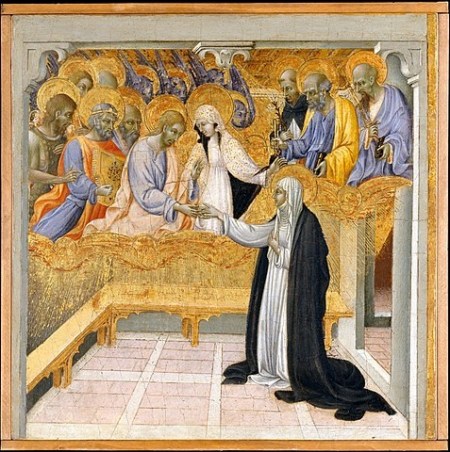
On Fat (or Shrove) Tuesday, while the people of Siena were celebrating carnival, the 21-year-old Catherine was praying in her room. A vision of Jesus appeared, with by Mary and the heavenly angels. Our Lady took Catherine’s hand and held it up to Christ, who placed a ring upon it and mystically married her to himself. Though invisible to others, this ring of St. Catherine of Siena was always visible to her.

Some misunderstand the meaning and purpose of celibacy in the Church. Jesus Christ, St. Paul, St. Catherine, and others have encouraged and lived this way of life not because human connection or natural marriage are bad, but because celibacy allows for a higher and broader intimacy. Every person is called to marriage, be it natural or spiritual; and everyone one is called to have children, be they biological or spiritual.