Archive for the ‘Saintly People’ Category

You Can Ask Jesus Your Questions

December 13, 2025

3rd Sunday of Advent
By Fr. Victor Feltes

St. John the Baptist, despite his continued imprisonment, had heard about the works Jesus was doing and sent two of his disciples to ask him, “Are you the one who is to come, or should we look for another?” John was no pushover, not some reed swayed by the wind, but from this question we can gather that while John sat in Herod’s prison some doubt arose about whether Jesus was their long-awaited Messiah.

Notice how Jesus reacts to the question. He does not lose his temper or condemn them for asking. He gives them a helpful response: “Go and tell John what you hear and see: the blind regain their sight, the lame walk, lepers are cleansed, the deaf hear, the dead are raised, and the poor have the good news proclaimed to them. And blessed is the one who takes no offense at me.” In other words: “Report to John my mighty works for these show that I am the Messiah of whom Isaiah wrote (e.g., ‘Then will the eyes of the blind be opened, the ears of the deaf be cleared; then will the lame leap like a stag, then the tongue of the mute will sing.’) How I accomplish my purposes may appear strange, but remember that a person who takes no offense at me is blessed.” Jesus was patient with people who asked him questions in good faith.

Nicodemus did not want to be seen in public with Jesus. That’s why Nicodemus approached him at night. But Jesus still engaged with his questions. The Samaritan woman at the well may have first thought the man speaking to her was weird, but Jesus invited her probing questions. And the rich young man who asked Jesus about the way to eternal life wasn’t quite ready to fully commit to following Christ, but Jesus looked at him, loved him, and gave personalized responses. Despite their flaws, they asked Jesus questions in good faith and Jesus answered them. What Jesus does not like is questions asked in bad faith.

When the Pharisees would set traps for him, Jesus knew their ill intent, saying, “Why are you testing me, you hypocrites?” He knew they were just looking for ways to condemn and reject him. And when Jesus appeared before King Herod during his Passion, Herod questioned him at length because he had heard about him and hoped to see him perform some sign. But when Jesus gave him no replies, Herod treated him with contempt and mocked him and sent him away. Wicked Herod was merely curious about Jesus and uninterested in repenting of his sins. We should not test God like the Pharisees and Herod did. Jesus delights, however, in genuine seekers and is pleased to answer them.

Whoever asks, receives,” and “whoever seeks, finds,” though the answer might not be instantaneous. Job, while doing nothing wrong, questioned for some time before the Lord answered him. Sometimes our answer is already readily available through Christ’s Church, and we should listen to him through her. But sometimes God, who is supremely brilliant and creative, will answer us through different avenues (though without contradicting himself). Sometimes his answer will come during prayer, or maybe through something we providentially see or hear, or perhaps through a friend or a stranger.

What are your questions for the Lord? I encourage you to ask him and keep your eyes and ears and heart open. If you’re seeking the truth and not seeking excuses; if you’re looking to love and serve Jesus better, pay Christ the compliment of approaching him as the One who knows all things and loves you. Blessed is the one who does so.

From Eden to Nazareth

December 8, 2025

Solemnity of the Immaculate Conception
By Fr. Victor Feltes

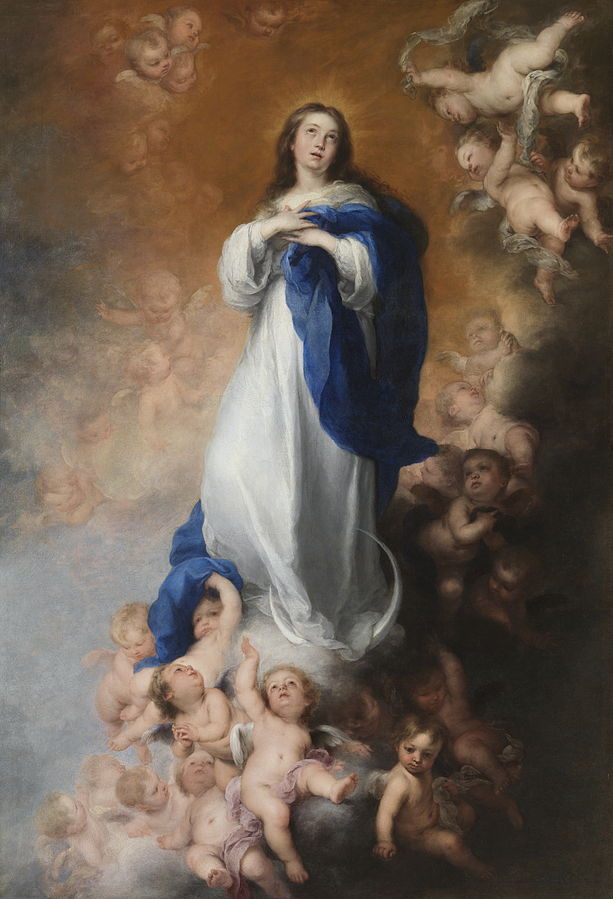
In the story of Genesis, the Lord God declares to the serpent: “I will put enmity [that is, hostility] between you and the woman, and between your offspring and hers; he will strike at your head, while you strike at his heel.” There is more going on here than an account of humanity’s dislike for slithering, venomous snakes. That tempter at the Fall was not a mere snake. The Book of Revelation identifies “the ancient serpent” as “the Devil and Satan.” And the Church saw in that declaration of the Lord God in Genesis the first proclamation of the Gospel, the Protoevangelium, foretelling what God intended to do to accomplish our salvation through Jesus Christ. “I will put enmity between you and the woman, and between your offspring and hers…” (or literally in the Hebrew) “between your seed and her seed”. That’s curious, since folks typically speak of the seed a man rather than the seed of a woman. Who is this woman whom God decrees to be in a state of opposition to Satan, whose Son would suffer due to the Evil One until he crushed the Serpent’s head?

The angel Gabriel was sent from God to a virgin in the city of Nazareth named Mary. And coming to her, he said, “Hail, full of grace! The Lord is with you.” Gabriel hails Mary with a title, like people cried “Hail, King of the Jews” during Jesus’ Passion. But the angel is not speaking ironically like Jesus’ tormentors and the angel does not lie. What we translate into English as “full of grace” has a deeper meaning in the original Greek. Heaven’s messenger calls Mary “Kecharitomene,” a perfect passive participle of a word which means “to fill or endow with grace.” Because it is in the Greek perfect tense, it declares Mary was graced as a completed action in the past but with effects continuing to the present. Mary had already been prepared by God for that moment, to become the sinless, grace-filled mother of our Incarnate Lord.

So why did God do this? One reason is so that she could give to God a full and free “Yes.” Once the angel explained that she would give birth to the Messiah and that this child would be God’s Son conceived by the Holy Spirit, Mary said, “Behold, I am the handmaid of the Lord. May it be done to me according to your word.” The Catechism of the Catholic Church teaches that “in order for Mary to be able to give the free assent of her faith to the announcement of her vocation, it was necessary that she be wholly borne by God’s grace.” (CCC #490) Mary says “Yes” to God not due to coercive fears, nor from selfish motives, but freely and faithfully on behalf of all Creation and the Holy Church to be.

Another reason God created her pure and filled her with grace, was to make her a fitting mother — not only for her Son but all his Christian siblings, his brothers and sisters, including you and me. She is the New Eve who, by her faithful loving obedience, “became the mother of all the living.” Today we celebrate with Blessed Mary how the Almighty has done great things for her, through which we now have Jesus Christ our Lord and a heavenly mother who knows us and loves us and prays for us now.

Heralding the Best Path

December 7, 2025

2nd Sunday of Advent
By Fr. Victor Feltes

St. John the Baptist taught his hearers that the time had come for them to take action and change course. St. Matthew writes it was of John the Baptist the Prophet Isaiah spoke when he foretold of “a voice of one crying out in the desert,” saying, “Prepare the way of the Lord! Make straight in the wasteland a highway for our God! Every valley shall be filled in, every mountain and hill shall be made low; the rugged land shall be made a plain, the rough country, a broad valley. Then the glory of the Lord shall be revealed…” So what is this imagery about?

In ancient times, preceding a king’s journey somewhere, a messenger would be sent ahead to announce how people should get ready for the royal arrival. One practical task was to improve his road: removing rocks, filling potholes, and smoothing ruts. For the coming of the King of kings, Isaiah even envisions lowering mountains and raising valleys to form a straight and level highway. John the Baptist calls everyone to reevaluate our priorities to better prepare the way for encountering Christ.

An angel of the Lord had announced to the Baptist’s father, Zechariah, that John’s mission had an intergenerational component. John was to “turn the hearts of fathers toward children and the disobedient to the understanding of the righteous, to prepare a people fit for the Lord.” St. John, inspiring adults to seek the very best for children and to form them in godly ways, would “turn many of the children of Israel to the Lord their God.” Today, I wish to inspire you to do the same for children now through our St. Paul’s Catholic Grade School.

We have an excellent Catholic school. For our most recent reaccreditation, administrators from four other Catholic schools thoroughly evaluated us and told us: “You have a beautiful school.” “[It’s] welcoming, faith-filled, and charming!” “[It’s] filled with excellent educational instruction.” “[There are] high expectations.” “The students are so well-mannered.” “[And there are] great relationships between teachers and students.” And all of them agreed, “We wish we could work at your school.”

Our highly-qualified teachers can provide one-on-one attention in a wholesome environment more like a family than a factory. And we have great young people who positively influence each other. Our reinvigorating new principal, Mr. Brad Cody, has been struck by our students’ respectfulness and politeness, noting how in all his time here he has yet to hear any student swear. Our behavioral expectations, our academic expectations, and our moral expectations are not found in many other schools today. St. Paul’s devoted teachers and substitutes who have taught in both worlds can attest to the differences in our Catholic school.

God and Christ’s teachings are not excluded here. We have daily prayer, weekly Mass, Confession, and seasonal devotions. Our students get to know Catholic clergy beyond just at Sunday Mass, like when we eat our excellent school lunches with them at their tables. Our littlest ones enjoy the Catechesis of the Good Shepherd, which introduces Christianity to them in an engaging way on their level. And while people of all faiths are welcome at our school, the Catholic Faith is taught and lived.

Our 4K through 8th grade Catholic school prepares the way for the Lord without the rocks, ruts, and pitfalls found in other paths; a smooth and straight road for children to get to know Jesus Christ and walk forward with him together. So if you or your acquaintances have school-aged children, please work to get them enrolled here in 2026. Make a call, take a tour. School Choice makes tuition free at higher incomes than you would think. But even families who don’t qualify can receive grants and scholarships we offer, so do not imagine cost to be an obstacle. In addition to recruiting for our great school, I invite you to join our work in person. We could always use more playground supervisors, substitute teachers, or helpers in the library, office, or classrooms.

It’s not so much that our Catholic school has a mission, as our Catholic mission here in Bloomer has a school. Please help prepare the way for our Lord, make straight our children’s paths, by supporting our St. Paul’s Catholic School.

Two Stories of Conversion

November 29, 2025

1st Sunday of Advent
By Fr. Victor Feltes

At the beginning of this Advent, I would like to tell two stories of conversion. In the spring of 1521, while defending the city of Pamplona, Spain a 30-year-old soldier got his right leg fractured by a French cannonball. He would spend the next several months healing in his family’s castle. Convalescing in bed, day after day, he became extremely bored and asked for some adventure stories to read about knights and ladies. He liked those kinds of stories, but they didn’t have any of those in the house. His sister-in-law provided him a book about the life of Christ and another book of short stories about famous saints.

Sometimes he would read and reflect on what he read. Other times, he would daydream about worldly things. He would pause and consider, “What if I were to do what St. Francis or St. Dominic did?” And other times he would fantasize about being a heroic knight and wooing a certain royal lady in another land who was high above his station.

When he reflected on these worldly fantasies he felt intense pleasure; and whenever he stopped, sometimes hours later from weariness, he felt dry and depressed. Yet whenever he imagined living the rigorous sort of life the saints had lived, he not only experienced pleasure during such thoughts but felt great joy afterwards as well.

Eventually, he noticed this difference and realized how thoughts of one kind left him sad while the others filled him with joy. This was an important moment in his discernment, for he would go on to embrace God’s call to become a saint: St. Ignatius of Loyola.

Sin disappoints us, but goodness (though difficult) yields peace and satisfaction. We are attracted to our sins. Sins would not tempt us if there were no hope for pleasure, relief, or temporary gain from them. But after sinning, if our consciences are well-formed, we feel guilt and regret. What we have done or failed to do harms ourselves and others. And apart from the damages caused, sin squanders opportunities for better things. Yet God continues lovingly calling us back to repentance and conversion.

In the year 386, a 32-year-old man felt very drawn to Christianity but felt enslaved to his sins. It was as if the temptations he loved and despised were whispering, ‘Are you going to part with us? Do you really think you can live without these pleasures forever?’ But another voice had him imagine the smiling multitude of saints who had lived before him. That sweet voice seemed to say, ‘You can do what these men and women did, but none of them did it by themselves. The Lord God gave it to them. Why do you try to stand by your own strength, only to fall over and over again? Cast yourself on Christ and don’t be afraid. He won’t flinch and you won’t fall. Cast yourself on him without fear, for he will accept and heal you.’ Yet he was still torn; desiring chastity, but not yet.

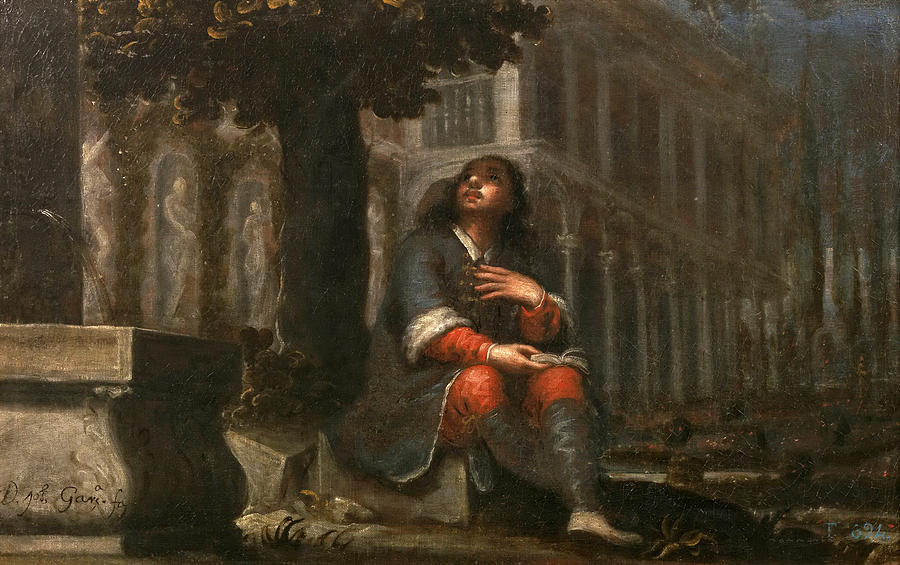
His turning-point moment came sitting in a garden outside his house. With tears he asked, ‘Why do I keep delaying until tomorrow? Why not now? Why not end my uncleanness this very hour?’ Yet he still lacked the strength. Then he heard a child from the house next door, chanting over and over, “Pick it up and read it; pick it up and read it!” He opened the Bible beside him to a random page, finding Romans 13:13-14, part of today’s Second Reading:

Let us conduct ourselves properly as in the day, not in orgies and drunkenness, not in promiscuity and licentiousness, not in rivalry and jealousy. But put on the Lord Jesus Christ, and make no provision for the desires of the flesh.”

Upon reading those words, his heart was infused with a light of certainty and all the gloom of doubt vanished. By this God-given grace, the life of the man we now know as St. Augustine of Hippo began to change.

This Advent, I encourage you to heed Jesus’ warning to “stay awake” and “be prepared,” like the saints before us. Identify your vice and call upon Christ, come to Confession and change your habits, to begin anew in the saintly life he calls you to. Open your arms to receive this gift, his gift, for Christmas.

A Vision of the Saints in Heaven

November 1, 2025

Solemnity of All Saints
By Fr. Victor Feltes

On this All Saints’ Day, let us consider what we can look forward to living as saints in heaven one day. But first, how does one get to heaven?

At the moment of death, our immortal souls will separate from our mortal bodies and go immediately to our particular judgment. There we will be judged according to our faith and deeds in Christ, based upon our connection to Christ and our love of God and neighbor. Then our personal punishment or reward will begin: either immediate and everlasting damnation, or entrance into the everlasting blessedness of heaven —either immediately or after the purifying process of purgatory. One day, the dead will arise and the saints will experience a new heavens and new earth in their glorified resurrected bodies. But for now, the saints only experience heaven through their souls (with the Blessed Virgin Mary being a notable exception). When someday, by the grace of God, we are saints in heaven, here are some things we will enjoy.

One thing to look forward to is probably having a perfect memory. A colleague of the genius mathematician and physicist John von Neumann writes “one of his remarkable abilities was his power of absolute recall. …Von Neumann was able on once reading a book or article to quote it back verbatim; moreover, he could do it years later without hesitation. …. On one occasion I tested his ability by asking him to tell me how A Tale of Two Cities started. Whereupon, without any pause, he immediately began to recite the first chapter and continued until asked to stop after about ten or fifteen minutes.” If this is possible with a frail human brain, how much more knowledge could our unhindered souls retain?

Another perk of being a saint in heaven is great ease in doing whatever is best. When in the unveiled presence of God, “we shall see him as he is,” and discerning God’s will should be easy. And our perfected virtues will make it easy to do what is good and right, for we shall be “pure, as he is pure.”

Another extraordinary blessing in heaven is having innumerable friends. In St. John’s vision of heaven he beholds “a great multitude which no one could count from every nation, race, people, and tongue.” Every saint in heaven has become an incredible person perfected in Christ’s beatitudes and love. There will be no lack of time to get to know people and with your perfect memory you’ll never forget anyone’s name or stories.

Yet the greatest joy in heaven is the beatific vision of God. Sometimes people worry the restful reward of seeing God and worshipping him forever will be dull. Don’t worry, heaven will never be boring. Every good and beautiful thing in Creation which you have ever delighted in has its origin in God who is supremely good, beautiful, and delightful. You have yet to fully exhaust the joys to be experienced in just one culture in one country in one century of human history, so do not imagine you will exhaust the joys to be found in our infinite God.

These are things to look forward to someday in heaven, but on this All Saints’ Day I wish to remind you that the saints in heaven know us and love us now. Yesterday, an online friend shared with me a beautiful story about the intercession of the saints and he has given me permission to share his story with you.

In January of 2018, his father suffered a massive heart attack at home. In the Emergency Room, they were able to restart his heart, but there was almost 100% arterial blockage and likely serious brain damage from the lack of oxygen. Some of the best doctors in the world could do nothing more to help. So the next day, all the family gathered to share final moments as they withdrew the mechanical life support. My friend writes:

I remember sitting in the room, in the cardiology unit there, praying my brains out for a miracle, as he lay dying. Just focused on nothing else but praying, praying, praying. Eyes closed, focused on nothing else. Praying, praying, praying for some miracle. And then I suddenly wasn’t in the hospital room anymore.

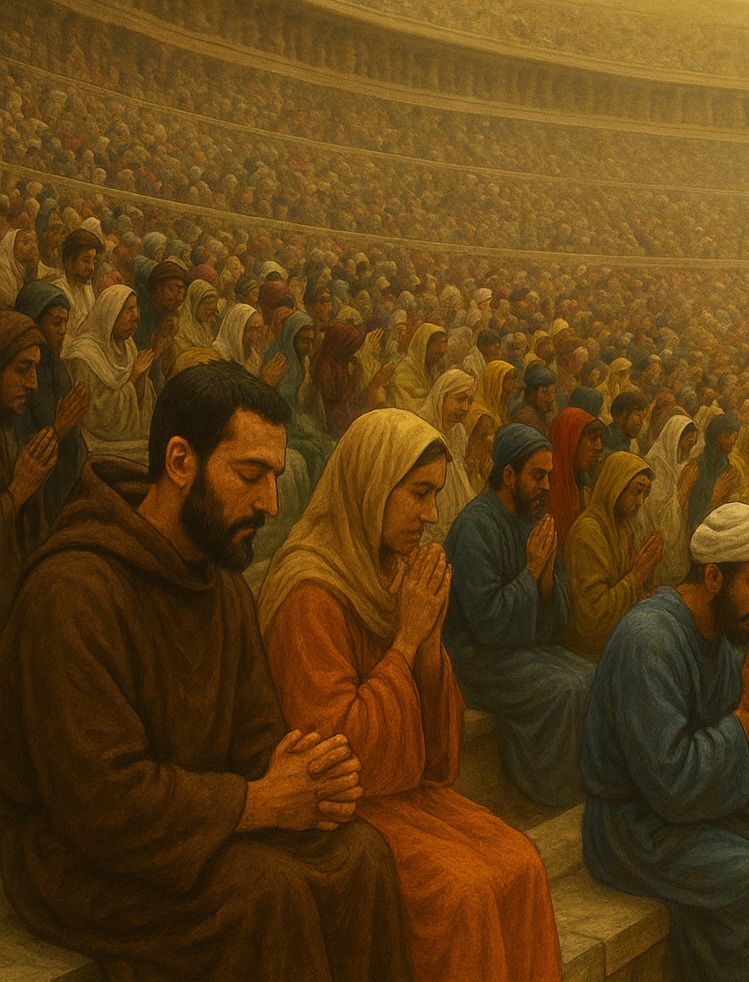
I was sitting on a bench in what to me appeared to be a huge football stadium, or more like a Roman circus (those long chariot tracks), stretching further in each direction than I could see (even the opposite side was so far away I couldn’t see it). And every seat was filled with people, all dressed differently (though most of them were in robes, in the section I was in), and all praying in different languages.

Their prayers collectively seemed like a buzzing, or the sound of a waterfall, because they were individually indistinct—countless voices all praying at once. But it was clear that each one of them were praying, non-stop, for me, my dad, and for everybody in the world.

And it was in that instant that it was told to me that I could stop praying—(“Look, all these Saints have the whole ‘praying for your dad’ thing covered for the moment…”)—and use the few moments my dad had left with us to just be with him, hold his hand, tell him that I love him and say goodbye to him. So that’s what I did. And I’m very grateful to this day that I did.

Why was my friend’s vision of the saints set in a long racetrack stadium? I recognize in this a reference to the Letter to Hebrews, which says, “since we are surrounded by so great a cloud of witnesses, let us rid ourselves of every burden and sin that clings to us and persevere in running the race that lies before us while keeping our eyes fixed on Jesus, the leader and perfecter of faith.” So be sure to befriend the saints and call upon them, because they know you, and they love you, and they eagerly want you to join their number.

Imitate What They Contain — Funeral Homily for Mary Jo Meuli, 83

October 14, 2025

By Fr. Victor Feltes

Mary Jo lived with a special devotion to our spiritual mother, the Blessed Virgin Mary, and she looked forward to journeying beyond death to be with our Lord and Savior, Jesus Christ. Besides coming to Holy Mass and helping bring Christ in Holy Communion to others, Mary Jo prayed the Holy Rosary daily, sometimes several times a day, growing her in her Christian likeness to Jesus and Mary. When a person picks up the practice of the Rosary for the first time, much of one’s attention is focused on tracking the beads and remembering the prayers. But with more experience, the words and the beads can drift to the background, clearing a place for meditation on its Holy Mysteries.

These twenty mysteries of the Rosary help us reflect upon joyful, luminous, sorrowful, and glorious episodes from salvation history. Mary is a firsthand witness to about three-fourths of these events. So for instance, we can contemplate Jesus with Mary at the Nativity and hold the Baby Jesus in our arms. We can consider how much Jesus loves us to become incarnate as one like us, and be moved to love him in return. We can stand with Mary at the Crucifixion, at the foot of Jesus’ Cross, and share in her compassion for her Beloved Son. We can behold Jesus’ heroic virtues in his sufferings for us, refusing to spare himself, and resolve to do hard things for him in return.

Prayerfully meditating upon the Rosary helps us to become more like Jesus and Mary. The same is true with the Beatitudes. Who is poor in spirit, relying completely on God? Who mourns and meekly, non-violently, hungers and thirsts for what is right? Who is merciful and clean of heart? Who promotes peace, yet is persecuted for the sake of righteousness? Jesus and Mary and the saints are like this, and we are called to be like them. As St. Paul our patron says, “Be imitators of me, as I am of Christ” so that we may “conquer overwhelmingly through him who loved us.” And God will help us do so, if we give him our “Yes.”

In her final season of living with illness, Mary Jo told every new doctor she met: “I’m ready.” And thirteen years to the day after her husband Allan’s death, she passed on as well. Pray for Mary Jo’s soul, in case any impurity remains within her gold, so that as a perfect offering God may take her to himself. And learn from her example, for blessed are those who grow in the likeness of Jesus and Mary and the saints, ‘for their reward will be great in Heaven.’

Catholic Diversity In Unity

July 3, 2025

Solemnity of Saints Peter & Paul
By Fr. Victor Feltes

Today, I wish to speak to you about Saints Peter and Paul, vocations, the Catholic Church and the Churches in her, and two aspects of the Holy Mass. This homily will be a bit longer than usual, but each of its parts are interesting. Saints Peter and Paul shared many similarities but manifested in different ways:

🔸 Both were personally called by Christ to become apostles; Peter quite early during Jesus’ public ministry, but Paul rather late, after Jesus’ Ascension.

🔸 Both beheld Jesus in his transfigured glory; making his friend Peter feel ecstatic, but making his persecutor Paul go temporarily blind.

🔸 Both preached the Gospel; Peter primarily to the Jews, but Paul particularly to the Gentiles.

🔸 Both taught the Faith; Paul the Pharisee was highly-educated, but Peter the uneducated fisherman was not.

🔸 Both experienced weakness; Peter in conquering his passions, but Paul by enduring “a thorn in the flesh.”

🔸 Both were martyred by the Roman Empire in Rome; Peter was crucified upside-down, but Paul the Roman citizen was beheaded.

That Saints Peter and Paul whom we celebrate this Sunday shared one Faith, one Lord, and one calling, and yet manifested these differently in their faithful lives. We also see this in the Catholic Church today. Peter and Paul were called to be apostles. Today, some are called to be bishops, priests, or deacons. Others are called to be consecrated male or female religious. Many more are called to the vocation of holy marriage. Others live out their baptismal mission and call as single persons or consecrated virgins. Which of these ways is the greatest way to live a Christian life? The greatest, most glorious, most fruitful path for you is the one Christ has called or is calling you to. Your life may look differently than others’, even amongst people living out the same vocation, but you can still be living a faithful, fruitful Christian life.

We belong to Christ’s Catholic Church. The word “Catholic” comes from Greek, meaning “universal, worldwide, (or) all-inclusive.” The Catholic Church, established by God for all people and places in this present age, unites humanity in our diversity, but even within our unity we see legitimate variety. Did you know that the one Catholic Church contains 24 Churches with apostolic roots and varying liturgical traditions practiced in full communion with the pope? The largest of these Catholic Churches is the Roman Catholic Church, to which we belong along with more than 98% of the world’s 1.3 billion Catholics. About 18 million other Catholics are in Churches in full communion with Rome; the three largest being the Ukrainian Greek Catholic Church (mainly in Western Ukraine), the Syro-Malabar Catholic Church (mainly in India), and the Maronite Church (mainly in Lebanon). Our one Faith differently celebrated. (Other Churches called the Orthodox Churches have nearly 300 million members put together, with valid priests and bishops and all seven sacraments like us, yet they are not in communion with the pope. Pray for our reunion. The gap between us is less than any Protestant group.) There is even legitimate variation within the Holy Mass of our Roman Catholic Church. I wish to highlight two examples: one in how one receives the Eucharist and another in how the Eucharist is celebrated.

The early Church Fathers mention the Eucharist being placed upon communicants’ hands. Other Communion customs also existed but Communion in the hand was explicitly described. For instance, St. Cyril in Jerusalem and St. Theodore in Turkey instructed the faithful to lay one hand over the other to create a throne (for both saints declare one is about to receive a King) cupping one’s palm to receive “The Body of Christ” and answering “Amen.” St. John Chrysostom observes how a communicant’s hands “hold [the Eucharistic Sacrifice] but for a time.” He writes, “Oh! What a marvel! What love of God to man! He who sits on high with the Father is at that hour held in the hands of all…” And St. Basil the Great records “in the church, when the priest gives the portion, the recipient takes it with complete power over it, and so lifts it to his lips with his own hand.” These and the writings of other Church Fathers show that receiving Communion in the hand existed in the Early Church.

However, though Communion in the hand is allowed today, the many-centuries-long tradition of receiving Communion on one’s tongue is also permitted, either standing or kneeling. Some find receiving our Lord on the tongue strengthens their reverence and devotion; acknowledging the glory of their Great Guest, extending the red carpet of one’s tongue for him to enter under one’s roof through the doors of one’s lips, humbly receiving this priceless Gift of pure grace. After next summer’s church renovation, once there is more space in front of these steps to our sanctuary, I plan to place a kneeler in the center-front as an option, as you may have seen offered already at churches in Chippewa Falls. How you receive our Lord, standing or kneeling, on your hand or on your tongue, is for you to personally discern, since they each option is permitted for you by the present liturgical rules of the Church.
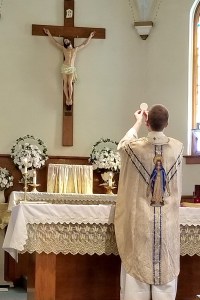
The next legitimate Mass option I would like to explain pertains to the celebrant leading the congregation. Since the Second Vatican Council, the most common way priests have celebrated Mass is versus populum, or “towards the people.” Yet the much-longer-practiced custom has been for the priest and the people to face (literally or symbolically) towards the east together, or “ad orientem.” Like the Jews used to pray towards the Holy Temple in Jerusalem, the writings of the Church Fathers show the early Christians prayed toward the east. St. Clement of Alexandria writes “prayers are made looking towards the sunrise in the east.” And Origen notes: “…Of all the quarters of the heavens, the east is the only direction we turn to when we pour out prayer…” Tertullian records that Christians facing east to pray caused some non-Christians to mistakenly believe we worshiped the sun. But the Christians praying toward the sunrise saw a symbol of Christ rising from the dead and of his promised return to earth in radiant glory one day. Throughout the centuries, even in churches which were not built to face east like our St. Paul’s Church, the priest and the people faced the same direction (or “liturgical east”) together. However, since the 1970’s the prevailing custom has been for the priest to face the congregation.

The Catholic Church approves both versus populum and ad orientem as valid options, and these two ways of celebrating the Mass emphasize different truths. Celebrating versus populum, toward the people, emphasizes the horizontal aspect, the communal meal. And the Holy Mass is indeed a meal, a memorial of the Last Supper, where Jesus Christ and his disciples gather at his table. Celebrating ad orientem, toward the east, emphasizes the vertical aspect, the sacrificial offering. And the Holy Mass is indeed a sacrifice, a memorial of the Cross, where Jesus Christ is offered up for us from his altar.

I experienced my first ad orientem Mass when I was still in seminary. The celebrant was a visiting alumnus and priest of our diocese, Fr. Derek Sakowski. I remember fearing that I would hate the Mass being said that way because I often dislike changes. (For instance, our seminary once changed the toaster in the dining hall and—even though I almost never used the old familiar toaster—I was annoyed when they had replaced it with a new one.) Fr. Sakowski said the same English prayers as at other Masses but watching him celebrate that Mass ad orientem, facing us when speaking to us and facing God when praying to God, I found it surprisingly beautiful and it made a lot of sense. When weekday Massgoers at St. John the Baptist Parish first experienced Mass ad orientem more than five years ago, the attendees reported positive experiences similar to mine.

I mention all this because I would like our weekday Massgoers to experience ad orientem in at least a few Masses this July and hear their feedback. After Vatican II, when Mass facing the people became the prevailing custom in the Church, pastors often introduced that liturgical change abruptly, without consultation, and without adequate explanation. It was jarring, and many lay people were bewildered and hurt. I do not wish to repeat such mistakes going in the opposite direction. Nothing will change without thorough consultation and consensus support. At the end of such a dialogue at St. John the Baptist’s Parish, one weekend Mass changed and the other stayed the same and today everyone seems happy or content with that. Our Faith, our calling, and our Lord are one, even as our faithful lives will manifest them differently. We are Catholic. So in essential things, unity. In non-essential things, liberty. And in all things, charity—that is, love.


The Church Reveals His Beauty

May 11, 2025

4th Sunday of Easter
By Fr. Victor Feltes

Churches should be marked by great beauty. Beauty attracts and delights. God, among his other perfections, is capital “B” Beauty, so a beautiful church glorifies God among us and helps draw people to him. One of the most famous and beautiful churches in the world is St. Peter’s Basilica in Rome. St. Peter’s Basilica is actually a shrine for the burial site of St. Peter the Apostle. He was crucified upside-down on Vatican Hill by the Romans and buried in a nearby cemetery. And in the early 1940s, archeological excavations below the main altar discovered what are most likely his bones. Jesus gave Peter his name, which means “Rock,” and said, “Upon this Rock, I will build my Church.” And today we see the largest and most renowned Christian Church in the world is built above that Rock.

It is wonderful for churches to be beautiful, but it is also important for our church architecture and decorations and to be meaningful—reflecting truths of our faith. For instance, St. Peter’s Basilica is capped by a dome designed by Michelangelo which is the world’s tallest. And two colonnades designed by Bernini, extend out in front of the basilica on both sides around St. Peter’s Square. The effect of this dome and these colonnades together present an image of God the Father. As one approaches St. Peter’s Square, the dome is like his head, the church is like his chest, and the colonnades are like his arms. God the Father is reaching out to beckon, welcome, receive, and embrace all people of the world. When St. Peter’s Square is filled with pilgrims as we saw last week it is like St. John’s vision in today’s second reading, “a great multitude… from every nation, race, people, and tongue,” joyfully standing before God the Father and the Lamb of God. The Kingdom of Heaven begins for us now in his Church on earth.

Once you enter inside St. Peter’s Basilica the architecture there also conveys spiritual truth. The dimensions are huge. The distance from the floor to ceiling—not under dome but in the nave of the basilica—is 152 feet. That’s about twelve stories high; and yet because of architectural tricks of perspective you do not feel tiny. For instance, there are two tiers of statues in alcoves along the sides—lower and higher—but the statues on the higher level are actually bigger than the lower statues so that when you look up at those saints they do not seem so distant. The scale of the arches, doors, and windows make you feel like you are inside of, not a hollow skyscraper, but a great, beautiful mansion. It is an image of the Father’s house, where there is room enough for a countless multitude but where no one is made to feel small or unimportant. In heaven, everyone is valued and has a place with God.

Last Thursday, from the exterior balcony of St. Peter’s Basilica called the Loggia of the Blessings, Pope Leo XIV was introduced to the world. It was quite a surprise and a moment we will remember the rest of our lives. In this Sunday’s Gospel, Jesus says his sheep have been given into his hand by the Father. Our Lord has now entrusted us into Pope Leo’s hands as well. I did not know much about him before the conclave, but I am excited by what I have seen and heard since.

Some people have predicted and hoped for a quiet papacy where very little will happen. But I do not want a quiet pope when so many people need Jesus, his Gospel, and his Church. Pope Leo has spoken insightfully—both years before and following his election—about evangelization in our time, and I look forward to him being a “Lion” for the Gospel. I do not expect our American pope to show the United States special favoritism, nor should he, but I believe this pope will be a great blessing for the Church in our country. When you freeze or boil water, nothing happens before the temperature reaches a threshold. But with the addition or subtraction of just a few more degrees the liquid transforms into a solid or gas. I believe this new American pope will trigger many fruitful responses in those whom God is already calling. There is a new openness and hunger in our culture and I believe great things will happen.

Yet do not just sit back and wait for the pope and priests to draw people closer to Christ. By your sacrificial love, by your Christian joy, by your growing devotion, by your deepening holiness, by your Catholic witness, by your unashamed invitations, the Lord wants you to help bring others—people you know—to a fuller relationship with him and his Church. The papal motto of Pope Leo XIV is the same as he chose when he became a bishop. It comes from a homily of St. Augustine: “In the One, we are one.” (That is, “In Christ, we are one.”) In Christ we are called to all be truly one, and each of us in these years of Pope Leo ahead have important parts to play.

Upon This Rock Christ Built His Church

May 4, 2025

3rd Sunday of Easter
By Fr. Victor Feltes

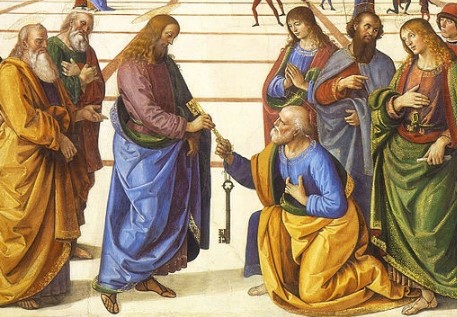
Jesus changed Simon the Apostle’s name to Peter or “Rock” and said, “Upon this rock I will build my Church, and the gates of the netherworld shall not prevail against it.” Jesus told him, “I will give you the keys to the Kingdom of Heaven,” and declared “Whatever you bind on earth shall be bound in heaven; and whatever you loose on earth shall be loosed in heaven.” This promise assures us that Peter would not bind the Church to error, for binding the Church on earth to lies would bind heaven to the same. What is the purpose of this awesome authority to teach and lead? Jesus tells him and us in today’s Gospel: it is to ‘Feed his lambs, tend his sheep, and feed his sheep.’

Jesus had specifically told Simon at the Last Supper, “Behold, Satan has demanded to sift all of you like wheat, but I have prayed that your own faith may not fail; and once you have turned back, you must strengthen your brothers.” In the Gospels, Simon Peter’s name is always first among his fellow apostles in any listing where he appears, while Judas Iscariot’s name is always placed last. All of this reflects the God-given preeminence of St. Peter as the servant-leader of Christ’s Church on earth. Jesus remains the invisible Head of his One, Holy, Catholic Church, but he knew that without providing clear and visible apostolic shepherds to give us clarity and unity his flock would surely scatter.

This was true in the 1st century with St. Peter as 1st bishop of Rome, and Peter’s office has continued in his successors, the popes, as recognized by Christians throughout the first millennium. Jesus had told the apostles “whoever hears you hears me” and promised the Holy Spirit would guide them “into all the truth.” The New Testament also proclaims the Church to be “the pillar and foundation of truth.” Was only the first century to be graced with such divine gifts and assurances? No. Jesus is the wise man who built his house on Rock so that even when the rains fell, the floods came, and winds blew and buffeted his Church it would not collapse into heresy.

Indeed, when a pope (or a Church council together with him) definitively defines a doctrine of faith or morals to be held by the whole Church, the Holy Spirit protects their teaching from error. This is called infallibility. Through divine inspiration, the Holy Spirit previously utilized imperfect men to pen precisely what he wished to be written as Holy Scripture; so simply protecting Holy Church from officially teaching errors is an important but lesser miracle. Though popes can teach infallibly and possess full authority as chief shepherds, they are not flawless people. Simon Peter, even after denying, repenting, and returning to Christ, sometimes still slipped up.

Through St. Paul’s Letter to the Galatians we learn that St. Peter was accustomed to eating with Gentile Christians who did not keep the Old Covenant’s rules about ritually clean and unclean foods, as Christ’s New Covenant allowed. That was all well and good, but once when some Jewish Christians arrived in town who cared about keeping all those dietary laws, Peter began to withdraw from his previous table companions. Peter probably wished to avoid causing offense and division, but this action caused confusing scandal by implying that keeping all the Old Laws of Moses was necessary for salvation.

St. Paul writes, “I opposed him to his face because he clearly was wrong.” Paul corrected Peter in front everyone, saying, “If you, though a Jew, are living like a Gentile and not like a Jew, how can you compel the Gentiles to live like Jews?” St. Peter had not denied the Gospel but his personal example in this case caused harm and he received a fraternal correction from St. Paul. In the Church’s two-millennium-long history there have been some very bad and scandalous popes, but by God’s grace none of them bound the Church to heresy, and that’s a priceless blessing.

Having mourned and prayed for Pope Francis, the cardinals will gather this Wednesday inside the Sistine Chapel at the Vatican for the important task of electing a new pope. Some 133 cardinals, appointed by previous popes from places around the world, will sequester themselves away until they elect a Holy Father. After any failed rounds of voting, they will burn the ballots to make black smoke. But once a pope has been elected by a two-thirds of the vote they will burn the ballots to make white smoke accompanied by the ringing of St. Peter’s Basilica’s bells. Then our new pope will be introduced to the world and impart his papal blessing. All the conclaves in recent decades have been short, concluding within three days, but do not be alarmed even if this conclave takes more than a week. We will have a pope again soon.

People sometimes wonder, “Does the Holy Spirit choose who will be the pope?” Before he became Pope Benedict XVI in 2005, Cardinal Joseph Ratzinger was asked about this in a 1997 interview. He replied, “I would not say so, in the sense that the Holy Spirit picks out the Pope…. [“There are too many contrary instances of popes the Holy Spirit obviously would not have picked!”] I would say that the Spirit does not exactly take control of the affair but rather like a good educator, as it were, leaves us much space, much freedom, without entirely abandoning us. Thus the Spirit’s role should be understood in a much more elastic sense, not that he dictates the candidate for whom one must vote. Probably the only assurance He offers is that the thing cannot be totally ruined….”

When I was younger, I would have imagined there was just one cardinal in any conclave who could be the right pope; but now I suspect the Holy Spirit perhaps beholds dozens of cardinals with whom he could accomplish comparable good fruits. God works with what we give him. So pray that the cardinals will be receptive to the Holy Spirit’s guidance, but do not be anxious or afraid. Whatever happens, we already know that Christ and his Church will endure and triumph in the end, for “the gates of the netherworld shall not prevail against it.” Pray this week that the Church of Christ on earth may soon be led by another great pope who will feed his lambs, tend his sheep, and feed his sheep.

The Deaths of Lazarus

April 6, 2025

5th Sunday of Lent
By Fr. Victor Feltes

God does not do bad things, for “God is not subject to temptation to evil” and “what he hates he does not do.” However, God is all-knowing and all-powerful. There is nothing knowable that God does not know, and nothing good and doable that he cannot do. Therefore, when a bad thing happens, God has allowed that to happen. Yet we also “know that God causes all things to work together for the good of those who love him.” We see these truths reflected in today’s Gospel reading.

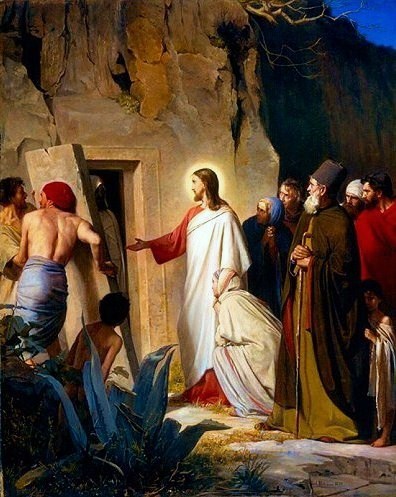
God clearly permitted Lazarus to fall ill. And when Jesus received the urgent message from Martha and Mary that their brother was sick, he remained in the place where he was and allowed Lazarus to die. “Now Jesus loved Martha and her sister and Lazarus.” So why did Jesus not come earlier, when he was told “the one you love is ill.” Or why did Jesus not heal his friend Lazarus’ sickness from a distance, like he cured the centurion’s servant or the royal official’s son? Jesus says the dying and rising of Lazarus was “for the glory of God, that the Son of God may be glorified through it,” and “that you may believe.”

Earlier in his public ministry, Jesus had raised Jairus’ daughter from the dead, having told mourners that the little girl was “asleep.” But that resurrection miracle was performed privately, shortly after death, and with strict orders to its witnesses that no one should know of it. By publicly raising Lazarus from the tomb in the presence of a crowd, Jesus manifests his power not only to heal the sick but to restore the dead to life.

Picture this: One moment, Lazarus was ailing and fading out of consciousness on his deathbed. The next thing he knows, he wakes up wrapped in bandages inside of a cave, and comes out toward the light at the sound of his friend Jesus’ call. His sisters would have filled him in on what he missed when he was dead.

The Gospels tell us Lazarus later attended a dinner with Jesus the day before Palm Sunday at the house of Simon the Leper. Martha served the meal while Mary took costly perfumed oil and poured it on Jesus’ head as he reclining at table. “A large crowd of the Jews found out that he was there and came, not only because of Jesus, but also to see Lazarus… And the chief priests plotted to kill Lazarus too, because many of the Jews were turning away and believing in Jesus because of him.” After Holy Week, the New Testament tells us no more of what happened to Lazarus. But we can imagine what it was like, years after Easter Sunday, when Lazarus died again.

Knowing that Jesus died and was risen, and having personally experienced death and resurrection himself, must have given Lazarus great peace even during his final passion. Consider Martha or Mary watching their brother die once more; having to burying him again. There would naturally still be sadness and ache in that parting, but I imagine the sisters would feel different this time: ‘We know he will rise in the Resurrection on the Last Day. Jesus Christ is the resurrection and the life who has come into the world, and whoever believes in him, even if they die, will live.’ Our brother Jesus died and has risen from the dead “for the glory of God” and “that you may believe.” Knowing and embracing this reality changes our life and how we face death. Do you believe this?

Last week, April 2nd, marked the twentieth anniversary of the passing of Pope St. John Paul the Great. And if you are like me, having witnessed how he lived and died, is inspiring. Pope John Paul’s famous motto was “Be not afraid!” In this, of course, he was quoting Christ who frequently said, “Be not afraid!” “Be not afraid,” Jesus tells us, “If you believe you will see the glory of God.”

Life Lessons From A Holy Family

December 29, 2024

Feast of the Holy Family
By Fr. Victor Feltes

The Holy Family went up to Jerusalem each year for the feast of Passover. Once, when Jesus was twelve years old, as they were leaving the city at the end of the festival, the Boy Jesus stayed behind without his parents knowing it. Whole communities would pilgrimage to and from these feasts together, so Joseph and Mary had assumed Jesus was walking with others in the caravan during that first day journeying on the road back to Nazareth. But then, perhaps when it was time to share a meal or set up camp for the evening, his parents could not find him. They would have asked all of their relatives and neighbors about the last place they had seen the boy and realized that he had not been with them for hours. Joseph and Mary would soon return to Jerusalem and find Jesus alive and well on the third day. In this difficult episode for the Holy Family, there are lessons for us today.

Jesus had the best parents in all of human history. His adoptive father was a great saint and his mother was filled with grace. And yet, one time, they lost track of their only child for three days. This shows us that sometimes we can try our hardest and things will still go wrong (at least in our own eyes). We can always choose to put forth our best effort, but we cannot control every outcome. Remember: Just because something goes wrong, even painfully wrong, does not necessarily mean that we have sinned. The Blessed Mother was sinless and yet she lost her Son.

When we are little, our parents might seem perfect. As we grow up, we are disappointed to see their imperfections. But as we advance in wisdom and age becoming adults ourselves, we better understand human weakness and limitations. This does not erase people’s flaws and sometimes grave faults, but it can help us have more mercy for people, including forgiving our parents and ourselves.

After three days, Joseph and Mary found Jesus in the temple, “sitting in the midst of the teachers, listening to them and asking them questions.” Jesus shows us that we can learn things even from imperfect people. Jesus’ parents were astonished when they found him, and his mother said to him, “Son, why have you done this to us? Your father and I have been looking for you with great anxiety.” Like holy figures in the Old Testament before her, Mary questions the Lord about the things she does not understand.

Being twelve years old, Jesus was years beyond the age of reason. He must have known his parents would be concerned after he concealed his plans from them. But the Sinless One does not offer an apology. Instead, he asks them, “Why were you looking for me? Did you not know that I must be in my Father’s house?” It is a mystery why it was God’s will for Jesus to remain in Jerusalem. Even after his reply, his parents did not understand what he said to them. But he returned home with them to Nazareth and was obedient to them as he advanced in wisdom and age and favor before God and man. Blessed Mother Mary kept this episode in her memory, remembering its stressful beginning and joyful end, and pondering its meaning in her heart.

The things which happen in our lives, like the circumstances of our upbringing or the crises that come our way, will not always make sense to us. But we can learn and grow from all these things, and become more holy families because of them, for “God works all things for the good of those who love him.”

3 Things I Didn’t Know About Christmas

December 24, 2024

Christmas Eve
By Fr. Victor Feltes

O holy night! Christmas has come! Jesus Christ is born! Tonight we celebrate and hear the story again of his world-changing birth. And though it is a familiar story, we all still have things to learn from it. For example, do you know what swaddling clothes are? “Mary wrapped her Son in swaddling clothes and laid him in a manger.

When I was younger, I didn’t know what swaddling clothes were. Maybe because “swaddle” sounded like “squalid” and I had seen the inside of messy barns, I imagined they were dirty pajamas. It’s actually an ancient and modern practice to use cloth to wrap up infants’ arms and legs tightly to their bodies. This is called “swaddling,” and babies enjoy it — it reminds them of the warm close comfort of the womb.

Another thing I didn’t know when I was younger was what a manger is. I assumed the manger was the stable because whenever someone would point out a “manger scene” what I always noticed was the big wooden barn. The shelter in Bethlehem where Jesus was born was actually more like a cave. But regardless, a manger is not a barn; it’s an animal feeding trough that holds dry feeds, like grain. So Mary wrapped up Jesus in swaddling clothes and laid him in a feed box.

These are interesting details, but why does St. Luke mention them? The details do reflect the humility of our Savior and King. Our Lord could have arranged providence instead to have himself born inside a palace with wealth, but he chose to enter into our human poverty and discomfort. But there is another reason why St. Luke notes these things: they foreshadow what would come later.

One day, decades after Christmas, assisted by another Joseph, the Blessed Mother Mary would wrap her Son’s body with cloths and lay him down inside another borrowed cave. And it is fitting that on Christmas night Jesus’ body was placed inside of a feedbox for grain, for he would go on to offer his full self as food for us, as Bread for the life of the world. It’s all connected and the beginning contains the end. Christmas leads to Holy Week, and Holy Week gives us the Faith, the Church, the Holy Eucharist.

A third and final thing I misunderstood when I was younger was when the Magi (or “Wisemen”) really arrived in Bethlehem. Having followed ‘the Christmas Star,’ I assumed they showed up on Christmas night. The Magi actually came later, sometime between forty days and perhaps two years after Christmas. We know this because Joseph and Mary did not yet have the Magi’s gift of gold to buy a sacrificial lamb for the Presentation at the Temple. And King Herod, in his attempt to kill Baby Jesus in Bethlehem, ordered the death of all the baby boys “two-years-old and under.The Magi responded to Christ’s birth and came after Christmas. They entered the house of the Holy Family and they came with gifts.

It is good that we are gathered for this holy night. Jesus has called you here to be with him and to be with us. But like the Magi, we all are also called to respond to his birth by coming after Christmas. This is the house of his Holy Family, and we must honor and adore him, bearing for him the gift of ourselves. Jesus’ wish this Christmas is for you, and each of us need him. Christmas, Easter, the Holy Mass; the Faith, the Church, the Eucharist; the past, the present, eternity; they’re all connected here, in Jesus Christ. Behold, I proclaim to you good news of great joy! A Savior has been born for you who is Christ and Lord. So come, let us adore him!

Imitate The Visitation

December 21, 2024

4th Sunday of Advent
By Fr. Victor Feltes

When Archangel Gabriel informed the Virgin Mary that she would conceive the Son of God, the last recorded thing he told her was: “[B]ehold, Elizabeth, your relative, has also conceived a son in her old age, and this is the sixth month for her who was called barren; for nothing will be impossible for God.” Notice how the angel does not tell Mary what to do with this final bit of news. Yet soon after in response, likely encouraged by the Holy Spirit, “Mary set out and traveled to the hill country in haste to a town of Judah, where she entered the house of Zechariah and greeted Elizabeth.”

St. Luke records that “Mary remained with her about three months and then returned to her home.” Luke’s Gospel contains details about the Annunciation, the Visitation, the Nativity, and Jesus’ early years which are not told in the other Gospels, including things upon which Mary “pondered in her heart.” Now how would you know what someone pondered in their heart unless they told you? This suggests that the original source for the stories in the first chapters of Luke was the Blessed Virgin Mary herself.

At the Visitation, at least four persons are brought together: Elizabeth, with John the Baptist at least twenty weeks along, and Mary her kinswoman, with Jesus who was perhaps only days old within her. Although Mary believed in what was spoken to her by the angel, she may not have known how far his words had been fulfilled. If that is the case, then the first person on earth to recognize and herald the presence of Christ Incarnate was another unborn child.

The angel never commanded Mary to make the journey, but she wanted to be there for Elizabeth. For about three months, apparently until the circumcision and naming of John eight days after his birth, Mary was there to help and support Elizabeth around the house and through her first delivery. Elizabeth, in turn, was an encouragement and help to Mary, sharing Spirit-inspired words, like “blessed are you among women and blessed is the fruit of your womb,” and offering wise advice, such as whether and how Mary should reveal the news of her pregnancy to Joseph. Unborn Jesus and unborn John depended upon their mothers for life itself, yet even these little ones were helpful as well. John’s tiny leaping kicks confirmed to Elizabeth what the Holy Spirit was revealing to her, while the grace of the Son of God was mystically supporting them all. They were called to community and to help and accept help from each other. We are called to help and accept help from one another sharing community in this parish as well.

When I was in seminary, we would gather for meals at round tables in the refectory (or cafeteria). We ate from plates and bowls on top of dinner trays. Sometimes at the end of meals, my fellow seminarians would offer to take up others’ trays to the dishwasher racks. I would gladly accept the offer and thank them for it. However, occasionally when I would offer to take up other seminarians’ trays, someone might adamantly refuse. So I would ask, “How come it’s okay for you to take up my tray but not okay for me to take up yours? Come on, allow me to merit with God from doing some good deeds too!” Mary and Jesus, Elizabeth and John, were all together and helpful to each other. Christians are called not only to serve but to be humble enough to accept and even seek out kindness and help from others.

The providence and grace of God led to the beautiful mystery of the Visitation. This week, God will draw many people to our church for the first time in a long time. Joyfully greet our guests, like Elizabeth welcomed Mary. Like little John the Baptist, express excitement that they are here. Invite them to be with us and be present yourself, at Sunday Mass, as part of our Parish Council of Catholic Women or our Knights of Columbus, in the That Man Is You men’s group, at parish meals or at activities, like my next Trivia Night this January. You have nothing to lose from this, while others have much to gain. And please prayerfully consider creating community events for our parish yourself. Would you like to start a Bible study, or a Catholic video series, or a book or movie club, or host an after-Mass social? Talk to me about whatever you have in mind because I desire your rewarding work to bear much good fruit. Blessed are you who believe that the Lord could do great things through you.

Rejoice, The Lord Is Near – Have No Anxiety At All

December 14, 2024

3rd Sunday of Advent
By Fr. Victor Feltes

A story is told of an old American Indian speaking to his young grandchild seated at his feet. “Inside of me there are two wolves,” the grandfather explains. “One of these wolves is virtuous: patient, kind, chaste, generous, forgiving, and loving. But the other wolf is vicious: angry, cruel, lustful, greedy, unforgiving, and hateful. These wolves are battling within me in a fight to the death.” The child asks, “Which wolf is gonna win, Grandpa?” The grandfather replies, “The one that I feed.”

One bit of encouragement I often give in the confessional concerns the ideas, feelings, memories, or temptations which enter people’s minds. When people confess to having had bad thoughts or temptations, I ask, “Did you will them? Did you choose them? Did you welcome them? Did you say ‘Yes’ to them, or did you resist them?” Unhelpful thoughts and feelings can come to us against our will. We only sin or merit when we engage our will to accept or reject them. A saint is not someone who never feels temptation but someone who, even when tempted, choses what is good and true and loving. If we do not realize this, we will believe every temptation we think or feel is a sinful defeat when it is merely a call to battle.

Some people think temptations only attract us to pleasures, to set us up for a fall. However, some temptations draw us downwards, to grumbling, bitterness, unhappiness, and despair. In today’s second reading from the Letter to the Philippians, St. Paul presents an antidote. He says, “Rejoice in the Lord always. I shall say it again: rejoice!” A person rejoices when they have gratitude for the present and the past and have hope for the future.

Our days may be very challenging but even amidst our sufferings we have much to be grateful for. We can always find a reason to complain. (Somebody with nothing to complain about could even choose to complain about that!) But most of our complaints are completely unnecessary. Instead, count your blessings—perhaps literally on your ten fingers—especially in hard times, and remember that you have great cause for hope in good things to come. When I replace pointless complaining with rejoicing my blessing cup is no longer empty but full enough to overflow for others. Because of this, St. Paul says, “Your kindness should be known to all.”

Another of our common unpleasant temptations is to anxiety. One of the things Jesus says most in the Gospels is “be not afraid!” Realize that worry (which is the natural fruit of fear) is worthless; concern is enough. If I were totally unconcerned about this homily then I would have prepared nothing to say. But if I had been worried about this homily there would still be just as much work to do but with added stress besides. What can you do when you are showing proper concern and you are doing your part but still feel the burden of anxiety? St. Paul provides this prescription: Remember that “The Lord is near.” So “have no anxiety at all, but in everything, by prayer and petition, with thanksgiving, make your requests known to God. Then the peace of God that surpasses all understanding will guard your hearts and minds in Christ Jesus.

We are called to zero anxiety, “to have no anxiety at all.” When you’ve done what you can, you can refer the rest to God. Lift up your prayers and petitions with a thankful heart. And then, even if nothing visibly changes in the situation immediately, the peace of God which surpasses our understanding will guard and protect your heart and mind from pointless worry. The Lord is near. Give thanks and rejoice. Have no anxiety at all. For the Lord is with you, fighting on your side in the battle.

The Subtle Spirit

December 9, 2024

Solemnity of the Immaculate Conception
By Fr. Victor Feltes

I would like to highlight certain stories about three people: Mary, Paul, and Caiaphas. First, consider the Blessed Virgin Mary. We celebrate how she was created by God, conceived entirely free from the wounds of original sin. Throughout her existence, she has been filled with God’s grace. She is the holiest woman who has ever lived. And yet, she was shocked that an angel would ever visit her. “Hail, full of grace,” announced the Archangel Gabriel, “The Lord is with you,” but she was greatly troubled at wondered at his greeting.

Next, consider St. Paul the Apostle. No human being has written more books of Sacred Scripture than he. These Pauline texts are usually letters written to particular Christian communities and they contain the particularities one finds in personal letters. For example, in the final chapter of his Letter to the Romans, Paul greets at least twenty-three persons by name. Now St. Paul believed that he was doing the Lord’s work, but if Paul had known the letters he was writing would go on to be as venerated and as widely read as the Old Testament’s books, I doubt he would have written, ‘Say Hi to Prisca and Aquila for me.’

Finally, consider Caiaphas. So many Jews were coming to believe in Jesus that the chief priests and the Pharisees convened and said, “If we leave him alone all will believe in him and the Romans will come and take away both our land and our nation!” Caiaphas, who was the high priest that year, said to them, “You know nothing, nor do you consider that it is better for you that one man should die instead of the people, so that the whole nation may not perish.” John’s Gospel notes, “He did not say this on his own, but since he was high priest for that year, he prophesied that Jesus was going to die for the nation….”

The High Priest Caiaphas was speaking prophesy but did not realize it. St. Paul the Apostle was writing inspired scripture but did not realize it. The Blessed Virgin Mary was living as the holiest of all women but did not realize it. They show us that the Holy Spirit is so agile, intelligent, and subtle that he can act through us without our realizing it.

Now, it is essential for us to remain in Christ, devoted to prayer and his Sacraments. Otherwise, the Holy Spirit will achieve his purposes in spite of us, as with the High Priest Caiaphas. But if you love our Lord, if you strive to please Jesus Christ, if you are open to doing the will of God, be encouraged and take heart. The Holy Spirit is working through you more profoundly than you realize.