Archive for the ‘Blessed Virgin Mary’ Category

Our Glorious Friends

October 31, 2020

Solemnity of All Saints

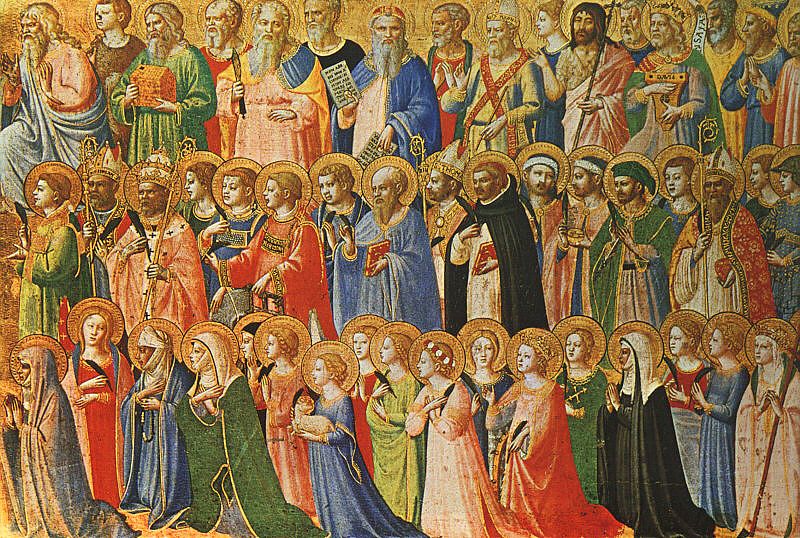
The saints who have died are not dead – they are more alive than we are now. The human saints in Heaven lived in times past, but they were made of the same stuff and faced similar struggles then as you and I today. Though the Catholic Church has canonized thousands of saints, when you consider the billions of Christians throughout history canonizations are relatively rare, yet there are more saints in Heaven than we can count. We know this because of St. John’s Revelation of Heaven: “I had a vision of a great multitude, which no one could count, from every nation, race, people, and tongue.” The Lord Jesus Christ wants you to be in that number. Unfortunately, common misconceptions about saints can keep us further from them. So, in this homily, I would like to help you to grow closer to them in friendship and in likeness.

First realize that the saints are not dead and gone but still living. This is why whenever I preach about the deceased I try to speak of them using the present tense whenever some fact about them remains true. For instance, if a kind and generous Christian father of three dies he is still a kind and generous father of three. Rather than saying “his name was David,” faithfully witness that “his name is David” even after he has died. Though deprived of their bodies for the moment, those who are in Heaven are more alive than we are here. There they experience God opening himself to them an inexhaustible way. This is called the beatific vision, an ever-flowing well-spring of happiness, peace, and mutual communion. The saints in Heaven see God face to face, and they have become like him for they see him as he is.

What is a glorified human being or exulted human nature like? Let’s consider the Blessed Virgin Mary. How much does she know us? How much does she love us? Does she hear each one of our prayers addressed to her? It is our sense of the Faith that our spiritual mother does indeed know us and loves us individually as her children. But consider this: if every Catholic in the world offers one Hail Mary a day, this means an average of more than fifteen thousand new prayers come her way each second. Therefore, if Mary hears all our prayers, her experience of time and/or the capacity of her glorified consciousness must far surpass our own.

The other glorified saints in Heaven, our brothers and sisters in Christ, know and care about you too. They understand you because they’ve walked in our shoes. Governments and borders and technologies change over time, but human nature is constant. The saints began with the same humanity as you and I, experienced challenges like our own, and prevailed. Lots of canonized saints have been priests, nuns, bishops, popes, or martyrs, but Heaven is certainly not limited to these backgrounds. Saints come from varied walks of life. Some canonized saints did extraordinary miracles or had visions here on earth, but even for these most of their days were ordinary, spent faithfully doing very ordinary things like us.

The saints in Heaven are our friends who lend us constant aid even if we do not know their names yet. In response, I encourage you to befriend them back. Which ones? Try doing this holy experiment: ask Jesus to introduce you to a saint and then keep your eyes open. Watch for a saint to providentially present him or herself to you, perhaps through an icon, a painting, or a photograph, a book or a film, or mentioned in a conversation thereafter. I look forward to hearing whom you’ll meet. Take these saints as teachers you learn from, role models you imitate, heroes to inspire you, and holy intercessors whose prayers before God for you are very powerful. I urge you to follow the saints, because those who follow them will embody the beatitudes, become more like Jesus, and become saints themselves.

Though it is unlikely any of us here will be officially canonized by the Church, we are all called to be saints. You are called to be a saint. St. Catherine of Siena said, “If you are what you should be, you will set the world on fire.” Do not say, “I have too sinful of a past to become a saint.” Recall that St. Paul had once persecuted Christians. There is no saint without a past and no sinner without a future. And do not say, “I’m too imperfect to become a saint.” Realize that even while St. Peter was serving as the first pope he sometimes made personal mistakes in his ministry. And do not say, “I’m too late in my life to become a saint.” Remember how the Good Thief on his cross next to Jesus made the most of the time he had left. As St. John Paul the Great preached, “Become a saint, and do so quickly.” Jesus is calling you to be a saint, so befriend the saints and they will help you on the way to Heaven.

What We Should Do Now

March 25, 2020

The Solemnity of the Annunciation

The angel Gabriel was sent from God to a town of Galilee called Nazareth, to a virgin betrothed to a man named Joseph, of the house of David, and the virgin’s name was Mary. And coming to her, he said, “Hail, full of grace! The Lord is with you.” But she was greatly troubled at what was said and pondered what sort of greeting this might be. Then the angel said to her, “Do not be afraid, Mary, for you have found favor with God. Behold, you will conceive in your womb and bear a son, and you shall name him Jesus. He will be great and will be called Son of the Most High, and the Lord God will give him the throne of David his father, and he will rule over the house of Jacob forever, and of his Kingdom there will be no end.”

But Mary said to the angel, “How can this be, since I have no relations with a man?” And the angel said to her in reply, “The Holy Spirit will come upon you, and the power of the Most High will overshadow you. Therefore the child to be born will be called holy, the Son of God. And behold, Elizabeth, your relative, has also conceived a son in her old age, and this is the sixth month for her who was called barren; for nothing will be impossible for God.” Mary said, “Behold, I am the handmaid of the Lord. May it be done to me according to your word.” Then the angel departed from her.


What would it be like to be visited by an angel? Scripture tells us “some [people] have unknowingly entertained angels,” like Gideon or Tobiah, because angels can appear on earth in human disguise. But if you ever saw an angel in unveiled glory this spiritual creature would not be a winged Precious Moments character like some people imagine. As C.S. Lewis writes in the preface of his book The Screwtape Letters:

In the plastic arts [the symbolic representations of angels] have steadily degenerated. Fra Angelico’s angels carry in their face and gesture the peace and authority of Heaven. Later come the chubby infantile nudes of Raphael; finally the soft, slim, girlish and consolatory angels of nineteenth-century art… They are a pernicious symbol. In Scripture the visitation of an angel is always alarming; it has to begin by saying “Fear not.” The Victorian angel looks as if it were going to say “There, there.

When the Archangel Gabriel came and greeted the Virgin Mary in Nazareth, “she was greatly troubled.” He must calm and reassure her, “Do not be afraid, Mary, for you have found favor with God.” His message from Heaven is a weighty and mysterious one: you shall conceive and bear the Messiah, the Christ, who is both the heir to David’s kingdom and the Son of Almighty God. Mary has apparently made a prior vow to remain a virgin within her current marriage to Joseph, for she questions how she would ever conceive apart from relations with a man. Gabriel explains this will be through the power of God, for whom all things are possible. Even this answer leaves a great deal unrevealed.

It’s natural for Mary to feel anxious. She has heard God’s promises but much remains uncertain for her near and distant future: Will Joseph believe her? How should she parent such a Holy Child? How will Jesus become king? What will happen to her? How long or difficult will her life be? God’s full plan is unknown to Mary, but she knows what to do for that moment. She says, “Behold, I am the handmaid of the Lord. May it be done to me according to your word.” Through this faithful, trusting response, Jesus Christ saves his Church, the Virgin Mary becomes the Most Blessed, and every generation is blessed.

It’s natural to feel anxious now. We have received God’s promises but much remains uncertain about our near and distant future. Follow Mary’s example and entrust your life to God’s will, so that you may be the most blessed and a great multitude may be blessed through you.

Finding Jesus in the Temple

March 19, 2020

The Solemnity of St. Joseph

Each year Jesus’ parents went to Jerusalem for the feast of Passover, and when he was twelve years old, they went up according to festival custom. After they had completed its days, as they were returning, the boy Jesus remained behind in Jerusalem, but his parents did not know it. Thinking that he was in the caravan, they journeyed for a day and looked for him among their relatives and acquaintances, but not finding him, they returned to Jerusalem to look for him.

After three days they found him in the temple, sitting in the midst of the teachers, listening to them and asking them questions, and all who heard him were astounded at his understanding and his answers. When his parents saw him, they were astonished, and his mother said to him, “Son, why have you done this to us? Your father and I have been looking for you with great anxiety.” And he said to them, “Why were you looking for me? Did you not know that I must be in my Father’s house?” But they did not understand what he said to them.


Joseph and Mary feel great anxiety in these days. Jesus is missing and Jerusalem could be dangerous. Yet the young Lord Jesus is not lost. Retracing their steps they find him in the Temple. He’s dialoguing with the Jewish teachers, perhaps answering their replies with more probing questions of his own in the tradition of the rabbis.

Mary asks her Son, “Why have you done this to us?” Her anxiety, perhaps even touched by anger, is natural. Jesus has purposes in these events that his parents do not fully grasp, but they still love him and he loves them too. “Why were you looking for me? Did you not know that I must be in my Father’s house?” Jesus could have been found by his parents sooner; he was in the Temple the whole time.

You may feel great anxiety in these days. With the suspension of public Masses you could feel like Jesus is missing. Given the serious reports of disease the city could be dangerous. Yet we have not lost Jesus. Retracing your steps you can find him in the church.

What questions are you asking Jesus in prayer? What question does he pose you in reply? Perhaps you ask, “Why have you allowed this to happen to us?” Our feelings of anxiety or anger are natural. Jesus has purposes in these events that we do not fully grasp, but we still love him and he loves us too.

And Jesus can still be found nearby; he has been present in the tabernacle of the church this whole time. You can find Jesus in his Temple by visiting the Real Presence of our Eucharistic Lord. St. Paul’s Church is open daily, 7 AM to 7 PM and St. John the Baptist’s Church is open 8 AM to 7 PM on Saturdays, Sundays, Tuesdays, & Thursdays. These churches will be spray-disinfected for each day they are open, but use the cleaning materials located in the back of church to clean your seating area before and after use.

Follow these important safety tips as they might save your life or the lives of others’:

  • Realize that possibly 80% of confirmed cases of Coronavirus are contracted from people who did not realize they were sick and that symptoms typically take five days to manifest. Therefore, we must guard against this disease before we know it is among us. Practice social distancing.
  • If you have a cough or a fever, you might not be sick with the Coronavirus but please stay home; this virus can linger in the air and upon surfaces and infect others.
  • Remember that the virus can survive on surfaces (such as door handles, pews, and clothing) for one, two, or three days; so avoid touching your eyes, nose, or mouth. Treat unwashed hands as if they were infected and clean them often with soap and water.
  • Maintain at least a six-foot distance from other people.
  • No more than nine persons can be at the church at once (under emergency Wisconsin state law and by our bishop’s decree).
  • The most common place visitors sit in church is the back pews; so I suggest sitting in other, less-frequented, possibly-safer rows.


St. Joseph,
Patron of the Universal Church
and Protector of the Holy Family,
pray for us in our time of need


Be Well-Prepared for Disaster

February 20, 2020

On October 9th, 1859, the first Marian apparition in the United States (since approved by the Catholic Church as “worthy of belief – although not obligatory”) occurred near Green Bay, Wisconsin. Adele Brise, a 28-year-old Belgian immigrant, was walking eleven miles home from Sunday Mass when she saw a beautiful lady with long, wavy, golden hair wearing a crown of stars and clothed in a dazzling white dress with a yellow sash around her waist.

Adele fell to her knees and asked, “In God’s name, who are you and what do you want of me?” The Blessed Virgin Mary replied, “I am the Queen of Heaven, who prays for the conversion of sinners, and I wish you to do the same. You received Holy Communion this morning, and that is well. But you must do more. Make a general confession, and offer Communion for the conversion of sinners. If they do not convert and do penance, my Son will be obliged to punish them. … Gather the children in this wild country and teach them what they should know for salvation…

Adele was faithful to her mission, teaching the Catholic Faith to the young and praying for sinners’ souls. However, almost exactly twelve years to the day after Mary’s message, Eastern Wisconsin experienced the one of the largest and the most deadly forest fire in our nation’s history. Flames of the vast Pestigo Fire surrounded the shrine built upon the apparition site, but all who fled to this ground dedicated to Mary survived. Consider: is our present time and culture somehow less deserving of divine punishment than theirs?

Another disaster afflicted our land a century ago. From 1918 to 1920, a deadly flu plagued Europe and the U.S. but wartime censors suppressed news reports from many nations besides the World War One neutral country of Spain. The Spanish Flu, as it came to be called, would go on to kill an estimated 675,000 Americans and at least 50 million people worldwide. This largely-forgotten history has been on my mind as the Coronavirus pneumonia outbreak has spread forth from Wuhan, China. There are strong indications that the dictatorial Chinese government is under-reporting how many of their people are infected or have died from this highly-infectious disease, and new cases are being reported day-by-day around the world. Earlier this month, in a effort to contain the spread of the disease, the Hong Kong government asked its citizens to stay at home and the cardinal of their Catholic diocese has suspended public Masses. Could we experience a deadly pandemic here? The U.S. Centers for Disease Control saysthe potential public health threat posed by [Coronavirus] is high.” Therefore, it is wise to be prepared.

I urge prudent preparation on two fronts. First, materially speaking, if an emergency were declared and schools and businesses sent everyone home, could your family be able to shelter at your house away from others for two or three weeks until the crisis passed? What food and water would you have if your electric power went out? Building non-perishable food reserves is easy now while store shelves remain fully stocked. And if no disaster ever comes (as may well be the case) you can simply cycle through these pantry supplies over time; so nothing is lost. The second, more important front in your disaster preparedness is: are you spiritually ready?

If you knew this Lent might possibly be your last, how would that change your spiritual focus? What vices would you cut and which virtues would you grow? How would you commit to prayer and prepare your soul? For many, times of great crisis or the end of their lives arrive unexpectedly and people face them unprepared. As Jesus once observed, “In [the days of Noah] before the flood, people were eating and drinking, marrying and giving in marriage, up to the day that Noah entered the ark. They did not know until the flood came and carried them all away.” Mark’s Gospel recalls one occasion when the Pharisees came forward and began to argue with Jesus, seeking from him a sign from Heaven to test him. Jesus sighed from the depth of his spirit and said, “Why does this generation seek a sign?” The Pharisees had heard Jesus’ teachings and known his mighty works but they still obstinately refused to change. Why do we put off the Lord, refusing to listen and respond, postponing our conversion until it might be too late?

Once, after a tower collapse in Jerusalem ended eighteen lives, Jesus asked, “Do you think they were more guilty than everyone else who lived in Jerusalem? By no means! But I tell you, if you do not repent, you will all perish as they did!” Will the Coronavirus become a devastating American disaster like the Pestigo Fire or the Spanish Flu? Hopefully not. I pray to God it will not be so and ask that you do the same. Yet even if this crisis never comes to your community, why not prepare? Stocking-up your pantry, regularly washing your hands, instilling our Faith into your children, and deepening your own relationship with Jesus Christ are wise decisions you won’t regret.

Naming Jesus — January 1 — Mary the Mother of God

January 7, 2020

“When eight days were completed for his circumcision, he was named Jesus, the name given him by the angel before he was conceived in the womb.”

Who named Jesus? In one sense, it was his parents; Mary his mother and Joseph his adoptive-father. Yet this name was not their own idea. At the Annunciation, the Archangel Gabriel told Mary: “you will conceive in your womb and bear a son, and you shall name him Jesus.” And later on, an angel of God, likely Gabriel but perhaps another, told Joseph in a dream: “[Mary, your wife,] will bear a son and you are to name him Jesus, because he will save his people from their sins.” So this name was communicated to Jesus’ parents, and both parents were instructed to name him so, but the idea of this name and the commands to bestow it did not originate with the angels.

The word “angel” comes from the Greek and Latin words for “messenger,” and the angel spirits are messengers of God. The Archangel Gabriel was sent from God to Nazareth to announce to Mary the plan and will of God. So who named Jesus? First and foremost, God. The Letter of St. Paul to the Philippians declares, “[God] bestowed on him the name that is above every name, that at the name of Jesus every knee should bend, of those in heaven and on earth and under the earth”.

And what does the name of Jesus mean? The name “Jesus” (or “Iēsous” in Greek) is “Yeshua” in Hebrew, which means “Yahweh helps,” or “God saves.” The name of Jesus, given him by his Heavenly Father, denotes the message and the mission of the Son, And this message and mission was given him by the Father. Jesus declares, “I did not speak on my own, but the Father who sent me commanded me what to say and speak,” and “I came down from heaven not to do my own will but the will of the one who sent me.” The Father names his Son, and the Son is obedient to his Father’s authority.

Naming someone or something is to author its name, and authorship denotes authority over that person or thing. In the story of Creation, God creates and names the Day and the Night; the Sky, the Earth, and the Sea. Then the Lord forms man from the ground and settles him in the garden, with a mission to cultivate, protect, and care for it. Then God forms the animals from the ground, bringing each to the man to see what he would call them; and whatever the man called each living creature was then its name. Since none of these would be a suitable partner for the man the Lord formed another from the man’s rib, perhaps the bone closest to the core of man’s being, God’s last and ultimate creature. When the Lord brought her to the man, he rejoiced: “This one shall be called ‘woman,’ for out of man this one has been taken,” and the man gave his wife the name “Eve.” God blessed them and said to them: “Be fertile and multiply; fill the earth and subdue it. Have dominion over the fish of the sea, the birds of the air, and all the living things that crawl on the earth.

The man has sovereignty and dominion over the creatures he named. Parents, likewise, have authority over their children. As we heard last Sunday from the Book of Sirach, on the Feast of the Holy Family, “God sets a father in honor over his children; [and] a mother’s authority he confirms over her sons.” Both Joseph and Mary name Jesus on this eighth day after his birth and they exercise authority over the Child-God. “[Jesus] went down with them and came to Nazareth, and was obedient to them.” All legitimate authority (in a family, a workplace, a government, or the Church) is to be exercised in accord with God’s will. And when authority is exercised in this way, we can expect the household, business, nation, or Church to thrive—provided that legitimate, godly authority is likewise obeyed in accord with God’s will. ‘Jesus went down with Joseph and Mary, and was obedient to them; and his mother kept all these things in her heart. And Jesus advanced in wisdom and age and favor before God and man.’

Who have you been entrusted with authority over? For whom has God given you a mission to cultivate, protect, and care for as their Christ-like servant-leader? Recognize your mission, and exercise your authority in accord with God’s will as a blessing for others. And realize that those with spiritual authority over others (as you may have in your household) can literally bless them. Usually when we say “God bless you,” (that is, when we say this to a peer) we are not really blessing them ourselves but desiring, hoping, wishing, praying that God might bless them. As the Letter to the Hebrews says, “Unquestionably, a lesser person is blessed by a greater.” When we have spiritual authority for someone we can personally speak blessings upon them.

Words can not only encourage, but they also seem to have metaphysical power. Our first reading recounts how Aaron and his sons as priests of Israel were given authority to bless God’s people. The Old Testament patriarchs blessed their children and we see their words fulfilled. God creates and Jesus works miracles through spoken words; God said “let there be light” and there was light. Jesus said to the paralytic your sins are forgiven; stand up, pick up your mat, and go home, and the man was healed inside and out. Your words of blessing, in accord with God’s authority, can have great power, too.

[After preaching this homily last night, a parishioner shared with me that she and her husband learned about blessing and claiming dominion your household from friends a decade ago. They notice a difference in their family in their years of marriage before and after. For example, when she begins to fell minor health issues coming on, she asks for her husband’s blessing, and reports that she can “feel the power of his prayers.”]

So husbands, bless your wives and children, mothers bless your children, and bless your grandchildren, too. And on this first day of the year, ask God our Father and Holy Mary, the Mother of God and our spiritual mother too, to bless you and yours in this new year ahead.

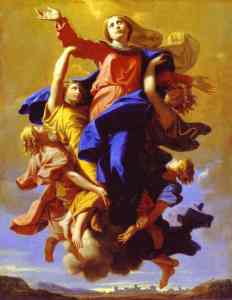
A Preview of our Future Glory – The Assumption of the Blessed Virgin Mary – August 15th

August 15, 2019

In the year 1950, with the world past beyond the deaths of World World II and rejoicing in the victory against evil, Pope Pius XII promulgated this joyful message:

“…For the glory of Almighty God who has lavished his special affection upon the Virgin Mary, for the honor of her Son – the immortal King of the Ages and the Victor over sin and death, for the increase of the glory of that same august Mother, and for the joy and exultation of the entire Church; by the authority of our Lord Jesus Christ, of the Blessed Apostles Peter and Paul, and by our own authority, we pronounce, declare, and define it to be a divinely revealed dogma: that the Immaculate Mother of God, the ever Virgin Mary, having completed the course of her earthly life, was assumed body and soul into heavenly glory.”

As Pope Pius detailed in the decree in which he proclaimed this dogma, the Church’s belief in Mary’s Assumption into Heaven is not something new. This is evidenced by the fact that no Church in East or West claims to have her body. You can find purported (and quite probable) relics of St. Peter or St. Paul, but you will encounter no bones of St. Mary. This is because Christians everywhere believed that her body no longer remained to be found anywhere on earth.

Some people say Catholics honor Mary too much, but this is an unfounded concern. Whatever we celebrate about Mary at the same time points to and glorifies her Son. The Lord’s Ark of the Covenant, his throne, and his mother are celebrated and glorious; but the One whom the ark, the throne, and the mother bear is greater still. While the mysteries of Mary point to and glorify Jesus, the mystery of Mary’s Assumption particularly points to our future glory in Christ.

For example, as I mentioned before, Mary’s body is no longer to be found on earth. In times past and present, some have doubted whether the bodily resurrection of the dead extends beyond Jesus from his tomb. Mary in her glory is not a disembodied spirit, but united in her body and soul. This is the future destined for our bodies as well. That is why we do not treat dead bodies as trash, like dirt swept up from the floor to be thrown outside to the wind. We reverence the bodies of the dead because those bodies will rise again.

We know more about Mary after her Assumption through the Church-approved apparitions of her; such as Our Lady of Guadalupe, Our Lady of Lourdes, Our Lady of Fatima, and other appearances. While we are not bound to believe in these apparitions, the Church – having investigated them thoroughly – has judged them to be true and worthy of belief. These apparitions indicate that Mary has been globe-traveling for nearly two thousand years.

The dogma of Mary’s Assumption leaves open the question of whether Mary ever actually died. There are traditions on both sides of the question, and Pope Pius XII merely proclaimed that she assumed after “having completed the course of her earthly life.” But in either case, whether she died or not, Mary now clearly shares in her Son’s victory over death. Death no longer has any power over her, and this will be true for all of us who rise in Christ.

A detail that seers of Mary’s apparitions agree on is that she is now exceedingly beautiful. During the years of her life on earth, Mary might not have been the most beautiful woman alive. We do not imagine that Jesus had to be the tallest or most muscular man who has ever lived, so likewise Mary need not have lived as history’s most beautiful woman either. If she had been that physically beautiful, I can easily imagine it impeding her God-given mission. But regardless, now there is no mismatch between Mary’s inner and outer beauty. This inner beauty is called holiness. Sometimes in this world the holy can look quite plain or even ugly, while the wicked can look very attractive. But after the resurrection, the abundance (or lack) of holiness we have cultivated within will be seen in our endless beauty (or ugliness) forever.

It seems that Mary, in her now-glorified body, can change aspects of her appearance. For instance, in her apparition to St. Juan Diego as Our Lady of Guadalupe in Mexico in 1531 she had darker skin and black hair, like the Native Americans. But at her first Church-approved apparition in the United States, to the Belgian-immigrant Adele Brise in 1859 here in Wisconsin near Green Bay, Mary had white skin and blonde hair. And on these occasions she did not speak to them in her own original language, in Hebrew or Aramaic, but in the familiar languages of those she was speaking to. She chose to look and speak this way to them because she is their spiritual mother. And she is our mother, too.

Mary may change her hair color, skin color, and age because these are relatively unimportant details of our person; but interestingly, she never appears as a different sex. She has never appeared as a bearded man declaring, “I am the Virgin Mary, who gave birth to Jesus.” God has created Mary as a female, just as the body he created for Jesus is forever male. God made them male and female, and what God has created is very good.

In none of her apparitions has Mary ever said, “I appreciate the sentiment, I really do, but could you please let up on all the prayers? I can’t keep up with all your Hail Marys!” Just imagine having an email account with an inbox receiving a billion new messages every day. For us this would be overwhelming, but Mary’s capacity to hear, and know, and act has been heightened in her glorified state. She hears you, she knows you, and she loves you personally. This foreshadows our life in the Kingdom to come. How many close friends can a person have? Five, ten, maybe twenty? But in Heaven we will have more than a billion such friends, and the capacity to profoundly know them all and to intensely love them all will be within our ability. The practice of love in this life is a preparation for that endless day.

What is Mary’s mission after her Assumption? It’s not that different from the Visitation we hear about in today’s Gospel. Mary encounters her extended family member, Elizabeth, and comes to serve her in love, for Elizabeth is up in age and pregnant with her first child. And Mary does not come alone, but with Jesus within her, and she helps to make him known. And then Mary and Elizabeth praise and rejoice in God together: “the Almighty has done great things for me and holy is his Name!” That is what she’s doing in her apparitions. And even after the Resurrection, that will continue to be her mission and ours; to encounter and love and serve our family in Christ, to praise and glorify God, and to rejoice with Christ and each other forever.

In conclusion, Mary’s Assumption points to our own bodily resurrection. Her beauty encourages us to pursue the beauty of holiness. She is our mother, and as long as we have God as our Father we will be their son or daughter forever. Mary knows and loves each one of us, helping us to grow in love. And her mission is our mission; to encounter and serve others, to walk with Jesus Christ, and to praise and rejoice in God. All of the mysteries of Mary point to and glorify Jesus, but the mystery of Mary’s Assumption particularly points to our future glory in Christ.

Mass Apparitions of Our Lord

June 26, 2019

So there’s Our Lady of Guadalupe, Our Lady of Lourdes, Our Lady of Knock, Our Lady of Fatima, and Our Lady of lots of places. Our Lady of the Rosary, Our Lady of the Miraculous Medal, Our Lady of Good Counsel, Our Lady of Good Help, Our Lady of Sorrows, Our Lady of Victory, Our Lady of Grace, Our Lady of Peace, and Our Lady of lots of other good things, too. When I was a kid, I didn’t realize that all these ladies were the same lady. But eventually I figured out that these were all titles of the Blessed Virgin Mary. With that confusion cleared up, I went on to wonder why there seems to be so many apparitions of Mother Mary throughout Church history and so few of her Son, Jesus Christ.

Sure, there are famous exceptions. In the 18th century, Jesus appeared to St. Margaret Mary Alacoque to invite devotion to his Sacred Heart. The month of June is now dedicated to the Sacred Heart of Jesus. And in the 20th century, St. Faustina Kowalska had visions of Jesus encouraging devotion to his Divine Mercy. As a result, the first Sunday after Easter is celebrated as Divine Mercy Sunday. But it’s usually Mary who we hear about appearing here or there around the world, encouraging people to repent, to listen to her Son’s words, and be saved.

So I wondered, “Why aren’t there more apparitions of Jesus in the world?” Eventually I figured out the reason: there’s an apparition of Jesus Christ at every Holy Mass. At every Mass, Jesus’ words are proclaimed. At every Mass, he works a miracle for us. At every Mass, his Real Presence come to us by the Eucharist. Compared to how frequently Jesus appears before us at Mass, Marian apparitions are the rarity.

In today’s Gospel, Jesus multiplies five loaves and two fish to feed more than five thousand people (and that’s just counting the men.) He has them sit in groups of about fifty, blesses and breaks the food, and hands it to his disciples to serve the people. They all eat and are satisfied, and the leftovers are more than Jesus had started with. The day after this amazing event (a miracle recounted by all four Gospels) St. John tells us that Jesus was in Capernaum, teaching in the synagogue about the Bread of Life:

I am the bread of life,” he said, “whoever eats this bread will live forever; and the bread that I will give is my flesh for the life of the world.” At this the Jews quarreled among themselves, saying, “How can this man give us his flesh to eat?” And Jesus replied, “Amen, amen, I say to you, unless you eat the flesh of the Son of Man and drink his blood, you do not have life within you. Whoever eats my flesh and drinks my blood has eternal life, and I will raise him on the last day. …My flesh is true food, and my blood is true drink. Whoever eats my flesh and drinks my blood remains in me and I in him. …The one who feeds on me will have life because of me. …Whoever eats this bread will live forever.

The crowds were perplexed by this teaching and St. John notes that after this many of Jesus disciples left and no longer followed him. But Jesus doesn’t chase them down saying, “Come back, you misunderstood, I was only using a figure of speech.” Instead, he turns to his apostles and asks, “Do you also want to leave?” St. Peter, not understanding but trusting, replies, “Master, to whom shall we go? You have the words of eternal life.” After the Last Supper, recounted by St. Paul in today’s second reading, the Early Church understood Jesus’ teaching. Multiplying five loaves into enough bread to feed thousands is a miracle, but Jesus’ far greater miracle is feeding the world with bread transformed into himself.

If someone asked you, “Are you an object? Are you a thing?” how would you answer? If someone asked me if I was an object, I’d say that I do have many qualities and traits of an object; I have size, and shape, and color, and weight. But an object or a thing can be bought or sold, used and discarded, held cheaply and treated cheaply. You and I are not merely objects or things, but persons; persons meant to be loved and to recognized as worthy of love. So much about our devotion is set right when we recognize that the Holy Eucharist is not merely an object but a person.

When we dress up for Sunday Mass, we dress up for him. When we sing as Mass, we’re singing for him. Unlike Judas, who took the morsel and left the Last Supper before it was over, we remain until the end of Mass because he is here. Sunday Mass in not merely an obligation, but an opportunity for encounter with him. And when we visit him (on Sundays, or at a weekday Mass, or just stopping by the church) he is please that we are here. In love, Jesus offers us a communion with himself through the Eucharist more intimate and profound than that shared by spouses. Our Eucharistic Lord wants us to behold him, recognize him, and rejoice to receive him. So, if a Christian ever asks you, “Have you personally received Jesus?” you can answer, “Yes, in my hand, on my tongue, into my body and blood, in my soul and in my heart, through the Most Holy Eucharist, which is his very self.

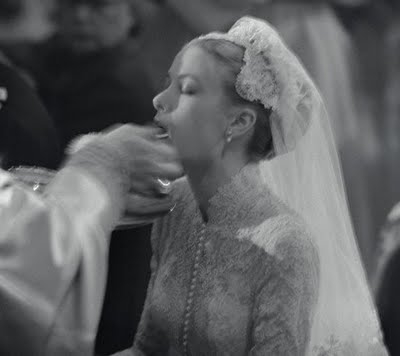
Princess Grace (née Kelly) of Monaco receives
the Holy Eucharist at her 1956 nuptial Mass


Mary in History: Our Lady of Lourdes

March 25, 2019

March 25, 1858 – Lourdes, France

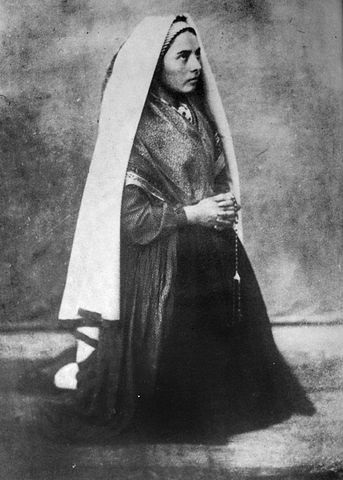
This was now the sixteenth time St. Bernadette Soubirous had encountered the Lady at the grotto. Bernadette had reported seeing “a young girl, sixteen, or seventeen years old. She wore a white dress drawn in at the waist by a blue ribbon whose ends hung down. On her head she wore a long white veil so as almost to cover her hair. Her feet were bare but nearly covered by the folds of her dress, except at the tip where a yellow rose shone on each. On her right arm she carried a Rosary of white beads on a golden chain, shining like the roses on her feet.” The local pastor, Fr. Dominique Peyramale, had prudently and persistently urged Bernadette to ask and discover the name of this strange visitor.

“She was there,” Bernadette recounts. “I asked her to forgive me for coming late. Always kind and gracious, she made a sign to me with her head to tell me that I need not make excuses. Then I spoke to her of all my love, all my reverence and the happiness I had in seeing her again. After having poured out my heart to her, I took up my Rosary. While I was praying, the thought of asking her name came before my mind with such persistence that I could think of nothing else. I feared to be presumptuous in repeating a question she had always refused to answer and yet something compelled me to speak.”

“At last, under an irresistible impulse, the words fell from my mouth, and I begged the Lady to tell me who she was. The Lady did as she had always done before; she bowed her head and smiled but she did not reply. I cannot say why, but I felt bolder and asked her again to be so kind as to tell me her name; however, she only bowed and smiled as before, still keeping silence. Then once more, for the third time, clasping my hands and acknowledging myself unworthy of the favor I was seeking of her, I again made my request.”

“The Lady was standing above the rosebush, in a position very similar to that shown in the Miraculous Medal. At my third request, her face became very serious and she seemed to bow down in an attitude of humility. Then she joined her hands and raised them to her breast… She looked up to Heaven… then slowly opening her hands and leaning forward towards me, she said to me in a voice vibrating with emotion, ‘I am the Immaculate Conception.'”

Bernadette, the simple and uneducated girl, did not understand what the Lady’s words meant but she repeated them over and over to herself (lest she forget them) as she walked to inform her parish priest. Only once the statement’s meaning was explained to her did St. Bernadette realize that her “Lady” was indeed the Blessed Virgin Mary. The apparition of Our Lady at Lourdes represents a heavenly confirmation of the Dogma of the Immaculate Conception which Pope Pius IX had solemnly and infallibly proclaimed and affirmed a few years before in 1854.

Mary in History: A Mystical Marriage

March 9, 2019

March 9, 1368 – Siena, Italy

Catherine Benincasa was born the youngest of twenty-five children in Siena, Italy. She was so joyful as a child that they nicknamed her “Eu-phro-sy-ne,” from the Greek word for “merriment.” At age six, while walking home with her brother, she stopped in her tracks. When she did not respond to his calls, he walked back to her and shook her, as from a dream. She burst into tears, having beheld in the sky a vision of Jesus seated in glory with the Apostles Peter, Paul, and John. A year later, she made a secret vow to give her whole life to God.

In her teenage years, Catherine’s parents began pressuring her to enter marriage, but she voiced with her intention not to. When her parents persisted, she cut short her beautiful golden-brown hair. As punishment, they made her do menial work in the household and, knowing she craved prayerful solitude, never allowed her to be alone. She bore all this with patient sweetness, later writing that God showed her how to build within her soul a private chamber where no tribulation could enter.

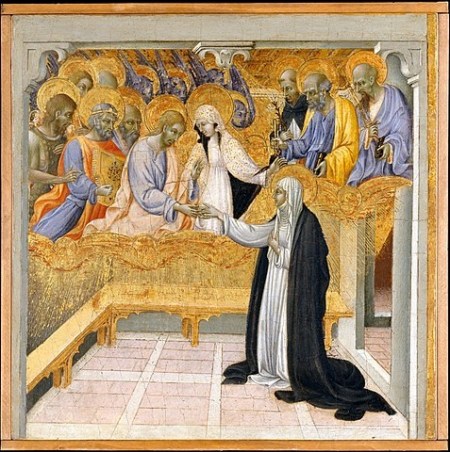
On Fat (or Shrove) Tuesday, while the people of Siena were celebrating carnival, the 21-year-old Catherine was praying in her room. A vision of Jesus appeared, with by Mary and the heavenly angels. Our Lady took Catherine’s hand and held it up to Christ, who placed a ring upon it and mystically married her to himself. Though invisible to others, this ring of St. Catherine of Siena was always visible to her.

Some misunderstand the meaning and purpose of celibacy in the Church. Jesus Christ, St. Paul, St. Catherine, and others have encouraged and lived this way of life not because human connection or natural marriage are bad, but because celibacy allows for a higher and broader intimacy. Every person is called to marriage, be it natural or spiritual; and everyone one is called to have children, be they biological or spiritual.

Mary in History: A Healing Spring

February 24, 2019

February 25, 1858 – Lourdes, France

By the time of this, the ninth appearance of the beautiful Lady to the fourteen-year-old St. Bernadette Soubirous, word had spread about these apparitions and the visionary. On this date, about 300 people accompanied Bernadette to the grotto near the Gave River outside Lourdes. No one except Bernadette could see the Lady nor hear her speaking aloud in their local French dialect.

On this occasion, the Lady told Bernadette, “Go and wash and drink in the spring.” But Bernadette became confused because there was no spring to be seen. At first she thought she meant the river, but the Lady directed her to the back of the grotto cave. Bernadette walked there, kneeled down, and dug at the earth with her hands. Water began seeping into the hole, turning the soil to mud. Bernadette drank it and washed her face with it. She also, at the lady’s command, ate some of the grass there. Understandably, the crowd was dismayed and thought her crazy. Bernadette answered, “It is for sinners.”

There had been no spring there before, but by the next day the spot was producing a thin stream trickling down to the river. Later, Louis Bourriette, a blinded stonecutter, bathed his eyes in its water and regained his sight. In another famous case, a desperate mom prayerfully plunged her weak and dying infant into the cold spring waters and he became healthy and strong for the first time, amazing the doctors. (This child, Justin Bouhort, who would go on to attend the canonization of St. Bernadette seventy-five years later, on December 8th, 1933.) Though there is nothing scientifically unique about the chemical makeup of this water, more than 7,000 miraculous healings have been counted at Lourdes, of which 67 have been officially recognized as “medically inexplicable” by the International Medical Association of Lourdes. As we see in the spring at Lourdes, St. Bernadette, and Our Lady, the Lord exults the lowly, leading all future generations to call them blessed.

Sound Interpretations

February 17, 2019

Last year, the internet hotly debated whether a particular sound clip was saying Yanny” or “Laurel.” While most people can only hear one name or the other, some people can make out each. In fact, both of the names are sounding in the clip together but at higher and lower pitches. In another online curiosity, a short video shows a small figurine glowing and emitting a sound, either “Brainstorm” or “Green Needle.” The amazing thing is that if you listen to this clip with either phrase in mind then that is the phrase you’ll hear. You can even alternate back and forth between the two. In each of these examples, the messages are indeed there to be heard if one has the ears to hear them.

These phenomena suggest how people in the Bible may have been present to the same auditory events but heard things quite differently. On one occasion recorded in John’s Gospel, Jesus prayed aloud, “Father, glorify your name.” Then a voice came from Heaven, “I have glorified it and will glorify it again.” John notes, “The crowd there heard it and said it was thunder; but others said, ‘An angel has spoken to him.‘” Later, at Pentecost in The Acts of the Apostles, the disciples “were filled with the Holy Spirit and began to speak in different tongues, as the Spirit enabled them to proclaim.” At the sound of it others in Jerusalem from many nations gathered in a large crowd “but they were confused because each one heard them speaking in his own language. … They were all astounded and bewildered, and said to one another, ‘What does this mean?’ But others said, scoffing, ‘They have had too much new wine.’” Sometimes people can hear more than one thing in the same divine message, or dismiss it all as nonsense.

Does each passage of the Bible have only one true interpretation? Some reject that Isaiah 7:14 (“The virgin shall be with child and bear a son, and they shall name him Emmanuel”) could foretell the virgin birth of Jesus, arguing “the author was referring only to the political situation of his day, not to an event centuries later he couldn’t possibly have known.” But this view forgets or denies that human beings are not the sole authors of Scripture. They are co-authors inspired by the Holy Spirit. God is all-knowing and alive outside of time. He can inspire prophesies with both near and distant fulfillments. And God can invest passages with multiple true and divinely-intended meanings. For example, in the Book of Revelation, John beholds in the sky, “a woman clothed with the sun, with the moon under her feet, and on her head a crown of twelve stars.” She gives birth to a son, the Christ, and then she is protected by God from a red dragon, the Devil. Does this represent God’s people of the Old and the New Covenants, or does it symbolize Mary the Mother of God? Yes. The answer is both.

Sacred Scripture, like other things of God, may be compared to a magic pool. It is a pool in which a small toddler may safely play and a great whale may deeply swim. Let us not remain shallow in our understandings, but explore the true depths of God’s Word.

Mary in History: A Surprising Lady

February 11, 2019

February 11, 1858 – Lourdes, France

On the Tuesday before Ash Wednesday (which is called “Fat” or “Shrove” Tuesday,) Bernadette Soubirous, her sister, and a friend were gathering firewood in the cold outside their small French town. They were near a river and a grotto (a shallow cave) where the locals would dump their garbage. Then fourteen-year-old Bernadette heard the sound of a sudden swish of wind. As Bernadette would later recall:

“I had just begun to take off my first stocking [intending to cross the shallow river barefooted as my companions had done] when suddenly I heard a great noise like the sound of a storm. I looked to the right, to the left, under the trees of the river, but nothing moved; I thought I was mistaken. I went on taking off my shoes and stockings, when I heard a fresh noise like the first. Then I was frightened and stood straight up. I lost all power of speech and thought, when, turning my head toward the grotto, I saw at one of the openings of the rock a [rose] bush, one only, moving as if it were very windy. Almost at the same time there came out of the interior of the grotto a golden colored cloud, and soon after a Lady, young and beautiful, exceedingly beautiful, the like of whom I had never seen, came and placed herself at the entrance of the opening above the bush. She looked at me immediately, smiled at me and signed me to advance, as if she had been my mother. All fear had left me, but I seemed to know no longer where I was. I rubbed my eyes, I shut them, I opened them; but the Lady was still there continuing to smile at me and making me understand that I was not mistaken. Without thinking of what I was doing, I took my Rosary in my hands and fell on my knees. The Lady made a sign of approval with her head and took into her hands a rosary which hung on her right arm. When I attempted to begin the Rosary and tried to lift my hand to my forehead, my arm remained paralyzed, and it was only after the Lady had signed herself that I could do the same. The Lady left me to pray all alone; she passed the beads of her Rosary between her fingers but she said nothing; only at the end of each decade did she say the ‘Glory Be’ with me.”

St. Bernadette Soubirous then returned to her family’s poor home, but this would be just the first of eighteen apparitions to her by the Blessed Virgin Mary, Our Lady of Lourdes, over the five months to follow.

Mary in History: The Conversion of Marie-Alphonse Ratisbonne

January 20, 2019

January 20, 1842 – Italy

Alphonse, a French, upper-class, secular Jew, was no fan of religion. He particularly opposed Catholicism after his brother converted and became a priest. Yet providential circumstances brought Alphonse to Rome where Baron Theodore de Bussières, a family friend and fervent Catholic, challenged the 27-year-old skeptic to wear the Miraculous Medal and say the Memorare prayer each day. Alphonse obliged and, on the morning of January 20th, he felt drawn to walk into a church.

I was scarcely in the church when a total confusion came over me,” he later wrote. “When I looked up, it seemed to me that the entire church had been swallowed up in shadow, except one chapel. It was as though all the light was concentrated in that single place. I looked over towards this chapel whence so much light shone, and above the altar was a living figure, tall, majestic, beautiful and full of mercy. It was the most holy Virgin Mary, resembling her figure on the Miraculous Medal. At this sight I fell on my knees right where I stood. Unable to look up because of the blinding light, I fixed my glance on her hands, and in them I could read the expression of mercy and pardon. In the presence of the Most Blessed Virgin, even though she did not speak a word to me, I understood the frightful situation I was in, my sins and the beauty of the Catholic Faith.

That day, he went to meet a Catholic priest. Eleven days after, Alphonse was baptized, confirmed, received Holy Communion, and added “Marie” (that is, “Mary”) to his name. That same year a formal Vatican investigation into his instant conversion judged it a divine miracle operated through the intercession of the Blessed Virgin Mary. Marie-Alphonse was ordained a priest five years later and alongside his priest-brother labored twenty-nine years establishing religious houses and evangelizing Jews in Palestine, or present-day Israel. At the first Pentecost, 3,000 people in Jerusalem were converted to Christ through the Apostles. The Lord Jesus would have us also use our personal testimonies, invitations, and prayers to win souls for him today.

Mary in History: Help of Christians

January 12, 2019

January 12-13, 1866 – Czech Republic

For more than a decade, Magdalena Kade suffered from very poor health. At age 30, her condition took a turn for the worse such that her two physicians thought she would soon die and her priest gave her the Sacrament of the Anointing of the Sick with Last Rites. One Friday night, while Magdalena lay in bed attended to by Veronika Kindermannová, her friend from next door, “All of a sudden the room became luminous, full of more light than daytime.” As Magdalena would later testify in the bishop’s investigation, “I was frightened. I elbowed Veronika, saying to her: ‘Veronika, wake up, do you not see this glow?’ Veronika said: ‘But I do not see anything.’ In front of my bed was a figure that emanated a very white light, with a golden crown on its head. I quickly thought it was the Mother of God. I united my hands in prayer and began to pray: ‘My soul magnifies the Lord, and my spirit exults in God, my Savior.‘ [Mary spoke these words at the Visitation.] Having said this, I heard a voice – but an unusual voice, different from that of people: ‘My child, from this moment on you will be healed.’ And in that moment the person disappeared and I no longer felt any pain.

That night, Magdalena rose from her bed to the great joy of her family and on Saturday morning she walked to the local bakery to buy bread. When the townspeople of Filipov saw her and asked how she was well, she replied, “Last night I saw the Virgin Mary and she told me I would be healed. And I am healed. Nothing more and nothing less happened.” Magdalena would go on to retell her story many times to inquirers and the room where she was healed became a place of pilgrimage. After her bishop’s investigation affirmed the supernatural character of Magdalena’s cure, a church was built on the site. In 1885, Pope Leo XIII elevated it to a minor basilica and officially consecrated and dedicated it to “Mary, Help of Christians.” Like Mary before her, Magdalena could rejoice that “the Almighty has done great things for me” and, by plainly sharing her firsthand experience, she led others to deeper faith in Christ. Let us likewise share the stories our own miraculous, God-touched moments with family, friends, and neighbors as well.

Mary in History: Our Lady of Prompt Succor

January 8, 2019

January 8, 1815 – Louisiana

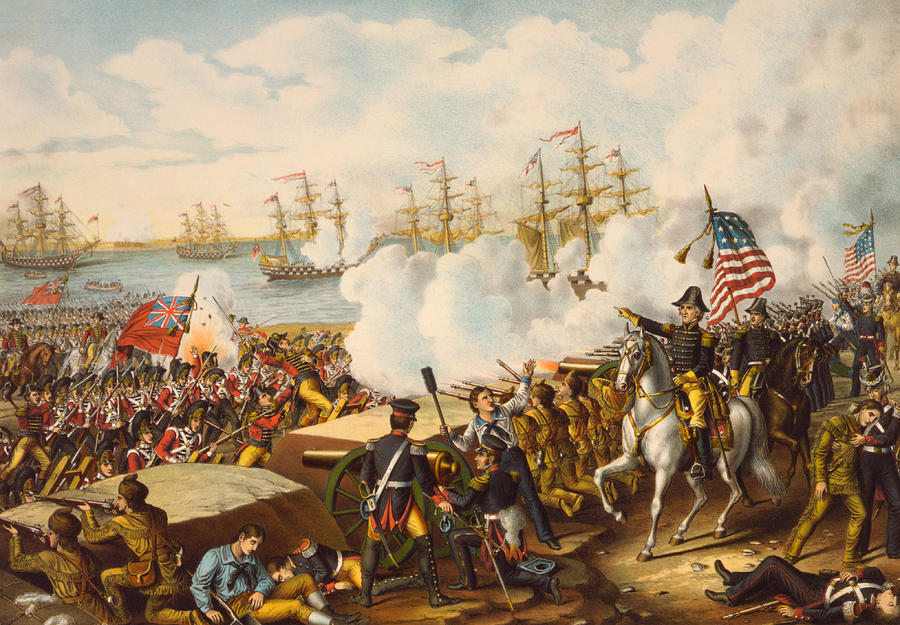
Mary as Our Lady of Prompt Succor (which means, “rapid aid”) has been celebrated in New Orleans, Louisiana on this date for more than 200 years since a famous military victory. The Ursuline Sisters in New Orleans had honored a statue of Mary by this title for several years in their chapel, but when the British army threatened to capture their city during the War of 1812 these nuns and many townsfolk spent the night beseeching her help. The convent’s prioress made a vow to have a Mass of Thanksgiving sung annually should the American forces prevail. During Mass the next morning, as Holy Communion was being distributed, a messenger rushed into the chapel with the news that the British had been defeated.

Though the British army had outnumbered the American troops (about 8,000 to 5,700) the invaders were repulsed and swiftly defeated in just over a half hour of fighting. The commanding general of the American side, the future president Andrew Jackson, went to nuns’ convent afterwards to thank them for their prayers: “By the blessing of heaven, directing the valor of the troops under my command, one of the most brilliant victories in the annals of war was obtained.” For each American soldier lost or wounded in that battle, the British had experienced roughly thirty casualties. This victory was commemorated by Johnny Horton’s 1959 #1 hit song “The Battle of New Orleans.” Since 1928, Our Lady of Prompt Succor has been honored as the principal patroness of the City of New Orleans and the State of Louisiana.