Archive for the ‘Blessed Virgin Mary’ Category

Mary in History: Our Lady of the Flowers

December 29, 2018

December 29, 1336 – Italy

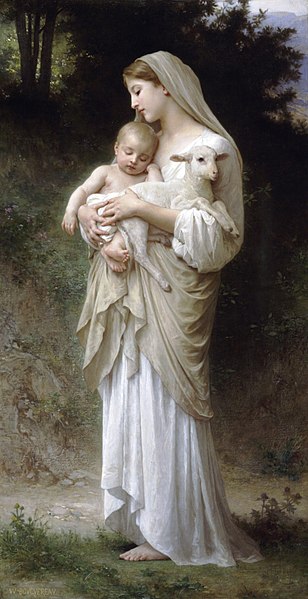
Egidia Mathis, a pregnant, young wife, was walking alone at the edge of nightfall near Bra, Italy. Near a pillar bearing a coarsely painted image of the Virgin Mary with Child, she crossed paths with two foreign soldiers-for-hire (that is, mercenaries) whom she sensed wished to do her harm. Incapable of defense or escape, Egidia flung herself towards the pillar, begging Mary’s help. A great light came forth from the image. Mary scared off the wicked men with a commanding gesture and smiled at Egidia with maternal empathy. The stress of the moment caused Egidia to go into labor and she delivered her baby there. As she held her newborn closely in the winter cold, the blackthorn thicket surrounding the pillar was now in full bloom with thousands of white flowers. Upon reaching home, she told her husband of the whole episode and he with their relatives and neighbors all beheld the miraculous, out-of season flowering.

Some might dismiss this tale as merely pious legend. But virtually every winter since 1336, this blackthorn thicket, contrary to its species and scientific explanation, has flowered between December 25th and January 15th. Two rare exceptions were 1914 and 1939, the years the two World Wars began. Furthermore, on three occasions, this winter flowering has extended for months, corresponding each time with rare public expositions of the Shroud of Turin (the possible burial cloth of Christ) housed twenty-seven miles away.

Christ, the Peace Light, is Born

December 27, 2018

In the city of Israel that is called Bethlehem, the ancient Church of the Nativity marks the site of the first Christmas. There one can actually stoop and bend down beneath the central altar & touch the celebrated spot where Jesus Christ was born. It is fitting that the pilgrims bend low to do this, because the miracle of God becoming a human being — to live and die and rise for us — surely deserves humble reverence with everything that we are.

Earlier this year, as has happened for a number of years now, an Austrian child and their family was selected to travel to Bethlehem. Candles and lamps are always burning within the Church of the Nativity, and there this chosen child transferred their fire into two blast-proof lanterns. Then they all flew back to Austria, where this flame (called “The Peace Light”) has spread from lamp to lamp, light to light, candle to candle, into more than thirty European countries and to places around the world. On December 1st of this year, the Peace Light arrived at J.F.K. Airport in New York City and it has traveled from there across our country. This week, it providentially came to our parish.

Last Friday, a Hudson couple traveling with the Peace Light approached me after morning Mass at St. Paul’s. I had never heard of the Peace Light before, but I happily received it and kept it for this Christmas celebration. All the flames you see burning our sanctuary this Christmas were originally lit from Bethlehem’s flame. Now I carefully carried, protected, and preserved this light; especially when I only had one vigil candle. I realized that one error, one jostling of the liquid wax, could extinguish the fire; and then what would become of this, my Christmas homily? I’d be lost. But, thanks be to God, these candles are lit here today.

So why do we have candles at Mass? Since the early days of Christianity, when Catholic Mass was celebrated in hiding, underground in the catacombs, lamps have provided useful illumination. But these lights are not merely practical. In the late 300’s A.D., a heretic named Vigilantius criticized Christians in the East about many of their practices, including their lighting of great piles of candles while the sun was still shining in the sky. St. Jerome declared in answer to him that candles are lighted where the Gospel is proclaimed not merely to put darkness to flight, but as a sign of joy. As an added symbol, these candles on the altar (and the Easter Candle) are, by tradition, mostly made of beeswax. Because beeswax, which is the product of the virginal female bee, is like the flesh of Our Lord supplied by the Blessed Virgin Mary.

Of course, the celebrated Peace Light is not merely a symbol of some abstract notion or idea of peace; it’s a symbol of the very real person of Jesus Christ. The “Light of the World” entered our world from his mother’s womb in Bethlehem. And his light has spread across the world and throughout time to this place and our day. Today, our candles burn and shine for him.

Within you there is also candle, but it is a very vulnerable light. Through error or neglect its light can go out. And without this light we are in darkness without true joy. So Jesus commands us to regularly gather all our candles together here, to be re-lit from the Source, the Light of Christ. In conclusion, in case my symbolism has been too subtle: Have a very joyful Christmas, and know that Jesus Christ (who loves you) wishes you to return here again for his Holy Mass next Sunday.

Mary in History: Our Lady of Guadalupe

December 11, 2018

December 12, 1531 – Mexico

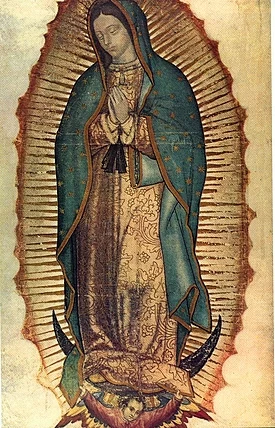
The Blessed Virgin had previously appeared to St. Juan Diego, a Native American, Catholic convert, twice sending him to the local bishop to ask that a church be built near Tepeyac Hill in what is today Mexico City, Mexico. The bishop was not persuaded by the native’s story but asked him for some kind of sign from Mary. On this date, Mary directed Juan to pick some non-native roses miraculously in bloom out of season on that hill and to bring them to the bishop. Juan gathered these in the front of his poncho-like garment (called a tilma) and set off.

When Juan opened the front of his tilma before the bishop to reveal the roses, Our Lady of Guadalupe’s image was found on the humble fabric of his garment. Her appearance was that of an Aztec princess, clothed in the Sun with the Moon under her feet, bearing a Divine Child in her womb. The image’s rich symbolism spoke compellingly to the native people and Mexico was converted to Christ.

That tilma, made of rough cactus fibers, should have deteriorated centuries ago, but this garment and its brushstroke-less image remain on display in Mexico’s greatest shrine to this day. Like many things, it’s a miracle existing in plain sight. Our diocese also has a beautiful shrine dedicated to Our Lady of Guadalupe, Patroness of the Americas, located just south of La Crosse. If you’ve never visited, it’s worth the pilgrimage.

Mary in History: The Immaculate Conception

December 8, 2018

December 8, 1854

On this date, to the delight of the Church in Heaven and earth, Pope Pius IX employed the gift of papal infallibility to dogmatically affirm our ancient belief in the sinlessness of the Mother of God: “We declare, pronounce, and define that the doctrine which holds that the most Blessed Virgin Mary, in the first instance of her conception, by a singular grace and privilege granted by Almighty God, in view of the merits of Jesus Christ, the Savior of the human race, was preserved free from all stain of original sin, is a doctrine revealed by God and therefore to be believed firmly and constantly by all the faithful.

In her apparitions at Lourdes, France three years after, Mary affirmed, “I am the Immaculate Conception.” The Church celebrates Mary’s Immaculate Conception on December 8th and her birthday nine months later, on September 8th. Every one of us, from the greatest to the least, begins very, very small. But God loves to make great things of the small.

Mary in History: The Miraculous Medal

November 29, 2018

November 27, 1830 – France

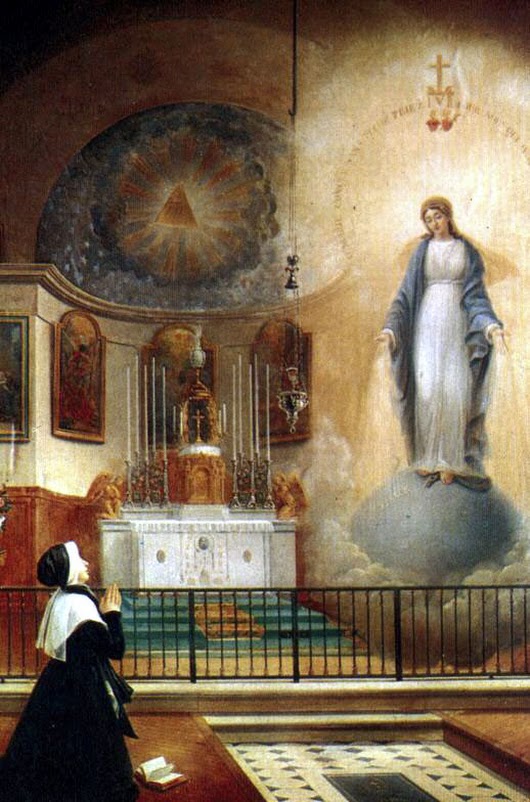
Our Lady appeared to St. Catherine Labouré, a 24-year-old novice (training to become a vowed religious sister,) in the Daughters of Charity’s convent chapel in Paris, France. In this, Mary’s second of three appearances to her, Catherine saw something like two living paintings, one fading into the other, in which the Blessed Virgin stood in a white silk dress upon a half-globe, her feet crushing a serpent. Mary held a small golden globe topped with a cross which she lifted up towards Heaven. Catherine heard a voice say, “This globe represents the entire world, including France, and every person.”

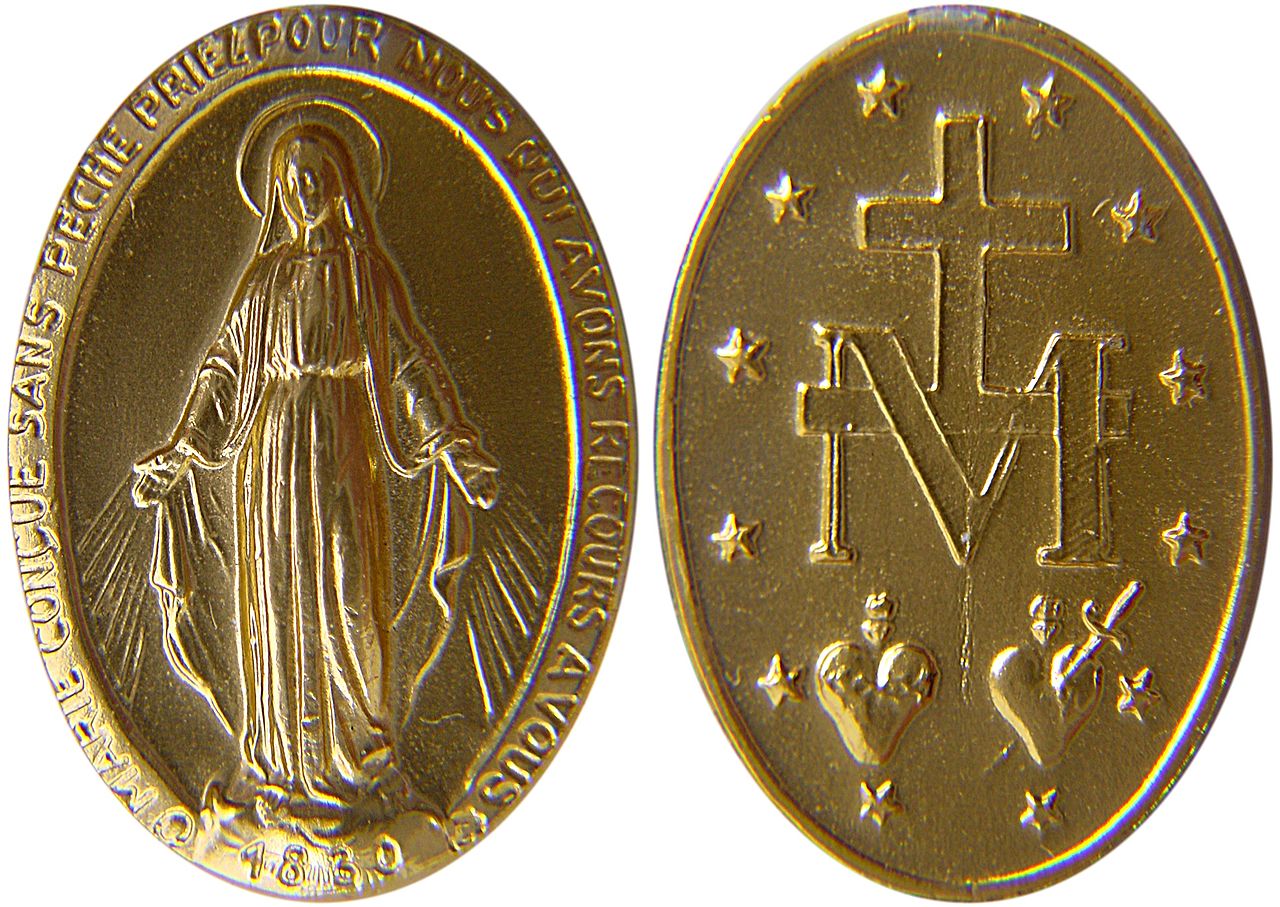
In the second image, beautiful rays of light streamed from Mary’s open hands, her fingers covered with jeweled rings. Catherine heard, “These rays are a symbol of the graces that I pour out on those who ask them of me. The gems from which rays do not fall are the graces for which souls forget to ask.” Then an oval formed around the apparition and Catherine saw in a semi-circle these words in gold letters: “O Mary, conceived without sin, pray for us who have recourse to you.”

Then a voice commanded Catherine, “Have a medal made according to this model. For those who wear it with confidence, there will be abundant graces.” The image turned and Catherine saw the reverse side of the medal: an “M” topped with a little cross and two hearts, one crowned with thorns and the other pierced by a sword. With approval by the Archbishop of Paris, the medal was minted and shared, leading to such gifts of grace that it came to be called “The Miraculous Medal.”

Mary, the Mother of All Christians

April 26, 2018

Earlier this year, the Vatican announced that the Monday after Pentecost Sunday shall henceforth be celebrated as a new feast day: the Memorial of the “Blessed Virgin Mary, Mother of the Church.” Its worldwide inaugural celebration will be on May 21st this year. The Holy Catholic Church has defined four dogmas about Mary: that she is ever-virginal and the Mother of God, that she was immaculately conceived and assumed body and soul into Heaven. What Pope Francis has decreed is not on the level of defining a fifth Marian dogma, but he is highlighting a precious truth about Our Lady for us to treasure and valuable for us to share with our Protestant brothers and sisters.

Mary is both poetically and actively the Mother of the Church. St. Augustine says of her, “She is clearly the Mother of His members; that is, of ourselves, because she cooperated by her charity, so that faithful Christians, members of the Head, might be born in the Church.” And as Blessed Pope Paul VI professes in his Credo of the People of God: “we believe that the Blessed Mother of God, the New Eve, Mother of the Church, continues in Heaven her maternal role with regard to Christ’s members, cooperating with the birth and growth of divine life in the souls of the redeemed.” How many Christians are unaware that they have a spiritual Mother who loves them?

That Mary is the Mother of all Christians is evident from Scripture. At the Cross, “when Jesus saw his mother and the disciple there whom he loved, he said to his mother, ‘Woman, behold, your son.’ Then he said to the disciple, ‘Behold, your mother.’ And from that hour the disciple took her into his home.” This scene was not included in John’s Gospel to satisfy some idle curiosity about Mary’s living arrangements in her later years. Understanding this scene according to its spiritual significance, every Christian is ‘the disciple who Jesus loved.’ Every Christian is entrusted to Mary as her child and she is given to each one of them as their mother.

Further proof of this is found in the Book of Revelation. There we see a huge dragon (explicitly called “the Devil and Satan”) attempt to destroy “a male child, destined to rule all the nations with an iron rod,” along with his mother who wears “a crown of twelve stars.” This is Jesus the Messianic King and his Queen Mother, Mary. Note what happens after the “ancient serpent” fails to conquer this man and woman: “Then the dragon became angry with the woman and went off to wage war against the rest of her offspring, those who keep God’s commandments and bear witness to Jesus.” Who are Mary’s children? They are Christians — “those who keep God’s commandments and bear witness to Jesus.”

Christ’s Church is meant to be gathered around Mother Mary. Before his Ascension, Jesus told the first Christians to “stay in the city until you are clothed with power from on high.” And so, “when the time for Pentecost was fulfilled, they were all in one place together” beside Mary his Mother and the reconstituted Twelve Apostles in the room where the First Eucharist was celebrated. It was through Mary that the Holy Spirit had first begun to bring mankind into communion with Jesus Christ. So likewise (the Catechism of the Catholic Church observes) “she was present with the Twelve, who with one accord devoted themselves to prayer, at the dawn of the end time which the Spirit was to inaugurate on the morning of Pentecost with the manifestation of the Church.”

This is why the Monday after Pentecost is a very fitting day for us to celebrate Mary as Mother of the Church and why all Christians should come together as her spiritual children. Let Catholics be rejoice and Christians be reunited as one!

Mary, Mother of all Christians, pray for us!

Our Lady of Zeitoun

April 3, 2018

A Fascinating Marian Apparition from Egypt

Fifty years ago this week, on the evening of April 2, 1968, a group of Muslim mechanics and drivers working across the street from Virgin Mary’s Coptic Church in Zeitoun, Egypt, saw a woman atop a dome of the church. Two other men also noticed the white figure on the top of the church and the matter was reported to the police. A crowd gathered on the site and interpreted the sighting as an apparition of the Blessed Virgin Mary. After a few minutes, the event ended. According to tradition, Zeitoun is on the route that the Holy Family took when fleeing King Herod’s efforts to murder the infant Jesus.

Our Lady of Zeitoun

One week later, on April 9, 1968, the phenomenon reoccurred, again lasting for only a few minutes. After that time apparitions became more frequent, sometimes two or three times a week, for several years, ending in 1971. The woman spoke no words, but moved about the church’s mysteriously illuminated domes. She would also face the people in the streets below and gesture warmly with her head or hands. Sometimes she was accompanied by luminous, dove-shaped bodies which moved about at high speeds. Muslims hold Mary in very high regard even though they deem Jesus to be merely a prophet of Islam. She was seen to kneel down before a cross on the church roof; significant, since Muslims deny Jesus’ crucifixion.

Pope (or Patriarch) Kyrillos VI, the head of the Coptic Orthodox Church of Alexandria, appointed a committee of high-ranking priests and bishops to investigate. On May 4, 1968, Kyrillos VI issued an official statement confirming and approving the apparition. These apparitions were witnessed by perhaps a million people, including President Gamal Abdel Nasser, and were documented by newspaper photographers and Egyptian television. Egyptian government officials concluded in 1968: “Official investigations have been carried out with the result that it has been considered an undeniable fact that the Blessed Virgin Mary has been appearing on Zeitoun Church in a clear and bright luminous body seen by all present in front of the church, whether Christians or Muslims.”

The Most Interesting Woman in the World

March 1, 2018

With a single word, she crushed a deadly serpent.

Pregnant just once, she has billions of children.

She ended the Soviet Union with her heart.

She is… The Most Interesting Woman in the World

For more than a decade, she held the title for
“The Best Thing to come from Nazareth.”

Her preexisting condition?
Sinlessness — The Lord ensured it.

She lost track of her 12-year-old for three days…
is still considered the world’s greatest mother.

She once redesigned a used garment
and it converted Mexico.

Her favorite nation?
Her coronation.
(But she loves your homeland, too.)

At over 2,000 years old,
she could still get carded buying wine,
though she never needs to.

I don’t always drink wine, but when I do, I prefer my Son’s.

Stay holy, my children.


The Holy Family and Yours

January 1, 2018

Every year, Holy Mother Church presents the Holy Family for our contemplation and imitation. Some imagine life in the home of Jesus, Mary, and Joseph in the soft, pastel colors of a Christmas card; so holy, so flawless, so unobtainable. We wonder, “Can the Holy Family and my family really relate to one another?” At least two out of the three members of the Holy Family never sinned in their entire lives together. We, meanwhile, could jokingly refer to the Feast of the Holy Family as “Elbow-Nudge Sunday.” Throughout the world this day, wives and husbands, parents and children, take turns gently nudging one another as they listen to God’s words about marriage and family life. The Holy Family was holy, but that doesn’t mean their lives were easy or smooth.

I’ve previously written about the stresses and difficulties of the holy couple leading up to the first Christmas: about Mary’s crisis pregnancy, about Joseph grappling with his wife telling him the child within her is the Son of God and Joseph contemplating a divorce, about their giving birth to that holy child in an animal stable. And their trials together continued after Jesus’ birth.

Imagine being Mary and hearing Simeon prophesy, “Behold, this child is destined … to be a sign that will be contradicted — and you yourself a sword will pierce…” How would that make you feel about the future for you and your child? Picture being Mary as her husband awakes and says “our boy is being hunted, we need to leave tonight.” Consider Joseph, the servant-leader of his family, having to pack-up quickly and leave so much behind to take his family into hiding in Egypt. Later, an angel tells Joseph to bring his family back into Israel. So Joseph returns with Jesus and Mary, but he’s afraid to resettle in the south because the son of Herod the Great now rules Judea. With the help of another dream, Joseph decides to resettle in the north, in Nazareth of Galilee.

I mention all this because St. Joseph, the just and holy man, feared an earthly king even as he trusted God. St. Mary at the Annunciation did not know all the details of her future, but she trusted in God by saying, “Let it be done to me according to your word.” Our Lord Jesus, sweating blood from stress the night before he died, trusted God to say, “Not my will but yours be done.” Their holy lives were often difficult, but God always rewarded their trust, bringing about good for them in the end.

In Genesis, Abram (whose name later got changed to Abraham) was promised a son by the Lord. But the childless Abraham looks at the old age of his wife and himself and asks, ‘Will my steward, Eliezer, be my heir?‘ God answers, ‘No, not him; your own flesh and blood son shall be your heir.’ Then the Lord took Abraham outside and said, “Look up at the sky and count the stars, if you can. Just so,” he added, “shall your descendants be.” And Abraham put his faith in the Lord.

When I first heard this story (and maybe when you heard it too) I assumed this event happened at night. But the message is even more powerful if God told him to “look up at the sky and count the stars, if you can,” during the daytime. Where do the stars go during the day? We know they’re still there, even though the Sun’s brightness the sky’s blueness prevent us from seeing them. Abraham trusted in the Lord’s unwavering goodwill towards him and beheld God’s word fulfilled in the birth of Isaac. Through that son, Abraham received glory and the whole world was blessed.

One of the things Jesus says in the Gospels more than anything else is, “Be not afraid.” Sacrifice your fears. Imagine taking those obsessive worrying thoughts from your mind, placing them upon the altar, and lighting them afire like a sacrifice of old to God. “Let the peace of Christ control your heart…” Trust that “God works all things for the good of those who love him” and then “the peace of God, which surpasses all understanding will guard your hearts and minds in Christ Jesus.”

God not only wants peace within us, but peace among us as well. In our homes there is always room for improvement. The household of the Holy Family may have been a sinless one, but mistakes and miscommunications surely happened. Joseph probably broke or misplaced tools. Mary probably burnt an occasional loaf of bread. From the Gospels we know they both thought they knew where their 12-year-old boy was as they left Jerusalem for home; several hours passed before they realized he was missing. Even when we deeply love one another, we must learn and practice how to love and serve each other better.

We love each other in many ways, and the best modes by which we experience love can vary from person to person. The book “The Five Love Languages” lays out five major ways that we give and receive love, namely:

Gift Giving
Acts of Service
Affectionate Touch
Words of Affirmation
Quality Time

What are your top-two love languages? Can you guess the preferred languages of your spouse and children? Sometimes we try to love others as ourselves by loving them exactly as ourselves and we unfortunately miss our mark. For example, imagine a spouse complaining, “Why don’t you let me know that you love me,” when they really mean “why don’t you get me surprises anymore” (gift giving) or “why don’t you tell me that I delight you and you’re pleased with me” (words of affirmation.) At this, their spouse might reply, “What do you mean? I’m loving you all the time,” when they’re really saying “I take care of the kids and do housework” (acts of service) and “We eat and sit in the living room together every evening” (quality time.) These two loving spouses are loving past each other.

Learn the preferred love languages of your family members, and don’t expect others read your mind, sabotaging our own happiness. Tell them how to delight you. They love you and they want to make you happy. Don’t attack and criticize (“You always this” or “You never that”) but invite them to bless you. And pray together, as a couple and a family. The Holy Family surely did and its one of the most valuable things I can recommend. Some married couples, who have shared a bed for years, have never revealed their personal prayer requests to each other. Pray together, and then even whenever frictions arise, you will remember that you are on the same team, together on the same side with God.

Your home will never be perfect – not even the Holy Family’s was perfect. Life’s circumstances will go awry, and there will be sins we have to apologize for and forgive one another. But with trust in God and a daily commitment to loving and serving each other better, you too can live in the peace and joy of the Holy Family.

What if Jerusalem were in Western Wisconsin?

December 29, 2017

(Not all will personally resonate with the reference city
chosen for this reflection, but I share this article because
its device and style may be fruitfully employed by others.)

One thing I brought back with me from my first trip to Israel was a better grasp of its geography. A visit to the Holy Land yields a previously unknown sense of scale offering new insights to the Gospel. In lieu of flying everyone abroad, perhaps I can bring its holy places closer to home. Let’s allow Bloomer, Wisconsin to represent the location of ancient Jerusalem and examine where other sites in the region would be situated relative to it.

The town of Bethlehem is about five and a half miles (in a straight line, as the crow flies) south-southwest (SSW) from Jerusalem. So, allowing Bloomer to be Jerusalem, Jesus was born not far from St. John the Baptist’s Catholic Church in Cooks Valley, Wisconsin. If the Holy Family, retracing the steps of their Hebrew ancestors during their flight into Egypt, passed by the Great Pyramids of Giza (273 miles WSW from Jerusalem) they fled almost as far as Sioux Falls, South Dakota. After King Herod the Great’s death, Joseph and Mary brought Jesus to their hometown of Nazareth, 64 miles north of Jerusalem. Each year, Jesus’ parents would pilgrimage from Nazareth to Jerusalem, as from Hayward, Wisconsin to Bloomer and back, for the Jewish festival of Passover.

One of the things that struck me about seeing the Old City of Jerusalem in person is how very small it is. There is just 0.35 square miles – only twice the area of Vatican City – within its high stone walls. The locales of Jesus’ Passion, Resurrection, and Ascension are all reasonably short walks from each other.  If we take St. Paul’s Catholic Church in Bloomer as the location of the Jewish Temple, the Cenacle (or “Upper Room” where the Last Supper was celebrated) is located to the southwest at the intersection of Riggs Street & 19th Avenue. The site of Jesus’ crucifixion and tomb (the Church of the Holy Sepulcher) is almost due west of the church, in the middle of Bloomer’s Lake Como behind the A.J. Manufacturing building. And the traditional site of Jesus’ Ascension into Heaven from the Mount of Olives would be almost due east from the church, in the first field south of the Bloomer Public Elementary School.

As the young Church spread, a Pharisee named Saul of Tarsus obtained authority from the Jewish High Priest to arrest any Christians he might find in Damascus, 134 miles NNE from Jerusalem in Syria. However, the Lord Jesus enlightened him on his journey as to (quite fittingly) the Apostle Islands off of Wisconsin’s northern shore. This Saul, who became St. Paul, would go on to preach and win converts as in the Canadian provinces of Manitoba & Saskatchewan (i.e., Turkey & Greece.) Just like St. Peter, St. Paul was martyred for Christ far from home, 1,432 miles from Jerusalem in Rome, a distance like that of Seattle, Washington from Bloomer.

Following the Apostles, Jesus’ Church continued to grow through the centuries and around the world, winning new souls in new lands, including our own. Our Christian Faith has come to us today from ancient Jerusalem to St. Paul’s Catholic Church, wondrously spanning a distance equaling that of Bloomer, Wisconsin to Kyoto, Japan.


The two gray domes of the Church of the Holy Sepulcher appear behind the Islamic Dome of the Rock shrine atop the Temple Mount
in this photo I took in November 2016 from the western slope
of the Mount of Olives in Jerusalem.

Saint Paul’s Grade School Patron Saint Candidates

October 12, 2017

Our grade schoolers will soon be voting on who they want to be our school’s patron saint this year (in addition to St. Paul, of course.) The winner of the election will be announced at our school Mass on All Saints’ Day. These are the candidates:

Saint Aloysius Gonzaga (Al-low-wish-ous Gone-za-gah)

  • Though born to a very rich and powerful Italian family, his first words were the holy names of Jesus and Mary and he resolved as a teenagers to become a priest and missionary.
  • During his last year of seminary, while caring for plague victims in Rome, he died at age twenty-three with Jesus’ name as his last word.
  • He is the patron saint of Catholic youths.

The Blessed Virgin Mary

  • Jesus’ momma, St. Joseph’s wife, and the mother of all Christians.
  • By God’s grace she lived a sinless life and was taken up body and soul into Heaven.
  • Since that time, she has appeared in Mexico, France, Portugal, Wisconsin, and elsewhere.

Saint Anthony of Padua (Pah-du-ah)

  • This Portuguese priest became close friends with St. Francis of Assisi.
  • An amazing preacher, when his tomb was opened after thirteen years his tongue still looked alive and moist even though the rest of him was dusty bones.
  • One of history’s most quickly canonized saints, he is the patron saint of lost things.

Saint Thérèse of Lisieux (Tur-rez of Liz-sue) also known as “The Little Flower”

  • She begged Pope Leo XIII for permission and entered a French convent at age fifteen.
  • Her “Little Way” spirituality teaches about doing little things with great love.
  • She is known to give roses at the end of novenas (nine days of prayer) asking her help.

Three Common Catholic Misconceptions

September 27, 2017

Sometimes even the faithful can get things wrong (perhaps that’s why we’re called “practicing” Catholics.) I believe the following rank among Catholics’ most common misconceptions about our own Faith:

Myth #1: “The Immaculate Conception was Jesus Becoming Man”

Although Jesus’ conception is also a holy miracle, the Immaculate Conception refers to the creation of his mother, Mary. The Church has believed in Mary’s perfect sinlessness from ancient times. Consider that the loaded Greek word with which the Archangel Gabriel hails her at the Annunciation identifies her as ‘one having been graced by God in the past with the result continuing in full effect to the present.’ (Luke 1:28)

On December 8, 1854, Pope Pius IX infallibly defined the Dogma of the Immaculate Conception in these words: “We declare, pronounce and define that the doctrine which holds that the Blessed Virgin Mary, at the first instant of her conception, by a singular privilege and grace of the Omnipotent God, in virtue of the merits of Jesus Christ, the Savior of mankind, was preserved immaculate from all stain of original sin, has been revealed by God, and therefore should firmly and constantly be believed by all the faithful.

Myth #2: “The Anointing of the Sick is Only for One’s Deathbed”

Among the seven sacraments, Anointing of the Sick is the one especially intended to strengthen those who, having reached the age of reason, begin to be in danger due to sickness or old age. As the Second Vatican Council teaches, this “is not a sacrament only for those who are at the point of death. Hence, as soon as any one of the faithful begins to be in danger of death from sickness or old age, the fitting time for that person to receive this sacrament has certainly already arrived.”

Catholics on their deathbeds should certainly ask a priest for “the Last Rites,” that is, Anointing of the Sick with special prayers for the dying. But Catholics facing major surgery (such as ones involving general anesthetic) or those feeling elderly frailty should request this sacrament as well. Anointing may be repeated if the sick person’s condition becomes more grave during the same illness, or if they recover and then become seriously ill again.

Myth #3: “Divorced People Cannot Receive Holy Communion”

Faithful to Christ, the Catholic Church teaches that a consummated sacramental marriage endures for as long as the bride and groom both live. However, being divorced does not, in and of itself, bar someone from worthily receiving Holy Communion. (For instance, an abandoned spouse may bear no fault for his or her divorce, and in some cases—like domestic abuse or a gambling addiction—it can be appropriate for a spouse to procure a legal separation.) Merely being divorced is not necessarily a sin; it is divorce followed by remarriage outside of the Church that is the issue. Jesus said, “Whoever divorces his wife and marries another commits adultery against her; and if she divorces her husband and marries another, she commits adultery.” (Mark 10:11-12)

So what should a person who is divorced and remarried outside the Church do? The first step is to approach your pastor. Together, you can begin exploring seeking an annulment. A sacramental marriage cannot be undone by any power on earth, but if something essential to marriage was absent or withheld from the very beginning then such a marriage is invalid (not sacramental) and may be annulled. After obtaining the needed annulment(s), a person is free to be married in the Church. But what should remarried persons do if an annulment is not possible? Even these may receive Holy Communion following a good confession if they are resolved to begin living chastely, “as brother and sister,” in their present relationship.

Mary, the New Ark of the Covenant

September 4, 2017

Did you ever see Indiana Jones and The Raiders of the Lost Ark? You may recall seeing the movie’s replica of the Ark of the Covenant featured as the McGuffin artifact everyone was seeking out. This movie has been very helpful to preachers in providing a visual aid to everyone of what the Ark of the Covenant looked like.

Like Noah’s Ark, the Ark of the Covenant was a box constructed according to God’s design and command. It served as a portable throne bearing the presence of God on earth. The Ark held inside of it three important things: the two tablets of the Ten Commandments, the wooden staff of Moses’ brother Aaron the High Priest, and a gold jar containing some of the Manna God provided his people to eat in the desert. The reason I mention these things today is because the Ark of the Covenant in the Old Testament foreshadows the Blessed Virgin Mary in the New Testament.

The old Ark held the Ten Commandments, the word of God in stone; the Virgin Mary bears the Word of God in flesh. The old Ark held the priestly staff which on one occasion miraculously blossomed despite being dead; Mary conceives by the power of the Holy Spirit despite her perfect virginity. The old Ark contained Manna bread in a golden vessel; Mary’s holy womb contains the true Bread from Heaven, provided to us for our journey to Promised Land — Jesus Christ, our Prophet, Priest, and King.

At God’s command, the old Ark was made of natural wood overlaid with pure gold inside and out. Mary is a human woman who is made “full of grace.” King David once joyfully leaped and danced before the Ark of the Lord. At the Visitation, when Mary visits Elizabeth her relative, John the Baptist likewise leaps with joy within his mother’s womb. David once asked, “How can the Ark of the Lord come to me?” Elizabeth likewise asks, “And how does this happen to me, that the mother of my Lord should come to me?” On one occasion, the old covenant ark was kept for three months in the house of a man named Obed-edom outside Jerusalem, and Scripture records that God blessed his whole household. Mary likewise dwelt three months in the home of Zechariah and Elizabeth near Jerusalem and was surely a blessing to them.

No man was to touch the Old Covenant Ark, lest they be struck down dead. (God instructed his ministers to move that holy Ark only by means of two gilded poles which slid through rings on the sides of the Ark.) Joseph of Nazareth held a similar reverence towards Mary, his ever-virgin wife. In the Old Testament, the Lord was to be found wherever the old Ark dwelt, from the Sinai wilderness to the Temple in Jerusalem. In the New Testament, “on entering the house, [the Magi] saw the child with Mary his mother,” and, “standing by the cross of Jesus [was] his mother.”

In the movie, Indiana Jones and the Nazis were looking for the “lost” Ark because Scripture reports that the Old Covenant Ark was hidden soon before the Jewish Temple was destroyed by the Babylonians in 587 BC. Jeremiah the Prophet took the Ark and placed it in a secret cave. Unlike in the 1981 movie, the Lost Ark has never been recovered. Yet, in his revelations recorded at the end of the New Testament, John the Apostle sees the new Ark revealed. John writes: “God’s temple in Heaven was opened, and the ark of his covenant could be seen in the temple.” The next thing John describes is a glorious woman pregnant with the Christ child, “A great sign appeared in the sky, a woman clothed with the sun, with the moon under her feet, and on her head a crown of twelve stars.” This is Mary, the New Ark of the Covenant, whom at the end of her time on earth God lifted up body and soul into Heaven.

The old Ark was of central, though secondary, importance in the Old Covenant. Drawing physically nearer to it brought one closer to the presence of God on earth. Likewise, God gives the Blessed Virgin Mary, the new Ark, a central role in his New Covenant. If you draw closer in your relationship with her, you will surely draw closer to our Lord Jesus Christ.

God Raises Up the Lowly

June 1, 2017

She was a teenage virgin when she received a word from Heaven — she was to be God’s instrument in an incredible way. She asked how this could be, since she was merely an uneducated peasant girl. The messenger answered that God would deliver his people through her and she consented to her part in God’s plan. Despite her utter lack of military training, St. Joan of Arc (1412—1431 AD) would go on to lead French troops to swift victories against the English armies occupying her  homeland, paving the way for her people’s liberation.

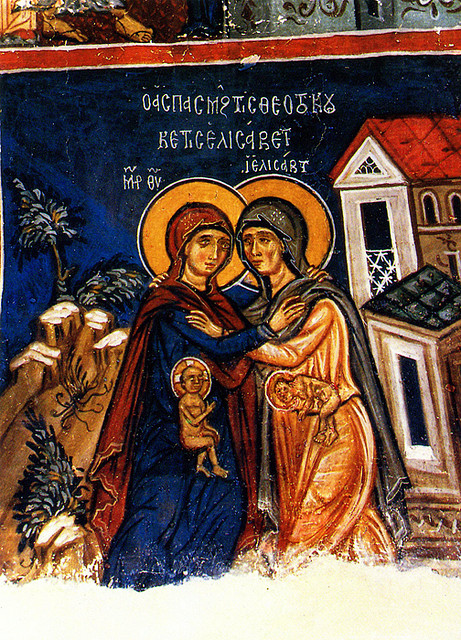
Every year, St. Joan’s of Arc’s feast (May 30th) comes the day before the Feast of the Visitation, which celebrates the meeting of the Blessed Virgin Mary and St. Elizabeth when they were pregnant with St. John the Baptist and Jesus the Christ. I think it is fitting and providential that these two celebrations are paired together on the liturgical calendar. These three, wondrous women display God’s preferred means of intervening and triumphing throughout human history: by manifesting his mighty power through the weak and the lowly.

Of course, God can work through the high-ranking and the powerful to accomplish his purposes as well. For example, in 312 AD the pagan emperor Constantine, on the eve of a great battle in a civil war for control of the Western Roman Empire, reportedly had a vision of the Chi-Rho (☧), a Greek symbol for “Christ.” He then heard these words:  “In this sign you will conquer.” Constantine had this symbol painted on his soldiers’ shields and  prevailed in that decisive Battle of the Milvian Bridge. Constantine became the first Christian emperor and promptly legalized the previously persecuted Christian religion throughout the empire in 313 AD.

And yet, the Virgin Mother Mary rejoices that God prefers to show the strength of his arm by lifting up the lowly and casting down the mighty from their thrones. St. Paul once redirected the attention of self-inflated Christians in Corinth, Greece to this truth:

Consider your own calling, brothers. Not many of you were wise by human standards, not many were powerful, not many were of noble birth. Rather, God chose the foolish of the world to shame the wise, and God chose the weak of the world to shame the strong, and God chose the lowly and despised of the world, those who count for nothing, to reduce to nothing those who are something, so that no human being might boast before God. … “Whoever boasts, should boast in the Lord.”

In the Old Testament, God chose sheepherders, like Moses the Prophet and later King David, to lead and deliver his oppressed people. He chose working-class fishermen as some of the Church’s first bishops. At the Visitation, the four most important people in the entire world met together in one place: two women and their unborn babies. And through one condemned man, whose three-year rabbinical career seemed to end in failure and death, God redeemed the world. Such is the divine approach, lest we look to merely our own human plans and efforts as the source for our salvation.

The Virgin Mary was a Martyr

September 15, 2016

 St.

The martyrdom of the Virgin is set forth both in the prophecy of Simeon and in the actual story of our Lord’s passion. The holy old man said of the infant Jesus: “He has been established as a sign which will be contradicted.” He went on to say to Mary: “And your own heart will be pierced by a sword.”

the-swoon-of-the-virginTruly, O blessed Mother, a sword has pierced your heart. For only by passing through your heart could the sword enter the flesh of your Son. Indeed, after your Jesus – who belongs to everyone, but is especially yours – gave up his life, the cruel spear, which was not withheld from his lifeless body, tore open his side. Clearly it did not touch his soul and could not harm him, but it did pierce your heart. For surely his soul was no longer there, but yours could not be torn away. Thus the violence of sorrow has cut through your heart, and we rightly call you more than martyr, since the effect of compassion in you has gone beyond the endurance of physical suffering.

Or were those words, “Woman, behold your Son,” not more than a word to you, truly piercing your heart, cutting through to the division between soul and spirit? What an exchange! John is given to you in place of Jesus, the servant in place of the Lord, the disciple in place of the master; the son of Zebedee replaces the Son of God, a mere man replaces God himself. How could these words not pierce your most loving heart, when the mere remembrance of them breaks ours, hearts of iron and stone though they are!

Do not be surprised, brothers, that Mary is said to be a martyr in spirit. Let him be surprised who does not remember the words of Paul, that one of the greatest crimes of the Gentiles was that they were without love. That was far from the heart of Mary; let it be far from her servants.

Perhaps someone will say: “Had she not known before that he would not die?” Undoubtedly. “Did she not expect him to rise again at once?” Surely. “And still she grieved over her crucified Son?” Intensely. Who are you and what is the source of your wisdom that you are more surprised at the compassion of Mary than at the passion of Mary’s Son? For if he could die in body, could she not die with him in spirit? He died in body through a love greater than anyone had known. She died in spirit through a love unlike any other since his.