Archive for the ‘Blessed Virgin Mary’ Category

5 Things / 5 Cosas — 5th Sunday in Ordinary Time—Year A

February 5, 2011

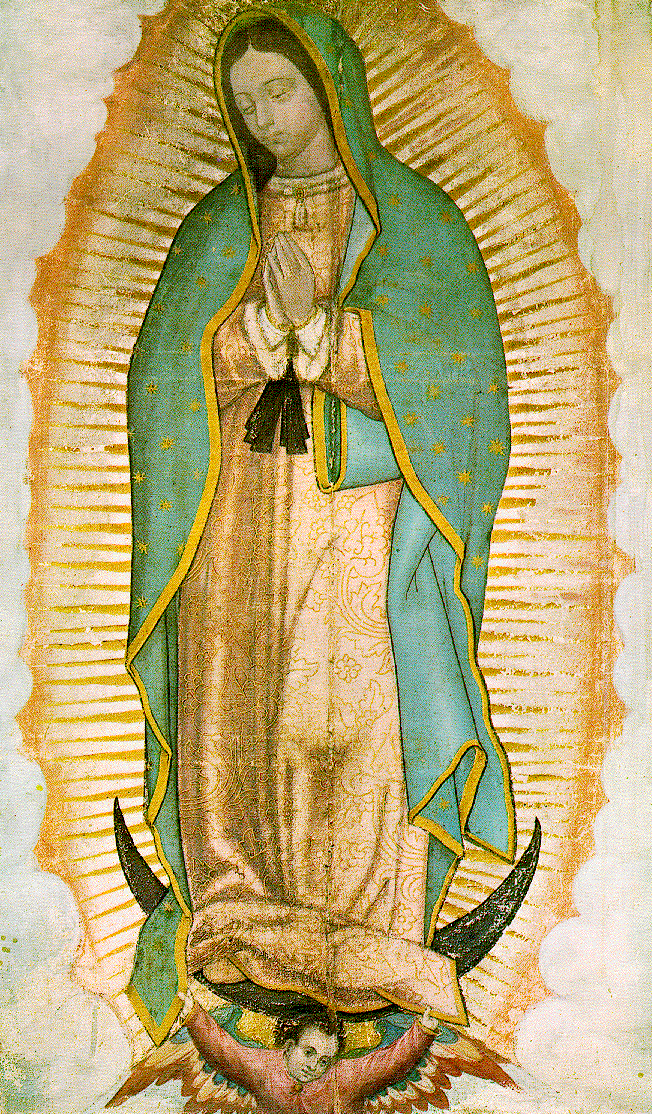
The Blessed Virgin Mary, our Lady of Guadalupe, comes to Saint Juan Diego dressed in the sun. She is clothed in light. Her light comes from God. In 1531, she does simple things. She says few words. She asks for one thing. She gives one gift. And as a few, small grains of salt can flavor a meal for many, Mary’s few, simple actions transformed a people, a culture, and a land forever.

You are called to be the light of the world, but remember that the light never begins you—the light only comes from Christ and shines through you. How can you be clothed in the sun of His grace? You need to pray every day, you need to receive the sacraments frequently, you need to fight against sin, you need holy community, and one of these friends must be Jesus.

By the light of Christ, you may be led to ‘share your bread with the hungry, open your house to the homeless, and clothe the naked’ in new ways. However, Jesus does not want you to do one thousand more things, He wants you to do the one thousand simple things that comprise your life differently, with peace and power. ‘The just man shines like a light in the darkness, and firm and without fear in his heart.’

With Jesus, you can become the best possible you. The best possible you is who you desire to be. This best possible you may still do few and small things, but the effect of these deeds will be powerful around you, as the salt of the earth transforms a bland meal.

Prayer, sacraments, conversion, community, intimacy with Christ. The light of Jesus comes through these. In which of these do you most need to grow? What are you going to do about it? Jesus and Mary await your reply.

La Virgen María, nuestra Señora de Guadalupe, llega a San Juan Diego, vestido con el sol. Ella está revestida en luz. Su luz viene de Dios. En 1531, ella hace cosas sencillas. Ella dice algunas palabras. Ella pide por una cosa. Ella da un regalo. Y como pocos, pequeños granos de sal pueden sabor a una comida para muchos, las acciones pocos y simples de María transformen un pueblo, una cultura y una tierra para siempre.

Usted está llamado a ser la luz del mundo, Pero, recuerde que la luz nunca empieza desde usted: la luz sólo viene de Cristo y brilla a través de usted. ¿Cómo puede usted ser revestido en el sol de la gracia de Christo? Es necesario orar cada día, es necesario recibir los sacramentos con frecuencia, es necesario luchar contra el pecado, es necesario formar parte de una comunidad santa, y uno de sus grandes amigos debe ser Jesús.

Por la luz de Cristo, es posible compartir su pan con el hambriento, abrir su casa al pobre sin techo, y vistir al desnudo de otra manera. Sin embargo, Jesús no quiere que haga mil cosas más, él quiere que haga las mil cosas simples que hace todos los dias pero de una manera diferente, con paz y poder. ‘La persona justo brilla como una luz en las tinieblas, y firme está y sin temor en su corazón.’

Con Jesús, usted puede convertirse en alguien mejor. Usted quiere ser major persona y eso es lo que Jesús tambien desea. Siendo una major persona usted puede todavía hacer pequeñas cosas, pero el efecto de estos hechos serán poderosos alrededor suyo, como la sal de la tierra transforma una comida ordinaria.

Oración, sacramentos, conversión, comunidad, y intimidad con Cristo. La luz de Jesús viene a través de estos. ¿En cuál de estos necesita mejorar al máximo? ¿Qué hará usted acerca de él? Jesús y María esperan su respuesta.

Their First Christmas — Christmas Mass at Midnight

December 27, 2010

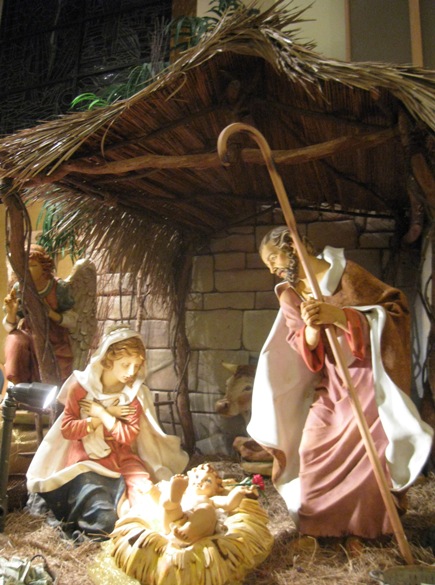
Christmas can be a hard time of year for a lot of people. Despite the pious, peaceful, and nostalgic scenes we see on the Christmas cards (like the one on the right,) many peoples’ Christmases are less than picture perfect. Today I would like to tell you the true story of two friends of mine, newlyweds whose first Christmas together was far from idyllic. (I’ll call them Chuck and Sue, though that’s not their real names.)  

In fact, Chuck and Sue’s first year together had been a rocky road. Chuck has always been a good and faithful man, but at one point in the beginning, he seriously thought about getting a divorce. He says that it was only by the grace of God that the serious tensions and misunderstandings between them were resolved and their marriage was saved.

After they tied the knot, the two picked-up and moved away from their closest family and friends to a small town down south where they had some distant relatives. Chuck worked hard as a blue-collar laborer, but after this transition, he found himself unemployed. And unfortunately, all of those distant relatives proved too distant to care about helping-out a struggling young couple in need. Their first Christmas together, Chuck and Sue were out of work, pregnant, and homeless.

How do you think Sue must have felt? Do you think she felt concerned about their circumstances and their family’s future? And how do you think Chuck must have felt when through no fault of his own he wasn’t able to provide better for his wife and child on the way? Had it not been for their deep faith in God and the consolation of their prayers, they would have been overcome by darkness, resentment, fear, and despair. But instead, their first Christmas together was the brightest and most joyful in history. You know Chuck and Sue’s story well, for theirs is the Christmas story. Chuck’s real name is Joseph and Sue’s real name is Mary.

Remember, the Christmas story is not a fairy tale from far, far away. It’s a real story in the real world, and for the real world. Our lives still have difficulties, but Jesus Christ has come, and that makes all the difference in the world. No matter what we’re going through, because of Christmas, we all have good reason to be merry.

And in closing, let me say one final word: I’m always pleased by how full the church is at Christmas. Please come back. Jesus Christ calls you back. He knows our world well and He knows how much you and those you love need His grace to get through it. The shepherds were called to find Jesus in a feed trough. Jesus invites you to find Him here.

Three Unexpectedly Expectant Mothers

December 22, 2010

Today’s readings feature three women who all wonderously conceived: Hannah, Mary, and Elizabeth.  There are many parallels between them. Together they teach us these lessons, among others:

  • With God, you can be more fruitful than you’d imagine.
  • You have great reason to rejoice today.
  • You keep forever what you give to God.

Close At Hand — 3rd Sunday of Advent—Year A

December 14, 2010

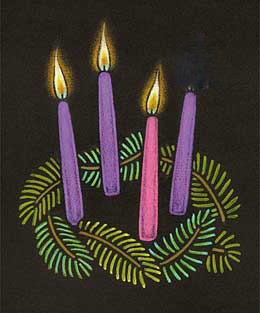
Today, the third Sunday of Advent, we light the pink or rose-colored candle because today is Gaudete Sunday. “Gaudete” means “rejoice” in Latin and we hear this call in the opening antiphon: “Rejoice in the Lord always; again I say, rejoice! The Lord is near.” Now that we are about halfway through this purple, penitential season, the Church is reminding us that Advent is also a time for joy. Though we await Him, “the Lord is near.”

This Guadete Sunday, we have extra cause for joy. As you may have heard, this week, a shrine in Champion, Wisconsin, 10 miles northeast of Green Bay, is now our country’s first Church-approved Marian apparition site. On the Feast of the Immaculate Conception, this happy news was announced by Bishop David Ricken of Green Bay:

“I declare with moral certainty and in accord with the norms of the Church that the events, apparitions and locutions given to Adele Brise in October of 1859 do exhibit the substance of supernatural character, and I do hereby approve these apparitions as worthy of belief (although not obligatory) by the Christian faithful.”

151 years ago, a lady clothed in dazzling white, with a yellow sash around her waist and a crown of stars around her head appeared to a 28-year-old lay woman named Adele. Adele asked the lady who she was and what she wanted, and the lady answered, “I am the Queen of Heaven who prays for the conversion of sinners, and I wish you to do the same. You received Holy Communion this morning and that is well. But you must do more. Make a general confession and offer Communion for the conversion of sinners… Gather the children in this wild country and teach them what they should know for salvation….”

That was the core of Mary’s message: the need for sinners to be converted and for children to be taught the faith. But Adele hesitated, and asked Mary how she was to teach the young when she knew so little herself. Mary replied, “Teach them their catechism, how to sign themselves with the sign of the Cross, and how to approach the sacraments; that is what I wish you to do. Go and fear nothing, I will help you.” After that encounter, Adele’s father built a small chapel on the site and Adele went about fulfilling her mission from Mary for the rest of her life.

The Bride of Christ, the Church, teaches that parents are the primary educators of their children. This means that even if your children go to Catholic or public school, you are their first and foremost teacher in the important lessons of life. But how often do our parents talk to their children about Jesus or Mary, or teach their children about what they should know for salvation? I suspect that many parents are intimidated because, like Adele Brise, they feel like they know too little. But Mary reassures us that we can all teach our children simple but important lessons in the faith that will remain with them and bless them forever.

Like Mary said, teach them the sign of the cross and how to approach the sacraments. At Mass, whisper in their ears, “Look, Father is holding up Jesus,” and on the way home in the car, ask them what they learned from the homily. Have interesting conversations with your children about the faith. Ask them, for example, if they think that Jesus likes sports, ask them what they think Mary’s favorite prayer is, or ask them what they think Heaven is like, and then share your answers with each other. And, perhaps most importantly, teach your children how to pray, by praying with them daily.

Though you know enough already to teach your children a great deal, you must always keep learning yourself. As your children mature in age, you must also mature in your understanding of the faith. Explore why we as Catholics do what we do, and learn why the Bride of Christ, our Mother, teaches as she does. For example, why do we make the sign of the cross? We do it at the open and close of our prayers and you’ve done it since you were little, but now consider more deeply what it means.

Its words and gestures encapsulate our faith’s most central mysteries. It confesses the Trinity and trances our redemption through the cross of Jesus Christ. We pray not “in the names,” but the “in the name of the Father, and of the Son, and of the Holy Spirit,” for God is three persons who are one in nature. [†] From the Father descends the Son, and the Holy Spirit proceeds from the love between them. Tracing the cross on ourselves, [†] we recall how the Father sent the Son to save us, and how the Holy Spirit now acts through our lives with power.

To pray this prayer, for it is a prayer, calls upon God to be powerfully with us. It is to say: “Father, Son and Holy Spirit, I ask you to be near me, here and now.” In the face of temptation or evil, this sign declares, “I belong to neither to the Devil nor the world, I belong to Jesus Christ.” So much is contained in this simple prayer and gesture. It can be taught to a child, yet meditated upon for a lifetime. And this is just one element of our faith. There is always more to explore.

Let us rejoice today, for the apparition of Our Lady of Champion reminds us, that even in Wisconsin, the Lord is near,  and [†] we can call upon Him at any time. Let us teach the faith to our children, so that they will remain near to Him and call upon His name.

Our Lady, Our Champion

December 8, 2010

What do Lourdes, France; Fatima, Portugal; and Champion, Wisconsin all have in common? As of today, they are all Church approved Marian apparition sites!

As his Excellency, David Ricken, bishop of Green Bay, pronounced today:  “I declare with moral certainty and in accord with the norms of the Church that the events, apparitions and locutions given to Adele Brise in October of 1859 do exhibit the substance of supernatural character, and I do hereby approve these apparitions as worthy of belief (although not obligatory) by the Christian faithful.” St. Mary told this young Belgian immigrant, “I am the Queen of Heaven who prays for the conversion of sinners, and I wish you to do the same. You received Holy Communion this morning and that is well. But you must do more. Make a general confession and offer Communion for the conversion of sinners… Gather the children in this wild country and teach them what they should know for salvation… Teach them their catechism, how to sign themselves with the sign of the Cross, and how to approach the sacraments; that is what I wish you to do. Go and fear nothing, I will help you.” The 151-year old Shrine of Our Lady of Good Help in Champion, Wisconsin is now the first and only Church approved Marian apparition site in the United States.

The New Eve — December 8 — Immaculate Conception

December 8, 2010

In the beginning, when our first parents fell, they lost a great deal, but they were not deprived of hope, for God spoke in their hearing a prophesy to the deceiving serpent, the devil. God said, “I will put enmity between you and the woman, and between your offspring and hers; he will strike at your head, while you strike at his heel.” Who is this offspring, who strikes back at the devil? He is Jesus the Christ, the New Adam, the Son of God. And who is this woman, who is Satan’s enemy? She is Mary of Nazareth, the New Eve, the Immaculate Conception.

After their Fall, when Adam and Eve heard God approaching in the garden, they became afraid, they fled and hid, so God called out, “Where are you?” When God drew near to Mary, she also was afraid, but she did not hide or flee. She declared, “Behold, I am the handmaid of the Lord. May it be done to me according to your word.” And, because she did, her Holy Offspring could go on to say in His garden of testing, “Father… not my will but yours be done.”

The first man, Adam, called the first woman Eve, because she became the mother of all the living. Now, Mary is the New and Second Eve, for she is the mother of all the living, and she loves each one of us personally as her very own children.

She is the icon of the Church, and as she is, we are called to be: holy and without blemish before God, as the second reading from Ephesians says. But how can we do this? Unlike Mary, at times we have been allies of Satan by our sins. To cleanse us, God gives us the sacrament of reconciliation, and to strengthen us He gives us the fruit from the new tree of life; that tree is the cross, and its fruit is the Eucharistic Christ.

If it has been a long time since you have been to confession, come that you may be purified as pure as Mary. And if you receive our Lord in the Eucharist tonight, consider that the Son of God Incarnate has come to dwell in you, just as truly as He dwelt in Mary.

Let Advent Be Advent — 2nd Sunday of Advent—Year A

December 5, 2010

John the Baptist was living quite differently compared to people in his day. What he wore was different, what he ate was different, and what came from his lips was also different. Yet, John shared something in common with us today. Like Christians in this season of Advent, John knew that the Christ, or Messiah, had already been born, years before in the past. Like us, what John was preparing for was the coming of Christ anew.

That’s the reason why in Advent, in this season of awaiting the Messiah’s arrival, John the Baptist is so prominently featured in our Sunday Gospel readings, like today’s. By looking at John we can learn how to prepare ourselves for Christ’s arrival. As I mentioned before, John was rather different from his neighbors in his day. Today I suggest that we in the Church need to be a bit more different from everybody else if we want to prepare better for Christ’s coming this year.

What did John do with all that time alone in the desert, when he wasn’t out preaching or baptizing? Surely, John was praying, asking for grace and contemplating the one who was coming. The desert is a quiet place, free of distractions, and conducive to prayer. The world can make this month before Christmas a very stressful time. This Advent, you must find a desert, a quiet place, free from distractions, where you can pray each day. Create a daily desert space for your own family as well and prayer together as one. You cannot prepare well for Christ’s coming without daily prayer and the peace it gives.

What did John eat in the desert? He ate locusts, or grasshoppers, and wild honey. The wild honey may sound pretty sweet, until you realize that it was guarded by wild bees. John ate simply. Our meals in Advent should be simple too. You know how it is at Easter, when you enjoy what you gave up for Lent again for the first time? You find yourself enjoying what you denied yourself more than ever before. Then just think of how much greater your Christmas feasting will be if you eat more simply in Advent. (Besides, if you fast or diet now, there will less pounds to lose next year.)

John dressed differently than other people in his day. He wore a garment made of camel’s hair and tied a leather belt around his waist. He dressed like the Old Testament prophet Elijah because he wanted people to know that these were special days. You can also dress in ways that witness to the world that these are special days. One way to do this is to dress liturgically. As you can see, the main color of Advent is purple. If you have purple outfits or ties, now is their season.

By the way, this Wednesday, December 8th, is a holy day of obligation and Christ is asking you to attend the worldwide feast in honor of His immaculately conceived mother. On such a day, intentionally wearing blue or white would honor her. Try dressing liturgically and you’ll find that it reminds you and others of what makes these days special.

What came from the lips of John was different, and despite the large crowds, whatever he spoke was not for himself but for Christ. This year, wish people “merry Christmas” instead of “seasons greetings,” and instead of “happy holidays,” say “happy holy days,” for by this you give witness to the true reason for the season.

John knew that he must decrease and that Christ must increase, for John himself was not the light but had come to give testimony to the light. In the world, the Christmas songs have already begun on the radio and the Christmas trees are all up and lit in the malls, but the day after Christmas their songs will stop and their decorations will be taken down. But as the world is packing Christ away for another year, the Church is just beginning its celebration. You know the “twelve days of Christmas?” On Christmas day, the twelve day begin, not end. Like Easter, the Church celebrates not just one day, but for weeks after.

This year, let Advent be Advent, and save Christmas for Christmas. Sing Advent songs for Advent, and (as much as possible) save Christmas carols for their time. I suggest leaving your Christmas lights, on your tree and on your house, unlit during Advent. Then, when you plug-in at last on Christmas Eve, you shall enjoy a joyful sign that the light of the world has come.

St. John the Baptist calls to you through the Scriptures. I encourage you here, before you. And I hope the Holy Spirit is now prompting you, in your hearts and minds, to keep Advent as Advent this year, and to prayerfully prepare for the coming of Christ at Christmas more profoundly than you ever have before.

Everything Awaits Her Reply

November 20, 2010

From a homily ‘In Praise of the Virgin Mother’ by St. Bernard of Clairvaux:

You have heard, O Virgin, that you will conceive and bear a son; you have heard that it will not be by man but by the Holy Spirit. The angel awaits an answer; it is time for him to return to God who sent him. We too are waiting, O Lady, for your word of compassion; the sentence of condemnation weighs heavily upon us.

The price of our salvation is offered to you. We shall be set free at once if you consent. In the eternal Word of God we all came to be, and behold, we die. In your brief response we are to be remade in order to be recalled to life.

Tearful Adam with his sorrowing family begs this of you, O loving Virgin, in their exile from Paradise. Abraham begs it, David begs it. All the other holy patriarchs, your ancestors, ask it of you, as they dwell in the country of the shadow of death. This is what the whole earth waits for, prostrate at your feet. It is right in doing so, for on your word depends comfort for the wretched, ransom for the captive, freedom for the condemned, indeed, salvation for all the sons of Adam, the whole of your race.

Answer quickly, O Virgin. Reply in haste to the angel, or rather through the angel to the Lord. Answer with a word, receive the Word of God. Speak your own word, conceive the divine Word. Breathe a passing word, embrace the eternal Word.

Why do you delay, why are you afraid? Believe, give praise, and receive. Let humility be bold, let modesty be confident. This is no time for virginal simplicity to forget prudence. In this matter alone, O prudent Virgin, do not fear to be presumptuous. Though modest silence is pleasing, dutiful speech is now more necessary. Open your heart to faith, O blessed Virgin, your lips to praise, your womb to the Creator. See, the desired of all nations is at your door, knocking to enter. If he should pass by because of your delay, in sorrow you would begin to seek him afresh, the One whom your soul loves. Arise, hasten, open. Arise in faith, hasten in devotion, open in praise and thanksgiving. “Behold the handmaid of the Lord,” she says, “be it done to me according to your word.”

The Sorrowful Mysteries, Meditations on Vocation with the Saints

October 29, 2010

The 1st Sorrowful Mystery:
The Agony in the Garden

Years before Jesus agonized in the Garden of Gethsemane, the Blessed Virgin Mary had an agony of her own, when the Archangel Gabriel came to announce to her that she would bear the Son of God. Mary was “greatly troubled,” and the angel sought to reassure her “Do not be afraid, Mary….” Even after the plan was presented to her, she must have been full of questions about her future, like “What will Joseph and my parents think?” But Mary answered, “Behold, I am the handmaid of the Lord. May it be done to me according to your word,” and because she said that, Jesus could say years later, “Father… not my will but yours be done.”

God has a plan for every life, and a calling, a “vocation,” meant for them. Accepting God’s plan for our lives can take great, trusting courage, but answering “Yes” to Him will do more good than we know. Let us pray for the grace, trust, and courage to say “Yes” to our own God-given callings.

The 2nd Sorrowful Mystery:
The Scourging at the Pillar

Father Damien went to the Hawaiian island of Molokai to minister the spiritual and bodily needs of lepers exiled there. Last year, in 2009, Father Damien was canonized a saint. But in 1889, six months after his death, the following letter was published in a Protestant Christian newspaper:

Dear Brother,

In answer to your inquires about Father Damien, I can only reply that we who knew the man are surprised at the extravagant newspaper laudations, as if he was a most saintly philanthropist. The simple truth is, he was a coarse, dirty man, headstrong and bigoted. He was not sent to Molokai, but went there without orders; did not stay at the leper settlement (before he became one himself), but circulated freely over the whole island (less than half the island is devoted to the lepers), and he came often to Honolulu. He had no hand in the reforms and improvements inaugurated, which were the work of our Board of Health, as occasion required and means were provided. He was not a pure man in his relations with women, and the leprosy of which he died should be attributed to his vices and carelessness. Other have done much for the lepers, our own ministers, the government physicians, and so forth, but never with the Catholic idea of meriting eternal life.

– Yours, etc., “C. M. Hyde”

Hyde’s comments are noted today only because they were so exquisitely answered in an open letter by Robert Louis Stevenson, the author of Treasure Island (1883) and The Strange Case of Dr. Jekyll and Mr. Hyde (1886). Stevenson quite rightly wrote, “[If the world will] at all remember you, on the day when Damien of Molokai shall be named a Saint, it will be in virtue of one work: your letter to the Reverend H. B. Gage.” The whole reply, assessing Damien and rebuking Hyde, is worth your reading, but I will give you the closing words: “[Father Damien] is my father… and the father of all who love goodness; and he was your father too, if God had given you grace to see it.”

In yesterday’s gospel, Jesus asked, “Do you think that I have come to establish peace on the earth? No, I tell you, but rather division.” This is because when someone set about to do God’s will, the world, which opposes God, will attack that person. Criticisms will land on the just man like lashes on the back. Jesus said, “Woe to you when all speak well of you,” for ‘the world loves its own.’ If there is nothing very counter-cultural about your life, then you are not yet living out the Gospel as Christ calls you to do. Let us pray for the grace to be faithful to the Gospel, even at personal cost.

The 3rd Sorrowful Mystery:
The Crowning with Thorns

Once, when St. Maximillian Kolbe was a boy, his behavior began trying his mother’s patience. She said in exasperation, “Maximillian, what will become of you?” As St. Maximillian writes, “Later, that night, I asked the Mother of God what was to become of me. Then she came to me holding two crowns, one white, the other red. She asked me if I was willing to accept either of these crowns. The white one meant that I should persevere in purity, and the red that I should become a martyr. I said that I would accept them both.” How bold of him to imagine, and how bolder still to ask, that he might receive them both. St. Maximillian would receive both crowns, as a holy Franciscan brother, and as a victim of the Nazis at Auschwitz, where he took the place of another innocent man who was condemned to die.

At yesterday’s Mass you heard that God, by His power, “is able to accomplish far more than all we ask or imagine.” Yet we will receive little if we are too timid to imagine or ask much of Him. Let us pray for the grace to imagine and ask to be crowned by Christ with a life with far greater than whatever we would merely drift into on our own.

The 4th Sorrowful Mystery:
The Carrying of the Cross

In 1961, Gianna Molla was expecting another child. During her second month of pregnancy, a tumor developed in her uterus. She could have chosen to have her uterus removed—preserving her own life, but resulting in her baby’s death.  Instead, she chose to try having the tumor surgery removed. After the operation, complications continued throughout her pregnancy. Gianna told her family, “This time it will be a difficult delivery, and they may have to save one or the other—I want them to save my baby.” On Good Friday, 1962, Gianna gave birth to her daughter, Gianna Emanuela, but it was too late for the mother. St. Gianna Molla died one week later.

Naturally, we all hate to suffering, but if you were to ask St. Gianna Molla what was the greatest thing she ever did, the thing she least regrets and of which she is most proud, I bet she point to this final trial, carrying the cross for the life of her child. I suspect, that on the other side of death, we shall see how much good an offered suffering can do, and we will regret not having offered more. We should ask ourselves, would I rather live a great life, or merely an easy one. Let us pray for the grace to be a lasting blessing to others though the crosses that come our way.

The 5th Sorrowful Mystery:
The Crucifixion

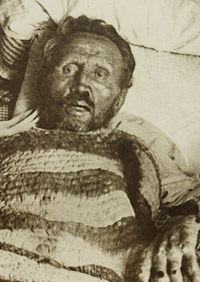
We think of Mexico as one of the most Catholic countries there are, but in 1920’s, it was illegal to celebrate Mass there.  That did not stop priests like Blessed Miguel Pro, S.J. from sneaking about to minister to people in their homes.  After many close calls, Fr. Pro was captured by police and condemned to death on false charges that he was somehow connected to a bombing assassination plot.

When he was led out for his execution by firing squad, Fr. Pro be blessed the soldiers, knelt and quietly prayed for a time. Declining a blindfold, he faced his executioners with a crucifix in one hand and a rosary in the other and held his arms out in imitation of the crucified Christ and shouted, “May God have mercy on you! May God bless you! Lord, you know that I am innocent! With all my heart I forgive my enemies!” Just before the firing squad was ordered to shoot, he proclaimed, “Viva Cristo Rey!” (“Long live Christ the King!”) When the first shots failed to kill him, a soldier shot him point-blank. The government had a photographer on hand, capturing these moments for propaganda purposes, but soon after the images were published their possession was made illegal—a Catholic priest dying faithfully and bravely was an inspiration giving new life to a people oppressed.

At the end of the Rosary we pray, “O God… grant, we beseech Thee, that, meditating upon these mysteries of the Most Holy Rosary of the Blessed Virgin Mary, we may imitate what they contain and obtain what they promise through the same Christ Our Lord. Amen.” If we are faithful to Christ, the mysteries of His life we be made manifest in our own. And if we are faithful to Christ, we will receive a glory similar to His own. Let us pray for the grace to live extraordinary lives in the likeness of Jesus Christ.

The Joyful Mysteries, Meditations with the Saints

October 28, 2010

The 1st Joyful Mystery: 
The Annunciation

The Blessed Virgin Mary may have been just 13 years old when the angel Gabriel announced to her that she would give birth to Jesus. She shows us that even if you are young, God can still do big things with you, if you say “Yes” to Him.

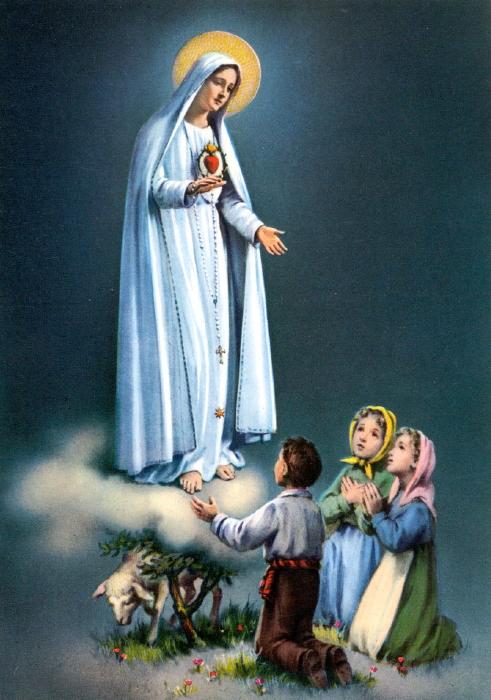
On May 13, 1917, three Portuguese children were praying the rosary after lunch in a field on a clear blue day.  The eldest was Lucia, age 10, and she was with her cousins, Francisco and Jacinta, ages eight and seven. Suddenly, they saw two bright flashes. They looked up and saw “a lady, clothed in white, brighter than the sun…” The Lady smiled and said, “Do not be afraid, I will not harm you.” Lucia asked her where she came from. The Lady pointed to the sky and said, “I come from heaven.” Lucia asked what she wanted. The Lady said, “I have come to ask you to come here for six months on the 13th day of the month, at this same hour.”

On July 13, the incredibly beautiful Lady appeared again. Lucia asked her who she was, and for a miracle so everyone would believe. The Lady answered, “Continue to come here every month. In October, I will tell you who I am and what I want, and I will perform a miracle for all to see and believe.” Then she taught them this prayer: “Oh my Jesus, forgive us our sins, save us from the fires of hell. Lead all souls to Heaven, especially those in most need of Thy Mercy.”

At noon, on October 13, 1917, some 70,000 people were gathered in the field. With a flash of light, the Lady appeared to the children and declared, “I am the Lady of the Rosary.” Some spectators cried out and the crowd turned their eyes upward to the cloudless sky, and they gazed on the sun without the least discomfort.  They saw it tremble and danced in a miraculous way.

Mary, Lucia, Francisco and Jacinta teach us this lesson: Even if you are young, God can do big things with you, if you say “Yes” to Him. Let us pray that we would be open to doing God’s will every day.
The 2nd Joyful Mystery:
The Visitation

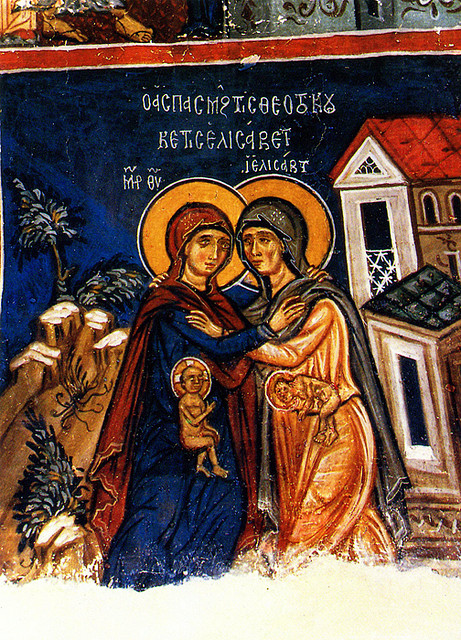
“During those days Mary set out and traveled to the hill country in haste to a town of Judah, where she entered the house of Zechariah and greeted Elizabeth. When Elizabeth heard Mary’s greeting, the infant leaped in her womb, and Elizabeth, filled with the Holy Spirit, cried out in a loud voice and said, ‘Most blessed are you among women, and blessed is the fruit of your womb. And how does this happen to me, that the mother of my Lord should come to me? For at the moment the sound of your greeting reached my ears, the infant in my womb leaped for joy.’” (Luke 1)

Imagine how St. Elizabeth must have felt to have Mary, Mother of God, walk in through her door. Elizabeth could not see the tiny Jesus, a fetus in Mary’s womb, but she was convinced that He was hidden there. How would you treat someone if you knew that Jesus was hidden inside of them?

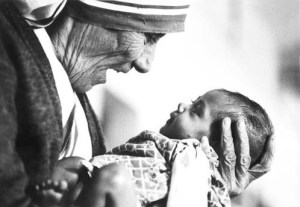
Blessed Mother Theresa cared for the poorest of the poor in the streets of Calcutta, India. Despite years of strenuous physical, emotional and spiritual work, Mother Teresa seemed unstoppable. Though frail and bent, with numerous health problems, she always returned to her work, to those who received her compassionate care for more than 50 years. How did she do it? She could do it because she encountered her beloved Christ both in times of prayer and in the people she cared for. Mother Teresa remembered Jesus’ words, “Amen, I say to you, whatever you did for one of these least brothers of mine, you did for me.” (Matthew 25:40) Mother Teresa loved others as if they were the Lord Himself.

Blessed Mother Teresa and St. Elizabeth teach us this lesson: Jesus is present in your classmates here at school, so you should always be welcoming and loving toward them. Let us pray for the grace to love others in this way.

The 3rd Joyful Mystery:
The Nativity

In his youth, Francis had been quite rich, the son of a wealthy merchant, yet he sensed that there was more to life. He put his former life behind him and devoted himself to following Christ. One day, at Mass, the Gospel told of how Christ’s disciples were to possess neither gold nor silver, nor traveling items, but were to exhort sinners to repentance and announce the Kingdom of God. Francis took these words as if spoken directly to himself, and as soon as Mass was over he threw away what little he had and went forth at once, exhorting the people of the country-side to penance, brotherly love, and peace. He was poor, but clearly happy, and others were attracted to join his movement. By the time of his death, hundreds had joined his religious order. On October 3, 1226, St. Francis died a penniless, but happy man. 

St. Francis of Assisi loved Christmas.  In fact, one story tells of how he petitioned the Holy Roman Emperor to make an edict that grain and bread should be provided to birds, beasts, and the poor this day, so that all God’s creatures would have occasion to rejoice in the Lord. St. Francis also invented the Christmas tradition of making a model of the nativity scene. These nativity scenes, called Crèches, remind us that even though Christ was rich in Heaven, he became poor when he was born on earth in a barn. Yet, Jesus was a happy man, despite his poverty.

Jesus and St. Francis teach us this lesson: You do not need to be wealthy in order to be happy. Let us pray that we may be content and happy with the riches that we have.
The 4th Joyful Mystery: 
The Presentation of Jesus in the Temple

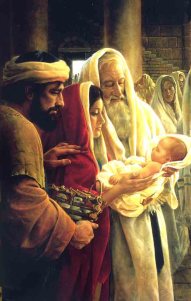
In the year that Jesus was born, “there was a man in Jerusalem whose name was Simeon. This man was righteous and devout” and he longed to see the Messiah who would save God people. It had been revealed to him by the Holy Spirit that he would indeed see the Christ before he died and Simeon trusted and hoped in that promise.

One day, the Spirit inspired him to come into the temple. When he say Mary and Joseph carrying in the baby Jesus to offer a sacrifice for Him, Simeon “took him into his arms and blessed God, saying: ‘Now, Master, you may let your servant go in peace, according to your word, for my eyes have seen your salvation, which you prepared in sight of all the peoples, a light for revelation to the Gentiles, and glory for your people Israel.’” (Luke 2)

What are the promises the Lord has made to us?  Do we trust and hope in these promises? Simeon teaches us this lesson: That we ought to trust and hope in the Lord’s promises, for all of them will be fulfilled in the sight of all someday.

The 5th Joyful Mystery:
The Finding of Jesus in the Temple

This is a true story, the story of a Catholic mother of three whose oldest son joined an anti-Catholic religious cult. It started him down a path of sinful pride and many sensual sins. It broke her heart and for years she prayed tearful prayers for his conversion.

She even asked the bishop to intervene in winning over her son. He counseled her to be patient, saying, “God’s time will come.” When she persisted in asking, the bishop (perhaps busy with many other things) famously reassured her: “Go now, I beg you; it is impossible that the son of so many tears should perish.”

That mother was St. Monica, and that son of hers, who was lost and found, was the great St. Augustine. Sts. Monica and Augustine teach us this lesson: that your persistent prayer can help people to find Christ. Let us pray for someone that we know, that he or she may be drawn closer to Jesus Christ.

Sources:
On Fatima
On St. Francis
On Blessed Mother Teresa

The Glorious Mysteries, Meditations with the Saints

October 27, 2010

The 1st Glorious Mystery:
The Resurrection of Jesus from the Dead

St. John Bosco, an Italian priest, founded a famous school for boys in the mid-1800’s and is the patron saint of students. He is known to have worked many miracles, but one from 1849 stands out. Returning from a journey, he learned that Charles, a 15 year old student, had died. He went immediately to the teenager’s home where the family informed him that Charles had been dead for over 10 hours. The body was laid out in the living room, already dressed for burial.

Fr. Bosco asked everyone to leave except the mother and the aunt. After some time in silent prayer, he cried out: “Charles, rise!” Charles emitted a long sigh, stirred, opened his eyes, stared at his mother and asked, “Why did you dress me like this?” Then, realizing Fr. Bosco was present, he told him how he had cried out for him and how he had been waiting for him. He exclaimed, “Father, I should be in hell!” He told of how a few weeks before he had fallen into serious sin. Then he said he had a “dream” of being on the edge of a huge fiery furnace, and as he was about to be thrown into the flames, a beautiful lady appeared and prevented it. She said, “There is still hope for you, Charles. You have not yet been judged.” Then he heard the voice of Fr. Bosco calling him back.

Charles asked Fr. Bosco to hear his confession. After his confession, the mourners filled the room again, and Fr. Bosco said, “Charles, now that the gates of heaven lie wide open for you, would you rather go there or stay here with us?” A profound silence filled the room. Charles, with tears in his eyes said, “I’d rather go to heaven.” Then he leaned back on the pillows, closed his eyes and breathed his last.

Unless Jesus’ Second Coming happens first, each of us here will die, and rise. As we meditate on Jesus’ resurrection, let us consider how ready we are to meet Him.

The 2nd Glorious Mystery:
The Ascension of Jesus into Heaven.

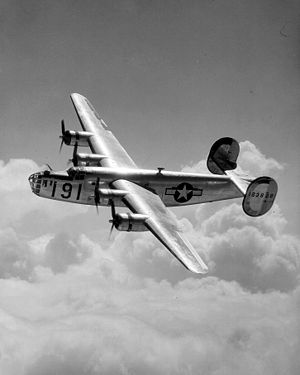
St. Padre Pio is another Italian priest from not so long ago who also worked remarkable miracles. During WWII, Allied planes flew bombing raids over Italy. Almost all of the centers of the region were subjected to repeated bombardment, but no bombs ravaged the town of San Giovanni Rotondo. Every time the aviators approached that place, they saw a monk flying in the air who prevented them from dropping their bombs. Understandably, reports of this flying friar did not amuse the superior offices.

Bernardo Rosini, a general of the Italian Air Force, recounts this story: “One day, an American commander wanted to lead a squadron of bombers himself to destroy the German arms depository of war material that was located at San Giovanni Rotondo. The commander related that as he approached the target, he and his pilots saw rising in the sky the figure of a friar with his hands held outward. The bombs released of their own accord, falling in the woods, and the planes completely reversed course without any intervention by the pilots.”  

Someone told the commanding general that in a convent at this town, there lived a saintly man. At war’s end, the general wanted to go meet this person. “He was accompanied by several pilots… He went to the convent of the Capuchins. As soon as he crossed the threshold of the sacristy, he found himself in front of several friars, among whom he immediately recognized the one who had ‘stopped’ his planes. Padre Pio went forward to meet him, and putting his hand on his shoulder, he said, `So, you’re the one who wanted to get rid of us all!’”

As we meditate on the Ascension of Jesus, to the right hand of the Father in Heaven, let us pray that He would establish justice and peace, in this country and the whole world, in our time.

The 3rd Glorious Mystery:
The Descent of the Holy Spirit at Pentecost

We usually don’t associate India with Christianity, but that nation has over 24 million Christians.  That’s about as many people as live in Texas, our second largest state. If you were to ask them how the faith reached their land they would point to St. Thomas the Apostle.

What led St. Thomas, who at first refused to even believe in the Good News, to travel over 2,500 miles to bring them the Gospel? It was not merely seeing the risen Christ. Jesus knew His disciples would need more to strengthen them then merely their memories of Him. St. Thomas journeyed because the Lord had sent the Holy Spirit at Pentecost, to fill them with gifts, like wisdom, courage, and zeal.

If we are in the state of grace, God the Holy Spirit dwells in us too, and He wants to empower us with His gifts. As we meditate on the descent of the Holy Spirit at Pentecost, let us pray for whatever spiritual gift that we need the most.

The 4th Glorious Mystery:
The Assumption of the Virgin Mary.

No Church, in the East or the West, claims to contain the body of St. Mary. This is because “the Immaculate Mother of God, the ever Virgin Mary, having completed the course of her earthly life, was assumed body and soul into heavenly glory.” This is because Jesus would not suffer Mary, His sinless, faithful beloved, to undergo corruption.

Death is a consequence of human sin, and without human intervention, as in embalming or mummification, our dead bodies will ordinarily experience its corruption. But, sometimes, the Lord preserves the dead bodies of his saints, to give a sign of their holiness, and to show that death is not all that awaits us.

Among the numerous saints whose incorrupt bodies you can still see today are:  St. John Bosco, St. John Vianney, St. Catherine Laboure (the visionary of the Miraculous Medal), St. Bernadette Soubirous (the visionary of Lourdes), and St. Maria Goretti.

As we meditate on the Assumption of the Virgin Mary, let us pray for purity in our lives.

The 5th Glorious Mystery:
The Coronation of Mary as the Queen of Heaven and Earth

Once, when St. Maximillian Kolbe was a boy, his behavior began trying his mother’s patience. She said in exasperation, “Maximillian, what will become of you?” As St. Maximillian writes, “Later, that night, I asked the Mother of God what was to become of me. Then she came to me holding two crowns, one white, the other red. She asked me if I was willing to accept either of these crowns. The white one meant that I should persevere in purity, and the red that I should become a martyr. I said that I would accept them both.” St. Maximillian would receive both crowns, as a holy Franciscan brother, and as a victim of the Nazis at Auschwitz, were he took the place of another innocent man who was condemned to die.

Jesus crowns his holy ones. He wills that those who share in His sacrifice should also share in His glory. As we meditate on the Coronation of Mary, let us pray to accept whatever crowns of burden and glory the Lord wants to give to us.

The Eager Provider — Thursday, 27th Week in Ordinary Time—Year II

October 7, 2010

Today we celebrate Our Lady of the Rosary and we hear a parable about a man who would rather not be bothered.  Let us compare this man to Mary.

He considers his visitor his friend, but she claims us as her children.

He feels too tired to help, but she never sleeps.

He hesitates to provide, but she is eager to give.

If mothers who are imperfect know how to give good gifts to their children, how much more will our perfect mother in Heaven intercede to give us good things whenever we ask her in the Rosary. It is a prayer which she receives from us as a sweet bouquet of roses.

Pray for Peace — 24th Sunday in Ordinary Time—Year C

September 12, 2010

I have a friend… let’s call her Kelly. Kelly works for a private company that does high-tech, scientific analysis for its clients. Most of this work is connected to criminal cases, examining and testing physical evidence on behalf of the prosecution or defense, but sometimes they also do sensitive work for the federal government, work about which Kelly shares no details. Kelly also wants to enter into religious life and become a nun. It’s a vocation she has considered for many years, and her job has only intensified her certainty of that calling.

You see, her work has shown her that if people want to do great evil in our world they would not seem to lack the opportunity. The technology and resources are out there; all that is needed is the malevolent will to use them. Kelly sees that our world is not preserved from self-annihilation by law enforcement, militaries, or government agencies alone. Just as important as these is the work of the spiritual battle which is invisibly waged amongst angels and demons and souls and whose primary battlefield is humanities’ hearts and minds. All of the peacekeepers and diplomats in the world cannot achieve peace, unless peace first wins its victory within the human soul. This peace is won through prayer.

In July of 1917, the Blessed Virgin Mary appeared to three shepherd children near a Portuguese town called Fatima. While the First World War was still raging, Mary told them, “The war is going to end. But if people do not stop offending God, another, even worse one will begin in the reign of Pius XI.” (At that time, the pope was Benedict XV.) “To prevent it,” Mary said, “I shall come to ask for the consecration of Russia to my Immaculate Heart and the Communion of reparation on the first Saturdays. If people attend to my requests, Russia will be converted and the world will have peace. If not, she will scatter her errors throughout the world, provoking wars and persecutions of the Church. The good will be martyred, the Holy Father will have much to suffer, and various nations will be destroyed.” Russia at that time was a war-devastated nation, poor and militarily weak. It was unclear what sort of “errors” they could spread. Four months later, the Communists came to power in the November Revolution. Mary’s call for prayer and conversion was not heeded and the worse war Mary which spoke of did come to pass; this was the Second World War.

Mary told the children, “In the end, my Immaculate Heart will triumph. The Holy Father will consecrate Russia to me; it will be converted, and a certain period of peace will be granted to the world.” I think many people here of a certain generation will remember having prayed for the conversion of Russia, and it came to pass. The Cold War ended not with the explosions of a thousand suns, nor with a thousand years of darkness, but peacefully with a new dawn of freedom. It was a miracle which no one saw coming, but a miracle for the whole world to see.

Despite the present conflicts around the world, we seem to be now living in that “certain period of peace” of which Mary spoke, but for how long will it last? That depends, in part, on us. We must offer prayers of intercession for the world, even for our present enemies, for there to be lasting peace.

In our first reading, did God really want to annihilate His people for their sins before Moses interceded for them? God said to Moses “Let me alone… that my wrath may blaze up against them to consume them.” But what was really holding the Lord back from punishing them instantly? Nothing really. In saying, “Let me alone,” the Lord prompts and gives Moses the opportunity to be their intercessor. In this, Moses prefigures Christ, who intercedes to save all sinners. God calls us to pray for sinners, too.

In the second reading St. Paul tells us, “This saying is trustworthy and deserves full acceptance: Christ Jesus came into the world to save sinners.  Of these I am the foremost.” He says, “I was once a blasphemer and a persecutor and arrogant, but I have been mercifully treated…” Paul was shown mercy, saw the light and converted to Christ. This happened in part because the Church was praying for him. He was one of the most feared and notorious persecutors of the early Christians. He was their enemy, but the Church had not forgotten Jesus’ words, “Love your enemies and pray for those who persecute you.”

The early Church’s prayers converted one of their greatest enemies. Moses’ intercession preserved the welfare of his nation. And the prayers of Mary and her children converted a misled people, and saved the world from destruction. The power of prayer has not diminished with time. It can still win our enemies for Christ, safeguard and bless our nation, and convert distant and misled peoples. The Lord calls us to pray for our enemies, for our nation and for our world, because as much as anything else, lasting peace depends on our prayers.

 [See the image I had to resist using to illustrate this post.]

The Child Mary — September 8 – Nativity of Mary

September 8, 2010

Nine months ago we celebrated Mary’s Immaculate Conception. Today we celebrate her birthday. By my estimation, Mary is now about two thousand, twenty-five years old, but if you saw her I’m sure she wouldn’t show her age. How old does Mary seem when you picture her in your mind? I’d bet that you think of her as fully-grown up; like your mom or your teachers. But today’s feast reminds us that she was once your age too.

Mary was little once too, and just because Mary lived a life without sin doesn’t mean that her childhood was a bed of roses. I think adults sometimes forget how hard and stressful things can be when you’re little, but Mary remembers everything perfectly well.

She remembers what it was like to be little like many of you. How she got scared when Nazareth’s big, neighborhood dogs would bark at her. How loud cracks of thunder frightened her at night and made her hide under the covers. She remembers how other girls made fun of her, for being different or weird, and she remembers how she cried. But even when she got sad or scared, Mary knew that she was loved and not alone. Not only did her parents love her, but she was convinced of God’s love, too, and understood that He was never far from her. This consoled Mary and reassured her that everything would be alright.

After our resurrection, when we get glorified bodies like Mary has now, we will have some new abilities. We will be able to go anywhere we want in an instant. And our glorified bodies should allow us to be more than one place at once. (It only makes sense that if saints on earth can bi-locate, then the  saints in Heaven should be able to as well.) And I also suspect that we will be able to change ourselves back and forth to whatever age we choose.

All this is to say that if at any moment you want Mary to be with you for consolation and support, you only need to ask her. Knowing her abundant love, I can’t imagine she would refuse. And when you think of her with you feel free to picture her at your age, even if you’re little. She understands you, loves you, and can relate to your situations more than you know. Like her Son, Mary is always with us, especially when we ask her be.

A Veiled Beauty — The Assumption

September 2, 2010

Consider this reflection by the servant of God, Bishop Fulton Sheen:

“Just suppose that you could have pre-existed your own mother, in much the same way that an artist pre-exists his painting. Furthermore, suppose that you had the infinite power to make your mother anything that you pleased, just as a great artist like Raphael has the power of realizing his artistic ideas. Suppose you had this double power, what kind of mother would you have made for yourself?

Would you have made her of such a type that would make you blush because of her unwomanly and un-mother-like actions? Would you have made her exteriorly and interiorly of such a character as to make you ashamed of her? Or would you have made her, so far as human beauty goes; the most beautiful woman in the world; and so far as beauty of the soul goes, one who would radiate every virtue, every manner of kindness and charity and loveliness; one who by the purity of her life and her mind and her heart would be an inspiration not only to you but even to your fellow men, so that all would look up to her as the very incarnation of what is best in motherhood?”

Now if you who are an imperfect being and who have not the most delicate conception of all that is fine in life would have wished for the loveliest of mothers, do you think that our Blessed Lord, who not only pre-existed His own mother but who had an infinite power to make her just what He chose, would in virtue of all the infinite delicacy of His spirit make her any less pure and loving and beautiful than you would have made your own mother? If you who hate selfishness would have made her selfless and you who hate ugliness would have made her beautiful, do you not think that the Son of God, who hates sin, would have made His own mother sinless and He who hates moral ugliness would have made her immaculately beautiful?”

Fulton Sheen thought that Mary was, in every respect, the most beautiful woman who had ever lived. However, if we had been travelers walking through the small town of Nazareth during the reign of Emperor Tiberius, I’m not sure that we would have recognized God’s greatest creature as we passed by her. I imagine that her face may have looked quite ordinary, apart from her beautifully, loving smile. Her Son, was the all-beautiful God become man, yet it seems that Jesus was not the most handsome man alive. As the prophet Isaiah says of Him, “There was in him no stately bearing to make us look at him, nor appearance that would attract us to him.” (Is 53) Perhaps Jesus and Mary had ordinary physical features on earth because having extraordinary appearances would have impeded their missions.

Yet now, invested with heavenly glory, Jesus and Mary possess a beauty greater than anyone in history. The perfection of love, goodness, purity and virtue within them shines through their exterior in a way that captivates those who behold them. Jesus told St. Faustina to commission a painting of how He appeared to her. When Faustina saw the artist’s quality work she dissappointedly lamented, “[Jesus,] Who will paint You as beautiful as You are?” The young visionaries at Fatima and Lourdes we struck by how very beautiful the mysterious lady was. And when St. Bernadette visited the grotto for the last time she remarked, “I have never seen her so beautiful before.” There is more to a beauty of this kind than natural appearance.

Why does the Church celebrate Mary’s Assumption? Because this solemnity not only celebrates her, but points to Church’s future. Virgin Mary is the icon, the image, of our Church. Jesus Christ’s Church is Marian. What she did, we are called to do; and where she has gone, we are called to follow. What Christ has done for Mary, He shall do for His Church on the last day. My previous reflections on the ordinary, appearances of Jesus and Mary probably had on earth only goes to show that external appearances can veil the true reality of things. 

Men judge by appearances, and they often misjudge. Many will drive past this building this hour without realizing the wondrous beauty of what is happening here inside. Many fail to see the beauty of Christ’s one, Catholic Church, for which this world was made and through which this world is saved. Many people see the beauty of exterior flesh, but not the beauty of the soul. Yet after the Last Judgment, everyone will see the most homely saint become radiant with beauty, and the most attractive sinner become repellant.

Mary is the first and greatest member of Jesus Christ’s Church. At the end of her unassuming life on earth Jesus lifted up her up body and soul into Heaven and gave her a beauty unmatched in history. He will do the same thing for His Church someday, and He desires to do the same for each of us. You and I are called to follow Mary in following Christ; to imitate their love, goodness, purity and virtue. Despite any appearances to the contrary, in this veiling and deceptive world, we are called to share in a beauty and glory like theirs.