Archive for the ‘Saintly People’ Category

A Testing By Fire

April 17, 2019

Jesus teaches, “There will be more joy in Heaven over one sinner who repents than over ninety-nine righteous people who have no need of repentance. … I tell you, there will be rejoicing among the angels of God over one sinner who repents.” I suspect the world’s heartbroken reaction to seeing Paris’ Notre Dame Cathedral ablaze resembles how the angels in Heaven mourn the loss of one soul.

On the day of the fire, many feared that this 12th century church honoring “Our Lady,” which took 182 years to build, was no more. But thankfully, the destruction appears limited to its massive oak beam roof. Its tall limestone walls and celebrated stained-glass windows reportedly survived with minor damage. The great cathedral will be resurrected, yet this event should be a wake-up call, a reminder that the most precious of things can be neglected and lost forever.

It is right and good that buildings for the worship of God should be strikingly beautiful. John’s Gospel recalls how less than a week before Jesus’ Passion, Judas Iscariot criticized Mary of Bethany for wasting wealth; using an expensive, fragrant ointment to adore Jesus rather than help the poor. But Christians are called to both – with our worship inspiring and guiding our charity – and no time in history has been wealthier to do both than ours. Notre Dame Cathedral, even now amid ashes and debris, draws souls to closer God. In this is its true value.

In itself, though great in age or size, a church is a less precious thing than its visitors. As C.S. Lewis wrote, “Nations, cultures, arts, civilization — these are mortal, and their life is to ours as the life of a gnat. But it is immortals whom we joke with, work with, marry, snub, and exploit — immortal horrors or everlasting splendors.” The famous author of The Lion, the Witch and the Wardrobe adds, “All day long we are, in some degree, helping each other to one or other of these destinations.” Our own choices help lead ourselves in one direction or the other, too.

Many will come to church for Easter this Sunday and that is well, but we must do more. Our faith in Jesus Christ must be our life’s foundation and, as St. Paul says, “each one must be careful how he builds upon it… If anyone builds on this foundation with gold, silver, precious stones, wood, hay, or straw, the work of each will come to light, for the Day [of Judgment] will disclose it. It will be revealed with fire, and the fire will test the quality of each one’s work.” As the Letter to the Hebrews tells us, “our God is a consuming fire.” A trial by fire came to France’s great cathedral and, by the grace of God worthy of our praise, it survived. “In just the same way,” Jesus says of souls, “it is not the will of your heavenly Father that one of these little ones be lost.” So let us carefully consider what is truly precious and what we value, what we have been choosing and what we will choose now beyond this Easter morning.

Lessons from the Sins of Simon Peter & Judas

April 9, 2019

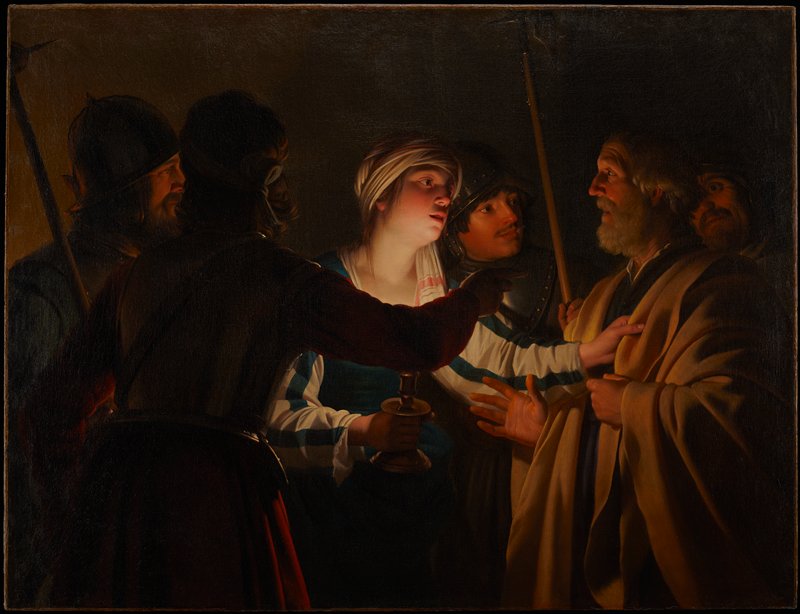
After arresting [Jesus] they led him away and took him into the house of the high priest; Peter was following at a distance. They lit a fire in the middle of the courtyard and sat around it, and Peter sat down with them. … About an hour later, still another insisted, “Assuredly, this man too was with him, for he also is a Galilean.” But Peter said, “My friend, I do not know what you are talking about.” Just as he was saying this, the cock crowed, and the Lord turned and looked at Peter, and Peter remembered the word of the Lord, how he had said to him, “Before the cock crows today, you will deny me three times.” He went out and began to weep bitterly.

– Luke 22:54-55,59-62

This threefold denial by Simon Peter was perhaps the most regretted moment of his life. He denied even knowing Jesus Christ, his teacher, friend, Lord, and God. How humble Peter was to share this story with the Early Church and how wonderful that the Holy Spirit inspired its inclusion in the Gospels! He shows us the fallen can get back up, wanderers can return, sinners can be forgiven, and even those who gravely sin can go on to become the greatest saints.

Jesus would go on to rehabilitate Peter after the Resurrection, alongside another charcoal fire by the Sea of Galilee. Mirroring the three denials, Jesus asks three times, “Simon, son of John, do you love me?” Simon Peter replies, “Yes, Lord, you know that I love you,” and Jesus reinstates him as shepherd of his sheep and lambs. The Sacrament of Reconciliation (or Confession) is likewise a personal encounter with Jesus Christ where we re-profess our love for God and receive his restoring forgiveness through the ministry of his ordained priest.

Though Simon Peter’s sins were forgiven they were not without loss and opportunities squandered. During the Passion, as they led Jesus away, “they took hold of a certain Simon, a Cyrenian, who was coming in from the country; and after laying the cross on him, they made him carry it behind Jesus.” If Simon Peter had not sinned in denying Christ the night before he could have been there, ready and willing to get behind his Lord, pick up Jesus’ cross and follow him. How beautiful that would have been! But this opportunity fell to another Simon.

Thanks be to God, St. Peter went on to repent. He did not give up to despair like Judas Iscariot. When Judas saw Jesus condemned and on his way to execution he deeply regretted what he had done. (One theory for why Judas had sold Jesus out is he wanted to trigger a confrontation with the leaders of Israel which would force Jesus to wield his mighty powers and take the throne.) Judas tried to return the thirty silver coins to the chief priests and elders saying, “I have sinned in betraying innocent blood.” They answered, “What is that to us? Look to it yourself.” Flinging the money into the temple, Judas departed and went off and hanged himself.

What if instead, on Good Friday afternoon, Judas had immediately ran to Calvary Hill? What if he had thrown himself down before Christ hanging on the Cross and begged his forgiveness? What would Jesus have said? What would Jesus have done? I think we already know the answer, or could pretty closely guess. Jesus would have forgiven Judas.

So come to Jesus in sacramental Confession. Come sooner rather than later and more than just once or twice a year. And, once wonderfully absolved, resolve and strive to sin no more. Though sins can be forgiven, we see that every sin or delayed conversion entails some loss, an opportunity missed.

Mary in History: Our Lady of Lourdes

March 25, 2019

March 25, 1858 – Lourdes, France

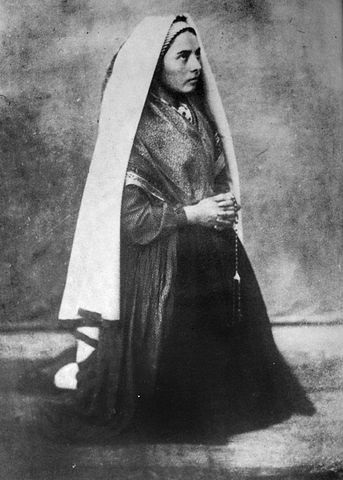
This was now the sixteenth time St. Bernadette Soubirous had encountered the Lady at the grotto. Bernadette had reported seeing “a young girl, sixteen, or seventeen years old. She wore a white dress drawn in at the waist by a blue ribbon whose ends hung down. On her head she wore a long white veil so as almost to cover her hair. Her feet were bare but nearly covered by the folds of her dress, except at the tip where a yellow rose shone on each. On her right arm she carried a Rosary of white beads on a golden chain, shining like the roses on her feet.” The local pastor, Fr. Dominique Peyramale, had prudently and persistently urged Bernadette to ask and discover the name of this strange visitor.

“She was there,” Bernadette recounts. “I asked her to forgive me for coming late. Always kind and gracious, she made a sign to me with her head to tell me that I need not make excuses. Then I spoke to her of all my love, all my reverence and the happiness I had in seeing her again. After having poured out my heart to her, I took up my Rosary. While I was praying, the thought of asking her name came before my mind with such persistence that I could think of nothing else. I feared to be presumptuous in repeating a question she had always refused to answer and yet something compelled me to speak.”

“At last, under an irresistible impulse, the words fell from my mouth, and I begged the Lady to tell me who she was. The Lady did as she had always done before; she bowed her head and smiled but she did not reply. I cannot say why, but I felt bolder and asked her again to be so kind as to tell me her name; however, she only bowed and smiled as before, still keeping silence. Then once more, for the third time, clasping my hands and acknowledging myself unworthy of the favor I was seeking of her, I again made my request.”

“The Lady was standing above the rosebush, in a position very similar to that shown in the Miraculous Medal. At my third request, her face became very serious and she seemed to bow down in an attitude of humility. Then she joined her hands and raised them to her breast… She looked up to Heaven… then slowly opening her hands and leaning forward towards me, she said to me in a voice vibrating with emotion, ‘I am the Immaculate Conception.'”

Bernadette, the simple and uneducated girl, did not understand what the Lady’s words meant but she repeated them over and over to herself (lest she forget them) as she walked to inform her parish priest. Only once the statement’s meaning was explained to her did St. Bernadette realize that her “Lady” was indeed the Blessed Virgin Mary. The apparition of Our Lady at Lourdes represents a heavenly confirmation of the Dogma of the Immaculate Conception which Pope Pius IX had solemnly and infallibly proclaimed and affirmed a few years before in 1854.

Mary in History: A Mystical Marriage

March 9, 2019

March 9, 1368 – Siena, Italy

Catherine Benincasa was born the youngest of twenty-five children in Siena, Italy. She was so joyful as a child that they nicknamed her “Eu-phro-sy-ne,” from the Greek word for “merriment.” At age six, while walking home with her brother, she stopped in her tracks. When she did not respond to his calls, he walked back to her and shook her, as from a dream. She burst into tears, having beheld in the sky a vision of Jesus seated in glory with the Apostles Peter, Paul, and John. A year later, she made a secret vow to give her whole life to God.

In her teenage years, Catherine’s parents began pressuring her to enter marriage, but she voiced with her intention not to. When her parents persisted, she cut short her beautiful golden-brown hair. As punishment, they made her do menial work in the household and, knowing she craved prayerful solitude, never allowed her to be alone. She bore all this with patient sweetness, later writing that God showed her how to build within her soul a private chamber where no tribulation could enter.

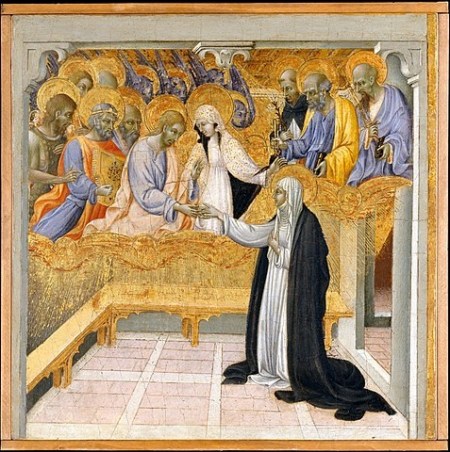
On Fat (or Shrove) Tuesday, while the people of Siena were celebrating carnival, the 21-year-old Catherine was praying in her room. A vision of Jesus appeared, with by Mary and the heavenly angels. Our Lady took Catherine’s hand and held it up to Christ, who placed a ring upon it and mystically married her to himself. Though invisible to others, this ring of St. Catherine of Siena was always visible to her.

Some misunderstand the meaning and purpose of celibacy in the Church. Jesus Christ, St. Paul, St. Catherine, and others have encouraged and lived this way of life not because human connection or natural marriage are bad, but because celibacy allows for a higher and broader intimacy. Every person is called to marriage, be it natural or spiritual; and everyone one is called to have children, be they biological or spiritual.

The Mercies of Two Adams

February 24, 2019

In our second reading this Sunday, St. Paul compares the First Man to the Last Adam. In our Gospel, that Second Adam (Jesus Christ) shares teachings on forgiveness which have reshaped the world. Catholic spiritual tradition holds that when Jesus descended to the Abode of the Dead on Holy Saturday he found Adam and announced that the gates of Heaven were now open to him and all the Old Testament’s friends of God. If Adam went to Heaven we know he practiced forgiveness himself because Jesus says “if you do not forgive others, neither will your Father forgive your transgressions.” I’d like to begin by reflecting on three people from Adam’s life whom he had to forgive; and each one has a practical lesson for us touching on forgiveness.

One person Adam had to forgive was his wife, Eve. “She saw that the [forbidden] tree was good for food and pleasing to the eyes, and the tree was desirable for gaining wisdom. So she took some of its fruit and ate it; and she also gave some to her husband, who was with her, and he ate it.” Adam had to forgive her for doing this, but he also had to seek her forgiveness. He had been charged by God with protecting her and the garden. He was with her as the Serpent spoke, and he failed in his duty. Adam and Eve had to forgive each other.

Now a foolish person insists that other people are completely at fault one hundred percent of the time. After a conflict, even if I didn’t sin (even if I did nothing intentionally that I knew to be wrong at the time) I can still reflect upon how I could have expressed myself or handled the situation better. Mistakes are not sins—we can only sin on purpose—but we should learn from our mistakes.

Another person Adam had to forgive was his son, Cain. Because he felt snubbed, Cain was filled with jealous anger towards his brother. “Cain said to his brother Abel, ‘Let us go out in the field.’ When they were in the field, Cain attacked his brother Abel and killed him.” This was the first recorded murder, and Adam had to forgive his son for it.

In 1981, Mehmet Ali Ağca shot the pope in St. Peter’s Square at the Vatican. St. Pope John Paul the Great nearly died, but two years later after he had recovered he went to visit his would-be assassin in prison. I remember being amazed as a kid in CCD class to learn that the pope sat at an arm’s length from the unshackled man who almost killed him in order to personally forgive him. Significantly, the pope did not ask Italy’s leader or government to release Ağca at that time. Ağca served twenty-nine years in prison until his release in 2010. Similarly, God showed his mercy and did not destroy Cain the murderer, but God did place punishments on him.

Sometimes withholding punishment is not kindness because we need discipline, to experience just consequences for our actions, for our own good. As the Letter to the Hebrews says, “whom the Lord loves, he disciplines; he chastises every son he acknowledges. … At the time, all discipline seems a cause not for joy but for pain, yet later it brings the peaceful fruit of righteousness to those who are trained by it.” Mercy and forgiveness do not rule out experiencing any consequences.

A third person Adam had to forgive is one you might not expect: Adam had to forgive the Serpent. Was the wicked Serpent sorry for what he had done? No, but Adam had to forgive for Adam’s own sake. Unforgiveness is a bitter poison we drink in hopes of hurting someone else. Renouncing our claims to vengeance against another actually sets us free.

Jesus said we must forgive to be forgiven ourselves, but some people think they can’t forgive because they think forgiveness means something it doesn’t. Forgiveness is not to say that the sin wasn’t wrong, or that it’s no big deal, or that it doesn’t hurt anymore, or that it never really happened, or everything can go back to how it was before. Forgiveness means loving someone despite their sins, even if prudence may require us to keep a healthy distance from them (as with the Devil.)

Does God hate that ancient serpent, the Devil, the father of lies and a murderer from the beginning? Amazingly, no. As the Book of Wisdom says, “you [Lord] love all things that are and loathe nothing that you have made; for you would not fashion what you hate. [And] how could a thing remain, unless you willed it; or be preserved, had it not been called forth by you? But you spare all things, because they are yours…” God hates what Satan does, but loves him still. God hates the sin, but loves the sinner. In the end, the wicked will not be annihilated, made to no longer exist, but given the disassociation and space away from God they desire forever. God hates no one and neither should we.

In several places in the New Testaments, St. Paul draws parallels between Adam and Jesus. St. Paul wrote the Romans: “just as through the disobedience of one person the many were made sinners, so through the obedience of one the many will be made righteous.” The First Adam gave life to all his descendants, and the Last Adam gives life to all who follow him. The Old Adam, by his selfish sin, condemned the world; but the New Adam, by his holy self-sacrifice, redeems us. The First Adam, as we have seen, practiced forgiveness, but Jesus Christ is personified Mercy.

Consider how autobiographical Jesus’ Gospel teaching on forgiveness is. Jesus says, “To the person who strikes you on one cheek, offer the other one as well.” During the Passion, at his Jewish trial before the Sanhedrin, “they spat in [Jesus’] face and struck him, while some slapped him, saying, ‘Prophesy for us, Messiah: who is it that struck you?’

Jesus says, “From the person who takes your cloak, do not withhold even your tunic.” “When the [Roman] soldiers had crucified Jesus, they took his clothes and divided them into four shares, a share for each soldier. They also took his tunic, but the tunic was seamless, woven in one piece from the top down. So they said to one another, ‘Let’s not tear it, but cast lots for it to see whose it will be…’

Jesus says, “Love your enemies, do good to those who hate you, bless those who curse you, pray for those who mistreat you.” The religious leaders sneered at Jesus as he hung on the Cross. Even the soldiers jeered at him. But Jesus prayed for them saying, “Father, forgive them, they know not what they do.”

Jesus says, “If you love those who love you, what credit is that to you? Even sinners love those who love them. And if you do good to those who do good to you,what credit is that to you? Even sinners do the same.” St. Paul wrote to the Christians at Rome, “God proves his love for us in that while we were still sinners Christ died for us.

Jesus says, “If you lend money to those from whom you expect repayment, what credit is that to you? Even sinners lend to sinners, and get back the same amount. But rather, love your enemies and do good to them, and lend expecting nothing back; then your reward will be great and you will be children of the Most High…” Jesus gave of himself knowing that many would give him nothing in return, he loves sinners knowing that many will not love him back. But Jesus is his Father’s Son, merciful as he is merciful, loving as he is loving, good as he is good, and generous as he is generous. And Jesus invites us to also be children of the Most High like himself.

So let’s be generous in every way towards Jesus, who gives us mercy, our every blessing in life, and his very self in the Eucharist. Jesus’ teaching at the close of today’s Gospel is true not only for financial giving but for every gift to God, for God is never outdone in generosity: “Give, and gifts will be given to you; a good measure, packed together, shaken down, and overflowing, will be poured into your lap. For the measure with which you measure will in return be measured out to you.” Let us be merciful and generous like Jesus is towards us.

Mary in History: A Healing Spring

February 24, 2019

February 25, 1858 – Lourdes, France

By the time of this, the ninth appearance of the beautiful Lady to the fourteen-year-old St. Bernadette Soubirous, word had spread about these apparitions and the visionary. On this date, about 300 people accompanied Bernadette to the grotto near the Gave River outside Lourdes. No one except Bernadette could see the Lady nor hear her speaking aloud in their local French dialect.

On this occasion, the Lady told Bernadette, “Go and wash and drink in the spring.” But Bernadette became confused because there was no spring to be seen. At first she thought she meant the river, but the Lady directed her to the back of the grotto cave. Bernadette walked there, kneeled down, and dug at the earth with her hands. Water began seeping into the hole, turning the soil to mud. Bernadette drank it and washed her face with it. She also, at the lady’s command, ate some of the grass there. Understandably, the crowd was dismayed and thought her crazy. Bernadette answered, “It is for sinners.”

There had been no spring there before, but by the next day the spot was producing a thin stream trickling down to the river. Later, Louis Bourriette, a blinded stonecutter, bathed his eyes in its water and regained his sight. In another famous case, a desperate mom prayerfully plunged her weak and dying infant into the cold spring waters and he became healthy and strong for the first time, amazing the doctors. (This child, Justin Bouhort, who would go on to attend the canonization of St. Bernadette seventy-five years later, on December 8th, 1933.) Though there is nothing scientifically unique about the chemical makeup of this water, more than 7,000 miraculous healings have been counted at Lourdes, of which 67 have been officially recognized as “medically inexplicable” by the International Medical Association of Lourdes. As we see in the spring at Lourdes, St. Bernadette, and Our Lady, the Lord exults the lowly, leading all future generations to call them blessed.

Sound Interpretations

February 17, 2019

Last year, the internet hotly debated whether a particular sound clip was saying Yanny” or “Laurel.” While most people can only hear one name or the other, some people can make out each. In fact, both of the names are sounding in the clip together but at higher and lower pitches. In another online curiosity, a short video shows a small figurine glowing and emitting a sound, either “Brainstorm” or “Green Needle.” The amazing thing is that if you listen to this clip with either phrase in mind then that is the phrase you’ll hear. You can even alternate back and forth between the two. In each of these examples, the messages are indeed there to be heard if one has the ears to hear them.

These phenomena suggest how people in the Bible may have been present to the same auditory events but heard things quite differently. On one occasion recorded in John’s Gospel, Jesus prayed aloud, “Father, glorify your name.” Then a voice came from Heaven, “I have glorified it and will glorify it again.” John notes, “The crowd there heard it and said it was thunder; but others said, ‘An angel has spoken to him.‘” Later, at Pentecost in The Acts of the Apostles, the disciples “were filled with the Holy Spirit and began to speak in different tongues, as the Spirit enabled them to proclaim.” At the sound of it others in Jerusalem from many nations gathered in a large crowd “but they were confused because each one heard them speaking in his own language. … They were all astounded and bewildered, and said to one another, ‘What does this mean?’ But others said, scoffing, ‘They have had too much new wine.’” Sometimes people can hear more than one thing in the same divine message, or dismiss it all as nonsense.

Does each passage of the Bible have only one true interpretation? Some reject that Isaiah 7:14 (“The virgin shall be with child and bear a son, and they shall name him Emmanuel”) could foretell the virgin birth of Jesus, arguing “the author was referring only to the political situation of his day, not to an event centuries later he couldn’t possibly have known.” But this view forgets or denies that human beings are not the sole authors of Scripture. They are co-authors inspired by the Holy Spirit. God is all-knowing and alive outside of time. He can inspire prophesies with both near and distant fulfillments. And God can invest passages with multiple true and divinely-intended meanings. For example, in the Book of Revelation, John beholds in the sky, “a woman clothed with the sun, with the moon under her feet, and on her head a crown of twelve stars.” She gives birth to a son, the Christ, and then she is protected by God from a red dragon, the Devil. Does this represent God’s people of the Old and the New Covenants, or does it symbolize Mary the Mother of God? Yes. The answer is both.

Sacred Scripture, like other things of God, may be compared to a magic pool. It is a pool in which a small toddler may safely play and a great whale may deeply swim. Let us not remain shallow in our understandings, but explore the true depths of God’s Word.

Mary in History: A Surprising Lady

February 11, 2019

February 11, 1858 – Lourdes, France

On the Tuesday before Ash Wednesday (which is called “Fat” or “Shrove” Tuesday,) Bernadette Soubirous, her sister, and a friend were gathering firewood in the cold outside their small French town. They were near a river and a grotto (a shallow cave) where the locals would dump their garbage. Then fourteen-year-old Bernadette heard the sound of a sudden swish of wind. As Bernadette would later recall:

“I had just begun to take off my first stocking [intending to cross the shallow river barefooted as my companions had done] when suddenly I heard a great noise like the sound of a storm. I looked to the right, to the left, under the trees of the river, but nothing moved; I thought I was mistaken. I went on taking off my shoes and stockings, when I heard a fresh noise like the first. Then I was frightened and stood straight up. I lost all power of speech and thought, when, turning my head toward the grotto, I saw at one of the openings of the rock a [rose] bush, one only, moving as if it were very windy. Almost at the same time there came out of the interior of the grotto a golden colored cloud, and soon after a Lady, young and beautiful, exceedingly beautiful, the like of whom I had never seen, came and placed herself at the entrance of the opening above the bush. She looked at me immediately, smiled at me and signed me to advance, as if she had been my mother. All fear had left me, but I seemed to know no longer where I was. I rubbed my eyes, I shut them, I opened them; but the Lady was still there continuing to smile at me and making me understand that I was not mistaken. Without thinking of what I was doing, I took my Rosary in my hands and fell on my knees. The Lady made a sign of approval with her head and took into her hands a rosary which hung on her right arm. When I attempted to begin the Rosary and tried to lift my hand to my forehead, my arm remained paralyzed, and it was only after the Lady had signed herself that I could do the same. The Lady left me to pray all alone; she passed the beads of her Rosary between her fingers but she said nothing; only at the end of each decade did she say the ‘Glory Be’ with me.”

St. Bernadette Soubirous then returned to her family’s poor home, but this would be just the first of eighteen apparitions to her by the Blessed Virgin Mary, Our Lady of Lourdes, over the five months to follow.

Mary in History: The Conversion of Marie-Alphonse Ratisbonne

January 20, 2019

January 20, 1842 – Italy

Alphonse, a French, upper-class, secular Jew, was no fan of religion. He particularly opposed Catholicism after his brother converted and became a priest. Yet providential circumstances brought Alphonse to Rome where Baron Theodore de Bussières, a family friend and fervent Catholic, challenged the 27-year-old skeptic to wear the Miraculous Medal and say the Memorare prayer each day. Alphonse obliged and, on the morning of January 20th, he felt drawn to walk into a church.

I was scarcely in the church when a total confusion came over me,” he later wrote. “When I looked up, it seemed to me that the entire church had been swallowed up in shadow, except one chapel. It was as though all the light was concentrated in that single place. I looked over towards this chapel whence so much light shone, and above the altar was a living figure, tall, majestic, beautiful and full of mercy. It was the most holy Virgin Mary, resembling her figure on the Miraculous Medal. At this sight I fell on my knees right where I stood. Unable to look up because of the blinding light, I fixed my glance on her hands, and in them I could read the expression of mercy and pardon. In the presence of the Most Blessed Virgin, even though she did not speak a word to me, I understood the frightful situation I was in, my sins and the beauty of the Catholic Faith.

That day, he went to meet a Catholic priest. Eleven days after, Alphonse was baptized, confirmed, received Holy Communion, and added “Marie” (that is, “Mary”) to his name. That same year a formal Vatican investigation into his instant conversion judged it a divine miracle operated through the intercession of the Blessed Virgin Mary. Marie-Alphonse was ordained a priest five years later and alongside his priest-brother labored twenty-nine years establishing religious houses and evangelizing Jews in Palestine, or present-day Israel. At the first Pentecost, 3,000 people in Jerusalem were converted to Christ through the Apostles. The Lord Jesus would have us also use our personal testimonies, invitations, and prayers to win souls for him today.

Christ Calls in Ordinary Time

January 16, 2019

As [Jesus] passed by the Sea of Galilee, he saw Simon and his brother Andrew casting their nets into the sea; they were fishermen. Jesus said to them, “Come after me, and I will make you fishers of men.” Then they left their nets and followed him.

— Mark 1:16-18

A remarkable thing about this calling of Simon Peter and Andrew is its ordinariness. The pair are not called through a vision or by angels. Mark mentions no miracles performed there on the shore. We know from John’s Gospel that they have met this rabbi before. Jesus simply tells them to follow him.

This call does not happen on a Jewish holy day, in the Temple, or in a palace, nor at Jerusalem or Rome. (The region of Galilee was an unesteemed place for the Jews and doubly so for the Romans.) Simon and Andrew are not clergy nor scholars, neither governors nor generals. They’re fishermen who work nights doing manual labor. They’re not on spiritual retreat or pilgrimage, they haven’t journeyed for days to a holy mountain of God. Yet Christ walks up to them and calls these two brothers during an ordinary day at their place of work.

Jesus Christ the God-Man does extraordinary things through the ordinary. He makes use of water for his baptism, bread for his Eucharist, and human pairing to reveal his loving union with the Church. He uses our human words to communicate God’s Word in the most published book on earth. He dwells (and waits) for us in every Catholic tabernacle. He makes himself so accessible that, if we are unattentive to him, we can disregard his presence and graces amidst familiar things.

Ordinary Time has returned in the Church. Though not a “special” season like Advent, Lent, Christmas, or Easter, its name does not derive from a lack of value but from the ordinal numbers which count its weeks (1st, 2nd, 3rd, etc.) The color of this time is green because it is a season for our ongoing growth. So let us follow the Christ who greets and calls us like Simon Peter and Andrew even in Ordinary Time.

Mary in History: Help of Christians

January 12, 2019

January 12-13, 1866 – Czech Republic

For more than a decade, Magdalena Kade suffered from very poor health. At age 30, her condition took a turn for the worse such that her two physicians thought she would soon die and her priest gave her the Sacrament of the Anointing of the Sick with Last Rites. One Friday night, while Magdalena lay in bed attended to by Veronika Kindermannová, her friend from next door, “All of a sudden the room became luminous, full of more light than daytime.” As Magdalena would later testify in the bishop’s investigation, “I was frightened. I elbowed Veronika, saying to her: ‘Veronika, wake up, do you not see this glow?’ Veronika said: ‘But I do not see anything.’ In front of my bed was a figure that emanated a very white light, with a golden crown on its head. I quickly thought it was the Mother of God. I united my hands in prayer and began to pray: ‘My soul magnifies the Lord, and my spirit exults in God, my Savior.‘ [Mary spoke these words at the Visitation.] Having said this, I heard a voice – but an unusual voice, different from that of people: ‘My child, from this moment on you will be healed.’ And in that moment the person disappeared and I no longer felt any pain.

That night, Magdalena rose from her bed to the great joy of her family and on Saturday morning she walked to the local bakery to buy bread. When the townspeople of Filipov saw her and asked how she was well, she replied, “Last night I saw the Virgin Mary and she told me I would be healed. And I am healed. Nothing more and nothing less happened.” Magdalena would go on to retell her story many times to inquirers and the room where she was healed became a place of pilgrimage. After her bishop’s investigation affirmed the supernatural character of Magdalena’s cure, a church was built on the site. In 1885, Pope Leo XIII elevated it to a minor basilica and officially consecrated and dedicated it to “Mary, Help of Christians.” Like Mary before her, Magdalena could rejoice that “the Almighty has done great things for me” and, by plainly sharing her firsthand experience, she led others to deeper faith in Christ. Let us likewise share the stories our own miraculous, God-touched moments with family, friends, and neighbors as well.

Mary in History: Our Lady of Prompt Succor

January 8, 2019

January 8, 1815 – Louisiana

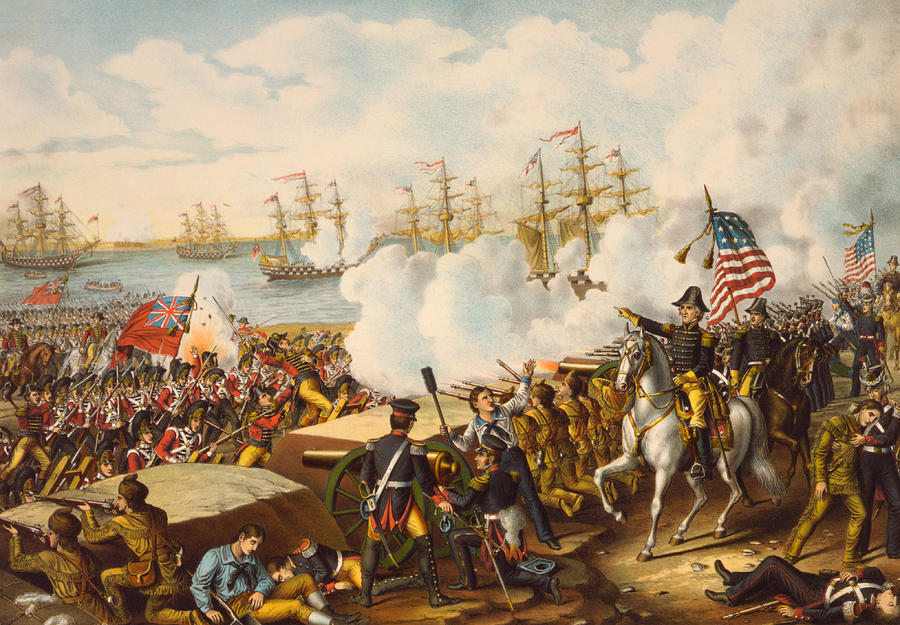
Mary as Our Lady of Prompt Succor (which means, “rapid aid”) has been celebrated in New Orleans, Louisiana on this date for more than 200 years since a famous military victory. The Ursuline Sisters in New Orleans had honored a statue of Mary by this title for several years in their chapel, but when the British army threatened to capture their city during the War of 1812 these nuns and many townsfolk spent the night beseeching her help. The convent’s prioress made a vow to have a Mass of Thanksgiving sung annually should the American forces prevail. During Mass the next morning, as Holy Communion was being distributed, a messenger rushed into the chapel with the news that the British had been defeated.

Though the British army had outnumbered the American troops (about 8,000 to 5,700) the invaders were repulsed and swiftly defeated in just over a half hour of fighting. The commanding general of the American side, the future president Andrew Jackson, went to nuns’ convent afterwards to thank them for their prayers: “By the blessing of heaven, directing the valor of the troops under my command, one of the most brilliant victories in the annals of war was obtained.” For each American soldier lost or wounded in that battle, the British had experienced roughly thirty casualties. This victory was commemorated by Johnny Horton’s 1959 #1 hit song “The Battle of New Orleans.” Since 1928, Our Lady of Prompt Succor has been honored as the principal patroness of the City of New Orleans and the State of Louisiana.

Mary in History: Our Lady of the Flowers

December 29, 2018

December 29, 1336 – Italy

Egidia Mathis, a pregnant, young wife, was walking alone at the edge of nightfall near Bra, Italy. Near a pillar bearing a coarsely painted image of the Virgin Mary with Child, she crossed paths with two foreign soldiers-for-hire (that is, mercenaries) whom she sensed wished to do her harm. Incapable of defense or escape, Egidia flung herself towards the pillar, begging Mary’s help. A great light came forth from the image. Mary scared off the wicked men with a commanding gesture and smiled at Egidia with maternal empathy. The stress of the moment caused Egidia to go into labor and she delivered her baby there. As she held her newborn closely in the winter cold, the blackthorn thicket surrounding the pillar was now in full bloom with thousands of white flowers. Upon reaching home, she told her husband of the whole episode and he with their relatives and neighbors all beheld the miraculous, out-of season flowering.

Some might dismiss this tale as merely pious legend. But virtually every winter since 1336, this blackthorn thicket, contrary to its species and scientific explanation, has flowered between December 25th and January 15th. Two rare exceptions were 1914 and 1939, the years the two World Wars began. Furthermore, on three occasions, this winter flowering has extended for months, corresponding each time with rare public expositions of the Shroud of Turin (the possible burial cloth of Christ) housed twenty-seven miles away.

Christ, the Peace Light, is Born

December 27, 2018

In the city of Israel that is called Bethlehem, the ancient Church of the Nativity marks the site of the first Christmas. There one can actually stoop and bend down beneath the central altar & touch the celebrated spot where Jesus Christ was born. It is fitting that the pilgrims bend low to do this, because the miracle of God becoming a human being — to live and die and rise for us — surely deserves humble reverence with everything that we are.

Earlier this year, as has happened for a number of years now, an Austrian child and their family was selected to travel to Bethlehem. Candles and lamps are always burning within the Church of the Nativity, and there this chosen child transferred their fire into two blast-proof lanterns. Then they all flew back to Austria, where this flame (called “The Peace Light”) has spread from lamp to lamp, light to light, candle to candle, into more than thirty European countries and to places around the world. On December 1st of this year, the Peace Light arrived at J.F.K. Airport in New York City and it has traveled from there across our country. This week, it providentially came to our parish.

Last Friday, a Hudson couple traveling with the Peace Light approached me after morning Mass at St. Paul’s. I had never heard of the Peace Light before, but I happily received it and kept it for this Christmas celebration. All the flames you see burning our sanctuary this Christmas were originally lit from Bethlehem’s flame. Now I carefully carried, protected, and preserved this light; especially when I only had one vigil candle. I realized that one error, one jostling of the liquid wax, could extinguish the fire; and then what would become of this, my Christmas homily? I’d be lost. But, thanks be to God, these candles are lit here today.

So why do we have candles at Mass? Since the early days of Christianity, when Catholic Mass was celebrated in hiding, underground in the catacombs, lamps have provided useful illumination. But these lights are not merely practical. In the late 300’s A.D., a heretic named Vigilantius criticized Christians in the East about many of their practices, including their lighting of great piles of candles while the sun was still shining in the sky. St. Jerome declared in answer to him that candles are lighted where the Gospel is proclaimed not merely to put darkness to flight, but as a sign of joy. As an added symbol, these candles on the altar (and the Easter Candle) are, by tradition, mostly made of beeswax. Because beeswax, which is the product of the virginal female bee, is like the flesh of Our Lord supplied by the Blessed Virgin Mary.

Of course, the celebrated Peace Light is not merely a symbol of some abstract notion or idea of peace; it’s a symbol of the very real person of Jesus Christ. The “Light of the World” entered our world from his mother’s womb in Bethlehem. And his light has spread across the world and throughout time to this place and our day. Today, our candles burn and shine for him.

Within you there is also candle, but it is a very vulnerable light. Through error or neglect its light can go out. And without this light we are in darkness without true joy. So Jesus commands us to regularly gather all our candles together here, to be re-lit from the Source, the Light of Christ. In conclusion, in case my symbolism has been too subtle: Have a very joyful Christmas, and know that Jesus Christ (who loves you) wishes you to return here again for his Holy Mass next Sunday.

Mary in History: Our Lady of Guadalupe

December 11, 2018

December 12, 1531 – Mexico

The Blessed Virgin had previously appeared to St. Juan Diego, a Native American, Catholic convert, twice sending him to the local bishop to ask that a church be built near Tepeyac Hill in what is today Mexico City, Mexico. The bishop was not persuaded by the native’s story but asked him for some kind of sign from Mary. On this date, Mary directed Juan to pick some non-native roses miraculously in bloom out of season on that hill and to bring them to the bishop. Juan gathered these in the front of his poncho-like garment (called a tilma) and set off.

When Juan opened the front of his tilma before the bishop to reveal the roses, Our Lady of Guadalupe’s image was found on the humble fabric of his garment. Her appearance was that of an Aztec princess, clothed in the Sun with the Moon under her feet, bearing a Divine Child in her womb. The image’s rich symbolism spoke compellingly to the native people and Mexico was converted to Christ.

That tilma, made of rough cactus fibers, should have deteriorated centuries ago, but this garment and its brushstroke-less image remain on display in Mexico’s greatest shrine to this day. Like many things, it’s a miracle existing in plain sight. Our diocese also has a beautiful shrine dedicated to Our Lady of Guadalupe, Patroness of the Americas, located just south of La Crosse. If you’ve never visited, it’s worth the pilgrimage.