Archive for the ‘Saintly People’ Category

His Power Shall be Known to his Servants

July 2, 2022

14th Sunday in Ordinary Time
By Fr. Victor Feltes

Today’s psalm tells us: “Shout joyfully to God… proclaim his glorious praise. Say to God, ‘How tremendous are your deeds!‘” When the Berlin Wall came down in 1989 and the Soviet Union dissolved two years after, I remember my dad remarking that those were things he thought he would never live to see. It seemed like Russian power would dominate Eastern Europe forever. But then, the Soviet Union suddenly collapsed, something which no one — not even the C.I.A. — saw coming.

At Fatima in 1917, before the Russian Bolshevik Revolution, the Blessed Virgin Mary accurately warned that Russia’s errors spreading throughout the world would cause wars and persecutions of the Church. But Mary said, “In the end, my immaculate heart will triumph.” In 1984, on the Feast of the Annunciation, the day when we celebrate the conception of Jesus in his mother’s womb, Pope St. John Paul the Great consecrated Russia and the whole world to Mary’s immaculate heart. Seven years later in 1991, on Christmas day, when we celebrate Jesus’ birth, Mikhail Gorbachev resigned as leader of the USSR and the Soviet flag was removed from atop the Kremlin forever. The Evil Empire ended, not with millions of deaths from nuclear blasts, but peacefully. This was a great miracle orchestrated by heaven.

Shout joyfully to God… proclaim his glorious praise. Say to God, ‘How tremendous are your deeds!‘” The Lord has brought about another tremendous victory in our time, and we do right to recognize and joyfully praise his glorious deed.

Once Wisconsin became a state in 1848, we quickly passed laws respecting the sanctity of human life from conception to natural death. In 1849, our state legislature outlawed abortion in all cases (except to preserve the life of the mother) and then, in 1853, our state government abolished capital punishment. Whenever possible, we do not kill people, not even people who are guilty or highly inconvenient, because killing is not the way of Christ and his Kingdom. We are instead to show merciful love for all.

In 1973, Wisconsin was one of thirty U.S. states which prohibited abortion at all stages. But that year, the Supreme Court’s ruling in Roe vs. Wade (a decision which even pro-abortion legal scholars acknowledge lacked constitutional justification) legalized the killing of unborn children everywhere in the United States. In response, for forty-nine years, pro-life people prayed and marched and voted. Through thousands of organizations across the land they provided moms better, holier, more loving options (like adoption) and practical resources (like diapers, formula, cribs, and clothes). Yet, despite their persistent efforts, many pro-lifers doubted they would ever live to see abortion end anywhere in our country. Last month, after seven sets of seven years of prayer and sacrifice, the Supreme Court returned the issue of abortion to the states. Wisconsin abortion laws were never repealed. And so, this Fourth of July weekend, Wisconsin is a pro-life state once again.

Today Isaiah says, “Rejoice with Jerusalem and be glad because of her, all you who love her; exult, exult with her, all you who were mourning over her!” Nurslings shall be carried in her arms and fondled in her lap; they shall now find comfort. “When you see this, your heart shall rejoice… the Lord’s power shall be known to his servants.”
The date on which the Supreme Court overturned Roe vs. Wade (June 24th) is usually the Solemnity of the Nativity of St. John the Baptist. In future years we will mark the anniversary of this victory by celebrating the birth of him who leapt for joy in his mother’s womb in the presence of the newly-conceived Christ. But this year, 2022, St. John’s day was superseded by an even greater feast which is always celebrated on the third Friday after Pentecost. This year, Friday, June 24th was the Solemnity of the Sacred Heart of Jesus. Indeed, in the end, his Sacred Heart has triumphed.

The reversal of Roe is a landmark victory, but of course there remains much work to do. “The harvest is abundant but the laborers are few; so ask the master of the harvest to send out laborers for his harvest,” and be open to being sent yourself. Like the seventy-two in today’s Gospel, Jesus Christ sends us forth to those he seeks to save. Wishing peace on everyone, peace to each house and peace in every household, we shall defend and extend his Kingdom’s Culture of Life throughout this land and around the world. And though literal demons will rage and resist us, we shall not be afraid but prevail, for Jesus, his mother, and the angels are with us for the victory. “When you see this, your heart shall rejoice… the Lord’s power shall be known to his servants.


Why Did Jesus Go?

May 29, 2022

The Ascension
By Fr. Victor Feltes

This week, our Catholic school celebrated our eighth graders’ graduation with a Mass and an awards ceremony. Afterwards, while the graduates were having their pictures taken, a teacher and I stood off to the side, looking on. He remarked, “It’s sad to see them go.” I replied, “Yeah, but it would be even sadder if they stayed.

Just whimsically imagine remaining an eighth grader well into your twenties. You don’t have a full-time job because you’re a full-time student without a high school degree. Of course you’re unmarried and have no kids—you’re still in middle school! And sure, after a decade of eighth grade, having had the same lessons over and over, you could ace all of your homework and tests (if you still had any motivation left to do so) but you would not be learning very much. It is bittersweet to see our graduates go forth from us, but it is better that they go. Though in one sense they are leaving us, they are not really gone. Yet this departure is necessary for them to reach their full human maturity and to fulfill God’s plans for their glory.

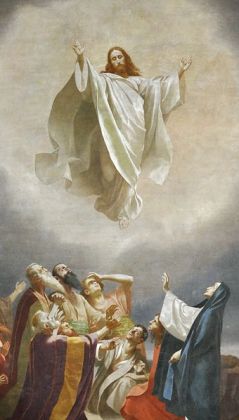
Today we celebrate Jesus’ bodily ascension into Heaven. The traditional day for celebrating the Ascension is forty days after Easter, which was last Thursday, or “Ascension Thursday.” Our diocese, like most dioceses in our country, transfers this celebration to this Sunday. I guess we like keeping Jesus around longer. But seriously, the ascension of Jesus into heaven raises this question: “Why did he go? Why didn’t Jesus stay?

Now Jesus does tell us, “Wherever two or three are gathered in my name I am there in their midst.” He says, “Behold, I am with you always until the end of the age.” And he is truly present for us in the Holy Eucharist. But Jesus’ presence now remains invisible or veiled to our eyes. By bodily ascending and disappearing into the clouds Jesus is visibly departing from us until he comes again with a glory manifested to all. “But I tell you the truth,” he says, “it is better for you that I go.” Why is this better? What would it be like if Jesus dwelt among us throughout the centuries like he did with his disciples those forty days, walking with them and talking with them, following his Resurrection?

There is no physical reason why Jesus could not have done this. His risen body is a glorified body no longer subject to injury or death, so that’s not the reason he did not remain. Did he go because on earth he’s reduced to being in one particular place, or limited in how much he can see, know, or do? Remember, Jesus is not merely human but divine, all-knowing and all-powerful, and his bi-locating saints (such as Venerable Mary of Ágreda or St. Padre Pio) who have manifested the miracle of being more than one place at once surely do not possess any supernatural ability which Jesus lacks.

So God the Father could have chosen “by his own authority” for his Son to remain visibly active here with us, in one, or thousands, or millions of locations at once, throughout the centuries up to our day. Jesus could be the pastor in every parish, the teacher in every classroom, the doctor in every hospital, and the leader in every country. He is the perfect priest, the best teacher, the greatest healer, and the rightful ruler of all. Who is better-qualified than Jesus to do any of these things? Nobody. People would demand this of him and resent him for not doing it. But if Jesus were visibly present and doing everything, then we would be left doing very little.

Would it be a better world if Jesus personally did everything? In some ways, yes. Earth would be closer to paradise in many respects. But would this lead to more souls being saved? I’m not so sure. Adam and Eve lived in an earthly paradise, too, before they fell. And the glory of Christ being manifested to the world in an undeniable way might gain peoples’ submission, but not necessarily their conversion or love. The demons who fell had no doubts about God’s existence and yet they chose to disobey him as far as they were able.

If Jesus did everything of importance on earth without us, one result which seems evident to me is that we would remain in an unending adolescence, like someone attending the eighth grade well into their adulthood. This is why it was better for us that Jesus ascended. We are children of God called to what St. Paul calls “the stature of the fullness of Christ.” If everything which matters were just Jesus’ job to handle, how would we grow from our immaturity into the full maturity of Christ?

Jesus says, “I tell you the truth, it is better for you that I go. For if I do not go, the (Holy Spirit) will not come to you. But if I go, I will send him to you.” By the Holy Spirit, the Church (which is Christ’s Body) is animated in this world. As members of his body we are moved by the Holy Spirit to love and to work united with Christ, growing more into his likeness and glory along the way. Would Jesus not ascending into heaven, remaining constantly here on earth and doing everything without us, have been easier than this present Christian life of ours? Perhaps, but Jesus desires that we would graduate with him to higher things and ascend to a greater glory with himself.

Resolving Christian Controversy

May 22, 2022

6th Sunday of Easter
By Fr. Victor Feltes

There was a serious religious controversy in the very early Church. The Acts of the Apostles records this story which contains important lessons for you and me and Christ’s one, holy, catholic, and apostolic Church in every age. In the first century A.D., some Jewish Christians came down to Antioch and were telling the Christians there: “Unless you are circumcised according to the Mosaic practice, you cannot be saved.” Many of the Christians in Antioch were Gentile converts. As Gentiles they had not followed the many Jewish religious laws, including circumcision. Now they were being told they had no share in Jesus Christ’s New Covenant unless they kept the entire Mosaic Covenant.

This was a crucial matter: either these Gentiles were not yet experiencing Christ’s salvation, or else the Law of Moses was being needlessly placed as a barrier between Gentiles and Jesus Christ. St. Paul and St. Barnabas strenuously opposed this alternate interpretation of the Gospel which was disturbing and dividing their community, but how could this important issue be decisively and infallibly settled? Everyone forming their own interpretations obviously would not resolve it. How could the Christian community be sure of the truth?

The Acts of the Apostles details how “it was decided that Paul, Barnabas, and some of the others should go up to Jerusalem to the apostles and presbyters about this question.” A Church council was held in Jerusalem and after they had discussed and discerned the matter, “the apostles and presbyters, in agreement with the whole church, decided to choose (a pair of) representatives and to send them to Antioch with Paul and Barnabas. (They selected) Judas, who was called Barsabbas, and Silas, (two) leaders among the brethren.

And they did not send Barsabbas and Silas empty-handed. The pair carried a letter from the council, which read in part: “It is the decision of the Holy Spirit and of us not to place on you any burden beyond these necessities.” It then listed a handful of culturally offensive and/or sinful acts to abstain from before concluding, “If you keep free of these, you will be doing what is right. Farewell.” In other words, the Gentile Christians would not be required to follow the full Mosaic Law.

Notice how the Church’s leaders, the apostles and presbyters in Jerusalem, pronounce their teaching with authority: “It is the decision of the Holy Spirit and of us…” As Jesus had promised at the Last Supper, “The Holy Spirit…will teach you everything and remind you of all that I told you.” The Church’s leaders teach in union with and in cooperation with the Holy Spirit.

Note as well how they do not send this letter by itself, but along with Barsabbas and Silas. This is partly to attest to the genuineness of the message—it’s not something Paul and Barnabas simply made up themselves. The accompanying witnesses are also sent to clarify any ambiguities and answer what remaining questions the Christians at Antioch might have. For instance, the Council of Jerusalem’s short letter bids the Christians to abstain from “porniea,” which various Christian Bibles translate as “sexual immorality,” or “fornication,” or “unlawful marriage.” But what was the precise meaning they intended here? One of these things or all of them together? Barsabbas and Silas could answer. We see that even a text inspired by the Holy Spirit (as this one was) can require an authoritative interpreter to be properly understood.

When the delegation from Jerusalem arrived at Antioch, the letter was read to the Christian community and the people were delighted. Barsabbas and Silas preached to them, encouraging them, and remained with them for some time. The controversy was resolved, and the community’s unity and peace of mind were restored; for the Bride of Christ, Mother Church, had spoken, removing all doubt about what Jesus wanted them to do.

This, of course, would not be the last controversy in Church history. Every century since has seen its heresies, and every error gains some followers because it is so easy to be mistaken. Clever minds and willful hearts in a fallen world can go down many false paths, and when lambs or sheep choose their own ways to go they scatter from Christ’s flock. Thankfully, God has given us his Holy Word in Sacred Scripture to help us to know him and his saving, loving will for our lives.

However, the Scriptures do not automatically interpret themselves. Even self-proclaimed “Bible Only” Christian denominations disagree with one another over important questions. The Protestant principle of Sola Scriptura (that “Scripture Alone” is the sole authority for Christian faith and life) is a self-refuting concept because the Bible does not teach it. How can someone even be sure which books are supposed to be in our Bible without there being an infallible Church to recognize them and place them into the canon of biblical books? Without a Spirit-guarded, infallibly-teaching Magisterium neither the Christians at Antioch nor Christians today could be sure about what we are to believe.

The Church of Jesus Christ is not meant to be many separate denomination, but one. Christ’s Church is not meant to bring salvation only to some, but to all. And the one, holy, catholic, and apostolic Church of Christ shares a continuity in her structure and in her teaching throughout the centuries from St. Peter and the apostles to Pope Francis and the bishops today.

In 1926, when G.K. Chesterton wrote his essay “Why I am a Catholic,” he presented a number of reasons, but the answer of his which has always stood out to me is this one: “(I am a Catholic because it) is the only thing that frees a man from the degrading slavery of being a child of his age.” Some secular people imagine our present generation is the first one to get everything right, but in one hundred years another secular generation will mock and cringe at this one while embracing another set of fashionable errors of their own. However, in one hundred years the Catholic Church will remain, built solidly upon rock, and united to the Person and teachings of Jesus Christ our Lord.

Here is a final reflection from the controversy at Antioch. The teaching of Paul and Barnabas was right, and Barsabbas and Silas carried authority from the apostles. They were important witnesses to the Faith. But their message would have been undermined in the minds of others if St. Paul, St. Barnabas, St. Barsabbas, or St. Silas had not lived as saints. Our fellow Christians, even popes or bishops, may disappoint or cause scandal by their poor personal example, harming souls. But let us, you and I, rededicate ourselves to Christ, loving him and serving him, remaining close to him in the Sacraments, allowing ourselves to be more fully converted to him, so that others may know, love, and faithfully follow Jesus alongside us in his Holy Catholic Church.

Transforming Love

May 1, 2022

3rd Sunday of Easter
By Fr. Chinnappan Pelavendran

Today we have another account of Jesus appearing to his disciples on Easter Sunday wherein he prepares a meal for them and gives them support. He comes constantly to the disciples to be with them, guide them and encourage them. All the three readings of today tell us of our vocation and our mission to be at the service of the word and not to hesitate to proclaim our closeness to Jesus. We admire the courage of the Disciples of Jesus who preach with boldness and are ready to face sufferings happily for His sake.

John the Evangelist tells us that God is love. God’s love is unconditional, unmerited, and without limit. It lasts forever. It’s the beginning and end. And it’s the essence of what it means to be a Christian – one who knows God’s love and forgiveness and who loves God in return with all one’s heart, soul, mind, body, and strength. God’s love heals and transforms our lives and frees us from fear, selfishness, and greed. It draws us to the very heart of God and it compels us to give to him the best we have and all we possess – our gifts, our time, our resources, and our very lives. St. Paul the Apostle tells us that God’s love has been poured into our hearts through the Holy Spirit which has been given us.

Why did Jesus question Peter’s love and fidelity three times in front of the other apostles? It must have caused Peter pain and sorrow since he had publicly denied Jesus three times. Now Peter, full of remorse and humility, stated that he loved his master and was willing to serve him whatever it might cost. Jesus asks him “do you love me more than these?

Jesus may have pointed to the boats, nets, and catch of fish. Do you love me more than these things? He may have challenged Peter to abandon his work as a fisherman for the task of shepherding God’s people. Jesus also may have pointed to the other disciples and to Peter’s previous boast: “Though they all fall away because of you, I will never fall away.” (Matthew 26:33) Peter now makes no boast or comparison but humbly responds: “You know I love you.”

The Lord Jesus calls each one of us, even in our weakness, sin, and failings, to love him above all else. Saint Augustine in his Confessions wrote: “Late have I loved you, O Beauty so ancient and so new. Late have I loved you! …You shone your Self upon me to drive away my blindness. You breathed your fragrance upon me… and in astonishment I drew my breath…now I pant for you! I tasted you, and now I hunger and thirst for you. You touched me! – and I burn to live within your peace.” (Confessions 10:27) Nothing but our sinful pride and willfulness can keep us from the love of God. It is a free gift, unmerited and beyond payment. We can never outmatch God in giving love. He loved us first and our love for him is a response to his exceeding graciousness and mercy towards us. Do you allow God’s love to change and transform your heart? “Lord Jesus, inflame my heart with your love and remove everything that is unloving, unkind, ungrateful, unholy, and not in accord with your will.”

“Do You Love Me?”

April 30, 2022

3rd Sunday of Easter
By Fr. Victor Feltes

At the Last Supper, Simon Peter assures Jesus, “Lord, I am prepared to go to prison and to die with you.” But Jesus replies, “Peter, before the rooster crows this day, you will deny three times that you know me.” Later that night, during Jesus’ trial before the Jewish high priest, Peter stands with the servants and soldiers outside. It’s a cold night, so they warm themselves around a charcoal fire in the middle of the courtyard. This is where Peter denies three times that he is in any way connected to Jesus. A rooster crows, Jesus turns and makes eye-contact with Peter, and Peter breaks down and weeps.

In our gospel, the risen Jesus appears to seven of his disciples at the Sea of Galilee (also known as the Sea of Tiberius). He invites them to breakfast with him around another charcoal fire. This is the context for the conversation between Jesus and Peter today. After Peter’s three denials, Jesus provides him an opportunity to thrice-reaffirm his love. Jesus meets Peter by that charcoal fire like he mercifully encounters you and me in the confessional.

Now there is more going on in the original Greek of this gospel text than can be seen in our English translation. In English, the word “love” does a lot of heavy lifting. We say: “I love my family,” “I love my car,” “I love my country,” “I love pizza,” and “I love God.” But in Greek, there are multiple words for “love.” For example, “Phileo” refers to friendship or brotherly love, “Eros” refers to romantic love, and “Agape” refers to self-sacrificial, unconditional love. Agape is the way God actively loves us and how we are called to love too. “This is my commandment,” says the Lord, “that you (apage) one another, just as I have (agaped) you.

In today’s gospel, Jesus first asks: “Simon, son of John, do you love me (do you agape me) more than these?” And Simon Peter answers, “Yes, Lord, you know that I (phileo) you.” Simon loves Jesus as a dear brother and friend, but Peter, now humbled, recognizes that he does not love Jesus perfectly. Then Jesus asks again, “Simon, son of John, do you (agape) me?” Simon Peter answers, “Yes, Lord, you know that I (phileo) you.” But the third and final time, Jesus asks, “Simon, son of John, do you (phileo) me?

Peter is distressed that Jesus switches this time to asking, “Do you (phileo) me?” Peter may be wondering, “Is Jesus questioning whether I even love him that much?” He says, “Lord, you know everything; you know that I (phileo) you.” Jesus is not doubting Peter’s phileo love for him, but rather meeting him where he’s at, allowing him to answer with an unqualified “yes.” Peter’s love is not yet perfect, they both recognize that, but Jesus tells him to feed his lambs, tend his sheep, and feed his sheep as the chief shepherd of Christ’s flock on earth as the first pope. Jesus reveals to Peter that his faithful service will lead him to the perfection of self-sacrificial, agape love in end.

Amen, amen,” Jesus tells him, “when you were younger, you used to dress yourself and go where you wanted; but when you grow old, you will stretch out your hands, and someone else will dress you and lead you where you do not want to go.” Jesus said this signifying by what kind of death Peter would glorify God; that is, a martyr’s death. Peter would go on to be crucified upside-down and buried on Vatican Hill. Our gospel concludes with Jesus telling St. Peter and us: “Follow me.”

Like Peter there on the seashore, we probably realize that our love for God is real though imperfect. Jesus knows this too, of course, but he still loves us here and now. He meets us where we’re at, he loves us as we are, but he will not settle for that. He intends to call us, lead us, press us forward to more perfect love. His providence will lead us to places we may not want to go, to experience trials we would not choose for ourselves. But his purpose is to make us into a person, a person who loves, like Jesus Christ himself.

A final story…
In C.S. Lewis’ Christian fantasy novel, “The Lion, The Witch, and The Wardrobe,” a little girl named Lucy is told about a great lion named Aslan. Aslan is the Christ figure in the world of Narnia. Mr. Tumnus tells Lucy, “He’s wild, you know. Not like a tame lion.” Lucy asks, “Is he—quite safe?” And Mr. Beaver replies, “Who said anything about safe? [Of] course he isn’t safe. But he’s good.”

Running to the Empty Tomb

April 17, 2022

Easter Sunday
By Fr. Victor Feltes

There is a joke about how John ran faster than Peter on Easter. John wins the footrace to the tomb and shouts, “I won, I won!” But Peter taunts him, “Who will ever know?” And John says under his breath: “Everyone will know.

St. John’s Gospel records how when Mary Magdalene told them about the empty tomb, “Peter and [John] went out and came to the tomb. They both ran, but [John] ran faster than Peter and arrived at the tomb first.” When Peter arrives, they both enter in to experience signs and results of Jesus’ Resurrection. If St. John is not highlighting his faster foot speed in order to brag, if his purpose is not to rub it in “Slow-Poke Peter’s” face, why include the detail about arriving before Peter?

Part of this is due to St. John accurately describing his firsthand experience of the empty Easter tomb of Christ. Who did what, when and with whom, are important facts when providing eyewitness testimony. Documenting that the tomb was empty before his disciples saw him alive again clarifies that Jesus’ Resurrection is a physical, historical event. The Risen Jesus is not a ghost, he’s not a vision, he’s not a fantasy. His body is not in the tomb. Christ has died, Christ is risen, and Christ will come again.

Like other verses in Sacred Scripture, the detail about John running faster and Peter arriving after contains a spiritual meaning for us. One disciple arrives earlier, another disciple comes later, but they both meet together at the same holy place on Easter morning. They enter in together and see signs and results of Christ’s Resurrection inviting them to believe and accept that the world has changed. Sin and death do not have the last word. Jesus Christ is Lord.

Today, those of us here are like those two disciples. Maybe you’re a disciple who ran here faster. Or maybe you’re one who has arrived more slowly. Maybe you’ve been waiting here, preparing to enter into Easter, since the beginning of Lent. Or maybe you have not come to this holy place for months or years, until today. Either way, whether you came here first or last, all of us are called and blessed to be here together now.

How shall we respond to Easter? With faith or faithlessness? On the first Easter morning, St. Peter could have chosen to leave the tomb and return to his former life of commercial fishing. St. John, the newly-entrusted guardian of Jesus’ Mother Mary, could have abandoned her and fled far away, never to return. But both men chose to remain with the other disciples and soon experienced Christ alive among them.

I hope we all, from this day forward, will be here together each Sunday. Prioritize your faith above the world, like St. Peter did. Draw nearer to Mary and the saints, like St. John did. Remain with us here at St. Paul’s, as fellow disciples of Christ, to experience Jesus Christ alive among us. Christ is risen. He is risen indeed. So believe in him, accepting how he has changed our world.

Encountering God, we Cannot Remain the Same

April 3, 2022

5th Sunday of Lent
By Fr. Chinnappan Pelavendran 

We are just one week away from the Holy Week and away from our celebration of God’s love shown in the passion, death, and resurrection of Jesus. For us, this season of Lent is a time of special grace in which we experience the presence of a God who cares and loves us. Our response is to transform ourselves and to live according to his will. Before him, we acknowledge our weakness and we know that he is the one who supports us and builds with us new relationships we ought to change our lives during Lent and come closer to him.

In today’s First Reading, we heard the prophetic Words of the Lord God speaking to the prophet Isaiah. Yahweh begins by identifying Himself. He says that it was He who created Israel. It was He who led the Exodus of His people under the leadership of Moses. It was He who divided the Red Sea and who destroyed the great army of the Pharaoh of Egypt. It was He who quenched the life out of the enemies of His people. God tells them to look ahead and not to look back into the past. The past always closes our minds and does not allow us to see things in the present moment as they are. The Lord promises to the people, “I am about to do a new thing for I am about to create new heavens and a new earth, and former things shall not be remembered or come to mind.”

In the second reading of today, St. Paul tells the church of Philippi to break away from its past. St. Paul presents his reflections on how much God loves him, He says I have accepted the loss of everything, and I look at everything so much as rubbish if only I can have Christ and be given a place in him. All I want is to know Christ and the power of his resurrection. In his search for perfection, he observed all the rules and norms as a Pharisee, but ultimately he found the meaning in Christ. He accepted the loss of all things that he might gain Christ.

The Gospel of today places before us an episode that emphasizes the need to examine ourselves and avoid passing any judgment on others. Generally, there is a tendency within us to find fault in others and to condemn them. As we approach the end of the Lenten season, we are reminded of the great opportunity to cooperate with God’s special graces. The Gospel presents to us a sharp contrast between the cruelty and wickedness of the scribes and Pharisees and the compassion of Jesus. The scribes and Pharisees had no regard for the woman caught in adultery and brought her to Jesus the master. They were only interested in using her to try to trap Jesus. Jesus places a bigger challenge before the accusers. He asks them to consider their actions and their shortcomings. He tells them to look into themselves before passing any judgment on others.

Jesus has forgiven the woman’s sin and expects her to live from now on in a life of grace and union with God by not sinning anymore. He gives her a chance to change her life completely. The Pharisees and the Scribes were proud and arrogant and preferred to judge. They had no idea how to love, how to forgive but only how to observe the Law externally. They did not love God’s people.

Once a person is touched by God and has received His divine command, he cannot remain the same person. That was the experience of Moses, Isaiah, Jeremiah, Peter, Paul, and several others who came into close contact with him and remained united to Him. In the Word of God today, we heard the divine message that God makes all things new. Jesus gives us a basic command that helps us to identify that we are on our way to reaching union with Him. We must persevere in our living faith. As Jesus said to the woman so he tells us Go your way, and from now on do not sin again.

God Chooses People Like You

January 29, 2022

4th Sunday of Ordinary Time
By Fr. Chinnappan Pelavendran

“Isn’t this the son of a carpenter?” —Luke 4:22

God chooses and uses ordinary people to do extraordinary things. He doesn’t need our ability, but rather our availability. He uses ordinary people who have nothing of their own to offer except their faithfulness and willingness to say “Yes” to God. One important point to note is that God does not call anyone by accident. Instead, He carefully considered before calling us. He knew each one of us personally. He also knows what he wants us to do for him. He calls us by our own names, with a plan in His mind.

We see this in the First Reading, which speaks of the calling of Jeremiah to be a prophet who will communicate God’s Word to his people. It was a calling that went back to the time before he was born. “Before I formed you in the womb I knew you, before you were born I dedicated you, a prophet to the nations I appointed you.” All of us have actually been called in this way. But our reaction is often similar to Jeremiah’s: “‘Ah, Lord God!’ ‘I know not how to speak; I am too young.’” But the Lord responded, “Say not, ‘I am too young’. To whomever I send you, you shall go; whatever I command you, you shall speak…” Then the Lord extended his hand and touched his mouth, saying: “See, I place my words in your mouth.” An ordinary youth called by God to do His Mission.

Look at the Apostle Paul. Whose feast day we celebrated on January 25th. St. Paul was one of the most educated men of his day and yet God brought him down in Acts 9. God opened his eyes to the beauty and glory of Jesus. Once Paul knew Jesus, all of his education, gifts, and talents were directed towards the Gospel. The Lord uses those humbled by a vision of His greatness and glory to testify to the proud and religious. The Lord humbled the Apostle Paul and used him mightily to plant churches, preach the Gospel, write more than a dozen New Testament letters, and so much more. God used educated people for His glory but often humbled them because of their pride so they will rely on Him.

Peter was a fisherman by trade, along with his brother Andrew. He grew into a gifted preacher and bold leader. Jesus told Peter that he would deny Him three times, but Peter didn’t believe Him. Imagine Peter, the leader of the Apostles and a member of the inner circle of the Son of God, denied him three times. Peter felt devastation, shame, and guilt. He may have thought “I’m such a failure that God could never use me again,” but that isn’t true. God uses our failures, hardships and trials for His glory. He turns what was meant for bad to testify to His grace. You say that you are a failure and yet God says because of the finished work of Christ you are victorious. The Apostle Peter went on to be mightily used by God because He was broken. You may be broken right now but in due season God will build you up and use you for His glory. Don’t run from Him, run to Jesus. God uses ordinary people for His glory.

Jesus is a good manual worker from a small village. He is just another person in the town. But the rumors being spread about his actions in Capernaum and the words he has just spoken seem to indicate a special connection with God. On the one hand, his origins are well-known, but on the other hand his origin is completely unknown. Who is Jesus really? The ordinary carpenter, Jesus, is the Son of God who has become man in order to redeem us from our sins.

How could God use you? Look at your situation and your surroundings. Perhaps God has placed you in your school, your job, your family, or your neighborhood to do something special for the Lord Jesus Christ. God is calling you right now; all you have to do is say, “Yes, Lord!” Will you make yourself available to Him? Remember, God uses ordinary people to do extraordinary things for His glory!

Called to Seek & Save

January 22, 2022

3rd Sunday of Ordinary Time
By Fr. Chinnappan Pelavendran

“The Spirit of the Lord is upon me,
  because he has anointed me
  to bring glad tidings to the poor
  He has sent me to proclaim liberty to captives
  and recovery of sight to the blind,
  to let the oppressed go free
  and to proclaim a year acceptable to the Lord.”

—Luke 4:18-19

In the beginning, God created everything by His words. When God created the first human being, He created him out of the dust in His own image and likeness. God’s creation was perfect, yet Adam and Eve chose to disobey God. Instead of following his instructions, Adam and Eve ate from the Tree of the Knowledge of Good and Evil, bringing darkness and death into the world. But God did not abandon them. He gave them hope by sending them a savior who would be born from the seed of a woman and would crush the head of the serpent who tricked them. This Savior would save His people from sin and death. From that moment on, God’s mission started.

In our time we have a wonderful saint, Mother Teresa, who continued God’s mission to the poor, the orphan, the refugees and all those who are considered least in the society. Mother Teresa was born in 1910 in Yugoslavia in ordinary family. At the age of twelve she had a call from Jesus to serve the poor. When she was eighteen years old, she left her home to join a community of Irish nuns. One of Mother Teresa’s first assignments was to teach in the school, Later she discovered that God was calling her to do more. She received a second calling, “a call within a call.” She left the convent life and started to work with the poor in the streets. She started this mission with 5 rupees, which is Indian money worth less than a penny. People witness her nuns ministering to the suffering Jesus whom they encountered in the poor, especially those who were dying in the streets. She quickly attracted both financial support and volunteers. This is the way God continues His mission even today.

Today’s first reading is a beautiful scene of Nehemiah, who was a layman, not a priest, not a king. During the Babylonian exile, Nehemiah served under the Persian king as a cup bearer, a position of great importance and influence with the king’s court. Nehemiah was a man who was dependent on God, always praying, always seeking to be sensitive to God’s will in his life. One day he had a chance to speak to the king about helping the people of Israel to rebuild the wall of Jerusalem. Under Nehemiah’s leadership, the Jews came together to accomplish the goal of reconstructing the walls of Jerusalem, Judea’s capital city. Nehemiah and Ezra led the spiritual renewal of the people and directed the political and religious restoration of the Jews in their homeland after the Babylonian captivity. God shows us how He can take an ordinary layman like Nehemiah to continue His extraordinary mission to His people.

The mission begins in the heart of God. God sent his only Son to this world to save His people. Jesus’ mission was to save that which was lost. Jesus was convinced that he was able to fulfill his mission because God had anointed him with the Holy Spirit. When Jesus entered Zacchaeus’ house He said, “The Son of Man came to seek and to save the lost.” Jesus had just been criticized for going to the house of a sinner. Jesus responded by affirming His mission to save the lost; sinners whose reputation for sinfulness was not a reason avoid then, rather, it was a reason to seek them out. In Matthew chapter nine, when Jesus went to Matthew’s home for dinner, while he was at table, once again Jesus was criticized for “eating with the tax collector and sinners,” and once again Jesus responded by stating of His mission “I have not come to call the righteous but sinners.” Jesus’ mission was to save His people. Jesus did not passively wait for the lost to come to Him, but He went after them. He explained His mission in the Parable of the Lost Sheep (in Luke chapter fifteen). In this parable, Jesus talks about a shepherd who loses his sheep and leaves the rest of his herd to find that lost sheep. Jesus concludes this parable saying “there will be more joy in heaven over one sinner who repents than over ninety-nine righteous’ persons who need no repentance.”

The Church by its nature is missionary because her founder, Jesus Christ, was the first missionary. God the Father sent God the Son Incarnate in Jesus into the world with a message of God’s love and salvation. Thus, the evangelizing mission of the Church is essentially the announcement of God’s love, mercy, forgiveness, and salvation, as these are revealed to mankind through the life, death, and Resurrection of Jesus Christ our Lord. How should we evangelize? By exemplary and transparent Christian life. The most powerful means of preaching Christ is by living a truly Christian life — a life filled with love, mercy, kindness, compassion, and a spirit of forgiveness and service.

How we Know the Magi Arrived Later (and What That Means for Us)

January 2, 2022

Feast of the Epiphany

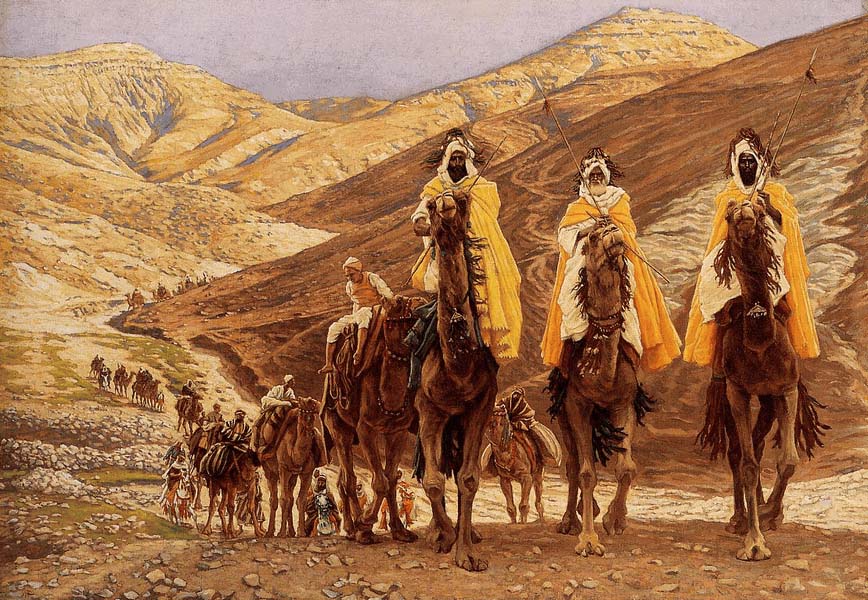
Did you notice that our three wise men statues arrived in our manger scene only on this Sunday of the Epiphany? That’s because the Magi were not in Bethlehem on Christmas Day. In many movies and imaginations, the visit of the shepherds and the arrival of the Magi get smushed together as events of the same night. St. Luke’s Gospel recalls Jesus being wrapped and laid in a feedbox and speaks about the shepherds, but St. Matthew’s Gospel tells us the Magis’ tale with several signs that the Magi came quite a bit later.

For starters, the Magi arrive in Jerusalem after their long journey from the east expecting that the new king has already been born. “Where is the newborn king of the Jews?” they ask. “We saw his star at its rising and have come to do him homage.” Once Herod had “ascertained from them the time of the star’s appearance” and had learned from the Jewish chief priests and scribes where the Christ was to be born, the wicked king sent the Magi to Bethlehem.

St. Matthew says “on entering the house they saw the child with Mary his mother.” There’s no mention of a cave or stable; it appears that the Holy Family has moved into better lodgings since Jesus’ birth. The Magi “prostrated themselves and did him homage. Then they opened their treasures and offered him gifts of gold, frankincense, and myrrh.” This happy encounter occurs at least forty days after Christmas. We know this because of a detail from the Gospel of Luke.

According to the Law of the Old Covenant, a Jewish woman who had given birth was required to wait a certain number of days and then provide sacrifices at the temple. For a baby boy, the mother had to wait at least forty days, then she was to bring the priest two animals for sacrifice; namely, a one-year-old lamb and either a turtledove or a pigeon. However, if she could not afford the lamb, God’s Law allowed her to just offer either two turtledoves or two pigeons instead.

St. Luke indicates that for Jesus’ Presentation at the Temple, after the completion of those forty days, Mary and Joseph were poor enough to take that second option, offering “a pair of turtledoves or two young pigeons in accordance with the dictate in the law of the Lord.” If the Magi had already visited, the Holy Family would have had some gold for buying a lamb. But Mary and Joseph did not have that gift because the Magi had not yet come. In fact, what King Herod goes on to do suggests it could have been more than a year later before the Magi arrived.

When Herod realizes the Magi have evaded him (for they were warned in a dream not to return to Herod) the paranoid and ruthless king does a horrifically evil thing. He orders that all the baby boys in Bethlehem – not just newborns but all those two years old and younger – be killed. This suggests King Herod thought the baby which the Magi sought could already be up to one or two years old.

The Magi arrive at our manger scene today on Epiphany Sunday because the Gospels show they celebrated the birth of Jesus Christ together with his Holy Family a time after Christmas Day. It’s interesting to learn about the Gospels and the life and times of Jesus, but collecting bits of biblical or historical trivia is not the point. What significance does the Magis’ later arrival have for our lives as Christians? One thing it means for Christ’s Church is that Christmas is not just a one day event but a whole season to celebrate.

What happens in our world on December 26th or 27th? Lots of people take down their decorations and throw out their Christmas trees. The Christmas songs played since before Thanksgiving disappear from the radio. Mentions of Christmas vanish from mass media because the opportunity to sell things to people has passed. Our secular culture uses Advent as its Christmas season, filling it with stressful hustling and hassles like Joseph and Mary experienced preceding Jesus’ birth. That birth is allowed one day of restful, spiritual, joyful peace and then the event is over. But for Catholics and Christians of times past, Christmas Eve is not the beginning of the end of Christmas, but the start of the Christmas Season. We are in that season now, decked in the liturgical color of white through the third Sunday after December 25th, the Feast of the Baptism of the Lord, which is next Sunday.

Beware of taking too many cues from the world of Herod, whose interests in Christmas are not pure. Let us learn instead from the Magi about celebrating this season. They come after Christmas day but are still “overjoyed” to celebrate his birth. They come to him, honor him, savor their time with him. They rest with him at Bethlehem. It appears the Magi did not come and leave in just one day, but were able to be warned in a dream not to return to Herod because they chose to rest with Christ and his Holy Family.

Living differently for Christ bears unexpected blessings and benefits. For instance, my good friend Katie told me yesterday that she gets a Christmas tree and puts it up on Christmas Eve. Doing it this way not only helps keep the whole season special but she gets a tree each year for free. (By that point, Christmas tree sellers are just happy to have her take one away.) Imagine no longer having to fit everything that is Christmas into the month of December. Like the Magi, you can plan trips and gatherings for after Christmas Day.

There’s still one week of Christmas left this year. Make a plan to keep it special. Play and sing your Christmas songs. Keep on feasting. Create some fun. And think of how next year you and yours can celebrate throughout the entire Christmas season. Like the Magi before you, let how you celebrate Christmas be guided by heavenly light.

Bringing Christ to Others — Funeral Homily for Loretta Logslett, 89

December 30, 2021

Loretta has been a faithful St. John the Baptist parishioner for very many years. Meeting our Lord Jesus Christ at his churches like this one was Loretta’s priority. Her son, Dean, says that she would leave a party early to attend a Sunday Mass, to contemplate and gaze upon Christ’s loveliness in his house and temple as today’s psalm says, before returning to the party after. In 1955, she married Julian here, her loving husband for 55 years. Today, Loretta shall be buried from here, and entrusted to her loving Lord forever.

Since 1977 she has worked at the Colfax Health and Rehabilitation Center as a nutrition cook. Her coworkers say that she provided them with generous food portions. But Loretta always knew that we do not live on bread alone. Residents in nursing homes often have limited mobility. Health and transportation problems prevent them from coming to church for Mass like they used to, and they miss it. They miss visiting that holy place of contact, they miss that sacred encounter, and they may feel separated from the Lord. But as St. Paul asks, what can ever separate us from Christ’s love? He who died for us, who was raised for us, and who sits at God’s right hand and intercedes for us, sends us help and consolation. Jesus sent Loretta to that nursing home not only to feed bodies but also to feed souls.

Loretta brought to its residents Jesus in the Holy Eucharist – the Sacrament of Christ’s Body and Blood – the food which gives eternal life. On days when a priest could come for monthly Mass there, Loretta helped set up the room for the celebration, she brought residents to the altar in their wheelchairs, and proclaimed the scripture readings. And throughout the week, she was a pleasant, joyful presence. She would visit residents in their rooms, genuinely befriend them, and pray the Rosary with them. Loretta’s coworker, Robert Johnson, reflected and shared that Loretta may have personally inspired among them some conversions to Christ and his Church. They were not able to make the trip to Jesus, so Jesus came to them in, with, and through Loretta.

These are things we would expect to see in someone very close to the Lord: a consuming desire to see him and be with him, a longing wish that others would know and love him too, a living reflection of his goodness and love in everything one does. Here today, we offer the greatest prayer of Christ’s Church, the Holy Mass, to aid Loretta on her journey to God and to comfort and strengthen us who remain here. On this day of hope and mourning, on this day of reflecting on the past and of looking forward to tomorrow let us ask our Lord Jesus Christ to increase our Christian devotion, to purify our love for him, to make us truly grateful for his gifts, to make us faithful, like Loretta.

Keeping the Faith During Trying Times

December 25, 2021

Feast of The Holy Family
By Deacon Dick Kostner

“Mary, did you know that your baby boy is Lord of all creation?  Mary, did you know that your baby boy would one day rule the nations?  Did you know that your baby boy is Heaven’s perfect Lamb?  That sleeping child you’re holding is the great “I Am“?

The answer to the lyrics just quoted from the popular Christmas Song “Mary did you know?” is “No! Not everything,” according to Pope John Paul II. She did not know everything at once and it is displayed in our gospel proclaimed in today’s Liturgy.

The morning I began to prepare for this homily I saw some very disturbing statistics from an article in The Wall Street Journal. Americans who pray daily was 58% in 2007, this dropped to 45% in 2021; Americans who identified themselves as Christians was 78% in 2007, in 2021 this dropped to 63%. This downward trend began long before COVID but increased during the pandemic. At our own parish we have experienced a substantial decline in attendance at Sunday Mass, especially family attendance. Other parishes have had similar declines.

So what’s going on? Our gospel displays to us the problem but it also gives us the answer to the problem. The problem is rooted in both mental and physical sufferings that are a part of the human experience. Sacred Scripture lays it out very well. Humans get sick, go blind, struggle with raising children, have disagreements with spouses and family, and yes the big one, death and when we pray for help we expect results not tomorrow but right now. All of these were experienced by Jesus the big question is: “Why?” The answer is a mystery we are incapable of understanding, but God did gift us with how we can get through these sufferings and anxieties when he sent His Son to experience these struggles and to supply us with the cure, and that is faith that the Father loves us, His Holy Family, and has a plan for us to follow and find happiness even while suffering, through His Holy Spirit and His Holy Family. The problem is our world has become secularized. Secularization is the process of removing religious and moral influence from our society. The significance of God and the Holy Family in our world is looked down upon and is been reduced.

Lets reflect on our Gospel this Feast of the Holy Family, and “Mary did you know?”. Humans are wired by our creator to care for and protect children we are blessed with. Mary was no exception and when her and Joseph realized Jesus was missing and days had passed panic hit them. They backtracked and found Jesus in the temple listening to the elders and conversing with them. They were upset and asked why Jesus had not told them where he was going. His reply was that he thought they would know that he was going to His fathers house. And then we are told that Mary and Joseph “did not understand what he said to them.” Thus we are given the answer to some of the songs questions of her that she did not know. But then we are told that Mary “kept all these things in her heart.” and thus she reflected upon her son’s words and she came to understand that Jesus had assumed she knew his vocation, to learn and be involved with public ministry. Jesus also realized they did not know this and felt sorry for not telling them his plans to visit his Fathers house, for we are told that “Jesus advanced in wisdom and age and favor before God and man and was there after obedient to them.”

Jesus made a mistake for causing anxieties to his Mother and his step father and corrected his behavior and honored his human parents. This is the guide line for human families becoming members of the Holy Family. They care for and correct mistakes they make within their Holy Family relationships and its members.

Being human will carry with it sufferings. There will be mistakes that we will make as members of the Holy Family that will cause not only us but other members of God’s family to suffer. We are called to reflect upon our mistakes and make corrections to assure those we have caused to suffer that this will not happen again. We are called by God to place other members of the family of Jesus ahead of ourselves when we realize that others need our help and support as Jesus, Mary and Joseph have taught us, by reflecting on our actions and praying to the Father for wisdom and direction in helping our brothers and sisters overcome their sufferings and anxieties of life.

Like Mary, there are many questions in life we don’t know answers to. It is faith that allows us to trust that the Father knows our fears and anxieties and will answer us through His Holy Family when the time is right, for as told to us by God we are to look to His Holy Family and the Word for help and guidance and as far as fear, He tells us: “Be still and know that I AM!

Learning from the Angels

December 24, 2021

Christmas, the Nativity of the Lord

It can be an alarming experience to encounter an angel. Their presence is typically veiled to us but once revealed to our human perception angels radiate such mightiness, holiness, and otherworldliness, that often the first thing they say upon appearing is: “Do not be afraid.” So it was on the first Christmas night in the fields outside the little town of Bethlehem where the shepherds kept watch over their flock.

A heavenly angel appeared to them, the Lord’s glory shone around them, and the shepherds were utterly terrified. But the herald angel said, “Do not be afraid… I proclaim to you good news of great joy that will be for all the people. …Today in the city of David a savior has been born for you who is Christ and Lord.” The angel then gave them a sign to look for, to know that they had found the newborn king: “You will find an infant wrapped in swaddling clothes and lying in a manger.” Suddenly, a whole multitude of angels appeared, praising God and saying: “Glory to God in the highest and on earth peace to those on whom his favor rests!” When the angels departed the shepherds were seemingly alone once more in the dark and quiet field.

Like the gospel two weeks ago about St. John the Baptist’s preaching, what strikes me about the angels’ proclamation is what the shepherds are not told to do. The Holy Family was very poor, but the shepherds are not told to bring them coins. The cave-stable in which Jesus laid was probably dirty like a barn, but the shepherds are not told to bring him a broom or clean blankets. Jesus’ parents had had a long day, but the shepherds are not told to bring them a meal. Any of these things would have been good gifts, but none of them were the most important thing. The angels invited the shepherds to bring themselves to Jesus; to approach him, see him, know him, love him, honor him; to come and encounter him, to come and adore him. This is the greatest gift.

Jesus Christ had only just been born on earth but the angels had already met the eternal Son of God in heaven. Through him all things were made, including the angels. The angels knew him from the start of their existence and in highest heaven they adored him constantly beholding his unveiled glory. In this, the angels seem to have an advantage compared to us. We see God’s creations, but they see the Craftsman. We see his effects, but they see the Source. We see his works which reflect his glory, but they see his glory directly. At Jesus’ birth, we see the Godhead veiled in flesh, lying in the manger. At his Holy Mass, we see Jesus Christ in the Eucharist, veiled in the appearances of bread and wine. Every good and beautiful thing you have ever enjoyed has its existence from him who is the most real, the most delightful, the greatest and best of all. And yet, for us human beings, God is easy to overlook.

If an angel had not visited the shepherds they would not have realized that they were within walking distance of their Savior, Messiah, and Lord. But once the angels had proclaimed the message and went away from them to heaven, the shepherds turned and said to one another, “Let us go, then, to Bethlehem to see this thing that has taken place, which the Lord has made known to us!” The shepherds left in haste, but imagine if… they had chosen not to go. The shepherds could have chosen not to go into Bethlehem. Nobody was forcing them to visit the Holy Family. They could have ignored Jesus and stayed away from him. Many people do.

The angels, in their beginning, once faced a choice like this themselves: would they love and adore and serve the Lord or would they disregard him, rejecting him and his reign? Would they love him or not? Would they worship God or themselves? The spirits who chose well are called the angels. The spirits who chose badly are called the demons. Ever since that decisive decision, the angels have loved and worshipped the Lord and been rightly ordered and thriving in his will, while the demons who refused to love and worship him have been disordered and depraved through and through.

Worship and love are linked. We worship what we love most, and that impacts our relationships to other things for good or ill. Imagine a child on Christmas morning who excitedly unwraps a new and coveted toy which, for a while, they love more than anything on earth. Will they remember to thank Mom and Dad who gifted it, or be too distracted to show gratitude? Will they be willing to share the toy with their brothers and sisters, or resent and fight against anyone who wants it? Will they draw closer to their family, or isolate to be alone with their most precious possession? Will they be delighted by that toy forever, or feel disappointment when it does not provide happiness unending? As adults, our coveted toys, our disordered loves, take different forms but lead to similar results. To love God as our greatest good and worship him with thanksgiving, praise, and openness to grace, are essential for us to love him and people and things like we should.

For the first Christmas, the angels’ gift to Jesus Christ was worship: “Glory to God in the highest!” And the angels’ gift to the human race was an invitation for us to do the same. As God’s messenger to you this sacred day, I invite and urge you to return to this church soon to faithfully encounter and adore your Savior, Christ, and Lord.

Squandered Gifts?

December 19, 2021

4th Sunday of Advent
By Deacon Matthew Bowe

This past week was finals week at the seminary. Many of my seminary brothers were busily writing papers and completing oral and written exams. Hours were spent with noses in the books and eyes staring at the screen. Stress and frantic work were abundant. I suffered.

Before you have any pity for me, I should confess the whole truth. After my one class Friday morning, which was only fifty minutes, I was mostly done. I only had a ten-minute oral exam to complete for the Eucharist class. I was on break mode since Friday at ten A.M., yet we were not allowed to depart from the seminary until after our final class on Tuesday. Some of my brothers went to class on Monday and Tuesday. I did not. I have not stressed about schoolwork for over a week, and I had plenty of time to work on my thesis and play fun activities with my friends. How, then, did I suffer?

Well, two of my closest friends, with whom I wanted to spend time, had a ton of work yet to do. They are procrastinators, poor planners, and undisciplined and unmotivated toward academic matters. Having an abundance of work left at the end of the semester is a common occurrence for them. Anyway, I suffered because they did not have time for me. I wanted to give them some of my time to be with them and to partake in shared activities. I understood that they had work to do. However, they mentioned that they were going to work on things sooner, yet they never did. They said that we could not watch a television show together because of the work that they had to do, yet I saw them sleep in, take naps, play video games, and watch television at other times. I was hurt because I felt left out. The message from this story is that our actions and our inactions can affect others in profound ways unbeknownst to us. We can be oblivious and passive to the passing moments in our lives. We can hurt others and not know it.

Please do not be hard on my friends, for I forgive them. Please do not have pity on me, for it was good spiritual growth. I tell this story to set up the message of my homily. In our humanness, we let many gifts and graces pass by in our lives. In our relationship with God, we are like my friends. I am like my friends to others and to God. How often do we squander the gifts that God gives us by casting them aside like pearls before swine? We look at God’s gifts and say, “Thanks, but no.” Then, we do our own thing not realizing that God had just given us the very thing that was necessary. It could have been an invitation to prayer, the grace that we needed to endure a hardship, a kind word to speak to another, or other good things. Why do we forsake heavenly things for the passing things of this world?

Yet, squandering gifts is not even my message, but it serves as a foil, as a contrast, for my main message. I want to talk about someone who never squandered one of God’s gifts. Glory to God that Mary, our Blessed Virgin Mother, never squandered a gift from God. In her immaculate and virginal heart, which magnifies the glory of the Lord, Mary perfectly received the angel Gabriel’s message. Her response and disposition were receptive – “Behold, the handmaid of the Lord, may it be done according to thy word.” Then, she received the Word Himself in her spotless womb. This gift of the Son was not for Mary alone, but the Savior came to redeem all nations back to God. Thanks be to God for Mary’s fiat, her “yes,” for the world gained the Savior of all Mankind.

Besides Mary’s disposition to receiving God and her freedom and openness to say yes to God’s will, Mary also exemplifies the love owed to a neighbor. She went into the hill country, around a ninety-mile journey from Nazareth, to rejoice with her cousin Elizabeth, who was once barren. Mary recognized that she had a duty to care for her cousin as her cousin progressed through her pregnancy. From this humble act of charity, another divine purpose would be served. Mary went to Elizabeth, and Jesus went to John. Jesus went to anoint John so that John would be ready to be the forerunner-prophet for the Christ. Whereas Mary and Elizabeth exchange greetings in a human way, Jesus and John exchange greetings in a spiritual way. Elizabeth heard the greeting first, but John experienced the grace from within Mary’s womb, leapt in Elizabeth’s womb, and filled Elizabeth with the Spirit. This prompts Elizabeth to praise Mary, who is “blessed among women” and is the “mother of my Lord.” Mary is first praised by an angel, and now she is praised by a woman. Even today, Mary is praised by the hosts of angels and by all the faithful in heaven and on earth.

Now, my brothers and sisters in Christ, we must continue to wait to hear more of the story. We must wait a little long to hear how the prophecy of Micah is fulfilled, when the “one who is to be ruler in Israel” comes forth. Mary will give birth to the One who shall stand firm and shepherd his flock, who will shepherd us. The King of Peace will come. Until that time, let us heed the words from the Letter to the Hebrews. The Lord wants us, and He wants the offering of our hearts. Jesus obeyed the Father’s will and offered His body once for all. Christmas does not stand apart from the Passion and Resurrection. Christmas points to Easter. The Son of God came to die for our sins. The old saying goes “from the wood of the manger to the wood of the Cross.” We hear in the opening prayer that we may “by His Passion and Cross be brought to the glory of His Resurrection.” But the Death is still awhile away, so let us prepare for His Birth.

There is one week left until Christmas. Let us intensify our spiritual sacrifices and penances to clear room in our hearts to receive the newborn King. Let us renew our vigilant waiting for the birth of our blessed Lord. Mary is very pregnant now; she is about to pop, as they say. We have seen mothers who are in their final days of pregnancy before the delivery. There is excitement in the eager and anxious anticipation of the newborn babe. St. John the Baptist announced the presence of Jesus by leaping in the womb of Elizabeth. Let us prepare our hearts to leap with joy with the presence of the newborn King on Christmas Day.

Christmas, Unlike We Envisioned It — Funeral Homily for Dr. S. Ann Hartlage-Feltes, 79

December 16, 2021

Ann and Larry realized something was gravely wrong during their recent vacation abroad. She was experiencing persistent and unexplained fatigue and shortness of breath. Just some forty days later, the cancer present and growing within her ended her earthly life. It’s stunning, it’s shocking, that a woman we know as being so energetically alive could pass away from us so quickly. As a good and faithful spouse to Larry after James’ passing, as a loving, caring mother to David, Kristin, and Ken, as a devoted, attentive grandma to her grandkids, as a dedicated psychologist to the clients and couples she served, as someone known and loved by us, her death creates a painful absence. How strange, how jarring, how incongruous it is, to be having her funeral now – so very close to Christmas. At a time for togetherness, we’re separated. In a season celebrating heavenly peace, we’re unsettled here on earth. Christmas joy, veiled by dismay. This is not how we imagine Christmas to be. And yet… the first Christmas was troubled too.

About fifteen months before the first Christmas, when Zachariah exited the temple sanctuary after having encountered an angel, he made excited, mute gestures to the people. Some concluded that he had seen vision but Zachariah was unable to speak or hear for many months. His wife, Elizabeth, may have worried whether her beloved suffered a stroke. Would he ever speak again? Then Elizabeth herself began to be unwell. She felt nauseous every day and noticed her abdomen expanding. Could she “who was called barren” somehow be pregnant, or was something gravely wrong?

Nine months before the first Christmas, the Blessed Virgin Mary gave her “Yes” to God’s plan at the Annunciation in Nazareth. An angel told Mary she would become the mother of the Messiah, but many details about her future remained hidden from her. Would her husband. Joseph, believe her when she told him? Would he become angry or afraid and decide to leave her? Joseph came very close to erroring and divorcing Mary, either because he judged her unworthy of him or because, believing her, he thought himself unworthy of her. After a torturous time of doubt and uncertainty, an angel visited Joseph in a dream and got him back on the right track.

Joseph resolved to be the very best protector and provider to Mary and her Holy Child that he could be. So imagine his great frustration that first Christmas night, consider his distress at being unable to find a proper place for Mary’s labor and Jesus’ birth; only an unclean cave with a feed trough for a crib. The first Christmas and the events leading up to it were not easy for the people who lived them. Their times were troubled, with hardships and fears. But in the end, now looking back, the accomplishment of God’s loving plan for them was more beautiful than any of them would have imagined.

See what God did for these saints of his who suffered: St. Elizabeth was not sick and dying but with child, carrying the forerunner of the Christ. St. Zachariah would regain his voice and rejoice in their firstborn son, St. John the Baptist. St. Mary would never be abandoned, but was lovingly cared for through it all. And St. Joseph succeeded in his mission to be the best father on earth. Jesus Christ’s birth in a stable was not an accident, not a divine oversight, but according to God’s plan. Their stories are a sign for us, a lesson for our lives. The Scriptures repeatedly tell us to hope in God and the good things to come.

The author of today’s first reading laments, “My soul is deprived of peace, I have forgotten what happiness is,” yet the prophet does not despair. “The favors of the Lord are not exhausted, his mercies are not spent. … Good is the Lord to one who waits for him, to the soul that seeks him. It is good to hope in silence for the saving help of the Lord.” St. John tells us in our second reading: “The way we came to know love was that [Jesus] laid down his life for us.” Our Lord faced dying so bravely because he knew not even death would end God the Father’s blessings toward him.

Today we gather in this famous and beautiful cathedral to offer the Church’s greatest prayer, the Holy Mass, for Ann’s soul and our consolation. She and Larry have been parishioners here at Holy Name for years, attending Sunday Mass and sometimes weekday Masses, too. From this altar, Ann received her Lord, his Body and Blood, his Soul and Divinity, his living and entire Self, in the Holy Eucharist. Jesus says in our Gospel, “My Flesh is true food and my Blood is true drink… Whoever eats my Flesh and drinks my Blood has eternal life, and I will raise him on the last day.” Today, we remember and are consoled by Jesus’ promise to Ann and us: “Whoever eats this bread will live forever.

Because of Ann’s parting, this Christmas will not be as we envisioned. But we are consoled by the truth that even amid these trials God is accomplishing his loving plan for us, a plan which is more beautiful than we can now imagine.