Archive for the ‘Pope John Paul the Great’ Category

Blessed Pope John Paul the Great Quotes

October 21, 2013

 “Freedom consists not in doing what we like, but in having the right to do what we ought.”

“A person’s rightful due is to be treated as an object of love, not as an object for use.”

“War is a defeat for humanity.”

“As the family goes, so goes the nation and so goes the whole world in which we live.”

“Do not abandon yourselves to despair. We are the Easter people and ‘hallelujah’ [“Praise the Lord”] is our song.”

“Science can purify religion from error and superstition. Religion can purify science from idolatry and false absolutes.”

“Faith and Reason are like two wings of the human spirit by which is soars to the truth.”

“Do not be afraid. Do not be satisfied with mediocrity. Put out into the deep and let down your nets for a catch.” “

The future starts today, not tomorrow.”

Our Lady of Good Help Pilgrimage Homily

June 14, 2011

In the Garden of Eden, there were many fruit-bearing trees but Genesis mentions two by name: the Tree of Life, and the Tree of the Knowledge of Good and Evil. By partaking of the Tree of Life, the human race could keep living forever, but the Lord warned that to eat from the other tree would mean our certain death.

On October 9th, 1859, the Blessed Virgin Mary appeared here, to 28 year-old Belgian emigrant, named Adele Brise, as she was walking 11 miles home from Sunday Mass. Interestingly, Our Lady chose to appear to Adele not in a church setting such as this, but between two trees: a Maple tree and a Hemlock tree.

You’re all familiar with the beauty and goodness of the Maple. In the fall, its leaves turn the most striking colors; and in the spring, its sap yields sweet syrup. But do you know what distinguishes the Hemlock tree? The poison that Socrates was condemned to drink came from this plant. Ingesting just six or eight fresh Hemlock leaves can kill a healthy adult. [Post-Script: The Hemlock Tree found in Wisconsin is not poisonous, but merely shares the name.] The Maple is a tree of life, while the Hemlock is a tree of death. Mary, the New Eve, stands between the two. [Post-Script: The Hemlock Trees native to Wisconsin are a non-poisonous but share the name.]

She tells Adele, “I am the Queen of Heaven, who prays for the conversion of sinners, and I wish you to do the same. You received Holy Communion this morning, and that is well. But you must do more. Make a general confession, and offer Communion for the conversion of sinners. If they do not convert and do penance, my Son will be obliged to punish them.”

Our Lady’s message by the trees recalls the counsel of Moses, who told the Israelites: “I have set before you life and death, the blessing and the curse. Choose life, then, that you and your descendants may live, by loving the Lord, your God, heeding his voice, and holding fast to him. For that will mean life for you, a long life for you to live on the land….”

Apparently, Our Lady’s warnings were not sufficiently heeded. In October of 1871, The Great Peshtigo Fire erupted. In terms of both size and loss of human life, The Great Peshtigo Fire remains the worst recorded forest fire in North American history. Between 1,200 and 2,400 lives ended in that firestorm which saw, according to an eyewitness, “large wooden houses torn from their foundations and caught up like straws by two opposing currents of air which raised them till they came in contact with the stream of fire.” This seems to be the punishment due to sin that Mary spoke of, but this does not mean that everyone who perished in that fire was condemned. We should remember that at harvest time, the good wheat and the bad weeds are pulled up together in a moment, but their future fates are not the same. Once uprooted from the earth, the good are gathered and kept in the barn, while the bad are thrown away forever.

The Peshtigo firestorm came and surrounded this shrine, where hundreds had come with their families and herds, to beseech the intercession of Mary before God. As many as fled to her were saved. The morning of October 9th, 1871, twelve years to the day after Our Lady’s appearance, saw them delivered.  This consecrated earth was an emerald-green island in an ocean of smoldering ashes as far as eyes could see.

After witnessing this miraculous deliverance, and seeing the lifelong dedication and fruitfulness in Adele Brise’s efforts, many began to believe that she had indeed seen and heard Our Lady. Just last year, the Church formally agreed, approving the apparitions and locutions given to Adele Brise in October of 1859 as worthy of belief by the Christian faithful. Some people will think that this official recognition closes the book on the story of Our Lady of Champion. Some will come here like tourists, excited see where Mary once appeared and go home contented. They won’t think to imagine that Mary’s message was not only meant for Adele in the past, but directed toward us today

In 1859, Mary prayed for and sought the conversion of sinners. Have we gotten less sinful since then? In 1859, Mary lamented how the young did not know the faith. How much better do we live it now? In 1859, Mary warned that if people did not convert and do penance, her Son will be obliged to punish them.” Do we need to convert and do penance? Would you be surprised if a great natural or man-made disaster befell us? How spiritually well prepared do you think people would be to face that?

I don’t think it is a coincidence that the message of Our Lady of Champion is arising to new prominence in our day. Today we heard talks about Our Lady’s Fatima apparitions, which date from 1917. At that time, Mary asked for Russia to be consecrated to her Immaculate Heart to bring about its conversion and a period of peace in the world. On March 25th, 1984, Blessed John Paul the Great consecrated Russia and the whole world to the Immaculate Heart of Mary. It was on the feast of the Annunciation. On Christmas, seven years later, the miracle arrived. On the evening of December 25th, 1991, Mikhail Gorbachev peacefully resigned as the President of the Soviet Union and from atop the Kremlin, the Soviet flag was lowered forever. This was not a coincidence. Politics, economics, and the threat of nuclear war did no bring the Soviet Union to a stunning and peaceful end; it was the work of Jesus and Mary.

What moved Blessed John Paul the Great to consecrate Russia, so many years later after the apparitions, precisely when he did? What moved Bishop David Ricken to approve this apparition, so many years later, as our country’s first Marian apparition site, here and now in our day? In both cases, I suspect that there is more behind these events than the personal whims of men. I suspect that both acts are orchestrated for their role in God’s plan.

I don’t think that Mary’s message was meant for Adele alone, such that their relevance passed away with her death. I think Mary is asking similar things from us. But what exactly? Mary’s message focused upon interceding for sinners and teaching the faith.

Mary the Queen of Heaven, prays for the conversion of sinners, and she wishes you to do the same. You receive Holy Communion, and that is well. But you must do more. First, regularly receive the sacrament of reconciliation, for the sinner whose conversion you are most responsible for is you. I suggest going once a month, for it is effective for growing in holiness.

Next, in this state of grace, offer holy Communions for the conversion of sinners. At every Mass, the priest has an intention for which he is offering the sacrifice. This is a person or group that he asks to be graced, or a problem or need he asks to be helped, by this offering of Jesus’ sacrifice. At every Mass that you attend, you can also offer an intention of your own. Offer some of your holy Communions for the conversion of sinners. And, like the children of Fatima, you can offer your daily sacrifices, burdens borne or pleasures foregone to help those far from God. In doing this, you follow Jesus, who suffered what He endured in order to save others.

Mary also told Adele: “Gather the children in this wild country and teach them what they should know for salvation.” Anyone who faith is immature is still a child in the faith. You can help teach them. Mary told Adele to ‘teach children their catechism, how to sign themselves with the sign of the Cross, and how to approach the sacraments.’ For children you will do one way, for adults, another, but you have something to offer them all; your children and relatives, your coworkers and acquaintances. As Mary said, “Go and fear nothing. I will help you.”

And finally, if and when a new firestorm afflicts our land, or when personal firestorms erupt in the lives of those we love, lead them to take refuge in Jesus through Mary. Confession and holiness of life, holy offerings and penances for sinners, teaching the faith to all, and leading them all to Jesus with Mary—this was Adele’s mission, and it is our mission too.

A Man In Jesus’ Image — Divine Mercy Sunday—Year A

May 1, 2011

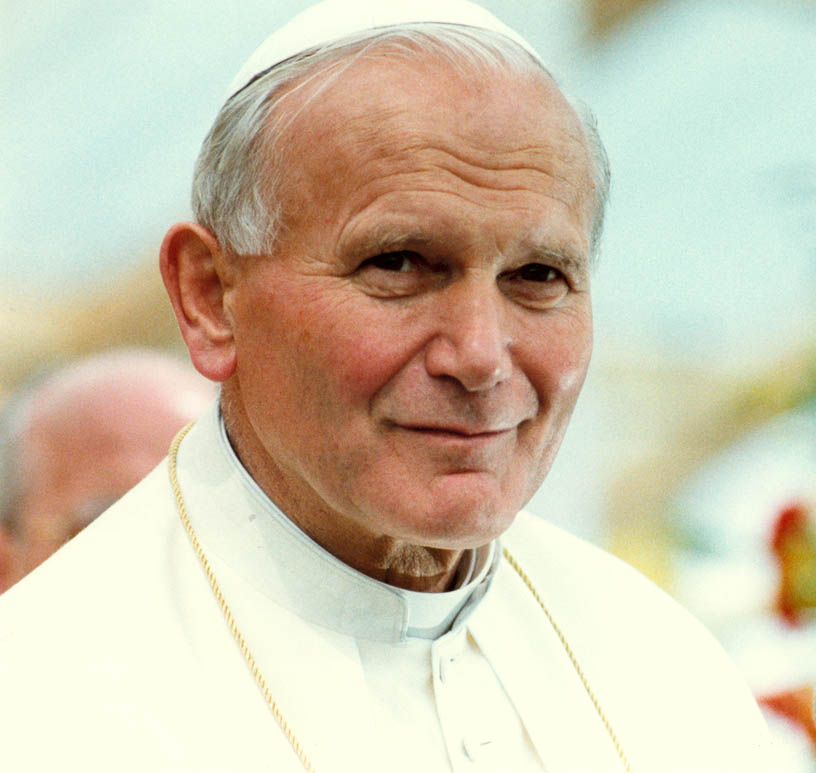
This Divine Mercy Sunday, our Catholic Church throughout the world celebrates and glorifies two men together in a special way. The first is our Savior, our Lord and our God, Jesus Christ; and the second is the great pope John Paul the Second, who is being beatified today in Rome. John Paul the Great, born Karol Wojtyla, is a man who lived in the image and likeness of Jesus Christ.

Both chose the Blessed Virgin Mary to be their mother. One chose her after the loss of his earthly mother as a boy. The other chose her from all eternity. Growing up, both of their beloved homelands were occupied and oppressed by foreign empires. For one it was the Romans. For the other it was the Nazis and then the Soviet Union. As young men, they both worked as manual laborers, in lives hidden from the world. When people encountered their ministries for the first time, many said, “Who is this man, and where does he come from?”

Both men transformed this world, not by leading violent revolutions, not by amassing incredible fortunes, but by speaking the truth, and living the truth, and leading others in doing the same for God. They preached God’s message, and their words gave hope and courage to many, but their words were not accepted by all. Both men had enemies who sought to destroy them, but they forgave, face to face, those who sought their lives.

At the end of their lives, both men were afflicted with great physical sufferings, but neither laid down their crosses. Some onlookers mocked or dismissed them in their afflictions, but those with spiritual insight beheld them to be offering a sacrifice to the Father for the salvation of the world.

St. John tells us that Jesus has done many other signs in the presence of his disciples that are not written in his Gospel. As St. John writes elsewhere, “There are many other things that Jesus did, but if these were to be described individually, I do not think the whole world would contain the books that would be written.”

Among these signs are the lives of the saints throughout the centuries, saints like Pope John Paul the Great. His life was a sign worked by Jesus Christ in our midst so that we would come to believe more deeply that Jesus is the Christ, the Son of God, and that through this belief we may have life in his name.

Why did people love Pope John Paul II so much? Catholics of every country and of all ages loved and flocked to him. Even non-Catholics and non-Christians were drawn to him. What explains this phenomenon? I think the answer is simple. People saw in him a reflection of Jesus Christ’s love for them. John Paul the Second was an icon of Christ and his love.

Every time you saw Pope John Paul, he was smiling. He traveled the nations, and embraced everyone warmly. When you encountered him, you felt loved, even if you were one person in a crowd of thousands. This was the Holy Spirit at work. Although you did not see Jesus you loved him in Pope John Paul; even though you did not see Jesus you believed in him all the more because of him, and rejoiced with an indescribable and glorious joy.

This morning we celebrate a feast day which Pope John Paul II established, Divine Mercy Sunday. What is divine mercy like? What does Jesus’ unfathomable love, which enfolds every one of us here and every person God has made, look like? Through the life of Pope John the Great we saw a partial glimpse of the divine mercy and love of Jesus Christ.

Be Not Afraid — 8th Sunday in Ordinary Time—Year A

February 28, 2011

This morning, I would like to recall events from the life of a great man. When he is eight years old his mother dies. When he is twelve years old, his older brother (a physician) also dies, having contracted scarlet fever from a patient. At nineteen years old, the Nazis invade his homeland and inflict much suffering on those he loves. With his father’s death, he becomes the last survivor of his immediate family, at only twenty years of age. After five years of war and occupation, the Nazis are driven out, but the Soviet communists replace them. They will later try to murder him, but they will (just barely) not succeed. At age seventy-three, he is diagnosed with an incurable disease that will slowly weaken him and kill him, and eleven difficult years later, he dies.

These are events from the life of a great man, a man the Church will declare “blessed” this May 1st. He is Karol Wojtyla, better known as Pope John Paul II. Throughout his papacy, over and over again, he repeated this message: “Do not be afraid.” He is well-known for saying this, but these words were not originally his. They come from another man, also a man of suffering—accustomed to infirmity, who knew both poverty and exile, one who experienced the deaths of loved ones, a man who was also targeted for death himself. This man is Jesus Christ, who first said, “Do not be afraid. Be not afraid.” In fact, in the Gospels, Jesus says this more than just about anything else.

I recall the trials of John Paul the Great and the sufferings of Jesus Christ lest anyone think their words come from naivety about life and the world, or that their Gospel is not grounded in reality. Jesus knows what he is talking about when teaches us, when He commands us, “Do not worry about your life, what you will eat or drink, or about your body, what you will wear. …Seek first the kingdom of God and his righteousness, and all these things will be given you besides. Do not worry about tomorrow; tomorrow will take care of itself. Sufficient for a day is its own evil.” Jesus never denies that evils exist in this world, but tells us that none of them should make us fear. This is why the Church asks God the Father at every Mass, “Deliver us Lord from every evil and grant us peace in our day, in your mercy keep us free from sin and protect us from all anxiety….” We really mean it when we pray this, that we may be free from all anxiety. Christians should care about many things, but not one of these things should make us anxious.

Of what should we be afraid? Poverty? Jesus lived it. Suffering? He experienced that, too. Sin? Jesus has conquered it, and He offers us restoration. Death? Jesus has defeated it, and He promises us resurrection. With Jesus Christ, we can have the peace that, in the end, everything will be ok. Yet, many people feel crushed by their worries, about matters large and small. How are we to overcome these anxieties and experience the peace Christ wants for our lives? We conquer anxiety with these two things: prayer, and confidence in God’s love for us.

As Saint Paul wrote the Philippians, “The Lord is near. Have no anxiety at all, but in everything, by prayer and petition, with thanksgiving, make your requests known to God. Then the peace of God that surpasses all understanding will guard your hearts and minds in Christ Jesus.” Jesus will never forsake us, and He will never forget us. Even if a mother should forget her infant, or be without tenderness for the child of her womb, Jesus will never forget you. So, “Do not be afraid.” The next time you feel worry, the fruit of fear, remove it from your mind and place it on an altar before the Lord. Make a sacrifice of it, a burnt-offering before God, and say, “Jesus, I trust in you. I’ll show up and do my part, but I’m relying on you to take care of this. I sacrifice my fears to you.” It is a high compliment to Him when we trust in Him to be our God, and opens us up to receive His peace.

Always be confident in Jesus Christ’s love for you. The next time you feel worry coming on, this is your cue to pray. Do not be afraid. With Jesus Christ, we can have the peace that everything will be ok.

Checkout Catholic Movies

July 14, 2010

Did you know the St. Vincent DePaul Society just two blocks from St. John’s (location) has a library of Christian movies, books, and CD’s free for checkout? Pick up the films below for a spiritually edifying and entertaining evening:

The Ten Commandments (1956, VHS, 219 min)
Moses faces Pharoah demanding “Let my people go!”
+ Charleton Heston, Yul Brynner, and a cast of thousands
+ Regarded as the greatest Biblical epic of all-time
+ In *Technicolor*!

For another film about a great shepherd of God’s people, I recommend…

John Paul II (2005, DVD, 180 min)
A dramatic biography about Karol Wojtyla, Pope John Paul II
+ Regarded as the best drama about the Great Pope
+ Cary Elwes (The Princess Bride) plays the young Wojtyla
+ Jon Voight stars as Pope John Paul II
— The latter half is better; I suggest skipping to the conclave

For another film about a character who becomes a new man midway into the film, I recommend…

Becket (1964, VHS,  150 min)
St. Thomas Becket’s conversion makes him King Henry II’s enemy
+ Good dialogue, verbal sparring
+ A great excommunication scene
+ Teaches that personal conversion is possible

For another film with another English Thomas crossing with another King Henry, I most highly recommend…

A Man for All Seasons (1966, DVD, 120 min)
St. Thomas More’s conviction makes him King Henry VIII’s enemy
+ Won Best Picture, Actor, Director, Cinematography
— This title can be mistaken for another starring Charlton Heston
+ Brilliant dialogue, drawn from More’s own words
+ My all-time favorite film, it’s almost perfect…
— Gives More a pride at heart inconsistent with his character
+ Teaches the awesomeness and the attractiveness of virtue

For another film about religious conviction not bowing to the politics of the age, I recommend…

Sophie Scholl: The Final Days (2005, DVD, 117 min)
A German girl is arrested for writing against the Nazis during WWII
— Subtitled
+ The lead actress is captivating
+ Great verbal combat throughout the interrogation and trial
— Ends sadly, like A Man for All Seasons
+ Shows times can cloud truth, but that conscience still speaks

For another film about another Christian who heroically resisted the Nazis, I suggest…

Maximilian: Saint of Auschwitz (1995, VHS, 76 min)
St. Maximilian Kolbe is a knight for Mary in a darkened age
+ All roles are interestingly played by one man, Leonardo Defilippis
— The recurring theme music is not bad, but overplayed
+ Satan’s speeches are enjoyable in a Screwtape Letters way
— A tad too preachy by way of the masonic, communist, Nazi foes
+ Presents the value and power of Marian devotion

For another film by Defilippis about a saint whose faith was a spiritual romance, I suggest…

John of the Cross (1997, VHS, 60 min)
A Spanish mystic seeks God and reform with St. Teresa of Avila
+ Leonardo and Patti Defilippis play all of the major roles
+ Gives a taste of John’s spirituality, quoting his Spiritual Canticle

For another film by Defilippis about a Carmalite Doctor of the Church, I suggest…

Therese (2004, DVD 96 min)
Thérèse of Lisieux’s story, the most popular saint of modern times.
+ Anyone with a fondness for her will gain from this movie
+ The lead actress, whom Providence led to this production, shines
— Criticized for not being as good as it should have been
— One gets no clear sense of her simple, “Little Way” spirituality
+ This film increases one’s love for this great, little saint

For another film about a holy nun’s experiences in the convent, I recommend…

Faustina (1994, DVD, 75 min)
Jesus tells a Polish nun, St. Faustina, to proclaim Divine Mercy
— Subtitled
+ A work of art of profound depth
+ Her love for Jesus and message of mercy are communicated well
+ Teaches that Jesus’ Mercy embraces all willing to receive it

For another film about supernatural phenomena and the value of suffering, I recommend…

Padre Pio: Miracle Man (2000, DVD, 214 min)
St. Padre Pio bears Christ’s wounds, reads souls, & battles Satan
— Subtitled; English is optional but its voices and dialogue are poor
— Long, 3 hours and 34 minutes, presented in two halfs.
+ Great scenes, like the actresses’ confession and His spiritual battles
+ Teaches, among other lessons, that holiness is manly

For another film about a Franciscan priest with amazing spiritual gifts, I recommend…

The Reluctant Saint: The Story of St. Joseph of Cupertino (1962, VHS, 104 min)
An unintelligent man rises to the heights of sanctity
— Black and white
+ Joseph is played handsomely and enduringly
+ Rather funny, if you are in a fun mood
— Runs about fifteen minutes longer than it needs to
+ Shows a little of the old ritual for exorcism, which is interesting
+ Teaches that God takes the weak and makes them strong

For another film about a simple mystic who was doubted in their day, I recommend…

The Song of Bernadette (1943, DVD or VHS 158 min)
St. Bernadette Soubirous’ sees Mary appear in Lourdes, France
— Black and white
+ Jennifer Jones, at her most innocent, in a Best Actress role
+ Vincent Price (Thriller) plays the skeptic
+ Teaches that God is still real and found among the small

For another film about the life of the Visionary of Lourdes, I recommend…

The Passion of Bernadette (1989, VHS, 106 min)
St. Bernadette Soubirous’ life after entering the convent
+ Sydney Penny reprises her role as Bernadette
+ Shows that humility is beautiful

For another film about a great French saint, I recommend…

Monsieur Vincent (1947, DVD, 114 min)
St. Vincent DePaul grows in his understanding and care of the poor
— Subtitled
— Black and white
+ Gritty, yet beautiful
+ Well crafted characters
+ Teaches us to love our neighbor as ourself

For another film about charity and our resposibility to the poor, I highly recommend…

Entertaining Angels: The Dorthy Day Story (1996, VHS, 112 min)
Dorthy Day’s journey from communist to Catholic humanitarian
+ Stars Moira Kelly (The Cutting Edge) and Martin Sheen
+ Heather Graham (Austin Powers 2) does surprisingly good acting
— Contains an historical, non-graphic nor explicit abortion subplot
+ Teaches that life’s meaning is in committed personal life

For another film with an American, pro-life message, I highly recommend…

Bella (2006, DVD, 91 min)
A man with emotional scars helps a friend through a crisis
— Not a true story
+ Rich characters
+ Shows that life is beautiful, in every sense of the word

For another film about escaping prisons of the heart, I recommend…

The Count of Monte Cristo (2002, VHS, 131 min)
A falsely-condemned Frenchmen escapes prison and plots revenge
— Not a true story
+ Stars Jim Caviezel (The Passion of the Christ) charmingly
+ Richard Harris (Harry Potter) portrays a good Christian
+ In a great scene, a fight to the death has a surprising end
+ Explores the Problem of Evil vs. Providence in a powerful way

For another film about an imposter who gradually becomes a real hero, I recommend……

Meet John Doe (1941, DVD, 122 min)
A feel good movie about American values and the little guy
+ This film is in the public domain; click above to watch it now
— Black and white
— Not a true story
+ Directed by Frank Capra (It’s A Wonderful Life)
+ Teaches about the enduring strength of the little guy

Staying Until Leaving — Thursday, 4th Week in Ordinary Time—Year II

February 4, 2010

Jesus provided the Twelve with their message to preach, their authority to cast out demons, and their power to cure the sick. However, Jesus withheld from the Twelve some basic provisions: no food, no bags, no spending cash, no second tunics for warmth in the cold night. On the other hand, Jesus instructs them carry walking sticks and wear sandals. What is Jesus thinking?

Jesus wants His disciples to be mobile, so that they can quickly travel to distant towns, but Jesus doesn’t want His disciples to be self-sufficient once they get there. Their lack of food, of money and of a place to sleep, forces them to become fully present to others. It necessitates the personal encounter.

Jesus told the Twelve to enter the lives of others, to enter their homes and to stay there until they leave. But what does it mean for them to stay until they leave? (How could someone leave before they’ve left?) Jesus is commanding them not trade up from house to house, as better accommodations are offered, thereby alienating and dishonoring their first hosts.

What does this gospel mean for us today? First of all, that our most important work, whatever our state in life, is our personal ministry to the people to whom Christ is sending us. We’re all busy, but we must not be too busy for what’s most important. Our professional careers will end, but our personal relationships will last, literally, forever.

Sometimes when we encounter other people we neglect Jesus’ advice to stay until we leave. Someone is speaking to us and we mentally check-out to green pastures. Sometime we fail to encounter the other person at all, brushing them off like dust on our feet.

I’ve heard it said that something which often struck people who met Pope John Paul the Great was how totally present He was to them, with his eyes and his mind, as if they were for him—in that moment—the most important person in the entire world. Can we imagine a personal encounter with Jesus Christ being any different? John Paul was a very busy man with a world of concerns on his shoulders, just like Jesus Christ, but they both had the time for what was most important.

I want to live more like that.  Don’t you?

Speaking Up — January 26 — Sts. Timothy and Titus

January 26, 2010

Think back.  When was the last time that the name of Jesus passed your lips? For comparison, do you speak about Jesus Christ less often than, say, Brett Favre, or President Obama? But isn’t Jesus Christ far more important than professional athletes or politicians? Our culture teaches us to keep our faith in Jesus unspoken and hidden, but this is a habit we need to unlearn. Our Christian faith is supposed to be personal, but it’s not supposed to be secret.

Today’s first reading comes from a letter from St. Paul to a young Christian named Timothy. Timothy grew up in a Christian family, but as we see in the Gospel, family ties are not what make a person close to Christ. What makes one close to Christ is the choice to do God’s will. Paul understood that Timothy’s youth might cause him to be too timid about expressing his faith in Jesus Christ. So Paul told Timothy, as I say to you, “stir into flame the gift of God that you have…. For God did not give us a spirit of cowardice but rather of power and love and self-control. So do not be ashamed of your testimony to our Lord….”

Never deny or be ashamed of Jesus because of the people who happen to be around you. Often, people are more receptive about Christ than you might think, and witnessing to your faith can change lives. Besides, if the people you’re with would mock our savior then the opinion they have about you doesn’t matter much anyways. Still, they may well may mock you one day, and respect you for your convictions the next.

Don’t be too timid lead prayers out loud to Jesus. Nobody expects you to be a poet. Just speak simply from your heart and your words will have a powerful effect. Listening to another’s struggle can help, but sharing prayer to Christ with them can really heal.

Be unafraid to talk about Jesus. Everyone needs Him and what He has to teach us, even if we’ve been Christians all of our lives. John Paul the Great said that Jesus Christ reveals humanity to itself. Jesus provides the answer; to why we’re here, where we’re going, how we should live, and how we are loved. He is the most worthy of topics for conversation.

As our psalm says,

“Announce [Christ’s] salvation, day after day.
Tell his glory among the nations;
[and] among all peoples, his wondrous deeds.”

So be unashamed of Jesus no matter who happens to be around you. Lead prayers aloud to Jesus for the benefit of your neighbors. And be not afraid to let the name of Jesus past your lips.

26th Sunday in Ordinary Time—Year B

September 27, 2009

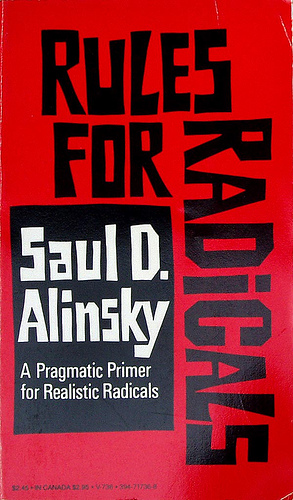
There are many things wrong with our society and the world, but how are we to go about changing them? One approach was presented by a fellow named Saul Alinsky. He, and his highly-influential 1971 book entitled Rules for Radicals: A Practical Primer for Realistic Radicals, have been popping up a lot lately. Reading his list of 11 rules you can see how they are widely used in politics & culture today.

The dedication of the book reads like this: “Lest we forget at least an over-the-shoulder acknowledgment to the very first radical: from all our legends, mythology, and history (and who is to know where mythology leaves off and history begins — or which is which), the first radical known to man who rebelled against the establishment and did it so effectively that he at least won his own kingdom — Lucifer.”

I doubt Alinsky believed in the devil at all.  He probably wrote that because it was a clever and effective attention-grabber for his book. But the book’s dedication was truer than he realized.  The book recalls the first rebel’s rejection of the kingdom of God and then goes on to explicate rules which often reject the approaches embodied and advocated by Christ, whose approaches the world often considers too impotent to defeat evil in the world.

The tactics this book advocates are often the same used by demons in spiritual warfare against us—a war fought on the battlefields of our hearts and minds, for the defense or the capture our souls.

Consider, for example, “Rules for Radicals #1: Power is not only what you have, but what an opponent thinks you have. If your organization is small, hide your numbers in the dark and raise a din that will make everyone think you have many more people than you do.” And, “Rule 9: The threat is more terrifying than the thing itself.” Demons fight us most effectively when they deceive us into imagining they are more powerful than they are. In fact, the only real weapon they have against us is to play on our fears, for we protected against demons in Christ.

Rules for Radicals # 4: “Make opponents live up to their own book of rules.” Alinsky writes, “You can kill them with this, for they can no more obey their own rules than the Christian church can live up to Christianity.” In following this rule, one follows the example of the Great accuser, the devil, who (as the book of Revelation says) night and day accuses us before God for sins. Alinsky’s charge against Christians, that the Christian Church cannot live up to Christianity, blends the truth and lies, just like the words of the demons when they speak to our thoughts.

The truth is that we are God’s servants, that we care deeply about Christ’s teachings, and that all of us commit sins, sins that we would say we truly oppose. But, like the psalmist, we pray for God to cleanse us from even our unknown faults. And from wanton sin especially, we sincerely ask the Lord to restrain us; to not let it rule us, so that we may be blameless and innocent of serious sin. Even though we do not yet follow Christ perfectly, we are truly made better people, more Christ-like, through our relationship with Him.

Yet demons want us to convince us we’re all hypocrites. They want to make us silent, out of shame for our sins, about what is right and what is wrong. They would even cause us to give up on trying to live-out lives of perfect love. Though we are sinners, we trust in God’s mercy and love. Jesus was always merciful toward sinners who acknowledged their guilt and He enabled them to become more perfect through a relationship with Himself.

Rules for Radicals #11: “Pick the target, freeze it, personalize it, polarize it. Don’t try to attack abstract corporations or bureaucracies. Identify a responsible individual. Ignore attempts to shift or spread the blame.” Alinsky writes, “One acts decisively only in the conviction that all the angels are on one side and all the devils on the other.” You’ve seen this polarizing tactic employed through the media, and you see it all the time. It’s called the politics of personal destruction.

It is the demonizing of individuals who we don’t agree with. Christians must not be indifferent to wrongs wherever they are committed, but when it comes to persons, what Christians seek and pray for is the conversion of sinners, not their destruction. “For God did not send his Son into the world to condemn the world, but that the world might be saved through him.”

Do tactics like those which Saul Alinsky laid out actually work at effecting change?  The answer is both Yes and No. Lots of influential people use them because they make lots of noise and heat and angry waves; they can end people’s careers, and they can extort institutions into making concessions. The power of these tactics makes them a strong temptation. But temptations they remain, for they do not have the power to bring about the kingdom of God.

Is the Church interested in social change? The Church is very much interested in social change, just like Jesus was, but we follow the way of His example. Allow me to present another influential writer of the 20th century, as an example, someone who was interested in radical social change of the Christian sort: Pope John Paul the Great. He is rightly called “the Great” for he must be counted among the greatest men of the last century.

Consider how he opposed the great evils and injustices of the communist empire. John Paul did not deal in deceptions. He spoke the truth, because he believed that the truth is powerful enough to set us free. He cared deeply and passionately about the grave injustices being committed, but he never seemed hateful because he was driven by true Christian love. He taught that some actions are wrong, even unspeakably wrong, but that all persons are worthy of love, and he radiated this love of God for all to see through his smile. His focus was not in personal attacks, but in speaking the truth to the human consciences. He insisted that all people should be given the recognition of the dignity and the rights they have from God: to live, and live freely, to speak the truth, and live the truth.

This is what he did, and the communist dictators literally trembled before him. When the communist leader of Poland welcomed the pope to his homeland in a speech at the airport broadcast on state-controlled TV, the dictator’s voice, and the paper he held in his hand, both quivered. The pope was so powerful against them, simply with the message and example of Christ, that the communists tried to kill him in St. Peter’s square, but the Pope miraculously survived the bullets, and forgave his would-be assassin.

By the mercy and the power of God, and in no small part through the words, deeds, and prayers of Pope John Paul the Great, the Soviet empire, which did so many evils for the sake of a utopia that never came to be, that empire ended; not with the fire of a thousand nuclear blasts, but with a harmless dying gasp. It was miracle, a peaceful victory for Christ and the Kingdom of God.

There are many things wrong with our society and the world, but how are we to go about changing them? Pope Paul VI said, “If you want peace, work for justice.” It’s good to work for justice, and we must work for justice, but we must remember this: true justice comes through the way of peace, the way embodied by our Lord, Jesus Christ. So whose example will we be dedicated to as we work for change in the world; that of Lucifer or that of Jesus Christ?