Archive for the ‘St. John the Baptist’ Category

An Identity and a Mission

April 1, 2020

2nd Sunday in Ordinary Time—Year A


When St. John the Baptist sees Jesus coming toward him he declares, “Behold, the Lamb of God, who takes away the sin of the world!” Why did John say that? How is Jesus like a lamb? Under the Old Covenant, animal sacrifices were offered for sins. The symbolism was that the living animal, often an unblemished male sheep, was dying in place of the sinner who offered it. This prefigured what was to come. Jesus Christ, like a flawless, obedient sheep, hears and follows his master’s voice, He does the Father’s will, and takes our place in the sacrifice which actually forgives sins. This is why Jesus is rightly called the Lamb of God who takes away the sins of the world.

John the Baptist goes on to say, “He is the one of whom I said, ‘A man is coming after me who ranks ahead of me because he existed before me.’” Indeed, Jesus, as the Second Person of the Most Holy Trinity, existed before the universe itself. Through Him all things were made, and the things that came to be pointed to and culminated in Him. For this reason, it is not so much that Jesus resembles the lambs of Old Covenant sacrifices, but rather that God establishes the ritual of lamb sacrifice for sins in order to point to Jesus and his ultimate sacrifice.

The story of the life of Jesus appears in the New Testament, but the Holy Spirit has spoken through the prophets about Him throughout the Old Testament. For example, our first reading from the Book of Isaiah written several centuries before Christ, is one of hundreds of passages which speak of Him. But before we return to that passage again, let’s review a little historical background.

We read in the Book of Genesis that Jacob was Abraham’s grandson. Jacob was renamed “Israel” by God and fathered twelve sons. From these twelve sons the “twelve tribes of Israel” descended. This is why the names “Jacob” and “Israel” are usually interchangeable, and may refer to one person or to many. In Isaiah, the prophet writes, “The Lord said to me: You are my servant, Israel, through whom I show my glory. Now the Lord has spoken who formed me as his servant from the womb…” To whom is God speaking in these lines? Who is the servant whom God formed from their beginning; the prophet himself, God’s faithful people, or Jesus Christ? There is truth in each of these interpretations, but this reading’s relevance to Jesus particularly shines forth. The prophesy continues:

It is too little, the Lord says, for you to be my servant, to raise up the tribes of Jacob, and restore the survivors of Israel; I will make you a light to the nations, that my salvation may reach to the ends of the earth.”

Jesus is the one who brings light and salvation not only for the physical descendants of Abraham, Isaac, and Jacob, but for all the nations on earth, to non-Jewish Gentiles like you and me through His one, holy, catholic, and apostolic Church. Another foreshadowing of Christ is seen in today’s psalm, written by King David one thousand years before Christ. Hear these words as if spoken from Jesus’ lips:

[Mere] sacrifice or offering you wished not, but ears open to obedience you gave me. [More of the former] burnt-offerings or sin-offerings you sought not; then said I, “Behold I come.”

In the written scroll it is prescribed [that is, it is foretold in the Scriptures.] For me to do your will, O my God, is my delight, and your law is within my heart!

I announced your justice in the vast assembly; I did not restrain my lips, as you, O Lord, know. I have waited, waited for the Lord, and he stooped toward me and heard my cry. And he put a new song into my mouth, a hymn to our God.

I fully suspect the 40th Psalm had an original, personal meaning for King David when he authored it, and these words have been prayed by God’s faithful people in a personal way ever since, but these words especially apply to the person and mission of Christ. After preaching God’s word to vast assemblies, obedience to his mission led Jesus to His Passion. After crying out for His Father to save Him, and waiting, waiting three days in the tomb, Jesus’ resurrection has put a new song in his mouth, a new hymn of praise to the Father in which we all have a part.

As I mentioned in my homily last week, by baptism you are baptized into Christ. And by remaining connected to Jesus Christ through his sacraments, He remains in you. The prophecies of Scripture refer not only to the human authors, like Isaiah or David, and they refer not only to Jesus, these passages’ fullest fulfillment, but also to us, His Bride and His Body, the Church in her members, the New Israel which comes to us through the twelve Apostles of Jesus. Hear those words of the Lord from Isaiah again:

You are my servant, Israel, through whom I show my glory. Now the Lord has spoken… that Jacob may be brought back to him and Israel gathered to him.”

Israel had been scattered, whole tribes of Jacob were lost due to sin and its consequences, but God Ever-Faithful used Israel, perfected in his Son, to gather his people Israel back to Himself. He says to us:

You are my servant, O Church of God, through whom I show my glory. Now the Lord has spoken… that the People of God may be brought back to him and the Church gathered to him.

God has purpose for your life. A purpose found in Christ. A mission to be faithful and fruitful in Christ. Jesus is still working to save souls today and he desires to work though each of us in His Body, the Church.

The Holy Stream — Baptism of the Lord—Year A

January 13, 2020

When you think of the River Jordan, maybe you imagine something broad, vast, and impressive, like the mighty Mississippi or even the Chippewa River. But the Jordan River is a lot more like Duncan Creek. Ever heard of Duncan Creek? It’s not far from here. Duncan Creek flows out of the south end of Lake Como in Bloomer. You know the bridge between Dairy Queen and the post office? That bridge crosses over Duncan Creek. In terms of size and color, the Jordan River is much like Duncan Creek; small and muddy with shrubs and trees growing along its banks. But unlike the rivers around here in Wisconsin, which are numerous and flow though green and lush countryside, the Jordan is among the few rivers passing through its region’s mostly arid lands. This is the body of water Jesus chose to be baptized in. A humble river of life flowing through a desert. Joshua led God’s Old Covenant people into the earthly Promised Land through this river. And Jesus, the new Joshua, leads God’s New Covenant people to the true Promised Land through holy baptism.

Jesus did not need John’s baptism for himself. John the Baptist sensed this and tried to prevent him, saying, “I need to be baptized by you, and yet you are coming to me?” Jesus insists, so John relents, but what is the purpose of his baptism? Jesus is baptized not to be made holy by the water, but to make the water holy, so that this most plentiful substance on the face of the earth could serve as the material for Christ’s gateway sacrament all throughout the world.

Jesus is baptized to allow us, through baptism, to be united to himself. His baptism foreshadows what comes in Christian baptism, what happened for you and me when we were baptized. The water, the decent of the Spirit, and the voice of the Father all signify effects of our first sacrament. Through baptism our souls were cleansed, the grace of the Holy Spirit was imparted to us, and we were acknowledged as a beloved children of God. We might take these things for granted: that sins can be forgiven, that the divine can dwell with us, that we can be more than mere servants, or slaves, or distant acquaintances to the transcendent God of the universe. That we can be treasured sons and daughters of God our Father. We need to remember and appreciate these things, for what goes unappreciated can be neglected to our loss.

The Jordan River flows about one hundred and fifty miles on the eastern border of Israel, south from the Sea of Galilee into the Dead Sea. These physical bodies of water contain a spiritual allegory. The Sea of Galilee is a large lake. Its fresh water, full of fish, pours out as the Jordan River. And this river, flowing through the arid desert, blesses its shores with life. But once these waters descent seven hundred vertical feet down into the Dead Sea, to the lowest place on earth, the water has no place else to go. So there the water sits, evaporating away in the heat, leaving its trace amounts of salt behind, causing the Dead Sea today to be an intensely salty sea in which no plants, nor fish, nor any other visible life lives.

The pure waters from above, received from the holy stream, bear no life in this recipient. Likewise, the sacraments offer grace from Heaven above, through Jesus Christ the stream of living water, but in the unrepentant soul they bear no life. Even a priest, baptized, confirmed, and ordained, saying the Mass every day, can be spiritually dead, causing spiritual harm to many, if he does not turn away from mortal sin. If you are in mortal sin, for God’s sake, for your sake, and for the sake of those around you, repent and be reconciled to God through his Sacrament of Confession. Jesus desires us to flow with his graces as a great blessing to others in this spiritually-arid world.

The words of Isaiah in our first reading point to Jesus, but because of your baptism you are in Christ. So Isaiah’s inspired words are spoken to every soul in a state of grace:

Thus says the Lord:
“You are my servant whom I uphold, my chosen one with whom I am pleased, upon whom I have put my spirit;
I, the LORD, have called you for the victory of justice, I have grasped you by the hand; I formed you… a light for the nations, to open the eyes of the blind, to bring out prisoners from confinement [and darkness.]”

You might not be called to cry out or shout, making your voice heard in the streets, breaking this and crushing that. But Jesus wants to use you as his powerful instrument to do transforming good in this world. Jesus is still quietly saving souls through his faithful ones, who receive his graces and pour them forth for others. Let this be you, for Him, and for many.

A Life for Christ — 2nd Sunday of Advent—Year C

December 8, 2019


This weekend the Catholic Church Jesus Christ established joyfully celebrates and remembers one of her martyrs. Moved by the Holy Spirit, he answered God’s calling. He renounced his possessions, left his home and family behind, and lived in a different land. He lived differently, he dressed differently, and lived a celibate life for the love of God and the service of God’s people. His life was a prophetic sign for others, pointing them to Christ and his Kingdom. He was humble but brave in doing what was right. And for this faithfulness, the wicked had him killed. Today we celebrate him as one of those blessed in the Kingdom of Heaven. This description sounds a lot like St. John the Baptist, featured in today’s Gospel, but I speak of another: Brother James Miller, born in our diocese, a native son of Stevens Point, who became a Christian Brother and a missionary. He was martyred in Guatemala and, in a Mass celebrated there yesterday (December 7, 2019) was beatified by the Catholic Church, that is, declared one of the blessed in Heaven.

James Miller was born in Stevens Point in 1944, grew up on a dairy farm, and graduated from Pacelli High School. Discerning his religious vocation, he entered the novitiate of the Christian Brothers in 1962, and taught for them in St. Paul, Minnesota. In addition to teaching religion, Brother James taught English and Spanish, coached football, and worked in the maintenance of the school building. In fact, his skill and pleasure in doing such repairs would win him the nickname “Brother Fix-it.” After taking final vows in 1969, Brother James was sent abroad. He worked as a teacher, an administrator, and even a builder of schools in both Nicaragua and Guatemala, serving the poor with Christ’s love.

It was a time of great violence in Latin America, of war and terrorism between the region’s dictatorial governments and communist rebels. In these conflicts, Catholic priests and religious could be marked for death by either side. The Sandinista rebels put Brother James on a list of people to be “dealt with,” viewing him as an ally of the Nicaraguan government, but it may have been his religious community’s resistance to the Guatemalan government’s wrongdoing which led to his martyrdom.

Despite the students at Brother James’ school in Guatemala being exempt from being drafted, four men abducted a local youth from the city marketplace and forced him into military service. The Christian Brothers went to the authorities objecting to this breach and demanding their young man’s release. Soon after, on February 13, 1982, the 37-years-old Brother James Miller was up on a ladder outside, repairing a wall of the school building. There, he was shot, point-blank, multiple times, by three still-unknown gunmen. It is suggested that Brother James died before his body hit the ground.

When I read the story of St. John the Baptist’s martyrdom — of how his objection to the king’s sin landed him in a prison, of how the dancing of Herod’s daughter, the rash vows of the king, and the scheming of his vengeful queen, resulted in an executioner being dispatched to the dungeon with orders to bring back John’s head on a platter — I wonder if John the Baptist knew what was coming. Did he have any awareness of the events at the party leading to his death? I think quite likely not. I can easily imagine the sword-bearing henchman entering John’s dark cell, giving a curt command for him to bend down, and ending his holy life without any warning or explanation.

This reflection comes to mind because when Brother James was getting into the car to depart for dangerous Guatemala and, though they did not know it, he would never return, his biological brother Ralph told him to “be careful.” Brother James replied, “I’m no martyr.” And yet Brother James Miller and John the Baptist did become martyrs. They may not have expected the day or hour, but they had already made the decision to live for Christ and even die for Christ years before. Whether to love and serve Christ the King is a decision, a resolution, we each have to make and constantly renew. There is no hedging – not making the choice is making a choice; and everything follows from the choice we make.

St. Ignatius of Loyola, in his Spiritual Exercises, has a famous prayer reflection: “The Meditation on Two Standards.” (The word “Standard” in this case means a military or ceremonial flag carried on a pole.) St. Ignatius asks us to imagine a great field near Jerusalem, the holy city, where the supreme commander-in-chief of the good is Christ our Lord; and another field in the region of Babylon, the city of sin, where the chief of the enemy is Lucifer.

Imagine that chief of all the enemy seated in that field of Babylon in a great throne of fire and smoke, horrible and terrifying in shape. Consider how he issues a summons to innumerable demons and how he scatters them, some to one city and others to another, and so through all the world not one province, place, state, nor particular person is omitted. Consider how he instructs them to cast out nets and chains; to tempt human beings to a longing for riches, to a desire for the vain honor of this world, and to vast pride, thereby leading them to all other sins besides.

And then, on the contrary, imagine the supreme and true captain, who is Christ our Lord. Consider how Christ our Lord puts himself in a great field near Jerusalem, in a humble place, beautiful and welcoming. Consider how the Lord of all the world chooses so many persons – apostles, disciples, and others – and sends them through all the world spreading his holy teaching to people of all conditions and states of life. Consider the discourse which Christ our Lord gives to all His servants and friends whom He sends on this expedition, counseling them to poverty rather than riches; to contempt for worldly honor, and to humility against pride, leading them to all other virtues besides.

Whose side, whose standard will you rally to today? John the Baptist appears in our Gospel crying out to us: “Repent, for the Kingdom of Heaven is at hand!” Blessed James Miller and St. John the Baptist gloriously rejoice today with their Lord, Jesus Christ the King. Now, which side do you choose? With whom and for whom will you live and die?

The Old Covenant’s (Surprising) Last Seven Prophets

May 6, 2016

A prophet is someone enlightened by God to reveal his message. Each Sunday, we familiarly proclaim that the Holy Spirit has “spoken through the prophets,” but the identities of the seven last Old Covenant prophets (as seen in the Bible) may well surprise you.

#7 :  The Author of 2nd Maccabees

Malachi is the last book in the Old Testament, yet the Bible’s books do not always appear in chronological order. Our separated Protestant brethren would identify Malachi as the last prophetic book in the Old Testament, but the Church’s Bible includes seven books which they exclude. The last of these is 2nd Maccabees, written during the 1st century BC.

The author of 2nd Maccabees, who chronicles the Jews’ successful rebellion against their Greek persecutors, does not seem to know he writes by divine inspiration. In his closing remarks he adds, “If [this story] is well written and to the point, that is what I wanted; if it is poorly done and mediocre, that is the best I could do.” (15:38) However, neither does St. Paul appear to grasp that his letters to the churches would be revered on the level of Genesis, Joshua, or Daniel. This shows that God can use us in amazing ways, in perfect accord with his will, even if we fail to recognize it at the time.

#6 & #5 :  St. Zachariah & St. Elizabeth

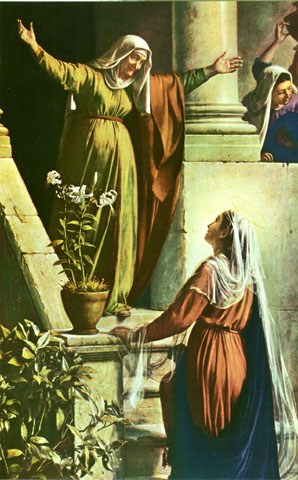
The Visitation by BlocZachariah and his wife, Elizabeth, are old and childless. But the Archangel Gabriel appears to Zachariah in the Temple and says that they shall have a son. Although he knows that God has blessed with children elderly and barren couples of old, Zachariah disbelieves the message. In response, he is put on a forty-week silent retreat. Zachariah becomes mute and apparently deaf as well (since his neighbors and relatives will later resort to making gestures to ask him the name of his newborn son.) Though he cannot tell his pregnant wife of their unborn son’s great mission, Elizabeth receives insights from the Holy Spirit.

When she hears the greeting of her visiting relative, Elizabeth is “filled with the holy Spirit” and cries out in a loud voice, “Most blessed are you among women, and blessed is the fruit of your womb!” The Blessed Virgin’s belly has not yet begun to grow, but Elizabeth prophesies and confirms to Mary that she is indeed pregnant with a boy who is “the Lord.” (Luke 1)

The Holy Spirit also seems to reveal to Elizabeth the name of her child: “John,” a name unfamiliar to her family. At the naming ceremony, Zechariah regains his voice, confirms her word, and “filled with the holy Spirit, prophesie[s]” through the canticle which bears his name. This holy, prophetic couple would ready their son for the great mission prepared for him by God.

#4 :  The Blessed Virgin Mary

The Annunciation by Henry Ossawa Tanner, Philadelphia, 1898.The Archangel Gabriel declared unto Mary that she would conceive the Son of God by the Holy Spirit. But is Mary a prophetess? Unlike Elizabeth and Zachariah, Luke’s Gospel does not say Mary, “filled with the Holy Spirit, prophesied,” or “filled with the Holy Spirit, cried out in a loud voice.” However, as Fr. Raymond Brown observed, the Annunciation to Mary shares the biblical form of a prophetic calling (like those of Moses, Gideon, Isaiah, Jeremiah, and Ezekiel before her):

(1) An Encounter with God or His Angel
(2) An Introductory Word
(3) A Call or Commission
(4) Objection(s) to the Message
(5) Reassurance by God or His Angel
(6) A Sign is Given

In her later canticle, Blessed Mary speaks a prophesy which remains fulfilled in our midst: “Behold, from now on all generations will call me blessed.” Mary is a prophetess, filled with the Holy Spirit, who bears God’s Word.

Simeon Holding the Baby Jesus in the Temple as His Parents Look On#3 & #2 :  St. Simeon & St. Anna

When the baby Jesus’ parents brought him to the Temple for the first time, they were met by Simeon and Anna; she was “a prophetess” and  “[t]he holy Spirit was upon him.” Simeon “came in the Spirit into the temple,” took Jesus in his arms, and declared him “a light for revelation to the Gentiles, and glory for your people Israel.” Anna likewise came forward at that very time and “gave thanks to God and spoke about the child to all who were awaiting the redemption of Jerusalem.” (Luke 2)

Simeon may have been advanced in years, but “it had been revealed to him by the holy Spirit that he should not see death before he had seen the Messiah of the Lord.” Anna, for her part, was an eighty-four-year-old widow who “never left the temple, but worshiped night and day with fasting and prayer.” Anna and Simeon show us how the old can bless the young through sharing the word of the Lord they have personally come to know.

#1 :  St. John the Baptist

St. John the Baptist PreachingWe do not know exactly how many Old Covenant prophets God inspired after the author of 2nd Maccabees. (A case might be made for the Bethlehem shepherds and the Magi as well.)  But we do know that John the Baptist represents the last Old Covenant prophet, the forerunner to the New Covenant Christ. He is “more than a prophet,” Jesus says. “All the prophets and the law prophesied up to the time of John. … Amen, I say to you, among those born of women there has been none greater than John the Baptist; yet the least in the kingdom of heaven is greater than he.” (Matthew 11)

At baptism, each Christian is entrusted with a prophetic mission. As those enlightened with God’s ultimate revelation, we are to share this Word. As great as it is to proclaim Christ’s coming, to proclaim his triumph is still greater.

Prepare the Way — 2nd Sunday of Advent—Year C

March 3, 2013

The message of John the Baptist is “prepare the way of the Lord. Fill the valleys, lower the hills, straighten the roads, and smooth the paths.” What is he talking about? John is speaking like the heralds or messengers who, in ancient times, were sent ahead to announce to villagers how they were to prepare for the king’s arrival. They would gather everyone together and say, “Pay heed! Your king is coming to visit you soon, but this road on which he will come is full of potholes and has too many twists and turns. Smooth and straighten this road, otherwise when the king comes he will feel unwelcome.”

John the Baptist words are not only spoken to the past. He speaks to us today about the state our lives. Advent prepares not only for the coming of Christ at Christmas but for the coming of Jesus as our Lord and judge on the Last Day. There are sacred works for us to do in preparation.

Note that in the fifteenth year of Caesar Tiberius, the word of God did not come to the emperor in Rome. The word of God did not come to the governor or kings of the Holy Land. This word did not come to the chief priests in Jerusalem. This word came upon John in the wilderness, John the poor, John the stranger, John the seemingly insignificant. The word of God comes to little ones, like John and us. Popes, bishops and presidents do important things, but if we rely solely on them to prepare and advance the kingdom of God on earth we will be greatly disappointed. The Lord also will be disappointed, because he wants to do great things through us. We cooperate with the Lord in the Gospel cause.

What holy works does God want you to do? I do not know, but the Holy Spirit knows. He is always there with you; at home, at work, when you are praying. He has a word for you. The Lord wants to do great things through you. Listen, listen, and prepare their part of the way of the Lord in your life and those around you.

San Juan el Bautista dice, “Preparen el camino del Señor; rellenen los valles, rebajen las montañas, alanen los caminos!” Juan habla como antiguos heraldos y mensajeros que se enviaron por delante para anunciar a los aldeanos cómo debían prepararse para la llegada del rey. “Preparen el camino del Rey, para que cuando él venga, estará encantado con ustedes.”

Estas no son palabras dichas sólo para el pasado. Se hablan hoy a nosotros. Adviento prepara no sólo para la venida de Cristo en Navidad. Adviento prepara para la venida de Jesús como nuestro Señor y juez en el último día.  Hay obras sagradas para nosotros que hacer en preparación.

Observe que en el año décimo quinto del César Tibero, no vino la palabra de Dios al emperador en Roma. La palabra de Dios no vino al gobernador o reyes de la Tierra Santa. Esta palabra no vino a los sumos sacerdotes en Jerusalén. Esta palabra vino sobre Juan en el desierto; Juan el pobre, Juan el desconocido, Juan el aparentemente insignificante. La palabra de Dios vino a los pequeños, como Juan, y nosotros. Papas, obispos y presidentes hacen cosas importantes. Pero si dependemos exclusivamente de ellos para preparar y avanzar el reino de Dios en la tierra, vamos a estar decepcionado. El Señor también se sentirán decepcionados, porque quiere hacer grandes cosas a través de nosotros. Tenemos colaborar con el Señor en la causa del Evangelio.

¿Qué santas obras qué Dios desea que hagas? No sé, pero el Espíritu Santo sabe. Él siempre está allí con usted en su casa, en su trabajo, o cuando se está rezando. Él tiene una palabra para ti. El Señor quiere hacer grandes cosas a través de usted. Escucha, escucha, y preparar su parte del camino del Señor en la viva a su alrededor.

Recognizing God’s Child — Monday Before Epiphany

January 3, 2011

If you saw Jesus clean-shaven, in slacks and a shirt, would you recognize Him? Probably not — John the Baptist only knew Him as God’s Son after he saw the Holy Spirit descend upon Him at His Baptism. The world did not recognize Jesus as God’s Son, nor does it recognize us as God’s children, yet so we are! Sometimes we treat others as if they were obstacles, distractions, or not even there. Instead, let us think of how Jesus would treat us if He anonymously encountered you or I, and then follow His example.

Let Advent Be Advent — 2nd Sunday of Advent—Year A

December 5, 2010

John the Baptist was living quite differently compared to people in his day. What he wore was different, what he ate was different, and what came from his lips was also different. Yet, John shared something in common with us today. Like Christians in this season of Advent, John knew that the Christ, or Messiah, had already been born, years before in the past. Like us, what John was preparing for was the coming of Christ anew.

That’s the reason why in Advent, in this season of awaiting the Messiah’s arrival, John the Baptist is so prominently featured in our Sunday Gospel readings, like today’s. By looking at John we can learn how to prepare ourselves for Christ’s arrival. As I mentioned before, John was rather different from his neighbors in his day. Today I suggest that we in the Church need to be a bit more different from everybody else if we want to prepare better for Christ’s coming this year.

What did John do with all that time alone in the desert, when he wasn’t out preaching or baptizing? Surely, John was praying, asking for grace and contemplating the one who was coming. The desert is a quiet place, free of distractions, and conducive to prayer. The world can make this month before Christmas a very stressful time. This Advent, you must find a desert, a quiet place, free from distractions, where you can pray each day. Create a daily desert space for your own family as well and prayer together as one. You cannot prepare well for Christ’s coming without daily prayer and the peace it gives.

What did John eat in the desert? He ate locusts, or grasshoppers, and wild honey. The wild honey may sound pretty sweet, until you realize that it was guarded by wild bees. John ate simply. Our meals in Advent should be simple too. You know how it is at Easter, when you enjoy what you gave up for Lent again for the first time? You find yourself enjoying what you denied yourself more than ever before. Then just think of how much greater your Christmas feasting will be if you eat more simply in Advent. (Besides, if you fast or diet now, there will less pounds to lose next year.)

John dressed differently than other people in his day. He wore a garment made of camel’s hair and tied a leather belt around his waist. He dressed like the Old Testament prophet Elijah because he wanted people to know that these were special days. You can also dress in ways that witness to the world that these are special days. One way to do this is to dress liturgically. As you can see, the main color of Advent is purple. If you have purple outfits or ties, now is their season.

By the way, this Wednesday, December 8th, is a holy day of obligation and Christ is asking you to attend the worldwide feast in honor of His immaculately conceived mother. On such a day, intentionally wearing blue or white would honor her. Try dressing liturgically and you’ll find that it reminds you and others of what makes these days special.

What came from the lips of John was different, and despite the large crowds, whatever he spoke was not for himself but for Christ. This year, wish people “merry Christmas” instead of “seasons greetings,” and instead of “happy holidays,” say “happy holy days,” for by this you give witness to the true reason for the season.

John knew that he must decrease and that Christ must increase, for John himself was not the light but had come to give testimony to the light. In the world, the Christmas songs have already begun on the radio and the Christmas trees are all up and lit in the malls, but the day after Christmas their songs will stop and their decorations will be taken down. But as the world is packing Christ away for another year, the Church is just beginning its celebration. You know the “twelve days of Christmas?” On Christmas day, the twelve day begin, not end. Like Easter, the Church celebrates not just one day, but for weeks after.

This year, let Advent be Advent, and save Christmas for Christmas. Sing Advent songs for Advent, and (as much as possible) save Christmas carols for their time. I suggest leaving your Christmas lights, on your tree and on your house, unlit during Advent. Then, when you plug-in at last on Christmas Eve, you shall enjoy a joyful sign that the light of the world has come.

St. John the Baptist calls to you through the Scriptures. I encourage you here, before you. And I hope the Holy Spirit is now prompting you, in your hearts and minds, to keep Advent as Advent this year, and to prayerfully prepare for the coming of Christ at Christmas more profoundly than you ever have before.

Across the Waters — Tuesday, 18th Week in Ordinary Time—Year II

August 3, 2010

Today’s gospel follows from yesterday’s. In yesterday’s gospel, Jesus hears that his relative and friend, John the Baptist, has been murdered—for that is what it is to intentionally kill the innocent, even when kings and governments do it. Jesus tries to go to a deserted place, but insistent crowds meet his boat. John’s death turns Jesus’ thoughts to the events ahead of Him. He has the people sit, takes the bread, says the blessing, breaks it, and gives it to His disciples, that they may share this miraculous bread with the people.

When evening comes, He sends off the Twelve ahead of Him in the boat and He dismisses the crowds on their way. Jesus climbs the mountain and communes with His Father in that solitude He longed for. Imagine if you were there with Jesus, giving Him silent company on that hill overlooking the Sea of Galilee, as He contemplated the things that were before Him.

Perhaps Jesus would turn to you, and ask, “Do you see that boat captained by Peter, the likeness of my Church? Shall I walk through the darkness across the waters of this world’s chaos and death? Should I face the headwinds of spiritual evil for you and them?” Of course, Jesus knows what He is going to do, but He wants to hear you answer. Let Him hear how precious His sacrifice is, for you and all His own.

St. John the Baptist Parish Patronal Feast Vespers

July 1, 2010

John answered and said… “You yourselves can testify that I said (that) I am not the Messiah, but that I was sent before him. The one who has the bride is the bridegroom; the best man, who stands and listens for him, rejoices greatly at the bridegroom’s voice. So this joy of mine has been made complete. He must increase; I must decrease.” (John 3:27-30)

Have you ever realized that Jesus could have done His saving work without involving anybody else, but didn’t? He included others, like John the Baptist, to prepare His way. John taught the Gospel, ministered in love, and suffered with Christ. Of him Jesus said, “…Among those born of women there has been none greater than John the Baptist; yet,” He added,”the least in the kingdom of heaven is greater than he.” (Matthew 11:11)

John was priviledged to share in the saving work of Christ, and so are we.

Our parish can be ranked among the greatest in our diocese.  It is both one of the largest and most beautiful. Yet, like our namesake, this Church’s greatness is not for the sake of our own glory, but for Christ’s, the Bridegroom, who loves us as His bride.

As St. John the Baptist’s parish, let us live up to our name. Let us rejoice greatly not in ourselves, but that the Bridegroom is among us, in the Eucharist and in our souls. We hear His voice, in the Scriptures and in our prayers. Let us rejoice in His increase and that He has given us the priviledge to share in His work of salvation.

Friday, 27th Week in Ordinary Time—Year I

October 9, 2009

God the Father, Sistine Chapel

In New Testament times, the Second Person of the Trinity, Jesus Christ, has been revealed to us plainly, but He has always been in the presence of the Father. That’s why we should expect to see signs pointing to God the Father’s eternal Son throughout the Old Testament. For example, when the psalmists speak of God’s ‘strong right hand,’ or His ‘holy arm,’ we are seeing references to Christ. Christ sits at the right hand of the Father in heaven, the place of honor. Thus, He is God’s right hand.

To call Christ the God’s holy arm evokes another truth. Consider your own arm.  It is one with you, and yet it is distinct from you.  It obeys whatever you tell it to do, and it works for you in the world. So it is with the Father and His holy arm.  Jesus is one with the Father, and yet distinct from Him.  Jesus obeys His Father in everything and does His work in the world.

So how does the Holy Spirit, the Third Person of the Holy Trinity, fit into this divine metaphor? Jesus says in today’s Gospel, “…If it is by the finger of God that I drive out demons, then the Kingdom of God has come upon you.” The finger of God is the Holy Spirit, who proceeds from the Father and through the Son.

The will and work of God in our world is done in this way: by the Head, through the Arm, and the finger; which is another way of saying, everything is accomplished by the Father, through His Son, and their Holy Spirit.

Let us pray that we shall never oppose the hand of God acting in our lives. For, Jesus as tells us, ‘whoever is not with Him is against Him, and whoever does not gather with Him scatters.’