Archive for the ‘St. Mary Magdalene’ Category

Encountering Our Risen Lord

March 31, 2024

Easter Sunday
Fr. Victor Feltes

This gospel reading is a curious one to proclaim on Easter Sunday. It’s the one we read on Easter Sunday morning every year: John’s story of Mary Magdalene, Peter, and the Beloved Disciple at the empty tomb. Other gospel reports about Jesus’ resurrection have miracles and appearances of angels or of Christ himself. St. John’s Gospel recounts examples of these on Easter as well; for instance, after where our reading ends, Mary is greeted by Jesus and angels at the tomb, and Peter sees and touches the Risen Lord in the Upper Room. This morning’s gospel reading, however, does not find Jesus and sees no angels or miracles in progress. Mary Magdalene discovers Jesus’ body is missing and runs away distressed. She finds Peter and the Beloved Disciple (traditionally, the Apostle John) and the men run back to the tomb. Both of them go inside but only find burial cloths. They had not yet understood Jesus’ previous remarks nor the Old Testament passages which foretold “that [Christ] had to rise from the dead.” But, when the other disciple went inside the tomb after Peter, “he saw and believed.”

So what convinced him? Was it something about those burial cloths? Was it because the cloth which had covered Jesus’ head was “not with the burial cloths but rolled up in a separate place” with a tender delicacy which a grave robber would not show? Was it because tomb raiders in the ancient world would typically steal fine burial linens and leave the body behind? Was it because a body-snatcher would not peel the dry-blood-caked shroud away from the body to carry away a naked corpse? Perhaps the cloths looked deflated, as though Jesus’ body had vanished or passed through without disturbing them. Or maybe a miraculous image of Jesus’ body had been left behind upon the shroud. Whatever it was, the Beloved Disciple reasoned from what he saw to firm conviction. Was Peter convinced by seeing the same scene? Maybe not. Mary Magdalene was not consoled by her first glances at the tomb. It was later encounters, typically together with other friends of Jesus, which led Christ’s disciples to faith in him as the risen Lord.

Many people come to church on Easter Sunday morning. And this is a good thing. Our Lord is pleased that you are here. On the first Easter Sunday evening, when Jesus Christ appeared in the Upper Room even though he had died for their sins, even though they had previously deserted him, he said to all those gathered: “Peace be with you… Peace be with you.” Many people come to church on Easter Sunday morning. But typically, on the following Sunday, a fewer number attend. Jesus may touch your heart this morning, he may give new insight to your mind, you may “see and believe” in a new way. Or maybe you will encounter Jesus’ empty Easter tomb this morning and walk away unchanged. Remember that it was later encounters, typically together with other friends of Jesus, which led disciples to faith in him as the risen Lord.

Jesus desires a personal relationship with each one of us; a relationship which will bless, console, strengthen, and guide us. A life of daily prayer, weekly worship, and true devotion. Praying to God only when I need something is like talking to a friend only when I want something. If you have been away from Christ, he calling you to return, to draw nearer, so your personal relationship and conviction may deepen. Realize that if Jesus Christ had not been risen, nothing else in life would matter. But since Jesus Christ has been risen, nothing else in life matters as much as this.

The People at the Passion (Part 3 of 3)

April 1, 2023

By Fr. Chinnappan Pelavendran

From history, we know that our Lord Jesus Christ died because He was condemned to death by the Jewish authorities who handed Him over to the Romans to be executed. He was put to death, because he said He was the Messiah, the Son of God, the one to whom God had given the power to judge all men. This statement was considered blasphemy, so the Sanhedrin said that He had to die. The Sanhedrin closely followed the teachings of Moses. They did not believe that Jesus was the Messiah. Throughout the history of Israel, the prophets often had to suffer injustices in order to carry out the mission God had given to them.

On Wednesday night, I talked about many of the people who were against Jesus. They inflicted very much pain and abuse on Jesus. Today, I want to remind you of the people who loved, trusted, and followed Jesus through His life and to His death.

The Blessed Virgin Mary

Jesus’s Mother was the most faithful of His followers. From the Annunciation to the Crucifixion of her Son, Mary can be seen as God’s ultimate validation of free will. She was obedient to God when He sent the Angel Gabriel to her. She was a very young woman, but her faith in God was strong. She was willing to do whatever God asked of her. She and St. Joseph were very loving parents. They protected Jesus from His birth, and during His years of growing to manhood. They taught Him and took him to the temple, where He learned the Jewish laws about God.

St. Joseph died before Jesus began His public ministry, but Mary continued to follow Jesus to His death. Mary was actually His first apostle. She was the first human to kiss the face of God and the first to believe in Jesus as her Savior. She was the first Christian. She was also probably the only disciple of Jesus who never left his side or doubted Him. She stayed and accepted to the very end, even as Jesus died on the Cross. Down through the ages, the weeping Mary of the Cross witnessing her son’s torture and death stands in solidarity with all believers who also suffer and live under the shadow of the Cross. Can you imagine how Mary felt watching her child die such a terrible death? She was helpless and all she could do was watch. She stayed at the foot of the Cross until the end. She never left all morning and was there in the afternoon when Jesus took His last breath. When His body was taken down from the Cross, she followed Him to the grave. She wanted to stay with Him as long as possible, even though it hurt her to watch Him suffer. Mary loved her son so much, she did not want to leave Him even after He died.

As Christians, we know we have to accept that suffering and death are just a part of life. It does not make it easier when we are living through it, but we should look to Mary as an example. We can copy her strength and bravery for the sake of our family and do whatever we can out of love, it will help us through those times. Mary showed incredible love, courage, and strength.

Peter the Apostle

St. Peter was a fisherman. He and his brother Andrew, were among the first four disciples of Jesus. Jesus called and they left everything behind, including their boats and fishing equipment. Peter was always a leader. He wanted to protect Jesus and keep Him safe. When Jesus told him that he would suffer and die, Peter would not believe it. When Jesus was arrested in the Garden of Gethsemane, Peter drew his sword and cut the soldier’s ear off. Peter was with Jesus and witnessed all the miracles, including the cure of Peter’s mother–in–law, and in the home of Jairus. He was at the Transfiguration, the Last Supper, and the Garden of Gethsemane. During the passion, he followed Jesus along the road to Calvary. Jesus gave him the keys to make him the head of the church. He was our first pope.

John the Apostle

At the very beginning of his public ministry, Jesus chose John and his brother as His disciples. The two are the sons of Zebedee, a fisherman. Jesus calls them, “Sons of Thunder.” It is a title that James and John earn by their quick judgment of others and eager enthusiasm. The gospels give John a position of importance among the twelve apostles. He is one of the first four disciples called by Jesus.

From the very beginning of his call, John is always with Jesus. He is one of the few who was with Jesus during the public ministry. He is probably one of the few disciples to witness all of the miracles performed by Jesus. During the passion and death of Jesus, John was with Him. He even stayed at the foot of the Cross as Jesus suffered and died.

St. John is also the author of the fourth gospel. His gospel is the only one that tells us that St. John and Mary were among those at the foot of the Cross when Jesus died. As Jesus was dying, He looked down at them and said; “Woman, behold your son!” Then He said to the disciple, “Behold, your mother.” And from that hour the disciple took her to his own home. (John 19:26–27) When Jesus said this, He was actually giving Mary to all of us as our Spiritual Mother. John at the foot of the Cross is a loyal friend. Faithfulness and loyalty are Love.

The Roman Centurion

In the Bible, we are given a glimpse of the roman centurion. He was the commander of over 100 soldiers in the Roman army. He was in charge of overseeing the crucifixion of Jesus. He may have been in charge of arresting Jesus. And he would have accompanied Jesus on the road to Golgotha. He had probably presided over the crucifixion of hundreds or even thousands of men and had probably become insensitive to the agony these men suffered.

The Roman Centurion is mentioned in three of the four gospel accounts. He is not mentioned for his cruelty, but for a marvelous transformation that occurred at the death of Jesus. Most of the men that were crucified were criminals, thieves, and murderers. They cried out in agony and pleaded for their lives. When Jesus died, he knew that this was not an ordinary execution. The darkness, the earthquake, and the cry of abandonment from Jesus convinced the soldiers that this was NOT an ordinary man. The events terrified them. The roman centurion said this man IS TRULY THE SON OF GOD.

The Good Thief

We know from St. Luke’s Gospel, that there were two thieves crucified with Jesus, one on either side of Him. One of the thieves mocked Jesus saying, “Are you not the Christ? Save yourself and us!” But the other thief said to him, “do you not fear God, since you are under the same sentence of condemnation? And we indeed justly, for we are receiving the due reward of our deeds, but this man has done nothing wrong.” Then he said to our Lord, “Jesus remember me when you come in your kingly power.” Jesus replied, “truly, I say to you today you will be with me in Paradise.” (Luke 23:3943) This second criminal has become known to us as St. Dismas, he is the patron saint of all criminals and convicts, especially thieves.

Mary Magdalene

St. Luke’s gospel tells us that Jesus cast seven devils out of Mary Magdalene. He also tells us that she poured expensive perfume over Jesus’ feet as she cried. She dried his feet with her long hair. Mary Magdalene, Mary the mother of Jesus, and several other women followed Jesus on the road to Golgotha, and remained at the foot of the Cross, even following to His burial place. She was a faithful disciple, following Jesus during most of His public ministry, passion, death, and resurrection.

Joseph of Arimathea and Nicodemus

Joseph of Arimathea is described as a good and just man, he was apparently wealthy, and a follower of Jesus. After the crucifixion, he requested permission from Pilate to remove Jesus’ body from the Cross. With the help of Nicodemus, he wrapped the body in fine linen and had it placed in his own unused tomb. These men were both members of the Sanhedrin, the supreme Jewish council. They were secret followers of Jesus. Nicodemus came to Jesus secretly at night to discuss the Jewish laws.

Both Joseph and Nicodemus did a great sacrifice—Joseph gave up his tomb and Nicodemus paid for costly burial spices and ointments. The Gospel of John (19:39) says it was seventy-five pounds, an extraordinary amount. This was an act of love for Joseph and Nicodemus. Two high-ranking religious officials, exhausting themselves to honor their Lord.

The worst night of their lives, when darkness seemed to cover the world, became the dawn of something new. The men and women who witnessed the trial, crucifixion, death, and resurrection of Christ saw more than words could ever express. What they saw in their lifetime, we have seen in the scripture, and the result is amazingly the same. We may not have seen Him physically, but we see Him in our Faith.

Why Did Jesus Go Incognito?

April 30, 2017

There are three episodes in the Gospels where the resurrected Christ appears to his disciples but initially goes unrecognized: at the tomb, to Mary Magdalene; in the appearance we hear about today, to a pair of travelers on the road to Emmaus; and lastly, to seven of his disciples fishing the Sea of Galilee.

Let us briefly review each encounter:

First, on Easter morning, Mary is weeping outside the tomb. She turns around and sees Jesus there, but she does not know it’s Jesus. He says to her, “Woman, why are you weeping? Whom are you looking for?” She thinks he’s the gardener and says to him, “Sir, if you carried him away, tell me where you laid him, and I will take him.” Jesus says to her, “Mary!” She turns, and says to him in Hebrew, “Rabbouni,” which means Teacher. Perhaps Mary Magdalene’s tear-filled eyes and anguished mind simply could not make out Jesus’ face in morning’s early light, but after one more word she recognizes him. (John 20)

Today, Jesus draws near to Cleopas and another unnamed disciple as they walk to Emmaus, but their eyes are prevented from recognizing him, for he appears to them in another form. Later, when all three of them are dining together, Jesus takes bread, says the blessing, breaks it, and gives it to them. With that their eyes are opened and they recognize him. He is revealed to them in the breaking of the bread, but then vanishes from their sight. (Luke 24, Mark 16:12)
Third and finally, after a night of completely unsuccessful fishing, Jesus appears to the Apostles Peter, Thomas, Nathanael, James, and John, and two other unnamed disciples. They’re in a boat and he’s on the shore, but they do not immediately realize it’s Jesus. He says to them, “Children, have you caught anything to eat?” They answer, “No.” So he says, “Cast the net over the right side of the boat and you will find something.” And they proceed to miraculously catch 153 large fish without tearing their nets. (The Biny fish, which is common to the Sea of Galilee today, has a weight at maturity of 13 to 15 pounds. A catch of 153 of these fish would weigh more than a ton.) Jesus then invites them, “Come, have breakfast.” And, St. John’s Gospel notes, none of the disciples dares to ask him, “Who are you?” because they realize it is the Lord. (John 21)

One might argue that Jesus’ looks were not in any way disguised on the shore, that the disciples simply failed to recognize him at first because he was about a hundred yards away and the light of dawn was still dim. But if that were the case, there would be no thought of asking him “Who are you” over breakfast around that charcoal fire; this question only arises if his identity remains somewhat concealed. Some have suggested that Jesus appeared elderly to the disciples at the Sea of Galilee, for he says, “Children, have you caught anything to eat?” On the other hand, Jesus had previously referred to the Apostles as his children at the Last Supper, “My children, I will be with you only a little while longer.”

Jesus has no difficulty being immediately recognizable when he wants to be. On Divine Mercy Sunday, when Jesus appears before St. Thomas for the first time, we perceive no hesitation in the former doubter’s declaration, “My Lord and my God!” So why then did Jesus allow himself to go unrecognized, at times even becoming physically unrecognizable to his disciples? Perhaps Jesus had thousands of good reasons for this, but I would offer these four:

Reason #1: To add proof that these resurrection accounts are true

Imagine if Jesus’ bodily resurrection were a lie and you were making up stories to bolster others’ belief in it. Would you invent and insert the odd detail that Jesus’ closest disciples couldn’t always recognize him when they saw him? What reason would there be to weave such a confounding wrinkle into your resurrection accounts — unless it were the truth?

Reason #2: To demonstrate how people can believe in Jesus without directly seeing him 

The disciples in Emmaus said to each other, “Were not our hearts burning within us while he spoke to us on the way and opened the Scriptures to us?” They came to faith in the resurrection by recognizing the fulfillment of prophesy, even before Jesus had opened their eyes to see himself. At the Sea of Galilee, when the Beloved Disciple saw the incredible catch of fish, he said to Peter, “It is the Lord.” The miraculous sign revealed to them the truth about a person they could not see. We today may not see Jesus’ unveiled presence among us, but he provides sufficient evidence to point to himself in every generation.

Reason #3: To show how Jesus would continue to be with us

In the forty days between Easter and his Ascension, Jesus was not visibly present to his Apostles twenty-four hours a day. Yet at the Great Commission, Jesus reassures, “[B]ehold, I am with you always, until the end of the age.” What he’s saying is, ‘Even when you are alone, I will always be at your side.’ By revealing his resurrected self to his disciples “in a different form,” Jesus prepares them for how they will regularly encounter him through the Sacraments until he comes again; truly present, but veiled.

Reason #4: To reveal how Jesus is presented to us through others

Who is the manual laborer we bump into, like Mary Magdalene saw on Easter morning and addressed respectfully as “Sir” (even though she was having a horrible day and thought he might be a body snatcher)? Who is the traveler we pass on the road, like the Emmaus duo met, dialogued with, and invited to stay with them? Who is the older person that greets us, like the Galilean fishermen encountered and with whom they shared their food? Jesus would have us see himself in all of them and everyone. At the Last Judgment, Jesus will declare to both the saved sheep and the guilty goats, “Whatever you did for the least of my brethren, you did it for me.”

Jesus once asked St. Catherine of Siena, the 14th century Italian mystic, “My beloved, do you know why I love you?” In response to Catherine’s negative reply, Jesus said, “I will tell you. If I cease to love you, you will be nothing; you will be incapable of anything good. Now you see why I have to love you.” Catherine replied, “It is true,” and suddenly added, “I would like to love you like that.” But as soon as she had spoken, she realized what she had said was misplaced. Jesus smiled. Then, she complained, “But this is not fair. You can love me with great love, and I can only love you with small love.” At that moment, Jesus interrupted and said, “I have made it possible for you to love me with great love.” Surprised, she immediately asked him how. “I have placed your neighbor at your side. Whatever you do to him, I will consider it as being done to me.” St. Catherine went running to care for the sick in the hospital, rejoicing: “Now I can love Jesus with great love!”

After the resurrection, Jesus was sometimes unrecognized by his disciples, but he allowed this so that we might better recognize him; as the Savior truly risen, as the Christ evidenced by signs, as the Lord truly present in the Sacraments, and as the one concealed in our neighbor.

He Proved Faithful — Good Friday Homily

March 25, 2016

Few proved faithful to Jesus on Good Friday, but on Good Friday Jesus proved himself faithful to us.

The political leaders were supposed to serve justice, but Pilate and Herod failed to protect Jesus as an innocent man. Jesus protected us when we were guilty.

The religious leaders were supposed to serve holiness, but the High Priests and the Sanhedrin failed to accept Jesus as their Messiah. Jesus accepted us so that we might become holy.

The disciples were supposed to serve their teacher and lord, but Judas betrayed him, Peter denied him, and the others abandoned him. By enduring his suffering and death, Jesus proved himself faithful to us.

Jesus’ mother Mary was faithful. She stood with him at the foot of the cross. It was a consolation for Jesus to have her there. Two of his beloved disciples were also there: Mary Magdalene and the apostle John. Jesus was grateful to have them close by.

Today, on this Good Friday, by the grace of God, we are at the foot of the cross. Let us pray for mercy, for ourselves and for others. Despite our past unfaithfulness, let us honor his faithfulness to us. Jesus is pleased that we are here with him, and he is grateful for our gratitude.

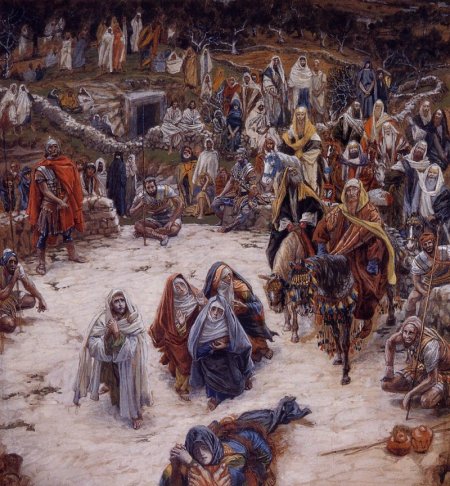
View From the Cross by Tissot

Encountering Jesus at His Ministry’s Beginning & End

January 9, 2015

Comparing John 1:35-43 & 20:11-18

  • John the Baptist is with two of his disciples when he points out Jesus “the Lamb of God” passing by. Jesus turns, sees the two disciples following him, and asks, “What are you looking for?
  • Mary of Magdala is with two angels at the empty tomb when Jesus comes by. She turns around and sees Jesus, but does not know it’s him. He asks her, “Whom are you looking for?
  • John the Baptist’s two disciples answer Jesus, “Rabbi, (that is, Teacher) where are you staying?
  • Mary, recognizing the risen Lord, says to him, “Rabbouni!” (which also means Teacher.)
  • Jesus tells the curious duo, (one of whom we are told is St. Andrew the Apostle) “Come, and you will see.
  • Jesus tells the overjoyed Mary, “Go to my brothers and tell them, ‘I am going to my Father and your Father, to my God and your God.

Points for Reflection:

St. Mary Magdalene Clings to Jesus□ We first come to Jesus looking for something. (“What are you looking for?”) But we are in fact looking for a Someone. (“Whom are you looking for?”)

□ Our search begins with curiosity, but grows finally into love.

□ Jesus is a Teacher to them all, but he more than a teacher to Mary of Magdela. (Similarly, in Matthew’s telling of the Last Supper, all the apostles call Jesus “Lord,” while Judas calls him merely, “Rabbi.”)

□ Jesus makes the first two apostles, but he makes Mary (as the Church Fathers call her) “the Apostle to the Apostles.

□ Jesus draws us near (“Come and see,”) and then he sends us forth on mission (“Go to my brothers and tell them…”)

□ Jesus’ baptism leads to his tomb and resurrection.

□ Jesus, who dwelt on earth, now dwells with His Father in Our Father’s house. Jesus wills that we come to dwell with him, in Heaven, as it is on earth.

Whom Her Heart Loves — July 22 – St. Mary Magdalene

July 23, 2011


Mary Magdalene in today’s gospel shares obvious parallels with the woman in the first reading from the Song of Songs. The woman in the Song of Songs rose to find him whom her heart loves. Mary Magdalene rose early in the morning and came to the tomb. The woman in the Song of Songs sought her beloved but did not find him. Mary Magdalene reported to the apostles, “They have taken the Lord from the tomb, and we don’t know where they put him.” The watchmen came upon the woman in the Song of Songs. As Mary wept, she saw two angels in white. The woman in the Song of Songs asked, “Have you seen him whom my heart loves?” Mary said (unknowingly to Jesus), “Sir, if you carried him away, tell me where you laid him, and I will take him.” The woman in the Song of Songs had hardly left the watchmen when she found him whom her heart loved. Jesus said Mary’s name; she turned and said to him, “My rabbi!” The woman in the Song of Songs goes on to say, “I took hold of him and would not let him go.” Jesus had to say to Mary Magdalene, “Stop holding on to me, for I have not yet ascended to the Father.”

So what is the reason behind this providential parallel between Mary Magdalene and the woman in the Song of Songs? I have heard it said that the Song of Songs is the book of the Bible on which the saints have written about most. Perhaps God gave us Mary’s example so that we would not interpret the Song of Songs merely as a description of the corporate love between Yahweh and the people of God, or between Jesus and His bride the Church, but so that we would also see in it the love affair between Him and every person individually.

Our faith is not based upon feelings alone. (Feelings are too fickle to be our foundation.) Yet, feelings of the heart are an important part of our relationship with God. As Jesus said, “You shall love the Lord you God with all your heart, with all you mind, with all your strength, and with all your soul.” We must love Him with the intellect of our minds, with the strength of our bodies, and with the will of our souls, but we must also love Him with the emotions of our hearts. Stir up your affections for Christ, pattern the emotions of Mary Magdalene, who showed true devotion to Him whom her heart loved.