Archive for the ‘St. Paul’ Category

Shepherds & Fishermen — 3rd Sunday in Ordinary Time—Year A

March 3, 2020

What did the twelve apostles do for a living before Jesus called them to follow him? For six of the first apostles, that is half of the original twelve, we have no words from Scripture concerning their previous jobs. We are told that St. Matthew was a tax collector for the Roman government. We also hear of St. Simon the Zealot, who was either especially zealous in his personal religious devotion, or had ties to the Jewish Zealot movement is Israel. The Zealot movement sought, through politics and insurrection, to overthrow the Roman government in the Promised Land. If Matthew and Simon did indeed come from opposite sides of that era’s political spectrum, it suggests that every political party or faction has important things to learn from Jesus Christ.

In today’s Gospel, we learn the shared profession of four other apostles: Simon Peter, Andrew, James, and John; they were commercial fishermen. Now the Lord choosing men from the fishing industry was something new in salvation history. In the Old Testament, God often employs shepherds in his holy service. Among the patriarchs there is Abraham, Jacob-Israel, and his twelve sons – shepherds all. Later there’s the prophet Moses, King David, and Amos the prophet, each of whom tended flocks for some time before receiving their higher calling from God. As far as I can tell, there are no fishermen of particular note in the Bible before these four to whom Jesus says, “Come after me, and I will make you fishers of men.” Jesus, in calling fishermen, is doing something new. Now if the fishing background of these four apostles were irrelevant, I doubt the Holy Spirit would have inspired the inclusion of this fact into the Gospels. So what is the significance of this detail?

The work of a shepherd is different from that of fisherman. A shepherd tends his flock. He knows his sheep and his sheep know him. Some new lambs are born while other, older sheep go off to market or return to the earth, but the size of the sheepfold tends to remain rather stable. A fisherman, on the other hand, through his practiced skills and God’s providence, seeks and finds new fish every day. The fish are living in their own dark, watery world until the fisherman gathers them to himself. A shepherd maintains his numbers, but a fisherman goes out to seek more and more. Jesus chose his apostles not only to shepherd his people Israel, but to go forth to fish for people from all nations. Jesus made Peter not only a “fisher of men” but commanded him to ‘”feed my lambs… tend my sheep… feed my sheep.

Today we primarily think of water as a symbol of life, because nothing lives without water. Yet in the ancient world, water was often seen as a symbol of death. It’s possible even on a calm day to drown in a river, lake, or sea, but the volatile, deadly nature of large bodies of water is the subject of stories, poems, and songs even up to our day. For example:

The legend lives on from the Chippewa on down
Of the big lake they called Gitche Gumee
Superior, they said, never gives up her dead
When the gales of November come early

Fish live with this realm of death, a dark, watery world. The fisherman brings fish into the light, to a higher realm, a world they had previously ignored or never imagined. In our semi-post-Christian world today, is Jesus calling you and I to be shepherds or fishermen? Are we meant to maintain our flock, or to endeavor for more unnetted souls? There is need for both missions. In fact, we are called to do both. Many around us are baptized and still identify as Christians, yet how deep does their faithful devotion really go? Peter and Andrew left their careers for Jesus. James and John left their family for Jesus. Yet how few people today even come to church for him. True devotion and divine relationship is ignored or never imagined. Jesus calls you to be a missionary; not on the far side of the earth so much as in our own community. Be able to give witness to him. When I was a kid, when we were driving home from Sunday Mass, my family would often talk about what we heard in the homily. Today you your drive home from church I encourage you to ask each other: Why did you come to church today? What difference does it make for your life? We need to practice sharing why our faith is a gift with one another so that we can invite others to share this treasure.

In our first reading from St. Paul’s first letter to the Corinthians, we learn that the Christians in Corinth were choosing favorites and forming factions: ‘I belong to Paul. I belong to Apollos. I belong to Cephas.‘ St. Paul writes to remind them, you belong to Christ! Do not allow another person to get in way of Jesus for you. Pastors are important and Jesus has ordained it so, since without clear leadership how could St. Paul’s prayer and Christ’s desire, ‘that all of us agree in what we say, that there be no divisions among us, that we be united in the same mind and in the same purpose‘ ever be achieved? The need for human leadership of Jesus’ Church in this broken world, however, makes grave sin and scandal possible. This is a terrible thing, wherever and whenever it occurs. But please, please, do not separate from Peter on account of another apostle’s sin. You need Jesus, I need Jesus, and everyone else needs Jesus, too. Let us be good shepherds and fishers of men, caring for and seeking out everyone in our midst, as Jesus calls us to do.

Jesus and His Wounded Church

October 27, 2019

On October 15th, her feast day, I heard a story told of St. Teresa of Avila I had never heard before. It may be a pious legend (as I have not found any primary sources for the tale) but it contains a truth all the same. The story goes that Satan once appeared to the 16th century Spanish nun in the glorious guise of Jesus. Satan intended to lead Teresa astray, but she quickly saw he was not Christ. Before departing from her the Devil asked how she was so certain. She replied, “Because you have no wounds.”

In the Book of Acts we read that on the road to Damascus Saul heard a voice say, “Saul, Saul, why are you persecuting me?” “Who are you, sir,” asked the afflictor of the Early Church. “I am Jesus, whom you are persecuting.” Jesus had already, some months or years before, bodily ascended into Heaven, but Our Lord felt all the afflictions of the Church on earth as his own. Saul repented, converted, and became St. Paul.

Jesus hates the grave mistreatment and harming of his members but his Body suffers and bears wounds still; wounds inflicted both from outside and within his Church. Jesus told his disciples, “Things that cause sin [literally “skandala,” scandals or stumbling-blocks] will inevitably occur, but woe to the person through whom they occur.” Yet even as Jesus heals and avenges his innocent, injured sheep he desires the salvation of wrongdoers too – that, justly-chastised, the sinner would ultimately appear before God as a saint.

Pray for our whole Church without despairing, for the victory of our Faithful Bridegroom is assured. St. Teresa of Avila said, “I do not fear Satan half so much as I fear those who fear him,” and she urged her sisters to unshakable confidence in Jesus Christ:

“Let nothing disturb thee; Let nothing dismay thee:
All thing pass; God never changes.
Patience attains all that it strives for.
He who has God finds he lacks nothing:
God alone suffices.”

The Time St. Paul Corrected St. Peter

August 31, 2018

Jesus gave Simon the fisherman the keys to his kingdom and changed his name to “Rock” (that is, “Petros” in Greek, or Peter):

I say to you, you are Peter, and upon this rock I will build my church, and the gates of the netherworld shall not prevail against it. I will give you the keys to the kingdom of heaven.” (Matthew 16:18-19a)

The significance of these things is found in the Old Testament. The Lord changed the names of Abram, Sarai, and Jacob to Abraham, Sarah, and Israel to declare what God would achieve through their lives. (Abraham, for example, means “father of a multitude.”) In the old Davidic dynasty, the king’s chief steward and master of the royal household would carry a key symbolizing his authority. Thus, for Jesus’ Kingdom – the Church – Peter is given the great power and office of prime minister:

Whatever you bind on earth shall be bound in heaven; and whatever you loose on earth shall be loosed in heaven.” (Matthew 16:19b)

Yet, despite his divine calling, St. Peter was not always perfect in his personal example. The New Testament records that on one occasion he had to be fraternally corrected by St. Paul.

In the early years of the Church, as belief in the Gospel began to spread from Jerusalem into pagan lands, the question arose of how much of what God commanded through Moses needed to be observed by the Gentile (that is, non-Jewish) converts to the New Covenent. God gave not only the Ten Commandments in the Old Covenant but some 613 religious rules, touching on many areas of daily life, including food and clothing. These precepts were called the Mosaic law.

St. Peter’s vision at Joppa and his subsequent visit to Cornelius the centurion’s house in Caesarea (recounted in Acts 10) revealed to him God’s will that Gentile converts to Christianity need not be obliged to observe the full Mosaic law. Yet others were teaching, “Unless you are circumcised according to the Mosaic practice, you cannot be saved.” Around the year 50 A.D., the Apostles and other Church leaders gathered for the Council of Jerusalem to settle this question.

There, some from the party of the Pharisees who had become believers in Christ stood up and said to the assembly, “It is necessary to circumcise them and direct them to observe the Mosaic law.” But St. Peter replied, “[Why] are you now putting God to the test by placing on the shoulders of the disciples a yoke that neither our ancestors nor we have been able to bear? On the contrary, we believe that we are saved through the grace of the Lord Jesus, in the same way as they.” (Acts 15:10-11) And the Council decreed that Gentile Christians were free from observing the bulk of Jewish religious rules and customs.

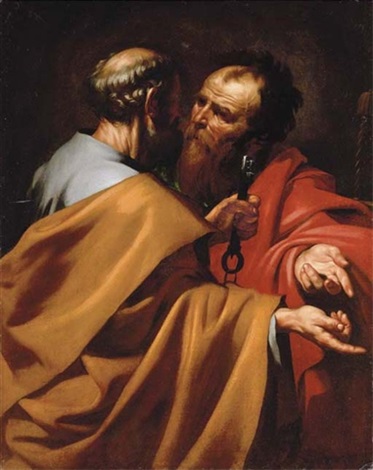
The Dispute at Antioch: Saints Peter & Paul by Jusepe de Ribera

But there was a later episode at Antioch where Peter’s personal example did not match his professed beliefs, and St. Paul was moved to correct him:

[W]hen Cephas (the Aramaic word for “Rock” or “Peter”) came to Antioch, I opposed him to his face because he clearly was wrong. For, until some people came from James, he used to eat with the Gentiles; but when they came, he began to draw back and separated himself, because he was afraid of the circumcised. And the rest of the Jews also acted hypocritically along with him, with the result that even Barnabas was carried away by their hypocrisy. But when I saw that they were not on the right road in line with the truth of the gospel, I said to Cephas in front of all, “If you, though a Jew, are living like a Gentile and not like a Jew, how can you compel the Gentiles to live like Jews?” (Galatians 2:11-14)

Apparently, the “people from James” were Jewish Christians who were disapproving of Peter eating non-kosher meals with the Gentile Christians, leading Peter to withdraw from table fellowship with those non-Jewish converts. St. Peter, the first Pope, was preserved by God from teaching error, but he was not immune to personal faults. Paul publicly corrected Peter because his failure in leadership was leading to scandal within the Church. Spirit-led fraternal correction is a spiritual work of mercy and a duty of Christian love.

The Catholic Church’s Code of Canon Law says:

[The Christian faithful] have the right, indeed at times the duty, in keeping with their knowledge, competence and position, to manifest to the sacred Pastors their views on matters which concern the good of the Church. They have the right also to make their views known to others of Christ’s faithful, but in doing so they must always respect the integrity of faith and morals, show due reverence to the Pastors and take into account both the common good and the dignity of individuals.” (Canon 212, Section 3)

In this present, painful season in the Church, let us remain faithful but not silent. Let us insist of our shepherds that these scandals may lead to cleansing through true leadership and effective reform.

St. Paul’s Vision Problems

July 11, 2018

 The oldest known depiction of St. Paul the Apostle, a fresco from the Catacomb of Saint Thekla in Rome dated to the 300’s A.D.

Paul’s encounter with the risen Jesus on the road to Damascus, accompanied by a great light from the sky which suddenly shone around him, left the great persecutor of the early Church blind. “Saul got up from the ground, but when he opened his eyes he could see nothing…” After three days, the Lord sent a Christian named Ananias to prayerfully lay hands upon Saul/Paul. “Immediately things like scales fell from his eyes and he regained his sight.” Yet problems with Paul’s vision seem to have lingered or later returned.

Writing to Christians in Galatia (central Turkey) more than a decade after his conversion, Paul recalls, “[Y]ou know that it was because of a physical illness that I originally preached the gospel to you…” While he does not directly identify the malady, he then observes, “Indeed, I can testify to you that, if it had been possible, you would have torn out your eyes and given them to me.” And in his personal closing to the letter he adds, “See with what large letters I am writing to you in my own hand!” These clues suggest that swapping-out Paul’s eyeballs for another pair would have improved his poor and ailing sight.

Paul, previously blinded by hatred of Christians, saw the light and was converted. The Lord forgave all of his sins through baptism but forgiveness does not always remove all of our sins’ consequences. In restoring Paul’s sight the Lord may have permitted some physical encumbrance to remain. For what purpose? For Paul’s greater good: to serve as an enduring sign to him that what he experienced on the way to Damascus had been real and to remind him of how far he had come; to keep him humble amid the incredible graces, revelations, and miracles of his epic ministry; and to help him remain faithfully dependent upon our Lord Jesus, who once told him, “My grace is sufficient for you, for power is made perfect in weakness.” May God grant that we would spiritually profit as much from our own divinely-permitted trials as St. Paul did through his.

What if Jerusalem were in Western Wisconsin?

December 29, 2017

(Not all will personally resonate with the reference city
chosen for this reflection, but I share this article because
its device and style may be fruitfully employed by others.)

One thing I brought back with me from my first trip to Israel was a better grasp of its geography. A visit to the Holy Land yields a previously unknown sense of scale offering new insights to the Gospel. In lieu of flying everyone abroad, perhaps I can bring its holy places closer to home. Let’s allow Bloomer, Wisconsin to represent the location of ancient Jerusalem and examine where other sites in the region would be situated relative to it.

The town of Bethlehem is about five and a half miles (in a straight line, as the crow flies) south-southwest (SSW) from Jerusalem. So, allowing Bloomer to be Jerusalem, Jesus was born not far from St. John the Baptist’s Catholic Church in Cooks Valley, Wisconsin. If the Holy Family, retracing the steps of their Hebrew ancestors during their flight into Egypt, passed by the Great Pyramids of Giza (273 miles WSW from Jerusalem) they fled almost as far as Sioux Falls, South Dakota. After King Herod the Great’s death, Joseph and Mary brought Jesus to their hometown of Nazareth, 64 miles north of Jerusalem. Each year, Jesus’ parents would pilgrimage from Nazareth to Jerusalem, as from Hayward, Wisconsin to Bloomer and back, for the Jewish festival of Passover.

One of the things that struck me about seeing the Old City of Jerusalem in person is how very small it is. There is just 0.35 square miles – only twice the area of Vatican City – within its high stone walls. The locales of Jesus’ Passion, Resurrection, and Ascension are all reasonably short walks from each other.  If we take St. Paul’s Catholic Church in Bloomer as the location of the Jewish Temple, the Cenacle (or “Upper Room” where the Last Supper was celebrated) is located to the southwest at the intersection of Riggs Street & 19th Avenue. The site of Jesus’ crucifixion and tomb (the Church of the Holy Sepulcher) is almost due west of the church, in the middle of Bloomer’s Lake Como behind the A.J. Manufacturing building. And the traditional site of Jesus’ Ascension into Heaven from the Mount of Olives would be almost due east from the church, in the first field south of the Bloomer Public Elementary School.

As the young Church spread, a Pharisee named Saul of Tarsus obtained authority from the Jewish High Priest to arrest any Christians he might find in Damascus, 134 miles NNE from Jerusalem in Syria. However, the Lord Jesus enlightened him on his journey as to (quite fittingly) the Apostle Islands off of Wisconsin’s northern shore. This Saul, who became St. Paul, would go on to preach and win converts as in the Canadian provinces of Manitoba & Saskatchewan (i.e., Turkey & Greece.) Just like St. Peter, St. Paul was martyred for Christ far from home, 1,432 miles from Jerusalem in Rome, a distance like that of Seattle, Washington from Bloomer.

Following the Apostles, Jesus’ Church continued to grow through the centuries and around the world, winning new souls in new lands, including our own. Our Christian Faith has come to us today from ancient Jerusalem to St. Paul’s Catholic Church, wondrously spanning a distance equaling that of Bloomer, Wisconsin to Kyoto, Japan.


The two gray domes of the Church of the Holy Sepulcher appear behind the Islamic Dome of the Rock shrine atop the Temple Mount
in this photo I took in November 2016 from the western slope
of the Mount of Olives in Jerusalem.

Satanic Bicycling, Pagan Meats, & Yoga Exercise

August 10, 2017

Imagine if Satanists began ritually riding bicycles while chanting out to spirits other than God. (For them, this might symbolize rebellion against the three axles of the Godhead, over whom they blasphemously enthrone themselves, stomping Christ’s two-natures underfoot while profaning the Trinity through the streets — or something like that.) Though silly to conceive, if Satanists actually began to do this, how would bicycling be affected?

First it should be noted that traditional cycling would remain what it is – its goodness as a healthy exercise and leisure activity would be unaffected. However, biking combined with false worship (whether done sincerely or ironically) would be harmful. If one of these satanic bicycling groups existed in our town, I would not ride with them. A Christian who silently biked along with the Satanists (to simply enjoy the ride) could be affected by the malevolent spirits invoked or cause scandal for others. I could still bike alone or with my friends, but certainly without voicing unchristian chants while doing so. If I had formerly parked my bike by the church or rectory, I might begin placing it in a more private place, lest people be misled by misinterpreting my innocent behavior. This scenario is simply a thought experiment, but real Christians faced a comparable situation in the first century AD.

In the ancient Greco-Roman world, meats sold in marketplaces or served at restaurants had commonly been sacrificed to pagan gods. This gave rise to a debate within the Christian church at Corinth, Greece about whether Christians could blamelessly eat such food or if this should be forbidden as second-hand idolatry.

St. Paul addressed this question in his 1st Letter to the Corinthians by first observing “there is no God but one… even though there are so-called gods” worshiped by the pagans. St. Paul, under the inspiration of the Holy Spirit, warned that “what [the pagans] sacrifice, they sacrifice to demons, not to God, and I do not want you to become participants with demons.” Christians were never to offer pagan worship, but this did not mean that pagan meat itself could not be eaten by well-formed Christians: “Eat anything sold in the market, without raising questions on grounds of conscience, for ‘the earth and its fullness are the Lord’s.’” But at the same time, a meat-eating Christian was to be careful not to cause scandal to others, leading them into or affirming them in idolatrous worship. St. Paul wrote, “Make sure that this liberty of yours in no way becomes a stumbling block to the weak. … If an unbeliever invites you and you want to go, eat whatever is placed before you, without raising questions on grounds of conscience. But if someone says to you, ‘This was offered in sacrifice,’ do not eat it on account of the one who called attention to it and on account of conscience; I mean not your own conscience, but the other’s.” That is how early Christianity handled the issue of meat sacrificed to idols. Today, we have a similar issue of live and local concern (which brings us to the ultimate purpose and conclusions of this article.)

In our beginning, God created the human body, endowing it with sensation, flexibility, and strength. He designed every natural posture and movement and gave breathing and exercising their healthy and pleasurable effects. A long, long time after, many of these bodily positions and exercises were appropriated by Hindus in India for the worship of their (so-called) gods and goddesses. In our time, this aspect of Eastern religion has entered into our culture as yoga. So… is it OK for Christians to practice yoga exercise?

As with bike riding and meat eating, the unchristian use of good things does not taint them for everyone else forever after. Breathing and stretching are good gifts from God and, for some, yoga is simply exercise. Yet spiritual danger exists wherever and whenever these exercises are being joined to false spirituality or idolatrous worship.

I myself have participated in secular yoga workouts in the past. My exercise instructor was a faithful Christian and I enjoyed them. However, together with Catholic exorcists, I would never recommend attending a yoga group with non-Christian spirituality because of the real potential for spiritual harm and scandal. If a yoga class, for instance, chants mantras (like “om,” or the names of Hindu gods); envisions becoming one with the cosmos, Brahman, or the Earth Mother; channels energies; or has participants breathe in the pulsating universe while exhaling all bad and evil from within, then that yoga class is certainly of the second sort and to be avoided. If my instructor or peers were using yoga in a non-Christian spiritual way, I would avoid that gathering for the same reasons that I would not attend a pagan sacrifice or bike with Satanists; namely, the prospect of causing scandal and the danger from evil spirits.

St. Paul once said we are to “retain what is good” but “refrain from every kind of evil.” That timeless wisdom applies to us in all things; to bicycling, to eating meat, and also to doing yoga.

Taking Jesus Too Literally

September 30, 2015

Jesus Facepalm

We do well to closely heed all that our Lord Jesus says, but we must also carefully understand what the Word of God Incarnate is really telling us. Using Scripture to interpret Scripture, let us consider two examples where some modern-day Christians misinterpret Jesus’ teaching by taking him too literally.


“Do not swear at all”

Jesus declares, “You have heard that it was said to your ancestors, ‘Do not take a false oath, but make good to the Lord all that you vow.’ But I say to you, do not swear at all; not by heaven, for it is God’s throne; nor by the earth, for it is his footstool; nor by Jerusalem, for it is the city of the great King. Do not swear by your head, for you cannot make a single hair white or black. Let your ‘Yes’ mean ‘Yes,’ and your ‘No’ mean ‘No.’ Anything more is from the evil one.” (Matthew 5:33-37)

Swearing an oath or vow invokes God as one’s witness to a claim or a promise and invites God’s just punishments if his name is taken in vain. It seems that people in Jesus’ day were trying to steal credibility without fearing divine retribution by swearing by lesser holy things. But Jesus warns that all good things belong to God, and condemns clever manipulations of the truth as coming from the devil. Instead, Jesus says, “do not swear at all,” but “let your ‘Yes’ mean ‘Yes.’”

So do any appropriate times and places remain for swearing oaths or vows in the New Covenant? God reveals that such exist through St. Paul. In Galatians 1:20 and 2nd Corinthians 1:23, God himself inspires St. Paul to swear oaths (for example, “I call upon God as witness, on my life, that it is to spare you that I have not yet gone to Corinth.“) And in Acts 18:18, we read that St. Paul “had taken a vow.” Thus, in rare, righteous, and serious situations a Christian may solemnly swear to things before God.


“Call no one on earth your father”

Jesus tells us, “Call no one on earth your father; you have but one Father in heaven.” (Matthew 23:9) Does this mean that we should not call priests (or our even own dads) “Father?” This is not how the first Christians understood Jesus’ words.

St. Stephen calls the Jewish leaders “fathers” in Acts 7:2, and St. Paul does similarly in Acts 22:1. God prompted St. John to address Christian community elders as “fathers.” (1st John 2:13-14) God also willed St. Paul to write of “our father Isaac” and to call Abraham “the father of us all.” (Romans 9:10, 4:16-17) God inspired St. Paul to regard and describe himself as a father to his spiritual children. (1st Corinthians 4:14-15, 1st Timothy 1:2, Titus 1:4, Philemon 10) Therefore, the true concern of our Lord is not with the label of “father,” but that our greatest devotion and love always be directed toward “our Father who art in Heaven.”

Popes Are Not Perfect — Wednesday, 27th Week of Ordinary Time—Year II

October 8, 2014

Readings: Galatians 2:1-2,7-14; Luke 11:1-4

[W]hen Cephas came to Antioch, I [Paul] opposed him to his face because he clearly was wrong. For, until some people came from James, he used to eat with the Gentiles; but when they came, he began to draw back and separated himself, because he was afraid of the circumcised. And the rest of the Jews acted hypocritically along with him, with the result that even Barnabas was carried away by their hypocrisy. But when I saw that they were not on the right road in line with the truth of the Gospel, I said to Cephas [Peter] in front of all, “If you, though a Jew, are living like a Gentile and not like a Jew, how can you compel the Gentiles to live like Jews?”

Jesus was praying in a certain place, and when he had finished, one of his disciples said to him, “Lord, teach us to pray just as John taught his disciples.” He said to them, “When you pray, say: Father, …forgive us our sins….”

Christ Handing the Keys to St. Peter by Pietro Perugino (detail)The Church on earth is both human and divine — it is holy, yet made up of and led by sinners. When the apostles asked Jesus how they should pray he told those men who were to become the Church’s first leaders to always ask that God the Father would forgive their sins.

Some bulk at the doctrine of papal infallibility asking, “How can a pope, a sinful man, be infallible?” (One could likewise ask how sinful men could write the Sacred Scriptures.) A pope is infallible when he proclaims a doctrine by a definitive act as supreme pastor and teacher of all the faithful regarding faith or morals, but nothing guarantees that he and the Church’s other leaders will never make sincere yet unwise decisions, or that they will never commit serious sins. Infallibility is not the same as impeccability. Imagine the Church as car on the interstate. The Holy Spirit provides guard rails to prevent us from crashing, but we do not always drive as straightly and speedily as we could.

In today’s reading from Galatians, St. Paul recalls the time he gave some fraternal correction to the first pope. St. Peter had not been teaching error regarding the Gentiles and the Mosaic Law, but his personal example (withdrawing from their company so as not to offend the circumcised) was sending a mixed and wrong signal. Even St. Peter could make a mess of things sometimes. Popes, bishops, and priests need the help of our prayers. Like St. Augustine observed: for you, they are leaders; but with you, they are Christians. They are disciples of Jesus Christ who, like yourself, must strive and follow after Him daily.

Converting Sinners — Friday, 1st Week of Lent

March 14, 2014

Readings: Ezekiel 18:21-28, Matthew 5:20-26

Do I indeed derive any pleasure from the death of the wicked? says the Lord GOD. Do I not rather rejoice when he turns from his evil way that he may live?

Jesus said to his disciples: “I tell you, unless your righteousness surpasses that of the scribes and Pharisees, you will not enter into the Kingdom of heaven.

The scribes and Pharisees wrote off the tax collectors and prostitutes as having no hope of salvation, yet Jesus pursued and prayed for these sinners. In the first century, one of the Church’s greatest persecutors became one of its greatest apostles, Saul of Tarsus, also known as St. Paul. In the last century, Dr. Bernard Nathanson, who killed thousands as an abortionist and helped to mislead millions as a co-founder of NARAL, went on to become a powerful pro-life advocate. God still rejoices in sinners turning from their evil way, and for us today, part of surpassing the scribes and Pharisees in righteousness means praying for and pursuing the conversion of sinners.

St. Paul’s Advice to Thessalonica’s Parish and Yours

June 18, 2013
  • Encourage and build one another up.
  • Respect, honor, and love those who serve over you in the Lord.
  • Be at peace among yourselves.
  • Admonish the idle.
  • Cheer the fainthearted.
  • Support the weak.
  • Be patient with all.
  • Never return evil for evil.
  • Always seek what is good for all.
  • Always rejoice.
  • Always pray.
  • Always give thanks.
  • Do not quench the Spirit.
  • Do not despise prophetic utterances.
  • Test everything; retain what is good.
  • Refrain from every kind of evil.

(See 1 Thessalonians 5)

What Jesus is Like — 4th Sunday in Ordinary Time—Year C

March 3, 2013

You may recognize today’s second reading from many weddings. This beautiful discourse on love from Saint Paul’s first letter to the Corinthians is often chosen by couples to be read at their ceremony. Ironically, Saint Paul wrote these words to the Christians at Corinth because they were not living together in love. However, these words gave to them, and give to us, a pattern to follow. This pattern for love is Jesus.

As Saint John has told us, “God is love.” Also, Jesus Christ is truly God. Therefore, whatever is true for love, is true about Jesus Christ. And likewise, knowing Christ gives us understanding into love.

Jesus is patient, Jesus is helpful and does not envy; Jesus is not boastful nor conceited, not rude nor selfish, not irritable nor resentful; he does not rejoice in unrighteousness, but rejoices with the truth. Jesus bears all things, hopes all things, preserves all things. Jesus endures forever.

Meditating on these words help us to know Jesus better. They can also serve as a list for ourselves. In which area do you need and want to improve the most? Choose one virtue and pray at this Mass for the help of God.

Never be afraid because your growth in holiness is slow. In today’s Gospel, the people of Nazareth, neighbors and acquaintances of Jesus, “were filled with wrath, and rose up, drove him out of the city and took him to a ledge of the mountain … to thrust him down. But passing through the midst of them, went away from there. You or I, in the situation of Jesus, could begin to hate these people. But Jesus’ love lasts forever.

Jesus can be patient and merciful towards people who hate him. Imagine the intense joy he has for people who want to serve and please him.

Usted podría reconocer la segunda lectura de hoy de muchas bodas.  Este discurso hermoso en el amor, de la primera carta de San Pablo a los Corintios, se elige a menudo por las parejas para ser leído en su ceremonia. Irónicamente, San Pablo escribió estas palabras a los cristianos de Corinto porque no estaban viviendo juntos en el amor. Sin embargo, estas palabras dio a ellos, y daran a nosotros, un modelo a seguir. Esto modelo del amor es Jesús.

Comosan Juan nos ha dicho: “Dios es amor”. Además, Jesucristo es verdaderamente Dios. Por lo tanto, todo lo que es verdadero para el amor, es verdad acerca de Jesucristo. Y de igual manera, sabiendo que Cristo nos da la comprensión en el amor.

Jesús es comprensivo, Jesús es servicial y no tiene envidia; Jesús no es presumido ni se envanece; no es grosero ni egoísta; no se irrita ni guarda rencor; no se alegra con la injusticia, sino que se goza con la verdad. Jesús disculpa sin límites, confía sin límites, espera sin límites, soporta sin límites. Jesús durara por siempre.

Meditando sobre estas palabras nos ayudan a conocer mejor a Jesús. También pueden servir como una lista para nosotros. ¿En qué área te necesito y quiero mejorar más? Elija una virtud y rezar en esta Misa por la ayuda de Dios.

Nunca tengas miedo porque su crecimiento en la santidad es lento. En el evangelio de hoy, la gente de Nazaret, los vecinos y los conocidos de Jesús, “se llenaron de ira, y levantándose, lo sacaron de la ciudad y lo llevaron hasta una saliente del monte…  para despeñarlo. Pero Él, pasando por en medio de ellos, se alejó de ahí”.  Usted o yo, en la situación de Jesús, podría comenzar a odiar a esta gente. Pero el amor de Jesús durara por siempre.

Jesús puede ser paciente y misericordioso hacia las personas que lo odian. Imaginen se la legría intensa que él tiene para las personas que quieren servirte y agradarte él.

“Are You Saved?”

May 13, 2011

Catholics take a modest approach to the question, “Are you saved?” We hope to be saved in Jesus Christ, and we can have some measure of confidence that we will be, but Catholics consider it presumptuous to say that our salvation is assured. The Catholic attitude is like that expressed by Paul:

“It does not concern me in the least that I be judged by you or any human tribunal; I do not even pass judgment on myself; I am not conscious of anything against me, but I do not thereby stand acquitted; the one who judges me is the Lord. Therefore, do not make any judgment before the appointed time, until the Lord comes, for he will bring to light what is hidden in darkness and will manifest the motives of our hearts, and then everyone will receive praise from God.” (1st Corinthians 4:3-5)

After seeing the light on the road to Damascus, if anyone could be certain of their salvation one would imagine it would be Paul. However, in 1st Corinthians 9, Paul doesn’t speak as if he had Heaven already in the bag. He says:

“All this (becoming all things for all people) I do for the sake of the gospel, so that I too may have a share in it. … I drive my body and train it, for fear that, after having preached to others, I myself should be disqualified.” (1 Cor 9:23, 27)

Immediately following this, Paul warns the Corinthians about the necessity of remaining faithful lest they be condemned like God’s people during the Exodus:

“They were all under the cloud (like the Holy Spirit) and all passed through the sea (like baptism) and all of them were baptized into Moses (who imaged Christ) in the cloud and in the sea. All ate the same spiritual food, and all drank the same spiritual drink (like the Eucharist)… Yet God was not pleased with most of them, for they were struck down in the desert. These things happened as examples for us, so that we might not desire evil things, as they did. … Therefore, whoever thinks he is standing secure should take care not to fall.” (1 Cor 10:1-6, 12)

In Matthew’s Gospel, Jesus warns us that if we are to be saved, we must not be among those who acknowledge Him as “Lord, Lord” but fail to do God’s will:

“Not everyone who says to me, ‘Lord, Lord,’ will enter the kingdom of heaven, but only the one who does the will of my Father in heaven. Many will say to me on that day, ‘Lord, Lord, did we not prophesy in your name? Did we not drive out demons in your name? Did we not do mighty deeds in your name?’ Then I will declare to them solemnly, ‘I never knew you. Depart from me, you evildoers.'” (Matthew 7:21-23)

Those condemned seemed surprised that they are refused entry into Heaven. This is why Catholics do not rest in a self-assurance of Heaven (that judgment belongs to the Lord.) Our part is to ceaselessly strive to cooperate with the saving grace of Jesus Christ as we “work out [our] salvation with fear and trembling” as God does His work in us. (Philippians 2:12)

Catholic Medical Ethics—30th Sunday in Ordinary Time—Year C

October 27, 2010

In today’s second reading we hear from St. Paul, a prisoner in Rome on account of Christ and the Gospel.  Paul senses that the end of his life on earth is near. He writes:

“I am already being poured out like a libation,
and the time of my departure is at hand.”

The emperor will soon order Paul to be executed by beheading, sending him to Christ’s eternal reward. Yet this is not to the emperor’s glory, for the blood of St. Paul’s murder will be on his hands.

By God’s grace, Paul was not left all alone in this difficult, final season of his life. Elsewhere in this chapter from 2nd Timothy, he writes, “Luke is the only one with me.”  (This is St. Luke the evangelist, whose Gospel we are reading this liturgical year.) In another letter, Paul calls Luke his “beloved physician.”

Now what if Luke, seeing Paul’s burdens and what trials awaited him, were to procure some hemlock with which to end his friend’s life? Would Paul be pleased with him? Would he not rather be angry that Luke would presume to thwart God’s purposes for him on earth?

The Lord, the author of our lives, is the one to decide when someone’s life story is complete. God has joined our souls to our bodies and what God has joined together, no human being must separate; for it is always and everywhere wrong to intentionally kill the innocent. God sent Luke to Paul not to kill him, but to strengthen, console and support him in this last season of his life.

Healthcare and end of life issues touch all our lives, and people of good will have many questions in this area. Like, “What is wrong with euthanasia or assisted suicide?” “What does Christ’s Church teach about living wills, ventilators, feeding tubes, and palliative care?” And, “What kind medical care is morally required, and what sorts of care are optional?”

The Church calls care and treatments which are morally required “ordinary care.” Treatments which are optional called “extraordinary care.” Each of us has an obligation to respect our lives and bodies as precious gifts from God.  This means that we must always receive, and provide to others, “ordinary care.” However, circumstances can arise where various treatments become “extraordinary” and may be omitted. Treatments which involve great pain, or extreme cost, or little likelihood of doing much good can be deemed extraordinary care.  Burden, cost, and futility can make a treatment morally optional.

Yet, every treatment must be put into context. Sometimes the same procedure, which is ordinary in some cases, will be extraordinary in others. Sometimes a ventilator can be an extraordinary treatment, making it acceptable for people to refuse or discontinue its use. However, imagine if an otherwise healthy person should come to the hospital with a routinely curable lung condition which requires surgery and the short-term use of a ventilator.  In this case, the ventilator—which can be costly and burdensome—is not extraordinary because its benefits far outweigh its burdens.

This is a danger with living wills and advance directives.  Making medical decisions about treatments, in the abstract, in advance, and out of context, can easily lead to wrong decisions. Consider the use of feeding tubes. A person can check a box on a living will that says they never want one, but feeding tubes are quite often ordinary care; however, in some cases, they become extraordinary care.

Sometimes, in the process of dying, a person may no longer be able to digest food. In such an instance, use of a feeding tube would be futile, painful, extraordinary, and rightly omitted. But if someone is not dying, to deprive them of food or water is like preventing a diabetic from taking their insulin. That is not allowing nature to take its course—it is homicide. Pope John Paul II taught that ‘a sick person in a vegetative state, awaiting recovery or a natural end to their life, still has the right to basic health care (such as nutrition, hydration, cleanliness, warmth, and the like), and to the prevention of complications related to his or her confinement to bed. … Causing someone’s death by starvation or dehydration, if done knowingly and willingly, is truly euthanasia by omission.’

We condemn euthanasia and assisted suicide because they are about killing the person rather than killing the disease, and we can never intentionally kill the innocent. It is wrong to kill the sick, but it is good to alleviate their pain and discomfort while they live. This kind of treatment, aimed at increasing a person’s comfort, is called palliative care and it is a great good. The work of Hospice and others is to provide palliative care in the final stages of life.

Would it be wrong to overdose a person with morphine to end their life?  Yes, for it is wrong to intentionally kill the innocent. But what about a case where treating someone’s pain with pain-killers (in the normal doses) might have the unintended side-effect of shortening their remaining days? Would it be wrong to request or administer such a treatment?  No because the aim is not to kill the sick person, but to relieve their pains. Sometimes, people with cancer choose to forgo chemotherapy and its burdens even though treatment might help them live longer than they would without it. Are these people choosing death? No, they are choosing a different way to live. The burdens of chemotherapy can make it an extraordinary treatment, and we are free to forego extraordinary treatments, even if it may shorten our lives.

The three principles I have tried to present today are these: first, that it is always and everywhere wrong to intentionally kill the innocent.  Second, that we must receive, and provide to others, ordinary care. And third, that treatment which entails great pain, or extreme cost, or little likelihood of doing much good can be deemed extraordinary care, and is morally optional.

I hope you now have a clearer understanding of some points of Catholic medical ethics, but these can be complicated issues. If you are facing difficult treatment decisions, for yourself or someone you love, seek out counsel of those who know the Church’s teachings on this subject. Holy Mother Church’s wisdom on healthcare issues is the natural and logical extension of her dedication to human dignity. As Roman Catholics in a culture of death, we must we stand for the dignity of every human life, from conception to natural death, and we need to vote for it, too.

  • An article on “ordinary” and “extraordinary” care.

The Rot Inside — Tuesday, 28th Week in Ordinary Time—Year II

October 13, 2010

St. Paul says in the first reading that “the works of the flesh are obvious.”  If so, then why does Jesus have to point out the sins of the scribes and Pharisees, whose sinfulness “are like unseen graves over which people unknowingly walk”? It’s not that Jesus is pronouncing “woe” upon people unaware that they have sins, the problem is these people think that their hidden sins are no big deal because of their outward practices and appearances.

As long as we are at ease with “immorality, impurity, licentiousness, idolatry, sorcery, hatreds, rivalry, jealousy, outbursts of fury, acts of selfishness, dissensions, factions, occasions of envy, drinking bouts, orgies, and the like,” in our lives we will not enter the Kingdom of God. Even if we do not end up in Hell because of them, we will certainly have to wait on the doorstep to Heaven in Purgatory until these sins are rooted out. Let us crush these sins in our lives like the cancers that they are.

Pray for Peace — 24th Sunday in Ordinary Time—Year C

September 12, 2010

I have a friend… let’s call her Kelly. Kelly works for a private company that does high-tech, scientific analysis for its clients. Most of this work is connected to criminal cases, examining and testing physical evidence on behalf of the prosecution or defense, but sometimes they also do sensitive work for the federal government, work about which Kelly shares no details. Kelly also wants to enter into religious life and become a nun. It’s a vocation she has considered for many years, and her job has only intensified her certainty of that calling.

You see, her work has shown her that if people want to do great evil in our world they would not seem to lack the opportunity. The technology and resources are out there; all that is needed is the malevolent will to use them. Kelly sees that our world is not preserved from self-annihilation by law enforcement, militaries, or government agencies alone. Just as important as these is the work of the spiritual battle which is invisibly waged amongst angels and demons and souls and whose primary battlefield is humanities’ hearts and minds. All of the peacekeepers and diplomats in the world cannot achieve peace, unless peace first wins its victory within the human soul. This peace is won through prayer.

In July of 1917, the Blessed Virgin Mary appeared to three shepherd children near a Portuguese town called Fatima. While the First World War was still raging, Mary told them, “The war is going to end. But if people do not stop offending God, another, even worse one will begin in the reign of Pius XI.” (At that time, the pope was Benedict XV.) “To prevent it,” Mary said, “I shall come to ask for the consecration of Russia to my Immaculate Heart and the Communion of reparation on the first Saturdays. If people attend to my requests, Russia will be converted and the world will have peace. If not, she will scatter her errors throughout the world, provoking wars and persecutions of the Church. The good will be martyred, the Holy Father will have much to suffer, and various nations will be destroyed.” Russia at that time was a war-devastated nation, poor and militarily weak. It was unclear what sort of “errors” they could spread. Four months later, the Communists came to power in the November Revolution. Mary’s call for prayer and conversion was not heeded and the worse war Mary which spoke of did come to pass; this was the Second World War.

Mary told the children, “In the end, my Immaculate Heart will triumph. The Holy Father will consecrate Russia to me; it will be converted, and a certain period of peace will be granted to the world.” I think many people here of a certain generation will remember having prayed for the conversion of Russia, and it came to pass. The Cold War ended not with the explosions of a thousand suns, nor with a thousand years of darkness, but peacefully with a new dawn of freedom. It was a miracle which no one saw coming, but a miracle for the whole world to see.

Despite the present conflicts around the world, we seem to be now living in that “certain period of peace” of which Mary spoke, but for how long will it last? That depends, in part, on us. We must offer prayers of intercession for the world, even for our present enemies, for there to be lasting peace.

In our first reading, did God really want to annihilate His people for their sins before Moses interceded for them? God said to Moses “Let me alone… that my wrath may blaze up against them to consume them.” But what was really holding the Lord back from punishing them instantly? Nothing really. In saying, “Let me alone,” the Lord prompts and gives Moses the opportunity to be their intercessor. In this, Moses prefigures Christ, who intercedes to save all sinners. God calls us to pray for sinners, too.

In the second reading St. Paul tells us, “This saying is trustworthy and deserves full acceptance: Christ Jesus came into the world to save sinners.  Of these I am the foremost.” He says, “I was once a blasphemer and a persecutor and arrogant, but I have been mercifully treated…” Paul was shown mercy, saw the light and converted to Christ. This happened in part because the Church was praying for him. He was one of the most feared and notorious persecutors of the early Christians. He was their enemy, but the Church had not forgotten Jesus’ words, “Love your enemies and pray for those who persecute you.”

The early Church’s prayers converted one of their greatest enemies. Moses’ intercession preserved the welfare of his nation. And the prayers of Mary and her children converted a misled people, and saved the world from destruction. The power of prayer has not diminished with time. It can still win our enemies for Christ, safeguard and bless our nation, and convert distant and misled peoples. The Lord calls us to pray for our enemies, for our nation and for our world, because as much as anything else, lasting peace depends on our prayers.

 [See the image I had to resist using to illustrate this post.]