Archive for the ‘The Poor Widow’ Category

The Widow’s Gift Was Love

November 9, 2024

32nd Sunday in Ordinary Time
By Fr. Victor Feltes
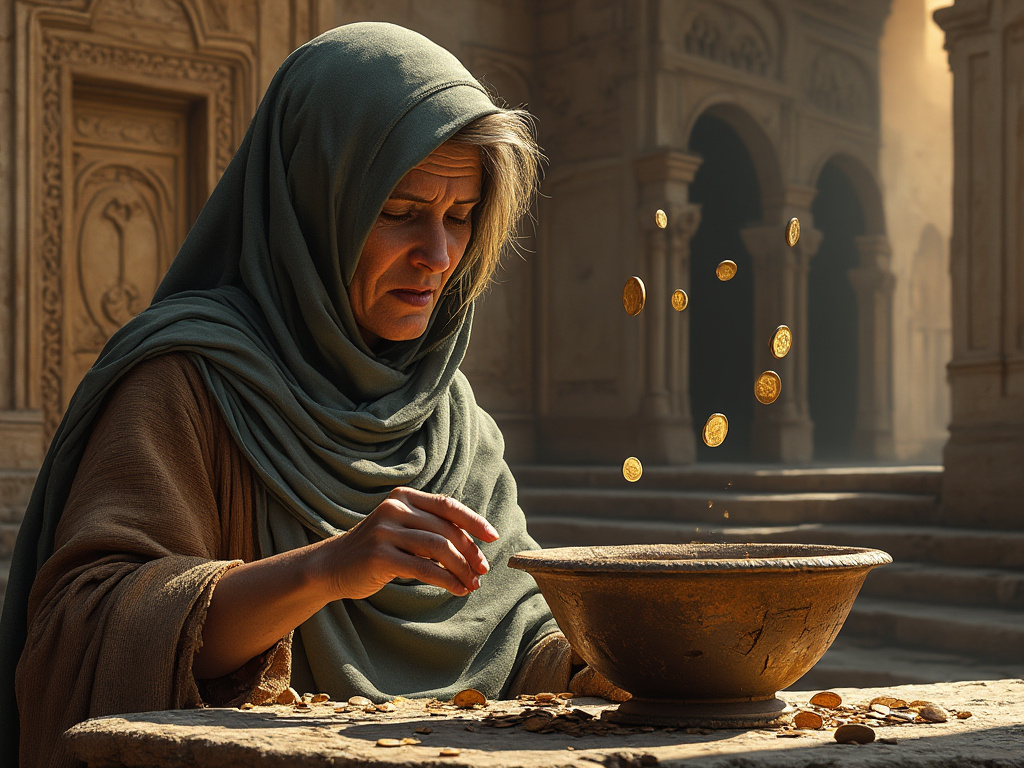
Jesus sat down opposite the temple treasury and watched how people gave money at God’s house. There were thirteen donation trumpets attached to sturdy chests into which people were dropping their contributions. Many rich people were donating large sums, causing loud commotions. But one poor widow’s two small coins went in quietly; a little click-click. Why did Jesus highlight her gift above everyone else’s that day?

Our Father in heaven is rich. He created the universe out of nothing. All things belong to him. Being the Almighty, he does not strictly need anything from us. In the 50th Psalm, God tells his people that he does not rebuke them for their animal sacrifices—he had commanded them to make them—but he notes “every animal of the forest is mine, beasts by the thousands on my mountains. I know every bird in the heights; whatever moves in the wild is mine. Were I hungry, I would not tell you, for mine is the world and all that fills it.” And yet, God insists upon our sacrifices for him.

God places us in a material world in which what we do matters. Whether and how we work and pray, learn and teach, plant and harvest, build and repair, save and donate, visit and invite, feed and clothe and care and love, these things really matter—for good or evil—for ourselves and others. It is true Almighty God could do everything all by himself, entrusting us with no mission and zero responsibility. But then, how would we ever mature and grow as glorious saints? Instead, God chooses to work through us, and with us, and in us. Our holy gifts and sacrifices, inspired and empowered by grace, advance God’s Kingdom while transforming us in Christ. Though, strictly speaking, God has no need of our gifts or praises, he insists upon them for our own good.

When Jesus saw that poor widow give God’s house just two coins worth only a few cents, he called his disciples to himself and said, “Amen, I say to you, this poor widow put in more than all the other contributors to the treasury; for they have all contributed from their surplus wealth, but she, from her poverty, has contributed all she had, her whole livelihood.”

Jesus condemns those who “devour the houses of widows,” but he celebrates this woman’s evident trusting, love for God. Jesus says to beware the scribes who love the robes, the titles, the honored seats at synagogues and feasts, who recite lengthy prayers in order to be seen by men. “They will receive a very severe condemnation,” Jesus says, because their focus is not on love of God and neighbor. That poor, loving widow, however, receives the praise of God. “The last shall be first, and the first shall be last.

As I preached in a homily three weeks ago, hierarchies are normal and natural, though some are better than others. The secular world has hierarchies according to power, wealth, or status. Christ establishes a hierarchy for his Church on earth according to sacramental holy orders. But amongst the Church in heaven, a hierarchy exists according to love. In heaven, God reigns supreme and God is love pouring out for all. There is no money to be had there, the sacraments are no longer needed, and there is perfect, perpetual peace. Greatness above is according to one’s capacity to give and receive love. So whoever wishes to be great in God’s Kingdom must imitate the faithful, self-gifting love Jesus highlights in that widow and which we see modeled for us by Jesus Christ himself.

How you love and what you do matters. In the words of St. Paul, “Let us not become weary in doing good, for at the proper time we will reap a harvest if we do not give up.” “Whatever you do, do it with all your heart as for the Lord … knowing that you will receive an inheritance from the Lord as a reward.” For when Christ comes “he will bring to light what is hidden in darkness and will manifest the motives of our hearts, and then everyone will receive praise from God.”
The Sound of Heaven — Monday, 34th Week in Ordinary Time—Year II

November 22, 2010

What do you think Heaven sounds like? In the first reading, St. John describes it for us. “I heard a sound from Heaven like the sound of rushing water or a loud peal of thunder. The sound I heard was like that of harpists playing their harps.”

The sound of Heaven that John describes is powerful and beautiful. It is like the onslaught of a tidal wave or a thunder burst, yet it has the harmony, clarity, proportion and perfection of supreme beauty. What John is hearing is the sound of worship in Heaven.

In the Gospel, we hear another sound, neither great nor gorgeous in itself: the quiet chinking of two small coins. Yet, this simple sound has echoed for two-thousand years and millions have been drawn to it. When Jesus Himself heard the sound of the faithful, poor widow’s generous gift, He was moved to speak words in praise. Despite its subtlety, it reminded Jesus of a sound He knew well; it reminded Him of the sound of Heaven.

In our own simple ways, with unending joy, let us echo on earth the song of the angels in Heaven as they praise God’s glory for ever.

32nd Sunday in Ordinary Time—Year B

November 9, 2009

Widow's Mite

Imagine if you took two pennies and put them into a savings account, at 1.5 percent interest annually, and left it there for 2000 years. How much money would there be at the end? (2 cents, 2000 years, at 1.5% interest.) One hundred dollars?  No, higher.  A thousand dollars?  Still higher.  Ten thousand dollars?   Not even close. There would be one-hundred, seventy-one billion dollars.

[$0.02 * (1.015)^2000 = $171,046,619,000]

First of all, this reveals to us the power and the fury of compound interest.  But second, and relevant to today’s gospel, this shows us that small things can be more powerful and valuable than we would expect.

One day, almost two thousand years ago, a poor widow climbed the temple mount in Jerusalem and walked among the crowds in the temple courts to the treasury where she gave two small coins for the support of the temple.  Many rich people where there, were pouring much larger gifts into the treasury with great fanfare. Though her gift was tiny compared to theirs, that doesn’t mean that what she did was an easy thing to do. Being poor, it was hard for her, a real sacrifice.  She had to trust in the God of Israel; the God said to provide for the needs of orphans and widows like her. She could have dropped in just one coin, or given nothing at all, but she gave both coins, everything she had. She wasn’t trying to be seen, but the Lord was watching.

Jesus, sitting across from the treasury, called His disciples to Himself to draw their attention to her. “Look at what this poor widow has done.  Take this, all of you, as an image of myself.  Just as she has given everything as a gift of herself to God (even though it was hard and took great trust) so will I give myself up for you.”

The poor widow’s two coins, worth just a few cents, landed in the treasury with a quiet “tink, tink,” but her act has echoed through the centuries. Everywhere this gospel has been preached, the throughout the centuries and around the world, what she did has been remembered.  How many consciences have been pricked and how many hearts have been inspired to invest more completely into the kingdom of God? If the good her small deed has done throughout the ages could be quantified, it would far surpass one hundred, seventy-one billion dollars.

When we rise from the dead, at the general resurrection, I suspect that this poor widow will stand out.  She will be more glorious and enchantingly beautiful than most, and (even though the gospel does not give her name) everyone will know who see is and she will enjoy the love and gratitude of vast multitudes.

When we die, we will all die penniless, and when we rise we will all rise penniless, but some of us will be richer than others. The richest in heaven are those who receive and can give the greatest love, and this will depend upon how much we have invested ourselves into the kingdom of heaven.

You are already giving to your spouses and your children, your friends and your family, at home, at work, and at church, but we should ask ourselves from time to time how much we are giving from our surplus wealth and how much was are making a total gift of ourselves.  Such giving is hard, it takes trust in God, and it conforms us to Jesus Christ. When we give ourselves in this way, in the likeness of Jesus Christ, our gifts yields the greatest returns, here on earth and forever in heaven.

Now you have heard me put in my two cents.  I pray that it may result in great profit for your souls.