17th Sunday of Ordinary Time
By Fr. Victor Feltes
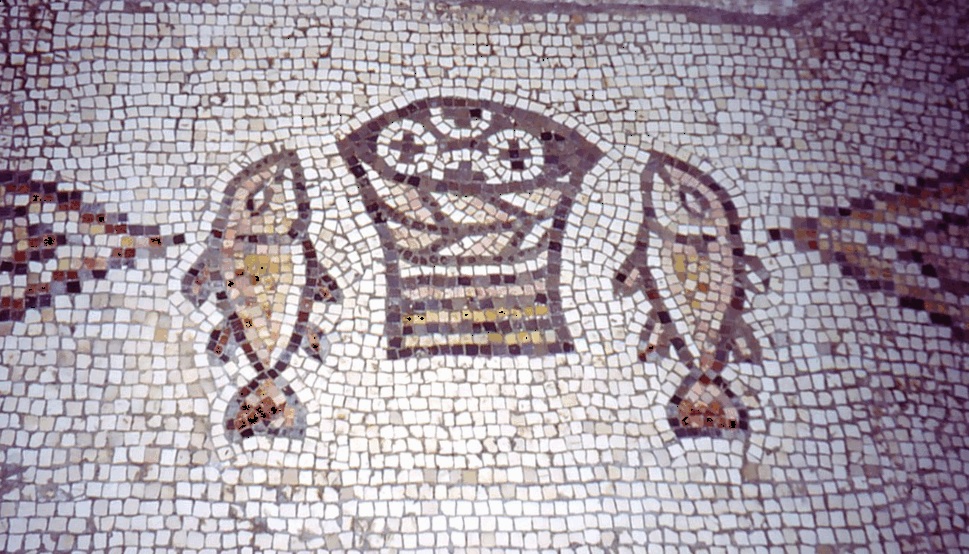
In our first reading from the 2nd Book of Kings, the Prophet Elisha uses twenty barley loaves to feed a hundred people. That suggests a miraculous multiplication of five times. In our Gospel reading, Jesus Christ uses five loaves to feed about 5,000 men – a multiplication of 1,000 times. So Jesus’ miracle was 200 hundred times greater than Elisha’s. That 200 figure is interesting because of something Philip the Apostle says.
When Jesus asked him, “Where can we buy enough food for them to eat,” to see what he would say, Philip remarked, “200 days’ wages worth of food would not be enough for each of them to have a little!” What good could 200 days of work do for so many? One might ask what good are any of our labors or efforts in the face of such great problems in our world today?
Many days passed between the events of the 2nd Book of Kings and the events of the Gospels. Why did the Old Testament people of God have to work and wait, suffer and endure, for days and years, for generations and centuries, before the coming of Christ? Because it was not yet the fullness of time; things were not yet fully prepared for those greater wonders. Our redemption in Christ is preeminently the work of God but God wills that the faithful efforts of faithful people help prepare the way.
While the disciples were still wondering what to do about the problem of the hungry crowd, Andrew the Apostle told Jesus, “There is a boy here who has five barley loaves and two fish, but what good are these for so many?” Jesus would take those loaves, give thanks to God the Father, and distribute the loaves and fishes to the reclining crowd as much as they wanted, and they all ate and had their fill.
Consider this: in the beginning, all things were created through God the Son out of nothing, ex nihilo. Yet Jesus did not conjure food to feed that crowd out of nothing. Like at the Wedding Feast of Cana, he received what was offered to him and transformed it for both our good and God’s glory.
That boy and those five loaves and two fish are remembered to this day, in our Gospel stories on earth and even more gloriously in heaven. Jesus used that entire gift, he multiplied all the loaves and fishes offered, just like how at Cana he transformed the contents of all six of the large stone water jars which the servants had filled for him. And Jesus directed his disciples to “gather the fragments left over, so that nothing will be wasted,” filling a dozen wicker baskets with fragments from the five barley loaves which had been more than they could eat.
Even as Christians we may get discouraged, feel overwhelmed and wonder, “What good are any of my labors or efforts? What good is this for few or many?” Today’s Gospel reading reminds us that Jesus will use everything which we offer him. He will bless it, transform it, multiply it, grow it. He will use it for both our good and God’s glory, and nothing will be wasted. Remember that Jesus promises “whoever gives but a cup of cold water… to drink… [for me] will surely not lose his reward.” (Matthew 10:42)
 In today’s gospel, Andrew the brother of Simon Peter sees the hungry crowd of thousands and says to Jesus, “There is a boy here who has five barley loaves and two fish; but what good are these for so many?” Andrew is discouraged and despairing. He has located some food – five loaves and two fish, and if they’re for sale he perhaps has enough coins on his person to purchase them. “But what good are these for so many?” Does what Andrew has to offer really matter? Will it make any real difference?



 Parishable Items