Archive for the ‘Passion’ Category

Christ Was Lifted Up

March 7, 2021

3rd Sunday of Lent

People would pilgrimage to the Temple in Jerusalem from across the known world to worship, often bringing money to purchase oxen, sheep, or doves for sacrifices to God. So vendors had set up shop in the Temple’s outermost court exchanging foreign currencies into Hebrew coins for a percentage fee and selling animals for a healthy profit. God, however, had designated that large, marble-paved court as the Court of the Gentiles where non-Jews (that is, the Gentiles) could come to worship him at his Temple. The Father willed his Temple to be “a house of prayer for all the nations,” but the moneychangers and animal sellers were making it a noisy, smelly “marketplace.” And by charging unlawful interest and demanding excessive prices even of the poor, they were also “making it a den of thieves.

A place intended to be free for holy worship and communion with God had become unclean, profaned by sin. So Jesus personally comes to Jerusalem at the time of Passover and does something dramatic. He zealously cleanses the Temple, conquering evil, achieving justice, restoring relationship between God and man, drawing people to himself, and indeed sacrificing himself; for when the chief priests and scribes heard of this incident they began seeking a way to put him to death. Their plotting would lead to the Pascal Mystery at the heart of The Apostles’ Creed:

He suffered under Pontius Pilate,
was crucified, died and was buried,
he descended into hell,
on the third day he rose again from the dead,
he ascended into heaven,
and is seated at the right hand of God the Father Almighty.

Why does Jesus Christ do these things? Because sin had caused the human race to fall far from God and paradise. Suffering, dying, and being barred from Heaven were our human lot. We had become slaves to sin and the Evil One, held hostage against our will. Our offenses against the All-Holy One required an incalculable repayment. And our separation from God had made us doubtful of his goodness and love for us. It was a slavery we could not escape, a debt of justice we could not repay, and a broken relationship we could not heal. But God had a plan to save us. He would aid humanity with his divinity by fashioning a remedy for us out of our weakness and suffering and mortality, that from fallout of our downfall would come the means to our salvation. By his Incarnation, the Son of God enters our sinful world as one of us and by his Pascal Mystery sets us free, cleansing us, for holy worship and communion with God. First, Jesus assumes our nature, and then he offers a perfect sacrifice.

As the Letter to the Hebrews says, since we “share in blood and Flesh, Jesus likewise shared in them, that through death he might destroy the one who has the power of death, that is, the Devil, and free those who through fear of death had been subject to slavery all their life.” Jesus said that he came “to give his life as a ransom for many.” And lest it be unclear, St. Paul proclaims that the Lord “gave himself as a ransom for all.” Christ’s death frees the slaves and ransoms the captives, and now saints and angels sing to Jesus, the Lamb of God, in Heaven: “Worthy are you… for you were slain and with your blood you purchased for God those from every tribe and tongue, people and nation.

To some, the idea of Almighty God dying on a cross seems impossible, unbecoming foolishness. Yet Christ crucified is the power and wisdom of God. “The foolishness of God is wiser than human wisdom, and the weakness of God is stronger than human strength.” This mysterious, hidden, wisdom, planned by God before the ages for our glory, was not understood by the devil and his demons; “for if they had known it, they would not have crucified the Lord of glory.” In sinning God, Adam had handed himself and his descendants into the devil’s clutches, but in crucifying Christ (the sinless New Adam) the serpent overplays his hand and loses big. St. Augustine uses the image of a mousetrap in which Jesus is the bait. The devil takes this bait in putting Jesus on the Cross, but by shedding Christ’s innocent blood the devil is forced to release his claims on those who are joined to Christ. The trap snapped down and crushed the serpent.

Jesus’ sacrifice was also able to pay the incredible debt of human sins before God. All sin is wrong, but consider which sin is worse: to lie to a stranger or to betray a friend; to slap your enemy or to slap your mother? The greater the generous goodness and love that a person has shown us, the greater is the offense of our trespasses against them. So how great a crime then are our sins against God, whose love created us and from whom all good things come? How very great a debt of justice must then be satisfied? Our sins caused a debt no sinner could repay. God had commanded his Old Covenant people to offer animal sacrifices for their sins, the idea being that the creature was dying in the place of the sinner whose sins had merited death. However, as the Letter to the Hebrews says, “it is impossible that the blood of bulls and goats take away sins. For this reason, when [Jesus] came into the world, he said: ‘Sacrifice and offering you did not desire, but a body you prepared for me; holocausts and sin offerings you took no delight in. Then I said, as is written of me in the scroll, “Behold, I come to do your will, O God.”’

Jesus Christ, God become man, perfectly fulfills the Law, keeping the commandments and doing his Father’s will. He lives for God without sin, honoring his Father and mother, proclaiming the Kingdom of God without idolatry or blasphemy, without murder or adultery, without thievery or lying or coveting, but with abundant love. And in his death, Christ obediently offers the perfect, acceptable sacrifice we were incapable of on our own; a divinely-perfected offering of humanity to God. By his Incarnation, Jesus has in a certain way united himself with every human person, inviting them to become one with him. Through his sacraments, we are more perfectly joined to Jesus to share in his life and enjoy the benefits of what he has accomplished. Christ is the Victor over sin and death, over the tomb and the underworld, over the world and the devil, and he invites us to partake in his victory.

In the beginning, though the Holy Trinity did not desire humanity to sin and fall, our freely-chosen rebellion did not come as a surprise. Before Creation, the eternal, all-knowing Trinity foreknew what it would cost to save us. And God still said Yes, “Let there be light.” Jesus Christ was freely delivered up crucifixion by lawless men according to the set plan and foreknowledge of God, as foreshadowed by the Old Testament Scriptures. But could God, if he had wished, before Creation or in the course of time, have ordained a manner for the Son’s saving sacrifice other than dying upon a Roman Cross? If so, if there were other unchosen options, then the Cross of Christ was chosen as a most effective and compelling sign for us. A less painful, less ignoble, less public, less striking death — if such a death could have saved us — would not speak to us so clearly as a powerful sign of God’s love for us as this. Jesus makes himself so vulnerable and so lowly so as to awaken a response of love in our hearts. He extends his arms on the Cross in hopes that the whole world will be drawn to his embrace. As Jesus said, “When I am lifted up from the earth, I will draw all people to myself.”

After Jesus died, the Apostles’ Creed says, “he descended into hell.” What are we to make of this? Death is the separation of one’s soul from one’s body. On Holy Saturday, while Jesus’ dead body laid in his sealed tomb keeping a perfect Sabbath rest, Jesus’ soul visited the souls of those in the realm of the dead. Our creed translates this abode of the dead (called “Sheol” in Hebrew or “Hades” in Greek) as “hell” because all souls there, whether righteous or unrighteous, were deprived of the vision of God. But this does not mean that the situations of the Just and Unjust there were identical. Jesus’ Parable of the Rich Man and Lazarus describes the afterlife before the gates of Heaven had opened, showing Lazarus comforted in the bosom of Father Abraham while the uncaring, anonymous rich man (whose name is not written in the Book of Life) suffers torment in the flames.

Jesus descends to hell as Savior, proclaiming the Good News to the souls imprisoned there. He does not descend into hell to deliver the damned, nor to destroy the hell of damnation, but to free the souls of the Just. Jesus had said, “Amen, amen, I say to you, the hour is coming and is now here when the dead will hear the voice of the Son of God, and those who hear will live.” By proclaiming the Gospel in the underworld and inviting souls to Heaven, Jesus extends his saving victory to all the faithful people who had preceded him in death.

On the third day he rose again from the dead,
he ascended into heaven,
and is seated at the right hand of God the Father Almighty.

I do not have the time to speak much about these lines this Sunday, but in closing, note what St. Paul beautifully observes about Christ in his Letter to the Philippians:

Though he was in the form of God, Jesus did not deem equality with God something to be grasped at. Rather, he emptied himself and took the form of a slave, Being born in the likeness of men, …it was thus that he humbled himself, obediently accepting even death, death on a cross!

Because of this, God highly exalted him and bestowed on him the name that is above every other name, so that at Jesus’ name every knee must bend in the heavens, on the earth, and under the earth, and every tongue proclaim to the glory of God the Father: Jesus Christ is Lord!

Jesus empties himself in his Incarnation, humbles himself in his holy obedience, submits himself to his Passion and death, descends to the depths of the underworld, lower and lower and then Jesus is raised up from there, higher and higher, to life and rewards, glory and honor and power, enthroned at the favored righthand of God the Father. St. Paul says to “have among yourselves the same attitude” as this in your Christian life, for as Jesus teaches, “Whoever exalts himself will be humbled; but whoever humbles himself will be exalted.

Jesus or Barabbas?

November 23, 2020

The Solemnity of Our Lord Jesus Christ, King of the Universe

For the feast of Passover, the Governor Pontius Pilate observed a tradition of releasing to the crowds any one prisoner they wished. On Good Friday, in addition to holding Jesus of Nazareth, the Romans in Jerusalem had a notorious prisoner named Barabbas. When the crowd came forward and began to ask Pilate to do for them as he was accustomed the governor dryly asked, “Do you want me to release to you the king of the Jews?” The chief priests stirred up the crowd to have him release Barabbas for them instead.

Pilate asked, “Which of the two do you want me to release to you? Barabbas, or Jesus who is called Christ?” They answered, “Barabbas!” Pilate said to them in reply, “Then what do you want me to do with the man you call the king of the Jews?” They shouted again, “Crucify him!” Pilate said to them, “Why? What evil has he done?” But they only shouted the louder, “Crucify him!” So Pilate, wishing to satisfy the crowd lest they riot, released Barabbas to them and, after he had Jesus scourged, handed him over to be crucified.

This episode with Jesus and Barabbas is recounted each Palm Sunday and Good Friday when the Passion narratives are read at church. However, the Gospels’ Passion accounts are so lengthy and rich with themes to consider that the crowds’ choice between these two figures is rarely ever preached on. Today, I would like to show you the deeper significance in this rejection of Christ the King.

The first interesting detail is in the meaning of these two men’s names. “Jesus” was the name given through angelic messages to Mary and Joseph, a name chosen in Heaven for the Son of God on earth. “Jesus” or “Yeshuah” in Hebrew means “God saves.” The name Barabbas breaks down into the Aramaic words “Bar” and “Abba”; “Bar” means “the son of,” while “Abba” means “father.” And thus, the name Barabbas means “the son of the father.” So Pilate is proposing a question to the crowd more profound than they realize: “Which son of the father do you choose? Do you desire God’s salvation?

The New Testament tells us that Barabbas was a Jewish revolutionary who, along with other captured rebels, had committed murder in a rebellion against Roman rule. The Jews commonly hated the Romans and resented the occupation of their Promised Land by a foreign, Gentile power. Jews expected that the Christ, the Messiah, if he were to come in Jesus’ day, would drive out the Romans and their puppets using the force of arms. Then they imagined that this man, God’s Anointed One, would take his seat upon his ancestor King David’s throne, establishing a renewed Israeli kingdom of worldly glory, with international power, military strength, and overflowing wealth. So when Jesus came among them they failed to recognize him as the Christ.

Unlike Barabbas, Jesus did not promote hatred for the Romans but a love for enemies. Jesus did not raise an army nor a sword, but preached “blessed are the peacemakers.” On Palm Sunday, Jesus does not enter Jerusalem riding on a warhorse, but on a donkey, as the Old Testament prophet Zechariah had foretold: “Shout for joy, O daughter Jerusalem! See, your king shall come to you; a just savior is he, meek, and riding on a donkey.” But when presented with Jesus and Barabbas, the people rejected their true King and Savior, the Christ. St. Peter would go on to preach to the people of Jerusalem on Pentecost, “You denied the Holy and Righteous One and asked that a murderer be released to you.” The choice between Barabbas and Jesus is a choice between two sorts of saviors, two very different kinds of revolutionaries and kings; one whom the earth thinks would be most effective and the one whom Heaven has sent us. The Christ and an anti-Christ.

It was within Jesus’ power to have forcibly imposed his rule over the whole world. At Jesus’ arrest in the Garden of Gethsemane, Peter is ready to fight—he draws a sword and cuts off the ear of the high priest’s servant. But Jesus intervenes, “Put your sword back into its sheath, for all who take the sword will perish by the sword. Do you think that I cannot call upon my Father and he will not provide me at this moment with more than twelve legions of angels? But then how would the scriptures be fulfilled which say that it must come to pass in this way? Put your sword into its scabbard. Shall I not drink the cup that the Father gave me?” Jesus then heals to slave’s ear before he is led away by the guards.

Like a gentle lamb silently led to slaughter, Jesus endures his Passion and death. And who would have thought any more of him? But God raised him from the dead and he appeared to his disciples, who then courageously proclaimed to everyone that Jesus is the Christ. The Jews and Romans persecuted the early Christians. Though peaceful and innocent, Christians suffered indignities, imprisonments, and martyrdoms, yet the number of those saved by the Church continued to grow. Then, in 313 A.D. the Emperor Constantine legalized Christianity and ten years later gave it the most favored religious status throughout the Roman Empire. “Blessed are the meek, for they will inherit the land … Blessed are those who are persecuted for the sake of righteousness, for they will be satisfied.” Indeed, Jesus Christ and his Church succeeded where Barabbas failed: they conquered the Roman Empire not by destroying it but by converting it.

Today we celebrate Jesus Christ, the King of the Universe. Jesus the Almighty now reigns over us and over the whole world. But this knowledge, upon reflection, can raise troubling questions in our hearts. When we see the horrors of this world, grave evils throughout history and evil happening in our time, we may ask, “Lord, why aren’t you doing more?” Every year in our country, hundreds of thousands of unborn children are being legally murdered. Right now, millions of people in Asia are being held in concentration camps. How many billions of grave sins are being committed every day which cause innocents to suffer? Lord, why don’t you end this evil? Why don’t you force the world to bow down to your will?

We may wish Jesus and others to go violently into full Barabbas-mode against all the world’s evil, but this is not his way. Christ’s goal is the salvation of souls, as many souls as possible. Jesus the Good Shepherd shepherds the world subtly but in every place, speaking to the souls of both his friends and sinners, drawing them freely toward his salvation. But what about the grievous sufferings and injustices along the way? Jesus is not at all indifferent to these. Our loving shepherd is the best of shepherds because he has been a sheep like us, a lamb who was slain. He endured such sufferings and injustices personally as the lamb of God, and he still mystically suffers in and with the innocent. “Amen, I say to you, what you did [or did] not do for one of these least ones, you did [or did] not do for me.

The evil of this world is a heart-breaking scandal. But sin and death do not have the final word. The last word will belong to Jesus Christ. Trust in the crucified One, our suffering God who died and rose for us, the Shepherd of souls, the victorious Lamb, Christ our King. May his Kingdom come and his will be more fully done, on earth as it is in Heaven, in each and every soul.

Fasting from the Eucharist

April 10, 2020

Good Friday

St. Pope John Paul II and Joseph Cardinal Ratzinger, Lent of 1995

The Latin Rite of the Catholic Church, to which we and 98.6% of the world’s Catholics belong, has just one day each year when no Masses are to be celebrated. That day is today, Good Friday. After a reading of Christ’s Passion from the Gospel of John and reverencing his holy Cross, the Good Friday liturgy contains a Communion service in which presanctified (previously consecrated) Hosts are distributed and consumed. However, in the early Church, there was no reception of Holy Communion by the faithful on Good Fridays at all. This fact was once noted by Joseph Cardinal Ratzinger. Cardinal Ratzinger, this highly-esteemed theologian, would go on to be elected pope and take the more familiar name Benedict XVI. In his 1986 book “Behold the Pierced One,” he reflected upon the spiritual benefits that could be found by Catholics in full communion with the Church abstaining for a time from receiving our Lord in the Holy Eucharist. Obviously, these interesting passages are relevant to us now during this Long Lent of 2020.

Cardinal Ratzinger wrote:

“When [St.] Augustine felt his death approaching, he ‘excommunicated’ himself and took upon himself ecclesiastical penitence. In his last days, he set himself alongside, in solidarity, with the public sinners who seek forgiveness and grace through the pain of not receiving the Communion. He wanted to meet his Lord in humility of those who hunger and thirst for righteousness, for Him, the righteous and gracious One. Against the background of his sermons and writings, which describe the mystery of the Church as a communion with the Body of Christ and as the Body of Christ, on the basis of the Eucharist, in a really marvelous way, this gesture is quite shocking. It seems to me more profound and fitting, the more often I ponder it. Do we not often take things too lightly today when we receive the most Holy Sacrament? Could such a spiritual fasting not sometimes be useful, or even necessary, to renew and establish more deeply our relation to the Body of Christ?

In the early Church there was a most expressive exercise of this kind: probably since the time of the apostles, Eucharistic fasting on Good Friday was part of the Church’s spirituality of Communion. Not receiving Communion on one of the most holy days of the Church’s year, which was celebrated with no Mass and without any Communion of the faithful, was a particularly profound way of sharing in the Passion of the Lord: the sorrowing of the bride from whom the bridegroom has been taken away (see Mark 2:20). I think that a Eucharistic fast of this kind, if it were deliberate and experienced as a deprivation, could even today be properly significant, on certain occasions that would have to be carefully considered—such as days of penitence (and why not, for instance, on Good Friday once more?) […]

Such fasting — which could not be allowed to become arbitrary, of course, but would have to be consonant with the spiritual guidance of the Church — could help people toward a deepening of their personal relation to the Lord in the Sacrament; it could be an act of solidarity with all those who have a yearning for the Sacrament but cannot receive it. […] I would not of course wish to suggest by this a return to some kind of Jansenism: in biological life, as in spiritual life, fasting presumes that eating is the normal thing to do. Yet from time to time we need a cure for falling into mere habit and its dullness. Sometimes we need to be hungry—need bodily and spiritual hunger—so as once more to comprehend the Lord’s gifts and to understand the suffering of our brethren who are hungry. Spiritual hunger, like bodily hunger, can be a vehicle of love.”

During this dangerous Coronavirus pandemic, faithful shepherds charged by Christ to care for the fullness of persons entrusted to them have prescribed sad but necessary measures which have restricted access to Holy Communion. In doing this, our Church leaders follow in the prudential footsteps of past prelates who likewise suspended public Masses during times of deadly contagion, from the medieval plagues to the modern Spanish Flu. Although public liturgies with Communion have ceased it is important to remember that the Holy Mass continues to be offered by priests in our Catholic churches. The graces of Jesus’ sacrifice pour forth from these altars into Christians souls around the world. Do not doubt that our Lord will provide sufficient grace for all that you are called to do in this season of our lives. As the Lord once told St. Paul when the saint prayerfully begged for a certain trial to be taken away, “My grace is sufficient for you, for power is made perfect in weakness.”

When we cannot physically receive Jesus in the Eucharist we can still unite ourselves to him through a prayer for Spiritual Communion. Pope St. John Paul the Great wrote that the practice of Spiritual Communion “has happily been established in the Church for centuries and recommended by saints who were masters of the spiritual life. St. Teresa of Jesus wrote: ‘When you do not receive Communion and you do not attend Mass, you can make a Spiritual Communion, which is a most beneficial practice; by it the love of God will be greatly impressed on you.’” Once, in a 14th century vision, Jesus showed St. Catherine of Siena two chalices, one gold and one silver. He said her Sacramental Communions were preserved in the gold chalice and her Spiritual Communions in the silver one. When our sacramental reception of our Lord proves impossible, Jesus desires our Spiritual Communion. Until the day we are all safely reunited around his altar, I urge you to make acts of Spiritual Communion, such as this famous prayer of St. Alphonsus Liguori:

My Jesus,
I believe that You are present in the Most Holy Sacrament.
I love You above all things, and I desire to receive You into my soul.
Since I cannot at this moment receive You sacramentally,
come at least spiritually into my heart.
I embrace You as if You were already there
and unite myself wholly to You.
Never permit me to be separated from You.
Amen.

Just one month ago, when pews were full for the 2nd Sunday of Lent, we heard the Gospel story of the Transfiguration. On Mount Tabor, Jesus’ face shone like the sun and his clothes became white as light. Ecstatic, Simon Peter said in reply, “Lord, it is good that we are here! If you wish, I will make three tents here, one for you, one for Moses, and one for Elijah.” Peter wanted to never leave that euphoric time and place, but it was necessary that Jesus lead him down from that mountain top into the dark valley; from the Mount of Transfiguration to the Hill of Crucifixion.

It is a true sacrifice to fast from the Eucharist this Good Friday amidst this Long Lent. But our Christian sacrifice is not without purpose nor without hope. Like Jesus’ Passion, it is a sacrifice offered for the love of others. This is his Body given up to save many; we do this in memory of him. And like Jesus within his Passion, we can be confident that this arduous trial shall pass away and our suffering and obedience will soon yield great rewards, particularly a deepened love for our Eucharistic Lord. Being followers of the transfigured Christ takes us to Calvary, but the Passion is what leads us to his Resurrection. And the more we share in the likeness of Christ, the more we will share in his glory.

Lessons from the Sins of Simon Peter & Judas

April 9, 2019

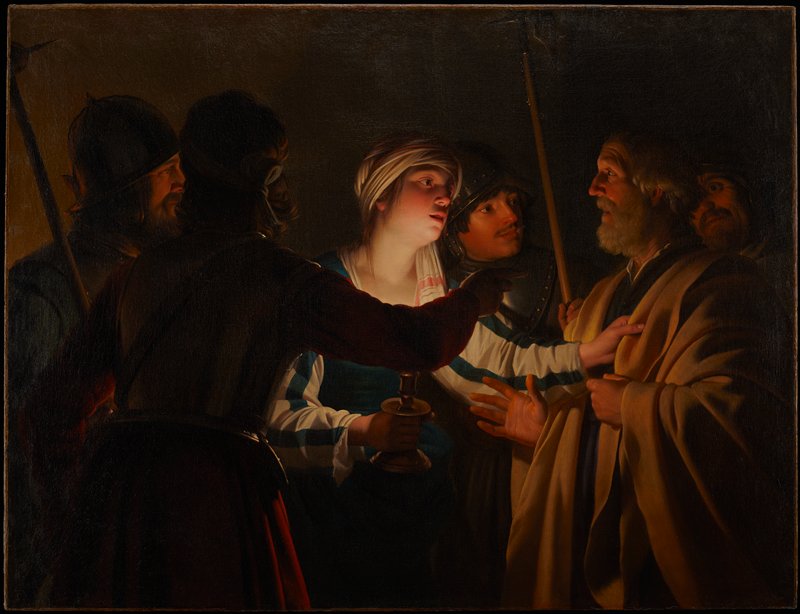
After arresting [Jesus] they led him away and took him into the house of the high priest; Peter was following at a distance. They lit a fire in the middle of the courtyard and sat around it, and Peter sat down with them. … About an hour later, still another insisted, “Assuredly, this man too was with him, for he also is a Galilean.” But Peter said, “My friend, I do not know what you are talking about.” Just as he was saying this, the cock crowed, and the Lord turned and looked at Peter, and Peter remembered the word of the Lord, how he had said to him, “Before the cock crows today, you will deny me three times.” He went out and began to weep bitterly.

– Luke 22:54-55,59-62

This threefold denial by Simon Peter was perhaps the most regretted moment of his life. He denied even knowing Jesus Christ, his teacher, friend, Lord, and God. How humble Peter was to share this story with the Early Church and how wonderful that the Holy Spirit inspired its inclusion in the Gospels! He shows us the fallen can get back up, wanderers can return, sinners can be forgiven, and even those who gravely sin can go on to become the greatest saints.

Jesus would go on to rehabilitate Peter after the Resurrection, alongside another charcoal fire by the Sea of Galilee. Mirroring the three denials, Jesus asks three times, “Simon, son of John, do you love me?” Simon Peter replies, “Yes, Lord, you know that I love you,” and Jesus reinstates him as shepherd of his sheep and lambs. The Sacrament of Reconciliation (or Confession) is likewise a personal encounter with Jesus Christ where we re-profess our love for God and receive his restoring forgiveness through the ministry of his ordained priest.

Though Simon Peter’s sins were forgiven they were not without loss and opportunities squandered. During the Passion, as they led Jesus away, “they took hold of a certain Simon, a Cyrenian, who was coming in from the country; and after laying the cross on him, they made him carry it behind Jesus.” If Simon Peter had not sinned in denying Christ the night before he could have been there, ready and willing to get behind his Lord, pick up Jesus’ cross and follow him. How beautiful that would have been! But this opportunity fell to another Simon.

Thanks be to God, St. Peter went on to repent. He did not give up to despair like Judas Iscariot. When Judas saw Jesus condemned and on his way to execution he deeply regretted what he had done. (One theory for why Judas had sold Jesus out is he wanted to trigger a confrontation with the leaders of Israel which would force Jesus to wield his mighty powers and take the throne.) Judas tried to return the thirty silver coins to the chief priests and elders saying, “I have sinned in betraying innocent blood.” They answered, “What is that to us? Look to it yourself.” Flinging the money into the temple, Judas departed and went off and hanged himself.

What if instead, on Good Friday afternoon, Judas had immediately ran to Calvary Hill? What if he had thrown himself down before Christ hanging on the Cross and begged his forgiveness? What would Jesus have said? What would Jesus have done? I think we already know the answer, or could pretty closely guess. Jesus would have forgiven Judas.

So come to Jesus in sacramental Confession. Come sooner rather than later and more than just once or twice a year. And, once wonderfully absolved, resolve and strive to sin no more. Though sins can be forgiven, we see that every sin or delayed conversion entails some loss, an opportunity missed.

A Solar Eclipse Q & A

August 15, 2017

What is it like to experience a total eclipse?

For places within the 70-mile-wide “path of totality” of this Monday’s eclipse it will be like sunset suddenly arriving in the middle of the day. The air temperature will drop, stars may appear, and animals could become confused.

Is this eclipse a sign of the end of the world?

Quite likely not. On average, total eclipses occur on earth more than sixty times every century. This particular eclipse simply happens to span across the United States from Oregon to South Carolina. However, it is always a good time to “repent and believe in the Gospel.”

Will we be able to see the solar eclipse in Wisconsin?

The Moon will not completely block out the Sun’s light in Wisconsin, but about 80% of the Sun will be obscured here on Monday at 1:10 PM local time. (Click here to check for your own zip-code, and review this important eye-safety info on viewing the eclipse.)

How do we know this eclipse is coming?

The Sun, Earth, and Moon move through the heavens according to God’s physical laws like clockwork. This makes it possible to accurately predict when eclipses will happen in the future or to calculate when they have occurred in the distant past.

Has our part of Wisconsin ever been in the direct path of a total eclipse?

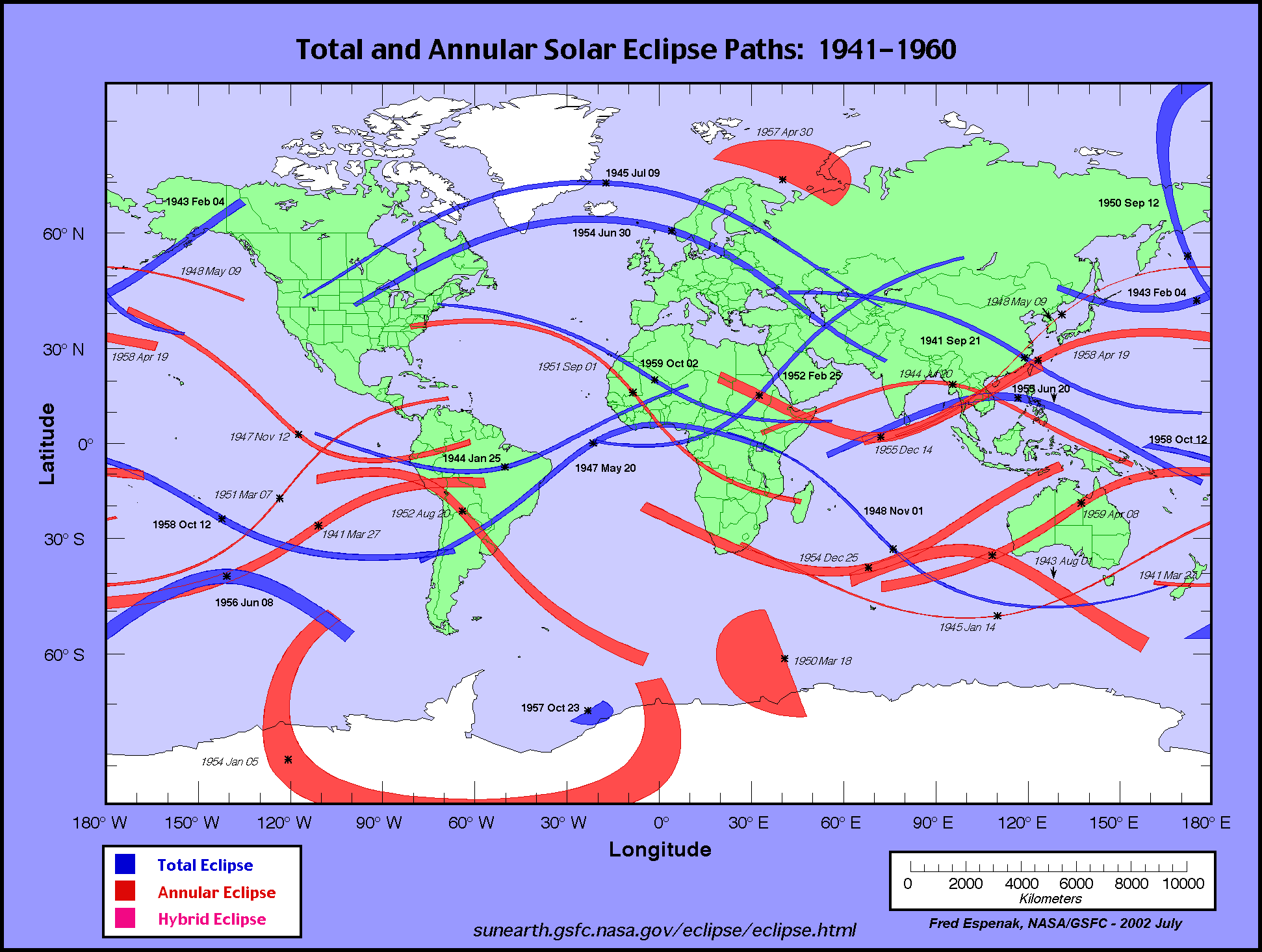
This has happened here several times since Jesus Christ was born: on April 2, 610[*]: the year Mohammad began preaching Islam; on September 21, 1205: the year after the Crusaders sacked Constantinople; on April 6, 1503: the year Leonardo da Vinci began the Mona Lisa; and most recently on June 30, 1954: the month “under God” was added to the Pledge of Allegiance.

Did Jesus ever see a solar eclipse during his lifetime in Israel?

One solar eclipse’s “path of totality” went through nearby Syria on November 22, 29 AD and perhaps Jesus saw the Sun become more than 90% obscured that day. Luke’s Gospel records that “the sun was darkened,” or eclipsed, the afternoon of Jesus’ crucifixion. Since solar eclipses are not naturally possible when there is a full moon (as at the time of the Jewish Passover) this failing of the Sun’s light must be due to some other natural or supernatural phenomena.

[*] – All Julian calendar dates (October 15, 1582 and earlier) have been converted to Gregorian calendar dates.

But It Was Not Enough For Him

April 16, 2017

At Passover, in Jesus’ day and in our own, the Jewish people remember and celebrate the great Exodus, how God delivered his people from slavery in Egypt and led them into the freedom of the Promised Land. Through Moses, God commanded his people to keep the Passover feast as an everlasting memorial. Jesus’ Last Supper was something of a transformed Passover meal, and his Passion, Death, and Resurrection are the mystery that the Passover foreshadowed and prefigured.

Jews today observe their annual Passover meal with an assortment of ancient traditions. Among these is singing or reciting an up-beat Hebrew song named “Dayenu” (Da-yea-nu.) Dayenu means “it would have been enough for us!” Here is an English translation of this more than one thousand year old song:

If [the Lord] had brought us out from Egypt, and had not carried out judgments against them
Dayenu, it would have been enough!

If He had carried out judgments against them, and not against their idols
Dayenu, it would have been enough!

If He had destroyed their idols, and had not struck their first-born
Dayenu, it would have been enough!

If He had struck their first-born, and had not given us their wealth
Dayenu, it would have been enough!

If He had given us their wealth, and had not split the sea for us
Dayenu, it would have been enough!

If He had split the sea for us, and had not taken us through it on dry land
Dayenu, it would have been enough!

If He had taken us through the sea on dry land, and had not drowned our oppressors in it
Dayenu, it would have been enough!

If He had drowned our oppressors in it, and had not supplied our needs in the desert for forty years
Dayenu, it would have been enough!

If He had supplied our needs in the desert for forty years, and had not fed us the Manna
Dayenu, it would have been enough!

If He had fed us the Manna, and had not given us the Sabbath
Dayenu, it would have been enough!

If He had given us the Sabbath, and had not brought us before Mount Sinai
Dayenu, it would have been enough!

If He had brought us before Mount Sinai, and had not given us the Law
Dayenu, it would have been enough!

If He had given us the Law, and had not brought us into the land of Israel
Dayenu, it would have been enough!

If He had brought us into the land of Israel, and not built for us the Holy Temple
Dayenu, it would have been enough!

It would have been enough for us,” for how could we demand more than what God had given? He created the universe out of nothing and every good thing is his gift. Apart from God’s promises (freely-imposed upon himself by His covenants) we could not rightfully insist upon anything more. As Job said at the onset of his trials, “Naked I came forth from my mother’s womb, and naked shall I go back there. The Lord gave and the Lord has taken away; blessed be the name of the Lord!” We could not demand more—but we would still desire more.

We would continue to desire life without end. We would still want deliverance from evils, outside us and within us. We would still desire unending delights, for as King Solomon observed, “The eye is not satisfied by seeing nor has the ear enough of hearing.” And would long for divine intimacy with the Holy Source of all good. All these desires are fulfilled for us through Jesus Christ.

We could not demand more, but we would still desire more, for the Lord has placed these desires within us. He did this that He might fulfill our desires and they reflected his own desires for us.

The Lord did all the great things that came before
— But this was not enough for Him!

He did all these great things, and then He became man for us
— But this was not enough for Him!

He became man for us, and then He taught us the New Law of Love
— But this was not enough for Him!

He taught us the New Law, and then He suffered and died to forgive us
— But this was not enough for Him!

He suffered and died to forgive us, and then He rose from the dead to save us from death
— But this was not enough for Him!

He rose from the dead to save us from death, and then He left us the Church
— But this was not enough for Him!

He left us the Church, and then He wedded and united himself to us through the Holy Sacraments

What God has given us, what Jesus has done for us, what we are given, what we are promised — this is enough for us. Let us rejoice in Him this day!

The Cross of the Passion

March 15, 2017

A local parishioner has drawn upon the best available evidence to create this realistic sculpture of Jesus Christ on his Cross. Come to St. Wenceslaus in Eastman on Friday, March 24th at 7 PM to encounter this impressive, life-sized crucifix. Father Victor Feltes will speak about the historical sources on which this crucifix is based and lead some short devotions.

The Virgin Mary was a Martyr

September 15, 2016

 St.

The martyrdom of the Virgin is set forth both in the prophecy of Simeon and in the actual story of our Lord’s passion. The holy old man said of the infant Jesus: “He has been established as a sign which will be contradicted.” He went on to say to Mary: “And your own heart will be pierced by a sword.”

the-swoon-of-the-virginTruly, O blessed Mother, a sword has pierced your heart. For only by passing through your heart could the sword enter the flesh of your Son. Indeed, after your Jesus – who belongs to everyone, but is especially yours – gave up his life, the cruel spear, which was not withheld from his lifeless body, tore open his side. Clearly it did not touch his soul and could not harm him, but it did pierce your heart. For surely his soul was no longer there, but yours could not be torn away. Thus the violence of sorrow has cut through your heart, and we rightly call you more than martyr, since the effect of compassion in you has gone beyond the endurance of physical suffering.

Or were those words, “Woman, behold your Son,” not more than a word to you, truly piercing your heart, cutting through to the division between soul and spirit? What an exchange! John is given to you in place of Jesus, the servant in place of the Lord, the disciple in place of the master; the son of Zebedee replaces the Son of God, a mere man replaces God himself. How could these words not pierce your most loving heart, when the mere remembrance of them breaks ours, hearts of iron and stone though they are!

Do not be surprised, brothers, that Mary is said to be a martyr in spirit. Let him be surprised who does not remember the words of Paul, that one of the greatest crimes of the Gentiles was that they were without love. That was far from the heart of Mary; let it be far from her servants.

Perhaps someone will say: “Had she not known before that he would not die?” Undoubtedly. “Did she not expect him to rise again at once?” Surely. “And still she grieved over her crucified Son?” Intensely. Who are you and what is the source of your wisdom that you are more surprised at the compassion of Mary than at the passion of Mary’s Son? For if he could die in body, could she not die with him in spirit? He died in body through a love greater than anyone had known. She died in spirit through a love unlike any other since his.

Islam Cross Examined

April 26, 2016

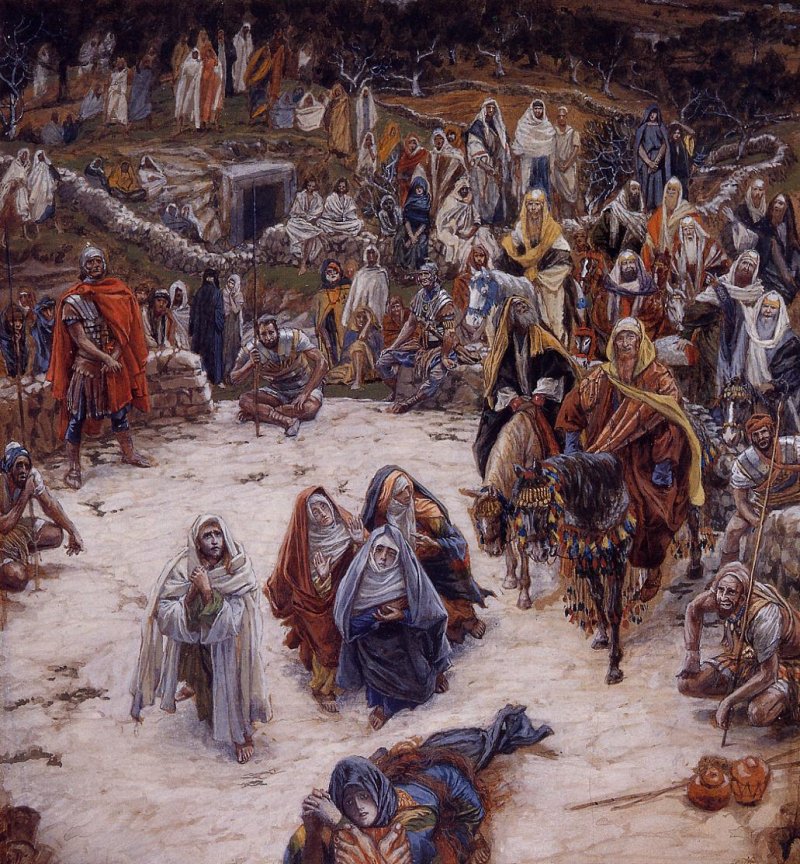
View From the Cross by TissotOnce, at a picnic in college, I learned from a Muslim professor about what Islam teaches regarding Jesus — that he is not the divine Son of God but a prophet of Allah. Of course, my own Christian beliefs differed but I sat patiently listening — until he told me something about ‘Jesus (peace be upon him)’ which left me manifestly incredulous. He said Jesus was never crucified; Allah only made it appear as if he suffered and died. Reportedly, most Muslims (like this professor) believe that Allah gave someone else Jesus’ physical appearance to die on the Cross instead.

The relevant portion of the Quran [4:157] says:

That they said (in boast), ‘We killed Christ Jesus the son of Mary, the Messenger of Allah’; but they killed him not, nor crucified him, but so it was made to appear to them, and those who differ therein are full of doubts, with no (certain) knowledge, but only conjecture to follow, for of a surety they killed him not…

I began asking the professor clarifying questions on this point to make sure that I understood and after a while he asked me why. I replied that if the eyewitnesses to the Crucifixion were not merely mistaken but actively deceived by Allah, then Allah is the author of a lie. God is Truth and “can neither deceive nor be deceived.” (CCC #156-157) So how could Islam’s doppelganger explanation for denying the Crucifixion of Jesus be true? (Similarly, creationists may argue that evolutionists are misinterpreting the ancient fossil record, but they may not say that God has planted false evidence to test our faith.) The now-ruffled Muslim professor retorted that Christianity’s belief in ‘the three gods of the Trinity’ did not make any sense, and we let our interfaith picnic dialogue end there.

But what if Allah can lie? If Allah acts against Truth then his omnipotence would be unlimited in every sense, transcending beyond both logic and goodness. But if Allah transcends good and evil, if God is not absolute goodness in a way that human beings can recognize, then what is our motive to worship him besides submission before his power? C.S. Lewis wrote in opposition to Calvinism’s doctrine of mankind’s “Total Depravity” with words which are just as applicable here:

[I]f God’s moral judgment differs from ours so that our ‘black’ may be His ‘white,’ we can mean nothing by calling Him good; for to say ‘God is good,’ while asserting that His goodness is wholly other than ours, is really only to say ‘God is we know not what.’ … If He is not (in our sense) ‘good’ we shall obey, if at all, only through fear – and should be equally ready to obey an omnipotent Fiend.”

In Plato’s Euthyphro, Socrates asks the title character, “Is the pious loved by the gods because it is pious, or is it pious because it is loved by the gods?” Or, put another way: “Is morality right simply because God declares it so, or does God acknowledge it as right because it is right independently of Himself?” Christianity answers that Euthyphro’s dilemma is a false choice. Goodness comes from God’s eternal nature; nothing could exist without Him. God’s word calls forth the good from Himself. He creates good things, sustains them, and sees that they are good. This is the good God we know; the true God “who does not lie” (Titus 1:2); the God who is supremely revealed by the death on the Cross of our Lord Jesus Christ for all people.

He Proved Faithful — Good Friday Homily

March 25, 2016

Few proved faithful to Jesus on Good Friday, but on Good Friday Jesus proved himself faithful to us.

The political leaders were supposed to serve justice, but Pilate and Herod failed to protect Jesus as an innocent man. Jesus protected us when we were guilty.

The religious leaders were supposed to serve holiness, but the High Priests and the Sanhedrin failed to accept Jesus as their Messiah. Jesus accepted us so that we might become holy.

The disciples were supposed to serve their teacher and lord, but Judas betrayed him, Peter denied him, and the others abandoned him. By enduring his suffering and death, Jesus proved himself faithful to us.

Jesus’ mother Mary was faithful. She stood with him at the foot of the cross. It was a consolation for Jesus to have her there. Two of his beloved disciples were also there: Mary Magdalene and the apostle John. Jesus was grateful to have them close by.

Today, on this Good Friday, by the grace of God, we are at the foot of the cross. Let us pray for mercy, for ourselves and for others. Despite our past unfaithfulness, let us honor his faithfulness to us. Jesus is pleased that we are here with him, and he is grateful for our gratitude.

View From the Cross by Tissot

Reflections on the Passion in Luke

March 18, 2016
  • Christ Carrying the Cross by Hieronymous Bosch, 1485-1490.At the Last Supper, Jesus says he has “eagerly desired to eat this Passover with you before I suffer…” Jesus did not allow stress to prevent him from enjoying the people and good things in his life. Do I experience joy at Holy Mass? Do I eagerly desire it?
  • Taking a cup, Jesus says, “I shall not drink of the fruit of the vine until the kingdom of God comes.” The next time Jesus drinks wine is on his cross; so God’s kingdom has begun on earth. Despite my trials, what good things am I looking forward to?
  • An argument breaks out among the apostles about which of them should be regarded as the greatest. Justifying ourselves through comparisons with others undermines our personal growth. Instead, Jesus commends imitating him as a servant to all.
  • To save Jerusalem, David tearfully fled the city by way of the Mount of Olives to escape his traitorous son, Absalom. Jesus also retreats there but resolves not to elude his betrayer and escape his death so that he might save us all.
  • Jesus is in such agony, praying so fervently in the garden, that his sweat becomes as drops of blood falling on the ground. This describes Hematidrosis, which has been observed in rare modern cases of people undergoing acute fear and intense mental contemplation. While I seek relief, do I offer my physical and emotional sufferings as a sacrifice?
  • He approaches Jesus to kiss him and Jesus asks, “Judas, are you betraying the Son of Man with a kiss?” Does my familiar intimacy with holy things lead me to hold them cheaply?
  • Jesus’ disciples realize what is about to happen and ask, “Lord, shall we strike with a sword?” However, they act before he can reply. Do I discern prayerfully and wait patiently for the Lord’s direction?
  • One of the disciples (St. Peter) strike the high priest’s servant (Malchus) and cut off his right ear. Jesus exclaims, “Stop, no more of this!” He touches the servant’s ear and heals him. Those without faith in Jesus cannot be converted by violence, that cuts off their ears to hear. Do I share Jesus Christ and my Catholic Faith in a winsome way?
  • Peter was willing to fight and die for Jesus in the garden, when he thought it would make a difference, but Peter did not recognize the importance of acknowledging Jesus to those around the fire. Do I recognize the importance of being faithful to Christ in all company and every moment?
  • Both Peter and Judas regretted what they had done, but Peter returned to Jesus. When I sin, do I delay to repent and return to Jesus?
  • Jesus was condemned for identifying as the Son of God and king of the Jews. When was the last time I suffered for telling the truth?
  • Pilate is glad to refer Jesus’ case to Herod. Pilate never hates Jesus, but sins through not caring about him. Who am I indifferent towards?
  • Herod enjoyed listening to John the Baptist until he had him executed. Jesus gives the unrepentant Herod only silence. Do I receive and heed God’s written and preached word when I can?
  • Barabbas is a murderer and a rebel. His name means “Son of the Father.” The crowds call out for him to be released to them instead of Jesus. Is my hope greater in political actors rather than the Lord?
  • Peter three-times denies Jesus and Pilate condemns Jesus after three-times declaring him innocent. They fold because they fear what others will say or do. Do I allow other people to persuade me to compromise on the truth or what is right?
  • The crowd cries, “Crucify him!” Every decision to sin chooses, at least in a small way, to exile Christ from our world.
  • Simon of Cyrene, coming in from the country, was pressed to carry Jesus’ cross. If Simon Peter had remained faithful, perhaps he would have come to Jesus’ aid. When I sin, what good do I forfeit?
  • The women of Jerusalem mourning and lamenting Jesus, crying for his Passion to end, may have served as a temptation for Jesus. He redirects them to pray for their own families’ deliverance. Do I pray for the salvation of my family and friends?
  • Two criminals were crucified beside Jesus. They symbolize all humanity, and Jesus suffers and dies among them. One is saved and one is likely lost.
  • One criminal acknowledges, “We have been condemned justly, for the sentence we received corresponds to our crimes, but this man has done nothing criminal.” Do I consider what my sins would deserve apart from the saving mercy of God?
  • Jesus says, “Father, forgive them, they know not what they do.” Do I assume malice where simple ignorance could explain the behavior of others?
  • Jesus cries out in a loud voice, “Father, into your hands I commend my spirit,” and breathes his last. What do I want my final, dying words to be?

Time Travel & God’s Prophesies

March 3, 2016

Many science-fiction stories have explored the idea of traveling through time and changing the past. For example, 1980’s “The Final Countdown” imagined a modern-day U.S. aircraft carrier being transported back to 1941 and facing the choice of either thwarting the Japanese attack on Pearl Harbor or allowing history to play out unchanged. In the early 1990’s, the TV time traveler Dr. Sam Beckett would “Quantum Leap” into other people’s lives, “striving to put right what once went wrong.” Just last fall, the internet hotly-debated the morality of going back in time to kill Adolf Hitler when he was still too young to have chosen or have committed any crimes.

ITardiss it possible to go back in history and change the past? There’s good reason to think that it is logically impossible. Here is why: Imagine traveling back in time and, by some tragic accident, killing your grandparent as a child. This would mean that one of your parents would have never been born… so you would have never been born… which raises the question: who killed your grandparent? Or imagine a time traveler’s intended history-changing mission succeeding, such as stopping JFK’s assassination. If so, then there is no cause for the time traveler to have ever been sent back from the future at all. This sort of logical contradiction is called a paradox.

Most serious time travel stories avoid this paradox problem using the premise that the past can be visited but never truly altered. Time travelers simply fulfill the role they have always played in those past events. Any and all attempts to avert some disaster in history will either prove useless or actually contribute to bringing about the calamity.

Time travel is merely fantasy, but the prophesies of God, which have correctly foretold future events, are very real. Consider, for instance, these passages from the 22nd Psalm written by King David under the inspiration of the Holy Spirit some 1,000 years before the coming of Christ:

“My God, my God, why have you abandoned me? … All who see me mock me… Like water my life drains away; all my bones are disjointed. My heart has become like wax, it melts away within me. As dry as a potsherd is my throat; my tongue cleaves to my palate… They have pierced my hands and my feet. I can count all my bones. They stare at me and gloat; they divide my garments among them; for my clothing they cast lots. … I will live for the Lord…”

This psalm is clearly fulfilled in Christ’s sufferings on the cross; the onlookers’ gloating mockery, the gambling over his garments, his dehydration and laboring heart, wounds cutting to his bones. What other form of torture is there that pierces the hands and feet? Jesus spoke this psalm’s opening words even while sharing the psalm’s closing hope in a life restored. These events were accurately described a millennium before they occurred.

God prophesying future events raises questions about human freewill. If Jesus’ crucifixion could be long foretold then what responsibility could Judas, Caiaphas, or Pontius Pilate possibly bear for their roles in the Passion? The answer is that Eternal God, from his vantage point outside of time, can behold all of history, including the free choices that each of us make. C.S. Lewis reconciles God’s knowledge and our freedom in these passages from his book “Mere Christianity”:

“…God is outside and above the Time-line. In that case, what we call ‘tomorrow’ is visible to Him in just the same way as what we call ‘today’. All the days are ‘Now’ for Him. He does not remember you doing things yesterday; He simply sees you doing them, because, though you have lost yesterday, He has not. He does not ‘foresee’ you doing things tomorrow; He simply sees you doing them: because, though tomorrow is not yet there for you, it is for Him. You never supposed that your actions at this moment were any less free because God knows what you are doing. Well, He knows your tomorrow’s actions in just the same way— because He is already in tomorrow and can simply watch you. In a sense, He does not know your action till you have done it: but then the moment at which you have done it is already ‘Now’ for Him.”

God’s knowledge of our free choices does not make our choices any less free. As St. Augustine once noted, “Just as you do not compel past events to happen by your memory of them, so God does not compel events of the future to take place by his knowledge of them.” God’s divine knowledge does not strip us of human freewill, but it does permit him to communicate perfect prophesies to his people concerning events further along our timeline. Such prophesies concern not only the Messiah’s life, but our times and future as well.

Jesus Christ has already victoriously prevailed. His Second Coming in glory is foretold and assured, and his people’s final victory over sin and death is prophesized and certain. This is the connection between time travel stories and the prophesies of God: like the futility of time travelers attempting to avert some historic disaster, any and all attempts to prevent the ultimate triumph of Christ will either prove useless or actually contribute to bringing about the coming of his Kingdom. The enemies of Jesus schemed to destroy him and his movement, but their very plotting led to the fulfillment of his mission and the birth of the Church. This knowledge is a cause for Christian endurance and joy, even amidst our times of struggle. We know that we are free to serve a faithful role in helping bring about the great, holy, happy ending of history.

A Chalice Reflection

October 13, 2015

Virgin Mary by the Host by Jean Auguste Dominique Ingres, 1854.     How could we possibly celebrate the Holy Mass without the chalice? Without the chalice, how would we adore the Precious Blood? The chalice holds the Lord and it gives form to his presence. He is not lifted up in sacrifice without its close collaboration. Perhaps our Lord could have chosen another means but this is the one He chose. The chalice at Mass is not divine, but when our Lord is adored it shares in His glory.

The chalice at Mass is an icon of a person. The chalice of Jesus Christ is the Blessed Virgin Mary. She held the Lord within her and from her He received his human form. He was not lifted up in sacrifice without her close collaboration. Perhaps our Lord could have chosen another means, but she is the one He chose. Mary is not divine, but when our Lord is adored she shares in His glory.

“One on His Right, the Other on His Left”

March 24, 2015

Revealing fascinating prophetic connections between Moses, Joshua, Samson, and Jesus Christ on the Cross; featuring the religious paintings of James Tissot (1836-1902.)

Reflections on The Passion of the Christ

February 26, 2015
  • Jesus Writing on the Ground from the Passion of the Christ with Jim CaviezelThe 2004 film begins quoting Isaiah 53, “He was wounded for our transgressions, crushed for our iniquities; by his wounds we are healed.” Isaiah foretold Christ’s sufferings seven centuries before they came to pass.
  • We see a full moon, for Passover was always celebrated upon a full moon (similar to how Easter is always the Sunday after the first full moon following spring equinox on March 20th.)
  • We find Jesus in the garden, praying the psalms to his Father: “Rise up, defend me” (Ps 94) “Save me from the traps they set for me” (Ps 141) “Shelter me, O Lord, I trust in you. In you I take my refuge.” (Ps 16)
  • Satan appears in the garden; androgynous, attractive, and deathly pale. He speaks doubts to Jesus: “Do you really believe that one man can bear the full burden of sin? No one can carry this burden… No one. Ever. No. Never. … Who is your Father? Who are you?” Jesus never speaks to the devil throughout the film, but here he stands, locks eyes with Satan, and crushes the snake’s head underfoot. This recalls God’s words to the ancient serpent in Genesis 3:15, “I will put enmity between you and the woman, and between your seed and hers; He will strike at your head, while you strike at his heel.
  • Awoken from her sleep, the Virgin Mother senses something is awry. She asks Mary Magdalene, “Why is this night different from every other night?” She answers, “Because once we were slaves and we are slaves no longer.” This quotes the traditional dialogue of the Jewish Passover meal ritual.
  • Given the choice, the crowd calls for the unsavory prisoner Barabbas, a violent revolutionary, to be freed instead of Jesus. “Barabbas” means “Son of the Father.
  • At the pillar, Jesus quotes Psalm 108: “My heart is ready, Father. My heart is ready.” In Hebrew, to say “very,” you repeat a word twice. To say something is so in the greatest measure, it is said thrice (e.g. “Holy, Holy, Holy.”) The Romans directing the flogging of Jesus say “Satis / Enough” three times.
  • The angry crowd from the Passion of the ChristPilate presents the lacerated Jesus saying, “Ecce Homo / Behold (the) man!” The shot is from behind, emphasizing the angry, riotous mob in the background, for these words are a critique of fallen man/mankind.
  • Pilate asks, “Shall I crucify your king?” The high priest replies, “We have no king but Caesar,” denying the kingship of God.
  • The 14 Stations of the Cross make appearances throughout the film, including the three times Jesus falls.
  • Embracing his cross, Jesus alludes to Psalm 116: “I am your servant Father. Your servant and the son of your handmaid.
  • Mary, recalling when Jesus once fell as a child, rushes to his side. Jesus tells her, “See, Mother, I make all things new,” foreshadowing Revelation 21:5, “Behold, I make all things new.
  • Veronica, who gives Jesus her veil to wipe his face, has a name which means “true image.”
  • Jesus’ experiences at Golgotha are paralleled with flashbacks to the Last Supper. Jesus is stripped, the bread is uncovered. The Host is lifted, his cross is raised.
  • The Virgin Mary at the foot of the cross calls Jesus, “Flesh of my flesh, heart of my heart…” echoing the words of Adam toward Eve.
  • On the cross, Jesus quotes Psalm 22: “My God, my God, why have you forsaken me?