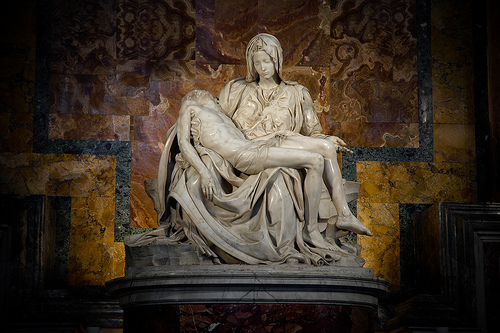
Archive for the ‘Passion’ Category

Mary and Pilate — 6th Sunday in Ordinary Time—Year C

February 14, 2010

In a few moments, after this homily, we will recite our creed, the summary of our faith. Every Sunday, we profess, in union with the Christians who came before us, our belief in these truths and our resolve to live our lives according to them. This morning we will look at just one rich aspect of our creed and consider its implications for our lives.

Have you ever noticed that in the entire creed, only two non-divine persons are mentioned by name? These are the Virgin Mary and Pontius Pilate.

“By the power of the Holy Spirit, He was born of the Virgin Mary and became man. For our sake He was crucified under Pontius Pilate; He suffered, died and was buried.”

Now many other figures from the Old and New Testaments could have justifiably been included in our creed; such as Adam and Eve, Abraham, Moses, David, Mary Magdalene, Peter, Paul, and many others. Yet, only Mary and Pilate get mentioned. So why is this? There seems to be two very good reasons. The first of these reasons I will give now—and the second I will save for the end.

The first reason why Mary and Pilate receive special mention is that they ground Jesus’ life, death, and resurrection in our real history. Jesus was ‘born of the Virgin Mary, suffered and died under Pontius Pilate, and on the third day, He rose again.’ Now other pre-Christian religions sometimes had stories about dying gods who came to life again, but those stories were always said to have happened ‘once upon a time,’ in some remote and mythic past. But with Jesus Christ, this ancient intuition and longing of humanity is actually realized. The inclusion of Mary and Pilate in the creed witness to this: that God became man, died, and rose for us, in this world and in real history.

Some people try to be too sophisticated by saying it doesn’t really matter if Jesus rose from the dead, or even if He lived at all, because His teachings are what’s important. But St. Paul blows this idea out of the water. “If Christ has not been raised, your faith is vain; you are still in your sins. Then those who have fallen asleep in Christ have perished” and “we are the most pitiable people of all.” Without Jesus Christ and His resurrection there is no Gospel, there is no Good News.

Just like Jesus Christ, Mary His Mother and Pontius Pilate His executioner are not fictional characters made up for some story. They are real people, from a time not that much different from our own. Our styles and technologies may have changed, but human beings themselves remain much the same. When we look at Mary and Pilate we can see ourselves in these two people whom Christ encountered twenty centuries ago.

Pilate is the secular Man of the World.
Mary is the devoted Disciple of Christ.

Pilate seeks the glory of men.
Mary seeks the glory of God.

Pilate knows worldly wisdom, he is clever and cunning.
But Mary knows God’s wisdom, and she is truly wise.

Pilate thinks he knows how the world works and the pragmatic way to get things done. For Pilate, our world is totally shaped by of power, money, and influence, with some blind luck thrown into the mix. When Jesus stands silent before him, Pilate says, “Do you not speak to me? Do you not know that I have the power to release you and I have the power to crucify you?” Jesus replies, “You would have no power over me if it had not been given you from above.”

Pilate is a very post-modern man.  He’s a moral relativist. When he asks Jesus, “What is truth,” he doesn’t bother to wait for an answer from Truth Himself. That’s because Pilate thinks that the ‘truth’ cannot be known except for the ‘truths’ which we choose for ourselves or impose upon others.

The Gospels show that Pilate knows Jesus is innocent, or at least that he poses no real threat to society, yet Pilate is willing to have this innocent man whipped and even crucified when that becomes the most expedient thing to do. The crowd threatens Pilate, “If you release him, you are not a friend of Caesar,” and he quickly caves and hands Jesus over.

Pilate washes his hands of responsibility, and extends Christ’s arms on the cross. Mary had extended her arms declaring, “Let it be done to me according to your word,” and lovingly held the infant savior in her hands.

Pilate, despite all his power, is ruled by fear.
Mary, despite her weaknesses, is freed from it.

Governor Pilate is rich in wealth and power and yet he has no peace.
Mary, the poor widow, has peace and everything she needs from God.

Pilate has no faith in the God of Israel. He says, “I am not Jew, am I?” But for Mary, God is her rock and this makes all the difference in the world. Mary is defined by her faith, hope and love.

Mary never attends an academy, but she is profoundly wise because she reflects in her heart on the words and deeds of God and because she lives by her own advice: “Do whatever he tells you.” She knows that we do not manufacture the truth for ourselves, we receive it, ultimately from God. We love it, we defend it, and we share it with others. “Blessed [is she],” as Elizabeth said, “who believed that what was spoken to [her] by the Lord would be fulfilled.” Mary trusted and believed, for she saw the evidence through history that God “has mercy on those who fear Him in every generation,” that “He scatters the proud in their pride, and casts down the mighty from their throwns, but He lifts up the lowly.”

Mary’s life was full, but was not free from trials. When Mary consents to be found with child through the Holy Spirit she is uncertain of what will happen to her, but she trusts in God. She does not know how she and her husband will get by as poor immigrants in foreign country, but she continues to trust. Mary’s response to every trial in life, even to the death of her son, is to trust in God. Despite men’s sins, she trusts in God as the Lord of history, that He casts down the proud and mighty from their throwns and raises up the lowly.

Pilate is indifferent to Christ, and he consents to sending Him to the cross, but Mary is wholly devoted to Christ, and she consents to share in His Passion. Pilate’s heart is hardened despite Christ’s Passion, while Mary’s heart is pierced by it.

Governor Pilate was once the most powerful man in Judea, but where is he now? Mary, the poor widow, is now our glorious queen, the most beautiful and powerful woman in heaven or earth, and through her reign she draws millions to Christ our king.
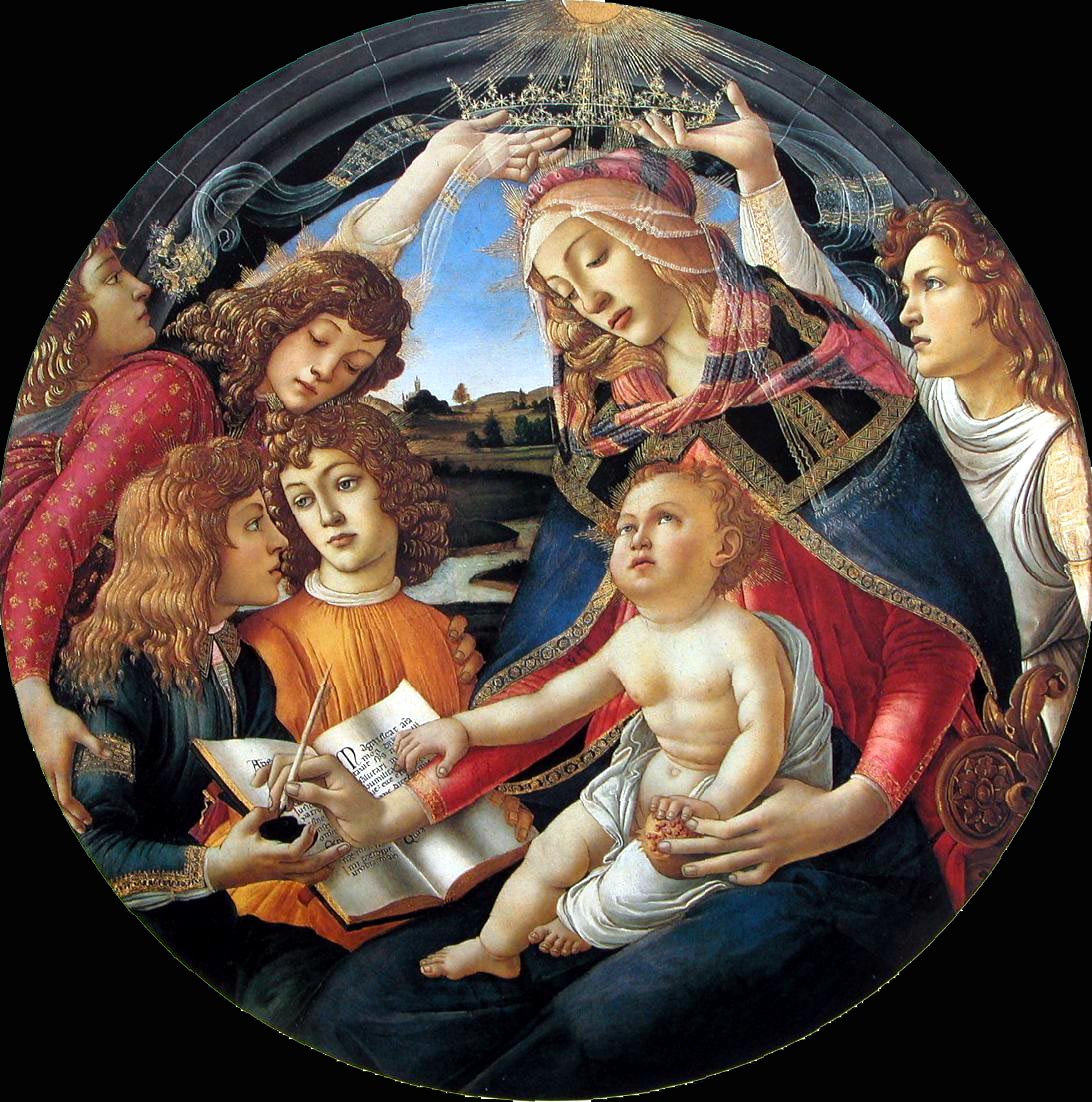
She is the one who wept and now laughs.
He is the one who laughed and now weeps.

He was rich in the world and now he is poor.
She was poor in the world and now the kingdom is hers.

He took root in the desert, he was barren and uprooted.
But she was planted beside the flowing waters, she endured and bore much fruit.

So what do all of these reflections about Mary and Pilate have to do with us? I promised you at the beginning a second good reason why Mary and Pilate are mentioned in the creed; and here it is: Mary and Pilate represent us. They stand as archetypes, models or patterns, for every person.

The faithful one and the faithless one.

The one who serves God and the one who serves himself.

The one who gives Christ life and the one who puts him to death.

We live our daily lives as either Mary or Pilate, with shades of the other thrown in. As we come to the season of Lent, let us examine and discern who we are. “How am I Pilate, and how am I Mary?” And at this Eucharist, let us ask Jesus to exchange in us the ways of Pilate for the ways of Mary, for hers is the way of Christ.

Decoding the Ritual — Friday After Epiphany

January 9, 2010

Jesus stretched out his hand, touched the leper before Him, and said, “Be made clean.” The leprosy left him immediately and Jesus ordered Him, “Go, show yourself to the priest and offer for your cleansing what Moses prescribed…” What was Jesus asking this man to do? In the Book of Leviticus it says:

This is the law for the victim of leprosy at the time of his purification. He shall be brought to the priest, who is to go outside the camp to examine him. If the priest finds that the sore of leprosy has healed in the leper, he shall order the man who is to be purified, to get two live, clean birds, as well as some cedar wood, scarlet yarn, and hyssop. The priest shall then order him to slay one of the birds over an earthen vessel with spring water in it. Taking the living bird with the cedar wood, the scarlet yarn and the hyssop, the priest shall dip them all in the blood of the bird that was slain over the spring water, and then sprinkle seven times the man to be purified from his leprosy. When he has thus purified him, he shall let the living bird fly away over the countryside.  (Leviticus 14:2-7)

Hidden within this strange Old Covenant ritual, Jesus Christ is concealed. And through Jesus’ death for us on the cross the true symbolism of this ritual is revealed.

The scarlet, the wood and the hyssop all have their place in Christ’s Passion.  The scarlet yarn points to the robe they placed upon Him; the wood to the cross on which they nailed Him; and the hyssop to the branch they used to offer Him drink. One bird is slain and the other is spared, dipped in the water and the blood of its brother. This water points to the water of Christian baptism, which receives its grace through the blood of Jesus’ cross. In the ritual the priest would take all of these things and sprinkle the man to be purified seven (the perfect number of) times from his leprosy. In His Passion Jesus took all these things and used them to purify us from the leprosy of our sins.

In our wonder at these signs, let us make our faith in God firmer, and give Him our thanks.

Treasure the Gift — Christmas Mass at Midnight

December 26, 2009

It’s Christmas, and today we hear one of the most familiar passages in the Gospel, the nativity scene in Bethlehem.  Is there anything that we can learn out of such a familiar text?  Yes, very much indeed. For example, have you ever wondered: what are swaddling clothes anyways?  ‘Mary wrapped her Son in swaddling clothes and laid him in a manger.’

When I was young I thought swaddling clothes were just dirty pajamas, but in fact swaddling refers to an ancient custom. They would use tightly bound cloths to wrap-in an infants’ arms and legs to their bodies (they thought this was important for promoting proper posture.) This practice was called “swaddling.” Was it cruel to confine the babies like this? No, the babies liked this. It reminded them of their many months, warm and snug, within their mothers’ wombs. Another thing I’ve learned since the time I was a kid was what a manger really was.  A manger is not a stable. It’s a feeding trough.  Mary wrapped Jesus up in swaddling clothes and laid him in a feeding trough.

Even if you knew all that stuff before, there remains the question of why St. Luke included these details in his Gospel. Why is it important?  Not only does it show the poverty and humility of the Christ, it also points to Jesus’ future. This is not the last time that His mother would wrap Him in tight cloths and lay His body down. And baby Jesus is laid in a feeding trough because when He is grown He will say to His disciples, as you will her Him say to you here, “Take this, all of you, and eat it. This is my body which will be given up for you.” The swaddling cloths point to Jesus burial cloth, and laying in the manger points to His Eucharist, where which He offers us His whole self, His body, blood, soul, and divinity as food.

So you see, whether we are a talking about the Sacred Scriptures, prayer, the sacraments, the teachings of Christ’s Bride (our Mother, the Church,)  our Catholic faith is not a half-cut orange whose richness you can drain out with one or two squeezes and then toss away. A lifetime of discovery will not exhaust what all that our Catholic Faith contains.

When I was a kid I might have looked at this manger scene and though that some people were missing.  “Where are the Magi, the wise men (or astrologers) from the East?”  They’re over there, hiding among the poinsettias. Maybe they are journeying through the forests, or maybe they haven’t even left home yet, but one thing we do know is that they were not there on Christmas night.  When they arrive in Jerusalem they ask King Herod, “Where is the newborn king of the Jews?” Days, weeks, or even months have passed since Christmas, and when they do arrive in Bethlehem they do not find Jesus, Mary and Joseph living in a stable or a cave, but in a house.

So who was there that first Christmas night? The shepherds were there. The angel said to them in the fields, ‘I declare to you news of great joy! A savior who is Christ and Lord is born for you in Bethlehem.  You will find Him wrapped in swaddling clothes and lying in a manger.” The shepherds look at each other and say, “Hey, we’ve gotta check this out.” Who wouldn’t turn out for that first Christmas after an angelic invitation like that?

The shepherds came to the stable and find the infant Christ just as the angel described. From there, Luke’s Gospel says, they returned rejoicing and spread the word about what had happened to all. The shepherds probably knew everybody from Bethlehem, since they were locals (“from that region”) and within walking distance from the stable.

Yet there is a question which I would like us to consider, a question which the Gospels do not answer, and it is this: After that first Christmas, did the shepherds ever come back to visit the Holy Family again? I doubt you could find two people more friendly and welcoming than Joseph and Mary, so I sure that any guest was welcome in their home, but did the shepherds ever take the opportunity to visit them again? The Magi had to travel hundreds of miles just to see Jesus once, but the shepherds were only a short distance away. 

Did the shepherds ever get to know Mary and Joseph better, these two holy saints of God? Did they ever take time come back to adore Jesus, to consider what the birth of this Child meant for their lives, and to praise and thank God for all the blessings they had received? If they had merely spent a single hour each week in the Christ child’s presence, imagine what difference it would have made for their relationships, their work, and their lives in general? We don’t know whether the shepherds ever came back again after that first Christmas, but if they didn’t, then they were foolish and they really missed out.

This Christmas Jesus Christ invites you come back and see Him again, to visit this house of Joseph and Mary, where He is always present to be adored. He wants to bless you through His saints, His teachings, His sacraments, and His Real Presence here, the whole year round. You may be receiving many gifts this Christmas, but make sure that you do not return this one.

34th Sunday in Ordinary Time—Year B

November 23, 2009

Today we celebrate the Solemnity of Christ the King. Jesus Christ is our king, now and forever. Yet, the idea of monarchy doesn’t really resonate with us. And it’s not just because we don’t have an earthly king ruling our country. It’s that we’re not big fans of authority. We are wary of anyone having too much power. This is because power is often abused.

Those with any degree of power, be it over entire people or a single employee, can abuse that power. We can fall into thinking only of themselves and our own advantages and be blind and deaf to the legitimate concerns and genuine needs of others. Sometimes those with power hold on to it jealously and will stomp out any real or perceived threats to that power without regard to the truth. This is how the Roman Governor Pontius Pilate responds to Christ. When Pilate asks Jesus, “Are you the King of the Jews,” he is not searching for the Jewish messiah, or even the truth.  He is probing for a political threat to himself.

The true purpose of power and authority is for serving the good of others. This goes for the Church and for all government, for our workplaces and our homes. The reason that our all-powerful God shares some of His power and authority with us, His creatures, is not so that we may be self-serving. It is so that we may serve others, give them life and bless them, and in this way resemble God Himself. God has given of Himself, given us life, and blessed all creation.

As Jesus said to His apostles, “You know that the rulers of the Gentiles lord it over them, and the great ones make their authority over them felt. But it shall not be so among you. Rather, whoever wishes to be great among you shall be your servant; whoever wishes to be first among you shall be your slave.”

Jesus showed his perfect love for us by becoming a slave and dying for us on the cross. For this reason, we do not fear the idea of Him being the first among us, reigning as our king. The Church, His bride, welcomes its royal bridegroom. And as it is for the bride of Christ as a whole, so it is for every Christian soul in relationship with Christ.

Every bride yearns to be fought for, to be pursued and to be a priority to someone. Christ has made us His priority.  He came down from heaven in pursuit of us. He has fought for and died for us, and now in heaven He still fights for us.

Every bride also wants an adventure to share. She doesn’t want to be the adventure; she wants to be caught up in something greater than herself. When we are living for ourselves we are alone, without purpose, and empty. Each of us is meant to live a life about more than just ourselves.  A life in Christ. We each have a vocation, a calling from God, a unique part to play in an epic adventure, a significant part to play in His great story.

Every bride wants to have a beauty to unveil. And it’s not just an exterior beauty. It’s a deep desire to truly BE the beauty and to be delighted in by the bridegroom. Christ is the lover of our souls and all of us wish to have beautiful souls. Each person desires to be approved and uniquely enjoyed by Christ. For us males, this is a desire for his approval and regard.  To be one who He is unashamed to call us His brother, a member on his team; a man in His platoon

Why bring up how Christ our King is the perfect bridegroom for His bride, the Church? Gentlemen, take note. Imitate Christ for your brides with Christian chivalry, love your wives as Christ loves the Church, and you will be like our king for your queen. Fight battles on Christ’s side for your beautiful bride. Lay down your life for her each day. Be Christ the king’s shining knight for her—honor, serve, and defend your bride and lead her on an adventure. The power you have is for her and you family.

For any of us, with any power and authority comes responsibility. And the power each of us has gives us a great opportunity. For by serving Christ our King and by caring for those He has entrusted to our care, we win the only glory and happiness worth having, that of Christ our king—the glory and happiness with the power to last forever.

October 28 – Sts. Simon and Jude

October 28, 2009

Cowardly Lion

Today we celebrate the Sts. Simon and Jude, apostles and martyrs for Christ. Simon was known as “the Zealot,” and Jude, or Judas the son of James, was nicknamed “Thaddeus,” which means “Courageous” in Greek. In the Gospel today the apostles are listed, with Simon and Jude coming towards the end, right before Judas Iscariot, the one who betrayed Jesus.

When Jesus sent out His disciples with the power and authority to heal the sick, cast out demons, and preach the Gospel, He sent them out two-by-two.  One could infer (though this is by no means certain) that this Gospel passage lists the apostles according to those old missionary pairings: Simon Peter with his brother, Andrew; James with his brother, John; and so on, ending with the Judas called “Courageous” and the other Judas who became a traitor.

So here we would have two Judas’, side-by-side, in discipleship and ministry. Yet, only one of them earned a nickname for being courageous. To grow in holiness requires our courage, a virtue that Judas Iscariot tragically lacked.

John’s Gospel tells us that this Judas held the money purse, and sometimes stole from it for himself. That’s because he lacked the courage to acknowledge his faults and to grow in the virtues.

Judas may have betrayed Jesus because he thought this would kick-start Jesus, the weak messiah, into real, revolutionary action. Judas did not have the courage to trust that the providence of God working through Jesus Christ was really the best way to bring about the Kingdom on earth.

And after he had sinned, Judas lacked the courage to seek forgiveness, choosing suicide instead, which is called “the coward’s death.” Simon Peter denied Jesus, but he had the courage to confess his sin and to seek reconciliation. That was Peter’s salvation.

If we are going to grow in holiness to sainthood, it’s going to require our courage; the courage to acknowledge our faults and grow virtue, the courage to trust in God’s will and providential plan for our lives, and, when we fall, the courage to confess our sins and to seek reconciliation with Christ.

October 1 – St. Therese of Lisieux

October 1, 2009

Today we celebrate the young woman Pope Pius XI called, “The greatest saint of modern times.” At the age of 15, she entered the Carmelite convent in Lisieux, France to give her whole life to God. There, she would take on a new religious name which would profoundly capture her identity: Sister Therese of the Child Jesus and the Holy Face.

St. Therese

How did her life resemble the Child Jesus? Early on, Therese saw her own weakness and littleness, and she believed that great and mighty deeds were beyond her, so she committed herself to a “little way of spiritual childhood.” She always tried to love and trust like a little child, modeling herself on the Child Jesus; not doing great things, but doing everything with great love.

The second title of St. Therese, that of the Holy Face, refers to the image Jesus’ bloodied face left upon St. Veronica’s veil during the Passion. How did Therese’s life resemble the Holy Face? Whatever she suffered, from small annoyances of daily life to the great pains of her final illness, Therese offered it all to God as a sacrifice for the good of souls. The image and likeness of Christ’s redemptive suffering was made present in her, like the image Christ’s face upon a clean, white cloth.

We can follow St. Therese’s example in our own lives, whenever we approach our Father in prayer with child’s fearless trust, whenever we do our daily tasks with a intention to do them with great love, and whenever we offer our sufferings as a sacrifice in Christ, for our good and the good of all His Church.

Wednesday, 26th Week in Ordinary Time—Year I

September 30, 2009

Why do the Jews in today’s psalm begin to mourn when their “captors” ask them to sing one of Zion’s songs? This psalm refers to the time of the Jewish Exile. The kingdom of Judea was conquered by the Babylonian Empire 586 years before Christ. Many Jews were deported from their homeland to the rivers of Babylon in the East. Time passed, and that superpower was conquered by another, and after 50 years of Babylonian Captivity, the Persian Empire allowed the Jews to go home. However, many years passed, and Jerusalem, the city of God, remained in great disrepair.

This weighed heavily on the heart of Nehemiah, who was the cupbearer to the king of Persia. As cupbearer, he was the king’s highly-trusted servant because it was his job to drink of any wine that would be offered to the king, lest that it be poisoned. In the first reading we heard Nehemiah recall in his own words how he obtained permission from the king to rebuild God’s city, the city of his ancestors. Nehemiah is a “type” or foreshadowing of Christ.

As Nehemiah had the consent of his king for his mission, so Jesus had the consent of His father to come to Jerusalem as the restorer of God’s people.

Like Nehemiah before Him, Jesus desired, with all the sentiments of His human heart, to bless His deceased ancestors in their graves, for their blood ran through His own veins.

Like Nehemiah, Jesus wanted to build God’s city, giving it a new glory that would attract all nations to a more perfect worship of God within its walls.

Nehemiah used the timber of the Gentiles to build the earthly Jerusalem. To build the heavenly Jerusalem, Jesus used the wood of the Roman’s cross.

Nehemiah was old cupbearer, who faced death in service of the king. Jesus is the new cupbearer, who drinks from the cup, so that sins may be forgiven.

The cup that Jesus drinks is a cup of suffering mingled with joy. Today, at this Mass, Jesus asks us to follow Him. He says, take this cup, all of you, and to drink from it in remembrance of me.

25th Sunday in Ordinary Time—Year B

September 20, 2009

Somewhere, in an underground lair, a secret hideout, or a den of iniquity, we find a criminal mastermind, or a mad scientist, scheming a nefarious plot. “Mah-ha-ha-ha,” the villain manically laughs. “Once I unleash my evil plan, evil will conquer the world.”

This is the way of villains as we often find them in comic books. Comic book bad guys love doing evil for evil’s sake. But we should realize that this isn’t why people do bad things in our world. In the real world, nobody does evil for evils sake. Every single person acts to achieve some real or perceived good. Sinners simply go about the pursuit of happiness in wrong ways. Bad people are not bad because they’re trying to do bad things. Unrepentant sinners actually feel justified in what they do.

For instance, in Jesus’ day, influential people said, “That Jesus from Nazareth so obnoxious. Let’s have him condemned and see how he holds up then.  If he’s really holier-than-thou, a son of God, then God will come to his rescue—otherwise he gets what he deserves.” People still rationalize like this today. It’s easy to come up all sorts of reasons for doing bad things rather than what is right:

“Lying? What I said isn’t technically untrue. Besides, it’s only a little white lie.”

“Angry? Is it any wonder that I get so angry when I have to deal with stuff this.”

“Stealing? The way I see it, they make plenty of money, and I deserve more than what they pay me.”

Activities outside of marriage?  “What’s the big deal? It’s all consensual, and nobody’s getting hurt. Besides, we love each other.”

It’s not only “bad people” who say things like this. Each of us fall into embracing lies like these sometimes. But what is the antidote for rationalizing aside our sins? The cure for this is a prayer life with Jesus Christ.

When the apostles came face to face with Jesus inside the house, Jesus began to ask them, “What were you arguing about on the way?” But they remained silent, for they had been discussing among themselves on the way who was the greatest. Coming into Jesus’ presence, who is the embodiment of Truth, the reality of what they had been doing became clear for them. Their false illusions completely faded away, like the smoke from a blown out candle.

We should spend time in conversational prayer with Jesus Christ every day, allowing Him to form us, build us up, and console us. When you receive the encouragement, confidence, and consolation which Christ is eager to give you in prayer, when He acknowledges you as His own brother or sister, as His good friend, as a favored child of His Father, fears dissolve and you live in peace—a peace in which cleverly-devised excuses are no longer sought for and no longer necessary.

September 15 – Our Lady of Sorrows

September 16, 2009

Imagine if you had to start a whole new life. I don’t mean just changing schools, or moving away from home, or even entering the federal witness protection program. Imagine if you had to start a whole new life from the very beginning, as a tiny little embryo. And imagine that this reincarnation of yours required you to choose a new mother for yourself, from among all the women in all the world. What qualities would you look for in choosing a new mom?

You would want her to be beautiful, not only on the outside, but on the inside too, for what we desire most of all from our mothers, is a great and beautiful love.

You would want her to be wise and full of goodness, someone who could introduce you to the world and show you how to live in it well.

You would want her to be the perfection of femininity, so you girls could see how to grow into excellent women, and to show you boys what to look for in an excellent wife someday.

You would want a mother with patience, and tenderness, and compassion, who would be at your side if you were sick or in pain, and who would comfort you just by her presence.

As fantastic as this sounds, Jesus faced a scenario a lot like this one. He had to choose from among all the women in all the history of all the world, the one woman who would become His mother. For his incarnation, Jesus chose Mary to be His own mother.

She was beautiful, inside and out. She introduced Him to life in our world. She loved Jesus with a great and beautiful love. And when Jesus looked at Mary, he saw the likeness of His future bride, because Mary is the icon of the Church perfected. She stood at His cross with compassionate strength and her presence helped Him amidst his suffering.

Mary was so great a mother, that Jesus wanted to share her with us. He wanted her to be our mother, too. Jesus looked down from the cross, on her and the beloved disciple, and said, “Woman, behold, your son,” and to the beloved disciple, “Behold, your mother.” You and I are the beloved disciple. Jesus gives us Mary to be a mother for us. He created her perfectly, to be His own mother and our mother, too.

From that hour, at the cross, the beloved disciple took Mary into the heart of his life. From this hour, at this Eucharist, take Mary deeper into the heart of your life; because she loves you more than you know.

24th Sunday in Ordinary Time—Year B

September 13, 2009

Once upon a time, there was a kingdom,
filled with forests, and farms, and villages.
There lived near one town, a humble farmer.
He was simple, but wise, and loved the Lord.
He worked his small farm, with his wife and son.
They kept fields, a home, and a few livestock.

One day, the farmer’s work-horse, ran away.
“How unfortunate,” said the villagers,
“It will be harder, to plant your crops now.”
The wise farmer replied, “Our God works all things,
for the good, of those, who love Him.”

Two days later, the horse came back.
bringing along two wild-horses with him.
“How lucky you are,” the villagers said,
“you have free horses, walk right to your door!”
The wise farmer replied, “Our God works all things
for the good of those who love Him.”

There after, his son, training the wild horses,
got kicked off of one, and broke both his legs.
“That’s so unlucky,” the villagers said,
“What bad change of luck, for you and your son.”
The wise farmer replied, “Our God works all things
for the good of those who love Him.”

Two weeks later, the son still bedridden,
the king’s army came, to draft men for war.
They took every young man, but left him behind.
“You’re just lucky people,” the villagers said,
“Isn’t that so?”
And the farmer replied, as he did every time,
“Our God works all things for the good of those who love Him.”

In our daily lives, when things don’t go our way, we are confronted with the most ancient temptation. In the Garden of Eden, the serpent, who is Satan, said, “God is withholding this good fruit from you because He doesn’t really want you to be happy.” The temptation, here, is to mistrust and rebellion, the fear, that the Lord, does not really care for us, that we’re left to chance, and left all on our own.

At such moments, we should recognize the temptation and say, “Depart from me, Satan, in the Name of Christ. You are thinking not as God does, but as human beings do.” Our God sees the outcome of all things, and He will not cause, or allow, anything to happen that would go against our ultimate good.

Jesus knew that His Father willed His happiness that’s why He kept an open ear, did not rebel, and did not turn back. That’s how He could give His back to those who beat Him, and his face to abuse. He could set His face like flint, by remembering that He would not be put to shame in the end. And now, Christ, beyond death and every suffering, alive and supremely happy, says, “See, the Lord God is my help; who will prove me wrong?”

So whether we stub our toe, or show up late, or get short on money, or experience even the greatest of trials, we should turn and pray: “Lord, you know that I don’t like this, but I trust that you will work, even this, to my good. Jesus, I trust in you. You work all things, for the good, of those, who love You.”

Thursday, 23rd Week in Ordinary Time—Year I

September 11, 2009

If you are among those who hear, you heard Jesus giving a challenging message today.  But He is only asking us to do as He Himself has done.

Jesus gave to everyone who asked of Him. He loved His enemies and did good to them. For those who struck Him on one cheek, as He carried the cross, He did not unleash upon them the furious fire of God. Jesus offered them His other cheek as well, that they might be saved, not destroyed. Maybe they took His cloak from Him when they arrested Him in the garden, but He never asked for it back. When they arrived at Golgotha, He let them take His tunic as well. Jesus did good to those who hated Him, He blessed those who cursed Him, and prayed for those who mistreated Him. Dying on the cross He said, “Father, forgive them, they know not what they do.” Jesus did unto others as he would have them do.

Jesus did as He would have you and me do. If we imitate Him we will receive a reward as great as His; a full measure, packed together, shaken down, and overflowing. But we must do as St. Paul tells us: “As the Lord has forgiven you, so must you also do.”