Archive for the ‘Resurrection’ Category

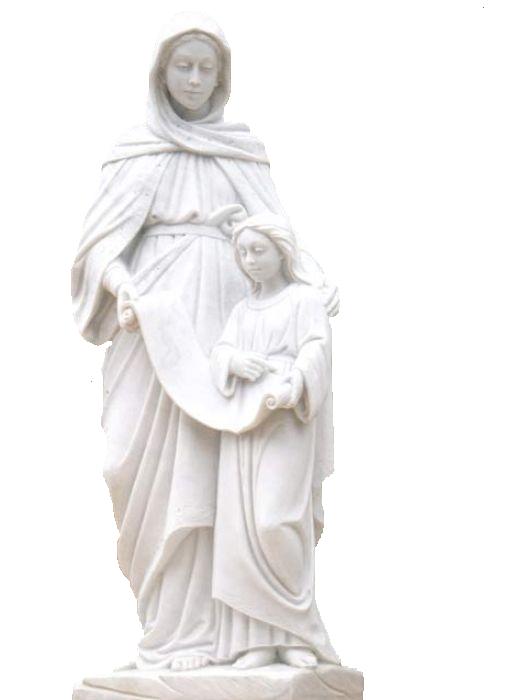
The Child Mary — September 8 – Nativity of Mary

September 8, 2010

Nine months ago we celebrated Mary’s Immaculate Conception. Today we celebrate her birthday. By my estimation, Mary is now about two thousand, twenty-five years old, but if you saw her I’m sure she wouldn’t show her age. How old does Mary seem when you picture her in your mind? I’d bet that you think of her as fully-grown up; like your mom or your teachers. But today’s feast reminds us that she was once your age too.

Mary was little once too, and just because Mary lived a life without sin doesn’t mean that her childhood was a bed of roses. I think adults sometimes forget how hard and stressful things can be when you’re little, but Mary remembers everything perfectly well.

She remembers what it was like to be little like many of you. How she got scared when Nazareth’s big, neighborhood dogs would bark at her. How loud cracks of thunder frightened her at night and made her hide under the covers. She remembers how other girls made fun of her, for being different or weird, and she remembers how she cried. But even when she got sad or scared, Mary knew that she was loved and not alone. Not only did her parents love her, but she was convinced of God’s love, too, and understood that He was never far from her. This consoled Mary and reassured her that everything would be alright.

After our resurrection, when we get glorified bodies like Mary has now, we will have some new abilities. We will be able to go anywhere we want in an instant. And our glorified bodies should allow us to be more than one place at once. (It only makes sense that if saints on earth can bi-locate, then the  saints in Heaven should be able to as well.) And I also suspect that we will be able to change ourselves back and forth to whatever age we choose.

All this is to say that if at any moment you want Mary to be with you for consolation and support, you only need to ask her. Knowing her abundant love, I can’t imagine she would refuse. And when you think of her with you feel free to picture her at your age, even if you’re little. She understands you, loves you, and can relate to your situations more than you know. Like her Son, Mary is always with us, especially when we ask her be.

Gospel Movies

July 1, 2010

Below are five original shorts drawn from the Scriptures. Click the images to watch them.

Teddy Bear Annunciation


The Annunciation of the Archangel Gabriel to the Blessed Virgin Mary; the Gospel of Luke, chapter 1, with teddy bears.

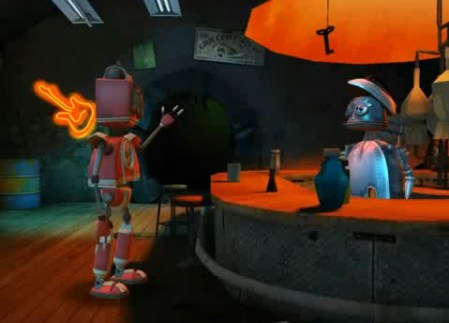
Robot Jesus at the Watering Hole

 
Jesus meets the woman at the well; the Gosple of John, chapter 4, starring robots.

The Rich Young Rapper

 
A rich young rapper questions Jesus on the subway; a remix of Matthew, chapter 19 and Mark, chapter 10.  

Doubting Thomas

 The resurrected Christ appears to a skeptical disciple in the Gospel of John, chapter 20.

The Importance of the Resurrection


From St. Paul’s 1st Letter to the Corinthians, chapter 15.

Farewell, and Farewell — Friday, 7th Week of Easter

May 23, 2010

When you were younger, your parents dressed you, and you were often led where you did not want to go. But now that you are older, you dress yourselves and more than ever you go where you wish.

As this school year ends, you take another step into the maturity of your youth. Soon you will be leaving school. Some of you will be leaving for the freedom of summer. You seniors will be leaving to begin the rest of your lives.

Your new freedom calls on you to make important choices about Christ. Now the question comes to you: Do you love Him? Do you want to respond like Simon Peter in the high priest’s courtyard, with a non-committed shrug as you walk away? Or will you choose to respond like St. Peter the Rock, who said, “Yes Lord, you know that I love you,” and then lived a life which proved that love.

Jesus asks you, “Do you love me?”  How are you going to answer Him?  Jesus asks you to do at least these things: to pray every day, to attend Mass every week, and strive to do His will every day.

Freely give your freedom to Jesus. He has given you everything good that you are. He has given you everything good that you have. Give it all to Him and stand in His will. His love and His grace are more than you know. He wants to give you more than you can ask. Jesus asks you, “Do you love me?” Follow Him.

Peter’s New Season — 3rd Sunday of Easter

April 20, 2010

Once, when Jesus was preaching as he stood on the shore of the Sea of Galilee, a large and eager crowd was pressing in on Him.  So Jesus got into a fisherman’s boat and asked him to put out aways so that He could sit and teach the crowds. The tired fisherman complied. And after Jesus had finished speaking, He said to this fisherman, “Put out into deep water and lower your nets for a catch.” The fisherman said, “We have worked hard all night and have caught nothing, but at your command I will lower the nets.” When they had done this, they caught an incredible number of fish such that their nets were tearing. And Jesus said to the startled man, “Do not be afraid. From now on you will be catching men.” As you probably remember, the fisherman was Simon Peter, and from that day on his life entered a new season. For the next few years Simon Peter would follow Jesus and evangelize towns on His behalf.

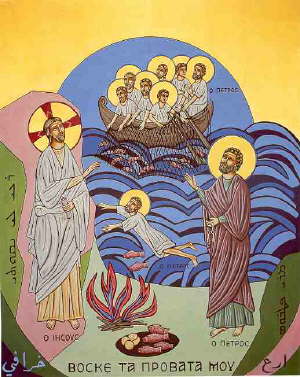
In today’s gospel, from the days after the resurrection, Peter is fishing again. And once again, Jesus is there on the shore. They have caught nothing, but Jesus says to try once more, and they catch an incredible number of fish. When Simon Peter realizes it is Jesus he eagerly comes to Him as fast as he can. He finds Jesus beside a charcoal fire. This should be familiar to Peter, too, calling to mind  another charcoal fire in the dark courtyard of the high priest.

After sharing a meal, Jesus says, “Simon, son of John, do you love me more than these? Do you love me?  Do you love me?” Simon Peter says, “Yes, Lord, you know that I love you. Yes, Lord, you know that I love you. Lord, you know everything; you know that I love you.” Jesus has given Peter the opportunity to undo his triple denial of Jesus with a triple confession of his love. And after each time, Jesus speaks of a new season for Peter’s life: “Feed my lambs. Tend my sheep. Feed my sheep.”

Now it is one thing to catch fish, but it is another thing to shepherd a flock. Up to now, Peter has been following Jesus and bringing others to Him. But now Jesus is asking Peter to do something new, to shepherd His flock for Him. Do you think Peter nervous? Is he concerned about whether he is up to the task? Is he worried about being led where he doesn’t want to go? I bet he is, but Jesus would have him ‘not be afraid,’ for he won’t be doing it alone. Jesus says to Peter, “Follow me.”

Our lives are often entering new seasons. Maybe you’re moving into a new town or a new school. Maybe you’re transitioning from engagement to marriage, welcoming new children, or living for the first time without children in the house. Maybe you have a new job, or don’t have a job for the first time. But whatever season of our life Jesus calls us into, His calling and our mission remain the same. Jesus said, ‘”I give you a new commandment; love one another as I have loved you,” and ” “There is no greater love than this, than to lay down your life for a friend.” Every new season of life offers us the unique opportunity to deepen our love for Christ and each other more than ever before.

Maybe you feel nervous? Maybe you’re concerned about whether you are up to the task? Maybe you’re worried about being led where you don’t want to go? But remember Simon Peter and don’t be afraid.  Jesus gives lots of second chances and He does not expect us to do it alone.

Faithful Despite Doubts — Divine Mercy Sunday—2nd Sunday in Easter—Year C

April 11, 2010

Thomas, called Didymus, one of the Twelve, was not with them when Jesus came. So the other disciples said to him, “We have seen the Lord.” But he said to them, “Unless I see the mark of the nails in his hands and put my finger into the nailmarks and put my hand into his side, I will not believe.”

Why is “Doubting” Thomas so slow to believe. Why is Thomas so reluctant to trust? A clue might be found in the gospel’s interesting inclusion of Thomas’ Greek nickname: Didymus. Didymus means “twin,” but in relation to whom was Thomas a twin? Some speculate that Thomas the Apostle bore a striking resemblance to Jesus Himself. This tradition is sometimes reflected in iconography where Thomas is the apostle who looks a lot like Jesus.

If this is why Thomas was the apostle called “the twin” then we can understand his rational skepticism. How many times during Jesus’ ministry had people come up to Thomas and said, “O Jesus, we’re so happy to see you! We’ve walked for miles to see you again!” Then, with some annoyance, Thomas might have answered, “We’ll you’ll have to walk a little bit further. Jesus is over there.” So now, when the other disciples come up to Thomas after Easter and say, “We have seen the Lord,” Thomas replies, ‘I’ll need more evidence than that.’

Thomas’ resistance to believing the good news about Jesus might not only be coming from his mind, but also from his heart. Jesus was Thomas’ hero, his teacher, and his close, beloved friend. Thomas thought that Jesus was going to be the savior and messianic king of Israel. But their close relationship and all of Thomas’ great hopes were destroyed for him at the crucifixion. Imagine how Thomas might have prayed then: “My God, why have you let this happen? How could you let Him be taken instead of me? Jesus was so good! He was completely innocent, and you let Him be die! Why?”

The unexpected death of Jesus broke Thomas’ heart, and having been so hurt once, Thomas was resolved not to let his heart be taken in again: “Unless I see the mark of the nails in his hands and put my finger into the nailmarks and put my hand into his side, I will not believe.”

Yet, though he doubts, notice where Thomas is one week after Easter. He is with the other apostles in the upper room in Jerusalem, gathered behind locked doors for fear of the authorities who killed Jesus. Now there are lots of other places Thomas could have chosen to be. There were safer places he could have gone, like back to his hometown and to the extended family and friends he had left behind to follow Jesus a few years before. Though Thomas doubts, he does not leave this house of faith. He struggles with his faith, but does not abandon it. He seeks within this house of faith, this Church, and because of it, Thomas finds sufficient evidence for his mind and healing for his heart.

The risen Lord appears in the upper room and how does Jesus respond to Thomas’ resistant unbelief? Not with anger.  Not with condemnation.  But with the divine mercy we celebrate today. Jesus appears in their midst and says, “Peace be with you.” Then he says to Thomas, “Put your finger here and see my hands, and bring your hand and put it into my side, and do not be unbelieving, but believe.”

In our lives we too will struggle with our faith and our doubts, with our emotions and with our thoughts, in our hearts and in our minds. Jesus does not condemn our honest struggles. But Jesus wants us to sincerely seek within this house of faith; this, His apostles’ Church, where the truth and healing is found by all those who seek Him.

Easter Endures — Easter Friday—Year C

April 11, 2010

For the rest of the world, today is the second friday of April. For us, today is Easter. The rest of the world has gone back to life as before, but we in the Church continues to remember and celebrate Easter.

In the Gospel we see Peter and some of the disciples going back to their old ways, back fishing in Galilee. And in the first reading we see the Jewish leaders, elders, and scribes operating just the same as before. But they all get reminded that Easter has changed everything.

So let’s not forget the graces we received this Triduum. And let us remember that in these “last days” every day is Easter and that our lives and our world will never be the same as before.

Jesus’ Resurrected Body — Easter

April 7, 2010


On Holy Thursday, we meditated on the disciples’ feet. On Good Friday, our Saviour’s hands.  Today, let us consider Jesus’ resurrected body.

Jesus’ resurrected body is the very same that died and was buried, but it is a very different body, too. The tomb was empty on Easter morning, not because Jesus’ body was vaporized, but because it was raised.

Jesus’ resurrected body has wounds, in his hands and feet and side, showing that this is the same body that suffered on the cross. It seems that the cuts and bruises on Jesus’ face and the lashes on His back are healed, but these five wounds remain. Why? These wounds are trophies and jewels.  They no longer cause Him pain, but they testify to Jesus’ greatness and love and He will have them forever.

So Jesus’ resurrected body is the very same body that died on the cross and was buried in the tomb, but it is a very different body. For instance, Jesus in His glorified body can cause others to see but not recognize Him, as He did on Easter evening with two disciples on the road to Emmaus. Only later, in the breaking of the bread, did they recognize Him. Then Jesus displayed another new power, disappearing from their sight. In His glorified body Jesus can move at the speed of thought and the walls and locked doors of the upper room do not prevent Him from appearing in the midst of the apostles.

In this there is a sign for the future of humanity. People often speak of “the end of the world” and imagine Heaven in strictly spiritual terms, but just as Jesus’ body was not annihilated but transformed, so our bodies and this universe will be remade. A glimpse into the future of the righteous is reflected in the resurrection of Christ.

Jesus’ body is not discarded, but gloriously transformed. In this there is a lesson for us. In (just about) every  life, there is a line that we have drawn in our relationship with God. It is a self-imposed limit on our trust, commitment, and self-gift towards Christ. “Lord, I will walk with you that far, (but no farther.)”

Perhaps we are unwilling to cross that line with us because we are too attached to the sins and mediocrity we have settled for, maybe we are afraid that we will lose who we are and become something that we are not, or maybe we are afraid that a total self-gift to God won’t truly make us happy. The devil likes this arbitrary line. He would like you to reach the end of your life and have to wonder with regret, “What would my life been if I had gone all-in for God?” The devil would have you fearful and repulsed of “the cross, the cross!” but the cross is not the end of our story.  Remember, as in Christ, God does not want to destroy you, but to transform you into who you truly are.

Do you believe Jesus suffered and died for you? Then He surely loves you. If He loves you, then how could He not desire your greatest happiness? Do you believe Jesus is divine and all-knowing? The surely He knows what will lead to your greatest good. Do you believe Jesus is all-powerful? Then surely He has the power the lead you to that good. Then what is standing in His way? There is only one thing standing in the way of His omnipotent power, preventing Him from transforming us into who (deep down) we truly want to be. That obstacle is our own freewill, the arbitrary line we draw in our relationship with Christ.

This Easter, let us be resolved to follow Christ without compromise. Let us entrust our whole selves to Him who has given us everything. Jesus does not want to destroy you, but to gloriously transform you into who you truly are.

A Premature Passion? — Palm Sunday—Year C

March 28, 2010

So why did we just proclaim the Passion?  Isn’t the Passion a bit premature? It’s Palm Sunday, not Holy Thursday or Good Friday. Aren’t we jumping the gun? No, like the two disciples Jesus instructed in our opening Gospel, we’re being told what we are going to see. The Church has us recount the Passion on Palm Sunday to prepare us; to prepare us for encountering Christ’s Passover through the special ceremonies and symbols of this Holy Week.

Now the celebration of the Eucharist actually makes the events of the Pascal mystery present for us every time we come to Mass. Jesus’ Last Supper, His Passion and Death, His Resurrection and Ascension into glory, are all truly presented to us at each and every Mass; but during Holy Week, we unpack and encounter these events in unique and special ways.

Today you have waved palms, an ancient symbol of victory, to Christ, welcoming Him into our city. On Holy Thursday, you can go where the Blessed Sacrament is reserved and give company to Christ in his lonely solitude, with Him in His agony before His arrest and with Him as He spends the night awaiting His trial. On Good Friday, you can reverence the crucifix; you can kiss the wood of Jesus’ cross and kiss His body hanging upon it, as He dies for us. And at the Easter Vigil, you can see the sign of the light of Jesus Christ resurrecting out of darkness and death.

And so I invite you to encounter Jesus’ Pascal mystery, at this Mass, at every Mass, and through the special signs and ceremonies of this Holy Week.

Mary and Pilate — 6th Sunday in Ordinary Time—Year C

February 14, 2010

In a few moments, after this homily, we will recite our creed, the summary of our faith. Every Sunday, we profess, in union with the Christians who came before us, our belief in these truths and our resolve to live our lives according to them. This morning we will look at just one rich aspect of our creed and consider its implications for our lives.

Have you ever noticed that in the entire creed, only two non-divine persons are mentioned by name? These are the Virgin Mary and Pontius Pilate.

“By the power of the Holy Spirit, He was born of the Virgin Mary and became man. For our sake He was crucified under Pontius Pilate; He suffered, died and was buried.”

Now many other figures from the Old and New Testaments could have justifiably been included in our creed; such as Adam and Eve, Abraham, Moses, David, Mary Magdalene, Peter, Paul, and many others. Yet, only Mary and Pilate get mentioned. So why is this? There seems to be two very good reasons. The first of these reasons I will give now—and the second I will save for the end.

The first reason why Mary and Pilate receive special mention is that they ground Jesus’ life, death, and resurrection in our real history. Jesus was ‘born of the Virgin Mary, suffered and died under Pontius Pilate, and on the third day, He rose again.’ Now other pre-Christian religions sometimes had stories about dying gods who came to life again, but those stories were always said to have happened ‘once upon a time,’ in some remote and mythic past. But with Jesus Christ, this ancient intuition and longing of humanity is actually realized. The inclusion of Mary and Pilate in the creed witness to this: that God became man, died, and rose for us, in this world and in real history.

Some people try to be too sophisticated by saying it doesn’t really matter if Jesus rose from the dead, or even if He lived at all, because His teachings are what’s important. But St. Paul blows this idea out of the water. “If Christ has not been raised, your faith is vain; you are still in your sins. Then those who have fallen asleep in Christ have perished” and “we are the most pitiable people of all.” Without Jesus Christ and His resurrection there is no Gospel, there is no Good News.

Just like Jesus Christ, Mary His Mother and Pontius Pilate His executioner are not fictional characters made up for some story. They are real people, from a time not that much different from our own. Our styles and technologies may have changed, but human beings themselves remain much the same. When we look at Mary and Pilate we can see ourselves in these two people whom Christ encountered twenty centuries ago.

Pilate is the secular Man of the World.
Mary is the devoted Disciple of Christ.

Pilate seeks the glory of men.
Mary seeks the glory of God.

Pilate knows worldly wisdom, he is clever and cunning.
But Mary knows God’s wisdom, and she is truly wise.

Pilate thinks he knows how the world works and the pragmatic way to get things done. For Pilate, our world is totally shaped by of power, money, and influence, with some blind luck thrown into the mix. When Jesus stands silent before him, Pilate says, “Do you not speak to me? Do you not know that I have the power to release you and I have the power to crucify you?” Jesus replies, “You would have no power over me if it had not been given you from above.”

Pilate is a very post-modern man.  He’s a moral relativist. When he asks Jesus, “What is truth,” he doesn’t bother to wait for an answer from Truth Himself. That’s because Pilate thinks that the ‘truth’ cannot be known except for the ‘truths’ which we choose for ourselves or impose upon others.

The Gospels show that Pilate knows Jesus is innocent, or at least that he poses no real threat to society, yet Pilate is willing to have this innocent man whipped and even crucified when that becomes the most expedient thing to do. The crowd threatens Pilate, “If you release him, you are not a friend of Caesar,” and he quickly caves and hands Jesus over.

Pilate washes his hands of responsibility, and extends Christ’s arms on the cross. Mary had extended her arms declaring, “Let it be done to me according to your word,” and lovingly held the infant savior in her hands.

Pilate, despite all his power, is ruled by fear.
Mary, despite her weaknesses, is freed from it.

Governor Pilate is rich in wealth and power and yet he has no peace.
Mary, the poor widow, has peace and everything she needs from God.

Pilate has no faith in the God of Israel. He says, “I am not Jew, am I?” But for Mary, God is her rock and this makes all the difference in the world. Mary is defined by her faith, hope and love.

Mary never attends an academy, but she is profoundly wise because she reflects in her heart on the words and deeds of God and because she lives by her own advice: “Do whatever he tells you.” She knows that we do not manufacture the truth for ourselves, we receive it, ultimately from God. We love it, we defend it, and we share it with others. “Blessed [is she],” as Elizabeth said, “who believed that what was spoken to [her] by the Lord would be fulfilled.” Mary trusted and believed, for she saw the evidence through history that God “has mercy on those who fear Him in every generation,” that “He scatters the proud in their pride, and casts down the mighty from their throwns, but He lifts up the lowly.”

Mary’s life was full, but was not free from trials. When Mary consents to be found with child through the Holy Spirit she is uncertain of what will happen to her, but she trusts in God. She does not know how she and her husband will get by as poor immigrants in foreign country, but she continues to trust. Mary’s response to every trial in life, even to the death of her son, is to trust in God. Despite men’s sins, she trusts in God as the Lord of history, that He casts down the proud and mighty from their throwns and raises up the lowly.

Pilate is indifferent to Christ, and he consents to sending Him to the cross, but Mary is wholly devoted to Christ, and she consents to share in His Passion. Pilate’s heart is hardened despite Christ’s Passion, while Mary’s heart is pierced by it.

Governor Pilate was once the most powerful man in Judea, but where is he now? Mary, the poor widow, is now our glorious queen, the most beautiful and powerful woman in heaven or earth, and through her reign she draws millions to Christ our king.

She is the one who wept and now laughs.
He is the one who laughed and now weeps.

He was rich in the world and now he is poor.
She was poor in the world and now the kingdom is hers.

He took root in the desert, he was barren and uprooted.
But she was planted beside the flowing waters, she endured and bore much fruit.

So what do all of these reflections about Mary and Pilate have to do with us? I promised you at the beginning a second good reason why Mary and Pilate are mentioned in the creed; and here it is: Mary and Pilate represent us. They stand as archetypes, models or patterns, for every person.

The faithful one and the faithless one.

The one who serves God and the one who serves himself.

The one who gives Christ life and the one who puts him to death.

We live our daily lives as either Mary or Pilate, with shades of the other thrown in. As we come to the season of Lent, let us examine and discern who we are. “How am I Pilate, and how am I Mary?” And at this Eucharist, let us ask Jesus to exchange in us the ways of Pilate for the ways of Mary, for hers is the way of Christ.

5th Sunday of Easter—Year B

August 23, 2009

This Sunday our country celebrates our mothers—and rightly so.  For the care and love which our mothers have given us cannot be measured or given a price.  Of course, our earthly parents are not perfect. Sometimes they’re quite far from perfect.  But any love we’ve known from them is a likeness of the love God has for us. A religious icon is made of mere wood and paint, but it can be a window to heavenly realities. In the same way, we can see through our parents’ love a glimpse to God himself.

Most of us have more memories about our mothers than we could possibly count, but today I would like to go with you back to a time and place about which you have no clear memories—to the time in your mother’s womb. Just as the Hebrews were 40 years in the desert; just as Jesus prepared 40 days in the wilderness; and just as Christ rested 40 hours until his resurrection from the tomb; so you remained 40 weeks, more or less, within your mother’s womb, being prepared for a new life.

Through your mother’s vine you grew into the mature fruit of her womb. You were nourished and grew within her. You were never far from her heart or mind. You existed in within her, connected to her at the center of your being.      She fed you with her very self. She provided for all your needs. Apart from her, you could do nothing. You remained in her and found rest in her.

At the early stages of our life in the womb, our minds did not comprehend very much, but what if you could have understood everything that your mom was doing for you at the time? Certainly you would have directed your thoughts to her often.  And certainly, from time to time, you would have turned to her with the eyes of your heart to bask in her love for you.

And imagine further what if you could have talked with your mom from the womb? Would you not have taken the opportunity to speak with her every day? Would you not have thanked her daily out of a deep gratitude? Would you not have let her know each day how much you love her? Whoever would refuse or neglect to do so would continue to live, at least functionally or biologically, but the person would not be fully alive without this relationship .

As you and your mother would continue to talk as the days and months of pregnancy passed, she would eventually present you with a most-frightening prospect: She might say, “My child, soon, in a little while, you are going to begin an new stage of life. You will be departing from the life you know, and then you’ll experience a world of people and things you have never known before.” But you would say, “I’m scared, I don’t want to go, not now, not ever!” But she would say, “I realize this concept is scary for you, but trust me when I say that it is better that you go. In fact, someday soon you’ll look back and think it a silly thought to be again as you are now. This transition is going to hurt a little bit… trust me, I know… but when the appointed time comes, I’ll be right here with you. Do not be afraid.”

This morning we reflect on this time in the womb because our life in our mothers is like our life in Christ. As it was with our mothers, so it is, in this life, with Christ. You are nourished and grow within Him. You are never far from His heart or mind. You exist in within Him, connected to Him at the center of your being. He feeds you with His very self. He provides for all your needs. Apart from Him, you can do nothing. You remain in Him and find rest in Him.

Knowing and believing this, shouldn’t we direct our thoughts to Him often? Shouldn’t we, from time to time, turn to Him with the eyes of our hearts to bask in His love for us.

We have the ability to talk with Jesus Christ. Who would not take the opportunity to speak with Him every day? Who would not thank Him daily out of deepest gratitude? And who would not let Him know each day how much we love Him? Whoever would refuse or neglect to talk with Him, that is to pray, would continue to live, at least functionally or biologically, but the person would not be fully alive without this relationship with Jesus Christ. We need to pray every day if we want to remain in Him and to bear much fruit.

None of us want to die and that’s perfectly natural. But Jesus says to us, “Soon, in a little while, you are going to begin a new stage of life. You will be departing from the life you know, and then you’ll experience a world of people and things you have never known before. I realize this concept is scary for you, but trust me when I say that it is better that you go. In fact, someday soon you’ll look back and think it a silly thought to be as you are now again. This transition is going to hurt a little bit… trust me, I know… but when the appointed time comes, I’ll be right there with you. Be not afraid.”

Today, let us thank God for the gift of our mothers and the gift of Jesus Christ.  God bless our mothers, and praised be Jesus Christ.

2nd Sunday of Easter—Year B

August 23, 2009

Jesus said to “Doubting” Thomas, “Have you come to believe because you have seen me? Blessed are those who have not seen and believed.”

This gospel passage has a very fond and special place in my heart, because when I was younger it used to really tick me off. If I had had my choice between either seeing and believing, or not seeing and being blessed, I’d have picked the seeing option every time. But now looking back, I realize  that if Jesus had actually appeared to me in a vision that would have just raised more doubts and questions in me. I once shared my various frustrations about faith and doubt with a priest.  After he had patiently listened, He suggested that perhaps I was going through these kinds of trials so that I could help others through similar trials someday.  At the time, that also ticked me off… but he was right. I hope that six lessons I’ve learned in the years since will be of help for you today. Today the Church celebrates Divine Mercy Sunday, but on account of Doubting Thomas one might also call it Doubter’s Sunday. I feel a lot of mercy for the doubters out there, and Jesus does too.

Lesson One:  Jesus does not condemn the honest doubter, the sincere questioner, the genuine seeker.

When Jesus appears to doubting Thomas notice that he is not angry with him.  He says, “Peace be with you!”  Then he says, “Put your finger here and see my hands, and bring your hand and put it into my side, and do not be unbelieving but believe.” The Gospel does not say whether Thomas actually took Jesus up on touching his wounds, but Jesus was not patronizing him when he made the offer—it was an sincere invitation that met Thomas where he was at.

Still today, Jesus is not angered by our honest questions.  In fact, it is a compliment to him to ask tough questions of our faith because it shows that we believe there are good answers out there to be found. Honest questions make our faith stronger, not weaker. However, our questioning must be sincere. We must not build a comfortable home upon our doubts, doing nothing to answer or resolve them. This sort of questioning is not sincere, but often self-serving.  Jesus wants to give to those who ask, to reveal to those who seek, to open for those who knock, so that they will not be unbelieving, but believe.  But, when we refuse to ask, or to seek, or  to knock, we frustrate the Lord.  Jesus is pleased, however, by the genuine seeker because the genuine seeker will find him.

Lesson Two:  Having beliefs is unavoidable and our faith is reasonable.

Some people object to faith saying that “reason” or “science” is certain while “belief” is doubtful.  But in reality, all of our knowledge depends upon trusted beliefs. We cannot live, or even reason, without accepting beliefs. Before the scientist calmly walks across the street he assumes a thousand things without certain proof of them. We can learn many valuable things from science, but science itself cannot prove all of its own assumptions. There are even questions that science cannot answer, such as the transcendent goodness, worth, or purpose of things. Our faith answers such questions and our faith is not unreasonable. Our true faith is no more in conflict with reason than the truth could contradict the truth. Not everyone shares our faith, but you cannot live as fully alive without it.

Lesson Three:  If you ever worry about whether you really believe in God, you shouldn’t be worried.

Some people experience real spiritual anxiety when they ask themselves, “Do I really believe in God?” Realize this: people who don’t believe in God, don’t spend time worrying about whether they believe in God. Only a believer would do that. So if you ever worry about your belief in God, you shouldn’t be worried; you’re actually a believer and your mind should be at ease.

Lesson Four:  You already have enough faith to do what Jesus asks of you today.

Some people say, “I believe in Jesus Christ, but I just don’t have enough faith to do what he wants me to do.” These people experience a spiritual paralysis: they’re waiting for faith to show up, before they’ll take the next step in living the Gospel, whatever that might be. They’re actually psyching themselves out. They are like the apostles who once begged the Lord, “Increase our faith!” Jesus told them if they had faith the size of a mustard seed they could uproot trees or mountains with a word and plant them in the sea. At first this might seem like a word of discouragement, but it is actually a word of hope. Your tiny, microscopic speck of faith is already enough for you to accomplish everything Christ asks of you today. Your faith right now may be only a pinhole-sized trust in him, but the God who can fit a camel through the eye of a needle can pour a river through your pinhole-sized faith. You already have enough faith to do what Jesus asks of you today.

Lesson Five:  Faith grows through being exercised.

We often keep very low expectations of God.  Maybe we think that if we don’t expect too much from him he won’t expect too much from us. Or maybe we think we won’t be disappointed by him, if we never get our hopes up. In this way our faith stays small. Our faith, which is our openness to the Gospel and our trust in Jesus Christ, remains small and weak because our faith is so rarely exercised. Do we really want to come to the end of our lives and have to look back and wonder what our lives could have been if we had committed ourselves more completely to Jesus Christ and his Gospel?

Consider this question:  If you had all the faith in the world, how would you pray, what would you pray for, and what would you do? If you want to see you faith grow, if you want to see the power of Jesus Christ active in your life, then try doing these things today.

Now sometimes Christ comes out of nowhere and powerfully reveals himself to those who have never really striven for him, or even looked for him, but it is more often the case with Christ that the more we give him the more we get. Imagine you hold in your hand seeds which symbolize your life; your time, your talents, and your treasure. You received all these seeds from Christ as pure gift. As long as we cling to the seeds in our hand, they will never bear fruit. But once we begin letting Christ plant these seeds, and we see the good fruit they produce, we will eagerly give him more and more. In this way, our faith grows through being exercised.

And finally, the sixth lesson:  Faith is about trusting in Jesus Christ.

Faith is not so much about generating a certain feeling, or a feeling of certainty, about particular facts.  The demons know that Jesus is Lord—and shudder. Faith is more about trust, trusting in a person who is worthy of our trust, Jesus Christ. Living-out such trust requires a personal relationship of knowledge and love with him.

What might be holding us back in the life of faith could be that we have unresolved sins, past and present, impeding our relationship with Christ. This Divine Mercy Sunday we celebrate the infinite mercy God shows toward all those who ask for it. Through the sacrament of reconciliation, we can receive a fresh start, a clean slate, an infusion of grace, a healing of the heart and mind, a full restoration of personal relationship with Jesus Christ.

Whenever I go to confession, I encounter Christ through the priest, like Thomas encountered Jesus in the upper room. Jesus enters into the locked inner room of my heart, where I would otherwise hide out of fear on account of my sins. I see his wounds, I admit the ways that I helped to put them there, and I tell him I’m sorry. And his response is always the same: mercy. “Peace be with you. Your sins are forgiven.” Confession gives us pardon and peace, it increases our trust and love for Jesus Christ, and strengthens our faith in him.

This Divine Mercy Sunday, let us pray the prayer that he has given us for our uncertain times: “Jesus, I trust in you.”

Tuesday, 16th Week in Ordinary Time—Year I

August 16, 2009

The book of Exodus says,

“In the night watch just before dawn the Lord cast upon the Egyptian force through the column of the fiery cloud a glance that threw them into a panic; and he so clogged their chariot wheels that they could hardly drive.”

Israel would soon see those Egyptians lying dead on the seashore.

During another night watch, many, many years later, as one Sunday was dawning on a tomb outside the walls of Jerusalem, an angel of the Lord descended from heaven. As the Gospel of Matthew describes it,

“His appearance was like lightning and his clothing was white as snow. The guards [there] were shaken with fear of him and became like dead men.”

When Pharaoh’s Egyptians saw the glance the Lord cast through the column of the fiery cloud they sounded the retreat before Israel, because the Lord was fighting for them against the Egyptians.

Since the resurrection of Jesus, the spirits of evil have been on a retreat, because the Lord is fighting for us against them. Their uneven retreat continues today, but we shall witness their total defeat. Then, the book of Revelation says, we who followed the Lord shall sing among the angels the “song of Moses,” or something like it.  And, in the presence of God our Father, Christ our brother, Mary our Mother, with the saints and one another as brothers and sisters, with the Holy Spirit as our bond, we will rejoice at the Lord’s victory for us.