Archive for the ‘Second Coming’ Category

Greet Him At His House

August 9, 2025

19th Sunday in Ordinary Time
By Fr. Victor Feltes

Today’s Gospel is first and foremost about the Second Coming of Christ and our judgment on the Last Day. Jesus Christ, who called himself the Son of Man, said that in the End Times “the sign of the Son of Man will appear in heaven, and all the tribes of the earth will mourn, and they will see the Son of Man coming upon the clouds of heaven with power and great glory.” The Book of Revelation agrees: “Behold, [Jesus Christ] is coming amid the clouds, and every eye will see him, even those who pierced him… ‘Behold, I am coming soon. I bring with me the recompense I will give to each according to his deeds.’” “But of [the timing of] that day and hour,” Jesus says, “no one knows, neither the angels of heaven, nor the Son, but the Father alone.” (The Son of God is divine and therefore knows everything, but in his humanity Jesus apparently did not know the date or was not supposed to reveal it.) Could Jesus Christ return during our lifetime? Of course. But even if Christ returns a thousand years from now we should still heed his warning to be prepared today, for we do not know the day and hour of our deaths when he will judge our souls and deeds.

Jesus’ parable about the returning master and his servants suggests another secondary interpretation. Consider the story’s details. The master has come from a wedding. He comes to his own house. He wants his servants to be there, ready to greet him. And in response he will “have the servants recline at table and proceed to wait on them.” And “should he come in the second or third watch” (when it is darkest and most inconvenient) and find them present, attentive, and well-prepared, those servants will be greatly blessed. So where is the Lord Jesus’ house to which he returns? Where does he want his servants to be present and pleased to see him? Where would he have his faithful servants rest, partake in a meal served by him, and receive his blessed rewards? This church is his house. We are his servants. And Jesus wants us to meet him here for a meal. Our Lord arrives here joyfully from a wedding. He wedded the Church to himself two thousand years ago. And the Holy Mass extends that mystery throughout time and space to here and now. Indeed, ‘blessed are those called to the wedding supper of the Lamb’ and who are here and ready to greet him.

Yet, for too many people, the precious time of Sunday Mass is an hour when they do not expect the Son of Man to come. Despite our many scheduled weekend Masses, they still do not attend. Others show up out of obligation or custom or habit, but fail to be attentive. Perhaps they do not yet believe—despite Scripture, ancient teaching, and centuries of miracles—that Jesus Christ is truly present in the Holy Eucharist. Or perhaps they do not yet realize that they are not mere spectators at Holy Mass but offering a sacrifice with the priest and the whole community, the eternal offering of the Son to the Father, through which everything united to Christ is raised up to heaven and grace and blessings are poured down to earth in return.

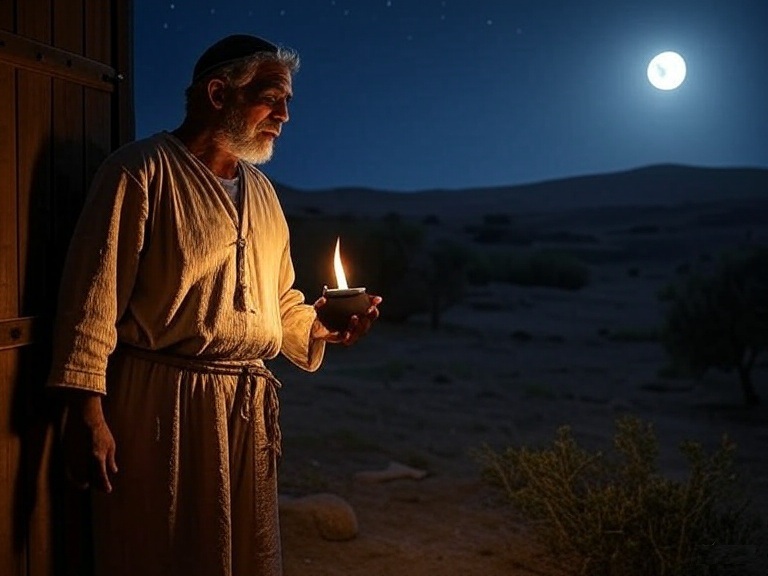
Be present and be vigilant. Distractions will come to anyone who is committed to regular Massgoing and daily prayer, but do not be discouraged by the times your thoughts accidentally wander. Every decision to turn your attention back to the Lord is another act of love and devotion. Sometimes those so-called distractions are actually things the Lord wants you to pray about or offer up to him. Ask the Holy Spirit and he will help you to pray as you ought, to gird your loins with reverence and light your lamps with faith and be like servants who are glad and blessed upon their master’s return from a wedding.

Jesus Christ Is King

November 24, 2024

Solemnity of Christ the King
By Fr. Victor Feltes

Today’s psalm says: “The Lord is King, in splendor robed… Your throne stands firm from of old… Your decrees are worthy of trust indeed…” The Old Testament prophets agreed. Isaiah said “the Lord is our King, it is he who will save us.” Jeremiah said our God “is the living God, the eternal King.” And Zephaniah said “the King of Israel, the Lord, is in your midst.” At the center of human history, when Jesus Christ is born among us, he comes as King as well.

Behold, magi from the east arrived in Jerusalem, saying, ‘Where is the newborn king of the Jews?’” And when Jesus rode into Jerusalem, the crowd cried out, “Hosanna! Blessed is he who comes in the name of the Lord, even the king of Israel!” Pontius Pilate unknowing proclaimed this truth when he had a sign placed above Christ’s head on the Cross: “This is Jesus the Nazorean, the King of the Jews.” This Sunday, we celebrate that our Lord Jesus Christ is King of the universe now.

After his Resurrection, when Jesus appeared to his apostles on a mountain in Galilee, he told them, “All power in heaven and on earth has been given to me” and he gave his Church our Great Commission to spread his Kingdom, reassuring us, “Behold, I am with you always, until the end of the age.” This raises a challenging question for us: why is Jesus not visibly doing more now? All power in heaven and on earth has been given to him, so why is he not making more things happen?

His disciples wondered about this, too. Before the Risen Jesus ascended into Heaven, they asked him, “Lord, are you at this time going to restore the Kingdom to Israel?” He answered, “It is not for you to know the times or seasons that the Father has established by his own authority. But you will receive power when the Holy Spirit comes upon you, and you will be my witnesses in Jerusalem, throughout Judea and Samaria, and to the ends of the earth.” The Kingdom of God is among us, and Jesus calls us to work with him to spread it and deepen it, everywhere in everyone.

But why doesn’t Jesus just force everything to be better? As God, he is omnipotent. He has the power to do all possible things. But one thing he cannot do is to force someone’s free “No” into a free “Yes.” When Jesus returns in unveiled glory, coming upon the clouds and flanked by his angels in full-force, humanity’s time for decision will be over. That day will bring the Last Judgment and sin will no longer be given any quarter. After that, there will be only God’s Kingdom and the outer darkness. Now is the time for freely choosing.

Do we desire God’s Kingdom? Around 1000 B.C., the elders of Israel came to the Prophet Samuel asking, “Appoint a king over us to rule us like other nations.” Samuel was displeased they said, “Give us a king to rule us,” but he brought the matter to the Lord in prayer. And the Lord replied: “Listen to whatever the people say. You are not the one they are rejecting. They are rejecting me as their king.” And during Christ’s Passion, Pilate asked the crowd, “Shall I crucify your king?” The chief priests answered for the mob, “We have no king but Caesar.” They were rejecting the Lord as their King. When we pray “thy Kingdom come, thy will be done, on earth as it is in Heaven,” do we really mean what we are saying?

When Pilate asked Jesus if he was a king, Jesus answered, “You say I am a king. For this I was born and for this I came into the world, to testify to the truth. Everyone who belongs to the truth listens to my voice.” Pilate then responds with a line which today’s Gospel reading cuts off. Pilate dismissively replies, “What is truth,” and then turns his back on Truth himself, and walks away. If you desire Jesus as your Savior, you must let him be your Lord.

Advent begins next Sunday—our annual season of preparation for the coming of the Lord. Here are three wise steps for a better Advent. First, his decrees are worthy of trust. Which of his words will you neglect no more but specifically begin putting into practice? Make yourself a short list. Second, make an Advent Confession, for a fresh beginning, a new infusion of grace. And third, pray every day, for you cannot thrive without him. The saints worked wonders in this world by following Christ and doing his will. So can you. The Lord is in your midst. He is the living God, our eternal King. And if we will let him, it is he who will save us.

Do Not Fear The Ending

November 16, 2024

33rd Sunday in Ordinary Time
By Fr. Victor Feltes

The Prophet Daniel says of the end of days, “It shall be a time unsurpassed in distress…” And Jesus foretells, “In those days after that tribulation the sun will be darkened, and the moon will not give its light, and the stars will be falling from the sky, and the powers in the heavens will be shaken.” Many Christians today regard the end times with aversion and dread. Many fear Jesus Christ as judge, as if he were coming to destroy us. And yet, at the conclusion of the Book of Revelation, in response to the One who declares, “Yes, I am coming soon,” God’s people cry out in answer, “Amen! Come, Lord Jesus!

The early Christians saw the arrival of God’s Kingdom for us—either when we die or at Christ’s Second Coming—as Good News. St. Paul the Apostle wrote, “For me, life is Christ and death is gain!” “Jesus Christ is the same yesterday, today, and forever,” and he tells us over and over, “Do not be afraid.” There will be trials before the end, in our own individual lifetimes and in the earthly pilgrimage of the Church, but what comes after this will be much, much better.

Out of fear of escapism, we fail to reflect upon Heaven enough. Great hope comes from having something great you’re looking forward to. Imagine Heaven, where sin will be no more; no shame or temptation; no guilt or condemnation; no ugliness, decay, or corruption; no sickness or suffering; no fear or tears; no pain or death; no more crime or injustice; no more separation from God and his saints. And remember not only what evils are absent in Heaven, but also what supreme goods are found there. In Heaven, there is peace and blessings; praise and rewards; knowledge and wonders; perfection and joys; beauty, delights, and unending love; reunion with loved ones; fellowship with the saints; and complete union with God.

The Prophet Daniel foretold about the Day of Resurrection: “At that time, [God’s] people shall escape, everyone who is found written in the book. Many of those who sleep in the dust of the earth shall awake; some to everlasting life, others to reproach and everlasting disgrace.” Sometimes Christians worry whether or not they are in that Book of Life. I do believe more of us need to be praying, going to Confession, and attending Holy Mass, but I like to reassure people by asking them this: First, what is your greatest desire? Next, what do you think is the greatest desire of a saint? If your answers are similar, then you have the desires of a saint—and that’s a very good sign.

Imagine another person just like you in every way; the same past, all the same strengths and weaknesses as you. What would you think of that person? Could you be friends with them? Do not treat yourself worse than you treat others, but love yourself like your neighbor. Be not afraid and remember that the Lord is preparing you for Heaven because God loves you.

A Little Time Remains

December 10, 2023

2nd Sunday of Advent
By Fr. Victor Feltes

Unlike the Gospels of Matthew and Luke, Mark’s Gospel does not start with stories of Christ’s Nativity. This gospel begins with the ministry of St. John the Baptist. John’s mission was to “prepare the way of the Lord (and) make straight his paths.” In ancient times, before a king or emperor would journey to a region, his heralds or messengers would be sent out ahead of him to announce how people were to prepare for his coming. One practical part of these preparations was to improve and repair the roads; filling in the potholes and smoothing the ruts, clearing branches and removing rocks. Isaiah the Prophet speaks of a herald crying out in the wilderness:

“Prepare the way of the Lord! Make straight in the wasteland a highway for our God! Every valley shall be filled in, every mountain and hill shall be made low; the rugged land shall be made a plain, the rough country, a broad valley. Then the glory of the Lord shall be revealed, and all people shall see it together…”

Of course, this readying of the way for the Lord is not done with shovels and wheelbarrows on country roads. St. John the Baptist, the “voice of one crying out in the desert,” preaches conversion and washes people with a baptism of repentance as they confess and renounce their sins. The way of the Lord we must prepare passes through ourselves.

This Advent is a season to prepare for the God, but time is running short. Christmas is coming. Because December 25th falls on a Monday, this year’s Advent is the shortest-possible length of days. The good news is that now is not too late. An unfaithful life can still be reformed. A sacramental Confession can still be arranged. Delayed good deeds can still be done. A life of daily prayer can begin today. There is still some time remaining for you; before Christmas, before Christ’s Second Coming, and before the end of your earthly life.

This world and its people are broken and we can see many sins and evils. Imagine how much better our world would be if everyone sincerely turned to Jesus. Wouldn’t that be wonderful? I doubt that everyone will do so, but the ongoing conversions of you and me to Christ can bless our families, friends, and neighbors, joyfully transforming the world around us for the better.

And here is some more good news… Even if not everyone turns to Christ, just as this Christmas, December 25th, is coming no matter what we do, the Second Coming of Jesus Christ cannot be stopped. St. Peter writes of how our Lord’s patience, his wish that none should parish but all come to repentance, has permitted the world to continue to our day. God does not tire of waiting; since for him “a thousand years is like one day.” “But the day of the Lord will come like a thief… and the earth and everything done on it will be found out.

We are encouraged to do our part to prepare a highway for God, lowering mountains and hills, smoothing rough lands and valleys, within ourselves and in our society. But Scriptures declare how at his coming “the mountains melt like wax before the Lord, before the Lord of all the earth.” (Psalm 97:5) “The eternal mountains are shattered, the age-old hills bow low, along his ancient ways.” (Habakkuk 3:6) “The mountains melt under him… like wax before the fire, like water poured down a slope.” (Micah 1:4) “The earth melts when he lifts his voice.” (Psalm 46:6)

Our returning Lord will not allow the sins of the world to go on forever. When his Kingdom fully comes, God’s will shall be fully done, on earth as it is in Heaven. So when you witness the many evils caused by misused human freedom, do not grieve as those who have no hope. (1 Thessalonians 4:13) Mourn as the blessed, whom Jesus promises will be consoled. (Matthew 5:4) “According to his promise, we await new heavens and a new earth in which righteousness dwells. Therefore, beloved, since you await these things, be eager to be found without spot or blemish before him, (and always be) at peace.”

Watching & Waiting

December 3, 2023

1st Sunday of Advent
By Fr. Chinnappan Pelavendran

The season of Advent always calls us to a sense of hope, that God loves us, has sent his Son to redeem us, and that no one is excluded from God’s loving care and protection. That is the heart of our belief in God: He knows us by name, cares for us, and never abandons us. That does not negate the fact of our free will, the ability to choose what is right and good, to heed God’s voice and God’s grace in our lives. We are always free to choose the good, since God never forces us, but always lovingly invites us.

The first reading from the book of the Prophet Isaiah, and the second reading from the First Letter of St. Paul to the Corinthian Church, give us examples of looking forward in hope for the Lord’s coming. The people confessed their guilt and admitted that God was indeed right to punish them. They understand that they have given Yahweh their God plenty of reason to stay away. They feel that they are sinful, unclean, and full of guilt. And yet, for those who are awake and waiting in faith, the second coming is a joyful event.

In the gospel, Jesus encourages us to be prepared, to stay awake. If we fall asleep and forget the need to wait in hope, then we risk that the Lord comes at a time we do not expect. In that case, we would not be ready to welcome him and celebrate with him. (cf. Mt 15:1-13) The Lord uses the example of a man who leaves his servants in charge while he travels abroad. He warns the gatekeeper to stay on the watch because he does not know the day and hour of his master’s return. Jesus specifically mentions all four watches of the night. The Lord of the house may come in the evening, at midnight, at dawn (“cockcrow”), or in the morning.

Jesus is going to come in glory to judge all people and take the righteous to their reward. The first Sunday of Advent invites us to be ready to receive the Lord who is going to come. This is the time of waiting and we await the one who is certain to come to us. We must be ever alert and ready so that the coming of the Son does not find us unprepared. Advent is a season for us to renew our hope because of the coming of Christ. As we reflect upon the period of waiting for the first coming of Jesus at Bethlehem, and as we begin to prepare for his coming at Christmas, we also await his final coming into our lives.

In addition, the Readings remind us that while Heaven and Earth shall pass away, the Word of the Lord shall not pass away. Every promise that He has made shall be fulfilled. Thus, Jesus gives us the warning: The Christian who listens to the words of Jesus lives in permanent expectation of his coming and will welcome him as the long-awaited Master arrives from his journey. To be on watch is to be aware each day, through prayer and reflection, that the ‘today’ of salvation is here and now.

We should live in the living presence of Jesus every day waiting for his Second Coming. We can experience Christ’s living presence in the Holy Eucharist, in the Holy Bible, in our worshiping community in our parish, in our family, in our souls, and everyone around us. The early Christians experienced it, and that is why the mutual greeting among Christians was “Maran Atha” which means “Come, Lord Jesus.” This greeting acknowledged Jesus present in each of them and about to return. May God bless you and keep you ever-prepared for Christ’s second coming.

The Three Comings of Christ

December 3, 2023

1st Sunday of Advent
By Fr. Victor Feltes

During this Advent season, we are called to contemplate three distinct comings of Christ. The first is his coming in the past, twenty centuries ago at the first Christmas. Answering the Prophet Isaiah’s plea, our Lord rent the heavens and came down for the sake of his servants by assuming a human nature. Through the Incarnation, God wrought an awesome deed we could not have hoped for, something unheard of from of old. The Shepherd of Israel came down to save us. By his birth, the Lord let us see his face that we may be saved.

The second coming of Jesus Christ which we contemplate in Advent is literally called his Second Coming. Like a master leaving to travel abroad, our Lord has promised his servants he will return some unknown future day and hour. He will return in unveiled glory as both our King and Judge, so we must strive to be firm to the end, irreproachable for the day of our Lord Jesus Christ.

In the upcoming weeks, when you hear St. John the Baptist preach about ‘making straight the way for the Lord,’ realize that these words are addressed to you. Now is the time to go to Confession and cast your sins away. You do not know when the Lord is coming. So be watchful and alert, lest our Lord come suddenly — on the Last Day of this world or the last day of your life — and find you unprepared.

So what is the third coming of Jesus Christ we should contemplate this Advent? The first is his coming in the past, the second is his coming in the future, and the third is his coming now. He comes to us now most marvelously in the Holy Eucharist, but he also comes to us during our ordinary days.

The master in Jesus’ parable “leaves home and places his servants in charge, each with his own work, and orders the gatekeeper to be on the watch.” Each of us has work to do during this Advent season; some tasks which come as part of our regular duties and others which are particular to this time of year. Whatever your state in life, you will likely be busy this month. May you be occupied with the good work our Lord entrusts to you, rather than distracted and burdened by ill-chosen pursuits of your own. But amidst your daily tasks, whatever they may be, be watchful for our Lord.

Jesus concludes today’s parable declaring, “What I say to you, I say to all: ‘Watch!’” Each of us is called to be on watch for him. And Jesus tells us on another occasion, “Behold, I am with you always, until the end of the age.” So vigilantly keep watch for the Lord. The past has gone and the future is not yet here. The only time you can ever encounter our Lord is the present moment. So as you go throughout this Advent, contemplate his presence with you from moment to moment.

Be attentive to him in times of dedicated personal prayer, even if starting with just five or ten minutes a day. And converse with him, commune with him, throughout the tasks of your daily life. Jesus came to us first at Christmas. He will come again in glory on the Last Day. And he comes to us at any moment we watch for him.

“Keep Watch!”

November 27, 2022

1st Sunday of Advent
By Fr. Chinnappan Pelavendran

Today we begin the season of Advent. The Church invites us to be ready and prepared to receive the Lord. The word Advent means waiting. The 1st Sunday of Advent gives us the warning to be watchful, waiting, and prepared.

The Titanic was the world’s largest ship when it was built. It was considered unsinkable. During the night of April 14–15, 1912 it struck an iceberg, ripping a three–hundred-foot hole in the ship. The crew received many warnings that they were speeding into an ice field, but the messages were ignored. The crew was preoccupied with dinner menus and other unimportant matters. They disregarded the danger of the weather and there were not enough lifeboats on board. It sank in two and a half hours killing 1,513 people. Sometimes we believe that our ‘ship’ is unsinkable, our life is all well planned, and the unthinkable can never happen to us. We need to pay attention to the warning signals.

Jesus is coming again and He is coming whether we are ready or not. Today’s Gospel tells the story of what happened in the time of Noah. In the days leading up to the flood, people were very naughty, not keeping the commandments and they did not care. They did not heed the warnings of God. God sent the flood. Only Noah and his family were safe inside the Ark. Everyone else was destroyed by the flood. No one knows when the end will come, ONLY GOD KNOWS!

Jesus gives us another example “Two men will be in a field; one will be taken and the other will be left. Two women will be grinding their meal; one will be taken and the other will be left behind.” Jesus then says to his listeners: “Stay awake! You do not know the day your Lord is coming. Be sure of this, if the owner of a house knew when a thief was coming, he would be watchful and prepared. You also must be prepared. The Son of Man is coming when you least expect it.

To be ready means to be awake. It means that we live in the present moment with God. Always be aware of His presence in our life. Everything we do, work, rest, eat and drink, we give glory to God. Today we celebrate the Sunday of Hope in God, and His Son, Jesus Christ, through whom God has promised to save and redeem us.

What is the pattern of your life? Do you share your time, talents and love with your family, your neighbor or even people you do not know? if we choose to do these things, we are preparing to welcome Christ. Shouldn’t we pray every day Lord, Show me someone today with whom I am to share your love, mercy, and forgiveness. St. Mother Teresa said, “Whatever you do in your family, for your children, for your husband, for your wife, you do for Jesus.” Every night let’s ask ourselves, where have I found Christ today? The answer will be God’s Advent gift to us that day. By being alert and watchful, we will be getting an extra gift: Christ Himself.

Ready for Christ’s Coming? Then & Now

November 26, 2022

1st Sunday of Advent
By Fr. Victor Feltes

Our season of Advent has now begun — a season of Christian preparation. Throughout Advent, we the Church are getting ready in two different respects: we are preparing to celebrate and commemorate the historical birth of Christ at Christmas and, at the same time, we are preparing for the day Jesus will return to this world in unveiled glory. In today’s Gospel, Jesus recalls the story of the days of Noah’s Ark, in which a few were prepared for the flood and saved while most were unprepared and swept away. “So too, you also must be prepared,” Jesus tells us, “for at an hour you do not expect, the Son of Man will come.” Will we be prepared for the day of Jesus’ return? How well prepared and open were people for Christ’s first arrival and what can their examples teach us?

Local shepherds of Bethlehem were the first to hear of Christ’s birth on Christmas. An angel of the Lord appeared to them and said, “[B]ehold, I proclaim to you good news of great joy… a savior has been born for you who is Messiah and Lord!” Now these shepherds were working, keeping night watch over their flock. They could have claimed they were too busy to accommodate Christ into their schedules. Instead they said, “Let us go… to see this thing… which the Lord has made known to us!” They went in haste and found Mary and Joseph, and their Lord lying in the manger.

Sometime later, word of Christ’s birth came to King Herod in Jerusalem, but he did not welcome this good news into his heart. This man loved to reign in his own domain and did not wish to share control. So the king sent soldiers to kill the children who could be Jesus. King Herod refused to change for Christ.

Where had Herod learned of Christ’s birth? Through Magi from the east who came to Jerusalem in good faith expecting to find the newborn king of the Jews. “We saw his star at its rising,” they said. They came with their gifts to honor him. Now most had missed the important sign from heaven (they were focused on other things) but the Magis’ attentions were not distracted, and based on what they saw, they acted. They too found the Lord amidst his Holy Family.

The examples of the shepherds, King Herod, and the Magi show us ways of either being ready and open for Christ or not. So ask yourself this Advent, will I allow work and responsibilities to crowd out my time for Jesus, or will I be like the shepherds who came to him and his Holy Family with joy? Will I cling to my own control, my wealth and my sinful pleasures like King Herod did, or will I offer and sacrifice these things to Christ? Will be distracted by the many diversions of this world and overlook what really matters, or will I be attentive like the Magi to act for the Lord?

At the start of this Advent season, St. Paul tells us, “You know the time; it is now the hour for you to awake from sleep. For our salvation is nearer now than when we first believed; the night is advanced, the day is at hand.” Let us prepare to celebrate and commemorate the historical birth of Christ at Christmas, while at the same time preparing for the day Jesus will return to this world in unveiled glory.

Hands Lifted up to Heaven

October 16, 2022

29th Sunday in Ordinary Time
By Fr. Victor Feltes

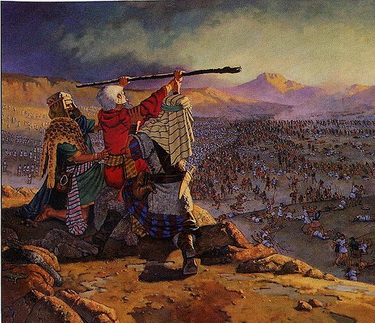
After God’s people, the descendants of Israel, crossed the Red Sea in the Exodus, an army of Amalekites came to battle them in the Sinai desert. So Moses instructed his servant Joshua: “Pick out certain men, and tomorrow go out and engage Amalek in battle. I will be standing on top of the hill with the staff of God in my hand.” The next day, while Joshua led Israel’s soldiers in fighting the foe on the battlefield, Moses stood upon an adjacent hill along with Aaron and Hur.

As long as Moses kept his hands raised up, Israel had the better of the fight, but when he let his hands rest, Amalek had the better of the fight.” Moses wielding this staff at God’s command triggered the plagues in Egypt, parted the Red Sea, and now brought Israel’s victory on the battlefield. But this raises a reasonable question: why would God condition his people’s success in combat upon an old man holding a piece of wood above his head? Moses lifting up this staff of God was a sign for God’s people which preserved them from a spiritual disaster.

God knew that if Israel had won apart from this sign they would have ascribed the victory to themselves. “We won this battle because we’re so smart, and strong, and brave! Maybe we don’t need God’s help after all.” Such pride in their success could be their downfall, in this life and the next. So instead, through the sign of an up-lifted staff, the Lord showed Israel, “I am the vine, you are the branches. Whoever remains [with] me and I [with] him will bear much fruit, because apart from me you can do nothing.”

Similarly today, our Lord desires us to pray without ceasing for the good things we want or need. Otherwise, if and when his blessings come, we shall attribute these things to mere luck, coincidence, or to our own personal abilities, with no growth in our relationship with God. He is the source from whom all good things come. By asking and then receiving, we come to see and know the Lord is near and cares for us. And in the end, that is the most valuable gift of all.

God not only wants us to know and to love him, he desires us to glorify us as well. God is all-powerful, omnipotent, he could do everything without us. But by God accomplishing his will through us, as he did with Moses, the Lord makes us more like himself and causes us to share in his glory.

Holding the staff of God in his hands throughout the day made Moses’ hands and arms grow tired. (If you cannot understand why, try holding an object above your head for just ten minutes sometime.) When Moses’ body grew tired, his friends came to his aide. “They put a rock in place for him to sit on. … Aaron and Hur supported his hands, one on one side and one on the other, [one on his right and the other on his left,] so that his hands remained steady till sunset.” With this help from his friends, Moses kept his arms raised-up and God’s people prevailed against their foe. All of this was a foreshadowing of greater things to come.

On Good Friday, when Jesus was condemned to death, he took the cross into his hands and carried it to the top of a hill. There his hands were nailed to the wood above his head. And Jesus was not there alone. All four Gospels note he was crucified between two others, “one on his right and the other on his left.”

Our Lord was mocked as he hung for hours upon the Cross: “Are you not the Messiah? … If you are the King of the Jews, save yourself!” But in the Garden of Gethsemane, Jesus had said, “Do you think that I cannot call upon my Father and he will not provide me at this moment with more than twelve legions of angels? But then how would the Scriptures be fulfilled…?” Christ had the power to come down from the Cross, but if he had done that—if Jesus had released his hands from the wood—if he had refused to die for us, how would we have been saved from our enemies, sin and death?

Love kept Jesus on his Cross: love for his friends gathered nearby. love for the criminals on his right and left, and love for you and me. Consider what a precious consolation it was for Jesus in his suffering to have his Mother Mary, John the Beloved, and Mary Magdalene there supporting him. “But,” Jesus asks, “when the Son of Man comes [again], will he find faith on earth?” Will Jesus return to a world where everyone imagines they can get along just fine without him?

Let us continue being God’s humble people, recognizing our dependence on him. Let us ask of him our wants and needs so that we can know and experience his blessings. Then we shall share his deeper friendship and share in his great works, increasing in his likeness and increasing in his glory. By relying on God and the holy friends and loved ones his providence places near to help us, we shall share in our Lord’s great victory.

So what do we do now?

May 16, 2021

Ascension Sunday

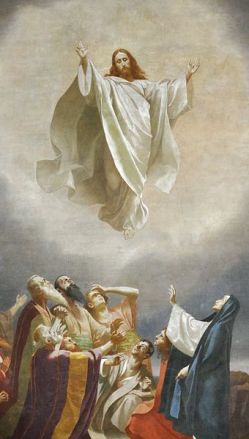
Christ's Ascension by Fresken von Gebhard Fugel, 1893-1894.Where are we now in the Easter season? Let’s recap. Jesus resurrects and first appeared to his disciples on Easter Sunday. And for forty days, he is with them off and on, appearing and disappearing, teaching them about the Kingdom of God and preparing them for their important work ahead: that of sharing the Good News and shepherding his Church. On the last of those forty days, Jesus ascends to his Father in heaven. And for the next nine days, his disciples (as per Christ’s instructions) remain in Jerusalem praying for and awaiting the promise of the Father about which they had heard Jesus speak. Finally, on the fiftieth day, on the Jewish feast of Pentecost, the disciples are intensely filled with the Holy Spirit. They become empowered to begin sharing their stories about who Jesus is and what he has done, inviting others to know him, love him, serve him, and be saved through him. Today we celebrate the Feast of the Ascension, looking forward to the Feast of Pentecost next Sunday.

But wait a second… didn’t I just mention that there were nine days in between the Ascension and Pentecost? Indeed, the Feast of the Ascension is traditionally observed on Ascension Thursday, a few days ago earlier this week. But in our diocese and the vast majority of dioceses in the U.S., the bishops officially transfer the feast to today, the following Sunday, so that more of the faithful will encounter and celebrate this feast. Another quirky thing about today’s Mass is how the story of Jesus’ Ascension is recounted more thoroughly by our first reading, from the beginning of the Acts of the Apostles, than by our Gospel reading, which briefly mentions the event.

The Acts of the Apostles says, when Jesus’ disciples had gathered together they asked him, “Lord, are you at this time going to restore the kingdom to Israel?” In other words, ‘Will you now forcefully make your kingdom come, restoring the earthly kingdom of David and Solomon, or perhaps now even impose a still greater kingdom where God’s will is done as fully on earth as it is in heaven?’ Jesus answered them, “It is not for you to know the times or seasons that the Father has established by his own authority.” When Jesus comes again in manifest, unveiled glory, with all his angels with him, no one will be able to ignore Christ the King or harass his flock any longer, but regarding the time of that return, no one knows the day or the hour except God. In the meantime, Jesus says, “you will receive power when the Holy Spirit comes upon you, and you will be my witnesses in Jerusalem… and to the ends of the earth.”

When he had said this, as the disciples were looking on, Jesus was lifted up and a cloud took him from their sight. So there they were, looking intently at the sky, not quite exactly sure what they were supposed to do now. I wonder how many hours they would have stood gapping at the sky if not for what happened next. Suddenly, two men dressed in white garments stood beside them. (Though not explicitly stated, these seem to be angels in human appearance. Well-informed young men in white had also been at the tomb on Easter Sunday morning, announcing and helping the disciples understand Jesus having risen from the dead.) At the Ascension, the messengers said, “Men of Galilee, why are you standing there looking at the sky? This Jesus who has been taken up from you into heaven will return in the same way as you have seen him going into heaven.” With this reassuring redirection, the disciples return from the Mount of Olives into the city of Jerusalem to pray and prepare for the Holy Spirit’s next move. The Apostles had received the Holy Spirit before in some measure. On Easter Sunday evening, Jesus had breathed on them and said, “Receive the Holy Spirit.” But they required a further gift of the Spirit to know and act on what God specifically wished them to do.

Today, we are in similar circumstances as those first Christians. We each first received the Holy Spirit at our baptisms and entered a deeper, more extensive relationship with him through our confirmations. Now, as we anticipate the Feast of Pentecost, I urge you to pray for the Holy Spirit to enlighten and empower you for what God wants you to do next. Our community is now happily returning nearer to normal, but what will our new habits and endeavors be? This post-pandemic world needs God—it always has—and the people in your world you need Jesus Christ and his Church. By your words and actions, Jesus wants you to show and share with others who Jesus is for you and what he has done for you, inviting others to know him, love him, serve him, and be saved through him. Jesus Christ is not forcibly imposing his Kingdom but sharing and advancing it subtly, intricately, mysteriously, and most wonderfully, especially through persons who are open to doing his will.

I believe God wants to begin one or more new things with you. So I urge you to ask him in these days, “Lord, what do you want me to do?” To ask the question is the start of saying “Yes” to him, but to refuse to ask the question is to answer him “No.” So ask, and seek, and see what new and great things the Lord would do through you during this new springtime for the Church.

The Fire of God

December 6, 2020


2nd Sunday of Advent

Eighteen years ago, when I applied to become a seminarian for our diocese, one part of the process was taking the MMPI, the Minnesota Multiphasic Personality Inventory Test — 567 True-False questions that help to detect psychological disorders. Of all of those written questions this one is for me the most memorable: “True or False: I am fascinated by fire.” How would you answer that question on a psych exam? I recall thinking at the time, “Yes, yes I am fascinated by fire, but I don’t want them to think I’m a pyromaniac. And I’m not a pyromaniac so maybe I should answer ‘False.’” But then I considered that wouldn’t be honest, so I reluctantly filled in the bubble for “True.” In the end, the diocesan psychologist did not diagnose me as crazy, so they sent me to seminary, eventually ordained me, and here I am today. But upon later reflection, I think this question is something of a trick.

Why do people pay more to have a fireplace in their home when a central heating system is sufficient to keep everyone comfortable? When people sit around a campfire, what does everybody look at for hours into the night? I strongly suspect this question (are you fascinated by fire) isn’t looking for pyromania so much as it is checking to see whether people will lie, because everyone is fascinated by fire. Fire is beautiful, it’s mesmerizing, dynamic and powerful; it’s well-known to us and yet surprising, an incredible blessing yet dangerous to the unwary.

The Sacred Scriptures often speak about fire. In today’s in gospel, we hear the preaching of St. John the Baptist. In the parallel passages of Matthew and Luke, St. John similarly cries out:

I am baptizing you with water… but the one who is coming after me is mightier than I… He will baptize you with the Holy Spirit and fire. His winnowing fan is in his hand. He will clear his threshing floor and gather his wheat into his barn, but the chaff he will burn with unquenchable fire.

Fire is also mentioned in today’s second reading. The Second Letter of St. Peter tells us:

The day of the Lord will come like a thief,
and then the heavens will pass away with a mighty roar
and the elements will be dissolved by fire…
the heavens will be dissolved in flames
and the elements melted by fire.”

The coming and presence of the Lord is associated with fire in the Old Testament as well. God first spoke to Moses through a burning bush. And during the Exodus the Lord went before his people, leading them in a pillar of cloud and fire. The appearance of God’s glory was like a devouring fire atop Mt. Sinai. The mountain was wrapped in smoke because the Lord had descended upon it in fire. Smoke rose up from it into the sky and the whole mountain greatly trembled. The Lord commanded Moses to warn the people not to approach, not to climb up the mountain, lest they be struck down in their unholiness. Listen to this vision of God the Prophet Daniel had in a dream one night:

As I looked, thrones were placed, and the Ancient of Days took his seat; his clothing was white as snow, and the hair of his head like pure wool; his throne was fiery flames; its wheels were burning fire. A stream of fire issued and came out from before him; a thousand thousands served him, and ten thousand times ten thousand stood before him; the court sat in judgment, and the books were opened.

Is the fire of God of which John the Baptist, Peter, Moses, and Daniel speak something for us to fear? Scripture says the punishment of God’s judgment is fire, but it also speaks of fire as God’s means of purifying his own. In regards to judgment, the Prophet Isaiah writes, “the Lord will come in fire, and his chariots like the whirlwind, to render his anger in fury, and his rebuke with flames of fire.” At the Last Judgment, Jesus Christ the King will turn to the goats on his left and say “Depart from me, you accursed, into the eternal fire prepared for the devil and his angels.” And the Book of Revelation says anyone whose name is not found written in the book of life will be thrown into a lake of fire: “[A]s for the cowardly, the faithless, the detestable, as for murderers, the sexually immoral, sorcerers, idolaters, & all liars, their portion will be in the lake that burns with fire and sulfur, which is the second death.” This is a fire to dread and to earnestly avoid.

Yet God’s prophets also speak of God’s purifying fire which perfects his people. Psalm 66 says “you, O God, have tested us; you have tried us as silver is tried;” and a verse from the Book of Proverbs says, “The crucible is for silver, and the furnace is for gold, and the Lord tests hearts.” Ancient gold and silversmiths would melt their precious metals with fire to separate out and burn away any impurities which they contained. Likewise, through the Prophet Zechariah, God says, “[I will put my people] into the fire, and refine them as one refines silver, and test them as gold is tested. They will call upon my name, and I will answer them. I will say, ‘They are my people’; and they will say, ‘The Lord is my God.’” This is why Jesus exclaims, “I have come to set the earth on fire, and how I wish it were already blazing!

Jesus would separate and burn away in us everything impure, false, and worthless. This purification can happen for God’s faithful friends in this life on earth or afterwards in Purgatory. St. Peter writes to the Church in his First Letter, “Now for a little while you may have to suffer through various trials, so that the genuineness of your faith, more precious than gold that is perishable even though tested by fire, may prove to be for praise, glory, and honor at the revelation of Jesus Christ.” And St. Paul tells the Corinthians, “If anyone builds on the foundation with gold, silver, precious stones, wood, hay, straw — each one’s work will become manifest, for the Day [of the Lord] will disclose it, because it will be revealed by fire, and the fire will test what sort of work each one has done.” Is this a fire we should fear and dread? No, as illustrated by this story from the Book of Daniel:

In the days of the Babylonian Empire, King Nebuchadnezzar had three servants named Shadrach, Meshach, and Abednego. When the king set up a tall, golden statue and commanded that all bow down and worship it, these three faithful Jewish men refused. Enraged, the king commanded that they be bound with rope and cast into a white-hot furnace. Once this had been done, the king looked inside the furnace. He became startled and rose in haste, asking his counselors, “Did we not cast three men bound into the fire?” “Certainly, O king,” they answered. “But, I see four men unbound and unhurt, walking in the fire, and the fourth looks like a son of God.” Then Nebuchadnezzar came to the opening of the furnace and called: “Shadrach, Meshach, and Abednego, servants of the Most High God, come out,” and the trio came out of the fire.

The fire had had no power over their bodies; not a hair of their heads had been singed, nor were their garments altered; there was not even a smell of fire about them. Yet notice, all of the ropes which had bound them were burned away and gone. Recall that the burning bush at Mt. Sinai was not destroyed by God’s fire. And when the Holy Spirit came down as tongues of fire at Pentecost, the disciples touched by the Holy Flame were not tormented by pain but rather filled with rejoicing. The process of conversion may entail some pains because change is often hard, whether on earth or in Purgatory, but I urge you not to fear it. God’s purifying fire would take away what binds you, it will not destroy what is good in you, and its fruit will be joy.

The Book of Wisdom tells us:

Chastised a little, [the souls of the just] shall be greatly blessed, because God tried them and found them worthy of himself.
As gold in the furnace, he proved them, and as sacrificial offerings he took them to himself.
In the time of their visitation they shall shine, and shall dart about as sparks through stubble;”
They shall judge nations and rule over peoples, and the Lord shall be their King forever.

So just souls become as sparks of fire and rule over the nations. They will rule like God their King and they will share in God’s fire. The New and Old Testaments agree, as the Books of Hebrews and Deuteronomy say, that “our God is a consuming fire.” The Lord your God is a consuming fire – beautiful, dynamic and powerful; well-known to us and yet surprising, an incredible blessing yet dangerous to the unwary. There is no approaching God without encountering his fire. Perhaps the delights of the saints and pains of damned have the same source – the unveiled presence of God. In this life, many people dismiss God while others long to see Him. But beyond the veil of this life the Holy One can no longer be ignored. Either we will eagerly run toward him or desperately desire to flee. The same Holy Fire is loved or despised according to our openness to love and honor and serve like him.

The call of Prophets Isaiah and John the Baptist to prepare the way of the Lord is addressed to us this Advent. In the wasteland of your imperfect soul prepare a straight and smooth highway for our God. Repent and confess your sins for forgiveness. When St. John the Baptist appeared in the desert, people from the whole Judean countryside and the city of Jerusalem were going out to him and being baptized by him in the Jordan River as they acknowledged their sins aloud. They would devote an entire day to walk or ride an animal out to where John was baptizing; wait in a single, very long line; and then confess their sinfulness in front of everybody in the mere hope of being forgiven by God. Jesus Christ makes it so much easier for us in the Sacrament of Confession. His minsters are not just one, but many, and his churches are not far away. We get to confess our sins privately in the quiet of the confessional, and with every good confession our forgiveness is assured.

St. Peter tells us “the day of the Lord will come like a thief,” that is, by surprise; we know not when. “(Then) the elements will be dissolved by fire, and the earth and everything done on it will be found out.” Since this is the case, St. Peter asks, “what sort of persons ought you to be?” Conduct yourselves in holiness and devotion. Do not delay your repentance and conversion. Jesus says, “If your hand or your foot causes you to sin, cut it off and throw it away. It is better for you to enter life crippled or lame than with two hands or two feet to be thrown into the eternal fire.” If this would be the case with precious limbs, how much more surely should we now cast off our worthless sins?

To give you that opportunity, for the forgiveness of your sins and a new infusion of God’s graces, I will be hearing confessions all day this Wednesday, December 9th at St. Paul’s. This Wednesday, from 10 AM to 8 PM, at the top of every hour, I will come to St. Paul’s main sacristy to hear the confessions of all penitents, either face-to-face or anonymously, masked and socially-distanced until all are heard. I sincerely hope you will come, and bring your family too, for the purifying fire of God is far sweeter than his fire which will punish unrepentance.
What Happens When You Die — 32nd Sunday of Ordinary Time—Year C

November 9, 2019

Our days are growing shorter and shorter. In the fall, it’s impossible not to notice the dark night encroaching. The trees are being drained of the color of life, their foliage is falling dead to the ground, turning the trees into bare skeletons. The farmer’s field has yielded its harvest; the once-living crops have been cut down. This changing of nature chills us in our flesh. During this season of dying, we are reminded in the world and in the Church, of our own mortality. This is a topic personally relevant to us all. Unless Jesus comes back first, each of us is going to die. What happens next is what I’ll preach about today.

Human nature is a unity of body and soul. At death, our body and soul will separate. Our mortal remains, our dead bodies, will decay according to natural processes. Sometimes God works a miracle, causing a saint’s corpse to remain incorruptible in part or in whole, but ordinarily our dead bodies return to the dust from which we were made. Our immortal souls, however, will not go into the grave with our bodies; at death; the who that is you behind your senses, your soul, will appear for the judgment of your Creator. As the Letter to the Hebrews says, “it is appointed that human beings die once, and after this the judgment.”

In the words of the Catechism of the Catholic Church: “Death puts an end to human life as the time open to either accepting or rejecting the divine grace manifested in Christ… each will be rewarded immediately after death in accordance with his works and faith. … Each man receives his eternal retribution in his immortal soul at the very moment of his death, in a particular judgment that refers his life to Christ: either entrance into the blessedness of Heaven—through a purification or immediately,—or immediate and everlasting damnation.”

Those who die in God’s grace and friendship and are perfectly purified live for ever with Christ. This perfect life with the Most Holy Trinity – this communion of life and love with the Trinity, with the Virgin Mary, the angels and all the blessed – is called ‘Heaven.’ Heaven is the ultimate end and fulfillment of the deepest human longings, the state of supreme, definitive happiness. … [Jesus] makes partners in his heavenly glorification those who have believed in him and remained faithful to his will.

But what if we die spurning his friendship? We cannot be united with God unless we freely choose to love him. But we cannot love God if we sin gravely against him, against our neighbor or against ourselves. To die in mortal sin without repenting and accepting God’s merciful love means remaining separated from him for ever by our own free choice. This state of definitive self-exclusion from communion with God and the blessed is called “Hell.” Jesus speaks repeatedly of Hell in the Gospels, so we cannot dismiss its reality. The numerous rebel angels, the demons, experience Hell, and it seems that many human beings will experience it forever as well. It’s a terrible thing, but recall C.S. Lewis’ words: “The gates of Hell are locked from the inside. … There are only two kinds of people in the end: those who say to God, ‘Thy will be done,’ and those to whom God says, in the end, ‘Thy will be done.’ All that are in Hell, choose it. Without that self-choice there could be no Hell.

What if I die as a friend of God but I’m still not yet perfect? What if I sincerely love God and my neighbor but I still retain a fondness for my sins. The Book of Revelation says of God’s Heavenly city “nothing unclean will enter it,” so how can I be cleansed to enter in? The Catechism teaches: “All who die in God’s grace and friendship, but still imperfectly purified, are indeed assured of their eternal salvation; but after death they undergo purification, so as to achieve the holiness necessary to enter the joy of Heaven. The Church gives the name ‘Purgatory’ to this final purification of the elect, which is entirely different from the punishment of the damned.

On earth we know that personal conversion and change of lifestyle can be difficult. Private revelation suggests that the purifying process of Purgatory is both painful and joyful at the same time. It’s like a soldier returning victorious from a war overseas, traveling to his wife and family. His long trip home may be exhausting, but his great love for those who await him sweetens his journey and focuses his efforts to join them.

We should pray for one another on earth and we should pray for the dead as well. From her beginning, the Church has honored the memory of the dead and offered prayers for them, above all at Christ’s great sacrifice, the Mass, so that, thus purified, they may attain the beatific vision of God. The Church also commends us, especially in the month of November, to almsgiving, indulgences, and works of penance on behalf of the dead to help them on their way to the fully-unveiled presence of God. The saints in Heaven now behold the divine essence with an intuitive vision, without the mediation of any creature. The Blessed Virgin Mary, and possibly Elijah, Moses, and Enoch, already have their bodies there, but the reunited bodies and souls of all the dead, of both the just and the unjust, will rise again one day.

The resurrection of the dead, which in today’s Gospel the Sadducees denied and Jesus affirms, will precede the Last Judgment. This will be “the hour when all who are in the tombs will hear [the Son of man’s] voice and come forth, those who have done good, to the resurrection of life, and those who have done evil, to the resurrection of judgment.” Then Christ will come “in his glory, and all the angels with him… Before him will be gathered all the nations, and he will separate them one from another as a shepherd separates the sheep from the goats, and he will place the sheep at his right hand, but the goats at the left… And they will go away into eternal punishment, but the righteous into eternal life.” This Last Judgment will reveal even to its furthest consequences the good each of us has done or failed to do during our earthly life.

After this last and universal judgment, the universe itself will be renewed into what Scripture calls “a new Heavens and a new Earth.” Recall how Jesus’ resurrected body is the body that was pierced (for he still bears some wounds as trophies,) and it is the body that was buried (for the Easter tomb is empty,) but Jesus’ resurrected body is now gloriously transformed. The same body, but renewed Likewise, our resurrected bodies and this material universe will be renewed and transformed as well. Then the righteous will reign with Christ, glorified in body and soul, in a new heavens and new earth, forever.

From these reflections on the last things, I offer you these three takeaways. First: care for your soul. Be committed to prayer and the sacraments (particularly confession for the forgiveness of your sins.) Second: pray for the dead. They will appreciate it forever and pray for you too. Third and finally: remember that our time on earth is short. And forever is a very long time. You have just one life, so live and love heroically in Christ.

Thy Kingdom Come — Tuesday, 1st Week of Advent

December 1, 2016

Readings: Isaiah 11, Luke 10

While recently visiting the Sea of Galilee in Israel I saw something in the skies I had never seen before. There were miles-wide concentric cloud rings with the occasional sound of long, rolling, man-made thunder. Though these things were interesting to behold, I hated the reason behind why they needed to be there. Northern Israel borders Syria and these high-altitude contrails and jet-engine sounds were from the Israeli Air Force’s U.S.-made F-15’s or F-16’s on defensive air patrols to ensure their neighbor’s civil war did not spill over into their own country.

The coastline of the Sea of Galilee is beautiful, peaceful, and prosperous. We were able to celebrate a Mass in an outside chapel near the site where Jesus appeared to his disciples after his resurrection and had breakfast with his disciples (as recorded in John 21.) But while we were free to tour and worship without threat or fear, the people of Aleppo, Syria were under siege just 250 miles north. There the Russian bear and the Syrian wolf are allied against the ISIS serpent in a battle for the right to rule over the suffering lambs and little children caught in the middle. The prophet Isaiah’s poetic vision of the radical peace the Messiah (or Christ) would someday establish has not yet fully come:

       “Then the wolf shall be a guest of the lamb,
and the leopard shall lie down with the kid;
       The calf and the young lion shall browse together, with a little child to guide them.
       The cow and the bear shall be neighbors,
together their young shall rest;
the lion shall eat hay like the ox.
       The baby shall play by the cobra’s den,
and the child lay his hand on the adder’s lair.
       There shall be no harm or ruin on all my holy mountain; for the earth shall be filled with knowledge of the LORD, as water covers the sea.”  (Isaiah 11:4-9)

The Infant Child of PragueOn one occasion, turning to the disciples in private, Jesus said, “Blessed are the eyes that see what you see. For I say to you, many prophets and kings desired to see what you see, but did not see it, and to hear what you hear, but did not hear it.” (Luke 10:23-24) Many great Old Testament figures longed for the promised Messiah but died before his coming. We are blessed to live in an age which has seen his arrival and blessed to have heard his message. Yet further blessed are we if we pray and prepare the path for the New Creation Christ promises to bring.

Along the sea of Galilee, it is possible to give no thought to the suffering and death happening not so far away. Likewise, in our beautiful, peaceful, prosperous country it is possible to ignore that there are grave evils in our midst, happening just out of sight. But blessed are we if we choose to long and labor for the life of the New Heavens and New Earth.

        “Blessed are they who mourn,
    for they will be comforted.
        …Blessed are they who hunger and thirst
for righteousness, for they will be satisfied.
        …Blessed are the peacemakers,
    for they will be called children of God.
        …Blessed are they who are persecuted for
    the sake of righteousness, for theirs is the
    kingdom of heaven.”  (Matthew 5)

What Remains of Capernaum Today — Monday, 1st Week of Advent

December 1, 2016

Readings: Isaiah 4, Matthew 8

galilean-sunrise-at-tiberius-november-2016Capernaum was a home base for Jesus Christ during his ministry in Galilee. Josephus, the 1st century A.D. Roman-Jewish historian, wrote that 30,000 people lived in Capernaum. Josephus has a bad reputation for exaggerating his figures but even if the true number were one-third that, Capernaum would still be a major city on the ancient trade route. But today, if you visit Capernaum (or Kfar Nahum “Nahum’s village” in Hebrew), you will find very little standing there. There are the ancient ruins St. Peter the Apostle’s home and of  a fourth-century synagogue, a couple of Catholic and Greek Orthodox churches and monasteries, but not much else. The nearby surroundings are dry orchard fields and rocky barrenness. Capernaum is no longer a great, impressive city. Jesus had once foretold of its desolation:

        “And as for you, Capernaum:
‘Will you be exalted to heaven?
       You will go down to the netherworld.’
       For if the mighty deeds done in your midst had been done in Sodom, it would have remained until this day.”  (Matthew 11:23)

One thing remaining from Capernaum are the Gospel accounts of this encounter between Jesus and a centurion. Once, when Jesus entered the city, the centurion approached and appealed to him, saying, “Lord, my servant is lying at home paralyzed, suffering dreadfully.” Jesus told him, “I will come and cure him.” The centurion replied, “Lord, I am not worthy to have you enter under my roof; only say the word and my servant will be healed. For I too am a person subject to authority, with soldiers subject to me. And I say to one, ‘Go,’ and he goes; and to another, ‘Come here,’ and he comes; and to my slave, ‘Do this,’ and he does it.” When Jesus heard this, he was amazed and said to those following him, “Amen, I say to you, in no one in Israel have I found such faith….” And Jesus said to the centurion, “You may go; as you have believed, let it be done for you.” And at that very hour his servant was healed. (Matthew 8)

The centurion does not do very much in this episode. According to Luke 7’s telling, he actually communicated with Jesus through intermediaries. So what about him impressed Jesus so much? The centurion’s few words reveal his reverent humility and confident trust before Jesus, and his loving concern for his suffering servant. Jesus is not impressed by world wealth and power, by great cities or empires, but by acts of faith and love, which remain before him always.

Catholic Teachings About The End Times

November 10, 2016

Catechism of the Catholic Church #668-679

I.  HE WILL COME AGAIN IN GLORY
Christ already reigns through the Church…

The Resurrection by Piero della Francesca, 1450-1463.        “Christ died and lived again, that he might be Lord both of the dead and of the living.”
Christ’s Ascension into heaven signifies his participation, in his humanity, in God’s power and authority. Jesus Christ is Lord: he possesses all power in heaven and on earth. He is “far above all rule and authority and power and dominion,” for the Father “has put all things under his feet.” Christ is Lord of the cosmos and of history. In him human history and indeed all creation are “set forth” and transcendently fulfilled.

        As Lord, Christ is also head of the Church, which is his Body. Taken up to heaven and glorified after he had thus fully accomplished his mission, Christ dwells on earth in his Church. The redemption is the source of the authority that Christ, by virtue of the Holy Spirit, exercises over the Church. “The kingdom of Christ [is] already present in mystery,” “on earth, the seed and the beginning of the kingdom.”

        Since the Ascension God’s plan has entered into its fulfillment. We are already at “the last hour.” “Already the final age of the world is with us, and the renewal of the world is irrevocably under way; it is even now anticipated in a certain real way, for the Church on earth is endowed already with a sanctity that is real but imperfect.” Christ’s kingdom already manifests its presence through the miraculous signs that attend its proclamation by the Church.

…until all things are subjected to him.

      Though already present in his Church, Christ’s reign is nevertheless yet to be fulfilled “with power and great glory” by the king’s return to earth. This reign is still under attack by the evil powers, even though they have been defeated definitively by Christ’s Passover. Until everything is subject to him, “until there be realized new heavens and a new earth in which justice dwells, the pilgrim Church, in her sacraments and institutions, which belong to this present age, carries the mark of this world which will pass, and she herself takes her place among the creatures which groan and travail yet and await the revelation of the sons of God.” That is why Christians pray, above all in the Eucharist, to hasten Christ’s return by saying to him: Marana tha! “Our Lord, come!”

        Before his Ascension Christ affirmed that the hour had not yet come for the glorious establishment of the messianic kingdom awaited by Israel which, according to the prophets, was to bring all men the definitive order of justice, love, & peace. According to the Lord, the present time is the time of the Spirit and of witness, but also a time still marked by “distress” and the trial of evil which does not spare the Church and ushers in the struggles of the last days. It is a time of waiting and watching.

The glorious advent of Christ, Israel’s hope

        Since the Ascension Christ’s coming in glory has been imminent, even though “it is not for you to know times or seasons which the Father has fixed by his own authority.” This eschatological coming could be accomplished at any moment, even if both it and the final trial that will precede it are “delayed.”

        The glorious Messiah’s coming is suspended at every moment of history until his recognition by “all Israel,” for “a hardening has come upon part of Israel” in their “unbelief” toward Jesus. St. Peter says to the Jews of Jerusalem after Pentecost: “Repent therefore, and turn again, that your sins may be blotted out, that times of refreshing may come from the presence of the Lord, and that he may send the Christ appointed for you, Jesus, whom heaven must receive until the time for establishing all that God spoke by the mouth of his holy prophets from of old.” St. Paul echoes him: “For if their rejection means the reconciliation of the world, what will their acceptance mean but life from the dead?” The “full inclusion” of the Jews in the Messiah’s salvation, in the wake of “the full number of the Gentiles,” will enable the People of God to achieve “the measure of the stature of the fullness of Christ,” in which “God may be all in all.” 

The Church’s ultimate trial

The Devil Tempting a Young Woman by André Jacques Victor Orsel, 1832.

        Before Christ’s second coming the Church must pass through a final trial that will shake the faith of many believers. The persecution that accompanies her pilgrimage on earth will unveil the “mystery of iniquity” in the form of a religious deception offering men an apparent solution to their problems at the price of apostasy from the truth. The supreme religious deception is that of the Antichrist, a pseudo-messianism by which man glorifies himself in place of God and of his Messiah come in the flesh.

      The Antichrist’s deception already begins to take shape in the world every time the claim is made to realize within history that messianic hope which can only be realized beyond history through the eschatological judgment. The Church has rejected even modified forms of this falsification of the kingdom to come under the name of millenarianism, especially the “intrinsically perverse” political form of a secular messianism.

        The Church will enter the glory of the kingdom only through this final Passover, when she will follow her Lord in his death and Resurrection. The kingdom will be fulfilled, then, not by a historic triumph of the Church through a progressive ascendancy, but only by God’s victory over the final unleashing of evil, which will cause his Bride to come down from heaven. God’s triumph over the revolt of evil will take the form of the Last Judgment after the final cosmic upheaval of this passing world.

II. TO JUDGE THE LIVING AND THE DEAD

The Resurrection by El Greco, Madrid, 1596-1600.      Following in the steps of the prophets and John the Baptist, Jesus announced the judgment of the Last Day in his preaching. Then will the conduct of each one and the secrets of hearts be brought to light. Then will the culpable unbelief that counted the offer of God’s grace as nothing be condemned. Our attitude about our neighbor will disclose acceptance or refusal of grace and divine love. On the last day Jesus will say: “Truly I say to you, as you did it to one of the least of these my brethren, you did it to me.”

        Christ is Lord of eternal life. Full right to pass definitive judgment on the works and hearts of men belongs to him as redeemer of the world. He “acquired” this right by his cross. The Father has given “all judgment to the Son.” Yet the Son did not come to judge, but to save and to give the life he has in himself. By rejecting grace in this life, one already judges oneself, receives according to one’s works, and can even condemn oneself for all eternity by rejecting the Spirit of love.