 A new liturgical Church year will begin in a couple of weeks with the first Sunday of Advent. As this Church year ends, our Mass readings (like today’s Sunday readings) focus on the Last Things and the end of the world as we know it. This weekend’s news reports, especially the terrible events in France, remind us that though the Kingdom of God is among us, we pray “thy Kingdom come” because it is not yet fully here in total, unveiled power. This weekend’s readings and news events remind me of passages from C.S. Lewis in excellent book Mere Christianity:
“Enemy-occupied territory—that is what this world is. Christianity is the story of how the rightful king has landed, you might say landed in disguise, and is calling us all to take part in a great campaign of sabotage. When you go to church you are really listening-in to the secret wireless [radio] from our friends: that is why the enemy is so anxious to prevent us from going.”
Why does Lewis say that our king has landed “in disguise?” Well, where would you expect a king to be born? The Magi sought the newborn king of the Jews in the palace at Jerusalem, but Jesus was born in a barn—a cave in Bethlehem—to a pair of poor parents. How would one expect the Jewish Messiah to enter into Jerusalem to claim his throne? Probably riding on a warhorse, but Jesus came meekly riding on a donkey, just as had been prophesied about him. Who would have thought that God would become a man, and then suffer and die as he did? After the vindication of the resurrection, one would have thought he would appear to the high priest and Governor Pilate, or to the Emperor Tiberius in Rome, to declare that he was indeed who he claimed to be. Instead, Jesus appeared discretely, to his disciples.
Lewis writes that God has landed in this enemy-occupied world in disguise and has started “a sort of secret society” to undermine the devil. This secret society he speaks of is the Church. But what is so secret about the Church? We have a sign in front with our Mass times. We don’t check ID’s at the door. And if anyone wants to know about what we do or what we believe, we will gladly inform them. But, in a sense, the Church is a secret society—for the world and even many Catholics do not recognize who and what we really are. We are a holy conspiracy. We are fighting the propaganda of the world and the devil with the truth of God. We are recruiting others to the side of the Lord. We are his special forces sabotaging evil with the weapons of love in preparation for the king’s arrival.
From where do we receive our power for this mission? The source of our power is the Holy Mass. Today’s second reading says that the Old Testament’s priests offered many sacrifices because those could not truly achieve their purpose, but Jesus our High Priest offers his sacrifice once for all. At Mass we transcend space and time to personally encounter that sacrifice, and it’s power is applied to us here and now, providing all the graces we need to fulfill his will.
Lewis asks, “Why is [God] not [yet] landing in [total unveiled] force, invading [our world]? Is it that He is not strong enough? Well, Christians think He is going to land in force; [but] we do not know when.”
Indeed, as Jesus says in today’s Gospel, “of that day or hour, no one knows… but only the Father.”
We do not know when the Lord is going to land in force. “But,” Lewis continues, “we can guess why He is delaying. He wants to give us the chance of joining His side freely. I do not suppose you and I would have thought much of a Frenchman [during World War II] who waited till the Allies were marching into Germany and then announced he was on our side. God will invade.”
Why has God not yet invaded our world with his full, unveiled force? Why does he allow the wicked to use their freedom for evil, like the terrorism we saw in Paris?
Lewis writes, “I wonder whether people who ask God to interfere openly and directly in our world quite realize what it will be like when He does. When that happens, it is the end of the world. When the author walks on to the stage the play is over. God is going to invade, all right: but what is the good of saying you are on His side then, when you see the whole natural universe melting away like a dream and something else—something it never entered your head to conceive—comes crashing in; something so beautiful to some of us and so terrible to others that none of us will have any choice left?”
I think “the whole natural universe melting away” is an excellent reflection on today’s gospel. Jesus tells us that at the end:
“the sun will be darkened,
and the moon will not give its light,
and the stars will be falling from the sky,
and the powers in the heavens will be shaken…”
In the ancient world, the sun and moon, stars and planets, were considered the most stable and eternal things in the cosmos (and you can understand why.) But when even these things are passing, you know the universe as we know it is melting away. After this, the Lord Jesus comes with judgment. “And then they will see ‘the Son of Man coming in the clouds’ with great power and glory… (and his angels, like St. Michael from our first reading, along with him…)”
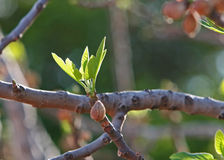 Perhaps we may find it surprising that Jesus describes these events as a good thing to his disciples. He says:
“Learn a lesson from the fig tree. When its branch becomes tender and sprouts leaves, you know that summer is near. In the same way, when you see these things happening, know that [the Son of Man] is near, at the gates.”
We usually associate the end of things with the fall. Youth is called the springtime of life, while old age is the fall. In the Northern Hemisphere, every Church year ends in the fall. Yet Jesus presents an analogy for the end of the world as one of spring becoming summer: ‘When the tender branch sprouts leaves, you know that summer is near.’ A small thing, the branch, points to the arrival of a much greater reality, the summer. Why would we cling to the branch when the whole world is being renewed in glory? For friends of God, what is to come is better than what we see. The life we live now in this world is the winter. What is still to come for us is the spring and summer. Let us not hesitate to hope for it, envision it, and rejoice in it.
When the last day comes, “it will be God without disguise; something so overwhelming that it will strike either irresistible love or irresistible horror into every creature. It will be too late then to choose your side. … That will not be the time for choosing: it will be the time when we discover which side we really have chosen, whether we realized it before or not. Now, today, this moment, is our chance to choose the right side. God is holding back to give [people] that chance. [But it] will not last forever. We must take it or leave it.”
How long will it be until the Lord comes again? Jesus says in today’s gospel that, “This generation will not pass away until all these things have taken place.” But he said this a long time ago. Was Jesus wrong? No, for when you read these passages from Mark in full context, Jesus is responding to his disciples questions about two things side-by-side: the fall of Jerusalem and the end of the world. The Romans destroyed the great city and its temple in 70 A.D., during the lifespan of some of Jesus’ hearers, and to many Jews it felt like the end of the world. This event prefigured the passing away of all things. Like other prophesies in the Bible, Jesus’ prophesy has a near and distant fulfillment, one after a forty-year opportunity for conversion, and another at the end of time.
So when will the Lord come again? The answer for every generation before us has been “not yet.” If this world endures to the year 10,000 A.D., the Christians of that time will probably regard us as the early Christians. I personally think it will still be awhile before he comes, for it is still legal to be a Christian in too many places on earth. Yet, in a sense, it doesn’t matter when Jesus is coming, for the end of our individual lives is equivalent to the end of the world for us. If you’re ready for one, you’re ready for the other. But if you, or people that you know, are not ready for either, then now is the time for conversion.
The Lord our King has recruited us into his holy conspiracy, arming us with the weapons of truth and love. You and I are his advanced forces and, among other tasks, he is sending us on rescue missions to bring others to himself. Who do you know that is far from Christ? We are to draw on the power of this Mass for them. We are called to pray, fast, and sacrifice for them, and even to be so bold as to talk with them—inviting them to come to Jesus Christ and his Church. Seize this opportunity and do not let it pass away, for whether the Lord first comes to us or we go forth to him, each and all will encounter him soon, face-to-face, in his full, unveiled glory.

 Parishable Items