Archive for the ‘Transfiguration’ Category

Difficult Decisions? Look to the Star

March 15, 2025

2nd Sunday of Lent
By Deacon Dick Kostner

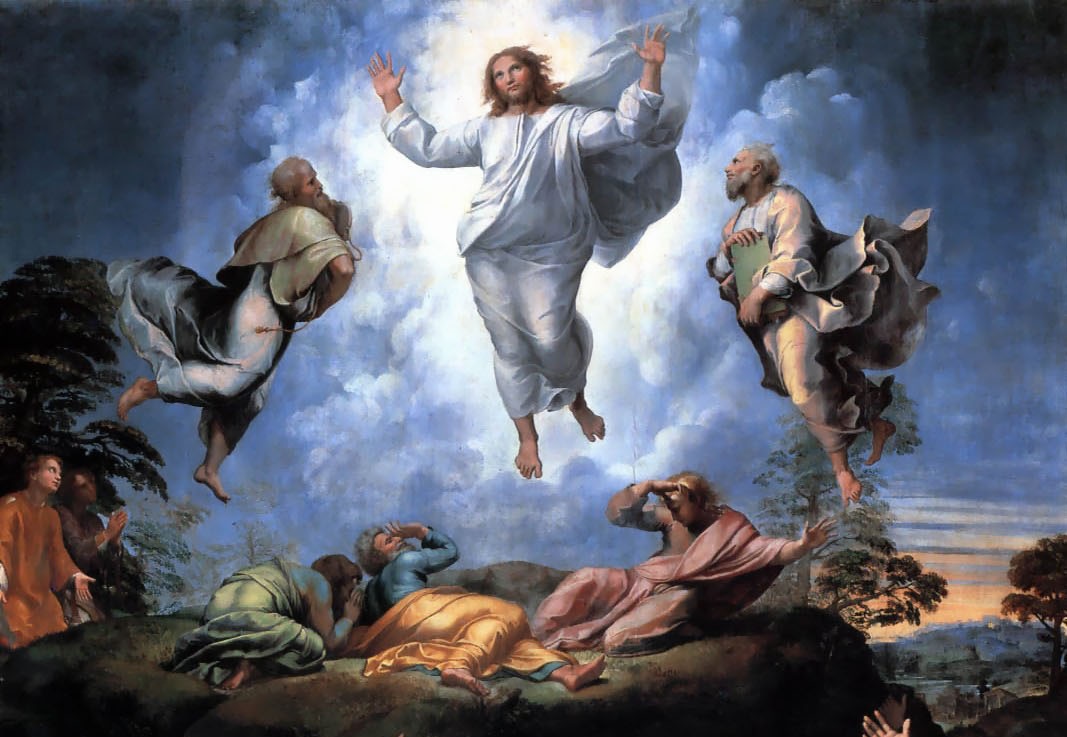
Our gospel this weekend tells of another Epiphany, the “Light of Christ.” Jesus has just disclosed to his disciples that his death is near. He needs to get away from the World and so he invites some of his friends Peter, James and John, to take some time off and follow him to the top of a mountain and pray for support from the Father for him to conclude his ministry vocation as savior of those he loves. His friends do not yet understand that he must die and rise from the dead to complete his assignment. But Jesus gifts them with a look at who he really is. They witness him talking to two Saints Moses and Elijah two Old Testament heroes. Showing them that he is the fulfillment of the Torah. Then they witness his glorified body turning into the bright Light of Christ and they begin to realize that he is not just their fisherman friend but also hear the Father call him his son who commands them to “listen to him.

Jesus is the great teacher and we, like the disciples are called to “listen to him,” and to follow his directions, actions, and words, and to teach the same to the children of God. Jesus gives us directions today on how we can be successful and fruitful disciples. First, we need to pray for help. Prayers seem to be more successful if we pray on “Holy Ground.” Where do we find that? Some, find it on a mountain like Jesus found it. Some find it in a Church where the Blessed Sacrament resides. But for many it lies where ever you go to when you need help and direction from God through prayer. For me that is usually near my garden or a place that I can witness the Father’s creatures and creations. A place of reverence and quiet wonder of creation. Sometimes it is my chair where I write my homilies and reflect on Scripture writings. Bottom line is the whole world can and is “Holy” if you find yourself thanking God for where you can find peace to talk to Him.

Next, Jesus tells us to invite family and friends to join you and maybe provide some help and support from them when you are confused or suffering through an event you need to get through. My favorite place to view this is at a funeral liturgy. Remember Jesus works through and with his followers, who he calls His earth Body, His Church.

Finally, remember that Jesus has respect for suffering, and in this life, it is a very important element of faith, for it requires us to admit we need his supernatural strength to overcome and turn suffering into redemptive faith in and through his power to bring about an end to suffering through Easter Sunday and bring about our glorified eternal life with him in heaven.

Transfiguration can happen to us when we are called by God to commit to a vocation call from Him. At RCIA/OCIA class we talked about special events we have experienced in our lives and I shared with the class one of my special and fearful events that occurred to me when we were asked to purchase for ourselves an alb, a white vestment which I believe is related to our baptismal vow to be priest, prophet and king,.  It was to be used by us for leading parish  prayer events after we had completed our two years Lay Minister class some twenty-nine years ago. Barb, had me trying on several albs at a store in La Crosse and after she found one that she thought looked best on me she told me to go over to the mirror to get my take on the one she had picked. I walked over to the mirror glanced at the alb ,which I thought was fine, and then I looked up and fear overtook me. The face I saw in the reflection was not some one that I knew. I said to myself “who is this person?” This is not the person I grew up with. I did not share this with Barb until a week or so later. A few days after the happening while having a beer with my best friend I confessed my experience to my best friend telling him that I think God has something planned for me that I have not yet thought about. I asked him what he thought about the event and where I should go from here with this new person I had met in the mirror. He grinned at me and said, “I think you should get to know this new person and that you should go for it!” You all know the ending.

P.S.: The guy I grew up with is still with me, and the new guy and him are now good friends.

The Mountaintop Experience

February 26, 2024

2nd Sunday of Lent
By Fr. Chinnappan Pelavendran

God’s call is personal; it is an invitation to enter into his holiness with an attitude of faith and total trust in God. As we enter the second week of Lent, our task is to continue to examine our hearts and change ourselves to be worthy of his glorious paschal mystery. As human beings, we do not like to change and we resist any change as much as we can. However, change is a part of our life. We know that we are pilgrims on a journey to a more permanent dwelling place. A place of total union with our God.

In Genesis 12, God tested Abraham to leave his father’s land for an unknown land. Abraham through his obedience demonstrated that he loved God more than his father’s land. In the first reading as we saw today, God tested Abraham again to see how convinced and strong his faith was by asking him to sacrifice the son of promise. Abraham was a man of great faith and his faith led him to the mountaintop, a place of great encounter with God. It took Abraham three days to journey to the mountaintop at Moriah for the sacrifice and within this period Abraham never changed his mind for his faith remained firm.

God wants you to make the first step with determination and he will come and take control. Remember not to entertain distractions and discouragements in your journey to the mountain-top, Abraham had to leave his servants at the foot of the mountain while he climbed with Isaac alone to avoid distractions. When we keep our faith strong in God and we are ready to make enormous sacrifices towards meeting Him at the mountaintop, then we can be sure that God will be on our side and as the second reading says if God is on our side nobody can be against us. Even when we make mistakes as humans, God would still forgive us since Christ has died to spare us and he stands at God’s right hand interceding for us.

In the Gospel reading, Jesus leads his disciples up a high mountain to witness his transfiguration. Elijah and Moses appear and this demonstrates that Jesus is the fulfillment of the prophets and the law. God speaks from heaven and this gives the disciples clarity in their vocations. Peter wants to stay in the moment. Peter wants to build monuments and to stay. Soon after the events at Mount Tabor, however, Jesus begins to lead his disciples to Jerusalem and the cross. You see, Jesus leads his disciples to another mountain, Golgotha, where all of humanity is transfigured through his passion, death, and resurrection. For Abraham, the undiscovered country seems to be a stretch of land that God would give to him and his descendants. For the disciples of Jesus, the undiscovered country is our salvation, the promise of resurrection and everlasting life.

As we make our way with Jesus from our Mount Tabors to our Good Fridays, we are invited to never lose sight of where Jesus is ultimately leading us. Our destination is our Easter hope. To get there, we need to know who we are, and where we are going, and recommit ourselves to following Jesus who is the Lamb of God who takes away the sins of the world.

The Transfiguration of Jesus

August 8, 2023

Feast of the Transfiguration
By Fr. Chinnappan Pelavendran

Today we celebrate the feast of the transfiguration. When God the Son, the Second Person of the Holy Trinity, came down to earth to suffer, die, and rise again for our redemption, He took on human flesh. In doing so, He veiled His divine glory and appeared like anyone of us. What a grace for Sts. Peter, James, and John to see Jesus transfigured. They got a preview of the glory of heaven. It was also a preview of the glory we all hope to share in heaven.

Jesus shared the special grace with Peter, James, and John. Just before receiving this special grace, Jesus transfigured, Jesus told his disciples that he must suffer greatly, be rejected by the elders, chief priests, and scribes, be killed, and rise after three days. Peter rebuked Jesus for saying this and Jesus responded, “Get behind me, Satan. You are thinking not as God does but as human beings do.” The disciples had to learn that Jesus was not the type of messiah they were expecting. What a shock! They needed this grace now. They left everything to follow Jesus and he had just told them he would be killed. They needed reassurance, and Jesus did not let them down. They received grace now on the mountain as they saw Jesus transfigured.

These three disciples, Peter, James, and John, were invited on three separate occasions into three privileged moments in the life of Jesus. They were present at the house of a synagogue official Jairus when his daughter was brought back to life. Again, they were with him in the agony of the garden. Finally, they were present at the Transfiguration where Moses and Elijah were also present speaking with Jesus about his approaching death. These disciples would have liked to remain on the mountaintop, but they did not want to stay in the Garden of Gethsemane. Here we can all identify with the apostles because in our mountain–top experiences of joy we also want to stay. And then in the moments of trial, we want to flee.

Now they hear the words of the Father, “This is my beloved son, listen to Him.” They have a task to listen attentively to his words and put them into practice.

The transfiguration was the mountain–top experience of the apostles which prepared them for their future trials. The glory they saw on the high mountain helped them understand that the Lord’s Passion was not the end of His mission. The Mass is our mountain–top experience which prepares us for the trials of the day. The Mass is not a transfiguration but a transubstantiation, in which bread and wine are transformed into the Body and Blood of Jesus. Now we say with St. Peter “Lord, it is good for us to be here” And we do not want to leave. But it is not to be. Soon we will hear the words, “The Mass is ended, go in peace to love and serve the Lord.” So we pick up our cross and leave to face the trials of the day.

As the disciples had wonderful movements with Jesus, we too meet Jesus in a most intimate way every time we receive Jesus in the Eucharist. It is the time when we are close to Jesus.

We also meet Jesus in the Scriptures as they touch our hearts. Jesus speaks to us now when we read the scriptures. And we meet Jesus in a very special way in all the sacraments.

We all want change. We all want to be transformed and yet we find it difficult to do so. May the transfiguration event inspire us to return to Jesus for He alone can lead us and transform us so we can see His Glory.

Feast on the Transfiguration

August 5, 2023

Feast of the Transfiguration
By Deacon Dick Kostner

Today we celebrate the Transfiguration. Peter, James and John are invited by Jesus to join him on the mountain. They are invited to share an experience with Jesus and see that Moses and Elijah are still alive and conversing with Jesus. Is this a dream they say to themselves? And then, they witness an epiphany, a revealing of who Jesus, their friend, really is. They hear the voice of God from a cloud, shouting a truth: “This is my beloved Son, with whom I am well pleased; listen to him!” The three men are in awe, they feel special but are confused and do not understand why they cannot share this experience when Jesus tells them to be silent, until he is raised from the dead.

Although they are confused Peter relates their feelings when he proclaims, “Lord, it is good that we are here!” Folks, we too need to reflect upon the fact that we too can share in and experience the Transfiguration for through our baptism we have received a personal invitation like Peter, James and John, to join Jesus on the mountain. We, too, are special people and members of the Holy Family; we too can experience that Jesus does not live in the sky, but is really with us every minute of every day here on earth all we need to do is open our eyes and ears and as the Father said, “Listen to Him.

As I reflect on this Gospel the first thing that came to my mind was our Church and Eucharist. Jesus calls to us and says, “Folks, you are special to me, please come with me and we will climb out of this world and rise way above it on a mountain I have created for us, and we can vacation from the problems and trials of this world to the peace found only at the home of the family of God.” A mountain place that He has named, “Church.” Mass is for us a mountain escape. A place for us to join people who are family to us to pray, and listen to Jesus speak to us through Scripture and celebrate as a family, a meal with Jesus, with our friends, sharing our love for each other and pledging support for each other as we all journey on the road to salvation.

The second thing that came to my mind as I was doing my morning prayer intercessions a week or so later, was the great gift God shares with us which are his creatures here on earth. The prayer read, “Lord show us your goodness, present in every creature, that we may contemplate your glory everywhere.” The birds, and animals are many times directed by God to help mitigate for us the problems of life, and how although we are maybe confused or even frightened by their existence and intelligence, we are awed by the joy they give to us by allowing us to, join them on a mountain and receive a mini-vacation from the challenges of life. What a gift God gives to his Holy Family.

I believe God gives to all of his creatures vocations. For us, Jesus gave us an 11th Commandment to love others as he has loved us. For animals their vocation is to display to us God’s goodness through his love and care for those creatures as well as his love for us humans as his children.

I had previously told you about my holy cat who taught me the virtue of being patent with others even if they hate you. I have witnessed a hen duck whose mate was run over and killed by a car, sit by her mate in the middle of the road for three day’s before leaving his side. And look at our police departments and how they have learned to ask the help of our canine friends, to make this world a safer place for us to live and to give us comfort. Finally, how about the resident cat I read about a few years ago who was given the vocation and ability to know when people in the nursing home it lived in were about to die, and who would sit with that resident until they died to give them comfort. The staff had indicated that this cat had a 98% record of knowing who would die within three days of when it took up residency with a patient.

Although this world has a lot of challenges for us to bear let us fear not for we have been invited to join Jesus and his creatures, and experience God, and the Transfiguration on a “mountain” with family and friends. When climbing the mountain and experiencing an epiphany, I encourage you to say a prayer that I have named the prayer of St. Peter, “Lord, it is good … that we are here! And as the Father directed us to do, I do listen to you! Amen.

Encounter Him & Return

March 4, 2023

2nd Sunday of Lent
Fr. Victor Feltes

What a grace for Peter, James, and John to see the Transfiguration of Jesus. Can you imagine? It was like a preview of the glory we all hope to share in heaven. Jesus shared other special times with Peter, James, and John. Earlier in the gospel, we read that Jesus only allowed Peter, James, and John to be with Him in the house of a synagogue official whose daughter he raised from the dead. These three apostles were also with Jesus in the Garden of Gethsemane.

Before the Transfiguration, Jesus told His disciples that He must suffer greatly, be rejected by the elders, the chief priest, and the scribes, be killed, and be raised from the dead in three days. They did not want to believe Him because they thought they could protect Him. Jesus responded, “Get behind me, Satan! You are thinking not as God does but as human beings.” The disciples had to learn that Jesus was not an earthly king, as they were expecting. They needed the special graces from Jesus so they could continue to follow Him and believe in Him. During the Transfiguration, God the Father said, “Listen to Him.” He revealed His glory to the disciples in order to strengthen them for the passion and death of Jesus Christ.

Let us review the events of Jesus’ Passion and Death, Peter denied Jesus three times. James, like the rest of the disciples, ran away. John was the only one who continued to follow Jesus during His Passion and Death on the Cross. He stayed with the women who followed Jesus. After the Resurrection and Pentecost, Peter, James, and John became great witnesses to Jesus. Peter became the first pope and was later martyred. James was killed by King Herod for witnessing Jesus. John wrote the fourth gospel in the bible, the Gospel of St. John.

How many times in your life have you let Jesus down or disappointed Him? We do this many times because we meet Jesus every day in our lives. The most intimate way we meet Jesus is when we receive Him in the Eucharist. It is the time when we are the closest to Jesus. We meet Jesus in the readings from the Bible as they touch our hearts. The Bible is not just about reading the life of Jesus, it is also about listening to His words. He is speaking to us about our lives. We meet Jesus in a very special way in all the sacraments.

Baptism makes us sons and daughters of God and heirs of heaven. Confirmation makes us the temples of the Holy Spirit. By the Sacrament of Reconciliation, God brings us, sinners, back to the path of holiness. By receiving the Sacrament of the Anointing of the Sick in Faith, we are spiritually, and, if God wills it, physically, healed but most importantly our sins are forgiven. The Sacrament of Marriage unites a man and a woman together for life according to His laws. In the Eucharist, we receive Christ’s Soul and Divinity into our body. With Holy Orders, a man becomes a Priest, an altar of Christ, and by the Power of the Holy Spirit, offers the Sacrifice of the Mass and serves as a shepherd of Jesus’ sheep.

We can share experiences like those of Peter, James, and John when we spend some extra time with Jesus in prayer during Lent. Maybe, we may want to fast for one day, taking only water, thus releasing spiritual energy, which in turn, can lift our thoughts to a higher level.

Our Mountaintops & Valleys

March 4, 2023

2nd Sunday of Lent
By Fr. Victor Feltes

Jesus went up a mountain to preach his Sermon on the Mount. Later, after feeding more than five thousand people using five loaves and two fish, he withdrew up a mountain alone for prayerful solitude. Today, Jesus leads Peter, James, and John up a high mountain by themselves to witness his Transfiguration. So why mountains? What is it about mountain heights which make them the preferred setting for so many biblical events?

Three themes occur to me: First, mountains remove people from the ordinary. They are remote places removed from everyday life. Second, mountains offer a greater perspective. A mountaintop can allow someone to see for many miles. And third, mountains elevate us. Mountaintops are not only literally higher but symbolically closer to heaven as well. Jesus takes Peter, James, and John to the top of Mount Tabor to give them an extraordinary experience, to give them a deeper vision into himself, and to give them strength for their trials ahead.

The Mass prefaces celebrating Jesus’ Transfiguration say:

“After he had told the disciples of his coming Death, on the holy mountain he manifested to them his glory, to show, even by the testimony of the law and the prophets, that the Passion leads to the glory of the Resurrection.”

“He revealed his glory in the presence of chosen witnesses… that the scandal of the Cross might be removed from the hearts of his disciples.”

The disciples had not imagined that the Jewish Messiah, God’s Holy Anointed One, would be gruesomely murdered. The Transfiguration helped prepare them to understand that Christ’s suffering was a part of God’s salvific plan. They also came to realize that Jesus’ teaching, “If anyone would come after me, let him deny himself and take up his cross and follow me,” would involve sufferings of their own. The apostles’ memories of beholding Christ’s miracles and glory and their ongoing relationship with their Risen and Ascended Lord strengthened them through their trials.

You and I will face trials as well. As St. Paul tells Timothy in today’s second reading: “Beloved: Bear your share of hardship for the Gospel with the strength that comes from God.” What have been the spiritual mountaintop experiences of consolation in your life? Remembering these moments gives us spiritual strength in hard times, and Jesus Christ walks alongside us through all our dark valleys.

Yesterday, I encountered the story of a man about my age named Mike. Not long ago, Mike was diagnosed with a cancer so advanced that he had back operation which removed one of his vertebrae. Mike is married and has two sons around middle school age. Though previously a somewhat lukewarm Christian, he began “searching for the understanding of the LOVE of Jesus.” Here is the amazing thing: Mike writes, “This last several months, with a few nudges from God, I have been overwhelmed with Jesus’ love. It’s been so powerful that the pain and uncertainty of the cancer have taken a back seat to it.” If he continues to carry this cross with Christ, no matter what happens, Mike is going to be OK.

Our spiritual mountaintop moments are extraordinary experiences that give us a greater perspective and draw us closer to God. But also remember the great consolation that Jesus Christ, our good and loving Lord, remains with us in our dark valleys as well.

A Time for Transformation

March 13, 2022

2nd Sunday of Lent
By Fr. Chinnappan Pelavendran

As we now enter the Second Week of Lent, our task is to continue to examine our hearts and change ourselves to be worthy of the Lord’s glorious paschal mystery. As human beings, we do not like change and we resist any change as much as we can. However, change is a part of our life, and we cannot just depend on our past glory and achievements. We know that we are pilgrims on a journey to a more permanent dwelling place, a place of total union with our God of Truth and Love. The readings for today invite us to reflect on the paradox of our Christian faith that we belong here but at the same time, we do not belong here. It is in this world that we are to find a home with God in the world to come.

Today’s first reading describes Abraham’s journey of faith. He had been asked to leave his homeland and to go and live in a strange place if he did so, he was promised a great future for his family and descendants. Without any further guarantees, Abram sets out. His readiness to put his trust in God’s word was rewarded by becoming our father in faith. At this time Abraham had no children and expresses his desire to the Lord. God had assured him of a great dynasty as numerous as the stars of heaven. He shows it to Abraham through a covenant. From this experience, Abraham knew his trust in God was justified.

In the second reading taken from the Letter of St. Paul to the Philippians, we heard St. Paul tell the new Christians that our citizenship is in Heaven, that is, the goal and destination of our lives are to be one with God. St. Paul explains to them the Lord Jesus Christ and how the Lord will transfigure our wretched bodies into copies of His glorious body. He will do that by the same power with which he can subdue the whole universe. At the same time, we do not belong to this world because Christ died for us so that we may be made righteous through Him. Through His death on the Cross as the sacrificial Lamb, we inherit the salvation that awaits all those who persevere in their living faith. Jesus will come to save us and will transform our lowly bodies to be like his own glorious body.

In today’s Gospel, we see the blessing for Peter and James and John to witness Jesus transfigured. They got a preview of the glory of Jesus risen from the dead. It was also a preview of the glory we all hope to share in heaven. This was a very special grace for Peter and James and John. Through the Mystery of his Transfiguration in the presence of Moses and Elijah, Jesus wanted to show his apostles, ahead of time, the glory of his Resurrection. Having had this experience they would keep these words to undergo the trial of the Cross and the Passion of their Master. We, too, can receive within us the risen Jesus to carry our daily cross. Jesus was accompanied by Moses and Elijah; two pillars of the Old Testament, representing the Law and the Prophets.

The Transfiguration mystery of Jesus defies all explanations. It is an encounter with the divine that is briefly experienced in the context of prayer. The Transfiguration of Jesus that the disciples witnessed was not simply something they were to see and experience only to the Lord Jesus to him alone. It was also an invitation for them to undergo a transformation of their own. By listening to Jesus, listening to all that he invites us to be and to do, It means especially listening to those words of Jesus; It means having total trust in walking in His Way; it means a total trust that only His Way brings us into full union with God, the source of all Truth, Love, Happiness, and Peace.

His Glorious Light Overcomes the Darkness

March 13, 2022

2nd Sunday of Lent
Fr. Victor Feltes

Once upon a time, little Billy’s grade school teacher was teaching her class about outer space. She said, “In 1969, the American astronaut Neil Armstrong became the first person to walk on the Moon.” Little Billy raised his hand and asked, “Teacher, has anyone ever walked on the Sun?” “Oh, no,” she said, “the Sun is far too hot for that.” But Billy replied with confidence, “I know how I can be the first.” Curious and bemused, she asked him how. “Easy. I’ll go at night!

The Sun, of course, does not turn off at night like a lamp on a switch. The Sun still blazes and shines with incredible heat and light even when the Earth obscures it from our sight. And even on the darkest, stormiest day the Sun remains in the heavens above us even though clouds prevent us from perceiving it clearly.

In this Sunday’s first reading from Genesis, Abram (before God changed his name to Abraham) seems discouraged. He’s lamenting to the Lord: “Look, you have given me no offspring.” Though God has promised him descendants, he and his wife have become very old without having any children together. The Lord God guides him outside and says, “Look up at the sky and count the stars, if you can. Just so, shall your descendants be.” We can easily picture this as a nighttime scene: Abram exits his dwelling and sees a billion stars in the Milky Way. Indeed, more than that number of people today recognize him as our spiritual ancestor, “our Father in Faith.” But this episode strikes as even more profound if, instead of during nighttime, it happened during the day.

‘Look up at the blue sky and count the stars, if you can. Just so, shall your descendants be. You know the stars are up there, Abram. You know they don’t stop being real each morning, it’s just that you can’t see them. Your many descendants will exist, though you cannot see them now, though you do not yet know how. I assure, you my promises to you will be kept.’ And “Abram put his faith in the Lord, who credited it to him as an act of righteousness.

Then God reaffirms his promises to Abram in a strange and mysterious way. The Lord directs him to sacrifice five animals. Abram slays them and lays them out, and then.. nothing happens. Birds of prey, scavengers, swoop down upon the carcasses to pick them over. Yet Abram does not give up; he patiently remains there. As the sun is about to set, a deep, terrifying darkness envelops Abram. And when the sun has set and it is dark, Abram sees a flaming torch and a smoking fire pot appear and pass between the sacrifices. This is a sign from God against any discouragement, doubt, and fear; it is the Lord’s light overcoming the darkness.

Christ’s Church pairs this reading from Genesis today with Jesus’ Transfiguration. After telling the disciples of his coming death, Jesus manifests to them his glory; a divine glory which is always present but which they cannot always see. This event seems to take place in the dark of night since Peter, John, and James were overcome by sleep while Jesus prayed. But upon becoming fully awake, their eyes are opened: they see Jesus’ face shining like the sun and his clothing now dazzling white, as he speaks with Moses and Elijah. These two, great prophets after their trials share in Christ’s radiant glory and speak of the exodus he will accomplish in Jerusalem (that is, they speak of his approaching paschal sacrifice which will set God’s people free).

In his Transfiguration, Jesus reveals his glory to the disciples to strengthen them for the scandal of the Cross. He wants to prepare them to accept, even by the testimony of the law and the prophets, that the Passion leads to the glory of the Resurrection. Christ’s glory shines forth from a body like our own, to show that we, his Church, the body of Christ, can likewise share his glory.

The stories of little Billy, Father Abraham, and Christ’s Transfiguration teach important truths believers will be blessed to remember and hold on to. Even more so than the Sun or stars, our good God endures unchanging. Though this world obscures the light of heaven, heaven’s light remains undimmed. Birds of prey may swoop down and impiously scavenge as enemies of Christ, but we are not forgotten. The innocent one may suffer like Christ, but he is not abandoned. Our times may be dark and frightening, but we need not be afraid: God’s promises will be kept. This is our faith: that despite doubt, discouragement, and distress, the glory of our Lord will overcome the darkness.

“I Believe in Jesus Christ”

February 27, 2021

2nd Sunday of Lent

In the words of The Apostles’ Creed:

I believe in Jesus Christ, his only Son, our Lord,
He was conceived by the power of the Holy Spirit
and born of the virgin Mary.
He suffered under Pontius Pilate,
was crucified, died, and was buried.

At the heart of our Christian Faith is a Person, the Person of Jesus of Nazareth. He is the Word become flesh, “the Father’s only Son, full of grace and truth.” Jesus comes to us as “the way, and the truth, and the life,” and Christian living consists in following him. As Pope Emeritus Benedict XVI has said, “Being Christian is not the result of an ethical choice or a lofty idea, but the encounter with an event, a person, which gives life a new horizon and a decisive direction.

I believe in Jesus Christ, his only Son, our Lord

Jesus’ name in Hebrew means: “God saves.” And this name, first announced by the archangel Gabriel, expresses his identity and mission. Through the incarnation, God made man “will save his people from their sins.” Jesus is the “name which is above every name” and “there is no other name under heaven given among men by which we must be saved.” He is called the Christ or the Messiah. These are Greek and Hebrew titles which mean “anointed one.” In Israel, those consecrated for a God-given mission were anointed in his name; kings, priests, and sometimes prophets had precious, shining olive oil poured upon them. Jesus Christ fulfills the messianic hope of Israel by coming anointed in the Holy Spirit as priest, prophet, and king, to inaugurate the Kingdom of God.

Jesus Christ the Son is eternally begotten of the Father. They are one God but two persons. This is why Jesus can say, “The Father and I are one,” and, “Whoever has seen me has seen the Father,” while he prays to, honors, and loves his Father as another Person. The Jews in holy reverence for God’s divine name Yahweh would substitute the word Adonai in Hebrew or Kyrios in Greek, both of which mean “Lord.” So when the early Christians professed “Jesus Christ is Lord” they were not merely announcing him as a king above Caesar but proclaiming him as God from God.

He was conceived by the power of the Holy Spirit
and born of the virgin Mary.

God becomes man not as a full-grown adult descending from the clouds; nor as an infant, delivered in a blanket by the Holy Spirit stork. Jesus Christ is conceived as a tiny embryo because that is how human life begins. Jesus Christ is not part God and part man, or some mixture of the two. He’s not half-and-half, or like 99.44% divine. The Son became truly man while remaining truly God; two natures united in one person, true God and true man. He is born among us, as one of us, to die for us as our saving sacrifice.

Roughly 3,800 years ago, God put Abraham to the test. “Take your son Isaac, your only one, whom you love, and go to the land of Moriah. There you shall offer him up as a holocaust [a sacrifice] on a height that I will point out to you.” Early the next morning Abraham saddled his donkey, took with him two of his servants and his son Isaac, and after cutting the wood for the burnt offering, set out for the place of which God had told him. On the third day, Abraham caught sight of the place from a distance. He said to his servants: “Stay here with the donkey, while the boy and I go on over there. We will worship and then come back to you.

We‘ will come back to you? Why lie to the servants? Why not just say, “Wait here”? You see, Abraham was in fact neither lying nor trying to deceive. As the Letter to the Hebrews teaches, God had promised him “through Isaac descendants shall bear your name,” so Abraham reasoned that God was able to raise even from the dead, and he received Isaac back as a symbol, a foreshadowing sign of things to come. God provides the sheep for the sacrifice upon Mount Moriah. There the city of Jerusalem would be established. There the Jewish Temple would be built, destroyed, and raised up again. And there Jesus Christ, the Lamb of God, would be sacrificed on the Cross. God the Father offers his own beloved Son in our place.

Born of the virgin Mary,
he suffered under Pontius Pilate,
was crucified, died, and was buried.

Holy Mary of Nazareth and Governor Pontius Pilate of Judea stand for the two types of people in this world in regards to Jesus: those who receive him, love him, and serve him like Mary, and those like Pilate who would prefer to ignore him but who will reject and destroy the Christ if he stands in the way of their desires. But Mary who bore him and Pilate who killed him are not merely types, symbols, or metaphors – they are real people who ground Jesus’ life in real history. Jesus’ public ministry, his Passion, death, and Resurrection were not “once upon a time,” but in the early 30’s AD. As the 2nd Letter of St. Peter testifies:

“We did not follow cleverly devised myths when we made known to you the power and coming of our Lord Jesus Christ, but we had been eyewitnesses of his majesty. For he received honor and glory from God the Father when that unique declaration came to him from the majestic glory, ‘This is my Son, my beloved, with whom I am well pleased.’ We ourselves heard this voice come from heaven while we were with him on the holy mountain.”

He speaks here of the Transfiguration, recounted in today’s gospel. Jesus, “after he had told the disciples of his coming death, on the holy mountain he manifested to them his glory, to show, even by the testimony of the law and the prophets, that the Passion leads to the glory of the Resurrection.” His disciples Peter, James, and John “were so terrified” at this experience, but then “Jesus came and touched them saying, ‘Rise, and do not be afraid.’

Brothers and sisters, we must take God seriously, but we need not be afraid. “Perfect love drives out fear.” The Word became flesh so that we might know God’s love. As Scripture says: “In this the love of God was made manifest among us, that God sent his only Son into the world, so that we might live through him.” – “God proves his love for us in that while we were still sinners Christ died for us.” – “God so loved the world that he gave his only Son, that whoever believes in him should not perish but have eternal life.”  – And “if God is for us, who can be against us?” If the Father has given us his Son, “how will he not also give us everything else along with him?” Jesus Christ, who died and was raised, sits at God’s right hand and intercedes for us.

So during this Lent, cultivate your personal relationship with Jesus, which is so very important. Yes, he is your Lord God and King, but you can personally relate to him in other true ways as well. He is your brother, for you share the same heavenly Father and blessed mother. He is your friend, for “no one has greater love than to lay down one’s life for one’s friends” and he has laid down his life for you. He is your teacher who said, “You call me ‘teacher’… and rightly so, for indeed I am.” He is your hero, champion, and star who by his excellence wins glory throughout the world. And he is your bridegroom, in whom his beloved bride and his best man rejoice. At the heart of our Christian Faith is a Person, Jesus Christ, the Word become flesh who died for you, and Christian life consists in knowing, and loving, and following him.

Fasting from the Eucharist

April 10, 2020

Good Friday

St. Pope John Paul II and Joseph Cardinal Ratzinger, Lent of 1995

The Latin Rite of the Catholic Church, to which we and 98.6% of the world’s Catholics belong, has just one day each year when no Masses are to be celebrated. That day is today, Good Friday. After a reading of Christ’s Passion from the Gospel of John and reverencing his holy Cross, the Good Friday liturgy contains a Communion service in which presanctified (previously consecrated) Hosts are distributed and consumed. However, in the early Church, there was no reception of Holy Communion by the faithful on Good Fridays at all. This fact was once noted by Joseph Cardinal Ratzinger. Cardinal Ratzinger, this highly-esteemed theologian, would go on to be elected pope and take the more familiar name Benedict XVI. In his 1986 book “Behold the Pierced One,” he reflected upon the spiritual benefits that could be found by Catholics in full communion with the Church abstaining for a time from receiving our Lord in the Holy Eucharist. Obviously, these interesting passages are relevant to us now during this Long Lent of 2020.

Cardinal Ratzinger wrote:

“When [St.] Augustine felt his death approaching, he ‘excommunicated’ himself and took upon himself ecclesiastical penitence. In his last days, he set himself alongside, in solidarity, with the public sinners who seek forgiveness and grace through the pain of not receiving the Communion. He wanted to meet his Lord in humility of those who hunger and thirst for righteousness, for Him, the righteous and gracious One. Against the background of his sermons and writings, which describe the mystery of the Church as a communion with the Body of Christ and as the Body of Christ, on the basis of the Eucharist, in a really marvelous way, this gesture is quite shocking. It seems to me more profound and fitting, the more often I ponder it. Do we not often take things too lightly today when we receive the most Holy Sacrament? Could such a spiritual fasting not sometimes be useful, or even necessary, to renew and establish more deeply our relation to the Body of Christ?

In the early Church there was a most expressive exercise of this kind: probably since the time of the apostles, Eucharistic fasting on Good Friday was part of the Church’s spirituality of Communion. Not receiving Communion on one of the most holy days of the Church’s year, which was celebrated with no Mass and without any Communion of the faithful, was a particularly profound way of sharing in the Passion of the Lord: the sorrowing of the bride from whom the bridegroom has been taken away (see Mark 2:20). I think that a Eucharistic fast of this kind, if it were deliberate and experienced as a deprivation, could even today be properly significant, on certain occasions that would have to be carefully considered—such as days of penitence (and why not, for instance, on Good Friday once more?) […]

Such fasting — which could not be allowed to become arbitrary, of course, but would have to be consonant with the spiritual guidance of the Church — could help people toward a deepening of their personal relation to the Lord in the Sacrament; it could be an act of solidarity with all those who have a yearning for the Sacrament but cannot receive it. […] I would not of course wish to suggest by this a return to some kind of Jansenism: in biological life, as in spiritual life, fasting presumes that eating is the normal thing to do. Yet from time to time we need a cure for falling into mere habit and its dullness. Sometimes we need to be hungry—need bodily and spiritual hunger—so as once more to comprehend the Lord’s gifts and to understand the suffering of our brethren who are hungry. Spiritual hunger, like bodily hunger, can be a vehicle of love.”

During this dangerous Coronavirus pandemic, faithful shepherds charged by Christ to care for the fullness of persons entrusted to them have prescribed sad but necessary measures which have restricted access to Holy Communion. In doing this, our Church leaders follow in the prudential footsteps of past prelates who likewise suspended public Masses during times of deadly contagion, from the medieval plagues to the modern Spanish Flu. Although public liturgies with Communion have ceased it is important to remember that the Holy Mass continues to be offered by priests in our Catholic churches. The graces of Jesus’ sacrifice pour forth from these altars into Christians souls around the world. Do not doubt that our Lord will provide sufficient grace for all that you are called to do in this season of our lives. As the Lord once told St. Paul when the saint prayerfully begged for a certain trial to be taken away, “My grace is sufficient for you, for power is made perfect in weakness.”

When we cannot physically receive Jesus in the Eucharist we can still unite ourselves to him through a prayer for Spiritual Communion. Pope St. John Paul the Great wrote that the practice of Spiritual Communion “has happily been established in the Church for centuries and recommended by saints who were masters of the spiritual life. St. Teresa of Jesus wrote: ‘When you do not receive Communion and you do not attend Mass, you can make a Spiritual Communion, which is a most beneficial practice; by it the love of God will be greatly impressed on you.’” Once, in a 14th century vision, Jesus showed St. Catherine of Siena two chalices, one gold and one silver. He said her Sacramental Communions were preserved in the gold chalice and her Spiritual Communions in the silver one. When our sacramental reception of our Lord proves impossible, Jesus desires our Spiritual Communion. Until the day we are all safely reunited around his altar, I urge you to make acts of Spiritual Communion, such as this famous prayer of St. Alphonsus Liguori:

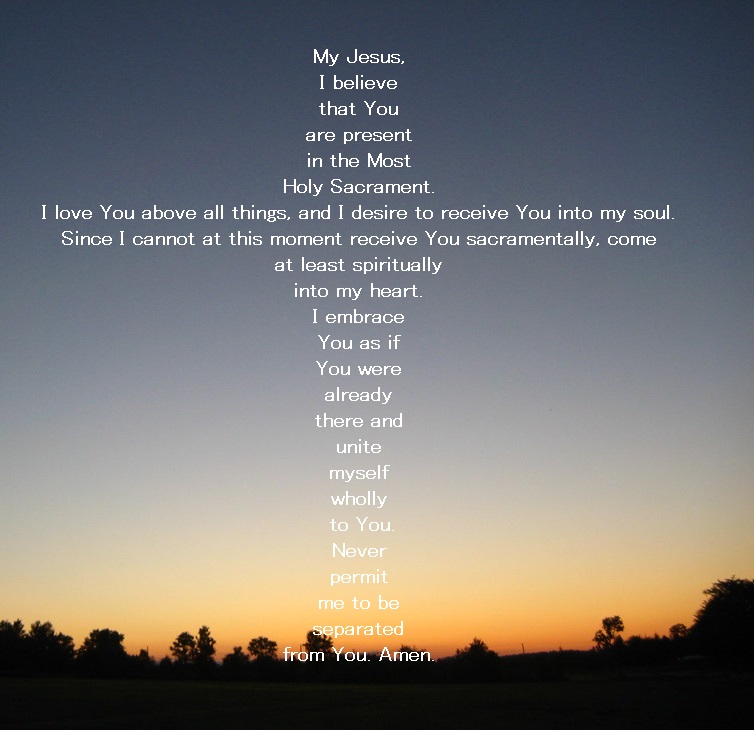
My Jesus,
I believe that You are present in the Most Holy Sacrament.
I love You above all things, and I desire to receive You into my soul.
Since I cannot at this moment receive You sacramentally,
come at least spiritually into my heart.
I embrace You as if You were already there
and unite myself wholly to You.
Never permit me to be separated from You.
Amen.

Just one month ago, when pews were full for the 2nd Sunday of Lent, we heard the Gospel story of the Transfiguration. On Mount Tabor, Jesus’ face shone like the sun and his clothes became white as light. Ecstatic, Simon Peter said in reply, “Lord, it is good that we are here! If you wish, I will make three tents here, one for you, one for Moses, and one for Elijah.” Peter wanted to never leave that euphoric time and place, but it was necessary that Jesus lead him down from that mountain top into the dark valley; from the Mount of Transfiguration to the Hill of Crucifixion.

It is a true sacrifice to fast from the Eucharist this Good Friday amidst this Long Lent. But our Christian sacrifice is not without purpose nor without hope. Like Jesus’ Passion, it is a sacrifice offered for the love of others. This is his Body given up to save many; we do this in memory of him. And like Jesus within his Passion, we can be confident that this arduous trial shall pass away and our suffering and obedience will soon yield great rewards, particularly a deepened love for our Eucharistic Lord. Being followers of the transfigured Christ takes us to Calvary, but the Passion is what leads us to his Resurrection. And the more we share in the likeness of Christ, the more we will share in his glory.

Moses & the Rock — 2nd Sunday of Lent—Year A

March 8, 2020

You’re familiar with the story of Moses: his being saved from the waters of the Nile as a baby, his growing up in the household of Pharaoh, his flight as a fugitive after killing an Egyptian taskmaster, his years shepherding in the Sinai Desert until God called him from the Burning Bush, how God used Moses to free the Hebrews from Egyptian slavery with great plagues and awesome miracles, how God through Moses gave his people the Law of the Old Covenant. Moses shared an incredible intimacy with God.

In the Book of Numbers, God said:

“If there are prophets among you,
in visions I reveal myself to them,
in dreams I speak to them;
Not so with my servant Moses!
Throughout my house he is worthy of trust:
face to face I speak to him,
plainly and not in riddles.
The likeness of the Lord he beholds.”

The Book of Deuteronomy declares: “Since [that time] no prophet has arisen in Israel like Moses, whom the Lord knew face to face.” So one would imagine, one would think, that Moses saw God’s face. The Book of Exodus says: “The Lord used to speak to Moses face to face, as a person speaks to a friend.” However, following soon after in that same chapter from Exodus, Moses asks the Lord, “Please let me see your glory!” And the Lord answers: “I will make all my goodness pass before you, and I will proclaim my name, ‘Lord,’ before you … But you cannot see my face, for no one can see me and live. Here is a place near me where you shall station yourself on the rock. When my glory passes I will set you in the cleft of the rock and will cover you with my hand until I have passed by. Then I will remove my hand, so that you may see my back; but my face may not be seen.” So Moses met with God in intimate conversation as one friend speaks to another, in his holy presence, yet it is not clear that Moses, during his lifetime, ever beheld God’s face. Similarly, God gave Moses the mission of leading his people from Egypt to the Promised Land, the land promised to Abraham and his descendants, yet Moses during his lifetime never entered the Promised Land himself.

Why was that the case? Early in their desert wanderings, the Hebrews complained against Moses because of their lack of water. Moses cried out to the Lord, “What shall I do with this people? A little more and they will stone me!” And the Lord answered Moses: “Go on ahead of the people, and take along with you some of the elders of Israel, holding in your hand, as you go, the staff with which you struck the Nile. I will be standing there in front of you on the rock in Horeb. Strike the rock, and the water will flow from it for the people to drink.” Moses did this in the sight of the elders of Israel and the crisis was adverted.

However, on a later occasion, when the community again lacked water, they held an assembly against Moses and Aaron. The people quarreled with Moses, exclaiming, “Why have you brought us out of Egypt, only to bring us to this wretched place [to die]? It is not a place for grain nor figs nor vines nor pomegranates! And there is no water to drink!” The Lord said to Moses: “Take the staff and assemble the community, you and Aaron your brother, and in their presence command the rock to yield its waters. Thereby you will bring forth water from the rock for them, and supply the community and their livestock with water.

So Moses took the staff from its place before the Lord, as he was commanded. Then Moses and Aaron gathered the assembly in front of the rock, where he said to them, “Just listen, you rebels! Are we to produce water for you out of this rock?” Then, raising his hand, Moses struck the rock twice with his staff, and water came out in abundance, and the community and their livestock drank. But the Lord said to Moses and Aaron: “Because you did not have confidence in me, to acknowledge my holiness before the Israelites, therefore you shall not lead this assembly into the land I have given them.

Years later, at the edge of the Promised Land, the Lord told Moses: “Ascend this mountain [Mount Nebo] and view the land … which I am giving to the Israelites as a possession. Then you shall die on the mountain you are about to ascend, and shall be gathered to your people, [because] you broke faith with me among the Israelites at the waters of Meribath-kadesh in the wilderness of Zin: you did not manifest my holiness among the Israelites. You may indeed see the land from a distance, but you shall not enter that land which I am giving to the Israelites.” And there, Moses the servant of the Lord died as the Lord had foretold. Moses was one hundred and twenty years old when he died, yet his eyes were undimmed and his vigor unabated.

What was behind this punishment from God? Moses had been disobedient to the Lord, striking the rock twice instead of speaking to the rock as instructed; and this was more than just some desert rock—the rock carried spiritual, symbolic, prophetic significance. In his First Letter to the Corinthians, St. Paul saw the Church and her sacraments prefigured in the story of the Hebrews and the Exodus. St. Paul writes: “Our ancestors were all under the cloud and all passed through the sea, and all of them were baptized into Moses in the cloud and in the sea. All ate the same spiritual food, and all drank the same spiritual drink, for they drank from a spiritual rock that followed them, and the rock was the Christ.

So the rock in the desert symbolized Jesus Christ. The first time, God told Moses to strike the rock, and it poured forth from its side saving water for God’s people. But the second time, when God told Moses to speak to the rock, Moses disobeyed and struck it twice. Jesus Christ has already been struck, beaten, and suffered violence once, for you and me in his Passion. We are no longer to keep striking him, again and again, through our sinful disobedience. Rather than choosing sin, we are to speak to Christ, asking him to pour forth his saving gifts. Jesus says, “Let anyone who thirsts come to me and drink. … To the thirsty I will give a gift from the spring of life-giving water.

I fear that sometimes we might think, “I can keep on sinning, it’s no big deal, because if I keep on going to Confession and have my sins forgiven it’s like they never happened—they don’t really matter.” Yet every sin is a lost opportunity to do God’s will. Every sin refuses God’s “Plan A.” And sins, even after they are forgiven, can bear earthly consequences which remain for the rest of our lives. Moses sinned, and repented, and remained God’s friend, but he was refused entry into the earthly Holy Land to his own great disappointment. Even convicted murderers can be forgiven by God, but they still remain behind prison bars and their victims bodies remain buried underground. Let’s not be complacent about our sins, for every sin is a lost opportunity to follow God’s better plan and, even if forgiven, sins can have irreparable consequences in this world for the rest of our lives. But, thanks be to God, our Christian hopes are not for this lifetime alone. Moses died and was buried, but that is not the end of his story.

Jesus took Peter, James, and John his brother, and led them up a high mountain by themselves. And he was transfigured before them; his face shone like the sun and his clothes became white as light. And behold, Moses and Elijah appeared to them, conversing with him.” St. Luke’s telling of today’s Gospel story notes Moses and Elijah “appeared in glory and spoke of [Jesus’] exodus that he was going to accomplish in Jerusalem.

Sometimes people ask how the apostles knew it was Moses and Elijah. Most likely they either introduced themselves, or Jesus introduced them. Some people have the notion that the dead forget who they were, forget all their memories, and care nothing about the events on earth. But Moses can only introduce himself if he knows who he is. And if Jesus said, “This is the prophet Moses,” there’s no indication that Moses replied, “I am? Where am I? What is happening?” Moses and Elijah can converse with Jesus about the exodus he is going to accomplish in Jerusalem (that is, about his coming Passion, death, and resurrection) because they know who they are, remember their lives, and are concerned about events among the living.

At the Transfiguration, we see the not quite fully-satisfied aspects of Moses’ life reaching their fulfillment. Moses never entered the Promised Land in his lifetime, but here he stands in Israel upon Mount Tabor with Jesus. Moses seems to have never seen God’s face, but now he speaks face to face with Christ. Consider how privileged we are to stand in this holy place and have such intimacy with Jesus Christ in his Holy Eucharist. It is good that we are here.

God greatly desires that we not sin. And if we have sinned, the Lord desires that we promptly repent and sin no more. Now, this season of Lent is an excellent time for repentance—especially while we’re still healthy. This world is scarred by sins, some forgiven and many not; and these painful wounds grieve us and prevent our full satisfaction in life. Yet the full story of Moses shows that our hopes are not merely limited to this life. Our hope extends beyond death, and St. Paul says, “God works all things for the good of those who love him.” And in the end, as St. Julian of Norwich says, “all shall be well, and all shall be well, and all manner of thing shall be well.

Transfiguring Our Perception of Others

August 6, 2017

Today, Jesus hikes with his three closest apostles, Peter, James, and John, to the top of Mount Tabor in Israel. And there, Jesus is transfigured before them. His face shines and his clothes become intensely white. Then they hear God the Father speaking from a bright cloud that envelops them, declaring: “This is my beloved Son.”

In the Incarnation, some two thousand and seventeen years ago, the Eternal Word became Flesh, the Second Person of the Holy Trinity became Man, and the divinity of the Son of God became veiled within a human nature. It has long been my sense that Jesus is not changed or transformed at the Transfiguration so much as his apostles are allowed to glimpse him more deeply as he really, truly is: God from God, Light from Light. This light shines from his face as radiantly as the sun and from his body such that the fabric of his clothing is brightly illuminated like a thin lampshade.

When the disciples become frightened after hearing the Father’s voice and fall prostrate on the ground, burying their faces, Jesus comes over and touches them: “Rise, and do not be afraid.” And when the disciples raise their eyes, they see Jesus once more the same way as they had always seen him, and yet they see him differently now.

If we saw Jesus tomorrow while buying bread and milk at the store, or if Jesus visited our place of work, or came to our front door, do you think we would recognize him? I tend to doubt it. Many of the Jews in Jesus’ day noticed nothing extra special about him. “Is he not the carpenter’s son?” The Prophet Isaiah foretold of the Messiah that ‘there would be in him no stately bearing to make us look at him, nor appearance that would attract us to him.’ Even Jesus’ close friends sometimes had a hard time recognizing him after his Resurrection. The most famous example of this was on the Road to Emmaus. But by the gift of God’s grace, with the Breaking of the Bread, the eyes of Jesus’ disciples were opened and they recognized him in their midst. The reason I doubt that many would recognize Jesus amid their everyday lives tomorrow is because so few of us recognize him among us today.

In the very early Church, a man named Saul had a murderous hatred for the first Christians. One day, was traveling to Damascus, Syria to arrest any Christians he might find there and bring them back to Jerusalem in chains. As he was nearing Damascus, a light from the sky suddenly flashed around him. He fell to the ground and heard a voice saying to him, “Saul, Saul, why are you persecuting me?” Saul asked, “Who are you, sir?” And the voice replied, “I am Jesus, whom you are persecuting.” This man went on to be converted to a Christian. We know him today as St. Paul.

Note how Jesus does not say, “Saul, Saul, why are you persecuting my Church,” nor “Why are you persecuting my people.” He says, “Why are you persecuting me?” Jesus identifies himself with his people and his Church because he is personally present within them. At the Last Supper, Jesus tells his disciples, “In a little while the world will no longer see me, but you will see me… You will realize that I am in my Father and you are in me and I in you.” Jesus speaks of his mystical presence within us our and neighbors at other times in the Gospels as well.

At the Last Judgment, Jesus tells us he will say to his saved sheep: ‘Whatever you did for one of the hungry, or thirsty, or naked, or sick, or imprisoned little brothers or sisters of mine, you did it for me.’ And then Jesus will turn and declare to the condemned goats: “Amen, I say to you, what you did not do for one of these least ones, you did not do for me.” These goats, Jesus tells us, will go off to eternal punishment, but the righteous sheep to eternal life.

And so you see, recognizing, loving, and serving Jesus in other people must be a top and serious priority for us. Yet how many people do we interact with each day with so much thoughtless indifference? We speed past other people like so many unnoticed trees and cars as we drive along our way of life. Sometimes we even take the people living in our own home for granted, treating our family members worse than our mere acquaintances. Many failed to recognize Jesus’ importance in his day; while we overlook the importance of people in our midst today. As C.S. Lewis wrote:

“It is a serious thing to live in a society of possible gods and goddesses, to remember that the dullest and most uninteresting person you can talk to may one day be a creature which, if you saw it now, you would be strongly tempted to worship, or else a horror and a corruption such as you now meet, if at all, only in a nightmare.

All day long we are, in some degree, helping each other to one or other of these destinations. It is in the light of these overwhelming possibilities, it is with the awe and the circumspection proper to them, that we should conduct all our dealings with one another, all friendships, all loves, all play, all politics.

There are no ordinary people. You have never talked to a mere mortal. Nations, cultures, arts, civilization — these are mortal, and their life is to ours as the life of a gnat. But it is immortals whom we joke with, work with, marry, snub, and exploit — immortal horrors or everlasting splendors.”

So how can we begin to behold and relate to other people in the manner we ought, as Christ would have us do? Jesus himself was open and loving towards everyone. I would suggest two steps: First, ask for the gift of God’s grace at this Breaking of the Bread on the Feast of the Transfiguration, that your eyes may be opened to truly see others. And second, begin a habit of praying for, say, five or ten people every day whom you’ve never thought to pray for before. For example, the cashier who gave you change yesterday, that politician whom you dislike, the suffering people of North Korea, your child’s best friend, your quiet co-worker, and the person whom you heard just died. And then, the next day, chose another new collection of people to pray for. This practice will reveal to you your inter-personal, spiritual blinders, and help you to begin tearing them down. Let us ask Jesus to transfigure our perception of others so that we may see them more in the way that he beholds them, with love.

Looking Forward to Heaven — 2nd Sunday of Lent—Year C

March 3, 2013

In Genesis, God promises descendants and a land to Abraham.  However, Abraham and his wife are very old, and Abraham feels uncertainty about whether they will have children. Therefore, God says to Abraham: “Look at the sky and count the stars, if you can. So shall your descendants be.” You may imagine this happening at night, but perhaps God has Abraham look during the day. We cannot see the stars in the daylight, but we know that they are there. Likewise, God’s promises to Abraham will be fulfilled even though Abraham cannot see it.

Like Abraham, we hope in God’s promises about things we cannot see. While Abraham wants to have children so that his legacy continues, we want eternal life. He hopes that his descendants someday get the Promised Land. We hope for the Promised Land of Heaven. I think we should feel hope in these things more.

In the Gospel, Peter is euphoric about seeing Jesus with Moses and Elijah and says something very silly. “Master, it is good for us to stay here and build three tents: one for you, one for Moses and one for Elijah.” How could Moses and Elijah prefer to live in tents on a mountain top on earth rather than return to paradise? Yet, sometimes we behave like our greatest hope isn’t heaven but to live here on earth forever.

Saint Paul says about sinners:  “… Just think of earthly things. We, however, are citizens of heaven, and from it we also await a savior, the Lord Jesus Christ. He will change our lowly body to conform with his glorified body… ” We all have a natural fear of death, and this is healthy and good. And we feel sad when persons depart from us, and this is understandable. But we should look forward to going to heaven. We should feel at least as much excitement about going to heaven as we would in winning an around-the-world vacation.

Have you encountered beauty here on earth? There is greater glory in heaven. Have you felt happiness and contentment here? There is overflowing joy in heaven. Have you known love? Every person loves perfectly in heaven. Which friends and family do you want to see again in heaven? Which saints or angels do you want to meet there? What will it be like to see Jesus face to face? Reflect on these things, and let this hope inspire you.

En el Génesis, Dios promete descendientes y una tierra a Abraham. Sin embargo, Abraham y su esposa son muy viejo, y Abraham se siente incertidumbre acerca de si van a tener hijos. Por lo tanto, Dios le dice a Abraham: “Mira el cielo y cuenta las estrellas, si puedes. Así sera tu descendencia.” Usted puede imaginar que esto ocurra por la noche, pero tal vez Dios ha Abraham mirar durante el día. No podemos ver las estrellas en la luz del día, pero sabemos que están ahí. Del mismo modo, las promesas de Dios a Abraham se cumplirá aunque Abraham no lo puede ver.

Como Abraham, esperamos que en las promesas de Dios acerca de cosas que no podemos ver. Mientras Abraham quiere tener hijos, para que su legado continúa, queremos la vida eterna. Él espera que sus descendientes algún día obtener a la Tierra Prometida. Esperamos que recibimos la tierra prometida de los Cielos. Creo que deberíamos sentir esperanza en estas cosas más.

En el Evangelio, Pedro es eufórico de ver a Jesús con Moisés y Elías y le dice algo muy tonto: “Maestro, sería bueno que nos quedarámos aquí y hiciéramos tres chozas: una para ti, una para Moisés y otra para Elías” sin saber lo que decía. ¿Cómo pudo Moisés y Elías prefieren vivir en tiendas de campaña en la cima de una montaña en la tierra en lugar de regresar al paraíso? Sin embargo, a veces nos comportamos como nuestra mayor esperanza no es el cielo sino a vivir aquí en la tierra para siempre.

San Pablo dice acerca de los pecadores: “…Sólo piensan en cosas de la tierra. Nosotros, en cambio, somos ciudadanos del cielo, de donde esperamos que venga nuestro salvador, Jesucristo. El transformará nuestro cuerpo miserable en un cuerpo glorioso, semejante al suyo…” Todos tenemos un temor natural de la muerte, y esto es sano y bueno. Y nos sentimos tristes cuando las personas salen de nosotros, y esto es comprensible. Pero debemos mirar hacia adelante para ir al cielo. Debemos sentir excitación cerca de ir al cielo como ganar unas vacaciones alrededor del mundo.

¿Se ha encontrado la belleza aquí en la tierra? Hay una mayor gloria en el cielo. ¿Se ha sentido la felicidad en la tierra? Hay mas alegría en el cielo. ¿Ha conocido el amor? Cada persona ama perfectamente en el cielo. ¿Lo que amigos y familiares qué quieres volver a ver en el cielo? ¿Que los santos y ángeles te quiero conocer allí? ¿Qué se sentiría al ver a Jesús cara a cara? Reflexiona sobre estas cosas que esta esperanza os inspire.

3 Mountains / 3 Montañas — 2nd Sunday in Lent—Year A

March 20, 2011
In the life of Jesus, he climbs three significant mountains; The mountain of the sermon on the mount, the mountain of Transfiguration (in today’s reading) and the mountain of the crucifixion. In the Christian life, we must also visit these three mountains. 
 
The three mountains are united. The wisdom of the sermon on the mount, on the first mountain, brings the pleasures and pains of the other mountains. The life of the Gospel brings the joys of the light and the suffering of the cross. Wisdom, glory and sacrifice; the three are a trio here on this earth. Our glories without sacrifice pass quickly. Our sacrifices without wisdom we regret quickly. And our wisdom will be without glory forever if we do not follow Christ in sacrifice. Which mountain should visit more this season of Lent?
 
Do you lack wisdom? Do you not know well that Jesus and his Church teaches? Go to the first mountain to learn, like the disciples at the Sermon on the Mount, with the Bible, or the Catechism or many popular resources available in audio or visual forms.
 
Do you need consolation? Do you not feel well that Jesus is your beloved friend? Go to the second mountain, to feel like Jesus and his disciples at the Transfiguration, through time in a quiet place with God.
 
Do you need perfection in your love? Do you not carry the cross well? Go to the last mountain to practice it, like Jesus at the crucifixion, through good works for others.
 
Jesus climbed the mountains of wisdom, glory and sacrifice. To be with him, we must climb these also.
 

En la vida de Jesús, él sube tres montañas notables. La montaña del sermón del monte, la montaña de la transfiguración (en la lectura de hoy) y la montaña de la crucifixión. En la vida cristiana, debemos visitar estas tres montañas también.

Las tres montañas están unidas. La sabiduría del sermón del monte, de la primera montaña, trae los placeres y dolores de las otras montañas. La vida del Evangelio trae las alegrías de la luz y los sufrimientos de la cruz.  Sabiduría, gloria y sacrificio; los tres son un trío unido en esta tierra.

Nuestras glorias sin sacrificio pasan rápidamente. Nuestros sacrificios sin sabiduría lamentamos rápidamente. Y nuestra sabiduría será sin gloria para siempre si no nos siga a Cristo en sacrificio. ¿Qué montaña deben visitar más esta temporada de Cuaresma?

¿Faltas de sabiduría? ¿No sabes bien lo que Jesús y su Iglesia enseñan? Vaya a la primera montaña para aprender como los discípulos al sermón del monte, con la Biblia, o el catecismo o muchos recursos populares disponibles en formularios visuales o de audio.

¿Necesitas consuelo? ¿No te sientes bien que Jesús es tu amigo amado? Vaya a la segunda montaña para sentirlo como Jesús y sus discípulos a la transfiguración, con tiempo con Dios en un lugar tranquilo.

¿Necesitas perfección en tu amor? ¿No llevas bien la cruz? Vaya a la última montaña para practicarlo como Jesús a la crucifixión, con buenas obras para otros.

Jesús subió las montañas de sabiduría, de gloria y de sacrificio. Para estar con él, debemos subir estas también.

Fatima Rosary Reflections

May 31, 2010

We celebrate May as the month of Mary, but we gather this particular day because 93 years ago Mary appeared to three children outside a small village in Portugal named Fatima. We will now pray the rosary and I will share with you just some of this story of Mary, Our Lady of Fatima.

[Pray the usual introductory Rosary Prayers]

In the year before Mary appeared to them, Lucia age 10, and her cousins Francisco and Jacinta, ages eight and seven, were grazing their sheep in a field. A dazzlingly beautiful young man, seemingly made of light, appeared to them and identified himself as the Angel of Peace. He invited them to pray with Him, and taught them a simple prayer.  I will pray this prayer three times and I invite you to join with me.

“My God, I believe, I adore, I trust and I love You! I beg pardon for all those who do not believe, do not adore, do not trust and do not love You. Amen.”

In the 1st Luminous Mystery we encounter “Jesus’ Baptism in the Jordan.” Jesus was not a sinner, He did not need baptism for himself, but He was baptized to become an advocate and intercessor for others. Likewise, let us pray as advocates and intercessors for all those who do not believe, do not adore, do not trust, or do not love God throughout the world.

[Pray the First Luminous Mystery]

On another occasion, the Angel of Peace appeared before them holding a chalice in his hands. Above it was suspended a host from which drops of blood were falling into the chalice. The Angel left the chalice suspended in the air, prostrated himself before it, and taught the children this prayer:

“O Most Holy Trinity, Father, Son and Holy Spirit, I adore Thee profoundly. I offer Thee the most precious Body, Blood, Soul and Divinity of Jesus Christ present in all the tabernacles of the world, in reparation for the outrages, sacrileges and indifferences by which He is offended. By the infinite merits of the Sacred Heart of Jesus and the Immaculate Heart of Mary I beg the conversion of poor sinners. Amen.”

In the 2nd Luminous Mystery we encounter “Jesus’ Miracle at the Wedding Feast of Cana.” For them, Jesus changed water into wine. For us, He changes wine into His blood. Are we indifferent to this miracle in our midst, or does it really matter to us? Let us pray that the Eucharist would transform us.

[Pray the Second Luminous Mystery]

On May 13, 1917, after lunch on a clear blue day, the children were praying the rosary. Suddenly, they saw two bright flashes. They looked up and saw, in Lucia’s words, “a lady, clothed in white, brighter than the sun…”

The Lady smiled and said: “Do not be afraid, I will not harm you.” Lucia asked her where she came from. The Lady pointed to the sky and said: “I come from heaven.” Lucia asked what she wanted. She said, “I have come to ask you to come here for six months on the 13th day of the month, at this same hour.” They tried to keep it to themselves, word of the children’s encounter with the Heavenly Lady got out. Though they were met with the townspeople’s skepticism and mockery, the children would not deny what they had seen and heard.

In the 3rd Luminous Mystery we encounter “Jesus’ Proclamation of the Kingdom of God.” Let us pray to be irresistibly led to proclaim what we have experienced in Christ.

[Pray the Third Luminous Mystery]

On July 13th, the incredibly beautiful Lady appeared to them again. Lucia asked her who she was, and for a miracle so everyone would believe. She answered, “Continue to come here every month. In October, I will tell you who I am and what I want, and I will perform a miracle for all to see and believe.” And the Lady taught them this prayer:

“Oh my Jesus, forgive us our sins, save us from the fires of hell. Lead all souls to Heaven,  especially those in most need of Thy Mercy.”

In the 4th Luminous Mystery we encounter “Jesus’ Transfiguration.” Sometimes we look at other people and think that they can’t change what they are. The apostles thought like this, but Jesus opened their eyes with His Transfiguration. Let us pray for the grace of transformation; in our family members, in our friends, and especially among those in most need of God’s Mercy.

[Pray the Fourth Luminous Mystery]

At noon on the 13th of October, 1917, some 70,000 people were gathered in the field. With a flash of light the Lady appeared to the children, and Lucia, for the last time, asked her what she wanted. The Lady answered, “I want to tell you that a chapel is to be built here in my honor. I am the Lady of the Rosary. Continue always to pray the Rosary every day. The war is going to end, and the soldiers will soon return to their homes.” And the Blessed Virgin Mary urged the conversion of hearts, as she had many times before, “Do not offend the Lord our God any more, because He is already so much offended.”

What happened next was reported at the time in an anti-religious Portuguese newspaper, by a reporter who had previously written dismissively about the goings-on at Fatima:

“…One could see the immense multitude turn towards the sun, which appeared free from clouds and at its zenith. It looked like a plaque of dull silver and it was possible to look at it without the least discomfort. It might have been an eclipse which was taking place. But at that moment a great shout went up and one could hear the spectators nearest at hand shouting: “A miracle! A miracle!” Before the astonished eyes of the crowd… the sun trembled, made sudden incredible movements outside all cosmic laws – the sun “danced” according to the typical expression of the people.”

In the 5th Luminous Mystery we encounter “Jesus’ Institution of the Eucharist.” What the masses saw in the heavens that day was a great miracle. But what we encounter at every Mass is an even greater wonder. Let us pray that we would always have the eyes to see it.

[Pray the Fifth Luminous Mystery, followed by the usual closing Rosary Prayers]

(Primary Source)