 The Holy Family’s first Christmas was both stressful and joyful.
- Jesus the Bread of Life was born in Bethlehem, which means “House of Bread.”
- Jesus was born and laid to rest in caves. His body was wrapped, in birth and death.
- Joseph taught carpentry to Him through whom all things were made.
- Mary taught prayers to God.
- St. Joseph, protector of the Holy Family, is now universal patron of the Church.
- St. Mary, the bearer of one child, is now mother of all Christians.
Archive for the ‘Typology’ Category
Mysteries of the Holy Family
December 26, 2014
Our Lady’s Wisconsin Message: The Meaning of the Two Trees
September 25, 2014In the Garden of Eden, there were many fruit-bearing trees, but Genesis mentions only two by name: the Tree of Life, and the Tree of the Knowledge of Good and Evil. By partaking of the Tree of Life the human race could keep living forever, but the Lord warned that to eat from the other tree would mean our certain death. On October 9th, 1859, the Blessed Virgin Mary appeared near Green Bay to a 28 year-old Belgian immigrant named Adele Brise while she was walking eleven miles home from Sunday Mass. Interestingly, Our Lady chose to appear to Adele not in a church, or a thousand other places, but between two trees: a Maple and a Hemlock.
 You’re familiar with the beauty and goodness of the Maple. In the fall, its leaves turn the most striking colors, and in the spring its sap yields sweet syrup. But do you know about the Hemlock tree? The poison that the Greek philosopher Socrates was condemned to drink came from this plant. Ingesting just six or eight fresh Hemlock leaves can kill a healthy adult. [Post-Script: The Hemlock Tree found in Wisconsin is not poisonous, but merely shares the name.] The Maple is a tree of life while the Hemlock is a tree of death. Mary, the New Eve, stood between the two.
 Mary told Adele, “I am the Queen of Heaven, who prays for the conversion of sinners, and I wish you to do the same. You received Holy Communion this morning, and that is well. But you must do more. Make a general confession, and offer Communion for the conversion of sinners. If they do not convert and do penance, my Son will be obliged to punish them.” Our Lady’s message between the two trees is akin the words of Moses, who told the Israelites: “I have set before you life and death, the blessing and the curse. Choose life, then, that you and your descendants may live, by loving the Lord, your God, heeding his voice, and holding fast to him. For that will mean life for you, a long life for you to live on the land….”
 Apparently, Our Lady’s warnings were not sufficiently heeded. In October of 1871, exactly twelve years later, disaster came. Both in terms of size and number of lives lost, the Peshtigo Fire remains the worst recorded forest fire in U.S. history. Between 1,200 and 2,400 lives ended in that firestorm which saw, according to an eyewitness, “large wooden houses torn from their foundations and caught up like straws by two opposing currents of air which raised them till they came in contact with the stream of fire.” This seems to be the punishment due to sin that Mary spoke of, yet this does not mean that everyone who perished in that fire was condemned. We should remember that at harvest time, the wheat and the weeds are pulled up together in a moment, but their future fates are not the same. Once uprooted, the good are gathered and kept in the barn, while the bad are thrown away forever.
The firestorm came and surrounded the shrine of Our Lady, where hundreds had come for refuge with their families and herds, beseeching her intercession before God. As many as fled to her there were saved. The shrine’s consecrated earth was an emerald-green island in an ocean of smoldering ashes as far as eyes could see.
Mary, the Queen of Heaven, prays for the conversion of sinners and she wishes you to do the same. You receive Holy Communion, and that is well. But you must do more. Begin by receiving the sacrament of reconciliation regularly, because it is powerful for growing in holiness. The sinner whose conversion you are most responsible for is your own.
The Two Mountains — Wednesday, 3rd Week of Lent
March 26, 2014Readings: Deuteronomy 4:5-9, Matthew 5:17-19
[W]hat great nation is there that has gods so close to it as the LORD, our God, is to us whenever we call upon him? Or what great nation has statutes and decrees that are as just as this whole law which I am setting before you today?
The greatness of Israel among the nations consisted not merely in their moral law but in their intimacy with God. As C.S. Lewis once observed, “The road to the promised land runs past Sinai.” The morality of Mount Sinai is essential to the journey, but our goal is to worship on Mount Zion.
Immediately following today’s Gospel about fulfilling the Law, Jesus declares, “I tell you, unless your righteousness surpasses that of the scribes and Pharisees, you will not enter into the kingdom of heaven.” The Pharisees and scribes kept the commandments pretty well but they were often far from God.
This Lent, let us not only focus on growing in our moral practices, but also on our love and intimacy with the Lord.
Reflections on St. Joseph — March 19 — St. Joseph
March 19, 2014- Joseph was probably the first person Jesus Christ called “Abba.”
- As a carpenter, Joseph created things by his mind and hand, imaging God the Father, Creator of the universe.
- Joseph never gave a stone, a snake, or a scorpion to Jesus when asked for a loaf of bread, a fish, or an egg.
- Like God the Father, Joseph can seem quiet, but he never ceases in his love and action.
- As God loved ancient Israel purely, so Joseph loved Mary—the icon of perfected Israel.
- Joseph was the protector and provider in the household of the Son of God. Now he is the patron of the universal Church.
Stained Glass Symbols — The Dove
February 9, 2014 A Symbol of the Holy Spirit
From the Ark, at the time of the Flood, Noah released a dove three times to scout for land. The bird’s return with a fresh olive leaf in its beak signaled an end to the deadly judgment and the beginning of new life. Noah’s dove revealed that peace was restored between heaven and earth. When Jesus was baptized in the Jordan River by John the Baptist, they saw the Holy Spirit descend in bodily form, like a dove, and land upon Christ. By receiving Christ’s baptism, the Holy Spirit comes to rest on us, pouring into us the new life and graces of the Trinity.
What do the Virgin Mary & the Ark of the Covenant Have in Common?
August 17, 2013The Ark of the Covenant bore the presence of God and three other important things, while Mary’s womb bears Jesus Christ, our Priest, Prophet and King. (Hebrews 9:4)
The Ark bore the Ten Commandments, the word of God in stone, while Mary’s womb carries Jesus Christ, the Word of God in flesh. (Deuteronomy 31:26, John 1:14)
The Ark bore the staff of Aaron which had miraculously blossomed, while Mary’s womb carries Jesus Christ, a bud blossoming miraculously from the stump of Jesse. (Numbers 17:10, Isaiah 11:1)
The Ark bore a gold container of Manna from heaven, while Mary’s womb carries Jesus Christ, the Bread from heaven. (Hebrews 9:4, John 6:41)
The Ark was made of wood overlaid with pure gold, inside and out, while Mary is a human being who is made “full of grace.” (Exodus 25:10-11, Luke 1:28)
King David joyfully leaped and danced before the Ark, while St. John the Baptist leaps within his mother’s womb at Mary’s arrival. (2 Samuel 6:14, Luke 1:44)
David asks, “How can the ark of the Lord come to me,” while St. Elizabeth asks, “And how does this happen to me, that the mother of my Lord should come to me?” (2 Samuel 6:9, Luke 1:43)
The Ark remained in the house of Obed-edom outside Jerusalem for three months and God blessed his whole house, while Mary remains in the house of Zechariah in Judea for three months. (2 Sam 6:14, Luke 1:56)
No man was to touch God’s holy Ark, lest they die. St. Joseph holds a similar reverent regard towards Mary, his wife. (Numbers 4:15, 2 Samuel 6:7, Matthew 1:25)
The Ark was a mercy-seat which served as the throne for God’s presence on earth. “On entering the house [the Magi] saw the child with Mary his mother.” (Exodus 25:22, Matthew 2:11)
In his vision of heaven, St. John saw the Ark revealed. The next thing he sees is a glorious woman pregnant with the Christ child. (Revelation 11:19, 12:1)
Just as the Ark of the Covenant was of central, though secondary, importance in the Old Covenant, so God gives the Blessed Virgin Mary an essential role in his New Covenant.
Eliakim the Prime Minister Prefigures Peter
April 28, 2013Eliakim, son of Hilkiah, was master of the palace, the prime minister in the Davidic kingdom. (Isa 22:15,20)
Simon Peter, son of Jonah, is always first in lists of Jesus’ Apostles—while Judas is listed last. (Matt 16:17, Matt 10:2, Mark 3:16. Luke 6:14, Acts 1:13)
Eliakim’s predecessor, Shebna, had hewn a tomb in a great rock which he hoped would be a lasting a resting place. (Isa 22:16)
Simon Peter is declared to be the “rock” (“Petros”) upon which Jesus will build his Church. (Matt 16:18)
Eliakim was clothed with a robe and girded with a sash. (Isa 22:21)
Peter stretches out his hands to be dressed by another. (John 21:18)
Eliakim was “a father to the inhabitants of Jerusalem and to the house of Judah.” (Isa 22:21)
Peter is the pope (“papa” or “Holy Father”) to the Church on earth.
Eliakim was given authority, “the key of the House of David.” (Isa 22:22)
Peter is given “the keys to the kingdom of heaven.” (Matt 16:19)
The Lord said of Eliakim, “What he opens, no one will shut, what he shuts, no one will open.” (Isa 22:22)
Jesus says to Peter, “Whatever you bind on earth shall be bound in heaven; and whatever you loose on earth shall be loosed in heaven.” (Matt 16:19)
Satan Prefigures Absalom
April 26, 2013Satan was among the angels, called the “sons of God.” (Job 1:6)
Absalom is one of King David’s sons. (2 Sam 3:3)
Satan was called “the father of lies.” (John 8:44)
Absalom proves false to his name, which means “father of peace.”
Satan was “a murderer form the beginning.” (John 8:44)
The first Bible story about Absalom has him arranging his brother’s murder. (2 Sam 13:28)
Satan afflicts the world to gain attention and achieve his ends. (Job 2:7)
Absalom sets fire to a field to get the attention of Joab, who is ignoring his requests. (2 Sam 14:30)
Satan lied to tempt humanity away from loyalty to God. (Gen 3:4-5)
Absalom sits at the city gates hearing legal cases, flattering all that they are right, and lamenting that he is not in power to help; thereby stealing loyalties away from the king. (2 Sam 15:2-6)
Satan inspired the betrayal of Jesus at the Mount of Olives, where he felt sorrow and distress. (Luke 22:39)
Absalom’s betrayal leads David to flee by way of the Mount of Olives, where he cries aloud. (2 Sam 15:30)
Satan plotted against Jesus using Caiaphas, who said, “It is better for you that one man should die instead of the people, so that the whole nation may not perish.” (John 11:50)
Absalom’s advisor Ahithophel counsels, ‘Let me choose twelve thousand men and be off in pursuit of David tonight. When all the people with him flee, I shall strike down the king alone. It is the death of only one man you are seeking; then all the people will be at peace.’ (2 Sam 17:1-3)
Once Satan was finished using the betrayer, Judas went away and hanged himself. (Matt 27:5)
Once Absalom’s advisor sees his counsel is ignored, Ahithophel leaves and hangs himself. (2 Sam 17:23)
Satan, called “Lucifer,” was radiant like the morning star. (Isa 14:12)
“In all Israel there was not a man who could so be praised for his beauty as Absalom, who was without blemish from the sole of his foot to the crown of his head.” (2 Sam 14:25)
Satan was a proud creature. (1 Tim 3:6)
Absalom shaves his hair every year—because it grows too heavy—and has the clippings weighted. (2 Sam 14:26)
Satan’s pride led to his downfall. (Isa 14:14-15)
Absalom is killed after his hair gets tangled in the branches of a tree. (2 Sam 18:9)
Satan, despite his unrepentance, is still loved by God. (Wis 11:24-12:1)
Absalom, despite his wickedness, is inconsolably mourned by his father, David. (2 Sam 19:1)
Sampson Prefigures Jesus
April 24, 2013Sampson’s mother was barren, but she conceived after the visit of an angel. (Judg 13:3)
Jesus’ mother is a virgin, but she conceives after the visit of Gabriel. (Luke 1:31)
Sampson revealed to Delilah the secret of his strength and she betrayed him for thousands of silver pieces. (Judg 16:5)
Jesus revealed to Judas his messianic secret and he betrayed him for thirty pieces of silver. (Matt 26:13)
Sampson was captured, blinded, and mocked. (Judg 16:21,25)
Jesus is arrested, blindfolded, and mocked, “Prophesy for us, Messiah: who is it that struck you?” (Matt 26:68)
Sampson extended his arms against the pillars to destroy the enemies of his people. (Judg 16:30)
Jesus extends his arms upon the cross to conquer the devil, sin, and death. (Heb 2:14)
Sampson the strong was made weak so that God’s people could be freed. (Judg 16:19,30)
Jesus the Christ is made to suffer so that God’s people can be saved. (Isa 53:11)
The Ark of the Covenant Prefigures Mary
April 23, 2013The Ark of the Covenant bore the presence of God and three important things. (Heb 9:4)
Mary’s womb bears Jesus Christ, our Priest, Prophet and King.
The Ark of the Covenant bore the Ten Commandments, the word of God in stone. (Deut 31:26)
Mary’s womb carries Jesus, the Word of God in flesh. (John 1:14)
The Ark of the Covenant bore the staff of Aaron which had miraculously blossomed. (Num 17:10)
Mary’s womb carries Jesus, a bud blossoming miraculously from the stump of Jesse. (Isa 11:1)
The Ark of the Covenant bore a gold container of Manna from heaven. (Heb 9:4)
Mary’s womb carries Jesus, the Bread from heaven. (John 6:41)
The Ark of the Covenant was made of wood overlaid with pure gold, inside and out. (Exo 25:10-11)
Mary is a human being made “full of grace.” (Luke 1:28)
King David joyfully leaped and danced before the Ark of the Covenant. (2 Sam 6:14)
John the Baptist leaps in his mother’s womb at Mary’s arrival. (Luke 1:44)
David said, “How can the ark of the Lord come to me?” (2 Sam 6:9)
Elizabeth says, “And how does this happen to me, that the mother of my Lord should come to me?” (Luke 1:43)
The Ark of the Covenant remained in the house of Obed-edom outside Jerusalem for three months, and God blessed his whole house. (2 Sam 6:14)
Mary remains in the house of Zechariah in the hill country of Judea for three months. (Luke 1:56)
No man was to touch the holy Ark of the Covenant, lest they die. (Num 4:15, 2 Sam 6:7)
Joseph holds a similar reverent regard towards Mary, his wife. (Matt 1:25)
The Ark of the Covenant’s mercy-seat served as the throne for God’s presence on earth. (Exo 25:22)
“On entering the house (the Magi) saw the child with Mary his mother.” (Matt 2:11)
In his vision, St. John saw the Ark of the Covenant revealed in heaven. (Rev 11:19)
The next thing he sees is a glorious woman pregnant with the Christ child. (Rev 12:1)
Eve Prefigures Mary
April 23, 2013Tempted by a demon, Eve distrusted God, leading to our fall.
Greeted by an angel, Mary trusts God, leading to our salvation.
Eve was “the mother of all the living.” (Gen 3:20)
Mary’s offspring are “those who keep God’s commandments and bear witness to Jesus.” (Rev 12:17)
Because of her sin, Eve was covered with dirt. (Gen 3:19)
Because of her faith, Mary is clothed with the sun. (Rev 12:1)
Adam Prefigures Jesus
April 22, 2013From the side of sleeping Adam, the woman Eve was fashioned.
From the blood and water flowing from his pierced side, Jesus’ Church is made.
Adam was tested in the Garden of Eden.
Jesus is tested in the Garden of Gethsemane.
Adam was naked without shame because of his innocence.
Jesus is stripped naked before dying his innocent death.
Adam may have failed to protect Eve and Eden because he feared the dragon-serpent’s violence.
Jesus is willing to suffer and die to save his Church and the world from the devil.
The Tree of the Knowledge of Good and Evil revealed right and wrong to humanity.
Jesus’ cross shows us the greatest acts of love and evil in all of human history.
Parables About Jesus — Monday, 17th Sunday in Ordinary Time—Year A
July 26, 2011Jesus speaks of Kingdom of God (or the Kingdom of Heaven) more times in the Gospel than perhaps anything else. But what is this kingdom? The Kingdom dwells among us when God’s will is done on earth as it is in Heaven. The Kingdom reigns wherever the will of God is known and followed. His Kingdom is not equally present at all times and everywhere, which is why we pray for the kingdom to fully come, yet it can be present within a good community, in a loving family, or within a Christian’s soul.
Jesus leads us into the Kingdom of God. He teaches us how to live as kingdom people. There’s an interesting twist contained in Jesus’ teachings: whenever He speaks about the kingdom of God, He is usually teaching us something true about Himself. This is so, because Jesus is the kingdom incarnate. Wherever Jesus is, you find the Kingdom, and wherever the Kingdom is, Jesus is there.
Because of this close identification between Jesus and the Kingdom, we can substitute between these terms and reread Scripture with new eyes. For example, “In those days John the Baptist appeared, preaching in the desert of Judea saying, ‘Repent, for (Jesus Christ) is at hand!’” The beatitude becomes: “Blessed are the poor in spirit, for theirs is (Jesus Christ).” One time, when Jesus sees how his disciples are shooing the little children away, He becomes indignant and says to them, “Let the children come to me; do not prevent them, for (I) belong to such as these.” And we hear it said, “Seek ye first (Jesus Christ) and his righteousness, and all these things will be given you besides.” When applied to today’s Gospel, Jesus three parables become revelatory of Jesus Himself.
Jesus is like a treasure buried in a field. This means that Jesus must be found. In the movie Forrest Gump, a down-in-the-dumps Lt. Dan Taylor asks Forrest derisively, “Have you found Jesus, Gump?” Forrest replies, “I didn’t know I was supposed to be looking for Him, Sir.” If I ask you if you’ve found Jesus you might feel like a bit Forrest; you’re baptized, you’re here at church, how could you still need to find him?
 Well, think of it this way: do you have a joy and excitement in your relationship with Christ anything like a man who finds a hidden treasure? Does you life feel rich and full of opportunity because you know Him? If not, then you have not yet found Him like He wants you too. We need to seek after Him in prayer and learning. Encounter Him in the Gospels, especially if you never have before. (Do you want to reach the end of your days without ever having read the Gospels?) Jesus is a rich treasure whom we must seek out and discover.
The second parable: Jesus is like a merchant searching for fine pearls. (Notice that Jesus was first the treasure, now He’s the searcher.) This means that Jesus searches after us. We should not despair. He pursues more passionately than a man searching a profit. Jesus seeks us as a man in love. A pearl may get dirty and think it is no longer desirable, but Jesus has the solution for cleansing pearls. He emptied Himself of glory to become man for us, and then he gave everything He had to die as a man for us. Do not forget that if we were the only sinner on earth He would have still come for you. Never despair. Jesus will always pursue you like a man in love.
In the third and final parable, Jesus is like a net thrown into the sea, which collects fish of every kind. This means that Jesus confronts us all. As Simenon foretold of The baby Jesus when Mary and Joseph brought Hi to the temple, “Behold, this child is destined for the fall and rise of many in Israel, and to be a sign that will be contradicted so that the thoughts of many hearts may be revealed.” The truth of Jesus Christ confronts all people, even if they’ve never heard the name of Jesus. But we have heard His name, and we must not put off responding to Him forever.
Jesus is the treasure we must seek. We must not despair, for Jesus relentlessly seeks after us. Jesus is the net who confronts us all, so we must not put Him off forever.
Born Under the Law — Tuesday, 15th Week in Ordinary Time—Year I
July 12, 2011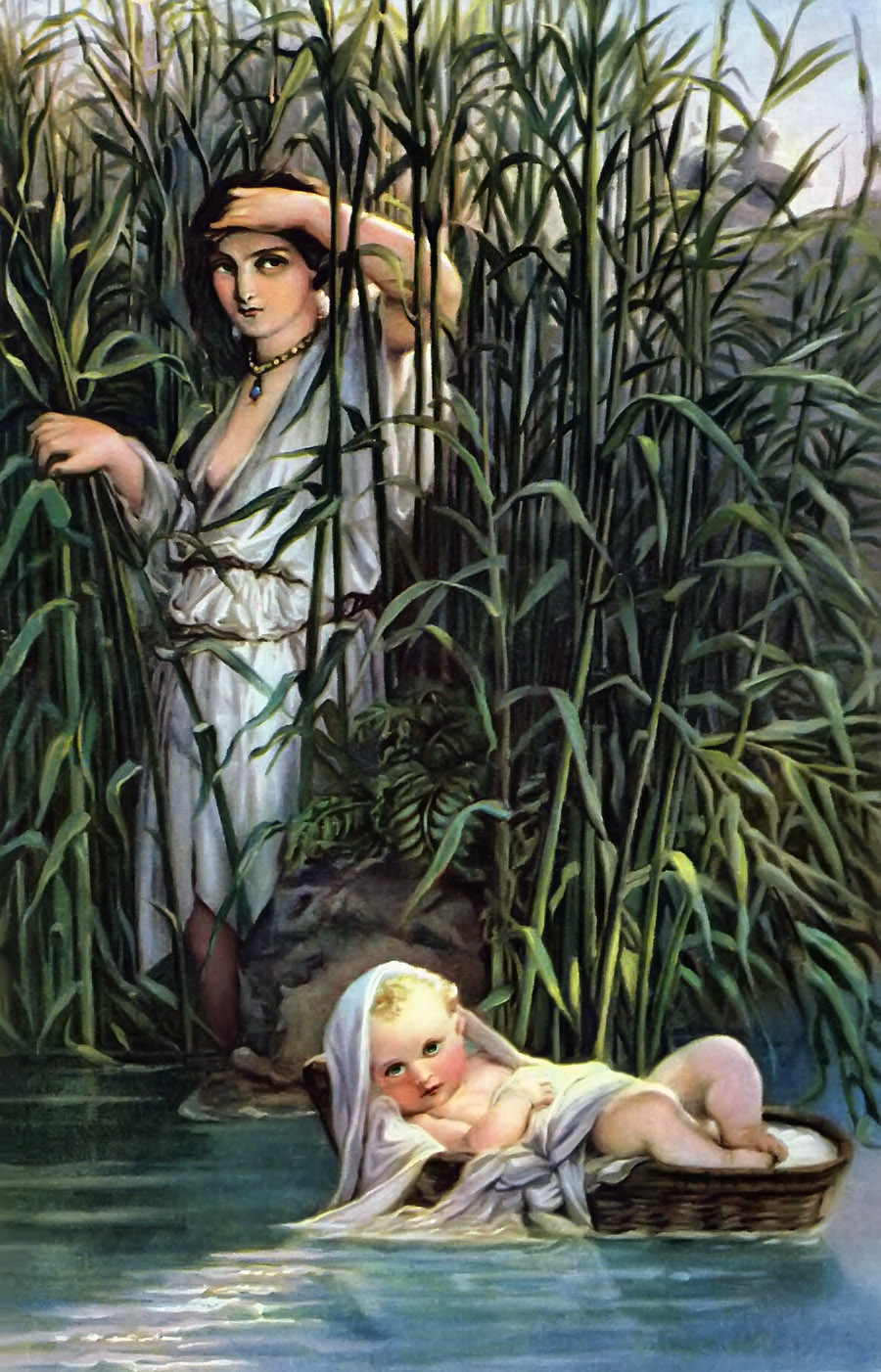 The story of Moses prefigures the life and works of Jesus Christ. St. Paul tells the Galatian Christians, “[We,] when we were not of age, were enslaved to the elemental powers of the world. But when the fullness of time had come, God sent his Son, born of a woman, born under the law, to ransom those under the law, so that we might receive adoption.”
The elemental powers St. Paul speaks of are the devil and the demons who powerfully and harmfully influence the world. Pharaoh and his evil reign image Satan, the demons, and their works. The children of Israel strained under the law and it brought them death. But, when the fullness of time had come, God sent a child, born of a woman, born under that law. That child, who would image person and works of Jesus, was Moses.
As long as he remained a quiet, sleepy newborn, the mother of Moses could hide him, but after three months her son began to loudly and frequently cry. With a pain that pierced her to the heart, she laid her son in the waters of death, hoping against hope, that she would receive him back safe. And, like Mary the mother of Jesus, God miraculously brought her son came back to her alive and safe. For what purpose was Moses was born under the law?—to ransom those under the law, so that they might receive God’s adoption. The Hebrews were known as the children of Israel, but they were to become the people of God.
Moses was destined to lead them, but in his youth, he was still unready. (His actions towards the Egyptian taskmaster make this clear. The one who would lead the people into the Promised Land, the one who would prefigure the Christ, could not to have an undisciplined and violent character.) After decades in a hidden life of preparation, Moses confronted Pharaoh and brought out the Israelites, not by force of arms, but by God’s power.
Moses led them into a new covenant relationship with God, who declared to them, “I will be your God, and you will be my people.” Through Moses, the Israelites were made God’s people. Through Jesus Christ, we are made God’s children. Let us recognize, that as much as Jesus is greater Moses, so the gift of the New Covenant is greater than the Old. As amazing as mighty deeds and graces of God were in the age of Moses, remember that these are all greater in the age of Jesus Christ.
Why Twelve Apostles? — Wednesday, 14th Week in Ordinary Time—Year I
July 6, 2011 Yesterday, Jesus said to His followers, “ask the master of the harvest to send out laborers for his harvest.” Today, He summons twelve disciples from the crowd to have a special role and authority among His people. Each is named an “apostle,” a title which is a Greek word, meaning “one who is sent.” Jesus shall send the apostles into the world to be the foundation stones of the Church. Why did Jesus choose twelve Apostles, rather than ten, twenty, or one hundred? I think that reasons are found in the history of God’s people and in the symbolic meaning of numbers.
Yesterday, Jacob wrestled with God and his name was changed Israel. This man, Israel, had twelve sons and through these sons, descended the twelve tribes, the people of Israel. By choosing twelve, Jesus establishes the people of God anew; He constitutes a new Israel. The number twelve is also three times four. Three is the Trinitarian number of God and four is the number of the created world; as in north, south, east and west, or the four corners of the earth. Twelve, the number which is three times four, denotes how the Triune God shall reach out to all nations to form a new people of God, a new family, a New Israel, the Church.
Our Church, its bishops, priests and deacons, like the sons of Israel and the twelve Apostles, frequently prove that they are human, yet our Church is more than just an organization and the ordained are more than just functionaries. Our clergy derive their special role and authority from Jesus Christ and the Apostles, and our Church is intended for all. They are our fathers and the Church is God’s family.
 Parishable Items