Archive for the ‘Typology’ Category

Jesus’ Resurrected Body — Easter

April 7, 2010


On Holy Thursday, we meditated on the disciples’ feet. On Good Friday, our Saviour’s hands.  Today, let us consider Jesus’ resurrected body.

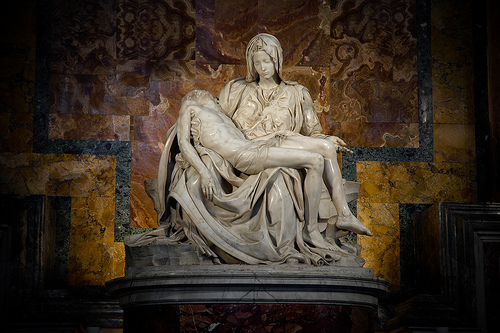
Jesus’ resurrected body is the very same that died and was buried, but it is a very different body, too. The tomb was empty on Easter morning, not because Jesus’ body was vaporized, but because it was raised.

Jesus’ resurrected body has wounds, in his hands and feet and side, showing that this is the same body that suffered on the cross. It seems that the cuts and bruises on Jesus’ face and the lashes on His back are healed, but these five wounds remain. Why? These wounds are trophies and jewels.  They no longer cause Him pain, but they testify to Jesus’ greatness and love and He will have them forever.

So Jesus’ resurrected body is the very same body that died on the cross and was buried in the tomb, but it is a very different body. For instance, Jesus in His glorified body can cause others to see but not recognize Him, as He did on Easter evening with two disciples on the road to Emmaus. Only later, in the breaking of the bread, did they recognize Him. Then Jesus displayed another new power, disappearing from their sight. In His glorified body Jesus can move at the speed of thought and the walls and locked doors of the upper room do not prevent Him from appearing in the midst of the apostles.

In this there is a sign for the future of humanity. People often speak of “the end of the world” and imagine Heaven in strictly spiritual terms, but just as Jesus’ body was not annihilated but transformed, so our bodies and this universe will be remade. A glimpse into the future of the righteous is reflected in the resurrection of Christ.

Jesus’ body is not discarded, but gloriously transformed. In this there is a lesson for us. In (just about) every  life, there is a line that we have drawn in our relationship with God. It is a self-imposed limit on our trust, commitment, and self-gift towards Christ. “Lord, I will walk with you that far, (but no farther.)”

Perhaps we are unwilling to cross that line with us because we are too attached to the sins and mediocrity we have settled for, maybe we are afraid that we will lose who we are and become something that we are not, or maybe we are afraid that a total self-gift to God won’t truly make us happy. The devil likes this arbitrary line. He would like you to reach the end of your life and have to wonder with regret, “What would my life been if I had gone all-in for God?” The devil would have you fearful and repulsed of “the cross, the cross!” but the cross is not the end of our story.  Remember, as in Christ, God does not want to destroy you, but to transform you into who you truly are.

Do you believe Jesus suffered and died for you? Then He surely loves you. If He loves you, then how could He not desire your greatest happiness? Do you believe Jesus is divine and all-knowing? The surely He knows what will lead to your greatest good. Do you believe Jesus is all-powerful? Then surely He has the power the lead you to that good. Then what is standing in His way? There is only one thing standing in the way of His omnipotent power, preventing Him from transforming us into who (deep down) we truly want to be. That obstacle is our own freewill, the arbitrary line we draw in our relationship with Christ.

This Easter, let us be resolved to follow Christ without compromise. Let us entrust our whole selves to Him who has given us everything. Jesus does not want to destroy you, but to gloriously transform you into who you truly are.

Three Temptations — 1st Sunday in Lent—Year C

February 23, 2010

In today’s gospel Jesus is led into the desert by the Holy Spirit for forty days of prayer, penance, and preparation and there He is tempted by the devil.  We have been led to this season of Lent and we also find ourselves being tempted. This morning I would like to talk about how the devil’s three temptations present themselves to us and to let you know about an allowance in Lent that you will be happy to hear.

Most of us here have chosen to take on a penance during Lent.  You have probably resolved to abstain from something good, like cookies, candies, ice cream, TV or the internet, to grow in disciple and virtue, and to offer some sacrifice to God. The devil first said to Jesus, “command this stone to become bread,” and we will probably be tempted in a similar way; “Put down the rock of your penance for awhile and let it nourish you.” It is the way of demons to first entice and then condemn. The rationalization, “Go ahead, it’s just a little cookie,” will afterwards become the accusation, “You couldn’t even sacrifice one cookie for God.” Let us preserve in our Lenten penances, for the joy of having carried a cross for the Lord is far preferable to the discouragement of a moment’s compromise.

As a second temptation, the devil, in a vision, showed Jesus all the kingdoms of the world in a single instant and said, “I shall give to you all this power and glory; for it has been handed over to me, and I may give it to whomever I wish. All this will be yours, if you worship me.” Scripture calls Satan the Father of Lies, so we ought to be skeptical about whether he really had this authority over the nations, and even if he did we should disbelieve that he would give Jesus the world if He were to worship him. Instead, I suspect that the devil would have simply laughed and left Jesus with nothing for having fallen into sin.

We human beings are creatures of habit. The same sins which you have struggled with in the past are probably the same ones that challenge you today. When we are tempted by sins they promise us the world, great peace and satisfaction. Yet we can look back at our own experiences and see that these are lies. Our past sins show us that they only lead to disappointment and dissatisfaction. We should stop swallowing the bait. We should stop accepting the lie. This Lent is a perfect time for us to commit to crushing the habitual sins in our lives, for our sins will not make us happy, even if they promise us the world.

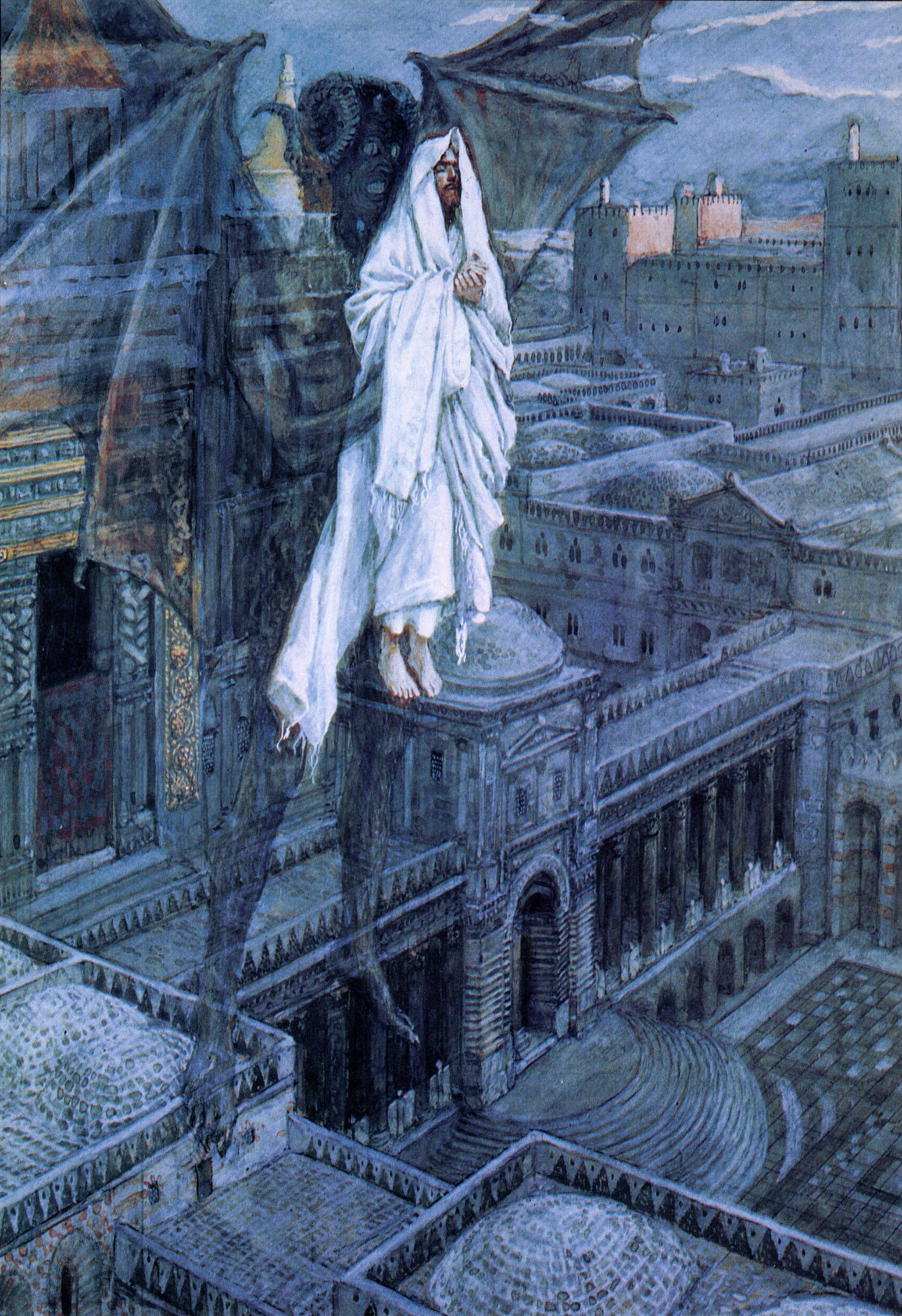
As a third temptation, the devil took Jesus up (in a vision or in the body we do not know) to the top of the temple in Jerusalem. He said to Him, “If you are the Son of God, throw yourself down from here, for it is written: He will command his angels concerning you, to guard you, and: With their hands they will support you, lest you dash your foot against a stone.” The temptation addressed to us sounds differently. “You are not the Son of God, you’re not even close to being saint! You should throw yourself down in shame for your sins and not dare to pray or present yourself to God!” On the contrary, as we heard in the second reading, “No one who believes in him will be put to shame.” Lent calls us to sorrow and conversion for our sins, not to shame and aversion from God.

We see the one-two combo of enticement and shame modeled in the case of Adam and Eve.  When they heard the sound of the Lord God moving about the garden they hid themselves among the trees, for they realized that they were naked before Him, and they were ashamed and afraid. Much later, in the case of Judas Iscariot, the devil led him to betray Jesus, one of the worst sins ever, and then after regretting it he was led to kill himself. If Judas had gone from the temple to Calvary, instead of to his tragic tree, Jesus would have forgiven him, because Jesus wanted to forgive him.

Jesus loves us. He doesn’t just love us because He’s God and He “has to” love everybody. Jesus loves us and He actually likes us for all the good things that we are and for all the good things He sees we can become. This is why He created us and died for us, because He loves us. So we should not be ashamed to come to Christ in the sacraments; in confession with our big sins, or at communion with our small ones. As Jesus told St. Faustina, the greater our sins the more entitled we are to his mercy. When it comes to God’s forgiveness, only we ourselves can get in His way.

Finally, I mentioned that there is an allowance during Lent which is a cause for consolation amidst our Lenten struggles. But first, did you know that there are more than forty days in Lent?  The season is longer than forty days because we don’t count the Sundays.  There are 40 days of penance, but every Sundays (from Saturday evening to Sunday night) we are released from our penances. At Sunday Mass the priest still wears the Lenten season’s purple, we might do less singing, and we don’t say the Gloria or say the “A”-word before the gospel, but we are freed from penances that day, for every Sunday is a “little Easter. ”

In the first reading, we heard how Moses commanded the Hebrews that once they came into the Promised Land they should come before God to present their first fruits and recount the story of how God had delivered them from slavery, brought them into the Promised Land, and filled them with blessings. Each Sunday we come before God and recall how His Son, Jesus Christ, delivered us from our slavery, brought us into His kingdom, and has filled us with His blessings, especially the gift of Himself in the Eucharist. Each Sunday gives us consolation, and this release from our penances encourages us to offer still more penance to God in the week ahead, for it is an easier thing abstain for just six days than to do it for forty in a row.

So in conclusion, be faithful to your penances, your faithfulness will have its reward. Commit to crushing your habitual sins, for sins cannot make us happy, even if they promise the world. Shame and fear are the devil’s traps, so whenever you sin, come to the Lord with trust and sorrow. And know that you are released from penances on Sundays in Lent.  May this gift be a cause for thanksgiving and joy and inspire us to make a still greater gift of ourselves to Christ in this Lenten season.

The Two Ways — Thursday, 6th Week in Ordinary Time—Year II

February 21, 2010

In the first reading Moses sets before the people ‘the two ways’: life and prosperity, or death and doom. In the gospel Jesus tells us to deny ourselves, take up our cross and to follow Him. From this we might think that one could choose to bypass the cross, to never take it up, and to avoid the burden of the cross, but the cross is unavoidable.

Jesus was crucified along with two others, one on His left and one on His right; one who rejected Him, and one who accepted Him. These two people represent us. We are all crucified with Christ, and He is crucified with us. The question is how we will respond to Him.

In life there is no avoiding the cross, but in which way will we respond to it?  Will we rage and despair, or embrace it and follow Christ? Today I have set before you life and prosperity, death and doom. Let us follow the Lord, ‘for whoever wishes to save their life will lose it, but whoever loses their life for Christ’s sake will save it.’

Mary and Pilate — 6th Sunday in Ordinary Time—Year C

February 14, 2010

In a few moments, after this homily, we will recite our creed, the summary of our faith. Every Sunday, we profess, in union with the Christians who came before us, our belief in these truths and our resolve to live our lives according to them. This morning we will look at just one rich aspect of our creed and consider its implications for our lives.

Have you ever noticed that in the entire creed, only two non-divine persons are mentioned by name? These are the Virgin Mary and Pontius Pilate.

“By the power of the Holy Spirit, He was born of the Virgin Mary and became man. For our sake He was crucified under Pontius Pilate; He suffered, died and was buried.”

Now many other figures from the Old and New Testaments could have justifiably been included in our creed; such as Adam and Eve, Abraham, Moses, David, Mary Magdalene, Peter, Paul, and many others. Yet, only Mary and Pilate get mentioned. So why is this? There seems to be two very good reasons. The first of these reasons I will give now—and the second I will save for the end.

The first reason why Mary and Pilate receive special mention is that they ground Jesus’ life, death, and resurrection in our real history. Jesus was ‘born of the Virgin Mary, suffered and died under Pontius Pilate, and on the third day, He rose again.’ Now other pre-Christian religions sometimes had stories about dying gods who came to life again, but those stories were always said to have happened ‘once upon a time,’ in some remote and mythic past. But with Jesus Christ, this ancient intuition and longing of humanity is actually realized. The inclusion of Mary and Pilate in the creed witness to this: that God became man, died, and rose for us, in this world and in real history.

Some people try to be too sophisticated by saying it doesn’t really matter if Jesus rose from the dead, or even if He lived at all, because His teachings are what’s important. But St. Paul blows this idea out of the water. “If Christ has not been raised, your faith is vain; you are still in your sins. Then those who have fallen asleep in Christ have perished” and “we are the most pitiable people of all.” Without Jesus Christ and His resurrection there is no Gospel, there is no Good News.

Just like Jesus Christ, Mary His Mother and Pontius Pilate His executioner are not fictional characters made up for some story. They are real people, from a time not that much different from our own. Our styles and technologies may have changed, but human beings themselves remain much the same. When we look at Mary and Pilate we can see ourselves in these two people whom Christ encountered twenty centuries ago.

Pilate is the secular Man of the World.
Mary is the devoted Disciple of Christ.

Pilate seeks the glory of men.
Mary seeks the glory of God.

Pilate knows worldly wisdom, he is clever and cunning.
But Mary knows God’s wisdom, and she is truly wise.

Pilate thinks he knows how the world works and the pragmatic way to get things done. For Pilate, our world is totally shaped by of power, money, and influence, with some blind luck thrown into the mix. When Jesus stands silent before him, Pilate says, “Do you not speak to me? Do you not know that I have the power to release you and I have the power to crucify you?” Jesus replies, “You would have no power over me if it had not been given you from above.”

Pilate is a very post-modern man.  He’s a moral relativist. When he asks Jesus, “What is truth,” he doesn’t bother to wait for an answer from Truth Himself. That’s because Pilate thinks that the ‘truth’ cannot be known except for the ‘truths’ which we choose for ourselves or impose upon others.

The Gospels show that Pilate knows Jesus is innocent, or at least that he poses no real threat to society, yet Pilate is willing to have this innocent man whipped and even crucified when that becomes the most expedient thing to do. The crowd threatens Pilate, “If you release him, you are not a friend of Caesar,” and he quickly caves and hands Jesus over.
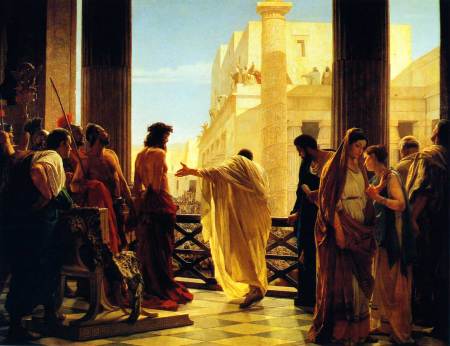
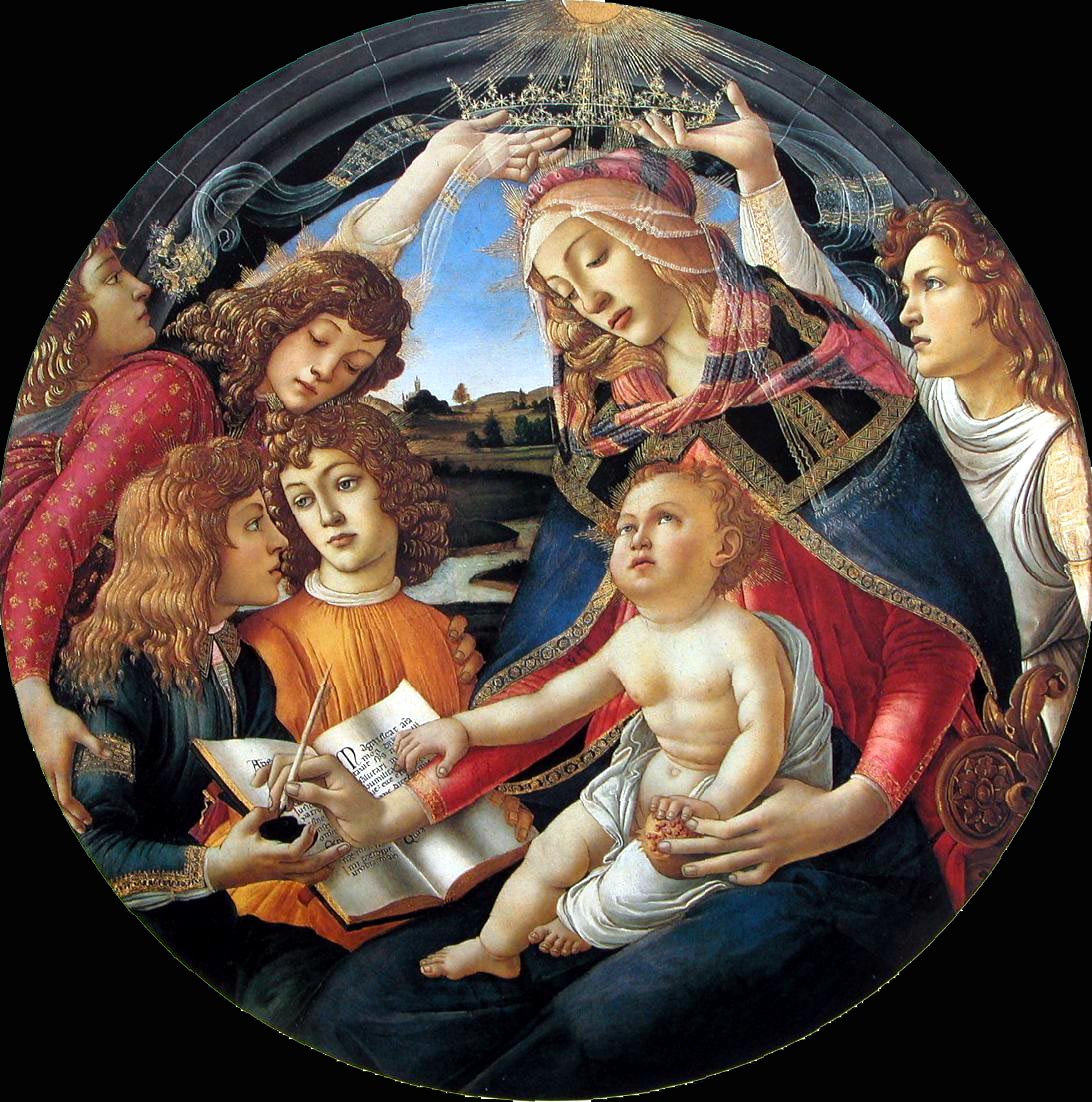
Pilate washes his hands of responsibility, and extends Christ’s arms on the cross. Mary had extended her arms declaring, “Let it be done to me according to your word,” and lovingly held the infant savior in her hands.

Pilate, despite all his power, is ruled by fear.
Mary, despite her weaknesses, is freed from it.

Governor Pilate is rich in wealth and power and yet he has no peace.
Mary, the poor widow, has peace and everything she needs from God.

Pilate has no faith in the God of Israel. He says, “I am not Jew, am I?” But for Mary, God is her rock and this makes all the difference in the world. Mary is defined by her faith, hope and love.

Mary never attends an academy, but she is profoundly wise because she reflects in her heart on the words and deeds of God and because she lives by her own advice: “Do whatever he tells you.” She knows that we do not manufacture the truth for ourselves, we receive it, ultimately from God. We love it, we defend it, and we share it with others. “Blessed [is she],” as Elizabeth said, “who believed that what was spoken to [her] by the Lord would be fulfilled.” Mary trusted and believed, for she saw the evidence through history that God “has mercy on those who fear Him in every generation,” that “He scatters the proud in their pride, and casts down the mighty from their throwns, but He lifts up the lowly.”

Mary’s life was full, but was not free from trials. When Mary consents to be found with child through the Holy Spirit she is uncertain of what will happen to her, but she trusts in God. She does not know how she and her husband will get by as poor immigrants in foreign country, but she continues to trust. Mary’s response to every trial in life, even to the death of her son, is to trust in God. Despite men’s sins, she trusts in God as the Lord of history, that He casts down the proud and mighty from their throwns and raises up the lowly.

Pilate is indifferent to Christ, and he consents to sending Him to the cross, but Mary is wholly devoted to Christ, and she consents to share in His Passion. Pilate’s heart is hardened despite Christ’s Passion, while Mary’s heart is pierced by it.

Governor Pilate was once the most powerful man in Judea, but where is he now? Mary, the poor widow, is now our glorious queen, the most beautiful and powerful woman in heaven or earth, and through her reign she draws millions to Christ our king.

She is the one who wept and now laughs.
He is the one who laughed and now weeps.

He was rich in the world and now he is poor.
She was poor in the world and now the kingdom is hers.

He took root in the desert, he was barren and uprooted.
But she was planted beside the flowing waters, she endured and bore much fruit.

So what do all of these reflections about Mary and Pilate have to do with us? I promised you at the beginning a second good reason why Mary and Pilate are mentioned in the creed; and here it is: Mary and Pilate represent us. They stand as archetypes, models or patterns, for every person.

The faithful one and the faithless one.

The one who serves God and the one who serves himself.

The one who gives Christ life and the one who puts him to death.

We live our daily lives as either Mary or Pilate, with shades of the other thrown in. As we come to the season of Lent, let us examine and discern who we are. “How am I Pilate, and how am I Mary?” And at this Eucharist, let us ask Jesus to exchange in us the ways of Pilate for the ways of Mary, for hers is the way of Christ.

Absalom and Satan — Monday, 4th Week in Ordinary Time—Year II

February 1, 2010

Absalom was one of David’s very own, but Absalom would betray him. Absalom’s name means “Father of Peace,” but he far closer resembles the “Father of Lies.”

In almost our earliest story about him, Absalom arranged his brother’s murder. He’s a murderer from the beginning.

We read that Absalom, like Satan, had a radiant beauty. “In all Israel there was not a man who could so be praised for his beauty as Absalom, who was without blemish from the sole of his foot to the crown of his head.”

Like the devil, Absalom’s glory was equaled by his vanity. At the end of every year, when his long hair grew too heavy, he would have it shaved and weighed it according to the royal standard.

Absalom was willing do havoc to attract another’s attention, as when he set fire to the field of a person ignoring him.

Like the serpent, Absalom was cunning and he would readily lie to serve his purposes. Absalom would sit at the city gates, listen to peoples’ (legal) grievances, and assure each one that they were right and entitled. Then he would manipulatively muse on how much better their lives would be if only he had the power.

Finally, Absalom sought to overthrow and kill his king. Absalom’s best advisor would counsel him, ‘Please let me choose twelve thousand men, and be off in pursuit of David tonight. When all the people with him flee, I shall strike down the king alone. It is the death of only one man you are seeking; then all the people will be at peace.’ This plan was agreeable to Absalom and to all the elders of Israel.

In our first reading we see David weeping on the Mount of Olives as he flees from Absalom. 1,000 years later, a descendant of David would be troubled in spirit on that same hill overlooking Jerusalem. Unlike David, Jesus did not flee His pursuers and was dead within a day. Jesus and the Sanhedrin agreed on this: it was better that one man should die, so that the whole nation may not perish.

David would flee and survive, but Absalom would die, thrust through with spears, hanging from a tree, entangled by his long, glorious hair.  But after this comes an episode which is a window into God’s incredible love for us. When news of the villainous betrayer’s death reaches King David, he mourns inconsolably at the loss of his beloved.

Likewise, and amazingly, despite Satan’s great and intractable wickedness; his betrayals, violence, and lies; the Lord still loves him. As the Book of Wisdom affirms, “[Lord,] you love all things that are and loathe nothing that you have made; for what you hated, you would not have fashioned. And how could a thing remain, unless you willed it; or be preserved, had it not been called forth by you?

There is a great encouragement in this for each one of us. If the Lord loves Satan, like David loved Absalom, then how could we ever doubt that the Lord will always love us, or imagine that He rejects us whenever we turn to Him?

Decoding the Ritual — Friday After Epiphany

January 9, 2010

Jesus stretched out his hand, touched the leper before Him, and said, “Be made clean.” The leprosy left him immediately and Jesus ordered Him, “Go, show yourself to the priest and offer for your cleansing what Moses prescribed…” What was Jesus asking this man to do? In the Book of Leviticus it says:

This is the law for the victim of leprosy at the time of his purification. He shall be brought to the priest, who is to go outside the camp to examine him. If the priest finds that the sore of leprosy has healed in the leper, he shall order the man who is to be purified, to get two live, clean birds, as well as some cedar wood, scarlet yarn, and hyssop. The priest shall then order him to slay one of the birds over an earthen vessel with spring water in it. Taking the living bird with the cedar wood, the scarlet yarn and the hyssop, the priest shall dip them all in the blood of the bird that was slain over the spring water, and then sprinkle seven times the man to be purified from his leprosy. When he has thus purified him, he shall let the living bird fly away over the countryside.  (Leviticus 14:2-7)

Hidden within this strange Old Covenant ritual, Jesus Christ is concealed. And through Jesus’ death for us on the cross the true symbolism of this ritual is revealed.

The scarlet, the wood and the hyssop all have their place in Christ’s Passion.  The scarlet yarn points to the robe they placed upon Him; the wood to the cross on which they nailed Him; and the hyssop to the branch they used to offer Him drink. One bird is slain and the other is spared, dipped in the water and the blood of its brother. This water points to the water of Christian baptism, which receives its grace through the blood of Jesus’ cross. In the ritual the priest would take all of these things and sprinkle the man to be purified seven (the perfect number of) times from his leprosy. In His Passion Jesus took all these things and used them to purify us from the leprosy of our sins.

In our wonder at these signs, let us make our faith in God firmer, and give Him our thanks.

Treasure the Gift — Christmas Mass at Midnight

December 26, 2009

It’s Christmas, and today we hear one of the most familiar passages in the Gospel, the nativity scene in Bethlehem.  Is there anything that we can learn out of such a familiar text?  Yes, very much indeed. For example, have you ever wondered: what are swaddling clothes anyways?  ‘Mary wrapped her Son in swaddling clothes and laid him in a manger.’

When I was young I thought swaddling clothes were just dirty pajamas, but in fact swaddling refers to an ancient custom. They would use tightly bound cloths to wrap-in an infants’ arms and legs to their bodies (they thought this was important for promoting proper posture.) This practice was called “swaddling.” Was it cruel to confine the babies like this? No, the babies liked this. It reminded them of their many months, warm and snug, within their mothers’ wombs. Another thing I’ve learned since the time I was a kid was what a manger really was.  A manger is not a stable. It’s a feeding trough.  Mary wrapped Jesus up in swaddling clothes and laid him in a feeding trough.

Even if you knew all that stuff before, there remains the question of why St. Luke included these details in his Gospel. Why is it important?  Not only does it show the poverty and humility of the Christ, it also points to Jesus’ future. This is not the last time that His mother would wrap Him in tight cloths and lay His body down. And baby Jesus is laid in a feeding trough because when He is grown He will say to His disciples, as you will her Him say to you here, “Take this, all of you, and eat it. This is my body which will be given up for you.” The swaddling cloths point to Jesus burial cloth, and laying in the manger points to His Eucharist, where which He offers us His whole self, His body, blood, soul, and divinity as food.

So you see, whether we are a talking about the Sacred Scriptures, prayer, the sacraments, the teachings of Christ’s Bride (our Mother, the Church,)  our Catholic faith is not a half-cut orange whose richness you can drain out with one or two squeezes and then toss away. A lifetime of discovery will not exhaust what all that our Catholic Faith contains.

When I was a kid I might have looked at this manger scene and though that some people were missing.  “Where are the Magi, the wise men (or astrologers) from the East?”  They’re over there, hiding among the poinsettias. Maybe they are journeying through the forests, or maybe they haven’t even left home yet, but one thing we do know is that they were not there on Christmas night.  When they arrive in Jerusalem they ask King Herod, “Where is the newborn king of the Jews?” Days, weeks, or even months have passed since Christmas, and when they do arrive in Bethlehem they do not find Jesus, Mary and Joseph living in a stable or a cave, but in a house.

So who was there that first Christmas night? The shepherds were there. The angel said to them in the fields, ‘I declare to you news of great joy! A savior who is Christ and Lord is born for you in Bethlehem.  You will find Him wrapped in swaddling clothes and lying in a manger.” The shepherds look at each other and say, “Hey, we’ve gotta check this out.” Who wouldn’t turn out for that first Christmas after an angelic invitation like that?

The shepherds came to the stable and find the infant Christ just as the angel described. From there, Luke’s Gospel says, they returned rejoicing and spread the word about what had happened to all. The shepherds probably knew everybody from Bethlehem, since they were locals (“from that region”) and within walking distance from the stable.

Yet there is a question which I would like us to consider, a question which the Gospels do not answer, and it is this: After that first Christmas, did the shepherds ever come back to visit the Holy Family again? I doubt you could find two people more friendly and welcoming than Joseph and Mary, so I sure that any guest was welcome in their home, but did the shepherds ever take the opportunity to visit them again? The Magi had to travel hundreds of miles just to see Jesus once, but the shepherds were only a short distance away. 

Did the shepherds ever get to know Mary and Joseph better, these two holy saints of God? Did they ever take time come back to adore Jesus, to consider what the birth of this Child meant for their lives, and to praise and thank God for all the blessings they had received? If they had merely spent a single hour each week in the Christ child’s presence, imagine what difference it would have made for their relationships, their work, and their lives in general? We don’t know whether the shepherds ever came back again after that first Christmas, but if they didn’t, then they were foolish and they really missed out.

This Christmas Jesus Christ invites you come back and see Him again, to visit this house of Joseph and Mary, where He is always present to be adored. He wants to bless you through His saints, His teachings, His sacraments, and His Real Presence here, the whole year round. You may be receiving many gifts this Christmas, but make sure that you do not return this one.

Advent Penance Service

December 1, 2009

 The psalm says, ‘On the holy mountain is [Jerusalem], his city, cherished by the Lord. The Lord prefers the gates of Zion to all Israel’s dwellings. Of you are told glorious things, O city of God, [Jerusalem].’  (Psalm 87) The Lord God loved Jerusalem and lived within its walls. God dwelt there in a special way in His temple on Mount Zion.

The people of Jerusalem felt pretty special about having such close access to God, but this pride was often their greatest weakness. You see the people of Jerusalem imagined they had this holiness thing in the bag, being so close to the Lord and all. Imagine their shock when a prophet would come along to tell them that they were not so perfect as they thought. When God sent them the prophet Jeremiah, he told them:

“Thus says the Lord of hosts, the God of Israel: Reform your ways and your deeds, so that I may remain with you in this place. Put not your trust in the deceitful words: “This is the temple of the LORD! The temple of the LORD! The temple of the LORD!” Only if you thoroughly reform your ways and your deeds; if each of you deals justly with his neighbor; if you no longer oppress the stranger, the orphan, and the widow; if you no longer shed innocent blood in this place, or follow strange gods to your own harm, will I remain with you in this place…”

Time and again, God sent prophets to Jerusalem to call them to conversion, but Jerusalem would persecute, imprison and kill them. But they did not convert.  And, in the lifetime of Jeremiah, their enemies (the Babylonians) conquered  the city of Jerusalem and destroyed the temple of God within it. We hear God’s feelings about all this through words of Jesus:

“Jerusalem… Jerusalem… you who kill the prophets and stone those sent to you, how many times I yearned to gather your children together, as a hen gathers her young under her wings, but you were unwilling! Behold, your house will be abandoned, desolate. I tell you, you will not see me again until you say, ‘Blessed is he who comes in the name of the Lord.’”

Jesus’ words matter for us today too, because Jerusalem symbolizes our souls. At our baptism, God began to dwell in our souls as His temple, as His new Jerusalem. The psalm is speaking about your soul and mine when it says:

O praise the Lord, Jerusalem! 
Zion, praise your God!
He has strengthened the bars of your gates,
He has blessed the children within you.
He established peace on your borders,
He feeds you with finest wheat.   (Psalm 147)

Indeed, God has strengthened the bars of our gates, our defenses against evil. He has blessed the children, everything that is good and loveable, within us. He establishes peace on our borders, in our relationships with others. And He feeds us with the finest of wheat in the Eucharist. We should feel pretty special about having such close access to God, but we should not make the same mistakes as the old Jerusalem.

You and I can persecute God’s prophets too. We do it whenever we choose to rebel and sin against the good God wills for us. We do it whenever we kill the voice of conscience within us. We do it whenever we imprison the Holy Spirit’s movements within us to the confines of a tiny cell. We do it whenever ignore or refuse to listen to the teachers Christ has given for His Church.

When we are persecuting God’s prophets, we can even evict God’s presence from our souls through freely and knowingly committing a grave or serious sin. We are conquered by our enemy and the temple inside us is destroyed. And ‘behold, our house is abandoned, desolate; and we do not see Him again until we say, ‘Blessed is he who comes in the name of the Lord.’ What can do to help prevent this horrible estrangement from occurring?  And if it does occur, how can we ask the Lord God to return?

In the sacrament of reconciliation, we acknowledge that Jesus Christ is the Blessed One who comes in the name of the Lord. When we acknowledge this, He forgives our sins, and God joyfully dwells in His cherished city. Today, Jesus Christ calls your city to repentance and the conversion of your soul.

Wednesday, 34th Week in Ordinary Time—Year I

November 25, 2009

Today’s responsorial psalm is not actually one of the 150 Psalms.  It comes from Daniel 3, where 3 men (none of whom are Daniel) are thrown into a fiery furnace for refusing to worship a golden  statue of King Nebuchadnezzar. (Isn’t it always so that all of history’s oppressive states and rulers have insisted that everyone fall down and worship gilded images of themselves or else be thrown to the fire?) Anyway, these three men are heaved into the flames, but God sends to them an “angel of the Lord,” or literally, a messenger, to preserve them from all harm. The trio sings a hymn of praise, part of which we heard today as our responsorial psalm.

Sun and moon, bless the Lord…
Stars of heaven, bless the Lord…
Every shower and dew, bless the Lord…
All you winds, bless the Lord…
Fire and heat, bless the Lord…
Cold and chill, bless the Lord;
praise and exalt him above all forever.

King Nebuchadnezzar rose in haste and asked his nobles, “Did we not cast three men bound into the fire?” “Assuredly, O king,” they answered. “But,” he replied, “I see four men unfettered and unhurt, walking in the fire, and the fourth looks like a son of God.”

Could this “son of God” amidst the flames actually be the Second Person of the Trinity, God the Father’s greatest messenger, or is it merely one of God’s many angelic spirits? In either case, this heaven-sent deliverer for God’s faithful ones at least symbolically points to Jesus Christ. We should not be surprised to find signs of Christ in the Old Testament.  Nor should we be surprised to see symbols of Him built into God’s creation all around us.

Consider the sun in the sky, which gives light to the world. It comes to earth, dies, and is buried, but then it rises again for us.

Consider the moon in the night, which resembles the Eucharistic host. We admire it held on high. We see it broken before us. Though consumed, it is renewed again for us.

Consider the stars, which resemble Christ’s numerous and glorious saints shining in heaven.

Consider the showers and dews, which resemble Him who humbly comes down from heaven to earth to give life to the world.

Consider the winds, which resembles Christ’s Spirit, mysteriously moving and active across the whole world.

Fire and heat, bless the Lord. Cold and chill, bless the Lord. For even in the extremes and in-between’s of life, God is to be found. Let us praise and exalt him above all forever.

Wednesday, 26th Week in Ordinary Time—Year I

September 30, 2009

Why do the Jews in today’s psalm begin to mourn when their “captors” ask them to sing one of Zion’s songs? This psalm refers to the time of the Jewish Exile. The kingdom of Judea was conquered by the Babylonian Empire 586 years before Christ. Many Jews were deported from their homeland to the rivers of Babylon in the East. Time passed, and that superpower was conquered by another, and after 50 years of Babylonian Captivity, the Persian Empire allowed the Jews to go home. However, many years passed, and Jerusalem, the city of God, remained in great disrepair.

This weighed heavily on the heart of Nehemiah, who was the cupbearer to the king of Persia. As cupbearer, he was the king’s highly-trusted servant because it was his job to drink of any wine that would be offered to the king, lest that it be poisoned. In the first reading we heard Nehemiah recall in his own words how he obtained permission from the king to rebuild God’s city, the city of his ancestors. Nehemiah is a “type” or foreshadowing of Christ.

As Nehemiah had the consent of his king for his mission, so Jesus had the consent of His father to come to Jerusalem as the restorer of God’s people.

Like Nehemiah before Him, Jesus desired, with all the sentiments of His human heart, to bless His deceased ancestors in their graves, for their blood ran through His own veins.

Like Nehemiah, Jesus wanted to build God’s city, giving it a new glory that would attract all nations to a more perfect worship of God within its walls.

Nehemiah used the timber of the Gentiles to build the earthly Jerusalem. To build the heavenly Jerusalem, Jesus used the wood of the Roman’s cross.

Nehemiah was old cupbearer, who faced death in service of the king. Jesus is the new cupbearer, who drinks from the cup, so that sins may be forgiven.

The cup that Jesus drinks is a cup of suffering mingled with joy. Today, at this Mass, Jesus asks us to follow Him. He says, take this cup, all of you, and to drink from it in remembrance of me.

Thursday, 20th Week in Ordinary Time—Year I

August 20, 2009

It can be important to remember that not every person and deed in the Bible is meant to be emulated as a model for us. Oftentimes the Scriptures are just recording the facts; the misdeeds and sinfulness of humans in need a savior. This is frequently true in the Old Testament where today we see Jephthah vowing to do an evil thing. There is a lot wrong with what Jephthah did.

First of all, human sacrifice was loved by the false gods surrounding and often infecting Israel, but it was absolutely forbidden under the Law of the Lord. Jephthah was disobeying that Law. He vowed to do something evil for the Lord, which is a self-contradiction. Finally, why did Jephthah promise to sacrifice the first person he saw—why did he not offer himself for the sacrifice?

Perhaps it was easy for Jephthah to vow a human sacrifice when he thought it would only cost him a stranger or one of his servants. But to offer his firstborn, or he himself, that was beyond his imagination. In this context, let us ponder and grapple with this strange mystery at the center of our faith:

Jesus Christ, God’s only and unique Son, allowed Himself to be sacrificed by sinners for His Father’s victory; for the salvation of God’s people.

What makes this divine sacrifice so different from Jephthah’s? Why is the one glorious and the other abominable?

Jephthah’s sacrifice was pointless and unnecessary, it was not needed to save God’s people. God fully planned to lead Israel to victory over the Ammonites even before, and without, Jephthah’s evil vow. On the other hand, the divine self-offering was necessary to save God’s people. (For His part, Jesus’ total self-offering, even to the point to death, was not a “necessary evil,” but a necessary good.) Theologians speculate and debate about whether our redemption could have come about under different circumstances, but Jesus spoke more than once during His life of the necessity that He go up to Jerusalem, to suffer and die, for our salvation.

Another importance difference is that Jephthah intentionally killed his innocent daughter (which is the definition of murder) by his own hand. The Father did not murder His Son, nor did the Son commit suicide. Jesus was killed by sinners.  The Father and Son permitted this, endured this, and made of this the perfect sacrifice for the salvation of the world.

We can imagine these words of the psalm as coming from Christ, but not as coming from Jephthah:

“Sacrifice or oblation you wished not,
but ears open to obedience you gave me.
Burnt offerings and sin-offerings you sought not;
then I said, ‘Behold, I come.’”

While Jephthah transgressed the Law by his sacrifice, Jesus uniquely and perfectly fulfilled it, at great personal cost to Himself. Christ is the model we should emmulate.

Tuesday, 20th Week in Ordinary Time—Year I

August 18, 2009

Jesus said, “For men [by themselves, salvation] is impossible, but for God all things are possible.” Evidence of this truth is seen in Gideon, whom the Lord this morning asks to save Israel.

Like Mary at the Annunciation, a messenger assures him, “The Lord is with you.”  But Gideon asks, “Please, my lord, how can I save Israel?” “I shall be with you,” the Lord says to him.

Gideon presents his strange visitor with a meal of unleavened bread and of young goat’s meat. He is directed to pour the broth of meat juices upon it. The juice flows over the bread and the meat and onto the ground, like Christ’s blood flowing over His flesh and down to the foot of the cross. Gideon sees the wondrous sacrifice and realizes that the presence and the power of God are in his midst.

After overcoming his hesitancies, Gideon listens to the Lord God as his military advisor, and using just 300 men, armed with lanterns in one hand and trumpet horns in the other, routs a hoard of Israel’s enemies.

God works no overwhelming miracles for Gideon. He never causes Gideon’s enemies to be swallowed up by earthquakes, or by balls of fire from heaven, or by tidal waves. Instead, God only uses little signs to reassure Gideon, to teach him to trust, and to listen to the still small voice of the Lord. In this way, Gideon becomes an effective instrument in fulfilling God’s plans. We can learn from Gideon, because the Lord prefers to work in the same way with us and through us: little signs, strengthen our trust, teach us to listen, and to fulfill God’s plans.

Gideon’s story is one of my favorites in the Old Testament. Unfortunately, you’re not going to hear any more of it after today because our lectionary skips beyond it. But the rest of Gideon’s fascinating story waits for you in the book of Judges, chapters 6 and 7.

August 14 – Vigil of the Assumption of Mary

August 17, 2009

When I was younger, I used to wonder why Mary was such a big deal. It wasn’t that I was against her or anything. I prayed Hail Mary’s to her, and I wasn’t out to deny anything our Church said about her. I just didn’t understand why we, as Catholics, honored her so much.

Some people say that Mary is no big deal, that she’s just another Christian.  They might point to today’s Gospel as evidence, where a woman from the crowd calls out to Jesus, “Blessed is the womb that carried you, and the breasts at which you nursed.”  And Jesus replies, “Rather, blessed are those who hear the word of God and observe it.” “So you see,” they would say, “it’s nothing special to be the mother of Jesus.” But in this Gospel Jesus is not denying Mary’s greatness, He is rather affirming it.

If Mary had merely been the biological mother of Jesus, delivering Him, and nursing Him, she might have been just another Christian. But Mary is most blessed among the disciples of Christ, of which she is the first, because she heard the word of God and observed it. She heard the word of God from the angel Gabriel and answered,

“Behold, I am the handmaid of the Lord. Let it be done to me according to your word.”

The overwhelming evidence for Mary’s exceptional glory, and her unique loveliness, is to be found throughout the Bible. The two Testaments, the Old, together with the New, show us why Mary is worthy of our great admiration and deserving of our special affection.

In the first reading we heard of the ark, the ark of the covenant, which you may remember seeing in Indiana Jones and the Raiders of the Lost Ark.  The ark was a wooden box, plated with gold inside and out, with two gold statues of winged angels on its lid.  This box, the ark, was carried about using two long polls, since men would be struck down if they touched the holy ark. The ark bore the presence of the Lord, it was His throne amidst His people.

The Lord had told Moses, who constructed the ark, according to the Lord’s precise specifications, to have some interesting things placed inside of it.  First, the wooden staff of Aaron, which had miraculously grown shoots and blossoms. Second, the two stone tablets inscribed with the Ten Commandments which were written by God’s own hand. And third, an urn full of manna, the food which the Lord had given his people to eat during the Exodus.

That was the ark of the Old Testament.
Mary is the ark of the New Testament.

As the ark was a box of wood, plated with precious gold, inside and out, so Mary was a human being, surrounded and filled with divine grace. Like the dead wood of Aaron’s staff, which (naturally speaking) should not have borne life, the Virgin Mary miraculously blossomed life within her. Unlike the written word of God in stone, Mary carried within her the eternal Word of God in flesh. Mary borne within herself the true bread from heaven, Our Lord Jesus Christ.

In the first reading we heard how David led the ark of God’s presence into Jerusalem.  The ark’s coming to Jerusalem is also commemorated in the psalm we heard.  Jerusalem is sometimes poetically referred to as Zion, since Mt. Zion was the place of the temple in Jerusalem.

Just as the Lord’s presence came into Zion, the presence of the Lord came to dwell in Mary. Nine times out of ten, whatever Scripture says of Zion or Jerusalem, also goes for Mary. Mary is Jerusalem.  She is Zion.

“For the Lord has chosen Zion;”
says the Psalm
He prefers her for his dwelling.
Zion is my resting place forever;
In her will I dwell, for I prefer her.”

And, nine times out of ten, whatever can be said of Mary, also applies to Christ’s Church. Mary is the icon of the Church.

So, as you can see, Mary is a big deal. And none of us is more admirable, praiseworthy, and sweetly loveable than her.

‘Therefore her heart is glad and her soul rejoices,
her body, too, abides in confidence;
because God did not abandon her soul to the netherworld,
nor would He suffer His faithful one to undergo corruption.’

He assumed His beloved into heaven. Thanks be to God, who gave Mary this victory over death, through her Lord and ours, Jesus Christ.

August 15 – The Assumption of Mary

August 17, 2009

When I was younger, I used to wonder why Mary was such a big deal. It wasn’t that I was against her or anything. I prayed Hail Mary’s to her, and I wasn’t out to deny anything our Church said about her. I just didn’t understand why we, as Catholics, honored her so much.

Yet, the overwhelming evidence for Mary’s exceptional glory, and her unique loveliness, is to be found throughout the Bible. The two Testaments, the Old, together with the New, show us why Mary is worthy of our great admiration and deserving of our special affection.

In the beginning, God created Adam and Eve.  An angel came to Eve, and tested her trust in God. Eve failed the test, and took the fruit, and gave it to Adam. Together, their actions led to the fall of humanity, and because she was “the mother of all the living,” the sad consequences of their sin propagated down to us and to all of their children. But, as St. Paul teaches, Jesus Christ is the “New Adam,” who, by his obedience, restores what was lost by the Old Adam’s disobedience.

“For just as in Adam all die, so too in Christ shall all be brought to life.”

So Christ is the New Adam, but where is the New Eve? Mary is the New Eve. An angel came to Mary, and her trust in God was tested. Mary answered,

“Behold, I am the handmaid of the Lord.”

Mary passed the test with trust and obedience, and she gave the Second Person of the Most Holy Trinity a body.  The New Eve gave the New Adam the fruit of her womb. Because Mary said at the Annunciation, “Let it be done to me according to your word,” Jesus could say in the garden, “Lord, not my will, but yours be done.”Together, their actions led to the salvation of humanity.  The happy effects of their faithfulness extend to all of us.  Mary is the new “mother of all the living,” that is, the mother of all Christians. Mary’s motherhood of all Christians, as Eve was the mother of all the living, is reflected in the Book of Revelation.

In Revelation, there is seen a glorious woman, who bears a son destined to rule all nations. (There are multiple senses of meaning here, but this woman and child, must in part represent Jesus and His mother Mary.) There is a dragon, who is the devil, poised to devour the woman’s child, but the Son escapes the Evil One’s grasp.

“Then,” Revelation says, “the dragon became angry with the woman and went off to wage war against the rest of her offspring, those who keep God’s commandments and bear witness to Jesus.”

Mary’s offspring are those who keep God’s commands and bear witness to Jesus.

In the Gospel of John we see that Jesus on the cross entrusted Mary to us as our mother, and entrusted us to Mary as her children.

“When Jesus saw his mother and the disciple there whom he loved, he said to his mother, ‘Woman, behold, your son.’ Then he said to the disciple, ‘Behold, your mother.’”

The “beloved disciple” here stands for each of us as Jesus’ disciples.  Each of us is beloved by Christ and each of us has Mary as a blessed mother.

Mary is indeed, “blessed among women,” as Elizabeth declared in the Gospel. Mary knows that she is most blessed, but she is also the most humble, because she knows the source of all her greatness:

“From this day, all generations will call me blessed: the Almighty has done great things for me, and holy is His Name.”

Every time we call her the Blessed Virgin Mary, this prophesy is fulfilled for our time.

So, as you can see, Mary is a big deal. And none of us is more admirable, praiseworthy, and sweetly loveable than her.

‘Therefore her heart is glad and her soul rejoices,
her body, too, abides in confidence;
because God did not abandon her soul to the netherworld,
nor would He suffer His faithful one to undergo corruption.’ 

He assumed His beloved into heaven. Thanks be to God, who gave Mary this victory over death, through her Lord and ours, Jesus Christ.

Tuesday, 16th Week in Ordinary Time—Year I

August 16, 2009

The book of Exodus says,

“In the night watch just before dawn the Lord cast upon the Egyptian force through the column of the fiery cloud a glance that threw them into a panic; and he so clogged their chariot wheels that they could hardly drive.”

Israel would soon see those Egyptians lying dead on the seashore.

During another night watch, many, many years later, as one Sunday was dawning on a tomb outside the walls of Jerusalem, an angel of the Lord descended from heaven. As the Gospel of Matthew describes it,

“His appearance was like lightning and his clothing was white as snow. The guards [there] were shaken with fear of him and became like dead men.”

When Pharaoh’s Egyptians saw the glance the Lord cast through the column of the fiery cloud they sounded the retreat before Israel, because the Lord was fighting for them against the Egyptians.

Since the resurrection of Jesus, the spirits of evil have been on a retreat, because the Lord is fighting for us against them. Their uneven retreat continues today, but we shall witness their total defeat. Then, the book of Revelation says, we who followed the Lord shall sing among the angels the “song of Moses,” or something like it.  And, in the presence of God our Father, Christ our brother, Mary our Mother, with the saints and one another as brothers and sisters, with the Holy Spirit as our bond, we will rejoice at the Lord’s victory for us.