Eucharist & The Priesthood

March 28, 2024

Holy Thursday
By Fr. Chinnappan Pelavendran

Today we thank Jesus for giving us the Eucharist and the priesthood. Both the Eucharist and the priesthood “were born” during the Last Supper and the two sacraments of the Eucharist and Holy Orders are so closely linked because without the priesthood we would have no Eucharist.

A priest is someone who offers sacrifice. There were many animals sacrificed in the Old Covenant by the Jewish priest, but there is one sacrifice offered in the New Covenant, the sacrifice of Jesus in his priestly offering of himself on the cross. Scripture talked of Christ’s death as a sacrifice because he is the Priest of the New Covenant, “Christ loved us and handed himself over for us as a sacrificial offering to God.”

Jesus gives us priests so that we may have the Eucharist. Jesus does not want our celebration of the Eucharist to be cut off from the rest of our lives. Our celebration of the Eucharist is to affect our entire lives. What kind of an effect does it have on our lives? Jesus washing his disciples’ feet in the context of the last Supper surely teaches us that the Eucharist is linked with service. Our celebration of the Eucharist should lead us to love all our brothers and sisters sacrificially. Our celebration of the Eucharist sends us out from here to love and serve the Lord in others.

Our meeting with the Lord here continues as we love and serve the Lord in others after our celebration here. At the Last Supper Jesus gave his new commandment, “Love one another as I have loved you.” (John 13:34) When you receive Christ in the Eucharist you too are to sacrifice yourself, and in that sense, you become what you eat. Just as Jesus took the bread, blessed it, broke it, and gave it. When we receive the Eucharist we are to allow ourselves to be taken by Jesus, blessed, broken, and given in love for others. In that sense, the words of St. Paul in our second reading become true, “For as often as you eat this bread and drink the cup, you proclaim the death of the Lord until he comes.” (1 Cor 11:26)

Thanks be to God for the Eucharist, the gift of Christ’s Body and Blood. Thanks be to God for priests who continue to make Christ present on our altars in his Body and Blood. And thanks be to God that we can serve others in love.

Let us imitate the self-giving model of Jesus who shares with us his own Body and Blood and who enriches us with his Real Presence in the Holy Eucharist. It is by sharing our blessings – our talents, time, health, and wealth – with others, that we become true Disciples of Christ and obey his new commandment: “Love one another as I have loved you.”

A Thanksgiving Meal With Family

March 28, 2024

Holy Thursday
By Deacon Dick Kostner

Tonight we celebrate the Last Supper a time when Jesus called his disciples together whom he called brothers to share a meal and gift them with the Bread of Life and to commission them as priests and anoint them into the sacred family of the kingdom of God.

As I pondered the significance of this Holy Thursday I came to realize three great spiritual events of that evening. First was the importance of “family” in God’s plan for our salvation and how family is God’s University offering everyone the opportunity to earn a Masters Degree in the Gospel directive of God’s Two Greatest Commandments, “Love of God and Love of Neighbor.” Family teaches us that we need to be humble and wash the feet of not only our children but all we encounter.

Second: Jesus gifted humans with the Bread of Life by offering himself as spiritual food for us to become one in spirit with him through the Sacrament of Eucharist, and commissioned his Disciples to consecrate bread and wine into his own body and blood for distribution to members of his Church, the bride of Christ.

Third: He had such great love for humans that he willingly offered his life up so that the doors to heaven would once more be open so that we could gain everlasting life and live forever with Jesus, in the Kingdom of God. Family takes care of family.

Our culture has downplayed the importance of family, God’s creations of male and female and the importance of children and the parents responsibility to teach them about our creator and the need to mentor them with God’s plan for our salvation. The need to love our neighbor and to help each other through the Good Friday’s we all encounter. We see what happens when humans try to come up with a better plan than God’s plan for our happiness here on earth and everlasting life in the Kingdom of God. Yes, we live in world of suffering but we also live through those sufferings as people of faith in a God who loves us even though we are weak and sinful, and yes not too bright. Why? Because we carry within us the light of Christ, a soul that makes us children of God, made in his image and likeness.

You will notice that I named this reflection “A Thanksgiving Meal with Family.” Holy Thursday Services and the Triduum remind us that we are family and we do give thanks to a God for all the gifts he has bestowed upon us during our lives knowing that through his gift of Jesus, and his Passion and Death, we too can handle rough times knowing that Easter Sunday is coming!

I want to share with you the death story of a lady most of us knew and loved. She was a great mom and wife to Norman and was my first pick to be part of my RCIA program that Father Norm asked me to start back some 20 + years ago. She had been diagnosed with a terminal illness and knew she had little time to live. On one Christmas Day at about Supper time I received a call from her family indicating that she had just passed away, and asking if I could come and say some prayers with the family. I jumped in my car, prayer book in hand and headed for their home. When I got there I was greeted by her family and was surprised to see a smile on their faces. They had just finished their Christmas meal and we all went into the bedroom where she was laying. We said a series of prayers together and then went back into the living room.

It was there that the family shared with me her last few days alive. They told me that she had been dying for a few days but that she was determined to make it to Christmas before she would die. They thought that she was just “hanging on” for their welfare so they kept telling her that it was “OK” to go. Finally she got kind of mad at them and on Christmas Day she told them to quit telling her that “it was OK to go.” Then she said, “I just want to savor this last time here before I go.” The family went back to have their Christmas meal together and when they had finished they went back to her room and found that she had died. Knowing Kathleen, I told her family that I am sure she was thanking God for the life he had given her and praying for God to be with her husband and children.

We are told that after we die God will judge us by how we lived our lives. I looked up the obit on Kathleen to see how she lived. Besides taking care of her children and husband this is what I found: “Parish Council of Catholic Women Secretary; Treasurer of Bloomer Catholic Cemetery Assoc; Deanery Council of Catholic Women; Triniteam, Maturity Matters and 4-H leader for years; High School CCD Teacher; Eucharistic Minister; RCIA Leader; and active member of St. Paul’s School and Church throughout her life.”

I told her family that I thought we had just witnessed the death of a Saint. I believe the people of Bloomer have been blessed to live with many saints many from the parish family of St. Paul’s Catholic Church. Today and everyday let us thank God for allowing us to live out our lives here with this Holy Family and the people of Bloomer. Let us never forget the ashes we received on Ash Wednesday and our directive to: “Repent and believe in the Gospel,” and might I add, “Honor the Saints we have been blessed to pray and live with.”

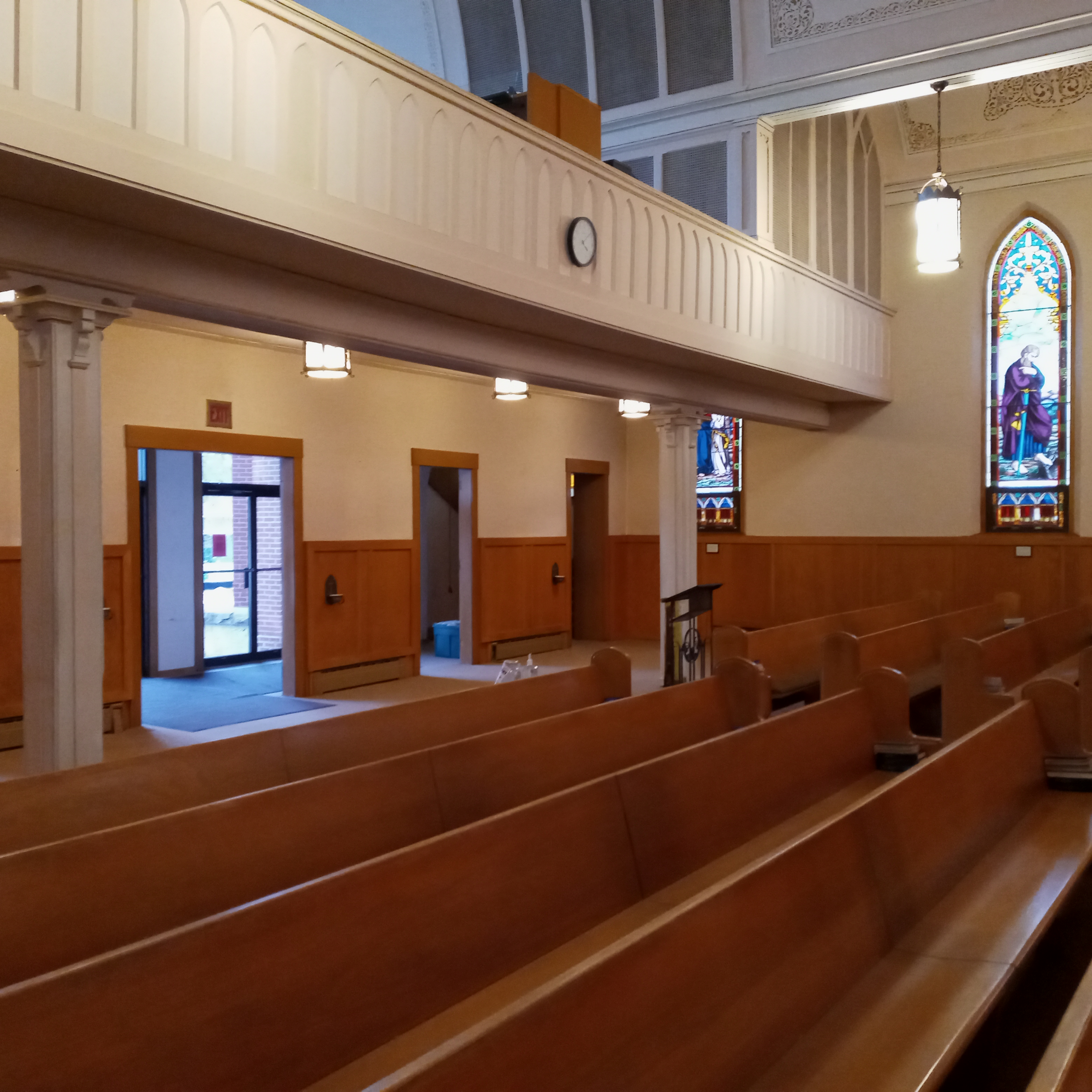
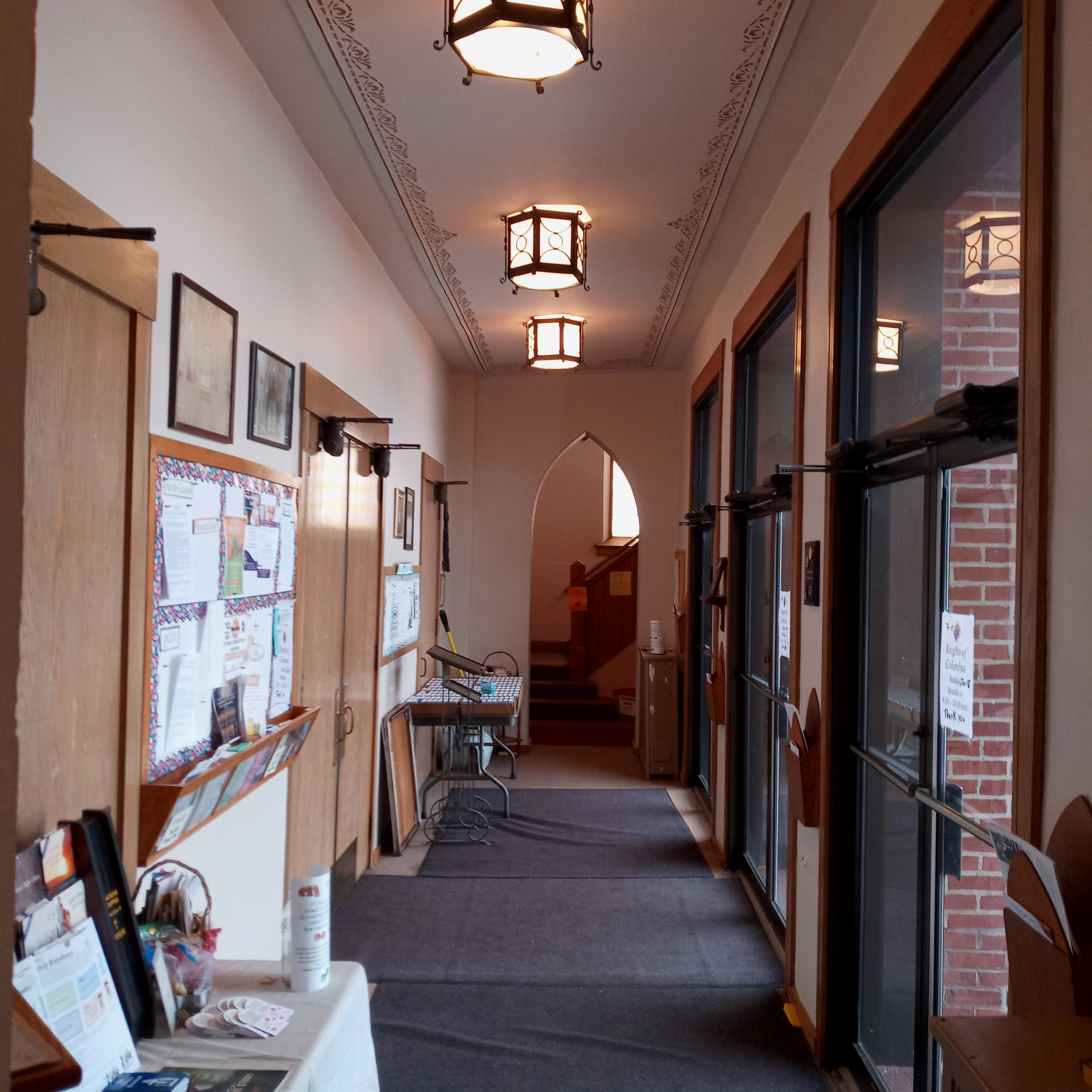
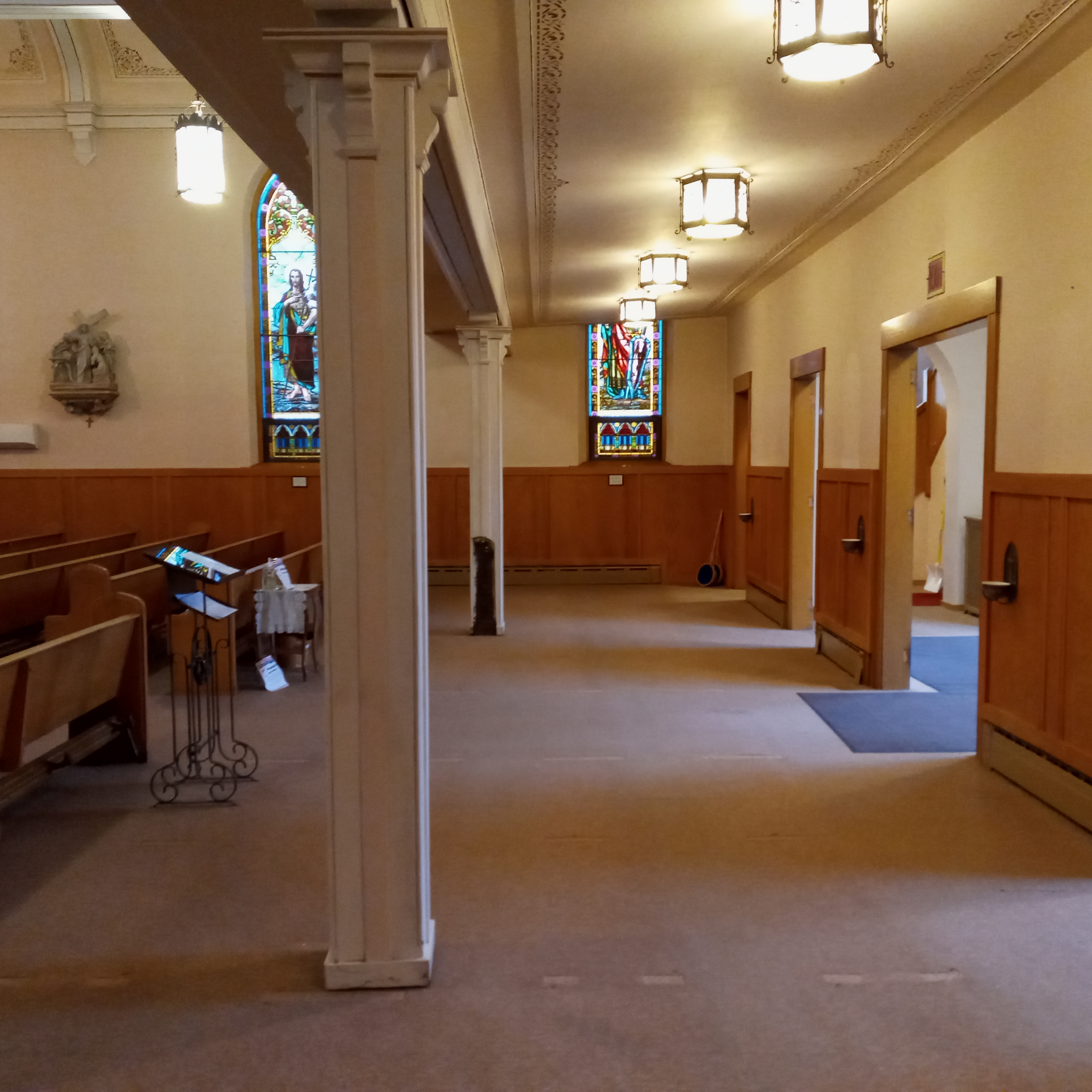
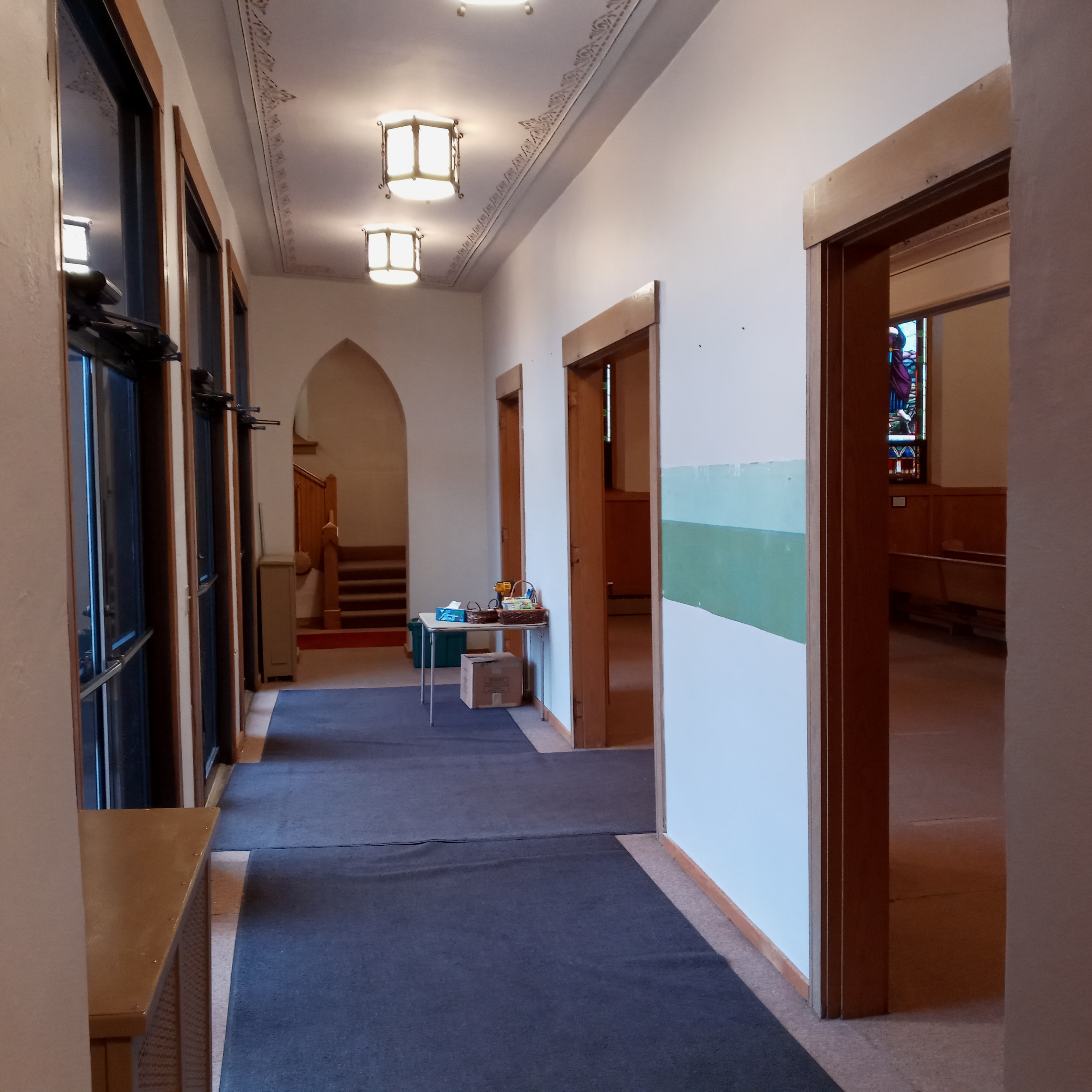
St. Paul’s Vestibule Renovation’s Before Photos

March 25, 2024

This is what the back of St. Paul’s Church looked like before our renovation began fifty-seven days ago. Attend St. Paul’s Triduum (Holy Thursday, Good Friday, Easter Sunday) this week to experience our new, expanded vestibule.


Labor, Toil, & Rest — Funeral Homily for Barbara “Barb” Hable, 68

March 25, 2024

By Fr. Victor Feltes

Barb grew up across the street from here in the building now known as Baier’s Bar. Forty-seven years ago, she married her husband Larry in this St. Peter’s Church. Today, we are gathered here to mourn, and pray for her eternal blessed rest. Barb’s family speaks about her love as the rock-center of their home. They also tell of her strong-willed determination, her focused level-headedness, and her persistent hard work. Amidst the responsibilities of motherhood, she would work around the house and work around the yard. She volunteered at her St. Paul’s Catholic Parish, where she worshipped our God every Sunday, and maintained employment in the wider workforce. Educated in accounting, working at Chippewa Valley companies, she then transitioned into an information technology career and commuted for more than twenty years between Bloomer and the Twin Cities. When that ended with her retirement in 2019, she still kept busy; faithfully attending the activities of her five granddaughters and staying connected with family and friends from her high school and business days, from Tilden, Bloomer, and beyond. Her family tells me Barb “couldn’t sit still,” that she was always working on something. What are we to make of the reality of human work, to which we devote so much of our lives?

Did you know that human work existed even before the Fall? In the beginning, the Lord God took the man and settled him in the Garden of Eden to cultivate and care for it. Then God gave man a helpmate, to fruitfully love and work alongside. A finite universe, even if sinless, can be endlessly improved with new beauties and delights forever. But with sin came the introduction of human toil and death. God said, “In toil you shall eat [the ground’s] yield all the days of your life. …By the sweat of your brow you shall eat bread, until you return to the ground from which you were taken, for you are dust and to dust you shall return.” This is why our labor is so often satisfying; we enjoy being co-creators with God and take pleasure in the fruits of creation. And this is why our labors are so often a burden; this world has been broken by sin and our lives are plagued by fatigue, pain, and death. If this life were all there is, one could reasonably ask with the Old Testament author of Ecclesiastes: “What profit have we from all the toil which we toil at under the sun? One generation departs and another generation comes… What profit comes to mortals from all the toil and anxiety of heart with which they toil under the sun?” But there is more to our story.

Jesus Christ, the Son of God, enters into our world proclaiming: “Come to me, all you who labor and are burdened, and I will give you rest. Take my yoke upon you and learn from me, for I am meek and humble of heart; and you will find rest for yourselves. For my yoke is easy, and my burden light.” Jesus declares, “I am the Good Shepherd,” He is the Lord about whom the psalmist said: “The Lord is my shepherd; I shall not want. In verdant pastures he gives me repose. Beside restful waters he leads me; he refreshes my soul. He guides me in right paths for his name sake.” Though the Twenty-Third Psalm is most commonly heard at funerals, as Jesus does offer eternal rest in the life to come, he also invites us to share in his peace now. Jesus says to us on earth: “Peace I leave with you; my peace I give to you. Not as the world gives do I give it to you. Do not let your hearts be troubled or afraid.” Because of the hope we have in him, because nothing good will be lost forever, we can be secure in the peace of Christ that our works of love and goodness are not done in vain.

We rightly pray for Barb’s soul today, that she may enter into perfect and unending rest. Yet this does not mean her labors will then be finished. St. Therese of Lisieux, seeing her own death approaching, wrote: “How unhappy I shall be in heaven if I cannot do little favors for those whom I love… I want to spend my heaven in doing good on earth. I’m happy to die… because I shall be much more useful than I am now to the souls who are dear to me…” And since her passing in 1897, St. Therese has proven to be a wondrous intercessor. So pray for Barb, and ask for her prayers. I doubt she will be will sitting still. And look forward to our reunion, our resurrection into the New Creation, where free of toil we will partake in joyful work with God forever.

Psalm 22 Fulfilled

March 24, 2024

Palm Sunday
By Fr. Victor Feltes

A thousand years before Christ’s Passion, King David was inspired by the Holy Spirit to pen the Twenty-Second Psalm. Jesus quotes this psalm’s opening words from the Cross: “My God, my God, why have you abandoned me?” Psalm 22 contains passage after passage prophetically predicting details of Good Friday.

It foretells how Christ’s enemies would deride him: “Scorned by men, despised by the people… they mock me with parted lips, they wag their heads: ‘He relied on the Lord; let him deliver him, let him rescue him, if he loves him.’”

It reveals what Jesus would endure in his chest, mouth, limbs, and back: “My heart has become like wax, it melts away within me. As dry as a potsherd is my throat; my tongue cleaves to my palate… They have pierced my hands and my feet; I can count all my bones.”

It predicts what all four gospels writers record the soldiers did: “They stare at me and gloat; they divide my garments among them, and for my vesture they cast lots.

Despite expressing great anguish at feeling as if God were distant throughout these sufferings, the psalm declares hope in deliverance, a restoration to life: “I will proclaim your name to my brethren; in the midst of the assembly I will praise you. …All the ends of the earth will remember and turn to the Lord; All the families of nations will bow low before him… The poor will eat their fill… And I will live for the Lord; my descendants will serve you. The generation to come will be told of the Lord, that they may proclaim to a people yet unborn the deliverance you have brought.”

These accurate prophesies have been realized in God’s Church, where our Lord is with and in his Eucharistic people proclaiming his resurrection to every land and generation. The Twenty-Second Psalm was fulfilled in Jesus Christ and he continues today to fulfill it in our midst.

He Set His Face Like Flint

March 23, 2024

Palm Sunday
By Fr. Chinnappan Pelavendran

This week, the Holy Week, is a week like no other in the year, a week when we celebrate in our special celebrations on Holy Thursday, Good Friday, and the Easter Vigil, what Jesus did for us. This week is a week to take time out, to stop, to reflect, to spend time with Jesus who gave his life for us, a week to pray.

Today I want to share my thoughts briefly on the words of the Prophet Isaiah: “I gave my back to those who beat me, my cheeks to those who tore out my beard; my face I did not hide from insults and spitting. The Lord God is my help, therefore I am not disgraced; Therefore, I have set my face like flint, knowing that I shall not be put to shame.” (Isaiah 50:6-7) This passage from the prophet Isaiah is very striking and every detail of his prophecy of Isaiah was fulfilled in the passion of Jesus.

The face is very important because, in many ways, the face represents the inner person. “The front part of the human head including the chin, mouth, nose, cheeks, eyes, and the forehead.” Therefore, the expressions of the mouth, such as smiling, tight lips, and shaking lips form part of facial expressions. Emotions of cheerfulness, fearfulness, troubled mind, and anger are often expressed on the face. The eye is called the light of the body and the window of the soul.

The face not only gives an idea of the emotional state of a person but also the mental state. One can imagine the facial expression of Jesus in those moments of his suffering and distress. Jesus also communicated to God with his face. When he went into the Garden of Gethsemane, he fell on his face to pray. Falling to the face was a mark of humility and total surrender to God’s will.

Therefore, it is not surprising that the detractors of Jesus targeted his face. “Then they spat in his face and struck him, while some slapped him. The soldiers weaved a crown of thorns and placed it on his head (his forehead, his face)…They spat upon him took the reed and kept striking him on the head.”

There is something great to learn from Jesus. Even when his body was wounded and his face suffered bashing, He set his face like flint meant he remained positive and strong. In his wounds, he never lost the spirit of fortitude, endurance, patience, and boldness. He carried his cross with dignity without a word of insult to his persecutors. What is more, even in the face of agony he sought the face of God and the will of God.

Therefore, He teaches us the necessity of seeking the face of the Lord when we are in difficulty, even when our detractors try to put our faces to shame. “Seek the Lord and His strength; Seek His face continually.” (1 Chronicles 16:11)

The Meaning of Malchus

March 21, 2024

By Fr. Victor Feltes

Judas Iscariot came to the Garden of Gethsemane with soldiers and guards who carried swords and clubs, lanterns and torches. Jesus’ disciples realized what was about to happen and asked, “Lord, shall we strike with a sword?” When one struck the high priest’s slave, cutting off his right ear, Jesus shouted, “Stop, no more of this!” Jesus then touched the man’s ear and healed him. All four gospels record the event but only St. John reveals it was St. Peter who had wielded the sword. Perhaps there was no longer a need to conceal his role in this violent episode once Peter had been martyred. St. John also tells us the wounded man was named Malchus.

Why did Peter strike at Malchus? It’s hard to imagine Peter attacking him if Malchus were unarmed and posed no immediate threat. That Peter slashed at him suggests Malchus was one of the most aggressive among those threatening to capture Jesus dead or alive. Why do all four gospels note that Malchus’ wound was his ear? Perhaps this is highlighting the truth that it’s harder for people to hear the Good News when the use of violence deafens them. Christ converts through loving persuasion, not force.

Given the apparent zealousness with which this slave served his master, risking life and limb to achieve Jesus’ quick arrest, Malchus may have been the kind of slave described in Deuteronomy 15. A Hebrew could sell himself into slavery but it was not automatically for life. The Old Covenant said: “If your kin, a Hebrew man or woman, sells himself or herself to you, he or she is to serve you for six years, but in the seventh year you shall release him or her as a free person. However, if your slave says to you, ‘I do not wish to leave you,’ because he loves you and your household, since he is well off with you, you shall take an awl and put it through his ear into the door, and he shall be your slave forever.” An awl resembles an icepick, a small pointed tool typically used to pierce holes through leather or wood. A Hebrew slave whose devotion was such that he wished to permanently serve the same household would get his ear pierced in this way. The hole in the servant’s ear and the matching imprint and blood stain on the house’s wooden door would be visible signs of the servant’s permanent commitment.

To whom did Malchus belong? Whether his ear had been awl-pierced or not, Malchus was enslaved to the high priest. “Malchus” comes from the Hebrew word for “King,” with sources saying the name means “My King.” His name providentially pointed to whom he truly belonged. Like everyone, Malchus rightfully belongs to Christ our King. Perhaps Jesus restored the ear of Malchus renewed, healed unpierced as a sign, since Christ through his Passion was setting him free. Jesus Christ is the Suffering Servant foretold of by Isaiah the Prophet. Jesus, because he loves you and your household, freely chose to dedicate himself to us forever. His body still bears the marks where we pierced him. And the wood of his Cross, which bears puncture holes and Christ’s blood stains, is our doorway to salvation—to living together with him forever.

Jesus the Grain of Wheat Died to Harvest Us

March 20, 2024

5th Sunday of Lent
By Fr. Chinnappan Pelavendran

Who are the important people in our world? Who are the great people in our country? It depends on what you mean by “important” and “great.” These are some of the people in our world who receive glory, fame, and publicity: such as pop stars, sports stars, successful businesspeople, and company directors. Other people are not famous—people caring for sick relatives, people suffering crosses without grumbling, those encouraging others, those who bring the love of God to others, those who witness to Jesus in small ways. Are they the greatest people in our world? I think they are.

What about Jesus? At the wedding in Cana Jesus said, his hour had not yet come but in today’s Gospel, he says his hour has come. Now the hour has come for the Son of Man to be glorified. (John 12:23)

What is this hour of glory for Jesus? It is his passion and death. That is the hour of glory for Jesus in John’s Gospel, his passion and death. Why? The first reading, taken from the book of the Prophet Jeremiah, explains how God will replace the Old Covenant of Judgment with a New Covenant of Forgiveness of sins. This New or Renewed Covenant prophesied by Jeremiah has been fulfilled, through Jesus’ life, and death. (John 12:24) “Truly, truly, I say to you, unless a grain of wheat falls into the earth and dies, it remains alone; but if it dies, it bears much fruit. He who loves his life loses it, and he who hates his life in this world will keep it for eternal life.” Here Jesus tells us that this is the price of eternal life. The grain, of course, does not die but is transformed into something completely new: roots, leaves, and fruit. Jesus here speaks about his own life, which he sacrificed to gain new life in the Kingdom. He invites us too to be ready to lose our life for the sake of Jesus to gain eternal life.

The hour of glory for Jesus is his passion and death because when he is lifted from the earth, he will draw all men to himself. (John 12:32) Jesus’ glory is not what the world thinks is glorious because the world does not see as God sees.

Today’s Gospel teaches us that new life and eternal life are made possible only by the death of the self through obedience, suffering, and service. Salt gives its taste by dissolving in water. A candle gives light by having its wick burned and its wax melted. Loving parents sacrifice themselves so that their children can enjoy a better life than they have had. Let us pray that we may acquire this self-sacrificing spirit, especially during Lent.

Only a life spent for others will be glorified, sometimes here in this world, but always in Heaven. We know that the world owes everything to people who have spent their time and talents for God and their fellow human beings. Mother Teresa, for instance, gave up her comfortable teaching career, and with just five rupees in her pocket began her challenging life for the “poorest of the poor” in the crowded slums of Calcutta. The people who spend their lives and talents for others are great and important.

St. Paul’s Vestibule Renovation (Day 51)

March 19, 2024

The tiling and carpeting of our new vestibule continues this week. (Click Images to Enlarge)

“Where I Am, There Also Will My Servant Be”

March 17, 2024

5th Sunday of Lent
By Fr. Victor Feltes

Whoever serves me must follow me, and where I am, there also will my servant be. The Father will honor whoever serves me.” Jesus says, “Where I am, there also will my servant be.” His statement is descriptive, prescriptive, and predictive. He describes what is the case, he prescribes how we should act, and he predicts what will be. His servants can be found where Jesus has been before. They should serve him where Jesus is now on earth. And one day his servants shall be where Jesus is in heaven.

So where has Jesus been? Next Sunday is Palm Sunday when we will remember the way of his sorrowful Passion; how he mentally agonized in the Garden of Gethsemane, how he faced religious and secular trials, criticism and mockery, how he carried and painfully endured his Cross. Jesus notes, “Unless a grain of wheat falls to the ground and dies, it remains just a grain of wheat; but if it dies, it produces much fruit.” Christ’s glory was made complete through his offering-up of his physical and emotional sufferings; and where he has been, his servant will also be. Jesus says, “No servant is greater than his master,” adding that if people persecuted him, they will persecute us also. St. Peter writes, “Beloved, do not be surprised that a trial by fire is occurring among you, as if something strange were happening to you. But rejoice to the extent that you share in the sufferings of Christ, so that when his glory is revealed you may also rejoice exultantly.” It will not always be an extreme burden, like martyrdom, but each of us has a cross to carry. Jesus says, “If anyone would come after me, let him deny himself and take up his cross daily and follow me.”

Jesus Christ has been on Calvary. Where is he present on earth today? He is present in his Church, for he says, “Where two or three are gathered together in my name, I am there among them.” He is present in his Sacraments, most blessedly in the Eucharist, of which he says, “This is my Body” and “This is…my Blood.” He is present in little ones and the least of his brethren, for Jesus says, “Whoever receives one of these little ones in my name receives me,” and declares, “Amen, I say to you, whatever you did for one of these least brethren of mine, you did for me.” Therefore we should not neglect to gather and adore him in his Church, to approach and honor him in his Sacraments, and to love and help him in the small and vulnerable. The servants of Jesus should serve him where he is.

Where else is Christ now, following his Ascension? Jesus declared during his religious trial before the high priest, “From now on the Son of Man shall be seated at the right hand of the power of God.” So St. Paul urges us to “seek the things that are above, where Christ is, seated at the right hand of God.” More than a mere description of Christian life, more than just a call to serve him, Jesus’ words contain a promise of heaven. The Letter to the Hebrews calls Jesus Christ “the source of eternal salvation for all who obey him.” And Jesus says, “Where I am, there also will my servant be. The Father will honor whoever serves me.”

Jesus Christ is present at Calvary, in his Church and in his Sacraments, with the lowly on earth and with the saints in heaven. Remember this, for Jesus says, “Where I am, there also will my servant be.”

St. Paul’s Vestibule Renovation (Day 44)

March 12, 2024

The flooring crew has arrived onsite and tiled our new bathroom. Today, Craig Zwiefelhofer and a few Knights of Columbus volunteers painted the bathroom and some vestibule walls.
(Click Images to Enlarge)


God Loves You So Much

March 11, 2024

4th Sunday of Lent
by Fr. Chinnappan Pelavendran

The central theme of today’s readings is that our salvation is the gift of a merciful God, given to us through Jesus, His Son. The readings give importance to God’s mercy and compassion and remind us of His great love and kindness. As an act of love and gratitude to God, who is “rich in mercy,” and as an expression of our Faith, we are invited to share Jesus’ sufferings by doing penance during Lent so that we may inherit our eternal salvation and the glory of his Resurrection in Heaven.

In the first reading, we learn the compassion and patience of God. The reading shows us how the people’s infidelities also caused them to lose the Temple, their homeland, until they “came to their senses,” recognizing their sinfulness, and cried out to God for mercy. It was then God came to their rescue, choosing to work through the pagan king Cyrus. To return them to their homeland and to help them rebuild His Temple there. God chose Cyrus the Great, a pagan conqueror, to become the instrument of His mercy and salvation for His chosen people.

The second reading reminds us to focus on the mystery of salvation as a gift to sinners. St. Paul teaches us that, although we do not deserve anything from God on our own merits, God has chosen to love, save, and give life to us – both Jewish and Gentile Christians. St. Paul says that Divine grace does three things for us: a) brings us to life in Christ, b) raises us with Christ, and c) seats us in the Heavens. The sole purpose of these Divine deeds is to show the immeasurable riches of God’s grace.

Today’s Gospel provides Jesus, the Son of God, to become the agent of God’s salvation, not just for one sinful nation but also for the sinfulness of the whole world. Through John 3:16, the Gospel teaches us that God has expressed His love, mercy, and compassion for us by giving His Only Son for our salvation. Nicodemus, the wealthy Pharisee, and member of the Sanhedrin, meets Jesus by night and begins a long religious discussion. Jesus explains to him that he must believe Jesus’ words because Jesus is the Son of God. Then, by referring to the story of Moses and the bronze serpent (Num 21:1-9), Jesus further explains God’s plan of salvation. Just as God saved the victims of serpent bite from death through the bronze serpent, He is going to save humankind from its sins by permitting the crucifixion and death of His Son Jesus, because the love of God for humankind is that great.

We need to love the cross, the symbol of God’s forgiving and merciful love: it is not only of God’s love and mercy but also of the price of our salvation, It encourages us not only to feel deep sorrow for another’s suffering but also to try our best to remove that suffering. God’s love is unconditional, universal, forgiving, and merciful. Let us try to make an earnest attempt to include these qualities in sharing our love with others during Lent

The Light of Christ

March 11, 2024

4th Sunday of Lent
Deacon Dick Kostner

It seems to me that the last time I talked to you I was wearing my “favorite” color of pink and talking about the light of Christ and once again I am called to talk to you bright as ever, once again displaying for all to see that God does indeed have a sense of humor in asking this Deacon friend of his to share some thoughts with you during this Holy Season of Lent before celebrating with you the “Light of Christ” at the Easter Vigil.

Why does God God punish us so much with pain and suffering? Why has our world lost common sense and no longer can determine what sex a person is or what bathroom one should use? Or the great question, where can I find someone I can count on to tell me some truth for it seems that no one seems to be able to even define what truth is? Sounds like the conversation between Pilate and Jesus don’t it? All of these big issues and questions are on display for us in the readings for this weekend with Jesus giving us the answer that we may not really want to hear or accept.

All of the problems we encounter during our lives centers around us being human descendants of Adam and Eve the first creatures God created in his image and likeness to create a new kingdom where love of God and others would find its home. But because of their desire to be like their creator and because of their free will they too wanted to be gods and make up their own plan of happiness and love, and so they did not listen to their creator and thus they and their descendants were blemished through their decision and God allowed them and all their descendants to suffer the consequences of their actions because of God’s love and respect for them.

Because of God’s love for us he gifted us with his son Jesus, and became human to allow us to learn how to live a life of happiness and love even in a world that contains sufferings. Jesus, our mentor and redeemer who will accompany us on our journey to eternity and support us to weather problems beyond our control such as natural storms and yes even the experience of having to die.

But what about the sufferings we experience such as failed relationships, and trying to find truth in a world filled with craziness? Where do we get relief and answers? Jesus gives us the answer in our Gospel as he explains it to Nicodemus. The answer is: “Through the light of Christ” and by allowing the light of Christ to become transparent and to shine through us as brothers and sisters of our Brother Jesus.

I believe that through our baptism we are given a hot line number, a switch so to speak that allows us to make a call for help to Jesus at any time of the day or night. When we are suffering or just uncertain of a path we are tempted to follow in life all we have to do is to not be afraid to make a call to the someone who can help us see the light to get us through our suffering or make that important decision. A person we can depend on to tell us the truth, that person is Jesus who has promised to send his spirit, the “light” referred to in the Gospels, to help us see our way out of a dilemma or weather a suffering. The problem is we first need to make that call for help or throw that switch “on” in order to make that connection with him, and secondly we need to listen to and trust his response even though it might not make sense to us or we disagree with what he is saying.

Because of free will if we fail to listen to him and trust ourselves over his advice, we will need to accept the consequences of our decision. God does not inflict punishment on us, rather he allows us to make up our own mind which can impose on us results that we might like to blame on him or others.

When I first got out of law school and began practice the first thing my dad taught me was to never be afraid to ask people who have knowledge and experience, for help. He said when you are uncertain pick up the phone and call a fellow attorney for advice. They will never refuse to help out a fellow brother. I trusted my dad and followed his advice and that eliminated me making a lot of mistakes and needless sufferings.

Jesus gifts us with the Sacraments to offer us help and support. He gives us an army of spiritual advisors to access through his Church, his body and his priests educated in obtaining for us the vocation he planned for each of us at our birth. And yes he gives us his written hopes and direction through his Gospels for us to study and to partner with him in building the kingdom of God here and now.

Do you trust Jesus? Do you believe he will tell you the truth? If so why do we not think about asking him and his Church first for help and direction when we are uncertain if we are making the right move in life or experiencing sufferings and need some support? He knows the future and what is best for us we don’t, so that’s where we need to trust his advice and accept it. We only need to throw the switch to see the light of Christ overtake the darkness of the world we live in and continue our walk in safety.

Remember the ashes we received, listen to our friend Jesus and “Repent and believe in the Gospel” to move through the Good Friday’s of life and see the light of Christ with him through his Resurrection on Easter Sunday. Assignment: Examination of Conscience meditation on being a Light Disciple through prayer giving us “The Last Days of our Life with no regrets!” A Second Chance! (PS. Barb agrees with AJ she says I look good in pink!)

St. Paul’s Vestibule Renovation (Day 38)

March 6, 2024

Exciting changes on display! Flooring crews are reportedly expected next week. (Click Images to Enlarge)

The Mother & The Governor

March 3, 2024

By Fr. Victor Feltes

We say their names at every Sunday Mass. We recall them at the start of every Rosary. They are the only two, non-divine persons referred to by name in the Nicene and Apostles’ Creeds. They are the Virgin Mary and Pontius Pilate.

For us men and for our salvation he came down from heaven, and by the Holy Spirit was incarnate of the Virgin Mary, and became man. For our sake he was crucified under Pontius Pilate, he suffered death and was buried, and rose again on the third day in accordance with the Scriptures.

Consider how many other figures from salvation history could have been justifiably cited in these creeds; from Adam and Eve to Peter and Paul. Yet only Mary and Pilate are mentioned. Why? At the heart of human history, where on our timeline B.C. becomes A.D., the eternal Son of God became man. Our Savior lives not “Once upon a time.” He is born, suffers, dies, and rises in flesh and blood reality. Mary, the woman who gave him life and Pilate, the man who put him to death, ground Jesus Christ, our Gospel, and our salvation in real human history.

Mary and Pilate are not merely historical figures but also archetypes. They represent two patterns, two types of people we can learn from: Mary, whose good example we should follow, and Pilate, whose bad example we should avoid. Recounting the gospel accounts of the Roman trial during Christ’s Passion, let us compare, contrast, and profit from contemplating Governor Pontius Pilate and the Blessed Virgin Mary. Consider to these reflections for what lessons you can gain.

On Good Friday morning, all the chief priests and the elders of the people took counsel against Jesus to put him to death. They bound him, led him away, and handed him over to Pilate, the governor.

Confronted with Jesus the Christ, all four Gospels record Pilate asking this pivotal question: “Are you the king of the Jews?” Jesus responds affirmatively that it is so. At the Annunciation, after greeting and reassuring Mary, St. Gabriel the Archangel said, “Behold, you will conceive in your womb and bear a son, and you shall name him Jesus. He will be great and will be called Son of the Most High, and the Lord God will give him the throne of David his father, and he will rule over the house of Jacob forever, and of his Kingdom there will be no end.” When the Virgin Mary is confronted with Jesus the Christ, the king of the Jews, she asks a clarifying question too. She said to the angel, “How can this be, since I have no relations with a man?

Pilate and Mary have this in common: they both ask serious questions about Jesus Christ seeking to better understand. It is good for us ask honest questions about Jesus Christ, about God, or about our Catholic Faith. Jesus says, “Whoever asks, receives,” and “whoever seeks, finds.” But when we receive our answer, when we find the truth, how will we respond to the Word? Here we see a difference between Mary and Pilate.

Pilate then addressed the chief priests and the crowds, “I find this man not guilty.” But they were adamant and said, “He is inciting the people with his teaching throughout all Judea, from Galilee where he began even to here.” On hearing this, Pilate asked if the man was a Galilean; and upon learning that he was under Herod’s jurisdiction, he sent him to Herod who was in Jerusalem at that time.

After questioning Jesus, Pilate finds him not guilty of any crime. Realize that Pontius Pilate does not want to kill Jesus; however, the governor would be very glad to be rid of him. Jesus has done nothing worthy of punishment, but Pilate wants to keep those who hate their Roman governor at bay while avoiding making new enemies. He declares Christ not guilty but refuses to set him free. As soon as Pilate sees an opportunity to pawn off Jesus the Nazarene to King Herod across town, he does so. Rather than doing something brave and good, Pilate punts. In contrast, at the Annunciation, when Mary is first presented with Jesus Christ, she does not ask the angel if someone else could be given this task. She does not refuse to do something righteous and courageous. Mary lovingly receives Christ through her “fiat,” saying, “Let it be done to me according to your will.”

King Herod had been eager to meet Jesus and questioned him. Yet the Lord gave him no reply, even as the chief priests and scribes stood by accusing him harshly. Herod does not hold Jesus in prison or behead him as he did with St. John the Baptist. Instead, having grown tired of Jesus, Herod sends Jesus back to Pilate dressed in resplendent garb like a king as a joke. Even though Herod and Pilate had previously been enemies, St. Luke records that the two became friends that day. This shows you that neither ruler saw Jesus as much of a threat. The worldly, like Pilate, will judge by appearances, but the godly, like Mary, can be granted the gift to see deeper realities. When Jesus gets brought back to Pilate’s praetorium doorstep, the governor must deal with this problem anew.

Pilate said to him, “Then you are a king?” Jesus answered, “You say I am a king. For this I was born and for this I came into the world, to testify to the truth. Everyone who belongs to the truth listens to my voice.” And Pilate said to him, “What is truth?” When he had said this, he again went out to the Jews and said to them, “I find no guilt in him.

Our styles and technologies have changed since ancient times, generations and great empires have come and gone, but human nature remains the same. Pilate is a moral relativist, a postmodern man in the ancient world. “What is truth” he scoffs at Jesus, turns his back on Truth Incarnate, and walks away. He thinks that truth cannot be known, except for those “truths” which we choose for ourselves or impose upon others.

Later in the Passion, Pilate provokes Jesus’ enemies with the sign he orders to be posted above Jesus’ head on the Cross. When the chief priests complain to Pilate saying, “Do not write ‘The King of the Jews,’ but that “He said ‘I am the King of the Jews.’” Pilate replies dismissively, “What I have written, I have written.” Pilate does not believe in truth but serves the truth despite himself. The Virgin Mary believes in truth, belongs to the truth, and cooperates with the truth: “Let it be done to me according to your word.” Jesus says everyone who belongs to the truth listens to his voice.

Pilate knows worldly wisdom, he is clever and cunning.
Mary knows God’s wisdom, and she is truly wise.

Pilate seeks the glory of men.
Mary seeks the glory of God.

Pilate, despite all his worldly power, is ruled by fear.
Mary, despite her natural weakness, is freed from fear.

Pilate is the secular Man of the World.
Mary is the devoted Disciple of Christ.

While Governor Pilate was still seated on the judge’s bench, his wife sent him a message, “Have nothing to do with that righteous man. I suffered much in a dream today because of him.”

This is another similarity between Pilate and Mary: both of their spouses experienced prophetic dreams. St. Matthew recounts how Mary’s husband, St. Joseph, had at least four inspired dreams. One dream reassured him to take Mary into his home, one told him to flee with his family into Egypt, another later told him to return them to the land of Israel, and one more dream which led him to resettle them in Nazareth. Matthew likewise records the dream of Pontius Pilate’s wife, and her urging her husband to “have nothing to do with that righteous man.” Mary listened to her spouse and was blessed. Pilate did not heed his wife and walked into disaster. God gave spouses to each other as helpmates, and the Lord sometimes gives authentic mystical experiences to guide us. Now spouses are not always right and some dreams are just dreams—some fears and some visions are merely imagined. But it is wise not to dismiss out of hand the input of your helpmate or the possibility of mystical experiences from God.

The Jews answered Pilate, “We have a law, and according to that law he ought to die, because he made himself the Son of God.” Now when Pilate heard this statement, he became even more afraid and went back into the praetorium and said to Jesus, “Where are you from?” Jesus did not answer him. So Pilate said to him, “Do you not speak to me? Do you not know that I have power to release you and I have power to crucify you?” Jesus answered him, “You would have no power over me if it had not been given to you from above. For this reason the one who handed me over to you has the greater sin.”

Both Mary and Pilate were entrusted with power over Jesus from above. After Mary and Joseph found the boy Jesus at the temple, “He went down with them and came to Nazareth, and was obedient to them.” And Jesus told Pilate, “You would have no power over me if it had not been given to you from above.” When the Son of Man comes in his glory and the sheep are separated from the goats, we will be judged in part on whether we did what good was in our power: “Amen, I say to you, what you did [or did] not do for one of these least ones, you [did or] did not do for me.” Jesus says, “Much will be required of the person entrusted with much, and still more will be demanded of the person entrusted with more.” Who and what has been entrusted to you? How are you using your power?

The gospels show how Pilate knows that Jesus Christ is innocent, or at least believes he poses no real threat to society, yet Pilate is willing to have this innocent man whipped and even killed when that becomes the most expedient thing to do.

When Pilate saw that he was not succeeding at all, but that a riot was breaking out instead, he took water and washed his hands in the sight of the crowd, saying, “I am innocent of this man’s blood. Look to it yourselves.” … Then he handed him over to be crucified.

Governor Pilate washes his hands, as if he had no hand in Jesus’ death. He washes his hands as a sign to say ‘my hands are clean in this injustice.’ Yet all our sins caused Jesus Christ to die. Though Mother Mary was free from sin and her hands were truly clean, Christ’s sacrifice was for her too. The First Letter of St. John says if you or I say, “‘We are without sin,’ we deceive ourselves, and the truth is not in us. If we acknowledge our sins, he is faithful and just and will forgive our sins and cleanse us from every wrongdoing. If we say, ‘We have not sinned,’ we make him a liar, and his word is not in us. If we claim to be without sin, we deceive ourselves and the truth is not in us.” If we go looking for excuses for our sinful behavior, we will always find them. Instead, let us repent of sin and live in the truth.

Pilate had an inscription written and put on the cross. It read, “Jesus the Nazorean, the King of the Jews.” Now many of the Jews read this inscription, because the place where Jesus was crucified was near the city; and it was written in Hebrew, Latin, and Greek.

Sometimes you will see this titulus sign depicted at the top of crucifixes featuring the letters “INRI.” This is an abbreviation for the Latin phrase “Iesus Nazarenus, Rex Iudaeorum,” or “Jesus the Nazarene, King of the Jews.” It was the Romans’ custom to display upon condemned persons’ crosses the crime for which they were being executed. As I said before, through this inscription, Pilate was antagonizing or trolling the Jewish religious leaders. Pilate does not truly believe that Jesus is a king, the Jewish Messiah or the Christ. Yet he accurately identifies the reason for Jesus Christ’s death: Jesus was killed for being who he was, he was killed for being the Christ. St. John’s Gospel says, “He came to what was his own, but his own people did not accept him. But to those who did accept him he gave power to become children of God, to those who believe in his name.”

On Good Friday, Pilate wrote his sign’s message in three common languages of that day for all the world to see. In the centuries since, when Mary has appeared in various apparitions around the world, she speaks in the native tongue of the visionaries in order for her messages pointing to her Son to be better understood by all. God never directly wills evil. Sins are something which we freely choose. But God writes straight with crooked lines. In the end, all of us, both God’s friends and his enemies, will have been agents of God’s will. Some, like Mary, will cooperate with him willingly. Others, like Pilate, will serve him unwittingly.

Jesus said, “Amen, I say to you that you who have followed me, in the new age, when the Son of Man is seated on his throne of glory, will yourselves sit on twelve thrones, judging the twelve tribes of Israel. And everyone who has given up houses or brothers or sisters or father or mother or children or lands for the sake of my name will receive a hundred times more, and will inherit eternal life. But many who are first will be last, and the last will be first.

So where are Pilate and Mary now?
The last became first and the first became last.

She who wept, now laughs.
He who laughed, now weeps.

He was Roman governor of Judea.
She is now queen of heaven and earth.

He took root in the desert for self-glory, but was barren and uprooted.
She was planted beside the flowing waters of her Son, and endured, bore fruit, and shares in God’s glory.

When Jesus saw his mother and the disciple there whom he loved, he said to his mother, “Woman, behold, your son.” Then he said to the disciple, “Behold, your mother.” And from that hour the disciple took her into his home.

Mary and Pilate: the one who gives Christ life and the one who puts him to death, the one who serves the Lord and the one who serves himself, the faithful one and the faithless one. Are we Pilate or are we Mary? At different times, in different ways, we may be like one or the other. During this Lenten season, let us examine and discern who we are. “How and when am I like Pilate? Where and how am I like Mary?” May we reject his bad example and follow her good leading to draw closer to Jesus Christ and share in his rewards and glory.