Be Not Afraid, Be Well-Prepared

November 5, 2022

32nd Sunday in Ordinary Time
By Fr. Victor Feltes

Today we see the Sadducees come forward and put a question to Jesus, but who were the Sadducees? They were a Jewish religious group less popular than the Pharisees but in some ways more powerful. The Sadducees were the party of high priests, aristocratic families, and wealthy merchants, and they were well-represented among the members of the Jewish high council, the Sanhedrin. Theologically, unlike Pharisees, the Sadducees only accepted the first five books of the Bible as scripture: that is, Genesis, Exodus, Leviticus, Numbers, and Deuteronomy. These five books are called the Torah (the Law) or the Pentateuch. The Sadducees denied the inspiration of all the other Old Testament books and only accepted religious beliefs which they thought were contained in those first five books.

The Sadducees did not believe in life-after-death nor in eternal punishments or eternal rewards hereafter; and they saw no scriptural evidence for the idea of a resurrection of the dead. Therefore, to challenge Jesus, they pose a hypothetical question about the resurrection involving a woman who had multiple husbands, a question they think will lead him to a ridiculous conclusion. In response, Jesus explains that life and love in the coming age are far more mystical than they imagine. But today I want to highlight the end of Jesus’ answer.

The Sadducees were hobbled by having accepted a truncated faith less than the fulness of all God had revealed (as is the case with most Christians today). Jesus desired to show them that life-after-death is proclaimed by God, but he had to do so using evidence they would acknowledge. So Jesus cites an event from their own accepted Book of Exodus. Jesus says: “That the dead will rise even Moses made known in the passage about the bush, when he called the Lord ‘the God of Abraham, the God of Isaac, and the God of Jacob.’ and he is not God of the dead, but of the living, for to him all are alive.”

Jesus highlights how at the Burning Bush the Lord did not identify himself to Moses by saying, “I was the God of Abraham, I was the God of Isaac, and I was the God of Jacob.” The Lord declares, “I AM the God of your fathers,” because even though their bodies had perished long before their souls remained alive to God. Jesus teaches that those who have died still live and that the dead will rise again, just like the Christ rises from his tomb in both his soul and body.

This time of year, throughout November, we remember in a special way those who have died. On November 1st, we celebrate all saints now in heaven. On November 2nd, we pray for all those who have died and whose souls continue being purified in Purgatory so as to be made perfect for heaven’s glory. In this fall season, as our trees’ leaves fade and fall and our farmers’ fields are harvested, the Church is nearing the end of our liturgical year (which begins anew with Advent). And the focus of our readings at Mass in these final weeks turn toward the last things, including death.

Unless Jesus Christ returns in glory first, each of us will die one day. And if we die, our bodies will one day rise again. In light of these facts, how should we live and prepare to die? Many people avoid thinking about death because it makes them feel so uncomfortable. Like a child who closes their eyes in order to be invisible, some choose not to consider their own death all. However, this strategy does not change reality and creates a grave risk of dying ill-unprepared.

Do not be spiritually unready; you probably have less time left than you think. So believe in our Lord and be converted, do what is right and reject your sins. For instance, stop skipping Sunday Mass and Holy Days of Obligation. If we do not wish to worship and obey God he will honor that decision… forever. So repent and do his will.

Do not neglect or postpone receiving Christ’s sacraments, Confession, the Eucharist, and the Anointing of the Sick. Even if it is possible to reach heaven without the Last Rites (including the Apostolic Pardon, Viaticum, and Extreme Unction) why would you risk foregoing these graces? Be well-prepared to die.

Throughout this month of November pray for the souls of the dead, befriend and ask help of the saints above, and grow closer to our Lord Jesus Christ through his sacraments. Jesus says, “I came so that they might have life and have it more abundantly.” Christ has died, Christ is risen, and Christ will come again. So do not be afraid of death; instead, be well-prepared.

He is not God of the Dead, but of the Living

November 5, 2022

32nd Sunday in Ordinary Time
By Fr. Chinnappan Pelavendran

My first funeral as a priest was for a baby who was two weeks out of the womb. How does one talk to the family? They are a devout, Catholic family, but they asked, why is God allowing this? I listened to them and cried with them. I later responded to them by saying that when I ask why I look at a crucifix. Why did God allow His own son to die? Our salvation and redemption come from the cross. Through the death of that baby, God wants to say something to us; resurrection is what comes out of Christ’s death.

When God revealed Himself to Moses in preparation for bringing His people out of Egypt, He called Himself “the God of Abraham, the God of Isaac, and the God of Jacob.” (Exodus 3:6) When God told this to Moses, centuries had passed after these forefathers had died. However, God acknowledged their existence even after their death. Though the verse did not specify the resurrection of the dead, it implied their survival after death.

Today’s first reading describes a Jewish family, consisting of a mother and her seven sons, who refuse their king’s command to eat pork, forbidden as “unclean” by Jewish Law. Because of their obedient Faith in God, they endure suffering and accept martyrdom. During their torture, three of the brothers speak, and each of them finds strength in the belief that he will eventually be raised and rewarded by God.

The second reading encourages the Thessalonians, who were waiting for the second coming of Christ, to trust in the fidelity of God who would strengthen their hearts in every good work and word.

In today’s Gospel, Jesus is challenged by a group of Sadducees concerning the resurrection of the dead. Just before this, Jesus had been challenged by Pharisees and Scribes, whether to pay taxes to Caesar or not. Jesus had dealt effectively with them and reduced them to silence. Again they raised a question this time about the imaginary story of seven brothers marrying one woman, and their relationship with each other in the next life. Their question in the Gospel is certainly an insincere and impossible example, they want to ridicule a belief in the resurrection.

Three Strengths of Saint Zacchaeus

October 30, 2022

31st Sunday of Ordinary Time
By Fr. Victor Feltes

The Jews in Jericho looked down on Zacchaeus (and not just because he was short). He was a tax collector regarded as a sinner. When Zacchaeus chose his occupation he knew his neighbors would despise him. Even if he had never extorted or cheated anybody, he still would be resented for serving the unpopular political powers ruling over Israel. It’s easy to imagine him being insulted and shunned by the Jews in his territory. He needed a thick skin to do his job, caring little about what others thought of him. He was not only a tax collector but a chief tax collector, and this made him a very wealthy man. Yet his riches did not fulfill him. He was searching for something more than money and this led him to Jesus.

[Zacchaeus] was seeking to see who Jesus was; but he could not see him because of the crowd, for he was short in stature. So he ran ahead and climbed a sycamore tree in order to see Jesus, who was about to pass that way.” Now apart from tree trimmers and deer hunters, when was the last time you saw a grown man sitting in a tree? It’s something children do, and Zacchaeus likely looked ridiculous in the eyes of the unfriendly crowd below. But “when [Jesus] reached the place, [he] looked up and said, ‘Zacchaeus, come down quickly, for today I must stay at your house.’ And he came down quickly and received him with joy.

When the crowd saw this they began to grumble, “He has gone to stay at the house of a sinner!” But Zacchaeus stood there and said to Jesus, “Behold, half of my possessions, Lord, I give to the poor, and if I have extorted anything from anyone I shall repay it four times over.” As a wealthy man, Zacchaeus came to know how great wealth disappoints. He had developed significant detachment from his wealth, which allowed him to give up half (and perhaps much more than half) of everything he owned. And Jesus declared to him, “Today salvation has come to this house because this man too is a descendant of Abraham. For the Son of Man has come to seek and to save what was lost.”

Zacchaeus had these three strengths helping him to find and follow Jesus: firstly, his honest acknowledgement of his dissatisfaction in this world; secondly, his indifference towards what others thought of him; and thirdly, his healthy detachment towards his riches. Why was he “seeking to see who Jesus was?” Why was he so joyfully eager to host Jesus at his house? Because Zacchaeus could admit that he was dissatisfied, with himself and what this sinful world offers, and he believed that Jesus could help him find salvation. Zacchaeus had developed a thick skin as a tax collector. He did not care about others’ mockery, gossip, and dim opinions about him. This allowed him to climb that tree to see Jesus even if others might laugh at him as a fool. And Zacchaeus’ healthy detachment concerning riches allowed him to be generous and fulfill justice with his wealth, as our Lord wished him to do.

Let us take stock of ourselves from the example of St. Zacchaeus. Can you admit where you are not yet fully the Christian you are called to be and then present yourself to Jesus? Are you dissatisfied enough with this unjust world to hope and act for more than the status quo, to sacrifice for this world’s betterment while longing for a world to come? Are you willing to be unapologetically Catholic before others; a person, for example, willing to pray before a meal at a restaurant even if someone might see you; a Christian who does not allow others’ opinions prevent you from being openly faithful to Jesus Christ and his Catholic Church? And are you detached enough from your wealth to generously share it and serve justice with it boldly, as our Lord would have you do? In what ways is Jesus calling you to go out on a limb for him?

A Trimmer of Trees — Funeral Homily for Gordon “Gordy” Weyers, 90

October 27, 2022

By Fr. Victor Feltes

For several decades, Gordy has loved trimming trees. Of course, there is much more to the man as a Catholic, a husband, a father, and a friend, but this is one of his curious quirks. Whenever Gordy saw outside his house a tree branch which was not right, he was highly-motivated to intervene. He would pull out his ladder and tree-cutting tool to go take care of that errant branch. Dot (that is, Dorothy) his wife of sixty-seven years would tell him, “Don’t climb the ladder,” but he would do it anyway.

Gordy began saying he wanted a new ladder but his kids kept trying to talk him out of this desire, hoping he would stop climbing at his age entirely. Yet by all accounts, his old ladder was very rickety, so eventually Dot said, “Get him a new ladder, because he’ll fall off the old one.” Dot would periodically look out the window to check on Gordy tree trimming on his ladder. Years later, she told him, “Good thing you never fell off!” He replied, “Oh, I fell off a few times, I just didn’t tell you.”

But here’s the thing: after Gordy’s trimming—however daring or reckless it may have been—his trees looked really good. Dot reports that “he never did anything that made them look bad.” Those trees became more perfect, more healthy and strong, more handsome and beautiful, by having been cared for and pruned by Gordy.

We often recall “the Lord is my shepherd,” but we less often reflect on how our God is a gardener. In the beginning, God created a perfect garden. And when St. Mary Magdalene first encountered Christ resurrected on Easter Sunday she thought he was the gardener. Jesus teaches, “I am the vine, you are the branches… and my Father is the vine grower. He takes away every branch in me that does not bear fruit, and every one that does he prunes so that it bears more fruit.” And the Letter to the Galatians tells us that the fruits which the Holy Spirit grows in us include love, joy, peace, patience, kindness, generosity, faithfulness, gentleness, and self-control. We are like trees which God prunes to make us more perfect.

Now I imagine if gold were alive and aware it may not feel eager be purified in a furnace’s fire, and the pruning process might not be a lot fun for a tree. But the Book of Wisdom tells us, ‘as gold in the furnace, God proves us… before taking us to himself.’ And though parts of our trees (of ourselves) must die and some of our unsightly branches must be trimmed away, the Lord makes our souls more perfect, more healthy and strong, more handsome and beautiful, through his care and pruning.

Like Gordy with his trees, Jesus saw us outside of his Father’s house. He saw our branches were not right. And he was highly-motivated to intervene. Call it daring or reckless, but our Lord put his life on the line. Christ went up the tree of the Cross to trim our flaws and perfect us. And after death felled him, Jesus rose again.

He declares, “I am the way and the truth and the life. No one comes to the Father except through me.” To enter into heaven, we must be perfected in Christ’s love. So if any imperfections still remain in Gordy’s soul, we ask Jesus today to prune them away. And we welcome our Lord to continue trimming any errant branches within our souls as well.

Our Divine Physician

October 22, 2022

30th Sunday in Ordinary Time
By Fr. Victor Feltes

Jesus tells us a story of two men who go up to the temple to pray. One is a Pharisee, a group with a reputation for holiness. The other is a tax collector, a profession associated with injustice. The Pharisee, entering the temple courtyard, walks to a more prominent place and speaks this prayer to himself: “O God, I thank you that I am not like the rest of humanity — greedy, dishonest, adulterous — or even like this tax collector. I fast twice a week, and I pay tithes on my whole income.” Jesus presents this Pharisee as an example of someone convinced of his own righteousness and despising of everyone else.

The tax collector, in contrast, stands at the distant edge of the temple court, keeps his eyes cast down, and beats his breast (an ancient sign of contrition) praying, “O God, be merciful to me a sinner.” The Pharisee exults himself while the tax collector humbles himself before God. And Jesus tells us the tax collector went home justified, reconciled with God, while the Pharisee did not.

Imagine going to the hospital clinic for your annual check-up. Sitting there in the waiting area, you glance discretely at the other people around the room. Your secret thoughts become filled with observations and guesses at what ailments brought them there. “I’m in much better health than these people,” you think to yourself with pride. Then your name gets called. The doctor greets you, you sit down, and asks if you are having any issues with your health. “No, nothing’s wrong” you say, but that’s not true.

Awhile back, you cut your hip on an exposed piece of jagged metal, and your concealed wound is not healing. It’s been oozing a smelly, yellow fluid and the skin all around the wound is swollen, red, and painful to touch, but you’ve been mostly able to ignore it. Either embarrassed at your injury or oblivious to the danger, you say, “I’m fine,” and leave without presenting this infection to your physician who has the ability to heal you.

In a sermon about Jesus’ story of the Pharisee and the Tax Collector, St. Augustine once preached:

How useful and necessary a medicine is repentance! People who remember that they are only human will readily understand this. It is written, ‘God resists the proud, but gives grace to the humble.’ The Pharisee was not rejoicing so much in his own clean bill of health as in comparing it with the diseases of others. He came to the doctor. It would have been more worthwhile to inform him by confession of the things that were wrong with himself instead of keeping his wounds secret and having the nerve to crow over the scars of others. It is not surprising that the tax collector went away cured, since he had not been ashamed of showing where he felt pain.

Do the sins of others bother you more than your own? Do you know what your sins are? Are you contrite for them? When was the last time you went to Confession? Will you present your infected wounds to our Divine Physician and then follow his prescription for your good health?

The Lord is With Us

October 16, 2022

29th Sunday in Ordinary Time
By Fr. Chinnappan Pelavendran

Prayer is our means of communication with God and it is the means to experience our closeness to him. At the same time, prayer is personal because it comes from our heart. It is a means to express our feelings and emotions, placing them before God. It is also a way to show our faith in God in whom we believe. We place ourselves humbly before our Lord and totally submit ourselves to him.

Today’s first reading from the book of Exodus tells us that Amalek fought with Israel at Rephidim; why? The previous verse leaves the open question, ‘Is the Lord with us or not?’ (Exodus 17: 7) I think the war answers that question. God will be with Israel and give them victory. Israel will see the hand of God at work during the prayer of Moses. Moses sent Joshua to fight with Amalek while he, accompanied by Aaron and Hur, stood on the top of the hill with the staff in his hand. As long as Moses kept his hands up, Israel was victorious. When he lowered his hands, Amalek was victorious. When Moses became tired of keeping his hands up in the air, Aaron and Hur put a stone under Moses so he could sit on it. Then they went on each of his sides, each one holding Moses’ hands up until the sunset. Finally, Joshua defeated Amalek because Moses was able to keep his hands up raised in prayer.

Today’s second reading from St. Paul reminds us of the importance of the scriptures in our Christian journey of faith. As an inspired word of God, the scriptures must be the guiding principle of our daily lives. If we remain faithful to God in continuous prayer, God will come to our assistance.

In the Gospel account, Jesus explains the importance of continuous prayer. He told his disciples a parable about the need to pray continually without becoming weary. The Gospel tells us not to be discouraged if we do not receive an immediate response to our prayers.

This particular judge, Jesus says, was a “dishonest” person who cared for no one, neither God nor man. The widow, on the other hand, was a helpless person looking for justice with regard to her own property. God is her only protector. She has one powerful weapon which is prayer. Her persistence takes away the judge’s peace. Finally, the unjust judge is forced to give judgment.

The judge in the parable does not represent God. The judge is unjust and doesn’t care about what this widow needs. Jesus tells this parable to his disciples to help them to understand that if this judge who is unjust finally listens to the woman’s request and grants her justice, how much more will a loving and just God answer the petitions of his own children who cry out for help.

Life has its ups and downs. When we are down, especially as we prepare for cold, wintry weather, it doesn’t mean we should become weary. It means it is time to come closer to our Father in heaven and to trust Him even more. We often hear the words that there is a reason for everything. Even in our darkest moments, God will come to redeem us and to let us see His glory. How true it is that those who leave everything in God’s hand will eventually see God’s hand in everything.

Death is not the End — Funeral Homily for Robert “Bob” Sarauer, 84

October 16, 2022

By Fr. Chinnappan Pelavendran

Robert “Bob” P. Sarauer’s death is not the end. We can still be united with him. We are gathered here around the table of Eucharist, around Jesus, and Bob too is gathered around the Lord. He is now closer to the Lord, enjoying a closer union with the Lord which we also hope to share in the future.

We have heard in the first reading the souls of the just are in the hands of God. What better place could we go after death than into the hands of God? What a beautiful way to describe God’s care for us. Do you remember when you were small and your parents took you up in their arms? You were in the arms of your parents. When we die, God takes us up in his hands. We are in the hands of God. We believe that God has taken Bob up into his hands.

The readings end beautifully, expressing the faith of someone who believes in God’s goodness and who therefore is not afraid to die.

They who trust in him will understand the truth,
those who are faithful will live with him in love.
For grace and mercy await those he has chosen.
(Wisdom 3:9)

Those who trust in him will understand the truth. Those who are faithful will live with him in love. When we die, we go to God’s love.

Robert “Bob” P. Sarauer, 84, passed away on Monday, October 10th, 2022, at his home surrounded by his loving wife Marlene, and family members. He was born September 2nd, 1938, in the Town of Cooks Valley and graduated from Bloomer High School in 1956. On September 8th, 1959, he married Marlene Bowe at St. Peter’s Catholic Church in Tilden.

Bob was a kind and gentle man who was loved by all, he loved spending time with family and friends. He always thanked everyone and had a big smile that everyone will remember. Bob enjoyed playing cards and getting together with his former classmates. He loved to travel whenever he could, especially the Alaska trip and all his hunting trips, and was a lover of the Packers football team.

Bob was a farmer all his life and liked milking cows, raising pigs, and cutting wood. In the year 2000, he sold the farm to his son and continued helping with farm work until his health slowed him down. He was survived by his loving wife Marlene for sixty-three years, had three children, four grandchildren, six step-grandchildren, one great-grandchild, and ten step-great-grandchildren.

So we ask God to take Bob up in his arms, to pour his love, grace, and mercy upon him.

Hands Lifted up to Heaven

October 16, 2022

29th Sunday in Ordinary Time
By Fr. Victor Feltes

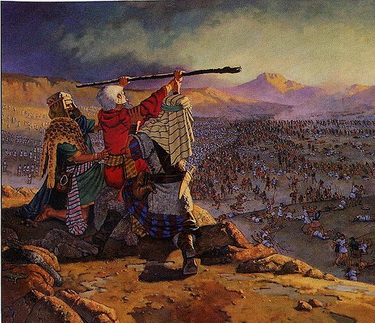
After God’s people, the descendants of Israel, crossed the Red Sea in the Exodus, an army of Amalekites came to battle them in the Sinai desert. So Moses instructed his servant Joshua: “Pick out certain men, and tomorrow go out and engage Amalek in battle. I will be standing on top of the hill with the staff of God in my hand.” The next day, while Joshua led Israel’s soldiers in fighting the foe on the battlefield, Moses stood upon an adjacent hill along with Aaron and Hur.

As long as Moses kept his hands raised up, Israel had the better of the fight, but when he let his hands rest, Amalek had the better of the fight.” Moses wielding this staff at God’s command triggered the plagues in Egypt, parted the Red Sea, and now brought Israel’s victory on the battlefield. But this raises a reasonable question: why would God condition his people’s success in combat upon an old man holding a piece of wood above his head? Moses lifting up this staff of God was a sign for God’s people which preserved them from a spiritual disaster.

God knew that if Israel had won apart from this sign they would have ascribed the victory to themselves. “We won this battle because we’re so smart, and strong, and brave! Maybe we don’t need God’s help after all.” Such pride in their success could be their downfall, in this life and the next. So instead, through the sign of an up-lifted staff, the Lord showed Israel, “I am the vine, you are the branches. Whoever remains [with] me and I [with] him will bear much fruit, because apart from me you can do nothing.”

Similarly today, our Lord desires us to pray without ceasing for the good things we want or need. Otherwise, if and when his blessings come, we shall attribute these things to mere luck, coincidence, or to our own personal abilities, with no growth in our relationship with God. He is the source from whom all good things come. By asking and then receiving, we come to see and know the Lord is near and cares for us. And in the end, that is the most valuable gift of all.

God not only wants us to know and to love him, he desires us to glorify us as well. God is all-powerful, omnipotent, he could do everything without us. But by God accomplishing his will through us, as he did with Moses, the Lord makes us more like himself and causes us to share in his glory.

Holding the staff of God in his hands throughout the day made Moses’ hands and arms grow tired. (If you cannot understand why, try holding an object above your head for just ten minutes sometime.) When Moses’ body grew tired, his friends came to his aide. “They put a rock in place for him to sit on. … Aaron and Hur supported his hands, one on one side and one on the other, [one on his right and the other on his left,] so that his hands remained steady till sunset.” With this help from his friends, Moses kept his arms raised-up and God’s people prevailed against their foe. All of this was a foreshadowing of greater things to come.

On Good Friday, when Jesus was condemned to death, he took the cross into his hands and carried it to the top of a hill. There his hands were nailed to the wood above his head. And Jesus was not there alone. All four Gospels note he was crucified between two others, “one on his right and the other on his left.”

Our Lord was mocked as he hung for hours upon the Cross: “Are you not the Messiah? … If you are the King of the Jews, save yourself!” But in the Garden of Gethsemane, Jesus had said, “Do you think that I cannot call upon my Father and he will not provide me at this moment with more than twelve legions of angels? But then how would the Scriptures be fulfilled…?” Christ had the power to come down from the Cross, but if he had done that—if Jesus had released his hands from the wood—if he had refused to die for us, how would we have been saved from our enemies, sin and death?

Love kept Jesus on his Cross: love for his friends gathered nearby. love for the criminals on his right and left, and love for you and me. Consider what a precious consolation it was for Jesus in his suffering to have his Mother Mary, John the Beloved, and Mary Magdalene there supporting him. “But,” Jesus asks, “when the Son of Man comes [again], will he find faith on earth?” Will Jesus return to a world where everyone imagines they can get along just fine without him?

Let us continue being God’s humble people, recognizing our dependence on him. Let us ask of him our wants and needs so that we can know and experience his blessings. Then we shall share his deeper friendship and share in his great works, increasing in his likeness and increasing in his glory. By relying on God and the holy friends and loved ones his providence places near to help us, we shall share in our Lord’s great victory.

Suffering & Joy — Funeral Homily for Rodger Falkenberg, 75

October 11, 2022

By Fr. Victor Feltes

Rodger has experienced years of suffering and years of joy. After being born into a large, poor family and serving in the Vietnam War, he returned home and joyfully joined a new household. Facing life’s struggles, what a man could do is be bitter and glum, but Rodger loved making people laugh; sometimes with his Donald Duck voice or an intentional stumble. Even after enduring four, painful back surgeries, he still would roll down a hill to amuse his nieces and nephews.

Rodger knew that just because something is broken doesn’t mean that it’s without value. At what he dubbed his “Polish Shopping Center” (or what others call the city dump) Rodger would take things which others had despised. He would tinker with them as necessary, restoring them and prizing them as treasures to keep for himself or to share with others.

One thing I learned about Rodger and his beloved Donna is that they share a great, personal love for ice cream. Giving up ice cream for Lent was a great personal sacrifice in their house because they could eat an entire pail of it for a meal. In recent years, with his memory declining, they would often go to a particular restaurant. When the friendly staff would ask him, “Is it your birthday?” He would sincerely reply, “I think so,” and be treated to ice cream.

September 2nd of this year marked the 50th anniversary of Rodger and Donna’s wedding day here at St. Paul’s Church, and the family celebrated this occasion simply and sweetly together. Their daughters were getting Dad and Mom an ice cream cake and the employee was making a mess of squeezing-out the inscription on top, but Kelly or Lisa said, ‘It’s fine, really, just put sprinkles on it.‘ The party was a happy, intimate family gathering at home. And despite what had seemed to go wrong the cake still tasted very delicious in the end.

In today’s psalm the psalmist speaks of his suffering, praying for deliverance: “Relieve the troubles of my heart and bring me out of my distress. Put an end to my affliction and my suffering and take away all my sins. To you, O Lord, I lift my soul.” It’s not wrong to pray for relief, like Jesus himself did in the Garden of Gethsemane, but in Christ we see that our sufferings play a role in our glory. Jesus says, “unless a grain of wheat falls to the ground and dies, it remains just a grain of wheat; but if it dies, it produces much fruit. …Whoever serves me must follow me… [to the Cross].

When Jesus suffered and died, “people saw and did not understand,” but in light of his resurrection Christians know death is not the end of the world. As St. Paul says, “We know that if our earthly dwelling, a tent, should be destroyed, we have a building from God, a dwelling not made with hands, eternal in heaven. [So] we are courageous, and we would rather leave the body and go home to the Lord. …We must all appear before the judgment seat of Christ, so that each may receive recompense, according to what he did in the body, whether good or evil.”

For the faithful and righteous the sufferings this world sees as worthless are taken up by Jesus to rework our souls. Our Lord will claim us from this junk yard, he will fully restore us and prize us as treasures for himself and to share with others. The messed-up cake of this world will be salvaged. Once God’s family is gathered together again, we will simply and sweetly agree that everything turned-out fine in the end. Can this day of Rodger’s funeral be his birthday to new life? I think so. In heaven, our Lord “will wipe every tear from their eyes,” and convert the sufferings of his people to joy. “Behold,” he says, “I make all things new.”

Our Great Prayer

October 9, 2022

28th Sunday in Ordinary Time
Deacon Dick Kostner

Want to get to heaven? Jesus says obey the Commandments, the two greatest being love God with all your heart, soul and mind and the second, love your neighbor as yourself. Before Jesus returned to the Father he gave his followers a third commandment: “Love as I have loved you!” Love requires intimacy. It requires knowing someone’s very make up and for us humans, their faults and deficiencies and yes acceptance of those deficiencies because of their God given right of free will. It is not an easy task when you realize that people we love are going down the wrong road which will lead them to problems and maybe even death. True love requires we accept their right of choice even if its wrong our only real weapon against a bad choice being made by someone we love, is “Prayer.”

Prayer allows us to be intimate with both God and intimacy with others who we are praying for. I believe it was St. Paul who said we need to be in constant prayer to God 24/7. It shows God that we are obeying His two great commandments and Jesus’ third commandment, “Love as I have loved you.” So our next challenge is to learn how to pray every awaking hour of every day to God for our challenges and for help and guidance for those we love. What are the words of prayer? In today’s Gospel Jesus gives us a supernatural and a kind of magical word of prayer. It is easy to remember and it can transform and heal. This word of Prayer will always be heard by God and responded to by God and the Body of Christ. It is simple but bares the power of God, the word is “THANKS.”

You folks may not know this but your deacon is not very mechanically gifted. When I attempt to fix something it many times is not successful and can also result in a repair job at the doctor’s office and maybe even a new tattoo not made with ink but rather stitch’s. I can remember working at one of my rentals one morning and while trying to drive a stake into the hard ground with a hammer I missed the stake I was driving and smashed the web between my thumb and finger. Blood was all over but I was lucky to be across the street from Dr. Rosenbrook’s house and I ran to him who proceeded to take me into his kitchen and clean and stitch my wound. With age comes wisdom and now before attempting to do even a simple task I pray for safety and upon completing the task always say the prayer of thanks to God for a safe completion of that task. That pretty much covers hourly prayers for my weekend “Honey-do” projects.

Our Gospel today has Jesus instructing his readers that a “thank you” is the greatest gift we can give to God for help he provides for his faith followers. Many times we get so caught up in having been answered by God with his gifts that we forget to give thanks, for his help and miracles. Its a quick prayer but a very important prayer. When we forget to give thanks during the week God gives us another chance to say “Thanks” on Sunday by celebrating the Eucharist with the Body of Christ. “Eucharist” (in Greek) means “giving thanks.” It’s a time for us to gather as the family of God and reflect upon the grace gifts we have received the previous week. The little miracles society calls coincidences. Little things that show up out of no where, and which are many times opposed to the laws of nature that make us realize the supernatural presence of God within our lives, within our very being and existence.

Let me share with you my last encounter with the power and presence of God and the supernatural. I recently did a funeral service for a gentleman who had just died who had lived his life with a mental illness and who had been dependent on his family and friends his whole life. His name is Robbie. I did not personally know Robbie and learned about his life when his Aunt said a few words before we ended the Service. She told about a man who loved his family very much as well as the people who cared for him at the facility he lived in. She talked about how one of the caretakers would take him to Mass every Sunday and how thankful he was to have so many people who cared for him. She told the story about how Robbie and his siblings had taken him to an outdoor concert one summer day and how it began to rain at its conclusion and how they held hands running and following one of his brothers who had a flashlight trying to find their car and how they all laughed and so enjoyed the event, even though they were soaking wet when they finally found their car. After her comments I told the family and friends of Robbie that I now knew who to blame for the thunderstorm we were experiencing at the time Robbie’s funeral service. They laughed and thought I was just cracking a joke but I had a feeling that I had just done another funeral service for a saint I did not even know until that day.

As Matt (the funeral director) and I drove to the cemetery in Cornell with the crowd of family and friends of Robbie following us, Matt commented how wet it was going to be to do the committal service and I made the comment, “That will be up to Robbie!” He gave me a funny look and said he had a bunch of umbrellas in his car. When we arrived at the cemetery it was still raining and Matt told me to sit in the car until the casket was placed. I wondered if I had drawn the wrong conclusion as I held my book close to me as I went to the crowd to begin the service. I opened my book to begin and three drops of rain fell on it and then the rain stopped completely. I grinned and said to myself, “thanks Rob.” After the prayers I told the crowd that I believe Robbie was telling them that he was alright and thanked them for their attendance. I don’t think they realized that they had just experienced the spiritual presence of their brother as one of God’s chosen. (And I did say “Thank you Lord” for this experience!)

Gratitude for our Healer

October 8, 2022

28th Sunday in Ordinary Time
By Fr. Chinnappan Pelavendran

My dear brothers and sisters, God is the creator of every human being. He has given life to all of us. He continually gives us sustenance, His protection and care. What is expected of us is to be grateful to Him and become more aware of how much we have been given. Gratitude is an expression of the heart, counting our blessings and acknowledging everything that we receive. Giving thanks makes people happier, it strengthens relationships, it improves health, and reduces stress. The readings of today present the theme of gratitude, showing that it should come spontaneously from the heart of every individual.

In today’s first reading, we heard the story of Naaman, the military general of the king of Aram. He was a great man in high favor with his master because, by him, the Lord had given victory to Aram. The man, though a mighty warrior, suffered from leprosy. The king sends him to the Kingdom of Israel for his healing. The king of Israel, however, misunderstands the entire motive of his coming and shows his anger. This anger is countered by the Prophet Elisha. In the name of Yahweh, Elisha sends a message to Naaman to cleanse himself in the River Jordan. Even though Naaman refuses at first, he carries out the order given by the prophet and is healed. Here we see the conversion of a pagan into believing in the true God. St. Paul, in the second reading, advises Timothy to be grateful to God even in his physical suffering and amid the dangers associated with spreading the word of God. Why? Because God will always be faithful to His people. And in today’s Gospel, we have the narrative of Jesus healing the ten lepers. The incident of the ten lepers happened when Jesus was on his way to Jerusalem, where he was to receive His cross and suffer for us.

The Gospel reminds us of the love, kindness, and mercy of Jesus to all classes of the people. Even lepers are not excluded from it. Jesus said to the lepers “go and show yourself to the priest.” While on their way they were gradually healed, one of them, the moment he realized that he was healed, knew that Jesus had healed him and returned to him before going to the priest to fulfill the obligation. He came and prostrated before Jesus, a sign of deepest respect and honor. This act of the Samaritan leper pleased Jesus but was He surprised and sad at the ingratitude of others.

The word of God today tells us that we all need to be grateful to God every day of our life for the graces and good gifts we have received in and through him. He has not only given us our life with all its joys and sorrows, but he has prepared for us a future life of joy and happiness. We often fail to acknowledge the good he has done to us. What is needed in our life is the recognition of these goods and the acknowledgment of gratitude towards God and all persons who come to us as instruments of God.

Also, let us realize the truth that we all need healing from our spiritual leprosy. Although we may not suffer from physical leprosy, the ‘spiritual leprosy’ of sin makes us unclean. Jesus is our Savior who wants to heal us from this leprosy of sin. Since Jesus is not afraid to touch our deepest impurities, let us not hide them. Just as the lepers cried out to Jesus for healing, let us also ask him to heal us from the spiritual leprosy of sins, including all kinds of impurity, injustice, and hatred.

The World’s Greatest Force

October 1, 2022

27th Sunday in Ordinary Time
By Fr. Chinnappan Pelavendran

On this Twenty-Seventh Sunday in Ordinary Time, we gather around God’s presence, praying for him to accept our thanksgiving, pardon our lack of faith, and increase our faith so that we may stand firm even when destruction and violence surrounds us. In the Garden of Gethsemane, Jesus our Lord prayed to the Father that, if it be possible, the chalice or cup of suffering be taken away from Him. What did the Father say? In the first reading from the Prophet Habakkuk, the lamentations seem to suggest the God who does not listen nor care about the cry of the poor person who calls upon Him. When God is silent, what could it mean? The silence of God is often the silence unto our own good the silence of God is a call to deep faith. The Gospel reading calls us to an authentic faith in God. We need the faith as little as a mustard seed to keep our heads high. The second reading encourages us to be courageous in our faith journey.

In the Bible, Abraham is mentioned several times for some of the great things he accomplished, God gave Abraham the promise that the Redeemer would come through his family. Abraham and wife Sarah were past child–bearing age when God gave them a child named Isaac. Even though God had promised that Abraham’s descendants would one day be a great nation, He asked Abraham to sacrifice his only son, Isaac (in Genesis 22). God told Abraham to take Isaac to a mountain to sacrifice him to the Lord. God never intended for Abraham to kill Isaac. This was merely a test to show to us the type of faith Abraham had. As we read the story of Abraham and Isaac we are reminded that God is faithful and that we can place our trust in Him

Again we have the wonderful example of David. We learn about a forty-day war between the Israelites and the Philistines, who were led by the giant Goliath. One day, Goliath challenged them to bring forth a soldier who could come up against him, but no one in the Israelite army was brave enough to challenge him. Hearing all Goliath’s bosting, hear came a little Shepherd boy David who told kind Saul that God had given him victory over all the animals who had threatened his sheep and he had faith in God that he would help him defeat this giant too. So going out to face the Philistines, Goliath saw this boy David who had nothing but a slingshot, and he laughed and mocked him. Then David replied to him saying, “Well, you come with your sword, spear, and all your armor but I come against you in the name of the Lord, God Almighty.” And with great strength, David drew his sling and sent it flying straight towards this giant’s forehead Goliath was defeated. David’s faith in God proved to be bigger than any giant.

According to William Barclay, “Faith is the greatest force in the world,” it moves us towards directions completely unknown and guides us towards belief in one God. Today’s Gospel tell us that all the followers of Jesus must have faith in Him, and we are to pray Christ to increase our faith. Faith is not for the good times only. Faith is that which sustains us in bad times. According to St. Augustine, “Faith is to believe what you do not see, the reward of this faith is to see what you believe.” It is not easy to live a righteous life when things are not going smoothly in your life, but do not forget that faith is patience. Trust that God will never leave you forsaken. Never give up on God.

Plant Using Your Tiny Seed of Faith

October 1, 2022

27th Sunday in Ordinary Time
By Fr. Victor Feltes

Today the apostles beg our Lord, “Increase our faith.” They feel apprehension at Jesus’ teachings. Christ asks extraordinary things of his disciples, and they fear their faith is insufficient. The Lord replies, “If you have faith the size of a mustard seed, you would say to this mulberry tree, ‘Be uprooted and planted in the sea,’ and it would obey you.” Realize that faith (like courage or love) is not necessarily a feeling. You can be courageous, even while feeling fear, by doing the right thing anyway. You can be loving, even while feeling strong dislike for your enemies, by willing their good anyway. And you can be faithful, even when you feel apprehensive like the apostles, by acting on your trust in God anyway.

Perhaps you feel nervous when you fly on an airplane, yet you buy your ticket and board the flight because you believe commercial jet is a very safe way to travel—and it is. If you were a business traveler, taking dozens of flights each year, your anxious feelings would calm and come to better resemble your sincere conviction about the safety of flying. Faith is like this, too. You may or may not have feelings of great faith, but when you choose to trust God and do the faithful thing you are acting in faith. Exercise your faith and your faith will strengthen, because you will see that God is faithful, and then your emotions touching on faith will naturally follow.

Jesus says, “If you have faith the size of a mustard seed,” you could miraculously transplant a tree with your command. When I was younger, the first time I read Jesus’ answer, I was discouraged by it—“I’ve never performed a miracle like that. How microscopic must my faith be!” But I had misunderstood him. Jesus’ reply is meant as an encouragement. Our Lord is saying, “Even if your faith is tiny, it is more than enough for you to fulfill my will.” What is God’s will for you? What does he want you to do? If you do not know this already ask him to reveal it to you. And “if today you hear his voice, harden not your hearts.”

On another occasion, Jesus said “the Kingdom of Heaven is like a mustard seed that a person took and sowed in a field. It is the smallest of all the seeds, yet when full-grown it is the largest of plants. It becomes a large bush, and the ‘birds of the sky come and dwell in its branches.’” So using your tiny seed of faith, plant in the field of your life as the Lord commands you. It may take awhile for the results to sprout but be patient. As the Lord said to Habakkuk, “The vision still has its time, presses on to fulfillment, and will not disappoint; if it delays, wait for it, it will surely come, it will not be late. The rash one has no integrity; but the just one, because of his faith, shall live.

Mustard bushes grow very large and the mustard it produces has a very potent taste. Given time, what you plant in faith will change the landscape and the flavor of our world. When you go on to see the incredible transforming results which faith allows you may become inflated and vulnerable to pride. People through whom God has accomplished great things may be tempted to think their serious sins are therefore no big deal, or may abandon serving the Lord before their days on earth are done. For this reason, Jesus follows his parable about faith and the mustard bush with another parable about a servant and his master.

Jesus asked his apostles, “Who among you would say to your servant who has just come in from plowing or tending sheep in the field, ‘Come here immediately and take your place at table’? Would he not rather say to him, ‘Prepare something for me to eat. Put on your apron and wait on me while I eat and drink. You may eat and drink when I am finished’? Is he grateful to that servant because he did what was commanded?” Jesus here is not describing how the world ought to be, but describing how their familiar, ancient world actually operated; where the stronger dominated the weaker. It is like when Jesus told them, “You know that the rulers of the Gentiles lord it over them, and their great ones make their authority over them felt. But it shall not be so among you. Rather, whoever wishes to be great among you shall be your servant.”

The apostles would not expect a slave’s master to be much grateful to his slave, and they would judge a slave to be most prudent in his position to remain humble and obey his master. “So should it be with you,” Jesus says, “When you have done all you have been commanded, say, ‘We are unprofitable servants; we have done what we were obliged to do.’” Indeed, apart from God we can do nothing, and keeping a humble servant’s attitude protects us from dangerous pride and presumption and helps us to fulfill what Christ commands. But the Master who is our Lord differs from other masters of the earth.

At the Last Supper, after he had washed his apostles’ feet, Jesus asked them, “Do you realize what I have done for you? You call me ‘teacher’ and ‘master,’ and rightly so, for indeed I am. If I, therefore, the master and teacher, have washed your feet, you ought to wash one another’s feet. I have given you a model to follow, so that as I have done for you, you should also do.” Although our Lord, being God, is rightfully entitled to all we have and are, he is grateful for our labors. If we do not let up our efforts, when our hard days on this earth are complete we can look forward to hearing him say: “Well done, my good and faithful servant… Come, share your master’s joy!

So while your faith may feel small, it is more than enough to do Christ’s will. If you do not know God’s will already, seek and ask to know it. Then plant your seed of faith in action and patiently watch it grow. And when you see the great things our Lord achieves through you do not let up your efforts slip, knowing that his reward for you is eternal joy in Heaven.

A New, Joyful Day — Funeral Homily for Robert “Bob” Sobotta, 77

September 26, 2022

By Fr. Victor Feltes

It was the day after Bob’s nineteenth birthday and the day before he would marry Joann. Bob and Joann had met at a Pines Ballroom dance and now they were at The Pines Ballroom again, together with family preparing food for the next day’s festivities. They listened to the radio as they labored, and that’s how they learned what had happened at 12:30 PM that day in Texas. A short time later that same afternoon, the first report of grim news was followed by another: President John F. Kennedy was dead. It was Friday, November 22nd, 1963.

Presidential assassinations had happened before, first and most famously with President Lincoln. But it had been sixty-two years since the last murder of a president, when President McKinley was shot and died in Buffalo, NY in 1901, and few were still alive who remembered living through it. So Joann recalls how shocked everyone was that a president, America’s first Catholic president, was killed. They were all discussing it, stunned. They just couldn’t believe it, it seemed so unbelievable — and yet it was real, as real as death.

I asked Joann whether that mournful news, whether this national tragedy, soured their “Big Day”? No, she said, it was “just as joyful.” Bob and Joann awoke the next day and were married in the morning (as was the custom then) in a 9:30 AM Saturday wedding Mass at St. Peter’s in Tilden in the company of many loved ones, their family and friends. This was followed by a dinner at the Sundial Club and then a reception back at The Pines, a feast and a dance for them all. Bob loved to dance, polkas and waltzes in particular, and he enjoyed dancing with his new bride. Bob and Joann would happily share their next fifty-eight years together loving God, each other, and their family, friends, and neighbors, until Bob’s recent passing.

Death is sad and unsettling. Though common to history, it still remains shocking for us. But suffering and death are not the end of our stories. Though we mourn now, we will be comforted. We expect a new dawn, a new day, when the blessed friends of Christ – our King who dies no more – will awaken to celebrate his wedding feast with him. Jesus our Good Shepherd will spread the table before us, and the just shall dance with delight, and every tongue shall give praise to God. Though today we walk in the dark valley, the day we prepare for, the day we look forward to, the day that awaits us, will be full of joy.

Caring For Our Neighbor

September 25, 2022

26th Sunday of Ordinary Time
By Fr. Chinnappan Pelavendran

The story is told of a Franciscan monk in Australia, who was assigned to be the guide to St. Mother Teresa when she visited New South Wales. The monk was thrilled and excited at being so close to this great woman. He dreamed of how much he would learn from her. But, during her visit, he became frustrated. There were always other people for her to meet. Finally, her tour was over and she was about to fly to her next destination. The Franciscan friar spoke to Mother Teresa: “If I pay my own fare to New Guinea, can I sit next to you on the plane so I can talk to you and learn from you?” Mother Teresa looked at him and said: “Do you have enough money to pay airfare to New Guinea?” He replied eagerly, “Yes!” Mother said, “Give that money to the poor. You will learn more from that than anything I can tell you.

God speaks to us in many ways and touches our lives but we often fail to listen to him. He speaks to us in gentle ways and guides us in our weaknesses. The readings of today give us the values of the kingdom of God, which is different from all worldly values. It tells us that we, as the children of God, have the obligation and duty to look after our brothers and sisters and care for them. We all belong to the one family of God.

The prophet Amos, in the first reading, gives a powerful warning to those who seek wealth at the expense of the poor: people who spend their time and their money on themselves alone. He prophesies that those rich and self-indulgent people will be punished by God because they don’t care for their poor, suffering brothers and sisters.

In today’s second reading, St. Paul reminds Timothy, who was an ordained priest and consecrated Bishop, of the Faith he had confessed at his Baptism, He reminded him of his obligation to pursue righteousness, devotion, faith, love, patience, and gentleness. He reminded him of his ongoing call to bear witness to Christ as a loyal teacher and example of that faith. The message for us is that the generous sharing of our talents and resources is the necessary response to our Christian commitment.

All the parables of our Lord are based on everyday happenings. In today’s gospel, we are tempted to ask the question, “Why was the rich man punished?” He did not kick Lazarus, he was not cruel to him. He was punished because he continued to commit a sin of omission. He never noticed Lazarus as a human being and a brother. He did no wrong, but he did nothing good, either. He neglected the poor beggar at his door by not helping him to treat his illness nor giving him a small house to live in. He totally ignored the poor people around him, which was Cain’s attitude: “Am I the guardian of my brother?” It is not wrong to be rich, but it is wrong not to share our blessings with our brothers and sisters.

Today’s readings teach us an important lesson: it reminds us that all of us will experience God’s justice after our death. We are all rich enough to share our blessings with others. God has blessed each one of us with wealth, health, special talents, social power, political influence, or many other blessings. The parable invites us to share, in various ways, what we have been given, not use everything for selfish gains.

In today’s world, who are the poor we must not neglect? The unborn. We need to treat the unborn as our brother or sister Lazarus of this century. The rich man was condemned for not treating Lazarus as his brother. We also will be condemned for our selfishness if we do not treat the preborn as our brother and sister. We might think: “Who am I to interfere with a woman’s choice to abort?” I am a brother, a sister of that child in the womb. Finally, I am a follower of the One who said, “Whatsoever you do to the least of my brothers and sisters, you do to me.